US8993464B2 - High performance glass ceramics and method for producing high-performance glass ceramics - Google Patents
High performance glass ceramics and method for producing high-performance glass ceramics Download PDFInfo
- Publication number
- US8993464B2 US8993464B2 US13/384,875 US201013384875A US8993464B2 US 8993464 B2 US8993464 B2 US 8993464B2 US 201013384875 A US201013384875 A US 201013384875A US 8993464 B2 US8993464 B2 US 8993464B2
- Authority
- US
- United States
- Prior art keywords
- article
- glass ceramic
- microstructure
- microstructures
- glass
- Prior art date
- Legal status (The legal status is an assumption and is not a legal conclusion. Google has not performed a legal analysis and makes no representation as to the accuracy of the status listed.)
- Active, expires
Links
- 239000002241 glass-ceramic Substances 0.000 title claims abstract description 163
- 238000004519 manufacturing process Methods 0.000 title claims description 23
- 239000013078 crystal Substances 0.000 claims abstract description 89
- 150000002500 ions Chemical class 0.000 claims abstract description 56
- 230000007704 transition Effects 0.000 claims abstract description 37
- 239000000203 mixture Substances 0.000 claims abstract description 23
- 239000011521 glass Substances 0.000 claims abstract description 17
- 238000001004 secondary ion mass spectrometry Methods 0.000 claims abstract description 4
- VYPSYNLAJGMNEJ-UHFFFAOYSA-N silicon dioxide Inorganic materials O=[Si]=O VYPSYNLAJGMNEJ-UHFFFAOYSA-N 0.000 claims description 60
- 239000002243 precursor Substances 0.000 claims description 52
- 239000010453 quartz Substances 0.000 claims description 50
- 238000000034 method Methods 0.000 claims description 46
- 229910021495 keatite Inorganic materials 0.000 claims description 29
- 229910001676 gahnite Inorganic materials 0.000 claims description 14
- 238000010438 heat treatment Methods 0.000 claims description 13
- 239000002253 acid Substances 0.000 claims description 11
- 230000002093 peripheral effect Effects 0.000 claims description 11
- 238000002468 ceramisation Methods 0.000 claims description 9
- 229910052700 potassium Inorganic materials 0.000 claims description 8
- 229910052708 sodium Inorganic materials 0.000 claims description 8
- 238000012360 testing method Methods 0.000 claims description 8
- 150000007513 acids Chemical class 0.000 claims description 7
- 229910001416 lithium ion Inorganic materials 0.000 claims description 7
- GOLCXWYRSKYTSP-UHFFFAOYSA-N Arsenious Acid Chemical compound O1[As]2O[As]1O2 GOLCXWYRSKYTSP-UHFFFAOYSA-N 0.000 claims description 6
- KKCBUQHMOMHUOY-UHFFFAOYSA-N Na2O Inorganic materials [O-2].[Na+].[Na+] KKCBUQHMOMHUOY-UHFFFAOYSA-N 0.000 claims description 6
- 230000008859 change Effects 0.000 claims description 6
- 238000009826 distribution Methods 0.000 claims description 6
- 229910001425 magnesium ion Inorganic materials 0.000 claims description 6
- XOLBLPGZBRYERU-UHFFFAOYSA-N tin dioxide Chemical compound O=[Sn]=O XOLBLPGZBRYERU-UHFFFAOYSA-N 0.000 claims description 6
- 238000004040 coloring Methods 0.000 claims description 5
- 238000010411 cooking Methods 0.000 claims description 5
- 230000001131 transforming effect Effects 0.000 claims description 5
- FUJCRWPEOMXPAD-UHFFFAOYSA-N Li2O Inorganic materials [Li+].[Li+].[O-2] FUJCRWPEOMXPAD-UHFFFAOYSA-N 0.000 claims description 3
- PNEYBMLMFCGWSK-UHFFFAOYSA-N aluminium oxide Inorganic materials [O-2].[O-2].[O-2].[Al+3].[Al+3] PNEYBMLMFCGWSK-UHFFFAOYSA-N 0.000 claims description 3
- GHPGOEFPKIHBNM-UHFFFAOYSA-N antimony(3+);oxygen(2-) Chemical compound [O-2].[O-2].[O-2].[Sb+3].[Sb+3] GHPGOEFPKIHBNM-UHFFFAOYSA-N 0.000 claims description 3
- 229910052593 corundum Inorganic materials 0.000 claims description 3
- XUCJHNOBJLKZNU-UHFFFAOYSA-M dilithium;hydroxide Chemical compound [Li+].[Li+].[OH-] XUCJHNOBJLKZNU-UHFFFAOYSA-M 0.000 claims description 3
- 239000000758 substrate Substances 0.000 claims description 3
- 229910001845 yogo sapphire Inorganic materials 0.000 claims description 3
- 229910000831 Steel Inorganic materials 0.000 claims description 2
- 230000006750 UV protection Effects 0.000 claims description 2
- 230000004297 night vision Effects 0.000 claims description 2
- 239000010959 steel Substances 0.000 claims description 2
- QAOWNCQODCNURD-UHFFFAOYSA-N sulfuric acid Substances OS(O)(=O)=O QAOWNCQODCNURD-UHFFFAOYSA-N 0.000 claims description 2
- 230000009466 transformation Effects 0.000 description 25
- 230000008569 process Effects 0.000 description 17
- 239000000126 substance Substances 0.000 description 17
- 230000004075 alteration Effects 0.000 description 10
- 238000002425 crystallisation Methods 0.000 description 9
- 230000008025 crystallization Effects 0.000 description 9
- 238000001816 cooling Methods 0.000 description 8
- 239000000463 material Substances 0.000 description 7
- 230000008901 benefit Effects 0.000 description 6
- GWEVSGVZZGPLCZ-UHFFFAOYSA-N Titan oxide Chemical compound O=[Ti]=O GWEVSGVZZGPLCZ-UHFFFAOYSA-N 0.000 description 5
- 239000000919 ceramic Substances 0.000 description 5
- 229910052681 coesite Inorganic materials 0.000 description 5
- 229910052906 cristobalite Inorganic materials 0.000 description 5
- 238000005259 measurement Methods 0.000 description 5
- 239000000377 silicon dioxide Substances 0.000 description 5
- 229910052682 stishovite Inorganic materials 0.000 description 5
- 229910052905 tridymite Inorganic materials 0.000 description 5
- MCMNRKCIXSYSNV-UHFFFAOYSA-N Zirconium dioxide Chemical compound O=[Zr]=O MCMNRKCIXSYSNV-UHFFFAOYSA-N 0.000 description 4
- 239000010410 layer Substances 0.000 description 4
- 238000012545 processing Methods 0.000 description 4
- 238000002834 transmittance Methods 0.000 description 4
- RTAQQCXQSZGOHL-UHFFFAOYSA-N Titanium Chemical compound [Ti] RTAQQCXQSZGOHL-UHFFFAOYSA-N 0.000 description 3
- QCWXUUIWCKQGHC-UHFFFAOYSA-N Zirconium Chemical compound [Zr] QCWXUUIWCKQGHC-UHFFFAOYSA-N 0.000 description 3
- 238000005452 bending Methods 0.000 description 3
- 150000001768 cations Chemical class 0.000 description 3
- 239000011248 coating agent Substances 0.000 description 3
- 238000000576 coating method Methods 0.000 description 3
- 238000005520 cutting process Methods 0.000 description 3
- 230000007423 decrease Effects 0.000 description 3
- 230000000694 effects Effects 0.000 description 3
- 230000007246 mechanism Effects 0.000 description 3
- 230000004048 modification Effects 0.000 description 3
- 238000012986 modification Methods 0.000 description 3
- MWUXSHHQAYIFBG-UHFFFAOYSA-N nitrogen oxide Inorganic materials O=[N] MWUXSHHQAYIFBG-UHFFFAOYSA-N 0.000 description 3
- 239000002245 particle Substances 0.000 description 3
- 230000004044 response Effects 0.000 description 3
- 229910052726 zirconium Inorganic materials 0.000 description 3
- 230000033228 biological regulation Effects 0.000 description 2
- 230000005540 biological transmission Effects 0.000 description 2
- 230000015572 biosynthetic process Effects 0.000 description 2
- 230000003247 decreasing effect Effects 0.000 description 2
- 238000010586 diagram Methods 0.000 description 2
- 238000000227 grinding Methods 0.000 description 2
- 238000000265 homogenisation Methods 0.000 description 2
- 238000010899 nucleation Methods 0.000 description 2
- 230000006911 nucleation Effects 0.000 description 2
- 238000005457 optimization Methods 0.000 description 2
- 239000011148 porous material Substances 0.000 description 2
- 230000009467 reduction Effects 0.000 description 2
- 230000035939 shock Effects 0.000 description 2
- 238000000844 transformation Methods 0.000 description 2
- 238000012369 In process control Methods 0.000 description 1
- JFBZPFYRPYOZCQ-UHFFFAOYSA-N [Li].[Al] Chemical compound [Li].[Al] JFBZPFYRPYOZCQ-UHFFFAOYSA-N 0.000 description 1
- 230000002411 adverse Effects 0.000 description 1
- 239000003513 alkali Substances 0.000 description 1
- 238000013459 approach Methods 0.000 description 1
- 239000002585 base Substances 0.000 description 1
- 229910010293 ceramic material Inorganic materials 0.000 description 1
- 238000012512 characterization method Methods 0.000 description 1
- 238000010924 continuous production Methods 0.000 description 1
- 230000008602 contraction Effects 0.000 description 1
- 238000005336 cracking Methods 0.000 description 1
- 230000006378 damage Effects 0.000 description 1
- 230000007547 defect Effects 0.000 description 1
- 230000001419 dependent effect Effects 0.000 description 1
- 238000009792 diffusion process Methods 0.000 description 1
- 239000002019 doping agent Substances 0.000 description 1
- 230000009977 dual effect Effects 0.000 description 1
- 239000000428 dust Substances 0.000 description 1
- 238000005516 engineering process Methods 0.000 description 1
- 230000001747 exhibiting effect Effects 0.000 description 1
- 238000002474 experimental method Methods 0.000 description 1
- 238000010965 in-process control Methods 0.000 description 1
- 239000005355 lead glass Substances 0.000 description 1
- 229910052744 lithium Inorganic materials 0.000 description 1
- 230000014759 maintenance of location Effects 0.000 description 1
- 239000011159 matrix material Substances 0.000 description 1
- 238000010002 mechanical finishing Methods 0.000 description 1
- 229910044991 metal oxide Inorganic materials 0.000 description 1
- 150000004706 metal oxides Chemical class 0.000 description 1
- 238000004886 process control Methods 0.000 description 1
- 230000000750 progressive effect Effects 0.000 description 1
- 230000002035 prolonged effect Effects 0.000 description 1
- 230000001105 regulatory effect Effects 0.000 description 1
- 230000000630 rising effect Effects 0.000 description 1
- 238000007665 sagging Methods 0.000 description 1
- 238000001878 scanning electron micrograph Methods 0.000 description 1
- 238000007789 sealing Methods 0.000 description 1
- 238000004904 shortening Methods 0.000 description 1
- 229910052710 silicon Inorganic materials 0.000 description 1
- 239000010703 silicon Substances 0.000 description 1
- 239000002344 surface layer Substances 0.000 description 1
- 230000008685 targeting Effects 0.000 description 1
- 230000000930 thermomechanical effect Effects 0.000 description 1
- 238000002233 thin-film X-ray diffraction Methods 0.000 description 1
- 238000012546 transfer Methods 0.000 description 1
- 230000000007 visual effect Effects 0.000 description 1
- XLYOFNOQVPJJNP-UHFFFAOYSA-N water Substances O XLYOFNOQVPJJNP-UHFFFAOYSA-N 0.000 description 1
- 229910052725 zinc Inorganic materials 0.000 description 1
Images


Classifications
-
- C—CHEMISTRY; METALLURGY
- C03—GLASS; MINERAL OR SLAG WOOL
- C03C—CHEMICAL COMPOSITION OF GLASSES, GLAZES OR VITREOUS ENAMELS; SURFACE TREATMENT OF GLASS; SURFACE TREATMENT OF FIBRES OR FILAMENTS MADE FROM GLASS, MINERALS OR SLAGS; JOINING GLASS TO GLASS OR OTHER MATERIALS
- C03C10/00—Devitrified glass ceramics, i.e. glass ceramics having a crystalline phase dispersed in a glassy phase and constituting at least 50% by weight of the total composition
- C03C10/0018—Devitrified glass ceramics, i.e. glass ceramics having a crystalline phase dispersed in a glassy phase and constituting at least 50% by weight of the total composition containing SiO2, Al2O3 and monovalent metal oxide as main constituents
- C03C10/0027—Devitrified glass ceramics, i.e. glass ceramics having a crystalline phase dispersed in a glassy phase and constituting at least 50% by weight of the total composition containing SiO2, Al2O3 and monovalent metal oxide as main constituents containing SiO2, Al2O3, Li2O as main constituents
-
- C—CHEMISTRY; METALLURGY
- C03—GLASS; MINERAL OR SLAG WOOL
- C03C—CHEMICAL COMPOSITION OF GLASSES, GLAZES OR VITREOUS ENAMELS; SURFACE TREATMENT OF GLASS; SURFACE TREATMENT OF FIBRES OR FILAMENTS MADE FROM GLASS, MINERALS OR SLAGS; JOINING GLASS TO GLASS OR OTHER MATERIALS
- C03C10/00—Devitrified glass ceramics, i.e. glass ceramics having a crystalline phase dispersed in a glassy phase and constituting at least 50% by weight of the total composition
- C03C10/0036—Devitrified glass ceramics, i.e. glass ceramics having a crystalline phase dispersed in a glassy phase and constituting at least 50% by weight of the total composition containing SiO2, Al2O3 and a divalent metal oxide as main constituents
-
- C—CHEMISTRY; METALLURGY
- C03—GLASS; MINERAL OR SLAG WOOL
- C03C—CHEMICAL COMPOSITION OF GLASSES, GLAZES OR VITREOUS ENAMELS; SURFACE TREATMENT OF GLASS; SURFACE TREATMENT OF FIBRES OR FILAMENTS MADE FROM GLASS, MINERALS OR SLAGS; JOINING GLASS TO GLASS OR OTHER MATERIALS
- C03C10/00—Devitrified glass ceramics, i.e. glass ceramics having a crystalline phase dispersed in a glassy phase and constituting at least 50% by weight of the total composition
- C03C10/0009—Devitrified glass ceramics, i.e. glass ceramics having a crystalline phase dispersed in a glassy phase and constituting at least 50% by weight of the total composition containing silica as main constituent
-
- C—CHEMISTRY; METALLURGY
- C03—GLASS; MINERAL OR SLAG WOOL
- C03C—CHEMICAL COMPOSITION OF GLASSES, GLAZES OR VITREOUS ENAMELS; SURFACE TREATMENT OF GLASS; SURFACE TREATMENT OF FIBRES OR FILAMENTS MADE FROM GLASS, MINERALS OR SLAGS; JOINING GLASS TO GLASS OR OTHER MATERIALS
- C03C3/00—Glass compositions
- C03C3/04—Glass compositions containing silica
- C03C3/076—Glass compositions containing silica with 40% to 90% silica, by weight
- C03C3/097—Glass compositions containing silica with 40% to 90% silica, by weight containing phosphorus, niobium or tantalum
-
- Y—GENERAL TAGGING OF NEW TECHNOLOGICAL DEVELOPMENTS; GENERAL TAGGING OF CROSS-SECTIONAL TECHNOLOGIES SPANNING OVER SEVERAL SECTIONS OF THE IPC; TECHNICAL SUBJECTS COVERED BY FORMER USPC CROSS-REFERENCE ART COLLECTIONS [XRACs] AND DIGESTS
- Y10—TECHNICAL SUBJECTS COVERED BY FORMER USPC
- Y10T—TECHNICAL SUBJECTS COVERED BY FORMER US CLASSIFICATION
- Y10T428/00—Stock material or miscellaneous articles
- Y10T428/24—Structurally defined web or sheet [e.g., overall dimension, etc.]
Definitions
- the invention relates to glass ceramics, the production and use thereof, and particularly relates to high-performance glass ceramics with significantly improved physical and chemical properties.
- the composition of the green glasses is altered, the focus of optimization is often on the workability of the glass ceramics, for example targeting at lower processing temperatures. Moreover, the composition influences the properties of glass ceramics since it influences transition enthalpy and hence the transition rate of the system.
- a challenge in the production of glass ceramics is the production of large or very thin-walled glass ceramic articles.
- Upon transition to a glass ceramic a new crystalline phase is formed.
- This transformation is always associated with a change in volume of the ceramizing article. Since, in different areas of the article, the transition and thus the volume change happens at different times and with different speeds, stresses are induced between different areas of the article. These stresses may become substantial to an extent which are hardly controllable, in particular for large-sized articles, where a large volume of glass has to be transformed, or for very thin articles whose mechanical stability is precarious, alone due to the very thin walls. Therefore, production thereof is very difficult and usually uneconomic.
- EP 1170264 B1 teaches the production of translucent glass ceramics exhibiting a relatively high impact strength which is attributed to a compressive stress generated at the surface. This compressive stress is caused by a high quartz mixed crystal phase at the surface and a keatite mixed crystal phase inside the glass ceramic. Since the high quartz mixed crystal phase exhibits lower thermal expansion than the keatite mixed crystal phase, a compressive stress is induced in the surface zones during cooling subsequently to the phase transition.
- the high quartz mixed crystal phase may, on the one hand be problematic in terms of its acid resistance, and on the other hand it is only produced through a very precise process control. For example, it has to be ensured that, during cooling, the high quartz included does not rearrange into a low quartz structure near the surface. Also, if the SiO 2 content is too high, this may result in a transformation to the low quartz structure.
- Cutting out flat portions from a larger plate is disadvantageous, not only in terms of costs.
- a specific sequence of microstructures is formed that contributes to the good mechanical properties of the glass ceramic. If this sequence is interrupted or altered by finishing operations such as by cutting or grinding, defects may arise in these areas.
- the mechanical and chemical resistance of machined glass ceramics tends to be significantly worse than that of non-reworked glass ceramics.
- the inner glass ceramic microstructure is exposed at the surface and has micro-cracks in parts thereof, and is no longer protected against a growth of cracks or against an attack of aggressive chemicals by the more resistant superficial microstructure.
- the object of the invention is to provide a glass ceramic that exhibits improved mechanical and chemical properties, especially a better impact resistance and improved resistance to acids.
- a method is to be developed by which the article according the invention can be produced.
- a glass ceramic comprising article according to the invention which is integral and had not been post-processed nor reworked can be produced by a method in which at least one precursor article is transformed, at least partially, to a glass ceramic comprising article.
- the glass ceramic comprising article can be translucent, and can preferably be opaque.
- the characterization of the glass ceramic comprising article to be integral and non-post-processed and non-reworked is primarily intended to define the properties of a glass ceramic comprising article according to the invention relative to prior art.
- the properties as described are not produced by any subsequent processing steps such as grinding or an application of a coating or the like, but are immanent to the article in its as-ceramized form.
- a precursor article of glass is transformed or ceramized to the glass ceramic comprising article which includes at least one first crystalline phase.
- a first crystalline phase of a precursor article which comprises at least this first crystalline phase is transformed to a second crystalline phase of the glass ceramic comprising article.
- a precursor article in the context of the present invention refers to a green glass with a crystalline phase content below 10 vol. %, or to a glass ceramic article which is transformed or further ceramized to an article with a (different type of) glass ceramic microstructure using the method according to the invention, wherein at least one phase transition occurs.
- This phase transition may comprise nucleation in a green glass and subsequent crystallization and growth of crystallites. Alternatively, it may involve transformation of an already existing first crystalline phase in a pre-ceramized precursor article to a different type of crystalline phase, or second crystalline phase.
- a transformation to a different type of, or second, crystalline phase in this context is understood as an alteration of the structure and composition which occurs for example upon transition from a high quartz mixed crystal phase to a keatite mixed crystal phase.
- the glass ceramic comprising article is made from an already ceramized precursor article, this does not preclude that the inventive process was also used for the production of the precursor article. That means, both the precursor article and the glass ceramic comprising article can be produced using the method according to the invention.
- a glass ceramic precursor article used it may have been ceramized independently from the inventive transformation, in particular independently in terms of time. Thus, the precursor article may temporarily have been cooled to room temperature.
- the invention also covers the case in which a glass ceramic precursor article is produced immediately before the inventive transformation and is not cooled to room temperature in the meantime. It is also possible for the precursor article and the glass ceramic comprising article to be produced in a continuous process.
- a precursor article may contain coloring metal oxides, so that the glass ceramic comprising article which is produced from this precursor article is colored across its volume.
- any coloring oxides or dopants for glass ceramics known from prior art might be added.
- a “translucent” glass ceramic comprising article is understood as an article with a transmittance from 0.10 to 0.95, in a range between 400 nm and 1600 nm.
- an “opaque” glass ceramic comprising article exhibits virtually no transmission; it has a transmittance from 0 to 0.10. Since a glass ceramic article which was produced in the same way, i.e. using the same process parameters, but with different wall thicknesses, can be translucent in case of a small thickness and can appear opaque in case of a larger thickness, the transmittance and thus the terms “translucent” and “opaque” are to be understood relative to a wall thickness of 4 mm.
- the precursor article is heated to a maximum temperature.
- the heat-up rate for reaching the maximum temperature is preferably more than 10 K/min, and more preferably between 14 and 36 K/min.
- there is no process-related upper limit for the heat-up rate rather it depends on the technological feasibility, e.g. the performance of the employed furnace.
- the maximum temperature When the maximum temperature is reached, it is maintained for a very short holding time, as compared to prior art, of not more than two minutes. Preferably, no holding time is observed at all, or, in other words, a holding time is substantially or completely dispensed with. This is advantageous because it saves process time. However, holding times during nucleation are possible without departing from the scope of the invention.
- the method according to the invention can generally be applied for glass ceramics of any compositions, since it relates to general issues of glass ceramic manufacturing which will be described in more detail below.
- the first mechanism implies that the phase transformation starts at different times in different areas of the precursor article and proceeds at different speeds.
- the phase transition produces crystallization heat. If this heat cannot be dissipated quickly enough, resulting overheat locally increases the ceramization rate. Since the progressive transformation additionally leads to a drastic increase in viscosity, the already transformed or crystallized areas are much less able to compensate for occurring stresses than the areas not yet transformed. Especially stresses that occur towards the end of the exothermic transformation period when viscosity is already significantly increased due to the well-advanced transformation cannot be relaxed sufficiently anymore.
- the so produced glass ceramic article has only a low strength, in particular low impact resistance.
- the second way or the second mechanism that may produce stresses in a glass ceramic microstructure which are critical in terms of strength, is due to a gradient of thermal expansion coefficients of different crystalline phases in a glass ceramic microstructure. It is known that, with a moderate rate of transformation, transfer of material may occur between the individual phases in the microstructure. As a result, individual phases may become enriched in specific components and may alter its type of microstructure in this way. This alteration in microstructure type is associated with a modification of the specific thermal expansion coefficient.
- the mixed crystal of the high quartz type microstructure may transform to the low quartz type microstructure due to an enrichment in silicon. This results in a significant alteration in the average thermal expansion coefficient from about 0.1 ⁇ 10 ⁇ 6 K ⁇ 1 of the high quartz type microstructure to more than 5.0 ⁇ 10 ⁇ 6 K ⁇ 1 of the low quartz type microstructure. In this way, critical tensile stresses arise inside the glass ceramic which may cause cracking but in any case result in reduced strength.
- this processing step of shortening or omitting the holding time at about maximum temperature is highly problematic with regard to a compensability of warpage which occurs during phase transformation.
- the transformation of a high quartz mixed crystal phase to a keatite mixed crystal phase is associated with a significant increase in volume by 0.1 to 2.0%.
- the homogeneity of crystallization not only depends on the size and wall thickness of the article to be ceramized, but in particular on the homogeneity of heat input to the article. Therefore, it is desirable for the ceramizing precursor article to be heated as evenly as possible to ensure ceramization to occur as uniformly as possible in horizontal and preferably also in lateral direction. In contrast, with uneven heating there is a risk of deformation or warpage of the glass ceramic comprising article.
- One way to avoid such bending or warpage is to observe holding times at a maximum temperature.
- the holding time at maximum temperature at least a slight reduction in viscosity occurs in the ceramizing material, as well as an increase in a respective concentration of a phase of the existing phases, and a reduction of tensions.
- Warpings are at least partially re-leveled.
- the ceramizing article matures, existing gradients are reduced, and due to the increase in phase concentrations, structural transformations and/or structural alterations are promoted. Therefore, this approach is not suitable for producing glass ceramic articles with the features according to the invention.
- the glass ceramic comprising articles can be manufactured individually in batch furnaces which have only a small furnace volume.
- rapid temperature control is possible.
- production in a roller kiln is disadvantageous.
- a useful measure in this regard is, for example, to heat the ceramizing article from different directions to allow for better compensation of temperature differences that may occur for example due to the geometry of the furnace.
- heating may be performed, for example, from the top and bottom of the ceramizing precursor article.
- the temperature gradient between top and bottom of the precursor article is kept as low as possible.
- the temperature differences between top and bottom should preferably not deviate by more than +/ ⁇ 1 K from an average temperature in the precursor article. In this way, deformations and deviations from flatness can be reduced or even completely avoided.
- temperature changes of the precursor article are measured, preferably continually and in particular during the critical period of volume crystallization, i.e. in the period of exothermic phase transition.
- critical deviations from an average temperature in the ceramizing precursor article can be detected and can be regulated by correcting or adjusting the furnace heating according to specified target values.
- heating of the furnace or chamber in which phase transition is performed is controlled such that the temperature distribution across the width and/or the length of the transforming precursor article deviated by not more than +/ ⁇ 5 K from a mean temperature in the transforming precursor article, at least during phase transition.
- the vertical or horizontal temperature changes can for example be detected by means of temperature sensors which are arranged in close proximity to the ceramizing precursor article.
- temperature sensors which are arranged in close proximity to the ceramizing precursor article.
- such temperature sensors have a response time of less than ten seconds, preferably not more than one second.
- the heaters should preferably be controllable within 10 seconds, more preferably within one second. Since phase transition may proceed exothermically and, with high heat-up rates, within a few minutes, fast response times are crucial for effective temperature control.
- a particular advantage of the method according to the invention is the form stability between the precursor article and the glass ceramic comprising article. Apart from the alteration in volume due to the phase transition, the precursor article hardly changes its shape during transformation. This is especially advantageous when shaped bodies are ceramized, for example wok bowls.
- a particular advantage here is that an already ceramized precursor article can be used, which is then subjected to a phase transition according to the invention. Since the article already has an at least partially crystalline microstructure, the minimum viscosities are by orders of magnitudes higher than upon transformation of a green glass into a transparent glass ceramic which includes a high quartz mixed crystal phase, so that no sagging of the upstanding walls nor warpage of the bottom occurs during ceramization.
- the shape of the wok substantially corresponds to the shape the wok had prior to ceramization, i.e. without considering the volume change caused by the phase transition.
- a glass ceramic comprising article is characterized in that it comprises, in its non-post-processed and non-reworked state, at least three different microstructures. These microstructures may differ in the number and/or size of the crystallites contained per unit volume, and/or in the composition of the crystallites, and/or in the composition of the residual glass phases.
- the at least three different microstructures can be distinguished from each other, for example from different ion contents in the cross section.
- ion content profiles are measured perpendicularly to the transition zones between the individual microstructures, characteristic differences are obtained for each of the individual microstructures.
- the relative ion content profiles can be determined using intensities determined by secondary ion mass spectrometry. These intensities do not reflect absolute ion contents; however they can be interpreted as a relative alteration of contents. For the sake of simplification, the “relative ion content profiles” will simply be referred to as “ion content profiles” below.
- each of the at least three different types of microstructures exhibits different intensity plateaus of individual ions.
- “Individual ions” preferably are cations which are involved in the formation of the major phases or main phases of the glass ceramic comprising article according to the invention.
- ions such as Na, K, Li, and Mg cations exhibit intensity plateaus.
- intensity plateaus of individual ions in different microstructural areas are not known from prior art.
- the transitions between zones of different microstructures of the glass ceramic comprising article typically reflect the morphology of the boundary faces to the environment, i.e. its contours or surfaces, wherein the zones of different microstructures are consecutively arranged from the surface towards the inside. That is, the different microstructures are nested inside each other in the manner of a Russian doll.
- the microstructures can be distinguished from each other based on the ratio of crystallites to the residual glass phase.
- An outer zone which comprises the interface of the glass ceramic comprising article to the environment has a largely amorphous, first microstructure.
- a largely amorphous peripheral layer or a largely amorphous first microstructure is to be understood as a microstructural zone near the surface that may have a thickness from 30 to 6000 nm and contains less than 10 vol. % of crystallites.
- this microstructural zone does not include any crystallites of the main crystalline phases of the glass ceramic article at all. In any case, not more than 10 vol. % of the crystallites contained in the amorphous surface zone belong to the main crystalline phase(s).
- a second zone adjacent to the first zone comprises a second microstructure which has a crystallite content from 10 to 80 vol. %.
- a third zone adjacent to the second zone comprises a third microstructure which has a crystallite content of more than 80 vol. %. This microstructure forms the innermost zone of the glass ceramic comprising article.
- a particularly preferred embodiment of the glass ceramic comprising article exhibits a class 1 or class 2 resistance to acids, according to DIN 12116. Therefore, such a glass ceramic comprising article can advantageously be used in production processes in which aggressive substances are employed, for example as laboratory equipment, or for lining furnaces or the like.
- a particular advantage of the glass ceramic comprising article is its high impact resistance.
- a glass ceramic comprising article with dimensions of 200 ⁇ 200 ⁇ 4 mm exhibits mean fracture heights of more than 15 cm, preferably more than 20 cm, and more preferably more than 25 cm (5% fractile of the Weibull distribution).
- a 535 g steel ball is dropped in free fall from a predefined height on the middle of a sample. The drop height is increased incrementally until fracture occurs.
- Impact resistance is a statistical value and represents the mean value of fracture heights determined from about 30 samples. The test is similar to the ball drop test in compliance with DIN 52306.
- the chemical resistance can also be proved using an S-test in which an inventive glass ceramic comprising article is subjected for 30 minutes to an attack of concentrated sulfuric acid at a temperature of 370° C.
- the articles still exhibit mean fracture heights of more than 15 cm, preferably even more than 20 cm (5% fractile).
- an opaque glass ceramic comprising article according to the invention advantageously exhibits a temperature difference resistance of more than 700° C. Such a temperature difference resistance is not uncommon for glass ceramics which comprise high quartz mixed crystals as the main crystalline phase.
- Shock resistant production, in particular of such keatite mixed crystal glass ceramics with a high white level and a good temperature difference resistance is not trivial, since glass ceramics which are produced according to prior art often present a severe network of cracks, already even within 48 hours after ceramization, without any external trigger. This network of cracks is attributed to a presence of strong internal stresses in conjunction with smallest injuries of the glass ceramic surface.
- the method according to the invention in particular a high heat-up rate (of more than 10 K/min, preferably 14 to 36 K/min) in combination with a very short holding time (0 to 2 minutes, preferably no holding time at all) at maximum temperatures from 900° C. to 1300° C., enables an industrially exploitable production of glass ceramic articles which in case of specific compositions have a main crystalline phase of keatite mixed crystals and exhibit a white level L* of more than 95, preferably even more than 97. It is believed that the novel microstructure is achieved by means of the parameters described above.
- the high impact and temperature difference resistances obtained by the inventive method are inter alia due to the fact that there are virtually no mixed crystals having a low quartz microstructure in zones near the surface.
- glass ceramics which were produced according to prior art often comprise an additional zone below the peripheral or substantially amorphous zone that also exists in the product of the invention, which additional zone includes mixed crystals having a low quartz structure. According to the invention, this zone is eliminated.
- This zone with mixed crystals of low quartz structure has a thermal expansion coefficient of more than 13 ⁇ 10 ⁇ 6 K ⁇ 1 which is significantly more than the thermal expansion coefficient of about 1.1 ⁇ 10 ⁇ 6 K ⁇ 1 inside the glass ceramic article, and even more than the thermal expansion coefficient of about 4 ⁇ 10 ⁇ 6 K ⁇ 1 in the largely amorphous peripheral zone. So, during cooling at the end of the ceramization process, a significantly stronger volume contraction occurs in the zone with the low quartz structure relative to the adjacent zones. It is believed that this different expansion behavior induces stresses the in the different zones that may lead to surface cracks.
- a glass ceramic comprising article according to the invention which can be produced by the described method may, for example, have the following mechanical or chemical properties:
- the good impact and temperature difference resistances allow the use of glass ceramic comprising articles according to the invention in fields where there are high differences in temperature over short distances.
- This can be, for example, cooking surfaces, oven panes, but also white goods or glass ceramic cooking vessels.
- the use as a cooking vessel is only reasonable by virtue of the impact resistance of the glass ceramic comprising articles according to the invention.
- articles according to the invention which are opaque in the visual wavelength range may have a transmittance of >70% in the infrared wavelength range.
- a high mechanical and also thermal stability means that the articles produced according the invention virtually do not give off any particles or components of the material/composition. Therefore, the inventive articles can be used in the pharmaceutical industry as a container or as system components, in thermal plants, e.g. as furnace linings for temper furnaces and in chemical or physical coating lines in the solar industry, and as high performance ceramics. The latter is especially promoted by the fact that the geometries required therefore are easily produced and provided with smooth surfaces.
- a glass ceramic comprising article may have the following composition:
- a glass ceramic comprising article that corresponds to any of the above compositions may comprise a first substantially amorphous microstructure which is depleted in Li and Mg ions and enriched in Na and K ions, as compared to the second and third microstructures.
- the ion content profiles described exhibit different intensity plateaus in the different microstructures.
- the relative enrichments or depletions described refer to the level of the intensity plateaus in the different microstructures.
- a second microstructure adjacent to the first, substantially amorphous microstructure may advantageously be enriched in Li and Mg ions, relative to the first microstructure. Na and K cations are depleted as compared to the first microstructure.
- Li and Mg ions are enriched relative to the first two microstructures.
- Na and K ions are depleted as compared to the two other microstructures.
- the first two microstructural zones have a thickness or width, perpendicular to the transition areas of the microstructures, of not more than 10 ⁇ m, and preferably not more than 5 ⁇ m, the microstructures being distinguishable based on their ion content profiles.
- At least the third microstructure of the glass ceramic comprising article comprises a main crystalline phase of keatite mixed crystals, and a second crystalline phase of high quartz mixed crystals, the ratio between the high quartz mixed crystal phase and the keatite mixed crystal phase increasing towards the surface of the glass ceramic comprising article, continuously or incrementally.
- the high quartz mixed crystal phase has a lower thermal expansion coefficient than the keatite mixed crystal phase, tensions arise which increase relatively continuously from the inside outwards. This comparatively steady increase from the inside outwards has to be understood especially in contrast to the prior art, where there are zones or layers rich in high quartz mixed crystals near the surface. However, between these layers rich in high quartz mixed crystals and the keatite mixed crystal inner zone, there is an abrupt transition of the thermal expansion coefficients, which may have an adverse effect on the stress distribution in the glass ceramic article.
- a glass ceramic comprising article according to the invention may include minority crystalline phases such as gahnite mixed crystals or zirconium titanate mixed crystals.
- a particularly preferred embodiment comprises lower amounts of gahnite mixed crystals especially in the first, substantially amorphous microstructural zone and possibly also in all other microstructural zones.
- gahnite mixed crystal concentrations, especially in the first microstructural zone which may be regarded as equivalent to a gahnite doping, advantageously enhance the resistance to acids of the glass ceramic comprising article.
- this content is gahnite mixed crystals, especially in combination with a relatively thick amorphous peripheral zone, is responsible for the very good acid resistance of the glass ceramic comprising article compared to the prior art.
- a particularly preferred glass ceramic comprising article comprises a peripheral zone of the first, largely amorphous microstructure which is enriched in gahnite mixed crystals.
- the peripheral zone of the first, largely amorphous microstructure includes at least a gahnite doping.
- FIG. 1 shows a temperature/time diagram of a method according to the invention for producing an opaque keatite mixed crystal ceramic
- FIG. 2 a shows the different microstructural zones of a glass ceramic comprising article according to the invention in a section from the top, and the corresponding ion content profile;
- FIG. 2 b shows the different microstructural zones of a glass ceramic comprising article according to the invention in a section from the bottom, and the corresponding ion content profile;
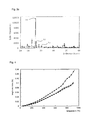
- FIG. 3 illustrates thin film X-ray diffraction measurements (TF-XRD) of different depth ranges ( FIGS. 3 a - 3 c ) of a glass ceramic comprising article according to the invention
- FIG. 4 illustrates relative alterations in length of glass ceramic comprising articles of different compositions for a temperature range from 0 to about 950° C.
- FIG. 1 illustrates a temperature/time diagram of a method according to the invention which can be used to produce an opaque glass ceramic comprising article from a green glass precursor article.
- the x-axis represents the time, and the y-axis represents the temperature.
- the method can also be performed with a pre-ceramized precursor article which had been produced separately, in terms of time and optionally location, from the production of the glass ceramic comprising article.
- a green glass precursor article with a lithium aluminum silicate (LAS) composition is first transformed to a precursor article having a high quartz mixed crystal phase, and then to a glass ceramic comprising article which comprises at least a keatite mixed crystal phase.
- LAS lithium aluminum silicate
- the green glass may have a composition in a range of:
- coloring oxides can be included.
- the precursor article is heated from room temperature to about 660° C. within 11 minutes, with a heat-up rate of 58 K/min or even up to 150 K/min.
- the heat-up rate can be selected as high as possible, since at this time the viscosity of the precursor article is so low that hardly any internal stresses arise.
- the heat-up rate should exceed 15 K/min, and should preferably exceed 30 K/min.
- the heat-up rate is slowly decreased to zero, so that either a volume crystallization of the high quartz mixed crystal phase occurs, for example at a constant temperature of 790° C., or a homogenization of the temperature of the article to be ceramized.
- this homogenization stage is only optional, i.e. it is not necessarily specific for the process and therefore not necessarily needed.
- the holding time during this process step is about 30 minutes.
- a precursor article having a high quartz mixed crystal phase can be produced using any method that generates such a mixed crystal phase.
- the process period until the end of this volume crystallization is not critical. However, the method steps as described above are preferred, since they imply a comparatively quick process.
- the process can be interrupted at this point, and the high quartz mixed crystal comprising article can be cooled to room temperature. In this way a transformation to the keatite mixed crystal phase would be possible separated in time.
- the ceramizing precursor article is heated to a maximum temperature between 1080° C. and 1300° C., preferably between 1100° C. and 1150° C., and more preferably, as illustrated in the exemplary embodiment, to 1120° C., with a heat-up rate of about 30 K/min.
- the heat-up rate should generally exceed 10 K/min and should preferably be between 14 and 36 K/min, with the upper limit of the heat-up rate depending on the technical possibilities.
- the relatively high heat-up rates in this process period result in a shift of the transition point from the high quartz mixed crystal phase to the keatite mixed crystal phase to higher temperatures.
- the result is an extremely rapid transformation which generally occurs within one to six minutes, preferably within one to four minutes, and more preferably within one to two minutes.
- the precursor article is then cooled to about 400° C., with an average cooling rate of about 350 K/min to 15 K/min, preferably between 50 K/min and 20 K/min, and is subsequently cooled to room temperature.
- the precursor article should be heated up as evenly as possible, at least during the exothermic period of phase transition.
- the temperature gradient across the width of the plate should deviate from an average temperature within the transforming precursor article by not more than +/ ⁇ 1 K.
- the temperature sensors Preferably have a response time of less than ten seconds, more preferably of not more than one second.
- a regulation of the heating is preferably achieved within 10 seconds, and more preferably within one second.
- FIGS. 2 a and 2 b each show an SEM image of a glass ceramic comprising article according to the invention and the corresponding ion content profiles which were determined by SIMS measurements.
- the SIMS measurements are plotted in a coordinate system, with the x-axis representing the depth from the surface of the glass ceramic comprising article towards the center, and the y-axis representing the intensity on a logarithmic scale.
- FIG. 2 a Three different microstructural zones 1 , 2 , 3 can be distinguished in the section, and the corresponding ion content profiles of the top ( FIG. 2 a ) and the bottom ( FIG. 2 b ) side of a glass ceramic comprising article can be seen.
- the general microstructure will be explained below with reference to FIG. 2 a , while FIG. 2 b serves to prove the similarity of the microstructures at the top and bottom side of a glass ceramic comprising article.
- a first, largely amorphous microstructural zone 1 is provided at the periphery of the glass ceramic comprising article.
- This zone 1 may have a thickness of up to six microns. In the example shown in FIG. 2 a , it has a width of about 570 nm.
- This microstructural zone 1 is defined by a glassy, i.e. substantially amorphous, matrix which comprises not more than 10 vol. % of crystallites.
- substantially amorphous zone 1 , Na, 4 , and K, 5 , ions are enriched as compared to the two other zones 2 , 3 , while Li, 6 , and Mg, 7 , ions are depleted.
- Zn ions 12 are particularly enriched in the superficial area, i.e. in the peripheral 100 to 200 nm, and then strongly decrease until the transition to the microstructural zone 2 .
- the described ion content profiles exhibit intensity plateaus 9 within the individual microstructures 1 , 2 , 3 .
- An intensity plateau 9 in the present context is not to be understood in its narrow sense of a constant ion content profile, but is primarily intended to emphasized the difference between steeply rising or falling contents, for example in the transition area between the individual microstructures, and the only slowly or slightly changing contents in individual ions within the microstructures.
- Zone 2 which is contiguous to the inner side of the first, largely amorphous microstructural zone 1 , is characterized by a crystallite content from 10 to 80 vol. %, with an increase in crystallite sizes from the outer to the inner side.
- the increase in size as well as an increase of the ratio between vol. % of crystallites and vol. % of residual glass phase seems to be continuous towards the inner zone.
- the ion content profile of this second microstructural zone 2 exhibits a relative enrichment in Li, 6 , Mg, 7 , and in Zn, 12 , ions in comparison to the first, largely amorphous microstructural zone 1 .
- the Na, 4 , and K, 5 , ions are depleted as compared to the first, substantially amorphous microstructural zone 1 .
- the second microstructural zone 2 comprises about one micron, but may generally comprise a width ranging from 0.03 to 5.00 ⁇ m.
- the third microstructural zone 3 is characterized by a crystallite content of more than 80 vol. %.
- the crystallites, with sizes from 0.05 to 100 ⁇ m, are significantly larger than in the two other microstructural zones 1 , 2 .
- This third microstructural zone 3 forms the innermost zone of the glass ceramic comprising article.
- the content profiles show a relative enrichment in Li, 6 , Mg, 7 , and Zn, 12 , ions, and a relative depletion in Na, 4 , and K, 5 , ions, as compared to the two other microstructural zones 1 , 2 , or microstructures.
- the concentration in Si ions 8 is essentially constant across the first 1 to third 3 microstructures, i.e. there are virtually any microstructure-specific alterations.
- the most conspicuous secondary crystalline phases included in all three microstructural zones 1 , 2 , 3 are needle- or rod-shaped gahnite mixed crystals 10 , and cubical or cube-shaped zirconium titanate mixed crystals 11 .
- phases as rutile mixed crystals may appear as minority components, distributed across the entire microstructure.
- the gahnite mixed crystals 10 seem to dominate the crystal phase in the first, largely amorphous microstructural zone 1 .
- the Zn ion content profile 12 especially shows an enrichment in the peripheral or near-surface area of the first microstructural zone 1 . It can be assumed that the Zn content of the glass ceramic essentially reflects the Zn content of the gahnite mixed crystals 10 .
- the inventors suppose that the relative enrichment in gahnite mixed crystals in the superficial area allows to at least partly explain the improved chemical resistance of the inventive glass ceramic article, since gahnite has a good resistance to acids. Especially in combination with a relatively thick amorphous peripheral zone (of up to 6 ⁇ m) this results in a dual effective “sealing” which protects the inside of the glass ceramic article, in particular against acid attacks.
- FIG. 3 shows TF-XRD measurements for depths of 0 to 2.5 ⁇ m ( FIG. 3 a ); 0 to 5 ⁇ m ( FIG. 3 b ); and 0 to 10 ⁇ m ( FIG. 3 c ), measured from the surface.
- the x-axis of these figures represents the diffraction angle
- the y-axis represents the intensity.
- FIGS. 3 a - 3 c show the presence of high quartz mixed crystals 13 rich in Si and of keatite mixed crystals 14 as the main crystalline phases, and of zirconium titanate mixed crystals 15 as a minor component.
- the ratio of the intensity of the high quartz mixed crystal main peaks at about 26.2° to that of the keatite mixed crystal main peaks at about 25.8° increases from the inner side ( FIG. 3 c ) to the outer side ( FIG. 3 a ).
- a continuous increase of the relative content in Si-rich high quartz mixed crystals 13 from the inner side to the outer side might be postulated.
- this is just an assumption, since TF-XRD measurements of either the second 2 or the first, largely amorphous microstructural zone 1 were not possible. Should this assumption be true, this would give a continuous diminution of the thermal expansion coefficient, at least across the third 3 and second 2 microstructural zones, from the innermost area outwards. This could have the effect that internal stresses arise in uniformly increasing manner from the inside outwards, at least in these zones 2 , 3 , and so could allow to explain the good mechanical properties of the glass ceramic comprising article according to the invention.
- DE 10 2005 019 247 B4 discloses a method for producing a glass ceramic that comprises keatite mixed crystals or high quartz mixed crystals and keatite mixed crystals.
- the glass ceramic produced with the method described in the patent document does not require any near-surface high quartz mixed crystal layer to generate a compressive stress at the surface to so ensure a high temperature difference resistance.
- the method according to the invention ensures specific chemical gradients which cause a different thermal expansion coefficient between the surface and the interior. These different thermal expansion coefficients in turn cause a compressive stress near the surface, which provides for the desired temperature difference resistance.
- the glass ceramic has a zone at the surface which is characterized by gradients of K, Na, Zn, and Li ions and which may have a thickness of up to 100 ⁇ m, or even up to 160 ⁇ m.
- the illustrated ion content profiles do not reveal any intensity plateaus, but continuously decrease or increase from the outside inwards.
- a glass ceramic comprising article with an LAS composition which is produced using the method according to the invention, has a content of a high quartz mixed crystal phase 13 which increases from the inside outwards relative to a keatite mixed crystal phase 14 .
- the inside of the glass ceramic comprising article is dominated by a keatite mixed crystal phase 14 having a thermal expansion coefficient of about 1 ⁇ 10 ⁇ 6 K ⁇ 1 .
- this thermal expansion coefficient decreases to a value between 0 and 1 ⁇ 10 ⁇ 6 K ⁇ 1 .
- the largely amorphous first microstructural zone 1 has a thermal expansion coefficient of about 3 ⁇ 10 ⁇ 6 K ⁇ 1 . Regardless of whether the proportion of the high quartz mixed crystal phase 13 increases continuously or incrementally, a compressive stress is built up which is more evenly or at least less dramatically increasing towards the areas near the surface. This is in contrast to the prior art.
- U.S. Pat. No. 4,218,512 discloses a glass ceramic having a two-tier microstructure, a keatite mixed crystal zone inside and a high quartz mixed crystal zone in the outer area. The transition between these two zones is described as abrupt. There seems to be no intermediary transition between the thermal expansion coefficients.
- Another advantage of the method according to the invention compared to the prior art as taught for example in EP 1170264 B1 is that the SiO 2 content of the existing high quartz mixed crystals is not critical. According to the aforementioned prior art, the process has to be controlled exactly to achieve that the SiO 2 content of the high quartz mixed crystals does not exceed a limit, for preventing transformation to the low quartz structure during cooling.
- the high quartz mixed crystals which may be contained in a glass ceramic comprising article according to the invention are of relic character, i.e. the ceramization was terminated before these high quartz mixed crystals could be transformed to keatite mixed crystals.
- the described method is considerably more robust than the method taught in the prior art, since inaccuracies in process control merely result in a more or less extensive transformation to keatite mixed crystals. There is thus no risk of a formation of high quartz mixed crystals which rearrange to the low quartz microstructure during cooling.
- a glass ceramic comprising article produced with the process according to the invention and having a wall thickness of 4 mm has the following mechanical and chemical properties, wherein x ⁇ s denote a mean value x and the corresponding standard deviation s:
- a glass ceramic comprising article according to the invention emits little or no particles.
- An emission of other material components such as alkali ions or alkaline earth ions etc. is only imaginable under extreme conditions, highest temperatures and extremely long operating times under sulfurous atmosphere.
- This low material emission generally provides for a use of these glass ceramics in areas with high purity standards, for example in the manufacturing of solar cells, or even in the medical and pharmaceutical industries.
- This low material emission can partly be explained by a very low pore density at the largely amorphous surface, which significantly reduces the outward diffusion of ions, for example under high temperature stress. At the same time, a low pore density also results in a very smooth surface which does not require any finishing.
- FIG. 4 shows the relative change in length of glass ceramic comprising articles in function of the temperature, for a temperature range between zero and about 950° C. It is obvious that a glass ceramic comprising article extends by not more than 0.16% when heated from zero to about 950° C. For this temperature range, the maximum average thermal expansion coefficient of the illustrated glass ceramic comprising articles is about 1.7 ⁇ 10 ⁇ 6 /K, and the minimum thermal expansion coefficient is about 1.1 ⁇ 10 ⁇ 6 /K.
Landscapes
- Chemical & Material Sciences (AREA)
- Engineering & Computer Science (AREA)
- Materials Engineering (AREA)
- Life Sciences & Earth Sciences (AREA)
- Chemical Kinetics & Catalysis (AREA)
- General Chemical & Material Sciences (AREA)
- Geochemistry & Mineralogy (AREA)
- Ceramic Engineering (AREA)
- Organic Chemistry (AREA)
- Crystallography & Structural Chemistry (AREA)
- Dispersion Chemistry (AREA)
- Glass Compositions (AREA)
- Re-Forming, After-Treatment, Cutting And Transporting Of Glass Products (AREA)
- Cookers (AREA)
Priority Applications (1)
| Application Number | Priority Date | Filing Date | Title |
|---|---|---|---|
| US13/384,875 US8993464B2 (en) | 2009-07-20 | 2010-07-13 | High performance glass ceramics and method for producing high-performance glass ceramics |
Applications Claiming Priority (9)
| Application Number | Priority Date | Filing Date | Title |
|---|---|---|---|
| DE102009034152 | 2009-07-20 | ||
| DE102009034152.8 | 2009-07-20 | ||
| DE102009034152 | 2009-07-20 | ||
| DE102010006232.4A DE102010006232B4 (de) | 2009-07-20 | 2010-01-28 | Hochleistungsglaskeramik und Verfahren zur Herstellung einer Hochleistungskeramik sowie ihre Verwendung |
| DE102010006232 | 2010-01-28 | ||
| DE102010006232.4 | 2010-01-28 | ||
| US31655710P | 2010-03-23 | 2010-03-23 | |
| US13/384,875 US8993464B2 (en) | 2009-07-20 | 2010-07-13 | High performance glass ceramics and method for producing high-performance glass ceramics |
| PCT/EP2010/004250 WO2011009544A1 (de) | 2009-07-20 | 2010-07-13 | Hochleistungsglaskeramik und verfahren zur herstellung einer hochleistungskeramik |
Publications (2)
| Publication Number | Publication Date |
|---|---|
| US20120157290A1 US20120157290A1 (en) | 2012-06-21 |
| US8993464B2 true US8993464B2 (en) | 2015-03-31 |
Family
ID=43448396
Family Applications (1)
| Application Number | Title | Priority Date | Filing Date |
|---|---|---|---|
| US13/384,875 Active 2030-11-15 US8993464B2 (en) | 2009-07-20 | 2010-07-13 | High performance glass ceramics and method for producing high-performance glass ceramics |
Country Status (7)
| Country | Link |
|---|---|
| US (1) | US8993464B2 (enExample) |
| EP (1) | EP2456729B1 (enExample) |
| JP (1) | JP5892932B2 (enExample) |
| KR (1) | KR101712225B1 (enExample) |
| CN (1) | CN102498072B (enExample) |
| DE (1) | DE102010006232B4 (enExample) |
| WO (1) | WO2011009544A1 (enExample) |
Cited By (2)
| Publication number | Priority date | Publication date | Assignee | Title |
|---|---|---|---|---|
| US10189741B2 (en) | 2014-10-08 | 2019-01-29 | Corning Incorporated | High strength glass-ceramics having petalite and lithium silicate structures |
| US12391604B2 (en) | 2015-03-24 | 2025-08-19 | Corning Incorporated | High strength, scratch resistant and transparent glass-based materials |
Families Citing this family (18)
| Publication number | Priority date | Publication date | Assignee | Title |
|---|---|---|---|---|
| US9241879B2 (en) * | 2008-04-11 | 2016-01-26 | James R. Glidewell Dental Ceramics, Inc. | Lithium silicate glass ceramic for fabrication of dental appliances |
| US9701574B2 (en) * | 2013-10-09 | 2017-07-11 | Corning Incorporated | Crack-resistant glass-ceramic articles and methods for making the same |
| DE102014013528B4 (de) * | 2014-09-12 | 2022-06-23 | Schott Ag | Beschichtetes Glas-oder Glaskeramiksubstrat mit beständigen multifunktionellen Oberflächeneigenschaften, Verfahren zu dessen Herstellung und dessen Verwendung |
| DE102014226986B9 (de) | 2014-12-23 | 2017-01-12 | Schott Ag | Glaskeramisches Substrat aus einer transparenten, eingefärbten LAS-Glaskeramik und Verfahren zu dessen Herstellung |
| DE102016216305B4 (de) | 2015-09-04 | 2023-04-20 | Schott Ag | Verwendung einer transparenten Glaskeramikscheibe als Kaminsichtscheibe in einem Kaminofen |
| DE102016101036B4 (de) * | 2016-01-21 | 2018-05-30 | Schott Ag | Kochmulde mit einer Glaskeramik-Kochfläche |
| DE102016101066B3 (de) | 2016-01-21 | 2017-02-23 | Schott Ag | Verfahren zur Herstellung eines vorzugsweise nicht eingefärbten glaskeramischen Materials mit geringem Streulichtanteil sowie verfahrensgemäß hergestelltes glaskeramisches Material und dessen Verwendung |
| DE102016101048B3 (de) * | 2016-01-21 | 2017-03-09 | Schott Ag | Glaskeramik-Kochmulde mit einem Infrarot-Sensor |
| DE102016211065B4 (de) | 2016-06-21 | 2019-09-05 | Schott Ag | Transparenter, vorzugsweise eingefärbter Glaskeramikartikel mit geringem Streulichtanteil und hoher Festigkeit sowie Verfahren zu seiner Herstellung und seine Verwendung |
| DE102017129634A1 (de) * | 2017-12-12 | 2019-06-13 | Endress+Hauser Conducta Gmbh+Co. Kg | Potentiometrischer Sensor zur pH-Wertbestimmung und Verfahren zur Ausbildung einer Verbindung zwischen einem Schaftrohr und einer Glasmembran eines potentiometrischen Sensors |
| CN115403256B (zh) * | 2018-07-16 | 2024-12-24 | 康宁股份有限公司 | 利用成核和生长密度以及粘度变化对玻璃进行陶瓷化的方法 |
| CN111153603B (zh) * | 2018-11-08 | 2021-10-26 | 华为机器有限公司 | 玻璃材料、玻璃材料的制造方法、电子设备 |
| DE102018132945B4 (de) | 2018-12-19 | 2020-12-31 | Schott Ag | Plattenförmiger Gegenstand, Verfahren zu dessen Herstellung sowie dessen Verwendung |
| WO2020137779A1 (ja) * | 2018-12-27 | 2020-07-02 | 日本電気硝子株式会社 | 医薬用ガラス容器 |
| US12281036B2 (en) | 2019-07-12 | 2025-04-22 | Corning Incorporated | Methods for forming glass ceramic articles |
| CN112939435A (zh) * | 2019-12-11 | 2021-06-11 | 四川旭虹光电科技有限公司 | 微晶玻璃及其生产方法和应用 |
| US20250223220A1 (en) * | 2024-01-05 | 2025-07-10 | Corning Incorporated | Color glass panel with reduced spodumene crystals and method of forming same |
| CN118005286A (zh) * | 2024-02-20 | 2024-05-10 | 河北光兴半导体技术有限公司 | 超薄微晶玻璃及其制备方法和应用 |
Citations (10)
| Publication number | Priority date | Publication date | Assignee | Title |
|---|---|---|---|---|
| US3637453A (en) * | 1966-06-17 | 1972-01-25 | Owens Illinois Inc | Glass-ceramic articles having an integral compressive stress surface layer |
| US3809543A (en) | 1971-02-19 | 1974-05-07 | Pilkington Brothers Ltd | Method of making glass ceramic materials on molten metal support |
| US3997352A (en) * | 1975-09-29 | 1976-12-14 | Corning Glass Works | Mica-spodumene glass-ceramic articles |
| US4211820A (en) | 1979-02-02 | 1980-07-08 | Corning Glass Works | Brown glass-ceramic articles |
| US4218512A (en) | 1979-01-04 | 1980-08-19 | Ppg Industries, Inc. | Strengthened translucent glass-ceramics and method of making |
| EP1170264A1 (de) | 2000-07-04 | 2002-01-09 | Schott Glas | Transluzente Glaskeramik, Verfahren zur Herstellung einer transluzenten Glaskeramik sowie deren Verwendung |
| US20050252503A1 (en) | 2004-05-12 | 2005-11-17 | Friedrich Siebers | Translucent or opaque colored glass-ceramic article providing a cooking surface and its use |
| US20050255983A1 (en) | 2004-05-12 | 2005-11-17 | Otmar Becker | Method of making a glass-ceramic article |
| DE102005019247A1 (de) | 2004-05-12 | 2005-12-08 | Schott Ag | Verfahren zur Herstellung von Glaskeramik |
| US8338318B2 (en) | 2007-06-01 | 2012-12-25 | Schott Ag | Glass ceramic armor material |
Family Cites Families (1)
| Publication number | Priority date | Publication date | Assignee | Title |
|---|---|---|---|---|
| CN1015255B (zh) * | 1986-05-19 | 1992-01-01 | 李承先 | 制造具备高抗热震性的陶瓷产品的方法 |
-
2010
- 2010-01-28 DE DE102010006232.4A patent/DE102010006232B4/de active Active
- 2010-07-13 WO PCT/EP2010/004250 patent/WO2011009544A1/de not_active Ceased
- 2010-07-13 JP JP2012520928A patent/JP5892932B2/ja not_active Expired - Fee Related
- 2010-07-13 CN CN201080041650.0A patent/CN102498072B/zh not_active Expired - Fee Related
- 2010-07-13 EP EP10734044.0A patent/EP2456729B1/de active Active
- 2010-07-13 US US13/384,875 patent/US8993464B2/en active Active
- 2010-07-13 KR KR1020127004342A patent/KR101712225B1/ko not_active Expired - Fee Related
Patent Citations (14)
| Publication number | Priority date | Publication date | Assignee | Title |
|---|---|---|---|---|
| US3637453A (en) * | 1966-06-17 | 1972-01-25 | Owens Illinois Inc | Glass-ceramic articles having an integral compressive stress surface layer |
| US3809543A (en) | 1971-02-19 | 1974-05-07 | Pilkington Brothers Ltd | Method of making glass ceramic materials on molten metal support |
| US3997352A (en) * | 1975-09-29 | 1976-12-14 | Corning Glass Works | Mica-spodumene glass-ceramic articles |
| US4218512A (en) | 1979-01-04 | 1980-08-19 | Ppg Industries, Inc. | Strengthened translucent glass-ceramics and method of making |
| US4211820A (en) | 1979-02-02 | 1980-07-08 | Corning Glass Works | Brown glass-ceramic articles |
| US6515263B2 (en) * | 2000-07-04 | 2003-02-04 | Schott Glas | Cooking stove having a smooth-top glass ceramic cooktop, and a smooth-top glass ceramic cooktop with a glass ceramic cooktop cooking surface, method for production of stoves with smooth-top glass ceramic cooktops and smooth-top glass ceramic cooktops |
| EP1170264A1 (de) | 2000-07-04 | 2002-01-09 | Schott Glas | Transluzente Glaskeramik, Verfahren zur Herstellung einer transluzenten Glaskeramik sowie deren Verwendung |
| US20050252503A1 (en) | 2004-05-12 | 2005-11-17 | Friedrich Siebers | Translucent or opaque colored glass-ceramic article providing a cooking surface and its use |
| US20050255983A1 (en) | 2004-05-12 | 2005-11-17 | Otmar Becker | Method of making a glass-ceramic article |
| JP2005325018A (ja) | 2004-05-12 | 2005-11-24 | Schott Ag | 調理面となる半透明または不透明着色ガラスセラミック製品及びその使用 |
| JP2005325017A (ja) | 2004-05-12 | 2005-11-24 | Schott Ag | ガラスセラミック品を作製する方法 |
| CN1702049A (zh) | 2004-05-12 | 2005-11-30 | 肖特股份有限公司 | 制备玻璃陶瓷制品的方法 |
| DE102005019247A1 (de) | 2004-05-12 | 2005-12-08 | Schott Ag | Verfahren zur Herstellung von Glaskeramik |
| US8338318B2 (en) | 2007-06-01 | 2012-12-25 | Schott Ag | Glass ceramic armor material |
Non-Patent Citations (6)
| Title |
|---|
| Chinese Office Action dated Sep. 5, 2014 corresponding to Chinese Patent Application 201080041650.0 with English translation. |
| English translation of Chinese Office Action dated Dec. 27, 2013 corresponding to Chinese Patent App. 201080041650.0. |
| English Translation of International Preliminary Report on Patentability corresponding to International Patent Application No. PCT/EP2010/004250. |
| International Preliminary Report on Patentability dated Nov. 3, 2011 corresponding to International Patent Application No. PCT/EP2010/004250. |
| International Search Report dated Nov. 19, 2010 corresponding to International Patent Application No. PCT/EP2010/004250. |
| Japanese Office action dated Jan. 30, 2014 corresponding to Japanese Patent App. No. 2012-520928 with English translation. |
Cited By (16)
| Publication number | Priority date | Publication date | Assignee | Title |
|---|---|---|---|---|
| US10189741B2 (en) | 2014-10-08 | 2019-01-29 | Corning Incorporated | High strength glass-ceramics having petalite and lithium silicate structures |
| US10239780B2 (en) | 2014-10-08 | 2019-03-26 | Corning Incorporated | High strength glass-ceramics having petalite and lithium silicate structures |
| US10427975B2 (en) | 2014-10-08 | 2019-10-01 | Corning Incorporated | High strength glass-ceramics having petalite and lithium silicate structures |
| US11034610B2 (en) | 2014-10-08 | 2021-06-15 | Corning Incorporated | High strength glass-ceramics having petalite and lithium silicate structures |
| US11148968B2 (en) | 2014-10-08 | 2021-10-19 | Corning Incorporated | High strength glass-ceramics having petalite and lithium silicate structures |
| US11168021B2 (en) | 2014-10-08 | 2021-11-09 | Corning Incorporated | High strength glass-ceramics having petalite and lithium silicate structures |
| US11174194B2 (en) | 2014-10-08 | 2021-11-16 | Corning Incorporated | High strength glass-ceramics having petalite and lithium silicate structures |
| US11319244B2 (en) | 2014-10-08 | 2022-05-03 | Corning Incorporated | High strength glass-ceramics having petalite and lithium silicate structures |
| US11384010B2 (en) | 2014-10-08 | 2022-07-12 | Corning Incorporated | High strength glass-ceramics having petalite and lithium silicate structures |
| US11634357B2 (en) | 2014-10-08 | 2023-04-25 | Corning Incorporated | High strength glass-ceramics having petalite and lithium silicate structures |
| US11952306B2 (en) | 2014-10-08 | 2024-04-09 | Corning Incorporated | High strength glass-ceramics having petalite and lithium silicate structures |
| US12049424B1 (en) | 2014-10-08 | 2024-07-30 | Corning Incorporated | High strength glass-ceramics having petalite and lithium silicate structures |
| US12049423B1 (en) | 2014-10-08 | 2024-07-30 | Corning Incorporated | High strength glass-ceramics |
| US12098090B1 (en) | 2014-10-08 | 2024-09-24 | Corning Incorporated | High strength glass-ceramics |
| US12371367B2 (en) | 2014-10-08 | 2025-07-29 | Corning Incorporated | High strength glass-ceramics |
| US12391604B2 (en) | 2015-03-24 | 2025-08-19 | Corning Incorporated | High strength, scratch resistant and transparent glass-based materials |
Also Published As
| Publication number | Publication date |
|---|---|
| JP5892932B2 (ja) | 2016-03-23 |
| DE102010006232B4 (de) | 2016-09-15 |
| US20120157290A1 (en) | 2012-06-21 |
| DE102010006232A1 (de) | 2011-02-17 |
| KR101712225B1 (ko) | 2017-03-03 |
| EP2456729B1 (de) | 2020-02-12 |
| JP2012533509A (ja) | 2012-12-27 |
| CN102498072A (zh) | 2012-06-13 |
| CN102498072B (zh) | 2015-09-30 |
| EP2456729A1 (de) | 2012-05-30 |
| WO2011009544A1 (de) | 2011-01-27 |
| KR20120052332A (ko) | 2012-05-23 |
Similar Documents
| Publication | Publication Date | Title |
|---|---|---|
| US8993464B2 (en) | High performance glass ceramics and method for producing high-performance glass ceramics | |
| JP6587903B2 (ja) | 結晶度が高いリチウムアルミニウムケイ酸塩のガラスセラミック、及びその使用 | |
| JP5893019B2 (ja) | リチウムを含有する透明なガラスセラミック材料およびその製造方法ならびにその使用 | |
| JP6899938B2 (ja) | 高均一性ガラスセラミック素子 | |
| JP6407725B2 (ja) | 透明な色の薄いリチウムアルミニウムシリケートガラスセラミックおよびその使用 | |
| JP6230775B2 (ja) | フロート結晶化ガラスの強化セラミック化の方法 | |
| JP6835659B2 (ja) | 結晶化可能なリチウムアルミニウムケイ酸塩ガラス、並びにそれから製造された透明なガラスセラミック、並びにガラス及びガラスセラミックの製造方法、並びにガラスセラミックの使用 | |
| JP2012533509A5 (enExample) | ||
| JP2001354429A (ja) | 清掃容易ガラスセラミック体 | |
| JP6890425B2 (ja) | 僅かな散乱光割合を示す、好ましくは着色されていないガラスセラミック材料の製造方法、並びにその方法により製造されたガラスセラミック材料及びその使用 | |
| JP2006523600A (ja) | ランプリフレクタ基体、それを製造するためのガラス、ガラスセラミック材料および方法 | |
| TWI828718B (zh) | 陶瓷化具有改善的翹曲的玻璃製品的方法 | |
| CN114853342B (zh) | 一种热弯亮光陶瓷岩板及其制备方法 | |
| JP2006008488A (ja) | 熱処理用セッター及びその製造方法、並びにガラス基板の熱処理方法 | |
| KR102822637B1 (ko) | 결정화 가능한 리튬 알루미늄 규산염 유리 및 그로부터 제조된 유리 세라믹, 유리 및 유리 세라믹의 제조 방법 및 유리 세라믹의 용도 | |
| US20210292220A1 (en) | Setter plates and methods of ceramming glass articles using the same | |
| KR20220035145A (ko) | 유리 세라믹 물품을 형성하는 방법 | |
| US20210130228A1 (en) | Glass substrates including uniform parting agent coatings and methods of ceramming the same | |
| JP2006008486A (ja) | 熱処理用セッター及びその製造方法、並びにガラス基板の熱処理方法 | |
| JP2022523029A (ja) | ガラスセラミック物品、組成物、及びその製造方法 | |
| JP2006008487A (ja) | 熱処理用セッター及びその製造方法、並びにガラス基板の熱処理方法 |
Legal Events
| Date | Code | Title | Description |
|---|---|---|---|
| AS | Assignment |
Owner name: SCHOTT AG, GERMANY Free format text: ASSIGNMENT OF ASSIGNORS INTEREST;ASSIGNORS:GABEL, FALK;RUDIGIER-VOIGT, EVELINE;HENN, CHRISTIAN;AND OTHERS;SIGNING DATES FROM 20120221 TO 20120223;REEL/FRAME:027853/0237 |
|
| FEPP | Fee payment procedure |
Free format text: PAYOR NUMBER ASSIGNED (ORIGINAL EVENT CODE: ASPN); ENTITY STATUS OF PATENT OWNER: LARGE ENTITY |
|
| STCF | Information on status: patent grant |
Free format text: PATENTED CASE |
|
| MAFP | Maintenance fee payment |
Free format text: PAYMENT OF MAINTENANCE FEE, 4TH YEAR, LARGE ENTITY (ORIGINAL EVENT CODE: M1551); ENTITY STATUS OF PATENT OWNER: LARGE ENTITY Year of fee payment: 4 |
|
| MAFP | Maintenance fee payment |
Free format text: PAYMENT OF MAINTENANCE FEE, 8TH YEAR, LARGE ENTITY (ORIGINAL EVENT CODE: M1552); ENTITY STATUS OF PATENT OWNER: LARGE ENTITY Year of fee payment: 8 |