US7164381B2 - Target identifying apparatus, target identifying method, and target identifying program - Google Patents
Target identifying apparatus, target identifying method, and target identifying program Download PDFInfo
- Publication number
- US7164381B2 US7164381B2 US11/110,801 US11080105A US7164381B2 US 7164381 B2 US7164381 B2 US 7164381B2 US 11080105 A US11080105 A US 11080105A US 7164381 B2 US7164381 B2 US 7164381B2
- Authority
- US
- United States
- Prior art keywords
- signal distribution
- target
- signal
- value
- approximate expression
- Prior art date
- Legal status (The legal status is an assumption and is not a legal conclusion. Google has not performed a legal analysis and makes no representation as to the accuracy of the status listed.)
- Expired - Fee Related, expires
Links
Images




Classifications
-
- G—PHYSICS
- G01—MEASURING; TESTING
- G01S—RADIO DIRECTION-FINDING; RADIO NAVIGATION; DETERMINING DISTANCE OR VELOCITY BY USE OF RADIO WAVES; LOCATING OR PRESENCE-DETECTING BY USE OF THE REFLECTION OR RERADIATION OF RADIO WAVES; ANALOGOUS ARRANGEMENTS USING OTHER WAVES
- G01S7/00—Details of systems according to groups G01S13/00, G01S15/00, G01S17/00
- G01S7/02—Details of systems according to groups G01S13/00, G01S15/00, G01S17/00 of systems according to group G01S13/00
- G01S7/41—Details of systems according to groups G01S13/00, G01S15/00, G01S17/00 of systems according to group G01S13/00 using analysis of echo signal for target characterisation; Target signature; Target cross-section
-
- G—PHYSICS
- G01—MEASURING; TESTING
- G01S—RADIO DIRECTION-FINDING; RADIO NAVIGATION; DETERMINING DISTANCE OR VELOCITY BY USE OF RADIO WAVES; LOCATING OR PRESENCE-DETECTING BY USE OF THE REFLECTION OR RERADIATION OF RADIO WAVES; ANALOGOUS ARRANGEMENTS USING OTHER WAVES
- G01S13/00—Systems using the reflection or reradiation of radio waves, e.g. radar systems; Analogous systems using reflection or reradiation of waves whose nature or wavelength is irrelevant or unspecified
- G01S13/02—Systems using reflection of radio waves, e.g. primary radar systems; Analogous systems
- G01S13/06—Systems determining position data of a target
- G01S13/08—Systems for measuring distance only
- G01S13/32—Systems for measuring distance only using transmission of continuous waves, whether amplitude-, frequency-, or phase-modulated, or unmodulated
- G01S13/34—Systems for measuring distance only using transmission of continuous waves, whether amplitude-, frequency-, or phase-modulated, or unmodulated using transmission of continuous, frequency-modulated waves while heterodyning the received signal, or a signal derived therefrom, with a locally-generated signal related to the contemporaneously transmitted signal
- G01S13/345—Systems for measuring distance only using transmission of continuous waves, whether amplitude-, frequency-, or phase-modulated, or unmodulated using transmission of continuous, frequency-modulated waves while heterodyning the received signal, or a signal derived therefrom, with a locally-generated signal related to the contemporaneously transmitted signal using triangular modulation
-
- G—PHYSICS
- G01—MEASURING; TESTING
- G01S—RADIO DIRECTION-FINDING; RADIO NAVIGATION; DETERMINING DISTANCE OR VELOCITY BY USE OF RADIO WAVES; LOCATING OR PRESENCE-DETECTING BY USE OF THE REFLECTION OR RERADIATION OF RADIO WAVES; ANALOGOUS ARRANGEMENTS USING OTHER WAVES
- G01S13/00—Systems using the reflection or reradiation of radio waves, e.g. radar systems; Analogous systems using reflection or reradiation of waves whose nature or wavelength is irrelevant or unspecified
- G01S13/02—Systems using reflection of radio waves, e.g. primary radar systems; Analogous systems
- G01S13/06—Systems determining position data of a target
- G01S13/42—Simultaneous measurement of distance and other co-ordinates
-
- G—PHYSICS
- G01—MEASURING; TESTING
- G01S—RADIO DIRECTION-FINDING; RADIO NAVIGATION; DETERMINING DISTANCE OR VELOCITY BY USE OF RADIO WAVES; LOCATING OR PRESENCE-DETECTING BY USE OF THE REFLECTION OR RERADIATION OF RADIO WAVES; ANALOGOUS ARRANGEMENTS USING OTHER WAVES
- G01S13/00—Systems using the reflection or reradiation of radio waves, e.g. radar systems; Analogous systems using reflection or reradiation of waves whose nature or wavelength is irrelevant or unspecified
- G01S13/88—Radar or analogous systems specially adapted for specific applications
- G01S13/93—Radar or analogous systems specially adapted for specific applications for anti-collision purposes
- G01S13/931—Radar or analogous systems specially adapted for specific applications for anti-collision purposes of land vehicles
- G01S2013/9321—Velocity regulation, e.g. cruise control
Definitions
- This invention relates to a target identifying apparatus, a target identifying method, and a target identifying program for identifying from a signal distribution with beam angle or frequency provided by a scan radar as a parameter, a target contained in the signal distribution.
- a on-vehicle radar sensor installed, which is a scan radar of FM-CW for emitting a continuous transmission signal frequency-modulated with a triangular wave and receiving a reflected wave from a target (another vehicle ahead of the vehicle) for each beam angle as a reception signal, thereby calculating a direction angle of the target, distance to the target, and relative speed between the radar sensor and the target has been available as shown in FIG. 2A .
- a signal distribution with beam angles used as a parameter in which power of a reception signal is distributed for each beam angle is generated as shown in FIG. 2B .
- the direction angle of the target is calculated from the signal distribution.
- the transmission signal is mixed with the reception signal to find a beat signal for each beam angle.
- the beat signal is subjected to fast Fourier transform (FFT) for each beam angle.
- FFT fast Fourier transform
- a signal distribution with frequencies used as a parameter in which the power of the beat signal is distributed for each frequency is generated as shown in FIG. 10B .
- the distance to the target and the relative speed between the radar and the target are calculated from the signal distribution (peak frequency) in the rising section and the signal distribution (peak frequency) in the falling section.
- the direction angle of the target, the distance to the target, and the relative speed between the radar and the target are calculated from the signal distributions with beam angles and frequencies used as the parameter. For example, if a plurality of targets are close to each other in the left and right direction as shown in FIG. 2A , a peak (signal) for each target does not clearly appear in the signal distribution as shown in FIG. 2C .
- measures for narrowing a beam width of an antenna for shortening sampling intervals (beam angle intervals), thereby clearly forming a plurality of peaks in the signal distribution has been conceived.
- a beam width of an antenna is narrowed, new problems occur. That is, since an area of the antenna is enlarged, size of the radar becomes large. Also, since number of beams increases, processing load increases.
- the problems are not necessarily limited to a case where a plurality of targets are close to each other in the left and right direction (see FIG. 2A ) in calculating the direction angle of the target. If a plurality of targets are close to each other back and forth (see FIG. 10A ) in calculating the direction angle of the target, a peak (signal) for each target does not clearly appear in the signal distribution as shown in FIG. 10C . Consequently, a similar problem occurs.
- the invention provides a target identifying apparatus, a target identifying method, and a target identifying program capable of reliably identifying targets even from a signal distribution in which a peak (signal) for each target does not clearly appear due to that a plurality of targets are close to each other in the left and right direction or back and forth.
- a target identifying apparatus identifies a target from a first signal distribution obtained by a scan radar.
- the target identifying apparatus includes a calculation section, a target signal identifying section, a subtraction section, and a correction section.
- the calculation section calculates a quadratic approximate expression in the first signal distribution.
- the first signal distribution includes one of beam angles and frequencies as a parameter.
- the quadratic approximate expression has the one of the beam angle and the frequency corresponding to a maximum value of the first signal distribution at a center thereof.
- the target signal identifying section identifies a signal contained in the quadratic approximate expression calculated by the calculation section as a single target signal.
- the target signal indicates the target.
- the subtraction section subtracts a value of the quadratic approximate expression calculated by the calculation section from a value of the first signal distribution to generate a second signal distribution.
- the correction section corrects the second signal distribution based on the quadratic approximate expression.
- the calculation section treats the corrected second signal distribution as a new first signal distribution.
- the calculation section treats the second signal distribution as a new first signal distribution.
- the correction section corrects the deleted peak to generate a new signal distribution (the corrected second signal distribution) in which signals of the other target is not erased but appears clearly. Therefore, the target identifying apparatus can identify a target reliably even from a signal distribution in which a peak (signal) for each target does not clearly appear because a plurality of targets are close to each other in the left and right direction or back and forth (see FIGS. 2C and 10C ). Further, since the targets can be thus reliably identified, it is also made possible to prevent target from being lost and prevent variation in the direction angle of a target.
- FIG. 1 is a block diagram showing the general configuration of a vehicle-to-vehicle distance control system including a radar sensor according to a first embodiment of the invention
- FIG. 2A is a drawing to describe that the radar sensor identifies targets arranged in the left and right direction;
- FIG. 2B is a drawing to describe that the radar sensor identifies targets arranged in the left and right direction;
- FIG. 2C is a drawing to describe that the radar sensor identifies targets arranged in the left and right direction;
- FIG. 3 is a block diagram showing the configuration of a target identifying section
- FIG. 4 is a flowchart showing a flow of target identifying process performed by the target identifying section
- FIG. 5A is a drawing to show a specific example of the target identifying process
- FIG. 5B is a drawing to show a specific example of the target identifying process
- FIG. 6A is a drawing to show a specific example of the target identifying process
- FIG. 6B is a drawing to show a specific example of the target identifying process
- FIG. 7A is a drawing to show a specific example of the target identifying process
- FIG. 7B is a drawing to show a specific example of the target identifying process
- FIG. 8A is a drawing to show a specific example of the target identifying process
- FIG. 8B is a drawing to show a specific example of the target identifying process
- FIG. 9A is a drawing to show a specific example of the target identifying process
- FIG. 9B is a drawing to show a specific example of the target identifying process
- FIG. 9C is a drawing to show a specific example of the target identifying process
- FIG. 10A is a drawing to describe that that the radar sensor identifies targets arranged in the back and forth direction;
- FIG. 10B is a drawing to describe that that the radar sensor identifies targets arranged in the back and forth direction;
- FIG. 10C is a drawing to describe that that the radar sensor identifies targets arranged in the back and forth direction;
- FIG. 11A is a drawing to describe matching with using an antenna pattern
- FIG. 11B is a drawing to describe watching with using the antenna pattern
- FIG. 12 is a block diagram showing the configuration of a target identifying section according to a second embodiment of the invention:
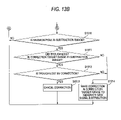
- FIG. 13 is a flowchart showing a flow of target identifying process performed by the target identifying section
- FIG. 14 is a drawing to describe correction performed by the target identifying section
- FIG. 15 is a drawing to describe correction performed by the target identifying section
- FIG. 16 is a drawing to describe correction performed by the target identifying section
- FIG. 17 is a drawing to describe correction performed by the target identifying section.
- FIG. 18 is a drawing to describe correction performed by the target identifying section.
- an outline of a radar sensor according to the first embodiment (1: outline of radar sensor), the configuration and processing flow involved in target identifying (2: Configuration of target identifying section and 3: Process performed by the target identifying section 20 ), the advantages of the first embodiment (4: Advantages of first embodiment), and modifications of the first embodiment (5: Modifications of first embodiment) will be discussed in order.
- FIG. 1 is a block diagram showing the general configuration of a vehicle-to-vehicle distance control system including a radar sensor 10 according to the first embodiment.
- the vehicle-to-vehicle distance control system includes a vehicle-to-vehicle distance control ECU 30 and the radar sensor 10 , a steering sensor 31 , a yaw rate sensor 32 , a speed sensor 33 , an alarm 34 , a brake 35 , and a throttle 36 connected to the vehicle-to-vehicle distance control ECU 30 so that they communicate with each other.
- the vehicle-to-vehicle distance control ECU 30 of the vehicle-to-vehicle distance control system determines the collision possibility with a target (target on the periphery of the home vehicle such as a vehicle ahead, a side vehicle, a following vehicle, a motorcycle, or a bicycle) based on home vehicle information and periphery information acquired from the sensors such as the radar sensor 10 , the steering sensor 31 , the yaw rate sensor 32 , and the speed sensor 33 , and performs vehicle control of sounding an alert from the alarm 34 , applying the brake 35 , easing up on the throttle 36 , etc.
- a target target on the periphery of the home vehicle such as a vehicle ahead, a side vehicle, a following vehicle, a motorcycle, or a bicycle
- the radar sensor 10 is an on-vehicle scan radar of FM-CW including an antenna 11 , a storage section 12 , a signal processing section 13 , and a target identifying section 20 , as shown in FIG. 1 .
- a continuous transmission signal frequency-modulated with a triangular wave is emitted from the antenna 11 and a reflected wave (radar signal) from a target (target such as a vehicle ahead of the home vehicle) is received at the antenna 11 for each beam angle as a reception signal, thereby calculating the direction angle of the target, the distance to the target, the relative speed between the radar sensor 10 and the target as shown in FIG. 2A .
- Schematic processing of the radar sensor 10 will be given below.
- the radar sensor 10 upon reception of a reception signal for each beam angle at the antenna 11 , a signal distribution in which the power of the reception signal is distributed for each beam angle with the beam angles used as a parameter is generated (the power of the reception signal is stored in the storage section 12 for each beam angle) as shown in FIG. 2B .
- the signal processing section 13 calculates the direction angle of the target from the signal distribution.
- the transmission signal is mixed with the reception signal to find a beat signal for each bean angle. Then, the beat signal is subjected to fast Fourier transform (FFT) for each beam angle. In the rising section of frequencies and the falling section of frequencies for each beam angle, a signal distribution in which the power of the beat signal is distributed for each frequency with the frequencies used as a parameter is generated (the power of the beat signal is stored in the storage section 12 for each frequency) as shown in FIG. 10B .
- the signal processing section 13 calculates the distance to the target and the relative speed between the radar sensor 10 and the target from the signal distribution (peak frequency) in the rising section and the signal distribution (peak frequency) in the falling section.
- the signal processing section 13 of the radar sensor 10 calculates the direction angle of the target, the distance to the target, and the relative speed between the radar sensor 10 and the target and outputs the calculation result to the vehicle-to-vehicle distance control ECU 30 .
- the target identifying section 20 identifies the target contained in the signal distribution from the signal distribution. That is, a target exists for each peak appearing in the signal distribution as shown in FIGS. 2B and 10B . Therefore, the target identifying section 20 identifies a signal contained in each peak (a signal forming a peak) as a single target signal, and outputs the identifying result to the signal processing section 13 .
- the signal processing section 13 calculates the direction angle of the target for each identified target. If the target identifying section 20 identifies a plurality of targets back and forth, the signal processing section 13 finds a peak frequency for each identified target (finds a peak frequency for each target in the rising section of frequencies and the falling section of frequencies) and pairs the peak frequencies of the same target in the rising section of frequencies and the falling section of frequencies and then calculates the distance to each target and the relative speed between the radar sensor 10 and each target.
- the radar sensor 10 identifies a target in the left and right direction from the signal distribution in which the power of the reception signal is distributed for each beam angle (see FIG. 2B ) and then, calculates the direction angle of each target.
- the radar sensor 10 identifies a target back and forth from the signal distribution in which the power of the beat signal is distributed for each frequency (see FIG. 10B ) and then, calculates the distance to each target and the relative speed between the radar sensor 10 and each target.
- the radar sensor 10 according to the first embodiment can identify each target reliably even from a signal distribution in which a peak (signal) for each target does not clearly appear because a plurality of targets are close to each other in the left and right direction or back and forth.
- the target identifying section 20 repeats a process of calculating a quadratic approximate expression having a beam angle (or frequency) corresponding to a maximum value of the signal distribution (first signal distribution) at a center thereof and identifying signals contained in the quadratic approximate expression as a single target signal (see FIGS. 5A and 5B ): and a process of subtracting the calculated values of the quadratic approximate expression from the values of the signal distribution to generate a new signal distribution (second signal distribution) (see FIGS. 7A and 7B ) until identifying all targets contained in the signal distribution.
- the quadratic approximate expression is calculated so as to take the maximum peak of the signal distribution at the center thereof in order not only for the initial signal distribution, but also for new signal distributions generated in sequence.
- the signals contained in the quadratic approximate expression are identified as a single target signal in sequence.
- the values of the quadratic approximate expression are subtracted from the values of the signal distribution to generate a new signal distribution in sequence. Accordingly, all targets contained in the signal distribution are identified (see FIG. 8B ).
- the target identifying section 20 corrects the newly generated signal distribution based on the calculated quadratic approximate expression. It is noted that dotted lines (without arrow) indicate an envelope of the signal distribution before corrected (first signal distribution).
- the target identifying section 20 adds to values of the newly generated signal distribution (second signal distribution) in the predetermined range including the maximum value thereof, a value of the quadratic approximate expression at a beam angle (or frequency) corresponding to the maximum value of the newly generated signal distribution (second signal distribution), to generate a new signal distribution (a corrected second signal distribution) (see FIG. 9B ). That is, if identifying one target involves deleting a peak caused by another target, the target identifying section 20 corrects the deleted peak to generate a new signal distribution (the corrected second signal distribution) in which signals of the other target is not erased but appears clearly.
- the target identifying section 20 generates a new signal distribution in which signals of a nearby target are not erased but appear clearly (see FIGS. 9C and 10C ) even from a signal distribution in which a peak (signal) for each target does not clearly appear because a plurality of targets are close to each other in the left and right direction or back and forth (see FIGS. 2C and 10C ). Accordingly, it is made possible to reliably identify targets. Further, since the targets can be thus reliably identified, it is also made possible to prevent target from being lost and prevent variation in the direction angle of a target.
- the configuration and process flow of the target identifying section 20 will be discussed in detail below.
- the target identifying section 20 executes the processes described above in the case of identifying targets arranged side by side from a signal distribution in which the power of the reception signal is distributed for each beam angle (see FIGS. 2B and 2C ) and a case of identifying targets arranged back and forth from a signal distribution in which the power of the beat signal is distributed for each frequency (see FIGS. 10B and 10C ). Since similar process is performed in the both cases, the former process will be discussed in detail.
- FIG. 3 is a block diagram showing the configuration of the target identifying section 20 .
- the target identifying section 20 is connected to the storage section 12 for storing data and programs, which are required for various processes performed by the radar sensor 10 .
- the storage section 12 stores a signal distribution in which power of a reception signal is distributed for each beam angle with beam angles used as a parameter (the power of the reception signal for each beam angle) as shown in FIG. 2B , a signal distribution in which power of a beat signal is distributed for each frequency with frequencies used as a parameter (the power of the beat signal for each frequency) as shown in FIG. 10B , and data being processed by the target identifying section 20 (newly generated signal distribution (second signal distribution and corrected second signal distribution)).
- the power of the signal distribution mentioned here is a voltage value of a signal rather than a decibel value. That is, a signal distribution made up of voltage values of signals rather than decibel values of the signals (signal distribution made up of reflection electric power sums) is stored in the storage section 12 .
- the target identifying section 20 uses the stored voltage values to execute target identifying operation process.
- the target identifying section 20 is a control section, which has internal memory for storing control programs such as an OS (operating system), programs defining procedures of the various processes, and required data and executes target identifying process according to the programs and the data.
- the target identifying section 20 includes a maximum peak detecting section 21 , an approximate expression calculating section 22 , a target signal identifying section 23 , a subtraction section 24 , and a correction section 25 as shown in FIG. 3 .
- the maximum peak detecting section 21 is a process section for detecting a maximum value (maximum peak) from a signal distribution. Specifically, when radar signals are received from all directions and a signal distribution (first signal distribution) in which power of the reception signal is distributed for each beam angle is stored in the storage section 12 , the maximum peak detecting section 21 detects a maximum peak as shown in FIG. 5A . If a new signal distribution (second signal distribution or corrected second signal distribution) is generated by the subtraction section 24 and the correction section 25 described later and is stored in the storage section 12 , the maximum peak detecting section 21 also detects a maximum peak as shown in FIGS. 8A and 9B . Further, after detecting the maximum peak, the maximum peak detecting section 21 also determines whether or not the maximum peak value is equal to or greater than a threshold value (threshold value for noise removal or threshold value for target identifying).
- a threshold value threshold value for noise removal or threshold value for target identifying
- the approximate expression calculating section 22 is a process section for calculating a quadratic approximate expression having a beam angle (or frequency) corresponding to a maximum peak in the signal distribution at a center thereof. Specifically, when the maximum peak detecting section 21 detects the maximum peak from the signal distribution, the approximate expression calculating section 22 uses a value of the maximum peak and its peripheral values (for example, values adjacent to both sides of the maximum peak) to calculate the quadratic approximate expression having the beam angle (or frequency) corresponding to the maximum peak at the center thereof as shown in FIG. 5B . Also, the approximate expression calculating section 22 determines whether or not a gradient of the quadratic approximate expression thus calculated is gentler than that of an antenna pattern previously stored in the storage section 12 . If the gradient of the quadratic approximate expression is gentler than that of the antenna pattern, the approximate expression calculating section 22 newly calculates a quadratic approximate expression along the antenna pattern, as shown in FIGS. 6A and 6B .
- the target signal identifying section 23 is a process section for identifying a target signal from the quadratic approximate expression. Specifically, when the approximate expression calculating section 22 calculates the quadratic approximate expression, the target signal identifying section 23 identifies signals contained in the calculated quadratic approximate expression (signals in a range sandwiched between two intersection points between curve of the quadratic approximate expression and the horizontal line) as a single target signal, as shown in FIG. 7A .
- the identifying result of the target signal identifying section 23 is stored in the storage section 12 .
- the signal processing section 13 refers to the determination result stored in the storage section 12 and calculates a direction angle of each identified target.
- the subtraction section 24 is a process section for subtracting values of the quadratic approximate expression from values of the signal distribution (first signal distribution) to generate a new signal distribution (second signal distribution). Specifically, when the target signal identifying section 23 identifies one target, the subtraction section 24 subtracts the values of the quadratic approximate expression used for the identifying from the values of the signal distribution to generate a new signal distribution, as shown in FIGS. 7A and 7B . In the subtraction processing, the subtraction section 24 performs subtraction only in a predetermined range including the maximum peak of the signal distribution as the center thereof (for example, nine signals containing the maximum peak) as shown in FIG. 7A rather than performs subtraction in the entire range of the signal distribution.
- the correction section 25 is a process section for correcting the signal distribution newly generated by the subtraction section 24 (second signal distribution). Specifically, when the subtraction section 24 generates a new signal distribution (second signal distribution), the correction section 25 determines whether or not a maximum peak in the newly generated signal distribution (second signal distribution) is in a range in which the values of the quadratic approximate expression is subtracted from the values of the signal distribution (first signal distribution). If the maximum peak of the newly generated signal distribution (second signal distribution) is not in the subtraction range (see FIG. 8A ), the correction section 25 does not make a correction. If the maximum peak of the newly generated signal distribution (second signal distribution) is in the subtraction range (see FIG.
- the correction section 25 adds to values of the newly generated signal distribution (second signal distribution) in the range including the maximum peak of the newly generated signal distribution (second signal distribution), a value of the quadratic approximate expression at a beam angle (or a frequency) corresponding to the maximum value of the newly generated signal distribution (second signal distribution). As a result, the correction section 25 generates a new signal distribution (corrected second signal distribution) as shown in the figure.
- FIG. 4 is a flowchart showing a flow of the target identifying process performed by the target identifying section 20 .
- the target identifying section 20 detects the maximum value (maximum peak) from the signal distribution (first signal distribution) as shown in FIG. 5A (step S 402 ).
- the target identifying section 20 determines whether or not the value of the detected maximum peak of the signal distribution (first signal distribution) is equal to or larger than a threshold value (threshold value for noise removal or threshold value for target identifying) (step S 403 ). If the value of the maximum peak is less than the threshold value (NO at step S 403 ), the target identifying section 20 assumes that all targets contained in the signal distribution have been identified, and terminates the target identifying process.
- a threshold value threshold value for noise removal or threshold value for target identifying
- the target identifying section 20 uses the value of the maximum peak detected at step S 402 and its peripheral values (for example, values adjacent to both sides of the maximum peak) to calculate the quadratic approximate expression having a beam angle (or frequency) corresponding to the maximum peak of the signal distribution (first signal distribution) at the center thereof as shown in FIG. 5B (step S 404 ).
- the target identifying section 20 determines whether or not a gradient of the calculated quadratic approximate expression is gentler than that of the antenna pattern previously stored in the storage section 12 (step S 405 ). If the gradient of the quadratic approximate expression is not gentler that of the antenna pattern as shown in FIG. 5B (No at step S 405 ), the quadratic approximate expression calculated at step S 404 is used as it is in the subsequent process described later.
- the target identifying section 20 newly calculates a quadratic approximate expression along the antenna pattern as shown in FIG. 6B (step S 406 ).
- the target identifying section 20 identifies a single target signal from the quadratic approximate expression calculated at step S 404 or S 406 (step S 407 ). Specifically, the target identifying section 20 identifies signals contained in the quadratic approximate expression (signals in a range sandwiched between two intersection points between a curve of the quadratic approximate expression and the horizontal line) as a single target signal, as shown in FIG. 7A . The identifying result is stored in the storage section 12 .
- the target identifying section 20 subtracts the values of the quadratic approximate expression from the values of the signal distribution (first signal distribution) to generate a new signal distribution (second signal distribution) (step S 408 ).
- the values of the quadratic approximate expression used in the identifying at step S 407 is subtracted from the values of the signal distribution (first signal distribution) only in the predetermined range including the maximum peak of the signal distribution (first signal distribution) at the center thereof to generate a new signal distribution (second signal distribution), as shown in FIGS. 7A and 7B .
- the target identifying section 20 detects a maximum peak in the signal distribution newly generated (second signal distribution) at step S 408 and determines whether or not the detected maximum peak is in the range in which the values of the quadratic approximate expression are subtracted from the values of the signal distribution (first signal distribution) (steps S 409 and S 410 ). As a result of the determination, if the maximum peak of the newly generated signal distribution (second signal distribution) is not in the subtraction range as shown in FIG. 8A (NO at step S 410 ), the signal distribution (second signal distribution) generated at step S 408 is used as it is in the subsequent process described later. That is, the process starting at step S 402 described above is also repeated for the newly generated signal distribution (second signal distribution) as shown in FIG. 8A . When all targets contained in the signal distribution (first signal distribution) are identified as shown in FIG. 8B , the target identifying process is terminated.
- the target identifying section 20 corrects the signal distribution (second signal distribution) newly generated at step S 408 (step S 411 ). Specifically, the target identifying section 20 adds to values of the newly generated signal distribution (second signal distribution) in the range including the maximum peak of the newly generated signal distribution (second signal distribution), a value of the quadratic approximate expression at a beam angle (or frequency) corresponding to the maximum value of the newly generated signal distribution (second signal distribution), as shown in FIGS. 9A and 9B , to generate a new signal distribution (corrected second signal distribution).
- the target identifying section 20 also repeats the process starting at step S 402 described above for the signal distribution (second signal distribution or corrected second signal distribution) newly generated at step S 411 (see FIG. 9B ).
- the target identifying section 20 identifies all targets contained in the signal distribution as shown in FIG. 9C , the target identifying section 20 terminates the target identifying process.
- the target identifying process has been described by taking the case of identifying targets arranged in the left and right direction (side by side) from the signal distribution in which the power of the reception signal is distributed for each beam angle (see FIGS. 2B and 2C ) as an example. However, similar process is also performed for each beam angle and section (rising section of frequencies and falling section of frequencies) in the case of identifying targets arranged back and forth from the signal distribution in which the power of the beat signal is distributed for each frequency (see FIGS. 10B and 10C ). In this case, however, the target identifying process is started only if the beat signal is subjected to fast Fourier transform (FFT) in the rising section of frequencies or the falling section of frequencies at one beam angle to obtain the power for each frequency.
- FFT fast Fourier transform
- the target identifying section 20 corrects the deleted peak to generate a new signal distribution (corrected second signal distribution) in which signals of the other target is not erased but appears clearly (see FIG. 9B ). Therefore, it is made possible to reliably identify targets even from a signal distribution in which peak (signal) for each target does not clearly appear because a plurality of targets are close to each other in the left and right direction or back and forth (see FIGS. 2C and 10C ). Further, since the targets can be thus reliably identified, it is also made possible to prevent a target from being lost and prevent variation in a direction angle of the target.
- the target identifying section 20 makes a correction made so as to restore to the original value a signal of an unidentified target whose the maximum peak has been deleted due to deletion of one target (see FIG. 9B ). Therefore, it is made possible to identify each target with good accuracy for improving the calculation accuracy of the direction angle of the target, the distance to the target, and the relative speed between the radar sensor and the target.
- the target is identified with using the quadratic approximate expression prepared from the signal values in the vicinity of the maximum peak (see FIG. 5B , etc.,) rather than antenna patterns varying from one product to another. Therefore, it is made possible to identify each target with good accuracy for improving the calculation accuracy of the direction angle of the target, the distance to the target, and the relative speed between the radar sensor and the target.
- the quadratic approximate expression prepared from the signals in the vicinity of the maximum peak deviates from the antenna pattern (see FIG. 6 A)
- the quadratic approximate expression prepared from the antenna pattern (see FIG. 6B ) is used in identifying the target. Therefore, it is made possible to prevent an accident of erroneously identifying a target with using the quadratic approximate expression deviating from the antenna pattern and also prevent an accident of erroneously deleting a signal caused by another target in the range located away from the maximum peak.
- signal subtraction is not performed in the range located away from the maximum peak (see FIG. 7A ). Therefore, it is made possible to prevent inversion of signals in the range and identify also another target located away from the maximum peak with no error.
- operation process is performed with using the signal distribution made up of the voltage values of signals rather than the decibel values (signal distribution made up of reflection electric power sums). Therefore, the necessity for correction as shown in FIG. 9B (occasions where actual correction is made) is also lessened. As a result, it is made possible to identify a target with still better accuracy.
- a comparison is made between peaks (P 2 and P 4 ) adjacent to both sides of peak (P 3 ) adjacent to the subtraction range in the waveform shown in FIG. 9A . If the value of P 2 is larger than the value of P 4 (P 2 >P 4 ), no correction may be made; if the value of P 2 is smaller than the value of P 4 (P 2 ⁇ P 4 ), a correction may be made.
- FIG. 12 is a block diagram showing the configuration of a target identifying section 20 according to a second embodiment of the invention.
- FIG. 13 is a flowchart showing a flow of target identifying process performed by the target identifying section 20 .
- the target identifying section 20 according to the second embodiment includes a maximum peak detecting section 21 , an approximate expression calculating section 22 , a target signal identifying section 23 , a subtraction section 24 , and a correction section 26 as shown in FIG. 12 .
- the maximum peak detecting section 21 , the approximate expression calculating section 22 , the target signal identifying section 23 , and the subtraction section 24 perform process similar to those with the same reference numerals previously described with reference to FIG. 3 in the first embodiment.
- correction process performed by the correction section 26 having a trough determining section 27 differs from that performed by the correction section 25 previously described in the first embodiment.
- steps S 1301 to S 1310 in the flow of the target identifying process performed by the target identifying section 20 according to the second embodiment are similar to steps S 401 to S 410 in FIG. 4 in the first embodiment, but correction process (steps S 1311 to S 1314 in FIG. 13 ) following step S 1310 differs from that in the first embodiment.
- the correction process performed by the correction section 26 will be described below.
- the correction section 26 according to the second embodiment makes a correction in the subtraction range of the subtraction section 24 . That is, the correction section 25 according to the first embodiment makes a correction in a range not limited to the subtraction range of the subtraction section 24 as shown in FIG. 9B , but the correction section 26 according to the second embodiment makes a correction only in the subtraction range of the subtraction section 24 .
- the correction section 26 adds a correction value equal to the subtraction value at a maximum peak P 8 to a crest (P 8 to P 10 ) containing the maximum peak P 8 in a peak group P 8 to P 14 to which the subtraction process has been applied, as shown in FIG. 14 . Accordingly, it is made possible to detect the original maximum peak P 8 (the center of gravity of target) of the crest (P 5 to P 10 ) extending in the range of P 8 to P 14 .
- the correction section 26 executes the correction process only in the subtraction range of the subtraction section 24 .
- the correction process is always executed for various signal distributions, the following problem occurs.
- a value of the peak P 8 of the original trough part becomes larger than the original value thereof and the crest (P 8 to P 10 ) is joined with the adjacent crest (P 5 to P 7 ). Consequently, the peak P 9 is erroneously identified as the maximum peak of the adjacent peak.
- the correction section 26 of the second embodiment does not make the correction. Specifically, the trough determining section 27 determines whether or not a trough originally existed in the correction target range within the subtraction range, namely, whether or not a local minimum value (minimum peak) existed in the correction target range within the signal distribution before subtraction performed by the subtraction section 24 (see step S 1311 in FIG. 13 ).
- the trough determining section 27 determines whether or not the trough is lost by correction, namely, whether or not the local minimum value in the correction target range within the signal distribution before subtraction performed by the subtraction section 24 does not become a local minimum value in a signal distribution newly generated by correction (step S 1312 ).
- step S 1312 If a result of the determination indicates that the peak of the original trough becomes higher than the adjacent peak due to correction and the trough is lost (YES at step S 1312 ), the correction section 26 cancels the correction as shown in FIG. 16 (step S 1313 ). Consequently, the value of the peak P 8 of the trough part does not become larger than its original value and, the crest containing the peak P 9 is prevented from being erroneously joined with the adjacent crest (P 5 to P 7 ).
- the correction section 26 makes the correction in the initial correction target range to generate a new signal distribution (step S 1314 ) without considering the trough.
- the correction amount equal to the subtraction amount of the maximum peak P 8 is added to the crest (P 8 to P 10 ) containing the maximum peak P 8 in the peak group P 8 to P 14 to which the subtraction process has been applied as shown in FIG. 14 .
- the target is identified with using the signal distribution corrected in the subtraction range after the subtraction process based on the quadratic approximate expression is performed for the signal distribution, if the original trough part is lost by correction and the crests are joined with each other, the correction is canceled. Therefore, it is made possible to avoid a target identifying error caused by the correction.
- the process other than the correction process of the correction section 26 (steps S 1301 to S 1310 ) is similar to that in the first embodiment, but the invention is not necessarily limited to the case where similar process is performed.
- the invention can be applied in a similar manner if at least process of identifying a target with using the signal distribution corrected in the subtraction range is performed after the subtraction process based on the quadratic approximate expression is performed for the signal distribution.
- the correction is canceled (see step S 1313 in FIG. 13 ), but the invention is not limited thereto.
- the correction may be made so as to maintain the original trough.
- the correction may be made in the correction target range excluding the trough to generate a new signal distribution, as shown in FIG. 17 . That is, the correction amount equal to the subtraction amount of the maximum peak is added to the peaks P 9 and P 10 excluding the trough in the correction target range (P 8 to P 10 ) containing the maximum peak P 9 , but not added to the peak P 8 of the original trough part. Consequently, the value of the peak P 8 of the trough part does not become larger than its original value, and the crest containing the peak 9 is prevented from being erroneously joined with the adjacent peak (P 5 to P 7 ).
- the correction may be made to add a value so that a value of the maximum peak after the correction becomes equal to or larger than at least the threshold value.
- the quadratic approximate expression is calculated with using the signal values in the vicinity of the maximum peak as shown in FIG. 5B.
- the quadratic approximate expression may be calculated directly with using an antenna pattern.
- the case where targets are identified in the left and right direction and the back and forth direction has been described.
- the invention is not limited thereto.
- the invention can be applied in a similar manner if a target is identified in a predetermined direction, for example, in such a manner that a target is further identified in an up and down direction, that a target is identified only in the left and right direction, or that a target is identified only in the back and forth direction.
- the invention is not limited thereto.
- the invention can also be applied to a radar sensor installed in any other machine, system, and environment than the vehicle.
- the components of the shown units are those like functional concept and do not necessarily require that they be physically configured as shown in the figures. That is, the specific modes of distribution and integration of the units is not limited to those shown in the figures and all or some of them can be distributed or integrated functionally or physically in any desired units in response to various load and use situations, etc. Further, all or some of the processing functions executed in the units can be implemented as a CPU and programs analyzed and executed by the CPU or can be implemented as hardware of wired logic.
- the target identifying method described in the embodiment can be implemented as a provided program is executed in a computer such as a personal computer or a workstation (for example, a computer incorporated in a ECU installed in a vehicle).
- the program can be distributed through a network such as the Internet.
- the program can also be executed as it is recorded on a computer-readable medium such as a hard disk, a flexible disk (FD), a CD-ROM, an MO, or a DVD and is read from the record medium by a computer.
- the target identifying apparatus, the target identifying method, and the target identifying program according to the embodiments of the invention are useful for identifying from a signal distribution with using the beam angle or the frequency provided by a scan radar as a parameter, a target contained in the signal distribution, and are particularly suited for reliably identifying each target even from a signal distribution in which a peak (signal) for each target does not clearly appear because a plurality of targets are close to each other in the left and right direction, in the back and forth direction or the like.
Landscapes
- Engineering & Computer Science (AREA)
- Radar, Positioning & Navigation (AREA)
- Remote Sensing (AREA)
- Computer Networks & Wireless Communication (AREA)
- Physics & Mathematics (AREA)
- General Physics & Mathematics (AREA)
- Signal Processing (AREA)
- Radar Systems Or Details Thereof (AREA)
- Aiming, Guidance, Guns With A Light Source, Armor, Camouflage, And Targets (AREA)
Applications Claiming Priority (2)
| Application Number | Priority Date | Filing Date | Title |
|---|---|---|---|
| JP2004125794A JP4476681B2 (ja) | 2004-04-21 | 2004-04-21 | 物標特定装置、物標特定方法および物標特定プログラム |
| JPP2004-125794 | 2004-04-21 |
Publications (2)
| Publication Number | Publication Date |
|---|---|
| US20050285775A1 US20050285775A1 (en) | 2005-12-29 |
| US7164381B2 true US7164381B2 (en) | 2007-01-16 |
Family
ID=34940932
Family Applications (1)
| Application Number | Title | Priority Date | Filing Date |
|---|---|---|---|
| US11/110,801 Expired - Fee Related US7164381B2 (en) | 2004-04-21 | 2005-04-21 | Target identifying apparatus, target identifying method, and target identifying program |
Country Status (4)
| Country | Link |
|---|---|
| US (1) | US7164381B2 (de) |
| EP (1) | EP1589352B1 (de) |
| JP (1) | JP4476681B2 (de) |
| DE (1) | DE602005021021D1 (de) |
Families Citing this family (16)
| Publication number | Priority date | Publication date | Assignee | Title |
|---|---|---|---|---|
| JP4476681B2 (ja) * | 2004-04-21 | 2010-06-09 | 富士通テン株式会社 | 物標特定装置、物標特定方法および物標特定プログラム |
| EP1881343B1 (de) * | 2005-05-13 | 2012-08-01 | Murata Manufacturing Co., Ltd. | Radar |
| US20080018523A1 (en) * | 2006-07-18 | 2008-01-24 | Kelly Jr Thomas M | Method and system for radar processing |
| JP5380788B2 (ja) | 2007-05-30 | 2014-01-08 | トヨタ自動車株式会社 | 物体検出装置、及び車両用制御装置 |
| JP5317570B2 (ja) * | 2008-08-07 | 2013-10-16 | 富士通テン株式会社 | レーダ装置及び物標検出方法 |
| US7667638B1 (en) * | 2009-02-26 | 2010-02-23 | Northrop Grumman Systems Corporation | Detection and resolution of closely spaced targets in a monopulse system |
| JP5540900B2 (ja) * | 2010-01-15 | 2014-07-02 | 株式会社デンソーウェーブ | レーザレーダ装置 |
| JP5605395B2 (ja) * | 2012-06-08 | 2014-10-15 | 株式会社デンソー | 車両判定装置、及び、プログラム |
| JP6022400B2 (ja) * | 2013-05-17 | 2016-11-09 | 株式会社豊田中央研究所 | レーダ装置 |
| JP5990761B2 (ja) | 2013-10-03 | 2016-09-14 | トヨタ自動車株式会社 | レーダ装置 |
| DE102016100261A1 (de) | 2016-01-08 | 2017-07-13 | Nanofocus Ag | Verfahren zur elektronischen Analyse eines zeitlichen veränderlichen Signals |
| CN106154242B (zh) * | 2016-06-21 | 2018-11-20 | 大连大学 | 基于分数低阶类相关熵的目标参数联合估计算法 |
| JP6858523B2 (ja) * | 2016-10-06 | 2021-04-14 | 京セラ株式会社 | 測距装置、測距方法及び車両 |
| KR102690760B1 (ko) * | 2017-02-21 | 2024-07-31 | 주식회사 히타치엘지 데이터 스토리지 코리아 | 거리 측정 방법 |
| US11313948B2 (en) * | 2019-07-08 | 2022-04-26 | GM Global Technology Operations LLC | Radar system and method for identifying multiple targets in a beam response spectrum |
| CN111398911B (zh) * | 2020-03-24 | 2022-03-08 | 中国人民解放军海军航空大学 | Mimo雷达目标检测方法及装置 |
Citations (13)
| Publication number | Priority date | Publication date | Assignee | Title |
|---|---|---|---|---|
| US3978482A (en) * | 1975-03-24 | 1976-08-31 | Hughes Aircraft Company | Dynamically focused thinned array |
| US4148026A (en) * | 1977-01-21 | 1979-04-03 | Thomson-Csf | System for tracking a moving target |
| US5093667A (en) * | 1989-10-16 | 1992-03-03 | Itt Corporation | T/R module with error correction |
| US5565870A (en) * | 1993-06-28 | 1996-10-15 | Nissan Motor Co., Ltd. | Radar apparatus with determination of presence of target reflections |
| US6239740B1 (en) * | 1991-04-15 | 2001-05-29 | The United States Of America As Represented By The Secretary Of The Navy | Efficient data association with multivariate Gaussian distributed states |
| JP2002014165A (ja) | 2000-06-29 | 2002-01-18 | Fujitsu Ten Ltd | スキャン式レーダの信号処理方法 |
| US6670911B2 (en) * | 2000-12-12 | 2003-12-30 | Fujitsu Ten Limited | Scanning radar system |
| US6690319B2 (en) * | 2001-11-08 | 2004-02-10 | Fujitsu Ten Limited | Scan type radar device |
| US20040130480A1 (en) * | 2001-05-11 | 2004-07-08 | Hans Hellsten | System for determining position and velocity of targets from signals scattered by the targets |
| US6778129B2 (en) * | 2002-08-30 | 2004-08-17 | Fujitsu Limited | Crossover detection method, radar apparatus and crossover detection program |
| US6798373B2 (en) * | 2001-02-06 | 2004-09-28 | Fujitsu Ten Limited | FM-CW radar system |
| US6861973B2 (en) * | 2002-06-04 | 2005-03-01 | Fujitsu Ten Limited | Method of storing data in radar used for vehicle |
| US20050285775A1 (en) * | 2004-04-21 | 2005-12-29 | Fujitsu Ten Limited | Target identifying apparatus, target identifying method, and target identifying program |
Family Cites Families (8)
| Publication number | Priority date | Publication date | Assignee | Title |
|---|---|---|---|---|
| JP4082473B2 (ja) * | 1997-12-19 | 2008-04-30 | 富士通テン株式会社 | レーダ装置の信号処理方法および装置 |
| JP4080042B2 (ja) * | 1997-12-19 | 2008-04-23 | 富士通テン株式会社 | レーダ装置の信号処理方法および装置 |
| JP2000039474A (ja) * | 1998-07-23 | 2000-02-08 | Fujitsu Ten Ltd | スキャン式レーダの信号処理装置 |
| JP3480486B2 (ja) * | 1998-08-18 | 2003-12-22 | トヨタ自動車株式会社 | Fm−cwレーダ装置 |
| JP3211792B2 (ja) * | 1999-01-05 | 2001-09-25 | 日本電気株式会社 | Fm−cwレーダ装置 |
| JP3663623B2 (ja) * | 2000-06-29 | 2005-06-22 | トヨタ自動車株式会社 | レーダ装置 |
| JP3428572B2 (ja) * | 2000-09-01 | 2003-07-22 | 日本電気株式会社 | 目標検出装置及び目標検出方法 |
| JP3995890B2 (ja) * | 2001-03-05 | 2007-10-24 | 株式会社村田製作所 | レーダ |
-
2004
- 2004-04-21 JP JP2004125794A patent/JP4476681B2/ja not_active Expired - Fee Related
-
2005
- 2005-04-20 EP EP05252461A patent/EP1589352B1/de not_active Expired - Lifetime
- 2005-04-20 DE DE602005021021T patent/DE602005021021D1/de not_active Expired - Lifetime
- 2005-04-21 US US11/110,801 patent/US7164381B2/en not_active Expired - Fee Related
Patent Citations (13)
| Publication number | Priority date | Publication date | Assignee | Title |
|---|---|---|---|---|
| US3978482A (en) * | 1975-03-24 | 1976-08-31 | Hughes Aircraft Company | Dynamically focused thinned array |
| US4148026A (en) * | 1977-01-21 | 1979-04-03 | Thomson-Csf | System for tracking a moving target |
| US5093667A (en) * | 1989-10-16 | 1992-03-03 | Itt Corporation | T/R module with error correction |
| US6239740B1 (en) * | 1991-04-15 | 2001-05-29 | The United States Of America As Represented By The Secretary Of The Navy | Efficient data association with multivariate Gaussian distributed states |
| US5565870A (en) * | 1993-06-28 | 1996-10-15 | Nissan Motor Co., Ltd. | Radar apparatus with determination of presence of target reflections |
| JP2002014165A (ja) | 2000-06-29 | 2002-01-18 | Fujitsu Ten Ltd | スキャン式レーダの信号処理方法 |
| US6670911B2 (en) * | 2000-12-12 | 2003-12-30 | Fujitsu Ten Limited | Scanning radar system |
| US6798373B2 (en) * | 2001-02-06 | 2004-09-28 | Fujitsu Ten Limited | FM-CW radar system |
| US20040130480A1 (en) * | 2001-05-11 | 2004-07-08 | Hans Hellsten | System for determining position and velocity of targets from signals scattered by the targets |
| US6690319B2 (en) * | 2001-11-08 | 2004-02-10 | Fujitsu Ten Limited | Scan type radar device |
| US6861973B2 (en) * | 2002-06-04 | 2005-03-01 | Fujitsu Ten Limited | Method of storing data in radar used for vehicle |
| US6778129B2 (en) * | 2002-08-30 | 2004-08-17 | Fujitsu Limited | Crossover detection method, radar apparatus and crossover detection program |
| US20050285775A1 (en) * | 2004-04-21 | 2005-12-29 | Fujitsu Ten Limited | Target identifying apparatus, target identifying method, and target identifying program |
Also Published As
| Publication number | Publication date |
|---|---|
| JP4476681B2 (ja) | 2010-06-09 |
| US20050285775A1 (en) | 2005-12-29 |
| EP1589352A2 (de) | 2005-10-26 |
| DE602005021021D1 (de) | 2010-06-17 |
| JP2005308545A (ja) | 2005-11-04 |
| EP1589352B1 (de) | 2010-05-05 |
| EP1589352A3 (de) | 2007-03-21 |
Similar Documents
| Publication | Publication Date | Title |
|---|---|---|
| US7164381B2 (en) | Target identifying apparatus, target identifying method, and target identifying program | |
| JP6520203B2 (ja) | 搭載角度誤差検出方法および装置、車載レーダ装置 | |
| CN106461772B (zh) | 雷达装置以及雷达装置中的信号处理方法 | |
| JP4790045B2 (ja) | レーダの軸ずれを判定する装置 | |
| JPWO2005059588A1 (ja) | レーダ | |
| JP7014041B2 (ja) | レーダ装置 | |
| US11899095B2 (en) | Doppler processing in frequency-modulated continuous wave radar systems using dither | |
| US7289059B2 (en) | Method and device for course prediction in motor vehicles | |
| US6686868B2 (en) | Radar ranging device for performing merging process on a plurality of detected targets | |
| JP2017215286A (ja) | 物標検出装置 | |
| WO2023008471A1 (ja) | 車両用レーダ装置 | |
| US20070222670A1 (en) | Measuring apparatus and measuring method | |
| JP2019200145A (ja) | レーダ装置及び干渉波検出方法 | |
| JP7188894B2 (ja) | レーダ装置及び信号処理方法 | |
| US11422231B2 (en) | Method for operating a vehicle radar system | |
| CN111722229B (zh) | 物体检测装置 | |
| JP2008286647A (ja) | ピーク位置抽出装置およびピーク位置抽出方法ならびにレーダ装置 | |
| CN118444254A (zh) | 一种干扰信号检测方法、装置、车辆以及存储介质 | |
| US7576685B2 (en) | Radar sensor | |
| JP7674217B2 (ja) | 情報処理装置、物体追跡装置、追跡方法、プログラム | |
| JP2000180532A (ja) | スキャン式レーダの物体位置検出方法 | |
| JP2020008310A (ja) | 物体検出装置 | |
| CN110235018A (zh) | 干扰对策装置 | |
| JP2007139471A (ja) | モノパルス方式レーダ装置のキャリブレーション方法及びキャリブレーション判定装置 | |
| JP4046713B2 (ja) | 周波数変調レーダの信号処理装置 |
Legal Events
| Date | Code | Title | Description |
|---|---|---|---|
| AS | Assignment |
Owner name: FUJITSU TEN LIMITED, JAPAN Free format text: ASSIGNMENT OF ASSIGNORS INTEREST;ASSIGNOR:KISHIDA, MASAYUKI;REEL/FRAME:016768/0587 Effective date: 20050908 |
|
| FPAY | Fee payment |
Year of fee payment: 4 |
|
| FPAY | Fee payment |
Year of fee payment: 8 |
|
| FEPP | Fee payment procedure |
Free format text: MAINTENANCE FEE REMINDER MAILED (ORIGINAL EVENT CODE: REM.); ENTITY STATUS OF PATENT OWNER: LARGE ENTITY |
|
| LAPS | Lapse for failure to pay maintenance fees |
Free format text: PATENT EXPIRED FOR FAILURE TO PAY MAINTENANCE FEES (ORIGINAL EVENT CODE: EXP.); ENTITY STATUS OF PATENT OWNER: LARGE ENTITY |
|
| STCH | Information on status: patent discontinuation |
Free format text: PATENT EXPIRED DUE TO NONPAYMENT OF MAINTENANCE FEES UNDER 37 CFR 1.362 |
|
| FP | Lapsed due to failure to pay maintenance fee |
Effective date: 20190116 |