US4775554A - Method of providing a mould with a release layer - Google Patents
Method of providing a mould with a release layer Download PDFInfo
- Publication number
- US4775554A US4775554A US07/027,915 US2791587A US4775554A US 4775554 A US4775554 A US 4775554A US 2791587 A US2791587 A US 2791587A US 4775554 A US4775554 A US 4775554A
- Authority
- US
- United States
- Prior art keywords
- hydrophilic
- mould
- group
- silane compound
- inorganic surface
- Prior art date
- Legal status (The legal status is an assumption and is not a legal conclusion. Google has not performed a legal analysis and makes no representation as to the accuracy of the status listed.)
- Expired - Fee Related
Links
Images
Classifications
-
- B—PERFORMING OPERATIONS; TRANSPORTING
- B29—WORKING OF PLASTICS; WORKING OF SUBSTANCES IN A PLASTIC STATE IN GENERAL
- B29C—SHAPING OR JOINING OF PLASTICS; SHAPING OF MATERIAL IN A PLASTIC STATE, NOT OTHERWISE PROVIDED FOR; AFTER-TREATMENT OF THE SHAPED PRODUCTS, e.g. REPAIRING
- B29C33/00—Moulds or cores; Details thereof or accessories therefor
- B29C33/56—Coatings, e.g. enameled or galvanised; Releasing, lubricating or separating agents
- B29C33/60—Releasing, lubricating or separating agents
- B29C33/62—Releasing, lubricating or separating agents based on polymers or oligomers
- B29C33/64—Silicone
-
- B—PERFORMING OPERATIONS; TRANSPORTING
- B29—WORKING OF PLASTICS; WORKING OF SUBSTANCES IN A PLASTIC STATE IN GENERAL
- B29C—SHAPING OR JOINING OF PLASTICS; SHAPING OF MATERIAL IN A PLASTIC STATE, NOT OTHERWISE PROVIDED FOR; AFTER-TREATMENT OF THE SHAPED PRODUCTS, e.g. REPAIRING
- B29C33/00—Moulds or cores; Details thereof or accessories therefor
- B29C33/56—Coatings, e.g. enameled or galvanised; Releasing, lubricating or separating agents
- B29C33/58—Applying the releasing agents
-
- B—PERFORMING OPERATIONS; TRANSPORTING
- B82—NANOTECHNOLOGY
- B82Y—SPECIFIC USES OR APPLICATIONS OF NANOSTRUCTURES; MEASUREMENT OR ANALYSIS OF NANOSTRUCTURES; MANUFACTURE OR TREATMENT OF NANOSTRUCTURES
- B82Y30/00—Nanotechnology for materials or surface science, e.g. nanocomposites
-
- B—PERFORMING OPERATIONS; TRANSPORTING
- B29—WORKING OF PLASTICS; WORKING OF SUBSTANCES IN A PLASTIC STATE IN GENERAL
- B29L—INDEXING SCHEME ASSOCIATED WITH SUBCLASS B29C, RELATING TO PARTICULAR ARTICLES
- B29L2011/00—Optical elements, e.g. lenses, prisms
- B29L2011/0016—Lenses
Definitions
- the invention relates to a method of rendering a hydrophilic, inorganic surface of a mould suitable for the release of synthetic resin products.
- the surface of the mould is treated with a polymer composition which contains an organopolysiloxane and a thiofunctional polysiloxane liquid.
- the polymer composition is a clear liquid whose kinematic viscosity is, for example, of from 75 to 100 cS (75.10 -6 to 100.10 -6 m 2 /s).
- the release agent is applied in relatively thick layers to a metal substrate, such as a metal board.
- a layer thickness of from 0.125 mm to 2.5 mm is applied.
- Such an SiO surface exhibits polarity, to some degree, which causes synthetic resins such as the somewhat polar synthetic resins, for example polyacrylates, polymethacrylates, polycarbonates etc., to exhibit a certain interaction with this surface.
- synthetic resins such as the somewhat polar synthetic resins, for example polyacrylates, polymethacrylates, polycarbonates etc.
- the synthetic resins can be readily released from such a modified surface.
- some synthetic resin material will remain in the long run on the surface of the mould. This will cause problems in reproduction processes where very many synthetic resin copies must be made of one mould or where the surface of the mould has a fine structure or texture, or a very smooth surface.
- the residual synthetic resin material no matter how little, will veil the texture of the surface of the mould thereby rendering the production of qualitatively good copies impossible. Thus, an early replacement of the mould is necessary.
- An object in accordance with the invention is to so modify the hydrophilic, inorganic surface of a mould that all types of synthetic resins, including those having a polar character, can readily be released from the modified surface.
- a further object is to so modify the hydrophilic, inorganic surface that a fine structure or profile is not changed essentially, and, as a consequence, exact copies can be made.
- Yet another object is to provide a method which can be applied to various types of a hydrophilic, inorganic surface.
- a further object in accordance with the invention is to provide a simple method of treating the surface, which does not require any labour-intensive pre-treatments or post-treatments.
- R is a linear or branched alkyl group or alkoxyalkyl group which contains 1-20 carbon atoms and which may be partly substituted with fluorine, and
- x is a chlorine atom, a methoxy group, ethoxy group, amino group, which amino group may be substituted with one or two methyl and ethyl groups or an imidazole group, where a monolayer of the silane compound is chemically linked t the hydrophilic, inorganic surface via oxygen bridges.
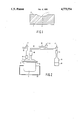
- FIG. 1 is a cross sectional view of a mold employed in the method of the drawing and
- FIG. 2 is a schematic view of an arrangement for carrying out the method of the invention.
- the hydrophilic, inorganic surface consists, in particular, of a metal such as Ni, Al, Ag or of glass or quartz.
- the mould may be made entirely of such a material but it may also be provided with an upper layer of metal, glass or quartz.
- An example thereof is a synthetic resin mould or a mould which is provided with a synthetic resin protective coating such as a protective coating of a UV-cured acrylate or methacrylate synthetic resin, the synthetic resin or synthetic resin coating being provided with a metal layer or, for example, a layer of SiO 2 .
- a metal layer such a layer may be provided by an electroless deposition process such as a vacuum deposition process, sputtering process or an electroless chemical process.
- This hydrophilic, inorganic surface contains hydroxyl (OH) groups which react with the group(s) X of the silane compound added, thereby forming oxygen bridges and separating out HX.
- OH hydroxyl
- one or more oxygen bridges can be formed with the inorganic surface.
- a silane compound which contains 3 ⁇ groups per molecule, 80 percent of the silane molecules are linked to the inorganic surface via two oxygen bridges.
- the R groups of the silane compound bonded to the inorganic surface extend outwardly and shield the entire surface. Consequently, the inorganic surface is changed to an inert surface of alkyl, alkoxyalkyl or fluorine-substituted alkyl or alkoxyalkyl, respectively.
- the R groups do not contain any reactive components, consequently no more layers can be chemically bonded to the layer of the surface-bonded silane compound.
- the layer bonded to the inorganic, hydrophilic surface of the silane compound is a monolayer having a very small thickness. A few more molecular layers may be physically bonded to the first molecular layer which is chemically bonded to the surface. Due to the very small thickness, the structure of the inorganic surface remains substantially unchanged.
- the hydrophilic, inorganic surface is treated with the vapour of the silane compound at a reduced pressure.
- This vapour-phase process is an elegant process which can be carried out under strictly anhydrous conditions. Preferably, it is carried out at a raised temperature.
- the hydrophilic, inorganic surface is treated with a solution of the silane compound in an anhydrous, organic solvent.
- a suitable solvent is dry toluene.
- a further advantageous embodiment of the method in accordance with the invention is characterized in that the hydrophilic, inorganic surface is treated with a silane compound of formula 1, where R is a fluoroalkyl group, branched or not, a fluoroalkoxy-alkyl group, branched or not, or an alkyl group, branched or not, having at least 10 carbon atoms.
- the hydrophilic, inorganic surface is treated with (heptadecafluorine 1,1,2,2-tetrahydrodecyl)-1-triethoxysilane, (heptadecafluorine 1,1,2,2-tetrahydrodecyl)-1-trichlorosilane, (heptadecafluorine 1,1,2,2-tetrahydrodecyl)-1-dimethylchlorosilane or with n-octadecyltrichlorosilane.
- silane compounds which may be applied in the method in accordance with the invention, are represented by the following formulae: ##STR1##
- the mould manufactured by the method in accordance with the invention may be used, for example, for the manufacture of synthetic resin optical components (lenses, mirrors) or optical components which are provided with a synthetic resin coating layer.
- the mould is made of, for example, Al, stainless steel, quartz or a synthetic resin which is provided with a layer of SiO 2 .
- a monolayer of the silane compound is applied in accordance with the inventive method to the inorganic, hydrophilic surface of the mould which during operation contacts the synthetic resin of the replica to be made.
- a further example is an Ni mould, the surface of which is modified in accordance with the process of the invention and which is used for the production of projection television screens.
- Reference numeral 1 in FIG. 1 denotes a mould which is made of Al.
- the mould 1 may also be made of another metal such as stainless steel or Ni, or of glass or quartz. It is also possible that mould 1 is made of a synthetic resin such as polycarbonate, epoxy synthetic resin or polymethyl methacrylate and that the upper surface is coated with a layer of SiO 2 which is applied by vacuum deposition.
- the mould shown in the figure is designed for producting optical components, in particular lenses.
- the mould is provided with a cavity 3 having an accurately polished aspherical surface 4.
- the upper surface 2 of mould 1 is purified by UV radiation in an ozone atmosphere for a few minutes. Said surface is hydrophilic and contains hydroxyl groups. Subsequently, the mould is positioned in a reaction vessel 5 (FIG. 2). This reaction vessel is provided with a flange 6. The vessel is closed by a cover 7 which is also provided with a flange 8. By means of a rubber ring (not shown) which is positioned between the flange portions 6 and 8, a vacuumtight sealing is obtained.
- the cover 7 is provided with two connections 9 and 10. Via a conduit 12 which is provided with a stop cock 11, the connection 9 is connected in a vacuumtight manner to a vacuum pump which is not shown.
- Connection 10 is connected in a vacuumtight manner to a conduit 13.
- Said conduit 13 is connected via a tap 14 to a supply pipe 15 for an inert gas, such as N 2 .
- the conduit 13 is furthermore connected to a connection 17 of a tank 18 which is provided with a quantity 19 of a silane compound which corresponds to one of the formulas (2)-(11), shown previously in this specification in particular a quantity of the substance (heptadecafluorine 1,1,2,2-tetrahydrodecyl)-1-triethoxysilane in accordance with the above given formula 5.
- Tap 11 is opened and the assembly is evacuated via the conduit 12.
- tap 16 is opened such that silane vapour from tank 18 is supplied to the reaction vessel 5 where it reacts with the hydrophilic surface of mould 1, a chemically bonded monolayer of the silane compound being formed as previously described.
- tap 16 is closed, the vacuum pump is disconnected and the silane vapour still present in the reaction vessel 5 is removed by flushing the vessel with an inert gas via conduit 15 and tap 14.
- the mould obtained is suitable for the production of synthetic resin copies or copies which are provided with a protective coating of a synthetic resin. This copies (replicas) can readily be released from the modified mould surface 2,4.
Landscapes
- Engineering & Computer Science (AREA)
- Chemical & Material Sciences (AREA)
- Mechanical Engineering (AREA)
- Nanotechnology (AREA)
- Physics & Mathematics (AREA)
- Composite Materials (AREA)
- Condensed Matter Physics & Semiconductors (AREA)
- General Physics & Mathematics (AREA)
- Materials Engineering (AREA)
- Crystallography & Structural Chemistry (AREA)
- Moulds For Moulding Plastics Or The Like (AREA)
- Laminated Bodies (AREA)
Applications Claiming Priority (2)
| Application Number | Priority Date | Filing Date | Title |
|---|---|---|---|
| NL8600809A NL8600809A (nl) | 1986-03-28 | 1986-03-28 | Methode om een matrijs te voorzien van een loslaag. |
| NL8600809 | 1986-03-28 |
Publications (1)
| Publication Number | Publication Date |
|---|---|
| US4775554A true US4775554A (en) | 1988-10-04 |
Family
ID=19847791
Family Applications (1)
| Application Number | Title | Priority Date | Filing Date |
|---|---|---|---|
| US07/027,915 Expired - Fee Related US4775554A (en) | 1986-03-28 | 1987-03-19 | Method of providing a mould with a release layer |
Country Status (5)
| Country | Link |
|---|---|
| US (1) | US4775554A (fr) |
| EP (1) | EP0244884B1 (fr) |
| JP (1) | JPH0796229B2 (fr) |
| DE (1) | DE3763894D1 (fr) |
| NL (1) | NL8600809A (fr) |
Cited By (19)
| Publication number | Priority date | Publication date | Assignee | Title |
|---|---|---|---|---|
| US4946369A (en) * | 1989-06-19 | 1990-08-07 | Dow Corning Corporation | Silicone mold and elastomer tool life |
| US5624512A (en) * | 1992-10-02 | 1997-04-29 | United Technologies Corporation | Method of curing composite articles using conformable vacuum bags |
| US20020130441A1 (en) * | 2001-01-19 | 2002-09-19 | Korry Electronics Co. | Ultrasonic assisted deposition of anti-stick films on metal oxides |
| US6461669B1 (en) * | 1999-09-22 | 2002-10-08 | Hanano Corporation | Coating mechanism and coating method of powdery mold releasing agent |
| US20020172895A1 (en) * | 2001-05-16 | 2002-11-21 | Breen Tricial L. | Vapor phase surface modification of composite substrates to form a molecularly thin release layer |
| US6506443B1 (en) * | 1999-03-04 | 2003-01-14 | Firma Carl Freudenberg | Method and device for applying surface-modifying auxiliary substances to working area interior surfaces of die molds |
| US6632872B1 (en) | 2000-09-19 | 2003-10-14 | 3M Innovative Properties Company | Adhesive compositions including self-assembling molecules, adhesives, articles, and methods |
| US20030192846A1 (en) * | 2002-04-16 | 2003-10-16 | White Michael J. | System for frontal display of objects |
| US6783719B2 (en) | 2001-01-19 | 2004-08-31 | Korry Electronics, Co. | Mold with metal oxide surface compatible with ionic release agents |
| US20040183220A1 (en) * | 2003-03-18 | 2004-09-23 | Avinash Dalmia | Ultra thin layer coating using self-assembled molecules as a separating layer for diffraction grating application |
| US20050148726A1 (en) * | 2003-12-30 | 2005-07-07 | Coggio William D. | Stain resistant grout |
| US20080012184A1 (en) * | 1995-11-15 | 2008-01-17 | Chou Stephen Y | Release Surfaces, Particularly For Use In Nanoimprint Lithography |
| US20080290249A1 (en) * | 2004-12-28 | 2008-11-27 | Nippon Soda Co., Ltd. | Forming Mold Or Electroforming Mother Die Having Release Layer And Method For Manufacturing The Same |
| US7704600B2 (en) | 2001-05-29 | 2010-04-27 | 3M Innovative Properties Company | Grout powder containing a fluorochemical compound |
| US20100233309A1 (en) * | 1995-11-15 | 2010-09-16 | Chou Stephen Y | Release surfaces, particularly for use in nanoimprint lithography |
| US20100267203A1 (en) * | 2009-04-17 | 2010-10-21 | Industrial Technology Research Institute | Method for isolating flexible film from support substrate |
| US20110012273A1 (en) * | 2008-03-19 | 2011-01-20 | Akiko Hara | Method for Producing Wafer Lens |
| US8202452B2 (en) * | 2010-09-21 | 2012-06-19 | Hon Hai Precision Industry Co., Ltd. | Mold for processing optical film and manufacturing method thereof |
| WO2013132079A1 (fr) * | 2012-03-08 | 2013-09-12 | Danmarks Tekniske Universitet | Revêtement de moule en aluminium à base de silane |
Families Citing this family (28)
| Publication number | Priority date | Publication date | Assignee | Title |
|---|---|---|---|---|
| EP0591545B1 (fr) * | 1992-03-30 | 1997-06-04 | Daikin Industries, Ltd. | Utilisation d'une composition comme agent de demoulage |
| US7758794B2 (en) | 2001-10-29 | 2010-07-20 | Princeton University | Method of making an article comprising nanoscale patterns with reduced edge roughness |
| US6309580B1 (en) * | 1995-11-15 | 2001-10-30 | Regents Of The University Of Minnesota | Release surfaces, particularly for use in nanoimprint lithography |
| US6482742B1 (en) * | 2000-07-18 | 2002-11-19 | Stephen Y. Chou | Fluid pressure imprint lithography |
| SE508968C2 (sv) * | 1996-12-19 | 1998-11-23 | Ericsson Telefon Ab L M | Förfarande för att göra elastiska kulor |
| SG94718A1 (en) | 1998-05-23 | 2003-03-18 | Samsung Electronics Co Ltd | Cartridge for an information recording medium |
| US6334960B1 (en) | 1999-03-11 | 2002-01-01 | Board Of Regents, The University Of Texas System | Step and flash imprint lithography |
| US6873087B1 (en) | 1999-10-29 | 2005-03-29 | Board Of Regents, The University Of Texas System | High precision orientation alignment and gap control stages for imprint lithography processes |
| KR100862301B1 (ko) | 2000-07-16 | 2008-10-13 | 보드 오브 리전츠, 더 유니버시티 오브 텍사스 시스템 | 임프린트 리소그래피를 위한 고분해능 오버레이 정렬 방법 및 시스템 |
| EP2270592B1 (fr) | 2000-07-17 | 2015-09-02 | Board of Regents, The University of Texas System | Procédé de formation d'un motif sur un substrat |
| CN1696826A (zh) | 2000-08-01 | 2005-11-16 | 得克萨斯州大学系统董事会 | 用对激活光透明的模板在衬底上形成图案的方法及半导体器件 |
| KR20020011727A (ko) * | 2000-08-04 | 2002-02-09 | 김승광 | 브라운관제조금형의 이형코팅제와 이를 이용한 코팅방법 |
| EP1352295B1 (fr) | 2000-10-12 | 2015-12-23 | Board of Regents, The University of Texas System | Gabarit pour photolithographie a temperature ambiante et basse pression produisant des empreintes de l'ordre du micron et du nanometre |
| US6964793B2 (en) | 2002-05-16 | 2005-11-15 | Board Of Regents, The University Of Texas System | Method for fabricating nanoscale patterns in light curable compositions using an electric field |
| SE519573C2 (sv) * | 2001-07-05 | 2003-03-11 | Obducat Ab | Stamp med antividhäftningsskikt samt sätt att framställa och sätt att reparera en sådan stamp |
| US7077992B2 (en) | 2002-07-11 | 2006-07-18 | Molecular Imprints, Inc. | Step and repeat imprint lithography processes |
| US6932934B2 (en) | 2002-07-11 | 2005-08-23 | Molecular Imprints, Inc. | Formation of discontinuous films during an imprint lithography process |
| US6916584B2 (en) | 2002-08-01 | 2005-07-12 | Molecular Imprints, Inc. | Alignment methods for imprint lithography |
| US7071088B2 (en) | 2002-08-23 | 2006-07-04 | Molecular Imprints, Inc. | Method for fabricating bulbous-shaped vias |
| US6929762B2 (en) | 2002-11-13 | 2005-08-16 | Molecular Imprints, Inc. | Method of reducing pattern distortions during imprint lithography processes |
| US6871558B2 (en) | 2002-12-12 | 2005-03-29 | Molecular Imprints, Inc. | Method for determining characteristics of substrate employing fluid geometries |
| US7452574B2 (en) | 2003-02-27 | 2008-11-18 | Molecular Imprints, Inc. | Method to reduce adhesion between a polymerizable layer and a substrate employing a fluorine-containing layer |
| US7122079B2 (en) | 2004-02-27 | 2006-10-17 | Molecular Imprints, Inc. | Composition for an etching mask comprising a silicon-containing material |
| US20040191639A1 (en) * | 2003-03-26 | 2004-09-30 | Danliang Jin | Micro-imprinting method and template for use in same |
| US7157036B2 (en) | 2003-06-17 | 2007-01-02 | Molecular Imprints, Inc | Method to reduce adhesion between a conformable region and a pattern of a mold |
| US7136150B2 (en) | 2003-09-25 | 2006-11-14 | Molecular Imprints, Inc. | Imprint lithography template having opaque alignment marks |
| JP4931518B2 (ja) * | 2006-08-31 | 2012-05-16 | 大阪瓦斯株式会社 | 皮膜を有する部材及び皮膜形成方法 |
| TW201615375A (zh) * | 2014-10-21 | 2016-05-01 | Nippon Soda Co | 有機薄膜製造方法 |
Citations (4)
| Publication number | Priority date | Publication date | Assignee | Title |
|---|---|---|---|---|
| US2306222A (en) * | 1940-11-16 | 1942-12-22 | Gen Electric | Method of rendering materials water repellent |
| CA446002A (fr) * | 1948-01-06 | H. Reckmeyer Verne | Methode de preparer des feuilles d'ecrans orthochromatiques | |
| US4263350A (en) * | 1979-12-31 | 1981-04-21 | Ppg Industries, Inc. | Silane release surfaces on glass |
| US4532096A (en) * | 1983-05-09 | 1985-07-30 | Bogner Ben R | Method of shaping articles using shaping surfaces having release agent coating |
Family Cites Families (7)
| Publication number | Priority date | Publication date | Assignee | Title |
|---|---|---|---|---|
| US3843399A (en) * | 1972-04-19 | 1974-10-22 | Rca Corp | Metallized video disc having an insulating layer thereon |
| JPS564402B2 (fr) * | 1973-04-12 | 1981-01-30 | ||
| US4146696A (en) * | 1976-08-11 | 1979-03-27 | Buckbee-Mears Company | Industrial production of cast plastic lenses |
| US4251277A (en) * | 1978-04-24 | 1981-02-17 | Sws Silicones Corporation | Compositions containing thiofunctional polysiloxanes |
| JPS5653038A (en) * | 1980-08-18 | 1981-05-12 | Asahi Chem Ind Co Ltd | Production of modified cast sheet by glass cell process |
| US4566930A (en) * | 1983-09-30 | 1986-01-28 | Canon Kabushiki Kaisha | Process for producing optical members |
| US4554215A (en) * | 1983-11-16 | 1985-11-19 | Edward Robbart | Coating of cellulosic base stocks and the product thereof |
-
1986
- 1986-03-28 NL NL8600809A patent/NL8600809A/nl not_active Application Discontinuation
-
1987
- 1987-03-03 DE DE8787200379T patent/DE3763894D1/de not_active Expired - Lifetime
- 1987-03-03 EP EP87200379A patent/EP0244884B1/fr not_active Expired
- 1987-03-19 US US07/027,915 patent/US4775554A/en not_active Expired - Fee Related
- 1987-03-28 JP JP62073030A patent/JPH0796229B2/ja not_active Expired - Lifetime
Patent Citations (4)
| Publication number | Priority date | Publication date | Assignee | Title |
|---|---|---|---|---|
| CA446002A (fr) * | 1948-01-06 | H. Reckmeyer Verne | Methode de preparer des feuilles d'ecrans orthochromatiques | |
| US2306222A (en) * | 1940-11-16 | 1942-12-22 | Gen Electric | Method of rendering materials water repellent |
| US4263350A (en) * | 1979-12-31 | 1981-04-21 | Ppg Industries, Inc. | Silane release surfaces on glass |
| US4532096A (en) * | 1983-05-09 | 1985-07-30 | Bogner Ben R | Method of shaping articles using shaping surfaces having release agent coating |
Cited By (27)
| Publication number | Priority date | Publication date | Assignee | Title |
|---|---|---|---|---|
| US4946369A (en) * | 1989-06-19 | 1990-08-07 | Dow Corning Corporation | Silicone mold and elastomer tool life |
| US5624512A (en) * | 1992-10-02 | 1997-04-29 | United Technologies Corporation | Method of curing composite articles using conformable vacuum bags |
| US8128856B2 (en) * | 1995-11-15 | 2012-03-06 | Regents Of The University Of Minnesota | Release surfaces, particularly for use in nanoimprint lithography |
| US20100233309A1 (en) * | 1995-11-15 | 2010-09-16 | Chou Stephen Y | Release surfaces, particularly for use in nanoimprint lithography |
| US20080012184A1 (en) * | 1995-11-15 | 2008-01-17 | Chou Stephen Y | Release Surfaces, Particularly For Use In Nanoimprint Lithography |
| US6506443B1 (en) * | 1999-03-04 | 2003-01-14 | Firma Carl Freudenberg | Method and device for applying surface-modifying auxiliary substances to working area interior surfaces of die molds |
| US6461669B1 (en) * | 1999-09-22 | 2002-10-08 | Hanano Corporation | Coating mechanism and coating method of powdery mold releasing agent |
| US6743470B2 (en) | 2000-09-19 | 2004-06-01 | 3M Innovative Properties Company | Method of modifying a surface molecules, adhesives, articles, and methods |
| US6632872B1 (en) | 2000-09-19 | 2003-10-14 | 3M Innovative Properties Company | Adhesive compositions including self-assembling molecules, adhesives, articles, and methods |
| US6852266B2 (en) | 2001-01-19 | 2005-02-08 | Korry Electronics Co. | Ultrasonic assisted deposition of anti-stick films on metal oxides |
| US20020130441A1 (en) * | 2001-01-19 | 2002-09-19 | Korry Electronics Co. | Ultrasonic assisted deposition of anti-stick films on metal oxides |
| US6783719B2 (en) | 2001-01-19 | 2004-08-31 | Korry Electronics, Co. | Mold with metal oxide surface compatible with ionic release agents |
| US6673287B2 (en) * | 2001-05-16 | 2004-01-06 | International Business Machines Corporation | Vapor phase surface modification of composite substrates to form a molecularly thin release layer |
| US20020172895A1 (en) * | 2001-05-16 | 2002-11-21 | Breen Tricial L. | Vapor phase surface modification of composite substrates to form a molecularly thin release layer |
| US7704600B2 (en) | 2001-05-29 | 2010-04-27 | 3M Innovative Properties Company | Grout powder containing a fluorochemical compound |
| US20030192846A1 (en) * | 2002-04-16 | 2003-10-16 | White Michael J. | System for frontal display of objects |
| US20040183220A1 (en) * | 2003-03-18 | 2004-09-23 | Avinash Dalmia | Ultra thin layer coating using self-assembled molecules as a separating layer for diffraction grating application |
| US20050148726A1 (en) * | 2003-12-30 | 2005-07-07 | Coggio William D. | Stain resistant grout |
| US8361375B2 (en) | 2004-12-28 | 2013-01-29 | Nippon Soda Co., Ltd. | Forming mold or electroforming mother die having release layer and method for manufacturing the same |
| US20080290249A1 (en) * | 2004-12-28 | 2008-11-27 | Nippon Soda Co., Ltd. | Forming Mold Or Electroforming Mother Die Having Release Layer And Method For Manufacturing The Same |
| US20110012273A1 (en) * | 2008-03-19 | 2011-01-20 | Akiko Hara | Method for Producing Wafer Lens |
| US20100267203A1 (en) * | 2009-04-17 | 2010-10-21 | Industrial Technology Research Institute | Method for isolating flexible film from support substrate |
| US8883053B2 (en) * | 2009-04-17 | 2014-11-11 | Industrial Technology Research Institute | Method for isolating flexible film from support substrate |
| US8202452B2 (en) * | 2010-09-21 | 2012-06-19 | Hon Hai Precision Industry Co., Ltd. | Mold for processing optical film and manufacturing method thereof |
| WO2013132079A1 (fr) * | 2012-03-08 | 2013-09-12 | Danmarks Tekniske Universitet | Revêtement de moule en aluminium à base de silane |
| CN104284763A (zh) * | 2012-03-08 | 2015-01-14 | 丹麦技术大学 | 铝模具的硅烷基涂层 |
| US9475214B2 (en) | 2012-03-08 | 2016-10-25 | Danmarks Tekniske Universitet | Silane based coating of aluminium mold |
Also Published As
| Publication number | Publication date |
|---|---|
| NL8600809A (nl) | 1987-10-16 |
| DE3763894D1 (de) | 1990-08-30 |
| EP0244884A1 (fr) | 1987-11-11 |
| EP0244884B1 (fr) | 1990-07-25 |
| JPS62236713A (ja) | 1987-10-16 |
| JPH0796229B2 (ja) | 1995-10-18 |
Similar Documents
| Publication | Publication Date | Title |
|---|---|---|
| EP0244884B1 (fr) | Procédé pour munir un moule d'une couche de démoulage | |
| CN1152153C (zh) | 用于制备光学基体上防水涂层的材料及方法 | |
| US4006271A (en) | Abrasion resistant coating for polycarbonate substrates | |
| US5334454A (en) | Articles by plasma-activated chemical vapor deposition of fluorinated cyclic siloxanes | |
| KR100538684B1 (ko) | 나노구조 성형체 및 층 그리고 그것의 제조방법 | |
| CA2153002A1 (fr) | Revetements a base de fluorosilicone | |
| FR2483325A1 (fr) | Composition de couche de fond a base de methacrylate pour piece a revetement superficiel de polyorganosiloxane | |
| ATE95574T1 (de) | Verfahren zur gesteigerten abscheidung von siliciumoxid durch plasma. | |
| DE3390171T1 (de) | Verfahren zur Erzeugung eines abriebfesten Überzugs auf einem festen Substrat und dadurch hergestellte Gegenstände | |
| US4091166A (en) | Boron trifluoride coatings for thermoplastic materials and method of applying same in glow discharge | |
| Kron et al. | Functional coatings on glass using ORMOCER®-systems: Code: BP20 | |
| JP2000127290A (ja) | バリア被覆および高出力プラズマ化学気相成長法によってプラスチック物体上にバリア被覆を堆積する方法 | |
| NL8204783A (nl) | Werkwijze voor het aanbrengen van een metaallaag op een substraat. | |
| EP0506432A1 (fr) | Polysilane et composition à base de polysilane | |
| US6797207B2 (en) | Process for producing organic thin film | |
| US5897925A (en) | Fog-resistant microporous SiOH films and the method of manufacturing the same | |
| JPS60231442A (ja) | 撥水処理硝子の製造方法 | |
| EP0699926A1 (fr) | Lentille en matiere plastique et composition pour couche de base | |
| EP0144705B1 (fr) | Milieu d'enregistrement optique et procédé de sa fabrication | |
| US6833159B1 (en) | Method for applying hydrophobic anti-reflection coatings to lenses and lens blanks | |
| US20040076750A1 (en) | Method for applying a coating to an optical substrate by thermal vaporization of an organosilicon compound using a non-sintered porous inorganic oxide matrix material | |
| EP0123334B1 (fr) | Matrice et procédé pour fabriquer des articles de résine synthétique en utilisant cette matrice | |
| JP2000109581A (ja) | バリア被覆および高出力プラズマ化学気相成長法によってプラスチック物体上にバリア被覆を堆積する方法 | |
| KR100315935B1 (ko) | 광학기재상에발수성피막을제조하기위한물질및그피막의제조방법 | |
| US5089303A (en) | Blend of solvent and photocurable arylsiloxane materials |
Legal Events
| Date | Code | Title | Description |
|---|---|---|---|
| AS | Assignment |
Owner name: U.S. PHILIPS CORPORATION, 100 EAST 42ND STREET, NE Free format text: ASSIGNMENT OF ASSIGNORS INTEREST.;ASSIGNOR:PONJEE, JOHANNES J.;REEL/FRAME:004740/0326 Effective date: 19870625 Owner name: U.S. PHILIPS CORPORATION,NEW YORK Free format text: ASSIGNMENT OF ASSIGNORS INTEREST;ASSIGNOR:PONJEE, JOHANNES J.;REEL/FRAME:004740/0326 Effective date: 19870625 |
|
| FEPP | Fee payment procedure |
Free format text: PAYOR NUMBER ASSIGNED (ORIGINAL EVENT CODE: ASPN); ENTITY STATUS OF PATENT OWNER: LARGE ENTITY |
|
| FPAY | Fee payment |
Year of fee payment: 4 |
|
| REMI | Maintenance fee reminder mailed | ||
| LAPS | Lapse for failure to pay maintenance fees | ||
| FP | Lapsed due to failure to pay maintenance fee |
Effective date: 19961009 |
|
| STCH | Information on status: patent discontinuation |
Free format text: PATENT EXPIRED DUE TO NONPAYMENT OF MAINTENANCE FEES UNDER 37 CFR 1.362 |