JP3781402B2 - Low thermal expansion Ni-base superalloy - Google Patents
Low thermal expansion Ni-base superalloy Download PDFInfo
- Publication number
- JP3781402B2 JP3781402B2 JP05605999A JP5605999A JP3781402B2 JP 3781402 B2 JP3781402 B2 JP 3781402B2 JP 05605999 A JP05605999 A JP 05605999A JP 5605999 A JP5605999 A JP 5605999A JP 3781402 B2 JP3781402 B2 JP 3781402B2
- Authority
- JP
- Japan
- Prior art keywords
- less
- thermal expansion
- low thermal
- base superalloy
- present
- Prior art date
- Legal status (The legal status is an assumption and is not a legal conclusion. Google has not performed a legal analysis and makes no representation as to the accuracy of the status listed.)
- Expired - Fee Related
Links
Classifications
-
- C—CHEMISTRY; METALLURGY
- C22—METALLURGY; FERROUS OR NON-FERROUS ALLOYS; TREATMENT OF ALLOYS OR NON-FERROUS METALS
- C22C—ALLOYS
- C22C19/00—Alloys based on nickel or cobalt
- C22C19/03—Alloys based on nickel or cobalt based on nickel
- C22C19/05—Alloys based on nickel or cobalt based on nickel with chromium
- C22C19/051—Alloys based on nickel or cobalt based on nickel with chromium and Mo or W
- C22C19/057—Alloys based on nickel or cobalt based on nickel with chromium and Mo or W with the maximum Cr content being less 10%
-
- C—CHEMISTRY; METALLURGY
- C22—METALLURGY; FERROUS OR NON-FERROUS ALLOYS; TREATMENT OF ALLOYS OR NON-FERROUS METALS
- C22C—ALLOYS
- C22C19/00—Alloys based on nickel or cobalt
- C22C19/03—Alloys based on nickel or cobalt based on nickel
- C22C19/05—Alloys based on nickel or cobalt based on nickel with chromium
- C22C19/051—Alloys based on nickel or cobalt based on nickel with chromium and Mo or W
- C22C19/055—Alloys based on nickel or cobalt based on nickel with chromium and Mo or W with the maximum Cr content being at least 20% but less than 30%
-
- C—CHEMISTRY; METALLURGY
- C22—METALLURGY; FERROUS OR NON-FERROUS ALLOYS; TREATMENT OF ALLOYS OR NON-FERROUS METALS
- C22C—ALLOYS
- C22C19/00—Alloys based on nickel or cobalt
- C22C19/03—Alloys based on nickel or cobalt based on nickel
- C22C19/05—Alloys based on nickel or cobalt based on nickel with chromium
- C22C19/051—Alloys based on nickel or cobalt based on nickel with chromium and Mo or W
- C22C19/056—Alloys based on nickel or cobalt based on nickel with chromium and Mo or W with the maximum Cr content being at least 10% but less than 20%
-
- C—CHEMISTRY; METALLURGY
- C22—METALLURGY; FERROUS OR NON-FERROUS ALLOYS; TREATMENT OF ALLOYS OR NON-FERROUS METALS
- C22F—CHANGING THE PHYSICAL STRUCTURE OF NON-FERROUS METALS AND NON-FERROUS ALLOYS
- C22F1/00—Changing the physical structure of non-ferrous metals or alloys by heat treatment or by hot or cold working
- C22F1/10—Changing the physical structure of non-ferrous metals or alloys by heat treatment or by hot or cold working of nickel or cobalt or alloys based thereon
Landscapes
- Chemical & Material Sciences (AREA)
- Engineering & Computer Science (AREA)
- Materials Engineering (AREA)
- Mechanical Engineering (AREA)
- Metallurgy (AREA)
- Organic Chemistry (AREA)
- Physics & Mathematics (AREA)
- Thermal Sciences (AREA)
- Crystallography & Structural Chemistry (AREA)
- Turbine Rotor Nozzle Sealing (AREA)
- Organic Low-Molecular-Weight Compounds And Preparation Thereof (AREA)
- Chemically Coating (AREA)
- Manufacture And Refinement Of Metals (AREA)
Abstract
Description
【0001】
【発明の属する技術分野】
本発明は、低熱膨張Ni基超合金、詳細には高強度であるとともに耐食・耐酸化性に優れた低熱膨張Ni基超合金に関する。
【0002】
【従来の技術】
従来、蒸気タービンおよびガスタービン機器の車室などの高温に加熱される圧力容器部材に使用される高温用のボルト材には、フェライト系12Cr鋼(C:0.12%,Si:0.04%,Mn:0.7 %,P:0.1 %,Ni:0.4 %,Cr:10.5%,Mo:0.5 %,Cu:0.03%,V:0.2 %,W:1.7 %,Nb:0.1 %,Fe:残部)やオーステナイト系耐熱合金(Cr:10.5%,Mn:0.4 %,Al:1.4 %,Ti:2.4 %,Sl:0.3 %,C:0.06%,Zr:0.06%,B:0.003 %,Ni:残部のNimonic alloy 80A 、Cr:18%,Co:20%,Mo:3 %,Ti:2.6 %,Fe:16%,C:0.05%,Ni:残部のRefractaloy26)が使用されている。
【0003】
近年、蒸気タービンの熱効率を向上させるため、蒸気温度をさらに上昇させており、高温用ボルトはますます過酷な条件で使用されるようになっている。この様な過酷な条件のところに上記各材料を高温ボルトに使用する場合、フェライト系12Cr鋼は、コストが低く、製造性に優れているが、現在より蒸気温度等が高くなると高温強度が不足するという問題があり、またオーステナイト系耐熱合金は、フェライト系12Cr鋼より耐食・耐酸化性に優れ、かつ高い高温強度を有するが、線膨張係数が大きいため、ボルトの締め付け力の不足による蒸気漏れなどの問題が生じるとともに、熱疲労が発生するという問題があり、より高温で使用される部材に用いられるには問題が大きい。
【0004】
耐食・耐酸化性に優れた低熱膨張Ni基超耐熱合金としてC:0.2%以下、Si:1%以下、Mn:1%以下、Cr:10〜24%、MoおよびWの1種または2種をMo+ 1/2W:5〜17%、Al:0.5〜2%、Ti:1〜3%、Fe:10%以下、B:0.02%以下およびZr:0.2%以下の1種または2種を含有し、必要に応じてCo:5%以下、Nb:1.0%以下を含有し、残部Niと不可避的不純物からなるものが特開平9─157779号公報に開示されており、同様なものが、特開平8─85838号公報に開示されている。
【0005】
また、線膨張係数の低い合金として、ジェットエンジン用部材として開発されたインバー合金のインコネル783(Cr:3.21%、Mn:0.08%、Al:5.4 %、Ti:0.2 %、Si:0.07%、C:0.03%、B:0.003 %、Fe:24.5 %、Ni:28.2%、Co:35.3 %、比較例のNo.2) が知られている。この合金は、Fe─Ni−Coのバランスでキューリー点を調整し、強磁性体状態で低い線膨張係数を持つものであるが、この合金を蒸気タービンなどに使用するには耐食性が不足しているという問題がある。
【0006】
【本発明が解決しようとする課題】
本発明は、12Cr鋼と同等の線膨張係数を持ち、かつ上記オーステナイト系耐熱合金と同様の高温強度と耐食・耐酸化性を持つ低熱膨張Ni基超合金を提供することを課題としている。
【0007】
【課題を解決するための手段】
上記課題を解決するため、本発明者達は、低熱膨張Ni基超合金について鋭意研究していたところ、Mo、WおよびReについて、Mo+ 1/2(W+Re)で表される値が10以上になると目標の熱膨張率が得られること、このとき、熱膨張率を大きくするCrは15%以下であることが必要であること、またMo+ 1/2(W+Re)を17を超える値とし、Crを10%未満にするとより熱膨張率が低下すること、Crは従来のNi基耐熱合金より低くても蒸気中の水蒸気酸化の問題がないことなどの知見を得て本発明をなしたものである。
【0008】
すなわち、本発明の低熱膨張Ni基超合金においては、C:0.15%以下、Si:1%以下、Mn:1%以下、Cr:5〜15%、Mo、WおよびReの1種または2種以上をMo+ 1/2(W+Re):17超〜25%、Al:0.2〜2%、Ti:0.5〜4.5%、Fe:10%以下、B:0.02%以下およびZr:0.2%以下の1種または2種を含有し、必要に応じてNbおよびTaのうちの1種または2種をNb+ 1/2Taで1.5%以下を含有し、さらに必要に応じて、Co:5%以下含有し、Nb、Taを含有しない場合にはAl+Tiの原子%を2.5〜7.0%とし、Nb、Taを含有する場合にはAl+Ti+Nb+Taの原子%を2.5〜7.0%とし、残部Niと不可避的不純物からなるものとすることである。
【0009】
なお、上記「Mo、WおよびReの1種または2種以上をMo+ 1/2(W+Re):17超〜25%」は、Mo、WおよびReの1種または2種以上をMo+ 1/2(W+Re)の式で計算して17超〜25%の範囲にすることを意味するものである。
また、上記「NbおよびTaの1種または2種をNb+ 1/2Ta:1.5%以下」は、NbおよびTaのうちの1種または2種をNb+ 1/2Ta:1.5%以下の式で計算して1.5%以下であることを意味するものである。
【0010】
さらに、本発明の低熱膨張Ni基超合金においては、C:0.15%以下、Si:1%以下、Mn:1%以下、Cr:5〜15%、Mo、WおよびReの1種または2種以上をMo+ 1/2(W+Re):10〜25%、Al:0.2〜0.4未満%、Ti:0.5〜4.5%、Fe:10%以下、B:0.02%以下およびZr:0.2%以下の1種または2種を含有し、必要に応じてNbおよびTaのうちの1種または2種をNb+ 1/2Taで1.5%以下を含有し、さらに必要に応じて、Co:5%以下含有し、Nb、Taを含有しない場合にはAl+Tiの原子%を2.5〜7.0%とし、Nb、Taを含有する場合にはAl+Ti+Nb+Taの原子%を2.5〜7.0%とし、残部Niと不可避的不純物からなるものとすることである。
【0011】
また、本発明の低熱膨張Ni基超合金においては、C:0.15%以下、Si:1%以下、Mn:1%以下、Cr:5〜15%、Mo、WおよびReの1種または2種以上をMo+ 1/2(W+Re):10〜25%、Al:0.2〜2.0%、Ti:3.5超〜4.5%、Fe:10%以下、B:0.02%以下およびZr:0.2%以下の1種または2種を含有し、必要に応じてNbおよびTaのうちの1種または2種をNb+ 1/2Taで1.5%以下を含有し、さらに必要に応じて、Co:5%以下含有し、Nb、Taを含有しない場合にはAl+Tiの原子%を2.5〜7.0%とし、Nb、Taを含有する場合にはAl+Ti+Nb+Taの原子%を2.5〜7.0%とし、残部Niと不可避的不純物からなるものとすることである。
【0012】
また、本発明の低熱膨張Ni基超合金は、上記低熱膨張Ni基超合金の室温ないし700℃の平均膨張係数が、14.0×10⁻⁶/℃以下のものとすることである。
【0013】
【発明の実施の形態】
次に、本発明において、成分組成を上記のように特定した理由を説明する。
C:0.15%以下
Cは、Ti、Nb、CrおよびMoと結合して炭化物を形成し、高温強度を高めるとともに、結晶粒の粗大化を防止するために含有させる元素であるが、0.15%より多いと熱間加工性を低下するので、その含有量を0.15%以下とする。望ましくは、0.10%以下である。
【0014】
Si:1%以下
Siは、脱酸剤として添加されるばかりでなく、耐酸化性を改善させるために含有させる元素であるが、1%を超えて含有させると延性を低下するので、その含有量を1%以下とする。望ましくは0.5%以下である。
Mn:1%以下
Mnは、Siと同様に脱酸剤として添加されるが、1%を超えて添加すると高温酸化特性が悪くなるばかりでなく、延性を害するη相(Ni3 Ti)の析出を助長するので、その含有量を1%以下とする。望ましくは0.5%以下である。
【0015】
Cr:5〜15%
Crは、オーステナイト相に固溶し、高温酸化および腐食を改善させるために含有させる元素である。十分な耐高温酸化および腐食特性を維持するためには多いほうが望ましていが、熱膨張係数を増加する元素であるので、熱膨張の観点からは少ないほうが望ましい。本発明が目的とした使用温度の650〜700℃付近において、目的の熱膨張率を得るためにはCr量は5〜15%にする必要がある。より低い熱膨張率を得るためにはCr量を5〜10未満%にするのが望ましい。
【0016】
Mo+ 1/2(W+Re):10〜25%
Mo、WおよびReは、オーステナイト相に固溶し、固溶強化によって高温強度を高めるとともに熱膨張率を下げるために含有させる元素である。本発明の目的とする熱膨張率を得るためには、これらの元素の1種または2種以上のMo+ 1/2(W+Re)の総和が最低10%以上必要であり、また、この総和が25%を超えると、熱間加工性が低下するばかりでなく、脆化相が析出して延性が低下するので、Mo+ 1/2(W+Re)の含有量を10〜25%とする。さらに、より低い熱膨張率を得るためにはMo+ 1/2(W+Re)を17超〜25%にするのが望ましい。
【0017】
Ti:0.5〜4.5%
Tiは、Niと結合してγ′相を形成し、γ′相を強化するとともに熱膨張係数を低下させ、またγ′相の時効析出硬化を促進させるために含有させる元素である。この効果を得るためには0.8%以上含有させる必要があるが、4.5%以上含有させると脆化相のη相(Ni3 Ti)を析出させる結果となり、延性の低下をまねくので、その含有量を0.5〜4.5%とする。本発明が目的とする使用温度の700℃において十分な強度と低い熱膨張率をえるためには3.5%を超え、4.5%以下が望ましい。
【0018】
Al:0.2〜2.0%
Alは、Niと結合してγ′相を形成し析出強化する最も重要な元素であるので、そのために含有させるものである。この含有量が0.2%より少ないとγ′相の析出が十分でなく、またTiやNbとTaが多量に存在する場合には、γ′相が不安定にη相やδ相が析出して脆化を起こし、2.0%より多いと熱間加工性が低下し、部品への鍛造成形が不可能になるので、その含有量を0.2〜2.0%とする。望ましい範囲は0.2〜0.4未満%である。
【0019】
Fe:10%以下
Feは、合金のコストを低減するために原料として安価なスクラップやW、MoなどのFeを含む安価な母合金を用いることにより含まれる不純物であり、高温強度を低下させ、熱膨張率を高くする元素であるので、少ないほうが望ましいが、10%以下であれば、高温強度および熱膨張率に及ぼす影響がわずかであるので、その含有量を10%以下とする。望ましくは5%以下、より望ましくは2%以下である。
【0020】
B:0.02%以下、Zr:0.2%以下
BおよびZrは、結晶粒界に偏析してクリープ強度を高めるほか、BはTiの多い合金ではη相の析出を押さえる効果があるので、そのために含有させる元素であるが、過剰に含有させると熱間加工性が低下し、Zrはクリープ特性を害するので、Bの含有量を0.02%以下、Zrの含有量を0.2%以下とする。
Co:5%以下
Coは、合金に固溶して、高温強度を高くするので、そのために含有させる元素であるが、その効果は他の元素に比較して小さく、また高価であるので、その含有量を5%以下とする。
【0021】
Nb+ 1/2Ta:1.5%以下
NbおよびTaは、Ni基超合金の析出強化相であるγ′相(Ni3(Al、Nb、Ta))を形成する元素であり、γ′相の強化を図るばかりでなく、γ′相の巨大化を防ぐ効果があるので、そのために含有させる元素であるが、多く含有させ過ぎるとδ相(Ni3(Nb 、Ta))が析出して延性を低下するので、その含有量をNb+ 1/2Taで1.5%とする。また、望ましい範囲は1.0%以下である。
Ni:残
Niは、マトリックスであるオーステナイトを形成する主元素であり、耐熱性および耐食性を向上させる元素である。また析出強化相であるγ′相を形成する元素でもある。
【0022】
Al+Ti:原子%で2.5〜7.0%、Al+Ti+Nb+Ta:原子%で2.5〜7.0%
Al、Ti、NbおよびTaは、γ′相の構成元素であるので、十分なNiが存在している場合には、γ′相の析出体積率はこれら元素の原子%の総和に比例する。また高温強度は、γ′相の体積率に比例することから、これら元素の総和に比例して高温強度は増加する。そのため、本発明が目的とする十分な強度を発揮するには2.5%以上必要であるが、7.0%を超えるとγ′相の体積率が多くなり過ぎて熱間加工性を著しく低下するので、これらの含有量を原子%で2.5〜7.0%とする。望ましくは原子%で3.5〜6.0%である。
【0023】
その他の元素
Mg、Ca、P、SおよびCuは、Mg:0.03%以下、Ca:0.03%以下、P:0.05%以下、S:001%以下、Cu:2%以下であれば、本発明の低熱膨張Ni基超合金の特性を低下することがない。
【0024】
本発明の低熱膨張Ni基超合金は、従来からあるNi基超合金と同様な方法で製造することができる。またその熱処理は、950℃以上の固溶化熱処理の後、1段時効(700〜850℃)および2段時効(1段目:800〜900℃、2段目:700〜800℃)のいずれも有効である。
【0025】
【実施例】
次に、本発明の実施例を説明する。
下記表1に示す組成の合金を容量50kgの真空誘導炉を用いて溶解し、50kgのインゴットを鋳造した。これらのインゴットの鋳肌部を旋削除去し、その後1150℃で15hr均質化熱処理した後、60mm角の棒に鍛造した。これらの鍛造した棒材を1100℃で2hr加熱したあと水冷する固溶化熱処理をした後、750℃で16hr加熱する時効処理を行った。これらの熱処理材から試験片を切り出して下記各種の試験を実施し、下記表2に示した。
【0026】
熱膨張率の測定は、理学電気製熱機械分析装置TMAで、標準試料に石英を用い、示差膨張方式によって、昇温速度5℃/minの条件で、室温から700℃までの平均熱膨張率を測定した。用いた試験片はφ5×L19である。
高温引張試験は、平行部6mmのツバ付き引張試験片を用い、JISの高温引張試験法に準拠して700℃で行った。
クリープ破断試験は、平行部6.4mmの試験片を用い、700℃で、負荷応力343MPaで実施した。
蒸気タービン部材で問題となる水蒸気酸化試験は、幅10mm、長さ10mm、厚さ5mmの試験片を用い、温度600℃で100時間の試験を行い、試験後の酸化増量を測定した。試験環境は、常圧で、蒸気濃度83%、水蒸気流量7.43ml/sであった。
【0027】
【表1】
【表2】
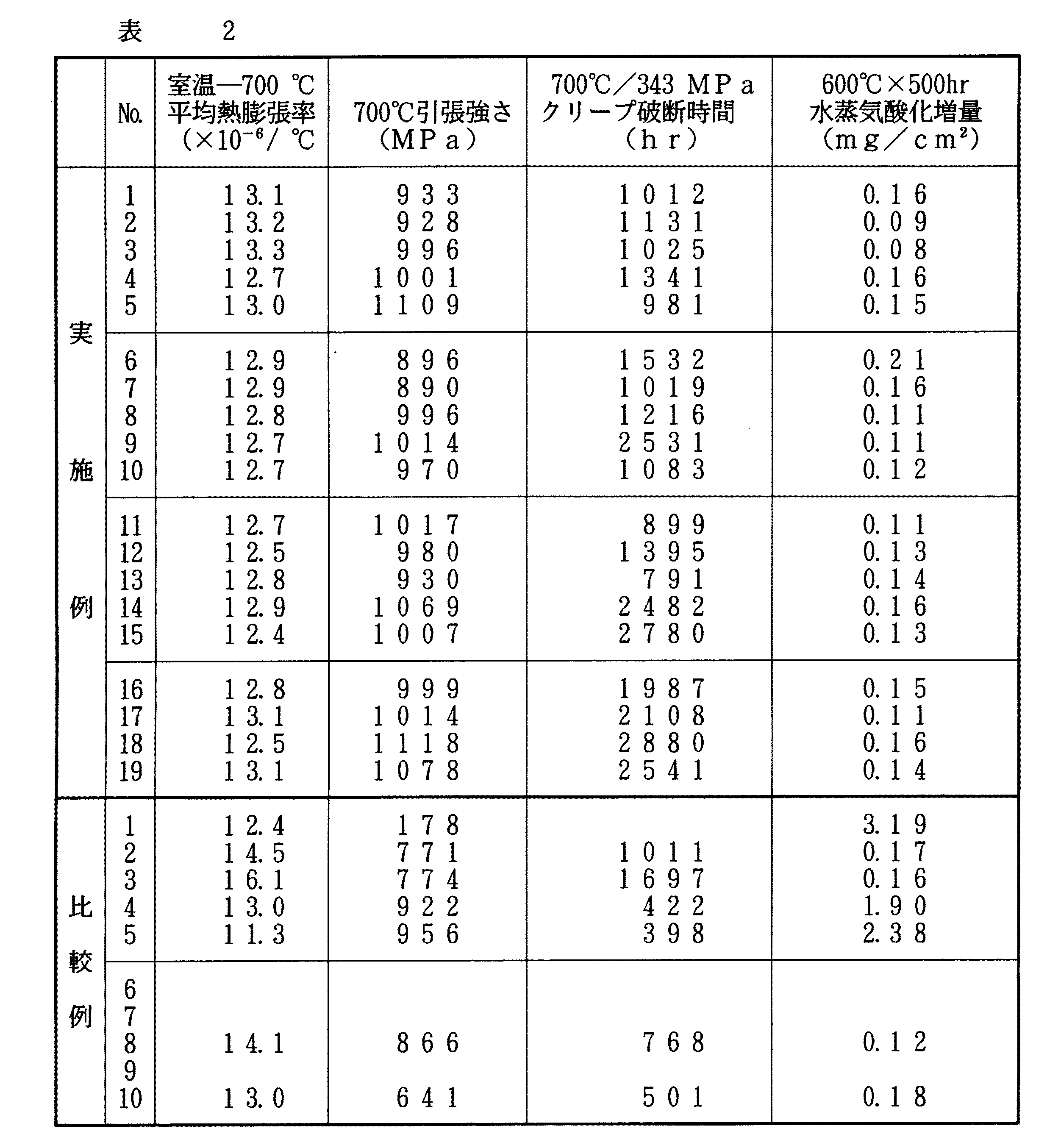
これらの結果より、本発明例のものは、いずれも室温から700℃までの平均熱膨張率が14.0×10⁻⁶/℃以下であり、また700℃における引張強さは890〜1118MPaであった。また、クリープ破断寿命が791〜2880hrであり、水蒸気酸化増量が0.05〜0.21mg/cm2 であった。
一方、比較例1は、フェライト系12Cr鋼であり、平均熱膨張率が12.4×10⁻⁶/℃と低いが、高温引張強度が本発明例のものに比べ著しく低かった。また比較例2,3は、高温ボルト材として知られているNimonic80AおよびRefractaloy26 であるが、この合金の平均熱膨張率がそれぞれ14.5×10⁻⁶/℃および16.1×10-6/℃であり、本発明例のものより大きかった。比較例4および比較例5は、Inconel783およびIncoloy909であり、平均熱膨張率が本発明例のものと同等またはそれより低いが、水蒸気酸化特性が本発明例のものより悪かった。
【0030】
比較例6は、Al含有量が本発明の上限を超え、またAl+Tiの総量も本発明の上限を超えた合金であるが、熱処理の固溶化処理時の水冷において素材に割れが発生した。また、比較例7は、Al+Tiの総量が本発明の上限を超えたものであるが、比較例6と同様に固溶化処理時の水冷において素材に割れが発生し、その後の評価ができなかった。
比較例8は、本発明よりCrが多く、またMo+ 1/2(W+Re)の値が小さい合金で、平均熱膨張率が14.1×10-6/℃と大きかった。
比較例9は、本発明よりMo+ 1/2(W+Re)が多く、この合金は鍛造性が悪く、鍛造時に割れが発生し、その後の評価ができなかった。
比較例10は、Al+Tiの総量が本発明より低く、γ′相の析出量が十分でないため、高温強度が本発明のものに比較して小さくなっていた。
【0031】
【発明の効果】
本発明の低熱膨張Ni基超合金は、上記成分組成にしたことにより、平均熱膨張率が14.0×10⁻⁶/℃以下で12Cr鋼とほぼ同等であり、またクリープ破断寿命が791〜2880hrおよび水蒸気酸化増量が0.05〜0.21mg/cm2 で、上記オーステナイト系耐熱合金とほぼ同様の高温強度と耐食・耐酸化性を持っているという優れた効果を奏する。
また、本発明の低熱膨張Ni基超合金は、蒸気タービン、ガスタービンおよびジェットエンジンのボルト、翼ならびにディスク、加熱機器のボイラーチューブ、圧力機などへ適用することにより火力発電プラントの信頼性の向上につながるという優れた効果を奏する。[0001]
BACKGROUND OF THE INVENTION
The present invention relates to a low thermal expansion Ni-base superalloy, and more particularly to a low thermal expansion Ni-base superalloy having high strength and excellent corrosion resistance and oxidation resistance.
[0002]
[Prior art]
Conventionally, a high-temperature bolt material used for a pressure vessel member heated to a high temperature such as a casing of a steam turbine and a gas turbine equipment includes ferritic 12Cr steel (C: 0.12%, Si: 0.04%, Mn: 0.7%, P: 0.1%, Ni: 0.4%, Cr: 10.5%, Mo: 0.5%, Cu: 0.03%, V: 0.2%, W: 1.7%, Nb: 0.1%, Fe: balance) and austenitic Heat-resistant alloy (Cr: 10.5%, Mn: 0.4%, Al: 1.4%, Ti: 2.4%, Sl: 0.3%, C: 0.06%, Zr: 0.06%, B: 0.003%, Ni: remaining Nimonic alloy 80A Cr: 18%, Co: 20%, Mo: 3%, Ti: 2.6%, Fe: 16%, C: 0.05%, Ni: remaining Refractaloy26).
[0003]
In recent years, in order to improve the thermal efficiency of the steam turbine, the steam temperature has been further increased, and high-temperature bolts have been used under increasingly severe conditions. When these materials are used for high-temperature bolts under such severe conditions, ferritic 12Cr steel is low in cost and excellent in manufacturability, but lacks high-temperature strength when the steam temperature etc. is higher than present. Austenitic heat-resistant alloys have better corrosion and oxidation resistance than ferritic 12Cr steel and have high high-temperature strength, but because of their large linear expansion coefficient, steam leakage due to insufficient bolt tightening force In addition to the above problems, there is a problem that thermal fatigue occurs, and the problem is large when used for a member used at a higher temperature.
[0004]
As a low thermal expansion Ni-based super heat-resistant alloy excellent in corrosion resistance and oxidation resistance, C: 0.2% or less, Si: 1% or less, Mn: 1% or less, Cr: 10 to 24%, one of Mo and W or Two types: Mo + 1 / 2W: 5 to 17%, Al: 0.5 to 2%, Ti: 1 to 3%, Fe: 10% or less, B: 0.02% or less, and Zr: 0.2% or less Disclosed in Japanese Patent Laid-Open No. 9-157779, which contains one or two of the following, Co: 5% or less, Nb: 1.0% or less as required, and the balance Ni and inevitable impurities A similar one is disclosed in Japanese Patent Laid-Open No. 8-85838.
[0005]
Moreover, as an alloy with a low coefficient of linear expansion, Inconel 783 of Invar alloy developed as a member for jet engines (Cr: 3.21%, Mn: 0.08%, Al: 5.4%, Ti: 0.2%, Si: 0.07%, C : 0.03%, B: 0.003%, Fe: 24.5%, Ni: 28.2%, Co: 35.3%, No. 2) of the comparative example is known. This alloy adjusts the Curie point with the balance of Fe-Ni-Co and has a low coefficient of linear expansion in the ferromagnetic state. However, this alloy has insufficient corrosion resistance to use it for steam turbines and the like. There is a problem that.
[0006]
[Problems to be solved by the present invention]
An object of the present invention is to provide a low thermal expansion Ni-base superalloy having a linear expansion coefficient equivalent to that of 12Cr steel and having the same high-temperature strength and corrosion / oxidation resistance as the austenitic heat-resistant alloy.
[0007]
[Means for Solving the Problems]
In order to solve the above-mentioned problems, the present inventors have intensively studied a low thermal expansion Ni-base superalloy. As for Mo, W and Re, the value represented by Mo + 1/2 (W + Re) is 10 or more. comes to the target thermal expansion coefficient is obtained, and this time, it is Cr to increase the thermal expansion coefficient is required to be below 15%, also a value in excess of Mo + 1/2 (W + Re) 17, The present invention has been made based on the knowledge that the coefficient of thermal expansion is further reduced when Cr is less than 10%, and that there is no problem of steam oxidation in steam even if Cr is lower than conventional Ni-based heat-resistant alloys. It is.
[0008]
That is, in the low thermal expansion Ni-base superalloy of the present invention, C: 0.15% or less, Si: 1% or less, Mn: 1% or less, Cr: 5 to 15 %, one of Mo, W and Re Two or more of Mo + 1/2 (W + Re): more than 17 to 25%, Al: 0.2 to 2%, Ti: 0.5 to 4.5%, Fe: 10% or less, B: 0.02% And one or two of Zr: 0.2% or less, optionally containing one or two of Nb and Ta, Nb + 1 / 2Ta containing 1.5% or less, If necessary, Co: 5% or less, and when Nb and Ta are not contained, the atomic percent of Al + Ti is set to 2.5 to 7.0%, and when Nb and Ta are contained, the atomic percent of Al + Ti + Nb + Ta. Is 2.5 to 7.0%, and is composed of the balance Ni and inevitable impurities.
[0009]
The above “Mo, W, and Re are one or more of Mo + 1/2 (W + Re): more than 17 to 25%” means that one or more of Mo, W, and Re is Mo + 1/2. It means that it is calculated by the formula of (W + Re) to be in the range of more than 17 to 25%.
In addition, the above-mentioned “one or two of Nb and Ta is Nb + 1 / 2Ta: 1.5% or less” means that one or two of Nb and Ta is Nb + 1 / 2Ta: 1.5% or less. It means that it is 1.5% or less calculated by the formula.
[0010]
Furthermore, in the low thermal expansion Ni-base superalloy of the present invention, C: 0.15% or less, Si: 1% or less, Mn: 1% or less, Cr: 5 to 15 %, one of Mo, W and Re Two or more of Mo + 1/2 (W + Re): 10-25%, Al: less than 0.2-0.4%, Ti: 0.5-4.5%, Fe: 10% or less, B: 0.0. Contains one or two of 02% or less and Zr: 0.2% or less, and optionally contains one or two of Nb and Ta with Nb + 1 / 2Ta containing 1.5% or less Further, if necessary, Co: 5% or less is contained, and when Nb and Ta are not contained, the atomic% of Al + Ti is set to 2.5 to 7.0%, and when Nb and Ta are contained, Al + Ti + Nb + Ta. The atomic% is 2.5 to 7.0%, and the balance is Ni and inevitable impurities. The
[0011]
In the low thermal expansion Ni-base superalloy of the present invention, C: 0.15% or less, Si: 1% or less, Mn: 1% or less, Cr: 5 to 15 %, one of Mo, W and Re Two or more of Mo + 1/2 (W + Re): 10 to 25%, Al: 0.2 to 2.0%, Ti: more than 3.5 to 4.5%, Fe: 10% or less, B: 0.0. Contains one or two of 02% or less and Zr: 0.2% or less, and optionally contains one or two of Nb and Ta with Nb + 1 / 2Ta containing 1.5% or less Further, if necessary, Co: 5% or less is contained, and when Nb and Ta are not contained, the atomic% of Al + Ti is set to 2.5 to 7.0%, and when Nb and Ta are contained, Al + Ti + Nb + Ta. The atomic% is 2.5 to 7.0%, and the balance is Ni and inevitable impurities.
[0012]
The low thermal expansion Ni-base superalloy of the present invention is such that the low thermal expansion Ni-base superalloy has an average expansion coefficient of room temperature to 700 ° C. of 14.0 × 10 −6 / ° C. or less.
[0013]
DETAILED DESCRIPTION OF THE INVENTION
Next, the reason why the component composition is specified as described above in the present invention will be described.
C: 0.15% or less C is an element that is incorporated to form carbides by combining with Ti, Nb, Cr, and Mo, to increase high-temperature strength and to prevent coarsening of crystal grains. If it exceeds 15%, the hot workability is lowered, so the content is made 0.15% or less. Desirably, it is 0.10% or less.
[0014]
Si: 1% or less Si is not only added as a deoxidizing agent, but is also an element to be included for improving oxidation resistance. However, if it exceeds 1%, ductility is lowered. The amount is 1% or less. Desirably, it is 0.5% or less.
Mn: 1% or less Mn is added as a deoxidizing agent in the same manner as Si, but if added over 1%, not only the high-temperature oxidation characteristics deteriorate, but also precipitation of η phase (Ni 3 Ti) impairs ductility. Therefore, the content is made 1% or less. Desirably, it is 0.5% or less.
[0015]
Cr: 5 to 15 %
Cr is an element contained in order to improve the high temperature oxidation and corrosion by dissolving in the austenite phase. A larger amount is desirable in order to maintain sufficient high-temperature oxidation resistance and corrosion characteristics. However, since it is an element that increases the thermal expansion coefficient, a smaller amount is desirable from the viewpoint of thermal expansion. In the vicinity of 650 to 700 ° C. of the intended use temperature of the present invention, the Cr content needs to be 5 to 15% in order to obtain the desired coefficient of thermal expansion . In order to obtain a lower coefficient of thermal expansion, it is desirable that the Cr content is 5 to less than 10%.
[0016]
Mo + 1/2 (W + Re): 10-25%
Mo, W, and Re are elements that are dissolved in the austenite phase to increase the high temperature strength by solid solution strengthening and reduce the coefficient of thermal expansion. In order to obtain the thermal expansion coefficient which is the object of the present invention, the total of one or more of these elements, Mo + 1/2 (W + Re), is required to be at least 10%. If it exceeds 50%, not only the hot workability is lowered, but also the brittle phase is precipitated and the ductility is lowered. Therefore, the content of Mo + 1/2 (W + Re) is set to 10 to 25%. Furthermore, in order to obtain a lower coefficient of thermal expansion, it is desirable to set Mo + 1/2 (W + Re) to more than 17 to 25%.
[0017]
Ti: 0.5 to 4.5%
Ti is an element to be combined with Ni to form a γ ′ phase, strengthen the γ ′ phase, lower the thermal expansion coefficient, and promote aging precipitation hardening of the γ ′ phase. In order to obtain this effect, it is necessary to contain 0.8% or more, but if it contains 4.5% or more, it results in the precipitation of the η phase (Ni 3 Ti) of the embrittlement phase, leading to a decrease in ductility. The content is 0.5 to 4.5%. In order to obtain a sufficient strength and a low coefficient of thermal expansion at 700 ° C., which is the intended use temperature of the present invention, it is preferably more than 3.5% and 4.5% or less.
[0018]
Al: 0.2-2.0%
Al is the most important element that combines with Ni to form a γ 'phase and strengthens precipitation, and is therefore included for this purpose. If this content is less than 0.2%, the precipitation of the γ 'phase is not sufficient, and if a large amount of Ti, Nb and Ta is present, the γ' phase is unstable and the η phase or δ phase is precipitated. When the content exceeds 2.0%, hot workability is deteriorated and forging into parts becomes impossible, so the content is set to 0.2 to 2.0%. A desirable range is 0.2 to less than 0.4%.
[0019]
Fe: 10% or less Fe is an impurity contained by using an inexpensive master alloy containing Fe such as cheap scrap or W, Mo as a raw material in order to reduce the cost of the alloy, lowering the high temperature strength, Since it is an element that increases the coefficient of thermal expansion, it is desirable that its content be less. However, if it is 10% or less, the effect on the high-temperature strength and the coefficient of thermal expansion is negligible, so its content is 10% or less. Desirably, it is 5% or less, more desirably 2% or less.
[0020]
B: 0.02% or less, Zr: 0.2% or less B and Zr segregate at the grain boundaries to increase the creep strength, and B has the effect of suppressing the precipitation of the η phase in an alloy with a large amount of Ti. Therefore, although it is an element to be contained, if it is contained excessively, the hot workability is lowered and Zr impairs the creep characteristics. Therefore, the B content is 0.02% or less, and the Zr content is 0.2. % Or less.
Co: 5% or less Co is an element to be contained because it dissolves in the alloy and increases the high-temperature strength, but its effect is small and expensive compared to other elements. The content is 5% or less.
[0021]
Nb + 1 / 2Ta: 1.5% or less Nb and Ta are elements that form a γ ′ phase (Ni 3 (Al, Nb, Ta)) that is a precipitation strengthening phase of a Ni-base superalloy. In addition to strengthening, it has the effect of preventing the enlargement of the γ 'phase, so it is an element to be included for this purpose, but if it is included excessively, the δ phase (Ni 3 (Nb, Ta)) precipitates and becomes ductile The content of Nb + 1 / 2Ta is 1.5%. A desirable range is 1.0% or less.
Ni: Residual Ni is a main element that forms austenite that is a matrix, and is an element that improves heat resistance and corrosion resistance. It is also an element that forms a γ 'phase that is a precipitation strengthening phase.
[0022]
Al + Ti: 2.5 to 7.0% in atomic%, Al + Ti + Nb + Ta: 2.5 to 7.0% in atomic%
Since Al, Ti, Nb, and Ta are constituent elements of the γ ′ phase, when sufficient Ni is present, the precipitation volume fraction of the γ ′ phase is proportional to the sum of atomic% of these elements. Further, since the high temperature strength is proportional to the volume fraction of the γ ′ phase, the high temperature strength increases in proportion to the sum of these elements. For this reason, 2.5% or more is necessary to exhibit the sufficient strength intended by the present invention. However, if it exceeds 7.0%, the volume fraction of the γ 'phase increases so much that the hot workability is remarkably increased. Therefore, the content thereof is set to 2.5 to 7.0% in atomic%. Desirably, the atomic percentage is 3.5 to 6.0%.
[0023]
Other elements Mg, Ca, P, S and Cu are Mg: 0.03% or less, Ca: 0.03% or less, P: 0.05% or less, S: 001% or less, Cu: 2% or less If present, the characteristics of the low thermal expansion Ni-base superalloy of the present invention are not deteriorated.
[0024]
The low thermal expansion Ni-base superalloy of the present invention can be manufactured by the same method as a conventional Ni-base superalloy. The heat treatment is a solution heat treatment at 950 ° C. or higher, and both one-stage aging (700 to 850 ° C.) and two-stage aging (first stage: 800 to 900 ° C., second stage: 700 to 800 ° C.). It is valid.
[0025]
【Example】
Next, examples of the present invention will be described.
An alloy having the composition shown in Table 1 below was melted using a vacuum induction furnace having a capacity of 50 kg to cast a 50 kg ingot. The ingot cast surface was removed and then homogenized for 15 hours at 1150 ° C. and then forged into 60 mm square bars. These forged rods were heated at 1100 ° C. for 2 hours, followed by a solution heat treatment with water cooling, followed by aging treatment at 750 ° C. for 16 hours. Test pieces were cut out from these heat-treated materials and subjected to the following various tests, which are shown in Table 2 below.
[0026]
The coefficient of thermal expansion is measured by a thermomechanical analyzer TMA made by Rigaku Denki, using quartz as the standard sample, and the average thermal expansion coefficient from room temperature to 700 ° C. under the condition of a temperature increase rate of 5 ° C./min by the differential expansion method. Was measured. The test piece used is φ5 × L19.
The high-temperature tensile test was performed at 700 ° C. in accordance with the JIS high-temperature tensile test method using a tensile test piece with a flange having a parallel portion of 6 mm.
The creep rupture test was performed at 700 ° C. under a load stress of 343 MPa using a test piece having a parallel part of 6.4 mm.
In the steam oxidation test, which is a problem in the steam turbine member, a test piece having a width of 10 mm, a length of 10 mm, and a thickness of 5 mm was used, a test was performed at a temperature of 600 ° C. for 100 hours, and an increase in oxidation after the test was measured. The test environment was a normal pressure, a steam concentration of 83%, and a steam flow rate of 7.43 ml / s.
[0027]
[Table 1]
[Table 2]
From these results, the examples of the present invention all have an average coefficient of thermal expansion from room temperature to 700 ° C. of 14.0 × 10 −6 / ° C. or less, and the tensile strength at 700 ° C. is 890 to 1118 MPa. there were. The creep rupture life was 791 to 2880 hr, and the steam oxidation increase was 0.05 to 0.21 mg / cm 2 .
On the other hand, Comparative Example 1 is a ferritic 12Cr steel having an average coefficient of thermal expansion as low as 12.4 × 10 −6 / ° C., but its high-temperature tensile strength is significantly lower than that of the present invention. Comparative Examples 2 and 3 are Nimonic 80A and Refractaloy 26, which are known as high-temperature bolt materials. The average thermal expansion coefficients of these alloys are 14.5 × 10 −6 / ° C. and 16.1 × 10 −6 / It was higher than that of the example of the present invention. Comparative Example 4 and Comparative Example 5 were Inconel 783 and Incoloy 909, and the average coefficient of thermal expansion was equal to or lower than that of the inventive example, but the steam oxidation characteristics were worse than those of the inventive example.
[0030]
Comparative Example 6 is an alloy in which the Al content exceeds the upper limit of the present invention and the total amount of Al + Ti also exceeds the upper limit of the present invention, but cracking occurred in the material during water cooling during the solution treatment of the heat treatment. Further, in Comparative Example 7, the total amount of Al + Ti exceeded the upper limit of the present invention, but cracking occurred in the material during water cooling during the solution treatment as in Comparative Example 6, and subsequent evaluation could not be performed. .
Comparative Example 8 is an alloy having more Cr and smaller Mo + 1/2 (W + Re) values than the present invention, and has an average coefficient of thermal expansion as high as 14.1 × 10 −6 / ° C.
Comparative Example 9 had more Mo + 1/2 (W + Re) than the present invention, and this alloy was poor in forgeability, cracked during forging, and could not be evaluated thereafter.
In Comparative Example 10, the total amount of Al + Ti was lower than that of the present invention, and the precipitation amount of the γ ′ phase was not sufficient, so that the high-temperature strength was smaller than that of the present invention.
[0031]
【The invention's effect】
Since the low thermal expansion Ni-base superalloy of the present invention has the above component composition, the average thermal expansion coefficient is 14.0 × 10 −6 / ° C. or less, which is almost equivalent to 12Cr steel, and the creep rupture life is 791 to 791. The 2880 hr and the steam oxidation increase amount are 0.05 to 0.21 mg / cm 2 , and the excellent effect of having high temperature strength, corrosion resistance and oxidation resistance almost the same as the austenitic heat resistant alloy is achieved.
Further, the low thermal expansion Ni-base superalloy of the present invention improves the reliability of thermal power plants by applying it to bolts, blades and disks of steam turbines, gas turbines and jet engines, boiler tubes of heating equipment, pressure machines, etc. It has an excellent effect of being connected to.
Claims (12)
Priority Applications (6)
| Application Number | Priority Date | Filing Date | Title |
|---|---|---|---|
| JP05605999A JP3781402B2 (en) | 1999-03-03 | 1999-03-03 | Low thermal expansion Ni-base superalloy |
| US09/517,305 US20020015656A1 (en) | 1999-03-03 | 2000-03-02 | Low thermal expansion NI-base superalloy |
| EP00104667A EP1035225B1 (en) | 1999-03-03 | 2000-03-03 | Ni-base superalloy |
| DE60020424T DE60020424T8 (en) | 1999-03-03 | 2000-03-03 | Nickel-base superalloy |
| AT00104667T ATE296901T1 (en) | 1999-03-03 | 2000-03-03 | NICKEL-BASED SUPER ALLOY |
| US10/255,716 US7160400B2 (en) | 1999-03-03 | 2002-09-27 | Low thermal expansion Ni-base superalloy |
Applications Claiming Priority (1)
| Application Number | Priority Date | Filing Date | Title |
|---|---|---|---|
| JP05605999A JP3781402B2 (en) | 1999-03-03 | 1999-03-03 | Low thermal expansion Ni-base superalloy |
Publications (2)
| Publication Number | Publication Date |
|---|---|
| JP2000256770A JP2000256770A (en) | 2000-09-19 |
| JP3781402B2 true JP3781402B2 (en) | 2006-05-31 |
Family
ID=13016523
Family Applications (1)
| Application Number | Title | Priority Date | Filing Date |
|---|---|---|---|
| JP05605999A Expired - Fee Related JP3781402B2 (en) | 1999-03-03 | 1999-03-03 | Low thermal expansion Ni-base superalloy |
Country Status (5)
| Country | Link |
|---|---|
| US (1) | US20020015656A1 (en) |
| EP (1) | EP1035225B1 (en) |
| JP (1) | JP3781402B2 (en) |
| AT (1) | ATE296901T1 (en) |
| DE (1) | DE60020424T8 (en) |
Families Citing this family (18)
| Publication number | Priority date | Publication date | Assignee | Title |
|---|---|---|---|---|
| JP4430974B2 (en) | 2004-04-27 | 2010-03-10 | 大同特殊鋼株式会社 | Method for producing low thermal expansion Ni-base superalloy |
| JP4575111B2 (en) * | 2004-10-28 | 2010-11-04 | 株式会社東芝 | Heat-resistant alloy and method for producing heat-resistant alloy |
| JP4830466B2 (en) * | 2005-01-19 | 2011-12-07 | 大同特殊鋼株式会社 | Heat-resistant alloy for exhaust valves that can withstand use at 900 ° C and exhaust valves using the alloys |
| JP4972972B2 (en) * | 2006-03-22 | 2012-07-11 | 大同特殊鋼株式会社 | Ni-based alloy |
| JP4800856B2 (en) | 2006-06-13 | 2011-10-26 | 大同特殊鋼株式会社 | Low thermal expansion Ni-base superalloy |
| JP4923996B2 (en) * | 2006-12-07 | 2012-04-25 | 大同特殊鋼株式会社 | Heat-resistant spring and method for manufacturing the same |
| JP2008275119A (en) * | 2007-05-07 | 2008-11-13 | Mitsubishi Heavy Ind Ltd | Valve device |
| CN102296209B (en) * | 2007-08-31 | 2013-07-17 | 日立金属株式会社 | Boiler piping and supercritical pressure boiler |
| RU2361944C1 (en) * | 2008-03-27 | 2009-07-20 | Юлия Алексеевна Щепочкина | Alloy on basis of nickel |
| JP5254693B2 (en) * | 2008-07-30 | 2013-08-07 | 三菱重工業株式会社 | Welding material for Ni-base alloy |
| EP2172299B1 (en) | 2008-09-09 | 2013-10-16 | Hitachi, Ltd. | Welded rotor for turbine and method for manufacturing the same |
| JP5500452B2 (en) * | 2008-09-30 | 2014-05-21 | 日立金属株式会社 | Ni-based alloy manufacturing method and Ni-based alloy |
| CN101748314A (en) * | 2008-11-28 | 2010-06-23 | 江苏龙鑫特殊钢实业总公司 | Nickel-based alloy of nuclear power steam generator |
| JP4839388B2 (en) | 2009-03-31 | 2011-12-21 | 株式会社日立製作所 | Welding material and welding rotor |
| JP2010249050A (en) * | 2009-04-16 | 2010-11-04 | Toshiba Corp | Steam turbine and steam turbine equipment |
| US9469893B2 (en) * | 2010-07-16 | 2016-10-18 | The Florida State University Research Foundation, Inc. | Age-hardening process featuring anomalous aging time |
| PL2675931T3 (en) * | 2011-02-18 | 2017-07-31 | Haynes International, Inc. | HIGH TEMPERATURE LOW THERMAL EXPANSION Ni-Mo-Cr ALLOY |
| CN117418153B (en) * | 2023-12-18 | 2024-03-12 | 北京北冶功能材料有限公司 | A nickel-based high-temperature alloy foil with long-term structural stability and its preparation method and application |
Family Cites Families (5)
| Publication number | Priority date | Publication date | Assignee | Title |
|---|---|---|---|---|
| JPH064900B2 (en) * | 1984-12-19 | 1994-01-19 | 日立金属株式会社 | Corrosion resistance High strength Ni-based alloy |
| JPH079048B2 (en) * | 1986-05-01 | 1995-02-01 | 三菱マテリアル株式会社 | Corrosion resistant Ni-base alloy wire rod with high strength and hardness |
| JPH0261019A (en) * | 1988-08-25 | 1990-03-01 | Mitsubishi Steel Mfg Co Ltd | High strength electrifying roll for electroplating |
| JPH083665A (en) * | 1994-06-20 | 1996-01-09 | Mitsubishi Materials Corp | Ni-based super heat-resistant alloy for dies, which has excellent oxidation resistance and high-temperature strength |
| JP4037929B2 (en) * | 1995-10-05 | 2008-01-23 | 日立金属株式会社 | Low thermal expansion Ni-base superalloy and process for producing the same |
-
1999
- 1999-03-03 JP JP05605999A patent/JP3781402B2/en not_active Expired - Fee Related
-
2000
- 2000-03-02 US US09/517,305 patent/US20020015656A1/en not_active Abandoned
- 2000-03-03 EP EP00104667A patent/EP1035225B1/en not_active Expired - Lifetime
- 2000-03-03 AT AT00104667T patent/ATE296901T1/en active
- 2000-03-03 DE DE60020424T patent/DE60020424T8/en active Active
Also Published As
| Publication number | Publication date |
|---|---|
| DE60020424D1 (en) | 2005-07-07 |
| ATE296901T1 (en) | 2005-06-15 |
| DE60020424T8 (en) | 2006-08-17 |
| EP1035225B1 (en) | 2005-06-01 |
| DE60020424T2 (en) | 2006-04-27 |
| US20020015656A1 (en) | 2002-02-07 |
| EP1035225A1 (en) | 2000-09-13 |
| JP2000256770A (en) | 2000-09-19 |
Similar Documents
| Publication | Publication Date | Title |
|---|---|---|
| US8491838B2 (en) | Low thermal expansion Ni-base superalloy | |
| JP3781402B2 (en) | Low thermal expansion Ni-base superalloy | |
| JP4861651B2 (en) | Advanced Ni-Cr-Co alloy for gas turbine engines | |
| JP4037929B2 (en) | Low thermal expansion Ni-base superalloy and process for producing the same | |
| JP2778705B2 (en) | Ni-based super heat-resistant alloy and method for producing the same | |
| EP1591548A1 (en) | Method for producing of a low thermal expansion Ni-base superalloy | |
| US7160400B2 (en) | Low thermal expansion Ni-base superalloy | |
| US20060266439A1 (en) | Heat and corrosion resistant cast austenitic stainless steel alloy with improved high temperature strength | |
| JP3559681B2 (en) | Steam turbine blade and method of manufacturing the same | |
| CN103276249A (en) | Ni based alloy for forging and components for steam turbine plant using same | |
| JP2003013161A (en) | Austenitic low thermal expansion Ni-base superalloy and method for producing the same | |
| JP4315582B2 (en) | Co-Ni base heat-resistant alloy and method for producing the same | |
| JP2004107777A (en) | Austenitic heat-resistant alloy, its production method and steam turbine parts | |
| JPH09268337A (en) | Forged high corrosion resistant superalloy alloy | |
| JP3424314B2 (en) | Heat resistant steel | |
| JP5283139B2 (en) | Low thermal expansion Ni-base superalloy | |
| JP4543380B2 (en) | Fuel cell stack fastening bolt alloy | |
| JP2002235134A (en) | Heat-resistant alloys and heat-resistant alloy parts with excellent strength and toughness | |
| JPWO2019182024A1 (en) | Ni-based alloy and heat-resistant plate material using the same | |
| JPH07300643A (en) | Heat resistant cast Co base alloy | |
| JP4923996B2 (en) | Heat-resistant spring and method for manufacturing the same | |
| JP3254002B2 (en) | High temperature bolt material | |
| JP3281685B2 (en) | Hot bolt material for steam turbine | |
| KR102740422B1 (en) | High strength heat stable nickel-based alloy | |
| JP3137426B2 (en) | High temperature bolt material |
Legal Events
| Date | Code | Title | Description |
|---|---|---|---|
| A131 | Notification of reasons for refusal |
Free format text: JAPANESE INTERMEDIATE CODE: A131 Effective date: 20051011 |
|
| A521 | Request for written amendment filed |
Free format text: JAPANESE INTERMEDIATE CODE: A523 Effective date: 20051209 |
|
| TRDD | Decision of grant or rejection written | ||
| A01 | Written decision to grant a patent or to grant a registration (utility model) |
Free format text: JAPANESE INTERMEDIATE CODE: A01 Effective date: 20060306 |
|
| A61 | First payment of annual fees (during grant procedure) |
Free format text: JAPANESE INTERMEDIATE CODE: A61 Effective date: 20060306 |
|
| R150 | Certificate of patent or registration of utility model |
Free format text: JAPANESE INTERMEDIATE CODE: R150 |
|
| FPAY | Renewal fee payment (event date is renewal date of database) |
Free format text: PAYMENT UNTIL: 20090317 Year of fee payment: 3 |
|
| FPAY | Renewal fee payment (event date is renewal date of database) |
Free format text: PAYMENT UNTIL: 20100317 Year of fee payment: 4 |
|
| FPAY | Renewal fee payment (event date is renewal date of database) |
Free format text: PAYMENT UNTIL: 20110317 Year of fee payment: 5 |
|
| FPAY | Renewal fee payment (event date is renewal date of database) |
Free format text: PAYMENT UNTIL: 20120317 Year of fee payment: 6 |
|
| FPAY | Renewal fee payment (event date is renewal date of database) |
Free format text: PAYMENT UNTIL: 20130317 Year of fee payment: 7 |
|
| FPAY | Renewal fee payment (event date is renewal date of database) |
Free format text: PAYMENT UNTIL: 20130317 Year of fee payment: 7 |
|
| FPAY | Renewal fee payment (event date is renewal date of database) |
Free format text: PAYMENT UNTIL: 20140317 Year of fee payment: 8 |
|
| R250 | Receipt of annual fees |
Free format text: JAPANESE INTERMEDIATE CODE: R250 |
|
| R250 | Receipt of annual fees |
Free format text: JAPANESE INTERMEDIATE CODE: R250 |
|
| R250 | Receipt of annual fees |
Free format text: JAPANESE INTERMEDIATE CODE: R250 |
|
| R250 | Receipt of annual fees |
Free format text: JAPANESE INTERMEDIATE CODE: R250 |
|
| LAPS | Cancellation because of no payment of annual fees |