EP4583532A1 - Akustische ausgabevorrichtung - Google Patents
Akustische ausgabevorrichtung Download PDFInfo
- Publication number
- EP4583532A1 EP4583532A1 EP23937293.1A EP23937293A EP4583532A1 EP 4583532 A1 EP4583532 A1 EP 4583532A1 EP 23937293 A EP23937293 A EP 23937293A EP 4583532 A1 EP4583532 A1 EP 4583532A1
- Authority
- EP
- European Patent Office
- Prior art keywords
- sound
- output device
- acoustic output
- sound guiding
- housing
- Prior art date
- Legal status (The legal status is an assumption and is not a legal conclusion. Google has not performed a legal analysis and makes no representation as to the accuracy of the status listed.)
- Pending
Links
Images




Classifications
-
- H—ELECTRICITY
- H05—ELECTRIC TECHNIQUES NOT OTHERWISE PROVIDED FOR
- H05K—PRINTED CIRCUITS; CASINGS OR CONSTRUCTIONAL DETAILS OF ELECTRIC APPARATUS; MANUFACTURE OF ASSEMBLAGES OF ELECTRICAL COMPONENTS
- H05K5/00—Casings, cabinets or drawers for electric apparatus
- H05K5/0026—Casings, cabinets or drawers for electric apparatus provided with connectors and printed circuit boards [PCB], e.g. automotive electronic control units
- H05K5/0047—Casings, cabinets or drawers for electric apparatus provided with connectors and printed circuit boards [PCB], e.g. automotive electronic control units having a two-part housing enclosing a PCB
- H05K5/006—Casings, cabinets or drawers for electric apparatus provided with connectors and printed circuit boards [PCB], e.g. automotive electronic control units having a two-part housing enclosing a PCB characterized by features for holding the PCB within the housing
-
- G—PHYSICS
- G02—OPTICS
- G02C—SPECTACLES; SUNGLASSES OR GOGGLES INSOFAR AS THEY HAVE THE SAME FEATURES AS SPECTACLES; CONTACT LENSES
- G02C11/00—Non-optical adjuncts; Attachment thereof
- G02C11/10—Electronic devices other than hearing aids
-
- H—ELECTRICITY
- H04—ELECTRIC COMMUNICATION TECHNIQUE
- H04R—LOUDSPEAKERS, MICROPHONES, GRAMOPHONE PICK-UPS OR LIKE ACOUSTIC ELECTROMECHANICAL TRANSDUCERS; DEAF-AID SETS; PUBLIC ADDRESS SYSTEMS
- H04R1/00—Details of transducers, loudspeakers or microphones
- H04R1/10—Earpieces; Attachments therefor ; Earphones; Monophonic headphones
- H04R1/105—Earpiece supports, e.g. ear hooks
-
- G—PHYSICS
- G02—OPTICS
- G02B—OPTICAL ELEMENTS, SYSTEMS OR APPARATUS
- G02B27/00—Optical systems or apparatus not provided for by any of the groups G02B1/00 - G02B26/00, G02B30/00
- G02B27/01—Head-up displays
- G02B27/017—Head mounted
- G02B27/0176—Head mounted characterised by mechanical features
-
- G—PHYSICS
- G06—COMPUTING OR CALCULATING; COUNTING
- G06F—ELECTRIC DIGITAL DATA PROCESSING
- G06F1/00—Details not covered by groups G06F3/00 - G06F13/00 and G06F21/00
- G06F1/16—Constructional details or arrangements
- G06F1/1613—Constructional details or arrangements for portable computers
- G06F1/163—Wearable computers, e.g. on a belt
-
- G—PHYSICS
- G10—MUSICAL INSTRUMENTS; ACOUSTICS
- G10K—SOUND-PRODUCING DEVICES; METHODS OR DEVICES FOR PROTECTING AGAINST, OR FOR DAMPING, NOISE OR OTHER ACOUSTIC WAVES IN GENERAL; ACOUSTICS NOT OTHERWISE PROVIDED FOR
- G10K11/00—Methods or devices for transmitting, conducting or directing sound in general; Methods or devices for protecting against, or for damping, noise or other acoustic waves in general
- G10K11/16—Methods or devices for protecting against, or for damping, noise or other acoustic waves in general
- G10K11/172—Methods or devices for protecting against, or for damping, noise or other acoustic waves in general using resonance effects
-
- G—PHYSICS
- G10—MUSICAL INSTRUMENTS; ACOUSTICS
- G10K—SOUND-PRODUCING DEVICES; METHODS OR DEVICES FOR PROTECTING AGAINST, OR FOR DAMPING, NOISE OR OTHER ACOUSTIC WAVES IN GENERAL; ACOUSTICS NOT OTHERWISE PROVIDED FOR
- G10K9/00—Devices in which sound is produced by vibrating a diaphragm or analogous element, e.g. fog horns, vehicle hooters or buzzers
- G10K9/12—Devices in which sound is produced by vibrating a diaphragm or analogous element, e.g. fog horns, vehicle hooters or buzzers electrically operated
- G10K9/13—Devices in which sound is produced by vibrating a diaphragm or analogous element, e.g. fog horns, vehicle hooters or buzzers electrically operated using electromagnetic driving means
-
- G—PHYSICS
- G11—INFORMATION STORAGE
- G11C—STATIC STORES
- G11C11/00—Digital stores characterised by the use of particular electric or magnetic storage elements; Storage elements therefor
- G11C11/02—Digital stores characterised by the use of particular electric or magnetic storage elements; Storage elements therefor using magnetic elements
- G11C11/10—Digital stores characterised by the use of particular electric or magnetic storage elements; Storage elements therefor using magnetic elements using multi-axial storage elements
-
- H—ELECTRICITY
- H04—ELECTRIC COMMUNICATION TECHNIQUE
- H04R—LOUDSPEAKERS, MICROPHONES, GRAMOPHONE PICK-UPS OR LIKE ACOUSTIC ELECTROMECHANICAL TRANSDUCERS; DEAF-AID SETS; PUBLIC ADDRESS SYSTEMS
- H04R1/00—Details of transducers, loudspeakers or microphones
- H04R1/02—Casings; Cabinets ; Supports therefor; Mountings therein
-
- H—ELECTRICITY
- H04—ELECTRIC COMMUNICATION TECHNIQUE
- H04R—LOUDSPEAKERS, MICROPHONES, GRAMOPHONE PICK-UPS OR LIKE ACOUSTIC ELECTROMECHANICAL TRANSDUCERS; DEAF-AID SETS; PUBLIC ADDRESS SYSTEMS
- H04R1/00—Details of transducers, loudspeakers or microphones
- H04R1/02—Casings; Cabinets ; Supports therefor; Mountings therein
- H04R1/025—Arrangements for fixing loudspeaker transducers, e.g. in a box, furniture
-
- H—ELECTRICITY
- H04—ELECTRIC COMMUNICATION TECHNIQUE
- H04R—LOUDSPEAKERS, MICROPHONES, GRAMOPHONE PICK-UPS OR LIKE ACOUSTIC ELECTROMECHANICAL TRANSDUCERS; DEAF-AID SETS; PUBLIC ADDRESS SYSTEMS
- H04R1/00—Details of transducers, loudspeakers or microphones
- H04R1/06—Arranging circuit leads; Relieving strain on circuit leads
-
- H—ELECTRICITY
- H04—ELECTRIC COMMUNICATION TECHNIQUE
- H04R—LOUDSPEAKERS, MICROPHONES, GRAMOPHONE PICK-UPS OR LIKE ACOUSTIC ELECTROMECHANICAL TRANSDUCERS; DEAF-AID SETS; PUBLIC ADDRESS SYSTEMS
- H04R1/00—Details of transducers, loudspeakers or microphones
- H04R1/08—Mouthpieces; Microphones; Attachments therefor
-
- H—ELECTRICITY
- H04—ELECTRIC COMMUNICATION TECHNIQUE
- H04R—LOUDSPEAKERS, MICROPHONES, GRAMOPHONE PICK-UPS OR LIKE ACOUSTIC ELECTROMECHANICAL TRANSDUCERS; DEAF-AID SETS; PUBLIC ADDRESS SYSTEMS
- H04R1/00—Details of transducers, loudspeakers or microphones
- H04R1/08—Mouthpieces; Microphones; Attachments therefor
- H04R1/083—Special constructions of mouthpieces
- H04R1/086—Protective screens, e.g. all weather or wind screens
-
- H—ELECTRICITY
- H04—ELECTRIC COMMUNICATION TECHNIQUE
- H04R—LOUDSPEAKERS, MICROPHONES, GRAMOPHONE PICK-UPS OR LIKE ACOUSTIC ELECTROMECHANICAL TRANSDUCERS; DEAF-AID SETS; PUBLIC ADDRESS SYSTEMS
- H04R1/00—Details of transducers, loudspeakers or microphones
- H04R1/10—Earpieces; Attachments therefor ; Earphones; Monophonic headphones
-
- H—ELECTRICITY
- H04—ELECTRIC COMMUNICATION TECHNIQUE
- H04R—LOUDSPEAKERS, MICROPHONES, GRAMOPHONE PICK-UPS OR LIKE ACOUSTIC ELECTROMECHANICAL TRANSDUCERS; DEAF-AID SETS; PUBLIC ADDRESS SYSTEMS
- H04R1/00—Details of transducers, loudspeakers or microphones
- H04R1/10—Earpieces; Attachments therefor ; Earphones; Monophonic headphones
- H04R1/1008—Earpieces of the supra-aural or circum-aural type
-
- H—ELECTRICITY
- H04—ELECTRIC COMMUNICATION TECHNIQUE
- H04R—LOUDSPEAKERS, MICROPHONES, GRAMOPHONE PICK-UPS OR LIKE ACOUSTIC ELECTROMECHANICAL TRANSDUCERS; DEAF-AID SETS; PUBLIC ADDRESS SYSTEMS
- H04R1/00—Details of transducers, loudspeakers or microphones
- H04R1/10—Earpieces; Attachments therefor ; Earphones; Monophonic headphones
- H04R1/1016—Earpieces of the intra-aural type
-
- H—ELECTRICITY
- H04—ELECTRIC COMMUNICATION TECHNIQUE
- H04R—LOUDSPEAKERS, MICROPHONES, GRAMOPHONE PICK-UPS OR LIKE ACOUSTIC ELECTROMECHANICAL TRANSDUCERS; DEAF-AID SETS; PUBLIC ADDRESS SYSTEMS
- H04R1/00—Details of transducers, loudspeakers or microphones
- H04R1/10—Earpieces; Attachments therefor ; Earphones; Monophonic headphones
- H04R1/1025—Accumulators or arrangements for charging
-
- H—ELECTRICITY
- H04—ELECTRIC COMMUNICATION TECHNIQUE
- H04R—LOUDSPEAKERS, MICROPHONES, GRAMOPHONE PICK-UPS OR LIKE ACOUSTIC ELECTROMECHANICAL TRANSDUCERS; DEAF-AID SETS; PUBLIC ADDRESS SYSTEMS
- H04R1/00—Details of transducers, loudspeakers or microphones
- H04R1/10—Earpieces; Attachments therefor ; Earphones; Monophonic headphones
- H04R1/1033—Cables or cables storage, e.g. cable reels
-
- H—ELECTRICITY
- H04—ELECTRIC COMMUNICATION TECHNIQUE
- H04R—LOUDSPEAKERS, MICROPHONES, GRAMOPHONE PICK-UPS OR LIKE ACOUSTIC ELECTROMECHANICAL TRANSDUCERS; DEAF-AID SETS; PUBLIC ADDRESS SYSTEMS
- H04R1/00—Details of transducers, loudspeakers or microphones
- H04R1/10—Earpieces; Attachments therefor ; Earphones; Monophonic headphones
- H04R1/1041—Mechanical or electronic switches, or control elements
-
- H—ELECTRICITY
- H04—ELECTRIC COMMUNICATION TECHNIQUE
- H04R—LOUDSPEAKERS, MICROPHONES, GRAMOPHONE PICK-UPS OR LIKE ACOUSTIC ELECTROMECHANICAL TRANSDUCERS; DEAF-AID SETS; PUBLIC ADDRESS SYSTEMS
- H04R1/00—Details of transducers, loudspeakers or microphones
- H04R1/10—Earpieces; Attachments therefor ; Earphones; Monophonic headphones
- H04R1/1058—Manufacture or assembly
-
- H—ELECTRICITY
- H04—ELECTRIC COMMUNICATION TECHNIQUE
- H04R—LOUDSPEAKERS, MICROPHONES, GRAMOPHONE PICK-UPS OR LIKE ACOUSTIC ELECTROMECHANICAL TRANSDUCERS; DEAF-AID SETS; PUBLIC ADDRESS SYSTEMS
- H04R1/00—Details of transducers, loudspeakers or microphones
- H04R1/10—Earpieces; Attachments therefor ; Earphones; Monophonic headphones
- H04R1/1058—Manufacture or assembly
- H04R1/1066—Constructional aspects of the interconnection between earpiece and earpiece support
-
- H—ELECTRICITY
- H04—ELECTRIC COMMUNICATION TECHNIQUE
- H04R—LOUDSPEAKERS, MICROPHONES, GRAMOPHONE PICK-UPS OR LIKE ACOUSTIC ELECTROMECHANICAL TRANSDUCERS; DEAF-AID SETS; PUBLIC ADDRESS SYSTEMS
- H04R1/00—Details of transducers, loudspeakers or microphones
- H04R1/10—Earpieces; Attachments therefor ; Earphones; Monophonic headphones
- H04R1/1083—Reduction of ambient noise
-
- H—ELECTRICITY
- H04—ELECTRIC COMMUNICATION TECHNIQUE
- H04R—LOUDSPEAKERS, MICROPHONES, GRAMOPHONE PICK-UPS OR LIKE ACOUSTIC ELECTROMECHANICAL TRANSDUCERS; DEAF-AID SETS; PUBLIC ADDRESS SYSTEMS
- H04R1/00—Details of transducers, loudspeakers or microphones
- H04R1/10—Earpieces; Attachments therefor ; Earphones; Monophonic headphones
- H04R1/1091—Details not provided for in groups H04R1/1008 - H04R1/1083
-
- H—ELECTRICITY
- H04—ELECTRIC COMMUNICATION TECHNIQUE
- H04R—LOUDSPEAKERS, MICROPHONES, GRAMOPHONE PICK-UPS OR LIKE ACOUSTIC ELECTROMECHANICAL TRANSDUCERS; DEAF-AID SETS; PUBLIC ADDRESS SYSTEMS
- H04R1/00—Details of transducers, loudspeakers or microphones
- H04R1/20—Arrangements for obtaining desired frequency or directional characteristics
- H04R1/22—Arrangements for obtaining desired frequency or directional characteristics for obtaining desired frequency characteristic only
- H04R1/24—Structural combinations of separate transducers or of two parts of the same transducer and responsive respectively to two or more frequency ranges
-
- H—ELECTRICITY
- H04—ELECTRIC COMMUNICATION TECHNIQUE
- H04R—LOUDSPEAKERS, MICROPHONES, GRAMOPHONE PICK-UPS OR LIKE ACOUSTIC ELECTROMECHANICAL TRANSDUCERS; DEAF-AID SETS; PUBLIC ADDRESS SYSTEMS
- H04R1/00—Details of transducers, loudspeakers or microphones
- H04R1/20—Arrangements for obtaining desired frequency or directional characteristics
- H04R1/22—Arrangements for obtaining desired frequency or directional characteristics for obtaining desired frequency characteristic only
- H04R1/24—Structural combinations of separate transducers or of two parts of the same transducer and responsive respectively to two or more frequency ranges
- H04R1/245—Structural combinations of separate transducers or of two parts of the same transducer and responsive respectively to two or more frequency ranges of microphones
-
- H—ELECTRICITY
- H04—ELECTRIC COMMUNICATION TECHNIQUE
- H04R—LOUDSPEAKERS, MICROPHONES, GRAMOPHONE PICK-UPS OR LIKE ACOUSTIC ELECTROMECHANICAL TRANSDUCERS; DEAF-AID SETS; PUBLIC ADDRESS SYSTEMS
- H04R1/00—Details of transducers, loudspeakers or microphones
- H04R1/20—Arrangements for obtaining desired frequency or directional characteristics
- H04R1/22—Arrangements for obtaining desired frequency or directional characteristics for obtaining desired frequency characteristic only
- H04R1/26—Spatial arrangements of separate transducers responsive to two or more frequency ranges
-
- H—ELECTRICITY
- H04—ELECTRIC COMMUNICATION TECHNIQUE
- H04R—LOUDSPEAKERS, MICROPHONES, GRAMOPHONE PICK-UPS OR LIKE ACOUSTIC ELECTROMECHANICAL TRANSDUCERS; DEAF-AID SETS; PUBLIC ADDRESS SYSTEMS
- H04R1/00—Details of transducers, loudspeakers or microphones
- H04R1/20—Arrangements for obtaining desired frequency or directional characteristics
- H04R1/32—Arrangements for obtaining desired frequency or directional characteristics for obtaining desired directional characteristic only
- H04R1/326—Arrangements for obtaining desired frequency or directional characteristics for obtaining desired directional characteristic only for microphones
-
- H—ELECTRICITY
- H04—ELECTRIC COMMUNICATION TECHNIQUE
- H04R—LOUDSPEAKERS, MICROPHONES, GRAMOPHONE PICK-UPS OR LIKE ACOUSTIC ELECTROMECHANICAL TRANSDUCERS; DEAF-AID SETS; PUBLIC ADDRESS SYSTEMS
- H04R1/00—Details of transducers, loudspeakers or microphones
- H04R1/20—Arrangements for obtaining desired frequency or directional characteristics
- H04R1/32—Arrangements for obtaining desired frequency or directional characteristics for obtaining desired directional characteristic only
- H04R1/34—Arrangements for obtaining desired frequency or directional characteristics for obtaining desired directional characteristic only by using a single transducer with sound reflecting, diffracting, directing or guiding means
- H04R1/342—Arrangements for obtaining desired frequency or directional characteristics for obtaining desired directional characteristic only by using a single transducer with sound reflecting, diffracting, directing or guiding means for microphones
-
- H—ELECTRICITY
- H04—ELECTRIC COMMUNICATION TECHNIQUE
- H04R—LOUDSPEAKERS, MICROPHONES, GRAMOPHONE PICK-UPS OR LIKE ACOUSTIC ELECTROMECHANICAL TRANSDUCERS; DEAF-AID SETS; PUBLIC ADDRESS SYSTEMS
- H04R1/00—Details of transducers, loudspeakers or microphones
- H04R1/20—Arrangements for obtaining desired frequency or directional characteristics
- H04R1/32—Arrangements for obtaining desired frequency or directional characteristics for obtaining desired directional characteristic only
- H04R1/40—Arrangements for obtaining desired frequency or directional characteristics for obtaining desired directional characteristic only by combining a number of identical transducers
- H04R1/406—Arrangements for obtaining desired frequency or directional characteristics for obtaining desired directional characteristic only by combining a number of identical transducers microphones
-
- H—ELECTRICITY
- H04—ELECTRIC COMMUNICATION TECHNIQUE
- H04R—LOUDSPEAKERS, MICROPHONES, GRAMOPHONE PICK-UPS OR LIKE ACOUSTIC ELECTROMECHANICAL TRANSDUCERS; DEAF-AID SETS; PUBLIC ADDRESS SYSTEMS
- H04R1/00—Details of transducers, loudspeakers or microphones
- H04R1/46—Special adaptations for use as contact microphones, e.g. on musical instrument, on stethoscope
-
- H—ELECTRICITY
- H04—ELECTRIC COMMUNICATION TECHNIQUE
- H04R—LOUDSPEAKERS, MICROPHONES, GRAMOPHONE PICK-UPS OR LIKE ACOUSTIC ELECTROMECHANICAL TRANSDUCERS; DEAF-AID SETS; PUBLIC ADDRESS SYSTEMS
- H04R11/00—Transducers of moving-armature or moving-core type
- H04R11/02—Loudspeakers
-
- H—ELECTRICITY
- H04—ELECTRIC COMMUNICATION TECHNIQUE
- H04R—LOUDSPEAKERS, MICROPHONES, GRAMOPHONE PICK-UPS OR LIKE ACOUSTIC ELECTROMECHANICAL TRANSDUCERS; DEAF-AID SETS; PUBLIC ADDRESS SYSTEMS
- H04R25/00—Deaf-aid sets, i.e. electro-acoustic or electro-mechanical hearing aids; Electric tinnitus maskers providing an auditory perception
- H04R25/60—Mounting or interconnection of hearing aid parts, e.g. inside tips, housings or to ossicles
- H04R25/604—Mounting or interconnection of hearing aid parts, e.g. inside tips, housings or to ossicles of acoustic or vibrational transducers
- H04R25/606—Mounting or interconnection of hearing aid parts, e.g. inside tips, housings or to ossicles of acoustic or vibrational transducers acting directly on the eardrum, the ossicles or the skull, e.g. mastoid, tooth, maxillary or mandibular bone, or mechanically stimulating the cochlea, e.g. at the oval window
-
- H—ELECTRICITY
- H04—ELECTRIC COMMUNICATION TECHNIQUE
- H04R—LOUDSPEAKERS, MICROPHONES, GRAMOPHONE PICK-UPS OR LIKE ACOUSTIC ELECTROMECHANICAL TRANSDUCERS; DEAF-AID SETS; PUBLIC ADDRESS SYSTEMS
- H04R3/00—Circuits for transducers, loudspeakers or microphones
- H04R3/005—Circuits for transducers, loudspeakers or microphones for combining the signals of two or more microphones
-
- H—ELECTRICITY
- H04—ELECTRIC COMMUNICATION TECHNIQUE
- H04R—LOUDSPEAKERS, MICROPHONES, GRAMOPHONE PICK-UPS OR LIKE ACOUSTIC ELECTROMECHANICAL TRANSDUCERS; DEAF-AID SETS; PUBLIC ADDRESS SYSTEMS
- H04R3/00—Circuits for transducers, loudspeakers or microphones
- H04R3/12—Circuits for transducers, loudspeakers or microphones for distributing signals to two or more loudspeakers
-
- H—ELECTRICITY
- H04—ELECTRIC COMMUNICATION TECHNIQUE
- H04R—LOUDSPEAKERS, MICROPHONES, GRAMOPHONE PICK-UPS OR LIKE ACOUSTIC ELECTROMECHANICAL TRANSDUCERS; DEAF-AID SETS; PUBLIC ADDRESS SYSTEMS
- H04R5/00—Stereophonic arrangements
- H04R5/033—Headphones for stereophonic communication
-
- H—ELECTRICITY
- H04—ELECTRIC COMMUNICATION TECHNIQUE
- H04R—LOUDSPEAKERS, MICROPHONES, GRAMOPHONE PICK-UPS OR LIKE ACOUSTIC ELECTROMECHANICAL TRANSDUCERS; DEAF-AID SETS; PUBLIC ADDRESS SYSTEMS
- H04R5/00—Stereophonic arrangements
- H04R5/033—Headphones for stereophonic communication
- H04R5/0335—Earpiece support, e.g. headbands or neckrests
-
- H—ELECTRICITY
- H04—ELECTRIC COMMUNICATION TECHNIQUE
- H04R—LOUDSPEAKERS, MICROPHONES, GRAMOPHONE PICK-UPS OR LIKE ACOUSTIC ELECTROMECHANICAL TRANSDUCERS; DEAF-AID SETS; PUBLIC ADDRESS SYSTEMS
- H04R7/00—Diaphragms for electromechanical transducers; Cones
- H04R7/02—Diaphragms for electromechanical transducers; Cones characterised by the construction
- H04R7/12—Non-planar diaphragms or cones
-
- H—ELECTRICITY
- H04—ELECTRIC COMMUNICATION TECHNIQUE
- H04R—LOUDSPEAKERS, MICROPHONES, GRAMOPHONE PICK-UPS OR LIKE ACOUSTIC ELECTROMECHANICAL TRANSDUCERS; DEAF-AID SETS; PUBLIC ADDRESS SYSTEMS
- H04R7/00—Diaphragms for electromechanical transducers; Cones
- H04R7/16—Mounting or tensioning of diaphragms or cones
- H04R7/18—Mounting or tensioning of diaphragms or cones at the periphery
-
- H—ELECTRICITY
- H04—ELECTRIC COMMUNICATION TECHNIQUE
- H04R—LOUDSPEAKERS, MICROPHONES, GRAMOPHONE PICK-UPS OR LIKE ACOUSTIC ELECTROMECHANICAL TRANSDUCERS; DEAF-AID SETS; PUBLIC ADDRESS SYSTEMS
- H04R9/00—Transducers of moving-coil, moving-strip, or moving-wire type
- H04R9/02—Details
-
- H—ELECTRICITY
- H04—ELECTRIC COMMUNICATION TECHNIQUE
- H04R—LOUDSPEAKERS, MICROPHONES, GRAMOPHONE PICK-UPS OR LIKE ACOUSTIC ELECTROMECHANICAL TRANSDUCERS; DEAF-AID SETS; PUBLIC ADDRESS SYSTEMS
- H04R9/00—Transducers of moving-coil, moving-strip, or moving-wire type
- H04R9/02—Details
- H04R9/025—Magnetic circuit
-
- H—ELECTRICITY
- H04—ELECTRIC COMMUNICATION TECHNIQUE
- H04R—LOUDSPEAKERS, MICROPHONES, GRAMOPHONE PICK-UPS OR LIKE ACOUSTIC ELECTROMECHANICAL TRANSDUCERS; DEAF-AID SETS; PUBLIC ADDRESS SYSTEMS
- H04R9/00—Transducers of moving-coil, moving-strip, or moving-wire type
- H04R9/02—Details
- H04R9/04—Construction, mounting, or centering of coil
- H04R9/045—Mounting
-
- H—ELECTRICITY
- H04—ELECTRIC COMMUNICATION TECHNIQUE
- H04R—LOUDSPEAKERS, MICROPHONES, GRAMOPHONE PICK-UPS OR LIKE ACOUSTIC ELECTROMECHANICAL TRANSDUCERS; DEAF-AID SETS; PUBLIC ADDRESS SYSTEMS
- H04R9/00—Transducers of moving-coil, moving-strip, or moving-wire type
- H04R9/02—Details
- H04R9/04—Construction, mounting, or centering of coil
- H04R9/046—Construction
-
- H—ELECTRICITY
- H04—ELECTRIC COMMUNICATION TECHNIQUE
- H04R—LOUDSPEAKERS, MICROPHONES, GRAMOPHONE PICK-UPS OR LIKE ACOUSTIC ELECTROMECHANICAL TRANSDUCERS; DEAF-AID SETS; PUBLIC ADDRESS SYSTEMS
- H04R9/00—Transducers of moving-coil, moving-strip, or moving-wire type
- H04R9/06—Loudspeakers
-
- H—ELECTRICITY
- H04—ELECTRIC COMMUNICATION TECHNIQUE
- H04R—LOUDSPEAKERS, MICROPHONES, GRAMOPHONE PICK-UPS OR LIKE ACOUSTIC ELECTROMECHANICAL TRANSDUCERS; DEAF-AID SETS; PUBLIC ADDRESS SYSTEMS
- H04R9/00—Transducers of moving-coil, moving-strip, or moving-wire type
- H04R9/06—Loudspeakers
- H04R9/066—Loudspeakers using the principle of inertia
-
- G—PHYSICS
- G10—MUSICAL INSTRUMENTS; ACOUSTICS
- G10L—SPEECH ANALYSIS TECHNIQUES OR SPEECH SYNTHESIS; SPEECH RECOGNITION; SPEECH OR VOICE PROCESSING TECHNIQUES; SPEECH OR AUDIO CODING OR DECODING
- G10L13/00—Speech synthesis; Text to speech systems
- G10L13/02—Methods for producing synthetic speech; Speech synthesisers
-
- H—ELECTRICITY
- H04—ELECTRIC COMMUNICATION TECHNIQUE
- H04R—LOUDSPEAKERS, MICROPHONES, GRAMOPHONE PICK-UPS OR LIKE ACOUSTIC ELECTROMECHANICAL TRANSDUCERS; DEAF-AID SETS; PUBLIC ADDRESS SYSTEMS
- H04R1/00—Details of transducers, loudspeakers or microphones
- H04R1/10—Earpieces; Attachments therefor ; Earphones; Monophonic headphones
- H04R1/1058—Manufacture or assembly
- H04R1/1075—Mountings of transducers in earphones or headphones
-
- H—ELECTRICITY
- H04—ELECTRIC COMMUNICATION TECHNIQUE
- H04R—LOUDSPEAKERS, MICROPHONES, GRAMOPHONE PICK-UPS OR LIKE ACOUSTIC ELECTROMECHANICAL TRANSDUCERS; DEAF-AID SETS; PUBLIC ADDRESS SYSTEMS
- H04R2201/00—Details of transducers, loudspeakers or microphones covered by H04R1/00 but not provided for in any of its subgroups
- H04R2201/10—Details of earpieces, attachments therefor, earphones or monophonic headphones covered by H04R1/10 but not provided for in any of its subgroups
-
- H—ELECTRICITY
- H04—ELECTRIC COMMUNICATION TECHNIQUE
- H04R—LOUDSPEAKERS, MICROPHONES, GRAMOPHONE PICK-UPS OR LIKE ACOUSTIC ELECTROMECHANICAL TRANSDUCERS; DEAF-AID SETS; PUBLIC ADDRESS SYSTEMS
- H04R2201/00—Details of transducers, loudspeakers or microphones covered by H04R1/00 but not provided for in any of its subgroups
- H04R2201/10—Details of earpieces, attachments therefor, earphones or monophonic headphones covered by H04R1/10 but not provided for in any of its subgroups
- H04R2201/107—Monophonic and stereophonic headphones with microphone for two-way hands free communication
-
- H—ELECTRICITY
- H04—ELECTRIC COMMUNICATION TECHNIQUE
- H04R—LOUDSPEAKERS, MICROPHONES, GRAMOPHONE PICK-UPS OR LIKE ACOUSTIC ELECTROMECHANICAL TRANSDUCERS; DEAF-AID SETS; PUBLIC ADDRESS SYSTEMS
- H04R2209/00—Details of transducers of the moving-coil, moving-strip, or moving-wire type covered by H04R9/00 but not provided for in any of its subgroups
- H04R2209/022—Aspects regarding the stray flux internal or external to the magnetic circuit, e.g. shielding, shape of magnetic circuit, flux compensation coils
-
- H—ELECTRICITY
- H04—ELECTRIC COMMUNICATION TECHNIQUE
- H04R—LOUDSPEAKERS, MICROPHONES, GRAMOPHONE PICK-UPS OR LIKE ACOUSTIC ELECTROMECHANICAL TRANSDUCERS; DEAF-AID SETS; PUBLIC ADDRESS SYSTEMS
- H04R2410/00—Microphones
- H04R2410/01—Noise reduction using microphones having different directional characteristics
-
- H—ELECTRICITY
- H04—ELECTRIC COMMUNICATION TECHNIQUE
- H04R—LOUDSPEAKERS, MICROPHONES, GRAMOPHONE PICK-UPS OR LIKE ACOUSTIC ELECTROMECHANICAL TRANSDUCERS; DEAF-AID SETS; PUBLIC ADDRESS SYSTEMS
- H04R2410/00—Microphones
- H04R2410/07—Mechanical or electrical reduction of wind noise generated by wind passing a microphone
-
- H—ELECTRICITY
- H04—ELECTRIC COMMUNICATION TECHNIQUE
- H04R—LOUDSPEAKERS, MICROPHONES, GRAMOPHONE PICK-UPS OR LIKE ACOUSTIC ELECTROMECHANICAL TRANSDUCERS; DEAF-AID SETS; PUBLIC ADDRESS SYSTEMS
- H04R2420/00—Details of connection covered by H04R, not provided for in its groups
- H04R2420/09—Applications of special connectors, e.g. USB, XLR, in loudspeakers, microphones or headphones
-
- H—ELECTRICITY
- H04—ELECTRIC COMMUNICATION TECHNIQUE
- H04R—LOUDSPEAKERS, MICROPHONES, GRAMOPHONE PICK-UPS OR LIKE ACOUSTIC ELECTROMECHANICAL TRANSDUCERS; DEAF-AID SETS; PUBLIC ADDRESS SYSTEMS
- H04R2460/00—Details of hearing devices, i.e. of ear- or headphones covered by H04R1/10 or H04R5/033 but not provided for in any of their subgroups, or of hearing aids covered by H04R25/00 but not provided for in any of its subgroups
- H04R2460/11—Aspects relating to vents, e.g. shape, orientation, acoustic properties in ear tips of hearing devices to prevent occlusion
-
- H—ELECTRICITY
- H04—ELECTRIC COMMUNICATION TECHNIQUE
- H04R—LOUDSPEAKERS, MICROPHONES, GRAMOPHONE PICK-UPS OR LIKE ACOUSTIC ELECTROMECHANICAL TRANSDUCERS; DEAF-AID SETS; PUBLIC ADDRESS SYSTEMS
- H04R2460/00—Details of hearing devices, i.e. of ear- or headphones covered by H04R1/10 or H04R5/033 but not provided for in any of their subgroups, or of hearing aids covered by H04R25/00 but not provided for in any of its subgroups
- H04R2460/13—Hearing devices using bone conduction transducers
-
- H—ELECTRICITY
- H04—ELECTRIC COMMUNICATION TECHNIQUE
- H04R—LOUDSPEAKERS, MICROPHONES, GRAMOPHONE PICK-UPS OR LIKE ACOUSTIC ELECTROMECHANICAL TRANSDUCERS; DEAF-AID SETS; PUBLIC ADDRESS SYSTEMS
- H04R2499/00—Aspects covered by H04R or H04S not otherwise provided for in their subgroups
- H04R2499/10—General applications
- H04R2499/11—Transducers incorporated or for use in hand-held devices, e.g. mobile phones, PDA's, camera's
-
- H—ELECTRICITY
- H04—ELECTRIC COMMUNICATION TECHNIQUE
- H04R—LOUDSPEAKERS, MICROPHONES, GRAMOPHONE PICK-UPS OR LIKE ACOUSTIC ELECTROMECHANICAL TRANSDUCERS; DEAF-AID SETS; PUBLIC ADDRESS SYSTEMS
- H04R2499/00—Aspects covered by H04R or H04S not otherwise provided for in their subgroups
- H04R2499/10—General applications
- H04R2499/15—Transducers incorporated in visual displaying devices, e.g. televisions, computer displays, laptops
Definitions
- the power consumption, volume, and sound leakage of acoustic output devices affect and constrain each other. When a greater volume is output, the power consumption of the acoustic output device is greater, and a sound leakage performance is not ideal.
- the frequency division point is not less than 1500 Hz.
- a difference between sound loads of the two sound guiding holes is less than 0.15.
- a ratio of surface sound loads of the two sound guiding holes is 0.5-3.5.
- the frequency division point is not higher than 4000 Hz.
- the processing module obtains the first audio signal and the second audio signal by performing a high-pass filtering process and a low-pass filtering process on an electrical signal containing sound information.
- the bone conduction vibrator includes a first magnetic circuit, a vibration sheet, and a first coil
- the air conduction vibrator includes a diaphragm, a second magnetic circuit, and a second coil, an angle between a first vibration direction of the vibration sheet in the first magnetic circuit and a second vibration direction of the diaphragm in the second magnetic circuit being in a range of 80°-100°.
- a mass center of the bone conduction vibrator is spaced apart from a mass center of the air conduction vibrator in a first vibration direction.
- the mass center of the bone conduction vibrator is flush with the mass center of the air conduction vibrator in the second vibration direction, and the bone conduction vibrator rotates relative to the air conduction vibrator.
- the bone conduction vibrator includes two vibration sheets symmetrically disposed on both sides of the first magnetic circuit, and a symmetry axis of the two vibration sheets is spaced apart from a center axis of the air conduction vibrator in the first vibration direction.
- the second magnetic circuit of the air conduction vibrator is located on a side of the diaphragm away from the bone conduction vibrator.
- the acoustic output device further includes an earhook assembly connected to the housing, and the second sound guiding hole is disposed in a sidewall of the housing away from the earhook assembly in an extension direction of the earhook assembly.
- the second sound guiding hole includes two or more second sub-sound guiding holes
- the acoustic output device further includes the earhook assembly connected to the housing, and at least one of the two or more second sub-sound guiding holes is disposed on an outer sidewall of the housing.
- the vibration sheet includes a long axis direction perpendicular to the first vibration direction, and in the long axis direction, a distance between the lowest point of the bone conduction vibrator and the lowest point of an opening of the second sound guiding hole facing the outside of the acoustic output device is not less than 1.0 mm.
- a curvature radius of a corner formed by a first sidewall of the bone conduction vibrator close to the second sound guiding hole and a second sidewall of the bone conduction vibrator close to the diaphragm is greater than 1.0 mm.
- a distance from the center point of the corner formed by the first sidewall of the bone conduction vibrator near the second sound guiding hole and the second sidewall of the bone conduction vibrator near the diaphragm to the apex of the folded ring of the diaphragm is not less than 1.5 mm.
- the front cavity includes an airflow channel connected to the second sound guiding hole, and a minimum cross-sectional area of the airflow channel is not less than 5.3 mm 2 .
- the acoustic output device further includes: a microphone.
- the housing is disposed with a microphone hole corresponding to the microphone, and the microphone hole and the second sound guiding hole are covered by a same steel mesh.
- the microphone hole is closer to the earhook assembly relative to the second sound guiding hole in a wearing state.
- the acoustic output device 100 includes a core assembly 1, an earhook assembly 2, and a rear-hanging assembly 3.
- the two core assemblies 1 are used to transmit vibration and/or sound to the left and right ears of a user, respectively, and the two core assemblies 1 may be the same or different.
- one core assembly 1 is provided with a microphone, and the other core assembly 1 is not provided with the microphone.
- one core assembly 1 is disposed with a key and a corresponding circuit board, and the other core assembly 1 is not provided with the key and the corresponding circuit board.
- the two core assemblies 1 may be the same on a core module (e.g., a speaker module).
- a core module e.g., a speaker module
- One of the two core assemblies 1 is described in detail later in the present disclosure as an example.
- one earhook assembly 2 is disposed with a battery, and the other earhook assembly 2 is disposed with a control circuit, etc.
- One end of the earhook assembly 2 is connected to the core assembly 1, and the other end of the earhook assembly 2 is connected to the rear-hanging assembly 3.
- the acoustic output device 100 does not include the rear-hanging assembly 3, at which point the acoustic output device 100 includes the core assembly 1 and the earhook assembly 2.
- One end of the earhook assembly 2 may be connected to the core assembly 1, and the other end extends along a junction of the ear and the head of the user.
- the earhook assembly 2 may be a curved structure adapted to fit the ear of the user to allow the earhook assembly 2 to hang on an auricle of the user.
- the earhook assembly 2 has a curved structure that adapts to the junction of the head and the ear of the user so that the earhook assembly 2 is suspended between the ear and the head of the user.
- the earhook assembly 2 is a clamping structure adapted to fit the auricle of the user so that the earhook assembly 2 is clamped at the auricle of the user.
- the earhook assembly 2 includes a hooked portion and a connection portion connected in sequence. The connection portion connects the hooked portion to the core assembly 1 to enable the acoustic output device 100 to be curved in a three-dimensional space when the acoustic output device 100 is in a non-wearing state (i.e., a natural state).
- the hooked portion, the connection portion, and the core assembly 1 are not coplanar.
- the hooked portion is primarily used for hooking between a back side of the ear and the head of the user
- the core assembly 1 is primarily used for contacting a front side of the ear or the head of the user, thereby allowing the core assembly 1 and the hooked portion to cooperate to be clamped to the ear.
- the connection portion extends from the head toward an outer side of the head, thereby cooperating with the hooked portion to provide a compressive force for the core assembly 1 against the front side of the ear.
- the core assembly 1 may be pressed against a skin of the user under the compression force so that the acoustic output device 100 does not block an outer ear canal of the ear when the acoustic output device 100 is in the wearing state.
- the acoustic output device 100 does not include the earhook assembly 2 and the rear-hanging assembly 3, but includes other fixing structures (not shown).
- the core assembly 1 is fixed to the fixing structure to affix the core assembly 1 to the ear, the head, or other part of the user via the fixing structure, thereby transmitting the air conduction sound waves and/or bone conduction sound waves output by the core assembly 1 to the user.
- the fixing structure is a head-mounted structure connecting left and right core assemblies 1 to form a head-mounted acoustic output device.
- the fixing structure is a holder for eyeglasses, and the core assembly is fixed to the eyeglass holder.
- the fixing structure is also a structure such as a helmet, a mask, etc., which is not specifically limited herein.
- FIG. 2 is a schematic diagram illustrating a structure of a connection portion between a core assembly and the earhook assembly according to some embodiments of the present disclosure.
- FIG. 3 is an exploded schematic diagram illustrating a structure of the core assembly in FIG. 2 .
- the core assembly 1 includes a housing 10, a bone conduction vibrator 11, and an air conduction vibrator 12.
- the housing 10 is provided with an accommodation cavity 1001 and an accommodation cavity 1002 isolated from each other, and the accommodation cavity 1001 has a greater sealing than the accommodation cavity 1002.
- the bone conduction vibrator 11 is provided in the accommodation cavity 1001
- the air conduction vibrator 12 is provided in the accommodation cavity 1002.
- the acoustic output device 100 operates through the bone conduction vibrator 11 and the air conduction vibrator 12 together.
- the air conduction vibrator 12 is used to generate air conduction sound waves and transmit them through a sound guiding hole (e.g., the first sound guiding hole 1080) in the housing 10 to an ear (or an ear canal) of a user so that the user receives an air conduction sound
- the bone conduction vibrator 11 is used to generate bone conduction sound waves and transmit them through the housing 10 to a cochlea of the user to generate a bone conduction sound.
- the accommodation cavity 1001 is set up as a completely sealed accommodation cavity
- the accommodation cavity 1002 is set up as an accommodation cavity with a high degree of sealing under a condition that a sound generated by the air conduction vibrator 12 is ensured.
- the bone conduction vibrator 11 and the air conduction vibrator 12 are provided independently from each other, which effectively improves a sealing effect of the bone conduction vibrator 11 so as to prevent the bone conduction vibrator 11 from being damaged by an erosion of external environmental factors, and at the same time ensure a sound quality effect of the air conduction vibrator 12.
- the bone conduction vibrator 11 and the air conduction vibrator 12 are working at the same time, the bone conduction vibrator 11 and the air conduction vibrator 12 are disposed in the accommodation cavity 1001 and the accommodation cavity 1002, respectively, which effectively prevents a mutual interference between the bone conduction vibrator 11 and the air conduction vibrator 12 (e.g., the mutual interference between the vibrations generated by the bone conduction vibrator 11 and the air conduction vibrator 12), thereby effectively improving the sound quality of the acoustic output device 100.
- a mutual interference between the bone conduction vibrator 11 and the air conduction vibrator 12 e.g., the mutual interference between the vibrations generated by the bone conduction vibrator 11 and the air conduction vibrator 12
- the housing 10 includes a first housing 101, a second housing 102, and a third housing 103.
- the first housing 101 and the second housing 102 cooperate with each other to form the accommodation cavity 1001.
- the first housing 101 and/or the second housing 102 further form a portion of the accommodation cavity 1002.
- the third housing 103 and the first housing 101 and/or the second housing 102 cooperate to form another portion of the accommodation cavity 1002.
- the housing 10 is formed by the first housing 101, the second housing 102, and the third housing 103 cooperating with each other.
- the first housing 101 and the second housing 102 cooperate to form the accommodation cavity 1001.
- the first housing 101 is disposed with a portion of the accommodation cavity 1002.
- the third housing 103 and the first housing 101 cooperate with each other to form another portion of the accommodation cavity 1002.
- the housing 10 is formed by the first housing 101, the second housing 102, and the third housing 103 cooperating with each other through the above structure, which makes the core assembly 1 compact and at the same time facilitates an assembling of the core assembly 1 to enhance an assembly efficiency of the core assembly 1.
- a portion of the accommodation cavity 1002 is disposed in the second housing 102, and the third housing 103 and the second housing 102 cooperate with each other to form another portion of the accommodation cavity 1002.
- the first housing 101 and the second housing 102 cooperate to form a portion of the accommodation cavity 1002.
- the third housing 103, the first housing 101, and the second housing 102 cooperate with each other to form another portion of the accommodation cavity 1002.
- the housing 10 realized by any of the above embodiments may make the core assembly 1 compact while facilitating the assembling of the core assembly 1 to enhance the assembly efficiency of the core assembly 1.
- a separation wall 1012 is provided within the housing 10 for separating the accommodation cavity 1001 and the accommodation cavity 1002.
- the separation wall 1012 is provided on the first housing 101 and/or the second housing 102, and the first housing 101 and the second housing 102 cooperate with each other to form the accommodation cavity 1001.
- the first housing 101 and/or the second housing 102 further form a portion of the accommodation cavity 1002.
- the third housing 103 cooperates with the first housing 101 and/or the second housing 102 to form another portion of the accommodation cavity 1002.
- the provision of the separation wall 1012 on the first housing 101 and/or the second housing 102 may be understood as that the separation wall 1012 belongs to a portion of the first housing 101 and/or the second housing 102.
- the first housing 101 and/or the second housing 102 further form a portion of the accommodation cavity 1002, and the third housing 103 cooperates with the first housing 101 and/or the second housing 102 to form the accommodation cavity 1002 of another portion of the accommodation cavity 1002.
- the manner in which the separation wall 1012 is provided is not limited to being provided on the first housing 101 and/or the second housing 102, and in other embodiments, the separation wall 1012 is provided as a separate portion of the first housing 101 and/or the second housing 102.
- the separation wall 1012 is disposed on the first housing 101, and the first housing 101 is provided with a sub-accommodation cavity 1010 and a sub-accommodation cavity 1011 disposed on opposite sides of the separation wall 1012.
- An opening direction of the sub-accommodation cavity 1010 is provided along a wall surface of the separation wall 1012, and an opening direction of the sub-accommodation cavity 1011 is arranged to intersect with the wall surface of the separation wall 1012.
- the second housing 102 is provided with a sub-accommodation cavity 1020.
- the second housing 102 is covered on an opening end of the sub-accommodation cavity 1010, and the sub-accommodation cavity 1020 cooperates with the sub-accommodation cavity 1010 to form the accommodation cavity 1001.
- the third housing 103 is disposed with a sub-accommodation cavity 1030.
- the third housing 103 is covered on an opening end of the sub-accommodation cavity 1011, and the sub-accommodation cavity 1030 cooperates with the sub-accommodation cavity 1011 to form the accommodation cavity 1002.
- An acoustic output of the acoustic output device 100 includes the air conduction sound waves and the bone conduction sound waves.
- the acoustic output device 100 outputs the air conduction sound waves in the vicinity of the ear of the user, causing the user to hear the sound and also radiating the sound to surroundings, which causes a greater degree of sound leakage.
- an output volume of the acoustic output device 100 is enhanced to allow the user to hear a greater volume of sound, a volume of sound radiated to the surroundings is increased as well, resulting in a degree of sound leakage of the acoustic output device 100 to increase.
- vibration amplitudes of the bone conduction vibrator 11 and the air conduction vibrator 12 have to be increased accordingly, resulting in an increase in power consumption of the acoustic output device 100.
- the bone conduction vibrator 11 pushes a solid load (e.g., the second housing 102, user tissues, bones, etc.) to produce the bone conduction sound
- the air conduction vibrator 12 pushes an air load to produce the air conduction sound.
- the bone conduction vibrator 11 In a range of a lower frequency band, the bone conduction vibrator 11 produces a sound to push a greater load compared to the air conduction vibrator 12, and the air conduction vibrator 12 consumes less power compared to the bone conduction vibrator 11 under a condition of enhancing the same output volume. Therefore, to enhance the output volume of the acoustic output device 100 while lowering the power consumption, the air conduction vibrator 12 may be allowed to output more low-frequency sound, while the bone conduction vibrator 11 may be allowed to output sound in a frequency range that is less likely to cover, or is farther from, the low-frequency range.
- the air conduction sound waves are used instead of the bone conduction sound waves to be output in the lower frequency band (e.g., 20 Hz-1000 Hz) to reduce the power consumption of the acoustic output device 100.
- the acoustic output device 100 simultaneously outputs the air conduction sound waves in a higher frequency band (e.g., 1000 Hz-5000 Hz)
- the sound leakage of the acoustic output device 100 in a far-field increases (e.g., in the high frequency band, a directivity of the air conduction sound waves output by the acoustic output device 100 in the far-field become poorer, and an ability to reduce the sound leakage becomes worse as described later), thereby affecting an overall sound quality of the sound emitted by the acoustic output device 100.
- the bone conduction vibrator 11 vibrates in response to the first audio signal to generate the bone conduction sound waves
- the air conduction vibrator 12 vibrates in response to the second audio signal to generate the air conduction sound waves.
- the signal processing described herein may include, but is not limited to, at least one of a signal amplification, a phase adjustment, a filtering processing, etc.
- the processing module processes the raw audio signal through hardware, software (an algorithm), or a combination thereof.
- the processing module amplifies a signal through an amplification circuitry and/or an algorithm.
- the hardware includes, but is not limited to, an equalizer (EQ), a dynamic range controller (DRC), a phase processor (GAIN), etc.
- the processing module is disposed inside at least one of the two core assemblies 1 and the two earhook assemblies 2.
- the first audio signal and the second audio signal have a frequency division point.
- the frequency division point refers to an intersection point in the frequency domain of the first audio signal and the second audio signal that are processed by the processing module and output to the bone conduction vibrator 11 and the air conduction vibrator 12, respectively.
- the first audio signal includes a first frequency band (e.g., 500Hz-5kHz) including frequency components with frequencies above the frequency division point
- the second audio signal includes a second frequency band (e.g., 20Hz-500Hz) including frequency components with frequencies below the frequency division point.
- the frequency division point may be measured in the following manner: accessing a lead connected in parallel with an input end of the bone conduction vibrator 11 and an input end of the air conduction vibrator 12 from an output end of the processing module, and utilizing a sound card and Audition software, two groups of electrical signals are recorded and converted to the frequency domain.
- the two groups of electrical signals are converted to the frequency domain, and an intersection between curves of the two groups of electrical signals in the frequency domain is the frequency division point of the two groups of electrical signals.
- the processing module determines components of a raw audio signal with frequencies within a first frequency band, i.e., the first audio signal, and components of the raw audio signal with frequencies within a second frequency band, i.e., the second audio signal.
- the bone conduction vibrator 11 vibrates in response to the first audio signal to generate the bone conduction sound waves within the first frequency band
- the air conduction vibrator 12 vibrates in response to the second audio signal to generate the air conduction sound waves within the second frequency band.
- a ratio range of the opening areas of the two sound guiding holes may be 0.8-1.25, 0.9-1.1, or 0.95-1.1.
- the difference between the sound loads of the two sound guiding holes includes 0.1, 0.15, 0.2, etc. In some embodiments, the difference between the sound loads of the two sound guiding holes is less than 0.15. Understandably, the smaller the difference between the sound loads of the two sound guiding holes, the closer the sound resistance of the two sound guiding holes, and thus the smaller the near-field sound pressure level difference between the two sound guiding holes, and the more effective the reduction of the far-field sound leakage.
- the difference between the sound loads of the two sound guiding holes may be less than 0.1.
- the near-field sound pressure level difference between the two sound guiding holes may be further reduced, thereby further improving the effect of reducing the far-field sound leakage.
- the frequency division point may be shifted toward a higher frequency. When the frequency division point is shifted toward the higher frequency, i.e., the air conduction sound waves output by the acoustic output device 100 contain more high-frequency components, at this time, the sound leakage in the far-field of the acoustic output device 100 is progressively increased.
- the frequency division point is set in a range of 1.5 kHz-2.5 kHz, at which time, the difference between the sound loads of the two sound guiding holes is set in a range of 0-0.07, so that the sound leakage of the acoustic output device 100 (or the air conduction vibrator 12) in the far-field is smaller.
- the frequency division point is set in a range of 2.5 kHz-4 kHz, at which time, to make the sound leakage of the acoustic output device 100 (or the ai conduction vibrator 12) in the far-field smaller, the difference between the sound loads of the two sound guiding holes is set in a range of 0-0.05.
- the near-field sound pressure level difference is further adjusted by adjusting the ratio of surface sound loads of the two sound guiding holes.
- the surface sound load refers to a product of a ratio of a sound pressure P1 after passing through the sound guiding hole to a sound pressure P0 without passing through the sound guiding hole and an area S of the sound guiding hole, i.e., the surface sound load is equal to S ⁇ P1/P0.
- the ratio of the surface sound loads of the two sound guiding holes is 0.5, 1, 2.5, etc. In some embodiments, the ratio of the surface sound loads of the two sound guiding holes is in a range of 0.5-3.5. By adjusting the ratio of the surface sound loads of the two sound guiding holes so as to keep it in a suitable range, the sound resistences of the two sound guiding holes may be made closer, thereby reducing the near-field sound pressure level difference between the two sound guiding holes, and improving the effect of reducing the sound leakage in the far-field.
- the ratio of the surface sound loads of the two sound guiding holes is in a range of 0.8-2. It is appreciated that by further narrowing the range of the ratio of the surface sound loads of the two sound guiding holes, the reduction of the far-field sound leakage may be made more effective.
- the frequency division point shifts toward a higher frequency. When the frequency division point shifts toward the higher frequency, i.e., the air conduction sound waves output by the acoustic output device 100 contain more high-frequency components, the sound leakage in the far-field of the acoustic output device 100 is progressively increased.
- the frequency division point is set in a range of 600 Hz-1 kHz, at which time, to make the acoustic output device 100 have less sound leakage in the far-field, the ratio of the surface sound loads of the two sound guiding holes is in a range of 0.5-3.5.
- the frequency division point is set in a range of 1 kHz-1.5 kHz, at which time, the ratio of the surface sound loads of the two sound guiding holes is in a range of 0.6-2.7, so that the sound leakage of the acoustic output device 100 (or the air conduction vibrator 12) in the far-field is smaller.
- the frequency division point is set in a range of 2.5 kHz-4 kHz, at which time, the ratio of the surface sound loads of the two sound guiding holes is in a range of 0.9-1.2, so that the sound leakage of the acoustic output device 100 (or the air conduction vibrator 12) in the far-field is smaller.
- adjustments are made by adjusting the difference range of the sound loads and/or the ratio of the surface sound loads of the two sound guiding holes to make the sound resistences of the two sound guiding holes closer, thereby reducing the near-field sound pressure level difference between the two sound guiding holes, and making the sound field of the constructed dipole or dipole-like more directional in the far-field, which improves the effect of reducing the sound leakage in the far-field.
- the first sound guiding hole 1080 and the second sound guiding hole 1081 are made to radiate sounds to the outside world with a phase difference and/or a magnitude difference, so as to further modulate the sound field of radiation of the dipole or the dipole-like.
- a cancellation degree of the sounds output by the acoustic output device 100 in the far-field is changed by regulating the phase difference between the two sounds output by the acoustic output device 100 from the two sound guiding holes, and when the phase difference satisfies certain conditions, the acoustic output device 100 is maintained to output a loud volume in a certain direction (e.g., a direction pointing to the ear canal of the user), while suppressing the sound leakage output by the acoustic output device 100 to the opposite direction, so that the sounds radiated to the outside world by the first sound guiding hole 1080 and the second sound guiding hole 1081 exhibit a strong directivity in a radiation space.
- a certain direction e.g., a direction pointing to the ear canal of the user
- the strong directivity is expressed as the far-field sound pressure level difference of not less than 3 dB in at least one pair of opposite directions (e.g., the direction in which the ear canal is located and the opposite direction thereof) of the sounds radiated from the two sound guiding holes, which results in a higher volume in the direction in which the ear canal of the user is located, and a lower sound leakage in the direction opposite to the direction thereof as well as other directions, thus providing a better balance between the openness of the ear canal and the listening privacy.
- the far-field sound pressure level difference refers to a difference in the sound pressure level of the sound radiated in the far-field by each of the two sound guiding holes.
- the far-field of the sound guiding hole refers to a position 10 cm away from the sound guiding hole.
- the far-field sound pressure level difference between the two sound guiding holes is expressed as a difference of sound pressure levels at the same or approximately the same distance (or symmetrical positions) from the two sound guiding holes in the direction of a line connecting the two sound guiding holes, respectively.
- the far-field sound pressure level difference is tested in a similar manner as the near-field sound pressure level difference, which is not repeated.
- the sound collection device when measuring the far-field sound pressure level, for example, when collecting sound from the first sound guiding hole 1080 (or the second sound guiding hole 1081), the sound collection device is set to collect the sound at a distance of 30 cm from the first sound guiding hole 1080 (or the second sound guiding hole 1081).
- the far-field sound pressure level difference between the two sound guiding holes is regulated by setting the amplitude difference and the phase difference of the sounds emitted from the two sound guiding holes.
- the phase of the sound radiated from the sound guiding hole (including the first sound guiding hole 1080 and the second sound guiding hole 1081) described in the embodiments of the present disclosure may be a phase measured at a distance of 4 mm from the sound guiding hole (or a geometric center of the sound guiding hole) (e.g., at a distance of 4 mm in front of the sound guiding hole).
- the phase difference is tested by measuring the phases of the sounds radiated from the two sound guiding holes (the first sound and the second sound, respectively) separately, and then the phase difference between the first sound and the second sound is obtained by calculation.
- a baffle is used to separate the first sound guiding hole 1080 and the second sound guiding hole 1081 to prevent the second sound guiding hole 1081 (or the first sound guiding hole 1080) from interfering the test.
- the sound collection device may be placed on the line connecting the first sound guiding hole 1080 and the second sound guiding hole 1081 and at a distance of 4 mm from the first sound guiding hole 1080 (or the second sound guiding hole 1081) to collect the first sound, so as to further avoid the second sound guiding hole 1081 (or the first sound guiding hole 1080) from interfering the test.
- the baffle may be sized by standard dimensions.
- a length, a width, and a height dimensions of the baffle are 1650mm, 1350mm, and 30mm, respectively.
- the count of the first sound guiding holes 1080 is two or more, any one of them is selected for testing.
- the first sound guiding hole 1080 and the second sound guiding hole 1081 located at a particular relative position are selected, and the phases of the sounds emitted from them are tested separately, and the phase difference is calculated.
- the sound measurements in a specific frequency band do not need to be exhaustive, but may be achieved by setting multiple (e.g., 20-30) frequency sampling points with equal steps whose endpoints are endpoints of the specific frequency band, and measuring the sound at each of the samples individually.
- the angle between the first vibration direction X1 and the second vibration direction X2 is in a range of 80°-100°. In some embodiments, the angle between the first vibration direction X1 and the second vibration direction X2 is in a range of 85°-95°. In some embodiments, the angle between the first vibration direction X1 and the second vibration direction X2 is in a range of 88°-92°.
- the second magnetic circuit 121 of the air conduction vibrator 12 is disposed on a side of the diaphragm 122 away from the bone conduction vibrator 11. Specifically, the second coil 123, the pot support 124, and the second magnetic circuit 121 are located on the side of the diaphragm 122 away from the bone conduction vibrator 11.
- the A region is located at an articulation of the diaphragm 122 and the second magnetic circuit 121) into a chamfered structure, thereby making a structural distribution of the bone conduction vibrator 11 and the air conduction vibrator 12 inside the housing 10 more reasonable and compact.
- the A region on the housing 10 is located at the user's tragus, and the A region formed into the chamfered adapts to a shape of the tragus, thereby avoiding the acoustic output device 100 from squeezing the tragus, and enhancing a wearing comfort of the user.
- the second magnetic circuit 121 of the air conduction vibrator 12 is disposed on the side of the diaphragm 122 away from the bone conduction vibrator 11, the low-frequency sound of the acoustic output device 100 is enhanced, and the acoustic output effect of the acoustic output device 100 is further enhanced.
- a mass center of the bone conduction vibrator 11 is disposed apart from a mass center of the air conduction vibrator 12 in the first vibration direction X1, in other words, the bone conduction vibrator 11 is set at a staggered position with the air conduction vibrator 12 in the first vibration direction X1 so as to increase a ventilation volume of the second sound guiding hole 1081 and/or the airflow channel 1081a.
- the acoustic output device 100 has a more beautiful appearance.
- the angle formed between the direction of the short axis of the bone conduction vibrator 11 (or the vibration sheet 112) and the vibration direction of the diaphragm 122 of the air conduction vibrator 12 is in a range of 1°-20°. In some embodiments, the angle formed between the direction of the short axis of the bone conduction vibrator 11 (or the vibration sheet 112) and the vibration direction of the diaphragm 122 of the air conduction vibrator 12 is in a range of 2°-10°.
- a distance from a center point of an angle formed between a first sidewall 1001a of the bone conduction vibrator 11 toward the second sound guiding hole 1081 and a second sidewall 1001b of the bone conduction vibrator 11 proximate to the diaphragm 122 to an apex of the folded ring 1221 of the diaphragm 122 of the air conduction vibrator 12 may be increased, so that a cross-sectional area of the airflow channel 1081a may be increased, thereby increasing the ventilation volume of the airflow in the airflow channel 1081a, so that a front cavity of the air conduction vibrator 12 has a better pressure relief effect, and the air conduction vibrator 12 has a better low-frequency effect.
- FIG. 6 is a schematic diagram illustrating a cross-section along a direction of a section B-B of a core assembly according to some embodiments of the present disclosure.
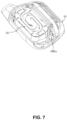
- FIG. 7 is a schematic diagram illustrating a cross-section of a second sound guiding hole according to some embodiments of the present disclosure.
- the air conduction vibrator 12 is disposed in the accommodation cavity 1002.
- the diaphragm 122 separates the accommodation cavity 1002 into a rear cavity 1004 and a front cavity 1003 disposed on opposite sides of the diaphragm 122.
- the rear cavity 1004 is disposed on a side of the diaphragm 122 away from the separation wall 1012, and the front cavity 1003 is disposed between the diaphragm 122 and the separation wall 1012.
- the first sound guiding hole 1080 connects the rear cavity 1004 to an external environment
- the second sound guiding hole 1081 connects the front cavity 1003 to the external environment. While the diaphragm 122 is vibrating in the air conduction vibration direction X2, the front cavity 1003 performs a pressure relief through the second sound guiding hole 1081.
- the first sound guiding hole 1080 is disposed on a portion of the housing 10 forming the rear cavity 1004.
- the second magnetic circuit 121 is disposed in the rear cavity 1004, and the first sound guiding hole 1080 is disposed in a sidewall of the housing 10 that is fronted by a bottom wall of the magnetic conduction shield 1212 (or the second magnetic circuit 121). In this way, when the user wears the acoustic output device 100, the first sound guiding hole 1080 is made to face an ear canal of a user, so that air conduction sound waves output from the air conduction vibrator 12 are better transmitted into the ear canal of the user.
- the second sound guiding hole 1081 is provided at a position as far away from the first sound guiding hole 1080 as possible.
- the second sound guiding hole 1081 is provided on a sidewall (which is also referred to as a lower sidewall, such as the lower sidewall 104 shown in FIG. 9 ) of the housing 10 away from the earhook assembly 2 along an extension direction of the earhook assembly 2.
- the second sound guiding hole 1081 is disposed on a portion of the housing 10 that forms the front cavity 1003 and is proximate the separation wall 1012.
- the second sound guiding hole 1081 is located away from the earhook assembly 2 and near an earlobe of the user, which keeps the second sound guiding hole 1081 away from the ear canal of the user, avoids or minimizes an impact of the sound output from the second sound guiding hole 1081 on a hearing sound of the user.
- the separation wall 1012 extends toward a side where the accommodation cavity 1001 is located and forms a portion of a hole wall of the second sound guiding hole 1081.
- the airflow channel 1081a of the second sound guiding hole 1081 is set to extend toward the side where the accommodation cavity 1001 is located. In this way, the second sound guiding hole 1081 may be made to be further away from the first sound guiding hole 1080, which effectively minimizes the influence of the second sound guiding hole 1081 on the first sound guiding hole 1080, and improves a listening volume of the user.
- the airflow channel 1081a of the second sound guiding hole 1081 is set to extend toward the side where the accommodation cavity 1001 is located, so that a cross-section in a direction from an inlet end to an outlet end of the airflow channel 1081a gradually increases in size, so as to ensure an airflow volume of the second sound guiding hole 1081, and thus ensure a good pressure relief effect.
- the second sound guiding hole 1081 is set at a position as far away as possible from the first sound guiding hole 1080, thereby avoiding or preventing a sound output from the second sound guiding hole 1081 from affecting the listening of the user, and improving the listening volume.
- FIG. 8 is a schematic diagram illustrating a position where a second sound guiding hole is disposed according to some embodiments of the present disclosure.
- the second sound guiding hole 1081 is disposed on an outer sidewall of the housing 10, as shown in FIG. 8 .
- the outer sidewall is a sidewall of the housing 10 away from the face of the user in a wearing state.
- the first sound guiding hole 1080 is disposed on a sidewall of the housing 10 facing an ear canal of the user
- the second sound guiding hole 1081 is disposed on the sidewall of the housing 10 away from the ear of the user.
- the second sound guiding hole 1081 is disposed away from the ear canal of the user, so that the sound output from the second sound guiding hole 1081 does not affect the hearing in the ear canal, and the hearing quality of the user is ensured.
- the acoustic output device 100 includes two or more second sound guiding holes in communication with the front cavity 1003.
- the plurality of second sound guiding holes are disposed on any sidewall of the housing 10.
- the acoustic output device 100 includes two second sound guiding holes, and one of the second sound guiding holes is disposed on the outer sidewall, and the other second sound guiding hole is disposed on the lower sidewall.
- the acoustic output device 100 includes two second sound guiding holes, and both the two second sound guiding holes are disposed on the lower sidewall.
- the second sound guiding hole 1081 is connected to the front cavity 1003 through the airflow channel 1081a.
- the vibration sheet 112 has a long axis direction L1 perpendicular to the first vibration direction X1 (see FIG. 6 ).
- a direction corresponding to the smallest size of the vibration sheet 112 is a short axis direction of the vibration sheet 112, and a direction perpendicular to the short axis direction is the long axis direction L1 of the vibration sheet 112.
- a distance d1 between a lowest point of the bone conduction vibrator 11 and a lowest point of an opening of the second sound guiding hole 1081 facing the outside of the acoustic output device in the long axis direction L1 not less than 1.00 mm, for example, 1.2 mm, 1.35 mm, 1.5 mm, 1.65 mm, 2 mm, etc.
- the lowest point referred to herein refers to a point furthest away from the earhook assembly 2 in the long-axis direction L1 in the wearing state.
- the front cavity 1003 by limiting the distance between the lowest point of the bone conduction vibrator 11 and the lowest point of the an opening of the second sound guiding hole 1081 facing the outside of the acoustic output device in the long axis direction L1, it is possible to allow the front cavity 1003 to have a sufficient space for the airflow channel 1081a and to avoid making the airflow channel 1081a of the second sound guiding hole 1081 too narrow to ensure that the front cavity 1003 has a sufficient pressure relief output to cancel with the sound of the first sound guiding hole 1080 in the far-field, thereby reducing the far-field sound leakage.
- a curvature radius of a corner formed by the first sidewall 1001a of the bone conduction vibrator 11 close to the second sound guiding hole 1081 and a second sidewall 1001b close to the diaphragm 122 is greater than 1.00 mm.
- the curvature radius is 1.2 mm, 1.5 mm, 1.8 mm, 2 mm, 2.5 mm, etc.
- a distance d2 from a center point of the corner formed by the first sidewall 1001a of the bone conduction vibrator 11 close to the second sound guiding hole 1081 and the second sidewall 1001b of the bone conduction vibrator 11 close to the diaphragm 122 to the apex of the folded ring 1221 of the diaphragm 122 is not less than 1.2 mm, for example, the distance d2 is 1.5 mm, 1.8 mm, 2 mm, 2.5 mm, 3 mm, etc..
- the apex of the folded ring 1221 refers to a point on the folded ring 1221 that is closest to the bone conduction vibrator 11.
- a distance d3 from the center point of the corner formed by the first sidewall 1001a of the bone conduction vibrator 11 close to the second sound guiding hole 1081 and the second sidewall 1001b of the bone conduction vibrator 11 close to the diaphragm 122 to the apex of the folded ring 1221 of the diaphragm 122 is not less than 1.5 mm, for example, the distance d3 is 1.8 mm, 2 mm, 2.4 mm, 2.6 mm, etc.
- the front cavity 1003 has the sufficient space for the airflow channel 1081a to avoid making the airflow channel 1081a of the second sound guiding hole 1081 too narrow to ensure the sufficient relief output to cancel out the sound of the first sound guiding hole 1080.
- the cross-sectional area of the airflow channel 1081a of the second sound guiding hole 1081 progressively increases in a direction from the accommodation cavity 1002 to the external environment.
- the cross-sectional area of the airflow channel 1081a gradually increases in the direction from the accommodation cavity 1002 to the external environment while the airflow channel 1081a extends inclined toward the side of the accommodation cavity 1001, allowing for a smoother gas discharge, thereby enhancing the sound quality of the sound emitted by the acoustic output device 100.
- a minimum cross-sectional area of the airflow channel 1081a of the second sound guiding hole 1081 is not less than 5.3 mm 2 .
- the minimum cross-sectional area of the airflow channel 1081a of the second sound guiding hole 1081 is not less than 6 mm 2 .
- the minimum cross-sectional area is 6.2 mm 2 , 6.5 mm 2 , 6.8 mm 2 , etc.
- the sufficient sound output from the second sound guiding hole 1081 is provided to cancel the sound from the first sound guiding hole 1080 to ensure a sufficient sound leakage reduction.
- FIG. 9 is a schematic diagram illustrating a surface of a portion of a housing according to some embodiments of the present disclosure.
- FIG. 10 is a schematic diagram illustrating a surface of a portion of a housing according to some embodiments of the present disclosure.
- the acoustic output device 100 further includes a microphone that converts a sound signal (sound waves) into an audio signal, and the acoustic output device 100 is disposed with a microphone hole 1082 in the housing 10 of the acoustic output device 100 (e.g., the first housing 101, the second housing 102, and/or the third housing 103).
- the microphone picks up an external sound through the microphone hole 1082.
- the microphone hole 1082 and the second sound guiding hole 1081 are provided adjacent to each other, and the microphone hole 1082 and the second sound guiding hole 1081 are covered by the same steel mesh 110.
- an overall dimensional area of the steel mesh 110 is effectively enhanced, a risk of sweat, rain, and other undesirable external factors from infiltrating at the steel mesh 110 and forming a film of water that blocks the second sound guiding hole 1081 is reduced, and in turn, it is effectively ensured that the second sound guiding hole 1081 normally performs a pressure relief work, thereby effectively enhancing a stability of the sound emitted by the acoustic output device 100.
- the microphone hole 1082 and the second sound guiding hole 1081 are covered by the same steel mesh 110, which also makes the acoustic output device 100 have a better appearance.
- the steel mesh 110 is set in a curved arc shape, so that when the user wears the acoustic output device 100, the sweat, the rain, etc., flowing through the steel mesh 110 ultimately drips directly or slides down to a bottom of the steel mesh 110 (at a position of the second sound guiding hole 1081) before dripping down, thereby effectively preventing an accumulation of the sweat, the rain, and other undesirable external factors on the steel mesh 110 to form a blockage.
Landscapes
- Engineering & Computer Science (AREA)
- Physics & Mathematics (AREA)
- Acoustics & Sound (AREA)
- Signal Processing (AREA)
- Health & Medical Sciences (AREA)
- Otolaryngology (AREA)
- Multimedia (AREA)
- General Health & Medical Sciences (AREA)
- Manufacturing & Machinery (AREA)
- Computer Hardware Design (AREA)
- General Physics & Mathematics (AREA)
- Electromagnetism (AREA)
- Optics & Photonics (AREA)
- Theoretical Computer Science (AREA)
- Microelectronics & Electronic Packaging (AREA)
- General Engineering & Computer Science (AREA)
- Neurosurgery (AREA)
- Human Computer Interaction (AREA)
- Ophthalmology & Optometry (AREA)
- Headphones And Earphones (AREA)
- Details Of Audible-Bandwidth Transducers (AREA)
- Circuit For Audible Band Transducer (AREA)
- Casings For Electric Apparatus (AREA)
- Audible-Bandwidth Dynamoelectric Transducers Other Than Pickups (AREA)
- Obtaining Desirable Characteristics In Audible-Bandwidth Transducers (AREA)
- Telephone Set Structure (AREA)
- Soundproofing, Sound Blocking, And Sound Damping (AREA)
Applications Claiming Priority (2)
| Application Number | Priority Date | Filing Date | Title |
|---|---|---|---|
| CN202310541798 | 2023-05-12 | ||
| PCT/CN2023/136558 WO2024234622A1 (zh) | 2023-05-12 | 2023-12-05 | 一种声学输出设备 |
Publications (2)
| Publication Number | Publication Date |
|---|---|
| EP4583532A1 true EP4583532A1 (de) | 2025-07-09 |
| EP4583532A4 EP4583532A4 (de) | 2026-01-07 |
Family
ID=91784493
Family Applications (22)
| Application Number | Title | Priority Date | Filing Date |
|---|---|---|---|
| EP25188417.7A Pending EP4633194A3 (de) | 2023-05-12 | 2023-08-08 | Kopfhörer |
| EP23937159.4A Pending EP4626019A1 (de) | 2023-05-12 | 2023-08-08 | Kopfhörer |
| EP25178895.6A Pending EP4611394A3 (de) | 2023-05-12 | 2023-08-08 | Verschleisskomponente und ohrhörer |
| EP23937161.0A Pending EP4607951A1 (de) | 2023-05-12 | 2023-08-08 | Verschleisskomponente und ohrhörer |
| EP25188401.1A Pending EP4633193A3 (de) | 2023-05-12 | 2023-08-08 | Kopfhörer |
| EP25187733.8A Pending EP4629661A3 (de) | 2023-05-12 | 2023-08-08 | Kopfhörer |
| EP23937160.2A Pending EP4629659A1 (de) | 2023-05-12 | 2023-08-08 | Kopfhörer |
| EP25187740.3A Pending EP4629662A3 (de) | 2023-05-12 | 2023-08-08 | Kopfhörer |
| EP23937213.9A Pending EP4611389A1 (de) | 2023-05-12 | 2023-10-11 | Akustische vorrichtung |
| EP23937229.5A Pending EP4568274A4 (de) | 2023-05-12 | 2023-10-23 | Kopfhörer |
| EP23937228.7A Pending EP4607958A1 (de) | 2023-05-12 | 2023-10-23 | Lautsprecheranordnung und tragbare elektronische vorrichtung |
| EP23937293.1A Pending EP4583532A4 (de) | 2023-05-12 | 2023-12-05 | Akustische ausgabevorrichtung |
| EP25178469.0A Pending EP4607952A3 (de) | 2023-05-12 | 2023-12-20 | Ohrhörer |
| EP25174914.9A Pending EP4601329A3 (de) | 2023-05-12 | 2023-12-20 | Schwingungsübertragungsschichten, knochenleitende lautsprecher und ohrhörer |
| EP23937320.2A Pending EP4598055A1 (de) | 2023-05-12 | 2023-12-20 | Schwingungsübertragungsfolie, knochenleitungslautsprecher und kopfhörer |
| EP23937321.0A Pending EP4604569A1 (de) | 2023-05-12 | 2023-12-20 | Kopfhörer |
| EP23937319.4A Pending EP4598049A1 (de) | 2023-05-12 | 2023-12-20 | Kopfhörer |
| EP23937318.6A Pending EP4614999A1 (de) | 2023-05-12 | 2023-12-20 | Elektronische vorrichtung |
| EP25183915.5A Pending EP4601328A3 (de) | 2023-05-12 | 2023-12-20 | Ohrhörer |
| EP25178483.1A Pending EP4607953A3 (de) | 2023-05-12 | 2023-12-20 | Ohrhörer |
| EP24787042.1A Pending EP4496347A4 (de) | 2023-05-12 | 2024-02-19 | Wearable-vorrichtung |
| EP24899158.0A Pending EP4694191A1 (de) | 2023-05-12 | 2024-05-31 | Akustische ausgabevorrichtung |
Family Applications Before (11)
| Application Number | Title | Priority Date | Filing Date |
|---|---|---|---|
| EP25188417.7A Pending EP4633194A3 (de) | 2023-05-12 | 2023-08-08 | Kopfhörer |
| EP23937159.4A Pending EP4626019A1 (de) | 2023-05-12 | 2023-08-08 | Kopfhörer |
| EP25178895.6A Pending EP4611394A3 (de) | 2023-05-12 | 2023-08-08 | Verschleisskomponente und ohrhörer |
| EP23937161.0A Pending EP4607951A1 (de) | 2023-05-12 | 2023-08-08 | Verschleisskomponente und ohrhörer |
| EP25188401.1A Pending EP4633193A3 (de) | 2023-05-12 | 2023-08-08 | Kopfhörer |
| EP25187733.8A Pending EP4629661A3 (de) | 2023-05-12 | 2023-08-08 | Kopfhörer |
| EP23937160.2A Pending EP4629659A1 (de) | 2023-05-12 | 2023-08-08 | Kopfhörer |
| EP25187740.3A Pending EP4629662A3 (de) | 2023-05-12 | 2023-08-08 | Kopfhörer |
| EP23937213.9A Pending EP4611389A1 (de) | 2023-05-12 | 2023-10-11 | Akustische vorrichtung |
| EP23937229.5A Pending EP4568274A4 (de) | 2023-05-12 | 2023-10-23 | Kopfhörer |
| EP23937228.7A Pending EP4607958A1 (de) | 2023-05-12 | 2023-10-23 | Lautsprecheranordnung und tragbare elektronische vorrichtung |
Family Applications After (10)
| Application Number | Title | Priority Date | Filing Date |
|---|---|---|---|
| EP25178469.0A Pending EP4607952A3 (de) | 2023-05-12 | 2023-12-20 | Ohrhörer |
| EP25174914.9A Pending EP4601329A3 (de) | 2023-05-12 | 2023-12-20 | Schwingungsübertragungsschichten, knochenleitende lautsprecher und ohrhörer |
| EP23937320.2A Pending EP4598055A1 (de) | 2023-05-12 | 2023-12-20 | Schwingungsübertragungsfolie, knochenleitungslautsprecher und kopfhörer |
| EP23937321.0A Pending EP4604569A1 (de) | 2023-05-12 | 2023-12-20 | Kopfhörer |
| EP23937319.4A Pending EP4598049A1 (de) | 2023-05-12 | 2023-12-20 | Kopfhörer |
| EP23937318.6A Pending EP4614999A1 (de) | 2023-05-12 | 2023-12-20 | Elektronische vorrichtung |
| EP25183915.5A Pending EP4601328A3 (de) | 2023-05-12 | 2023-12-20 | Ohrhörer |
| EP25178483.1A Pending EP4607953A3 (de) | 2023-05-12 | 2023-12-20 | Ohrhörer |
| EP24787042.1A Pending EP4496347A4 (de) | 2023-05-12 | 2024-02-19 | Wearable-vorrichtung |
| EP24899158.0A Pending EP4694191A1 (de) | 2023-05-12 | 2024-05-31 | Akustische ausgabevorrichtung |
Country Status (7)
| Country | Link |
|---|---|
| US (21) | US20250048566A1 (de) |
| EP (22) | EP4633194A3 (de) |
| JP (1) | JP2025536409A (de) |
| KR (1) | KR20250065394A (de) |
| CN (42) | CN120640190A (de) |
| DE (2) | DE212023000458U1 (de) |
| WO (13) | WO2024234485A1 (de) |
Families Citing this family (3)
| Publication number | Priority date | Publication date | Assignee | Title |
|---|---|---|---|---|
| JP1788428S (ja) * | 2023-04-23 | 2025-01-07 | ヘッドホン | |
| USD1093338S1 (en) * | 2023-11-09 | 2025-09-16 | Binglan Tang | Earphone |
| EP4694209A1 (de) * | 2024-04-11 | 2026-02-11 | Shenzhen Shokzhear Co., Ltd. | Wearable-vorrichtung |
Family Cites Families (97)
| Publication number | Priority date | Publication date | Assignee | Title |
|---|---|---|---|---|
| KR19980063410A (ko) * | 1997-08-19 | 1998-10-07 | 양승택 | 골도 및 기도 청각 겸용의 수화갑이 구비된 전화기 |
| JP4135043B2 (ja) * | 1999-01-06 | 2008-08-20 | ソニー株式会社 | ヘッドホン |
| KR20050015290A (ko) * | 2003-08-05 | 2005-02-21 | 류강수 | 기도 및 골도 스피커 |
| KR20080072323A (ko) * | 2007-02-02 | 2008-08-06 | 노틸러스효성 주식회사 | 이어마이크폰 |
| KR100903606B1 (ko) * | 2007-10-09 | 2009-06-18 | 지디텍 주식회사 | 방수기능을 갖는 골전도 이어폰장치 |
| JP4946976B2 (ja) * | 2008-06-04 | 2012-06-06 | コスモギア株式会社 | 骨伝導スピーカの取付構造及び該取付構造を備えた骨伝導スピーカ付き機器 |
| KR101125728B1 (ko) * | 2010-07-01 | 2012-03-27 | 박의봉 | 귀걸이형 무선 스피커장치 |
| FR2974655B1 (fr) * | 2011-04-26 | 2013-12-20 | Parrot | Combine audio micro/casque comprenant des moyens de debruitage d'un signal de parole proche, notamment pour un systeme de telephonie "mains libres". |
| JP2014096732A (ja) * | 2012-11-09 | 2014-05-22 | Oki Electric Ind Co Ltd | 収音装置及び電話機 |
| TW201441926A (zh) * | 2013-04-30 | 2014-11-01 | Wintek Corp | 具播音及收音之電子裝置 |
| KR101389691B1 (ko) * | 2014-02-13 | 2014-04-29 | 주식회사 블루콤 | 자성 유체로 노이즈를 감소시킨 골전도 스피커 유니트 |
| KR101542598B1 (ko) * | 2014-08-06 | 2015-08-07 | 주식회사 블루콤 | 교체 가능한 텐션바를 갖는 블루투스 이어폰 |
| TWM501703U (zh) * | 2015-01-16 | 2015-05-21 | Jetvox Acoustic Corp | 雙頻同軸耳機 |
| CN205081915U (zh) * | 2015-09-08 | 2016-03-09 | 深圳市冠旭电子有限公司 | 小型化蓝牙耳机及其电路板组件 |
| KR101742008B1 (ko) * | 2015-12-28 | 2017-05-31 | 주식회사 에이피케이 | 이어 팁 및 이를 구비하는 이어 폰 |
| CN206480838U (zh) * | 2017-01-17 | 2017-09-08 | 岱炜科技股份有限公司 | 防水电连接器模块 |
| CN206629264U (zh) * | 2017-02-13 | 2017-11-10 | 吉林航盛电子有限公司 | 一种扬声器的磁路系统及扬声器 |
| CN206820997U (zh) * | 2017-04-27 | 2017-12-29 | 歌尔股份有限公司 | 用于扬声器模组的壳体、扬声器模组以及电子设备 |
| US10395667B2 (en) * | 2017-05-12 | 2019-08-27 | Cirrus Logic, Inc. | Correlation-based near-field detector |
| CN207070283U (zh) * | 2017-08-18 | 2018-03-02 | 深圳市韶音科技有限公司 | 一种骨传导耳机 |
| CN107484054B (zh) * | 2017-08-18 | 2023-08-25 | 深圳市韶音科技有限公司 | 一种骨传导耳机 |
| CN107493532B (zh) * | 2017-08-18 | 2023-08-25 | 深圳市韶音科技有限公司 | 一种骨传导耳机 |
| CN117098043A (zh) * | 2017-09-24 | 2023-11-21 | 深圳市韶音科技有限公司 | 骨传导扬声器 |
| AU2019285890B2 (en) * | 2018-06-15 | 2022-06-30 | Shenzhen Shokz Co., Ltd | Bone conduction speaker and testing method therefor |
| CN117202044A (zh) * | 2019-01-05 | 2023-12-08 | 深圳市韶音科技有限公司 | 骨传导扬声装置 |
| CN117793593A (zh) * | 2019-01-05 | 2024-03-29 | 深圳市韶音科技有限公司 | 骨传导扬声装置 |
| CN117241183B (zh) * | 2019-01-05 | 2025-10-03 | 深圳市韶音科技有限公司 | 骨传导扬声装置 |
| CN209402721U (zh) * | 2019-01-05 | 2019-09-17 | 深圳市韶音科技有限公司 | 骨传导扬声装置 |
| WO2020140456A1 (zh) * | 2019-01-05 | 2020-07-09 | 深圳市韶音科技有限公司 | 一种扬声器装置 |
| CN109547888B (zh) * | 2019-01-05 | 2024-05-14 | 深圳市韶音科技有限公司 | 骨传导扬声装置 |
| CN209375873U (zh) * | 2019-01-23 | 2019-09-10 | 深圳市蓝禾技术有限公司 | 无线耳机组件 |
| CN209488778U (zh) * | 2019-04-10 | 2019-10-11 | 深圳湃声声学科技有限公司 | 一种骨传导耳机 |
| CN209572154U (zh) * | 2019-04-10 | 2019-11-01 | 南京咩咩达智能科技有限公司 | 小型平面振膜扬声器及耳机 |
| CN209767790U (zh) * | 2019-05-15 | 2019-12-10 | 安克创新科技股份有限公司 | 无线耳机组件及其耳机 |
| CN112394632B (zh) * | 2019-08-16 | 2022-05-17 | Oppo广东移动通信有限公司 | 可穿戴设备 |
| CN110519671A (zh) * | 2019-08-26 | 2019-11-29 | 华为技术有限公司 | 无线耳机 |
| MX2022003327A (es) * | 2019-09-19 | 2022-04-07 | Shenzhen Shokz Co Ltd | Aparato de emision acustica. |
| CN110782912A (zh) * | 2019-10-10 | 2020-02-11 | 安克创新科技股份有限公司 | 音源的控制方法以及扬声设备 |
| CN210431806U (zh) * | 2019-10-22 | 2020-04-28 | 深圳市豪恩声学股份有限公司 | 一种耳机调音结构和入耳式耳机 |
| CN112995825A (zh) * | 2019-12-13 | 2021-06-18 | 深圳市韶音科技有限公司 | 声音输出装置 |
| CN111163394B (zh) * | 2019-12-30 | 2025-12-02 | 歌尔科技有限公司 | 一种骨传导声学装置 |
| CN210868165U (zh) * | 2019-12-31 | 2020-06-26 | 深圳市韶音科技有限公司 | 骨传导扬声器及骨传导耳机 |
| WO2021196624A1 (en) * | 2020-03-31 | 2021-10-07 | Shenzhen Voxtech Co., Ltd. | Acoustic output device |
| CN211909097U (zh) * | 2020-04-01 | 2020-11-10 | 深圳市启元迅通科技有限公司 | 一种骨传导耳机 |
| CN211909152U (zh) * | 2020-04-01 | 2020-11-10 | 深圳市启元迅通科技有限公司 | 一种骨传扬声装置的外壳组件 |
| CN211909098U (zh) * | 2020-04-01 | 2020-11-10 | 深圳市启元迅通科技有限公司 | 一种防水骨传导耳机 |
| CN211909102U (zh) * | 2020-04-03 | 2020-11-10 | 深圳市启元迅通科技有限公司 | 一种骨传扬声装置的连接组件 |
| KR102798995B1 (ko) * | 2020-04-29 | 2025-04-23 | 삼성전자주식회사 | 연결 부재를 구비하는 연성 회로 기판을 포함하는 전자 장치 |
| CN212851008U (zh) * | 2020-08-12 | 2021-03-30 | 深圳市韶音科技有限公司 | 发声装置及其扬声器组件 |
| CN113596652B (zh) * | 2020-04-30 | 2025-01-10 | 深圳市韶音科技有限公司 | 骨传导耳机及其制造方法 |
| CN212086434U (zh) * | 2020-04-30 | 2020-12-04 | 深圳市韶音科技有限公司 | 一种骨传导耳机 |
| WO2021218987A1 (zh) * | 2020-04-30 | 2021-11-04 | 深圳市韶音科技有限公司 | 声学输出装置及连接组件 |
| CN211880590U (zh) * | 2020-04-30 | 2020-11-06 | 深圳市韶音科技有限公司 | 一种骨传导耳机 |
| CN212115606U (zh) * | 2020-06-22 | 2020-12-08 | 潍坊歌尔电子有限公司 | 麦克风结构和耳机 |
| CN212302361U (zh) * | 2020-07-09 | 2021-01-05 | 深圳市灏宸智能开发有限公司 | 超薄平板电脑结构 |
| CN212910010U (zh) * | 2020-08-13 | 2021-04-06 | 深圳市韶音科技有限公司 | 发声装置及其壳体组件 |
| WO2022021954A1 (zh) * | 2020-07-28 | 2022-02-03 | 深圳市韶音科技有限公司 | 一种发声装置 |
| CN112073885B (zh) * | 2020-07-28 | 2025-09-19 | 深圳市韶音科技有限公司 | 一种骨传导助听器 |
| CN111988702B (zh) * | 2020-08-25 | 2022-02-25 | 歌尔科技有限公司 | 音频信号的处理方法、电子设备及存储介质 |
| CN212752630U (zh) * | 2020-08-26 | 2021-03-19 | 瑞声科技(新加坡)有限公司 | 复合型扬声器 |
| CN111988696B (zh) * | 2020-08-31 | 2025-06-27 | 歌尔科技有限公司 | 耳机 |
| TWI746158B (zh) * | 2020-09-10 | 2021-11-11 | 寶德科技股份有限公司 | 耳機裝置、頭戴式耳機裝置及聲音撥放裝置 |
| CN213403429U (zh) * | 2020-09-10 | 2021-06-08 | 安克创新科技股份有限公司 | 一种耳机 |
| WO2022141585A1 (zh) * | 2020-12-31 | 2022-07-07 | 深圳市韶音科技有限公司 | 一种骨传导传声装置 |
| CN112533101B (zh) * | 2021-02-08 | 2021-06-29 | 江西联创宏声电子股份有限公司 | 一种耳机 |
| CN214544718U (zh) * | 2021-02-24 | 2021-10-29 | 深圳前海帕拓逊网络技术有限公司 | 耳机按键防水结构及耳机 |
| WO2022197924A1 (en) * | 2021-03-17 | 2022-09-22 | 3M Innovative Properties Company | Earpiece and earhook for the same |
| CN115209286B (zh) * | 2021-04-09 | 2025-03-07 | 深圳市韶音科技有限公司 | 一种耳机 |
| CN214707998U (zh) * | 2021-04-09 | 2021-11-12 | 深圳市韶音科技有限公司 | 一种耳机 |
| CN115209285B (zh) * | 2021-04-09 | 2025-04-04 | 深圳市韶音科技有限公司 | 一种耳机 |
| CN115209263B (zh) * | 2021-04-09 | 2025-03-07 | 深圳市韶音科技有限公司 | 一种耳机 |
| CN115209287B (zh) * | 2021-04-09 | 2025-03-07 | 深圳市韶音科技有限公司 | 一种耳机 |
| CN115209280B (zh) * | 2021-04-09 | 2025-04-04 | 深圳市韶音科技有限公司 | 一种耳机 |
| CN115209294B (zh) * | 2021-04-09 | 2025-09-23 | 深圳市韶音科技有限公司 | 耳挂组件及耳机 |
| CN115209266B (zh) * | 2021-04-09 | 2025-04-04 | 深圳市韶音科技有限公司 | 一种耳机 |
| CN115209264B (zh) * | 2021-04-09 | 2025-05-09 | 深圳市韶音科技有限公司 | 一种耳机 |
| CN214708019U (zh) * | 2021-04-09 | 2021-11-12 | 深圳市韶音科技有限公司 | 一种耳机 |
| CN115243167B (zh) * | 2021-04-22 | 2025-03-04 | 万魔声学股份有限公司 | 一种扬声器 |
| CN216146435U (zh) * | 2021-05-12 | 2022-03-29 | 佳禾智能科技股份有限公司 | 一种用于骨传导耳机的防转耳挂 |
| CN215646860U (zh) * | 2021-06-22 | 2022-01-25 | 华勤技术股份有限公司 | 可移动终端及其外壳组件 |
| CN214756797U (zh) * | 2021-06-28 | 2021-11-16 | 歌尔股份有限公司 | 扬声器模组和电子设备 |
| CN214756796U (zh) * | 2021-06-28 | 2021-11-16 | 歌尔股份有限公司 | 扬声器模组和电子设备 |
| CN113965846B (zh) * | 2021-09-18 | 2024-08-13 | 苏州索迩电子技术有限公司 | 骨传导发声装置、骨传导发声装置装配方法及骨传导耳机 |
| CN114007174A (zh) * | 2021-11-30 | 2022-02-01 | 深圳市明悦达电声科技有限公司 | 一种全频骨声传导扬声器及耳机 |
| US11368780B1 (en) * | 2021-12-06 | 2022-06-21 | Shenzhen Xinwanhong Technology Co., Ltd. | Bone conduction earphone |
| CN217133995U (zh) * | 2021-12-30 | 2022-08-05 | 万魔声学股份有限公司 | 降风噪模组及电子产品 |
| CN216775013U (zh) * | 2021-12-31 | 2022-06-17 | 歌尔股份有限公司 | 扬声器和发声设备 |
| CN217486643U (zh) * | 2022-02-18 | 2022-09-23 | 东莞泉声电子有限公司 | 双单元扬声器及电子装置 |
| CN217591036U (zh) * | 2022-03-15 | 2022-10-14 | 肇庆德庆冠旭电子有限公司 | 一种耳机和耳机组件 |
| CN217428322U (zh) * | 2022-03-21 | 2022-09-13 | 深圳市韶音科技有限公司 | 一种传振片及骨传导耳机 |
| CN114401477B (zh) * | 2022-03-24 | 2022-09-02 | 北京荣耀终端有限公司 | 扬声器模组和电子设备 |
| CN218041713U (zh) * | 2022-06-10 | 2022-12-13 | 苏州索迩电子技术有限公司 | 一种颈戴线及骨传导耳机 |
| CN115065906A (zh) * | 2022-06-10 | 2022-09-16 | 苏州索迩电子技术有限公司 | 一种防水连接结构及无线耳机 |
| CN218976828U (zh) * | 2022-09-13 | 2023-05-05 | 中科声特美(苏州)声学科技有限公司 | 一种传振片、骨导振子及可穿戴电子设备 |
| CN218473354U (zh) * | 2022-10-18 | 2023-02-10 | 江西联创宏声电子股份有限公司 | 一种耳挂及骨传导耳机 |
| KR20240141188A (ko) * | 2022-10-28 | 2024-09-25 | 썬전 샥 컴퍼니, 리미티드 | 개방식 이어폰 |
| CN220325779U (zh) * | 2022-10-28 | 2024-01-09 | 深圳市韶音科技有限公司 | 一种开放式耳机 |
-
2023
- 2023-08-08 CN CN202510945227.1A patent/CN120640190A/zh active Pending
- 2023-08-08 CN CN202380067717.5A patent/CN119908123A/zh active Pending
- 2023-08-08 EP EP25188417.7A patent/EP4633194A3/de active Pending
- 2023-08-08 CN CN202510944726.9A patent/CN120640189A/zh active Pending
- 2023-08-08 CN CN202380061546.5A patent/CN119769106A/zh active Pending
- 2023-08-08 EP EP23937159.4A patent/EP4626019A1/de active Pending
- 2023-08-08 CN CN202511233694.8A patent/CN120857028A/zh active Pending
- 2023-08-08 EP EP25178895.6A patent/EP4611394A3/de active Pending
- 2023-08-08 EP EP23937161.0A patent/EP4607951A1/de active Pending
- 2023-08-08 EP EP25188401.1A patent/EP4633193A3/de active Pending
- 2023-08-08 CN CN202311003296.8A patent/CN118945533A/zh active Pending
- 2023-08-08 CN CN202310996882.0A patent/CN118945530A/zh active Pending
- 2023-08-08 CN CN202310998087.5A patent/CN118945532A/zh active Pending
- 2023-08-08 WO PCT/CN2023/111837 patent/WO2024234485A1/zh active Pending
- 2023-08-08 CN CN202310996869.5A patent/CN118945529A/zh active Pending
- 2023-08-08 CN CN202310996526.9A patent/CN118945528A/zh active Pending
- 2023-08-08 WO PCT/CN2023/111834 patent/WO2024234483A1/zh active Pending
- 2023-08-08 CN CN202310996515.0A patent/CN118945527A/zh active Pending
- 2023-08-08 EP EP25187733.8A patent/EP4629661A3/de active Pending
- 2023-08-08 CN CN202380053298.XA patent/CN119586158A/zh active Pending
- 2023-08-08 EP EP23937160.2A patent/EP4629659A1/de active Pending
- 2023-08-08 CN CN202511233516.5A patent/CN120857027A/zh active Pending
- 2023-08-08 EP EP25187740.3A patent/EP4629662A3/de active Pending
- 2023-08-08 CN CN202311003376.3A patent/CN118945534A/zh active Pending
- 2023-08-08 WO PCT/CN2023/111836 patent/WO2024234484A1/zh active Pending
- 2023-08-08 CN CN202310996984.2A patent/CN118945531A/zh active Pending
- 2023-10-11 CN CN202380065383.8A patent/CN119856511A/zh active Pending
- 2023-10-11 WO PCT/CN2023/124010 patent/WO2024234538A1/zh active Pending
- 2023-10-11 EP EP23937213.9A patent/EP4611389A1/de active Pending
- 2023-10-11 CN CN202311315758.XA patent/CN118945535A/zh active Pending
- 2023-10-23 WO PCT/CN2023/126023 patent/WO2024234553A1/zh active Pending
- 2023-10-23 EP EP23937229.5A patent/EP4568274A4/de active Pending
- 2023-10-23 CN CN202380062452.XA patent/CN119790667A/zh active Pending
- 2023-10-23 CN CN202322854467.XU patent/CN221329088U/zh active Active
- 2023-10-23 EP EP23937228.7A patent/EP4607958A1/de active Pending
- 2023-10-23 WO PCT/CN2023/126024 patent/WO2024234554A1/zh active Pending
- 2023-10-23 CN CN202322843777.1U patent/CN221329086U/zh active Active
- 2023-10-23 CN CN202322862588.9U patent/CN221329091U/zh active Active
- 2023-10-23 CN CN202380094483.3A patent/CN120712790A/zh active Pending
- 2023-10-23 CN CN202322845671.5U patent/CN222053308U/zh active Active
- 2023-12-05 WO PCT/CN2023/136558 patent/WO2024234622A1/zh active Pending
- 2023-12-05 CN CN202311670681.8A patent/CN118945536A/zh active Pending
- 2023-12-05 KR KR1020257011500A patent/KR20250065394A/ko active Pending
- 2023-12-05 DE DE212023000458.5U patent/DE212023000458U1/de active Active
- 2023-12-05 CN CN202380059464.7A patent/CN119769104A/zh active Pending
- 2023-12-05 EP EP23937293.1A patent/EP4583532A4/de active Pending
- 2023-12-05 JP JP2025524485A patent/JP2025536409A/ja active Pending
- 2023-12-20 CN CN202311764476.8A patent/CN118945538A/zh active Pending
- 2023-12-20 EP EP25178469.0A patent/EP4607952A3/de active Pending
- 2023-12-20 DE DE212023000459U patent/DE212023000459U1/de active Active
- 2023-12-20 CN CN202311772364.7A patent/CN118945543A/zh active Pending
- 2023-12-20 WO PCT/CN2023/140250 patent/WO2024234647A1/zh active Pending
- 2023-12-20 CN CN202311766594.2A patent/CN118945540A/zh active Pending
- 2023-12-20 EP EP25174914.9A patent/EP4601329A3/de active Pending
- 2023-12-20 WO PCT/CN2023/140262 patent/WO2024234649A1/zh active Pending
- 2023-12-20 CN CN202311766595.7A patent/CN118945541A/zh active Pending
- 2023-12-20 CN CN202323491977.1U patent/CN221930075U/zh active Active
- 2023-12-20 EP EP23937320.2A patent/EP4598055A1/de active Pending
- 2023-12-20 WO PCT/CN2023/140254 patent/WO2024234648A1/zh active Pending
- 2023-12-20 EP EP23937321.0A patent/EP4604569A1/de active Pending
- 2023-12-20 CN CN202510948650.7A patent/CN120786231A/zh active Pending
- 2023-12-20 EP EP23937319.4A patent/EP4598049A1/de active Pending
- 2023-12-20 CN CN202311764510.1A patent/CN118945539A/zh active Pending
- 2023-12-20 EP EP23937318.6A patent/EP4614999A1/de active Pending
- 2023-12-20 CN CN202380065382.3A patent/CN119866640A/zh active Pending
- 2023-12-20 CN CN202380062451.5A patent/CN119856509A/zh active Pending
- 2023-12-20 CN CN202311772353.9A patent/CN118945542A/zh active Pending
- 2023-12-20 CN CN202380062454.9A patent/CN119790665A/zh active Pending
- 2023-12-20 EP EP25183915.5A patent/EP4601328A3/de active Pending
- 2023-12-20 CN CN202380062453.4A patent/CN120380781A/zh active Pending
- 2023-12-20 CN CN202311763195.0A patent/CN118945537A/zh active Pending
- 2023-12-20 EP EP25178483.1A patent/EP4607953A3/de active Pending
- 2023-12-20 WO PCT/CN2023/140263 patent/WO2024234650A1/zh active Pending
-
2024
- 2024-02-19 CN CN202480001715.0A patent/CN119318160A/zh active Pending
- 2024-02-19 EP EP24787042.1A patent/EP4496347A4/de active Pending
- 2024-02-19 CN CN202420308609.4U patent/CN222072234U/zh active Active
- 2024-02-19 WO PCT/CN2024/077618 patent/WO2024234758A1/zh active Pending
- 2024-05-31 CN CN202480023698.0A patent/CN120958845A/zh active Pending
- 2024-05-31 WO PCT/CN2024/096875 patent/WO2025118506A1/zh active Pending
- 2024-05-31 EP EP24899158.0A patent/EP4694191A1/de active Pending
- 2024-05-31 CN CN202410710309.3A patent/CN120111406A/zh active Pending
- 2024-10-17 US US18/919,401 patent/US20250048566A1/en active Pending
-
2025
- 2025-03-02 US US19/067,980 patent/US20250203269A1/en active Pending
- 2025-03-25 US US19/090,381 patent/US20250254461A1/en active Pending
- 2025-05-07 US US19/201,907 patent/US20250267391A1/en active Pending
- 2025-05-18 US US19/211,273 patent/US20250280226A1/en active Pending
- 2025-05-18 US US19/211,270 patent/US20250280225A1/en active Pending
- 2025-05-19 US US19/212,574 patent/US20250280229A1/en active Pending
- 2025-05-19 US US19/212,517 patent/US20250280233A1/en active Pending
- 2025-05-19 US US19/212,568 patent/US20250280241A1/en active Pending
- 2025-05-19 US US19/212,554 patent/US20250280227A1/en active Pending
- 2025-05-20 US US19/212,768 patent/US20250280219A1/en active Pending
- 2025-05-20 US US19/212,728 patent/US20250280224A1/en active Pending
- 2025-05-28 US US19/221,488 patent/US20250294293A1/en active Pending
- 2025-05-30 US US19/223,388 patent/US20250294294A1/en active Pending
- 2025-06-09 US US19/232,829 patent/US20250310673A1/en active Pending
- 2025-07-20 US US19/274,632 patent/US20250350872A1/en active Pending
- 2025-07-20 US US19/274,627 patent/US20250350878A1/en active Pending
- 2025-07-20 US US19/274,625 patent/US20250350877A1/en active Pending
- 2025-07-20 US US19/274,619 patent/US20250350876A1/en active Pending
- 2025-07-20 US US19/274,636 patent/US20250350879A1/en active Pending
- 2025-07-21 US US19/275,920 patent/US20250350880A1/en active Pending
Also Published As
Similar Documents
| Publication | Publication Date | Title |
|---|---|---|
| EP4583532A1 (de) | Akustische ausgabevorrichtung | |
| US11985478B1 (en) | Earphones | |
| US11877111B1 (en) | Earphones | |
| CN221784331U (zh) | 一种耳夹式耳机 | |
| CN115516877A (zh) | 一种声学输出装置 | |
| CN109952766B (zh) | 扬声器装置和再现装置 | |
| JP2025506281A (ja) | イヤホン | |
| US20240323578A1 (en) | Earphones | |
| EP4507328A1 (de) | Lautsprecher | |
| WO2024109218A1 (zh) | 一种声学输出装置 | |
| WO2024119393A1 (zh) | 开放式可穿戴声学设备及主动降噪方法 | |
| US20250193579A1 (en) | Clipping earphones | |
| CN222827351U (zh) | 一种耳机 | |
| CN119906925A (zh) | 一种声学输出设备 | |
| HK40119627A (zh) | 一种声学输出设备 | |
| KR20260018079A (ko) | 이어폰 | |
| CN118695157A (zh) | 一种耳机 | |
| KR20260015286A (ko) | 이어폰 | |
| KR20260018916A (ko) | 음향출력장치 | |
| WO2025245677A1 (zh) | 一种耳机 | |
| WO2025245678A1 (zh) | 一种耳机 | |
| WO2025245675A1 (zh) | 一种耳机 | |
| KR20260005933A (ko) | 음향출력장치 | |
| CN121037732A (zh) | 一种耳机 | |
| WO2026036339A1 (zh) | 声学设备以及耳挂式助听设备 |
Legal Events
| Date | Code | Title | Description |
|---|---|---|---|
| STAA | Information on the status of an ep patent application or granted ep patent |
Free format text: STATUS: THE INTERNATIONAL PUBLICATION HAS BEEN MADE |
|
| PUAI | Public reference made under article 153(3) epc to a published international application that has entered the european phase |
Free format text: ORIGINAL CODE: 0009012 |
|
| STAA | Information on the status of an ep patent application or granted ep patent |
Free format text: STATUS: REQUEST FOR EXAMINATION WAS MADE |
|
| 17P | Request for examination filed |
Effective date: 20250403 |
|
| AK | Designated contracting states |
Kind code of ref document: A1 Designated state(s): AL AT BE BG CH CY CZ DE DK EE ES FI FR GB GR HR HU IE IS IT LI LT LU LV MC ME MK MT NL NO PL PT RO RS SE SI SK SM TR |
|
| A4 | Supplementary search report drawn up and despatched |
Effective date: 20251210 |
|
| RIC1 | Information provided on ipc code assigned before grant |
Ipc: H04R 1/10 20060101AFI20251204BHEP Ipc: G02B 27/01 20060101ALI20251204BHEP Ipc: G02C 11/00 20060101ALI20251204BHEP Ipc: H04R 9/06 20060101ALI20251204BHEP Ipc: H04R 25/00 20060101ALI20251204BHEP Ipc: G06F 1/16 20060101ALI20251204BHEP |