EP4582810A2 - Verfahren zur messung eines zielantigens und darin verwendete unlösliche partikel und kit zur messung eines zielantigens - Google Patents
Verfahren zur messung eines zielantigens und darin verwendete unlösliche partikel und kit zur messung eines zielantigens Download PDFInfo
- Publication number
- EP4582810A2 EP4582810A2 EP25170324.5A EP25170324A EP4582810A2 EP 4582810 A2 EP4582810 A2 EP 4582810A2 EP 25170324 A EP25170324 A EP 25170324A EP 4582810 A2 EP4582810 A2 EP 4582810A2
- Authority
- EP
- European Patent Office
- Prior art keywords
- seq
- amino acid
- acid sequence
- identity
- mutated
- Prior art date
- Legal status (The legal status is an assumption and is not a legal conclusion. Google has not performed a legal analysis and makes no representation as to the accuracy of the status listed.)
- Pending
Links
Images


Classifications
-
- C—CHEMISTRY; METALLURGY
- C07—ORGANIC CHEMISTRY
- C07K—PEPTIDES
- C07K17/00—Carrier-bound or immobilised peptides; Preparation thereof
- C07K17/02—Peptides being immobilised on, or in, an organic carrier
-
- C—CHEMISTRY; METALLURGY
- C07—ORGANIC CHEMISTRY
- C07K—PEPTIDES
- C07K16/00—Immunoglobulins [IG], e.g. monoclonal or polyclonal antibodies
- C07K16/18—Immunoglobulins [IG], e.g. monoclonal or polyclonal antibodies against material from animals or humans
-
- C—CHEMISTRY; METALLURGY
- C07—ORGANIC CHEMISTRY
- C07K—PEPTIDES
- C07K16/00—Immunoglobulins [IG], e.g. monoclonal or polyclonal antibodies
- C07K16/42—Immunoglobulins [IG], e.g. monoclonal or polyclonal antibodies against immunoglobulins
- C07K16/4283—Immunoglobulins [IG], e.g. monoclonal or polyclonal antibodies against immunoglobulins against an allotypic or isotypic determinant on Ig
- C07K16/4291—Immunoglobulins [IG], e.g. monoclonal or polyclonal antibodies against immunoglobulins against an allotypic or isotypic determinant on Ig against IgE
-
- G—PHYSICS
- G01—MEASURING; TESTING
- G01N—INVESTIGATING OR ANALYSING MATERIALS BY DETERMINING THEIR CHEMICAL OR PHYSICAL PROPERTIES
- G01N33/00—Investigating or analysing materials by specific methods not covered by groups G01N1/00 - G01N31/00
- G01N33/48—Biological material, e.g. blood, urine; Haemocytometers
- G01N33/50—Chemical analysis of biological material, e.g. blood, urine; Testing involving biospecific ligand binding methods; Immunological testing
- G01N33/53—Immunoassay; Biospecific binding assay; Materials therefor
- G01N33/543—Immunoassay; Biospecific binding assay; Materials therefor with an insoluble carrier for immobilising immunochemicals
- G01N33/54313—Immunoassay; Biospecific binding assay; Materials therefor with an insoluble carrier for immobilising immunochemicals the carrier being characterised by its particulate form
-
- G—PHYSICS
- G01—MEASURING; TESTING
- G01N—INVESTIGATING OR ANALYSING MATERIALS BY DETERMINING THEIR CHEMICAL OR PHYSICAL PROPERTIES
- G01N33/00—Investigating or analysing materials by specific methods not covered by groups G01N1/00 - G01N31/00
- G01N33/48—Biological material, e.g. blood, urine; Haemocytometers
- G01N33/50—Chemical analysis of biological material, e.g. blood, urine; Testing involving biospecific ligand binding methods; Immunological testing
- G01N33/53—Immunoassay; Biospecific binding assay; Materials therefor
- G01N33/543—Immunoassay; Biospecific binding assay; Materials therefor with an insoluble carrier for immobilising immunochemicals
- G01N33/54393—Improving reaction conditions or stability, e.g. by coating or irradiation of surface, by reduction of non-specific binding, by promotion of specific binding
-
- G—PHYSICS
- G01—MEASURING; TESTING
- G01N—INVESTIGATING OR ANALYSING MATERIALS BY DETERMINING THEIR CHEMICAL OR PHYSICAL PROPERTIES
- G01N33/00—Investigating or analysing materials by specific methods not covered by groups G01N1/00 - G01N31/00
- G01N33/48—Biological material, e.g. blood, urine; Haemocytometers
- G01N33/50—Chemical analysis of biological material, e.g. blood, urine; Testing involving biospecific ligand binding methods; Immunological testing
- G01N33/53—Immunoassay; Biospecific binding assay; Materials therefor
- G01N33/543—Immunoassay; Biospecific binding assay; Materials therefor with an insoluble carrier for immobilising immunochemicals
- G01N33/544—Immunoassay; Biospecific binding assay; Materials therefor with an insoluble carrier for immobilising immunochemicals the carrier being organic
- G01N33/545—Synthetic resin
Definitions
- Patent Literature 2 discloses polysaccharide-modified composite particles in which the occurrence of nonspecific adsorption is reduced so that the measurement sensitivity is not reduced.
- a granular carrier (contained in insoluble particles) to which antibodies specific to a target antigen are bound allowing a high degree of aggregation may improve the detection sensitivity, since it is assumed that the detection will be able to be performed even with a trace amount of the target antigen.
- the present invention relates to an insoluble particle comprising: a granular carrier; and an antibody against a target antigen carried on the granular carrier wherein no sugar chain is bound to a heavy chain of the antibody.
- the present invention relates to a kit for measuring a target antigen, comprising: the insoluble particle; or an antibody or a granular carrier for preparing the insoluble particle.
- the present invention also relates to a method for measuring a target antigen wherein the insoluble particle is used.
- an insoluble particle having excellent aggregation ability when an antigen-antibody reaction occurs it is possible to provide an insoluble particle having excellent aggregation ability when an antigen-antibody reaction occurs. High-sensitivity detection of a target antigen can be expected by the insoluble particle having excellent aggregation ability.
- An insoluble particle comprises: a granular carrier; and an antibody against a target antigen carried on the granular carrier wherein no sugar chain is bound to a heavy chain of the antibody.
- the antibody against the target antigen may be in a mode in which no sugar chain bound not only to a heavy chain, but also to a light chain.
- target antigen examples include protein markers such as CRP (C-reactive protein), prostate-specific antigen, ferritin, ⁇ -2-microglobulin, myoglobin, hemoglobin, albumin, and creatinine; immunoglobulins such as IgG, IgE, IgA, and IgM; various tumor markers; lipoproteins such as LDL, HDL, and TG; virus antigens such as influenza A virus, influenza B virus, RS virus (RSV), rhinovirus, rotavirus, norovirus, adenovirus, astrovirus, HAV, HBs, HCV, HIV, and EBV; bacterial antigens such as Chlamydia trachomatis, Streptococcus pyogenes, Bordetella pertussis, Helicobacter pylori, Leptospira, Treponema pallidum, Toxoplasma gondii, Borrelia, genus Legionella, Bacillus anthracis, and
- the granular carrier examples include latex particles, ceramic particles, alumina particles, silica-alumina particles, and carbon black particles. Latex particles are preferable among these particles. Examples of latex materials include polystyrene and divinylbenzene, and polystyrene is preferable.
- the average particle diameter of the granular carrier can be 0.1 to 5 ⁇ m.
- the particle diameters of the granular carrier can be measured through a dynamic light scattering method.
- the term "average particle diameter" in the present specification means a particle diameter when a cumulative value from the small particle diameter reaches 50% of the total in a volume-based particle diameter distribution curve obtained through a dynamic light scattering method.
- the antibody is not particularly limited as long as it can specifically bind to the target antigen, and may be any of IgG, IgM, IgA, IgD, and IgE, but is preferably IgG.
- IgG is composed of two heavy chains (H chains) and two light chains (L chains).
- the heavy chain is composed of a variable region (VH), a first constant region (CH1), a second constant region (CH2), and a third constant region (CH3) in this order from the N-terminus.
- a light chain is composed of a variable region (VL) and a constant region (CL) in this order from the N-terminus.
- a portion composed of CH2 and CH3 is an Fc region.
- the antibody may be a fragment of IgG with a heavy chain, may be rIgG (reduced IgG) composed of one heavy chain and one light chain, may be a fragment composed of two heavy chains, or may be a fragment composed of one heavy chain.
- at least one heavy chain may be free of a sugar chain bound thereto, or both heavy chains may be free of sugar chains bound thereto.
- an Fc region thereof preferably has an amino acid sequence having 90% or more identity with any one of amino acid sequences of SEQ ID NOs: 1 to 13, but does not have a sugar chain-binding motif Asn-Xaa-Ser/Thr (Xaa is any amino acid).
- SEQ ID NO: 1 is protein accession no. P01857 (human Ig gamma-1 C region)
- SEQ ID NO: 2 is protein accession no. P01859 (human Ig gamma-2 C region)
- SEQ ID NO: 3 is protein accession no. P01860 (human Ig gamma-3 C region)
- SEQ ID NO: 4 is protein accession no. P01861 (human Ig gamma-4 C region)
- SEQ ID NO: 5 is protein accession no. P01868 (mouse Ig gamma-1 C region)
- SEQ ID NO: 6 is protein accession no. P01863 (mouse Ig gamma-2a C region)
- SEQ ID NO: 7 is protein accession no.
- SEQ ID NO: 8 is protein accession no. P03987 (mouse Ig gamma-3 C region)
- SEQ ID NO: 9 is protein accession no. P20759 (rat Ig gamma-1 C region)
- SEQ ID NO: 10 is protein accession no. P20760 (rat Ig gamma-2a C region)
- SEQ ID NO: 11 is protein accession no. P20761 (rat Ig gamma-2b C region)
- SEQ ID NO: 12 is protein accession no. P20762 (rat Ig gamma-2c C region)
- SEQ ID NO: 13 is protein accession no. P01870 (rabbit Ig gamma C region).
- an Fc region thereof may have an amino acid sequence of SEQ ID NOs: 14 to 26 or an amino acid sequence having 90% or more identity with the amino acid sequence of SEQ ID NOs: 14 to 26 wherein Asp at position 180 of SEQ ID NO: 14, at position 176 of SEQ ID NO: 15, at position 227 of SEQ ID NO: 16, at position 177 of SEQ ID NO: 17, at position 174 of SEQ ID NO: 18, at position 180 of SEQ ID NO: 19, at position 185 of SEQ ID NO: 20, at position 179 of SEQ ID NO: 21, at position 176 of SEQ ID NO: 22, at position 172 of SEQ ID NO: 23, at position 183 of SEQ ID NO: 24, at position 179 of SEQ ID NO: 25, or at position 173 of SEQ ID NO: 26 is not mutated.
- SEQ ID NO: 14 is a sequence in which Asn at position 180 of SEQ ID NO: 1 is replaced with Asp
- SEQ ID NO: 15 is a sequence in which Asn at position 176 of SEQ ID NO: 2 is replaced with Asp
- SEQ ID NO: 16 is a sequence in which Asn at position 227 of SEQ ID NO: 3 is replaced with Asp
- SEQ ID NO: 17 is a sequence in which Asn at position 177 of SEQ ID NO: 4 is replaced with Asp
- SEQ ID NO: 18 is a sequence in which Asn at position 174 of SEQ ID NO: 5 is replaced with Asp
- SEQ ID NO: 19 is a sequence in which Asn at position 180 of SEQ ID NO: 6 is replaced with Asp
- SEQ ID NO: 20 is a sequence in which Asn at position 185 of SEQ ID NO: 7 is replaced with Asp
- SEQ ID NO: 21 is a sequence in which Asn at position 179 of SEQ ID NO: 8 is replaced with Asp in S
- an Fc region thereof may have an amino acid sequence of SEQ ID NOs: 27 to 39 or an amino acid sequence having 90% or more identity with the amino acid sequence of SEQ ID NOs: 27 to 39 wherein Gln at position 180 of SEQ ID NO: 27, at position 176 of SEQ ID NO: 28, at position 227 of SEQ ID NO: 29, at position 177 of SEQ ID NO: 30, at position 174 of SEQ ID NO: 31, at position 180 of SEQ ID NO: 32, at position 185 of SEQ ID NO: 33, at position 179 of SEQ ID NO: 34, at position 176 of SEQ ID NO: 35, at position 172 of SEQ ID NO: 36, at position 183 of SEQ ID NO: 37, at position 179 of SEQ ID NO: 38, or at position 173 of SEQ ID NO: 39 is not mutated.
- SEQ ID NO: 27 is a sequence in which Asn at position 180 of SEQ ID NO: 1 is replaced with Gln
- SEQ ID NO: 28 is a sequence in which Asn at position 176 of SEQ ID NO: 2 is replaced with Gln
- SEQ ID NO: 29 is a sequence in which Asn at position 227 of SEQ ID NO: 3 is replaced with Gln
- SEQ ID NO: 30 is a sequence in which Asn at position 177 of SEQ ID NO: 4 is replaced with Gln
- SEQ ID NO: 31 is a sequence in which Asn at position 174 of SEQ ID NO: 5 is replaced with Gln
- SEQ ID NO: 32 is a sequence in which Asn at position 180 of SEQ ID NO: 6 is replaced with Gln
- SEQ ID NO: 33 is a sequence in which Asn at position 185 of SEQ ID NO: 7 is replaced with Gln
- SEQ ID NO: 34 is a sequence in which Asn at position 179 of SEQ ID NO: 8
- an Fc region thereof may have an amino acid sequence of SEQ ID NOs: 40 to 52 or an amino acid sequence having 90% or more identity with the amino acid sequence of SEQ ID NOs: 40 to 52 wherein Ala at position 182 of SEQ ID NO: 40, at position 178 of SEQ ID NO: 41, at position 229 of SEQ ID NO: 42, at position 179 of SEQ ID NO: 43, at position 176 of SEQ ID NO: 44, at position 182 of SEQ ID NO: 46, at position 187 of SEQ ID NO: 45, at position 181 of SEQ ID NO: 47, at position 178 of SEQ ID NO: 48, at position 174 of SEQ ID NO: 49, at position 185 of SEQ ID NO: 50, at position 181 of SEQ ID NO: 51, or at position 175 of SEQ ID NO: 52 is not mutated.
- SEQ ID NO: 40 is a sequence in which Thr at position 182 of SEQ ID NO: 1 is replaced with Ala
- SEQ ID NO: 41 is a sequence in which Thr at position 178 of SEQ ID NO: 2 is replaced with Ala
- SEQ ID NO: 42 is a sequence in which Thr at position 229 of SEQ ID NO: 3 is replaced with Ala
- SEQ ID NO: 43 is a sequence in which Thr at position 179 of SEQ ID NO: 4 is replaced with Ala
- SEQ ID NO: 44 is a sequence in which Thr at position 176 of SEQ ID NO: 5 is replaced with Ala
- SEQ ID NO: 45 is a sequence in which Thr at position 182 of SEQ ID NO: 6 is replaced with Ala
- SEQ ID NO: 46 is a sequence in which Thr at position 187 of SEQ ID NO: 7 is replaced with Ala
- SEQ ID NO: 47 is a sequence in which Thr at position 181 of SEQ ID NO: 8 is replaced with Ala
- the antibody with no sugar chain bound to its heavy chain can be produced using a plant transient expression system and can also be produced using a genetically modified plant.
- plant transient expression systems a method disclosed in Japanese Patent No. 5015012 can be used, for example.
- the antibody with no sugar chain bound to its heavy chain can also be obtained as a recombinant in which mammalian cells are used as expression hosts. Examples of mammalian cells in that case include, but are not limited to, CHO (Chinese hamster ovary) cells and HEK293 cells (human embryonic kidney cells 293).
- Examples of techniques of obtaining a recombinant include a transient expression system in which a plasmid vector or a virus vector lacking autonomous replication ability is used, a semi-stable expression system in which an episomal vector that has a nuclear localization signal imparted and has autonomous replication ability is used, and a stable expression system in which a target gene is inserted into a genome of an expression host, but are not particularly limited.
- the insoluble particle is used.
- the measurement method can be performed to qualitatively evaluate the presence or absence of the target antigen in a test sample or to quantitatively evaluate a concentration of the target antigen in a test sample.
- the measurement method comprises: a step of bringing the insoluble particles into contact with a test sample that may contain the target antigen; and a step of measuring an aggregation reaction of the insoluble particles due to an antigen-antibody reaction of the antibody and the target antigen.
- the insoluble particles those that have already been prepared may be used, and insoluble particles may be prepared by binding a granular carrier to an antibody with no sugar chain bound to its heavy chain upon measurement.
- the insoluble particles By mixing a suspension comprising the insoluble particles with the test sample, the insoluble particles can be brought into contact with the test sample that may contain a target antigen. When the two are brought into contact with each other, the insoluble particles are aggregated by an interaction between the target antigen contained in the test sample and the antibody carried on the granular carrier, and the absorbance of the suspension changes. The amount of change in absorbance (endpoint method) or the change rate (rate method) is measured. Turbidimetric or colorimetric methods are suitably used for the measurement.
- light in the visible to near-infrared region usually 300 nm to 1,000 nm, preferably 500 nm to 900 nm, is emitted from outside a cell, a change in absorbance or a change in intensity of scattered light is detected to measure the aggregation reaction of the insoluble particles.
- a plurality of standard samples containing various known concentrations of the target antigen to be measured are prepared, and the amount or rate of change in absorbance for each of them is measured through the method.
- a calibration curve is drawn by plotting the concentrations of the antigen to be measured in the standard samples on the horizontal axis and the measured amount or rate of change in absorbance on the vertical axis.
- the amount or rate of change in absorbance for an unknown test sample can be measured through the same method, and measurement results can be applied to the calibration curve to quantitatively evaluate the target antigen in the test sample.
- a threshold value for the amount or rate of change in absorbance is set in advance, and in a case where the threshold value is exceeded, the presence of the target antigen in the test sample can be qualitatively evaluated.
- a kit for measuring a target antigen comprises the insoluble particles.
- the kit for measuring the target antigen can be used for qualitatively evaluating the presence or absence of the target antigen in a test sample or quantitatively evaluating the concentration of the target antigen in a test sample, and more specifically, it can be used in the method for measuring the target antigen.
- PVX vector pICH56131 FIG. 3
- synthetic DNA containing an anti-IgE antibody light chain coding sequence and a BsaI site were used to obtain an anti-IgE antibody light chain coding vector.
- These vectors were added to separate Agrobacterium competent cells, transformed through an electroporation method, and cultured at 28°C for 3 days. Each culture medium was mixed with one infiltration buffer (10 mM MES, 10 mM MgSO 4 , pH 5.5) at 1/1000, infiltrated into Nicotiana benthamiana leaves, and harvested after about one week. The harvested leaves (infected leaves) were frozen.
- An antibody whose heavy chain constant region sequence consists of SEQ ID NO: 44 was produced by the same manner as in the antibody whose heavy chain constant region consists of SEQ ID NO: 5 (Anti-IgE Ab-Wild).
- a 7180 automatic analyzer manufactured by Hitachi, Ltd. was used as an automatic analyzer to measure aggregation states of insoluble particles through antigen-antibody reactions between target antigen (IgE) samples at various concentrations and the antibodies carried on the polystyrene latex particles described in (1) by light transmittance. Specifically, 140 ⁇ L of the buffer solution prepared in (1)(ii) above was added to 3.5 ⁇ L of the IgE solution, and this mixture was stirred and mixed at 37°C. After standing for 5 minutes, 70 ⁇ L of the insoluble particle suspension was added thereto and further stirred and mixed at 37°C. An aggregation reaction for about 5 minutes was measured as an amount of change in absorbance.
- the insoluble particles of Anti-IgE Ab-Wild, Anti-IgE Ab-N-Q, and Anti-IgE Ab-T-A prepared in (1) above were evaluated for the degree of aggregation due to a reaction with the target antigen, and as a result, it was confirmed that the insoluble particles of Anti-IgE Ab-N-Q and Anti-IgE Ab-T-A had a higher degree of aggregation than Anti-IgE Ab-Wild, enabling highly sensitive measurement.
- TMV Tobacco mosaic virus
- pICH56122 FIG. 3
- synthetic DNA containing an anti-CRP antibody heavy chain coding sequence and a BsaI site were opened by BsaI and ligated through a reaction with T4 DNA ligase overnight at 37°C.
- the ligation reaction solution was added to Escherichia coli competent cells, transformed through a heat shock method, and cultured overnight at 37°C.
- QIAprep Spin Miniprep Kit (manufactured by QIAGEN) was used to obtain an anti-CRP antibody heavy chain coding vector from the culture medium.
- 200 g of the frozen infected leaves were weighed and pulverized with a cutter mixer.
- 200 mL of an extraction solution (100 mM Tris, 250 mM NaCl, 5 mM EDTA, and 40 mM sodium ascorbate) was added to the pulverized material, and the infected leaves were pulverized repeatedly.
- a supernatant was recovered through centrifugation.
- the recovered solution was filtered through a 0.22 ⁇ m filter. Impurities were removed by subjecting the filtrate to Protein A column chromatography.
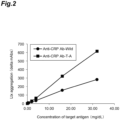
- An antibody whose heavy chain constant region sequence consists of SEQ ID NO: 40 was produced by the same manner as in the antibody whose heavy chain constant region consists of SEQ ID NO: 1 (Anti-CRP Ab-Wild).
- Antibodies against CRP were used to prepare measurement reagents for an immunoagglutination method as follows.
- a 3500 automatic analyzer manufactured by Hitachi, Ltd. was used as an automatic analyzer to measure aggregation states of insoluble particles through antigen-antibody reactions between target antigen (CRP) samples at various concentrations and the antibodies carried on the polystyrene latex particles described in (1) by light transmittance. Specifically, 100 ⁇ L of the buffer solution prepared in (1)(ii) above was added to 2.0 ⁇ L of the CRP solution, and this mixture was stirred and mixed at 37°C. After standing for 5 minutes, 100 ⁇ L of the insoluble particle suspension was added thereto and further stirred and mixed at 37°C. An aggregation reaction for about 5 minutes was measured as an amount of change in absorbance.
- the insoluble particles of Anti-CRP Ab-Wild, and Anti-CRP Ab-T-A prepared in (1) above were evaluated for the degree of aggregation due to a reaction with the target antigen, and as a result, it was confirmed that the insoluble particles of Anti-CRP Ab-T-A had a higher degree of aggregation than Anti-CRP Ab-Wild, enabling highly sensitive measurement.
Landscapes
- Health & Medical Sciences (AREA)
- Immunology (AREA)
- Life Sciences & Earth Sciences (AREA)
- Chemical & Material Sciences (AREA)
- Engineering & Computer Science (AREA)
- Molecular Biology (AREA)
- Urology & Nephrology (AREA)
- Biomedical Technology (AREA)
- Hematology (AREA)
- Medicinal Chemistry (AREA)
- Biochemistry (AREA)
- General Health & Medical Sciences (AREA)
- Organic Chemistry (AREA)
- General Physics & Mathematics (AREA)
- Physics & Mathematics (AREA)
- Cell Biology (AREA)
- Pathology (AREA)
- Microbiology (AREA)
- Analytical Chemistry (AREA)
- Food Science & Technology (AREA)
- Biotechnology (AREA)
- Proteomics, Peptides & Aminoacids (AREA)
- Genetics & Genomics (AREA)
- Biophysics (AREA)
- Chemical Kinetics & Catalysis (AREA)
- Peptides Or Proteins (AREA)
- Medicines Containing Antibodies Or Antigens For Use As Internal Diagnostic Agents (AREA)
Applications Claiming Priority (3)
| Application Number | Priority Date | Filing Date | Title |
|---|---|---|---|
| JP2020217745 | 2020-12-25 | ||
| EP21910898.2A EP4261221A4 (de) | 2020-12-25 | 2021-12-22 | Verfahren zur messung eines zielantigens und darin verwendete unlösliche partikel und kit zur messung eines zielantigens |
| PCT/JP2021/047681 WO2022138758A1 (ja) | 2020-12-25 | 2021-12-22 | 標的抗原の測定方法並びにそれに用いる不溶性粒子及び標的抗原測定用キット |
Related Parent Applications (1)
| Application Number | Title | Priority Date | Filing Date |
|---|---|---|---|
| EP21910898.2A Division EP4261221A4 (de) | 2020-12-25 | 2021-12-22 | Verfahren zur messung eines zielantigens und darin verwendete unlösliche partikel und kit zur messung eines zielantigens |
Publications (2)
| Publication Number | Publication Date |
|---|---|
| EP4582810A2 true EP4582810A2 (de) | 2025-07-09 |
| EP4582810A3 EP4582810A3 (de) | 2025-12-31 |
Family
ID=82157013
Family Applications (2)
| Application Number | Title | Priority Date | Filing Date |
|---|---|---|---|
| EP25170324.5A Pending EP4582810A3 (de) | 2020-12-25 | 2021-12-22 | Verfahren zur messung eines zielantigens und darin verwendete unlösliche partikel und kit zur messung eines zielantigens |
| EP21910898.2A Withdrawn EP4261221A4 (de) | 2020-12-25 | 2021-12-22 | Verfahren zur messung eines zielantigens und darin verwendete unlösliche partikel und kit zur messung eines zielantigens |
Family Applications After (1)
| Application Number | Title | Priority Date | Filing Date |
|---|---|---|---|
| EP21910898.2A Withdrawn EP4261221A4 (de) | 2020-12-25 | 2021-12-22 | Verfahren zur messung eines zielantigens und darin verwendete unlösliche partikel und kit zur messung eines zielantigens |
Country Status (5)
| Country | Link |
|---|---|
| US (1) | US20240060970A1 (de) |
| EP (2) | EP4582810A3 (de) |
| JP (2) | JPWO2022138758A1 (de) |
| CN (1) | CN116601168A (de) |
| WO (1) | WO2022138758A1 (de) |
Citations (3)
| Publication number | Priority date | Publication date | Assignee | Title |
|---|---|---|---|---|
| JP2009162537A (ja) | 2007-12-28 | 2009-07-23 | Furukawa Electric Co Ltd:The | 多糖を表面に有する複合粒子、複合粒子コロイド、それを用いた分析試薬、及び複合粒子の製造方法 |
| JP5015012B2 (ja) | 2005-01-28 | 2012-08-29 | アイコン・ジェネティクス・ゲーエムベーハー | 植物におけるヘテロ‐オリゴマータンパク質の産生 |
| JP2017083440A (ja) | 2015-10-23 | 2017-05-18 | 株式会社Lsiメディエンス | 免疫学的測定試薬、測定方法及び測定範囲の拡大方法 |
Family Cites Families (9)
| Publication number | Priority date | Publication date | Assignee | Title |
|---|---|---|---|---|
| JPH08220099A (ja) * | 1995-02-10 | 1996-08-30 | Morinaga Milk Ind Co Ltd | 物質の検出試薬及び慢性関節リウマチの検知法 |
| CA2257357C (en) * | 1996-06-07 | 2010-04-13 | Neorx Corporation | Humanized antibodies with modified glycosylation |
| US20090010920A1 (en) * | 2003-03-03 | 2009-01-08 | Xencor, Inc. | Fc Variants Having Decreased Affinity for FcyRIIb |
| ES2818103T3 (es) * | 2015-01-16 | 2021-04-09 | Juno Therapeutics Inc | Anticuerpos y receptores de antígenos quiméricos específicos para ROR1 |
| JPWO2017131021A1 (ja) * | 2016-01-27 | 2018-11-22 | 株式会社J−オイルミルズ | 糖タンパク質の測定方法 |
| GB201700553D0 (en) * | 2017-01-12 | 2017-03-01 | Genagon Therapeutics Ab | Therapeutic agents |
| JP6870851B2 (ja) * | 2017-05-12 | 2021-05-12 | 国立研究開発法人農業・食品産業技術総合研究機構 | 機能的な一本鎖抗体の製造方法 |
| WO2018213064A1 (en) * | 2017-05-19 | 2018-11-22 | The United States Of America, As Represented By The Secretary, Department Of Health And Human Services | Human monoclonal antibody targeting tnfer2 for cancer immunotherapy |
| US20250138025A1 (en) * | 2021-08-30 | 2025-05-01 | Eiken Kagaku Kabushiki Kaisha | Antibody, immobilized antibody using the same, antibody composition, reagent for immunoassay and immunoassay method, as well as method for improving reactivity of antibody with antigen |
-
2021
- 2021-12-22 CN CN202180084916.8A patent/CN116601168A/zh active Pending
- 2021-12-22 WO PCT/JP2021/047681 patent/WO2022138758A1/ja not_active Ceased
- 2021-12-22 JP JP2022571581A patent/JPWO2022138758A1/ja active Pending
- 2021-12-22 EP EP25170324.5A patent/EP4582810A3/de active Pending
- 2021-12-22 EP EP21910898.2A patent/EP4261221A4/de not_active Withdrawn
- 2021-12-22 US US18/269,257 patent/US20240060970A1/en active Pending
-
2025
- 2025-01-17 JP JP2025006604A patent/JP7834214B2/ja active Active
Patent Citations (3)
| Publication number | Priority date | Publication date | Assignee | Title |
|---|---|---|---|---|
| JP5015012B2 (ja) | 2005-01-28 | 2012-08-29 | アイコン・ジェネティクス・ゲーエムベーハー | 植物におけるヘテロ‐オリゴマータンパク質の産生 |
| JP2009162537A (ja) | 2007-12-28 | 2009-07-23 | Furukawa Electric Co Ltd:The | 多糖を表面に有する複合粒子、複合粒子コロイド、それを用いた分析試薬、及び複合粒子の製造方法 |
| JP2017083440A (ja) | 2015-10-23 | 2017-05-18 | 株式会社Lsiメディエンス | 免疫学的測定試薬、測定方法及び測定範囲の拡大方法 |
Also Published As
| Publication number | Publication date |
|---|---|
| US20240060970A1 (en) | 2024-02-22 |
| WO2022138758A1 (ja) | 2022-06-30 |
| EP4261221A4 (de) | 2025-01-15 |
| CN116601168A (zh) | 2023-08-15 |
| EP4261221A1 (de) | 2023-10-18 |
| JP2025061422A (ja) | 2025-04-10 |
| JP7834214B2 (ja) | 2026-03-23 |
| JPWO2022138758A1 (de) | 2022-06-30 |
| EP4582810A3 (de) | 2025-12-31 |
Similar Documents
| Publication | Publication Date | Title |
|---|---|---|
| CN101711361B (zh) | 检测感染的多元方法 | |
| EP1371983A1 (de) | Immuntestverfahren, Reagenz für Immuntestverfahren und Verfahren zur dessen Herstellung | |
| US7785773B1 (en) | Method of diagnosis and kit therefor | |
| CN109142753A (zh) | 鳞状上皮细胞癌抗原化学发光免疫检测试剂盒及其制备方法 | |
| EP4582810A2 (de) | Verfahren zur messung eines zielantigens und darin verwendete unlösliche partikel und kit zur messung eines zielantigens | |
| KR101628221B1 (ko) | 검사 시약 및 그것을 사용한 피검 시료 중의 피측정물의 측정 방법 | |
| Drygin et al. | High-sensitivity express immunochromatographic method for detection of plant infection by tobacco mosaic virus | |
| TW201314208A (zh) | 用於抗原特異性抗體之以自組裝珠粒為主的多重檢測法 | |
| KR100356596B1 (ko) | 탄소졸표지물을이용한면역에세이방법 | |
| EP4121765A1 (de) | Coronavirus-assay | |
| JP2024026911A (ja) | 標的抗原の測定方法並びにそれに用いる不溶性粒子及び標的抗原測定用キット | |
| TW202311743A (zh) | 包含人類化抗體之試劑 | |
| Mandel | Methods for the Study of Virus–Antibody Complexes | |
| EP3916012A2 (de) | Alkalischer phosphatase-fusionsantikörper und verfahren zur herstellung davon und immunoassay-verfahren | |
| JPH08184597A (ja) | 炭素ゾルラベルを用いるイムノアッセイ | |
| WO2021193566A1 (ja) | 新規抗体及びその用途 | |
| CN111983213A (zh) | 蛋白a/g微球、胶乳抗体及试剂盒 | |
| JP3328053B2 (ja) | 免疫凝集反応による抗体又は抗原の濃度定量法 | |
| JP7626753B2 (ja) | Fc領域の一部を欠損した抗体を含む試薬 | |
| WO2025135074A1 (ja) | 標的抗原の測定方法並びにそれに用いる抗体、不溶性粒子及び標的抗原測定用キット | |
| CN116621930B (zh) | 检测基孔肯雅病毒的多肽、试剂盒和方法 | |
| CN120329437B (zh) | 18-oxof抗体或其抗原结合片段 | |
| WO2025135129A1 (ja) | 凝集反応用改善剤、標的抗原の測定方法の改善方法、及びヒト脳性ナトリウム利尿ペプチドの測定試薬 | |
| EP3336545A1 (de) | Reversible markierung von antigenen in biologischen proben | |
| JP2026027893A (ja) | 免疫複合体 |
Legal Events
| Date | Code | Title | Description |
|---|---|---|---|
| PUAI | Public reference made under article 153(3) epc to a published international application that has entered the european phase |
Free format text: ORIGINAL CODE: 0009012 |
|
| STAA | Information on the status of an ep patent application or granted ep patent |
Free format text: STATUS: REQUEST FOR EXAMINATION WAS MADE |
|
| 17P | Request for examination filed |
Effective date: 20250414 |
|
| AC | Divisional application: reference to earlier application |
Ref document number: 4261221 Country of ref document: EP Kind code of ref document: P |
|
| AK | Designated contracting states |
Kind code of ref document: A2 Designated state(s): AL AT BE BG CH CY CZ DE DK EE ES FI FR GB GR HR HU IE IS IT LI LT LU LV MC MK MT NL NO PL PT RO RS SE SI SK SM TR |
|
| REG | Reference to a national code |
Ref country code: DE Ref legal event code: R079 Free format text: PREVIOUS MAIN CLASS: G01N0033545000 Ipc: C07K0016000000 |
|
| RIC1 | Information provided on ipc code assigned before grant |
Ipc: C07K 16/00 20060101AFI20250908BHEP Ipc: C07K 17/00 20060101ALI20250908BHEP Ipc: C07K 17/02 20060101ALI20250908BHEP Ipc: C12N 15/13 20060101ALI20250908BHEP Ipc: G01N 33/543 20060101ALI20250908BHEP Ipc: G01N 33/545 20060101ALI20250908BHEP |
|
| PUAL | Search report despatched |
Free format text: ORIGINAL CODE: 0009013 |
|
| AK | Designated contracting states |
Kind code of ref document: A3 Designated state(s): AL AT BE BG CH CY CZ DE DK EE ES FI FR GB GR HR HU IE IS IT LI LT LU LV MC MK MT NL NO PL PT RO RS SE SI SK SM TR |
|
| RIC1 | Information provided on ipc code assigned before grant |
Ipc: C07K 16/00 20060101AFI20251127BHEP Ipc: C07K 17/00 20060101ALI20251127BHEP Ipc: C07K 17/02 20060101ALI20251127BHEP Ipc: C12N 15/13 20060101ALI20251127BHEP Ipc: G01N 33/543 20060101ALI20251127BHEP Ipc: G01N 33/545 20060101ALI20251127BHEP |