EP4582146A2 - Enhanced chimeric antigen receptors and use thereof - Google Patents
Enhanced chimeric antigen receptors and use thereof Download PDFInfo
- Publication number
- EP4582146A2 EP4582146A2 EP25169707.4A EP25169707A EP4582146A2 EP 4582146 A2 EP4582146 A2 EP 4582146A2 EP 25169707 A EP25169707 A EP 25169707A EP 4582146 A2 EP4582146 A2 EP 4582146A2
- Authority
- EP
- European Patent Office
- Prior art keywords
- cells
- cell
- seq
- car
- polypeptides
- Prior art date
- Legal status (The legal status is an assumption and is not a legal conclusion. Google has not performed a legal analysis and makes no representation as to the accuracy of the status listed.)
- Pending
Links
Images


























Classifications
-
- A—HUMAN NECESSITIES
- A61—MEDICAL OR VETERINARY SCIENCE; HYGIENE
- A61K—PREPARATIONS FOR MEDICAL, DENTAL OR TOILETRY PURPOSES
- A61K35/00—Medicinal preparations containing materials or reaction products thereof with undetermined constitution
- A61K35/12—Materials from mammals; Compositions comprising non-specified tissues or cells; Compositions comprising non-embryonic stem cells; Genetically modified cells
- A61K35/14—Blood; Artificial blood
- A61K35/17—Lymphocytes; B-cells; T-cells; Natural killer cells; Interferon-activated or cytokine-activated lymphocytes
-
- A—HUMAN NECESSITIES
- A61—MEDICAL OR VETERINARY SCIENCE; HYGIENE
- A61K—PREPARATIONS FOR MEDICAL, DENTAL OR TOILETRY PURPOSES
- A61K38/00—Medicinal preparations containing peptides
- A61K38/16—Peptides having more than 20 amino acids; Gastrins; Somatostatins; Melanotropins; Derivatives thereof
- A61K38/17—Peptides having more than 20 amino acids; Gastrins; Somatostatins; Melanotropins; Derivatives thereof from animals; from humans
- A61K38/19—Cytokines; Lymphokines; Interferons
- A61K38/20—Interleukins [IL]
-
- A—HUMAN NECESSITIES
- A61—MEDICAL OR VETERINARY SCIENCE; HYGIENE
- A61K—PREPARATIONS FOR MEDICAL, DENTAL OR TOILETRY PURPOSES
- A61K39/00—Medicinal preparations containing antigens or antibodies
- A61K39/0005—Vertebrate antigens
- A61K39/0011—Cancer antigens
- A61K39/001102—Receptors, cell surface antigens or cell surface determinants
- A61K39/001111—Immunoglobulin superfamily
- A61K39/001112—CD19 or B4
-
- A—HUMAN NECESSITIES
- A61—MEDICAL OR VETERINARY SCIENCE; HYGIENE
- A61K—PREPARATIONS FOR MEDICAL, DENTAL OR TOILETRY PURPOSES
- A61K39/00—Medicinal preparations containing antigens or antibodies
- A61K39/0005—Vertebrate antigens
- A61K39/0011—Cancer antigens
- A61K39/001102—Receptors, cell surface antigens or cell surface determinants
- A61K39/001129—Molecules with a "CD" designation not provided for elsewhere
-
- A—HUMAN NECESSITIES
- A61—MEDICAL OR VETERINARY SCIENCE; HYGIENE
- A61K—PREPARATIONS FOR MEDICAL, DENTAL OR TOILETRY PURPOSES
- A61K40/00—Cellular immunotherapy
- A61K40/10—Cellular immunotherapy characterised by the cell type used
- A61K40/15—Natural-killer [NK] cells; Natural-killer T [NKT] cells
-
- A—HUMAN NECESSITIES
- A61—MEDICAL OR VETERINARY SCIENCE; HYGIENE
- A61K—PREPARATIONS FOR MEDICAL, DENTAL OR TOILETRY PURPOSES
- A61K40/00—Cellular immunotherapy
- A61K40/30—Cellular immunotherapy characterised by the recombinant expression of specific molecules in the cells of the immune system
- A61K40/31—Chimeric antigen receptors [CAR]
-
- A—HUMAN NECESSITIES
- A61—MEDICAL OR VETERINARY SCIENCE; HYGIENE
- A61K—PREPARATIONS FOR MEDICAL, DENTAL OR TOILETRY PURPOSES
- A61K40/00—Cellular immunotherapy
- A61K40/40—Cellular immunotherapy characterised by antigens that are targeted or presented by cells of the immune system
- A61K40/41—Vertebrate antigens
- A61K40/42—Cancer antigens
- A61K40/4202—Receptors, cell surface antigens or cell surface determinants
- A61K40/421—Immunoglobulin superfamily
- A61K40/4211—CD19 or B4
-
- A—HUMAN NECESSITIES
- A61—MEDICAL OR VETERINARY SCIENCE; HYGIENE
- A61P—SPECIFIC THERAPEUTIC ACTIVITY OF CHEMICAL COMPOUNDS OR MEDICINAL PREPARATIONS
- A61P29/00—Non-central analgesic, antipyretic or antiinflammatory agents, e.g. antirheumatic agents; Non-steroidal antiinflammatory drugs [NSAID]
-
- A—HUMAN NECESSITIES
- A61—MEDICAL OR VETERINARY SCIENCE; HYGIENE
- A61P—SPECIFIC THERAPEUTIC ACTIVITY OF CHEMICAL COMPOUNDS OR MEDICINAL PREPARATIONS
- A61P37/00—Drugs for immunological or allergic disorders
- A61P37/02—Immunomodulators
-
- A—HUMAN NECESSITIES
- A61—MEDICAL OR VETERINARY SCIENCE; HYGIENE
- A61P—SPECIFIC THERAPEUTIC ACTIVITY OF CHEMICAL COMPOUNDS OR MEDICINAL PREPARATIONS
- A61P37/00—Drugs for immunological or allergic disorders
- A61P37/02—Immunomodulators
- A61P37/06—Immunosuppressants, e.g. drugs for graft rejection
-
- C—CHEMISTRY; METALLURGY
- C07—ORGANIC CHEMISTRY
- C07K—PEPTIDES
- C07K14/00—Peptides having more than 20 amino acids; Gastrins; Somatostatins; Melanotropins; Derivatives thereof
- C07K14/435—Peptides having more than 20 amino acids; Gastrins; Somatostatins; Melanotropins; Derivatives thereof from animals; from humans
- C07K14/52—Cytokines; Lymphokines; Interferons
- C07K14/54—Interleukins [IL]
- C07K14/5443—IL-15
-
- C—CHEMISTRY; METALLURGY
- C07—ORGANIC CHEMISTRY
- C07K—PEPTIDES
- C07K14/00—Peptides having more than 20 amino acids; Gastrins; Somatostatins; Melanotropins; Derivatives thereof
- C07K14/435—Peptides having more than 20 amino acids; Gastrins; Somatostatins; Melanotropins; Derivatives thereof from animals; from humans
- C07K14/705—Receptors; Cell surface antigens; Cell surface determinants
- C07K14/70503—Immunoglobulin superfamily
-
- C—CHEMISTRY; METALLURGY
- C07—ORGANIC CHEMISTRY
- C07K—PEPTIDES
- C07K14/00—Peptides having more than 20 amino acids; Gastrins; Somatostatins; Melanotropins; Derivatives thereof
- C07K14/435—Peptides having more than 20 amino acids; Gastrins; Somatostatins; Melanotropins; Derivatives thereof from animals; from humans
- C07K14/705—Receptors; Cell surface antigens; Cell surface determinants
- C07K14/70503—Immunoglobulin superfamily
- C07K14/7051—T-cell receptor (TcR)-CD3 complex
-
- C—CHEMISTRY; METALLURGY
- C07—ORGANIC CHEMISTRY
- C07K—PEPTIDES
- C07K14/00—Peptides having more than 20 amino acids; Gastrins; Somatostatins; Melanotropins; Derivatives thereof
- C07K14/435—Peptides having more than 20 amino acids; Gastrins; Somatostatins; Melanotropins; Derivatives thereof from animals; from humans
- C07K14/705—Receptors; Cell surface antigens; Cell surface determinants
- C07K14/70503—Immunoglobulin superfamily
- C07K14/70521—CD28, CD152
-
- C—CHEMISTRY; METALLURGY
- C07—ORGANIC CHEMISTRY
- C07K—PEPTIDES
- C07K14/00—Peptides having more than 20 amino acids; Gastrins; Somatostatins; Melanotropins; Derivatives thereof
- C07K14/435—Peptides having more than 20 amino acids; Gastrins; Somatostatins; Melanotropins; Derivatives thereof from animals; from humans
- C07K14/705—Receptors; Cell surface antigens; Cell surface determinants
- C07K14/71—Receptors; Cell surface antigens; Cell surface determinants for growth factors; for growth regulators
-
- C—CHEMISTRY; METALLURGY
- C07—ORGANIC CHEMISTRY
- C07K—PEPTIDES
- C07K16/00—Immunoglobulins [IGs], e.g. monoclonal or polyclonal antibodies
- C07K16/18—Immunoglobulins [IGs], e.g. monoclonal or polyclonal antibodies against material from animals or humans
- C07K16/28—Immunoglobulins [IGs], e.g. monoclonal or polyclonal antibodies against material from animals or humans against receptors, cell surface antigens or cell surface determinants
- C07K16/2803—Immunoglobulins [IGs], e.g. monoclonal or polyclonal antibodies against material from animals or humans against receptors, cell surface antigens or cell surface determinants against the immunoglobulin superfamily
-
- C—CHEMISTRY; METALLURGY
- C07—ORGANIC CHEMISTRY
- C07K—PEPTIDES
- C07K16/00—Immunoglobulins [IGs], e.g. monoclonal or polyclonal antibodies
- C07K16/18—Immunoglobulins [IGs], e.g. monoclonal or polyclonal antibodies against material from animals or humans
- C07K16/28—Immunoglobulins [IGs], e.g. monoclonal or polyclonal antibodies against material from animals or humans against receptors, cell surface antigens or cell surface determinants
- C07K16/2863—Immunoglobulins [IGs], e.g. monoclonal or polyclonal antibodies against material from animals or humans against receptors, cell surface antigens or cell surface determinants against receptors for growth factors, growth regulators
-
- C—CHEMISTRY; METALLURGY
- C07—ORGANIC CHEMISTRY
- C07K—PEPTIDES
- C07K16/00—Immunoglobulins [IGs], e.g. monoclonal or polyclonal antibodies
- C07K16/18—Immunoglobulins [IGs], e.g. monoclonal or polyclonal antibodies against material from animals or humans
- C07K16/28—Immunoglobulins [IGs], e.g. monoclonal or polyclonal antibodies against material from animals or humans against receptors, cell surface antigens or cell surface determinants
- C07K16/2896—Immunoglobulins [IGs], e.g. monoclonal or polyclonal antibodies against material from animals or humans against receptors, cell surface antigens or cell surface determinants against molecules with a "CD"-designation, not provided for elsewhere
-
- C—CHEMISTRY; METALLURGY
- C12—BIOCHEMISTRY; BEER; SPIRITS; WINE; VINEGAR; MICROBIOLOGY; ENZYMOLOGY; MUTATION OR GENETIC ENGINEERING
- C12N—MICROORGANISMS OR ENZYMES; COMPOSITIONS THEREOF; PROPAGATING, PRESERVING, OR MAINTAINING MICROORGANISMS; MUTATION OR GENETIC ENGINEERING; CULTURE MEDIA
- C12N15/00—Mutation or genetic engineering; DNA or RNA concerning genetic engineering, vectors, e.g. plasmids, or their isolation, preparation or purification; Use of hosts therefor
- C12N15/09—Recombinant DNA-technology
- C12N15/11—DNA or RNA fragments; Modified forms thereof; Non-coding nucleic acids having a biological activity
- C12N15/52—Genes encoding for enzymes or proenzymes
-
- C—CHEMISTRY; METALLURGY
- C12—BIOCHEMISTRY; BEER; SPIRITS; WINE; VINEGAR; MICROBIOLOGY; ENZYMOLOGY; MUTATION OR GENETIC ENGINEERING
- C12N—MICROORGANISMS OR ENZYMES; COMPOSITIONS THEREOF; PROPAGATING, PRESERVING, OR MAINTAINING MICROORGANISMS; MUTATION OR GENETIC ENGINEERING; CULTURE MEDIA
- C12N15/00—Mutation or genetic engineering; DNA or RNA concerning genetic engineering, vectors, e.g. plasmids, or their isolation, preparation or purification; Use of hosts therefor
- C12N15/09—Recombinant DNA-technology
- C12N15/63—Introduction of foreign genetic material using vectors; Vectors; Use of hosts therefor; Regulation of expression
- C12N15/79—Vectors or expression systems specially adapted for eukaryotic hosts
- C12N15/85—Vectors or expression systems specially adapted for eukaryotic hosts for animal cells
- C12N15/86—Viral vectors
-
- C—CHEMISTRY; METALLURGY
- C12—BIOCHEMISTRY; BEER; SPIRITS; WINE; VINEGAR; MICROBIOLOGY; ENZYMOLOGY; MUTATION OR GENETIC ENGINEERING
- C12N—MICROORGANISMS OR ENZYMES; COMPOSITIONS THEREOF; PROPAGATING, PRESERVING, OR MAINTAINING MICROORGANISMS; MUTATION OR GENETIC ENGINEERING; CULTURE MEDIA
- C12N5/00—Undifferentiated human, animal or plant cells, e.g. cell lines; Tissues; Cultivation or maintenance thereof; Culture media therefor
- C12N5/06—Animal cells or tissues; Human cells or tissues
- C12N5/0602—Vertebrate cells
- C12N5/0634—Cells from the blood or the immune system
- C12N5/0636—T lymphocytes
-
- C—CHEMISTRY; METALLURGY
- C12—BIOCHEMISTRY; BEER; SPIRITS; WINE; VINEGAR; MICROBIOLOGY; ENZYMOLOGY; MUTATION OR GENETIC ENGINEERING
- C12N—MICROORGANISMS OR ENZYMES; COMPOSITIONS THEREOF; PROPAGATING, PRESERVING, OR MAINTAINING MICROORGANISMS; MUTATION OR GENETIC ENGINEERING; CULTURE MEDIA
- C12N5/00—Undifferentiated human, animal or plant cells, e.g. cell lines; Tissues; Cultivation or maintenance thereof; Culture media therefor
- C12N5/06—Animal cells or tissues; Human cells or tissues
- C12N5/0602—Vertebrate cells
- C12N5/0634—Cells from the blood or the immune system
- C12N5/0646—Natural killers cells [NK], NKT cells
-
- A—HUMAN NECESSITIES
- A61—MEDICAL OR VETERINARY SCIENCE; HYGIENE
- A61K—PREPARATIONS FOR MEDICAL, DENTAL OR TOILETRY PURPOSES
- A61K39/00—Medicinal preparations containing antigens or antibodies
- A61K2039/51—Medicinal preparations containing antigens or antibodies comprising whole cells, viruses or DNA/RNA
- A61K2039/515—Animal cells
- A61K2039/5156—Animal cells expressing foreign proteins
-
- A—HUMAN NECESSITIES
- A61—MEDICAL OR VETERINARY SCIENCE; HYGIENE
- A61K—PREPARATIONS FOR MEDICAL, DENTAL OR TOILETRY PURPOSES
- A61K39/00—Medicinal preparations containing antigens or antibodies
- A61K2039/51—Medicinal preparations containing antigens or antibodies comprising whole cells, viruses or DNA/RNA
- A61K2039/515—Animal cells
- A61K2039/5158—Antigen-pulsed cells, e.g. T-cells
-
- A—HUMAN NECESSITIES
- A61—MEDICAL OR VETERINARY SCIENCE; HYGIENE
- A61K—PREPARATIONS FOR MEDICAL, DENTAL OR TOILETRY PURPOSES
- A61K39/00—Medicinal preparations containing antigens or antibodies
- A61K2039/57—Medicinal preparations containing antigens or antibodies characterised by the type of response, e.g. Th1, Th2
- A61K2039/572—Medicinal preparations containing antigens or antibodies characterised by the type of response, e.g. Th1, Th2 cytotoxic response
-
- A—HUMAN NECESSITIES
- A61—MEDICAL OR VETERINARY SCIENCE; HYGIENE
- A61K—PREPARATIONS FOR MEDICAL, DENTAL OR TOILETRY PURPOSES
- A61K39/00—Medicinal preparations containing antigens or antibodies
- A61K2039/58—Medicinal preparations containing antigens or antibodies raising an immune response against a target which is not the antigen used for immunisation
- A61K2039/585—Medicinal preparations containing antigens or antibodies raising an immune response against a target which is not the antigen used for immunisation wherein the target is cancer
-
- A—HUMAN NECESSITIES
- A61—MEDICAL OR VETERINARY SCIENCE; HYGIENE
- A61K—PREPARATIONS FOR MEDICAL, DENTAL OR TOILETRY PURPOSES
- A61K2239/00—Indexing codes associated with cellular immunotherapy of group A61K40/00
- A61K2239/10—Indexing codes associated with cellular immunotherapy of group A61K40/00 characterized by the structure of the chimeric antigen receptor [CAR]
- A61K2239/17—Hinge-spacer domain
-
- A—HUMAN NECESSITIES
- A61—MEDICAL OR VETERINARY SCIENCE; HYGIENE
- A61K—PREPARATIONS FOR MEDICAL, DENTAL OR TOILETRY PURPOSES
- A61K2239/00—Indexing codes associated with cellular immunotherapy of group A61K40/00
- A61K2239/10—Indexing codes associated with cellular immunotherapy of group A61K40/00 characterized by the structure of the chimeric antigen receptor [CAR]
- A61K2239/22—Intracellular domain
-
- A—HUMAN NECESSITIES
- A61—MEDICAL OR VETERINARY SCIENCE; HYGIENE
- A61K—PREPARATIONS FOR MEDICAL, DENTAL OR TOILETRY PURPOSES
- A61K2239/00—Indexing codes associated with cellular immunotherapy of group A61K40/00
- A61K2239/46—Indexing codes associated with cellular immunotherapy of group A61K40/00 characterised by the cancer treated
- A61K2239/48—Blood cells, e.g. leukemia or lymphoma
-
- A—HUMAN NECESSITIES
- A61—MEDICAL OR VETERINARY SCIENCE; HYGIENE
- A61K—PREPARATIONS FOR MEDICAL, DENTAL OR TOILETRY PURPOSES
- A61K38/00—Medicinal preparations containing peptides
-
- A—HUMAN NECESSITIES
- A61—MEDICAL OR VETERINARY SCIENCE; HYGIENE
- A61P—SPECIFIC THERAPEUTIC ACTIVITY OF CHEMICAL COMPOUNDS OR MEDICINAL PREPARATIONS
- A61P35/00—Antineoplastic agents
-
- C—CHEMISTRY; METALLURGY
- C07—ORGANIC CHEMISTRY
- C07K—PEPTIDES
- C07K2317/00—Immunoglobulins specific features
- C07K2317/20—Immunoglobulins specific features characterized by taxonomic origin
- C07K2317/24—Immunoglobulins specific features characterized by taxonomic origin containing regions, domains or residues from different species, e.g. chimeric, humanized or veneered
-
- C—CHEMISTRY; METALLURGY
- C07—ORGANIC CHEMISTRY
- C07K—PEPTIDES
- C07K2317/00—Immunoglobulins specific features
- C07K2317/50—Immunoglobulins specific features characterized by immunoglobulin fragments
- C07K2317/56—Immunoglobulins specific features characterized by immunoglobulin fragments variable (Fv) region, i.e. VH and/or VL
-
- C—CHEMISTRY; METALLURGY
- C07—ORGANIC CHEMISTRY
- C07K—PEPTIDES
- C07K2317/00—Immunoglobulins specific features
- C07K2317/50—Immunoglobulins specific features characterized by immunoglobulin fragments
- C07K2317/56—Immunoglobulins specific features characterized by immunoglobulin fragments variable (Fv) region, i.e. VH and/or VL
- C07K2317/565—Complementarity determining region [CDR]
-
- C—CHEMISTRY; METALLURGY
- C07—ORGANIC CHEMISTRY
- C07K—PEPTIDES
- C07K2317/00—Immunoglobulins specific features
- C07K2317/50—Immunoglobulins specific features characterized by immunoglobulin fragments
- C07K2317/56—Immunoglobulins specific features characterized by immunoglobulin fragments variable (Fv) region, i.e. VH and/or VL
- C07K2317/567—Framework region [FR]
-
- C—CHEMISTRY; METALLURGY
- C07—ORGANIC CHEMISTRY
- C07K—PEPTIDES
- C07K2317/00—Immunoglobulins specific features
- C07K2317/60—Immunoglobulins specific features characterized by non-natural combinations of immunoglobulin fragments
- C07K2317/62—Immunoglobulins specific features characterized by non-natural combinations of immunoglobulin fragments comprising only variable region components
- C07K2317/622—Single chain antibody (scFv)
-
- C—CHEMISTRY; METALLURGY
- C07—ORGANIC CHEMISTRY
- C07K—PEPTIDES
- C07K2317/00—Immunoglobulins specific features
- C07K2317/70—Immunoglobulins specific features characterized by effect upon binding to a cell or to an antigen
- C07K2317/73—Inducing cell death, e.g. apoptosis, necrosis or inhibition of cell proliferation
-
- C—CHEMISTRY; METALLURGY
- C07—ORGANIC CHEMISTRY
- C07K—PEPTIDES
- C07K2317/00—Immunoglobulins specific features
- C07K2317/70—Immunoglobulins specific features characterized by effect upon binding to a cell or to an antigen
- C07K2317/73—Inducing cell death, e.g. apoptosis, necrosis or inhibition of cell proliferation
- C07K2317/732—Antibody-dependent cellular cytotoxicity [ADCC]
-
- C—CHEMISTRY; METALLURGY
- C07—ORGANIC CHEMISTRY
- C07K—PEPTIDES
- C07K2317/00—Immunoglobulins specific features
- C07K2317/70—Immunoglobulins specific features characterized by effect upon binding to a cell or to an antigen
- C07K2317/76—Antagonist effect on antigen, e.g. neutralization or inhibition of binding
-
- C—CHEMISTRY; METALLURGY
- C07—ORGANIC CHEMISTRY
- C07K—PEPTIDES
- C07K2319/00—Fusion polypeptide
-
- C—CHEMISTRY; METALLURGY
- C07—ORGANIC CHEMISTRY
- C07K—PEPTIDES
- C07K2319/00—Fusion polypeptide
- C07K2319/01—Fusion polypeptide containing a localisation/targetting motif
- C07K2319/02—Fusion polypeptide containing a localisation/targetting motif containing a signal sequence
-
- C—CHEMISTRY; METALLURGY
- C07—ORGANIC CHEMISTRY
- C07K—PEPTIDES
- C07K2319/00—Fusion polypeptide
- C07K2319/01—Fusion polypeptide containing a localisation/targetting motif
- C07K2319/03—Fusion polypeptide containing a localisation/targetting motif containing a transmembrane segment
-
- C—CHEMISTRY; METALLURGY
- C07—ORGANIC CHEMISTRY
- C07K—PEPTIDES
- C07K2319/00—Fusion polypeptide
- C07K2319/30—Non-immunoglobulin-derived peptide or protein having an immunoglobulin constant or Fc region, or a fragment thereof, attached thereto
-
- C—CHEMISTRY; METALLURGY
- C07—ORGANIC CHEMISTRY
- C07K—PEPTIDES
- C07K2319/00—Fusion polypeptide
- C07K2319/33—Fusion polypeptide fusions for targeting to specific cell types, e.g. tissue specific targeting, targeting of a bacterial subspecies
-
- C—CHEMISTRY; METALLURGY
- C12—BIOCHEMISTRY; BEER; SPIRITS; WINE; VINEGAR; MICROBIOLOGY; ENZYMOLOGY; MUTATION OR GENETIC ENGINEERING
- C12N—MICROORGANISMS OR ENZYMES; COMPOSITIONS THEREOF; PROPAGATING, PRESERVING, OR MAINTAINING MICROORGANISMS; MUTATION OR GENETIC ENGINEERING; CULTURE MEDIA
- C12N2510/00—Genetically modified cells
Definitions
- the Ev3 may comprise or have at least 80% (e.g., 81%, 82%, 83%, 84%, 85%, 86%, 87%, 88%, 89%, 90%, 91%, 92%, 93%, 94%, 95%, 96%, 97%, 98%, 99%, or 100%) sequence identity to SEQ ID NO:2 LEEKK-GNYVVTDHGSCVRACGADSYEMEEDGVRKCKKCEGPCRK-VCNGIGIGEFKDSLSINATNIKHFKNCTSISGDLHILPVAFRGDSFTHTPPLDPQELDIL KTVKEITGFLLIQAWPENRTDLHAFENLEIIRGRTKQHGQFSLAVVSLNITSLGLRSLK EISDGDVIISGNKNLCYANTINWKKLFGTSGQKTKIISNRGENSCKATGQ-VCHALCSPEGCWGPEPRDCVSCRNVSRGRECVDKCNLLEGEPREFVENSECIQCHPE CLPQAMNITCTGRGPDNCIQCAHYIDGPHCVKTCP
- the Ev3 hinge is encoded by a nucleotide sequence with at least 80%, such as at least 81, 82, 83, 84, 85, 86, 87, 88, 89, 90, 91, 92, 93, 94, 95, 96, 97, 98, or 99% sequence identity to SEQ ID NO:1.
- the Ev3 hinge is encoded by a nucleotide sequence of SEQ ID NO:1.
- the extracellular domain of the CAR comprises an antigen-binding domain selected from the group consisting of F(ab')2, Fab', Fab, Fv, and scFv.
- the antigen-binding domain comprises a scFv.
- the scFv is further defined as a humanized scFv.
- the humanized scFv is a scFv according to the embodiments.
- the antigen binding region of the CAR binds one or more tumor associated antigens.
- the one or more tumor associated antigens are selected from the group consisting of CD19, CD319 (CS1), ROR1, CD20, carcinoembryonic antigen, alphafetoprotein, CA-125, MUC-1, epithelial tumor antigen, melanoma-associated antigen, mutated p53, mutated ras, HER2/Neu, ERBB2, folate binding protein, HIV-1 envelope glycoprotein gp120, HIV-1 envelope glycoprotein gp41, GD2, CD5, CD123, CD23, CD30, CD56, c-Met, mesothelin, GD3, HERV-K, IL-11Ralpha, kappa chain, lambda chain, CSPG4, ERBB2, WT-1, TRAIL/DR4, VEGFR2, CD33, CLL-1 and CD99.
- the at least one signaling domain comprises CD3 ⁇ , CD28, OX40/CD134, 4-1BB/CD137, Fc ⁇ RI ⁇ , ICOS/CD278, ILRB/CD122, IL-2RG/CD132, DAP12, CD70, CD40, or a combination thereof.
- the at least one signaling domain comprises DAP12.
- the CAR comprises IL-15.
- the CAR comprises CD3 ⁇ , CD28, DAP12, and IL-15.
- the CAR further comprises a suicide gene.
- the suicide gene is inducible caspase 9.
- isolated antigen-specific humanized single chain variable fragments comprising a light chain variable region (V L ) and a heavy chain variable region (V H ), wherein the scFv is:
- the scFv sequences comprise 91, 92, 93, 94, 95, 96, 97, 98, or 99% sequence identity to the framework regions of SEQ ID NOs:6, 12, 18, 24, or 30 and 100% sequence identity to the CDRs of said sequences.
- the CDRs of said sequences may have one, two, or three modifications.
- the scFv is CD19-specific and wherein the V L comprises an amino acid sequence of SEQ ID NO:7 and the V H comprises an amino acid sequence of SEQ ID NO:8.
- the CD19-specific scFv comprises an amino acid sequence of SEQ ID NO:6.
- the scFv is CD123-specific and wherein the V L comprises an amino acid sequence of SEQ ID NO:13 and the V H comprises an amino acid sequence of SEQ ID NO:14.
- the CD123-specific scFv comprises an amino acid sequence of SEQ ID NO:12.
- the scFv is mesothelin-specific and wherein the V L comprises an amino acid sequence of SEQ ID NO:19 and the V H comprises an amino acid sequence of SEQ ID NO:20.
- the mesothelin-specific scFv comprises an amino acid sequence of SEQ ID NO:18.
- the scFv is ROR1-specific and wherein the V L comprises an amino acid sequence of SEQ ID NO:25 and the V H comprises an amino acid sequence of SEQ ID NO:26.
- the ROR1-specific comprises an amino acid sequence of SEQ ID NO:24.
- the scFv is CD5-specific and wherein the V L comprises an amino acid sequence of SEQ ID NO:31 and the V H comprises an amino acid sequence of SEQ ID NO:32.
- the CD5-specific comprises an amino acid sequence of SEQ ID NO:30.
- the scFv comprises an amino acid sequence with at least 95%, such as at least 96, 97, 98, or 99% sequence identity to framework regions an amino acid sequence of SEQ ID NO:6, 12, 18, 24, or 30.
- the polynucleotide comprises SEQ ID NO:3, 9, 15, 21, or 27. In other aspects, the polynucleotide comprises a sequence with at least 90, 91, 92, 93, 94, 95, 96, 97, 98, or 99% sequence identity to SEQ ID NO:3, 9, 15, 21, or 27.
- expression vectors comprising isolated nucleotides of the embodiments.
- the vector is further defined as a viral vector.
- isolated nucleic acids comprising a nucleotide sequence encoding the CAR according to any one of the present embodiments.
- host cells engineered to express a CAR comprising a humanized scFv of the present embodiments and/or a truncated EGFRvIII (Ev3) in the hinge region of said CAR.
- the CAR is according to any one of the present embodiments.
- DNA encoding the CAR is integrated into the genome of the cell.
- the host cell is further defined as a CAR immune cell.
- the immune cell is a T cell, peripheral blood lymphocyte, NK cell, invariant NK cell, NKT cell, or stem cell.
- the immune cell is a T cell or a NK cell.
- the stem cell is a mesenchymal stem cell (MSC) or an induced pluripotent stem (iPS) cell.
- the immune cell is derived from an iPS cell.
- the T cell is a CD8 + T cell, CD4 + T cell, or gamma-delta T cell.
- the T cell is a cytotoxic T lymphocyte (CTL).
- CTL cytotoxic T lymphocyte
- the immune cell is allogeneic or autologous. In some aspects, the immune cell is isolated from peripheral blood, cord blood, or bone marrow. In certain aspects, the immune cell is isolated from cord blood. In particular aspects, the cord blood is pooled from 2 or more individual cord blood units.
- compositions comprising a population of immune cells according to any of the present embodiments. Also provided herein are compositions comprising a population of immune cells of any one of present embodiments for use in the treatment of an immune-related disorder.
- a method of treating an immune-related disorder in a subject comprising administering an effective amount of CAR immune cells of any one of the present embodiments, such as comprising a humanized scFv and/or a Ev3 hinge.
- the immune-related disorder is a cancer, autoimmune disorder, graft versus host disease, allograft rejection, or inflammatory condition.
- the immune-related disorder is an inflammatory condition and the immune cells have essentially no expression of glucocorticoid receptor.
- the immune-related disorder is a cancer.
- the immune cells are autologous or allogeneic.
- the cancer is a solid cancer or a hematologic malignancy.
- the method further comprises administering at least a second therapeutic agent.
- the at least a second therapeutic agent comprises chemotherapy, immunotherapy, surgery, radiotherapy, or biotherapy.
- the immune cells and/or the at least a second therapeutic agent are administered intravenously, intraperitoneally, intratracheally, intratumorally, intramuscularly, endoscopically, intralesionally, percutaneously, subcutaneously, regionally, or by direct injection or perfusion.
- Chimeric antigen receptor (CAR) based cellular immunotherapy has shown significant efficacies in cancer treatment, in particular for treatment of leukemia and lymphoma. Nevertheless, currently available CARs can comprise various design defects. Recent clinical results using CARs to reprogram immune cells for targeted cancer immunotherapy have shown potent anti-tumor cytotoxicity. Since most CAR single chain variable fragment (scFv) modules are derivatives of murine antibodies, human anti-mouse immune-reactivity compromises the efficacy of CARs thus derived.
- scFv single chain variable fragment
- the pluripotent stem cells used herein may be induced pluripotent stem (iPS) cells, commonly abbreviated iPS cells or iPSCs. With the exception of germ cells, any cell can be used as a starting point for iPSCs.
- iPSCs induced pluripotent stem cells
- germ cells any cell can be used as a starting point for iPSCs.
- cell types could be keratinocytes, fibroblasts, hematopoietic cells, mesenchymal cells, liver cells, or stomach cells.
- undifferentiated progenitor cells including somatic stem cells
- differentiated mature cells can be used as sources of somatic cells in the methods disclosed herein.
- EGFRvIII is the result of a mutation of exons 2-7 of the EGFR gene which renders the mutant receptor incapable of binding any known ligand as the receptor does not have a complete ligand binding domain.
- the truncated EGFRvIII, Ev3, of the present disclosure further comprises a deletion of the intracellular domain or endodomain of EGFRvIII.
- Ev3 does not comprise a functional EGF binding domain or the intracellular signaling domain of EGFRvIII.
- the Ev3 hinge may comprise a nucleotide sequence of SEQ ID NO:1 and/or an amino acid sequence of SEQ ID NO:2.
- the Ev3 hinge has at least 80, 85, 90, 91, 92, 93, 94, 95, 96, 97, 98, 99, or 100% sequence identity with SEQ ID NO:1 or SEQ ID NO:2.
- the Ev3 hinge region may comprise a fragment of SEQ ID NO:2 or may comprise additional amino acids on the N-terminal or C-terminal end of the receptor fragment.
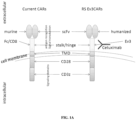
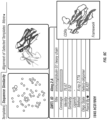
- An exemplary schematic of Ev3 is depicted in FIG. 2 .
- the CARs provided herein may have any antigenic specificity useful in the treatment of a disease or disorder.
- the CARs provided herein may comprise more than one antigen, such as two antigens.
- Exemplary antigens include, but are not limited to, CD19, CD123, mesothelin, CD5, CD47, CLL-1, CD33, CD99, CLL-1, U5snRNP200, CD200, CS1, BAFF-R, ROR-1, CD99, Mesothelin, or BCMA.
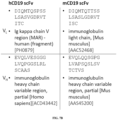
- the encoded light chain variable region comprises one, two, three or all four framework regions of the human PH0879 germline sequence.
- the encoded heavy chain variable region of hCD19 may comprise one, two, three or all four framework regions of the human ACD43442 germline sequence.
- the encoded antigen binding domain is a scFv comprising a light chain and a heavy chain of an amino acid sequence of SEQ ID NO:6, 12, 18, 24, 30, 58 or 61.
- the antigen binding domain (e.g., an scFv) comprises: a light chain variable region comprising an amino acid sequence having at least one, two or three modifications (e.g., substitutions) but not more than 10, 20 or 30 modifications (e.g., substitutions) of an amino acid sequence of a light chain variable region provided herein, or a sequence with 90-99% identity with an amino acid sequence of SEQ ID NOs:7, 13, 19, 25, 31, 59 or 63; and/or a heavy chain variable region comprising an amino acid sequence having at least one, two or three modifications (e.g.
- substitutions but not more than 10, 20 or 30 modifications (e.g ., substitutions) of an amino acid sequence of a heavy chain variable region of SEQ ID NOs:8, 14, 20, 26, 32, 60 or 64; or a sequence with 90-99% identity to an amino acid sequence of SEQ ID NOs:6, 12, 18, 24, 30, 58 or 61.
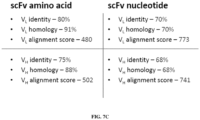
- a humanized scFv for CD19 is provided herein.
- the humanized CD19 (hCD19) scFv may have a variable light chain sequence of SEQ ID NO:7 (DIQMTQSPSSLSASVGDRVTITC RASQDISKYLN WYQQKPGKVPKLLIY HTSRLHS GVPDRFSGSGSGTDFTLTISSLQPEDVATYYC QQGNTLPYT FGQGTKVEIKR) and a variable heavy chain of SEQ ID NO:8 (EVQLVESGGGLVQPGGSLRLSCAAS GVSLPDYGVS WVRQAPGKGLEWIG VIWGSE TTYYNSALKS KFIISRDNAKNSLYLQMNSLRAEDTAVYYCAR HYYYGGSYAMDY WGQGTLVTVSS).
- SEQ ID NO:7 DIQMTQSPSSLSASVGDRVTITC RASQDISKYLN WYQQKPGKVPKLLIY HTS
- the hCD19 scFv may comprise a V L with at least 80%, 85%, 90%, 91%, 921%, 93%, 94%, 95%, 96%, 97%, 98%, or 99% sequence identity to SEQ ID NO:7 and/or a V H with at least 80%, 85%, 90%, 91%, 921%, 93%, 94%, 95%, 96%, 97%, 98%, or 99% sequence identity to SEQ ID NO:8.
- the hCD19 scFv may comprise an amino acid sequence with at least 80%, 85%, 90%, 91%, 921%, 93%, 94%, 95%, 96%, 97%, 98%, 99%, or 100% sequence identity to SEQ ID NO:6.
- the hCD19 scFv may be encoded by a polynucleotide with at least 80%, 85%, 90%, 91%, 921%, 93%, 94%, 95%, 96%, 97%, 98%, 99%, or 100% sequence identity to SEQ ID NO:3.
- the V L of the hCD19 scFv may be encoded by a polynucleotide with at least 80%, 85%, 90%, 91%, 921%, 93%, 94%, 95%, 96%, 97%, 98%, 99%, or 100% sequence identity to SEQ ID NO:4.
- the V H of the hCD19 scFv may be encoded by a polynucleotide with at least 80%, 85%, 90%, 91%, 921%, 93%, 94%, 95%, 96%, 97%, 98%, 99%, or 100% sequence identity to SEQ ID NO:5.
- a humanized scFv for CD123 is provided herein.
- the humanized CD123 (hCD123) scFv may have a variable light chain sequence of SEQ ID NO:13 and a variable heavy chain of SEQ ID NO:14.
- the hCD123 scFv may comprise a V L with at least 80%, 85%, 90%, 91%, 92%, 93%, 94%, 95%, 96%, 97%, 98%, or 99% sequence identity to SEQ ID NO:13 and/or a V H with at least 80%, 85%, 90%, 91%, 92%, 93%, 94%, 95%, 96%, 97%, 98%, or 99% sequence identity to SEQ ID NO:14.
- the hCD123 scFv may comprise an amino acid sequence with at least 80%, 85%, 90%, 91%, 92%, 93%, 94%, 95%, 96%, 97%, 98%, 99%, or 100% sequence identity to SEQ ID NO:12.
- the hCD123 scFv may be encoded by a polynucleotide with at least 80%, 85%, 90%, 91%, 92%, 93%, 94%, 95%, 96%, 97%, 98%, 99%, or 100% sequence identity to SEQ ID NO:9.
- the V L of the hCD123 scFv may be encoded by a polynucleotide with at least 80%, 85%, 90%, 91%, 92%, 93%, 94%, 95%, 96%, 97%, 98%, 99%, or 100% sequence identity to SEQ ID NO:10.
- the V H of the hCD123 scFv may be encoded by a polynucleotide with at least 80%, 85%, 90%, 91%, 92%, 93%, 94%, 95%, 96%, 97%, 98%, 99%, or 100% sequence identity to SEQ ID NO:11.
- a humanized scFv for mesothelin is provided herein.
- the humanized mesothelin (hMeso) scFv may have a variable light chain sequence of SEQ ID NO:19 and a variable heavy chain of SEQ ID NO:20.
- the hMeso scFv may comprise a V L with at least 80%, 85%, 90%, 91%, 921%, 93%, 94%, 95%, 96%, 97%, 98%, or 99% sequence identity to SEQ ID NO:19 and/or a V H with at least 80%, 85%, 90%, 91%, 921%, 93%, 94%, 95%, 96%, 97%, 98%, or 99% sequence identity to SEQ ID NO:20.
- the hMeso scFv may comprise an amino acid sequence with at least 80%, 85%, 90%, 91%, 92%, 93%, 94%, 95%, 96%, 97%, 98%, 99%, or 100% sequence identity to SEQ ID NO:18.
- the hMeso scFv may be encoded by a polynucleotide with at least 80%, 85%, 90%, 91%, 92%, 93%, 94%, 95%, 96%, 97%, 98%, 99%, or 100% sequence identity to SEQ ID NO:15.
- the V L of the hMeso scFv may be encoded by a polynucleotide with at least 80%, 85%, 90%, 91%, 92%, 93%, 94%, 95%, 96%, 97%, 98%, 99%, or 100% sequence identity to SEQ ID NO:16.
- the V H of the hMeso scFv may be encoded by a polynucleotide with at least 80%, 85%, 90%, 91%, 92%, 93%, 94%, 95%, 96%, 97%, 98%, 99%, or 100% sequence identity to SEQ ID NO:17.
- a humanized scFv for ROR1 is provided herein.
- the humanized ROR1 (hROR1) scFv may have a variable light chain sequence of SEQ ID NO:25 and a variable heavy chain of SEQ ID NO:26.
- the hROR1 scFv may comprise a V L with at least 80%, 85%, 90%, 91%, 921%, 93%, 94%, 95%, 96%, 97%, 98%, or 99% sequence identity to SEQ ID NO:25 and/or a V H with at least 80%, 85%, 90%, 91%, 92%, 93%, 94%, 95%, 96%, 97%, 98%, or 99% sequence identity to SEQ ID NO:26.
- the hROR1 scFv may comprise an amino acid sequence with at least 80%, 85%, 90%, 91%, 92%, 93%, 94%, 95%, 96%, 97%, 98%, 99%, or 100% sequence identity to SEQ ID NO:24.
- the hROR1 scFv may be encoded by a polynucleotide with at least 80%, 85%, 90%, 91%, 92%, 93%, 94%, 95%, 96%, 97%, 98%, 99%, or 100% sequence identity to SEQ ID NO:21.
- the V L of the hROR1 scFv may be encoded by a polynucleotide with at least 80%, 85%, 90%, 91%, 92%, 93%, 94%, 95%, 96%, 97%, 98%, 99%, or 100% sequence identity to SEQ ID NO:22.
- the V H of the hROR1 scFv may be encoded by a polynucleotide with at least 80%, 85%, 90%, 91%, 92%, 93%, 94%, 95%, 96%, 97%, 98%, 99%, or 100% sequence identity to SEQ ID NO:23.
- a humanized scFv for CD5 is provided herein.
- the humanized CD5 (hCD5) scFv may have a variable light chain sequence of SEQ ID NO:31 and a variable heavy chain of SEQ ID NO:32.
- the hCD5 scFv may comprise a V L with at least 80%, 85%, 90%, 91%, 921%, 93%, 94%, 95%, 96%, 97%, 98%, or 99% sequence identity to SEQ ID NO:31 and/or a V H with at least 80%, 85%, 90%, 91%, 92%, 93%, 94%, 95%, 96%, 97%, 98%, or 99% sequence identity to SEQ ID NO:32.
- the hCD5 scFv may comprise an amino acid sequence with at least 80%, 85%, 90%, 91%, 92%, 93%, 94%, 95%, 96%, 97%, 98%, 99%, or 100% sequence identity to SEQ ID NO:30.
- the hCD5 scFv may be encoded by a polynucleotide with at least 80%, 85%, 90%, 91%, 92%, 93%, 94%, 95%, 96%, 97%, 98%, 99%, or 100% sequence identity to SEQ ID NO:27.
- the V L of the hCD5 scFv may be encoded by a polynucleotide with at least 80%, 85%, 90%, 91%, 92%, 93%, 94%, 95%, 96%, 97%, 98%, 99%, or 100% sequence identity to SEQ ID NO:28.
- the V H of the hCD5 scFv may be encoded by a polynucleotide with at least 80%, 85%, 90%, 91%, 92%, 93%, 94%, 95%, 96%, 97%, 98%, 99%, or 100% sequence identity to SEQ ID NO:29.
- the hCD99 scFv may comprise an amino acid sequence with at least 80%, 85%, 90%, 91%, 92%, 93%, 94%, 95%, 96%, 97%, 98%, 99%, or 100% sequence identity to SEQ ID NO:58.
- the hCD99 scFv may be encoded by a polynucleotide with at least 80%, 85%, 90%, 91%, 92%, 93%, 94%, 95%, 96%, 97%, 98%, 99%, or 100% sequence identity to SEQ ID NO:57.
- Antigens derived from respiratory syncytial virus that are contemplated for use herein include any of the eleven proteins encoded by the RSV genome, or antigenic fragments thereof: NS 1, NS2, N (nucleocapsid protein), M (Matrix protein) SH, G and F (viral coat proteins), M2 (second matrix protein), M2-1 (elongation factor), M2-2 (transcription regulation), RNA polymerase, and phosphoprotein P.
- VSV Vesicular stomatitis virus
- Antigens derived from Vesicular stomatitis virus (VSV) include any one of the five major proteins encoded by the VSV genome, and antigenic fragments thereof: large protein (L), glycoprotein (G), nucleoprotein (N), phosphoprotein (P), and matrix protein (M).
- L large protein
- G glycoprotein
- N nucleoprotein
- P phosphoprotein
- M matrix protein
- Antigens derived from an influenza virus that are contemplated for use in certain embodiments include hemagglutinin (HA), neuraminidase (NA), nucleoprotein (NP), matrix proteins M1 and M2, NS1, NS2 (NEP), PA, PB1, PB1-F2, and PB2.
- Exemplary viral antigens also include, but are not limited to, adenovirus polypeptides, alphavirus polypeptides, calicivirus polypeptides (e.g., a calicivirus capsid antigen), coronavirus polypeptides, distemper virus polypeptides, Ebola virus polypeptides, enterovirus polypeptides, flavivirus polypeptides, hepatitis virus (AE) polypeptides (a hepatitis B core or surface antigen, a hepatitis C virus E1 or E2 glycoproteins, core, or non-structural proteins), herpesvirus polypeptides (including a herpes simplex virus or varicella zoster virus glycoprotein), infectious peritonitis virus polypeptides, leukemia virus polypeptides, Marburg virus polypeptides, orthomyxovirus polypeptides, papilloma virus polypeptides, parainfluenza virus polypeptides (e.g., the
- the antigen may be bacterial antigens.
- a bacterial antigen of interest may be a secreted polypeptide.
- bacterial antigens include antigens that have a portion or portions of the polypeptide exposed on the outer cell surface of the bacteria.
- Antigens derived from Staphylococcus species including Methicillin-resistant Staphylococcus aureus (MRSA) that are contemplated for use include virulence regulators, such as the Agr system, Sar and Sae, the Arl system, Sar homologues (Rot, MgrA, SarS, SarR, SarT, SarU, SarV, SarX, SarZ and TcaR), the Srr system and TRAP.
- MRSA Methicillin-resistant Staphylococcus aureus
- Staphylococcus proteins that may serve as antigens include Clp proteins, HtrA, MsrR, aconitase, CcpA, SvrA, Msa, CfvA and CfvB (see, e.g., Staphylococcus: Molecular Genetics, 2008 Caister Academic Press, Ed. Jodi Lindsay ).
- the genomes for two species of Staphylococcus aureus (N315 and Mu50) have been sequenced and are publicly available, for example at PATRIC ( PATRIC: The VBI PathoSystems Resource Integration Center, Snyder et al., 2007 ).
- Staphylococcus proteins for use as antigens may also be identified in other public databases such as GenBank ® , Swiss-Prot ® , and TrEMBL ® .
- Antigens derived from Streptococcus pneumoniae that are contemplated for use in certain embodiments described herein include pneumolysin, PspA, choline-binding protein A (CbpA), NanA, NanB, SpnHL, PavA, LytA, Pht, and pilin proteins (RrgA; RrgB; RrgC).
- Antigenic proteins of Streptococcus pneumoniae are also known in the art and may be used as an antigen in some embodiments.
- the complete genome sequence of a virulent strain of Streptococcus pneumoniae has been sequenced and, as would be understood by the skilled person, S.
- pneumoniae proteins for use herein may also be identified in other public databases such as GenBank ® , Swiss-Prot ® , and TrEMBL ® . Proteins of particular interest for antigens according to the present disclosure include virulence factors and proteins predicted to be exposed at the surface of the pneumococci.
- bacterial antigens examples include, but are not limited to, Actinomyces polypeptides, Bacillus polypeptides, Bacteroides polypeptides, Bordetella polypeptides, Bartonella polypeptides, Borrelia polypeptides (e.g., B.
- influenzae type b outer membrane protein Helicobacter polypeptides, Klebsiella polypeptides, L-form bacteria polypeptides, Leptospira polypeptides, Listeria polypeptides, Mycobacteria polypeptides, Mycoplasma polypeptides, Neisseria polypeptides, Neorickettsia polypeptides, Nocardia polypeptides, Pasteurella polypeptides, Peptococcus polypeptides, Peptostreptococcus polypeptides, Pneumococcus polypeptides (i.e., S.
- pneumoniae polypeptides (see description herein), Proteus polypeptides, Pseudomonas polypeptides, Rickettsia polypeptides, Rochalimaea polypeptides, Salmonella polypeptides, Shigella polypeptides, Staphylococcus polypeptides, group A streptococcus polypeptides (e.g., S. pyogenes M proteins), group B streptococcus (S. agalactiae) polypeptides, Treponema polypeptides, and Yersinia polypeptides (e.g., Y pestis F1 and V antigens).
- group A streptococcus polypeptides e.g., S. pyogenes M proteins
- group B streptococcus (S. agalactiae) polypeptides e.g., Treponema polypeptides
- fungal antigens include, but are not limited to, Absidia polypeptides, Acremonium polypeptides, Alternaria polypeptides, Aspergillus polypeptides, Basidiobolus polypeptides, Bipolaris polypeptides, Blastomyces polypeptides, Candida polypeptides, Coccidioides polypeptides, Conidiobolus polypeptides, Cryptococcus polypeptides, Curvalaria polypeptides, Epidermophyton polypeptides, Exophiala polypeptides, Geotrichum polypeptides, Histoplasma polypeptides, Madurella polypeptides, Malassezia polypeptides, Microsporum polypeptides, Moniliella polypeptides, Mortierella polypeptides, Mucor polypeptides, Paecilomyces polypeptides, Penicillium polypeptides, Phialemonium polypeptides, Phialophora polypeptides, Prototheca polypeptides, P
- protozoan parasite antigens include, but are not limited to, Babesia polypeptides, Balantidium polypeptides, Besnoitia polypeptides, Cryptosporidium polypeptides, Eimeria polypeptides, Encephalitozoon polypeptides, Entamoeba polypeptides, Giardia polypeptides, Hammondia polypeptides, Hepatozoon polypeptides, Isospora polypeptides, Leishmania polypeptides, Microsporidia polypeptides, Neospora polypeptides, Nosema polypeptides, Pentatrichomonas polypeptides, Plasmodium polypeptides.
- helminth parasite antigens include, but are not limited to, Acanthocheilonema polypeptides, Aelurostrongylus polypeptides, Ancylostoma polypeptides, Angiostrongylus polypeptides, Ascaris polypeptides, Brugia polypeptides, Bunostomum polypeptides, Capillaria polypeptides, Chabertia polypeptides, Cooperia polypeptides, Crenosoma polypeptides, Dictyocaulus polypeptides, Dioctophyme polypeptides, Dipetalonema polypeptides, Diphyllobothrium polypeptides, Diplydium polypeptides, Dirofilaria polypeptides, Dracunculus polypeptides, Enterobius polypeptides, Filaroides polypeptides, Haemonchus polypeptides, Lagochilascaris polypeptides, Loa polypeptides, Mansonella polypeptides,
- P. falciparum circumsporozoite P. falciparum circumsporozoite (PfCSP)
- PfSSP2 sporozoite surface protein 2
- PfLSA1 c-term carboxyl terminus of liver state antigen 1
- PfExp-1 exported protein 1
- ectoparasite antigens include, but are not limited to, polypeptides (including antigens as well as allergens) from fleas; ticks, including hard ticks and soft ticks; flies, such as midges, mosquitoes, sand flies, black flies, horse flies, horn flies, deer flies, tsetse flies, stable flies, myiasis-causing flies and biting gnats; ants; spiders, lice; mites; and true bugs, such as bed bugs and kissing bugs.
- polypeptides including antigens as well as allergens
- ticks including hard ticks and soft ticks
- flies such as midges, mosquitoes, sand flies, black flies, horse flies, horn flies, deer flies, tsetse flies, stable flies, myiasis-causing flies and biting gnats
- the CAR contains an extracellular antigen-recognition domain that specifically binds to an antigen.
- the antigen is a protein expressed on the surface of cells.
- the CAR is a TCR-like CAR and the antigen is a processed peptide antigen, such as a peptide antigen of an intracellular protein, which, like a TCR, is recognized on the cell surface in the context of a major histocompatibility complex (MHC) molecule.
- MHC major histocompatibility complex
- the chimeric antigen receptor comprises: a) an intracellular signaling domain, b) a hinge and transmembrane domain, such as a Ev3 hinge, and c) an extracellular domain comprising an antigen binding region.
- the engineered antigen receptors include chimeric antigen receptors (CARs), including activating or stimulatory CARs, costimulatory CARs (see WO2014/055668 ), and/or inhibitory CARs (iCARs, see Fedorov et al., 2013 ).
- CARs chimeric antigen receptors
- the CARs generally include an extracellular antigen (or ligand) binding domain linked to one or more intracellular signaling components, in some aspects via linkers and/or transmembrane domain(s).
- Such molecules typically mimic or approximate a signal through a natural antigen receptor, a signal through such a receptor in combination with a costimulatory receptor, and/or a signal through a costimulatory receptor alone.
- nucleic acids including nucleic acids encoding an antigen-specific CAR polypeptide, including a CAR that has been humanized to reduce immunogenicity (hCAR), comprising an intracellular signaling domain, a transmembrane domain, and an extracellular domain comprising one or more signaling motifs.
- the CAR may recognize an epitope comprising the shared space between one or more antigens.
- the binding region can comprise complementary determining regions of a monoclonal antibody, variable regions of a monoclonal antibody, and/or antigen binding fragments thereof.
- that specificity is derived from a peptide (e.g., cytokine) that binds to a receptor.
- the human CAR nucleic acids may be human genes used to enhance cellular immunotherapy for human patients.
- the invention includes a full-length CAR cDNA or coding region.
- the antigen binding regions or domain can comprise a fragment of the V H and V L chains of a single-chain variable fragment (scFv) derived from a particular human monoclonal antibody, such as those described in U.S. Patent 7,109,304 , incorporated herein by reference.
- the fragment can also be any number of different antigen binding domains of a human antigen-specific antibody.
- the fragment is an antigen-specific scFv encoded by a sequence that is optimized for human codon usage for expression in human cells.
- the arrangement could be multimeric, such as a diabody or multimers.
- the multimers are most likely formed by cross pairing of the variable portion of the light and heavy chains into a diabody.
- the hinge portion of the construct can have multiple alternatives from being totally deleted, to having the first cysteine maintained, to a proline rather than a serine substitution, to being truncated up to the first cysteine.
- the Fc portion can be deleted. Any protein that is stable and/or dimerizes can serve this purpose.
- One could use just one of the Fc domains, e.g., either the CH2 or CH3 domain from human immunoglobulin.
- One could also use just the hinge portion of an immunoglobulin.
- the CAR nucleic acid comprises a sequence encoding other costimulatory receptors, such as a transmembrane domain and a modified CD28 intracellular signaling domain.
- costimulatory receptors include, but are not limited to one or more of CD28, CD27, OX-40 (CD134), DAP10, DAP12, and 4-1BB (CD137).
- CD28 CD27
- OX-40 CD134
- DAP10 DAP12
- 4-1BB CD137
- an additional signal provided by a human costimulatory receptor inserted in a human CAR is important for full activation of NK cells and could help improve in vivo persistence and the therapeutic success of the adoptive immunotherapy.
- the CAR may express one or more cytokines, such as IL-15.
- the inclusion of one or more cytokines may promote in vivo persistence.
- the CAR comprises the antigen binding domain, such as humanized scFv, CD3 ⁇ , DAP12, and IL-15, optionally in combination with the Ev3 hinge.
- the chimeric construct can be introduced into immune cells as naked DNA or in a suitable vector.
- Methods of stably transfecting cells by electroporation using naked DNA are known in the art.
- naked DNA generally refers to the DNA encoding a chimeric receptor contained in a plasmid expression vector in proper orientation for expression.
Landscapes
- Health & Medical Sciences (AREA)
- Life Sciences & Earth Sciences (AREA)
- Chemical & Material Sciences (AREA)
- Immunology (AREA)
- Organic Chemistry (AREA)
- General Health & Medical Sciences (AREA)
- Genetics & Genomics (AREA)
- Medicinal Chemistry (AREA)
- Zoology (AREA)
- Engineering & Computer Science (AREA)
- Biochemistry (AREA)
- Molecular Biology (AREA)
- Biophysics (AREA)
- Proteomics, Peptides & Aminoacids (AREA)
- Cell Biology (AREA)
- Gastroenterology & Hepatology (AREA)
- Biomedical Technology (AREA)
- Animal Behavior & Ethology (AREA)
- Public Health (AREA)
- Veterinary Medicine (AREA)
- Toxicology (AREA)
- Bioinformatics & Cheminformatics (AREA)
- Biotechnology (AREA)
- Epidemiology (AREA)
- Pharmacology & Pharmacy (AREA)
- Wood Science & Technology (AREA)
- General Engineering & Computer Science (AREA)
- Microbiology (AREA)
- Hematology (AREA)
- Nuclear Medicine, Radiotherapy & Molecular Imaging (AREA)
- Chemical Kinetics & Catalysis (AREA)
- General Chemical & Material Sciences (AREA)
- Virology (AREA)
- Developmental Biology & Embryology (AREA)
- Physics & Mathematics (AREA)
- Plant Pathology (AREA)
- Oncology (AREA)
- Transplantation (AREA)
- Mycology (AREA)
- Pain & Pain Management (AREA)
Applications Claiming Priority (3)
| Application Number | Priority Date | Filing Date | Title |
|---|---|---|---|
| US201762536934P | 2017-07-25 | 2017-07-25 | |
| PCT/US2018/043779 WO2019023396A1 (en) | 2017-07-25 | 2018-07-25 | ENHANCED CHIMERIC ANTIGENIC RECEPTORS AND USES THEREOF |
| EP18838056.2A EP3658163A4 (en) | 2017-07-25 | 2018-07-25 | IMPROVED ANTIGENIC CHEMICAL RECEPTORS AND THEIR USES |
Related Parent Applications (1)
| Application Number | Title | Priority Date | Filing Date |
|---|---|---|---|
| EP18838056.2A Division EP3658163A4 (en) | 2017-07-25 | 2018-07-25 | IMPROVED ANTIGENIC CHEMICAL RECEPTORS AND THEIR USES |
Publications (1)
| Publication Number | Publication Date |
|---|---|
| EP4582146A2 true EP4582146A2 (en) | 2025-07-09 |
Family
ID=65040821
Family Applications (2)
| Application Number | Title | Priority Date | Filing Date |
|---|---|---|---|
| EP25169707.4A Pending EP4582146A2 (en) | 2017-07-25 | 2018-07-25 | Enhanced chimeric antigen receptors and use thereof |
| EP18838056.2A Withdrawn EP3658163A4 (en) | 2017-07-25 | 2018-07-25 | IMPROVED ANTIGENIC CHEMICAL RECEPTORS AND THEIR USES |
Family Applications After (1)
| Application Number | Title | Priority Date | Filing Date |
|---|---|---|---|
| EP18838056.2A Withdrawn EP3658163A4 (en) | 2017-07-25 | 2018-07-25 | IMPROVED ANTIGENIC CHEMICAL RECEPTORS AND THEIR USES |
Country Status (9)
| Country | Link |
|---|---|
| US (1) | US20240336699A1 (enExample) |
| EP (2) | EP4582146A2 (enExample) |
| JP (2) | JP2020530989A (enExample) |
| KR (1) | KR20200032174A (enExample) |
| CN (2) | CN118206655A (enExample) |
| AU (1) | AU2018306307B2 (enExample) |
| CA (1) | CA3070998A1 (enExample) |
| TW (1) | TW201908335A (enExample) |
| WO (1) | WO2019023396A1 (enExample) |
Families Citing this family (25)
| Publication number | Priority date | Publication date | Assignee | Title |
|---|---|---|---|---|
| WO2020106621A1 (en) * | 2018-11-19 | 2020-05-28 | Board Of Regents, The University Of Texas System | A modular, polycistronic vector for car and tcr transduction |
| WO2021032783A1 (en) | 2019-08-21 | 2021-02-25 | Fraunhofer-Gesellschaft zur Förderung der angewandten Forschung e.V. | Methods for detecting, quantifying and monitoring immune-cell mediated cytotoxicity of cell populations comprising immune cells and/or stem cells |
| NL2023924B1 (nl) * | 2019-10-01 | 2021-06-01 | Lely Patent Nv | Meetsysteem voor levensmiddelen |
| CN115461361B (zh) * | 2020-05-08 | 2025-03-14 | 玛希敦大学 | 嵌合抗原受体和携带该受体的经修饰的细胞 |
| KR102297396B1 (ko) * | 2020-07-29 | 2021-09-06 | (주)티카로스 | 면역시냅스를 안정화시키는 키메라 항원 수용체(car) t 세포 |
| AU2021392032A1 (en) | 2020-12-03 | 2023-06-22 | Century Therapeutics, Inc. | Genetically engineered cells and uses thereof |
| CN116981685A (zh) * | 2020-12-03 | 2023-10-31 | 世纪治疗股份有限公司 | 基因工程化细胞及其用途 |
| US11661459B2 (en) | 2020-12-03 | 2023-05-30 | Century Therapeutics, Inc. | Artificial cell death polypeptide for chimeric antigen receptor and uses thereof |
| CN113045658B (zh) | 2020-12-11 | 2021-12-24 | 广州百暨基因科技有限公司 | 抗cll1抗体及其应用 |
| CN113234169B (zh) * | 2020-12-11 | 2022-11-01 | 广州百暨基因科技有限公司 | 靶向cll1嵌合抗原受体及其应用 |
| CA3210702A1 (en) | 2021-04-07 | 2022-10-13 | Century Therapeutics, Inc. | Gene transfer vectors and methods of engineering cells |
| JP2024519515A (ja) | 2021-04-07 | 2024-05-15 | センチュリー セラピューティクス,インコーポレイテッド | 人工多能性幹細胞からガンマ-デルタt細胞を生成するための組成物および方法 |
| CN117441010A (zh) | 2021-04-07 | 2024-01-23 | 世纪治疗股份有限公司 | 从诱导多能干细胞产生α-βT细胞的组合物和方法 |
| BR112023021133A2 (pt) * | 2021-04-14 | 2023-12-12 | Univ Texas | Receptores quiméricos de antígenos para direcionar cânceres positivos para cd5 |
| AR127745A1 (es) * | 2021-10-18 | 2024-02-28 | Kite Pharma Inc | Dominios de señalización para receptores quiméricos de antígenos |
| EP4456912A1 (en) | 2021-12-29 | 2024-11-06 | Century Therapeutics, Inc. | Genetically engineered cells having anti-cd19 / anti-cd22 chimeric antigen receptors, and uses thereof |
| US20250090582A1 (en) | 2022-06-08 | 2025-03-20 | Century Therapeutics, Inc. | Genetically engineered cells having anti-cd133 / anti-egfr chimeric antigen receptors, and uses thereof |
| WO2023240169A1 (en) | 2022-06-08 | 2023-12-14 | Century Therapeutics, Inc. | Immunoeffector cells derived from induced pluripotent stem cells genetically engineered with membrane bound il12 and uses thereof |
| WO2024102838A1 (en) | 2022-11-09 | 2024-05-16 | Century Therapeutics, Inc. | Engineered interleukin-7 receptors and uses thereof |
| WO2024103017A2 (en) | 2022-11-10 | 2024-05-16 | Century Therapeutics, Inc. | Genetically engineered cells having anti-nectin4 chimeric antigen receptors, and uses thereof |
| WO2024240243A1 (en) * | 2023-05-25 | 2024-11-28 | Nanjing Legend Biotech Co., Ltd. | Chimeric antigen receptors and uses thereof |
| WO2025101938A2 (en) | 2023-11-10 | 2025-05-15 | Century Therapeutics, Inc. | Genetically engineered cells having multi-transmembrane domain chimeric antigen receptors utilizing g protein-coupled receptor scaffolds, and uses thereof |
| WO2025106626A1 (en) | 2023-11-15 | 2025-05-22 | Century Therapeutics, Inc. | Genetically engineered cells expressing c-x-c chemokine receptor type 4, and uses thereof |
| WO2025207798A1 (en) | 2024-03-26 | 2025-10-02 | Century Therapeutics, Inc. | Genetically engineered cells having anti-cd123 chimeric antigen receptors, and uses thereof |
| WO2025207795A1 (en) | 2024-03-26 | 2025-10-02 | Juno Therapeutics, Inc. | Genetically engineered cells having anti-cd33 / anti-cd123 chimeric antigen receptors, and uses thereof |
Citations (2)
| Publication number | Priority date | Publication date | Assignee | Title |
|---|---|---|---|---|
| US7109304B2 (en) | 2003-07-31 | 2006-09-19 | Immunomedics, Inc. | Humanized anti-CD19 antibodies |
| WO2014055668A1 (en) | 2012-10-02 | 2014-04-10 | Memorial Sloan-Kettering Cancer Center | Compositions and methods for immunotherapy |
Family Cites Families (12)
| Publication number | Priority date | Publication date | Assignee | Title |
|---|---|---|---|---|
| DE69233204T2 (de) * | 1991-12-13 | 2004-07-15 | Xoma Corp., Berkeley | Verfahren und materialien zur herstellung von modifizierten variablen antikörperdomänen und ihre therapeutische verwendung |
| ES2911246T3 (es) * | 2009-11-03 | 2022-05-18 | Hope City | Receptor del factor de crecimiento epidérmico truncado (EGFRT) para selección de células T transducidas |
| CA3133545C (en) * | 2012-05-25 | 2023-08-08 | Cellectis | Use of pre t alpha or functional variant thereof for expanding tcr alpha deficient t cells |
| SG11201505896YA (en) * | 2013-02-20 | 2015-09-29 | Novartis Ag | Treatment of cancer using humanized anti-egfrviii chimeric antigen receptor |
| KR102238226B1 (ko) * | 2013-05-14 | 2021-04-09 | 보드 오브 리전츠, 더 유니버시티 오브 텍사스 시스템 | 가공된 키메라 항원 수용체 (car) t-세포의 인간 적용 |
| EP3925618A1 (en) * | 2013-07-29 | 2021-12-22 | 2seventy bio, Inc. | Multipartite signaling proteins and uses thereof |
| KR20160145802A (ko) * | 2014-04-23 | 2016-12-20 | 보드 오브 리전츠, 더 유니버시티 오브 텍사스 시스템 | 요법에 사용하기 위한 키메라 항원 수용체 (car) 및 이의 제조 방법 |
| HK1243441A1 (zh) * | 2014-11-05 | 2018-07-13 | Board Of Regents, The University Of Texas System | 基因修饰的免疫效应细胞和用於扩增免疫效应细胞的工程化细胞 |
| CA2973529A1 (en) * | 2015-01-26 | 2016-08-04 | Cellectis | Cll1-specific multi-chain chimeric antigen receptor |
| US10786549B2 (en) * | 2015-04-23 | 2020-09-29 | Baylor College Of Medicine | CD5 chimeric antigen receptor for adoptive T cell therapy |
| WO2017096329A1 (en) * | 2015-12-03 | 2017-06-08 | Juno Therapeutics, Inc. | Modified chimeric receptors and related compositions and methods |
| WO2017112877A1 (en) * | 2015-12-22 | 2017-06-29 | Icell Gene Therapeutics, Llc | Chimeric antigen receptors and enhancement of anti-tumor activity |
-
2018
- 2018-07-25 TW TW107125720A patent/TW201908335A/zh unknown
- 2018-07-25 JP JP2020503988A patent/JP2020530989A/ja not_active Withdrawn
- 2018-07-25 CA CA3070998A patent/CA3070998A1/en active Pending
- 2018-07-25 CN CN202410061631.8A patent/CN118206655A/zh active Pending
- 2018-07-25 CN CN201880058794.3A patent/CN111432823A/zh active Pending
- 2018-07-25 KR KR1020207005375A patent/KR20200032174A/ko not_active Ceased
- 2018-07-25 EP EP25169707.4A patent/EP4582146A2/en active Pending
- 2018-07-25 AU AU2018306307A patent/AU2018306307B2/en active Active
- 2018-07-25 EP EP18838056.2A patent/EP3658163A4/en not_active Withdrawn
- 2018-07-25 WO PCT/US2018/043779 patent/WO2019023396A1/en not_active Ceased
-
2023
- 2023-07-19 JP JP2023117421A patent/JP2023134735A/ja active Pending
-
2024
- 2024-06-21 US US18/750,233 patent/US20240336699A1/en active Pending
Patent Citations (2)
| Publication number | Priority date | Publication date | Assignee | Title |
|---|---|---|---|---|
| US7109304B2 (en) | 2003-07-31 | 2006-09-19 | Immunomedics, Inc. | Humanized anti-CD19 antibodies |
| WO2014055668A1 (en) | 2012-10-02 | 2014-04-10 | Memorial Sloan-Kettering Cancer Center | Compositions and methods for immunotherapy |
Non-Patent Citations (15)
| Title |
|---|
| "Genbank", Database accession no. L15006 |
| ALTSCHUL, S.F. ET AL., NUCLEIC ACIDS RES, vol. 25, 1997, pages 3389 - 3402 |
| ARNOLD, K. ET AL., BIOINFORMATICS, vol. 22, 2006, pages 195 - 201 |
| AUSUBEL ET AL.: "Current Protocols in Molecular Biology", 1994, GREENE PUBLISHING ASSOCIATES AND JOHN WILEY & SONS |
| BENKERT, P. ET AL., BIOINFORMATICS, vol. 27, 2011, pages 343 - 350 |
| FEDOROV ET AL., SCI. TRANSL. MEDICINE, vol. 5, no. 215, pages 2013 |
| GAO SH ET AL., BMC BIOTECHNOLOGY, vol. 13, 2013, pages 55 |
| GUEX, N. ET AL., ELECTROPHORESIS, vol. 18, 1997, pages 2714 - 2723 |
| MARCO BIASINI ET AL., NUCLEIC ACIDS RESEARCH, vol. 42, no. 1, 2014, pages 252 - 258 |
| REMMERT, M. ET AL., NAT METHODS, vol. 9, 2012, pages 173 - 175 |
| SAMBROOK ET AL.: "Molecular Cloning: A Laboratory Manual", 2001, COLD SPRING HARBOR PRESS |
| SELA-CULANG ET AL., FRONTIERS IN IMMUNOLOGY, vol. 4, 2013, pages 302 |
| SHAH ET AL., PL S ONE, vol. 8, 2013, pages 776781 |
| SINGH ET AL., CANCER RESEARCH, vol. 68, 2008, pages 2961 - 2971 |
| SINGH ET AL., CANCER RESEARCH, vol. 71, 2011, pages 3516 - 3527 |
Also Published As
| Publication number | Publication date |
|---|---|
| AU2018306307B2 (en) | 2025-04-17 |
| CA3070998A1 (en) | 2019-01-31 |
| JP2023134735A (ja) | 2023-09-27 |
| CN111432823A (zh) | 2020-07-17 |
| KR20200032174A (ko) | 2020-03-25 |
| CN118206655A (zh) | 2024-06-18 |
| AU2018306307A1 (en) | 2020-02-20 |
| EP3658163A4 (en) | 2021-08-04 |
| EP3658163A1 (en) | 2020-06-03 |
| WO2019023396A1 (en) | 2019-01-31 |
| US20240336699A1 (en) | 2024-10-10 |
| TW201908335A (zh) | 2019-03-01 |
| JP2020530989A (ja) | 2020-11-05 |
Similar Documents
| Publication | Publication Date | Title |
|---|---|---|
| US20240336699A1 (en) | Enhanced chimeric antigen receptors and use thereof | |
| US20210253729A1 (en) | Enhanced chimeric antigen receptors and use thereof | |
| EP3886874B1 (en) | Methods for ex vivo expansion of natural killer cells and use thereof | |
| TW202104252A (zh) | 用於生產car-nk細胞之方法及其用途 | |
| AU2019345052B2 (en) | Protein L for activation and expansion of chimeric antigen receptor-modified immune cells | |
| US20240261332A1 (en) | Inhibitory chimeric antigen receptor prevents on-target off-tumor effects of adoptive cell therapy | |
| JP7630832B2 (ja) | Carおよびtcr形質導入用のモジュール式ポリシストロニックベクター | |
| US20240125765A1 (en) | A method for selection of cryopreserved cord blood units for the manufacture of engineered natural killer cells with enhanced potency against cancer | |
| CN117098543A (zh) | 用于选择冷冻保存的脐带血单位以制备具有增强的抗癌效力的工程化自然杀伤细胞的方法 | |
| WO2024249728A2 (en) | Selection of cryopreserved cord blood units for the manufacture of natural killer cells with enhanced potency | |
| AU2024280012A1 (en) | Selection of cryopreserved cord blood units for the manufacture of natural killer cells with enhanced potency |
Legal Events
| Date | Code | Title | Description |
|---|---|---|---|
| PUAI | Public reference made under article 153(3) epc to a published international application that has entered the european phase |
Free format text: ORIGINAL CODE: 0009012 |
|
| STAA | Information on the status of an ep patent application or granted ep patent |
Free format text: STATUS: THE APPLICATION HAS BEEN PUBLISHED |
|
| AC | Divisional application: reference to earlier application |
Ref document number: 3658163 Country of ref document: EP Kind code of ref document: P |
|
| AK | Designated contracting states |
Kind code of ref document: A2 Designated state(s): AL AT BE BG CH CY CZ DE DK EE ES FI FR GB GR HR HU IE IS IT LI LT LU LV MC MK MT NL NO PL PT RO RS SE SI SK SM TR |