EP4576388A1 - Hochfeste lithium-ionen-batteriemembran und herstellungsverfahren dafür - Google Patents
Hochfeste lithium-ionen-batteriemembran und herstellungsverfahren dafür Download PDFInfo
- Publication number
- EP4576388A1 EP4576388A1 EP22959227.4A EP22959227A EP4576388A1 EP 4576388 A1 EP4576388 A1 EP 4576388A1 EP 22959227 A EP22959227 A EP 22959227A EP 4576388 A1 EP4576388 A1 EP 4576388A1
- Authority
- EP
- European Patent Office
- Prior art keywords
- layer
- million
- weight
- separator
- polyethylene
- Prior art date
- Legal status (The legal status is an assumption and is not a legal conclusion. Google has not performed a legal analysis and makes no representation as to the accuracy of the status listed.)
- Pending
Links
Images
Classifications
-
- H—ELECTRICITY
- H01—ELECTRIC ELEMENTS
- H01M—PROCESSES OR MEANS, e.g. BATTERIES, FOR THE DIRECT CONVERSION OF CHEMICAL ENERGY INTO ELECTRICAL ENERGY
- H01M50/00—Constructional details or processes of manufacture of the non-active parts of electrochemical cells other than fuel cells, e.g. hybrid cells
- H01M50/40—Separators; Membranes; Diaphragms; Spacing elements inside cells
- H01M50/409—Separators, membranes or diaphragms characterised by the material
- H01M50/449—Separators, membranes or diaphragms characterised by the material having a layered structure
- H01M50/457—Separators, membranes or diaphragms characterised by the material having a layered structure comprising three or more layers
-
- H—ELECTRICITY
- H01—ELECTRIC ELEMENTS
- H01M—PROCESSES OR MEANS, e.g. BATTERIES, FOR THE DIRECT CONVERSION OF CHEMICAL ENERGY INTO ELECTRICAL ENERGY
- H01M10/00—Secondary cells; Manufacture thereof
- H01M10/05—Accumulators with non-aqueous electrolyte
- H01M10/052—Li-accumulators
- H01M10/0525—Rocking-chair batteries, i.e. batteries with lithium insertion or intercalation in both electrodes; Lithium-ion batteries
-
- H—ELECTRICITY
- H01—ELECTRIC ELEMENTS
- H01M—PROCESSES OR MEANS, e.g. BATTERIES, FOR THE DIRECT CONVERSION OF CHEMICAL ENERGY INTO ELECTRICAL ENERGY
- H01M50/00—Constructional details or processes of manufacture of the non-active parts of electrochemical cells other than fuel cells, e.g. hybrid cells
- H01M50/40—Separators; Membranes; Diaphragms; Spacing elements inside cells
- H01M50/403—Manufacturing processes of separators, membranes or diaphragms
-
- H—ELECTRICITY
- H01—ELECTRIC ELEMENTS
- H01M—PROCESSES OR MEANS, e.g. BATTERIES, FOR THE DIRECT CONVERSION OF CHEMICAL ENERGY INTO ELECTRICAL ENERGY
- H01M50/00—Constructional details or processes of manufacture of the non-active parts of electrochemical cells other than fuel cells, e.g. hybrid cells
- H01M50/40—Separators; Membranes; Diaphragms; Spacing elements inside cells
- H01M50/409—Separators, membranes or diaphragms characterised by the material
- H01M50/411—Organic material
- H01M50/414—Synthetic resins, e.g. thermoplastics or thermosetting resins
- H01M50/417—Polyolefins
-
- H—ELECTRICITY
- H01—ELECTRIC ELEMENTS
- H01M—PROCESSES OR MEANS, e.g. BATTERIES, FOR THE DIRECT CONVERSION OF CHEMICAL ENERGY INTO ELECTRICAL ENERGY
- H01M50/00—Constructional details or processes of manufacture of the non-active parts of electrochemical cells other than fuel cells, e.g. hybrid cells
- H01M50/40—Separators; Membranes; Diaphragms; Spacing elements inside cells
- H01M50/409—Separators, membranes or diaphragms characterised by the material
- H01M50/443—Particulate material
-
- H—ELECTRICITY
- H01—ELECTRIC ELEMENTS
- H01M—PROCESSES OR MEANS, e.g. BATTERIES, FOR THE DIRECT CONVERSION OF CHEMICAL ENERGY INTO ELECTRICAL ENERGY
- H01M50/00—Constructional details or processes of manufacture of the non-active parts of electrochemical cells other than fuel cells, e.g. hybrid cells
- H01M50/40—Separators; Membranes; Diaphragms; Spacing elements inside cells
- H01M50/409—Separators, membranes or diaphragms characterised by the material
- H01M50/449—Separators, membranes or diaphragms characterised by the material having a layered structure
-
- H—ELECTRICITY
- H01—ELECTRIC ELEMENTS
- H01M—PROCESSES OR MEANS, e.g. BATTERIES, FOR THE DIRECT CONVERSION OF CHEMICAL ENERGY INTO ELECTRICAL ENERGY
- H01M50/00—Constructional details or processes of manufacture of the non-active parts of electrochemical cells other than fuel cells, e.g. hybrid cells
- H01M50/40—Separators; Membranes; Diaphragms; Spacing elements inside cells
- H01M50/409—Separators, membranes or diaphragms characterised by the material
- H01M50/449—Separators, membranes or diaphragms characterised by the material having a layered structure
- H01M50/451—Separators, membranes or diaphragms characterised by the material having a layered structure comprising layers of only organic material and layers containing inorganic material
-
- H—ELECTRICITY
- H01—ELECTRIC ELEMENTS
- H01M—PROCESSES OR MEANS, e.g. BATTERIES, FOR THE DIRECT CONVERSION OF CHEMICAL ENERGY INTO ELECTRICAL ENERGY
- H01M50/00—Constructional details or processes of manufacture of the non-active parts of electrochemical cells other than fuel cells, e.g. hybrid cells
- H01M50/40—Separators; Membranes; Diaphragms; Spacing elements inside cells
- H01M50/489—Separators, membranes, diaphragms or spacing elements inside the cells, characterised by their physical properties, e.g. swelling degree, hydrophilicity or shut down properties
-
- H—ELECTRICITY
- H01—ELECTRIC ELEMENTS
- H01M—PROCESSES OR MEANS, e.g. BATTERIES, FOR THE DIRECT CONVERSION OF CHEMICAL ENERGY INTO ELECTRICAL ENERGY
- H01M50/00—Constructional details or processes of manufacture of the non-active parts of electrochemical cells other than fuel cells, e.g. hybrid cells
- H01M50/40—Separators; Membranes; Diaphragms; Spacing elements inside cells
- H01M50/489—Separators, membranes, diaphragms or spacing elements inside the cells, characterised by their physical properties, e.g. swelling degree, hydrophilicity or shut down properties
- H01M50/491—Porosity
-
- H—ELECTRICITY
- H01—ELECTRIC ELEMENTS
- H01M—PROCESSES OR MEANS, e.g. BATTERIES, FOR THE DIRECT CONVERSION OF CHEMICAL ENERGY INTO ELECTRICAL ENERGY
- H01M50/00—Constructional details or processes of manufacture of the non-active parts of electrochemical cells other than fuel cells, e.g. hybrid cells
- H01M50/40—Separators; Membranes; Diaphragms; Spacing elements inside cells
- H01M50/489—Separators, membranes, diaphragms or spacing elements inside the cells, characterised by their physical properties, e.g. swelling degree, hydrophilicity or shut down properties
- H01M50/494—Tensile strength
-
- Y—GENERAL TAGGING OF NEW TECHNOLOGICAL DEVELOPMENTS; GENERAL TAGGING OF CROSS-SECTIONAL TECHNOLOGIES SPANNING OVER SEVERAL SECTIONS OF THE IPC; TECHNICAL SUBJECTS COVERED BY FORMER USPC CROSS-REFERENCE ART COLLECTIONS [XRACs] AND DIGESTS
- Y02—TECHNOLOGIES OR APPLICATIONS FOR MITIGATION OR ADAPTATION AGAINST CLIMATE CHANGE
- Y02E—REDUCTION OF GREENHOUSE GAS [GHG] EMISSIONS, RELATED TO ENERGY GENERATION, TRANSMISSION OR DISTRIBUTION
- Y02E60/00—Enabling technologies; Technologies with a potential or indirect contribution to GHG emissions mitigation
- Y02E60/10—Energy storage using batteries
Definitions
- the present disclosure relates to the technical field of lithium-ion battery separators, and particularly to a high-strength lithium-ion battery separator (i.e., high-strength lithium-ion battery diaphragm) with a thin thickness, high mechanical strength, and excellent thermal dimensional stability, and a preparation method therefor.
- a high-strength lithium-ion battery separator i.e., high-strength lithium-ion battery diaphragm
- the separator improves the energy density of the battery in a thinning method, and at the same time, it should also have sufficient mechanical strength, which avoids the short circuit caused by separator breakage during assembly and usage of the battery under external forces.
- the lithium-ion battery is often accompanied by a certain degree of heating or heating generation phenomenon during the manufacturing, charging, and discharging process. If the thermal dimensional stability of the separator is poorer, the heat deformation will directly lead to a short circuit due to the positive material in contact with the negative material. Therefore, the thermal dimensional stability of the separator is a very important safety indicator. However, when the separator is thinner, it is often accompanied by a sharp decrease in mechanical strength, and the separator with higher mechanical strength usually has a poorer thermal dimensional stability.
- the prior art cannot provide a separator that combines the high mechanical strength and excellent thermal dimensional stability, especially a lithium-ion battery separator with thinner thickness, higher mechanical strength, and excellent thermal dimensional stability at high temperatures.
- the present disclosure solves technical problems in the prior art that the mechanical strength and thermal dimensional stability of the lithium-ion battery separator cannot be taken into account at the same time, and provides a lithium-ion battery separator with a high mechanical strength and an excellent thermal dimensional stability, and a preparation method therefor. Particularly, it provides a thin battery separator with the excellent mechanical strength and thermal stability.
- the separator in the present disclosure is designed to include a core layer with a higher molecular weight and a surface layer with a lower molecular weight, wherein the core layer with the larger molecular weight has a large thermal shrinkage rate but a higher strength, and the surface layer with smaller molecular weight has a small thermal shrinkage but a lower strength, so that separator realizes a balance of low thermal shrinkage and high strength.
- the present disclosure also finds that a certain correlation exists between the polymer melt index and the molecular weight of the polymer.
- the separator By designing the separator to include a core layer with a lower melt index and a surface layer with a higher melt index, it can also realize that the core layer has a large thermal shrinkage rate and a higher strength, and the surface layer has a small thermal shrinkage and a lower strength, so that separator realizes the balance of low thermal shrinkage and high strength.
- the present disclosure also develops a preparation method for the separator, which can ensure a high mechanical strength of the separator without the need for a larger stretching ratio, so that it is more beneficial to the control of thermal dimensional stability and tensile uniformity.
- the method described mainly includes the following process steps: melting and molding a material of surface layer containing at least polyolefin and a pore-forming agent to a surface layer, and melting and molding a material of core layer containing at least the polyolefin and the pore-forming agent to a core layer, wherein the surface layer covers upper and lower surfaces of the core layer to form a stacked layer body; bi-directionally stretching the stretched stacked layer body to obtain a stretched stacked layer body; removing the pore-forming agent from the stretched stacked layer body to obtain a separator precursor; and performing heat setting on the separator precursor to obtain the separator.
- the separator of the present disclosure greatly improves the mechanical strength, especially the stretching strength, and it has an excellent thermal dimensional stability under the higher temperature. Additionally, the separator of the present disclosure has both the excellent gas permeability and puncture strength. Particularly, the high mechanical strength and excellent thermal dimensional stability can also be taken into account when the thickness is smaller.
- the present disclosure relates to a lithium-ion battery separator, including a core layer and surface layers covering upper and lower surfaces of the core layer, wherein the core layer has porousness and the surface layers have porousness, and the surface layers and the core layer satisfy at least one of the following two conditions.
- the core layer and the surface layers are both porous separator layers and a specific core-layer polymer is selected.
- the weight-average molecular weight of the surface-layer polymer and the core-layer polymer is controlled within a certain ratio, so that the separator has excellent gas permeability, and at the same time the mechanical strength of the separator is ensured to a certain extent.
- the core layer and the surface layer are both porous separator layers, and the melt indexes of the surface-layer polymer and the core-layer polymer are set in a certain proportional relationship, so that the mechanical strength is ensured when the separator has the excellent gas permeability, and the product processability is good.
- the present disclosure relates to the lithium-ion battery separator, wherein in a direction from separator surfaces of two sides respectively to a center of the separator, a porous separator layer A polymer, including 2.5 ⁇ 10%, preferably 4.5-9%, and further preferably 6-7.5% of a separator layer thickness, has a weight-average molecular weight a or a melt index a'; and a porous separator layer B polymer, including a remaining central part, has a weight-average molecular weight b or a melt index b', which satisfies at least one of the following two conditions.
- both the separator layer A and separator layer B have porousness separator layers, and a porous separator layer B polymer is selected.
- the weight-average molecular weights of the porous separator layer A polymer and the porous separator layer B polymer are controlled to be within a certain ratio, so that the separator has the excellent gas permeability, and at the same time the mechanical strength of the separator is ensured to a certain extent.
- the core-layer polymer or the porous separator layer B polymer is a polyolefin, preferably a single type of polyethylene, two or more types of polyethylene, or a mixture of one or more types of polyethylene and polypropylene;
- the surface-layer polymer or the porous separator layer A polymer is a polyolefin, preferably polyethylene, which is a single type of polyethylene, or a mixture of two or more types of polyethylene; and a weight-average molecular weight of the surface-layer polymer or the porous separator layer A polymer is 600,000-1.5 million, preferably 700,000-1.4 million, more preferably 900,000-1.4 million, and further preferably 1.1 million-1.35 million.
- the surface layer or the porous separator layer A includes a first polyethylene with a weight-average molecular weight of 300,000-600,000, preferably 400,000-550,000, and a second polyethylene with a weight-average molecular weight of 1.3 million-3.0 million, preferably 1.3 million-1.8 million, wherein a weight ratio of the first polyethylene to the second polyethylene is 0-80: 20-100, preferably 1-50: 50-99, more preferably 0-40: 60-100, and most preferably 15-35: 65-85.
- the material of core layer or the porous separator layer B material includes a third polyethylene with a weight-average molecular weight of 300,000-600,000, preferably 400,000-550,000, and a fourth polyethylene with a weight-average molecular weight of 1.3 million-3.0 million, preferably 1.5-2.0 million, wherein a weight ratio of the third polyethylene to the fourth polyethylene is 0-30: 70-100, preferably 1-10: 90-99, and more preferably 5-20: 80-95.
- the core layer or the porous separator layer B optionally further includes a fifth polypropylene with a weight-average molecular weight of 300,000-600,000, preferably 400,000-550,000, wherein the fifth polypropylene accounts for 0-20% of a weight of the core layer or the porous separator layer B, preferably 0 ⁇ 13%.
- a melt index of the surface-layer polymer or the porous separator layer A polymer is 0.35-0.7 g/10min, preferably 0.4-0.65 g/10min, more preferably 0.42-0.55 g/10min; and a melt index of the core-layer polymer or the porous separator layer B polymer is 0.3-0.6 g/10min, preferably 0.3-0.5 g/10min, more preferably 0.32-0.45 g/10min, wherein the melt index is measured at 190°C, 2.16 kg/10min.
- an average pore size of the core layer or the porous separator layer B is 30-50 nm, for example, which can be any one of 30, 32, 35, 37, 40, 45, 50 nm or a range between any two of them, preferably 37-45 nm; and an average pore size of the surface layer or the porous separator layer A is 35-60 nm, for example, which can be any one of 35, 40, 45, 50, 55, 60 nm or a range between any two of them, preferably 40-50 nm.
- a thickness of the separator is 3-15 ⁇ m, preferably 10.5-11.5 ⁇ m, which further achieves the effect of thinning the separator when ensuring the gas permeability.
- a longitudinal thermal shrinkage rate of the separator at 120°C for 1 hour is smaller than 10%, preferably smaller than 6.5%, more preferably smaller than 6.0%, and most preferably smaller than 5.6%; a longitudinal thermal shrinkage rate at 130°C for 30 minutes is smaller than 17%, preferably smaller than 15%, preferably smaller than 14%, preferably smaller than 13%, more preferably smaller than 11.5%, and most preferably smaller than 10%; a transverse thermal shrinkage rate of the separator at 120°C for 1 hour is smaller than 10%, preferably smaller than 7%, more preferably smaller than 5.0%, and most preferably smaller than 4.0%; a transverse thermal shrinkage rate at 130°C for 30 minutes is smaller than 15%, more preferably smaller than 12.5%, more preferably smaller than 8.5%, and most preferably smaller than 6.5%; preferably, a stretching strength of the separator in a longitudinal direction (length direction) is ⁇ 2980 kgf/cm 2 , for example, which can be any one of 2980, 3000, 3200, 3300
- a gas permeability of the separator is 50-250 sec/100 ml, preferably 90-140 sec/100 ml; a porosity of the separator is 35-60%, preferably 40-48%; a puncture strength of the separator is ⁇ 200 gf, for example, which can be any one of 200, 400, 500, 550, 600, 650, 700, 800 gf, or a range between any two of them, preferably ⁇ 400 gf, and more preferably 400-1500 gf; a sum of thicknesses of the two surface layers or a sum of thicknesses of the two porous separator layers A is 5-20% of the thickness of the separator, preferably 9-18%, and further preferably 12-15%; and a weight-average molecular weight of the separator is 1.1 million-1.6 million, preferably 1.2 million-1.5 million, and further preferably 1.3 million-1.45 million.
- the thickness of the surface layer or porous separator layer A accounts for a higher percentage, the thermal shrinkage performance of the prepared separator is better, but the overall mechanical strength will be worse.
- the present disclosure controls the thickness percentage of the surface layer or porous separator layer A within a certain range, which is beneficial to obtain a suitable thermal shrinkage performance when pursuing the high-strength separator performance.
- the present disclosure relates to a manufacturing method for the lithium-ion battery separator, including the following steps:
- the material of surface layer includes the first polymer and the pore-forming agent, wherein the first polyethylene includes a first polyethylene with a weight-average molecular weight of 300,000-600,000, preferably 400,000-550,000, and a second polyethylene with a weight-average molecular weight of 1.3 million-3.0 million, preferably 1.3 million-1.8 million, wherein a weight ratio of the first polyethylene to the second polyethylene is 0-80: 20-100, preferably 1-50: 50-99, more preferably 0-40: 60-100, and most preferably 15-35: 65-85.
- the material of core layer includes the second polymer and the pore-forming agent, wherein the second polymer includes a third polyethylene with a weight-average molecular weight of 300,000-600,000, preferably 400,000-550,000, and a fourth polyethylene with a weight-average molecular weight of 1.3 million-3.0 million, preferably 1.5 million-2.0 million, wherein a weight ratio of the third polyethylene to the fourth polyethylene is 0-30: 70-100, preferably 1-10: 90-99, and more preferably 5-20: 80-95.
- the second polymer includes a third polyethylene with a weight-average molecular weight of 300,000-600,000, preferably 400,000-550,000, and a fourth polyethylene with a weight-average molecular weight of 1.3 million-3.0 million, preferably 1.5 million-2.0 million, wherein a weight ratio of the third polyethylene to the fourth polyethylene is 0-30: 70-100, preferably 1-10: 90-99, and more preferably 5-20: 80-95.
- the second polymer optionally includes a fifth polypropylene with a weight-average molecular weight of 300,000-600,000, preferably 400,000-550,000, and the fifth polypropylene accounts for 0-20% of a weight of the second polymer, preferably 0 ⁇ 13%.
- a weight of the material of surface layer accounts for 5-20% of a total weight of the material of surface layer and the material of core layer, preferably 9-18%, and further preferably 12-15%, wherein a weight ratio of the first polymer to the pore-forming agent in the material of surface layer is 15-30: 70-85, preferably 16-23: 77-84, and/or, a weight ratio of the second polymer to the pore-forming agent in the material of core layer is 15-30: 70-85, preferably 18-25: 75-82.
- the stacked layer body before bi-directionally stretching the stacked layer body, is passed through a cooling bath, preferably a water bath, for double-sided cooling, and a temperature of the cooling bath is 5-40°C, preferably from 10 to 25°C, and more preferably 10-20°C.
- a cooling bath preferably a water bath
- the stacked layer body has a faster cooling speed; the cooling temperature of its two opposite surfaces is more uniform; and the phase separation is more complete, which is more beneficial to the consistency control of the performance of the separator.
- the bi-directional stretching includes:
- the pore-forming agent is removed from the stretched stacked layer body by using an extractant, wherein the extractant is an alkane extractant, preferably dichloromethane; preferably, a circulating liquid feed volume of the extractant is 1 ⁇ 5m 3 /h; and the stretched stacked layer body is heated for drying by using one or more means of a hot roller, a heat plate, and hot air, preferably with a drying temperature of 20 ⁇ 150 °C.
- the extractant is an alkane extractant, preferably dichloromethane
- a circulating liquid feed volume of the extractant is 1 ⁇ 5m 3 /h
- the stretched stacked layer body is heated for drying by using one or more means of a hot roller, a heat plate, and hot air, preferably with a drying temperature of 20 ⁇ 150 °C.
- parameters for the heat setting include: a relaxation rate of 5-30%, and a setting temperature of 120-145°C.
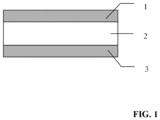
- FIG. 1 shows a schematic structure diagram of a high-strength lithium-ion battery separator provided by the present disclosure.
- FIG. 1 Reference numbers in FIG. 1: 1 - upper surface layer; 2 - core layer; 3 - lower surface layer.
- a melt index of the surface-layer polymer is set as 1.01-2.00 times a melt index of the core-layer polymer, preferably 1.05-1.70 times, and further preferably 1.10-1.50 times.
- a weight-average molecular weight of the core-layer polymer can be 1.1 million-1.7 million, preferably 1.2 million-1.7 million, more preferably 1.3 million-1.6 million, and further preferably 1.4 million-1.55 million; and the weight-average molecular weight of the core-layer polymer can be 1.01-2.20 times the weight-average molecular weight of the surface-layer polymer, preferably 1.05-1.80 times, and further preferably 1.10-1.30 times.
- the surface-layer polymer and the core-layer polymer described in the present disclosure can be the same or different polymers, wherein the different polymers are referred to: polymers with different chemical properties (e.g., a copolymer of PE and PP, where polymers with different chemical properties are chemically distinct from a copolymer of PE and PE); and/or polymers with the same chemical properties but with different characteristics (e.g., two PEs with different characteristics (e.g., two types of PE with different characteristics such as density, molecular weight, molecular weight distribution, rheological properties, and additives (composition and/or percentage)).
- the types of polymers can be the same or entirely consistent.
- the surface-layer polymer and core-layer polymer can be independently selected polyolefins.
- the polyolefin can include an ethylene homopolymer, a propylene homopolymer, a copolymer of ethylene and propylene, or a mixture of the above polymers, for example, it can be a single type of polyethylene, a mixture of two or more types of polyethylene, or a mixture of one or more types of polyethylene and polypropylene.
- the polyolefin can be obtained by a one-step polymerization method or a multi-step polymerization method.
- a melt index of the surface-layer polymer adopted by the separator of the present disclosure is 0.35-0.7 g/10min, preferably 0.4-0.65 g/10min, and more preferably 0.42-0.55 g/10min, wherein a melt index of the core-layer polymer is 0.3-0.6 g/10min, preferably 0.3-0.5 g/10min, more preferably 0.32-0.45 g/10min, and the melt index is measured at 190°C, 2.16 kg/10min.
- the present disclosure controls a pore size of the separator to be 30-60 nm, an average pore size of the core layer to be 30-50 nm, preferably 37-45 nm, and an average pore size of the surface layer to be 35-60 nm, preferably 40-50 nm, so as to ensure that the separator has a good gas permeability.
- Longitudinal stretching the sheet obtained by casting is stretched along the machine direction (longitudinal direction), wherein the stretching temperature is 80 ⁇ 120°C, and stretching ratio is 5.0 ⁇ 12.0 times, which can be any one of 5 times, 5.5 times, 6 times, 6.5 times, 7 times, 7.5 times, 8.5 times, 10 times, 11 times, 12 times, or a range of values between any two values, for example, preferably 6.5 ⁇ 8.5 times.
- Transverse stretching the thick sheet which has been longitudinally stretched is fed into a transverse stretching machine for transverse stretching, wherein the stretching temperature is 100 ⁇ 140°C, and the stretching ratio is 7.0 ⁇ 15.0 times, which can be any one of 7 times, 7.5 times, 8.5 times, 9 times, 10 times, 10.5 times, 11.5 times, 12 times, 13 times, 15 times, or a range of values between any two values, for example, preferably 9.0 ⁇ 11.5 times.
- the stretched separator is immersed into a tank containing an extractant, and the pore-forming agent is extracted by using the principle of similarity and compatibility.
- the extractant is an alkane extractant, preferably dichloromethane; preferably, a circulating liquid feed volume of the extractant is 1 ⁇ 5m 3 /h; and the stretched stacked layer body is heated for drying by using one or more means of a hot roller, a heat plate, and hot air, preferably with a drying temperature of 20 ⁇ 150 °C. Therefore, the residual extractant on the separator surface volatilizes and can be recovered for reuse.
- the parameters of heat setting include: a relaxation rate of 5-30%, and a setting temperature of 120-145°C. Under the same setting temperature condition, the larger the relaxation rate is, the lower the heat shrinkage of the separator is.
- the first polyethylene powder (with the weight-average molecular weight of 500,000) and the second polyethylene powder (with the weight-average molecular weight of 1.5 million) were measured and mixed in the weight ratio of 70:30, so as to obtain the polyethylene mixture. Subsequently, the polyethylene mixture and liquid paraffin were added into the second extruder in the weight ratio of 18:82, and they were melted and mixed at 200°C and 80 rpm, so as to obtain the surface-layer polymer molten body.
- the technical effects described by the present disclosure can be realized when the weight-average molecular weight or the melt index of the separator layer of the separator conforms to the gradient law defined by the present disclosure, and it is not limited to a proportional relationship of the thicknesses of the core layer and the surface layer.
- the separator layer on the interface in the direction close to the center of the separator is the core layer, and the separator layers from two side surfaces of the separator to the interface are surface layers of two sides respectively.
- the part including 2.5 ⁇ 10%, preferably 4.5-9%, and further preferably 6-7.5% of the separator layer thickness is the surface layer (single side) of the present disclosure, and the remaining center part is the core layer.
- the present disclosure used the following test methods for measurement.
- the distance L 0 between two points on the separator was marked and measurement at the room temperature (23°C); then they were put between two sheets of A4 paper, put together into the oven at 120°C, kept warm for 1 hour, and taken out to cool down naturally to the room temperature (or they were put together into the oven at 130°C, kept warm for 0.5 hour, and taken out to cool down naturally to the room temperature); and the distance L 1 between the two points was measured.
- the shrinkage rate (L 0 -L 1 )/L 0 *100%.
- Example 1 Items Powder Molecular Weight (W) Weight Ratio of Surface-Laver Powder (%) Weight Ratio of Core Layer Powder (%) First Polyethylene Second Polyethylene Third Polyethylene Fourth Polyethylene Fifth Polypropylene First Polyethylene Second Polyethylene Third Polyethylene Fourth Polyethylene Fifth Polypropylene Example 1 50 150 50 ⁇ 20 80 5 95 ⁇ Example 2 50 150 50 150 ⁇ 20 80 5 95 ⁇ Example 3 50 150 50 150 ⁇ 20 80 5 95 ⁇ Example 4 50 150 50 150 ⁇ 80 20 5 95 ⁇ Example 5 50 150 50 150 ⁇ 40 60 30 70 ⁇ Example 6 50 150 50 150 ⁇ 20 80 ⁇ 100 ⁇ Example 7 50 150 50 200 ⁇ 20 80 20 80 ⁇ Example 8 50 200 50 200 ⁇ 30 70 20 80 ⁇ Example 9 50 150 50 150 50 20 80 5 90 5 Example 10 50 150 50 150 ⁇ 20 80 5 95 ⁇ Example 11 50 150 50 150 ⁇ 20 80 18 82 ⁇ Example 12 50 150 50 150 ⁇ 20 80 5 95 ⁇ Example 10
- Example 13 Example 14
- Example 15 Comparative Example 4 Comparative Example 5 Cooling Method Cold Water bath; 20 °C Cold Water bath; 20 °C Cold Water bath; 20 °C Cooling Roller; 20°C Cold Water bath; 20 °C Stretching Ratio Longitudinal Stretching Ratio 5.2 11 7.2 7.2 13 Transverse Stretching Ratio 7.5 13.5 10.3 10.3 15.5 Separator Surface Appearance Qualified Qualified Qualified Some crystalline spots on Separator Surface Scratched Separator Surface and Frequent Separator Breakage Stretching Strength (kgf/cm 2 ) MD 2750 3706 3320 3300 3768 TD 2795 3625 3295 3280 3735 Thermal Shrinkage 120 °C,1 hour MD 4.8 8.3 5.9 6 9.1 TD 0.9 4.2 2.7 2.8 5.7
- the present disclosure notes that when the cooling cast effect is poor, it will result in uneven cooling and the separator surface exhibits crystalline spots, and the performance consistency is poor.
- the solution of the present disclosure adopts the cooling bath, which helps the separator to cool rapidly, so that the phase separation in the wet separator process is more complete, and the preferred cooling duration is 10s or more.
- the present disclosure also notes that when the stretching ratio is too low, the molecular chain orientation is low, which results in the low strength of the product; and when the stretching ratio is too high, the stretching stress is high and the heat shrinkage is poor, which may even lead to the separator to be broken directly.
- the melt index of the polymer is related to the molecular weight of the polymer.
- the ratio of the melt indexes of the surface layer to the core layer is more than 2 times, which means that the molecular weight of the surface layer is relatively low, and the mechanical strength of the separator is relatively low; and when the ratio is equal to or smaller than 1 time, the effect of improving the heat shrinkage cannot be achieved.
- the present disclosure obtains the thinner separator with the excellent strength and improved thermal shrinkage.
- the present disclosure also notes that when the temperature of the extrusion system is too high, the cross-linking reaction between the raw materials will occur and the black spot will be produced; and when the temperature of the extrusion system is low, the raw materials will not melt or the melting condition is worse, which affects the production.
- the extruder speed is too low, the raw material conveying efficiency is low and the pressure is unstable; and when the extruder speed is too high, the shear force is too strong, molecular chain breaks, and the shear heat will also lead to localized cross-linking reactions in the polymer.
- the extraction feed volume exceeds 5m 3 /h, it is easy to cause waste; and when it is lower than 1m 3 /h, the extraction is incomplete, which affects the overall performance of the separator.
- the present disclosure obtains a separator with the excellent comprehensive performance by appropriately selecting various parameters.
Landscapes
- Chemical & Material Sciences (AREA)
- Chemical Kinetics & Catalysis (AREA)
- Electrochemistry (AREA)
- General Chemical & Material Sciences (AREA)
- Engineering & Computer Science (AREA)
- Manufacturing & Machinery (AREA)
- Materials Engineering (AREA)
- Inorganic Chemistry (AREA)
- Cell Separators (AREA)
- Molding Of Porous Articles (AREA)
- Manufacture Of Porous Articles, And Recovery And Treatment Of Waste Products (AREA)
Applications Claiming Priority (1)
| Application Number | Priority Date | Filing Date | Title |
|---|---|---|---|
| PCT/CN2022/120967 WO2024060222A1 (zh) | 2022-09-23 | 2022-09-23 | 一种高强度锂离子电池隔膜及其制备方法 |
Publications (2)
| Publication Number | Publication Date |
|---|---|
| EP4576388A1 true EP4576388A1 (de) | 2025-06-25 |
| EP4576388A4 EP4576388A4 (de) | 2026-03-11 |
Family
ID=90453695
Family Applications (1)
| Application Number | Title | Priority Date | Filing Date |
|---|---|---|---|
| EP22959227.4A Pending EP4576388A4 (de) | 2022-09-23 | 2022-09-23 | Hochfeste lithium-ionen-batteriemembran und herstellungsverfahren dafür |
Country Status (6)
| Country | Link |
|---|---|
| US (1) | US20260088442A1 (de) |
| EP (1) | EP4576388A4 (de) |
| JP (1) | JP2025527029A (de) |
| KR (1) | KR20250048338A (de) |
| CN (1) | CN119816993A (de) |
| WO (1) | WO2024060222A1 (de) |
Families Citing this family (2)
| Publication number | Priority date | Publication date | Assignee | Title |
|---|---|---|---|---|
| CN119419449B (zh) * | 2024-12-25 | 2025-05-09 | 合肥长阳新能源科技有限公司 | 一种错层结构超大孔径隔膜及其制备方法 |
| CN121769443A (zh) * | 2026-02-28 | 2026-03-31 | 宁波长阳科技股份有限公司 | 高抗氧高耐候电池隔膜及其制备方法 |
Family Cites Families (16)
| Publication number | Priority date | Publication date | Assignee | Title |
|---|---|---|---|---|
| US6180280B1 (en) * | 1998-03-12 | 2001-01-30 | Celgard Inc. | Trilayer battery separator |
| JP4902455B2 (ja) * | 2006-08-01 | 2012-03-21 | 東レ東燃機能膜合同会社 | ポリオレフィン多層微多孔膜、その製造方法、電池用セパレータ及び電池 |
| US10680224B2 (en) * | 2014-06-20 | 2020-06-09 | Toray Industries, Inc. | Polyolefin multilayer microporous film, method for producing same, and cell separator |
| JP6346986B1 (ja) * | 2016-12-20 | 2018-06-20 | 旭化成株式会社 | 蓄電デバイス用セパレータ並びにこれを用いた積層体、捲回体及び二次電池 |
| JP6367453B2 (ja) * | 2016-12-20 | 2018-08-01 | 旭化成株式会社 | 蓄電デバイス用セパレータ及びそれを用いた積層体、捲回体、リチウムイオン二次電池又は蓄電デバイス |
| CN110249449B (zh) * | 2017-03-17 | 2022-03-08 | 东丽株式会社 | 电池用隔膜、电极体和非水电解质二次电池 |
| CN107316964B (zh) * | 2017-06-02 | 2019-12-17 | 武汉惠强新能源材料科技有限公司 | 一种改性均聚聚丙烯/高密度聚乙烯/改性均聚聚丙烯三层共挤锂电池隔膜及其制备方法 |
| CN107331822B (zh) * | 2017-06-02 | 2020-10-20 | 武汉惠强新能源材料科技有限公司 | 一种聚丙烯/聚乙烯/聚丙烯三层共挤锂离子电池隔膜及其制备方法 |
| CN111212734B (zh) * | 2017-10-13 | 2023-04-25 | 旭化成株式会社 | 聚烯烃微多孔膜以及使用其的锂离子二次电池 |
| US20210218108A1 (en) * | 2017-11-08 | 2021-07-15 | Toray Industries, Inc. | Polyolefin composite porous film, method of producing same, battery separator, and battery |
| JP7409042B2 (ja) * | 2018-12-10 | 2024-01-09 | 東レ株式会社 | 微多孔膜捲回体及びその製造方法 |
| DE102019112089A1 (de) * | 2019-05-09 | 2020-11-12 | Brückner Maschinenbau GmbH & Co. KG | Folie mit wenigstens zwei Schichten und Verfahren zu ihrer Herstellung |
| JP7386015B2 (ja) * | 2019-08-27 | 2023-11-24 | 東レ株式会社 | 電池用セパレータ及びその製造方法 |
| CN113809474B (zh) * | 2020-06-01 | 2023-09-08 | 深圳市星源材质科技股份有限公司 | 聚丙烯隔膜及其制备方法和锂离子电池 |
| WO2022092189A1 (ja) * | 2020-10-29 | 2022-05-05 | 東レ株式会社 | ポリオレフィン多層微多孔膜およびその製造方法ならびに積層多層微多孔膜 |
| CN112592500B (zh) | 2020-12-15 | 2023-06-20 | 上海恩捷新材料科技有限公司 | 一种聚烯烃微多孔膜及其生产系统、电池隔膜、电化学装置 |
-
2022
- 2022-09-23 JP JP2025512089A patent/JP2025527029A/ja active Pending
- 2022-09-23 WO PCT/CN2022/120967 patent/WO2024060222A1/zh not_active Ceased
- 2022-09-23 EP EP22959227.4A patent/EP4576388A4/de active Pending
- 2022-09-23 US US19/111,125 patent/US20260088442A1/en active Pending
- 2022-09-23 CN CN202280099390.5A patent/CN119816993A/zh active Pending
- 2022-09-23 KR KR1020257008103A patent/KR20250048338A/ko active Pending
Also Published As
| Publication number | Publication date |
|---|---|
| WO2024060222A1 (zh) | 2024-03-28 |
| CN119816993A (zh) | 2025-04-11 |
| EP4576388A4 (de) | 2026-03-11 |
| KR20250048338A (ko) | 2025-04-08 |
| JP2025527029A (ja) | 2025-08-15 |
| US20260088442A1 (en) | 2026-03-26 |
Similar Documents
| Publication | Publication Date | Title |
|---|---|---|
| JP6688922B2 (ja) | 分離膜およびその製造方法 | |
| EP3960421B1 (de) | Vorrichtung und verfahren zur herstellung einer hochfesten polyolefindünnschicht mit hohem modul und hochfeste polyolefindünnschicht mit hohem modul | |
| CN105246693B (zh) | 聚烯烃多层微多孔膜及其制造方法 | |
| EP3272500B1 (de) | Auf polyolefin basierender poröser film | |
| KR101406051B1 (ko) | 폴리올레핀 다층 미세 다공막, 그 제조 방법, 전지용 세페레이터 및 전지 | |
| EP2442981B1 (de) | Mehrschichtige mikroporöse folie | |
| EP3098256B1 (de) | Mikroporöse polyolefinmembran und verfahren zu deren herstellung | |
| EP4576388A1 (de) | Hochfeste lithium-ionen-batteriemembran und herstellungsverfahren dafür | |
| US20100248002A1 (en) | Microporous Multilayer Membrane, System And Process For Producing Such Membrane, And The Use Of Such Membrane | |
| WO2010048397A1 (en) | Liquid-permeable microlayer membranes, methods for making such membranes, and the use of such membranes as battery separator film | |
| JPWO2018043335A1 (ja) | 微多孔膜、リチウムイオン二次電池及び微多孔膜製造方法 | |
| KR20110139279A (ko) | 열가소성 필름, 이러한 필름의 제조 방법, 및 전지 세퍼레이터 필름으로서의 이러한 필름의 사용 | |
| WO2020203908A1 (ja) | ポリオレフィン微多孔膜、電池用セパレータ及び二次電池 | |
| CN115621664B (zh) | 一种耐穿刺锂电池隔膜及其制备方法 | |
| WO2023071543A1 (zh) | 复合隔膜、电化学装置和电子设备 | |
| CN114784454A (zh) | 一种高耐温聚烯烃微孔膜及其制备方法 | |
| CN113809474B (zh) | 聚丙烯隔膜及其制备方法和锂离子电池 | |
| CN116315456B (zh) | 一种五层共挤锂电池微孔隔膜及其制备方法 | |
| JP2012022911A (ja) | 積層セパレータおよび蓄電デバイス | |
| JP2025503935A (ja) | 多層セパレータの製造方法 | |
| CN102884116A (zh) | 微孔膜、该膜的生产方法、以及该膜作为电池隔膜的应用 | |
| KR20140048147A (ko) | 다공성 폴리프로필렌 필름 및 그의 제조 방법 | |
| JP2013199597A (ja) | ポリエチレン微多孔膜 | |
| TWI422489B (zh) | 多層微多孔膜,電池隔板及電池 | |
| KR102195445B1 (ko) | 분리막 및 그 제조방법 |
Legal Events
| Date | Code | Title | Description |
|---|---|---|---|
| STAA | Information on the status of an ep patent application or granted ep patent |
Free format text: STATUS: THE INTERNATIONAL PUBLICATION HAS BEEN MADE |
|
| PUAI | Public reference made under article 153(3) epc to a published international application that has entered the european phase |
Free format text: ORIGINAL CODE: 0009012 |
|
| STAA | Information on the status of an ep patent application or granted ep patent |
Free format text: STATUS: REQUEST FOR EXAMINATION WAS MADE |
|
| 17P | Request for examination filed |
Effective date: 20250317 |
|
| AK | Designated contracting states |
Kind code of ref document: A1 Designated state(s): AL AT BE BG CH CY CZ DE DK EE ES FI FR GB GR HR HU IE IS IT LI LT LU LV MC MK MT NL NO PL PT RO RS SE SI SK SM TR |
|
| DAV | Request for validation of the european patent (deleted) | ||
| DAX | Request for extension of the european patent (deleted) | ||
| REG | Reference to a national code |
Ref country code: DE Ref legal event code: R079 Free format text: PREVIOUS MAIN CLASS: H01M0050417000 Ipc: H01M0050457000 |
|
| STAA | Information on the status of an ep patent application or granted ep patent |
Free format text: STATUS: EXAMINATION IS IN PROGRESS |
|
| A4 | Supplementary search report drawn up and despatched |
Effective date: 20260210 |
|
| RIC1 | Information provided on ipc code assigned before grant |
Ipc: H01M 50/457 20210101AFI20260204BHEP Ipc: H01M 10/0525 20100101ALI20260204BHEP Ipc: H01M 50/403 20210101ALI20260204BHEP Ipc: H01M 50/417 20210101ALI20260204BHEP Ipc: H01M 50/449 20210101ALI20260204BHEP Ipc: H01M 50/451 20210101ALI20260204BHEP Ipc: H01M 50/489 20210101ALI20260204BHEP Ipc: H01M 50/491 20210101ALI20260204BHEP Ipc: H01M 50/494 20210101ALI20260204BHEP |
|
| 17Q | First examination report despatched |
Effective date: 20260223 |