EP4553924A1 - Composite powder, positive electrode mix, and alkali metal ion battery - Google Patents
Composite powder, positive electrode mix, and alkali metal ion battery Download PDFInfo
- Publication number
- EP4553924A1 EP4553924A1 EP23835510.1A EP23835510A EP4553924A1 EP 4553924 A1 EP4553924 A1 EP 4553924A1 EP 23835510 A EP23835510 A EP 23835510A EP 4553924 A1 EP4553924 A1 EP 4553924A1
- Authority
- EP
- European Patent Office
- Prior art keywords
- composite powder
- lithium
- heat
- alkali metal
- phosphorus
- Prior art date
- Legal status (The legal status is an assumption and is not a legal conclusion. Google has not performed a legal analysis and makes no representation as to the accuracy of the status listed.)
- Pending
Links
Images




Classifications
-
- H—ELECTRICITY
- H01—ELECTRIC ELEMENTS
- H01M—PROCESSES OR MEANS, e.g. BATTERIES, FOR THE DIRECT CONVERSION OF CHEMICAL ENERGY INTO ELECTRICAL ENERGY
- H01M10/00—Secondary cells; Manufacture thereof
- H01M10/05—Accumulators with non-aqueous electrolyte
- H01M10/052—Li-accumulators
-
- H—ELECTRICITY
- H01—ELECTRIC ELEMENTS
- H01M—PROCESSES OR MEANS, e.g. BATTERIES, FOR THE DIRECT CONVERSION OF CHEMICAL ENERGY INTO ELECTRICAL ENERGY
- H01M4/00—Electrodes
- H01M4/02—Electrodes composed of, or comprising, active material
- H01M4/36—Selection of substances as active materials, active masses, active liquids
- H01M4/362—Composites
- H01M4/364—Composites as mixtures
-
- H—ELECTRICITY
- H01—ELECTRIC ELEMENTS
- H01M—PROCESSES OR MEANS, e.g. BATTERIES, FOR THE DIRECT CONVERSION OF CHEMICAL ENERGY INTO ELECTRICAL ENERGY
- H01M4/00—Electrodes
- H01M4/02—Electrodes composed of, or comprising, active material
- H01M4/36—Selection of substances as active materials, active masses, active liquids
- H01M4/58—Selection of substances as active materials, active masses, active liquids of inorganic compounds other than oxides or hydroxides, e.g. sulfides, selenides, tellurides, halogenides or LiCoFy; of polyanionic structures, e.g. phosphates, silicates or borates
- H01M4/583—Carbonaceous material, e.g. graphite-intercalation compounds or CFx
- H01M4/587—Carbonaceous material, e.g. graphite-intercalation compounds or CFx for inserting or intercalating light metals
-
- C—CHEMISTRY; METALLURGY
- C01—INORGANIC CHEMISTRY
- C01B—NON-METALLIC ELEMENTS; COMPOUNDS THEREOF; METALLOIDS OR COMPOUNDS THEREOF NOT COVERED BY SUBCLASS C01C
- C01B25/00—Phosphorus; Compounds thereof
- C01B25/14—Sulfur, selenium, or tellurium compounds of phosphorus
-
- C—CHEMISTRY; METALLURGY
- C01—INORGANIC CHEMISTRY
- C01D—COMPOUNDS OF ALKALI METALS, i.e. LITHIUM, SODIUM, POTASSIUM, RUBIDIUM, CAESIUM, OR FRANCIUM
- C01D15/00—Lithium compounds
-
- H—ELECTRICITY
- H01—ELECTRIC ELEMENTS
- H01M—PROCESSES OR MEANS, e.g. BATTERIES, FOR THE DIRECT CONVERSION OF CHEMICAL ENERGY INTO ELECTRICAL ENERGY
- H01M10/00—Secondary cells; Manufacture thereof
- H01M10/05—Accumulators with non-aqueous electrolyte
- H01M10/052—Li-accumulators
- H01M10/0525—Rocking-chair batteries, i.e. batteries with lithium insertion or intercalation in both electrodes; Lithium-ion batteries
-
- H—ELECTRICITY
- H01—ELECTRIC ELEMENTS
- H01M—PROCESSES OR MEANS, e.g. BATTERIES, FOR THE DIRECT CONVERSION OF CHEMICAL ENERGY INTO ELECTRICAL ENERGY
- H01M10/00—Secondary cells; Manufacture thereof
- H01M10/05—Accumulators with non-aqueous electrolyte
- H01M10/056—Accumulators with non-aqueous electrolyte characterised by the materials used as electrolytes, e.g. mixed inorganic/organic electrolytes
- H01M10/0561—Accumulators with non-aqueous electrolyte characterised by the materials used as electrolytes, e.g. mixed inorganic/organic electrolytes the electrolyte being constituted of inorganic materials only
- H01M10/0562—Solid materials
-
- H—ELECTRICITY
- H01—ELECTRIC ELEMENTS
- H01M—PROCESSES OR MEANS, e.g. BATTERIES, FOR THE DIRECT CONVERSION OF CHEMICAL ENERGY INTO ELECTRICAL ENERGY
- H01M4/00—Electrodes
- H01M4/02—Electrodes composed of, or comprising, active material
- H01M4/13—Electrodes for accumulators with non-aqueous electrolyte, e.g. for lithium-accumulators; Processes of manufacture thereof
- H01M4/136—Electrodes based on inorganic compounds other than oxides or hydroxides, e.g. sulfides, selenides, tellurides, halogenides or LiCoFy
-
- H—ELECTRICITY
- H01—ELECTRIC ELEMENTS
- H01M—PROCESSES OR MEANS, e.g. BATTERIES, FOR THE DIRECT CONVERSION OF CHEMICAL ENERGY INTO ELECTRICAL ENERGY
- H01M4/00—Electrodes
- H01M4/02—Electrodes composed of, or comprising, active material
- H01M4/13—Electrodes for accumulators with non-aqueous electrolyte, e.g. for lithium-accumulators; Processes of manufacture thereof
- H01M4/139—Processes of manufacture
- H01M4/1397—Processes of manufacture of electrodes based on inorganic compounds other than oxides or hydroxides, e.g. sulfides, selenides, tellurides, halogenides or LiCoFy
-
- H—ELECTRICITY
- H01—ELECTRIC ELEMENTS
- H01M—PROCESSES OR MEANS, e.g. BATTERIES, FOR THE DIRECT CONVERSION OF CHEMICAL ENERGY INTO ELECTRICAL ENERGY
- H01M4/00—Electrodes
- H01M4/02—Electrodes composed of, or comprising, active material
- H01M4/36—Selection of substances as active materials, active masses, active liquids
- H01M4/362—Composites
-
- H—ELECTRICITY
- H01—ELECTRIC ELEMENTS
- H01M—PROCESSES OR MEANS, e.g. BATTERIES, FOR THE DIRECT CONVERSION OF CHEMICAL ENERGY INTO ELECTRICAL ENERGY
- H01M4/00—Electrodes
- H01M4/02—Electrodes composed of, or comprising, active material
- H01M4/36—Selection of substances as active materials, active masses, active liquids
- H01M4/38—Selection of substances as active materials, active masses, active liquids of elements or alloys
-
- H—ELECTRICITY
- H01—ELECTRIC ELEMENTS
- H01M—PROCESSES OR MEANS, e.g. BATTERIES, FOR THE DIRECT CONVERSION OF CHEMICAL ENERGY INTO ELECTRICAL ENERGY
- H01M4/00—Electrodes
- H01M4/02—Electrodes composed of, or comprising, active material
- H01M4/36—Selection of substances as active materials, active masses, active liquids
- H01M4/58—Selection of substances as active materials, active masses, active liquids of inorganic compounds other than oxides or hydroxides, e.g. sulfides, selenides, tellurides, halogenides or LiCoFy; of polyanionic structures, e.g. phosphates, silicates or borates
- H01M4/581—Chalcogenides or intercalation compounds thereof
- H01M4/5815—Sulfides
-
- H—ELECTRICITY
- H01—ELECTRIC ELEMENTS
- H01M—PROCESSES OR MEANS, e.g. BATTERIES, FOR THE DIRECT CONVERSION OF CHEMICAL ENERGY INTO ELECTRICAL ENERGY
- H01M4/00—Electrodes
- H01M4/02—Electrodes composed of, or comprising, active material
- H01M4/62—Selection of inactive substances as ingredients for active masses, e.g. binders, fillers
-
- C—CHEMISTRY; METALLURGY
- C01—INORGANIC CHEMISTRY
- C01P—INDEXING SCHEME RELATING TO STRUCTURAL AND PHYSICAL ASPECTS OF SOLID INORGANIC COMPOUNDS
- C01P2006/00—Physical properties of inorganic compounds
- C01P2006/12—Surface area
-
- C—CHEMISTRY; METALLURGY
- C01—INORGANIC CHEMISTRY
- C01P—INDEXING SCHEME RELATING TO STRUCTURAL AND PHYSICAL ASPECTS OF SOLID INORGANIC COMPOUNDS
- C01P2006/00—Physical properties of inorganic compounds
- C01P2006/14—Pore volume
-
- H—ELECTRICITY
- H01—ELECTRIC ELEMENTS
- H01M—PROCESSES OR MEANS, e.g. BATTERIES, FOR THE DIRECT CONVERSION OF CHEMICAL ENERGY INTO ELECTRICAL ENERGY
- H01M4/00—Electrodes
- H01M4/02—Electrodes composed of, or comprising, active material
- H01M2004/021—Physical characteristics, e.g. porosity, surface area
-
- H—ELECTRICITY
- H01—ELECTRIC ELEMENTS
- H01M—PROCESSES OR MEANS, e.g. BATTERIES, FOR THE DIRECT CONVERSION OF CHEMICAL ENERGY INTO ELECTRICAL ENERGY
- H01M4/00—Electrodes
- H01M4/02—Electrodes composed of, or comprising, active material
- H01M2004/026—Electrodes composed of, or comprising, active material characterised by the polarity
- H01M2004/028—Positive electrodes
-
- H—ELECTRICITY
- H01—ELECTRIC ELEMENTS
- H01M—PROCESSES OR MEANS, e.g. BATTERIES, FOR THE DIRECT CONVERSION OF CHEMICAL ENERGY INTO ELECTRICAL ENERGY
- H01M2300/00—Electrolytes
- H01M2300/0017—Non-aqueous electrolytes
- H01M2300/0065—Solid electrolytes
- H01M2300/0068—Solid electrolytes inorganic
-
- Y—GENERAL TAGGING OF NEW TECHNOLOGICAL DEVELOPMENTS; GENERAL TAGGING OF CROSS-SECTIONAL TECHNOLOGIES SPANNING OVER SEVERAL SECTIONS OF THE IPC; TECHNICAL SUBJECTS COVERED BY FORMER USPC CROSS-REFERENCE ART COLLECTIONS [XRACs] AND DIGESTS
- Y02—TECHNOLOGIES OR APPLICATIONS FOR MITIGATION OR ADAPTATION AGAINST CLIMATE CHANGE
- Y02E—REDUCTION OF GREENHOUSE GAS [GHG] EMISSIONS, RELATED TO ENERGY GENERATION, TRANSMISSION OR DISTRIBUTION
- Y02E60/00—Enabling technologies; Technologies with a potential or indirect contribution to GHG emissions mitigation
- Y02E60/10—Energy storage using batteries
Definitions
- the present invention relates to a composite powder, a positive electrode mixture and an alkali metal-ion battery including the composite powder.
- Alkali metal-ion batteries such as a lithium-ion battery and a sodium-ion battery are desired to have excellent battery capacities at high current density.
- a method of using sulfur for a positive electrode has been studied because of its large theoretical capacity (for example, see Non-Patent Document 1).
- sulfur has low electron conductivity, when sulfur is used for the positive electrode, it is required to ensure electron conductivity by some means.
- Patent Document 1 a composite having sulfur and carbon material having pores has been studied (see, for example, Patent Document 1 and Non-Patent Document 2).
- sulfur-carbon composite has a problem of small discharge capacity (low-rate properties) at high current density due to slow diffusion of alkali metal-ions in sulfur.
- the present invention it is possible to provide a composite powder capable of improving a discharge capacity (rate property) of an alkali metal-ion battery at a high current density.
- a composite powder includes a carbon material having pores, a first heat-impregnating material and a second heat-impregnating material present in the pores, wherein the first heat-impregnating material includes an alkali metal ion-conductive material or precursor thereof containing one or more elements selected from lithium, boron, oxygen, phosphorus, halogen and antimony, and the second heat-impregnating material includes an elemental sulfur.
- the first heat-impregnating material and the second heat-impregnating material which are melted by heating, are impregnated into the pores of the carbon material and filled into the pores. That is, they are impregnated into the pores by melting without using a solvent and without diluting the heat-impregnating material.
- the first heat-impregnating material and the second heat-impregnating material can be sufficiently contained in the pores, and the rate characteristics are improved.
- the first heat-impregnating material includes material having an alkali metal ionic conductivity containing one or more elements selected from lithium, boron, oxygen, phosphorus, halogen, and antimony, or precursor thereof.
- alkali metal ion-conductive material containing one or more elements selected from lithium, boron, oxygen, phosphorus, halogen, and antimony is a material that maintains solids at 25°C in a nitrogenous atmosphere and has ionic conductivity attributable to alkali metal-ions.
- a precursor of an alkali metal ion-conductive material containing one or more elements selected from lithium, boron, oxygen, phosphorus, halogen, and antimony refers to a precursor that, when used as an active material of an alkali metal-ion battery, reacts with an alkali metal or an alkali metal-ion to form a compound containing an alkali metal, thereby forming the alkali metal ion-conductive material.
- alkali metal ion-conductive material and “precursor of alkali metal ion-conductive material” may be simply referred to as “alkali metal ion-conductive material or precursor thereof”.
- halogen includes elements such as fluorine, chlorine, bromine, and iodine.
- the first heat-impregnating material is a melt by heating, it preferably has a melting point of 130 to 950°C, and more preferably 220 to 950°C. Further, the melting point of the first heat-impregnating material, such as 850°C or less, 750°C or less, 650°C or less, 600°C or less, or 550°C or less, is preferably a lower temperature. Lowering the temperature in the process can reduce the energy at the time of production, leading to a cost reduction.
- the alkali metal ion-conductive material when the alkali metal is lithium, example thereof include lithium sulfide, lithium polysulfide (Li 2 S n : n satisfies 1 ⁇ n ⁇ 8), lithium halide (LiCl, LiBr, Lil, etc.), lithium boron hydride, lithium oxide, trilithium phosphate, lithium sulfate, lithium carbonate, LiBF 4 , lithium tetraborate, organic lithium salt, lithium hydroxide, and the like.
- lithium sulfide lithium polysulfide (Li 2 S n : n satisfies 1 ⁇ n ⁇ 8)
- lithium halide LiCl, LiBr, Lil, etc.
- lithium boron hydride lithium oxide, trilithium phosphate, lithium sulfate, lithium carbonate, LiBF 4 , lithium tetraborate, organic lithium salt, lithium hydroxide, and the like.
- lithium ion-conductive material examples thereof include phosphorus pentasulfide, red phosphorus, boron sulfide, phosphorus pentoxide, boron oxide, antimony sulfide, antimony, tin sulfide, tin, germanium sulfide, bismuth sulfide, and the like. These compounds may be used alone, or two or more of them may be used in combination.
- the alkali metal is sodium
- examples thereof include sodium sulfide, sodium polysulfide, sodium halide (such as NaCl, NaBr, Nal), sodium boron hydride, sodium sulfate, sodium carbonate, NaBF 4 , sodium tetraborate, organic sodium salt, and sodium hydroxide.
- the precursor of the sodium-ion conductive material include the same as those of the precursor of lithium ion-conductive material described above. These compounds may be used alone, or two or more of them may be used in combination.
- organic lithium salt examples thereof include lithium salt of bis(perfluoroalkylsulfonyl)imide such as lithium bis(trifluoromethanesulfonyl)imide, lithium bis(fluorosulfonyl)imide, lithium (fluorosulfonyl)(trifluoromethanesulfonyl)imide, lithium bis(pentafluoroethanesulfonyl)imide and lithium bis(nonafluorobutanesulfonyl)imide; lithium salt of perfluoroalkylsulfonimide such as lithium 4,4,5,5-tetrafluoro-1,3,2-dithiazolidine-1,1,3,3-tetraoxyde; lithium salt of fluorosulfonylimide; lithium carbonate such as trifluoromethanesulfonate, lithium acetate, lithium propionate and lithium butyrate; lithium organic sulfonate such as lithium dodecylbenzenesulfon
- organic lithium salts are also preferably used for both ionic conductivity polymer and ionic liquids, and can be expected to impart high lithium conductivity.
- organic sodium salt examples include those obtained by replacing lithium-ion of the above-described organic lithium salt with a sodium ion.
- the first heat-impregnating material is preferably one or more compounds selected from the group consisting of phosphorus pentasulfide, red phosphorus, boron sulfide, lithium sulfide, lithium polysulfide (Li 2 S n , n satisfies 1 ⁇ n ⁇ 8), lithium halide, lithium boron hydride, lithium oxide, phosphorus pentoxide, boron oxide, trilithium phosphate and antimony sulfide.
- Particularly preferable examples thereof include phosphorus pentasulfide or boron sulfide which is expected to react with lithium to form a sulfide solid electrolyte having high ionic conductivity, and lithium halide which is reported to be capable of forming a solid solution with lithium sulfide being a discharged product of sulfur to improve lithium ionic conductivity of lithium sulfide.
- examples of the carbon material having pores include carbon black such as Ketjen black, acetylene black, Denka black, thermal black, channel black and Knobel (registered trademark); graphite; activated carbon; and the like. These may be used alone, or two or more thereof may be used in combination.
- the BET specific surface area of the carbon material is 50 m 2 /g or more and 6,000 m 2 /g or less. As a result, a wide interface between the carbon material and the elemental sulfur can be formed, and the utilization rate of the sulfur can be improved.
- the BET specific surface area is preferably 70 m 2 /g or more, more preferably 100 m 2 /g or more, 1,000 m 2 /g or more, or 1,500 m 2 /g or more. Further, 5,500 m 2 /g or less is preferable, and 5,000 m 2 /g or less is more preferable.
- the pore volume of the carbon material is 0.5 cm 3 /g or more and 6 cm 3 /g or less.
- the pore volume is preferably 0.7 cm 3 /g or more, and more preferably 1.0 cm 3 /g or more. It is preferably 5.5 cm 3 /g or less, and more preferably 5.0 cm 3 /g or less.
- the BET specific surface area and the pore volume can be determined by using a nitrogen adsorption isotherm obtained by adsorbing nitrogen gas to carbon material at a liquid-nitrogen temperature.
- the BET specific surface area can be calculated by Brenauer-Emmet-Telle (BET) multipoint method using a nitrogen-adsorption isotherm.
- the pore volume can be determined by Barret-Joyner-Halenda (BJH) method using a nitrogen-adsorption isotherm.
- the measuring device for example, it can be measured using a specific surface area and pore distribution measuring device (Autosorb-3) manufactured by Quantacrome.
- the composite powder of the present embodiment can be produced by heating a carbon material having pores, a first heat-impregnating material, and a second heat-impregnating material (hereinafter, the first heat-impregnating material and the second heat-impregnating material together may be simply referred to as a heat-impregnating material), at a temperature equal to or higher than the melting point of each heat-impregnating material.
- the carbon material, the first heat-impregnating material, and the second heat-impregnating material are mixed, and then they are heated to melt the first heat-impregnating material and the second heat-impregnating material, whereby the first heat-impregnating material and the second heat-impregnating material are impregnated into the pores of the carbon material.
- the first heat-impregnating material and the second heat-impregnating material can be impregnated into the carbon material at the same time.
- the first heat-impregnating material and the second heat-impregnating material may be separately impregnated into the carbon material.
- the first heat-impregnating material may be impregnated into the carbon material, and then the second heat-impregnating material may be impregnated thereinto.
- the mixing ratio of the carbon material and the heat-impregnating material can be appropriately adjusted to the material to be used.
- the mixing ratio of carbon material is 0.073 to 0.990.
- the pores of the carbon material are filled without insufficient heat-impregnating material. It is preferably from 0.077 to 0.950, more preferably from 0.081 to 0.905.
- the mixture of the carbon material and the heat-impregnating material is heated at a temperature equal to or higher than the melting point of the heat-impregnating material.
- the heating temperature is adjusted to the heat-impregnating material used.
- a material having sublimability at atmospheric pressure can be heat-impregnated under pressure.
- the heating time is preferably 10 minutes to 24 hours.
- a composite powder is obtained. If necessary, a grinding step may be performed after cooling.
- the alkali metal ion-conductive material or the precursor thereof having a melting point of 130 to 950°C is preferably heated at a temperature equal to or higher than the melting point.
- the step (2) is conducted after the step (1). This allows the pores of the carbon material to be impregnated with enough alkali metal ion-conducting material or precursor thereof without being affected by the melt of the elemental sulfur.
- the mixing ratio of the carbon material is preferably 0.075 to 0.990. It is more preferably 0.078 to 0.951, and still more preferably 0.082 to 0.906.
- the mixing ratio of the carbon material is 0.073 to 0.990.
- the heating temperature in the step (2) is equal to or higher than the melting point (about 115°C) of the elemental sulfur.
- the temperature is preferably 130°C or higher, and more preferably 150°C or higher.
- the heating of the step (2) may be performed in two or more stages.
- the heating temperature of the first stage may be equal to or higher than the melting point of the elemental sulfur and equal to or lower than the melting point of the alkali metal ion-conductive material or the precursor thereof
- the heating temperature of the second stage may be equal to or higher than the melting point of the alkali metal ion-conductive material or the precursor thereof. This makes it easier to impregnate the pores of the carbon material with enough elemental sulfur and alkali metal ion-conducting material or precursor thereof.
- the composite powder of the present invention can be used as a material of an alkali metal-ion battery.
- the type of the alkali metal-ion battery is not limited, but may be, for example, a positive electrode made of a positive electrode mixture including a solid electrolyte and the composite powder.
- the alkali metal-ion battery according to one embodiment of the present invention includes the above-described composite powder of the present invention.
- an all-solid-state alkali metal-ion battery can be produced by using the solid electrolyte instead of a liquid-based electrolyte.
- an all-solid-state alkali metal-ion battery having good rate characteristics can be produced.
- an all-solid-state lithium-ion battery will be described as an exemplary all-solid-state alkali metal-ion battery.
- the all-solid-state lithium-ion battery mainly includes a positive electrode layer, a negative electrode layer, and an electrolyte layer, but the composite powder of the present invention is suitable as a material of the positive electrode layer.
- the negative electrode layer and the electrolyte layer can be produced by a known method.
- a current collector is preferably used, and a known current collector is also used.
- the solid electrolyte is not particularly limited, and examples thereof include a sulfide solid electrolyte.
- the sulfide solid electrolyte is a solid electrolyte including at least sulfur atom and exhibiting ionic conductivity due to contained metallic ions, and a solid electrolyte including sulfur atom and preferably lithium atom and phosphorus atom, more preferably lithium atom, phosphorus atom and halogen atom, and having ionic conductivity due to lithium atom.
- the sulfide solid electrolyte may be an amorphous sulfide solid electrolyte, or may be a crystalline sulfide solid electrolyte.
- An amorphous sulfide solid electrolyte includes at least sulfur atom, and any one can be used therein without any particular limitation as long as it exhibits ionic conductivity caused by contained metal-ions, and typical examples thereof preferably include a solid electrolyte including sulfur atom, lithium atom and phosphorus atom, composed of lithium sulfide and phosphorus sulfide, such as Li 2 S-P 2 S 5 ; a solid electrolyte composed of lithium sulfide, phosphorus sulfide and lithium halide, such as Li 2 S-P 2 S 5 -LiI, Li 2 S-P 2 S 5 -LiCl, Li 2 S-P 2 S 5 -LiBr and Li 2 S-P 2 S 5 -LiI-LiBr; and a solid electrolyte further including other element such as oxygen element and silicon element, for example, such as Li 2 S-P 2 S 5 -Li 2 O-LiI and Li 2 S-
- a solid electrolyte composed of lithium sulfide, phosphorus sulfide and lithium halide such as Li 2 S-P 2 S 5 -LiI, Li 2 S-P 2 S 5 -LiCl, Li 2 S-P 2 S 5 -LiBr and Li 2 S-P 2 S 5 -LiI-LiBr is preferable.
- the type of the element constituting the amorphous sulfide solid electrolyte can be confirmed by, for example, an ICP emission spectrometer.
- the molar ratio of Li 2 S to P 2 S 5 is preferably 65 to 85:15 to 35, more preferably 70 to 80:20 to 30, and still more preferably 72 to 78:22 to 28, from the viewpoint of obtaining higher ionic conductivity with high chemical stability.
- the total amount of lithium sulfide and phosphorus pentasulfide is preferably 60 to 95 mol%, more preferably 65 to 90 mol%, and still more preferably 70 to 85 mol%.
- the amount of lithium bromide based on the total amount of lithium bromide and lithium iodide is preferably 1 to 99 mol%, more preferably 20 to 90 mol%, still more preferably 40 to 80 mol%, and particularly preferably 50 to 70 mol%.
- the blending ratio (molar ratio) of these atoms is preferably 1.0 to 1.8:1.0 to 2.0:0.1 to 0.8:0.01 to 0.6, more preferably 1.1 to 1.7:1.2 to 1.8:0.2 to 0.6:0.05 to 0.5, and still more preferably 1.2 to 1.6:1.3 to 1.7:0.25 to 0.5:0.08 to 0.4.
- the blending ratio (molar ratio) of lithium atom, sulfur atom, phosphorus atom, bromine atom, and iodine atom is preferably 1.0 to 1.8:1.0 to 2.0:0.1 to 0.8:0.01 to 0.3:0.01 to 0.3, more preferably 1.1 to 1.7:1.2 to 1.8:0.2 to 0.6:0.02 to 0.25:0.02 to 0.25, still more preferably 1.2 to 1.6:1.3 to 1.7:0.25 to 0.5:0.03 to 0.2:0.03 to 0.2, and still more preferably 1.35 to 1.45:1.4 to 1.7:0.3 to 0.45:0.04 to 0.18:0.04 to 0.18.
- the form of the amorphous sulfide solid electrolyte is not particularly limited, and examples thereof include particulate forms.
- the average particle size (D 50 ) of the particulate amorphous sulfide solid electrolyte may be, for example, in the range of 0.01 ⁇ m to 500 ⁇ m, or 0.1 to 200 ⁇ m.
- the average particle diameter (D 50 ) is a particle diameter that reaches 50% of the total by sequentially integrating the particles having the smallest particle diameter when the particle diameter distribution integrating curve is drawn, and the volume distribution is an average particle diameter that can be measured using, for example, a laser diffraction/scattering particle diameter distribution measuring device.
- the crystalline sulfide solid electrolyte may be, for example, a so-called glass ceramic obtained by heating the amorphous sulfide solid electrolyte above to a crystallization temperature or higher, and a sulfide solid electrolyte having the following crystal structure may be employed.
- Examples of the crystal structure that the crystalline sulfide solid electrolyte including lithium atom, sulfur atom, phosphorus atom, and halogen atom include a Li 4-x Ge 1-x P x S 4 thio-LISICON region II type crystal structure (see Kanno et al., Journal of The Electrochemical Society, 148 (7) A742-746 (2001 )), a crystal structure similar to that of Li 4-x Ge 1-x P x S 4 thio-LISICON region II (see Solid State Ionics, 177 (2006), 2721-2725 ), and the like.
- the "thio-LISICON region II type crystal structure” is any of a crystal structure Li 4-x Ge 1-x P x S 4 system thio-LISICON region II type crystal structure or a crystal structure similar to Li 4-x Ge 1-x P x S 4 system thio-LISICON region II type crystal structure.
- the crystalline structure of the crystalline sulfide solid electrolyte may be argyrodite-type crystal structure.
- argyrodite-type crystal structure include a Li 7 PS 6 crystal structure; a crystal structure represented by the formula Li 7-x P 1-y Si y S 6 or Li 7+x P 1-y Si y S 6 (x is -0.6 to 0.6, y is 0.1 to 0.6) having a Li 7 PS 6 structure skeleton; a crystal structure having Li 7-x-2y PS 6-x-y Cl x (0.8 ⁇ x ⁇ 1.7, 0 ⁇ y ⁇ -0.25x+0.5); and a crystal structure having Li 7-x PS 6-x Ha x (Ha is Cl or Br, and x is preferably 0.2 to 1.8).
- the crystal structure of the crystalline sulfide solid electrolyte is preferably a Li 3 PS 4 crystal structure, a thio-LISICON region II type crystal structure, and an argyrodite-type crystal structure.
- the form of the crystalline sulfide solid electrolyte is not particularly limited, and examples thereof include particulate forms.
- the average particle size (D 50 ) of the particulate crystalline sulfide solid electrolyte may be, for example, in the range of 0.01 ⁇ m to 500 ⁇ m, or 0.1 to 200 ⁇ m, similar to the average particle size (D 50 ) of the amorphous sulfide solid electrolyte described above.
- the present invention is specifically described by way of Examples. The present invention is not limited to Examples.
- the average particle size D 50 of the activated carbon (MSC-30) used was 50 to 150 ⁇ m (catalog value), and the pore volume was 1.58 cm 3 /g, and the BET specific surface area was 2840 m 2 /g.
- the pore volume and BET specific surface area are values for pores having a pore diameter of 100 nm or smaller in porous carbon.
- a specific surface area and pore distribution measuring device (Autosorb-3) manufactured by Quantacrome Instruments was used.
- Argon-ion milling treatment was conducted on the composite powder A to expose the particle cross-section, and SEM-EDX analysis was conducted to confirm the impregnation of phosphorus pentasulfide into the activated carbon.
- Fig. 1 is a SEM image and EDX mapping of a cross-section of the composite powder A (carbon element (C), phosphorus element (P) and sulfur element (S)). From Fig. 1 , it can be confirmed that the P element and the S element are present on the cross-section of the activated carbon identified by the C element, and therefore, phosphorus pentasulfide is impregnated into the pores of the activated carbon.
- C carbon element
- P phosphorus element
- S sulfur element
- the composite powder A and an elemental sulfur (melting point: 115°C) with the mass ratio of 39:61 were added to a Tammann tube with the inner diameter of 12 mm, and it was added and sealed in a SUS tube container. It was heated in an electric furnace at 150°C for 6 hours and then at 300°C for 2.75 hours to obtain a composite powder B including the composite powder A and sulfur.
- An activated carbon (MSC-30) and the elemental sulfur with the mass ratio of 30:70 were added to a glass tube, and it was added and sealed in a SUS tube container. It was heated in an electric furnace at 150°C for 6 hours and then at 300°C for 2.75 hours to obtain a composite powder.
- Example 1 0.45 g of the composite powder described above in (1), 0.064 g of phosphorus pentasulfide and 0.45 g of the solid electrolyte prepared in Example 1 were used as a raw material powder, and a positive electrode mixture was prepared in the same manner as in Example 1. And the all-solid-state battery was produced in the same manner as in Example 1.
- Example 1 0.32 g of the elemental sulfur, 0.14 g of activated carbon (MSC-30), 0.064 g of phosphorus pentasulfide and 0.45 g of the solid electrolyte prepared in Example 1 were used as a raw material powder, and a positive electrode mixture was prepared in the same manner as in Example 1. And the all-solid-state battery was produced in the same manner as in Example 1.
- Fig. 2A shows charge and discharge curves of Example 1, and Comparative Examples 1 and 2 at the second cycle (current density at discharge: 0.187 mAcm -2 ), and Fig. 2B shows charge and discharge curves of Example 1, and Comparative Examples 1 and 2 at the eighth cycle (current density at discharge: 7.46 mAcm -2 ).
- Fig. 3 is a diagram illustrating discharge capacity (rate characteristics) in a high current density
- Fig. 4 is a diagram illustrating cycle characteristics.
- a composite powder C was prepared in the same manner as in the preparation of the composite powder A of Example 1, except that the mass ratio of activated carbon (MSC-30) to phosphorus pentasulfide was 81:19.
- a composite powder D was prepared in the same manner as in the preparation of the composite powder B of Example 1, except that the mass ratio of the composite powder C to the elemental sulfur was 35:65.
- Example 1 0.48 g of the composite powder D and 0.45 g of the solid electrolyte prepared in Example 1 were used as a raw material powder, and a positive electrode mixture was prepared in the same manner as in Example 1.
- An all-solid-state battery was produced in the same manner as in Example 1, except that 5.2 mg of the positive electrode mixture powder was used for the all-solid-state battery.
- a composite powder E was prepared in the same manner as in the preparation of the composite powder A of Example 1, except that the weight ratio of activated carbon (MSC-30) to phosphorus pentasulfide was 51:49.
- a composite powder F was prepared in the same manner as in the preparation of the composite powder B of Example 1, except that the mass ratio of the composite powder E to the elemental sulfur was 45:55.
- Fig. 8 is a SEM image and EDX mapping (carbon element (C) and iodine element (I)) of a cross-section of the composite powder G. From Fig. 8 , it can be confirmed that the I element is present on the cross-section of the activated carbon identified by the C element, and therefore, lithium iodide is impregnated into the pores of the activated carbon.
- a composite powder H was prepared in the same manner as in the preparation of the composite powder B of Example 1, except that the mass ratio of the composite powder G to the elemental sulfur was 43:57.
- Example 1 0.56 g of the composite powder H and 0.45 g of the solid electrolyte prepared in Example 1 were used as a raw material powder, and a positive electrode mixture was prepared in the same manner as in Example 1. An all-solid-state battery was produced in the same manner as in Example 1, except that 5.6 mg of the positive electrode mixture powder was used for the all-solid-state battery.
- Fig. 5A shows charge and discharge curves of Examples 2 to 4 at the second cycle (current density at discharge: 0.187 mAcm -2 ), and Fig. 5B shows charge and discharge curves of Examples 2 to 4 at the eighth cycle (current density at discharge: 7.46 mAcm -2 ).
- Fig. 6 is a diagram illustrating discharge capacity (rate characteristics) in a high current density
- Fig. 7 is a diagram illustrating cycle characteristics.
- Figs. 5 to 7 it can be confirmed that they exhibit a large discharge capacity (excellent rate characteristics) at high current density and also have excellent cycle characteristics.
- a composite powder I was prepared in the same manner as in the preparation of the composite powder A of Example 1, except that antimony sulfide (melting point: 550°C) was used instead of phosphorus pentasulfide, the mass ratio of activated carbon (MSC-30) to antimony sulfide was 49:51, and the heating temperature was 580°C.
- antimony sulfide melting point: 550°C
- MSC-30 mass ratio of activated carbon
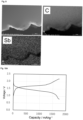
- Fig. 9 is a SEM image and EDX mapping (carbon element (C) and antimony element (Sb)) of a cross-section of the composite powder I. From Fig. 9 , it can be confirmed that the Sb element is present on the cross-section of the activated carbon identified by the C element, and therefore, antimony sulfide is impregnated into the pores of the activated carbon.
- C carbon element
- Sb antimony element
- a composite powder J was prepared in the same manner as in the preparation of the composite powder B of Example 1, except that the composite powder I was used, and the mass ratio of the composite powder I to the elemental sulfur was 47:53.
- a positive electrode mixture and an all-solid-state battery were produced in the same manner as in Example 1, except that the composite powder J was used as a raw material powder.
- Example 5 The all-solid-state battery produced in Example 5 was evaluated in the same manner as in Example 1.
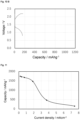
- Fig. 10A shows a charge and discharge curve of Example 5 at the second cycle (current density at discharge: 0.187 mAcm -2 ), and Fig. 10B shows a charge and discharge curve of Example 5 at the eighth cycle (current density at discharge: 7.46 mAcm -2 ).
- Fig. 11 is a diagram illustrating discharge capacity (rate characteristics) in a high current density
- Fig. 12 is a diagram illustrating cycle characteristics.
- a composite powder K was prepared in the same manner as in the preparation of the composite powder A of Example 1, except that lithium bromide (melting point: 547°C) was used instead of phosphorus pentasulfide, the mass ratio of activated carbon (MSC-30) to lithium bromide was 56:44, and the heating temperature was 552°C.
- Fig. 13 is a SEM image and EDX mapping (carbon element (C) and bromine element (Br)) of a cross-section of the composite powder K. From Fig. 13 , it can be confirmed that the Br element is present on the cross-section of the activated carbon identified by the C element, and therefore, lithium bromide is impregnated into the pores of the activated carbon.
- a composite powder L was prepared in the same manner as in the preparation of the composite powder B of Example 1, except that the composite powder K was used, and the mass ratio of the composite powder K to the elemental sulfur was 43:57.
- a composite powder M was prepared in the same manner as in the preparation of the composite powder A of Example 1, except that red phosphorus (melting point: 589.5°C, sublimation temperature: 416°C) was used instead of phosphorus pentasulfide, the mass ratio of activated carbon (MSC-30) to red phosphorus was 67:33, and the heating temperature was 450°C.
- Fig. 14 is a SEM image and EDX mapping (carbon element (C) and phosphorus element (P)) of a cross-section of the composite powder M. From Fig. 14 , it can be confirmed that the P element is present on the cross-section of the activated carbon identified by the C element, and therefore, phosphorus is impregnated into the pores of the activated carbon.
- a composite powder N was prepared in the same manner as in the preparation of the composite powder B of Example 1, except that the composite powder M was used, and the mass ratio of the composite powder M to the elemental sulfur was 39:61.
- the composite powder of the present invention is suitable as a structural material of an alkali metal-ion battery, particularly as a positive electrode mixture.
- the alkali metal-ion battery of the present invention is suitably used for, for example, a battery and the like used in a personal computer, a video camera, an information-related device or a communication device such as a mobile phone, and a vehicle such as an electric vehicle.
Landscapes
- Chemical & Material Sciences (AREA)
- General Chemical & Material Sciences (AREA)
- Chemical Kinetics & Catalysis (AREA)
- Electrochemistry (AREA)
- Engineering & Computer Science (AREA)
- Inorganic Chemistry (AREA)
- Manufacturing & Machinery (AREA)
- Materials Engineering (AREA)
- Organic Chemistry (AREA)
- Composite Materials (AREA)
- Physics & Mathematics (AREA)
- Condensed Matter Physics & Semiconductors (AREA)
- General Physics & Mathematics (AREA)
- Secondary Cells (AREA)
- Battery Electrode And Active Subsutance (AREA)
Applications Claiming Priority (2)
| Application Number | Priority Date | Filing Date | Title |
|---|---|---|---|
| JP2022107642 | 2022-07-04 | ||
| PCT/JP2023/024704 WO2024009978A1 (ja) | 2022-07-04 | 2023-07-04 | 複合粉末、正極合材及びアルカリ金属イオン電池 |
Publications (1)
| Publication Number | Publication Date |
|---|---|
| EP4553924A1 true EP4553924A1 (en) | 2025-05-14 |
Family
ID=89453404
Family Applications (1)
| Application Number | Title | Priority Date | Filing Date |
|---|---|---|---|
| EP23835510.1A Pending EP4553924A1 (en) | 2022-07-04 | 2023-07-04 | Composite powder, positive electrode mix, and alkali metal ion battery |
Country Status (6)
| Country | Link |
|---|---|
| US (1) | US20250385261A1 (https=) |
| EP (1) | EP4553924A1 (https=) |
| JP (1) | JPWO2024009978A1 (https=) |
| KR (1) | KR20250029040A (https=) |
| CN (1) | CN119384731A (https=) |
| WO (1) | WO2024009978A1 (https=) |
Families Citing this family (2)
| Publication number | Priority date | Publication date | Assignee | Title |
|---|---|---|---|---|
| JPWO2024166918A1 (https=) * | 2023-02-07 | 2024-08-15 | ||
| WO2026034190A1 (ja) * | 2024-08-05 | 2026-02-12 | 出光興産株式会社 | 正極合材 |
Family Cites Families (10)
| Publication number | Priority date | Publication date | Assignee | Title |
|---|---|---|---|---|
| JPS5856979U (ja) | 1981-10-12 | 1983-04-18 | 株式会社トキメック | 静電容量測定装置 |
| WO2012086196A1 (ja) * | 2010-12-24 | 2012-06-28 | 出光興産株式会社 | リチウムイオン電池用正極材料及びリチウムイオン電池 |
| JP5443445B2 (ja) | 2011-07-06 | 2014-03-19 | トヨタ自動車株式会社 | 硫化物固体電解質材料、リチウム固体電池、および、硫化物固体電解質材料の製造方法 |
| JP6203474B2 (ja) * | 2011-11-24 | 2017-09-27 | 出光興産株式会社 | 電極材料、電極及びそれを用いたリチウムイオン電池 |
| JP6475159B2 (ja) * | 2013-04-02 | 2019-02-27 | 出光興産株式会社 | 複合材料 |
| JP6380883B2 (ja) | 2013-10-16 | 2018-08-29 | ナガセケムテックス株式会社 | 正極合材及びその製造方法、並びに、全固体型リチウム硫黄電池 |
| KR102350807B1 (ko) * | 2014-11-18 | 2022-01-14 | 내셔날 인스티튜트 오브 어드밴스드 인더스트리얼 사이언스 앤드 테크놀로지 | 리튬-철-인-황-탄소 복합체 및 그 제조 방법 |
| KR102302554B1 (ko) * | 2017-10-30 | 2021-09-14 | 주식회사 엘지화학 | 황-탄소 복합체 및 그의 제조방법 |
| JP7283657B2 (ja) | 2019-03-26 | 2023-05-30 | 東京電力ホールディングス株式会社 | 硫黄正極合材およびその製造方法、硫黄正極、リチウム硫黄固体電池 |
| JP2021068663A (ja) | 2019-10-28 | 2021-04-30 | トヨタ自動車株式会社 | 正極材料の製造方法 |
-
2023
- 2023-07-04 KR KR1020247040750A patent/KR20250029040A/ko active Pending
- 2023-07-04 US US18/878,851 patent/US20250385261A1/en active Pending
- 2023-07-04 WO PCT/JP2023/024704 patent/WO2024009978A1/ja not_active Ceased
- 2023-07-04 JP JP2024532140A patent/JPWO2024009978A1/ja active Pending
- 2023-07-04 EP EP23835510.1A patent/EP4553924A1/en active Pending
- 2023-07-04 CN CN202380047143.5A patent/CN119384731A/zh active Pending
Also Published As
| Publication number | Publication date |
|---|---|
| US20250385261A1 (en) | 2025-12-18 |
| KR20250029040A (ko) | 2025-03-04 |
| JPWO2024009978A1 (https=) | 2024-01-11 |
| WO2024009978A1 (ja) | 2024-01-11 |
| CN119384731A (zh) | 2025-01-28 |
Similar Documents
| Publication | Publication Date | Title |
|---|---|---|
| KR102162070B1 (ko) | 리튬 이차전지용 황화물계 고체 전해질 | |
| US10879558B2 (en) | Materials for solid electrolyte | |
| US9577243B2 (en) | Use of expanded graphite in lithium/sulphur batteries | |
| EP2609652B1 (en) | Sulfide solid electrolyte material, cathode body and lithium solid state battery | |
| CN103038924B (zh) | 用于制备锂电池或钠电池的方法 | |
| Li et al. | Developments of electrolyte systems for lithium–sulfur batteries: A review | |
| US20130295469A1 (en) | Lithium sulfide compositions for battery electrolyte and battery electrode coatings | |
| EP4553924A1 (en) | Composite powder, positive electrode mix, and alkali metal ion battery | |
| JP2019033067A (ja) | 正極合材及びその製造方法 | |
| US20190372105A1 (en) | Cathode mixture and method for producing the same | |
| US20230387452A1 (en) | Method for fabricating gallium-doped lithium lanthanum zirconium oxide, and all-solid-state battery including the same | |
| WO2020214786A1 (en) | Method for wet chemical synthesis of lithium argyrodites | |
| JP2024539332A (ja) | アルジロダイト型の構造を有する無機化合物、その調製方法および電気化学的用途におけるその使用 | |
| Nam et al. | Silicon disulfide for high-performance Li-ion batteries and solid-state electrolytes | |
| KR20240037037A (ko) | 고체 전해질 및 이를 포함하는 리튬 이차 전지 | |
| Xu et al. | Exploration of Na 2.65 Ti 3.35 Fe 0.65 O 9 as anode materials for Na-ion batteries | |
| KR101233410B1 (ko) | 리튬 이차 전지용 양극 활물질 및 이를 포함하는 리튬 이차 전지 | |
| KR20180131972A (ko) | 고체전해질 및 이를 포함한 전지 | |
| KR20230165525A (ko) | 황화물계 고체전해질의 제조방법, 황화물계 고체전해질, 고체 전해질막 및 전고체 전지 | |
| Kim et al. | A scalable and flexible hybrid solid electrolyte based on NASICON-structure Li3Zr2Si2PO12 for high-voltage hybrid batteries | |
| KR102707195B1 (ko) | 제올라이트 및 불소계 리튬염을 이용한 복합 고체 전해질 | |
| KR102932779B1 (ko) | 리튬 황 배터리용 전해액 조성물 및 이를 포함하는 리튬 황 배터리 | |
| WO2025142869A1 (ja) | 正極合材 | |
| WO2025142860A1 (ja) | 正極合材前駆体及びその製造方法 | |
| WO2025142863A1 (ja) | 正極合材 |
Legal Events
| Date | Code | Title | Description |
|---|---|---|---|
| STAA | Information on the status of an ep patent application or granted ep patent |
Free format text: STATUS: THE INTERNATIONAL PUBLICATION HAS BEEN MADE |
|
| PUAI | Public reference made under article 153(3) epc to a published international application that has entered the european phase |
Free format text: ORIGINAL CODE: 0009012 |
|
| STAA | Information on the status of an ep patent application or granted ep patent |
Free format text: STATUS: REQUEST FOR EXAMINATION WAS MADE |
|
| 17P | Request for examination filed |
Effective date: 20250127 |
|
| AK | Designated contracting states |
Kind code of ref document: A1 Designated state(s): AL AT BE BG CH CY CZ DE DK EE ES FI FR GB GR HR HU IE IS IT LI LT LU LV MC ME MK MT NL NO PL PT RO RS SE SI SK SM TR |
|
| DAV | Request for validation of the european patent (deleted) | ||
| DAX | Request for extension of the european patent (deleted) |