EP4545477A1 - Verfahren zur herstellung von eisenphosphat aus eisenphosphorschlacke, eisenphosphat und verwendung von eisenphosphat - Google Patents
Verfahren zur herstellung von eisenphosphat aus eisenphosphorschlacke, eisenphosphat und verwendung von eisenphosphat Download PDFInfo
- Publication number
- EP4545477A1 EP4545477A1 EP22949135.2A EP22949135A EP4545477A1 EP 4545477 A1 EP4545477 A1 EP 4545477A1 EP 22949135 A EP22949135 A EP 22949135A EP 4545477 A1 EP4545477 A1 EP 4545477A1
- Authority
- EP
- European Patent Office
- Prior art keywords
- iron
- ion
- phosphate
- iron phosphate
- phosphorus slag
- Prior art date
- Legal status (The legal status is an assumption and is not a legal conclusion. Google has not performed a legal analysis and makes no representation as to the accuracy of the status listed.)
- Pending
Links
Images
Classifications
-
- C—CHEMISTRY; METALLURGY
- C01—INORGANIC CHEMISTRY
- C01B—NON-METALLIC ELEMENTS; COMPOUNDS THEREOF; METALLOIDS OR COMPOUNDS THEREOF NOT COVERED BY SUBCLASS C01C
- C01B25/00—Phosphorus; Compounds thereof
- C01B25/16—Oxyacids of phosphorus; Salts thereof
- C01B25/26—Phosphates
- C01B25/37—Phosphates of heavy metals
- C01B25/375—Phosphates of heavy metals of iron
-
- H—ELECTRICITY
- H01—ELECTRIC ELEMENTS
- H01M—PROCESSES OR MEANS, e.g. BATTERIES, FOR THE DIRECT CONVERSION OF CHEMICAL ENERGY INTO ELECTRICAL ENERGY
- H01M10/00—Secondary cells; Manufacture thereof
- H01M10/05—Accumulators with non-aqueous electrolyte
- H01M10/052—Li-accumulators
- H01M10/0525—Rocking-chair batteries, i.e. batteries with lithium insertion or intercalation in both electrodes; Lithium-ion batteries
-
- H—ELECTRICITY
- H01—ELECTRIC ELEMENTS
- H01M—PROCESSES OR MEANS, e.g. BATTERIES, FOR THE DIRECT CONVERSION OF CHEMICAL ENERGY INTO ELECTRICAL ENERGY
- H01M10/00—Secondary cells; Manufacture thereof
- H01M10/54—Reclaiming serviceable parts of waste accumulators
-
- H—ELECTRICITY
- H01—ELECTRIC ELEMENTS
- H01M—PROCESSES OR MEANS, e.g. BATTERIES, FOR THE DIRECT CONVERSION OF CHEMICAL ENERGY INTO ELECTRICAL ENERGY
- H01M4/00—Electrodes
- H01M4/02—Electrodes composed of, or comprising, active material
- H01M4/36—Selection of substances as active materials, active masses, active liquids
- H01M4/58—Selection of substances as active materials, active masses, active liquids of inorganic compounds other than oxides or hydroxides, e.g. sulfides, selenides, tellurides, halogenides or LiCoFy; of polyanionic structures, e.g. phosphates, silicates or borates
- H01M4/5825—Oxygenated metallic salts or polyanionic structures, e.g. borates, phosphates, silicates, olivines
-
- C—CHEMISTRY; METALLURGY
- C01—INORGANIC CHEMISTRY
- C01P—INDEXING SCHEME RELATING TO STRUCTURAL AND PHYSICAL ASPECTS OF SOLID INORGANIC COMPOUNDS
- C01P2002/00—Crystal-structural characteristics
- C01P2002/70—Crystal-structural characteristics defined by measured X-ray, neutron or electron diffraction data
- C01P2002/72—Crystal-structural characteristics defined by measured X-ray, neutron or electron diffraction data by d-values or two theta-values, e.g. as X-ray diagram
-
- C—CHEMISTRY; METALLURGY
- C01—INORGANIC CHEMISTRY
- C01P—INDEXING SCHEME RELATING TO STRUCTURAL AND PHYSICAL ASPECTS OF SOLID INORGANIC COMPOUNDS
- C01P2004/00—Particle morphology
- C01P2004/01—Particle morphology depicted by an image
- C01P2004/03—Particle morphology depicted by an image obtained by SEM
-
- C—CHEMISTRY; METALLURGY
- C01—INORGANIC CHEMISTRY
- C01P—INDEXING SCHEME RELATING TO STRUCTURAL AND PHYSICAL ASPECTS OF SOLID INORGANIC COMPOUNDS
- C01P2004/00—Particle morphology
- C01P2004/60—Particles characterised by their size
- C01P2004/62—Submicrometer sized, i.e. from 0.1-1 micrometer
-
- C—CHEMISTRY; METALLURGY
- C01—INORGANIC CHEMISTRY
- C01P—INDEXING SCHEME RELATING TO STRUCTURAL AND PHYSICAL ASPECTS OF SOLID INORGANIC COMPOUNDS
- C01P2006/00—Physical properties of inorganic compounds
- C01P2006/40—Electric properties
-
- C—CHEMISTRY; METALLURGY
- C01—INORGANIC CHEMISTRY
- C01P—INDEXING SCHEME RELATING TO STRUCTURAL AND PHYSICAL ASPECTS OF SOLID INORGANIC COMPOUNDS
- C01P2006/00—Physical properties of inorganic compounds
- C01P2006/80—Compositional purity
-
- H—ELECTRICITY
- H01—ELECTRIC ELEMENTS
- H01M—PROCESSES OR MEANS, e.g. BATTERIES, FOR THE DIRECT CONVERSION OF CHEMICAL ENERGY INTO ELECTRICAL ENERGY
- H01M4/00—Electrodes
- H01M4/02—Electrodes composed of, or comprising, active material
- H01M2004/026—Electrodes composed of, or comprising, active material characterised by the polarity
- H01M2004/028—Positive electrodes
-
- Y—GENERAL TAGGING OF NEW TECHNOLOGICAL DEVELOPMENTS; GENERAL TAGGING OF CROSS-SECTIONAL TECHNOLOGIES SPANNING OVER SEVERAL SECTIONS OF THE IPC; TECHNICAL SUBJECTS COVERED BY FORMER USPC CROSS-REFERENCE ART COLLECTIONS [XRACs] AND DIGESTS
- Y02—TECHNOLOGIES OR APPLICATIONS FOR MITIGATION OR ADAPTATION AGAINST CLIMATE CHANGE
- Y02E—REDUCTION OF GREENHOUSE GAS [GHG] EMISSIONS, RELATED TO ENERGY GENERATION, TRANSMISSION OR DISTRIBUTION
- Y02E60/00—Enabling technologies; Technologies with a potential or indirect contribution to GHG emissions mitigation
- Y02E60/10—Energy storage using batteries
Definitions
- the present application relates to the technical field of lithium ion batteries, in particular to a method for preparing iron phosphate from an iron phosphorus slag, iron phosphate, and an application thereof.
- a first object of the present application is to provide a method of preparing iron phosphate from an iron phosphorus slag.
- the method can effectively remove an aluminum impurity, a carbon impurity, a titanium impurity, and a copper impurity from the iron phosphorus slag to obtain ion phosphate with a low impurity content.
- the method further has the advantages of simple process, easy control, and low cost.
- a second object of the present application is to provide iron phosphate with a low impurity content and a high quality.
- a third object of the present application is to provide a cathode material for a lithium ion battery.
- the iron phosphorus slag includes a waste material obtained from a waste lithium iron phosphate battery after the extraction of lithium (lithium element).
- the iron phosphorus slag includes iron phosphate, aluminum hydroxide, metallic aluminum, carbon, metallic copper, copper oxide, and titanium oxide.
- the residue includes iron hydroxide, carbon (elementary substance), metallic copper (elementary copper), copper oxide, and titanium oxide as main components.
- the anion in the first filtrate includes the meta-aluminate ion, the phosphate ion, and the hydroxide ion.
- the reaction scheme in the step (a) is as follows: FePO 4 +3OH - ⁇ Fe(OH) 3 +PO 4 3- ; Al(OH) 3 +OH - ⁇ AlO 2 - +2H 2 O; 2Al+2H 2 O+2OH - ⁇ 2AlO 2 - +3H 2 ⁇ .
- This step enables the separation of phosphorus and aluminum elements from iron, titanium, copper, and carbon elements in the iron phosphorus slag, which facilitates the subsequent step-by-step removal of impurities and the synthetic reaction of iron phosphate.
- an acid solution (an aqueous solution containing an acid) is added into the first filtrate containing the meta-aluminate ion and the phosphate ion to carry out an aluminum-removing reaction.
- the meta-aluminate ion in the first filtrate reacts with the hydrogen ion in the acid solution to produce an aluminum hydroxide precipitate.
- a solid-liquid separation is performed after the aluminum-removing reaction is finished to obtain a second filtrate containing the phosphate ion for subsequent use.
- An aluminum hydroxide residue is also obtained while obtaining the second filtrate containing the phosphate ion.
- the aluminum impurity is precipitated in a form of aluminum hydroxide precipitate, so that the purpose of removing aluminum can be achieved after the solid-liquid separation.
- reaction scheme in this step is as follows: H 2 O+AlO 2 - +H + ⁇ Al(OH) 3 ⁇ .
- the anion in the second filtrate mainly includes the phosphate ion.
- step (b) The residue obtained in the step (a) is mixed with an acid solution to carry out a carbon-removing reaction followed by a solid-liquid separation to obtain a carbon residue (which includes elementary carbon and elementary copper as main components) and a third filtrate containing an iron ion, a titanium ion, and a copper ion.
- a mixed residue with metallic copper (elementary copper) and meta-titanic acid (TiO(OH) 2 , also known as hydrated titanium dioxide) as main components is also obtained while obtaining the fourth filtrate containing the ferrous ion.
- the reaction scheme in the step (c) is as follows: Fe+Cu 2+ ⁇ Cu+Fe 2+ ; Fe+2H + ⁇ Fe 2+ +H 2 ⁇ ; Ti 4+ +3H 2 O-TiO(OH) 2 +4H + .
- the step (c) by adding the metallic iron, not only the residual acid in the third filtrate can be neutralized to increase the pH of the third filtrate, but also the content of the ferrous ion in the third filtrate can be increased.
- the titanium impurity forms the meta-titanic acid precipitate by hydrolysis, achieving the purpose of removing titanium, and the copper impurity is subjected to a replacement reaction, achieving the purpose of removing copper. Consequently, the separation of the copper impurity and the titanium impurity from iron can be achieved by the solid-liquid separation in the step (c).
- the metallic iron can be added in an excessive amount in the step (c) to make the reaction sufficient, at which time the mixed residue still contains a small amount of metallic iron.
- This iron phosphate refers to anhydrous iron phosphate.
- the reaction principle in the step (d) includes the reaction of the ferrous ion and the oxidant to produce a ferric ion.
- the reaction equation is as follows: 2Fe 2+ +H 2 O 2 +2H + ⁇ 2Fe 3+ +2H 2 O; Fe 3+ +PO 4 3- +2H 2 O-FePO 4 -2H 2 O; FePO 4 -2H 2 O-FePO 4 +2H 2 O.
- the present application uses the waste iron phosphorus slag as the raw material, which has the advantages of low cost, avoiding waste of resources, and protecting the environment.
- the method can effectively remove aluminum, carbon, titanium, and copper impurities from the iron phosphorus slag. After the removal of aluminum, carbon, titanium, and copper, the prepared iron phosphate has a low impurity content, a high quality, and a high added value, which can be used as a precursor for power lithium iron phosphate.
- a mass ratio of the iron phosphorus slag to the alkali solution is 1:3 to 1: 10, including, but not limited to, any point value of or a range between any two point values of 1:3, 1:4, 1:5, 1:6, 1:7, 1:8, 1:9, 1:10, more preferably, 1:4 to 1:6.
- a mass fraction of the alkali solution i.e., a mass fraction of the alkali in the aqueous solution containing the alkali
- a mass fraction of the alkali solution is 8% to 20%, including, but not limited to, any point value of or a range between any two point values of 9%, 10%, 11%, 12%, 13%, 14%, 15%, 16%, 17%, 18%, 19%.
- the alkali solution includes a sodium hydroxide solution and/or a potassium hydroxide solution.
- a temperature of the mixture material is 30°C to 80°C, including, but not limited to, any point value of or a range between any two point values of 35°C, 40°C, 45°C, 50°C, 55°C, 60°C, 65°C, 70°C, 75°C, 78°C.
- a time of the reaction is 1 to 3 h, including, but not limited to, any point value of or a range between any two point values of 1.5 h, 2 h, 2.5 h.
- the above parameters used are conducive to promoting the dissolution of the aluminum hydroxide and the metallic aluminum and thus improving the efficiency of aluminum removal.
- the acid used in the acid solution includes at least one of sulfuric acid, hydrochloric acid, phosphoric acid, or nitric acid, more preferably, phosphoric acid.
- the phosphate ion in the phosphoric acid can be used as a raw material for the subsequent synthetic reaction of iron phosphate.
- a mass fraction of the acid solution i.e., a mass fraction of the acid in the aqueous solution containing the acid
- a mass fraction of the acid solution is 30% to 85%, including, but not limited to, any point value of or a range between any two point values of 35%, 40%, 45%, 50%, 55%, 60%, 65%, 70%, 75%, 80%.
- the acid solution is added until a pH of the mixture material is 5.0 to 7.5, including, but not limited to, any point value of or a range between any two point values of 5.2, 5.5, 5.8, 6.0, 6.3, 6.5, 6.8, 7.0, 7.2, more preferably, 6.8 to 7.1.
- the temperature of the mixture material during the aluminum-removing reaction is 15 to 80°C, including, but not limited to, any point value of or a range between any two point values of 20°C, 25°C, 30°C, 35°C, 40°C, 45°C, 50°C, 55°C, 60°C, 65°C, 70°C, 75°C.
- the above parameters used are conducive to promoting the precipitation of the aluminum hydroxide, thereby improving the aluminum removing effect.
- a molar ratio of the iron element in the residue to the hydrogen ion in the acid solution is 1:3.1 to 1:4; including, but not limited to, any point value of or a range between any two point values of 1:3.2, 1:3.3, 1:3.4, 1:3.5, 1:3.6, 1:3.7, 1:3.8, 1:3.9.
- the acid includes at least one of sulfuric acid, hydrochloric acid, nitric acid, or phosphoric acid; more preferably, at least one of sulfuric acid, hydrochloric acid, or nitric acid, which are less costly.
- a molality of the acid solution i.e., a molality of the acid in the aqueous solution containing the acid
- a molality of the acid solution is 1 to 3 mol/kg, including, but not limited to, any point value of or a range between any two point values of 1.3 mol/kg, 1.5 mol/kg, 1.8 mol/kg, 2.0 mol/kg, 2.3 mol/kg, 2.5 mol/kg, 2.8 mol/kg, 3 mol/kg.
- the temperature of the mixture material during the carbon-removing reaction is 60 to 80°C, including, but not limited to, any point value of or a range between any two point values of 63°C, 65°C, 68°C, 70°C, 73°C, 75°C, 78°C.
- a time of the carbon-removing reaction is 1 to 3 h, including, but not limited to, any point value of or a range between any two point values of 1.5 h, 2 h, 2.5 h, 3 h, more preferably, 1 to 1.5 h.
- the above parameters used are conductive to the separation of carbon from iron, titanium, and copper.
- the temperature of the mixture material during the titanium and copper-removing reaction is 75 to 85°C, including, but not limited to, any point value of or a range between any two point values of 76°C, 77°C, 78°C, 79°C, 80°C, 82°C, 83°C, 84°C.
- the solid-liquid separation is performed once the mixture material in the titanium and copper-removing reaction has a pH of 2 to 4.2, including, but not limited to, any point value of or a range between any two point values of 2.3, 2.5, 2.8, 3.0, 3.2, 3.5, 3.7, 3.9.
- the above parameters used are conductive to the separation of the copper impurity and the titanium impurity from iron.
- the oxidant includes at least one of a hydrogen peroxide aqueous solution, sodium peroxide, potassium peroxide, sodium persulfate, ammonium persulfate, or potassium persulfate, more preferably, a hydrogen peroxide aqueous solution.
- a molar ratio of the ferrous ion in the fourth filtrate to the hydrogen peroxide in the hydrogen peroxide aqueous solution is 1:0.55 to 1:0.75, including, but not limited to, any point value of or a range between any two point values of 1:0.58, 1:0.6, 1:0.62, 1:0.65, 1:0.68, 1:0.7, 1:0.73.
- Such molar ratio enables sufficient oxidation of the ferrous ion while saving costs.
- a molar ratio of the phosphate ion in the second filtrate to the ferrous ion in the fourth filtrate is 1.05:1 to 1.5:1, including, but not limited to, any point value of or a range between any two point values of 1.1:1, 1.15:1, 1.2:1, 1.25:1, 1.3:1, 1.35:1, 1.4:1, 1.45:1.
- the temperature of the mixture material during the reaction is 80 to 95°C, including, but not limited to, any point value of or a range between any two point values of 83°C, 85°C, 88°C, 90°C, 93°C.
- the above molar ratios and the above reaction temperature are conductive to obtaining iron phosphate with a higher quality.
- the time of the reaction is 2 to 6 h, including, but not limited to, any point value of or a range between any two point values of 2 h, 3 h, 4 h, 5 h, 6 h.
- a temperature of the sintering process is 550 to 700°C, including, but not limited to, any point value of or a range between any two point values of 570°C, 590°C, 600°C, 620°C, 650°C, 680°C, 700°C.
- the sintering process is for removing water of crystallization from iron phosphate.
- the product obtained before the sintering process is iron phosphate dihydrate which is sintered and dehydrated at high temperature to obtain the anhydrous iron phosphate.
- a step of washing and drying a solid material obtained by the solid-liquid separation is further included.
- the present application further provides iron phosphate, which is prepared by the method for preparing iron phosphate from the iron phosphorus slag as described above.
- the iron phosphate has a low impurity content, a high quality, and a low cost.
- the iron phosphate has a ratio of iron to phosphorus of 0.96 to 0.98, including, but not limited to, any point value of or a range between any two point values of 0.963, 0.964, 0.965, 0.968, 097, 0.972, 0.974, 0.975, 0.978.
- the present application further provides a cathode material for a lithium ion battery, including the iron phosphate as described above.
- the cost can be controlled to be low by using the iron phosphate as described above. Moreover, the iron phosphate with the low impurity content is conductive to improving the electrochemical performance of the lithium ion battery.
- the iron phosphorus slag used in the following examples of the present application and comparative examples is a waste material obtained from a waste lithium iron phosphate battery after the extraction of lithium.
- the iron phosphorus slag includes iron phosphate, aluminum hydroxide, metallic aluminum, carbon, metallic copper, copper oxide, and titanium oxide as main components.
- a method for preparing iron phosphate from an iron phosphorus slag in this example includes the following steps:
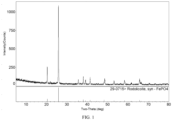
- the anhydrous iron phosphate obtained in the step (5) was subjected to an XRD detection, and the results are shown in FIG. 1 .
- the anhydrous iron phosphate obtained by the present application is FePO 4 (JCPDF Card No.: 29-0715), and the purity of iron phosphate prepared in the present example was calculated to be 99.74% with a total impurity content of 0.26% according to the types and amounts of the impurity elements detected in Table 3.
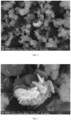
- the anhydrous iron phosphate obtained in step (5) was subjected to a SEM detection, and the results are shown in FIG. 2 and FIG. 3.
- FIG. 2 shows the SEM image of iron phosphate at a magnification of 50,000 times
- FIG. 3 shows the SEM image of iron phosphate at a magnification of 200,000 times. It can be seen that the anhydrous iron phosphate obtained by the present application has a microstructure in form of nano-flake, and the particle size of a primary particle is about 400 nm.
- a method for preparing iron phosphate from an iron phosphorus slag in this example includes the following steps:
- the Al removal rate in the step (2) was 96.01%
- the Cu removal rate in the step (4) was 99.95%
- the Ti removal rate in the step (4) was 99.02%.
- the contents of all impurity elements in the anhydrous iron phosphate obtained in the step (5) were less than 100 ppm.
- a method for preparing iron phosphate from an iron phosphorus slag in this example includes the following steps:
- the Al removal rate in the step (2) was 95.72%
- the Cu removal rate in the step (4) was 99.96%
- the Ti removal rate in the step (4) was 98.21%.
- the contents of all impurity elements in the anhydrous iron phosphate obtained in the step (5) were less than 100 ppm.
- a method for preparing iron phosphate from an iron phosphorus slag in this comparative example is substantially the same as that in Example 1, except that the pH of the mixture material was adjusted to 4.0 ⁇ 0.1 in the step (2).
- the Al removal rate in the step (2) was 42.32%, and the purity of iron phosphate prepared was 98.56%, with a total impurity content of 1.44%.
- a method for preparing iron phosphate from an iron phosphorus slag in this comparative example is substantially the same as that in Example 1, except that the reaction temperature is 50°C instead in the step (4).
- the Cu removal rate was 95.45%
- the Ti removal rate was 64.20%
- the purity of iron phosphate prepared was 99.45%, with a total impurity content of 0.55%.
Landscapes
- Chemical & Material Sciences (AREA)
- Organic Chemistry (AREA)
- Inorganic Chemistry (AREA)
- General Chemical & Material Sciences (AREA)
- Chemical Kinetics & Catalysis (AREA)
- Electrochemistry (AREA)
- Engineering & Computer Science (AREA)
- Crystallography & Structural Chemistry (AREA)
- Manufacturing & Machinery (AREA)
- Materials Engineering (AREA)
- Manufacture And Refinement Of Metals (AREA)
- Compounds Of Iron (AREA)
- Secondary Cells (AREA)
- Battery Electrode And Active Subsutance (AREA)
Applications Claiming Priority (2)
| Application Number | Priority Date | Filing Date | Title |
|---|---|---|---|
| CN202210735393.5A CN115231537B (zh) | 2022-06-27 | 2022-06-27 | 一种利用铁磷渣制备磷酸铁的方法、磷酸铁及其应用 |
| PCT/CN2022/138064 WO2024001059A1 (zh) | 2022-06-27 | 2022-12-09 | 一种利用铁磷渣制备磷酸铁的方法、磷酸铁及其应用 |
Publications (2)
| Publication Number | Publication Date |
|---|---|
| EP4545477A1 true EP4545477A1 (de) | 2025-04-30 |
| EP4545477A4 EP4545477A4 (de) | 2026-03-18 |
Family
ID=83672303
Family Applications (1)
| Application Number | Title | Priority Date | Filing Date |
|---|---|---|---|
| EP22949135.2A Pending EP4545477A4 (de) | 2022-06-27 | 2022-12-09 | Verfahren zur herstellung von eisenphosphat aus eisenphosphorschlacke, eisenphosphat und verwendung von eisenphosphat |
Country Status (6)
| Country | Link |
|---|---|
| US (1) | US20250059041A1 (de) |
| EP (1) | EP4545477A4 (de) |
| JP (1) | JP7801454B2 (de) |
| KR (1) | KR20240110848A (de) |
| CN (1) | CN115231537B (de) |
| WO (1) | WO2024001059A1 (de) |
Families Citing this family (7)
| Publication number | Priority date | Publication date | Assignee | Title |
|---|---|---|---|---|
| CN115231537B (zh) * | 2022-06-27 | 2023-09-08 | 湖北虹润高科新材料有限公司 | 一种利用铁磷渣制备磷酸铁的方法、磷酸铁及其应用 |
| CN115520995A (zh) * | 2022-11-01 | 2022-12-27 | 湖北虹润高科新材料有限公司 | 一种钙法生产磷酸铁的污水利用方法及其应用 |
| CN115818613B (zh) * | 2022-12-13 | 2023-10-03 | 湖北万润新能源科技股份有限公司 | 以废弃磷酸铁锂制备碳包覆的氟磷酸铁钠的方法及其应用 |
| CN116534822B (zh) * | 2023-05-15 | 2025-08-22 | 河南龙佰新材料科技有限公司 | 一种利用氯化法钛白废酸制备磷酸铁的方法及其应用 |
| WO2025187296A1 (ja) * | 2024-03-06 | 2025-09-12 | Jfeスチール株式会社 | リン酸鉄の製造方法 |
| CN118221086A (zh) * | 2024-03-22 | 2024-06-21 | 江苏贝特瑞纳米科技有限公司 | 一种磷酸铁锂提锂废料回收制备电池级磷酸铁的方法 |
| CN119525258B (zh) * | 2024-12-23 | 2025-10-10 | 浙江威尔森新材料有限公司 | 一种磷化渣化学综合利用处理方法 |
Family Cites Families (16)
| Publication number | Priority date | Publication date | Assignee | Title |
|---|---|---|---|---|
| DE102011056812A1 (de) * | 2011-12-21 | 2013-06-27 | Chemische Fabrik Budenheim Kg | Metallphosphate und Verfahren zu deren Herstellung |
| JP6508675B2 (ja) * | 2015-03-16 | 2019-05-08 | 地方独立行政法人 岩手県工業技術センター | リン酸鉄の回収方法 |
| CN108455547B (zh) * | 2018-02-11 | 2019-09-03 | 衢州华友钴新材料有限公司 | 一种低杂质高铁磷比大比表面积电池级磷酸铁的制备方法 |
| CN109179358B (zh) * | 2018-11-08 | 2020-06-09 | 广东省稀有金属研究所 | 一种从废旧磷酸铁锂电池中制备电池级磷酸铁的方法 |
| WO2021102842A1 (zh) * | 2019-11-28 | 2021-06-03 | 宁德时代新能源科技股份有限公司 | 一种以退役磷酸铁锂电池为原料生产磷酸铁锂前驱体的方法 |
| CN111252749B (zh) * | 2020-01-21 | 2022-11-22 | 曲靖市德方纳米科技有限公司 | 由锂磷铝石制备磷酸铁和氢氧化铝的方法 |
| CN111646447B (zh) * | 2020-06-17 | 2021-12-14 | 中国科学院宁波材料技术与工程研究所 | 一种从磷酸铁锂电池提锂后的铁磷渣中回收磷酸铁的方法 |
| CN112320780B (zh) * | 2020-09-25 | 2023-08-29 | 湖北金泉新材料有限公司 | 磷酸铁废料的回收方法 |
| CN112357899B (zh) * | 2020-11-23 | 2022-04-22 | 湖南金源新材料股份有限公司 | 一种废旧磷酸铁锂电池的综合回收利用方法 |
| CN112551498A (zh) * | 2020-12-14 | 2021-03-26 | 中钢集团南京新材料研究院有限公司 | 一种磷酸铁锂提锂后磷铁渣的回收方法 |
| CN112811404B (zh) * | 2020-12-31 | 2022-07-19 | 九江天赐高新材料有限公司 | 废旧磷酸铁锂正极粉料的回收利用方法 |
| CN113061723B (zh) | 2021-03-04 | 2023-01-20 | 长沙友合金属材料有限公司 | 一种从废旧磷酸铁锂电池中回收锂并制备磷酸铁的方法 |
| CN113735087B (zh) | 2021-08-25 | 2024-02-06 | 金川集团股份有限公司 | 一种废旧磷酸铁锂电池正极物料回收的方法 |
| CN113753873B (zh) | 2021-10-19 | 2022-10-04 | 湖北虹润高科新材料有限公司 | 一种废弃铁磷渣制备低铝杂质花瓣状磷酸铁的方法 |
| CN114394582B (zh) * | 2022-01-28 | 2023-10-27 | 四川长虹格润环保科技股份有限公司 | 一种从提锂后磷铁渣再生为磷酸铁的方法 |
| CN115231537B (zh) * | 2022-06-27 | 2023-09-08 | 湖北虹润高科新材料有限公司 | 一种利用铁磷渣制备磷酸铁的方法、磷酸铁及其应用 |
-
2022
- 2022-06-27 CN CN202210735393.5A patent/CN115231537B/zh active Active
- 2022-12-09 WO PCT/CN2022/138064 patent/WO2024001059A1/zh not_active Ceased
- 2022-12-09 JP JP2024537008A patent/JP7801454B2/ja active Active
- 2022-12-09 EP EP22949135.2A patent/EP4545477A4/de active Pending
- 2022-12-09 US US18/723,913 patent/US20250059041A1/en active Pending
- 2022-12-09 KR KR1020247020771A patent/KR20240110848A/ko active Pending
Also Published As
| Publication number | Publication date |
|---|---|
| WO2024001059A1 (zh) | 2024-01-04 |
| JP7801454B2 (ja) | 2026-01-16 |
| JP2024547058A (ja) | 2024-12-26 |
| US20250059041A1 (en) | 2025-02-20 |
| EP4545477A4 (de) | 2026-03-18 |
| KR20240110848A (ko) | 2024-07-16 |
| CN115231537B (zh) | 2023-09-08 |
| CN115231537A (zh) | 2022-10-25 |
Similar Documents
| Publication | Publication Date | Title |
|---|---|---|
| EP4545477A1 (de) | Verfahren zur herstellung von eisenphosphat aus eisenphosphorschlacke, eisenphosphat und verwendung von eisenphosphat | |
| CN113044821B (zh) | 一种镍铁合金资源化回收的方法和应用 | |
| EP4269337A1 (de) | Verfahren zur rückgewinnung von lithium in lithiumeisenphosphatabfall und anwendung davon | |
| CN112158894A (zh) | 一种废旧锂电池正极材料的回收方法 | |
| CN115448279A (zh) | 一种提锂后磷铁渣回收制备电池级磷酸铁材料的方法 | |
| US11695170B2 (en) | Battery-level Ni—Co—Mn mixed solution and preparation method for battery-level Mn solution | |
| US20240055684A1 (en) | Preparation method of heterosite iron phosphate and application thereof | |
| CN115321505B (zh) | 一种含锂废水综合回收制取磷酸铁锂的方法及应用 | |
| KR20230167021A (ko) | 캐소드 활성 물질 전구체를 제조하는 방법 | |
| CN115784188A (zh) | 回收制备电池级磷酸铁的方法 | |
| CN115448335B (zh) | 一种废旧磷酸锰铁锂电池的回收利用方法 | |
| CN115893351B (zh) | 利用废副氯化亚铁溶液制备电池级磷酸铁的方法及其应用 | |
| EP4699978A1 (de) | Verfahren zur rückgewinnung einer lithium-eisen-phosphat-abfallbatterie | |
| CA3191108A1 (en) | A method for producing lithium hydroxide from lithium-containing raw material | |
| CN116409768A (zh) | 磷酸铁盐系电池正极回收的方法 | |
| CN117566708B (zh) | 一种磷酸铁锂正极废料浸出液净化除杂的方法 | |
| CN113321241B (zh) | 高价锰氧化物及其制备方法、硫酸镍锰溶液的制备方法 | |
| CN116768180B (zh) | 一种利用废旧磷酸铁锂电池制备磷酸铁锂正极材料的方法 | |
| CN114180546A (zh) | 一种含钛磷酸铁锂废料制备无水磷酸铁的方法 | |
| CN117154273A (zh) | 一种废旧锂离子电池正极材料回收中磷循环的方法 | |
| JP7834666B2 (ja) | Ni、co及びmnの2つ以上のオキサレートの混合物を分離する方法 | |
| KR102856818B1 (ko) | 폐 전극소재로부터 유가금속을 회수하는 방법 | |
| US20250070290A1 (en) | Impurity control in lithium-ion battery recycling | |
| CN120841468B (zh) | 利用提锂渣制备电池级磷酸铁的方法及电池级磷酸铁 | |
| KR20240173800A (ko) | 리튬 이차 전지의 전이금속 회수 방법 |
Legal Events
| Date | Code | Title | Description |
|---|---|---|---|
| STAA | Information on the status of an ep patent application or granted ep patent |
Free format text: STATUS: THE INTERNATIONAL PUBLICATION HAS BEEN MADE |
|
| PUAI | Public reference made under article 153(3) epc to a published international application that has entered the european phase |
Free format text: ORIGINAL CODE: 0009012 |
|
| STAA | Information on the status of an ep patent application or granted ep patent |
Free format text: STATUS: REQUEST FOR EXAMINATION WAS MADE |
|
| 17P | Request for examination filed |
Effective date: 20240617 |
|
| AK | Designated contracting states |
Kind code of ref document: A1 Designated state(s): AL AT BE BG CH CY CZ DE DK EE ES FI FR GB GR HR HU IE IS IT LI LT LU LV MC ME MK MT NL NO PL PT RO RS SE SI SK SM TR |
|
| DAV | Request for validation of the european patent (deleted) | ||
| DAX | Request for extension of the european patent (deleted) | ||
| A4 | Supplementary search report drawn up and despatched |
Effective date: 20260213 |
|
| RIC1 | Information provided on ipc code assigned before grant |
Ipc: C01B 25/37 20060101AFI20260209BHEP Ipc: H01M 4/58 20100101ALI20260209BHEP Ipc: H01M 10/0525 20100101ALI20260209BHEP Ipc: H01M 10/54 20060101ALI20260209BHEP |