EP4516404A1 - Zirconiumdioxidmedium, lagerkugel und herstellungsverfahren dafür - Google Patents
Zirconiumdioxidmedium, lagerkugel und herstellungsverfahren dafür Download PDFInfo
- Publication number
- EP4516404A1 EP4516404A1 EP23796015.8A EP23796015A EP4516404A1 EP 4516404 A1 EP4516404 A1 EP 4516404A1 EP 23796015 A EP23796015 A EP 23796015A EP 4516404 A1 EP4516404 A1 EP 4516404A1
- Authority
- EP
- European Patent Office
- Prior art keywords
- medium
- zirconia
- powder
- range
- mass
- Prior art date
- Legal status (The legal status is an assumption and is not a legal conclusion. Google has not performed a legal analysis and makes no representation as to the accuracy of the status listed.)
- Pending
Links
Images

Classifications
-
- C—CHEMISTRY; METALLURGY
- C04—CEMENTS; CONCRETE; ARTIFICIAL STONE; CERAMICS; REFRACTORIES
- C04B—LIME, MAGNESIA; SLAG; CEMENTS; COMPOSITIONS THEREOF, e.g. MORTARS, CONCRETE OR LIKE BUILDING MATERIALS; ARTIFICIAL STONE; CERAMICS; REFRACTORIES; TREATMENT OF NATURAL STONE
- C04B35/00—Shaped ceramic products characterised by their composition; Ceramics compositions; Processing powders of inorganic compounds preparatory to the manufacturing of ceramic products
- C04B35/01—Shaped ceramic products characterised by their composition; Ceramics compositions; Processing powders of inorganic compounds preparatory to the manufacturing of ceramic products based on oxide ceramics
- C04B35/48—Shaped ceramic products characterised by their composition; Ceramics compositions; Processing powders of inorganic compounds preparatory to the manufacturing of ceramic products based on oxide ceramics based on zirconium or hafnium oxides, zirconates, zircon or hafnates
- C04B35/486—Fine ceramics
- C04B35/488—Composites
- C04B35/4885—Composites with aluminium oxide
-
- C—CHEMISTRY; METALLURGY
- C04—CEMENTS; CONCRETE; ARTIFICIAL STONE; CERAMICS; REFRACTORIES
- C04B—LIME, MAGNESIA; SLAG; CEMENTS; COMPOSITIONS THEREOF, e.g. MORTARS, CONCRETE OR LIKE BUILDING MATERIALS; ARTIFICIAL STONE; CERAMICS; REFRACTORIES; TREATMENT OF NATURAL STONE
- C04B35/00—Shaped ceramic products characterised by their composition; Ceramics compositions; Processing powders of inorganic compounds preparatory to the manufacturing of ceramic products
- C04B35/01—Shaped ceramic products characterised by their composition; Ceramics compositions; Processing powders of inorganic compounds preparatory to the manufacturing of ceramic products based on oxide ceramics
- C04B35/48—Shaped ceramic products characterised by their composition; Ceramics compositions; Processing powders of inorganic compounds preparatory to the manufacturing of ceramic products based on oxide ceramics based on zirconium or hafnium oxides, zirconates, zircon or hafnates
- C04B35/486—Fine ceramics
-
- C—CHEMISTRY; METALLURGY
- C04—CEMENTS; CONCRETE; ARTIFICIAL STONE; CERAMICS; REFRACTORIES
- C04B—LIME, MAGNESIA; SLAG; CEMENTS; COMPOSITIONS THEREOF, e.g. MORTARS, CONCRETE OR LIKE BUILDING MATERIALS; ARTIFICIAL STONE; CERAMICS; REFRACTORIES; TREATMENT OF NATURAL STONE
- C04B35/00—Shaped ceramic products characterised by their composition; Ceramics compositions; Processing powders of inorganic compounds preparatory to the manufacturing of ceramic products
- C04B35/622—Forming processes; Processing powders of inorganic compounds preparatory to the manufacturing of ceramic products
- C04B35/626—Preparing or treating the powders individually or as batches ; preparing or treating macroscopic reinforcing agents for ceramic products, e.g. fibres; mechanical aspects section B
- C04B35/62605—Treating the starting powders individually or as mixtures
- C04B35/62645—Thermal treatment of powders or mixtures thereof other than sintering
- C04B35/62675—Thermal treatment of powders or mixtures thereof other than sintering characterised by the treatment temperature
-
- C—CHEMISTRY; METALLURGY
- C04—CEMENTS; CONCRETE; ARTIFICIAL STONE; CERAMICS; REFRACTORIES
- C04B—LIME, MAGNESIA; SLAG; CEMENTS; COMPOSITIONS THEREOF, e.g. MORTARS, CONCRETE OR LIKE BUILDING MATERIALS; ARTIFICIAL STONE; CERAMICS; REFRACTORIES; TREATMENT OF NATURAL STONE
- C04B35/00—Shaped ceramic products characterised by their composition; Ceramics compositions; Processing powders of inorganic compounds preparatory to the manufacturing of ceramic products
- C04B35/622—Forming processes; Processing powders of inorganic compounds preparatory to the manufacturing of ceramic products
- C04B35/626—Preparing or treating the powders individually or as batches ; preparing or treating macroscopic reinforcing agents for ceramic products, e.g. fibres; mechanical aspects section B
- C04B35/62605—Treating the starting powders individually or as mixtures
- C04B35/62685—Treating the starting powders individually or as mixtures characterised by the order of addition of constituents or additives
-
- C—CHEMISTRY; METALLURGY
- C04—CEMENTS; CONCRETE; ARTIFICIAL STONE; CERAMICS; REFRACTORIES
- C04B—LIME, MAGNESIA; SLAG; CEMENTS; COMPOSITIONS THEREOF, e.g. MORTARS, CONCRETE OR LIKE BUILDING MATERIALS; ARTIFICIAL STONE; CERAMICS; REFRACTORIES; TREATMENT OF NATURAL STONE
- C04B35/00—Shaped ceramic products characterised by their composition; Ceramics compositions; Processing powders of inorganic compounds preparatory to the manufacturing of ceramic products
- C04B35/622—Forming processes; Processing powders of inorganic compounds preparatory to the manufacturing of ceramic products
- C04B35/626—Preparing or treating the powders individually or as batches ; preparing or treating macroscopic reinforcing agents for ceramic products, e.g. fibres; mechanical aspects section B
- C04B35/62605—Treating the starting powders individually or as mixtures
- C04B35/62695—Granulation or pelletising
-
- C—CHEMISTRY; METALLURGY
- C04—CEMENTS; CONCRETE; ARTIFICIAL STONE; CERAMICS; REFRACTORIES
- C04B—LIME, MAGNESIA; SLAG; CEMENTS; COMPOSITIONS THEREOF, e.g. MORTARS, CONCRETE OR LIKE BUILDING MATERIALS; ARTIFICIAL STONE; CERAMICS; REFRACTORIES; TREATMENT OF NATURAL STONE
- C04B35/00—Shaped ceramic products characterised by their composition; Ceramics compositions; Processing powders of inorganic compounds preparatory to the manufacturing of ceramic products
- C04B35/622—Forming processes; Processing powders of inorganic compounds preparatory to the manufacturing of ceramic products
- C04B35/64—Burning or sintering processes
-
- C—CHEMISTRY; METALLURGY
- C09—DYES; PAINTS; POLISHES; NATURAL RESINS; ADHESIVES; COMPOSITIONS NOT OTHERWISE PROVIDED FOR; APPLICATIONS OF MATERIALS NOT OTHERWISE PROVIDED FOR
- C09K—MATERIALS FOR MISCELLANEOUS APPLICATIONS, NOT PROVIDED FOR ELSEWHERE
- C09K3/00—Materials not provided for elsewhere
- C09K3/14—Anti-slip materials; Abrasives
- C09K3/1436—Composite particles, e.g. coated particles
-
- F—MECHANICAL ENGINEERING; LIGHTING; HEATING; WEAPONS; BLASTING
- F16—ENGINEERING ELEMENTS AND UNITS; GENERAL MEASURES FOR PRODUCING AND MAINTAINING EFFECTIVE FUNCTIONING OF MACHINES OR INSTALLATIONS; THERMAL INSULATION IN GENERAL
- F16C—SHAFTS; FLEXIBLE SHAFTS; ELEMENTS OR CRANKSHAFT MECHANISMS; ROTARY BODIES OTHER THAN GEARING ELEMENTS; BEARINGS
- F16C33/00—Parts of bearings; Special methods for making bearings or parts thereof
- F16C33/30—Parts of ball or roller bearings
- F16C33/32—Balls
-
- B—PERFORMING OPERATIONS; TRANSPORTING
- B02—CRUSHING, PULVERISING, OR DISINTEGRATING; PREPARATORY TREATMENT OF GRAIN FOR MILLING
- B02C—CRUSHING, PULVERISING, OR DISINTEGRATING IN GENERAL; MILLING GRAIN
- B02C17/00—Disintegrating by tumbling mills, i.e. mills having a container charged with the material to be disintegrated with or without special disintegrating members such as pebbles or balls
- B02C17/18—Details
- B02C17/20—Disintegrating members
-
- C—CHEMISTRY; METALLURGY
- C04—CEMENTS; CONCRETE; ARTIFICIAL STONE; CERAMICS; REFRACTORIES
- C04B—LIME, MAGNESIA; SLAG; CEMENTS; COMPOSITIONS THEREOF, e.g. MORTARS, CONCRETE OR LIKE BUILDING MATERIALS; ARTIFICIAL STONE; CERAMICS; REFRACTORIES; TREATMENT OF NATURAL STONE
- C04B2235/00—Aspects relating to ceramic starting mixtures or sintered ceramic products
- C04B2235/02—Composition of constituents of the starting material or of secondary phases of the final product
- C04B2235/30—Constituents and secondary phases not being of a fibrous nature
- C04B2235/32—Metal oxides, mixed metal oxides, or oxide-forming salts thereof, e.g. carbonates, nitrates, (oxy)hydroxides, chlorides
- C04B2235/3217—Aluminum oxide or oxide forming salts thereof, e.g. bauxite, alpha-alumina
-
- C—CHEMISTRY; METALLURGY
- C04—CEMENTS; CONCRETE; ARTIFICIAL STONE; CERAMICS; REFRACTORIES
- C04B—LIME, MAGNESIA; SLAG; CEMENTS; COMPOSITIONS THEREOF, e.g. MORTARS, CONCRETE OR LIKE BUILDING MATERIALS; ARTIFICIAL STONE; CERAMICS; REFRACTORIES; TREATMENT OF NATURAL STONE
- C04B2235/00—Aspects relating to ceramic starting mixtures or sintered ceramic products
- C04B2235/02—Composition of constituents of the starting material or of secondary phases of the final product
- C04B2235/30—Constituents and secondary phases not being of a fibrous nature
- C04B2235/32—Metal oxides, mixed metal oxides, or oxide-forming salts thereof, e.g. carbonates, nitrates, (oxy)hydroxides, chlorides
- C04B2235/3224—Rare earth oxide or oxide forming salts thereof, e.g. scandium oxide
- C04B2235/3225—Yttrium oxide or oxide-forming salts thereof
-
- C—CHEMISTRY; METALLURGY
- C04—CEMENTS; CONCRETE; ARTIFICIAL STONE; CERAMICS; REFRACTORIES
- C04B—LIME, MAGNESIA; SLAG; CEMENTS; COMPOSITIONS THEREOF, e.g. MORTARS, CONCRETE OR LIKE BUILDING MATERIALS; ARTIFICIAL STONE; CERAMICS; REFRACTORIES; TREATMENT OF NATURAL STONE
- C04B2235/00—Aspects relating to ceramic starting mixtures or sintered ceramic products
- C04B2235/02—Composition of constituents of the starting material or of secondary phases of the final product
- C04B2235/30—Constituents and secondary phases not being of a fibrous nature
- C04B2235/32—Metal oxides, mixed metal oxides, or oxide-forming salts thereof, e.g. carbonates, nitrates, (oxy)hydroxides, chlorides
- C04B2235/3231—Refractory metal oxides, their mixed metal oxides, or oxide-forming salts thereof
- C04B2235/3244—Zirconium oxides, zirconates, hafnium oxides, hafnates, or oxide-forming salts thereof
- C04B2235/3246—Stabilised zirconias, e.g. YSZ or cerium stabilised zirconia
-
- C—CHEMISTRY; METALLURGY
- C04—CEMENTS; CONCRETE; ARTIFICIAL STONE; CERAMICS; REFRACTORIES
- C04B—LIME, MAGNESIA; SLAG; CEMENTS; COMPOSITIONS THEREOF, e.g. MORTARS, CONCRETE OR LIKE BUILDING MATERIALS; ARTIFICIAL STONE; CERAMICS; REFRACTORIES; TREATMENT OF NATURAL STONE
- C04B2235/00—Aspects relating to ceramic starting mixtures or sintered ceramic products
- C04B2235/02—Composition of constituents of the starting material or of secondary phases of the final product
- C04B2235/30—Constituents and secondary phases not being of a fibrous nature
- C04B2235/34—Non-metal oxides, non-metal mixed oxides, or salts thereof that form the non-metal oxides upon heating, e.g. carbonates, nitrates, (oxy)hydroxides, chlorides
- C04B2235/3418—Silicon oxide, silicic acids or oxide forming salts thereof, e.g. silica sol, fused silica, silica fume, cristobalite, quartz or flint
-
- C—CHEMISTRY; METALLURGY
- C04—CEMENTS; CONCRETE; ARTIFICIAL STONE; CERAMICS; REFRACTORIES
- C04B—LIME, MAGNESIA; SLAG; CEMENTS; COMPOSITIONS THEREOF, e.g. MORTARS, CONCRETE OR LIKE BUILDING MATERIALS; ARTIFICIAL STONE; CERAMICS; REFRACTORIES; TREATMENT OF NATURAL STONE
- C04B2235/00—Aspects relating to ceramic starting mixtures or sintered ceramic products
- C04B2235/02—Composition of constituents of the starting material or of secondary phases of the final product
- C04B2235/50—Constituents or additives of the starting mixture chosen for their shape or used because of their shape or their physical appearance
- C04B2235/54—Particle size related information
- C04B2235/5409—Particle size related information expressed by specific surface values
-
- C—CHEMISTRY; METALLURGY
- C04—CEMENTS; CONCRETE; ARTIFICIAL STONE; CERAMICS; REFRACTORIES
- C04B—LIME, MAGNESIA; SLAG; CEMENTS; COMPOSITIONS THEREOF, e.g. MORTARS, CONCRETE OR LIKE BUILDING MATERIALS; ARTIFICIAL STONE; CERAMICS; REFRACTORIES; TREATMENT OF NATURAL STONE
- C04B2235/00—Aspects relating to ceramic starting mixtures or sintered ceramic products
- C04B2235/02—Composition of constituents of the starting material or of secondary phases of the final product
- C04B2235/50—Constituents or additives of the starting mixture chosen for their shape or used because of their shape or their physical appearance
- C04B2235/54—Particle size related information
- C04B2235/5418—Particle size related information expressed by the size of the particles or aggregates thereof
- C04B2235/5445—Particle size related information expressed by the size of the particles or aggregates thereof submicron sized, i.e. from 0,1 to 1 micron
-
- C—CHEMISTRY; METALLURGY
- C04—CEMENTS; CONCRETE; ARTIFICIAL STONE; CERAMICS; REFRACTORIES
- C04B—LIME, MAGNESIA; SLAG; CEMENTS; COMPOSITIONS THEREOF, e.g. MORTARS, CONCRETE OR LIKE BUILDING MATERIALS; ARTIFICIAL STONE; CERAMICS; REFRACTORIES; TREATMENT OF NATURAL STONE
- C04B2235/00—Aspects relating to ceramic starting mixtures or sintered ceramic products
- C04B2235/02—Composition of constituents of the starting material or of secondary phases of the final product
- C04B2235/50—Constituents or additives of the starting mixture chosen for their shape or used because of their shape or their physical appearance
- C04B2235/54—Particle size related information
- C04B2235/5463—Particle size distributions
- C04B2235/5481—Monomodal
-
- C—CHEMISTRY; METALLURGY
- C04—CEMENTS; CONCRETE; ARTIFICIAL STONE; CERAMICS; REFRACTORIES
- C04B—LIME, MAGNESIA; SLAG; CEMENTS; COMPOSITIONS THEREOF, e.g. MORTARS, CONCRETE OR LIKE BUILDING MATERIALS; ARTIFICIAL STONE; CERAMICS; REFRACTORIES; TREATMENT OF NATURAL STONE
- C04B2235/00—Aspects relating to ceramic starting mixtures or sintered ceramic products
- C04B2235/70—Aspects relating to sintered or melt-casted ceramic products
- C04B2235/74—Physical characteristics
- C04B2235/76—Crystal structural characteristics, e.g. symmetry
- C04B2235/765—Tetragonal symmetry
-
- C—CHEMISTRY; METALLURGY
- C04—CEMENTS; CONCRETE; ARTIFICIAL STONE; CERAMICS; REFRACTORIES
- C04B—LIME, MAGNESIA; SLAG; CEMENTS; COMPOSITIONS THEREOF, e.g. MORTARS, CONCRETE OR LIKE BUILDING MATERIALS; ARTIFICIAL STONE; CERAMICS; REFRACTORIES; TREATMENT OF NATURAL STONE
- C04B2235/00—Aspects relating to ceramic starting mixtures or sintered ceramic products
- C04B2235/70—Aspects relating to sintered or melt-casted ceramic products
- C04B2235/74—Physical characteristics
- C04B2235/77—Density
-
- C—CHEMISTRY; METALLURGY
- C04—CEMENTS; CONCRETE; ARTIFICIAL STONE; CERAMICS; REFRACTORIES
- C04B—LIME, MAGNESIA; SLAG; CEMENTS; COMPOSITIONS THEREOF, e.g. MORTARS, CONCRETE OR LIKE BUILDING MATERIALS; ARTIFICIAL STONE; CERAMICS; REFRACTORIES; TREATMENT OF NATURAL STONE
- C04B2235/00—Aspects relating to ceramic starting mixtures or sintered ceramic products
- C04B2235/70—Aspects relating to sintered or melt-casted ceramic products
- C04B2235/74—Physical characteristics
- C04B2235/78—Grain sizes and shapes, product microstructures, e.g. acicular grains, equiaxed grains, platelet-structures
- C04B2235/785—Submicron sized grains, i.e. from 0,1 to 1 micron
-
- C—CHEMISTRY; METALLURGY
- C04—CEMENTS; CONCRETE; ARTIFICIAL STONE; CERAMICS; REFRACTORIES
- C04B—LIME, MAGNESIA; SLAG; CEMENTS; COMPOSITIONS THEREOF, e.g. MORTARS, CONCRETE OR LIKE BUILDING MATERIALS; ARTIFICIAL STONE; CERAMICS; REFRACTORIES; TREATMENT OF NATURAL STONE
- C04B2235/00—Aspects relating to ceramic starting mixtures or sintered ceramic products
- C04B2235/70—Aspects relating to sintered or melt-casted ceramic products
- C04B2235/96—Properties of ceramic products, e.g. mechanical properties such as strength, toughness, wear resistance
-
- C—CHEMISTRY; METALLURGY
- C04—CEMENTS; CONCRETE; ARTIFICIAL STONE; CERAMICS; REFRACTORIES
- C04B—LIME, MAGNESIA; SLAG; CEMENTS; COMPOSITIONS THEREOF, e.g. MORTARS, CONCRETE OR LIKE BUILDING MATERIALS; ARTIFICIAL STONE; CERAMICS; REFRACTORIES; TREATMENT OF NATURAL STONE
- C04B2235/00—Aspects relating to ceramic starting mixtures or sintered ceramic products
- C04B2235/70—Aspects relating to sintered or melt-casted ceramic products
- C04B2235/96—Properties of ceramic products, e.g. mechanical properties such as strength, toughness, wear resistance
- C04B2235/963—Surface properties, e.g. surface roughness
-
- C—CHEMISTRY; METALLURGY
- C04—CEMENTS; CONCRETE; ARTIFICIAL STONE; CERAMICS; REFRACTORIES
- C04B—LIME, MAGNESIA; SLAG; CEMENTS; COMPOSITIONS THEREOF, e.g. MORTARS, CONCRETE OR LIKE BUILDING MATERIALS; ARTIFICIAL STONE; CERAMICS; REFRACTORIES; TREATMENT OF NATURAL STONE
- C04B35/00—Shaped ceramic products characterised by their composition; Ceramics compositions; Processing powders of inorganic compounds preparatory to the manufacturing of ceramic products
- C04B35/622—Forming processes; Processing powders of inorganic compounds preparatory to the manufacturing of ceramic products
- C04B35/626—Preparing or treating the powders individually or as batches ; preparing or treating macroscopic reinforcing agents for ceramic products, e.g. fibres; mechanical aspects section B
- C04B35/62605—Treating the starting powders individually or as mixtures
- C04B35/62645—Thermal treatment of powders or mixtures thereof other than sintering
- C04B35/62655—Drying, e.g. freeze-drying, spray-drying, microwave or supercritical drying
-
- C—CHEMISTRY; METALLURGY
- C09—DYES; PAINTS; POLISHES; NATURAL RESINS; ADHESIVES; COMPOSITIONS NOT OTHERWISE PROVIDED FOR; APPLICATIONS OF MATERIALS NOT OTHERWISE PROVIDED FOR
- C09K—MATERIALS FOR MISCELLANEOUS APPLICATIONS, NOT PROVIDED FOR ELSEWHERE
- C09K3/00—Materials not provided for elsewhere
- C09K3/14—Anti-slip materials; Abrasives
- C09K3/1409—Abrasive particles per se
-
- F—MECHANICAL ENGINEERING; LIGHTING; HEATING; WEAPONS; BLASTING
- F16—ENGINEERING ELEMENTS AND UNITS; GENERAL MEASURES FOR PRODUCING AND MAINTAINING EFFECTIVE FUNCTIONING OF MACHINES OR INSTALLATIONS; THERMAL INSULATION IN GENERAL
- F16C—SHAFTS; FLEXIBLE SHAFTS; ELEMENTS OR CRANKSHAFT MECHANISMS; ROTARY BODIES OTHER THAN GEARING ELEMENTS; BEARINGS
- F16C2206/00—Materials with ceramics, cermets, hard carbon or similar non-metallic hard materials as main constituents
- F16C2206/40—Ceramics, e.g. carbides, nitrides, oxides, borides of a metal
- F16C2206/42—Ceramics, e.g. carbides, nitrides, oxides, borides of a metal based on ceramic oxides
- F16C2206/48—Ceramics, e.g. carbides, nitrides, oxides, borides of a metal based on ceramic oxides based on zirconia (ZrO2)
-
- F—MECHANICAL ENGINEERING; LIGHTING; HEATING; WEAPONS; BLASTING
- F16—ENGINEERING ELEMENTS AND UNITS; GENERAL MEASURES FOR PRODUCING AND MAINTAINING EFFECTIVE FUNCTIONING OF MACHINES OR INSTALLATIONS; THERMAL INSULATION IN GENERAL
- F16C—SHAFTS; FLEXIBLE SHAFTS; ELEMENTS OR CRANKSHAFT MECHANISMS; ROTARY BODIES OTHER THAN GEARING ELEMENTS; BEARINGS
- F16C2220/00—Shaping
- F16C2220/20—Shaping by sintering pulverised material, e.g. powder metallurgy
-
- F—MECHANICAL ENGINEERING; LIGHTING; HEATING; WEAPONS; BLASTING
- F16—ENGINEERING ELEMENTS AND UNITS; GENERAL MEASURES FOR PRODUCING AND MAINTAINING EFFECTIVE FUNCTIONING OF MACHINES OR INSTALLATIONS; THERMAL INSULATION IN GENERAL
- F16C—SHAFTS; FLEXIBLE SHAFTS; ELEMENTS OR CRANKSHAFT MECHANISMS; ROTARY BODIES OTHER THAN GEARING ELEMENTS; BEARINGS
- F16C2240/00—Specified values or numerical ranges of parameters; Relations between them
- F16C2240/40—Linear dimensions, e.g. length, radius, thickness, gap
- F16C2240/54—Surface roughness
Definitions
- the present invention relates to zirconia media, a bearing ball, and methods for producing the same.
- the fine medium is small in size, and hence needs to be charged in a large amount into a mill.
- a medium having a slightly lower strength is present in the charged medium, it is likely that high-speed rotation in the mill applies a high load to the medium, causing breakage of the medium.
- breakage of the medium generates a fragment, the resultant fragment can be pulverized and mixed as foreign matter into the powder to be treated.
- the slurry temperature in the mill may be increased according to the conditions for pulverization or dispersion to cause deterioration of strength or wear resistance of the medium, leading to mixing of foreign matter into the powder to be treated.
- Patent Literature 1 discloses a method for dispersing a pigment in a solution using zirconia sintered beads having an average particle diameter of 40 to 192 ⁇ m, a density of 5.9 g/cm 3 or more, and a sphericity of 1.07 or less.
- Patent Literature 2 discloses a ZrO 2 -Y 2 O 3 zirconia sintered material for use in media for pulverization or dispersion, wherein the ZrO 2 -Y 2 O 3 zirconia sintered material has the chemical composition and microstructure controlled to obtain a wear resistance. There is a disclosure that the ZrO 2 -Y 2 O 3 zirconia sintered material described in Patent Literature 2 exhibits excellent wear resistance in pulverization or dispersion of a hard powder.
- Patent Literature 2 has a description of the control of the chemical composition of the ZrO 2 -Y 2 O 3 zirconia sintered material, but there is no description about suppression of variation of properties of the whole of the fine medium.
- the fine medium which does not satisfy a predetermined strength as a whole has a disadvantage in that stress concentration on the fine medium having a slightly lower strength can cause an occurrence of fracture or chipping.
- Patent Literature 3 has a description that, with respect to the spherical material after sintering, a difference can be made between the average crystal grain diameter around the center of the spherical material and that around the surface of the spherical material according to the granulation method for a molded spherical material before sintering. There is a description that when the average crystal grain diameter around the center of the spherical material is larger than that around the surface of the spherical material, marked wearing progresses on the initial stage, so that the amount of impurities mixed is drastically increased.
- uniformity of the average crystal grain diameter around the center in the individual spherical material and that around the surface of the spherical material is controlled by controlling the specific surface area and average secondary particle diameter of the ZrO 2 powder used for molding of the molded spherical material before sintering to be in their respective specific ranges, and further controlling the chemical composition, e.g., the Y 2 O 3 , Al 2 O 3 , Fe, or Ti amount to be in the specific range.
- Patent Literature 4 discloses a zirconia sintered material which stably exhibits excellent wear resistance and durability for a long term when used in warm water at about 100°C, or 100°C or lower or in a high humidity atmosphere, wherein the molar ratio of Y 2 O 3 and ZrO 2 , the amount of Al 2 O 3 contained, the total amount of SiO 2 and TiO 2 contained, and the average crystal grain diameter are controlled.
- Patent Literature 4 has a description of the control of the chemical composition of the ZrO 2 -Y 2 O 3 zirconia sintered material, but there is no description about suppression of variation of properties of the whole of the fine media.
- the fine medium which does not satisfy a predetermined strength as a whole has a disadvantage in that, like Patent Literature 2, stress concentration on the fine medium having a slightly lower strength can cause an occurrence of fracture or cutout, leading to a lowering of the durability.
- a object of the present invention is to provide zirconia media which has suppressed variation of the shape of the medium and reduced variation of the mechanical properties, and has improved wear resistance and durability, a bearing ball, and methods for producing the same.
- the first embodiment of the present invention is a zirconia medium which satisfies the following requirements (a) to (h):
- the fourth embodiment of the present invention is a method for producing a zirconia bearing ball, the method comprising:
- the zirconia medium of the present invention satisfies the requirements (a) to (h) described below, preferably satisfies the requirement (k) below, and may satisfy the requirement (j), (n), or (o) below.
- the zirconia medium or zirconia bearing ball satisfies the requirements: (a) comprising a ZrO 2 -Y 2 O 3 zirconia sintered material, wherein the Y 2 O 3 /ZrO 2 molar ratio is in the range of from 2.5/97.5 to 3.2/96.8; (b) the amount of the contained Al 2 O 3 being in the range of from 0.1% by mass to 30.0% by mass; (c) containing tetragonal crystal system zirconia in an amount of 90% by volume or more; (d) having a relative density of 95% or more; (e) having an average crystal grain diameter in the range of from 0.25 ⁇ m to 0.50 ⁇ m; (f) the minimum value Pmin of crushing load measured at a crosshead speed of 0.5 mm/minute satisfying the relationship: Pmin (N) > 600 ⁇ D 2.0 (wherein D is an average of medium diameter); (g) the Weibull coefficient of crushing load being 10 or more; and (h) the coefficient of variation of medium
- the zirconia medium or zirconia bearing ball (a) comprises a ZrO 2 -Y 2 O 3 zirconia sintered material, wherein the Y 2 O 3 /ZrO 2 molar ratio is in the range of from 2.5/97.5 to 3.2/96.8, and may be in the range of from 2.6/97.4 to 3.1/96.9.
- the Y 2 O 3 /ZrO 2 molar ratio is in the above range, and therefore the amount of monoclinic crystal system zirconia is small so that the crystal structure of tetragonal crystal system zirconia has excellent stability.
- the Y 2 O 3 /ZrO 2 molar ratio is in the above range, and therefore an occurrence of fracture or cutout can be suppressed, making it possible to improve the wear resistance and durability.
- the Y 2 O 3 /ZrO 2 molar ratio is less than 2.5/97.5, the amount of the contained monoclinic crystal system zirconia is increased, so that the stability of tetragonal crystal system zirconia becomes low.
- the zirconia medium or zirconia bearing ball when the Y 2 O 3 /ZrO 2 molar ratio is less than 2.5/97.5, a stress generates a very small chipping to cause an occurrence of fracture or chipping, so that the wear resistance or durability becomes low.
- the zirconia medium or zirconia bearing ball when the Y 2 O 3 /ZrO 2 molar ratio is more than 3.2/96.8, the amount of tetragonal crystal system zirconia is reduced, so that the mechanical strength is reduced.
- the mechanical strength is reduced, fracture or chipping in the medium occurs in a bead mill in which a high load is applied to the medium, so that the wear resistance becomes low.
- the ZrO 2 raw material generally contains a small amount of HfO 2 , and therefore the total amount of ZrO 2 and HfO 2 is used as the amount of ZrO 2 .
- the ZrO 2 powder may contain at least one member selected from the group consisting of TiO 2 , FeO 2 , MgO, Na 2 O, and K 2 O.
- the amount of a component or components other than ZrO 2 contained in the ZrO 2 powder may be 0.3% by mass or less, based on the mass of the ZrO 2 .
- the amount of the contained Al 2 O 3 is in the range of from 0.1% by mass to 30.0% by mass. In the zirconia medium or zirconia bearing ball, (b) the amount of the contained Al 2 O 3 is in the above range, and therefore the sintering properties of ZrO 2 are improved. In the zirconia medium or zirconia bearing ball, (b) the amount of the contained Al 2 O 3 is in the above range, and therefore Al 2 O 3 undergoes segregation to the crystal grain boundary of ZrO 2 or is present as Al 2 O 3 crystal grains, and thus the crystal grain boundary of ZrO 2 is reinforced, so that mechanical properties, such as an impact resistance, are improved.
- the amount of the contained Al 2 O 3 when the amount of the contained Al 2 O 3 is less than 0.1% by mass, the effects of an improvement of the sintering properties and an improvement of the mechanical properties aimed at by adding Al 2 O 3 cannot be obtained.
- the amount of the contained Al 2 O 3 when the amount of the contained Al 2 O 3 is more than 30.0% by mass, such an increased amount of Al 2 O 3 rather lowers the sintering properties and mechanical properties.
- the amount of the contained Al 2 O 3 is preferably in the range of from 0.2 to 25% by mass.
- the amount of the contained SiO 2 is in the range of from 0.2% by mass to 1.0% by mass.
- the ZrO 2 -Y 2 O 3 zirconia sintered material is used in warm water at 40°C or higher, it is likely that the crystal grain boundary suffers erosion of water, so that the wear resistance is markedly reduced.
- the zirconia medium or zirconia bearing ball contains SiO 2 therein, the medium can maintain the wear resistance even when used in warm water at 40°C or higher.
- the amount of the contained SiO 2 is in the range of from 0.2 % by mass to 1.0% by mass, and therefore erosion of water into the crystal grain boundary of ZrO 2 in the sintered material constituting the medium is suppressed even when the medium is used in warm water at 40°C or higher, so that the medium can maintain the wear resistance.
- the amount of the contained SiO 2 when the amount of the contained SiO 2 is more than 1.0% by mass, it is likely that a SiO 2 phase is formed in the crystal grain boundary of ZrO 2 , so that the strength is reduced.
- the amount of the contained SiO 2 may be in the range of from 0.3% by mass to 0.9% by mass, and may be in the range of from 0.4% by mass to 0.7% by mass.
- the amount of the SiO 2 contained in the zirconia medium or zirconia bearing ball may be less than 0.2% by mass.
- the zirconia medium or zirconia bearing ball (c) contains tetragonal crystal system zirconia in an amount of 90% by volume or more, preferably 95% by volume or more.
- the zirconia medium or zirconia bearing ball contains tetragonal crystal system zirconia in an amount of 90% by volume or more, and therefore the wear resistance, durability, and mechanical strength, such as an impact resistance, can be improved.
- the zirconia medium or zirconia bearing ball may contain tetragonal crystal system zirconia in an amount of 100% by volume.
- the zirconia medium or zirconia bearing ball when the amount of the contained tetragonal crystal system zirconia is less than 90% by volume, a large amount of monoclinic crystal system zirconia is contained. A very small chipping is formed around the monoclinic crystal system zirconia contained in the zirconia medium or zirconia bearing ball, so that the wear resistance, durability, and mechanical strength, such as an impact resistance, becomes low.
- the acceptable amount of the contained monoclinic crystal system zirconia is up to 5% by volume, preferably 5% by volume or less.
- the zirconia medium or zirconia bearing ball contains a large amount of cubic crystal system zirconia, the effect of stress-induced phase transformation is reduced to lower the toughness, so that a very small chipping is likely to be formed in the medium when used in a bead mill in which a high load is applied to the medium.
- the acceptable amount of the contained cubic crystal system zirconia is up to 5% by volume, preferably 5% by volume or less.
- the presence and amount of the contained monoclinic crystal system zirconia (M), the amount of the contained tetragonal crystal system zirconia (T), and the presence and amount of the contained cubic crystal system zirconia (C) in the zirconia crystal phase of the sintered material can be determined by an X-ray diffraction method.
- the medium is placed in a curable embedding resin so as to have an area equal to or larger than the area of a circle having a diameter of 10 mm or more, and the curable embedding resin is cured.
- the cured resin is ground to about one third of the diameter in the cross-section of the medium embedded into the cured embedding resin.
- the ground surface is subjected to lapping using 4 to 8 ⁇ m diamond abrasive grains and further using 3 ⁇ m or less diamond abrasive grains at a depth of 5 ⁇ m or more, and finally subjected to mirror polishing by polishing using 1 ⁇ m or less diamond abrasive grains so that a surface roughness Rz, as measured in accordance with JIS B0601:2001, becomes less than 0.050 ⁇ m (surface roughness Rz ⁇ 0.05 ⁇ m), and measurement is made by an X-ray diffraction method at a diffraction angle in the range of from 27 to 34 degrees.
- the monoclinic crystal system zirconia (M) amount (% by volume) can be determined from the formula (1) below.
- the curable embedding resin for example, a polyester resin, an acrylic resin, or an epoxy resin can be used.
- Monoclinic crystal system zirconia (M) amount (% by volume) ⁇ [I M (111)+I M (1 11 )]/[I M (111)+(1 11 )+I T+C (111)] ⁇ ⁇ 100
- the presence and amount (% by volume) of the cubic crystal system zirconia (C) can be determined in the same manner as in the monoclinic crystal system zirconia (M) amount by measurement by X-ray diffraction at a diffraction angle in the range of from 70 degree to 77 degree and calculation from the obtained results using the formula (2) below.
- the tetragonal crystal system zirconia (T) amount can be determined from the following formula (3).
- the zirconia medium or zirconia bearing ball has (d) a relative density of 95% or more, more preferably 97% or more.
- the zirconia medium or zirconia bearing ball has the (d) relative density of 95% or more, and therefore the zirconia medium or zirconia bearing ball has a high relative density.
- the relative density of the zirconia medium or zirconia bearing ball may be 100%, and may be 99.9% or less. In the zirconia medium or zirconia bearing ball having such high relative density, the pores contained in the sintered material are reduced, making it possible to suppress an occurrence of fracture or chipping.
- the sintered material contains therein pores in a large amount.
- the zirconia medium containing a large amount of pores causes an occurrence of fracture or chipping in a bead mill in which a high load is applied to the medium, so that the wear resistance and durability of the medium become low.
- the zirconia bearing ball containing a large amount of pores has low wear resistance and durability.
- the relative density of the zirconia medium or zirconia bearing ball can be determined from the formula (4) below. The apparent density is measured by the gas replacement method described in JIS R1620.
- the theoretical density can be calculated, based on the theoretical density (6.1 g/cm 3 ) of ZrO 2 , into which Y 2 O 3 is mixed as solid solution, and the theoretical density (3.98 g/m 3 ) of Al 2 O 3 , from the compositional ratio of ZrO 2 and Al 2 O 3 , into which Y 2 O 3 is mixed as solid solution, in the sintered material.
- Relative density % Apparent density/Theoretical density ⁇ 100
- the zirconia medium or zirconia bearing ball has (e) an average crystal grain diameter in the range of from 0.25 ⁇ m to 0.50 ⁇ m.
- the (e) average crystal grain diameter of the zirconia medium or zirconia bearing ball may be in the range of from 0.26 ⁇ m to 0.48 ⁇ m, and may be in the range of from 0.3 ⁇ m to 0.45 ⁇ m.
- the zirconia medium or zirconia bearing ball is less than 0.25 ⁇ m, the zirconia medium or zirconia bearing ball is reduced in toughness, and likely to suffer chipping or fracture in a mill in which a high load is applied to the medium or bearing ball, making it difficult to maintain high purity of the powder to be treated.
- the zirconia medium or zirconia bearing ball When the (e) average crystal grain diameter of the zirconia medium or zirconia bearing ball is more than 0.5 ⁇ m, the zirconia medium or zirconia bearing ball is reduced in wear resistance and durability.
- the wear resistance of the zirconia medium or zirconia bearing ball varies depending on the microstructure of crystals near the surface of the sintered material constituting the zirconia medium or zirconia bearing ball. For this reason, it is preferred that the average crystal grain diameter of the zirconia medium or zirconia bearing ball is measured with respect to the portion of 10% or less of the medium diameter as viewed in the direction toward the center from the surface of the medium.
- the average crystal grain diameter of the zirconia medium or zirconia bearing ball can be measured as follows.
- the sintered material constituting the medium is embedded into a curable embedding resin, and the curable embedding resin is cured.
- the cured resin is ground less than 10% of the medium diameter in the direction toward the center from the surface of the sintered material embedded into the cured embedding resin, and the ground surface is subjected to mirror polishing by the same method as the method for the surface measured for the crystal phase so that a surface roughness Rz, as measured in accordance with JIS B0601:2001, satisfies the relationship: surface roughness Rz ⁇ 0.05 ⁇ m.
- the polished surface is subjected to thermal etching or chemical etching, and then examined by means of a scanning electron microscope (SEM) at a magnification such that 100 or more crystal grains per field of view can be observed, and an average crystal grain diameter can be determined by an intercept method.
- SEM scanning electron microscope
- a straight line having a length L is drawn on the plane in which crystal grains to be measured can be seen, and the number of the crystal grains which the line crosses is determined.
- the number of the crystal grain in which the end of the line is present is determined as 1/2.
- the average crystal grain diameter can be determined from the formula (5) below. It is preferred that the average crystal grain diameter is determined by a method in which two to five lines having a length L are drawn.
- Average crystal grain diameter ⁇ m 1.5 ⁇ L/n
- the medium having a low crushing load i.e., a low strength
- the medium having a low crushing load there is a high probability that an impact causes the medium having a low crushing load to suffer fracture or chipping in a mill in which a high load is applied to the medium or bearing ball.
- the average D of medium diameter is determined from an average of the medium diameter of 200 media, wherein the medium diameter is the largest diameter of the medium measured from an image of one medium obtained using a scanning electron microscope.
- the crushing load is determined using a testing machine by placing one medium between two diamond sintered materials or boron nitride (BN) sintered materials, and applying a load to the medium at a crosshead speed (speed of reducing the distance between the plates) of 0.5 mm/minute, and measuring a load at a time when the medium breaks.
- the measurement of crushing load is made with respect to 50 media, and the lowest crushing load of the measured values is determined as a minimum value Pmin (N).
- the Weibull coefficient of crushing load is 10 or more, preferably 12 or more. With respect to the zirconia medium or zirconia bearing ball, (g) the Weibull coefficient of crushing load is 10 or more, and therefore variation of the strength is small, making it possible to improve the wear resistance and durability. In the zirconia medium or zirconia bearing ball, when the Weibull coefficient of crushing load is less than 10, variation of the strength is increased, and the medium having a low strength suffers fracture or chipping in a mill in which a high load is applied to the medium or bearing ball, so that the zirconia medium or zirconia bearing ball is reduced in wear resistance and durability.
- the Weibull coefficient of crushing load may be 25 or less.
- the Weibull coefficient is a Weibull coefficient determined by making Weibull plots of crushing load or flexural strength measured with respect to 50 media.
- the Weibull coefficient can be determined as follows.
- a Weibull coefficient of flexural strength is determined by replacing the crushing load by a flexural strength in the formula (6) below. According to the rank i of the crushing load or flexural strength, combinations of ⁇ i and Fi are plotted on the Y axis lnln(1 - F) -1 and the X axis ln ⁇ .
- a method of least squares is applied to the data for the Weibull plots (lnln(1 - F) -1 - ln ⁇ ) to obtain a linear regression line, and the slope of the line is determined as a Weibull coefficient m.
- Fi i / n + 1
- the coefficient of variation of medium diameter is preferably less than 6%, wherein the coefficient of variation of medium diameter is introduced from an average and a standard deviation of medium diameter measured with respect to 200 media, wherein the medium diameter is the largest diameter of the medium seen in a SEM image obtained using a scanning electron microscope.
- the coefficient of variation of medium diameter is preferably 5.9% or less, and may be 5.8% or less, more preferably 4% or less.
- the coefficient of variation of medium diameter is preferably 0%, and may be 0.1% or more.
- the coefficient of variation of medium diameter is less than 6%, and therefore variation of the size of the medium is small, and thus pulverization properties for the medium in a bead mill are even, enabling uniform pulverization and dispersion of the powder to be treated.
- the coefficient of variation of medium diameter is 6% or more
- both the medium having a large size and the medium having a small size are present, and the movement of the medium having a large size is different from that of the medium having a small size in a bead mill, and thus variation of pulverization and dispersion properties for the medium is caused, so that the particle size distribution of the powder to be treated is not uniform, leading to low reproductivity of the pulverization or dispersion treatment.
- the medium having a small size has a small crushing load, and the small crushing load causes the medium to suffer fracture or chipping.
- the coefficient of variation of medium diameter can be determined from the following formula (7).
- Coefficient of variation of medium diameter (%) Standard deviation of medium diameter/ Average of medium diameter ⁇ 100
- the zirconia medium or zirconia bearing ball satisfies the above-mentioned requirements (a) to (h), preferably further satisfies the above requirement (k).
- the zirconia medium or zirconia bearing ball satisfies the above-mentioned requirements (a) to (h), preferably further satisfies at least one of the requirements (j), (k), (n), and (o) below.
- the zirconia medium or zirconia bearing ball satisfies the above-mentioned requirements (a) to (h) and (k), preferably further satisfies at least one of the requirements (j), (n), and (o) below.
- the coefficient of variation of microindentation hardness is 5% or less, wherein the coefficient of variation of microindentation hardness is introduced from an average and a standard deviation of microindentation hardness, as measured by a method in accordance with ISO 14577, in which one medium is embedded into a curable embedding resin, and the curable embedding resin is cured, and ground to 40 to 50% of the diameter of the medium, and the ground surface is subjected to mirror polishing by the same method as the method for the surface measured for the crystal phase so that a surface roughness, as measured in accordance with JIS B0601:2001, satisfies the relationship: surface roughness Rz ⁇ 0.05 ⁇ m, and then, using an ultra-microindentation hardness tester, a microindentation hardness of the polished cross-section of the medium is measured with respect to 10 sites at regular intervals, and the microindentation hardness is measured with respect to 10 media
- the amount of the contained SiO 2 is in the range of from 0.2 to 1.0% by mass.
- the crushing load ratio A (Pmin (N)/Pave (N)) of the minimum value Pmin (N) of crushing load to the average Pave (N) of crushing load measured at a crosshead speed of 0.5 mm/minute is 0.8 or more.
- the crushing load ratio B (Pave 0.1 (N)/Pave (N)) of the average Pave 0.1 (N) of crushing load measured at a crosshead speed of 0.1 mm/minute to the average Pave (N) of crushing load measured at a crosshead speed of 0.5 mm/minute is 0.95 or more.
- the coefficient of variation of microindentation hardness can be introduced from an average and a standard deviation of microindentation hardness, as measured by a method in accordance with ISO 14577, in which one medium is embedded into a curable embedding resin, and the curable embedding resin is cured, and ground to 40% to 50% of the diameter of the medium and the resultant cross-section is subjected to mirror polishing by the above-mentioned method so that a surface roughness Rz, as measured in accordance with JIS B0601:2001, satisfies the relationship: surface roughness Rz ⁇ 0.05 ⁇ m, and then, using an ultra-microindentation hardness tester, a microindentation hardness of the polished cross-section of the medium is measured with respect to 10 sites at regular intervals, and the microindentation hardness is measured with respect to 10 media.
- the coefficient of variation of microindentation hardness is preferably 5% or less.
- the coefficient of variation of microindentation hardness is more preferably 4.8% or less, and may be 4.5% or less, may be 4.0% or less, may be 3.5% or less, and is preferably 0%, but may be 0.1% or more, may be 0.2% or more, and may be 0.5% or more.
- the molded article for forming the zirconia medium or zirconia bearing ball which is obtained by granulation of the powder for molding, has an ununiform density
- a difference of the shrinkage is caused in a single sintered material in the subsequent sintering step, and therefore the ununiformity of the structure of the sintered material is marked.
- the sintered material obtained by sintering the molded article having marked ununiformity of the structure has an ununiform ultra-microindentation hardness.
- the sintered material having an ununiform structure has a large residual stress, and hence is reduced in the resistance to impact, leading to an occurrence of fracture or chipping in a bead mill in which a high load is applied to the medium.
- the zirconia medium or zirconia bearing ball when the coefficient of variation of microindentation hardness is 5% or less, the structure in the sintered material constituting the medium is uniform, making it possible to suppress an occurrence of fracture or chipping. With respect to the zirconia medium or zirconia bearing ball, when the coefficient of variation of microindentation hardness is more than 5%, the structure of the sintered material constituting the medium is ununiform.
- the zirconia medium comprising the sintered material having an ununiform structure is likely to suffer an occurrence of fracture or chipping due to collision of the one medium to another in a bead mill in which a high load is applied to the medium, so that the zirconia medium is reduced in wear resistance.
- the zirconia bearing ball comprising the sintered material having an ununiform structure is likely to suffer an occurrence of fracture or chipping, for example, in a bearing in which a high load is applied to the bearing ball, so that the zirconia bearing ball is reduced in wear resistance and durability.
- the microindentation hardness of the zirconia medium or zirconia bearing ball can be measured at a test load of 50 mN, a load applying speed of 5 mN/second, a test load retention time of 1 second, and a load removing speed of 5 mN/second.
- the coefficient of variation of microindentation hardness, as measured using an ultra-microindentation hardness tester, of the medium can be determined from the following formula (8).
- Coefficient of variation of microindentation hardness (%) Standard deviation of microindentation hardness/Average of microindentation hardness ⁇ 100
- the zirconia medium or zirconia bearing ball (m) preferably has a medium diameter of 0.5 mm or less.
- the zirconia medium or zirconia bearing ball more preferably has a medium diameter of 0.2 mm or less.
- the medium diameter may be 0.01 mm or more, and may be 0.015 mm or more.
- the method for measuring the medium diameter is the same as the method for measuring a medium diameter from an image obtained using a scanning electron microscope.
- the zirconia medium can be used as a medium for use in the pulverization or dispersion treatment for a finely divided powder.
- the medium used in the pulverization or dispersion treatment for a finely divided powder needs to be finely divided.
- a medium having a medium diameter of 0.5 mm or less is desirably used, and a fine medium having a medium diameter of 0.2 mm or less is more desirably used.
- the size of the medium is extremely large, as compared to the size of the powder to be treated, the pulverization or dispersion treatment cannot pulverize or disperse the powder so as to have a very small size.
- the zirconia bearing ball can be used in a smallsize bearing.
- the crushing load ratio A (Pmin (N)/Pave (N)) of the minimum value Pmin (N) of crushing load to the average Pave (N) of crushing load measured at a crosshead speed of 0.5 mm/minute is preferably 0.8 or more, and may be 0.81 or more.
- the crushing load ratio A is 1 or less.
- the crushing load varies depending on the grain boundary strength of crystals of the sintered material constituting the medium, or the size or the number of internal defects. Therefore, in the medium, with respect to not only the coefficient of variation of medium diameter, which indicates uniformity of the size distribution of the medium, but also the crushing load ratio A, when the crushing load ratio A is 0.8 or more, the medium individually has uniform strength.
- the crushing load ratio A is 0.8 or more, the zirconia medium or zirconia bearing ball has such uniform strength that the impact resistance, wear resistance, and durability can be maintained.
- a crushing load is measured in the same manner as in the measurement of the minimum value Pmin (N) of crushing load, and an average of crushing load measured with respect to 50 media is determined as Pave (N).
- the crushing load ratio A can be determined from the following formula (9). Crushing load ration A:P min N / P ave N ⁇ 0.8
- the crushing load ratio B (Pave 0.1 (N)/Pave (N)) of the average Pave 0.1 (N) of crushing load measured at a crosshead speed of 0.1 mm/minute to the average Pave of crushing load measured at a crosshead speed of 0.5 mm/minute is preferably 0.950 or more, more preferably 0.955 or more, further preferably 0.960 or more, still further preferably 0.965 or more.
- the closer the average Pave of crushing load and the average Pave 0.1 of crushing load are to each other (Pave 0.1 (N)/Pave (N) 1), the less the amount of internal defects of the zirconia medium or zirconia bearing ball.
- the crushing load when the load speed is reduced, it is likely that a stress is concentrated on the structure having a low strength, such as ununiformity or defects in the medium, so that the crushing load is reduced.
- the crushing load ratio B of the average Pave 0.1 (N) of crushing load measured at a crosshead speed of 0.1 mm/minute to the average Pave (N) of crushing load measured at a crosshead speed of 0.5 mm/minute is 0.95 or more, the inside of the medium has more uniform strength, and thus the medium has excellent impact resistance, wear resistance, and durability.
- the average Pave 0.1 (N) of crushing load measured at a crosshead speed of 0.1 mm/minute is an average Pave 0.1 (N) of crushing load measured with respect to 50 media.
- the crushing load ratio B can be determined from the following formula (10). Crushing load ration B:P ave 0.1 N / P ave N ⁇ 0.95
- the zirconia bearing ball has (x) a fracture toughness of 5.0 MPa•m 1/2 or more, preferably 5.2 MPa•m 1/2 or more, more preferably 5.4 MPa•m 1/2 or more, further preferably 5.5 MPa•m 1/2 or more, especially preferably 5.6 MPa•m 1/2 or more, and may have a fracture toughness of 8.0 MPa•m 1/2 or less, or 7.0 MPa • m 1/2 or less, or 6.5 MPa•m 1/2 or less.
- the zirconia bearing ball may have (x) a fracture toughness of 7.0 MPa • m 1/2 or less, or 6.8 MPa•m 1/2 or less.
- the zirconia bearing ball has (x) a fracture toughness of 5.0 MPa•m 1/2 or more, and therefore, for example, can satisfy the fracture toughness of the material Class III for silicon nitride (Si 3 N 4 ) bearing ball, which is specified by F2094 of ASTM International (the former American Society for Testing and Materials), and can be used as a bearing ball which satisfies the specified value of ASTM International. Further, the zirconia bearing ball can satisfy the fracture toughness of the Grade 3 for silicon nitride (Si 3 N 4 ) material for roller bearing ball, which is specified by JIS R1669, and can be used as a bearing ball which satisfies the specified value of JIS R1669. The fracture toughness of the zirconia bearing ball can be measured in accordance with JIS R1669.
- the powder for molding for forming the zirconia bearing ball is subjected to press molding, and the resultant molded article for test is sintered under the same conditions as those for the medium, and cut by means of a #140 diamond wheel into a size of 3 mm ⁇ 4 mm ⁇ 45 mm (height ⁇ width ⁇ thickness), and the obtained test piece can be used.
- evaluation can be conducted by three-point bending at a span of 30 mm and at a crosshead speed of 0.5 mm/minute.
- a notch is made in the center of the pulling surface of the test piece so that the notch end has a curvature radius of 10 ⁇ m and a depth of 1.5 mm, and the resultant test piece can be used for the measurement.
- a fracture toughness K IC can be determined from the following formulae (11) and (12).
- the zirconia bearing ball has (y) a flexural strength of more than 1,100 MPa, wherein the Weibull coefficient of flexural strength is more than 7, and the flexural strength may be 1,110 MPa or more, may be 1,120 MPa or more, and may be 1,150 MPa or more, and may be 1,600 MPa or less, may be 1,500 MPa or less, and may be 1,450 MPa or less.
- the Weibull coefficient of flexural strength may be 7.1 or more, may be 7.5 or more, and may be 8 or more, and may be 30 or less, and may be 25 or less.
- the zirconia bearing ball has (y) a flexural strength of more than 1,100 MPa, wherein the Weibull coefficient of flexural strength is more than 7, and therefore the zirconia bearing ball, for example, can satisfy the flexural strength of the material Class III for silicon nitride (Si 3 N 4 ) bearing ball, which is specified by F2094 of ASTM International, and can satisfy the Weibull coefficient of flexural strength, and can be used as a bearing ball which satisfies the specified value of ASTM International.
- the zirconia bearing ball can satisfy the flexural strength of the Grade 3 for silicon nitride (Si 3 N 4 ) material for roller bearing ball, which is specified by JIS R1669, and the Weibull coefficient of flexural strength, and can be used as a bearing ball which satisfies the specified value of JIS R1669.
- the flexural strength of the zirconia bearing ball can be measured in accordance with JIS R1669 by conducting measurement of a flexural strength by three-point bending at a span of 30 mm and at a crosshead speed of 0.5 mm/minute with respect to 10 samples, and determining an arithmetic mean of the measured values of the 10 samples as (y) a flexural strength.
- a Weibull coefficient of flexural strength can be determined by replacing the crushing load by a flexural strength in the formula (6) above.
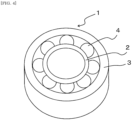
- Fig. 4 is a diagrammatic perspective view showing an example of a bearing using the zirconia bearing ball.
- a bearing ball 4 is held between an inner ring 2 and an outer ring 3 by a not shown holder.
- the bearing is used in a wind turbine generator, aircraft, an automobile, a bicycle, an electric train, a refrigerator, an air conditioner, a cleaner, a copier, a washing machine, an electric massage chair, a camera, an electric screwdriver, a personal computer, an automatic ticket gate, moving walkway, an elevator, a conveyer, and medical apparatuses, such as a computed tomography apparatus (CT), a magnetic resonance imaging apparatus (MRI), and a dental handpiece.
- CT computed tomography apparatus
- MRI magnetic resonance imaging apparatus
- the bearing In an automobile, the bearing is used in, for example, a car wheel, a car suspension, and a steering wheel. In a bicycle, the bearing is used in, for example, a speed variator and a wheel. In an automatic ticket gate, the bearing is used in, for example, a roller part for feeding a ticket or the like. In a dental handpiece, the bearing is used in, for example, a drill conducting high-speed rotation.
- the method for producing a zirconia medium or zirconia bearing ball of the present invention comprises:
- a zirconium raw material and a yttrium raw material are mixed so that the Y 2 O 3 /ZrO 2 molar ratio is in the range of from 2.5/97.5 to 3.2/96.8, and water is added to obtain an aqueous solution, and the aqueous solution is hydrolyzed by heating under reflux at a temperature of 100°C, and then the obtained hydrate of zirconium and yttrium is dehydrated and dried, and calcined at a temperature in the range of from 600°C to 1,200°C to obtain a synthetic powder.
- the calcination temperature may be in the range of from 800°C to 1,000°C.
- the calcination temperature is in the range of from 600°C to 1,200°C, and therefore the composition in the synthetic powder is uniform, and the powder being sintered has an uniform composition, so that a sintered material having uniform strength can be obtained.
- the calcination time is 30 minutes to 2 hours, and may be one hour or less.
- the calcination is preferably conducted in an air atmosphere (oxygen: 20% by volume) under the standard pressure (0.101 MPa).
- a zirconium compound is used as a zirconium raw material.
- zirconium oxychloride, zirconium acetate, zirconium nitrate, zirconium sulfate, or the like can be used.
- the zirconium compound preferably has a purity of 99.9% by mass or more.
- a yttrium compound is used as a yttrium raw material.
- yttrium compound yttrium nitrate, yttrium oxide, or the like can be used.
- the yttrium compound preferably has a purity of 99.9% by mass or more.
- An Al 2 O 3 powder and the synthetic powder are mixed so that the amount of the contained Al 2 O 3 is in the range of from 0.1% to 30.0% by mass, based on the mass of the resultant mixed powder, obtaining a mixed powder.
- the mixed powder contains an Al 2 O 3 powder, and therefore a molded article formed using a powder for molding prepared from the mixed powder is improved in the sintering properties.
- Al 2 O 3 undergoes segregation to the crystal grain boundary of ZrO 2 or is present as Al 2 O 3 crystal grains, and therefore the crystal grain boundary of ZrO 2 is reinforced, so that a sintered material having improved mechanical properties, such as an impact resistance, can be obtained.
- the Al 2 O 3 powder has an aluminum oxide purity of 99.9% by mass or more, and that the average particle diameter for 50% cumulative frequency in the volume-based particle size distribution is in the range of from 0.1 ⁇ m to 0.3 ⁇ m, as measured by a laser diffraction method in accordance with JIS Z8825.
- the amount of impurities in the Al 2 O 3 powder is large, as mentioned above, an impurity phase is likely to be formed in the crystal grain boundary in the obtained sintered material.
- the average particle diameter of the Al 2 O 3 powder is in the range of from 0.1 ⁇ m to 0.3 ⁇ m
- the Al 2 O 3 powder in an amount that satisfies the requirement (q) is uniformly dispersed in the mixed powder containing the synthetic powder and the Al 2 O 3 powder.
- Al 2 O 3 undergoes segregation to the crystal grain boundary of ZrO 2 , or is present as Al 2 O 3 crystal grains, and therefore the crystal grain boundary of ZrO 2 is reinforced, so that the obtained sintered material can be improved in mechanical properties, such as an impact resistance.
- the average particle diameter of the Al 2 O 3 powder is more than 0.3 ⁇ m, the size of Al 2 O 3 crystal grains is extremely large, as compared to the size of ZrO 2 crystal grains, and therefore a sintered material having a uniform structure cannot be obtained. Further, when the average particle diameter of the Al 2 O 3 powder is less than 0.1 ⁇ m, aggregation is likely to occur, making it difficult to achieve uniform dispersion.
- the mixed powder (w) preferably contains a SiO 2 raw material so that the amount of the contained SiO 2 is in the range of from 0.2% to 1.0% by mass, based on the mass of the resultant mixture, and the amount of the contained SiO 2 may be in the range of from 0.3% to 0.9% by mass, and may be in the range of from 0.5% to 0.7% by mass.
- the mixed powder (w) contains a SiO 2 raw material so that the amount of the contained SiO 2 is in the range of from 0.2% to 1.0% by mass, based on the mass of the resultant mixture, erosion of water into the crystal grain boundary of ZrO 2 in the sintered material constituting the medium is suppressed even in the medium which is used in warm water at 40°C or higher, so that the medium can maintain the wear resistance.
- a SiO 2 powder such as fumed silica, or a silica sol, such as ethyl silicate or colloidal silica, can be used as a SiO 2 source.
- the mixed powder is pulverized and/or dispersed so that (r) a powder for molding, which is obtained by drying a mixed powder slurry obtained by wet pulverizing and/or dispersing the mixed powder, has a specific surface area in the range of from 5 m 2 /g to 10 m 2 /g, as measured by a BET method, and that (s) the mixed powder slurry has an average particle diameter in the range of from 0.3 ⁇ m to 0.6 ⁇ m, as measured by a laser diffraction method.
- the obtained mixed powder slurry is subjected to drying and particle size selection so that the aggregate powder particle diameter becomes the value shown below, obtaining a powder for molding.
- the powder for molding in which the specific surface area and average particle diameter are in the above respective ranges, when sintering a molded article obtained by granulation molding of the powder, the inside of the molded article is uniformly sintered, so that a sintered material having uniform strength can be obtained.
- the specific surface area of the mixed powder is more than 10 m 2 /g, or the average particle diameter of the mixed powder is less than 0.3 ⁇ m, the sintering properties upon sintering a molded article obtained by granulation molding of the powder become such excessively large that the inside of the molded article is ununiformly sintered, so that the resultant sintered material has a portion having a low strength.
- the sintered material having a portion having a low strength a stress is likely to be concentrated on the weak portion to cause fracture or chipping, so that the wear resistance and durability become low.
- the specific surface area of the mixed powder is less than 5 m 2 /g, or the average particle diameter of the mixed powder is more than 0.6 ⁇ m, the sintering properties become such low that a defect is likely to remain, and the strength of the resultant sintered material is lowered to cause fracture or chipping, so that the wear resistance and durability become low.
- the mixed powder may be wet pulverized and/or dispersed so that the specific surface area becomes in the range of from 5.2 m 2 /g to 9.5 m 2 /g, as measured by a BET method. Further, the mixed powder may be wet pulverized and/or dispersed so that the average particle diameter becomes in the range of from 0.32 ⁇ m to 0.59 ⁇ m, as measured by a laser diffraction method, and may be wet pulverized and/or dispersed so that the average particle diameter becomes in the range of from 0.35 ⁇ m to 0.50 ⁇ m.
- the mixed powder slurry is subjected to drying and particle size selection so that, with respect to a slurry for measurement of aggregate powder average particle diameter obtained by mixing 1 part by mass of a powder, which is obtained by drying the mixed powder slurry, and 100 parts by mass of a solvent for molding, the aggregate powder average particle diameter for 50% cumulative frequency in the volume-based particle size distribution of the powder in an aggregate form in the slurry, as measured by a laser diffraction method in accordance with JIS Z8825, becomes in the range of from 1 ⁇ m to 5 ⁇ m, preparing the resultant powder for molding.
- the aggregate powder average particle diameter of the powder in an aggregate form may be in the range of from 1.2 ⁇ m to 4.9 ⁇ m, and may be in the range of from 1.5 ⁇ m to 4.0 ⁇ m.
- the present inventors have further found that not only the specific surface area and average particle diameter of the mixed powder but also the state of the powder in an aggregate form, which is obtained by drying the mixed powder slurry, largely affect the moldability and sintering properties.
- the powder for molding is prepared by controlling the conditions for wet pulverization and dispersion and the conditions for addition of a suitable surfactant, drying, and particle size selection so that the aggregate powder average particle diameter of the powder in an aggregate form, which is obtained by drying the mixed powder slurry, is in the range of from 1 ⁇ m to 5 ⁇ m, the powder for molding exhibits excellent wettability upon granulation molding, and granulation molding of the powder can produce a molded article having uniform structure and molded article density.
- the obtained molded article can be uniformly sintered, so that a sintered material having a uniform density can be obtained.
- a surfactant added for wet pulverizing or dispersing the mixed powder sodium polycarboxylate, ammonium polycarboxylate, or the like can be used.
- the surfactant can be optionally used in an amount in the range of from 0.1% to 5% by mass, based on the mass of the mixed powder contained in the mixed powder slurry (100% by mass).
- the obtained molded article is uniformly sintered, making it possible to remove a shrinkage difference due to sintering.
- the "powder in an aggregate form” means a powder in such a state that the secondary particles are further in a weak aggregate form.
- the powder in an aggregate form maintains the aggregate state even in a slurry.
- the powder in an aggregate form 1 part by mass of the powder in an aggregate form and 100 parts by mass of a solvent for molding are mixed in a test tube, and an aggregate powder average particle diameter can be measured.
- 0.1 g of the powder in an aggregate form and 10 g of a solvent for molding are placed in a test tube and mixed by vertically shaking for 3 seconds, and the resultant slurry is taken by means of a dropper and placed in a container for analysis, and the slurry in the container for analysis is irradiated with a laser to measure an aggregate powder average particle diameter of the powder in an aggregate form in the slurry.
- the powder for molding can be used as long as the aggregate powder average particle diameter of the powder in an aggregate form is in the range of from 1.2 ⁇ m to 4.9 ⁇ m.
- the method for producing a zirconia medium or zirconia bearing ball comprises (u) subjecting the obtained powder for molding to granulation molding to obtain a molded article.
- a solvent for molding is added to the powder for molding and subjected to granulation molding, obtaining a molded article.
- the solvents for molding used in the molding include water, an alcohol, a paraffin hydrocarbon, and a mixture thereof.
- water there can be mentioned ion-exchanged water.
- alcohols there can be mentioned alcohols having a linear or branched alkyl group having 1 to 4 carbon atoms.
- the molded article it is preferred that the molded article is obtained by granulation molding so that the medium diameter becomes 0.5 mm or less after being sintered.
- the method for producing a zirconia medium or zirconia bearing ball comprises (v) sintering the obtained molded article at a temperature in the range of from 1,250°C to 1,600°C to obtain a ZrO 2 -Y 2 O 3 zirconia sintered material.
- the sintering temperature is more preferably in the range of from 1,300°C to 1,550°C.
- the sintering temperature is in the range of from 1,250°C to 1,600°C, and therefore uniform sintering can be achieved, so that a sintered material having high strength can be obtained.
- the medium comprising the sintered material obtained by the method for producing a zirconia medium can satisfy the requirements (a) to (h).
- the sintering temperature is lower than 1,250°C, sintering is unsatisfactory, and pores constituting defects remain to lower the strength, so that the resultant sintered material has a low wear resistance.
- the sintering temperature is higher than 1,600°C, it is likely that the crystal grain diameter is considerably increased, and further the amount of the contained cubic crystal system zirconia is increased, and the toughness is reduced, so that the wear resistance becomes low.
- Sintering for the molded article is preferably conducted using a gas oven or the like in an air atmosphere (oxygen: 20% by volume) under the standard pressure (0.101 MPa).
- the surface of the sintered material is polished using a barrel polishing apparatus so that a surface roughness Rz (largest height of the roughness curve for surface roughness), as measured in accordance with JIS B0601:2001, becomes 0.3 ⁇ m or less (Rz ⁇ 0.3 ⁇ m).
- Rz largest height of the roughness curve for surface roughness
- the obtained sintered material can be used as the medium.
- Zirconium oxychloride having a purity of 99.9% by mass (value shown in the catalogue) and yttrium nitrate having a purity of 99.9% by mass (value shown in the catalogue) were mixed into water so that the Y 2 O 3 /ZrO 2 molar ratio, in terms of a mole of the oxide, became the value shown in Table 2, obtaining an aqueous solution. Then, the aqueous solution was hydrolyzed by heating under reflux at 100°C, obtaining a deposit of a zirconium hydrate containing yttrium.
- the zirconium hydrate containing yttrium was dehydrated, and dried at 100°C for 24 hours to obtain a zirconium hydrate containing yttrium. After the zirconium hydrate containing yttrium had reached the calcination temperature shown in Table 1, the zirconium hydrate was subjected to calcination for one hour using a gas oven in an air atmosphere under the standard pressure, obtaining a synthetic powder (the treatment (p) above).
- the obtained synthetic powder was wet dispersed in water, and an Al 2 O 3 powder having a purity of 99.9% by mass (value shown in the catalogue) and, if necessary, fumed silica or silica sol having a purity of 99.9% by mass (value shown in the catalogue) as a SiO 2 source were added so that the respective amounts based on the mass of the resultant mixed powder became the amounts shown in Table 2, obtaining a mixed powder (the treatments (q) and (w) above).
- the obtained mixed powder was wet pulverized and/or dispersed using water as a medium so that a specific surface area of the resultant slurry, as measured by the below -mentioned BET method, became the value shown in Table 1 and an average particle diameter of the slurry, as measured by the below-mentioned laser diffraction method, became the value shown in Table 1, obtaining a mixed powder slurry (the treatments (r) and (s) above).
- the mixed powder slurry was subjected to drying and particle size selection so that, with respect to a slurry for measurement of aggregate powder average particle diameter obtained by mixing 1 part by mass of a powder, which is obtained by drying the mixed powder slurry, and 100 parts by mass of a solvent for molding, the aggregate powder average particle diameter of the powder in an aggregate form in the slurry, as measured by the below-mentioned laser diffraction method, became the value shown in Table 1, obtaining a powder for molding.
- the particle size selection was conducted by classification using a sieve (the treatment (t) above).
- the molded article was sintered for one hour using a gas oven in an air atmosphere under the standard pressure, obtaining sintered materials in the Examples and Comparative Examples.
- the surface of the sintered material was polished using a barrel polishing apparatus so that a surface roughness Rz (largest height of the roughness curve for surface roughness), as measured in accordance with JIS B0601:2001, became 0.3 ⁇ m or less (Rz ⁇ 0.3 ⁇ m), and the polished sintered material was used as a medium for pulverization or dispersion (the treatment (v) above).
- the roughness curve for surface roughness was measured using a laser microscope (manufactured by Keyence Corporation).
- a specific surface area of the mixed powder slurry was measured by a BET method using a specific surface area measurement apparatus (Tristar II, manufactured by Shimadzu Corporation).
- an average particle diameter of the mixed powder for 50% cumulative frequency in the volume-based particle size distribution was measured by a laser diffraction method in accordance with JIS Z8825.
- One part by mass of a powder, which was obtained by drying the mixed powder slurry, and 100 parts by mass of ion-exchanged water as a solvent for molding were mixed to obtain a slurry for measurement of aggregate powder average particle diameter, and, with respect to the powder in an aggregate form in the slurry, using a particle size distribution measurement apparatus (MT3000, manufactured by MicrotracBEL Corp.), an aggregate powder average particle diameter of the powder in an aggregate form for 50% cumulative frequency in the volume-based particle size distribution was measured by a laser diffraction method in accordance with JIS Z8825.
- MT3000 manufactured by MicrotracBEL Corp.
- an image for 200 media was taken using a scanning electron microscope (SEM) (SU3500, manufactured by Hitachi High-Technologies Corporation). With respect to the obtained image, using image analysis soft (Image-Pro Plus, manufactured by Nippon Roper K.K.), the largest diameter of the medium was determined as a medium diameter, and a particle size distribution of the medium diameter of 200 media was prepared. An average and a standard deviation of the medium diameter of 200 media were determined, and a coefficient of variation of medium diameter was determined from the formula (7) above.
- SEM scanning electron microscope
- image analysis soft Image-Pro Plus, manufactured by Nippon Roper K.K.
- the medium comprising a sintered material was placed in a curable embedding resin so as to have an area equal to or larger than the area of a circle having a diameter of 10 mm or more.
- the curable embedding resin epoxy resin
- X-ray source CuK ⁇
- output 40 kV/40 mA
- incident-side divergence slit 1/2°
- incident-side soller slit 4.1°
- receiving-side divergence slit 5.2 mm
- receiving-side soller slit OPEN
- scanning speed 0.5°/minute
- scanning axis 2 ⁇ / ⁇ .
- an apparent density was measured in accordance with the gas replacement described in JIS R1620. Further, the theoretical density of each medium was calculated from the Y 2 O 3 /ZrO 2 molar ratio and Al 2 O 3 amount, and a relative density (%) was determined from the formula (4) above. The theoretical density was calculated, based on the theoretical density (6.1 g/cm 3 ) of ZrO 2 , into which Y 2 O 3 is mixed as solid solution, and the theoretical density (3.98 g/m 3 ) of Al 2 O 3 , from the compositional ratio of ZrO 2 and Al 2 O 3 , into which Y 2 O 3 is mixed as solid solution, in the sintered material.
- the medium was embedded into a curable embedding resin (epoxy resin), and the curable embedding resin was cured.
- the cured resin was ground less than 100 ⁇ m in the direction toward the center from the surface of the medium embedded into the cured embedding resin, and the ground surface was subjected to mirror polishing by the above-mentioned method, followed by thermal etching or chemical etching. Then, the resultant surface was examined by means of a scanning electron microscope (SEM) (SU3500, manufactured by Hitachi High-Technologies Corporation) at a magnification such that 100 or more crystal grains per field of view can be observed, and an average crystal grain diameter was determined by an intercept method.
- SEM scanning electron microscope
- the crushing load ratio A (Pmin (N)/Pave (N)) of the minimum value Pmin (N) of crushing load to the average Pave (N) of crushing load measured at a crosshead speed of 0.5 mm/minute with respect to 50 media was determined from the formula (9) above.
- the crushing load ratio B (Pave 0.1 (N)/Pave (N)) of the average Pave 0.1 (N) of crushing load measured at a crosshead speed of 0.1 mm/minute to the average Pave of crushing load measured at a crosshead speed of 0.5 mm/minute with respect to 50 media was determined from the formula (10) above.
- one medium was embedded into a curable embedding resin (epoxy resin), and the curable embedding resin was cured.
- the cured resin was ground to 40% to 50% of the diameter of the medium and the resultant cross-section was subjected to mirror polishing by the above-mentioned method so that a surface roughness Rz, as measured in accordance with JIS B0601:2001, satisfied the relationship: surface roughness Rz ⁇ 0.05 ⁇ m.
- a microindentation hardness (N/mm 2 ) was measured with respect to 10 sites at regular intervals of the cross-section of the medium in the direction of the diameter of the medium at a load of 50 mN, a load applying speed of 5 mN/second, for a test load retention time of 1 second, and at a load removing speed of 5 mN/second. From an average and a standard deviation of the microindentation hardness measured with respect to 10 media, a coefficient of variation of the ultra-microindentation hardness was determined from the formula (8) above.
- the powders for molding in the Examples and Comparative Examples were individually subjected to cold isostatic press (CIP) molding at 1,000 kgf/cm 2 using Sr.CIP-M, manufactured by Kobe Steel Ltd., and then sintered under the same conditions as those for the medium to prepare a sample for processing.
- the sample for processing was cut by means of a #140 diamond wheel into a size of height: 3 mm ⁇ width: 4 mm ⁇ thickness: 45 mm, preparing a test piece.
- a flexural strength by three-point bending at a span of 30 mm and at a crosshead speed of 0.5 mm/minute was conducted with respect to 10 test piece samples, and an arithmetic mean of the values of the 10 samples was determined as a flexural strength. Further, using the flexural strength, with respect to each of the media in the Examples and Comparative Examples, a Weibull coefficient of flexural strength was determined from the formula (6) above.
- a powder to be treated was subjected to dispersion treatment under the conditions shown below.
- the dispersion treatment was conducted at a temperature such that the temperature of the slurry for first test was 40°C or lower, or higher than 40°C.
- the dispersion treatment was conducted both at a temperature such that the temperature of the slurry for first test was 40°C or lower and at a temperature such that the temperature of the slurry for first test was higher than 40°C.
- Titanium oxide primary particle diameter, as measured from an image of transmission electron microscope (TEM): 35 nm (value shown in the catalogue); specific surface area, as measured by a BET method: 37 m 2 /g (value shown in the catalogue))
- Powder to be treated Calcium carbonate (average particle diameter, as measured by a laser diffraction particle size distribution measurement method: 2.1 ⁇ m (value shown in the catalogue); specific surface area, as measured by a BET method: 10 m 2 /g (value shown in the catalogue))
- the dispersion treatment was conducted and then, the ZrO 2 amount (ppm by mass/hour) contained in the slurry for first test or slurry for second test as a medium abrasive powder was measured from the powder to be treated (titanium oxide powder or calcium carbonate powder) after the dispersion treatment by inductively coupled plasma emission spectrometry (ICP) using an ICP emission spectrometer (ICPS-8100, manufactured by Shimadzu Corporation).
- ICP inductively coupled plasma emission spectrometry
- ICPS-8100 ICP emission spectrometer
- a wear rate (ppm by mass/hour) obtained from the measured ZrO 2 amount in the powder to be treated (calcium carbonate powder) after the dispersion treatment was shown in Table 5.
- the medium corresponding to 10% of the used medium was taken and, using a digital microscope (VHX-6000, manufactured by Keyence Corporation), an image of the medium at a magnification of 200 times was visually observed.
- the results of the observation of an occurrence of fracture of the medium after the dispersion treatment of the powder to be treated were shown Table 4, and the results of the observation of an occurrence of fracture of the medium after the dispersion treatment of the powder to be treated (calcium carbonate powder) were shown in Table 5.
- the media in Examples 1 to 8 satisfied all the above-mentioned requirements (a) to (h), (j), (k), (n), and (o), and satisfied the treatments (p) to (w) for the method for producing the media. Further, the media in Examples 1 to 8 satisfied the above-mentioned requirements (x) and (y), and satisfied the fracture toughness, flexural strength, and Weibull coefficient of flexural strength, which are required by, for example, the material Class III for silicon nitride (Si 3 N 4 ) bearing ball, which is specified by F2094 of ASTM International, or the Grade 3 for silicon nitride (Si 3 N 4 ) material for roller bearing, which is specified by JIS R1669.
- the wear rate when used in the pulverization or dispersion treatment for the slurry for first test containing a powder to be treated and using a medium (water) at a temperature of 40°C or lower, the wear rate was less than 100 ppm by mass/hour, which indicates that the media had excellent wear resistance. Further, with respect to the media in Examples 6 and 7, when used in the pulverization or dispersion treatment for the slurry for first test containing a powder to be treated (titanium oxide powder) having a small primary particle diameter and using a medium (water) at a temperature of higher than 40°C, the wear rate was 101 ppm by mass/hour or less, which indicates that the media had excellent wear resistance even when used in warm water. With respect to the media in Examples 1 to 7, neither fracture nor chipping occurred after the pulverization or dispersion treatment, which indicates that the media had excellent durability.
- Fig. 1 is a photograph of the medium in Example 1 taken by means of a scanning electron microscope (SEM). The medium in Example 1 has a shape close to a sphere, and has excellent wear resistance.
- the Y 2 O 3 /ZrO 2 molar ratio is less than 2.5/97.5, and the amount of the contained tetragonal crystal system zirconia is less than 90% by volume, and thus the requirements (a) and (c) are not satisfied.
- the fracture toughness is 4.2 MPa • m 1/2
- the flexural strength is 770 MPa, and thus part of the requirements (x) and (y) are not satisfied.
- the medium in Comparative Example 1 does not satisfy the treatment (p) for the method for producing the medium.
- the amount of the contained monoclinic crystal system zirconia is as large as 11% by volume, and the mechanical properties are low, and the wear resistance is reduced.
- the crushing load ratio B does not satisfy the requirement (o).
- the amount of the contained Al 2 O 3 is not in the range of from 0.1 to 30.0% by mass, and thus the requirement (b) is not satisfied.
- Al 2 O 3 is not contained, and an improvement of the sintering properties is not achieved, and the relative density is less than 95%, and thus the requirement (d) is not satisfied.
- the mechanical properties are not improved, and thus the minimum value Pmin of crushing load does not satisfy the relationship: Pmin (N) > 600 ⁇ D 2.0 (the requirement (f)).
- the Weibull coefficient of crushing load is less than 10, and thus the requirement (g) is not satisfied.
- the flexural strength is 700 MPa, and thus part of the requirement (y) is not satisfied.
- the medium having a low strength is also present, and therefore a stress is concentrated on the medium having a low strength, and fracture or chipping is likely to occur, so that the wear resistance and durability become low.
- the medium in Comparative Example 3 has a relative density of less than 95%, and does not satisfy the requirement (d), and a large amount of internal defects remained.
- the mechanical properties are not improved, and thus the minimum value Pmin of crushing load does not satisfy the relationship: Pmin (N) > 600 ⁇ D 2.0 (the requirement (f)), so that the wear resistance and durability become low.
- the coefficient of variation of microindentation hardness as measured using an ultra-microindentation hardness tester is as large as more than 5%.
- the fracture toughness is 4.8 MPa • m 1/2
- the flexural strength is 690 MPa, and thus part of the requirements (x) and (y) are not satisfied.
- the wear resistance is further reduced when used in warm water at 40°C in the pulverization or dispersion treatment.
- the media in Comparative Examples 4 and 5 do not satisfy the treatment (r) conducted so that the specific surface area of the mixed powder is in the range of from 5 to 10 m 2 /g. Further, with respect to the media in Comparative Examples 4 and 5, the calcination temperature for obtaining a synthetic powder is not in the range of from 600°C to 1,200°C, and thus the treatment (p) is not satisfied. With respect to the medium in Comparative Example 4, the mixed powder has such a large specific surface area that the powder is finely divided, and hence the sintering properties are non-uniform, and the Weibull coefficient of crushing load is less than 10, and thus the requirement (g) is not satisfied. In the medium having a low strength, a stress is concentrated on the portion having a low strength in the medium, so that the wear resistance and durability become low.
- the coefficient of variation of hardness as measured using an ultra-microindentation hardness tester is as large as more than 5%, and the crushing load ratio A is less than 0.8, and thus the requirements (j) and (n) are not satisfied.
- the specific surface area is small and the sintering properties are such low that a defect remains in the resultant sintered material, and the relative density is less than 95%, and thus the requirement (d) is not satisfied.
- the minimum value Pmin of crushing load does not satisfy the relationship: Pmin (N) > 600 ⁇ D 2.0 (the requirement (f)).
- the flexural strength is 750 MPa, and the Weibull coefficient of flexural strength is 5.6, and thus the requirement (y) is not satisfied.
- the wear resistance is further reduced when used in warm water at higher than 40°C in the pulverization or dispersion treatment.
- the media in Comparative Examples 6 and 7 do not satisfy the treatment (t) conducted so that the powder in an aggregate form obtained by drying the mixed powder slurry has an aggregate powder average particle diameter in the range of from 1 to 5 ⁇ m.
- the average particle diameter of the mixed powder is less than 0.3 ⁇ m, and thus the treatment (s) is not satisfied.
- the amount of the contained SiO 2 is more than 1.0% by mass, and thus the requirement (k) or (w) is not satisfied.
- the aggregate powder average particle diameter is not in the range of from 1 ⁇ m to 5 ⁇ m, and therefore the moldability is low, and the coefficient of variation of medium diameter is 6% or more, and thus the requirement (h) is not satisfied, and the particle size distribution of the medium diameter is not uniform, and a stress is concentrated on the medium having a low strength to cause fracture or chipping, so that the wear resistance and durability become low.
- the minimum value Pmin of crushing load does not satisfy the relationship: Pmin (N) > 600 ⁇ D 2.0 (the requirement (f)), and the Weibull coefficient of crushing load and crushing load ratio A do not satisfy the requirements (g) and (n).
- the flexural strength is 1,080 MPa, and part of the requirement (y) is not satisfied.
- the amount of the contained SiO 2 is more than 1.0% by mass, and the second phase composed of a SiO 2 phase is formed in the crystal grain boundary of ZrO 2 , and the minimum value Pmin of crushing load does not satisfy the relationship: Pmin (N) > 600 ⁇ D 2.0 (the requirement (f)), and the crushing load ratio A and crushing load ratio B do not satisfy the requirements (n) and (o).
- the crushing load ratio A and crushing load ratio B do not satisfy the requirements (n) and (o).
- the Weibull coefficient of flexural strength is 6.2, and thus part of the requirement (y) is not satisfied.
- Fig. 2 is a photomicrograph of the medium in Comparative Example 7 taken by means of a scanning electron microscope (SEM).
- SEM scanning electron microscope
- the Y 2 O 3 /ZrO 2 molar ratio is more than 3.2/96.8, and thus the requirement (a) is not satisfied.
- the amount of the contained cubic crystal system zirconia (C) is as large as 6% by volume, which causes the toughness to become low, and fracture or chipping is likely to occur in the medium having a low strength, so that the wear resistance and durability become low.
- the minimum value Pmin of crushing load does not satisfy the relationship: Pmin (N) > 600 ⁇ D 2.0 (the requirement (f)), and the crushing load ratio A and crushing load ratio B do not satisfy the requirements (n) and (o).
- the flexural strength is 980 MPa, and part of the requirement (y) is not satisfied.
- Fig. 3A is a photograph taken by means of a scanning electron microscope (SEM) of the medium in Comparative Example 8 before used in the pulverization and/or dispersion treatment.
- SEM scanning electron microscope
- Fig. 3B a fragment formed due to fracture of the sintered material was found.
- Fig. 3B is a photomicrograph taken by means of a scanning electron microscope (SEM) of the medium in Comparative Example 8 after used in the pulverization and/or dispersion treatment.
- the sintering temperature is not in the range of from 1,250°C to 1,600°C, and thus the treatment (v) is not satisfied.
- the sintering temperature is higher than 1,600°C, and the crystal grain diameter is considerably increased, and the average crystal grain diameter is more than 0.5 ⁇ m, and thus the requirement (e) is not satisfied.
- the amount of the contained tetragonal crystal system zirconia is less than 90% by volume, and thus the requirement (c) is not satisfied.
- the amount of the contained cubic crystal system zirconia (C) is as large as 11% by volume, which causes the toughness to become low, and fracture or chipping is likely to occur in the medium having a low strength, so that the wear resistance and durability become low.
- the coefficient of variation of ultra-microindentation hardness is as large as more than 5%, and the crushing load ratio B is less than 0.95, and thus the requirements (j) and (o) are not satisfied.
- the flexural strength is 910 MPa, and part of the requirement (y) is not satisfied.
- the sintering temperature is lower than 1,250°C, and the treatment (v) is not satisfied.
- sintering is unsatisfactory, and a defect remains to lower the strength, so that the wear resistance and durability become low.
- the medium in Comparative Example 10 has a relative density of 90% or less and an average crystal grain diameter of less than 0.25 ⁇ m, and the Weibull coefficient of crushing load is less than 10, and thus the requirements (d), (e), and (g) are not satisfied.
- the minimum value Pmin of crushing load does not satisfy the relationship: Pmin (N) > 600 ⁇ D 2.0 (the requirement (f)).
- the medium in Comparative Example 10 has a fracture toughness of 4.9 MPa • m 1/2 and a flexural strength of 720 MPa, and does not satisfy part of the requirements (x) and (y).
- the minimum value Pmin of crushing load does not satisfy the relationship: Pmin (N) > 600 ⁇ D 2.0 (the requirement (f)).
- the crushing load ratio A and crushing load ratio B do not satisfy the requirements (n) and (o).
- the amount of the contained SiO 2 is more than 1.0% by mass, and thus the requirement (k) is not satisfied.
- the medium in Comparative Example 11 has a fracture toughness of 4.8 MPa • m 1/2 and a flexural strength of 1,030 MPa, and does not satisfy part of the requirements (x) and (y).
- the amount of the contained SiO 2 is more than 1.0% by mass, and therefore the second phase composed of a SiO 2 phase is formed in the crystal grain boundary of ZrO 2 , and fracture or chipping occurs, so that the wear resistance and durability become low.
- the wear resistance is further reduced when used in warm water at higher than 40°C in the pulverization or dispersion treatment.
- the specific surface area of the mixed powder is more than 10 m 2 /g, and thus the treatment (r) is not satisfied.
- the sintering properties are such high that the structure is not uniformly sintered, and the coefficient of variation of ultra-microindentation hardness is more than 5%, and thus the requirement (j) is not satisfied.
- the crushing load ratio A does not satisfy the requirement (n).
- the Weibull coefficient of crushing load does not satisfy the requirement (g).
- the Weibull coefficient of flexural strength is 5.8, and thus part of the requirement (y) is not satisfied.
- the strength of the medium is not uniform, and therefore a stress is concentrated on the medium having a low strength, so that the wear resistance becomes low.
- the zirconia medium of the present disclosure has such excellent wear resistance and durability that an occurrence of fracture or chipping can be suppressed even when the medium is used in a bead mill conducting high-speed rotation in which a high load is applied to the medium, making it possible to maintain high purity of the powder to be treated.
- the zirconia medium of the present disclosure has reduced variation of the sintering properties and has high mechanical properties, and therefore can be advantageously used not only as a powder for use in a material for electronic parts, but also as a medium for pulverization or dispersion treatment of a powder for pharmaceutical use, which is required to maintain high purity.
- the zirconia medium has high mechanical properties and has suppressed variation of the shape of the medium, and satisfies the fracture toughness, flexural strength, and Weibull coefficient of flexural strength, which are required by, for example, the material Class III for silicon nitride (Si 3 N 4 ) bearing ball, which is specified by F2094 of ASTM International, or the Grade 3 for silicon nitride (Si 3 N 4 ) material for roller bearing, which is specified by JIS R1669, and therefore can be advantageously used as a bearing ball.
- the material Class III for silicon nitride (Si 3 N 4 ) bearing ball which is specified by F2094 of ASTM International
- the Grade 3 for silicon nitride (Si 3 N 4 ) material for roller bearing which is specified by JIS R1669
- a bearing having the zirconia bearing ball can be used in a wind turbine generator, aircraft, an automobile, a bicycle, an electric train, a refrigerator, an air conditioner, a cleaner, a copier, a washing machine, an electric massage chair, a camera, an electric screwdriver, a personal computer, an automatic ticket gate, moving walkway, an elevator, a conveyer, and medical apparatuses, such as a computed tomography apparatus (CT), a magnetic resonance imaging apparatus (MRI), and a dental handpiece.
- CT computed tomography apparatus
- MRI magnetic resonance imaging apparatus
Landscapes
- Chemical & Material Sciences (AREA)
- Engineering & Computer Science (AREA)
- Ceramic Engineering (AREA)
- Manufacturing & Machinery (AREA)
- Materials Engineering (AREA)
- Organic Chemistry (AREA)
- Structural Engineering (AREA)
- Composite Materials (AREA)
- General Engineering & Computer Science (AREA)
- Inorganic Chemistry (AREA)
- Mechanical Engineering (AREA)
- Physics & Mathematics (AREA)
- Thermal Sciences (AREA)
- Compositions Of Oxide Ceramics (AREA)
- Crushing And Grinding (AREA)
Applications Claiming Priority (2)
| Application Number | Priority Date | Filing Date | Title |
|---|---|---|---|
| JP2022071299 | 2022-04-25 | ||
| PCT/JP2023/013825 WO2023210268A1 (ja) | 2022-04-25 | 2023-04-03 | ジルコニア質メディア、ベアリングボール及びそれらの製造方法 |
Publications (2)
| Publication Number | Publication Date |
|---|---|
| EP4516404A1 true EP4516404A1 (de) | 2025-03-05 |
| EP4516404A4 EP4516404A4 (de) | 2026-04-29 |
Family
ID=88518737
Family Applications (1)
| Application Number | Title | Priority Date | Filing Date |
|---|---|---|---|
| EP23796015.8A Pending EP4516404A4 (de) | 2022-04-25 | 2023-04-03 | Zirconiumdioxidmedium, lagerkugel und herstellungsverfahren dafür |
Country Status (5)
| Country | Link |
|---|---|
| US (1) | US20250207634A1 (de) |
| EP (1) | EP4516404A4 (de) |
| JP (3) | JP7648848B2 (de) |
| CN (1) | CN119013101A (de) |
| WO (1) | WO2023210268A1 (de) |
Families Citing this family (1)
| Publication number | Priority date | Publication date | Assignee | Title |
|---|---|---|---|---|
| EP4516404A4 (de) * | 2022-04-25 | 2026-04-29 | Nikkato Corp | Zirconiumdioxidmedium, lagerkugel und herstellungsverfahren dafür |
Family Cites Families (21)
| Publication number | Priority date | Publication date | Assignee | Title |
|---|---|---|---|---|
| JP2587767B2 (ja) * | 1992-04-23 | 1997-03-05 | 株式会社ニッカトー | 粉砕機用部材 |
| JP3265518B2 (ja) * | 1992-12-16 | 2002-03-11 | 東ソー株式会社 | ジルコニアボールおよびその製造方法 |
| JP3736649B2 (ja) * | 1996-01-12 | 2006-01-18 | 品川白煉瓦株式会社 | ジルコニア質焼結体及びその製造方法並びに粉砕用部品材料 |
| JP4104698B2 (ja) * | 1996-06-07 | 2008-06-18 | 東レ株式会社 | 粉砕機、粉砕機用部材、粉砕用媒体、複合セラミックス焼結体および粉砕方法 |
| JPH1135323A (ja) * | 1997-07-15 | 1999-02-09 | Nippon Shokubai Co Ltd | ジルコニア系粉体およびジルコニア系成形体 |
| JP3970462B2 (ja) * | 1999-02-19 | 2007-09-05 | 株式会社ニッカトー | 耐久性にすぐれたジルコニア質焼結体からなる粉砕・分散用メディア及びその製造方法 |
| JP3766773B2 (ja) * | 1999-12-07 | 2006-04-19 | 株式会社日本触媒 | ジルコニア系セラミックスおよびその製法 |
| JP4597320B2 (ja) * | 2000-06-28 | 2010-12-15 | 株式会社村田製作所 | 粉砕・分散・混合用メディアおよびその製造方法 |
| JP2003314556A (ja) | 2002-04-16 | 2003-11-06 | Nitsukatoo:Kk | ジルコニア質焼結体からなるベアリング |
| WO2003033433A1 (en) * | 2001-10-18 | 2003-04-24 | Nikkato Corporation | Zirconia based sintered product excellent in durability and abrasion-resistant member using the same |
| JP2004061945A (ja) * | 2002-07-30 | 2004-02-26 | Fuji Photo Film Co Ltd | 画像記録材料 |
| JP4396123B2 (ja) | 2003-04-11 | 2010-01-13 | 東レ株式会社 | 部分安定化ZrO2球体およびその製造方法 |
| JP4410044B2 (ja) | 2004-07-02 | 2010-02-03 | 株式会社ニッカトー | 耐摩耗性及び耐久性に優れたジルコニア質焼結体及びその製造方法 |
| JP2013148127A (ja) | 2012-01-17 | 2013-08-01 | Nsk Ltd | セラミックス製転動体の製造方法及び転がり支持装置 |
| JP2014092259A (ja) * | 2012-11-06 | 2014-05-19 | Nsk Ltd | 転がり支持装置及びその製造方法 |
| JP6134561B2 (ja) * | 2013-04-11 | 2017-05-24 | 株式会社ニッカトー | ジルコニア質焼結体、ジルコニア質焼結体からなる粉砕・分散用メディア |
| CN104101550A (zh) * | 2014-07-22 | 2014-10-15 | 中国人民解放军装甲兵工程学院 | 基于仪器化Berkovich压入O-P硬度确定材料维氏硬度的方法 |
| JP6632287B2 (ja) * | 2015-09-18 | 2020-01-22 | 株式会社ニッカトー | ジルコニア質微小メディア |
| FR3069243B1 (fr) | 2017-07-20 | 2023-11-03 | Saint Gobain Ct Recherches | Billes frittees de zircon |
| TWI839716B (zh) * | 2021-05-18 | 2024-04-21 | 法信諾生醫股份有限公司 | 抗病毒感染之胜肽疫苗 |
| EP4516404A4 (de) * | 2022-04-25 | 2026-04-29 | Nikkato Corp | Zirconiumdioxidmedium, lagerkugel und herstellungsverfahren dafür |
-
2023
- 2023-04-03 EP EP23796015.8A patent/EP4516404A4/de active Pending
- 2023-04-03 US US18/848,366 patent/US20250207634A1/en active Pending
- 2023-04-03 JP JP2024517927A patent/JP7648848B2/ja active Active
- 2023-04-03 CN CN202380033115.8A patent/CN119013101A/zh active Pending
- 2023-04-03 WO PCT/JP2023/013825 patent/WO2023210268A1/ja not_active Ceased
-
2025
- 2025-03-04 JP JP2025033436A patent/JP7839918B2/ja active Active
-
2026
- 2026-01-21 JP JP2026007898A patent/JP2026069521A/ja active Pending
Also Published As
| Publication number | Publication date |
|---|---|
| JP2026069521A (ja) | 2026-04-23 |
| JPWO2023210268A1 (de) | 2023-11-02 |
| CN119013101A (zh) | 2024-11-22 |
| WO2023210268A1 (ja) | 2023-11-02 |
| JP7839918B2 (ja) | 2026-04-02 |
| JP7648848B2 (ja) | 2025-03-18 |
| JP2025083366A (ja) | 2025-05-30 |
| EP4516404A4 (de) | 2026-04-29 |
| US20250207634A1 (en) | 2025-06-26 |
Similar Documents
| Publication | Publication Date | Title |
|---|---|---|
| AU679489B2 (en) | Alpha-alumina powder and process for producing the same | |
| US6066584A (en) | Sintered Al2 O3 material, process for its production and use of the material | |
| EP2520555A1 (de) | Verfahren zur herstellung eines keramikmaterials aus zirkonkorund-verbund, granulatpulver aus zirkonkorund-verbund und zirkonkügelchen | |
| EP3960721A1 (de) | Sinterkörper, pulver und verfahren zur herstellung davon | |
| JPH09221354A (ja) | 耐摩耗性アルミナ質セラミックス及びその製造方法 | |
| EP3831798A1 (de) | Schwarzer sinterkörper und verfahren zur herstellung davon | |
| EP4039648B1 (de) | Zirkoniumoxidpulver, zirkoniumoxidsinterkörper und verfahren zur herstellung zirkoniumoxidsinterkörper | |
| EP4470991A1 (de) | Pulver und herstellungsverfahren dafür | |
| EP4488232A1 (de) | Sinterkörper, verfahren zur herstellung eines sinterkörpers, pulver und vorgesinterter körper | |
| JP7845566B2 (ja) | 仮焼体、及び焼結体の製造方法 | |
| JP2026069521A (ja) | ジルコニア質メディア及びそれらの製造方法 | |
| EP4596499A1 (de) | Keramische kugelkörper und verfahren zur herstellung keramischer kugelkörper | |
| JP4927292B2 (ja) | 優れた耐摩耗性および耐食性を有するアルミナ質セラミックス | |
| US20250049547A1 (en) | Dental ceramic oxide pre-sintered body having excellent machinability and production method for same | |
| JP2004137128A (ja) | 部分安定化ジルコニア焼結体 | |
| JP7670222B2 (ja) | チタン及びイットリウム固溶ジルコニア焼結体 | |
| EP4431080A1 (de) | Kalzinierter dentaler keramikoxidkörper mit hervorragender bearbeitbarkeit und herstellungsverfahren dafür | |
| EP4438025A1 (de) | Oxidkeramischer teilgesinterter körper für dentale zwecke mit günstigen poliereigenschaften und verfahren zu seiner herstellung | |
| US20120318132A1 (en) | Ceramic Composite Materials and Their Production | |
| JP2025088309A (ja) | 窒化ケイ素質メディア及びその製造方法 | |
| JP2008094688A (ja) | ジルコニア質導電性焼結体 | |
| EP4628450A1 (de) | Pulver | |
| Nomoev¹ et al. | Ceramic Preparation of Nanopowders and Experimental Investigation of Its Properties |
Legal Events
| Date | Code | Title | Description |
|---|---|---|---|
| STAA | Information on the status of an ep patent application or granted ep patent |
Free format text: STATUS: THE INTERNATIONAL PUBLICATION HAS BEEN MADE |
|
| PUAI | Public reference made under article 153(3) epc to a published international application that has entered the european phase |
Free format text: ORIGINAL CODE: 0009012 |
|
| STAA | Information on the status of an ep patent application or granted ep patent |
Free format text: STATUS: REQUEST FOR EXAMINATION WAS MADE |
|
| 17P | Request for examination filed |
Effective date: 20241125 |
|
| AK | Designated contracting states |
Kind code of ref document: A1 Designated state(s): AL AT BE BG CH CY CZ DE DK EE ES FI FR GB GR HR HU IE IS IT LI LT LU LV MC ME MK MT NL NO PL PT RO RS SE SI SK SM TR |
|
| DAV | Request for validation of the european patent (deleted) | ||
| DAX | Request for extension of the european patent (deleted) | ||
| A4 | Supplementary search report drawn up and despatched |
Effective date: 20260401 |
|
| RIC1 | Information provided on ipc code assigned before grant |
Ipc: B02C 17/20 20060101AFI20260326BHEP Ipc: C04B 35/488 20060101ALI20260326BHEP Ipc: C04B 35/626 20060101ALI20260326BHEP Ipc: C04B 35/486 20060101ALI20260326BHEP Ipc: C09K 3/14 20060101ALI20260326BHEP Ipc: F16C 33/32 20060101ALI20260326BHEP |