EP4502580A2 - System und verfahren zur inspektion eines transparenten zylinders - Google Patents
System und verfahren zur inspektion eines transparenten zylinders Download PDFInfo
- Publication number
- EP4502580A2 EP4502580A2 EP24221889.9A EP24221889A EP4502580A2 EP 4502580 A2 EP4502580 A2 EP 4502580A2 EP 24221889 A EP24221889 A EP 24221889A EP 4502580 A2 EP4502580 A2 EP 4502580A2
- Authority
- EP
- European Patent Office
- Prior art keywords
- transparent cylinder
- mask
- light source
- inspection system
- transparent
- Prior art date
- Legal status (The legal status is an assumption and is not a legal conclusion. Google has not performed a legal analysis and makes no representation as to the accuracy of the status listed.)
- Pending
Links
Images



Classifications
-
- G—PHYSICS
- G01—MEASURING; TESTING
- G01N—INVESTIGATING OR ANALYSING MATERIALS BY DETERMINING THEIR CHEMICAL OR PHYSICAL PROPERTIES
- G01N21/00—Investigating or analysing materials by the use of optical means, i.e. using sub-millimetre waves, infrared, visible or ultraviolet light
- G01N21/84—Systems specially adapted for particular applications
- G01N21/88—Investigating the presence of flaws or contamination
- G01N21/95—Investigating the presence of flaws or contamination characterised by the material or shape of the object to be examined
- G01N21/958—Inspecting transparent materials or objects, e.g. windscreens
-
- G—PHYSICS
- G01—MEASURING; TESTING
- G01N—INVESTIGATING OR ANALYSING MATERIALS BY DETERMINING THEIR CHEMICAL OR PHYSICAL PROPERTIES
- G01N21/00—Investigating or analysing materials by the use of optical means, i.e. using sub-millimetre waves, infrared, visible or ultraviolet light
- G01N21/84—Systems specially adapted for particular applications
- G01N21/88—Investigating the presence of flaws or contamination
- G01N21/90—Investigating the presence of flaws or contamination in a container or its contents
- G01N21/9018—Dirt detection in containers
-
- G—PHYSICS
- G01—MEASURING; TESTING
- G01N—INVESTIGATING OR ANALYSING MATERIALS BY DETERMINING THEIR CHEMICAL OR PHYSICAL PROPERTIES
- G01N21/00—Investigating or analysing materials by the use of optical means, i.e. using sub-millimetre waves, infrared, visible or ultraviolet light
- G01N21/84—Systems specially adapted for particular applications
- G01N21/88—Investigating the presence of flaws or contamination
- G01N21/90—Investigating the presence of flaws or contamination in a container or its contents
- G01N21/9018—Dirt detection in containers
- G01N21/9027—Dirt detection in containers in containers after filling
-
- G—PHYSICS
- G01—MEASURING; TESTING
- G01N—INVESTIGATING OR ANALYSING MATERIALS BY DETERMINING THEIR CHEMICAL OR PHYSICAL PROPERTIES
- G01N21/00—Investigating or analysing materials by the use of optical means, i.e. using sub-millimetre waves, infrared, visible or ultraviolet light
- G01N21/84—Systems specially adapted for particular applications
- G01N21/88—Investigating the presence of flaws or contamination
- G01N21/90—Investigating the presence of flaws or contamination in a container or its contents
- G01N21/9036—Investigating the presence of flaws or contamination in a container or its contents using arrays of emitters or receivers
-
- G—PHYSICS
- G01—MEASURING; TESTING
- G01N—INVESTIGATING OR ANALYSING MATERIALS BY DETERMINING THEIR CHEMICAL OR PHYSICAL PROPERTIES
- G01N21/00—Investigating or analysing materials by the use of optical means, i.e. using sub-millimetre waves, infrared, visible or ultraviolet light
- G01N21/84—Systems specially adapted for particular applications
- G01N21/88—Investigating the presence of flaws or contamination
- G01N21/8806—Specially adapted optical and illumination features
- G01N2021/8822—Dark field detection
Definitions
- the invention relates to an inspection system for a transparent cylinder, such as a cylinder made of transparent material and having a longitudinal axis and a diameter.
- the inspection system is adapted to detect particles or defects inside transparent cylinders.
- the invention further relates to a method for detection of particles and defects inside transparent cylinder.
- Transparent cylinders are widespread in various fields such as laboratory glassware in the form of beaker or metering cylinder, food container in the form of tub or bottle or medical glassware in the form of vial, cartridge or syringe. Whatever the field considered, these different containers require a high degree of quality and cleanliness, especially in the medical field where quality and/or cleanliness issues may have a direct impact on the safety of patients and medical staff.
- transparent cylinders made of glass or plastic, are produced by complex manufacturing processes that may result in the formation of particles or defects in the material itself or on its surface. A careful inspection step of such transparent cylinders is thus required before delivery to the customer.
- Such an inspection step is usually made automatically by cameras using a back end light positioned behind the transparent cylinder.
- this kind of inspection does not allow the detection of small-size cosmetic defects and/or glass particles.
- such an inspection system is not specific as it cannot differentiate the different types of observed defects.
- a goal of the present invention is to propose an improved inspection system able to detect small-sized glass particles and defects. Another goal of the present invention is to provide an inspection system able to discriminate the different types of defects.
- An object of the present invention is a portable inspection system for detecting a particle in a transparent cylinder, the transparent cylinder having a longitudinal axis and a diameter, the inspection system being configured to be held by an operator and comprising:
- substantially aligned means that the light source, the mask and the acquisition means are aligned on the inspection axis, although a small deviation is acceptable.
- the specific set-up of the inspection system according to the present invention can be easily realized by a skilled person in the art by checking the image acquired by the acquisition means.
- All kind of transparent cylinders can be inspected with the inspection system of the present invention, such as laboratory glassware, food containers or medical glass wares.
- Examples of such cylinders are beakers, metering cylinders, bottles, jars, medical vial, cartridges or syringes. Any other cylinders may be inspected as long as they are made of a transparent material. Thanks to the partial illumination of the transparent cylinder, any particle inside the non-illuminated part of the transparent cylinder is illuminated by an indirect light refracted by the illuminated portion of the transparent cylinder and is clearly visible in front of the mask acting as a dark background. Such illuminated particles may be easily detected by the acquisition means such as a human eye or a video camera.
- the mask may be arrange such that the width of the non-illuminated portion of the transparent cylinder may range from 20 to 80% of the diameter of the transparent cylinder, . or is equal to 50% of the diameter of the transparent cylinder. In some configurations, the mask is arranged such that the non-illuminated portion of the transparent cylinder is a central portion of the transparent cylinder.
- This configuration of the inspection system is especially adapted to detect glass particles at the surface of the transparent cylinder or inside the transparent cylinder itself.
- the mask is arranged such that the non-illuminated portion of the transparent cylinder extends on a side of the transparent cylinder.
- particles may be detected or both particles and scratches during a single inspection step.
- Such an inspection system is thus able to differentiate a particle from a scratch which allows an accurate inspection of transparent cylinders.
- the mask is opaque to the light emitted by the light source and preferably black-colored. This allows for an optimized contrast to detect easily particles above 300 ⁇ m.
- the light source is preferably able to generate a white light. LEDs, halogen bulbs or neon tube may be used.
- the inspection system may further comprise a switch button provided on the portable inspection device for controlling illumination of the light source.
- the light source may be battery powered.
- Another object of the present invention is a method to inspect a transparent cylinder having a longitudinal axis and a diameter for detecting a particle, comprising:
- the method to inspect a transparent cylinder further comprises a rotation of the transparent cylinder around its longitudinal axis with regard to the mask and the light source.
- the method to inspect a transparent cylinder further comprises a rotation of the mask and the light source around the longitudinal axis of the transparent cylinder.
- FIG. 1 shows a syringe 10 as an example of a transparent cylinder that can be inspected by a system according to the present invention.
- transparent cylinders include cartridges, vials as well as bottles and glassware such as glasses, beakers or metering cylinders (not shown).
- the syringe 10 of Figure 1 includes a cylindrical transparent barrel 11 having a diameter D, a longitudinal axis A and defining a tubular chamber 12 with two extremities.
- One of the extremities of the syringe 10 corresponds to a tip 13 used for the injection of medical products and that may be provided with a staked needle or an adaptor for connecting an intravenous line or any other types of connectors.
- the other extremity of the cylindrical transparent barrel 11 corresponds to a flange 14 used for gripping the syringe 10.
- the syringe 10 may be made from any transparent material such as glass or plastic, for example polyethylene, polypropylene, polycarbonate or cyclic polyolefin and any combination thereof.
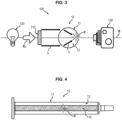
- a schematic inspection system 100 comprises a black mask 110, a light source 120 and acquisition means 130.
- the mask 110, the light source 120 and the acquisition means 130 are aligned on an axis B, hereinafter called inspection axis.
- the syringe 10 is placed between the mask 110 and the acquisition means 130 so that its longitudinal axis A is perpendicular to the axis B.
- the acquisition means 130 may be any acquisition means capable of obtaining an image of the cylinder, for example the eye of an operator or a video camera.
- the operational principle of the inspection system 100 is described with reference to Figure 3 .
- the light source 120, the mask 110, the transparent cylinder under inspection, for example a syringe 10, and the acquisition means 130 are aligned on the inspection axis B, the syringe 10 being placed between the mask 110 and the acquisition means 130.
- the syringe may be supported by a holder (not shown) or handheld by an operator.
- the light source 120 is switched on, a portion of the emitted light EL is blocked by the mask 110 and only the peripheral light L passing around the mask 110 thus reaches the syringe barrel 11. Because of the cylindrical shape of the syringe barrel 11, the light is refracted to illuminate particles and for instance, a particle P.
- the illuminated particle P is easily detectable on an image acquired by the acquisition means 130, thanks to the black mask that acts as a black background.
- a rotation of the syringe 10 around its longitudinal axis A or a rotation of the light source, the mask and the acquisition means around the longitudinal axis A of the syringe 10 is preferable in order to inspect the whole circumference of the syringe 10.
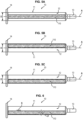
- the width and the positioning of the mask 110 with regard to the light source 120 and the syringe 10 must be chosen in order to block the illumination of 20 to 80 % of the diameter of the syringe 10. Preferably, 30 to 70 % of the diameter of the syringe 10 are not illuminated, more preferably 50 %, as shown in Figure 4 .
- the dimensions and the positioning of the mask 110 with regard to the light source 120 and the syringe 10 may thus be selected for each specific inspection device according to the size of the transparent cylinders to be inspected. In the same way, the arrangement of the mask 110, the transparent cylinder 10, the light source 120 and the acquisition means 130 into the inspection system 100 may be optimized to obtain an acquired image as the one shown in Figure 4 .
- the mask 110 is preferentially a plain plate, and as such, configured to block incoming light over the entirety of its exposed surface that receives light from the light source.
- Figures 5A-5C show different positioning of the mask 110 with respect to the syringe 10, as viewed by the acquisition means 130.
- the mask is centered relative to the longitudinal axis A of the syringe 10. This prevents illumination of a central portion of the syringe and this specific configuration is optimal for the detection of glass particles, which are particularly visible in the middle of the transparent barrel 11.
- the mask 110 is decentered radially relative to the longitudinal axis A of the syringe 10 and only covers half of the diameter D, above or below the longitudinal axis A. This position prevents illumination on a half of the diameter D of the longitudinal barrel 11 and allows the detection of both scratches and particles as it will be explained below.
- the mask 110 has the same length as the barrel 11, which allows inspection of the whole barrel length. However, specific applications may require a mask covering only a partial length of the syringe 10.
- the mask 110 is preferably positioned parallel to the syringe axis A, although a small deviation may be acceptable.
- the mask 110 is preferably opaque to the light emitted by the light source and black-colored in order to provide the greatest possible contrast with particles P. It may be made from any suitable materials such as metal, plastic, paper or cardboard.
- the syringe 10 is illuminated on only a limited portion of its diameter D, the mask 110 both blocking part of the light from the light source 120 and acting as a dark background for the detection of illuminated particles.
- the inspection system 100 therefore provides a simple and reliable way to detect small size particles, for example particles above 300 ⁇ m.
- the configurations of the inspection system as shown in Figures 5B and 5C also allow the detection of scratches. Indeed, if the particles remain visible by contrast with the mask 110, the scratches are easily visible under direct illumination, in the portion where the light is not masked by the mask 110. This case is illustrated in Figure 6 where the acquisition means 130 are able to detect simultaneously both a scratch S in the "white” illuminated region and a particle P in the "black” non-illuminated region.
- the light source 120 may be any light source producing a homogeneous light.
- the light is a white color light that may be obtained for example with LEDs, halogen bulbs or neon tubes.
- the acquired pictures may be processed with commercially available software designed to identify particles and scratches. Such software may also measure the size of the detected defects and help to reject cylindrical containers having unacceptable defects with respect to the targeted quality level.
- a portable inspection system 200 comprises a light source 220 and an integrated mask 210.
- the inspection system 200 is further provided with a switch button 201 and integrated batteries (not shown).
- this portable inspection system 200 may be used manually by an operator for random manual inspections on a manufacturing line.
- a syringe 10 may be positioned by the operator at the right distance from the inspection device 200 in order to obtain an image as the ones shown in Figures 4 or 6 .
- the syringe 10 may also be rotated appropriately by the operator to inspect the whole barrel circumference.
- an inspection system 300 is set up to inspect syringes 10 on an in-line manufacturing process.
- Syringes 10 are carried on a transportation system 30 comprising holders such as plugs 31 able to maintain the syringes in a vertical positioning.
- the inspection system 300 comprises a rotatable axis 301 and a horizontal frame 302.
- the mask 310, the light source 320 and the acquisition means 330 are held by the horizontal frame 302 and aligned on the inspection axis B.
- the light source 320 When a syringe 10 is presented to the inspection system 300, the light source 320 is switched on and the rotatable axis 301 is motorized by an electric motor (not shown) in order to rotate the mask 310, the light source 320 and the acquisition means 330 around the longitudinal axis of the syringe 10.
- a set of pictures is acquired by the acquisition means 330 to inspect the whole circumference of the syringe barrel 11 in a very short period of time without removing the inspected syringe from the in-line manufacturing process.
- the optimal rotating speed depends on the size of the syringe itself, the size of the defects to be detected as well as the quality and the parameters of the acquisition means.
- 60 images with a 13 MPx camera may be captured in 10 to 20 seconds.
- a casing (not shown) may be provided around the inspection system 300, to prevent or limit light coming from other sources that may reduce the efficiency of the light source 320, the casing thus enhancing the contrast and the detection quality of the inspection device 300.
- an inspection system 400 is set-up for the automated inspection of a syringe 10.
- This inspection system 400 is provided with a frame 401 supporting a mask 410, a light source 420 and acquisition means 430.
- the syringe 10 is accommodated on a rotary holder 402 comprising two axes (not shown) provided with three wheels (only two are visible in Figure 9 , the third wheel being hidden by one the two visible wheels). At least one of the two axes is coupled to an electric motor (not shown) in order to maintain the syringe 10 in rotation, the second axis being either motorized or free to rotate.
- This rotary holder 402 allows the full rotation of the syringe 10 in order to inspect the whole circumference of the syringe barrel 11.
- the inspection 430 means may be either a video camera similar to the inspection means 330 or a magnifying glass for a direct visual inspection.
- the inspection system 400 according to this embodiment is especially adapted for an in-depth inspection of high quality syringes or transparent cylinders before their delivery to customers that will proceed to filling with medical products.
Landscapes
- Physics & Mathematics (AREA)
- Health & Medical Sciences (AREA)
- Life Sciences & Earth Sciences (AREA)
- Chemical & Material Sciences (AREA)
- Analytical Chemistry (AREA)
- Biochemistry (AREA)
- General Health & Medical Sciences (AREA)
- General Physics & Mathematics (AREA)
- Immunology (AREA)
- Pathology (AREA)
- Investigating Materials By The Use Of Optical Means Adapted For Particular Applications (AREA)
- Length Measuring Devices By Optical Means (AREA)
Applications Claiming Priority (3)
| Application Number | Priority Date | Filing Date | Title |
|---|---|---|---|
| EP16305214 | 2016-02-24 | ||
| EP17707522.3A EP3420346B1 (de) | 2016-02-24 | 2017-02-24 | System und verfahren zur inspektion eines transparenten zylinders |
| PCT/EP2017/054269 WO2017144634A1 (en) | 2016-02-24 | 2017-02-24 | System and method for inspecting a transparent cylinder |
Related Parent Applications (2)
| Application Number | Title | Priority Date | Filing Date |
|---|---|---|---|
| EP17707522.3A Division-Into EP3420346B1 (de) | 2016-02-24 | 2017-02-24 | System und verfahren zur inspektion eines transparenten zylinders |
| EP17707522.3A Division EP3420346B1 (de) | 2016-02-24 | 2017-02-24 | System und verfahren zur inspektion eines transparenten zylinders |
Publications (2)
| Publication Number | Publication Date |
|---|---|
| EP4502580A2 true EP4502580A2 (de) | 2025-02-05 |
| EP4502580A3 EP4502580A3 (de) | 2025-04-30 |
Family
ID=55443212
Family Applications (2)
| Application Number | Title | Priority Date | Filing Date |
|---|---|---|---|
| EP17707522.3A Active EP3420346B1 (de) | 2016-02-24 | 2017-02-24 | System und verfahren zur inspektion eines transparenten zylinders |
| EP24221889.9A Pending EP4502580A3 (de) | 2016-02-24 | 2017-02-24 | System und verfahren zur inspektion eines transparenten zylinders |
Family Applications Before (1)
| Application Number | Title | Priority Date | Filing Date |
|---|---|---|---|
| EP17707522.3A Active EP3420346B1 (de) | 2016-02-24 | 2017-02-24 | System und verfahren zur inspektion eines transparenten zylinders |
Country Status (7)
| Country | Link |
|---|---|
| US (2) | US10663409B2 (de) |
| EP (2) | EP3420346B1 (de) |
| JP (1) | JP7046819B2 (de) |
| CN (3) | CN206583820U (de) |
| ES (1) | ES3017687T3 (de) |
| MX (2) | MX385958B (de) |
| WO (1) | WO2017144634A1 (de) |
Families Citing this family (7)
| Publication number | Priority date | Publication date | Assignee | Title |
|---|---|---|---|---|
| JP7046819B2 (ja) * | 2016-02-24 | 2022-04-04 | ベクトン ディキンソン フランス | 透明シリンダを検査するためのシステムおよび方法 |
| FR3101947B1 (fr) * | 2019-10-15 | 2023-11-24 | Cie Plastic Omnium Se | Dispositif et procédé pour l’évaluation de la qualité d’un revêtement |
| EP3916379B1 (de) * | 2020-05-29 | 2025-04-09 | Becton Dickinson France | Verfahren zur inspektion eines medizinischen behälters und dafür verwendetes system |
| WO2022174131A1 (en) * | 2021-02-15 | 2022-08-18 | Amgen Inc. | Systems and methods for automated in-line plunger depth measurement |
| IL319423A (en) * | 2022-09-09 | 2025-05-01 | Hoffmann La Roche | System and method for testing a closed medical container |
| IT202200026136A1 (it) * | 2022-12-20 | 2024-06-20 | Gd Spa | Sistema di ispezione di un articolo |
| TWI903669B (zh) * | 2024-08-05 | 2025-11-01 | 可成應材科技有限公司 | 粉塵檢查裝置 |
Family Cites Families (51)
| Publication number | Priority date | Publication date | Assignee | Title |
|---|---|---|---|---|
| US3880501A (en) * | 1973-04-16 | 1975-04-29 | Tropel | Optical system for objective refractor for the eye |
| JPS5927859B2 (ja) * | 1978-07-26 | 1984-07-09 | 石塚硝子株式会社 | ガラスビン胴部の欠陥検査装置 |
| JPH0612344B2 (ja) | 1982-08-31 | 1994-02-16 | サントリー株式会社 | 瓶類のスカッフ程度検査装置 |
| US4609991A (en) * | 1983-07-19 | 1986-09-02 | The United States Of America As Represented By The Department Of Health And Human Services | Automated system for determining the molecular weight and/or concentration of macromolecules via sedimentation equilibrium |
| US4610542A (en) * | 1984-11-16 | 1986-09-09 | Owens-Illinois, Inc. | System for detecting selective refractive defects in transparent articles |
| JPS61207952A (ja) * | 1985-03-12 | 1986-09-16 | Hajime Sangyo Kk | 透明材よりなるビンの欠陥検査方法 |
| JPS61232195A (ja) * | 1985-03-29 | 1986-10-16 | サッポロビール株式会社 | 壜口のキヤツプ検査装置 |
| CN1008003B (zh) * | 1985-04-01 | 1990-05-16 | 欧文斯-伊利诺衣公司 | 透明物体中折光缺陷的检测系统 |
| DE3880700D1 (de) * | 1987-02-04 | 1993-06-09 | Hoefliger Harro Verpackung | Verfahren und vorrichtung zum feststellen von fremdkoerpern in fluiden. |
| US4868404A (en) * | 1987-04-23 | 1989-09-19 | Hajime Industries, Ltd. | Surface inspection apparatus using a mask system to monitor uneven surfaces |
| JPH01141341A (ja) * | 1987-11-27 | 1989-06-02 | Hajime Sangyo Kk | 壜底検査装置 |
| JPH0627717B2 (ja) * | 1988-04-13 | 1994-04-13 | 株式会社キリンテクノシステム | 壜の胴部検査装置 |
| DE68923653T2 (de) * | 1988-05-30 | 1996-01-18 | Kirin Techno Syst Yokohama | Verfahren und Vorrichtung zur Prüfung der Seitenwände von Flaschen. |
| JPH0731135B2 (ja) * | 1989-11-22 | 1995-04-10 | 東洋ガラス株式会社 | びん胴部の欠陥検出装置 |
| US5215883A (en) * | 1990-07-09 | 1993-06-01 | The Research Foundation | Electrophoretic mobility of fluorophore labeled particles in gels by fluorophore movement after photobleaching |
| JPH06100555B2 (ja) * | 1990-12-19 | 1994-12-12 | 東洋ガラス株式会社 | 透明物体の欠陥検査方法とその装置 |
| JPH0711490B2 (ja) * | 1992-02-12 | 1995-02-08 | 東洋ガラス株式会社 | 透明物体の欠陥検出方法とその装置 |
| IL100972A0 (en) * | 1992-02-17 | 1992-11-15 | Optomic Techn Corp Ltd | Device for testing optical elements |
| US5243400A (en) * | 1992-04-27 | 1993-09-07 | Owens-Brockway Glass Container Inc. | Inspection of transparent containers |
| JPH06249969A (ja) * | 1993-02-26 | 1994-09-09 | Omron Corp | 光電スイッチ及び光電スイッチ検出方法 |
| JPH0929184A (ja) * | 1995-07-18 | 1997-02-04 | Ishikawajima Harima Heavy Ind Co Ltd | ガラス瓶の色識別装置 |
| US5859375A (en) * | 1996-04-03 | 1999-01-12 | Barringer Research Limited | Apparatus for and method of collecting trace samples for analysis |
| JPH1019799A (ja) * | 1996-07-09 | 1998-01-23 | Mutual Corp | 容器内の混入異物検査方法及びその装置 |
| DE19809505A1 (de) * | 1997-03-05 | 1998-09-17 | Asahi Optical Co Ltd | Einrichtung zum Prüfen optischer Elemente |
| DE19741384A1 (de) * | 1997-09-19 | 1999-03-25 | Heuft Systemtechnik Gmbh | Verfahren zum Erkennen von diffus streuenden Materialien, Verunreinigungen und sonstigen Fehlern bei transparenten Gegenständen |
| JP3417816B2 (ja) * | 1997-10-22 | 2003-06-16 | ペンタックス株式会社 | 光学部材検査装置,画像処理装置,及び、コンピュータ可読媒体 |
| EP1006350A1 (de) * | 1998-11-30 | 2000-06-07 | Kirin Techno-System Corporation | Verfahren zur Detektion von Fehlern in Flaschen |
| JP2001059823A (ja) * | 1999-08-25 | 2001-03-06 | Fuji Electric Co Ltd | 外観検査システム |
| DE19948140A1 (de) * | 1999-09-29 | 2001-04-05 | Friedrich Schiller Uni Jena Bu | Verfahren und Vorrichtung zur Erkennung von Defekten in und an transparenten Objekten |
| US7010991B2 (en) * | 2000-09-13 | 2006-03-14 | Pentagon Technologies Group, Inc. | Surface particle detector |
| US6424414B1 (en) * | 2000-10-16 | 2002-07-23 | Agr International, Inc. | Method and apparatus for detecting refractive defects in transparent containers |
| JP3698424B2 (ja) * | 2001-11-14 | 2005-09-21 | Hoya株式会社 | ガラス塊の検査方法および検査装置、ガラス塊の成形方法、光学素子の製造方法、並びにプレス成形用ガラス素材 |
| FR2846423B1 (fr) * | 2002-10-25 | 2005-12-23 | Bsn Glasspack | Procede et dispositif pour detecter des defauts de surface presentes par unr bague d'un recipient de revolution transparent ou translucide |
| US7321679B2 (en) * | 2004-07-02 | 2008-01-22 | Emhart Glass Sa | Machine for inspecting glass bottles |
| JP2006343138A (ja) * | 2005-06-07 | 2006-12-21 | Keizo Taishaku | 検査装置 |
| DE602005012163D1 (de) * | 2005-09-09 | 2009-02-12 | Sacmi | Verfahren und vorrichtung zur optischen inspektion eines gegenstands |
| EP1934585B1 (de) * | 2005-10-15 | 2010-04-28 | Udviklingsselskabet Innoscan K/S | Verfahren und system zur bestrahlung und inspektion flüssigkeitstragender behälter |
| US20070181822A1 (en) * | 2006-02-06 | 2007-08-09 | Charles Harris Mazel | Method and apparatus for fluorescent magnetic particle and fluorescent liquid penetrant testing |
| DE102006032701B3 (de) * | 2006-07-14 | 2008-01-10 | Sensor Instruments Entwicklungs- Und Vertriebs Gmbh | Gerät zum Detektieren einer Laser-angeregten Lumineszenzstrahlung |
| US20090154789A1 (en) * | 2007-12-17 | 2009-06-18 | Gradience Imaging, Inc. | System and method for detecting optical defects |
| JP4886830B2 (ja) * | 2009-10-15 | 2012-02-29 | 東洋ガラス株式会社 | 透明ガラス容器の焼傷検査方法及び装置 |
| CN201561935U (zh) * | 2009-12-22 | 2010-08-25 | 燕京啤酒(桂林漓泉)股份有限公司 | 验瓶机瓶身薄膜检测装置 |
| JP4668354B1 (ja) | 2010-07-20 | 2011-04-13 | トリオ・セラミックス株式会社 | 透明管の泡検出装置および泡検出方法 |
| DE102010043632B4 (de) * | 2010-11-09 | 2017-08-24 | Krones Aktiengesellschaft | Verfahren zur Funktionskontrolle einer Inspektionsvorrichtung und Vorrichtung zur Inspektion eines Produktsstroms |
| JP2013130489A (ja) * | 2011-12-22 | 2013-07-04 | Kirin Techno-System Co Ltd | ガラス壜の照明装置及び検査装置 |
| FR2993662B1 (fr) * | 2012-07-23 | 2015-05-15 | Msc & Sgcc | Procede et installation pour la detection notamment de defauts refractants |
| CN103115928A (zh) * | 2013-02-05 | 2013-05-22 | 深圳市华星光电技术有限公司 | 玻璃表面异物检查装置、检查机及其检查方法 |
| US20160015472A1 (en) * | 2013-03-15 | 2016-01-21 | Aaron Matthew Noble | Methods for Detecting Materials in a Body Cavity |
| CN103234979B (zh) * | 2013-04-07 | 2015-09-09 | 北京大恒图像视觉有限公司 | 玻璃瓶缺陷检测装置及分像装置 |
| GB201601960D0 (en) * | 2016-02-03 | 2016-03-16 | Glaxosmithkline Biolog Sa | Novel device |
| JP7046819B2 (ja) | 2016-02-24 | 2022-04-04 | ベクトン ディキンソン フランス | 透明シリンダを検査するためのシステムおよび方法 |
-
2017
- 2017-02-24 JP JP2018544859A patent/JP7046819B2/ja active Active
- 2017-02-24 ES ES17707522T patent/ES3017687T3/es active Active
- 2017-02-24 WO PCT/EP2017/054269 patent/WO2017144634A1/en not_active Ceased
- 2017-02-24 MX MX2018009909A patent/MX385958B/es unknown
- 2017-02-24 US US16/078,821 patent/US10663409B2/en active Active
- 2017-02-24 CN CN201720174660.0U patent/CN206583820U/zh not_active Withdrawn - After Issue
- 2017-02-24 EP EP17707522.3A patent/EP3420346B1/de active Active
- 2017-02-24 CN CN202110066111.2A patent/CN112881433A/zh active Pending
- 2017-02-24 EP EP24221889.9A patent/EP4502580A3/de active Pending
- 2017-02-24 CN CN201710102686.9A patent/CN107121443B/zh active Active
-
2018
- 2018-08-15 MX MX2021010741A patent/MX2021010741A/es unknown
-
2020
- 2020-04-06 US US16/841,209 patent/US11125699B2/en active Active
Also Published As
| Publication number | Publication date |
|---|---|
| US20200232935A1 (en) | 2020-07-23 |
| EP3420346B1 (de) | 2025-03-26 |
| EP3420346C0 (de) | 2025-03-26 |
| CN107121443A (zh) | 2017-09-01 |
| MX2021010741A (es) | 2021-10-14 |
| CN206583820U (zh) | 2017-10-24 |
| WO2017144634A1 (en) | 2017-08-31 |
| CN107121443B (zh) | 2021-02-12 |
| ES3017687T3 (en) | 2025-05-13 |
| EP4502580A3 (de) | 2025-04-30 |
| JP2019506616A (ja) | 2019-03-07 |
| MX385958B (es) | 2025-03-18 |
| JP7046819B2 (ja) | 2022-04-04 |
| CN112881433A (zh) | 2021-06-01 |
| US11125699B2 (en) | 2021-09-21 |
| MX2018009909A (es) | 2018-09-11 |
| US10663409B2 (en) | 2020-05-26 |
| EP3420346A1 (de) | 2019-01-02 |
| US20190056335A1 (en) | 2019-02-21 |
Similar Documents
| Publication | Publication Date | Title |
|---|---|---|
| US11125699B2 (en) | System and method for inspecting a transparent cylinder | |
| EP2564185B1 (de) | Kit und Verfahren zur Prüfung eines Artikels | |
| EP3262400B1 (de) | Vorrichtung und verfahren zur prüfung und inspektion der integrität eines behälters | |
| US10883943B2 (en) | Method and apparatus for detecting a crack in a transparent article | |
| US7697132B2 (en) | Machine for inspecting glass containers | |
| CN102661955A (zh) | 一种可见异物的检测系统 | |
| EP3855174B1 (de) | Detektion und charakterisierung von defekten in pharmazeutischen zylindrischen behältern | |
| Ishii et al. | Detection of foreign substances mixed in a plastic bottle of medicinal solution using real-time video image processing | |
| Hindelang et al. | Forensic investigation in the pharmaceutical industry: identification procedure of visible particles in (drug) solutions and different containers by combining vibrational and X-ray spectroscopic techniques | |
| US11703451B2 (en) | Apparatus and method for inspecting transparent cylindrical containers containing milky products, in particular for medical applications | |
| EP4291878B1 (de) | Verfahren zur überwachung der nachgiebigkeit eines behälters und vorrichtung dafür | |
| EP3485429A1 (de) | Verfahren zur verfolgung und ortung spritzen in der pharmaindustrie | |
| EP3887808B1 (de) | Phioleninspektionsverfahren und -vorrichtung | |
| CN202720199U (zh) | 一种用于可见异物检测系统的检测观察装置 |
Legal Events
| Date | Code | Title | Description |
|---|---|---|---|
| PUAI | Public reference made under article 153(3) epc to a published international application that has entered the european phase |
Free format text: ORIGINAL CODE: 0009012 |
|
| STAA | Information on the status of an ep patent application or granted ep patent |
Free format text: STATUS: THE APPLICATION HAS BEEN PUBLISHED |
|
| AC | Divisional application: reference to earlier application |
Ref document number: 3420346 Country of ref document: EP Kind code of ref document: P |
|
| AK | Designated contracting states |
Kind code of ref document: A2 Designated state(s): AL AT BE BG CH CY CZ DE DK EE ES FI FR GB GR HR HU IE IS IT LI LT LU LV MC MK MT NL NO PL PT RO RS SE SI SK SM TR |
|
| REG | Reference to a national code |
Ref country code: DE Ref legal event code: R079 Free format text: PREVIOUS MAIN CLASS: G01N0021880000 Ipc: G01N0021958000 |
|
| PUAL | Search report despatched |
Free format text: ORIGINAL CODE: 0009013 |
|
| AK | Designated contracting states |
Kind code of ref document: A3 Designated state(s): AL AT BE BG CH CY CZ DE DK EE ES FI FR GB GR HR HU IE IS IT LI LT LU LV MC MK MT NL NO PL PT RO RS SE SI SK SM TR |
|
| RIC1 | Information provided on ipc code assigned before grant |
Ipc: F21L 4/00 20060101ALI20250325BHEP Ipc: F21V 14/00 20180101ALI20250325BHEP Ipc: F21V 11/04 20060101ALI20250325BHEP Ipc: G01N 21/88 20060101ALI20250325BHEP Ipc: G01N 21/90 20060101ALI20250325BHEP Ipc: G01N 21/958 20060101AFI20250325BHEP |
|
| STAA | Information on the status of an ep patent application or granted ep patent |
Free format text: STATUS: REQUEST FOR EXAMINATION WAS MADE |
|
| 17P | Request for examination filed |
Effective date: 20250729 |