EP4502206A1 - Aluminiumlegierung und verfahren zur herstellung einer aluminiumlegierung - Google Patents
Aluminiumlegierung und verfahren zur herstellung einer aluminiumlegierung Download PDFInfo
- Publication number
- EP4502206A1 EP4502206A1 EP22933444.6A EP22933444A EP4502206A1 EP 4502206 A1 EP4502206 A1 EP 4502206A1 EP 22933444 A EP22933444 A EP 22933444A EP 4502206 A1 EP4502206 A1 EP 4502206A1
- Authority
- EP
- European Patent Office
- Prior art keywords
- mass
- alloy
- less
- contained
- aluminum alloy
- Prior art date
- Legal status (The legal status is an assumption and is not a legal conclusion. Google has not performed a legal analysis and makes no representation as to the accuracy of the status listed.)
- Pending
Links
Images
Classifications
-
- C—CHEMISTRY; METALLURGY
- C22—METALLURGY; FERROUS OR NON-FERROUS ALLOYS; TREATMENT OF ALLOYS OR NON-FERROUS METALS
- C22C—ALLOYS
- C22C21/00—Alloys based on aluminium
- C22C21/10—Alloys based on aluminium with zinc as the next major constituent
-
- B—PERFORMING OPERATIONS; TRANSPORTING
- B22—CASTING; POWDER METALLURGY
- B22F—WORKING METALLIC POWDER; MANUFACTURE OF ARTICLES FROM METALLIC POWDER; MAKING METALLIC POWDER; APPARATUS OR DEVICES SPECIALLY ADAPTED FOR METALLIC POWDER
- B22F10/00—Additive manufacturing of workpieces or articles from metallic powder
- B22F10/20—Direct sintering or melting
- B22F10/28—Powder bed fusion, e.g. selective laser melting [SLM] or electron beam melting [EBM]
-
- B—PERFORMING OPERATIONS; TRANSPORTING
- B22—CASTING; POWDER METALLURGY
- B22F—WORKING METALLIC POWDER; MANUFACTURE OF ARTICLES FROM METALLIC POWDER; MAKING METALLIC POWDER; APPARATUS OR DEVICES SPECIALLY ADAPTED FOR METALLIC POWDER
- B22F3/00—Manufacture of workpieces or articles from metallic powder characterised by the manner of compacting or sintering; Apparatus specially adapted therefor ; Presses and furnaces
- B22F3/10—Sintering only
- B22F3/105—Sintering only by using electric current other than for infrared radiant energy, laser radiation or plasma ; by ultrasonic bonding
-
- B—PERFORMING OPERATIONS; TRANSPORTING
- B22—CASTING; POWDER METALLURGY
- B22F—WORKING METALLIC POWDER; MANUFACTURE OF ARTICLES FROM METALLIC POWDER; MAKING METALLIC POWDER; APPARATUS OR DEVICES SPECIALLY ADAPTED FOR METALLIC POWDER
- B22F9/00—Making metallic powder or suspensions thereof
- B22F9/002—Making metallic powder or suspensions thereof amorphous or microcrystalline
- B22F9/008—Rapid solidification processing
-
- B—PERFORMING OPERATIONS; TRANSPORTING
- B22—CASTING; POWDER METALLURGY
- B22F—WORKING METALLIC POWDER; MANUFACTURE OF ARTICLES FROM METALLIC POWDER; MAKING METALLIC POWDER; APPARATUS OR DEVICES SPECIALLY ADAPTED FOR METALLIC POWDER
- B22F9/00—Making metallic powder or suspensions thereof
- B22F9/02—Making metallic powder or suspensions thereof using physical processes
- B22F9/06—Making metallic powder or suspensions thereof using physical processes starting from liquid material
- B22F9/08—Making metallic powder or suspensions thereof using physical processes starting from liquid material by casting, e.g. through sieves or in water, by atomising or spraying
- B22F9/082—Making metallic powder or suspensions thereof using physical processes starting from liquid material by casting, e.g. through sieves or in water, by atomising or spraying atomising using a fluid
-
- B—PERFORMING OPERATIONS; TRANSPORTING
- B33—ADDITIVE MANUFACTURING TECHNOLOGY
- B33Y—ADDITIVE MANUFACTURING, i.e. MANUFACTURING OF THREE-DIMENSIONAL [3D] OBJECTS BY ADDITIVE DEPOSITION, ADDITIVE AGGLOMERATION OR ADDITIVE LAYERING, e.g. BY 3D PRINTING, STEREOLITHOGRAPHY OR SELECTIVE LASER SINTERING
- B33Y10/00—Processes of additive manufacturing
-
- B—PERFORMING OPERATIONS; TRANSPORTING
- B33—ADDITIVE MANUFACTURING TECHNOLOGY
- B33Y—ADDITIVE MANUFACTURING, i.e. MANUFACTURING OF THREE-DIMENSIONAL [3D] OBJECTS BY ADDITIVE DEPOSITION, ADDITIVE AGGLOMERATION OR ADDITIVE LAYERING, e.g. BY 3D PRINTING, STEREOLITHOGRAPHY OR SELECTIVE LASER SINTERING
- B33Y70/00—Materials specially adapted for additive manufacturing
-
- C—CHEMISTRY; METALLURGY
- C22—METALLURGY; FERROUS OR NON-FERROUS ALLOYS; TREATMENT OF ALLOYS OR NON-FERROUS METALS
- C22C—ALLOYS
- C22C1/00—Making non-ferrous alloys
- C22C1/02—Making non-ferrous alloys by melting
- C22C1/026—Alloys based on aluminium
-
- C—CHEMISTRY; METALLURGY
- C22—METALLURGY; FERROUS OR NON-FERROUS ALLOYS; TREATMENT OF ALLOYS OR NON-FERROUS METALS
- C22C—ALLOYS
- C22C1/00—Making non-ferrous alloys
- C22C1/04—Making non-ferrous alloys by powder metallurgy
- C22C1/0408—Light metal alloys
- C22C1/0416—Aluminium-based alloys
-
- C—CHEMISTRY; METALLURGY
- C22—METALLURGY; FERROUS OR NON-FERROUS ALLOYS; TREATMENT OF ALLOYS OR NON-FERROUS METALS
- C22F—CHANGING THE PHYSICAL STRUCTURE OF NON-FERROUS METALS AND NON-FERROUS ALLOYS
- C22F1/00—Changing the physical structure of non-ferrous metals or alloys by heat treatment or by hot or cold working
- C22F1/04—Changing the physical structure of non-ferrous metals or alloys by heat treatment or by hot or cold working of aluminium or alloys based thereon
- C22F1/053—Changing the physical structure of non-ferrous metals or alloys by heat treatment or by hot or cold working of aluminium or alloys based thereon of alloys with zinc as the next major constituent
-
- C—CHEMISTRY; METALLURGY
- C22—METALLURGY; FERROUS OR NON-FERROUS ALLOYS; TREATMENT OF ALLOYS OR NON-FERROUS METALS
- C22F—CHANGING THE PHYSICAL STRUCTURE OF NON-FERROUS METALS AND NON-FERROUS ALLOYS
- C22F3/00—Changing the physical structure of non-ferrous metals or alloys by special physical methods, e.g. treatment with neutrons
-
- B—PERFORMING OPERATIONS; TRANSPORTING
- B22—CASTING; POWDER METALLURGY
- B22F—WORKING METALLIC POWDER; MANUFACTURE OF ARTICLES FROM METALLIC POWDER; MAKING METALLIC POWDER; APPARATUS OR DEVICES SPECIALLY ADAPTED FOR METALLIC POWDER
- B22F1/00—Metallic powder; Treatment of metallic powder, e.g. to facilitate working or to improve properties
- B22F1/05—Metallic powder characterised by the size or surface area of the particles
- B22F1/052—Metallic powder characterised by the size or surface area of the particles characterised by a mixture of particles of different sizes or by the particle size distribution
-
- B—PERFORMING OPERATIONS; TRANSPORTING
- B22—CASTING; POWDER METALLURGY
- B22F—WORKING METALLIC POWDER; MANUFACTURE OF ARTICLES FROM METALLIC POWDER; MAKING METALLIC POWDER; APPARATUS OR DEVICES SPECIALLY ADAPTED FOR METALLIC POWDER
- B22F1/00—Metallic powder; Treatment of metallic powder, e.g. to facilitate working or to improve properties
- B22F1/07—Metallic powder characterised by particles having a nanoscale microstructure
-
- B—PERFORMING OPERATIONS; TRANSPORTING
- B22—CASTING; POWDER METALLURGY
- B22F—WORKING METALLIC POWDER; MANUFACTURE OF ARTICLES FROM METALLIC POWDER; MAKING METALLIC POWDER; APPARATUS OR DEVICES SPECIALLY ADAPTED FOR METALLIC POWDER
- B22F1/00—Metallic powder; Treatment of metallic powder, e.g. to facilitate working or to improve properties
- B22F1/14—Treatment of metallic powder
- B22F1/145—Chemical treatment, e.g. passivation or decarburisation
-
- B—PERFORMING OPERATIONS; TRANSPORTING
- B22—CASTING; POWDER METALLURGY
- B22F—WORKING METALLIC POWDER; MANUFACTURE OF ARTICLES FROM METALLIC POWDER; MAKING METALLIC POWDER; APPARATUS OR DEVICES SPECIALLY ADAPTED FOR METALLIC POWDER
- B22F3/00—Manufacture of workpieces or articles from metallic powder characterised by the manner of compacting or sintering; Apparatus specially adapted therefor ; Presses and furnaces
- B22F3/20—Manufacture of workpieces or articles from metallic powder characterised by the manner of compacting or sintering; Apparatus specially adapted therefor ; Presses and furnaces by extruding
- B22F2003/208—Warm or hot extruding
-
- B—PERFORMING OPERATIONS; TRANSPORTING
- B22—CASTING; POWDER METALLURGY
- B22F—WORKING METALLIC POWDER; MANUFACTURE OF ARTICLES FROM METALLIC POWDER; MAKING METALLIC POWDER; APPARATUS OR DEVICES SPECIALLY ADAPTED FOR METALLIC POWDER
- B22F2202/00—Treatment under specific physical conditions
- B22F2202/11—Use of irradiation
-
- B—PERFORMING OPERATIONS; TRANSPORTING
- B22—CASTING; POWDER METALLURGY
- B22F—WORKING METALLIC POWDER; MANUFACTURE OF ARTICLES FROM METALLIC POWDER; MAKING METALLIC POWDER; APPARATUS OR DEVICES SPECIALLY ADAPTED FOR METALLIC POWDER
- B22F2301/00—Metallic composition of the powder or its coating
- B22F2301/05—Light metals
- B22F2301/052—Aluminium
-
- B—PERFORMING OPERATIONS; TRANSPORTING
- B22—CASTING; POWDER METALLURGY
- B22F—WORKING METALLIC POWDER; MANUFACTURE OF ARTICLES FROM METALLIC POWDER; MAKING METALLIC POWDER; APPARATUS OR DEVICES SPECIALLY ADAPTED FOR METALLIC POWDER
- B22F2998/00—Supplementary information concerning processes or compositions relating to powder metallurgy
- B22F2998/10—Processes characterised by the sequence of their steps
-
- B—PERFORMING OPERATIONS; TRANSPORTING
- B22—CASTING; POWDER METALLURGY
- B22F—WORKING METALLIC POWDER; MANUFACTURE OF ARTICLES FROM METALLIC POWDER; MAKING METALLIC POWDER; APPARATUS OR DEVICES SPECIALLY ADAPTED FOR METALLIC POWDER
- B22F2999/00—Aspects linked to processes or compositions used in powder metallurgy
-
- C—CHEMISTRY; METALLURGY
- C22—METALLURGY; FERROUS OR NON-FERROUS ALLOYS; TREATMENT OF ALLOYS OR NON-FERROUS METALS
- C22C—ALLOYS
- C22C2200/00—Crystalline structure
Definitions
- the present disclosure relates to an aluminum alloy with high strength and high surface treatment properties.
- Light alloy materials meet various needs and are widely used industrially. When considered as mechanical and structural materials, light alloy materials are increasingly used for, for example, automobiles, high-speed railway vehicles, and aerospace. Among lightweight alloys, aluminum alloys are used in major fields in most countries because aluminum alloys are materials which are inexpensive and easy to process. Hereinafter, an aluminum alloy will be referred to as an Al alloy. Improvement in mechanical strength of Al alloys is being studied by material manufacturers. However, the strength of Al alloys is low compared to steel, Ti-based alloys, Ni-based alloys, and so forth. Even A7075-T6 (JIS standard), which is a high-strength commercially available Al alloy, is considered insufficient in terms of mechanical strength for some applications. For this reason, an optimal metal composition for Al alloys has been continuously studied.
- JIS standard JIS standard
- the composition of an Al alloy is required to be set to Zn: 5-12 mass%, Mg: 2-4 mass%, and Cu: 1-2 mass%, and 0.01-0.1 mass% of Ag needs to be further added, so as to obtain a high-strength Al alloy.
- the composition is required to contain Zn: 3.2-8.0 mass%, Mg: 1.2-4.5 mass%, Cu: 0.2-1.5 mass%, Mn: 0.1-1.2 mass%, Cr: 0.1-0.5 mass%, B: 0.005-0.2 mass%, Be: 0.02-1.0 mass% , Ni and/or Co: 0.1-1.2 mass%, Zr and/or Hf: 0.05-1.2 mass%, and Ag: 0.05-2.0 mass%, so as to obtain a high-strength Al alloy.
- the composition is set to contain Zn: 5-11 mass%, Mg: 2-4.5 mass%, Cu: 0.5-2.0 mass%, Mn 2-6 mass%, and Ag 0.01-0.5 mass%, so as to obtain a high-strength Al alloy.
- Al alloys are known as base metal following Mg alloys among utility metals, and are known to be easily corroded. Therefore, it is necessary to perform surface treatment such as plating and painting on Al alloy products to provide corrosion resistance.
- surface treatment such as plating and painting on Al alloy products to provide corrosion resistance.
- a machined metal surface develops a plastically deformed layer called a Beilby layer. For this reason, it is common to perform surface treatment after removing the plastically deformed layer by etching with alkali or acid.
- An object of the present disclosure is to provide an Al alloy on which smut generation is suppressed during a surface treatment process and which is highly strong.
- an Al alloy with excellent surface treatment properties and high strength can be provided.
- Higher strength of an Al alloy can reduce product weight.
- improvement in surface treatment properties can provide stable corrosion resistance and shorten product lead time.
- An Al alloy according to Embodiment 1 will be described below.
- the following description includes an Al alloy which is a raw material alloy and an Al alloy which is finally produced from a raw material alloy. To distinguish between the two, these Al alloys are sometimes referred to as a raw material alloy, and a final alloy which is an Al alloy manufactured from a raw material alloy. Further, a final alloy is sometimes referred to as an "Al alloy (final alloy)".
- the final alloy is an Al alloy whose powder is solidified in a solidifying step described later.
- the Al alloy (final alloy) of Embodiment 1 is manufactured by cold solidification.
- the tensile strength of the Al alloy (final alloy) of Embodiment 1 is 650 MPa or greater.
- the Al alloy (final alloy) of Embodiment 1 has a smut film of 1 ⁇ m or less when immersed in 10 mass% or more of alkali or 10 mass% or more of acid.
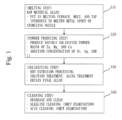
- Fig. 1 shows a final alloy manufacturing process.
- Step S10 is a melting step.
- the following raw material alloy is placed in a melting furnace, molten at a temperature of 800°C to 1200°C, and tapped. Then, the molten raw material alloy is introduced to a molten metal spout of an atomizing nozzle.
- the raw material alloy is an Al alloy.
- the aluminum alloy which is the raw material alloy has the following composition.
- Step S20 is a powder producing step.
- an inert gas such as nitrogen, argon, and helium is injected at high pressure through nozzle holes to produce rapidly solidified Al alloy powder.
- the notation "5.0-6.5 mass%” in Zn means “from 5.0 mass% to 6.5 mass% inclusive”. Further, the same is applied to the notations Mg: 2.0-3.0 mass%, Cu: 1.2-2.0 mass%, and the like.
- the raw material alloy contains at least one element in the following range of mass% for each of the three elements:
- Ni when only Ni is contained, Ni: 2.0-5.0 mass%. When two elements, Ni and Ag, are contained, Ni: 2.0-5.0 mass% and Ag: 0.5-3.5 mass%. When three elements, Ni, Ag, and Li, are contained, respective elements are in the three ranges shown above. When two or more elements among Ni, Ag, and Li are contained, one of these elements may be at the lower limit of the allowable mass% range.
- the raw material alloy contained Si is 0.25 mass% or less and contained Mn is 0.5 mass% or less.
- the contents of Si and Mn will be described later in relation to smut.
- Step S30 is a solidifying step.
- the rapidly solidified powder of the raw material alloy produced in the powder producing step was densified and solidified by hot extrusion processing. Then, the rapidly solidified powder which was solidified was subjected to solution treatment and aging treatment under tempering conditions equivalent to T6 of A7075 in the JIS standard. Thus, a high-strength Al alloy was obtained as a final alloy
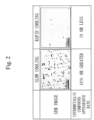
- Fig. 2 shows the results of binarizing SEM images, which were obtained by cross-sectional SEM observation, of Al alloys (final alloys) obtained by the manufacturing method shown in the flowchart of Fig. 1 .
- the black colors in the slow cooling and rapid cooling SEM images in Fig. 2 represent precipitation of an intermetallic compound.
- Fig. 2 shows a length of 100 ⁇ m.
- a coarsened intermetallic compound can be seen in the Al alloy using the slowly cooled raw material alloy powder.
- the appearance rate of the intermetallic compound in slow cooling was 10% or greater in a field of view of 300 ⁇ m ⁇ 300 ⁇ m as a result of cross-sectional observation by SEM.
- the appearance rate of the intermetallic compound was 1% or less in the field of view of 300 ⁇ m ⁇ 300 ⁇ m.
- an appearance area which represents a total area of an intermetallic compound appearing in the Al alloy (final alloy), is preferably 2% or less and more preferably 1% or less in observation with a scanning electron microscope with the field of view of 300 ⁇ m ⁇ 300 ⁇ m.
- Step S40 is a cleaning step.
- the manufactured Al alloy (final alloy) is degreased and cleaned to remove organic matters to which oil and the like are attached. Subsequently, alkaline cleaning is performed.
- the surface is etched by performing immersion in an aqueous solution containing 10 mass% to 20 mass% inclusive of sodium hydroxide or potassium hydroxide at a temperature of 50°C or higher for 10 to 30 seconds, revealing a clean surface.
- any strong alkaline aqueous solution such as potassium hydroxide may be adopted for alkaline cleaning.
- the thickness of smut formed during alkaline cleaning was measured by spectroscopic ellipsometry. If smut is thin and reflected light from underlying metal can be measured, the smut thickness can be measured. When measurement was possible, a measurement result of the smut thickness was 1 ⁇ m or less. On the other hand, smut that is thick and exhibits a black color is difficult to measure. When measurement was difficult, the smut thickness was 1 ⁇ m or greater. Poor surface treatment properties can be visually determined based on change to a black color caused by thick smut.
- the degreased and cleaned final alloy was immersed in an aqueous solution containing 10 mass% to 20 mass% inclusive of nitric acid.
- Smut was examined by immersion at a temperature of 50°C or higher for 10 to 30 seconds, employing the same method as the alkaline cleaning.
- the surface treatment properties were determined based on the smut film thickness and blackening.
- strong acids such as sulfuric acid and hydrochloric acid may be used or mixed acids may be used for acid cleaning in addition to nitric acid.
- weak acids such as phosphoric acid and carbonic acid can be mixed with strong acids.
- mixed acids of phosphoric acid and nitric acid and mixed acids of phosphoric acid and sulfuric acid are known as chemical polishing fluids. These are used for improving surface smoothness.
- Amounts of Si and Mn largely affect thickening and blackening of smut.
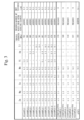
- Fig. 3 shows results of surface treatment properties and tensile strength of Al alloys (final alloys) manufactured by the method of Fig. 1 .
- Fig. 3 shows Al alloys of Examples 1 to 11, Comparative examples 1 to 4, and A7075.
- Examples 1 to 11 are final alloys, and Comparative examples 1 to 4 and A7075 are equivalent to final alloys.
- Zn, Mg, and Cu are Zn: 5.5 mass%, Mg: 2.5 mass%, and Cu: 1.5 mass%.
- Si and Mn are Si: 0.2 mass% and Mn: 0.1-0.2 mass%.
- Ni, Ag, and Li are Ni: 2.0-5.0 mass%, Ag: 0.5-3.5 mass%, and Li: 0.1-0.4 mass%.
- the left side of Fig. 3 shows tensile strength (MPa), presence/absence of black color after alkaline cleaning, and smut thickness ( ⁇ m) of Al alloys (final alloys).
- an Al alloy with excellent surface treatment properties and high strength can be manufactured by the manufacturing method described in Fig. 1 .
- the higher strength of the Al alloy can accordingly reduce product weight.
- the improvement in the surface treatment properties can provide stable corrosion resistance and shorten product lead time.
- the smut thickness needs to be set to 1 ⁇ m or less.
- Patent Literature 1 and Patent Literature 2 allow the Si content to be up to 0.25 mass% or greater, and Patent Literature 3 allows the Mn content to be up to 2-6 mass%. Therefore, Patent Literature 1 and Patent Literature 2 cannot achieve the 1 ⁇ m or less of smut thickness.
- the added elements are preferably dissolved as a solid solution in Al matrix.
- higher tensile strength is obtained when inhibiting generation of precipitates, which are coarse intermetallic compounds. Therefore, rapid solidification was employed for manufacturing.
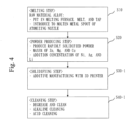
- Fig. 4 shows a flowchart of a method for manufacturing an Al alloy (final alloy) in employing the additive manufacturing method.
- Fig. 4 is different from Fig. 1 in that Fig. 4 has Steps S30-1 and S40-1 instead of Steps S30 and S40 of Fig. 1 .
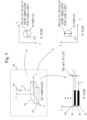
- Fig. 5 is a diagram for explaining the additive manufacturing method.
- a conceptual perspective view of the 3D printer 40 in XYZ coordinates is shown on the upper left, an XY plane is shown on the upper right, a YZ plane is shown on the lower left, and a ZX plane is shown on the lower right.
- the powder produced in Step S20 is placed on a base plate 32.
- the powder will be referred to as the powder 31 hereinafter.
- a diameter ⁇ d of a crystal particle 20 is shown on the XY plane and the ZX plane.
- the diameter of the crystal particle 20 is sometimes referred to as the particle diameter.
- the powder particle size distribution of the atomized powder produced in the powder producing step in Step S20 is adjusted as follows.
- an Al alloy (final alloy) product can be directly manufactured by additive manufacturing using the 3D printer 40.
- Step S30-1 will be described with reference to Fig. 5 .
- the Z direction is assumed to be the height direction. It is preferable to perform additive manufacturing with a pitch P of 100 ⁇ m or less in the Z direction by irradiation with laser light 11 by a laser device 10, and it is more preferable to perform additive manufacturing with the pitch P of 30 ⁇ m or less.
- the YZ plane shows layers #1 to #4. The pitch P between the layers is shown in the YZ plane.
- the powder 31 produced in Step S20 is easily oxidized and nitrided because the temperature can be raised and lowered in a short time by irradiation with the laser light 11. Therefore, it is important to control oxygen and nitrogen concentrations.
- oxidation causes brittle fracture and therefore, products are preferably manufactured with the 3D printer 40 in a non-oxygen atmosphere, and products are more preferably manufactured in an Ar gas atmosphere.
- Oxygen contained in a manufactured object manufactured with the 3D printer 40 in the non-oxygen atmosphere is preferably 0.1 mass% or less, and more preferably 0.05 mass% or less.
- Nitrogen contained in a manufactured object by the 3D printer 40 is preferably 0.01 mass% or less, and more preferably 0.001 mass% or less.
- the range of the laser wavelength is preferably from 700 nm to 1100 nm inclusive.
- the Si content of the powder 31 produced in Step S20 is low, whereby the melting temperature is high. Accordingly, it is more preferable to irradiate it at a laser wavelength from 800 nm to 1100 nm inclusive, which is a wavelength range where light is easily absorbed.
- the diameter ⁇ d of the crystal particle 20 of the powder 31 which is rapidly solidified is smaller, the tensile strength is higher.
- the manufactured product has anisotropy in the diameter cpd of the crystal particles 20 due to the characteristics of the 3D printer 40.
- the laser light 11 which is a heat source, is radiated in the Z direction, the diameter ⁇ d of the crystal particle 20 is elongated in the Z direction.
- the Z direction is assumed to be the height direction.
- the diameter ⁇ d of the crystal particle 20 is preferably 100 ⁇ m or less and more preferably 30 ⁇ m or less, in the XY direction, which is a planar direction with respect to the laser light 11 which is the heat source.
- This particle diameter is a particle diameter for a manufactured product directly manufactured with the 3D printer 40.
- the XY direction means all directions of 360 degrees on the XY plane with respect to the directions of a double-headed arrow shown as ⁇ d on the XY plane.
- the diameter ⁇ d of the crystal particle 20 in the Z direction is preferably 400 ⁇ m or less and more preferably 200 ⁇ m or less.
- This particle diameter is a particle diameter for a manufactured product directly manufactured with the 3D printer 40.
- a manufactured object by the 3D printer 40 is manufactured on the base plate 32 of aluminum. Manufacturing is preferably performed at 200°C or lower of temperature of the base plate 32.
- a product made of high-strength Al alloy can be obtained by implementing one or both of aging treatment and stress relaxation heat treatment to the product without performing solution treatment of the product, after manufacturing with the 3D printer 40.
- Step S40-1 which is a surface treatment
- cleaning is performed by using alkali and acid which are the same conditions as in Fig. 1 .
- the cleaning with these makes it possible to check that the smut thickness is 1 ⁇ m or less and that there is no blackening in an appearance.
- an Al alloy (final alloy) manufactured by solidification is irradiated with a heat source from a direction along the Z axis in the solidifying step, and the diameter ⁇ d of the crystal particle 20 has anisotropy with respect to the laser light 11 which is a heat source.
- the diameter ⁇ d is 30 ⁇ m or less in a cross section parallel to the XY plane, and 200 ⁇ m or less in a cross section parallel to the ZX plane.
- the contained oxygen is 0.1 mass% or less and the contained nitrogen is 0.01 mass% or less.
- the Al alloy (final alloy) of Embodiment 1 described above is as the following.
- an appearance area which represents a total area of an intermetallic compound appearing in the Al alloy (final alloy), is 2% or less in observation with a scanning electron microscope with a field of view of 300 ⁇ m ⁇ 300 ⁇ m.
Landscapes
- Chemical & Material Sciences (AREA)
- Engineering & Computer Science (AREA)
- Materials Engineering (AREA)
- Mechanical Engineering (AREA)
- Metallurgy (AREA)
- Organic Chemistry (AREA)
- Manufacturing & Machinery (AREA)
- Physics & Mathematics (AREA)
- Crystallography & Structural Chemistry (AREA)
- Optics & Photonics (AREA)
- Plasma & Fusion (AREA)
- Thermal Sciences (AREA)
- Powder Metallurgy (AREA)
Applications Claiming Priority (1)
| Application Number | Priority Date | Filing Date | Title |
|---|---|---|---|
| PCT/JP2022/014160 WO2023181304A1 (ja) | 2022-03-24 | 2022-03-24 | アルミニウム合金及びアルミニウム合金の製造方法 |
Publications (2)
| Publication Number | Publication Date |
|---|---|
| EP4502206A1 true EP4502206A1 (de) | 2025-02-05 |
| EP4502206A4 EP4502206A4 (de) | 2025-05-21 |
Family
ID=88100701
Family Applications (1)
| Application Number | Title | Priority Date | Filing Date |
|---|---|---|---|
| EP22933444.6A Pending EP4502206A4 (de) | 2022-03-24 | 2022-03-24 | Aluminiumlegierung und verfahren zur herstellung einer aluminiumlegierung |
Country Status (5)
| Country | Link |
|---|---|
| US (1) | US20250207226A1 (de) |
| EP (1) | EP4502206A4 (de) |
| JP (1) | JP7693097B2 (de) |
| CN (1) | CN118891385A (de) |
| WO (1) | WO2023181304A1 (de) |
Family Cites Families (7)
| Publication number | Priority date | Publication date | Assignee | Title |
|---|---|---|---|---|
| JPS6383251A (ja) | 1986-09-26 | 1988-04-13 | Ichiro Kawakatsu | 高力高弾性アルミニウム合金の製造法 |
| JPH07316601A (ja) * | 1994-03-28 | 1995-12-05 | Toyo Alum Kk | アルミニウム急冷凝固粉末およびアルミニウム合金成形材の製造方法 |
| JP3638188B2 (ja) * | 1996-12-12 | 2005-04-13 | 住友軽金属工業株式会社 | 耐応力腐食割れ性に優れた自動二輪車のフロントフォークアウターチューブ用高力アルミニウム合金押出管の製造方法 |
| JP4925028B2 (ja) | 2005-03-30 | 2012-04-25 | 東洋アルミニウム株式会社 | アルミニウム合金成形材 |
| WO2008105303A1 (ja) * | 2007-02-28 | 2008-09-04 | Kabushiki Kaisha Kobe Seiko Sho | 高強度、高延性Al合金およびその製造方法 |
| JP5059512B2 (ja) | 2007-02-28 | 2012-10-24 | 株式会社神戸製鋼所 | 高強度、高延性Al合金およびその製造方法 |
| WO2018185259A1 (de) * | 2017-04-05 | 2018-10-11 | Amag Casting Gmbh | Ausgangswerkstoff, dessen verwendung und additives fertigungsverfahren mit diesem ausgangswerkstoff |
-
2022
- 2022-03-24 US US18/847,704 patent/US20250207226A1/en active Pending
- 2022-03-24 EP EP22933444.6A patent/EP4502206A4/de active Pending
- 2022-03-24 WO PCT/JP2022/014160 patent/WO2023181304A1/ja not_active Ceased
- 2022-03-24 CN CN202280093814.7A patent/CN118891385A/zh active Pending
- 2022-03-24 JP JP2024509614A patent/JP7693097B2/ja active Active
Also Published As
| Publication number | Publication date |
|---|---|
| CN118891385A (zh) | 2024-11-01 |
| JP7693097B2 (ja) | 2025-06-16 |
| EP4502206A4 (de) | 2025-05-21 |
| US20250207226A1 (en) | 2025-06-26 |
| JPWO2023181304A1 (de) | 2023-09-28 |
| WO2023181304A1 (ja) | 2023-09-28 |
Similar Documents
| Publication | Publication Date | Title |
|---|---|---|
| TWI406719B (zh) | 鎂合金元件及其製法 | |
| KR102266075B1 (ko) | 도금 강판 | |
| CN103703155B (zh) | 铝合金片材及其制造方法 | |
| KR102384674B1 (ko) | 내식성, 내골링성, 가공성 및 표면 품질이 우수한 도금 강판 및 이의 제조방법 | |
| KR102501440B1 (ko) | 표면 품질이 우수한 열간 프레스 성형용 도금 강판 및 이의 제조방법 | |
| Jasthi et al. | Microstructure and mechanical properties of cold spray additive manufactured Cu-Cr-Nb and Fe-Ni-Cr alloys | |
| CN110832093B (zh) | 用于添加剂技术的铝合金 | |
| EP4012062A1 (de) | Aluminiumlegierung für 3d-druck- oder generative fertigung, 3d-druck- oder generatives fertigungsverfahren, das diese legierung verwendet; und mit 3d-druck oder generativer fertigung hergestelltes produkt oder bauteil aus dieser aluminiumlegierung | |
| US20220275484A1 (en) | Aluminum alloy for 3d printing or additive manufacturing, 3d printing or additive manufacturing method using same, and aluminum alloy product or component manufactured by 3d printing or additive manufacturing | |
| WO2020081255A1 (en) | Aluminum alloys having iron and rare earth elements | |
| CN114787403A (zh) | 粉末铝材料 | |
| JP6249435B2 (ja) | アルミニウム−亜鉛系合金押出材およびその製造方法 | |
| EP4502206A1 (de) | Aluminiumlegierung und verfahren zur herstellung einer aluminiumlegierung | |
| JP2007270199A (ja) | 耐高温酸化性に優れたチタン合金およびエンジン排気管 | |
| Fang et al. | Improved properties of wire arc direct energy deposited Sc/Zr-modified Al-Zn-Mg Alloy with low heat input | |
| CN112424385B (zh) | 镁合金板材及其制造方法 | |
| Deng et al. | Investigation on microstructure, mechanical properties and corrosion behavior of Sc-contained Al-7075 alloys after solution-Aging treatment | |
| JP7772102B2 (ja) | ステンレス鋼粉末、ステンレス鋼部材およびステンレス鋼部材の製造方法 | |
| RU2410456C2 (ru) | Титановый материал и выхлопная труба для двигателя | |
| Melik et al. | Solide state diffusion bonding of Al6061-SiC nanocomposites | |
| WO2024071068A1 (ja) | Mg合金粉末、Mg合金部材およびその製造方法 | |
| US11643715B2 (en) | Composite structure with aluminum-based alloy layer containing boron carbide and manufacturing method thereof | |
| JP7677529B2 (ja) | 積層造形体からなるNi-Cr合金部材、Ni-Cr合金部材の製造方法、およびNi-Cr合金部材を用いた製造物 | |
| EP4474516A1 (de) | Plattiertes stahlblech für heisspressformen mit hervorragenden oberflächeneigenschaften und verfahren zur herstellung davon | |
| US20250179615A1 (en) | Ni-based alloy powder for additive manufacturing, additively manufactured product, and method for manufacturing additively manufactured product |
Legal Events
| Date | Code | Title | Description |
|---|---|---|---|
| STAA | Information on the status of an ep patent application or granted ep patent |
Free format text: STATUS: THE INTERNATIONAL PUBLICATION HAS BEEN MADE |
|
| PUAI | Public reference made under article 153(3) epc to a published international application that has entered the european phase |
Free format text: ORIGINAL CODE: 0009012 |
|
| STAA | Information on the status of an ep patent application or granted ep patent |
Free format text: STATUS: REQUEST FOR EXAMINATION WAS MADE |
|
| 17P | Request for examination filed |
Effective date: 20240802 |
|
| AK | Designated contracting states |
Kind code of ref document: A1 Designated state(s): AL AT BE BG CH CY CZ DE DK EE ES FI FR GB GR HR HU IE IS IT LI LT LU LV MC MK MT NL NO PL PT RO RS SE SI SK SM TR |
|
| A4 | Supplementary search report drawn up and despatched |
Effective date: 20250423 |
|
| RIC1 | Information provided on ipc code assigned before grant |
Ipc: C22C 1/04 20230101ALI20250415BHEP Ipc: B33Y 70/00 20200101ALI20250415BHEP Ipc: B33Y 50/02 20150101ALI20250415BHEP Ipc: B33Y 10/00 20150101ALI20250415BHEP Ipc: B22F 10/32 20210101ALI20250415BHEP Ipc: B22F 10/28 20210101ALI20250415BHEP Ipc: B22F 10/25 20210101ALI20250415BHEP Ipc: B22F 9/08 20060101ALI20250415BHEP Ipc: B22F 3/20 20060101ALI20250415BHEP Ipc: B22F 1/07 20220101ALI20250415BHEP Ipc: B22F 1/052 20220101ALI20250415BHEP Ipc: C22F 1/00 20060101ALI20250415BHEP Ipc: C22C 21/10 20060101AFI20250415BHEP |
|
| DAV | Request for validation of the european patent (deleted) | ||
| DAX | Request for extension of the european patent (deleted) |