EP4474516A1 - Plattiertes stahlblech für heisspressformen mit hervorragenden oberflächeneigenschaften und verfahren zur herstellung davon - Google Patents
Plattiertes stahlblech für heisspressformen mit hervorragenden oberflächeneigenschaften und verfahren zur herstellung davon Download PDFInfo
- Publication number
- EP4474516A1 EP4474516A1 EP22925053.5A EP22925053A EP4474516A1 EP 4474516 A1 EP4474516 A1 EP 4474516A1 EP 22925053 A EP22925053 A EP 22925053A EP 4474516 A1 EP4474516 A1 EP 4474516A1
- Authority
- EP
- European Patent Office
- Prior art keywords
- plating layer
- press forming
- hot press
- steel sheet
- plated steel
- Prior art date
- Legal status (The legal status is an assumption and is not a legal conclusion. Google has not performed a legal analysis and makes no representation as to the accuracy of the status listed.)
- Pending
Links
Images
Classifications
-
- C—CHEMISTRY; METALLURGY
- C23—COATING METALLIC MATERIAL; COATING MATERIAL WITH METALLIC MATERIAL; CHEMICAL SURFACE TREATMENT; DIFFUSION TREATMENT OF METALLIC MATERIAL; COATING BY VACUUM EVAPORATION, BY SPUTTERING, BY ION IMPLANTATION OR BY CHEMICAL VAPOUR DEPOSITION, IN GENERAL; INHIBITING CORROSION OF METALLIC MATERIAL OR INCRUSTATION IN GENERAL
- C23C—COATING METALLIC MATERIAL; COATING MATERIAL WITH METALLIC MATERIAL; SURFACE TREATMENT OF METALLIC MATERIAL BY DIFFUSION INTO THE SURFACE, BY CHEMICAL CONVERSION OR SUBSTITUTION; COATING BY VACUUM EVAPORATION, BY SPUTTERING, BY ION IMPLANTATION OR BY CHEMICAL VAPOUR DEPOSITION, IN GENERAL
- C23C2/00—Hot-dipping or immersion processes for applying the coating material in the molten state without affecting the shape; Apparatus therefor
- C23C2/04—Hot-dipping or immersion processes for applying the coating material in the molten state without affecting the shape; Apparatus therefor characterised by the coating material
- C23C2/12—Aluminium or alloys based thereon
-
- B—PERFORMING OPERATIONS; TRANSPORTING
- B21—MECHANICAL METAL-WORKING WITHOUT ESSENTIALLY REMOVING MATERIAL; PUNCHING METAL
- B21D—WORKING OR PROCESSING OF SHEET METAL OR METAL TUBES, RODS OR PROFILES WITHOUT ESSENTIALLY REMOVING MATERIAL; PUNCHING METAL
- B21D22/00—Shaping without cutting, by stamping, spinning, or deep-drawing
-
- B—PERFORMING OPERATIONS; TRANSPORTING
- B32—LAYERED PRODUCTS
- B32B—LAYERED PRODUCTS, i.e. PRODUCTS BUILT-UP OF STRATA OF FLAT OR NON-FLAT, e.g. CELLULAR OR HONEYCOMB, FORM
- B32B15/00—Layered products comprising a layer of metal
- B32B15/01—Layered products comprising a layer of metal all layers being exclusively metallic
- B32B15/012—Layered products comprising a layer of metal all layers being exclusively metallic one layer being formed of an iron alloy or steel, another layer being formed of aluminium or an aluminium alloy
-
- C—CHEMISTRY; METALLURGY
- C22—METALLURGY; FERROUS OR NON-FERROUS ALLOYS; TREATMENT OF ALLOYS OR NON-FERROUS METALS
- C22C—ALLOYS
- C22C21/00—Alloys based on aluminium
- C22C21/10—Alloys based on aluminium with zinc as the next major constituent
-
- C—CHEMISTRY; METALLURGY
- C22—METALLURGY; FERROUS OR NON-FERROUS ALLOYS; TREATMENT OF ALLOYS OR NON-FERROUS METALS
- C22C—ALLOYS
- C22C38/00—Ferrous alloys, e.g. steel alloys
- C22C38/02—Ferrous alloys, e.g. steel alloys containing silicon
-
- C—CHEMISTRY; METALLURGY
- C22—METALLURGY; FERROUS OR NON-FERROUS ALLOYS; TREATMENT OF ALLOYS OR NON-FERROUS METALS
- C22C—ALLOYS
- C22C38/00—Ferrous alloys, e.g. steel alloys
- C22C38/04—Ferrous alloys, e.g. steel alloys containing manganese
-
- C—CHEMISTRY; METALLURGY
- C22—METALLURGY; FERROUS OR NON-FERROUS ALLOYS; TREATMENT OF ALLOYS OR NON-FERROUS METALS
- C22C—ALLOYS
- C22C38/00—Ferrous alloys, e.g. steel alloys
- C22C38/18—Ferrous alloys, e.g. steel alloys containing chromium
- C22C38/40—Ferrous alloys, e.g. steel alloys containing chromium with nickel
- C22C38/50—Ferrous alloys, e.g. steel alloys containing chromium with nickel with titanium or zirconium
-
- C—CHEMISTRY; METALLURGY
- C22—METALLURGY; FERROUS OR NON-FERROUS ALLOYS; TREATMENT OF ALLOYS OR NON-FERROUS METALS
- C22C—ALLOYS
- C22C38/00—Ferrous alloys, e.g. steel alloys
- C22C38/18—Ferrous alloys, e.g. steel alloys containing chromium
- C22C38/40—Ferrous alloys, e.g. steel alloys containing chromium with nickel
- C22C38/52—Ferrous alloys, e.g. steel alloys containing chromium with nickel with cobalt
-
- C—CHEMISTRY; METALLURGY
- C23—COATING METALLIC MATERIAL; COATING MATERIAL WITH METALLIC MATERIAL; CHEMICAL SURFACE TREATMENT; DIFFUSION TREATMENT OF METALLIC MATERIAL; COATING BY VACUUM EVAPORATION, BY SPUTTERING, BY ION IMPLANTATION OR BY CHEMICAL VAPOUR DEPOSITION, IN GENERAL; INHIBITING CORROSION OF METALLIC MATERIAL OR INCRUSTATION IN GENERAL
- C23C—COATING METALLIC MATERIAL; COATING MATERIAL WITH METALLIC MATERIAL; SURFACE TREATMENT OF METALLIC MATERIAL BY DIFFUSION INTO THE SURFACE, BY CHEMICAL CONVERSION OR SUBSTITUTION; COATING BY VACUUM EVAPORATION, BY SPUTTERING, BY ION IMPLANTATION OR BY CHEMICAL VAPOUR DEPOSITION, IN GENERAL
- C23C2/00—Hot-dipping or immersion processes for applying the coating material in the molten state without affecting the shape; Apparatus therefor
- C23C2/02—Pretreatment of the material to be coated, e.g. for coating on selected surface areas
- C23C2/022—Pretreatment of the material to be coated, e.g. for coating on selected surface areas by heating
-
- C—CHEMISTRY; METALLURGY
- C23—COATING METALLIC MATERIAL; COATING MATERIAL WITH METALLIC MATERIAL; CHEMICAL SURFACE TREATMENT; DIFFUSION TREATMENT OF METALLIC MATERIAL; COATING BY VACUUM EVAPORATION, BY SPUTTERING, BY ION IMPLANTATION OR BY CHEMICAL VAPOUR DEPOSITION, IN GENERAL; INHIBITING CORROSION OF METALLIC MATERIAL OR INCRUSTATION IN GENERAL
- C23C—COATING METALLIC MATERIAL; COATING MATERIAL WITH METALLIC MATERIAL; SURFACE TREATMENT OF METALLIC MATERIAL BY DIFFUSION INTO THE SURFACE, BY CHEMICAL CONVERSION OR SUBSTITUTION; COATING BY VACUUM EVAPORATION, BY SPUTTERING, BY ION IMPLANTATION OR BY CHEMICAL VAPOUR DEPOSITION, IN GENERAL
- C23C2/00—Hot-dipping or immersion processes for applying the coating material in the molten state without affecting the shape; Apparatus therefor
- C23C2/26—After-treatment
-
- C—CHEMISTRY; METALLURGY
- C23—COATING METALLIC MATERIAL; COATING MATERIAL WITH METALLIC MATERIAL; CHEMICAL SURFACE TREATMENT; DIFFUSION TREATMENT OF METALLIC MATERIAL; COATING BY VACUUM EVAPORATION, BY SPUTTERING, BY ION IMPLANTATION OR BY CHEMICAL VAPOUR DEPOSITION, IN GENERAL; INHIBITING CORROSION OF METALLIC MATERIAL OR INCRUSTATION IN GENERAL
- C23C—COATING METALLIC MATERIAL; COATING MATERIAL WITH METALLIC MATERIAL; SURFACE TREATMENT OF METALLIC MATERIAL BY DIFFUSION INTO THE SURFACE, BY CHEMICAL CONVERSION OR SUBSTITUTION; COATING BY VACUUM EVAPORATION, BY SPUTTERING, BY ION IMPLANTATION OR BY CHEMICAL VAPOUR DEPOSITION, IN GENERAL
- C23C2/00—Hot-dipping or immersion processes for applying the coating material in the molten state without affecting the shape; Apparatus therefor
- C23C2/26—After-treatment
- C23C2/28—Thermal after-treatment, e.g. treatment in oil bath
-
- C—CHEMISTRY; METALLURGY
- C23—COATING METALLIC MATERIAL; COATING MATERIAL WITH METALLIC MATERIAL; CHEMICAL SURFACE TREATMENT; DIFFUSION TREATMENT OF METALLIC MATERIAL; COATING BY VACUUM EVAPORATION, BY SPUTTERING, BY ION IMPLANTATION OR BY CHEMICAL VAPOUR DEPOSITION, IN GENERAL; INHIBITING CORROSION OF METALLIC MATERIAL OR INCRUSTATION IN GENERAL
- C23C—COATING METALLIC MATERIAL; COATING MATERIAL WITH METALLIC MATERIAL; SURFACE TREATMENT OF METALLIC MATERIAL BY DIFFUSION INTO THE SURFACE, BY CHEMICAL CONVERSION OR SUBSTITUTION; COATING BY VACUUM EVAPORATION, BY SPUTTERING, BY ION IMPLANTATION OR BY CHEMICAL VAPOUR DEPOSITION, IN GENERAL
- C23C2/00—Hot-dipping or immersion processes for applying the coating material in the molten state without affecting the shape; Apparatus therefor
- C23C2/26—After-treatment
- C23C2/28—Thermal after-treatment, e.g. treatment in oil bath
- C23C2/29—Cooling or quenching
-
- C—CHEMISTRY; METALLURGY
- C23—COATING METALLIC MATERIAL; COATING MATERIAL WITH METALLIC MATERIAL; CHEMICAL SURFACE TREATMENT; DIFFUSION TREATMENT OF METALLIC MATERIAL; COATING BY VACUUM EVAPORATION, BY SPUTTERING, BY ION IMPLANTATION OR BY CHEMICAL VAPOUR DEPOSITION, IN GENERAL; INHIBITING CORROSION OF METALLIC MATERIAL OR INCRUSTATION IN GENERAL
- C23C—COATING METALLIC MATERIAL; COATING MATERIAL WITH METALLIC MATERIAL; SURFACE TREATMENT OF METALLIC MATERIAL BY DIFFUSION INTO THE SURFACE, BY CHEMICAL CONVERSION OR SUBSTITUTION; COATING BY VACUUM EVAPORATION, BY SPUTTERING, BY ION IMPLANTATION OR BY CHEMICAL VAPOUR DEPOSITION, IN GENERAL
- C23C2/00—Hot-dipping or immersion processes for applying the coating material in the molten state without affecting the shape; Apparatus therefor
- C23C2/34—Hot-dipping or immersion processes for applying the coating material in the molten state without affecting the shape; Apparatus therefor characterised by the shape of the material to be treated
- C23C2/36—Elongated material
- C23C2/40—Plates; Strips
-
- C—CHEMISTRY; METALLURGY
- C23—COATING METALLIC MATERIAL; COATING MATERIAL WITH METALLIC MATERIAL; CHEMICAL SURFACE TREATMENT; DIFFUSION TREATMENT OF METALLIC MATERIAL; COATING BY VACUUM EVAPORATION, BY SPUTTERING, BY ION IMPLANTATION OR BY CHEMICAL VAPOUR DEPOSITION, IN GENERAL; INHIBITING CORROSION OF METALLIC MATERIAL OR INCRUSTATION IN GENERAL
- C23C—COATING METALLIC MATERIAL; COATING MATERIAL WITH METALLIC MATERIAL; SURFACE TREATMENT OF METALLIC MATERIAL BY DIFFUSION INTO THE SURFACE, BY CHEMICAL CONVERSION OR SUBSTITUTION; COATING BY VACUUM EVAPORATION, BY SPUTTERING, BY ION IMPLANTATION OR BY CHEMICAL VAPOUR DEPOSITION, IN GENERAL
- C23C30/00—Coating with metallic material characterised only by the composition of the metallic material, i.e. not characterised by the coating process
Definitions
- the present disclosure relates to a plated steel sheet for hot press forming having excellent surface quality and a method for manufacturing the same.
- High-strength steel is increasing, to reduce the weight of automobiles.
- high-strength steel has a problem in that it is difficult to form a product with a complex and precise shape as a material breaks during processing or springback occurs after processing.
- Hot press forming (HPF) is a method to solve these problems, and the application thereof has recently been expanding.
- the steel sheet for hot press forming is generally easy to be formed as the steel sheet is press processed while heated to a temperature range of 800 to 950°C, and have an advantage of being able to increase the strength of a formed product when rapidly cooling in a mold.
- oxidation may occur on a surface of the steel sheet, and accordingly, there may be a problem that a process to remove oxides on the surface of the steel sheet should be added after press forming.
- a plated steel sheet with an aluminum plating layer, a zinc plating layer, or a mixture of the aluminum plating layer and the zinc plating layer are used on the surface of the steel sheet as a material for hot press forming.
- an aluminum plated steel sheet has a high melting point of an aluminum plating bath, so a lifespan of sink rolls used in the plating bath is only 3 to 4 days, so production thereof should be stopped periodically and the sink rolls should be replaced, so productivity is very poor. Since the lifespan of these sink rolls is inversely proportional to a temperature of the plating bath, it is important to lower the temperature of the plating bath.
- the aluminum plating layer has a problem of poor corrosion resistance due to lack of sacrificial corrosion resistance of the plating layer after hot press forming.
- the zinc-added aluminum plating layer has a problem in that the plating layer may be easily separated from the base material at curved areas in the mold after hot press forming, so it has not been able to meet the demand for high-quality steel materials requiring strict quality until now.
- Patent Document 1 U.S. Patent Publication No. 6,296,805
- An aspect of the present disclosure is to provide a plated steel sheet for hot press forming having excellent surface quality, and a method for manufacturing the same.
- another aspect of the present disclosure is to provide a plated steel sheet for hot press forming having excellent productivity and corrosion resistance, and excellent surface quality since a plating layer may not be separated from a base material even after hot forming, and a method for manufacturing the same.
- the subject of the present invention is not limited to the above.
- the subject of the present invention will be understood from the overall content of the present specification, and those of ordinary skill in the art to which the present invention pertains will have no difficulty in understanding the additional subject of the present invention.
- a plated steel sheet for hot press forming including:
- a method for manufacturing a plated steel sheet for hot press forming comprising:
- a hot press forming member obtained by hot press forming the above-described plated steel sheet for hot press forming is provided.
- a hot press forming member including:
- a hot press forming member including:
- a plated steel sheet for hot press forming with excellent surface quality and a method for manufacturing the same may be provided.
- a plated steel sheet for hot press forming having excellent productivity and corrosion resistance and excellent surface quality since a plating layer is not separated from a base material even after hot forming, and a method for manufacturing the same may be provided.
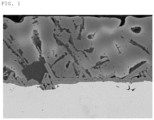
- FIG. 1 is an image of Inventive Example 11 observed with a scanning electron microscope (SEM).
- the present inventors have conducted intensive research and then found that, in production of a plated steel sheet with a plating layer including components including Zn, Al, and Si, peeling of the plating layer is a major problem when aluminum primary crystals occur, and found that there is an effect of preventing LME and improving plating layer adhesion by precisely controlling the components of Zn, and Si, in addition to corrosion resistance and productivity, thereby completing the present disclosure.
- the plated steel sheet for hot press forming includes a base steel; and a plating layer provided on at least one surface of the base steel.
- any type of base steel may be applied without limitations as long as it may be used as a steel sheet for hot press forming. Therefore, as the base steel, any steel sheet in which austenite transformation is initiated at a temperature of 800°C or higher, and in which martensite transformation can be performed by rapid cooling which occurs simultaneously with forming, is sufficient.
- base steel comprising by weight%: 0.15 to 0.39% of C, 0.5 to 3% of Mn, 0.01% or less (including 0%) of B, 0.1% or less of Ti (including 0%), with a balance of Fe and other inevitable impurities, may be used, and an example thereof may include 22MnB5.
- the plating layer has a composition including, by weight%, 21 to 34% of Zn, 6.3 to 15% of Si, 3 to 13% of Fe, with a balance of Al, and other inevitable impurities.
- the reason for which the components of each component are added and the reason for the content thereof is limited, will be described in detail. Unless otherwise particularly stated in the present disclosure, the content of each element is by weight %.
- Zinc (Zn) is an element added to improve corrosion resistance. Usually, since an aluminum-plated steel sheet does not have sacrificial corrosion resistance, corrosion resistance may be secured by adding zinc. In addition, zinc is added to improve productivity by lowering a melting point of a plating bath and improving a lifespan of a sink roll. Therefore, in the present disclosure, 21% or more of Zn is added to secure a desired level of corrosion resistance and productivity. However, if excessive Zn is added, there may be a risk in that liquid metal embrittlement (LME) may occur during hot press molding, so in the present disclosure, a Zn content is limited to 34% or less. However, from the viewpoint of further improving the desired effect of the present invention, a lower limit of the Zn content may preferably be 23%, more preferably 25%, and an upper limit of the Zn content may be 31.2%.
- LME liquid metal embrittlement
- Si is an element added to control alloying of Al contained in a plating layer and Fe contained in base steel, and excessive alloying may be prevented by adding Si.
- Si is an element lowering a temperature of a plating bath by causing a decrease in a melting point of Al, thereby effectively suppressing occurrence of ash in the plating bath. Therefore, in the present disclosure, in order to properly control a degree of alloying between Al and Fe, Si is added in an amount of 6.3% or more. However, if a Sn content in the plating layer is less than 6.3%, a highly brittle Fe-Al-based interfacial alloy layer is formed too thick due to excessive alloying, which may cause brittleness to appear during processing and cause the plating layer to be dropped.
- the Si content is limited to 15% or less.
- a lower limit of the Si content may be 7.0%, and an upper limit of the Si content may be 13.1%.
- a Fe content in the plating layer is preferably 3 to 13%. If the Fe content in the plating layer is less than 3%, Al in the plating bath and Fe in base steel form a non-uniform Al-Fe alloy phase on a surface of the base steel, which may cause a problem in that a plating surface becomes rough and plating defects increase. In addition, if the Fe content in the plating layer exceeds 13%, an excessive Fe-Al-based interfacial alloy layer is formed, and there is a risk that the plating layer may be dropped during processing due to the highly brittle Fe-Al-based interfacial alloy layer.
- the excessive Fe-Al-based interfacial alloy layer formed during plating plays a role in suppressing diffusion of Fe during a heat treatment process performed during hot press forming, so the plating layer remains in a liquid state for a long time, thereby causing a problem of sticking in a heating furnace. Therefore, in the present disclosure, the Fe content in the plating layer is controlled to 3 to 13%. However, from the viewpoint of further improving the desired effect of the present disclosure, more preferably, a lower limit of the Fe content may be 3.8%, and an upper limit of the Fe content may be 11.2%. Meanwhile, the small amount of Fe may be included in the plating bath, which may be due to a small amount of Fe flowing into the plating bath from base steel during the manufacturing process.
- a remainder may be Al and other inevitable impurities. Any inevitable impurities may be included as long as they can be unintentionally mixed during the manufacturing process of a normal aluminum-based or aluminum alloy-based plated steel sheet. Since the meaning of these impurities may be easily understood by those skilled in the art, the present disclosure does not specifically limit the meaning thereof.
- the plating layer may optionally further include Mg in an amount of 1.4% or less to further improve corrosion resistance
- Mg may further improve corrosion resistance by acting as a buffer which prevents zinc oxide from being decomposed in a corrosive environment. Therefore, Mg may optionally be added in an amount of 1.4% or less.
- a lower limit of the Mg content may not be separately limited. As an example, the lower limit of the Mg content may be 0.05%.
- liquid metal embrittlement refers to a phenomenon in which zinc in the plating layer diffuses into base steel and brittle fracture occurs due to grain boundary cracking during the plating process or hot forming process.
- LME liquid metal embrittlement
- the LME phenomenon does not occur, but the LME phenomenon easily occurs when zine is added. Accordingly, the present inventors have conducted in-depth studies, and as a result thereof, it was confirmed that the tendency of LME to occur varies depending on the combination of components between Al and Zn.
- the plated steel sheet for hot press forming according to the present disclosure satisfies the following Relational expressions 1 and 2. 0.09 ⁇ Zn / Si ⁇ 4.8 3.6 ⁇ Al / Si ⁇ 8.5
- [Zn] represents an average content, weight%, of Zn in the plating layer
- [Si] represents an average content, weight%, of Si in the plating layer
- [Al] represents an average content, weight%, of Si in the plating layer.
- the plating layer may include an Al-Zn-based plating layer; and a Fe-Al-based interfacial alloy layer provided between the Al-Zn-based plating layer and the base steel.
- the Fe-Al-based interfacial alloy layer is a layer provided in contact with the base steel, and is a layer containing an intermetallic compound of Fe and Al formed through an alloying reaction of Fe and Al, and examples of the intermetallic compounds of Fe and Al may include FeAl, FeAl 3 , Fe 2 Al 5 , and the like.
- the Fe-Al-based interfacial alloy layer may comprise, by weight%: 30 to 50% of Fe and 35 to 55% of Al, and may partially further comprise components that can be included in the plating layer such as Zn and Si, in addition to Fe and Al in weight% (for example, 27% or less of Si).
- the Fe-Al-based interfacial alloy layer may comprise, by weight%: 30 to 50% of Fe, 35 to 55% of Al, 5 to 27% of Si, 4% or less (including 0%) of Zn, with a remainder and other inevitable impurities.
- the Al-Zn-based plating layer may refer to a layer other than an Fe-Al-based suppression layer among the above-mentioned plating layers. That is, the Al-Zn-based plating layer may refer to a layer which is provided on the Fe-Al-based suppression layer, and distinguished from the Fe-Al-based suppression layer by content, among the plating layers formed when the hot-dip plating layer described later is solidified. Specifically, the Al-Zn-based plating layer may comprise, by weight%: 15 to 31% of Zn, 2 to 12 of Si, 10% or less of Fe, with a balance of Al and other inevitable impurities.
- a point at which the Fe content is 50% is judged to be an interface between the base steel and the plating layer, since the thickness of the Fe-Al-based plating layer is less than 30% of that of the Al-Zn-based plating layer, a value of GDS, measured at a midpoint between the surface of the plating layer and the depth at which the Fe content is 50% may be determined as a component value of the composition of the Al-Zn plating layer, and the composition of the Fe-Al-based plating layer may be determined by an average value of the Fe-Al alloy layer by EDS analysis three or more times at a magnification of 1500 times or more using a scanning electron microscope.
- a weight ratio (Sb/Sa) of the average Si content (Sb) in the Fe-Al-based alloy layer and the average Si content (Sa) in the Al-Zn-based plating layer may be 1 to 3.1. If the value of Sb/Sa is less than 1, an excessive Si phase is formed on an Al-Zn phase when the plating layer is solidified, and there is a risk of surface defects due to a hard Si phase on a surface of the plating layer.
- the Si content in the Fe-Al-based alloy layer is excessive, and Si penetrates into an Fe-Al-based crystal structure, thereby inhibiting a diffusion coefficient of Fe in the Fe-Al-based alloy layer, which may inhibit alloying of the initial plating layer during hot press forming, to cause problems such as sticking, or the like, and thus, there is a risk that adhesion of the plating may be impaired.
- the plated steel sheet for hot press forming is usually used in automobiles and is used after electrodeposition coating.
- the steel sheet for hot press forming is usually used in automobiles and is used after electrodeposition coating.
- These surface defects occur when the components present in the plating layer are not uniformly alloyed during the heat treatment process and different components are gathered locally.
- the present inventors have conducted in-depth studies, as a result thereof, have found that the uniform alloying described above may be achieved by controlling the value of Sb/Sa.
- the plating layer may include a region in which the Si content is concentrated at 40% or more as compared to the average Si content of the Al-Zn-based plating layer per unit area of 100 ⁇ m 2 of the plating layer, based on a cross-section of the Al-Zn-based plating layer in the thickness direction.
- the region in which Si is concentrated an Si phase concentrated at the interface at the beginning of the heat treatment and an Si phase concentrated in the plating layer may be simultaneously dissolved in molten aluminum, and a uniform Si content may be maintained throughout the plating layer, so that plating adhesion after hot press forming may be further improved.
- the plating layer may include by area fraction, 3 to 30% of an Si phase, based on the cross-section of the Al-Zn-based plating layer in the thickness direction.
- the Si phase refers to a phase including by weight, 40 to 99.9% of Si.
- the plating layer includes the Si phase in an amount about 3 to 30%, a dropping phenomenon resulting from a highly brittle Fe-Al-based interfacial alloy layer at the interface between the base steel before hot forming and the plating layer, and simultaneously, by including zinc, a peeling phenomenon of the plating layer, which easily occurs during hot forming may be prevented at the same time. Therefore, even if a plated steel sheet having a plating layer of a component system including Zn and Al is used for hot press forming, in addition to corrosion resistance, productivity, and LME prevention, the adhesion of the plating layer may be further improved.
- hot press formed parts are mainly applied to parts with complex shapes and high strength compared to cold forming products.
- deep processing is required to produce the products in complex shapes, and due to the nature of hot press forming, which requires deep processing and uses a lot of molds, apart from the dropping phenomenon caused by excessive formation of the highly brittle Fe-Al-based interfacial alloy layer due to friction and tolerance between the mold and the plating layer, there is a problem in that peeling of the plating layer is likely to occur after hot press forming is applied.
- the plated steel sheet for hot press forming includes a plating step of immersing the base steel in a plating bath, comprising by weight%: 21 to 34% of Zn, 6.3 to 15% of Si, 2% or less (including 0%) of Fe, with a balance of Al and other inevitable impurities, wherein the following Relational expressions 1 and 2 are satisfied, to obtain a steel sheet with a hot-dip plating layer formed on the surface.
- a plating step of immersing the base steel in a plating bath, comprising by weight%: 21 to 34% of Zn, 6.3 to 15% of Si, 2% or less (including 0%) of Fe, with a balance of Al and other inevitable impurities, wherein the following Relational expressions 1 and 2 are satisfied, to obtain a steel sheet with a hot-dip plating layer formed on the surface.
- the explanation for the above-mentioned plating layer can be applied in the same manner as to the reason for adding the component in the plating bath and the reason for limiting the content
- the composition of the plating layer includes components derived from base steel, the components in the plating bath and the components may vary slightly. However, other than those derived from base steel, the reason for adding each component in the plating bath and the reason for limiting upper and lower numerical limits are the same. 0.09 ⁇ Zn / Si ⁇ 4.8 3.6 ⁇ Al / Si ⁇ 8.5
- [Zn] represents an average content, weight%, of Zn in the hot-dip plating layer
- [Si] represents an average content, weight%, of Si in the hot-dip plating layer
- [Al] represents an average content, weight%, of Al in the hot-dip plating layer.
- the average cooling rate Vc1 is 25 to 90°C
- cooling may be performed to have an average cooling rate Vc1 of 25 to 90°C/s in a first section with a temperature of 630 to 530°C, and an average cooling rate Vc2 of 3 to 15°C in a second section with a temperature of 529 to 350°C, based on a surface temperature of a hot-dip plating layer for the steel sheet.
- the surface quality of the plating layer can be improved.
- the cooling rate in the first section to 25 to 90°C/s
- a size of aluminum-specific spangles becomes smaller and finer at the time of solidification of the plating layer, resulting in uniform surface roughness and improved surface quality.
- the average cooling rate in the second section by controlling the average cooling rate to be as low as 3 to 15°C/s, an amount of blowing air from a cooling tower may be reduced so that incorporation of foreign substances into the plating layer may be reduced.
- the base steel before the plating step, may be heat treated in an annealing furnace in which the temperature is 650 to 850°C and a hydrogen ratio is 0.1 to 30%.
- the heat treatment may be performed at a temperature above recrystallization temperature to prevent work hardening of the material in a continuous plating process, and plating properties may be improved by maintaining the base steel sheet at a higher temperature than the plating bath. If the heat treatment temperature is lower than 650°C, there is a disadvantage in that the material may deform and meander due to work hardening when passing through a roll such as a continuous process.
- the heat treatment temperature before the plating is preferably controlled to 650 to 850°C, more preferably, a lower limit of the heat treatment temperature may be 700°C, and an upper limit of the heat treatment temperature may be 810°C.
- the heat treatment can be controlled in a reducing atmosphere in which the hydrogen ratio is 0.1 to 30% and a balance thereof is nitrogen gas. If high-purity nitrogen gas is not used, it may be difficult to maintain a reducing atmosphere in a heat treatment furnace, making it difficult to clean the surface of the base steel sheet. In this case, if 0.1% or more of hydrogen gas is added, a dew point in the heat treatment furnace may be lowered and a reducing atmosphere may be maintained to prevent further oxidation of base steel, and to clean the surface of the base steel sheet. However, if a fraction of the hydrogen gas exceeds 30%, there is a risk of explosion due to a heat treatment due to contact with oxygen when leaking into the atmosphere. Therefore, in the present disclosure, the hydrogen ratio during the heat treatment can be controlled to 0.1 to 30%, and more preferably, a lower limit of the hydrogen ratio may be 5%, and an upper limit of the hydrogen ratio may be 25%.
- the annealing may be performed in an atmosphere with a dew point temperature of -30 to -60°C. If the dew point temperature during the annealing is lower than -30°C, a sufficient reducing atmosphere cannot be created, which may cause problems with reducibility of Fe oxides generated on the surface. If the dew point temperature is higher than -60°C, the use of high-purity nitrogen to maintain a clean atmosphere can cause a problem which results in high costs.
- the temperature of the plating bath may be controlled to be from Tb+20°C to Tb+80°C, based on a melting point of the plating bath (Tb). If the temperature of the plating bath is lower than Tb+20°C, the plating bath may harden at locations in which heat can be discharged to the outside, such as the sink roll, within a plating pot, and overall, at low temperatures, there may be a problem of lowered fluidity. In addition, if the temperature of the plating bath exceeds Tb+80°C, a roll replacement cycle may be shortened due to equipment deterioration due to the high temperature of the plating bath, and operation may become difficult due to high temperatures. Therefore, in the present disclosure, it is preferable to control the temperature of the plating bath within the range of Tb+20°C to Tb+80°C.
- another aspect of the present disclosure is to provide a hot press forming member obtained by hot press forming the above-described plated steel sheet for hot press forming.
- a method for manufacturing a plated steel sheet for hot press forming including heat treating the plated steel sheet for hot press forming obtained by the above-described method for manufacturing a plated steel sheet for hot press forming at a temperature within a range of Ac3 to 950°C for 1 to 1000 seconds; and hot press forming the heat-treated plated steel sheet for hot press forming using a mold.
- Base steel comprising by weight%: 0.23% of C, 1.3% of Mn, 0.002% of B, 0.03% of Ti, 0.25% of Si, 0.15% of Cr, with a balance of Fe and other impurities was prepared.
- the base steel was heat treated at a temperature of 750°C in an annealing furnace with a dew point temperature of -50°C and a mixed atmosphere of 5% hydrogen and 95% nitrogen, and then immersed in a plating bath under the conditions shown in Table 1 below to form a hot-dip plating layer on a surface of the base steel. Thereafter, under the conditions shown in Table 1 below, a plating amount per side was controlled by treatment with an air knife and then cooled to manufacture a plated steel sheet for hot press forming.
- an alloy composition of a plating layer was analyzed. Specifically, the alloy composition of the plating layer was first dissolved with a NaOH solution for 10 minutes to remove an aluminum oxide film present on the surface, and then the plating layer was dissolved for 30 minutes using an HCI solution and inhibitor and the two dissolved solutions were combined and measured through inductively coupled plasms optical emission spectroscopy (ICP-OES), which were shown in Table 2 below. [Table 2] No.
- the specimen was cut into a blank, and the blank specimen was kept in a furnace at a temperature of 900°C for 2 minutes after reaching 900°C. Thereafter, the heated blank specimen was transferred to a mold within 20 seconds, hot-formed using the mold, and then cooled at a cooling rate of 20°C/s to obtain a hot forming member.
- a depth of cracks of a base material was measured by observing a cross-section in a thickness direction (meaning a direction perpendicular to a rolling direction) of each specimen subjected to hot press forming using an optical microscope.
- a case in which the depth of cracks of the base material was 30 ⁇ m or more was indicated as a specimen in which 'LME occurs'.
- SST salt spray test
- a major axis length of an area, separated from a component was measured and evaluated based on the following criteria.
- Comparative Examples 1 to 9 not satisfying one or more of the composition of the plating layer, Relational expression 1, Relational expression 2, and manufacturing conditions, defined in the present disclosure, it was confirmed that at least one of the following characteristics: LME characteristics, whether peeling occurred at the interface between the base steel and the plating layer, corrosion resistance after hot press forming, and plating adhesion after hot press forming, was inferior.
- a plated steel sheet for hot press forming was manufactured in the same manner as in Experimental Example 1 described above, except that the base steel was heat treated at 750°C in an annealing furnace with a dew point temperature of -50°C, and a mixed atmosphere of 5% hydrogen and 95% nitrogen, and a hot-dip plating layer was cooled under the conditions shown in Table 4 after plating. [Table 4] No.
- a specimen was observed with the naked eye to evaluate whether there was a difference in surface colors and whether overall staining was found due to excessively generated zinc oxide on the surface, and was evaluated based on the following criteria.
- Difference in surface colors There is a region on the surface of 50 mm 2 or more which is different in color from a surrounding region
- FIG. 1 an image taken by observing a cross-sectional specimen in the thickness direction of the plated steel sheet obtained in Inventive Example 11 using a scanning electron microscope (SEM) was shown in FIG. 1 .
- SEM scanning electron microscope
Landscapes
- Chemical & Material Sciences (AREA)
- Engineering & Computer Science (AREA)
- Mechanical Engineering (AREA)
- Materials Engineering (AREA)
- Metallurgy (AREA)
- Organic Chemistry (AREA)
- Chemical Kinetics & Catalysis (AREA)
- Physics & Mathematics (AREA)
- Oil, Petroleum & Natural Gas (AREA)
- Thermal Sciences (AREA)
- Coating With Molten Metal (AREA)
- Shaping Metal By Deep-Drawing, Or The Like (AREA)
Applications Claiming Priority (1)
| Application Number | Priority Date | Filing Date | Title |
|---|---|---|---|
| PCT/KR2022/001693 WO2023149586A1 (ko) | 2022-02-03 | 2022-02-03 | 표면 품질이 우수한 열간 프레스 성형용 도금 강판 및 이의 제조방법 |
Publications (2)
| Publication Number | Publication Date |
|---|---|
| EP4474516A1 true EP4474516A1 (de) | 2024-12-11 |
| EP4474516A4 EP4474516A4 (de) | 2025-01-01 |
Family
ID=87552648
Family Applications (1)
| Application Number | Title | Priority Date | Filing Date |
|---|---|---|---|
| EP22925053.5A Pending EP4474516A4 (de) | 2022-02-03 | 2022-02-03 | Plattiertes stahlblech für heisspressformen mit hervorragenden oberflächeneigenschaften und verfahren zur herstellung davon |
Country Status (6)
| Country | Link |
|---|---|
| US (1) | US20260009115A1 (de) |
| EP (1) | EP4474516A4 (de) |
| JP (1) | JP2024545452A (de) |
| CN (1) | CN118696145A (de) |
| MX (1) | MX2024006734A (de) |
| WO (1) | WO2023149586A1 (de) |
Family Cites Families (13)
| Publication number | Priority date | Publication date | Assignee | Title |
|---|---|---|---|---|
| FR2780984B1 (fr) | 1998-07-09 | 2001-06-22 | Lorraine Laminage | Tole d'acier laminee a chaud et a froid revetue et comportant une tres haute resistance apres traitement thermique |
| JP5600868B2 (ja) * | 2008-09-17 | 2014-10-08 | Jfeスチール株式会社 | 溶融Al−Zn系めっき鋼板の製造方法 |
| JP5505132B2 (ja) * | 2010-06-30 | 2014-05-28 | 新日鐵住金株式会社 | 溶接性に優れたAl−Zn系合金めっき鋼材 |
| KR101359183B1 (ko) * | 2011-06-28 | 2014-02-06 | 주식회사 포스코 | 액상 금속 취화가 억제된 열간 프레스 성형용 도금강판 |
| KR101639843B1 (ko) * | 2013-12-24 | 2016-07-14 | 주식회사 포스코 | 열간 프레스 성형용 도금강판 및 그 제조방법 |
| WO2016140370A1 (ja) * | 2015-03-02 | 2016-09-09 | Jfe鋼板株式会社 | 溶融AI-Zn-Mg-Siめっき鋼板とその製造方法 |
| BR112018071451A2 (pt) * | 2016-05-10 | 2019-02-05 | Nippon Steel & Sumitomo Metal Corporation | aço estampado a quente |
| KR102153164B1 (ko) * | 2017-12-26 | 2020-09-07 | 주식회사 포스코 | 열간 프레스 성형용 도금강판 및 이를 이용한 성형부재 |
| JP6432717B1 (ja) * | 2018-05-17 | 2018-12-05 | 新日鐵住金株式会社 | Al系めっき鋼板及びその製造方法 |
| JP7248930B2 (ja) * | 2019-08-29 | 2023-03-30 | 日本製鉄株式会社 | ホットスタンプ成形体 |
| KR20210078277A (ko) * | 2019-12-18 | 2021-06-28 | 주식회사 포스코 | 알루미늄합금 도금강판, 열간성형 부재 및 이들의 제조방법 |
| KR102330812B1 (ko) * | 2020-06-30 | 2021-11-24 | 현대제철 주식회사 | 열간 프레스용 강판 및 이의 제조 방법 |
| KR102501440B1 (ko) * | 2020-12-21 | 2023-02-20 | 주식회사 포스코 | 표면 품질이 우수한 열간 프레스 성형용 도금 강판 및 이의 제조방법 |
-
2022
- 2022-02-03 WO PCT/KR2022/001693 patent/WO2023149586A1/ko not_active Ceased
- 2022-02-03 JP JP2024533301A patent/JP2024545452A/ja active Pending
- 2022-02-03 US US18/712,517 patent/US20260009115A1/en active Pending
- 2022-02-03 MX MX2024006734A patent/MX2024006734A/es unknown
- 2022-02-03 CN CN202280089624.8A patent/CN118696145A/zh active Pending
- 2022-02-03 EP EP22925053.5A patent/EP4474516A4/de active Pending
Also Published As
| Publication number | Publication date |
|---|---|
| US20260009115A1 (en) | 2026-01-08 |
| EP4474516A4 (de) | 2025-01-01 |
| MX2024006734A (es) | 2024-06-20 |
| CN118696145A (zh) | 2024-09-24 |
| WO2023149586A1 (ko) | 2023-08-10 |
| JP2024545452A (ja) | 2024-12-06 |
Similar Documents
| Publication | Publication Date | Title |
|---|---|---|
| JP7798753B2 (ja) | 加工後耐食性に優れた亜鉛合金めっき鋼材及びその製造方法 | |
| EP3859045B1 (de) | Hochkorrosionsbeständiges plattiertes stahlblech mit hervorragender plattierungshaftung und beständigkeit gegen flüssigmetallversprödung | |
| EP3476968B1 (de) | Feuerverzinkter stahl mit niedriger dichte und herstellungsverfahren dafür | |
| KR102501440B1 (ko) | 표면 품질이 우수한 열간 프레스 성형용 도금 강판 및 이의 제조방법 | |
| EP3733922A1 (de) | Plattierungsstahlblech für heisspressformen, formelement damit und herstellungsverfahren dafür | |
| EP3561141A1 (de) | Feueraluminiertes stahlmaterial mit hervorragender korrosionsbeständigkeit und bearbeitbarkeit sowie herstellungsverfahren dafür | |
| KR102453011B1 (ko) | 실러 접착성이 우수한 도금 강판 및 이의 제조방법 | |
| EP3845681A1 (de) | Feuerverzinktes stahlmaterial mit hervorragender korrosionsbeständigkeit und bearbeitbarkeit sowie herstellungsverfahren dafür | |
| CN106574328B (zh) | 铝合金板 | |
| CN110088349B (zh) | 牺牲腐蚀保护性及镀覆性优异的高锰热浸镀铝钢板及其制造方法 | |
| KR20070112874A (ko) | 합금화 용융 아연 도금 강판 및 그 제조 방법 | |
| KR20150070841A (ko) | 고내식 도금강판 및 그 제조방법 | |
| EP4403665A1 (de) | Stahlblech zum heisspressen, verfahren zur herstellung eines stahlblechs zum heisspressen, heissgepresstes element und verfahren zur herstellung eines heissgepressten elements | |
| TWI588293B (zh) | 熱壓印成形體 | |
| EP4474516A1 (de) | Plattiertes stahlblech für heisspressformen mit hervorragenden oberflächeneigenschaften und verfahren zur herstellung davon | |
| JP2023507638A (ja) | 加工性及び耐食性に優れたアルミニウム系合金めっき鋼板及びこの製造方法 | |
| EP4411014A1 (de) | Plattiertes stahlblech mit hervorragender korrosionsbeständigkeit und biegbarkeit sowie verfahren zur herstellung davon | |
| JP7265217B2 (ja) | ホットスタンプ用めっき鋼板 | |
| JP4452126B2 (ja) | 合金化溶融亜鉛めっき用鋼板 | |
| JP4940813B2 (ja) | TS×Elの値が21000MPa・%以上である溶融亜鉛めっき鋼板の製造方法 | |
| JP3185530B2 (ja) | 耐食性に優れた深絞り用表面処理鋼板及びその製造方法 | |
| EP4640910A1 (de) | Plattiertes stahlblech mit hervorragender korrosionsbeständigkeit und herstellungsverfahren dafür | |
| KR102384675B1 (ko) | 용접액화취성에 대한 저항성과 도금밀착성이 우수한 고내식 도금강판 | |
| EP4461840A1 (de) | Plattiertes stahlblech | |
| EP4170056A1 (de) | Plattiertes stahlblech mit hervorragender korrosionsbeständigkeit, bearbeitbarkeit und oberflächenqualität und verfahren zur herstellung davon |
Legal Events
| Date | Code | Title | Description |
|---|---|---|---|
| STAA | Information on the status of an ep patent application or granted ep patent |
Free format text: STATUS: THE INTERNATIONAL PUBLICATION HAS BEEN MADE |
|
| PUAI | Public reference made under article 153(3) epc to a published international application that has entered the european phase |
Free format text: ORIGINAL CODE: 0009012 |
|
| STAA | Information on the status of an ep patent application or granted ep patent |
Free format text: STATUS: REQUEST FOR EXAMINATION WAS MADE |
|
| 17P | Request for examination filed |
Effective date: 20240813 |
|
| AK | Designated contracting states |
Kind code of ref document: A1 Designated state(s): AL AT BE BG CH CY CZ DE DK EE ES FI FR GB GR HR HU IE IS IT LI LT LU LV MC MK MT NL NO PL PT RO RS SE SI SK SM TR |
|
| A4 | Supplementary search report drawn up and despatched |
Effective date: 20241129 |
|
| RIC1 | Information provided on ipc code assigned before grant |
Ipc: B32B 15/01 20060101ALI20241125BHEP Ipc: C23C 30/00 20060101ALI20241125BHEP Ipc: C23C 28/02 20060101ALI20241125BHEP Ipc: C23C 2/28 20060101ALI20241125BHEP Ipc: C21D 9/00 20060101ALI20241125BHEP Ipc: C21D 8/00 20060101ALI20241125BHEP Ipc: C21D 7/13 20060101ALI20241125BHEP Ipc: C21D 1/673 20060101ALI20241125BHEP Ipc: C21D 1/26 20060101ALI20241125BHEP Ipc: C21D 1/19 20060101ALI20241125BHEP Ipc: C21D 1/18 20060101ALI20241125BHEP Ipc: B21D 22/00 20060101ALI20241125BHEP Ipc: C22C 21/10 20060101ALI20241125BHEP Ipc: C23C 2/26 20060101ALI20241125BHEP Ipc: C23C 2/02 20060101ALI20241125BHEP Ipc: C23C 2/40 20060101ALI20241125BHEP Ipc: C21D 1/76 20060101ALI20241125BHEP Ipc: C23C 2/12 20060101AFI20241125BHEP |
|
| DAV | Request for validation of the european patent (deleted) | ||
| DAX | Request for extension of the european patent (deleted) |