EP4501690A1 - Elektrische arbeitsmaschine - Google Patents
Elektrische arbeitsmaschine Download PDFInfo
- Publication number
- EP4501690A1 EP4501690A1 EP23779371.6A EP23779371A EP4501690A1 EP 4501690 A1 EP4501690 A1 EP 4501690A1 EP 23779371 A EP23779371 A EP 23779371A EP 4501690 A1 EP4501690 A1 EP 4501690A1
- Authority
- EP
- European Patent Office
- Prior art keywords
- rotation speed
- electric motor
- hydraulic fluid
- temperature
- electric
- Prior art date
- Legal status (The legal status is an assumption and is not a legal conclusion. Google has not performed a legal analysis and makes no representation as to the accuracy of the status listed.)
- Pending
Links
Images



Classifications
-
- E—FIXED CONSTRUCTIONS
- E02—HYDRAULIC ENGINEERING; FOUNDATIONS; SOIL SHIFTING
- E02F—DREDGING; SOIL-SHIFTING
- E02F9/00—Component parts of dredgers or soil-shifting machines, not restricted to one of the kinds covered by groups E02F3/00 - E02F7/00
- E02F9/20—Drives; Control devices
- E02F9/2058—Electric or electro-mechanical or mechanical control devices of vehicle sub-units
- E02F9/2062—Control of propulsion units
- E02F9/207—Control of propulsion units of the type electric propulsion units, e.g. electric motors or generators
-
- B—PERFORMING OPERATIONS; TRANSPORTING
- B60—VEHICLES IN GENERAL
- B60L—PROPULSION OF ELECTRICALLY-PROPELLED VEHICLES; SUPPLYING ELECTRIC POWER FOR AUXILIARY EQUIPMENT OF ELECTRICALLY-PROPELLED VEHICLES; ELECTRODYNAMIC BRAKE SYSTEMS FOR VEHICLES IN GENERAL; MAGNETIC SUSPENSION OR LEVITATION FOR VEHICLES; MONITORING OPERATING VARIABLES OF ELECTRICALLY-PROPELLED VEHICLES; ELECTRIC SAFETY DEVICES FOR ELECTRICALLY-PROPELLED VEHICLES
- B60L1/00—Supplying electric power to auxiliary equipment of vehicles
- B60L1/003—Supplying electric power to auxiliary equipment of vehicles to auxiliary motors, e.g. for pumps, compressors
-
- E—FIXED CONSTRUCTIONS
- E02—HYDRAULIC ENGINEERING; FOUNDATIONS; SOIL SHIFTING
- E02F—DREDGING; SOIL-SHIFTING
- E02F9/00—Component parts of dredgers or soil-shifting machines, not restricted to one of the kinds covered by groups E02F3/00 - E02F7/00
- E02F9/20—Drives; Control devices
- E02F9/22—Hydraulic or pneumatic drives
- E02F9/2246—Control of prime movers, e.g. depending on the hydraulic load of work tools
-
- E—FIXED CONSTRUCTIONS
- E02—HYDRAULIC ENGINEERING; FOUNDATIONS; SOIL SHIFTING
- E02F—DREDGING; SOIL-SHIFTING
- E02F9/00—Component parts of dredgers or soil-shifting machines, not restricted to one of the kinds covered by groups E02F3/00 - E02F7/00
- E02F9/20—Drives; Control devices
- E02F9/22—Hydraulic or pneumatic drives
- E02F9/2278—Hydraulic circuits
-
- E—FIXED CONSTRUCTIONS
- E02—HYDRAULIC ENGINEERING; FOUNDATIONS; SOIL SHIFTING
- E02F—DREDGING; SOIL-SHIFTING
- E02F9/00—Component parts of dredgers or soil-shifting machines, not restricted to one of the kinds covered by groups E02F3/00 - E02F7/00
- E02F9/26—Indicating devices
-
- B—PERFORMING OPERATIONS; TRANSPORTING
- B60—VEHICLES IN GENERAL
- B60L—PROPULSION OF ELECTRICALLY-PROPELLED VEHICLES; SUPPLYING ELECTRIC POWER FOR AUXILIARY EQUIPMENT OF ELECTRICALLY-PROPELLED VEHICLES; ELECTRODYNAMIC BRAKE SYSTEMS FOR VEHICLES IN GENERAL; MAGNETIC SUSPENSION OR LEVITATION FOR VEHICLES; MONITORING OPERATING VARIABLES OF ELECTRICALLY-PROPELLED VEHICLES; ELECTRIC SAFETY DEVICES FOR ELECTRICALLY-PROPELLED VEHICLES
- B60L2200/00—Type of vehicles
- B60L2200/40—Working vehicles
-
- B—PERFORMING OPERATIONS; TRANSPORTING
- B60—VEHICLES IN GENERAL
- B60L—PROPULSION OF ELECTRICALLY-PROPELLED VEHICLES; SUPPLYING ELECTRIC POWER FOR AUXILIARY EQUIPMENT OF ELECTRICALLY-PROPELLED VEHICLES; ELECTRODYNAMIC BRAKE SYSTEMS FOR VEHICLES IN GENERAL; MAGNETIC SUSPENSION OR LEVITATION FOR VEHICLES; MONITORING OPERATING VARIABLES OF ELECTRICALLY-PROPELLED VEHICLES; ELECTRIC SAFETY DEVICES FOR ELECTRICALLY-PROPELLED VEHICLES
- B60L2240/00—Control parameters of input or output; Target parameters
- B60L2240/10—Vehicle control parameters
- B60L2240/36—Temperature of vehicle components or parts
-
- B—PERFORMING OPERATIONS; TRANSPORTING
- B60—VEHICLES IN GENERAL
- B60L—PROPULSION OF ELECTRICALLY-PROPELLED VEHICLES; SUPPLYING ELECTRIC POWER FOR AUXILIARY EQUIPMENT OF ELECTRICALLY-PROPELLED VEHICLES; ELECTRODYNAMIC BRAKE SYSTEMS FOR VEHICLES IN GENERAL; MAGNETIC SUSPENSION OR LEVITATION FOR VEHICLES; MONITORING OPERATING VARIABLES OF ELECTRICALLY-PROPELLED VEHICLES; ELECTRIC SAFETY DEVICES FOR ELECTRICALLY-PROPELLED VEHICLES
- B60L2240/00—Control parameters of input or output; Target parameters
- B60L2240/40—Drive Train control parameters
- B60L2240/42—Drive Train control parameters related to electric machines
- B60L2240/421—Speed
-
- B—PERFORMING OPERATIONS; TRANSPORTING
- B60—VEHICLES IN GENERAL
- B60L—PROPULSION OF ELECTRICALLY-PROPELLED VEHICLES; SUPPLYING ELECTRIC POWER FOR AUXILIARY EQUIPMENT OF ELECTRICALLY-PROPELLED VEHICLES; ELECTRODYNAMIC BRAKE SYSTEMS FOR VEHICLES IN GENERAL; MAGNETIC SUSPENSION OR LEVITATION FOR VEHICLES; MONITORING OPERATING VARIABLES OF ELECTRICALLY-PROPELLED VEHICLES; ELECTRIC SAFETY DEVICES FOR ELECTRICALLY-PROPELLED VEHICLES
- B60L2260/00—Operating Modes
- B60L2260/20—Drive modes; Transition between modes
-
- E—FIXED CONSTRUCTIONS
- E02—HYDRAULIC ENGINEERING; FOUNDATIONS; SOIL SHIFTING
- E02F—DREDGING; SOIL-SHIFTING
- E02F9/00—Component parts of dredgers or soil-shifting machines, not restricted to one of the kinds covered by groups E02F3/00 - E02F7/00
- E02F9/20—Drives; Control devices
- E02F9/22—Hydraulic or pneumatic drives
- E02F9/2278—Hydraulic circuits
- E02F9/2285—Pilot-operated systems
Definitions
- the present invention relates to an electric working machine driven by the power of an electric motor.
- PTL 1 discloses an electric working machine driven by the power of an electric motor.
- the electric working machine disclosed in PTL 1 includes an electric motor driven by electric power output from a battery unit, a hydraulic pump driven by the electric motor to deliver a hydraulic fluid, a hydraulic device driven by the hydraulic fluid delivered by the hydraulic pump, a working device operated by the hydraulic device, an operation device that operates the hydraulic device, a controller that controls the rotation speed of the electric motor, and the like.
- the controller sets the rotation speed of the electric motor according to the operation of the operation device, and when the value of current output from the battery unit is less than the predetermined value, the controller sets the rotation speed of the electric motor to a predetermined idling rotation speed.
- the present invention has been made to solve the problems of the above technology of the related art and has an object to reduce wasteful electric power consumption in an electric working machine and improve the working efficiency.
- An electric working machine includes: a machine body; a battery unit mounted on the machine body; an electric motor to be driven by electric power from the battery unit; a hydraulic device to be actuated by power from the electric motor; a working device to be actuated by a hydraulic pressure of a hydraulic fluid supplied from the hydraulic device; a controller to control driving of the electric motor; a switching member operable to be switched between a first position for permitting actuation of the working device and a second position for not permitting the actuation of the working device; and a fluid temperature detector to detect a temperature of the hydraulic fluid, and the controller is configured or programmed to, while the electric motor is being driven, when the switching member is switched to the second position and the temperature of the hydraulic fluid is within a predetermined allowable temperature range that is neither in a low temperature state nor a high temperature state, control a rotation speed of the electric motor to a predetermined first rotation speed corresponding to a stopped state of the electric motor.
- the controller may be configured or programmed to, while the electric motor is being driven, when the switching member is switched to the second position and the temperature of the hydraulic fluid is not within the allowable temperature range, control the rotation speed of the electric motor to a predetermined idling rotation speed higher than the first rotation speed and lower than or equal to a lower limit of the rotation speed when the working device performs work.
- the controller may be configured or programmed to: if the temperature of the hydraulic fluid is lower than the allowable temperature range, control the rotation speed of the electric motor to coincide with a predetermined third rotation speed; and if the temperature of the hydraulic fluid is higher than the allowable temperature range, control the rotation speed of the electric motor to a predetermined second rotation speed higher than the first rotation speed and lower than the third rotation speed.
- the electric working machine may include a work detector to detect, by the hydraulic pressure of the hydraulic fluid, whether the working device is actuated, and the second rotation speed may be set to a rotation speed such as to cause the hydraulic fluid to have a hydraulic pressure that enables the work detector to detect whether the working device is actuated.
- the controller may be configured or programmed to: if the temperature of the hydraulic fluid is lower than the allowable temperature range, control the rotation speed of the electric motor to coincide with the third rotation speed, and if the temperature of the hydraulic fluid is higher than or equal to the allowable temperature range, control the rotation speed of the electric motor to the second rotation speed.
- the electric working machine may include a specification member to be operated to specify the rotation speed of the electric motor, and the controller may be configured or programmed to set, according to the temperature of the hydraulic fluid, the rotation speed of the electric motor specifiable by operation of the specification member.
- the electric working machine may include a selection member to select either a first mode or a second mode that reduces electric power consumption more than the first mode, and when the temperature of the hydraulic fluid is within the allowable temperature range, the controller may be configured or programmed to set an upper limit of the specified range for the rotation speed of the electric motor by operation of the specification member when the second mode is selected by the selection member to be smaller than the upper limit of the specified range when the first mode is selected by the selection member.
- the controller may be configured or programmed to set the upper limit of the specified range for the rotation speed of the electric motor by operation of the specification member to a value smaller than a predetermined maximum rotation speed, and the maximum rotation speed may be an upper limit of the rotation speed specifiable by the specification member when the temperature of the hydraulic fluid is within the allowable temperature range and the first mode is selected.
- the controller may be configured or programmed to, when the temperature of the hydraulic fluid is higher than a predetermined second temperature higher than the allowable temperature range, regardless of whether the first mode or the second mode is selected by the selection member, set the rotation speed specifiable by the specification member to the third rotation speed.
- the electric working machine may include a cooler to cool the hydraulic fluid, and the controller may be configured or programmed to: when the temperature of the hydraulic fluid detected by the fluid temperature detector is higher than the allowable temperature range, drive the cooler to cool the hydraulic fluid; and when the temperature of the hydraulic fluid is lower than or equal to the allowable temperature range, stop the cooler.
- the electric working machine may include: an inverter to adjust the electric power supplied from the battery unit to the electric motor; a rotation speed detector to detect the rotation speed of the electric motor; and a work operation member to operate the actuation of the working device, the switching member may include an unload operation member switchable between a load position for permitting the actuation of the working device and an unload position for not permitting the actuation of the working device, and the controller may be configured or programmed to control the rotation speed of the electric motor by adjusting the electric power supplied from the inverter to the electric motor, based on the rotation speed of the electric motor detected by the rotation speed detector.
- FIG. 5 is an overall side view of the electric working machine 1.
- the electric working machine 1 is an excavator called a backhoe.
- the electric working machine 1 includes a machine body (swivel base) 2, a traveling device 10, a working device 20, and the like.
- the electric working machine 1 also includes an electric motor 9 ( FIG. 1 ) as a prime mover and is operated by the power of the electric motor 9.
- an operator's seat 4 On top of the machine body 2 of the electric working machine 1, there are provided an operator's seat 4 to be seated by an operator (worker) and a protection mechanism 6 that protects the operator's seat 4 from the front, rear, left, right, and above.
- the protection mechanism 6 is called a cabin.
- Each side of the protection mechanism 6 is provided with a transparent portion (a so-called window) through which the surroundings can be viewed from the operator's seat 4.
- the protection mechanism 6 separates the interior space in which the operator's seat 4 is provided from the outside.
- an operation device 5 for operating the electric working machine 1.
- the operator can operate the operation device 5 while seated on the operator's seat 4.
- the direction toward the working device 20 (arrow A1 direction in FIG. 5 ) from the protection mechanism 6 is described as the front, and the opposite direction thereof (arrow A2 direction in FIG. 5 ) is described as the rear.
- a horizontal direction perpendicular to the front-rear direction is described as a width direction.
- the left is described as the left, and the right as the right.
- the traveling device 10 supports the machine body 2 in a travelable manner.
- the traveling device 10 has a traveling frame (track frame) 11 and at least one traveling mechanism 12.
- the traveling frame 11 is a structure around which the traveling mechanism 12 is attached and above which the machine body 2 is supported.
- the traveling mechanism 12 is, for example, a crawler type traveling mechanism.
- the traveling mechanism 12 is provided on each of the left and right of the traveling frame 11.
- the traveling mechanism 12 has an idler 13, a driving wheel 14, a plurality of rollers 15, an endless crawler belt 16, and traveling motors ML and MR.
- the idler 13 is disposed at the front of the traveling frame 11.
- the driving wheel 14 is disposed at the rear of the traveling frame 11.
- the plurality of rollers 15 are provided between the idler 13 and the driving wheel 14.
- the crawler belt 16 is wound around the idler 13, the driving wheel 14, and the rollers 15.
- the left traveling motor ML is included in the traveling mechanism 12 located on the left of the traveling frame 11.
- the right traveling motor MR is included in the traveling mechanism 12 located on the right of the traveling frame 11.
- These traveling motors ML and MR are constituted by hydraulic motors.
- the driving wheel 14 is rotationally driven by the power of the traveling motor ML or MR, causing the crawler belt 16 to circulate in the circumferential direction.
- a dozer device 18 is attached to the front of the traveling device 10.
- the dozer device 18 swings up and down by the extension and contraction of a dozer cylinder C5.
- the dozer cylinder C5 is attached to the traveling frame 11.
- the dozer cylinder C5 is constituted by a hydraulic cylinder.
- the machine body 2 is supported on the traveling frame 11 via a swivel bearing 3 so as to be rotatable around a swivel axis X.
- a swivel motor MT is provided inside the machine body 2.
- the swivel motor MT is constituted by a hydraulic motor (a hydraulic actuator included in hydraulic devices).
- the machine body 2 swivels around the swivel axis X by the power of the swivel motor MT.
- the working device 20 is supported at the front of the machine body 2.
- the working device 20 has a boom 21, an arm 22, a bucket (working tool) 23, and hydraulic cylinders C1 to C5.
- the base end of the boom 21 is pivotally mounted to a swing bracket 24 so as to be rotatable around a horizontal axis (an axis extending in the width direction of the machine body 2). Therefore, the boom 21 is capable of swinging up and down (vertically).
- the arm 22 is pivotally mounted on the distal end of the boom 21 so as to be rotatable around a horizontal axis. Therefore, the arm 22 is capable of swinging in the front-rear or up-down direction.
- the bucket 23 is provided at the distal end of the arm 22 so as to be capable of a shovel operation and dump operation.
- another working tool that can be driven by a hydraulic actuator can be attached to the distal end of the arm 22.
- the other working tool include a hydraulic breaker, a hydraulic crusher, an angle broom, an earth auger, a pallet fork, a sweeper, a mower, a snow blower, and the like.
- the swing bracket 24 swings left and right by the extension and contraction of the swing cylinder C1 provided inside the machine body 2.
- the boom 21 swings up and down (back and forth) by the extension and contraction of the boom cylinder C2.
- the arm 22 swings up and down (back and forth) by the extension and contraction of the arm cylinder C3.
- the bucket 23 performs a shovel operation and dump operation by the extension and contraction of the bucket cylinder (working tool cylinder) C4.
- the swing cylinder C1, the boom cylinder C2, the arm cylinder C3, and the bucket cylinder C4 are constituted by hydraulic cylinders.
- the electric working machine 1 performs work, such as excavation, by driving the traveling device 10 with the traveling motors ML and MR, driving the working device 20 with the hydraulic cylinders C1 to C5, and swiveling the machine body 2 with the swivel motor MT.
- Hydraulic actuators such as the traveling motors ML and MR, the swivel motor MT, and the hydraulic cylinders C1 to C5, are included in hydraulic devices.
- the traveling device 20 is a working device provided on the electric working machine 1.
- the working device 20 and the traveling device 10 will be collectively referred to as "working devices 20 and 10.”
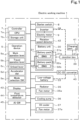
- FIG. 1 is an electrical block diagram of the electric working machine 1.
- a controller 7 includes a CPU 7a and a storage unit 7b.
- the CPU 7a controls the operation of each unit of the electric working machine 1 illustrated in FIG. 1 .
- the storage unit 7b is constituted by a volatile memory, a nonvolatile memory, and the like. Information, data, programs, and the like used by the CPU 7a to control the operation of each unit are stored in a readable and writable manner in the storage unit 7b.
- the operation device 5 has operation members such as a work operation lever 5a, a travel operation lever 5b, an unload lever 5c, an accelerator dial 5d, and a mode selection SW (switch) 5e.
- the operation device 5 also has a potentiometer, a switch, a sensor, or the like (not illustrated) for detecting whether each of the operation members 5a to 5e is operated, the operating position thereof, or the operating amount thereof.
- the work operation lever 5a is a member for operating the actuation of the working device 20.
- the travel operation lever 5b is a member for operating the actuation of the traveling device 10.
- the work operation lever 5a and the travel operation lever 5b are each illustrated as one block for convenience. However, a plurality of work operation levers 5a and a plurality of travel operation levers 5b are actually provided.
- the work operation lever 5a and the travel operation lever 5b are examples of the "work operation member" of the present invention.
- the unload lever 5c is a member that can be switched between a load position (first position) for permitting the actuation of the working device 20 and an unload position (second position) for not permitting (prohibiting) the actuation of the working device 20.
- the unload lever 5c is disposed, for example, at a side of the operator's seat 4 ( FIG. 5 ) so as to be capable of swinging up and down.
- the unload lever 5c By the unload lever 5c swinging down to be in the load position (first position, lowered position), the passage for the operator to get on and off an operator's room 4R is closed. By the unload lever 5c swinging up to be in the unload position (second position, raised position), the passage is opened.
- the unload lever 5c is an example of the "unload operation member” of the present invention.
- the unload lever 5c is also an example of a configuration included in the "switching member" of the present invention.
- the accelerator dial 5d is rotated to specify the rotation speed of the electric motor 9.
- the angle range in which the accelerator dial 5d can be rotated corresponds to a specification range in which the rotation speed of the electric motor 9 can be specified. Therefore, by changing the operating position of the accelerator dial 5d, a specified value for the rotation speed of the electric motor 9 can also be changed. Specifically, the controller 7 calculates the specified value for the rotation speed of the electric motor 9 according to the operation state of the accelerator dial 5d (whether it is operated and the operating position).
- the accelerator dial 5d is an example of the "specification member" of the present invention.
- the mode selection SW 5e is a switch that is operated to select either a normal mode (first mode) for controlling the driving of the electric motor 9, or an ECO mode (ecology mode, second mode) for reducing electric power consumption more than the normal mode.
- the mode selection SW 5e is an example of the "selection member" of the present invention.
- a starter SW switch 8 which can be operated by the operator seated on the operator's seat 4.
- the starter SW 8 is operated to start and stop the electric working machine 1. Specifically, when the starter SW 8 is turned on, the controller 7 starts each unit of the electric working machine 1. In addition, when the starter SW 8 is turned off, the controller 7 stops each unit of the electric working machine 1.
- the electric motor 9 is a drive source (one example of a prime mover) of the electric working machine 1 and is constituted by, for example, a permanent magnet embedded type three-phase AC synchronous motor.
- An inverter 38 is a motor driving device that drives the electric motor 9. The inverter 38 is connected to the electric motor 9 and a junction box 39.
- the junction box 39 is connected to a battery unit 30, a DC-DC converter 40, and a charging port 41.
- the junction box 39 outputs electric power output from the battery unit 30 to the inverter 38 and the DC-DC converter 40.
- the inverter 38 converts DC power input from the battery unit 30 via the junction box 39 into three-phase AC power and supplies the three-phase AC power to the electric motor 9. As a result, the electric motor 9 is driven. In addition, the inverter 38 can freely adjust the current and voltage of electric power to be supplied to the electric motor 9.
- the controller 7 controls the operation of the inverter 38 to drive and stop the electric motor 9.
- a rotation speed detector 42 is constituted by a sensor that detects the rotation speed (actual rotation speed) of the electric motor 9, an encoder, a pulse generator, or the like.
- the controller 7 controls, for example, based on the rotation speed (actual rotation speed) of the electric motor 9 detected by the rotation speed detector 42, the driving of the electric motor 9 by the inverter 38. More specifically, the controller 7 controls the driving of the electric motor 9 by the inverter 38 such that the actual rotation speed of the electric motor 9 detected by the rotation speed detector 42 coincides with the target rotation speed (specified value by the accelerator dial 5d or one of predetermined rotation speeds R1 to R3 described later).
- the DC-DC converter 40 is a voltage converter that converts the voltage of the direct current input from the battery unit 30 via the junction box 39 into a different voltage.
- the DC-DC converter 40 is a step-down converter that converts a high voltage of the battery unit 30 into a predetermined low voltage according to electrical equipment provided in the electric working machine 1.
- the DC-DC converter 40 supplies electric power to a low-voltage battery 33 after voltage conversion.
- the electrical equipment provided in the electric working machine 1 includes lighting, a heater, and the like in addition to the units illustrated in FIG 1 .
- the charging port 41 has a connector (not illustrated) into which a charging cable (not illustrated) is fitted and a connection detector 41a.
- the charging port 41 is connected to an external power source (e.g., commercial power source) via the charging cable.
- the connection detector 41a is constituted by a sensor or the like that detects the connection of the external power source by the charging cable fitted into the charging port 41.
- the junction box 39 outputs, to the battery unit 30, electric power input from the external power source via the charging cable through the charging port 41.
- the battery unit 30 is charged with the electric power input from the charging port 41 via the junction box 39.
- the battery unit 30 has a plurality of battery packs 31 and 32.
- Each of the battery packs 31 and 32 is a secondary battery (storage battery) such as a lithium ion battery constituted by at least one battery.
- the battery packs 31 and 32 are constituted by a plurality of batteries, the plurality of batteries are electrically connected in series and/or in parallel.
- the batteries constituting each of the battery packs 31 and 32 have a plurality of cells therein, and the plurality of cells are electrically connected in series and/or in parallel.
- Each of the battery packs 31 and 32 has an electric capacity sufficient to operate each unit of the electric working machine 1 for a predetermined time.
- the battery packs 31 and 32 are connected in parallel.
- the battery unit 30 is provided with the two battery packs 31 and 32.
- the number of battery packs included in the battery unit 30 is not limited to two and may be one, or three or more.
- connection switches 31a and 32a are provided with connection switches 31a and 32a, respectively.
- Each of the connection switches 31a and 32a is constituted by, for example, a relay, a switch, or the like and can be switched between a connected state and a disconnected state.
- the controller 7 outputs electric power from one of the plurality of battery packs 31 and 32 to the junction box 39 and stops the output of electric power from the other battery pack by switching one connection switch of the connection switches 31a and 32a to the connected state and switching the other connection switch to the disconnected state. That is, the controller 7 controls the output and stop of the electric power of each of the battery packs 31 and 32.
- the controller 7 switches the connection state inside the junction box 39 to connect or disconnect the inverter 38, the DC-DC converter 40, or the charging port 41 to each of the battery packs 31 and 32.
- the junction box 39 and the connection switches 31a and 32a are connection switches that switch between connection and disconnection of the inverter 38, the DC-DC converter 40, and the charging port 41 to and from each of the battery packs 31 and 32.
- Each of the battery packs 31 and 32 is further provided with BMUs (battery management units; battery monitors) 31b and 32b.
- BMUs battery management units; battery monitors
- the BMUs 31b and 32b are provided within the corresponding battery packs 31 and 32.
- the BMUs 31b and 32b may be built in the corresponding battery packs 31 and 32 or may be disposed outside the battery packs 31 and 32.
- the BMU 31b monitors and controls the corresponding battery pack 31.
- the BMU 32b monitors and controls the corresponding battery pack 32.
- the BMUs 31b and 32b control the opening and closing of relays provided inside the battery packs 31 and 32 to control the start and stop of electric power supply from the battery packs 31 and 32.
- the BMUs 31b and 32b detect the temperatures, voltages, currents, internal cell terminal voltages, or the like of the battery packs 31 and 32.
- the BMUs 31b and 32b detect a remaining capacity (remaining electric power amount) of the battery packs 31 and 32 by a voltage measurement method, based on the internal cell terminal voltages of the battery packs 31 and 32, for example.
- the method of detecting the remaining capacity of the battery packs 31 and 32 is not limited to the voltage measurement method, but may be other methods such as a Coulomb counting method, a battery cell modeling method, an impedance tracking method, and the like.
- a capacity detector for detecting the remaining capacity of the battery packs 31 and 32 may be provided separately from the BMUs 31b and 32b.
- the low-voltage battery 33 is a storage battery with a lower voltage than the battery unit 30.
- the low-voltage battery 33 is charged with electric power supplied from the DC-DC converter 40.
- the low-voltage battery 33 supplies the electric power to the electrical equipment provided in the electric working machine 1.
- a radiator 35 cools cooling water for cooling high-heat generating electric devices such as the electric motor 9, the inverter 38, the DC-DC converter 40, and the battery unit 30.
- the high-heat generating electric devices are electric devices that generate more heat than other electric devices provided in the electric working machine 1 when operated with electric power.
- the cooling water is not simply water, but is a liquid that does not freeze even in cold regions.
- the radiator 35 has a fan motor 35a, a radiator fan that is rotationally driven by the power of the fan motor 35a, and a heat exchanger (not illustrated).
- the fan motor 35a is driven by the electric power of the low-voltage battery 33.
- a cooling pump 36 is provided in a cooling water passage (not illustrated) disposed within the machine body 2 together with the radiator 35 and the above high-heat generating electric devices.
- the cooling pump 36 delivers and circulates the cooling water to and through the cooling water passage.
- An oil cooler 37 cools the hydraulic fluid that has passed through hydraulic devices such as the hydraulic actuators ML, MR, MT, and C1 to C5 described above and hydraulic pumps P1 and P2 and a control valve CV (illustrated in FIG. 2 or the like) described below.
- the oil cooler 37 has a fan motor 37a, an oil cooler fan that is rotationally driven by the power of the fan motor 37a, and a heat exchanger (not illustrated).
- the fan motor 37a is driven by the electric power of the low-voltage battery 33.
- the oil cooler 37 is an example of the "cooler" of the present invention.
- a display 43 is constituted by a liquid crystal display, a touch panel, or the like, and displays various kinds of information.
- a fluid temperature detector 44 is constituted by a sensor that detects the temperature of the hydraulic fluid.
- the temperature of the hydraulic fluid will be referred to as "hydraulic fluid temperature.”
- An AI (auto-idling)-SW (switch) 45 is constituted by a pressure sensor that is actuated by the hydraulic pressure of the hydraulic fluid.
- the AI-SW 45 is turned on when at least one of the working devices 20 and 10 is actuated, and is turned off when neither of the working devices 20 and 10 is actuated. That is, the AI-SW 45 detects whether the working devices 20 and 10 are actuated.
- the AI-SW 45 is an example of the "work detector" of the present invention.
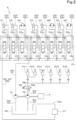
- FIG. 2 is a diagram illustrating a hydraulic circuit K provided in the electric working machine 1.
- the hydraulic circuit K is provided with hydraulic devices such as the hydraulic actuators C1 to C5, ML, MR, and MT, the control valve CV, the hydraulic pumps P1 and P2, a hydraulic fluid tank 48, the oil cooler 37, operation valves PV1 to PV6, an unload valve 58, and a fluid passage 50.
- These hydraulic pumps P1 and P2 are driven by the power of the electric motor 9.
- the actuation hydraulic pump P1 sucks the hydraulic fluid stored in the hydraulic fluid tank 48 and then delivers the hydraulic fluid to the control valve CV.
- FIG. 2 illustrates the one actuation hydraulic pump P1.
- an appropriate number of actuation hydraulic pumps P1 may be provided so as to supply the hydraulic fluid to each of the hydraulic actuators C1 to C5, ML, MR, and MT.
- the control hydraulic pump P2 sucks the hydraulic fluid stored in the hydraulic fluid tank 48 and then delivers the hydraulic fluid to output a hydraulic pressure for signals, control, or the like. That is, the control hydraulic pump P2 supplies (delivers) a pilot fluid.
- An appropriate number of control hydraulic pumps P2 may be provided too.
- the control valve CV has a plurality of control valves V1 to V8. Each of the control valves V1 to V8 adjusts the control (adjustment) of the flow rate of the hydraulic fluid to be output from the hydraulic pumps P1 and P2 to each of the hydraulic actuators C1 to C5, ML, MR, and MT.
- the swing control valve V1 controls the flow rate of the hydraulic fluid to be supplied to the swing cylinder C1.
- the boom control valve V2 controls the flow rate of the hydraulic fluid to be supplied to the boom cylinder C2.
- the arm control valve V3 controls the flow rate of the hydraulic fluid to be supplied to the arm cylinder C3.
- the bucket control valve V4 controls the flow rate of the hydraulic fluid to be supplied to the bucket cylinder C4.
- the dozer control valve V5 controls the flow rate of the hydraulic fluid to be supplied to the dozer cylinder C5.
- the left traveling control valve V6 controls the flow rate of the hydraulic fluid to be supplied to the left traveling motor ML.
- the right traveling control valve V7 controls the flow rate of the hydraulic fluid to be supplied to the right traveling motor MR.
- the swivel control valve V8 controls the flow rate of the hydraulic fluid to be supplied to the swivel motor MT.
- the operation valves (remote control valves) PV1 to PV6 are actuated in response to the operation of the operation levers 5a and 5b ( FIG. 1 ) included in the operation device 5.
- the pilot fluid acts on each of the control valves V1 to V8 in proportion to the actuating amount (operating amount) of each of the operation valves PV1 to PV6, causing a spool of each of the control valves V1 to V8 to move linearly.
- the hydraulic fluid is supplied to the hydraulic actuators C1 to C5, ML, MR, and MT to be controlled, at a flow rate proportional to the amount of movement of the spool of each of the control valves V1 to V8.
- the hydraulic actuators C1 to C5, ML, MR, and MT are driven according to the amount of hydraulic fluid supplied from the control valves V1 to V8.
- the fluid passage 50 is constituted by, for example, a hose or a pipe made of a material such as metal.
- the fluid passage 50 is a flow passage that connects each unit provided in the hydraulic circuit K and allows the hydraulic fluid or pilot fluid to flow to each unit.
- the fluid passage 50 includes a first fluid passage 51, a second fluid passage 52, a first suction fluid passage 54, a second suction fluid passage 55, and a restriction fluid passage 57.
- the first suction fluid passage 54 is a flow passage through which the hydraulic fluid sucked from the hydraulic fluid tank 48 by the actuation hydraulic pump P1 flows.
- the second suction fluid passage 55 is a flow passage through which the hydraulic fluid sucked from the hydraulic fluid tank 48 by the control hydraulic pump P2 flows.
- the first fluid passage 51 is a flow passage through which the hydraulic fluid delivered from the actuation hydraulic pump P1 flows toward the control valves V1 to V8 of the control valve CV.
- the first fluid passage 51 branches into a plurality of passages within the control valve CV and is connected to each of the control valves V1 to V8.
- the second fluid passage 52 is a flow passage through which the hydraulic fluid that has passed through the control valves V1 to V8 flows toward the hydraulic fluid tank 48.
- the hydraulic fluid tank 48 stores the hydraulic fluid.
- the second fluid passage 52 includes at least one reciprocating fluid passage 52a and a drain fluid passage 52b.
- a plurality of reciprocating fluid passages 52a are provided so as to connect each of the control valves V1 to V8 to a corresponding one of the hydraulic actuators C1 to C5, ML, MR, and MT to be controlled.
- the reciprocating fluid passage 52a is a flow passage that supplies the hydraulic fluid from the connected control valves V1 to V8 to the hydraulic actuators C1 to C5, ML, MR, and MT and returns the hydraulic fluid from the hydraulic actuators C1 to C5, ML, MR, and MT to the control valves V1 to V8.
- One end of the drain fluid passage 52b branches into a plurality of passages connected to the respective control valves V1 to V8. The other end of the drain fluid passage 52b is connected to the hydraulic fluid tank 48.
- Part of the hydraulic fluid that flows through the first fluid passage 51 to any one of the control valves V1 to V8 passes through the one of the control valves V1 to V8 and one side of the reciprocating fluid passage 52a and is supplied to any one of the hydraulic actuators C1 to C5, ML, MR, and MT to be controlled. Then, the hydraulic fluid delivered from the one of the hydraulic actuators C1 to C5, ML, MR, and MT returns to the connected one of the control valves V1 to V8 through the other side of the reciprocating fluid passage 52a, passes through the one of the control valves V1 to V8, and flows into the drain fluid passage 52b.
- the drain fluid passage 52b is provided with the oil cooler 37.
- the oil cooler 37 cools the hydraulic fluid that flows from any one of the control valves V1 to V8 through the drain fluid passage 52b.
- the hydraulic fluid cooled in the oil cooler 37 returns to the hydraulic fluid tank 48 through the drain fluid passage 52b.
- the fluid passages 54, 51, and 52 are arranged to circulate the hydraulic fluid to the hydraulic fluid tank 48, the hydraulic pump P1, and the control valves V1 to V8 of the control valve CV (part of the hydraulic fluid is also circulated to the hydraulic actuators C1 to C5, ML, MR, and MT).
- the restriction fluid passage 57 is a flow passage through which the hydraulic fluid delivered by the control hydraulic pump P2 flows to the operation valves PV1 to PV6.
- One end of the restriction fluid passage 57 is connected to the control hydraulic pump P2, and the other end thereof is branched into a plurality of passages connected to the primary ports (primary ports) of the respective operation valves PV1 to PV6.
- the restriction fluid passage 57 is provided with the unload valve 58, which is a two-position switching valve.
- the unload valve 58 switches between a first position 58a and a second position 58b in response to the operation of the unload lever 5c ( FIG. 1 ).
- the hydraulic fluid is supplied from the actuation hydraulic pump P1 to the hydraulic actuators C1 to C5, ML, MR, and MT, permitting the actuation of the hydraulic actuators C1 to C5, ML, MR, and MT, the working device 20, and the traveling device 10.
- the unload valve 58 is switched to the first position (fluid supply position, load position) 58a by the controller 7, and the hydraulic fluid delivered from the control hydraulic pump P2 to the restriction fluid passage 57 is supplied to the operation valves PV1 to PV6, making the control valves V1 to V8 operable.
- This also makes it possible to operate the hydraulic actuators C1 to C5, ML, MR, and MT, the working device 20, and the traveling device 10, and the actuation of these units C1 to C5, ML, MR, MT, 20, and 10 is permitted.
- the hydraulic fluid delivered from the operation valves PV1 to PV6 returns to the hydraulic fluid tank 48 through a separate drain fluid passage (not illustrated).
- the unload valve 58 When the unload lever 5c is operated to be in the unload position (second position), the unload valve 58 is switched to the second position (fluid interrupted position, unload position) 58b by the controller 7, and the hydraulic fluid delivered from the control hydraulic pump P2 to the restriction fluid passage 57 is not supplied to the operation valves PV1 to PV6, making the control valves V1 to V8 inoperable (operation prohibited state).
- This also makes it not possible to operate the hydraulic actuators C1 to C5, ML, MR, and MT, the working device 20, and the traveling device 10, and the actuation of these units C1 to C5, ML, MR, MT, 20, and 10 is not permitted.
- the unload lever 5c but also the unload valve 58 is an example of a configuration included in the "switching member" of the present invention.
- the hydraulic circuit K is provided with an operation detection fluid passage (not illustrated) for detecting the operation states of the control valves V1 to V8.
- the operation detection fluid passage is a fluid passage that returns the pilot fluid delivered from the control hydraulic pump P2 to the hydraulic fluid tank 48 via a plurality of switching valves for switching the positions of the control valves V1 to V8.
- the AI-SW 45 FIG. 1
- the control valve V1 which is disposed closest to the control hydraulic pump P2.
- FIG. 3 is a diagram illustrating an example of a control map for the rotation speed of the electric motor 9.
- the control map in FIG. 3 illustrates a graph of a correlation between the hydraulic fluid temperature and a control value for the rotation speed of the electric motor 9.
- the horizontal axis represents the hydraulic fluid temperature [°C]
- the vertical axis represents the rotation speed [rpm] of the electric motor 9.
- the data representing the control map in FIG. 3 is stored in advance in the storage unit 7b ( FIG. 1 ) of the controller 7.
- the controller 7 determines whether a hydraulic fluid temperature T detected by the fluid temperature detector 44 is in any one of five predetermined temperature ranges I to V illustrated in FIG. 3 .
- the third temperature range III is an allowable temperature range and is higher than or equal to a predetermined temperature T2 (for example, 30°C) and lower than or equal to a predetermined temperature T3 (for example, 87°C).
- the temperatures T2 and T3 and the allowable temperature range T2 to T3 are set to, for example, hydraulic fluid temperatures and a temperature range that allow each unit of the electric working machine 1 to operate stably.
- the first temperature range I is set to temperatures lower than a predetermined temperature T1 (for example, 2°C).
- the second temperature range II is set to temperatures higher than or equal to the temperature T1 and lower than the temperature T2.
- the fourth temperature range IV is set to temperatures higher than the temperature T3 and lower than or equal to a predetermined temperature T4 (for example, 103°C).
- the temperature T1 is an example of the "first temperature” of the present invention
- the temperature T4 is an example of the "second temperature” of the present invention.
- the fourth temperature range IV is set to temperatures higher than the temperature T4 (for example, 103°C).
- the controller 7 controls a rotation speed R of the electric motor 9 within predetermined ranges R1 to R5 according to the hydraulic fluid temperature T, the unload lever 5c, and the state of the AI-SW 45 while the electric motor 9 is being driven.
- the first rotation speed R1 is a rotation speed (for example, 0 rpm) that corresponds to a stopped state of the electric motor 9.
- the second rotation speed R2 is a rotation speed (for example, 250 rpm) of the electric motor 9 at which a hydraulic pressure of the hydraulic fluid can be generated, the hydraulic pressure enabling the AI-SW 45 to detect whether the working devices 20 and 10 are actuated. More specifically, the second rotation speed R2 is set to the rotation speed of the electric motor 9 for generating a hydraulic pressure higher than or equal to the minimum hydraulic pressure of the hydraulic fluid, at which the AI-SW 45 can be turned on when at least one of the working devices 20 and 10 is actuated, and the AI-SW 45 can be turned off when the working devices 20 and 10 are not actuated.
- the third rotation speed R3 is the lower limit (for example, 1,000 rpm) of the rotation speed of the electric motor 9 for the working devices 20 and 10 to perform work. More specifically, the third rotation speed R3 is set to a rotation speed in a no-load state of the electric motor 9 that can instantly actuate the working devices 20 and 10 in response to the operation of the operation levers 5a and 5b.
- the third rotation speed R3 is a rotation speed higher than the first rotation speed R1 and the second rotation speed R2 and is also an idling rotation speed.
- the second rotation speed R2 is a rotation speed higher than the first rotation speed R1 and lower than the third rotation speed R3.
- the second rotation speed R2 is also an idling rotation speed lower than the rotation speed of the electric motor 9 when the working devices 20 and 10 perform work.
- the fifth rotation speed R5 is the predetermined maximum rotation speed (for example, 2,200 rpm) that can be set for the electric motor 9.
- the fourth rotation speed R4 is a rotation speed that is limited to be lower than the fifth rotation speed R5 and is higher than the third rotation speed R3.
- the above-described numerical values of the temperatures T1 to T4 and the rotation speeds R1 to R5 are examples and are not limited to the above.
- the first rotation speed R1 corresponding to the stopped state of the electric motor 9 is not limited to 0 rpm and may be an extremely low rotation speed, for example, lower than 1 rpm.
- the controller 7 when the controller 7 sets the rotation speed of the electric motor 9 to 0 rpm (first rotation speed), the controller 7 continues the electric power supply from the inverter 38 to the electric motor 9.
- the controller 7 may interrupt the electric power supply from the inverter 38 to the electric motor 9 to completely stop the electric motor 9, thereby setting the rotation speed of the electric motor 9 to 0 rpm.
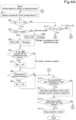
- FIGS. 4A to 4C are flowcharts illustrating control operations of the rotation speed of the electric motor 9 in the electric working machine 1.
- the series of control operations illustrated in FIGS. 4A to 4C are executed by the CPU 7a ( FIG. 1 ) of the controller 7, based on a software program and the control map in FIG. 3 that are stored in advance in the storage unit 7b.
- the rotation speed of the electric motor 9 will be referred to as "motor rotation speed.”
- the controller 7 In response to the operator turning on the starter SW 8, the controller 7 starts the electric motor 9 by the inverter 38. While the electric motor 9 is being driven, the controller 7 detects the hydraulic fluid temperature T by the fluid temperature detector 44 (S1 in FIG. 4A ).
- the controller 7 checks the mode selected by the mode selection SW 5e ( FIG. 1 ). At this time, when the normal mode is selected by the mode selection SW 5e (S3: NO in FIG. 4A ), the controller 7 sets a specified range Rrange for the motor rotation speed R by the accelerator dial 5d ( FIG. 1 ) to be higher than or equal to the third rotation speed R3 and lower than or equal to the fifth rotation speed R5 (S5 in FIG. 4A , circled S in the allowable temperature range III in FIG. 3 ). That is, the controller 7 sets the third rotation speed R3 as the lower limit of the specified range Rrange for the motor rotation speed R by the accelerator dial 5d and sets the fifth rotation speed R5 as the upper limit thereof.
- the controller 7 sets the specified range Rrange for the motor rotation speed R by the accelerator dial 5d to be higher than or equal to the third rotation speed R3 and lower than or equal to the fourth rotation speed R4 (S4 in FIG. 4A , circled E in the allowable temperature range III in FIG. 3 ). That is, the controller 7 sets the third rotation speed R3 as the lower limit of the specified range Rrange for the motor rotation speed R by the accelerator dial 5d and sets the fourth rotation speed R4 as the upper limit thereof.
- the controller 7 controls the motor rotation speed R to coincide with the second rotation speed R2 (S7 in FIG. 4A , black circles in the allowable temperature range III in FIG. 3 ).
- S6 and S7 in FIG. 4A are so-called AI (auto-idling) control.
- the controller 7 calculates a specified value for the motor rotation speed R according to the operating position of the accelerator dial 5d and changes the motor rotation speed R to coincide with the specified value (S11 in FIG. 4A ).
- the controller 7 calculates the specified value for the motor rotation speed R according to the operating position of the accelerator dial 5d within the specified range Rrange (R3 to R5) set in S5 in FIG. 4A .
- the controller 7 calculates the specified value for the motor rotation speed R according to the operating position of the accelerator dial 5d within the specified range Rrange (R3 to R4) set in S4 in FIG. 4A .
- the controller 7 determines that there has been an instruction to stop the electric motor 9 (S12: YES in FIG. 4A ) and stops the electric power supply to the electric motor 9 by the inverter 38, thereby stopping the driving of the electric motor 9 (S13 in FIG. 4A ). As a result, the electric working machine 1 enters the stopped state.
- the controller 7 determines that there is no instruction to stop the electric motor 9 (S12: NO in FIG. 4A ) and executes the process in and after S1 again. In this case, the electric motor 9 is being driven.
- the controller 7 determines whether the hydraulic fluid temperature T is in the temperature range I or II.
- the controller 7 checks the mode selected by the mode selection SW 5e. At this time, when the normal mode is selected by the mode selection SW 5e (S16: NO in FIG. 4B ), the controller 7 sets the specified range Rrange for the motor rotation speed R by the accelerator dial 5d to be higher than or equal to the third rotation speed R3 and lower than or equal to the fifth rotation speed R5 (S18 in FIG. 4B , circled S in the high temperature range II in FIG. 3 ).
- the controller 7 sets the specified range Rrange for the motor rotation speed R by the accelerator dial 5d to be higher than or equal to the third rotation speed R3 and lower than or equal to the fourth rotation speed R4 (S17 in FIG. 4B , circled E in the high temperature range II in FIG. 3 ).
- the controller 7 controls the motor rotation speed R to coincide with the third rotation speed R3 (S20 in FIG. 4B , black circles in the high temperature range II in FIG. 3 ).
- S19 and S20 in FIG. 4B are also AI control.
- the controller 7 controls the motor rotation speed R to coincide with the third rotation speed R3 (S22 in FIG. 4B ).
- the controller 7 does not execute AS (auto-stop) control, but continues to rotationally drive the electric motor 9 at the third rotation speed R3 or higher to circulate the hydraulic fluid for warming up.
- S19 to S22 in FIG. 4B are so-called warming-up control.
- the controller 7 calculates the specified value for the motor rotation speed R according to the operating position of the accelerator dial 5d and changes the motor rotation speed R to coincide with the specified value (S11 in FIG. 4A ).
- the controller 7 calculates the specified value for the motor rotation speed R according to the operating position of the accelerator dial 5d within the specified range Rrange (R3 to R5) set in S18 in FIG. 4B .
- the controller 7 calculates the specified value for the motor rotation speed R according to the operating position of the accelerator dial 5d within the specified range Rrange (R3 to R4) set in S17 in FIG. 4B .
- the controller 7 sets the specified range Rrange for the motor rotation speed R by the accelerator dial 5d to be higher than or equal to the third rotation speed R3 and lower than or equal to the fourth rotation speed R4 (S17 in FIG. 4B , circled S and circled E in the extremely low temperature range I in FIG. 3 ).
- the controller 7 controls the motor rotation speed R to coincide with the third rotation speed R3 (S20 and S22 in FIG. 4B , black circles in the extremely low temperature range I in FIG. 3 ).
- the controller 7 does not execute AS (auto-stop) control, but continues to rotationally drive the electric motor 9 at the third rotation speed R3 or higher to circulate the hydraulic fluid for warming up.
- the controller 7 calculates the specified value for the motor rotation speed R according to the operating position of the accelerator dial 5d and changes the motor rotation speed R to coincide with the specified value (S11 in FIG. 4A ).
- the controller 7 calculates the specified value for the motor rotation speed R according to the operating position of the accelerator dial 5d within the specified range Rrange (R3 to R4) set in S17 in FIG. 4B .
- the controller 7 determines whether the hydraulic fluid temperature T is in the temperature range IV or V.
- the controller 7 checks the mode selected by the mode selection SW 5e. At this time, when the normal mode is selected by the mode selection SW 5e (S24: NO in FIG. 4C ), the controller 7 sets the specified range Rrange for the motor rotation speed R by the accelerator dial 5d to be higher than or equal to the third rotation speed R3 and lower than or equal to the fifth rotation speed R5 (S26 in FIG. 4C , circled S in the high temperature range IV in FIG. 3 ).
- the controller 7 sets the specified range Rrange for the motor rotation speed R by the accelerator dial 5d to be higher than or equal to the third rotation speed R3 and lower than or equal to the fourth rotation speed R4 (S25 in FIG. 4C , circled E in the high temperature range IV in FIG. 3 ).
- the controller 7 controls the motor rotation speed R to coincide with the second rotation speed R2 (S28 in FIG. 4C , black circles in the high temperature range IV in FIG. 3 ).
- S27 and S28 in FIG. 4C are also AI control.
- the controller 7 controls the motor rotation speed R to coincide with the second rotation speed R2 (S30 in FIG. 4C , black circles in the high temperature range IV in FIG. 3 ).
- the controller 7 does not execute AS (auto-stop) control, but continues to rotationally drive the electric motor 9 at the second rotation speed R2, which is lower than third rotation speed R3, to circulate the hydraulic fluid for cooling the hydraulic fluid.
- S27 to S30 in FIG. 4C are so-called cooling control.
- the controller 7 calculates the specified value for the motor rotation speed R according to the operating position of the accelerator dial 5d and changes the motor rotation speed R to coincide with the specified value (S11 in FIG. 4A ).
- the controller 7 calculates the specified value for the motor rotation speed R according to the operating position of the accelerator dial 5d within the specified range Rrange (R3 to R5) set in S26 in FIG. 4C .
- the controller 7 calculates the specified value for the motor rotation speed R according to the operating position of the accelerator dial 5d within the specified range Rrange (R3 to R4) set in S25 in FIG. 4C .
- the controller 7 sets the upper limit and the lower limit of the specified range Rrange for the motor rotation speed R by the accelerator dial 5d to be the third rotation speed R3 (S31 in FIG. 4C , circled S and circled E in the extremely high temperature range V in FIG. 3 ). That is, when the hydraulic fluid temperature T is within the extremely high temperature range V, the specified range Rrange for the motor rotation speed R by the accelerator dial 5d is set to the constant third rotation speed R3. Therefore, regardless of whether the accelerator dial 5d is operated to any position from the neutral position, the specified value for the motor rotation speed R becomes the third rotation speed R3, and the rotation speed R of the electric motor 9 is limited to the third rotation speed R3.
- the controller 7 controls the motor rotation speed R to coincide with the second rotation speed R2 (S30 in FIG. 4C , black circles in the extremely high temperature range V in FIG. 3 ).
- the controller 7 does not execute AS control, but continues to rotationally drive the electric motor 9 at the second rotation speed R2 to circulate the hydraulic fluid for cooling the hydraulic fluid.
- the controller 7 calculates the specified value for the motor rotation speed R and changes the motor rotation speed R to coincide with the specified value (S11 in FIG. 4A ). At this time, since the hydraulic fluid temperature T is in the extremely high temperature range V, regardless of the mode selected by the mode selection SW 5e and the operating position of the accelerator dial 5d, the controller 7 determines the constant value R3 set in S31 in FIG. 4C as the specified value for the motor rotation speed R.
- the controller 7 may cool the hydraulic fluid by rotationally driving the fan motor 37a of the oil cooler 37 at a predetermined rotation speed when controlling the motor rotation speed R to coincide with the second rotation speed R2. In other words, when the working devices 20 and 10 are not actuated, while the electric motor 9 is rotated at the second rotation speed R2, the oil cooler 37 is driven to cool the hydraulic fluid.
- the controller 7 may reduce electric power consumption and promote warming up of the hydraulic fluid by stopping the oil cooler 37 when controlling the motor rotation speed R to coincide with the third rotation speed R3. Furthermore, also in a case in which the hydraulic fluid temperature T is within the allowable temperature range III, the controller 7 may reduce electric power consumption by stopping the oil cooler 37 when controlling the motor rotation speed R to coincide with the first rotation speed R1 or the second rotation speed R2.
- the temperature range of the hydraulic fluid temperature T is divided into five, which are the first to fifth temperature ranges I to V.
- the present invention is not limited to this.
- the temperature range of the hydraulic fluid temperature T may be divided into two, which are inside the allowable temperature range and outside the allowable temperature range.
- the temperature range of the hydraulic fluid temperature T may be divided into three, which are within the allowable temperature range, a temperature range lower than the allowable temperature range, and a temperature range higher than the allowable temperature range.
- the temperature range of the hydraulic fluid temperature T may be divided into four, or six or more.
- three or more predetermined rotation speeds may be set in addition to the two rotation speeds, which are the second rotation speed R2 and the third rotation speed R3.
- the controller 7 may change the second to fourth rotation speeds R2 to R4 according to the remaining capacity of the battery packs 31 and 32 provided in the battery unit 30. Specifically, as the remaining capacity of the battery packs 31 and 32 decreases, at least one of the second to fourth rotation speeds R2 to R4 may be changed to be lower.
- the work operation lever 5a and the travel operation lever 5b are used as the work operation members
- the unload lever 5c is used as the switching member and the unload operation member
- the mode selection SW 5e is used as the selection member
- the accelerator dial 5d is used as the specification member.
- various operation members such as a lever, a joystick, a slide switch, a tumbler switch, a push button, a dial, and a key may be used as the work operation member, the switching member, the unload operation member, the selection member, and the specification member.
- the unload valve 58 may be a mechanically actuated valve or an electrically actuated solenoid valve.
- the above embodiment has illustrated an example in which the AI-SW 45 made up of a pressure switch is used as the work detector.
- the present invention is not limited to this.
- a potentiometer, a sensor, a switch, or the like that detects whether the work operation lever 5a and the travel operation lever 5b are operated may be used as the work detector.
- An electric working machine 1 of the present embodiment has the following configuration and provides the following effects.
- An electric working machine 1 of the present embodiment includes: a machine body 2; a battery unit 30 mounted on the machine body 2; an electric motor 9 to be driven by the electric power from the battery unit 30; at least one hydraulic device (at least one of hydraulic motors ML, MR, and MT, at least one of hydraulic cylinders C1 to C5, at least one of hydraulic pumps P1 and P2, and/or control valve CV) to be actuated by the power from the electric motor 9; at least one working device 20 or 10 (working device 20 or traveling device 10) to be actuated by a hydraulic pressure of a hydraulic fluid supplied from the at least one hydraulic device; a controller 7 to control driving of the electric motor 9; at least one switching member 5c or 58 (unload lever 5c or unload valve 58) operable to be switched between a first position for permitting actuation of the at least one working device 20 or 10 and a second position for not permitting the actuation of the at least one working device 20 or 10; and a fluid temperature detector 44 to detect a temperature T of the
- the rotation speed R of the electric motor 9 decreases to the first rotation speed R1 corresponding to the stopped state. Accordingly, it is possible to suppress wasteful consumption of the electric power of the battery unit 30 by the electric motor 9, thereby reducing wasteful electric power consumption in the electric working machine 1 and improving the working efficiency.
- the rotation speed R of the electric motor 9 is not controlled to the first rotation speed R1. Accordingly, the electric motor 9 continues to rotate without completely entering the stopped state, so that the hydraulic fluid can be circulated by at least one hydraulic device such as at least one hydraulic pump P1 or P2 to warm up or cool the hydraulic fluid, thereby improving the working efficiency.
- the rotation speed R of the electric motor 9 is controlled to at least one predetermined idling rotation speed R2 or R3 higher than the first rotation speed R1 and lower than or equal to a lower limit of the rotation speed when the at least one working device 20 or 10 perform work.
- the rotation speed R of the electric motor 9 is decreased to the first rotation speed R1 or the at least one idling rotation speed R2 or R3 depending on whether the temperature T of the hydraulic fluid is within the allowable temperature range III. Accordingly, wasteful electric power consumption can be reduced. In addition, the reduction in wasteful electric power consumption allows the operating time of the at least one working device 20 or 10 to be extended, thereby improving the working efficiency.
- the controller 7 is configured or programmed to: if the temperature T of the hydraulic fluid is lower than the allowable temperature range III, control the rotation speed R of the electric motor 9 to coincide with a predetermined third rotation speed R3 for the at least one working device 20 or 10 to enter an idling state; and if the temperature T of the hydraulic fluid is higher than the allowable temperature range III, control the rotation speed R of the electric motor 9 to a predetermined second rotation speed R2 higher than the first rotation speed R1 and lower than the third rotation speed R3.
- the rotation speed R of the electric motor 9 is decreased to the third rotation speed R3. Accordingly, wasteful electric power consumption can be reduced, and the at least one hydraulic device such as the at least one hydraulic pump P1 or P2 can be actuated to circulate the hydraulic fluid for warming up, thereby shortening the time taken for warming up.
- the rotation speed R of the electric motor 9 is decreased to the second rotation speed R2, which is lower than the third rotation speed R3.
- wasteful electric power consumption can be reduced, and the hydraulic fluid can be circulated for cooling. Furthermore, as described above, when the at least one switching member 5c or 58 is switched to the second position, the rotation speed R of the electric motor 9 is controlled to one of the first to third rotation speeds R1 to R3 according to the temperature T of the hydraulic fluid. Accordingly, wasteful electric power consumption can be reduced while maintaining a balance between warming up and cooling of the hydraulic fluid.
- the electric working machine 1 includes a work detector (AI-SW) 45 to be actuated by the hydraulic pressure of the hydraulic fluid so as to detect whether the at least one working device 20 or 10 is actuated, and the second rotation speed R2 is set to a rotation speed R such as to cause the hydraulic fluid to have a hydraulic pressure that enables the work detector 45 to detect whether the at least one working device is actuated. Accordingly, even when the rotation speed R of the electric motor 9 is decreased to the second rotation speed R2, the work detector 45 can detect whether the at least one working device 20 or 10 is actuated.
- AI-SW work detector
- the controller 7 is configured or programmed to control the rotation speed R of the electric motor 9 to coincide with the third rotation speed R3 if the temperature T of the hydraulic fluid is lower than the allowable temperature range III, and control the rotation speed R of the electric motor 9 to the second rotation speed R2 if the temperature T of the hydraulic fluid is higher than or equal to the allowable temperature range III.
- the rotation speed R of the electric motor 9 is decreased to the third rotation speed R3 or the second rotation speed R2 depending on whether the temperature T of the hydraulic fluid is high or low relative to the allowable temperature range III, and wasteful electric power consumption can be reduced, and also, the hydraulic fluid can be circulated for warming up or cooling.
- the electric working machine 1 includes a specification member (accelerator dial) 5d to be operated to specify the rotation speed R of the electric motor 9, and the controller 7 is configured or programmed to set, according to the temperature T of the hydraulic fluid, the rotation speed R of the electric motor 9 specifiable by operation of the specification member 5d.
- the controller 7 is configured or programmed to calculate a specified value for the rotation speed R of the electric motor 9 according to an operation state of the specification member 5d and control the rotation speed R of the electric motor 9 to coincide with the specified value.
- the rotation speed R of the electric motor 9 can be controlled according to the operation state of the specification member 5d and the temperature T of the hydraulic fluid to circulate the hydraulic fluid at an appropriate flow rate and pressure, thereby enabling the at least one working device 20 or 10 to be actuated stably.
- the controller 7 is configured or programmed to set a specified range Rrange for the motor rotation speed R specifiable by operation of the specification member 5d within the range from the third rotation speed R3 of the electric motor 9 for the at least one working device 20 or 10 so as to enter the idling state to a maximum rotation speed (fifth rotation speed) R5, which is an upper limit of the settable rotation speed of the electric motor 9. Accordingly, the rotation speed R of the electric motor 9 can be changed within an appropriate range according to the operation state of the specification member 5d and the temperature T of the hydraulic fluid.
- the electric working machine 1 includes a selection member (mode selection SW) 5e to select either a first mode (normal mode) or a second mode (ECO mode) that reduces electric power consumption more than the first mode, and the controller 7 is configured or programmed to, when the temperature T of the hydraulic fluid is within the allowable temperature range III, set an upper limit of a specified range Rrange for the rotation speed R of the electric motor 9 by operation of the specification member 5d when the second mode is selected by the selection member 5e to be smaller than the upper limit of the specified range Rrange when the first mode is selected by the selection member 5e.
- mode selection SW mode selection SW
- ECO mode second mode
- the upper limit of the rotation speed R of the electric motor 9 can be kept lower than the upper limit value of the rotation speed R when the first mode is selected, thereby reducing electric power consumption.
- the controller 7 is configured or programmed to, when the temperature T of the hydraulic fluid is lower than a predetermined first temperature T1 lower than the allowable temperature range III, regardless of whether the first mode or the second mode is selected by the selection member 5e, set the upper limit of the specified range Rrange for the rotation speed R of the electric motor 9 by the operation of the specification member 5d to a value smaller than a predetermined maximum rotation speed R5.
- the maximum rotation speed R5 is, for example, an upper limit of the rotation speed of the electric motor 9 specifiable by the specification member 5d when the temperature T of the hydraulic fluid is within the allowable temperature range III and the first mode is selected by the selection member 5e.
- the rotation speed R of the electric motor 9 can be kept lower than the maximum rotation speed R5, thereby preventing cavitation from occurring in the at least one hydraulic device or at least one fluid passage through which the hydraulic fluid flows and reducing electric power consumption.
- the controller 7 is configured or programmed to, when the temperature T of the hydraulic fluid is higher than a predetermined second temperature T4 higher than the allowable temperature range III, regardless of whether the first mode or the second mode is selected by the selection member 5e, set the rotation speed R of the electric motor 9 specifiable by the specification member 5d to the third rotation speed R3 (upper limit and lower limit of the specified range Rrange). Accordingly, when the temperature T of the hydraulic fluid is in the extremely high temperature range V, the hydraulic fluid in the high temperature state can be prevented from flowing to wear and damage the hydraulic devices or fluid passages.
- the electric working machine 1 includes a cooler (oil cooler) 37 to cool the hydraulic fluid
- the controller 7 is configured or programmed to: when the temperature T of the hydraulic fluid detected by the fluid temperature detector 44 is higher than the allowable temperature range III, drive the cooler 37 to cool the hydraulic fluid; and when the temperature T of the hydraulic fluid is lower than or equal to the allowable temperature range III, stop the cooler 37.
- the temperature T of the hydraulic fluid is high, if the at least one switching member 5c or 58 is switched to the second position, or the at least one working device 20 or 10 is not actuated for a predetermined time or longer, by rotating the electric motor 9 at the second rotation speed R2, which is low, wasteful electric power consumption can be reduced, and by using the cooler 37 in combination, the time taken to cool the hydraulic fluid to the allowable temperature range III can be shortened.
- the temperature T of the hydraulic fluid is low, by stopping the cooler 37, wasteful electric power consumption can be reduced, and by rotating the electric motor 9 to circulate the hydraulic fluid, the hydraulic fluid can be warmed up.
- the electric working machine 1 includes: an inverter 38 to adjust the electric power supplied from the battery unit 30 to the electric motor 9; a rotation speed detector 42 to detect the rotation speed R of the electric motor 9; and at least one work operation member 5a or 5b (work operation lever 5a or travel operation lever 5b) to operate the actuation of the at least one working device 20 or 10,
- the at least one switching member 5c or 58 includes an unload operation member 5c switchable between a load position for permitting the actuation of the at least one working device 20 or 10 and an unload position for not permitting the actuation of the at least one working device 20 or 10
- the controller 7 is configured or programmed to control the rotation speed R of the electric motor 9 by adjusting the electric power supplied from the inverter 38 to the electric motor 9, based on the rotation speed R of the electric motor 9 detected by the rotation speed detector 42.
- the unload operation member 5c by switching the unload operation member 5c to either the load position or the unload position, the actuation of the at least one working device 20 or 10 can be permitted or not permitted.
- the rotation speed R of the electric motor 9 can be reliably set to the specified value by the specification member 5d or one of the predetermined rotation speeds R1 to R3.
- the AI-SW 45 can detect whether the at least one work operation member 5a or 5b is operated, which corresponds to whether the at least one working device 20 or 10 are actuated.
- the present invention is applied to the electric working machine 1 such as a backhoe.
- the application target of the present invention is not limited to this, and the present invention may be applied to other construction machines such as a wheel loader, a compact track loader, and a skid-steer loader and may be applied to agricultural machines such as a tractor, a combine, a rice transplanter, and a lawn mower.
Landscapes
- Engineering & Computer Science (AREA)
- Mining & Mineral Resources (AREA)
- Civil Engineering (AREA)
- General Engineering & Computer Science (AREA)
- Structural Engineering (AREA)
- Power Engineering (AREA)
- Transportation (AREA)
- Mechanical Engineering (AREA)
- Operation Control Of Excavators (AREA)
Applications Claiming Priority (2)
| Application Number | Priority Date | Filing Date | Title |
|---|---|---|---|
| JP2022060020 | 2022-03-31 | ||
| PCT/JP2023/008995 WO2023189344A1 (ja) | 2022-03-31 | 2023-03-09 | 電動作業機 |
Publications (2)
| Publication Number | Publication Date |
|---|---|
| EP4501690A1 true EP4501690A1 (de) | 2025-02-05 |
| EP4501690A4 EP4501690A4 (de) | 2026-04-08 |
Family
ID=88200682
Family Applications (1)
| Application Number | Title | Priority Date | Filing Date |
|---|---|---|---|
| EP23779371.6A Pending EP4501690A4 (de) | 2022-03-31 | 2023-03-09 | Elektrische arbeitsmaschine |
Country Status (4)
| Country | Link |
|---|---|
| US (1) | US20250019935A1 (de) |
| EP (1) | EP4501690A4 (de) |
| JP (1) | JP7711310B2 (de) |
| WO (1) | WO2023189344A1 (de) |
Family Cites Families (14)
| Publication number | Priority date | Publication date | Assignee | Title |
|---|---|---|---|---|
| JPH06346488A (ja) * | 1993-06-07 | 1994-12-20 | Yutani Heavy Ind Ltd | デセル付レバーロック装置 |
| JP3113562B2 (ja) * | 1995-12-01 | 2000-12-04 | 新キャタピラー三菱株式会社 | 車両における電気機器制御方法 |
| JP3552588B2 (ja) | 1999-04-30 | 2004-08-11 | トヨタ自動車株式会社 | 車両の制御装置 |
| JP5341040B2 (ja) | 2010-08-18 | 2013-11-13 | 日立建機株式会社 | 電動式建設機械 |
| KR101891376B1 (ko) * | 2012-01-25 | 2018-09-28 | 가부시키가이샤 히다치 겡키 티에라 | 건설 기계 |
| DE112013000129B4 (de) * | 2013-07-26 | 2016-12-01 | Komatsu Ltd. | Arbeitsfahrzeug und Verfahren zum Steuern des Arbeitsfahrzeugs |
| JP6259380B2 (ja) | 2014-09-12 | 2018-01-10 | 日立建機株式会社 | ハイブリッド式建設機械 |
| JP6247236B2 (ja) | 2015-01-22 | 2017-12-13 | 日立建機株式会社 | 建設機械 |
| JP6695792B2 (ja) * | 2016-12-28 | 2020-05-20 | 株式会社クボタ | 作業機の油圧システム |
| JP6552998B2 (ja) * | 2016-06-24 | 2019-07-31 | 株式会社クボタ | 作業機 |
| JP6944426B2 (ja) * | 2018-09-05 | 2021-10-06 | 株式会社日立建機ティエラ | 電動式建設機械 |
| JP7321899B2 (ja) | 2019-11-18 | 2023-08-07 | 株式会社クボタ | 作業機 |
| JP7321900B2 (ja) * | 2019-11-18 | 2023-08-07 | 株式会社クボタ | 旋回作業機 |
| JP7422610B2 (ja) * | 2020-06-02 | 2024-01-26 | ヤンマーホールディングス株式会社 | 電動式建設機械 |
-
2023
- 2023-03-09 WO PCT/JP2023/008995 patent/WO2023189344A1/ja not_active Ceased
- 2023-03-09 EP EP23779371.6A patent/EP4501690A4/de active Pending
- 2023-03-09 JP JP2024511629A patent/JP7711310B2/ja active Active
-
2024
- 2024-09-26 US US18/897,199 patent/US20250019935A1/en active Pending
Also Published As
| Publication number | Publication date |
|---|---|
| EP4501690A4 (de) | 2026-04-08 |
| WO2023189344A1 (ja) | 2023-10-05 |
| JP7711310B2 (ja) | 2025-07-22 |
| US20250019935A1 (en) | 2025-01-16 |
| JPWO2023189344A1 (de) | 2023-10-05 |
Similar Documents
| Publication | Publication Date | Title |
|---|---|---|
| US20240083265A1 (en) | Electric working machine and charging system for electric working machine | |
| EP2889432B1 (de) | Elektrische baumaschine | |
| US12345014B2 (en) | Swiveling working machine | |
| JP7581380B2 (ja) | 電動作業機 | |
| WO2019208370A1 (ja) | 電動式作業機械 | |
| WO2021131118A1 (ja) | 作業機 | |
| US12583281B2 (en) | Working machine | |
| JP2020051065A (ja) | 電動式建設機械 | |
| KR20180022624A (ko) | 제어 시스템, 작업 기계, 및 제어 방법 | |
| US20250003193A1 (en) | Working machine | |
| EP4501690A1 (de) | Elektrische arbeitsmaschine | |
| EP4502294A1 (de) | Elektrische arbeitsmaschine | |
| JP7379319B2 (ja) | 作業機 | |
| US12500541B2 (en) | Electric working machine and method of controlling electric working machine | |
| JP7830311B2 (ja) | 電動作業機、及び電動作業機の制御方法 | |
| JP2025143006A (ja) | 作業機械の制御方法、制御プログラム、制御システム、および作業機械 | |
| JP7736521B2 (ja) | 電動式建設機械 | |
| JP2024094639A (ja) | 電動作業機、及び電動作業機の制御方法 | |
| CN121110766A (zh) | 作业机械的控制方法、作业机械的控制程序、作业机械的控制系统以及作业机械 |
Legal Events
| Date | Code | Title | Description |
|---|---|---|---|
| STAA | Information on the status of an ep patent application or granted ep patent |
Free format text: STATUS: THE INTERNATIONAL PUBLICATION HAS BEEN MADE |
|
| PUAI | Public reference made under article 153(3) epc to a published international application that has entered the european phase |
Free format text: ORIGINAL CODE: 0009012 |
|
| STAA | Information on the status of an ep patent application or granted ep patent |
Free format text: STATUS: REQUEST FOR EXAMINATION WAS MADE |
|
| 17P | Request for examination filed |
Effective date: 20241029 |
|
| AK | Designated contracting states |
Kind code of ref document: A1 Designated state(s): AL AT BE BG CH CY CZ DE DK EE ES FI FR GB GR HR HU IE IS IT LI LT LU LV MC ME MK MT NL NO PL PT RO RS SE SI SK SM TR |
|
| DAV | Request for validation of the european patent (deleted) | ||
| DAX | Request for extension of the european patent (deleted) | ||
| A4 | Supplementary search report drawn up and despatched |
Effective date: 20260306 |
|
| RIC1 | Information provided on ipc code assigned before grant |
Ipc: B60L 15/20 20060101AFI20260302BHEP Ipc: E02F 9/20 20060101ALI20260302BHEP Ipc: B60L 9/18 20060101ALI20260302BHEP Ipc: B60L 50/60 20190101ALI20260302BHEP Ipc: E02F 9/22 20060101ALI20260302BHEP Ipc: B60L 1/00 20060101ALI20260302BHEP |