EP4496019A1 - Fertigungsvorrichtung - Google Patents
Fertigungsvorrichtung Download PDFInfo
- Publication number
- EP4496019A1 EP4496019A1 EP23770513.2A EP23770513A EP4496019A1 EP 4496019 A1 EP4496019 A1 EP 4496019A1 EP 23770513 A EP23770513 A EP 23770513A EP 4496019 A1 EP4496019 A1 EP 4496019A1
- Authority
- EP
- European Patent Office
- Prior art keywords
- metal foil
- pressure bonding
- bonding roller
- pair
- protrusion
- Prior art date
- Legal status (The legal status is an assumption and is not a legal conclusion. Google has not performed a legal analysis and makes no representation as to the accuracy of the status listed.)
- Pending
Links
Images



Classifications
-
- B—PERFORMING OPERATIONS; TRANSPORTING
- B23—MACHINE TOOLS; METAL-WORKING NOT OTHERWISE PROVIDED FOR
- B23K—SOLDERING OR UNSOLDERING; WELDING; CLADDING OR PLATING BY SOLDERING OR WELDING; CUTTING BY APPLYING HEAT LOCALLY, e.g. FLAME CUTTING; WORKING BY LASER BEAM
- B23K20/00—Non-electric welding by applying impact or other pressure, with or without the application of heat, e.g. cladding or plating
- B23K20/04—Non-electric welding by applying impact or other pressure, with or without the application of heat, e.g. cladding or plating by means of a rolling mill
-
- B—PERFORMING OPERATIONS; TRANSPORTING
- B23—MACHINE TOOLS; METAL-WORKING NOT OTHERWISE PROVIDED FOR
- B23K—SOLDERING OR UNSOLDERING; WELDING; CLADDING OR PLATING BY SOLDERING OR WELDING; CUTTING BY APPLYING HEAT LOCALLY, e.g. FLAME CUTTING; WORKING BY LASER BEAM
- B23K20/00—Non-electric welding by applying impact or other pressure, with or without the application of heat, e.g. cladding or plating
- B23K20/26—Auxiliary equipment
-
- H—ELECTRICITY
- H01—ELECTRIC ELEMENTS
- H01M—PROCESSES OR MEANS, e.g. BATTERIES, FOR THE DIRECT CONVERSION OF CHEMICAL ENERGY INTO ELECTRICAL ENERGY
- H01M4/00—Electrodes
- H01M4/02—Electrodes composed of, or comprising, active material
- H01M4/04—Processes of manufacture in general
- H01M4/0402—Methods of deposition of the material
- H01M4/0404—Methods of deposition of the material by coating on electrode collectors
-
- H—ELECTRICITY
- H01—ELECTRIC ELEMENTS
- H01M—PROCESSES OR MEANS, e.g. BATTERIES, FOR THE DIRECT CONVERSION OF CHEMICAL ENERGY INTO ELECTRICAL ENERGY
- H01M4/00—Electrodes
- H01M4/02—Electrodes composed of, or comprising, active material
- H01M4/04—Processes of manufacture in general
- H01M4/043—Processes of manufacture in general involving compressing or compaction
- H01M4/0435—Rolling or calendering
-
- H—ELECTRICITY
- H01—ELECTRIC ELEMENTS
- H01M—PROCESSES OR MEANS, e.g. BATTERIES, FOR THE DIRECT CONVERSION OF CHEMICAL ENERGY INTO ELECTRICAL ENERGY
- H01M4/00—Electrodes
- H01M4/02—Electrodes composed of, or comprising, active material
- H01M4/13—Electrodes for accumulators with non-aqueous electrolyte, e.g. for lithium-accumulators; Processes of manufacture thereof
- H01M4/139—Processes of manufacture
- H01M4/1395—Processes of manufacture of electrodes based on metals, Si or alloys
-
- H—ELECTRICITY
- H01—ELECTRIC ELEMENTS
- H01M—PROCESSES OR MEANS, e.g. BATTERIES, FOR THE DIRECT CONVERSION OF CHEMICAL ENERGY INTO ELECTRICAL ENERGY
- H01M4/00—Electrodes
- H01M4/02—Electrodes composed of, or comprising, active material
- H01M4/64—Carriers or collectors
- H01M4/66—Selection of materials
- H01M4/661—Metal or alloys, e.g. alloy coatings
-
- B—PERFORMING OPERATIONS; TRANSPORTING
- B23—MACHINE TOOLS; METAL-WORKING NOT OTHERWISE PROVIDED FOR
- B23K—SOLDERING OR UNSOLDERING; WELDING; CLADDING OR PLATING BY SOLDERING OR WELDING; CUTTING BY APPLYING HEAT LOCALLY, e.g. FLAME CUTTING; WORKING BY LASER BEAM
- B23K2101/00—Articles made by soldering, welding or cutting
- B23K2101/16—Bands or sheets of indefinite length
-
- B—PERFORMING OPERATIONS; TRANSPORTING
- B23—MACHINE TOOLS; METAL-WORKING NOT OTHERWISE PROVIDED FOR
- B23K—SOLDERING OR UNSOLDERING; WELDING; CLADDING OR PLATING BY SOLDERING OR WELDING; CUTTING BY APPLYING HEAT LOCALLY, e.g. FLAME CUTTING; WORKING BY LASER BEAM
- B23K2101/00—Articles made by soldering, welding or cutting
- B23K2101/36—Electric or electronic devices
-
- B—PERFORMING OPERATIONS; TRANSPORTING
- B23—MACHINE TOOLS; METAL-WORKING NOT OTHERWISE PROVIDED FOR
- B23K—SOLDERING OR UNSOLDERING; WELDING; CLADDING OR PLATING BY SOLDERING OR WELDING; CUTTING BY APPLYING HEAT LOCALLY, e.g. FLAME CUTTING; WORKING BY LASER BEAM
- B23K2103/00—Materials to be soldered, welded or cut
- B23K2103/18—Dissimilar materials
Definitions
- the present disclosure relates to a manufacturing apparatus that manufactures an electrode plate.
- a negative electrode current collector in a secondary battery such as a lithium ion battery is manufactured by arranging a lithium foil on a copper foil. For example, a lithium foil is cut to a predetermined dimension, holes are drilled at regular intervals on a negative electrode current collector surface, an adhesive is applied to the hole, and the cut lithium foil is transferred to the hole of the negative electrode current collector (see, for example, Patent Literature 1).
- Patent Literature 1 JP H6-150935
- the present disclosure addresses the issue described above, and a purpose thereof is to provide a technology for improving the accuracy of manufacturing of an electrode plate.
- a manufacturing apparatus includes: a pair of pressure bonding rollers each having a cylindrical shape.
- a first metal foil and a second metal foil stacked are inserted between the pair of rollers, the first metal foil and the second metal foil are pressure bonded by a rotation of the pair of pressure bonding rollers, and the pair of pressure bonding rollers include a first pressure bonding roller provided on a side of the first metal foil and a second pressure bonding roller different from the first pressure bonding roller.
- the first pressure bonding roller includes a D-cut surface at least in a portion of the cylindrical shape.
- a protrusion is provided in each of two boundaries between a side surface and the D-cut surface of the cylindrical shape in the first pressure bonding roller.
- the accuracy of manufacturing of an electrode plate can be improved.
- Figs. 1A-1B show the structure of a cylindrical battery 1.
- Fig. 1A is a cross-sectional view of the cylindrical battery 1
- Fig. 1B is an exploded perspective view of an electrode group 2.
- the cylindrical battery 1 is, for example, a rechargeable secondary battery such as a lithium ion battery, a nickel-metal hydride battery, and a nickelcadmium battery.
- the cylindrical battery 1 by way of one example has a structure in which the electrode group 2 is stored in an outer can 4 along with an electrolytic solution (not shown).
- the electrode group 2 is cylindrical in shape by way of one example and, as shown in Fig.
- the separator 10 is formed by a microporous film made of, by way of one example, a polypropylene resin or the like.
- the first electrode plate 6 and the second electrode plate 8 have a structure in which an electrode active material layer is stacked on a current collector.
- the current collector is comprised of an aluminum foil or the like when it is a positive electrode and is comprised of a copper foil or the like when it is a negative electrode.
- the electrode active material layer can be formed by applying an electrode mixture material to the surface of the current collector by a known coating apparatus and drying and rolling the material.
- the electrode mixture material is obtained by kneading materials including an electrode active material, a binder, a conductive material, etc. in a dispersion medium and uniformly dispersing the materials.
- the electrode active material is lithium cobalt oxide, lithium iron phosphate, or the like when it is a positive electrode and is graphite or the like when it is a negative electrode.
- the first electrode plate 6 has a first electrode core member 12 that is not coated with an electrode mixture material at the end on one side in the width direction A (a direction that intersects the longitudinal direction of the belt).
- the width direction A is also referred to as "vertical direction”.
- the side of the first electrode plate 6 on which the first electrode core member 12 is disposed by the "upper side” the side of the first electrode plate 6 on which the first electrode core member 12 is not disposed is called the "lower side”.
- the first electrode core member 12 is an exposed portion of the current collector of the first electrode plate 6 in which the electrode active material layer is not stacked.
- the second electrode plate 8 has a second electrode core member 14 not coated with an electrode mixture material on the other side in the width direction A, i.e., at the end opposite to the side where the first electrode core member 12 protrudes. It can be said that the second electrode core member 14 is disposed on the lower side of the second electrode plate 8. The second electrode core member 14 is an exposed portion of the current collector of the second electrode plate 8 in which the electrode active material layer is not stacked.
- the electrode group 2 has a structure in which the first electrode plate 6 and the second electrode plate 8 are wound. For this reason, a plurality of ends of the first electrode plate 6 and the second electrode plate 8 in the width direction A are arranged in the radial direction B of the electrode group 2. Therefore, the electrode group 2 includes a plurality of first electrode core members 12 arranged in the radial direction B and a plurality of second electrode core members 14 arranged in the radial direction B.
- each first electrode core member 12 is bent toward the central axis C of the winding of the electrode group 2, i.e., bent inward in the radial direction B.
- the central axis C of the winding is, for example, the geometric center of the outline of the electrode group 2 seen in the width direction A, i.e., the geometric center of the outline of the shape of the electrode group 2 projected in the width direction A.
- the ends (the second electrode core member 14) of a plurality of second electrode plates 8 arranged in the radial direction B are bent in the radial direction B.
- each second electrode core member 14 is bent toward the central axis C of the winding.
- a first current collector plate 20 is provided on the side in the electrode group 2 where the first electrode core member 12 protrudes, i.e., toward the upper side of the electrode group 2.
- the first current collector plate 20 is made of, for example, aluminum or the like.
- the first electrode core member 12 of the plurality of first electrode plates 6 bent on the upper side are placed in surface contact with the first current collector plate 20.
- Laser welding, etc. of the first current collector plate 20 and the first electrode core member 12 forms a first welded part 30. Thereby, the first electrode plate 6 of each winding layer and the first current collector plate 20 are joined to each other in the first welded part 30.
- a second current collector plate 22 is provided on the side in the electrode group 2 where the second electrode core member 14 protrudes, i.e., on the lower side of the electrode group 2.
- the second current collector plate 22 is made of, for example, copper, nickel, nickel-plated copper, nickel-plated iron, and the like.
- the second electrode core member 14 of the plurality of second electrode plates 8 bent on the lower side are in surface contact with the second current collector plate 22.
- Laser welding, etc. of the second current collector plate 22 with the second electrode core member 14 forms a second welded part 32. Thereby, the second electrode plate 8 of each winding layer and the second current collector plate 22 are joined to each other in the second welded part 32.
- the electrode group 2 to which the first current collector plate 20 and the second current collector plate 22 are joined is stored in the bottomed cylindrical outer can 4 along with the electrolytic solution.
- the outer can 4 is made of, for example, copper, nickel, iron, an alloy thereof, or the like.
- the second current collector plate 22 is joined to the inner bottom surface of the outer can 4 by welding or the like.
- the first current collector plate 20 is joined to a sealing plate 26 made of the same metal as the outer can 4 by welding or the like.
- the sealing plate 26 is fitted into the opening of the outer can 4 via an insulating gasket 24. Thereby, the electrode group 2 and the electrolytic solution are sealed in the outer can 4.
- FIG. 2 is a side view showing a structure of a manufacturing apparatus 180.
- a first metal foil roll member 100 has a first metal foil 200 wrapped around it.
- the first metal foil 200 is a lithium foil (about 10 um) that is a negative electrode active material.
- the second metal foil roll member 102 has a second metal foil 202 wrapped around it.
- the second metal foil 202 is a copper foil (about 13 um) that is a negative electrode current collector.
- the third metal foil roll member 104 has a third metal foil 204 wrapped around it.
- the third metal foil 204 is a lithium foil (about 10 um) that is a negative electrode active material.
- the first metal foil 200 and the second metal foil 202 are different metals, and the first metal foil 200 and the third metal foil 204 are the same metal.
- the width of the second metal foil 202 is narrower than the width of the first metal foil 200 and the width of the third metal foil 204.
- the first metal foil 200 is drawn from the first metal foil roll member 100
- the second metal foil 202 is drawn from the second metal foil roll member 102
- the third metal foil 204 is drawn from the third metal foil roll member 104.
- the first metal foil 200, the second metal foil 202, and the third metal foil 204 travel toward a first pressure bonding roller 110 and a second pressure bonding roller 112 forming a pair of pressure bonding rollers. In that process, the first metal foil 200, the second metal foil 202, and the third metal foil 204 are stacked in that order from top to bottom.
- the first pressure bonding roller 110 and the second pressure bonding roller 112 are arranged in the vertical direction. To describe it specifically, the first pressure bonding roller 110 is provided on the side of the first metal foil 200, and the second pressure bonding roller 112 is provided on the side of the third metal foil 204.
- the first metal foil 200, the second metal foil 202, and the third metal foil 204 stacked are inserted between the first pressure bonding roller 110 and the second pressure bonding roller 112.
- the first pressure bonding roller 110 and the second pressure bonding roller 112 have a cylindrical shape and are rotatable.
- the first metal foil 200, the second metal foil 202, and the third metal foil 204 are pressure bonded by the rotation of the first pressure bonding roller 110 and the second pressure bonding roller 112.
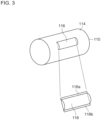
- Fig. 3 is a perspective view showing a structure of the first pressure bonding roller 110.
- the first pressure bonding roller 110 has a cylindrical shape and is covered with a side surface 114.
- a D-cut surface 116 is formed on a portion of the side surface 114.
- a first protrusion 118a and a second protrusion 118b are respectively provided in the two boundaries between the side surface 114 and the D-cut surface 116.
- the first protrusion 118a and the second protrusion 118b are collectively referred to as a protrusion 118.
- the protrusion 118 has, for example, a semi-cylindrical shape or a triangular prism shape.
- the height of the protrusion 118 from the side surface 114 is 20% to 70% and, preferably, 50%, of the thickness of the first metal foil 200.
- the height of the protrusion 118 may be varied by a spring.
- the second pressure bonding roller 112 also has the same structure as the first pressure bonding roller 110.
- the second pressure bonding roller 112 is provided with a third protrusion (not shown) similar to the first protrusion 118a and with a fourth protrusion (not shown) similar to the second protrusion 118b.
- the third and fourth processes are collectively referred to as a protrusion.
- the height of the protrusion of the second pressure bonding roller 112 is 20% to 70% and, preferably, 50%, of the thickness of the third metal foil 204. Reference is made back to Fig. 2 .
- the timing of pressure bonding by the protrusion 118 of the first pressure bonding roller 110 and the timing of pressure bonding by the protrusion (not shown) of the second pressure bonding roller 112 are synchronized. This is equivalent to the time when the D-cut surface 116 of the first pressure bonding roller 110 pressure-bonds the first metal foil 200 and the time when the D-cut surface (not shown) of the second pressure bonding roller 112 pressure-bonds the third metal foil 204 coinciding.
- a vertical alignment jig is used, but a description thereof is omitted here.
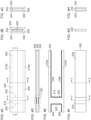
- Figs. 4A-4H show a structure of a laminated body manufactured by the manufacturing apparatus 180.
- Fig. 4A is a top view of the first metal foil 200, the second metal foil 202 (not shown), and the third metal foil 204 (not shown) pressure bonded by the first pressure bonding roller 110 and the second pressure bonding roller 112 as viewed from the side of the first metal foil 200 side.
- a first boundary 300 is formed by the first protrusion 118a of the first pressure bonding roller 110 and the third protrusion of the second pressure bonding roller 112, and a second boundary 302 is formed by the second protrusion 118b of the first pressure bonding roller 110 and the fourth protrusion of the second pressure bonding roller 112.
- the first boundary 300 and the second boundary 302 are formed not only in the first metal foil 200 but also in the third metal foil 204. That is, each protrusion forms the first boundary 300 and the second boundary 302 by molding. In that process, the height of each protrusion is set as described above in consideration of the impact on the second metal foil 202.
- This portion represents an interval portion 212.
- pressure bonding is performed by the side surface 114 of the first pressure bonding roller 110 and the side surface (not shown) of the second pressure bonding roller 112.
- the pressure bonding force of the interval portion 212 is weaker than the pressure bonding force of the portions other than the interval portion 212. That is, pressure bonding of the first metal foil 200 through the third metal foil 204 and formation of the interval portion 212 are both performed in a series of steps.
- Fig. 4B is a cross-sectional view in A-A' direction of Fig. 4A , that is, a cross-sectional view of the interval portion 212.
- a weakly pressure bonded portion 220 is provided between the first metal foil 200 and the second metal foil 202, and a weakly pressure bonded portion 220 is also provided between the second metal foil 202 and the third metal foil 204.
- the weakly pressure bonded portion 220 is a portion with a weak pressure bonding force.
- a portion, of the first metal foil 200 and the third metal foil 204, in contact with one end of the second metal foil 202 is a third boundary 304, and a portion in contact with another end of the second metal foil 202 is a fourth boundary 306.
- the third boundary 304 and the fourth boundary 306 are also provided in the third metal foil 204.
- a portion outside the third boundary 304 is a first surplus portion 210a
- a portion outside the fourth boundary 306 is a second surplus portion 210b.
- the first surplus portion 210a and the second surplus portion 210b are collectively referred to as a surplus portion 210.
- the surplus portion 210 is a portion protruding from the second metal foil 202 and is a portion that does not adhere to the second metal foil 202.
- Fig. 4C is a cross-sectional view in B-B' direction of Fig. 4A .
- the first metal foil 200, the second metal foil 202, and the third metal foil 204 are stacked, and the weakly pressure bonded portion 220 is not provided.
- Fig. 4D is a cross-sectional view in C-C' direction of Fig. 4A .
- the weakly pressure bonded portion 220 is provided only in the interval portion 212, and the weakly pressure bonded portion 220 is not provided in the portions other than the interval portion 212.
- Figs. 4E-4H will be described later, and reference is made back to Fig. 2 .
- a first adhesive tape feed 120 has a first adhesive tape 240 wrapped around it.
- a second adhesive tape feed 122 has a second adhesive tape 242 wrapped around it.
- the first adhesive tape 240 is drawn from the first adhesive tape feed 120
- the second adhesive tape 242 is drawn from the second adhesive tape feed 122.
- the first adhesive tape 240 has a width equal to or greater than the width of the first metal foil 200 and has an adhesive surface on the side of the first metal foil 200.
- the second adhesive tape 242 has a width equal to or greater than the width of the third metal foil 204 and has an adhesive surface on the third metal foil 204 side.
- the first adhesive tape 240, the laminated body of the first metal foil 200 through the third metal foil 204, and the second adhesive tape 242 travel toward a first pressing roller 130 and a second pressing roller 132 forming a pair of pressing rollers. In that process, the first adhesive tape 240, the laminated body of the first metal foil 200 through the third metal foil 204, and the second adhesive tape 242 are stacked in that order from top to bottom.
- the first pressing roller 130 and the second pressing roller 132 are arranged in the vertical direction. To describe it specifically, the first pressing roller 130 is provided on the side of the first adhesive tape 240, and the second pressing roller 132 is provided on the side of the second adhesive tape 242.
- the first adhesive tape 240, the laminated body of the first metal foil 200 through the third metal foil 204, and the second adhesive tape 242 are inserted between the first pressing roller 130 and the second pressing roller 132.
- the first pressing roller 130 and the second pressing roller 132 have a cylindrical shape and are rotatable.
- the first adhesive tape 240 adheres to the first metal foil 200
- the second adhesive tape 242 adheres to the third metal foil 204 by the rotation of the first pressing roller 130 and the second pressing roller 132.
- a first adhesive tape take-up 140 takes up the first adhesive tape 240 from the first pressing roller 130 and the second pressing roller 132
- a second adhesive tape take-up 142 takes up the second adhesive tape 242 from the first pressing roller 130 and the second pressing roller 132.
- the first adhesive tape 240 peels off the portion of the first metal foil 200 that has a weak pressure bonding force with respect to the second metal foil 202, i.e., the surplus portion 210 and the interval portion 212, from the first metal foil 200. Further, by adhesion between the second adhesive tape 242 and the third metal foil 204, the second adhesive tape 242 peels off the portion of the third metal foil 204 that has a weak pressure bonding force with respect to the second metal foil 202, i.e., the surplus portion 210 and the interval portion 212 from the third metal foil 204.
- the first boundary 300 and the second boundary 302 provided in the first metal foil 200 and the third metal foil 204 will have a small depth. If the depth of the first boundary 300 and the second boundary 302 is shallow, the boundary of the interval portion 212 will be difficult to peel off, and a warp may be created in the boundary of the interval portion 212 when the interval portion 212 is peeled off by the first adhesive tape 240 and the second adhesive tape 242.
- the first boundary 300 and the second boundary 302 provided in the first metal foil 200 and the third metal foil 204 will have a large depth. Given a large depth of the first boundary 300 and the second boundary 302, the boundary of the interval portion 212 is easily peeled off, and a warp is created less easily in the boundary of the interval portion 212 when the interval portion 212 is peeled off by the first adhesive tape 240 and the second adhesive tape 242.
- Fig. 4E shows a portion of the first metal foil 200 that has been peeled off by the first adhesive tape 240. As shown, the surplus portion 210 and the interval portion 212 are peeled off. The portion of the third metal foil 204 peeled off by the second adhesive tape 242 will also be as shown in Fig. 4E.
- Fig. 4F shows an electrode plate 280, i.e., a laminated body that remains after the first metal foil 200 and the third metal foil 204 as shown in Fig. 4E have been peeled off.
- the second metal foil 202 is exposed from a portion of the first metal foil 200.
- the second metal foil 202 is also exposed from a portion of the third metal foil 204, although it is not shown here.
- FIG. 4G is a D-D' cross-sectional view of Fig. 4F , which includes only the second metal foil 202.
- Fig. 4H is an E-E' cross-sectional view of Fig. 4F , in which the first metal foil 200, the second metal foil 202, and the third metal foil 204 are stacked.
- a plurality of second electrode plates 8 are produced by cutting the electrode plate 280 into a plurality of pieces.
- the first pressure bonding roller 110 and the second pressure bonding roller 112 are provided with the D-cut surface 116 and the protrusion 118 so that pressure bonding of the first metal foil 200 through the third metal foil 204 and formation of the interval portion 212 are both performed in a series of steps. Further, pressure bonding of the first metal foil 200 through the third metal foil 204 and formation of the interval portion 212 are both performed in a series of steps so that misalignment is prevented when the interval portion 212 is formed. Further, misalignment is prevented when the interval portion 212 is formed so that the accuracy of manufacturing of the electrode plate 280 can be improved.
- the height of the protrusions in the first pressure bonding roller 110 and the second pressure bonding roller 112 are configured to be 20% to 70% of the thickness of the first metal foil 200 and the third metal foil 204 so that it is possible to reduce the impact on the second metal foil 202, while also ensuring a sufficient depth of the first boundary 300 and the second boundary 302. Further, the timing of pressure bonding by the protrusion 118 of the first pressure bonding roller 110 and the timing of pressure bonding by the protrusion of the second pressure bonding roller 112 are synchronized so that the positions of the interval portions 212 in the first metal foil 200 and the third metal foil 204 can be aligned.
- the first metal foil 200 and the third metal foil 204 are pressure bonded to both surfaces of the second metal foil 202.
- the first metal foil 200 is pressure bonded to one surface of the second metal foil 202
- the third metal foil 204 is not pressure bonded to the second metal foil 202.
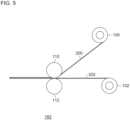
- Fig. 5 is a side view showing a structure of a manufacturing apparatus 182.
- the first metal foil roll member 100 and the second metal foil roll member 102 are the same as those of Fig. 2 .
- the manufacturing apparatus 182 does not include the third metal foil roll member 104.
- the first metal foil 200 is drawn from the first metal foil roll member 100
- the second metal foil 202 is drawn from the second metal foil roll member 102.
- the first metal foil 200 and the second metal foil 202 travel toward the first pressure bonding roller 110 and the second pressure bonding roller 112 forming a pair of pressure bonding rollers. In that process, the first metal foil 200 and the second metal foil 202 are stacked from top to bottom in that order.
- the first pressure bonding roller 110 and the second pressure bonding roller 112 are arranged in the vertical direction.
- the first pressure bonding roller 110 is provided on the side of the first metal foil 200
- the second pressure bonding roller 112 is provided on the side of the second metal foil 202.
- the first metal foil 200 and the second metal foil 202 stacked are inserted between the first pressure bonding roller 110 and the second pressure bonding roller 112.
- the first metal foil 200 and the second metal foil 202 are pressure bonded by the rotation of the first pressure bonding roller 110 and the second pressure bonding roller 112.
- the first pressure bonding roller 110 is provided with the D-cut surface 116 and the protrusion 118.
- the second pressure bonding roller 112 is not provided with a D-cut surface and a protrusion, and a side surface (not shown) is provided.
- the D-cut surface 116 and the protrusion 118 of the first pressure bonding roller 110 form the surplus portion 210 and the interval portion 212 in the first metal foil 200.
- the surplus portion 210 and the interval portion 212 are peeled off by the first adhesive tape 240.
- the D-cut surface 116 and the protrusion 118 are provided in the first pressure bonding roller 110, and a D-cut surface is not provided in the second pressure bonding roller 112 so that pressure-bonding of the first metal foil 200 and the second metal foil 202 and formation of the interval portion 212 in the first metal foil 200 can both be performed in a series of steps. Further, pressure bonding of the first metal foil 200 and the third metal foil 204 and formation of the interval portion 212 in the first metal foil 200 are both performed in a series of steps so that misalignment is prevented when the interval portion 212 is formed. Further, misalignment is prevented when the interval portion 212 is formed so that the accuracy of manufacturing of the electrode plate 280 can be improved.
- the height of the first pressure bonding roller 110 is configured to be 20% to 70% of the thickness of the first metal foil 200 so that it is possible to reduce the impact on the second metal foil 202, while also ensuring a sufficient depth of the first boundary 300 and the second boundary 302.
- embodiment 3 the first pressure bonding roller 110 and the second pressure bonding roller 112 is caused to pressure-bond the first metal foil 200 and the third metal foil 204 on both surfaces of the second metal foil 202 and to form the surplus portion 210 and the interval portion 212 in the first metal foil 200 and the third metal foil 204.
- the arrangement of the pressure bonding rollers is different from that of embodiment 1. The description below highlights a difference from the foregoing.
- Fig. 6 is a side view showing a structure of a manufacturing apparatus 184.
- the first metal foil roll member 100, the second metal foil roll member 102, and the third metal foil roll member 104 are as shown in Fig. 2 .
- the first metal foil 200 is drawn from the first metal foil roll member 100
- the second metal foil 202 is drawn from the second metal foil roll member 102
- the third metal foil 204 is drawn from the third metal foil roll member 104.
- the first metal foil 200, the second metal foil 202, and the third metal foil 204 travel toward the first pressure bonding roller 110 and the second pressure bonding roller 112 forming a pair of pressure bonding rollers. In that process, the first metal foil 200, the second metal foil 202, and the third metal foil 204 are stacked from top to bottom in that order.
- the first pressure bonding roller 110 and the second pressure bonding roller 112 are arranged in the vertical direction. To describe it specifically, the first pressure bonding roller 110 is provided on the side of the first metal foil 200, and the second pressure bonding roller 112 is provided on the side of the third metal foil 204.
- the first metal foil 200, the second metal foil 202, and the third metal foil 204 stacked are inserted between the first pressure bonding roller 110 and the second pressure bonding roller 112.
- the first pressure bonding roller 110 and the second pressure bonding roller 112 have a cylindrical shape and are rotatable.
- the first metal foil 200, the second metal foil 202, and the third metal foil 204 are pressure bonded by the rotation of the first pressure bonding roller 110 and the second pressure bonding roller 112.
- the first pressure bonding roller 110 is provided with the D-cut surface 116 and the protrusion 118.
- the second pressure bonding roller 112 is not provided with a D-cut surface and a protrusion, and a side surface (not shown) is provided.
- the D-cut surface 116 and the protrusion 118 of the first pressure bonding roller 110 form the surplus portion 210 and the interval portion 212 in the first metal foil 200.
- first pressure bonding roller 110 and the second pressure bonding roller 112 are defined as a pair of pressure bonding rollers in the front stage
- a third pressure bonding roller 150 and a fourth pressure bonding roller 152 are referred to as a pair of pressure bonding rollers in the rear stage.
- the first metal foil 200, the second metal foil 202, and the third metal foil 204 that are pressure bonded travel toward the third pressure bonding roller 150 and the fourth pressure bonding roller 152 forming a pair of pressure bonding rollers.
- the third pressure bonding roller 150 and the fourth pressure bonding roller 152 are arranged in the vertical direction. To describe it specifically, the third pressure bonding roller 150 is provided on the side of the first metal foil 200, and the fourth pressure bonding roller 152 is provided on the side of the third metal foil 204.
- the first metal foil 200, the second metal foil 202, and the third metal foil 204 that are pressure bonded are inserted between the third pressure bonding roller 150 and the fourth pressure bonding roller 152.
- the third pressure bonding roller 150 and the fourth pressure bonding roller 152 have a cylindrical shape and are rotatable.
- the first metal foil 200, the second metal foil 202, and the third metal foil 204 are further pressure bonded by the rotation of the third pressure bonding roller 150 and the fourth pressure bonding roller 152.
- the third pressure bonding roller 150 is not provided with a D-cut surface and a protrusion, and a side surface (not shown) is provided.
- a D-cut surface (not shown) and a protrusion (not shown) are provided in a portion of the side surface (not shown) of the fourth pressure bonding roller 152.
- the D-cut surface and the protrusion of the fourth pressure bonding roller 152 form the surplus portion 210 and the interval portion 212 in the third metal foil 204.
- the area of the D-cut surface 116 in the first pressure bonding roller 110 of embodiment 1 is the same as the area of the D-cut surface in the second pressure bonding roller 112.
- the area of the interval portion 212 provided in the first metal foil 200 and the area of the interval portion 212 provided in the third metal foil 204 are also the same.
- the area of the D-cut surface 116 in the first pressure bonding roller 110 of embodiment 3 may be smaller than the area of the D-cut surface in the fourth pressure bonding roller 152. Therefore, the area of the interval portion 212 provided in the first metal foil 200 may be smaller than the area of the interval portion 212 provided in the third metal foil 204.
- the third pressure bonding roller 150 and the fourth pressure bonding roller 152 are provided to follow the first pressure bonding roller 110 and the second pressure bonding roller 112, formation of the interval portion 212 in the first metal foil 200 and formation of the interval portion 212 in the third metal foil 204 can be timed differently. Further, formation of the interval portion 212 in the first metal foil 200 and formation of the interval portion 212 in the third metal foil 204 are timed differently so that the flexibility in the configuration can be improved.
- the area of the D-cut surface 116 in the first pressure bonding roller 110 is configured to be smaller than the area of the D-cut surface in the fourth pressure bonding roller 152 so that the area of the interval portion 212 in the first metal foil 200 can be configured to be smaller than the area of the interval portion 212 in the third metal foil 204. Further, the area of the interval portion 212 in the first metal foil 200 is configured to be smaller than the area of the interval portion 212 in the third metal foil 204 so that the flexibility in the configuration can be improved.
- the height of the protrusions in the first pressure bonding roller 110 and the fourth pressure bonding roller 152 are configured to be 20% to 70% of the thickness of the first metal foil 200 and the third metal foil 204 so that it is possible to reduce the impact on the second metal foil 202, while also ensuring a sufficient depth of the first boundary 300 and the second boundary 302.
- the embodiments may be defined by the following items.
- manufacturing accuracy of an electrode plate can be improved.
- a width direction, B radial direction, C central axis of the winding, D direction of winding, 1 cylindrical battery, 2 electrode group, 4 outer can, 6 first electrode plate, 8 second electrode plate, 10 separator, 12 first electrode core member, 14 second electrode core member, 20 first current collector plate, 22 second current collector plate, 24 insulating gasket, 26 sealing plate, 30 first welded part, 32 second welded part, 100 first metal foil roll member, 102 second metal foil roll member, 104 third metal foil roll member, 110 first pressure bonding roller, 112 second pressure bonding roller, 114 side surface, 116 D-cut surface, 118 protrusion, 120 first adhesive tape feed, 122 second adhesive tape feed, 130 first pressing roller, 132 second pressing roller, 140 first adhesive tape take-up, 142 second adhesive tape take-up, 150 third pressure bonding roller, 152 fourth pressure bonding roller, 180, 182, 184 manufacturing apparatus, 200 first metal foil, 202 second metal foil, 204 third metal foil, 210 surplus portion, 212 interval portion, 220 weakly pressure bonded
Landscapes
- Engineering & Computer Science (AREA)
- Chemical & Material Sciences (AREA)
- Chemical Kinetics & Catalysis (AREA)
- Electrochemistry (AREA)
- General Chemical & Material Sciences (AREA)
- Mechanical Engineering (AREA)
- Manufacturing & Machinery (AREA)
- Materials Engineering (AREA)
- Battery Electrode And Active Subsutance (AREA)
- Connection Of Batteries Or Terminals (AREA)
Applications Claiming Priority (2)
| Application Number | Priority Date | Filing Date | Title |
|---|---|---|---|
| JP2022041569 | 2022-03-16 | ||
| PCT/JP2023/008393 WO2023176557A1 (ja) | 2022-03-16 | 2023-03-06 | 製造装置 |
Publications (2)
| Publication Number | Publication Date |
|---|---|
| EP4496019A1 true EP4496019A1 (de) | 2025-01-22 |
| EP4496019A4 EP4496019A4 (de) | 2025-06-25 |
Family
ID=88023051
Family Applications (1)
| Application Number | Title | Priority Date | Filing Date |
|---|---|---|---|
| EP23770513.2A Pending EP4496019A4 (de) | 2022-03-16 | 2023-03-06 | Fertigungsvorrichtung |
Country Status (5)
| Country | Link |
|---|---|
| US (1) | US20250205808A1 (de) |
| EP (1) | EP4496019A4 (de) |
| JP (1) | JPWO2023176557A1 (de) |
| CN (1) | CN118830097A (de) |
| WO (1) | WO2023176557A1 (de) |
Families Citing this family (1)
| Publication number | Priority date | Publication date | Assignee | Title |
|---|---|---|---|---|
| EP4421902A4 (de) * | 2021-10-22 | 2025-02-26 | Panasonic Intellectual Property Management Co., Ltd. | Walzenpressvorrichtung und pressverfahren |
Family Cites Families (34)
| Publication number | Priority date | Publication date | Assignee | Title |
|---|---|---|---|---|
| JP2870037B2 (ja) * | 1989-09-05 | 1999-03-10 | ソニー株式会社 | リチウム負極の製造装置 |
| JPH06150935A (ja) | 1992-11-12 | 1994-05-31 | Yuasa Corp | 負極集電体の製造方法 |
| JPH09330707A (ja) * | 1996-06-10 | 1997-12-22 | Fuji Photo Film Co Ltd | リチウム箔密着用ローラおよびその製造方法 |
| JP4688406B2 (ja) * | 2003-04-17 | 2011-05-25 | セイコーインスツル株式会社 | 端子付き電気化学セル |
| JP2006320917A (ja) * | 2005-05-17 | 2006-11-30 | Honda Motor Co Ltd | マスキング部材、レーザ溶接方法および電気化学素子の製造方法 |
| JP2006324323A (ja) * | 2005-05-17 | 2006-11-30 | Honda Motor Co Ltd | 電気化学素子における溶接領域のレーザ溶接方法 |
| US20090173721A1 (en) * | 2006-03-10 | 2009-07-09 | Kouji Ueoka | Method and apparatus for welding electrode collectors and terminals of electrical storage element |
| JP4880664B2 (ja) * | 2007-12-28 | 2012-02-22 | 株式会社神戸製鋼所 | パルスレーザ溶接用アルミニウム合金材及び電池ケース |
| FR2933424B1 (fr) * | 2008-07-07 | 2011-03-25 | Alcan Rhenalu | Procede de preparation avant soudage de produits en alliage aluminium-lithium |
| US8722238B2 (en) * | 2009-11-23 | 2014-05-13 | Greatbatch Ltd. | Direct resistance welding—self brazing of aluminum to molybdenum pin |
| US8535395B2 (en) * | 2011-03-23 | 2013-09-17 | GM Global Technology Operations LLC | Beam welding of a multi-sheet work stack having a reduced thickness feature |
| JP6007502B2 (ja) * | 2012-02-13 | 2016-10-12 | 株式会社Gsユアサ | 蓄電素子の製造方法 |
| CN104584272B (zh) * | 2012-08-28 | 2017-03-15 | 株式会社杰士汤浅国际 | 蓄电装置的制造方法以及蓄电装置 |
| JP6101513B2 (ja) * | 2012-12-27 | 2017-03-22 | 株式会社アマダミヤチ | 金属箔の重ね接合方法及び接合構造体 |
| JP6176524B2 (ja) * | 2013-06-25 | 2017-08-09 | 株式会社Gsユアサ | 蓄電装置及び該蓄電装置の製造方法 |
| EP3188874B1 (de) * | 2014-09-01 | 2019-10-30 | Toyota Motor Europe | System und verfahren zum schweissen mit einem laserstrahlpunktlinearprofil, das in bezug auf die bewegungsrichtung schräg ausgerichtet ist |
| FR3034259B1 (fr) * | 2015-03-27 | 2021-08-27 | Accumulateurs Fixes | Procede de traitement mecanique d'une piece de connexion electrique pour generateur electrochimique |
| JP6372453B2 (ja) * | 2015-09-07 | 2018-08-15 | トヨタ自動車株式会社 | 積層電極体の製造方法 |
| WO2018043739A1 (ja) * | 2016-09-05 | 2018-03-08 | ナグシステム株式会社 | 積層金属箔の製造方法 |
| US11329312B2 (en) * | 2017-04-03 | 2022-05-10 | Lg Energy Solution, Ltd. | Pre-lithiation apparatus, method of producing negative electrode unit and negative electrode unit |
| US10944096B2 (en) * | 2018-04-10 | 2021-03-09 | GM Global Technology Operations LLC | Method of manufacturing a lithium metal negative electrode |
| FR3084529B1 (fr) * | 2018-07-24 | 2022-03-25 | Armor | Procede de fabrication d'un collecteur de courant et dispositifs associes |
| US11367864B2 (en) * | 2018-11-08 | 2022-06-21 | Tesla, Inc. | Intermittently coated dry electrode for energy storage device and method of manufacturing the same |
| DE102018221843A1 (de) * | 2018-12-14 | 2020-06-18 | Volkswagen Aktiengesellschaft | Ultraschallschweißvorrichtung sowie Verfahren zur Herstellung eines Metallfolienstapels |
| JP7331573B2 (ja) * | 2019-09-19 | 2023-08-23 | 株式会社Gsユアサ | 蓄電素子 |
| AT523340B1 (de) * | 2020-01-09 | 2022-12-15 | Miba Battery Systems Gmbh | Spannvorrichtung |
| US11446764B2 (en) * | 2020-03-24 | 2022-09-20 | Corelase Oy | Laser welding stacked foils |
| WO2021246529A1 (ja) * | 2020-06-04 | 2021-12-09 | 古河電気工業株式会社 | 溶接方法、溶接装置、金属積層体、電気部品、および電気製品 |
| JP7592983B2 (ja) * | 2020-06-05 | 2024-12-03 | 株式会社Gsユアサ | 蓄電素子の製造方法、及び、蓄電素子 |
| DE102020120263B3 (de) * | 2020-07-31 | 2021-12-09 | Manz Ag | Verschweißen von metallischen Folien mittels Laser |
| WO2022113023A1 (en) * | 2020-11-26 | 2022-06-02 | Manz Italy S.R.L. | Assembling method and apparatus to assemble a power storage device using impulsive welding action |
| NL2028135B1 (en) * | 2021-05-04 | 2022-11-10 | Leydenjar Tech B V | Electrode assembly for a battery having an ultrasonic weld, method for manufacture and use of the assembly |
| CN116135398B (zh) * | 2021-11-16 | 2025-07-04 | 通快(中国)有限公司 | 改善方法、焊接方法、加工系统、控制装置、程序产品 |
| CN120674699A (zh) * | 2025-06-24 | 2025-09-19 | 厦门海辰储能科技股份有限公司 | 端盖组件、储能装置及用电设备 |
-
2023
- 2023-03-06 JP JP2024507766A patent/JPWO2023176557A1/ja active Pending
- 2023-03-06 CN CN202380025887.7A patent/CN118830097A/zh active Pending
- 2023-03-06 WO PCT/JP2023/008393 patent/WO2023176557A1/ja not_active Ceased
- 2023-03-06 US US18/845,585 patent/US20250205808A1/en active Pending
- 2023-03-06 EP EP23770513.2A patent/EP4496019A4/de active Pending
Also Published As
| Publication number | Publication date |
|---|---|
| EP4496019A4 (de) | 2025-06-25 |
| JPWO2023176557A1 (de) | 2023-09-21 |
| US20250205808A1 (en) | 2025-06-26 |
| CN118830097A (zh) | 2024-10-22 |
| WO2023176557A1 (ja) | 2023-09-21 |
Similar Documents
| Publication | Publication Date | Title |
|---|---|---|
| US12206063B2 (en) | Button cells and method of producing same | |
| EP3477729B1 (de) | Wiederaufladbare lithium-ionen-knopfzellenbatterie | |
| JP6208687B2 (ja) | 円筒形二次電池及びその製造方法 | |
| CN103891024B (zh) | 具备螺旋电极体的电池及其制造方法 | |
| US8956748B2 (en) | Battery | |
| US10062873B2 (en) | Secondary battery and battery pack using the same | |
| EP0975041A2 (de) | Flache Zellen | |
| CN102804473A (zh) | 具有卷绕电极的纽扣电池及其制造方法 | |
| US20210210813A1 (en) | Top Plate for Laser Welded Lithium-Ion Button Cell Battery | |
| JP2008300141A (ja) | 積層型二次電池およびその製造方法 | |
| JPH09306471A (ja) | 非水電解質二次電池およびその製造方法 | |
| EP4496019A1 (de) | Fertigungsvorrichtung | |
| US10608233B2 (en) | Method of manufacturing secondary battery | |
| US11552374B2 (en) | Electrode for non-aqueous electrolyte secondary battery and non-aqueous electrolyte secondary battery | |
| CN104981316A (zh) | 叠层金属箔的制造方法、包含叠层金属箔的制造方法的密封型电池的制造方法以及密封型电池 | |
| JPH10302839A (ja) | 非水電解質二次電池及びそのセパレータ並びにこれらの製造方法 | |
| CN111261832A (zh) | 二次电池及其制造方法 | |
| EP4401178A1 (de) | Batterieherstellungsverfahren und batterie | |
| JP3749010B2 (ja) | 非水電解液電池の製造方法 | |
| EP4350822A1 (de) | Fügeverfahren | |
| JP7161373B2 (ja) | 二次電池 | |
| JPH06140028A (ja) | 負極集電体及びその製造方法 | |
| EP4503154A1 (de) | Elektrodenplatte und elektrodenplattenherstellungsverfahren | |
| JP3558328B2 (ja) | 非水電解液二次電池およびその製造方法 | |
| JP5064146B2 (ja) | 電極板用金属基材およびこれを用いた電極板、金属基材および電極板の製造方法並びにこの電極板を用いた電池 |
Legal Events
| Date | Code | Title | Description |
|---|---|---|---|
| STAA | Information on the status of an ep patent application or granted ep patent |
Free format text: STATUS: THE INTERNATIONAL PUBLICATION HAS BEEN MADE |
|
| PUAI | Public reference made under article 153(3) epc to a published international application that has entered the european phase |
Free format text: ORIGINAL CODE: 0009012 |
|
| STAA | Information on the status of an ep patent application or granted ep patent |
Free format text: STATUS: REQUEST FOR EXAMINATION WAS MADE |
|
| 17P | Request for examination filed |
Effective date: 20240821 |
|
| AK | Designated contracting states |
Kind code of ref document: A1 Designated state(s): AL AT BE BG CH CY CZ DE DK EE ES FI FR GB GR HR HU IE IS IT LI LT LU LV MC ME MK MT NL NO PL PT RO RS SE SI SK SM TR |
|
| A4 | Supplementary search report drawn up and despatched |
Effective date: 20250526 |
|
| DAV | Request for validation of the european patent (deleted) | ||
| DAX | Request for extension of the european patent (deleted) | ||
| RIC1 | Information provided on ipc code assigned before grant |
Ipc: H01M 4/139 20100101ALI20250521BHEP Ipc: H01M 4/04 20060101AFI20250521BHEP |