EP4401178A1 - Batterieherstellungsverfahren und batterie - Google Patents
Batterieherstellungsverfahren und batterie Download PDFInfo
- Publication number
- EP4401178A1 EP4401178A1 EP22867085.7A EP22867085A EP4401178A1 EP 4401178 A1 EP4401178 A1 EP 4401178A1 EP 22867085 A EP22867085 A EP 22867085A EP 4401178 A1 EP4401178 A1 EP 4401178A1
- Authority
- EP
- European Patent Office
- Prior art keywords
- electrode
- current collector
- plate
- electrode group
- region
- Prior art date
- Legal status (The legal status is an assumption and is not a legal conclusion. Google has not performed a legal analysis and makes no representation as to the accuracy of the status listed.)
- Pending
Links
Images


Classifications
-
- H—ELECTRICITY
- H01—ELECTRIC ELEMENTS
- H01M—PROCESSES OR MEANS, e.g. BATTERIES, FOR THE DIRECT CONVERSION OF CHEMICAL ENERGY INTO ELECTRICAL ENERGY
- H01M50/00—Constructional details or processes of manufacture of the non-active parts of electrochemical cells other than fuel cells, e.g. hybrid cells
- H01M50/50—Current conducting connections for cells or batteries
- H01M50/531—Electrode connections inside a battery casing
- H01M50/533—Electrode connections inside a battery casing characterised by the shape of the leads or tabs
-
- H—ELECTRICITY
- H01—ELECTRIC ELEMENTS
- H01M—PROCESSES OR MEANS, e.g. BATTERIES, FOR THE DIRECT CONVERSION OF CHEMICAL ENERGY INTO ELECTRICAL ENERGY
- H01M10/00—Secondary cells; Manufacture thereof
- H01M10/05—Accumulators with non-aqueous electrolyte
- H01M10/058—Construction or manufacture
- H01M10/0587—Construction or manufacture of accumulators having only wound construction elements, i.e. wound positive electrodes, wound negative electrodes and wound separators
-
- H—ELECTRICITY
- H01—ELECTRIC ELEMENTS
- H01M—PROCESSES OR MEANS, e.g. BATTERIES, FOR THE DIRECT CONVERSION OF CHEMICAL ENERGY INTO ELECTRICAL ENERGY
- H01M10/00—Secondary cells; Manufacture thereof
- H01M10/04—Construction or manufacture in general
- H01M10/0431—Cells with wound or folded electrodes
-
- H—ELECTRICITY
- H01—ELECTRIC ELEMENTS
- H01M—PROCESSES OR MEANS, e.g. BATTERIES, FOR THE DIRECT CONVERSION OF CHEMICAL ENERGY INTO ELECTRICAL ENERGY
- H01M4/00—Electrodes
- H01M4/02—Electrodes composed of, or comprising, active material
- H01M4/13—Electrodes for accumulators with non-aqueous electrolyte, e.g. for lithium-accumulators; Processes of manufacture thereof
- H01M4/139—Processes of manufacture
-
- H—ELECTRICITY
- H01—ELECTRIC ELEMENTS
- H01M—PROCESSES OR MEANS, e.g. BATTERIES, FOR THE DIRECT CONVERSION OF CHEMICAL ENERGY INTO ELECTRICAL ENERGY
- H01M50/00—Constructional details or processes of manufacture of the non-active parts of electrochemical cells other than fuel cells, e.g. hybrid cells
- H01M50/40—Separators; Membranes; Diaphragms; Spacing elements inside cells
- H01M50/46—Separators, membranes or diaphragms characterised by their combination with electrodes
-
- H—ELECTRICITY
- H01—ELECTRIC ELEMENTS
- H01M—PROCESSES OR MEANS, e.g. BATTERIES, FOR THE DIRECT CONVERSION OF CHEMICAL ENERGY INTO ELECTRICAL ENERGY
- H01M10/00—Secondary cells; Manufacture thereof
- H01M10/05—Accumulators with non-aqueous electrolyte
- H01M10/052—Li-accumulators
- H01M10/0525—Rocking-chair batteries, i.e. batteries with lithium insertion or intercalation in both electrodes; Lithium-ion batteries
-
- H—ELECTRICITY
- H01—ELECTRIC ELEMENTS
- H01M—PROCESSES OR MEANS, e.g. BATTERIES, FOR THE DIRECT CONVERSION OF CHEMICAL ENERGY INTO ELECTRICAL ENERGY
- H01M50/00—Constructional details or processes of manufacture of the non-active parts of electrochemical cells other than fuel cells, e.g. hybrid cells
- H01M50/50—Current conducting connections for cells or batteries
- H01M50/531—Electrode connections inside a battery casing
- H01M50/536—Electrode connections inside a battery casing characterised by the method of fixing the leads to the electrodes, e.g. by welding
-
- Y—GENERAL TAGGING OF NEW TECHNOLOGICAL DEVELOPMENTS; GENERAL TAGGING OF CROSS-SECTIONAL TECHNOLOGIES SPANNING OVER SEVERAL SECTIONS OF THE IPC; TECHNICAL SUBJECTS COVERED BY FORMER USPC CROSS-REFERENCE ART COLLECTIONS [XRACs] AND DIGESTS
- Y02—TECHNOLOGIES OR APPLICATIONS FOR MITIGATION OR ADAPTATION AGAINST CLIMATE CHANGE
- Y02E—REDUCTION OF GREENHOUSE GAS [GHG] EMISSIONS, RELATED TO ENERGY GENERATION, TRANSMISSION OR DISTRIBUTION
- Y02E60/00—Enabling technologies; Technologies with a potential or indirect contribution to GHG emissions mitigation
- Y02E60/10—Energy storage using batteries
-
- Y—GENERAL TAGGING OF NEW TECHNOLOGICAL DEVELOPMENTS; GENERAL TAGGING OF CROSS-SECTIONAL TECHNOLOGIES SPANNING OVER SEVERAL SECTIONS OF THE IPC; TECHNICAL SUBJECTS COVERED BY FORMER USPC CROSS-REFERENCE ART COLLECTIONS [XRACs] AND DIGESTS
- Y02—TECHNOLOGIES OR APPLICATIONS FOR MITIGATION OR ADAPTATION AGAINST CLIMATE CHANGE
- Y02P—CLIMATE CHANGE MITIGATION TECHNOLOGIES IN THE PRODUCTION OR PROCESSING OF GOODS
- Y02P70/00—Climate change mitigation technologies in the production process for final industrial or consumer products
- Y02P70/50—Manufacturing or production processes characterised by the final manufactured product
Definitions
- the present invention relates to a method of manufacturing batteries and to batteries.
- PATENT LITERATURE 1 discloses a method of bending the end of the electrode group to form a flat welding surface and welding the welding surface and the current collector plate.
- the bent end of the electrode plate can hinder the execution of the battery manufacturing process depending on the method for manufacturing the battery. If the execution of the battery manufacturing process is hindered, it can lead to a deterioration in the quality of the battery obtained.
- the present disclosure addresses the issue described above, and a purpose thereof is to provide a technology for improving the quality of batteries.
- An embodiment of the present disclosure relates to a method of manufacturing a battery.
- the method includes: preparing an electrode group having a winding structure in which a separator and an electrode plate are stacked and wound, the electrode group having, in a first region continuous from an inner edge at one end of the electrode group in an axial direction, a recess in which the electrode plate is shorter than in a second region located more toward an outer edge than the first region; bending an end of the electrode plate in the second region in a radial direction of the electrode group and joining the bent end to a current collector plate; inserting the electrode group joined to the current collector plate into an outer can and causing the current collector plate and a bottom surface of the outer can to face each other; and inserting a pressing tool into a central space of the electrode group and pressing the current collector plate against the bottom surface to join the current collector plate to the outer can.
- the battery includes: an electrode group having a winding structure in which a separator and an electrode plate are stacked and wound; and a current collector plate.
- the electrode group has, in a first region continuous from an inner edge at one end of the electrode group in an axial direction, a recess in which the electrode plate is shorter than in a second region located more toward an outer edge than the first region, an end of the electrode plate in the second region is bent in a radial direction of the electrode group, and the bent end is joined to the current collector plate.
- the quality of batteries can be improved.
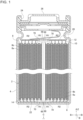
- FIG. 1 is a cross-sectional view of a battery 1.
- the battery 1 is, for example, a rechargeable secondary battery such as a lithium ion battery, a nickel-metal hydride battery, and a nickel-cadmium battery.
- the battery 1 by way of one example has a structure in which the electrode group 2 is stored in an outer can 4 along with a electrolytic solution (not shown).
- the electrode group 2 is cylindrical in shape by way of one example and has a winding structure in which a belt-like first electrode plate 6 and a belt-like second electrode plate 8 are stacked, sandwiching a belt-like separator 10, and are wound in a spiral shape (see also FIG. 2A ).
- the first electrode plate 6 is the positive electrode plate and the second electrode plate 8 is the negative electrode plate, but the polarity of the first electrode plate 6 and the second electrode plate 8 may be reversed.
- the separator 10 is formed by a microporous film made of, by way of one example, a polypropylene resin or the like.
- the first electrode plate 6 has a structure in which an electrode active material layer 6b is stacked on a current collector 6a.
- the second electrode plate 8 has a structure in which an electrode active material layer 8b is stacked on a current collector 8a.
- the current collector 6a, 8a is comprised of an aluminum foil or the like when it is a positive electrode and is comprised of a copper foil or the like when it is a negative electrode.
- the electrode active material layer 6b, 8b can be formed by applying an electrode mixture material to the surface of the current collector 6a, 8a by a known coating apparatus and drying and rolling the material.
- the electrode mixture material is obtained by kneading materials including an electrode active material, a binder, a conductive material, etc. in a dispersion medium and uniformly dispersing the materials.
- the electrode active material is lithium cobalt oxide, lithium iron phosphate, or the like when it is a positive electrode and is graphite or the like when it is a negative electrode.
- the first electrode plate 6 has a first uncoated portion 12 that is not coated with an electrode mixture material at the end on one side in the width direction A.
- the width direction A is a direction that intersects the longitudinal direction of the belt and is a direction in which center of winding C of the electrode group 2 extends, i.e., the same direction as the axial direction E of the electrode group 2.
- the first uncoated portion 12 is an exposed portion in the current collector 6a where the electrode active material layer 6b is not stacked.
- the second electrode plate 8 has a second uncoated portion 14 not coated with an electrode mixture material at the end on the other side in the width direction A (the axial direction E), i.e., at the end opposite to the side where the first uncoated portion 12 protrudes.
- the second uncoated portion 14 is an exposed portion in the current collector 8a where the electrode active material layer 8b is not stacked.
- the electrode group 2 has a structure in which the first electrode plate 6 and the second electrode plate 8 are wound. For this reason, a plurality of ends of the first electrode plate 6 and the second electrode plate 8 in the width direction A are arranged in the radial direction B of the electrode group 2. Therefore, the electrode group 2 includes a plurality of first uncoated portions 12 arranged in the radial direction B and a plurality of second uncoated portions 14 arranged in the radial direction B.
- the electrode group 2 has, in a first region R1 continuous from an inner edge 68 at one end (the end that faces the bottom side of the outer can 4) of the electrode group 2 in the axial direction E, a recess 70 in which the second electrode plate 8 is shorter than in a second region R2 located more toward the outer edge than the first region R1.
- the length of the current collector 8a (the second uncoated portion 14) of the second electrode plate 8 located in the first region R1 is shorter than the current collector 8a of the second electrode plate 8 located in the second region R2.
- the end of the second electrode plate 8 in the second region R2 is bent in the radial direction B of the electrode group 2.
- the end of each second electrode plate 8 is bent toward the center of winding C.
- the second electrode plate 8 in the second region R2 is bent in the radial direction B at predetermined intervals in the circumferential direction of the electrode group 2.
- the electrode group 2 has, in a first region R1 continuous from the inner edge 68 at the other end (the end that faces the opening of the outer can 4) of the electrode group 2 in the axial direction E, a recess 70 in which the first electrode plate 6 is shorter than in the second region R2 located more toward the outer edge than the first region R1.
- the length of the current collector 6a (the first uncoated portion 12) of the first electrode plate 6 located in the first region R1 is shorter than the current collector 6a of the first electrode plate 6 located in the second region R2.
- the end of the first electrode plate 6 in the second region R2 is bent in the radial direction B of the electrode group 2. In this embodiment, the end of each first electrode plate 6 is bent toward the center of winding C.
- the first electrode plate 6 in the second region R2 is bent in the radial direction B at predetermined intervals in the circumferential direction of the electrode group 2. It should be noted that the electrode group 2 may have a recess 70 at least at the end thereof that faces the bottom of the outer can 4.
- a first current collector plate 20 is provided on the side where the first uncoated portion 12 in the electrode group 2 protrudes.
- the first current collector plate 20 is made of, for example, aluminum or the like.
- the ends of the plurality of first electrode plates 6 bent in the second region R2 are placed in surface contact with the first current collector plate 20.
- the contact area between each first electrode plate 6 and the first current collector plate 20 increases.
- Each first electrode plate 6 and the first current collector plate 20 are joined to each other by laser welding, etc. Thereby, the first electrode plate 6 and the first current collector plate 20 are electrically connected.
- a second current collector plate 22 is provided on the side where the second uncoated portion 14 in the electrode group 2 protrudes.
- the second current collector plate 22 is made of, for example, copper, nickel, nickel-plated copper, nickel-plated iron, and the like.
- the ends of the plurality of second electrode plates 8 bent in the second region R2 are in surface contact with the second current collector plate 22. By bending the end of each second electrode plate 8, the contact area between each second electrode plate 8 and the second current collector plate 22 increases.
- Each second electrode plate 8 and the second current collector plate 22 are joined to each other by laser welding, etc. Thereby, the second electrode plate 8 and the second current collector plate 22 are electrically connected.
- the electrode group 2 is stored in the bottomed cylindrical outer can 4 along with the electrolytic solution.
- the outer can 4 is made of, for example, copper, nickel, iron, an alloy thereof, or the like.
- the second current collector plate 22 joined to the electrode group 2 is joined to the inner bottom surface of the outer can 4 by welding or the like.
- the first current collector plate 20 joined to the electrode group 2 is joined to a sealing plate 26 made of the same metal as the outer can 4 by welding or the like.
- the sealing plate 26 is fitted into the opening of the outer can 4 via an insulating gasket 24. Thereby, the electrode group 2 and the electrolytic solution are sealed in the outer can 4.
- FIG. 2A shows a step of forming the electrode group 2.
- FIG. 2B shows a step of joining the electrode group 2 and the second current collector plate 22.
- FIG. 4A shows a step of joining the second current collector plate 22 and the outer can 4.
- FIG. 4B shows a step of joining the electrode group 2 and the first current collector plate 20.
- the first electrode plate 6, the second electrode plate 8, and the separators 10, which are belt-like, are prepared.
- the separator 10, the first electrode plate 6, the separator 10, and the second electrode plate 8 are stacked in this order.
- the stacked product thus obtained is wound in a spiral shape to form the winding electrode group 2.
- the first electrode plate 6 and the second electrode plate 8, in which the ends corresponding to the recess 70 are cut in advance, and the separator 10 are wound to form the electrode group 2. That is, each electrode plate has a notch at the end in the width direction A over a predetermined range corresponding to the first region R1, starting at the end in the longitudinal direction of the belt where the winding starts.
- the electrode group 2 having the recess 70 in the first region R1 at the end in the axial direction E can be obtained simply by winding each electrode plate and the separator 10.
- the end of each electrode plate in the first region R1 may be removed to form the recess 70 after winding each electrode plate and the separator 10.
- removing the end before winding makes processing easier and makes it possible to avoid the risk of chips or the like being mixed into the electrode group 2.
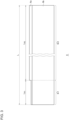
- FIG. 3 is a plan view showing the first electrode plate 6 before it is wound.
- the vertical direction of FIG. 3 corresponds to the width direction A described so far.
- the current collector 6a is exposed from one end of the electrode active material layer 6b formed in a belt-like shape in the width direction.
- the first electrode plate 6 includes a first region portion 6r1 included in the first region R1 when the first electrode plate 6 is wound and a second region portion 6r2 included in the second region R2 when the first electrode plate 6 is wound.
- the length of the first electrode plate 6 in the width direction in the first region portion 6r1 is shorter than the length of the first electrode plate 6 in the width direction in the second region portion 6r2.
- the length of the first electrode plate 6 in the longitudinal direction of the belt is denoted by L
- the length of the first region portion 6r1 of the first electrode plate 6 in the longitudinal direction of the belt is denoted by L R1
- the length of the second region portion 6r2 of the first electrode plate 6 in the longitudinal direction of the belt is denoted by L R2 .
- L R1 is preferably 15% or less of L and, more preferably 10% or less of L. This suppresses the risk of electrical connection between the electrode plate and the current collector plate becoming insufficient.
- the second electrode plate 8 also has the same configuration as the first electrode plate 6. Reference is mad back to FIG. 2A .
- the recess 70 is formed by cutting the exposed portions of the current collectors 6a, 8a in each electrode plate. In this process, it is preferable to remove the exposed portion so that a part of the exposed portion remains as shown as in FIGS. 1 and 3 . If the exposed portion is cut as far as where the electrode active material layers 6b, 8b overlap the current collectors 6a, 8a, the electrode active material layers 6b, 8b may be easily peeled off. By leaving the exposed portion, on the other hand, peeling of the electrode active material layers 6b, 8b can be suppressed.
- the end of the second electrode plate 8 in the second region R2 is bent in the radial direction B. Further, the end of the first electrode plate 6 in the second region R2 is also bent in the radial direction B.
- the method for bending the first electrode plate 6 and the second electrode plate 8 is not particularly limited.
- the first electrode plate 6 and the second electrode plate 8 in the second region R2 can be bent by pressing a jig (not shown) having a plane perpendicular to the axial direction E against the end of the electrode group 2 in the axial direction E.
- the jig may overlap the first region R1. Since the first electrode plate 6 and the second electrode plate 8 in the first region R1 are shorter than the first electrode plate 6 and the second electrode plate 8 in the second region R2, the first electrode plate 6 and the second electrode plate 8 in the first region R1 are not bent, or even if they are bent, the amount of bending is smaller than that in the second region R2, even if the jig overlaps the first region R1.
- the depth of the recess 70 is set so that the first electrode plate 6 and the second electrode plate 8 in the first region R1 do not come into contact with the jig.
- the dimension of the recess 70 in the radial direction B from the inner edge 68 is preferably equal to or greater than the depth of the recess 70. This can more properly inhibit the leading edge of the first electrode plate 6 or the second electrode plate 8 in the second region R2 from extending beyond the inner edge 68 and protruding to the side of the center of winding C side when the plates are bent.
- the electrode group 2 to which the second current collector plate 22 is joined is inserted into the outer can 4.
- the electrode group 2 is inserted into the outer can 4 from the side of the second current collector plate 22.
- the second current collector plate 22 and the bottom surface of the outer can 4 face each other.
- a rod-shaped pressing tool 72 is inserted from the side of the opening of the outer can 4 into the central space of the electrode group 2, and the second current collector plate 22 is pressed against the bottom surface of the outer can 4 by the pressing tool 72. In this state, the second current collector plate 22 and the outer can 4 are joined by laser welding or the like.
- the pressing tool 72 can create a state in which the second current collector plate 22 and the bottom surface of the outer can 4 are in intimate contact, the quality of joint between the second current collector plate 22 and the outer can 4 can be improved.
- the electrode group 2 has the recess 70 adjacent to the pressing tool 72 at the end that faces the second current collector plate 22. This inhibits the bent end of the second electrode plate 8 from being sandwiched between the pressing tool 72 and the second current collector plate 22 when the pressing tool 72 is inserted into the central space of the electrode group 2. As a result, a state in which the second current collector plate 22 and the bottom surface of the outer can 4 are in intimate contact can be produced more stably.
- the electrode group 2 of this embodiment also has the recess 70 at the other end in the axial direction E, i.e., on the side of the opening of the outer can 4. This suppresses contact between the end of the first electrode plate 6 and the pressing tool 72, unintentional breakage of the first electrode plate 6, dust generation due to contact, etc., when the pressing tool 72 is inserted into the central space of the electrode group 2.
- the pressing tool 72 is extracted, and the end of the first electrode plate 6 bent in the second region R2 and the first current collector plate 20 are joined by laser welding or the like. Thereafter, as shown in FIG. 1 , the first current collector plate 20 and the sealing plate 26 are joined.
- the electrolytic solution is poured into the outer can 4, and then the sealing plate 26 is fitted into the opening of the outer can 4 via the insulating gasket 24. Thereby, the battery 1 is obtained.
- the electrolytic solution may be poured into the outer can 4 after a sealing member is fitted in the opening of the outer can 4.
- the method of manufacturing the battery 1 includes: preparing the electrode group 2 that has, in the first region R1 continuous from the inner edge 68 at one end (the end on the side where the second uncoated portion 14 protrudes) of the electrode group 2 in the axial direction E, the recess 70 in which the second electrode plate 8 is shorter than in the second region R2 located toward the outer edge; bending the end of the second electrode plate 8 in the second region R2 in the radial direction B and joining the bent end to the second current collector plate 22; inserting the electrode group 2 joined to the second current collector plate 22 into the outer can 4 and causing the second current collector plate 22 and the bottom surface of the outer can 4 to face each other; and inserting the pressing tool 72 into the central space of the electrode group 2 and pressing the second current collector plate 22 against the bottom surface to join the second current collector plate 22 to the outer can 4.
- a current collector plate is welded to one end of an electrode group, and, subsequently, the electrode group is inserted into an outer can from the side of the current collector, and the current collector plate and the bottom surface of the outer can are caused to face each other. Subsequently, a pressing tool is inserted into the central space of the electrode group to press the current collector plate against the bottom surface of the outer can to join the current collector plate and the bottom surface while they are in intimate contact.
- the bent end may protrude into the central space in which the pressing tool 72 is inserted.
- the electrode plate When the electrode plate protrudes into the space, the electrode plate is sandwiched between the pressing tool 72 and the second current collector plate 22, causing the pressing of the second current collector plate 22 by the pressing tool 72 to become unstable and making it difficult to stably create a state in which the second current collector plate 22 and the bottom surface of the outer can 4 is intimate contact.
- the recess 70 is provided in the first region R1 continuous from the inner edge 68 in this embodiment. This inhibits the electrode plate from protruding into the central space in which the pressing tool 72 is inserted, even when the electrode plate is bent. Therefore, it is possible to create, more stably, a state in which the second current collector plate 22 and the bottom surface of the outer can 4 are in intimate contact. For this reason, the quality of joint between the second current collector plate 22 and the outer can 4 is improved, and the quality of the battery 1 is improved.
- the electrode group 2 of this embodiment also has the recess 70 at the other end in the axial direction E (the end on the side where the first uncoated portion 12 protrudes). This makes it easier to insert the pressing tool 72 into the central space of the electrode group 2.
- the dimension of the recess 70 in the radial direction B from the inner edge 68 is equal to or greater than the depth (the dimension in the axial direction E) of the recess 70. This can more properly inhibit the bent electrode plate from protruding into the space of the electrode group 2.
- the embodiment further includes winding the first electrode plate 6 and the second electrode plate 8, in which the ends corresponding to the recess 70 are cut in advance, and the separator 10 to form the electrode group 2.
- the embodiment further includes forming the recess 70 by cutting the exposed portions of the current collectors 6a, 8a and cutting the exposed portions so that the exposed portion remains. This suppresses peeling of the electrode active material layers 6b, 8b from the current collectors 6a, 8a.
- the embodiments may be defined by the following items.
- a method of manufacturing a battery (1) including:
- the present disclosure is applicable to a method of manufacturing batteries and to batteries.
Landscapes
- Chemical & Material Sciences (AREA)
- Chemical Kinetics & Catalysis (AREA)
- Electrochemistry (AREA)
- General Chemical & Material Sciences (AREA)
- Engineering & Computer Science (AREA)
- Manufacturing & Machinery (AREA)
- Materials Engineering (AREA)
- Secondary Cells (AREA)
- Connection Of Batteries Or Terminals (AREA)
Applications Claiming Priority (2)
| Application Number | Priority Date | Filing Date | Title |
|---|---|---|---|
| JP2021147084 | 2021-09-09 | ||
| PCT/JP2022/027847 WO2023037763A1 (ja) | 2021-09-09 | 2022-07-15 | 電池の製造方法および電池 |
Publications (2)
| Publication Number | Publication Date |
|---|---|
| EP4401178A1 true EP4401178A1 (de) | 2024-07-17 |
| EP4401178A4 EP4401178A4 (de) | 2025-09-03 |
Family
ID=85506438
Family Applications (1)
| Application Number | Title | Priority Date | Filing Date |
|---|---|---|---|
| EP22867085.7A Pending EP4401178A4 (de) | 2021-09-09 | 2022-07-15 | Batterieherstellungsverfahren und batterie |
Country Status (5)
| Country | Link |
|---|---|
| US (1) | US20240405292A1 (de) |
| EP (1) | EP4401178A4 (de) |
| JP (1) | JPWO2023037763A1 (de) |
| CN (1) | CN117941114A (de) |
| WO (1) | WO2023037763A1 (de) |
Families Citing this family (1)
| Publication number | Priority date | Publication date | Assignee | Title |
|---|---|---|---|---|
| WO2025095073A1 (ja) * | 2023-10-31 | 2025-05-08 | パナソニックIpマネジメント株式会社 | 蓄電装置 |
Family Cites Families (6)
| Publication number | Priority date | Publication date | Assignee | Title |
|---|---|---|---|---|
| JP2000251871A (ja) * | 1999-03-02 | 2000-09-14 | Toshiba Battery Co Ltd | アルカリ二次電池 |
| JP4401634B2 (ja) * | 2002-09-04 | 2010-01-20 | パナソニック株式会社 | 蓄電池およびその製造方法 |
| JP2007329050A (ja) * | 2006-06-08 | 2007-12-20 | Mitsubishi Cable Ind Ltd | シート状電池及びその製造方法 |
| KR101943675B1 (ko) * | 2011-06-28 | 2019-01-29 | 닛뽄 케미콘 가부시끼가이샤 | 축전 디바이스 및 축전 디바이스의 제조 방법 |
| CN114128023B (zh) * | 2019-07-30 | 2024-03-29 | 株式会社村田制作所 | 二次电池、电池包、电子设备、电动工具、电动航空器及电动车辆 |
| WO2021176906A1 (ja) * | 2020-03-04 | 2021-09-10 | 株式会社村田製作所 | 二次電池、電子機器及び電動工具 |
-
2022
- 2022-07-15 EP EP22867085.7A patent/EP4401178A4/de active Pending
- 2022-07-15 US US18/690,203 patent/US20240405292A1/en active Pending
- 2022-07-15 JP JP2023546813A patent/JPWO2023037763A1/ja active Pending
- 2022-07-15 WO PCT/JP2022/027847 patent/WO2023037763A1/ja not_active Ceased
- 2022-07-15 CN CN202280059911.4A patent/CN117941114A/zh active Pending
Also Published As
| Publication number | Publication date |
|---|---|
| CN117941114A (zh) | 2024-04-26 |
| JPWO2023037763A1 (de) | 2023-03-16 |
| EP4401178A4 (de) | 2025-09-03 |
| WO2023037763A1 (ja) | 2023-03-16 |
| US20240405292A1 (en) | 2024-12-05 |
Similar Documents
| Publication | Publication Date | Title |
|---|---|---|
| JP2025087870A (ja) | タブレス構造電極を有するセル | |
| US10243194B2 (en) | Sealed battery and sealed battery manufacturing method | |
| JP6208687B2 (ja) | 円筒形二次電池及びその製造方法 | |
| JP6569322B2 (ja) | 二次電池及びそれを用いた組電池 | |
| CN102142582B (zh) | 密闭型电池及其制造方法 | |
| US20110086258A1 (en) | Method for manufacturing secondary battery and secondary battery | |
| US20230223551A1 (en) | Lithium-ion cell with a high energy density | |
| KR20100089092A (ko) | 이차 전지 | |
| CN106025373A (zh) | 方形二次电池以及使用其的组电池 | |
| CN102804473A (zh) | 具有卷绕电极的纽扣电池及其制造方法 | |
| JP2003317805A (ja) | 円筒型リチウムイオン二次電池およびその製造方法 | |
| JP7329538B2 (ja) | 二次電池及びその製造方法 | |
| EP3879614A1 (de) | Vorrichtung und verfahren zur herstellung einer sekundärbatterie | |
| US20140030568A1 (en) | Cylindrical secondary battery | |
| JP5006603B2 (ja) | 非水電解質二次電池 | |
| EP4401178A1 (de) | Batterieherstellungsverfahren und batterie | |
| US20120321942A1 (en) | Electrode assembly and secondary battery using the same | |
| JP7353302B2 (ja) | 二次電池 | |
| JP2000243372A (ja) | 二次電池 | |
| US20240283104A1 (en) | Electrode Tab and Method for Cutting Electrode Tab | |
| CN118302882A (zh) | 电池单元中增强的电解质渗透 | |
| CN115053393A (zh) | 蓄电模块 | |
| US20250205808A1 (en) | Manufacturing apparatus | |
| EP4350822A1 (de) | Fügeverfahren | |
| JP2012252980A (ja) | 角形電池 |
Legal Events
| Date | Code | Title | Description |
|---|---|---|---|
| STAA | Information on the status of an ep patent application or granted ep patent |
Free format text: STATUS: THE INTERNATIONAL PUBLICATION HAS BEEN MADE |
|
| PUAI | Public reference made under article 153(3) epc to a published international application that has entered the european phase |
Free format text: ORIGINAL CODE: 0009012 |
|
| STAA | Information on the status of an ep patent application or granted ep patent |
Free format text: STATUS: REQUEST FOR EXAMINATION WAS MADE |
|
| 17P | Request for examination filed |
Effective date: 20240307 |
|
| AK | Designated contracting states |
Kind code of ref document: A1 Designated state(s): AL AT BE BG CH CY CZ DE DK EE ES FI FR GB GR HR HU IE IS IT LI LT LU LV MC MK MT NL NO PL PT RO RS SE SI SK SM TR |
|
| DAV | Request for validation of the european patent (deleted) | ||
| DAX | Request for extension of the european patent (deleted) | ||
| A4 | Supplementary search report drawn up and despatched |
Effective date: 20250801 |
|
| RIC1 | Information provided on ipc code assigned before grant |
Ipc: H01M 10/04 20060101AFI20250728BHEP Ipc: H01M 4/04 20060101ALI20250728BHEP Ipc: H01M 4/13 20100101ALI20250728BHEP Ipc: H01M 4/139 20100101ALI20250728BHEP Ipc: H01M 10/0525 20100101ALI20250728BHEP Ipc: H01M 10/0587 20100101ALI20250728BHEP Ipc: H01M 50/533 20210101ALI20250728BHEP Ipc: H01M 50/536 20210101ALI20250728BHEP Ipc: H01M 50/548 20210101ALI20250728BHEP |