EP4489448A1 - Fahrzeugbasiertes informationsaustauschverfahren, kopfeinheitsende, speichermedium und fahrzeug - Google Patents
Fahrzeugbasiertes informationsaustauschverfahren, kopfeinheitsende, speichermedium und fahrzeug Download PDFInfo
- Publication number
- EP4489448A1 EP4489448A1 EP23762727.8A EP23762727A EP4489448A1 EP 4489448 A1 EP4489448 A1 EP 4489448A1 EP 23762727 A EP23762727 A EP 23762727A EP 4489448 A1 EP4489448 A1 EP 4489448A1
- Authority
- EP
- European Patent Office
- Prior art keywords
- vehicle
- intelligent terminal
- terminal
- interaction
- machine
- Prior art date
- Legal status (The legal status is an assumption and is not a legal conclusion. Google has not performed a legal analysis and makes no representation as to the accuracy of the status listed.)
- Pending
Links
Images





Classifications
-
- H—ELECTRICITY
- H04—ELECTRIC COMMUNICATION TECHNIQUE
- H04W—WIRELESS COMMUNICATION NETWORKS
- H04W4/00—Services specially adapted for wireless communication networks; Facilities therefor
- H04W4/30—Services specially adapted for particular environments, situations or purposes
- H04W4/40—Services specially adapted for particular environments, situations or purposes for vehicles, e.g. vehicle-to-pedestrians [V2P]
-
- H—ELECTRICITY
- H04—ELECTRIC COMMUNICATION TECHNIQUE
- H04L—TRANSMISSION OF DIGITAL INFORMATION, e.g. TELEGRAPHIC COMMUNICATION
- H04L61/00—Network arrangements, protocols or services for addressing or naming
- H04L61/09—Mapping addresses
- H04L61/25—Mapping addresses of the same type
- H04L61/2503—Translation of Internet protocol [IP] addresses
- H04L61/255—Maintenance or indexing of mapping tables
- H04L61/2553—Binding renewal aspects, e.g. using keep-alive messages
-
- H—ELECTRICITY
- H04—ELECTRIC COMMUNICATION TECHNIQUE
- H04L—TRANSMISSION OF DIGITAL INFORMATION, e.g. TELEGRAPHIC COMMUNICATION
- H04L67/00—Network arrangements or protocols for supporting network services or applications
- H04L67/01—Protocols
- H04L67/12—Protocols specially adapted for proprietary or special-purpose networking environments, e.g. medical networks, sensor networks, networks in vehicles or remote metering networks
-
- H—ELECTRICITY
- H04—ELECTRIC COMMUNICATION TECHNIQUE
- H04M—TELEPHONIC COMMUNICATION
- H04M1/00—Substation equipment, e.g. for use by subscribers
- H04M1/72—Mobile telephones; Cordless telephones, i.e. devices for establishing wireless links to base stations without route selection
- H04M1/724—User interfaces specially adapted for cordless or mobile telephones
- H04M1/72403—User interfaces specially adapted for cordless or mobile telephones with means for local support of applications that increase the functionality
- H04M1/72409—User interfaces specially adapted for cordless or mobile telephones with means for local support of applications that increase the functionality by interfacing with external accessories
- H04M1/724098—Interfacing with an on-board device of a vehicle
-
- H—ELECTRICITY
- H04—ELECTRIC COMMUNICATION TECHNIQUE
- H04W—WIRELESS COMMUNICATION NETWORKS
- H04W4/00—Services specially adapted for wireless communication networks; Facilities therefor
- H04W4/30—Services specially adapted for particular environments, situations or purposes
- H04W4/40—Services specially adapted for particular environments, situations or purposes for vehicles, e.g. vehicle-to-pedestrians [V2P]
- H04W4/48—Services specially adapted for particular environments, situations or purposes for vehicles, e.g. vehicle-to-pedestrians [V2P] for in-vehicle communication
Definitions
- the present application relates to the field of intelligent cars, and particularly relates to a method for information interaction based on a vehicle, a vehicle-machine terminal, a storage medium and a vehicle.
- the current configurations of the information interaction between the mobile phone and the vehicle are merely for the information interaction between the mobile phone of the vehicle owner and the vehicle of the vehicle owner, and the intelligent terminals of the users relevant to the vehicle owner (for example, the family members of the vehicle owner) cannot perform information interaction with the vehicle of the vehicle owner.
- the present application provides a method for information interaction based on a vehicle, a vehicle-machine terminal, a storage medium and a vehicle, for the purpose of ensuring that an intelligent terminal interacts with the vehicle.
- a method for information interaction based on a vehicle wherein the method is applied to a vehicle-machine terminal, and comprises:
- the step of, in response to the activating operation by the user, sending the first interaction request to the intelligent terminal having the binding relation with the vehicle-machine terminal, to cause the intelligent terminal to execute the responding operation that was deployed in advance in the intelligent terminal comprises:
- the method further comprises: receiving an interaction-succeeding signal that is fed back by the intelligent terminal based on the first interaction request, and executing a feeding-back operation that was deployed in advance in the vehicle-machine terminal.
- the step of, after the second interaction request sent by the intelligent terminal has been received, executing the responding operation corresponding to the state of the vehicle comprises:
- the method further comprises: sending an interaction-succeeding signal to the intelligent terminal, to cause the intelligent terminal to execute a feeding-back operation that was deployed in advance in the intelligent terminal.
- a method for information interaction based on a vehicle wherein the method is applied to an intelligent terminal, and comprises:
- the step of, in response to the activating operation by the user, sending the second interaction request to the vehicle-machine terminal having the binding relation with the intelligent terminal, to cause the vehicle-machine terminal to execute the responding operation corresponding to the state of the vehicle comprises:
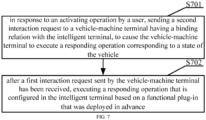
- the method further comprises: receiving an interaction-succeeding signal that is fed back by the vehicle-machine terminal based on the second interaction request, and executing a feeding-back operation that is configured in the intelligent terminal based on a functional plug-in that was deployed in advance.
- the method further comprises: sending an interaction-succeeding signal to the vehicle-machine terminal, to cause the vehicle-machine terminal to execute a feeding-back operation that was deployed in advance in the vehicle-machine terminal.
- a vehicle-machine terminal wherein the vehicle-machine terminal comprises:
- the responding unit is particularly configured for:
- controlling unit is particularly configured for:
- the vehicle-machine terminal further comprises:
- An intelligent terminal wherein the intelligent terminal comprises:
- the responding unit is particularly configured for:
- the intelligent terminal further comprises:
- a computer-readable storage medium wherein the computer-readable storage medium contains a stored program, and the program implements the method for information interaction based on a vehicle.
- a vehicle wherein the vehicle comprises:
- the technical solutions according to the present application are applied to a vehicle-machine terminal.
- the vehicle-machine terminal in response to the activating operation by the user, sends the first interaction request to the intelligent terminal having the binding relation with the vehicle-machine terminal, to cause the intelligent terminal to execute the responding operation that was deployed in advance in the intelligent terminal, and, after the second interaction request sent by the intelligent terminal has been received, executes the responding operation corresponding to the state of the vehicle.
- the user can trigger, by using the activating operation, the vehicle-machine terminal to interact with the intelligent terminal.
- the vehicle-machine terminal sends the first interaction request to the intelligent terminal, to cause the intelligent terminal to execute the responding operation that was deployed in advance in the intelligent terminal, and, based on the second interaction request sent by the intelligent terminal, executes the responding operation corresponding to the state of the vehicle, to realize the effective interaction between the intelligent terminal and the vehicle, so as to provide a novel interaction mode for the vehicle, thereby enriching the user experience of the vehicle.
- FIG. 1 is a schematic flow chart of a method for information interaction based on a vehicle according to an embodiment of the present application.
- the method is applied to a vehicle-machine terminal (also referred as vehicle-mounted terminal or in-vehicle infotainment system or vehicle terminal, for example HUT) which can interact with a mobile terminal, and comprises the following steps: S101: in response to an activating operation by a user, sending a first interaction request to an intelligent terminal having a binding relation with the vehicle-machine terminal, to cause the intelligent terminal to execute a responding operation that was deployed in advance in the intelligent terminal.
- a vehicle-machine terminal also referred as vehicle-mounted terminal or in-vehicle infotainment system or vehicle terminal, for example HUT
- S101 in response to an activating operation by a user, sending a first interaction request to an intelligent terminal having a binding relation with the vehicle-machine terminal, to cause the intelligent terminal to execute a responding operation that was deployed in advance in the intelligent terminal.
- the particular principle of implementation of the step of, in response to the activating operation by the user, sending the first interaction request to the intelligent terminal having the binding relation with the vehicle-machine terminal may refer to the following interpretation and description with reference to S201-S204 shown in FIG. 2 .
- the particular principle of implementation of the step of, after the second interaction request sent by the intelligent terminal has been received, executing the responding operation corresponding to the state of the vehicle may refer to the following interpretation and description with reference to S205-S209 shown in FIG. 2 .
- the user can trigger, by using the activating operation, the vehicle-machine terminal to interact with the intelligent terminal.
- the vehicle-machine terminal sends the first interaction request to the intelligent terminal, to cause the intelligent terminal to execute the responding operation that was deployed in advance in the intelligent terminal, and, based on the second interaction request sent by the intelligent terminal, executes the responding operation corresponding to the state of the vehicle, to realize the effective interaction between the intelligent terminal and the vehicle, so as to provide a novel interaction mode for the vehicle, thereby enriching the user experience of the vehicle.
- FIG. 2 is a schematic flow chart of another method for information interaction based on a vehicle according to an embodiment of the present application.
- the method is applied to a vehicle-machine terminal, and comprises the following steps: S201: sending a binding request to the intelligent terminal in advance, to cause the intelligent terminal to, according to a plug-in link shown by the binding request, download a functional plug-in, and according to a pairing code shown by the binding request, start up a process of deploying the functional plug-in.
- the functional plug-in contains a responding operation and a feeding-back operation that are pre-configured.
- the type of the intelligent terminal includes but is not limited to a mobile-phone system and a vehicle-machine system.
- the responding operation deployed in the mobile-phone system may be playing a predetermined animation (for example, a dazzle color heart-shape animation) and a predetermined prompt tone (for example, a Ding Dong sound, a human voice of "Ding Dong expresses the affection" and so on), and the feeding-back operation deployed in the mobile-phone system may be playing a predetermined animation.
- the functional plug-in contains a responding operation and a feeding-back operation that are pre-configured. Both of the mobile-phone system and the vehicle-machine system may, by being provided with the functional plug-in, realize the pre-configuration of the responding operation and the feeding-back operation. Moreover, in the process of the deployment of the functional plug-in in the mobile-phone system, the mobile-phone system is upgraded, so that the mobile-phone system can be adapted for the functional plug-in.
- the correspondence address of the mobile-phone system or the vehicle-machine system has already been pre-configured. After the vehicle-machine terminal has been provided with the responding operation and the feeding-back operation of itself, the vehicle-machine terminal sends the binding request to the mobile-phone system or the vehicle-machine system according to the correspondence address, to seek to establish the binding relation with the mobile-phone system or the vehicle-machine system.
- the responding operation deployed in the vehicle-machine system comprises a first responding operation, a second responding operation and a third responding operation
- the feeding-back operation deployed in the vehicle-machine system may be controlling a center-control screen to play a predetermined animation.
- the so-called first responding operation is for sending a notification request to a mobile device of the user (which particularly refers to the owner of the vehicle-machine system), to cause the mobile device to play a predetermined animation and a predetermined sound effect.
- the so-called second responding operation is for controlling the center-control screen to play the predetermined animation, controlling an ambient light to operate, and controlling a loudspeaker box to play the predetermined prompt tone.
- the so-called third responding operation is for controlling the center-control screen to display a predetermined pop-up window, and controlling the loudspeaker box to play the predetermined prompt tone.
- the intelligent terminal after successfully provided with the functional plug-in, sends a binding-succeeding prompt to the vehicle-machine terminal, so as to establish the binding relation with the vehicle-machine terminal.
- the activating operation by the user includes but is not limited to hand-gesture activation (i.e., performing a predetermined hand gesture to a predetermined camera), voice activation (i.e., speaking a predetermined voice to a predetermined microphone), clicking a predetermined shortcut key at the vehicle-machine terminal, and performing a triggering operation to the center-control screen.
- hand-gesture activation i.e., performing a predetermined hand gesture to a predetermined camera
- voice activation i.e., speaking a predetermined voice to a predetermined microphone
- clicking a predetermined shortcut key at the vehicle-machine terminal i.e., clicking a predetermined shortcut key at the vehicle-machine terminal, and performing a triggering operation to the center-control screen.
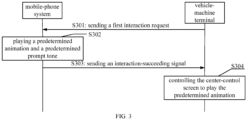
- the mobile-phone system plays the predetermined animation and the predetermined prompt tone.
- the vehicle-machine system acquires the state of the vehicle that the vehicle-machine system belongs to; if the vehicle is in a powering-off state, executes the first responding operation; if the vehicle is in a powering-on state and a stationary state, executes the second responding operation; and if the vehicle is in the powering-on state and a travelling state, executes the third responding operation.
- the feeding-back operation that was deployed in advance in the vehicle-machine terminal may be controlling the center-control screen to play the predetermined animation.
- the vehicle-machine terminal may realize the provision of the feeding-back operation by being installed with the functional plug-in.
- the flow shown by S201-S204 is that the vehicle-machine terminal, in response to the activation request by the user, actively interacts with the intelligent terminal.
- the mode of the implementation of the active interaction by the vehicle-machine terminal with the mobile-phone system may refer to the flow shown in FIG. 3
- the mode of the implementation of the active interaction by the vehicle-machine terminal with the vehicle-machine system may refer to the flow shown in FIG. 4 .
- the intelligent terminal may actively interact with the vehicle-machine terminal.
- the process of the active interaction by the intelligent terminal with the vehicle-machine terminal has the flow shown by the following S105-S109.
- S209 continues to be executed.
- the second responding operation is for controlling the center-control screen to play the predetermined animation, controlling an ambient light to operate, and controlling a loudspeaker box to play the predetermined prompt tone.
- S209 continues to be executed.
- the third responding operation is for controlling the center-control screen to display a predetermined pop-up window (the predetermined pop-up window contains a predetermined text message, for example, "xx is missing you"), and controlling the loudspeaker box to play the predetermined prompt tone.
- the flow shown by S205-S209 is that the intelligent terminal, in response to the activation request by the user, actively interacts with the vehicle-machine terminal.
- the mode of the implementation of the active interaction by the mobile-phone system with the vehicle-machine terminal may refer to the flow shown in FIG. 5
- the mode of the implementation of the active interaction by the vehicle-machine system with the vehicle-machine terminal may refer to the flow shown in FIG. 6 .
- the user can trigger, by using the activating operation, the vehicle-machine terminal to interact with the intelligent terminal.
- the vehicle-machine terminal sends the first interaction request to the intelligent terminal, to cause the intelligent terminal to execute the responding operation that was deployed in advance in the intelligent terminal, and, based on the second interaction request sent by the intelligent terminal, executes the responding operation corresponding to the state of the vehicle, to realize the effective interaction between the intelligent terminal and the vehicle, so as to provide a novel interaction mode for the vehicle, thereby enriching the user experience of the vehicle.
- FIG. 3 is a schematic flow chart of another method for information interaction based on a vehicle according to an embodiment of the present application. The method comprises the following steps:
- FIG. 8 is a schematic flow chart of another method for information interaction based on a vehicle according to an embodiment of the present application.
- the method is applied to an intelligent terminal, and comprises the following steps: S801: receiving in advance a binding request sent by the vehicle-machine terminal, according to a plug-in link shown by the binding request, downloading a functional plug-in, and according to a pairing code shown by the binding request, starting up a process of deploying the functional plug-in.
- the functional plug-in contains a responding operation and a feeding-back operation that are pre-configured.
- S806 sending an interaction-succeeding signal to the vehicle-machine terminal, to cause the vehicle-machine terminal to execute a feeding-back operation that was deployed in advance in the vehicle-machine terminal.
- the user can trigger, by using the activating operation, the intelligent terminal to interact with the vehicle-machine terminal.
- the vehicle-machine terminal sends the first interaction request to the intelligent terminal, to cause the intelligent terminal to execute the responding operation that was deployed in advance in the intelligent terminal, and, based on the second interaction request sent by the intelligent terminal, executes the responding operation corresponding to the state of the vehicle, to realize the effective interaction between the intelligent terminal and the vehicle, so as to provide a novel interaction mode for the vehicle, thereby enriching the user experience of the vehicle.
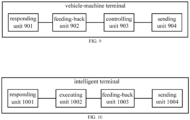
- the responding unit 901 is particularly configured for:
- the vehicle-machine terminal further comprises: a feeding-back unit 902 configured for receiving an interaction-succeeding signal that is fed back by the intelligent terminal based on the first interaction request, and controlling the vehicle to execute a feeding-back operation that was deployed in advance in the vehicle-machine terminal.
- a feeding-back unit 902 configured for receiving an interaction-succeeding signal that is fed back by the intelligent terminal based on the first interaction request, and controlling the vehicle to execute a feeding-back operation that was deployed in advance in the vehicle-machine terminal.
- the responding unit 1001 is particularly configured for:
- the intelligent terminal further comprises: an executing unit 1002 configured for, after a first interaction request sent by the vehicle-machine terminal has been received, executing a responding operation that is configured in the intelligent terminal based on a functional plug-in that was deployed in advance.
- the intelligent terminal further comprises: a feeding-back unit 1003 configured for receiving an interaction-succeeding signal that is fed back by the vehicle-machine terminal based on the second interaction request, and executing a feeding-back operation that is configured in the intelligent terminal based on a functional plug-in that was deployed in advance.
- a feeding-back unit 1003 configured for receiving an interaction-succeeding signal that is fed back by the vehicle-machine terminal based on the second interaction request, and executing a feeding-back operation that is configured in the intelligent terminal based on a functional plug-in that was deployed in advance.
- the intelligent terminal further comprises: a sending unit 1004 configured for sending an interaction-succeeding signal to the vehicle-machine terminal, to cause the vehicle-machine terminal to execute a feeding-back operation that was deployed in advance in the vehicle-machine terminal.
- a sending unit 1004 configured for sending an interaction-succeeding signal to the vehicle-machine terminal, to cause the vehicle-machine terminal to execute a feeding-back operation that was deployed in advance in the vehicle-machine terminal.
- the user can trigger, by using the activating operation, the intelligent terminal to interact with the vehicle-machine terminal.
- the vehicle-machine terminal sends the first interaction request to the intelligent terminal, to cause the intelligent terminal to execute the responding operation that was deployed in advance in the intelligent terminal, and, based on the second interaction request sent by the intelligent terminal, executes the responding operation corresponding to the state of the vehicle, to realize the effective interaction between the intelligent terminal and the vehicle, so as to provide a novel interaction mode for the vehicle, thereby enriching the user experience of the vehicle.
- the step of, in response to the activating operation by the user, sending the first interaction request to the intelligent terminal having the binding relation with the vehicle-machine terminal, to cause the intelligent terminal to execute the responding operation that was deployed in advance in the intelligent terminal comprises:
- the method further comprises: receiving an interaction-succeeding signal that is fed back by the intelligent terminal based on the first interaction request, and executing a feeding-back operation that was deployed in advance in the vehicle-machine terminal.
- the step of, after the second interaction request sent by the intelligent terminal has been received, executing the responding operation corresponding to the state of the vehicle comprises:
- the functions of the method according to the embodiments of the present application may be stored in a computing-device-readable storage medium.
- a computing-device-readable storage medium On the basis of such a comprehension, the part of the embodiments of the present application that makes a contribution over the prior art, or part of the technical solutions, may be embodied in the form of a software product.
- the software product is stored in a storage medium, and contains multiple instructions configured so that a computing device (which may be a personal computer, a server, a mobile computing device, a network device and so on) implements all or some of the steps of the methods according to the embodiments of the present application.
- the above-described storage medium includes various media that can store a program code, such as a USB flash disk, a mobile hard disk drive, a read-only memory, a random access memory, a diskette and an optical disk.
Landscapes
- Engineering & Computer Science (AREA)
- Computer Networks & Wireless Communication (AREA)
- Signal Processing (AREA)
- Health & Medical Sciences (AREA)
- Computing Systems (AREA)
- General Health & Medical Sciences (AREA)
- Medical Informatics (AREA)
- Human Computer Interaction (AREA)
- Telephone Function (AREA)
- User Interface Of Digital Computer (AREA)
Applications Claiming Priority (2)
| Application Number | Priority Date | Filing Date | Title |
|---|---|---|---|
| CN202210210250.2A CN115250447B (zh) | 2022-03-03 | 2022-03-03 | 基于车辆的信息交互方法、车机端、存储介质和车辆 |
| PCT/CN2023/075889 WO2023165326A1 (zh) | 2022-03-03 | 2023-02-14 | 基于车辆的信息交互方法、车机端、存储介质和车辆 |
Publications (2)
| Publication Number | Publication Date |
|---|---|
| EP4489448A1 true EP4489448A1 (de) | 2025-01-08 |
| EP4489448A4 EP4489448A4 (de) | 2025-06-11 |
Family
ID=83698986
Family Applications (1)
| Application Number | Title | Priority Date | Filing Date |
|---|---|---|---|
| EP23762727.8A Pending EP4489448A4 (de) | 2022-03-03 | 2023-02-14 | Fahrzeugbasiertes informationsaustauschverfahren, kopfeinheitsende, speichermedium und fahrzeug |
Country Status (3)
| Country | Link |
|---|---|
| EP (1) | EP4489448A4 (de) |
| CN (1) | CN115250447B (de) |
| WO (1) | WO2023165326A1 (de) |
Families Citing this family (4)
| Publication number | Priority date | Publication date | Assignee | Title |
|---|---|---|---|---|
| CN115250447B (zh) * | 2022-03-03 | 2025-06-20 | 长城汽车股份有限公司 | 基于车辆的信息交互方法、车机端、存储介质和车辆 |
| CN115226070A (zh) * | 2022-03-03 | 2022-10-21 | 长城汽车股份有限公司 | 基于车辆的信息交互方法、手机端以及车机端 |
| CN116639075B (zh) * | 2023-06-20 | 2026-03-03 | 阿维塔科技(重庆)股份有限公司 | 控制方法 |
| CN118394547B (zh) * | 2024-06-24 | 2024-10-01 | 宁波均联智行科技股份有限公司 | 一种插件式数据通信方法、设备及介质 |
Family Cites Families (13)
| Publication number | Priority date | Publication date | Assignee | Title |
|---|---|---|---|---|
| CN108263303A (zh) * | 2016-12-30 | 2018-07-10 | 上海擎感智能科技有限公司 | 车辆控制方法、装置及系统 |
| CN108256033A (zh) * | 2018-01-11 | 2018-07-06 | 北京新能源汽车股份有限公司 | 一种车辆的控制方法、装置、终端及车辆 |
| CN110337060B (zh) * | 2018-03-30 | 2021-05-14 | 比亚迪股份有限公司 | 车辆与移动终端通信控制方法、车辆及移动终端 |
| CN113984086B (zh) * | 2019-08-16 | 2024-10-15 | 阿波罗智联(北京)科技有限公司 | 导航方法、导航装置、电子设备和存储介质 |
| CN111429665A (zh) * | 2020-02-21 | 2020-07-17 | 浙江吉利控股集团有限公司 | 一种车辆分享控制方法、装置和设备 |
| CN111432020A (zh) * | 2020-04-02 | 2020-07-17 | 斑马网络技术有限公司 | 车联网云服务平台、车联网系统及车机控制方法 |
| CN113766448A (zh) * | 2020-06-01 | 2021-12-07 | 富顶精密组件(深圳)有限公司 | 车辆控制方法、智能车钥匙及移动终端 |
| CN112109631B (zh) * | 2020-09-17 | 2022-08-16 | 广州小鹏汽车科技有限公司 | 一种车辆交互的方法和装置 |
| CN112373431A (zh) * | 2020-10-22 | 2021-02-19 | 上汽通用五菱汽车股份有限公司 | 一种云数字密钥生成及授权方法 |
| CN117692484A (zh) * | 2021-01-25 | 2024-03-12 | 华为技术有限公司 | 一种移动终端和车载终端的交互方法、终端以及系统 |
| CN113421564A (zh) * | 2021-06-22 | 2021-09-21 | 广州小鹏汽车科技有限公司 | 语音交互方法、语音交互系统、服务器和存储介质 |
| CN115226070A (zh) * | 2022-03-03 | 2022-10-21 | 长城汽车股份有限公司 | 基于车辆的信息交互方法、手机端以及车机端 |
| CN115250447B (zh) * | 2022-03-03 | 2025-06-20 | 长城汽车股份有限公司 | 基于车辆的信息交互方法、车机端、存储介质和车辆 |
-
2022
- 2022-03-03 CN CN202210210250.2A patent/CN115250447B/zh active Active
-
2023
- 2023-02-14 WO PCT/CN2023/075889 patent/WO2023165326A1/zh not_active Ceased
- 2023-02-14 EP EP23762727.8A patent/EP4489448A4/de active Pending
Also Published As
| Publication number | Publication date |
|---|---|
| CN115250447A (zh) | 2022-10-28 |
| WO2023165326A1 (zh) | 2023-09-07 |
| CN115250447B (zh) | 2025-06-20 |
| EP4489448A4 (de) | 2025-06-11 |
Similar Documents
| Publication | Publication Date | Title |
|---|---|---|
| EP4489448A1 (de) | Fahrzeugbasiertes informationsaustauschverfahren, kopfeinheitsende, speichermedium und fahrzeug | |
| JP5201599B2 (ja) | 端末装置、および、プログラム | |
| CN112214186B (zh) | 信息共享方法及车载终端 | |
| JP6057504B2 (ja) | 電子装置、出力制御方法および出力制御プログラム | |
| CN111107518A (zh) | 显示方法、车载终端、显示系统及计算机可读存储介质 | |
| US9841293B2 (en) | In-vehicle display system for navigation and additional functions | |
| CN111371695B (zh) | 服务限流方法及装置 | |
| TWM592840U (zh) | 用以映射智慧型手機功能之可攜式車載觸控螢幕裝置 | |
| US11210056B2 (en) | Electronic device and method of controlling thereof | |
| CN112579038A (zh) | 一种内置录音方法、装置、电子设备和存储介质 | |
| CN111970671B (zh) | 近场通信模块的控制方法、装置及电子设备 | |
| KR20220016544A (ko) | 오디오 공유를 지원하는 전자 장치 | |
| CN111083683B (zh) | 通话显示控制方法及设备 | |
| EP4489449A1 (de) | Fahrzeugbasiertes informationsinteraktionsverfahren sowie mobiltelefon und kopfeinheitsendgerät | |
| CN114691067B (zh) | 投屏方法及电子设备 | |
| CN113778371A (zh) | 针对车机系统实现多模块声音管理控制的系统、方法、装置、处理器及其计算机存储介质 | |
| CN115623122A (zh) | 基于车内通话信息的隐私保护方法、介质、设备及系统 | |
| US11726741B2 (en) | Agent control device, agent control method, and recording medium | |
| US20210357086A1 (en) | Agent control device, agent control method, and recording medium | |
| CN112181863B (zh) | 页面回收方法、装置、终端及存储介质 | |
| CN111460424A (zh) | 一种锁屏配置的交互方法、终端及计算机存储介质 | |
| CN118069334B (zh) | 设备能力的使能方法和装置 | |
| CN111078212A (zh) | 用于实现语音产品的个性化定制化的操作方法及系统、和服务端处理方法及服务器 | |
| CN114138230B (zh) | 音频处理方法、系统、设备及计算机可读存储介质 | |
| CN116800881B (zh) | 投屏控制方法、装置、设备及计算机可读存储介质 |
Legal Events
| Date | Code | Title | Description |
|---|---|---|---|
| STAA | Information on the status of an ep patent application or granted ep patent |
Free format text: STATUS: THE INTERNATIONAL PUBLICATION HAS BEEN MADE |
|
| PUAI | Public reference made under article 153(3) epc to a published international application that has entered the european phase |
Free format text: ORIGINAL CODE: 0009012 |
|
| STAA | Information on the status of an ep patent application or granted ep patent |
Free format text: STATUS: REQUEST FOR EXAMINATION WAS MADE |
|
| 17P | Request for examination filed |
Effective date: 20240930 |
|
| AK | Designated contracting states |
Kind code of ref document: A1 Designated state(s): AL AT BE BG CH CY CZ DE DK EE ES FI FR GB GR HR HU IE IS IT LI LT LU LV MC ME MK MT NL NO PL PT RO RS SE SI SK SM TR |
|
| A4 | Supplementary search report drawn up and despatched |
Effective date: 20250512 |
|
| DAV | Request for validation of the european patent (deleted) | ||
| DAX | Request for extension of the european patent (deleted) | ||
| RIC1 | Information provided on ipc code assigned before grant |
Ipc: H04W 4/48 20180101ALI20250506BHEP Ipc: H04M 1/72409 20210101ALI20250506BHEP Ipc: H04W 4/40 20180101AFI20250506BHEP |
|
| STAA | Information on the status of an ep patent application or granted ep patent |
Free format text: STATUS: EXAMINATION IS IN PROGRESS |
|
| 17Q | First examination report despatched |
Effective date: 20251208 |