EP4488331A2 - Mehrschichtkörper und aus dem mehrschichtkörper gebildeter verpackungsbehälter - Google Patents
Mehrschichtkörper und aus dem mehrschichtkörper gebildeter verpackungsbehälter Download PDFInfo
- Publication number
- EP4488331A2 EP4488331A2 EP24213559.8A EP24213559A EP4488331A2 EP 4488331 A2 EP4488331 A2 EP 4488331A2 EP 24213559 A EP24213559 A EP 24213559A EP 4488331 A2 EP4488331 A2 EP 4488331A2
- Authority
- EP
- European Patent Office
- Prior art keywords
- layer
- polyethylene resin
- resin
- density
- laminate
- Prior art date
- Legal status (The legal status is an assumption and is not a legal conclusion. Google has not performed a legal analysis and makes no representation as to the accuracy of the status listed.)
- Pending
Links
Images
Classifications
-
- B—PERFORMING OPERATIONS; TRANSPORTING
- B65—CONVEYING; PACKING; STORING; HANDLING THIN OR FILAMENTARY MATERIAL
- B65D—CONTAINERS FOR STORAGE OR TRANSPORT OF ARTICLES OR MATERIALS, e.g. BAGS, BARRELS, BOTTLES, BOXES, CANS, CARTONS, CRATES, DRUMS, JARS, TANKS, HOPPERS, FORWARDING CONTAINERS; ACCESSORIES, CLOSURES, OR FITTINGS THEREFOR; PACKAGING ELEMENTS; PACKAGES
- B65D65/00—Wrappers or flexible covers; Packaging materials of special type or form
- B65D65/38—Packaging materials of special type or form
- B65D65/40—Applications of laminates for particular packaging purposes
-
- B—PERFORMING OPERATIONS; TRANSPORTING
- B32—LAYERED PRODUCTS
- B32B—LAYERED PRODUCTS, i.e. PRODUCTS BUILT-UP OF STRATA OF FLAT OR NON-FLAT, e.g. CELLULAR OR HONEYCOMB, FORM
- B32B1/00—Layered products having a non-planar shape
-
- B—PERFORMING OPERATIONS; TRANSPORTING
- B32—LAYERED PRODUCTS
- B32B—LAYERED PRODUCTS, i.e. PRODUCTS BUILT-UP OF STRATA OF FLAT OR NON-FLAT, e.g. CELLULAR OR HONEYCOMB, FORM
- B32B1/00—Layered products having a non-planar shape
- B32B1/08—Tubular products
-
- B—PERFORMING OPERATIONS; TRANSPORTING
- B32—LAYERED PRODUCTS
- B32B—LAYERED PRODUCTS, i.e. PRODUCTS BUILT-UP OF STRATA OF FLAT OR NON-FLAT, e.g. CELLULAR OR HONEYCOMB, FORM
- B32B27/00—Layered products comprising a layer of synthetic resin
- B32B27/06—Layered products comprising a layer of synthetic resin as the main or only constituent of a layer, which is next to another layer of the same or of a different material
- B32B27/08—Layered products comprising a layer of synthetic resin as the main or only constituent of a layer, which is next to another layer of the same or of a different material of synthetic resin
-
- B—PERFORMING OPERATIONS; TRANSPORTING
- B32—LAYERED PRODUCTS
- B32B—LAYERED PRODUCTS, i.e. PRODUCTS BUILT-UP OF STRATA OF FLAT OR NON-FLAT, e.g. CELLULAR OR HONEYCOMB, FORM
- B32B27/00—Layered products comprising a layer of synthetic resin
- B32B27/18—Layered products comprising a layer of synthetic resin characterised by the use of special additives
-
- B—PERFORMING OPERATIONS; TRANSPORTING
- B32—LAYERED PRODUCTS
- B32B—LAYERED PRODUCTS, i.e. PRODUCTS BUILT-UP OF STRATA OF FLAT OR NON-FLAT, e.g. CELLULAR OR HONEYCOMB, FORM
- B32B27/00—Layered products comprising a layer of synthetic resin
- B32B27/30—Layered products comprising a layer of synthetic resin comprising vinyl (co)polymers; comprising acrylic (co)polymers
- B32B27/306—Layered products comprising a layer of synthetic resin comprising vinyl (co)polymers; comprising acrylic (co)polymers comprising vinyl acetate or vinyl alcohol (co)polymers
-
- B—PERFORMING OPERATIONS; TRANSPORTING
- B32—LAYERED PRODUCTS
- B32B—LAYERED PRODUCTS, i.e. PRODUCTS BUILT-UP OF STRATA OF FLAT OR NON-FLAT, e.g. CELLULAR OR HONEYCOMB, FORM
- B32B27/00—Layered products comprising a layer of synthetic resin
- B32B27/30—Layered products comprising a layer of synthetic resin comprising vinyl (co)polymers; comprising acrylic (co)polymers
- B32B27/308—Layered products comprising a layer of synthetic resin comprising vinyl (co)polymers; comprising acrylic (co)polymers comprising acrylic (co)polymers
-
- B—PERFORMING OPERATIONS; TRANSPORTING
- B32—LAYERED PRODUCTS
- B32B—LAYERED PRODUCTS, i.e. PRODUCTS BUILT-UP OF STRATA OF FLAT OR NON-FLAT, e.g. CELLULAR OR HONEYCOMB, FORM
- B32B27/00—Layered products comprising a layer of synthetic resin
- B32B27/32—Layered products comprising a layer of synthetic resin comprising polyolefins
-
- B—PERFORMING OPERATIONS; TRANSPORTING
- B32—LAYERED PRODUCTS
- B32B—LAYERED PRODUCTS, i.e. PRODUCTS BUILT-UP OF STRATA OF FLAT OR NON-FLAT, e.g. CELLULAR OR HONEYCOMB, FORM
- B32B27/00—Layered products comprising a layer of synthetic resin
- B32B27/34—Layered products comprising a layer of synthetic resin comprising polyamides
-
- B—PERFORMING OPERATIONS; TRANSPORTING
- B32—LAYERED PRODUCTS
- B32B—LAYERED PRODUCTS, i.e. PRODUCTS BUILT-UP OF STRATA OF FLAT OR NON-FLAT, e.g. CELLULAR OR HONEYCOMB, FORM
- B32B27/00—Layered products comprising a layer of synthetic resin
- B32B27/36—Layered products comprising a layer of synthetic resin comprising polyesters
-
- B—PERFORMING OPERATIONS; TRANSPORTING
- B32—LAYERED PRODUCTS
- B32B—LAYERED PRODUCTS, i.e. PRODUCTS BUILT-UP OF STRATA OF FLAT OR NON-FLAT, e.g. CELLULAR OR HONEYCOMB, FORM
- B32B27/00—Layered products comprising a layer of synthetic resin
- B32B27/40—Layered products comprising a layer of synthetic resin comprising polyurethanes
-
- B—PERFORMING OPERATIONS; TRANSPORTING
- B32—LAYERED PRODUCTS
- B32B—LAYERED PRODUCTS, i.e. PRODUCTS BUILT-UP OF STRATA OF FLAT OR NON-FLAT, e.g. CELLULAR OR HONEYCOMB, FORM
- B32B7/00—Layered products characterised by the relation between layers; Layered products characterised by the relative orientation of features between layers, or by the relative values of a measurable parameter between layers, i.e. products comprising layers having different physical, chemical or physicochemical properties; Layered products characterised by the interconnection of layers
- B32B7/02—Physical, chemical or physicochemical properties
-
- B—PERFORMING OPERATIONS; TRANSPORTING
- B32—LAYERED PRODUCTS
- B32B—LAYERED PRODUCTS, i.e. PRODUCTS BUILT-UP OF STRATA OF FLAT OR NON-FLAT, e.g. CELLULAR OR HONEYCOMB, FORM
- B32B7/00—Layered products characterised by the relation between layers; Layered products characterised by the relative orientation of features between layers, or by the relative values of a measurable parameter between layers, i.e. products comprising layers having different physical, chemical or physicochemical properties; Layered products characterised by the interconnection of layers
- B32B7/04—Interconnection of layers
- B32B7/12—Interconnection of layers using interposed adhesives or interposed materials with bonding properties
-
- B—PERFORMING OPERATIONS; TRANSPORTING
- B65—CONVEYING; PACKING; STORING; HANDLING THIN OR FILAMENTARY MATERIAL
- B65D—CONTAINERS FOR STORAGE OR TRANSPORT OF ARTICLES OR MATERIALS, e.g. BAGS, BARRELS, BOTTLES, BOXES, CANS, CARTONS, CRATES, DRUMS, JARS, TANKS, HOPPERS, FORWARDING CONTAINERS; ACCESSORIES, CLOSURES, OR FITTINGS THEREFOR; PACKAGING ELEMENTS; PACKAGES
- B65D35/00—Pliable tubular containers adapted to be permanently or temporarily deformed to expel contents, e.g. collapsible tubes for toothpaste or other plastic or semi-liquid material; Holders therefor
- B65D35/02—Body construction
- B65D35/10—Body construction made by uniting or interconnecting two or more components
-
- C—CHEMISTRY; METALLURGY
- C08—ORGANIC MACROMOLECULAR COMPOUNDS; THEIR PREPARATION OR CHEMICAL WORKING-UP; COMPOSITIONS BASED THEREON
- C08L—COMPOSITIONS OF MACROMOLECULAR COMPOUNDS
- C08L23/00—Compositions of homopolymers or copolymers of unsaturated aliphatic hydrocarbons having only one carbon-to-carbon double bond; Compositions of derivatives of such polymers
- C08L23/02—Compositions of homopolymers or copolymers of unsaturated aliphatic hydrocarbons having only one carbon-to-carbon double bond; Compositions of derivatives of such polymers not modified by chemical after-treatment
- C08L23/04—Homopolymers or copolymers of ethene
- C08L23/06—Polyethylene
-
- C—CHEMISTRY; METALLURGY
- C08—ORGANIC MACROMOLECULAR COMPOUNDS; THEIR PREPARATION OR CHEMICAL WORKING-UP; COMPOSITIONS BASED THEREON
- C08L—COMPOSITIONS OF MACROMOLECULAR COMPOUNDS
- C08L23/00—Compositions of homopolymers or copolymers of unsaturated aliphatic hydrocarbons having only one carbon-to-carbon double bond; Compositions of derivatives of such polymers
- C08L23/02—Compositions of homopolymers or copolymers of unsaturated aliphatic hydrocarbons having only one carbon-to-carbon double bond; Compositions of derivatives of such polymers not modified by chemical after-treatment
- C08L23/04—Homopolymers or copolymers of ethene
- C08L23/08—Copolymers of ethene
- C08L23/0807—Copolymers of ethene with unsaturated hydrocarbons only containing four or more carbon atoms
- C08L23/0815—Copolymers of ethene with unsaturated hydrocarbons only containing four or more carbon atoms with aliphatic 1-olefins containing one carbon-to-carbon double bond
-
- B—PERFORMING OPERATIONS; TRANSPORTING
- B32—LAYERED PRODUCTS
- B32B—LAYERED PRODUCTS, i.e. PRODUCTS BUILT-UP OF STRATA OF FLAT OR NON-FLAT, e.g. CELLULAR OR HONEYCOMB, FORM
- B32B2250/00—Layers arrangement
- B32B2250/24—All layers being polymeric
-
- B—PERFORMING OPERATIONS; TRANSPORTING
- B32—LAYERED PRODUCTS
- B32B—LAYERED PRODUCTS, i.e. PRODUCTS BUILT-UP OF STRATA OF FLAT OR NON-FLAT, e.g. CELLULAR OR HONEYCOMB, FORM
- B32B2255/00—Coating on the layer surface
- B32B2255/10—Coating on the layer surface on synthetic resin layer or on natural or synthetic rubber layer
-
- B—PERFORMING OPERATIONS; TRANSPORTING
- B32—LAYERED PRODUCTS
- B32B—LAYERED PRODUCTS, i.e. PRODUCTS BUILT-UP OF STRATA OF FLAT OR NON-FLAT, e.g. CELLULAR OR HONEYCOMB, FORM
- B32B2255/00—Coating on the layer surface
- B32B2255/20—Inorganic coating
- B32B2255/205—Metallic coating
-
- B—PERFORMING OPERATIONS; TRANSPORTING
- B32—LAYERED PRODUCTS
- B32B—LAYERED PRODUCTS, i.e. PRODUCTS BUILT-UP OF STRATA OF FLAT OR NON-FLAT, e.g. CELLULAR OR HONEYCOMB, FORM
- B32B2255/00—Coating on the layer surface
- B32B2255/26—Polymeric coating
-
- B—PERFORMING OPERATIONS; TRANSPORTING
- B32—LAYERED PRODUCTS
- B32B—LAYERED PRODUCTS, i.e. PRODUCTS BUILT-UP OF STRATA OF FLAT OR NON-FLAT, e.g. CELLULAR OR HONEYCOMB, FORM
- B32B2255/00—Coating on the layer surface
- B32B2255/28—Multiple coating on one surface
-
- B—PERFORMING OPERATIONS; TRANSPORTING
- B32—LAYERED PRODUCTS
- B32B—LAYERED PRODUCTS, i.e. PRODUCTS BUILT-UP OF STRATA OF FLAT OR NON-FLAT, e.g. CELLULAR OR HONEYCOMB, FORM
- B32B2307/00—Properties of the layers or laminate
- B32B2307/70—Other properties
- B32B2307/724—Permeability to gases, adsorption
- B32B2307/7242—Non-permeable
- B32B2307/7244—Oxygen barrier
-
- B—PERFORMING OPERATIONS; TRANSPORTING
- B32—LAYERED PRODUCTS
- B32B—LAYERED PRODUCTS, i.e. PRODUCTS BUILT-UP OF STRATA OF FLAT OR NON-FLAT, e.g. CELLULAR OR HONEYCOMB, FORM
- B32B2307/00—Properties of the layers or laminate
- B32B2307/70—Other properties
- B32B2307/724—Permeability to gases, adsorption
- B32B2307/7242—Non-permeable
- B32B2307/7246—Water vapor barrier
-
- B—PERFORMING OPERATIONS; TRANSPORTING
- B32—LAYERED PRODUCTS
- B32B—LAYERED PRODUCTS, i.e. PRODUCTS BUILT-UP OF STRATA OF FLAT OR NON-FLAT, e.g. CELLULAR OR HONEYCOMB, FORM
- B32B2439/00—Containers; Receptacles
-
- B—PERFORMING OPERATIONS; TRANSPORTING
- B65—CONVEYING; PACKING; STORING; HANDLING THIN OR FILAMENTARY MATERIAL
- B65D—CONTAINERS FOR STORAGE OR TRANSPORT OF ARTICLES OR MATERIALS, e.g. BAGS, BARRELS, BOTTLES, BOXES, CANS, CARTONS, CRATES, DRUMS, JARS, TANKS, HOPPERS, FORWARDING CONTAINERS; ACCESSORIES, CLOSURES, OR FITTINGS THEREFOR; PACKAGING ELEMENTS; PACKAGES
- B65D2565/00—Wrappers or flexible covers; Packaging materials of special type or form
- B65D2565/38—Packaging materials of special type or form
- B65D2565/381—Details of packaging materials of special type or form
- B65D2565/385—Details of packaging materials of special type or form especially suited for or with means facilitating recycling
Definitions
- the present disclosure relates to a laminate and a packaging container.
- polyester films composed of a polyester resin, such as poly(ethylene terephthalate), (hereinafter also referred to as polyester films) have been used as substrates constituting multilayer bodies used to produce packaging containers.
- Such a polyester film is generally laminated with a polyethylene film serving as a sealant layer to form a laminate, which is then formed into a packaging container.
- the present inventors have found new problems that the formation of a vapor deposition film on a surface of a stretched polyethylene film to compensate for gas barrier properties impaired by substituting the stretched polyethylene film for a polyester film and to improve the design performance and gloss of the stretched polyethylene film causes insufficient adhesion between the stretched polyethylene film and the vapor deposition film and, when a packaging container is produced from the stretched polyethylene film on which the vapor deposition film is formed, may cause separation (delamination) between the stretched polyethylene film and the vapor deposition film.
- the present inventors have found that these problems can be solved by adjusting the density of a polyethylene resin in a layer of a substrate composed of the polyethylene resin on which a vapor deposition film is formed and thereby significantly improving the adhesion between the layer and the vapor deposition film.
- an olefin elastomer together with a polyethylene resin to a layer of a substrate composed of the polyethylene resin on which a vapor deposition film is formed and thereby significantly improving the adhesion between the layer and the vapor deposition film.
- the reason for improved adhesion to the vapor deposition film is not clear but may be as described below.
- an olefin elastomer contained together with a polyethylene resin can adjust orientation and crystallization while stretching and maintain the adhesiveness to a vapor deposition film.
- the present disclosure is based on such findings and firstly aims to provide a laminate that can be suitably used to produce a mono-material packaging container, has high adhesiveness to a vapor deposition film, can effectively prevent delamination in a packaging container, and has high gas barrier properties.
- a second object of the present disclosure is to provide a packaging container composed of the laminate.
- a laminate according to a first embodiment of the present disclosure is a laminate including at least a first sealant layer, a vapor deposition film, and a second sealant layer in this order,
- a laminate according to a second embodiment of the present disclosure is a laminate including at least a first sealant layer, a vapor deposition film, a substrate, and a second sealant layer in this order,
- a laminate according to a third embodiment of the present disclosure is a laminate including at least a first sealant layer, a vapor deposition layer, and a substrate in this order,
- a laminate according to a fourth embodiment of the present disclosure is a laminate including at least a first sealant layer, a vapor deposition film, a substrate, a gas barrier layer, and a second sealant layer in this order,
- the present disclosure also provides a packaging container composed of any one of these laminates.
- the present disclosure can provide a laminate that can be suitably used to produce a mono-material packaging container, can significantly improve the adhesiveness to a vapor deposition film, and can achieve preferred gas barrier properties.
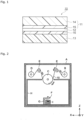
- a laminate 10 includes at least a first sealant layer 11, a vapor deposition film 12, and a second sealant layer 13 in this order.
- the first sealant layer 11 includes at least a polyethylene resin layer 14 and a surface resin layer 15.
- the vapor deposition film 12 is located on the surface resin layer 15 of the first sealant layer 11.
- a laminate according to the present disclosure includes a polyethylene resin layer and a second sealant layer composed of a polyethylene resin. Such a laminate can be suitably used as a laminate to produce a mono-material packaging container. Furthermore, the laminate according to the first embodiment has significantly improved adhesion between the sealant layer and the vapor deposition film and has very high gas barrier properties.
- the first sealant layer 11 may include an adhesive resin layer (not shown) between the polyethylene resin layer 14 and the surface resin layer 15.
- the laminate 10 may include a melt-extruded resin layer or an adhesive layer 16 between the vapor deposition film 12 and the second sealant layer 13.
- the ratio of the polyethylene resin content to the total solid content of the laminate is preferably 95% or more by mass. This allows the laminate to be suitably used to produce a mono-material packaging container.
- the first sealant layer includes at least a polyethylene resin layer and a surface resin layer.
- the first sealant layer includes an adhesive resin layer between the polyethylene resin layer and the surface resin layer.
- the ratio of the thickness of the surface resin layer to the total thickness of the first sealant layer is preferably 1% or more and 20% or less, more preferably 2% or more and 10% or less.
- the ratio of the thickness of the surface resin layer to the total thickness of the first sealant layer is 1% or more, this can further improve the adhesiveness to a vapor deposition film and the gas barrier properties.
- the laminate can be suitably used to produce a mono-material packaging container. This can also further improve the film-forming properties and processability of the sealant layer.
- polyethylene resin layer refers to a layer composed of a polyethylene resin.
- the polyethylene resin may be a high-density polyethylene resin (HDPE), a medium-density polyethylene resin (MDPE), a low-density polyethylene resin (LDPE), a linear low-density polyethylene resin (LLDPE), or a very-low-density polyethylene resin (VLDPE).
- HDPE high-density polyethylene resin
- MDPE medium-density polyethylene resin
- LDPE low-density polyethylene resin
- LLDPE linear low-density polyethylene resin
- VLDPE very-low-density polyethylene resin
- the polyethylene resin may also be a copolymer of ethylene and another monomer.
- the polyethylene resin may also be a biomass-derived polyethylene resin or a mechanically or chemically recycled polyethylene resin.
- the high-density polyethylene resin may be a polyethylene resin with a density of 0.945 g/cm 3 or more.
- the medium-density polyethylene resin may be a polyethylene resin with a density of 0.930 g/cm 3 or more and less than 0.945 g/cm 3 .
- the low-density polyethylene resin may be a polyethylene resin with a density of 0.900 g/cm 3 or more and less than 0.930 g/cm 3 .
- the linear low-density polyethylene resin may be a polyethylene resin with a density of 0.900 g/cm 3 or more and less than 0.930 g/cm 3 .
- the very-low-density polyethylene resin may be a polyethylene resin with a density of less than 0.900 g/cm 3 .
- the polyethylene resin content of the polyethylene resin layer is preferably 70% or more by mass, more preferably 80% or more by mass. This allows the laminate according to the first embodiment to be more suitably used to produce a mono-material packaging container.
- the polyethylene resin layer of the first sealant layer may have a monolayer structure or a multilayer structure.
- the polyethylene resin layer may include at least one layer containing a compatibilizer.
- a compatibilizer in the polyethylene resin layer allows a resin material with a melting point of 150°C or more in the surface resin layer to be uniformly mixed with a polyethylene resin constituting the polyethylene resin layer and can thereby effectively prevent deterioration of physical properties. This can also effectively prevent loss of transparency.
- the compatibilizer is preferably contained in a layer of the polyethylene resin layer in contact with the surface resin layer.
- the compatibilizer in the layer of the polyethylene resin layer in contact with the surface resin layer can further improve the effects described above.
- the compatibilizer can be appropriately selected from known compatibilizers and is preferably an unsaturated carboxylic acid modified polyolefin resin, more preferably a maleic anhydride modified polyethylene resin, in terms of recyclability.
- the compatibilizer content of the layer containing the compatibilizer is preferably 5% or more by mass and 30% or less by mass.
- the compatibilizer content of the polyethylene resin layer is 5% or more by mass, the effects described above can be further improved.
- the compatibilizer content of the polyethylene resin layer is 30% or less by mass, the strength and heat resistance of the first sealant layer can be improved.
- the polyethylene resin layer may contain a resin material other than the polyethylene resin, for example, a polyolefin resin, such as a polypropylene resin, a (meth)acrylic resin, a vinyl resin, a cellulose resin, a polyamide resin, a polyester resin, or an ionomer resin.
- a polyolefin resin such as a polypropylene resin, a (meth)acrylic resin, a vinyl resin, a cellulose resin, a polyamide resin, a polyester resin, or an ionomer resin.
- the polyethylene resin layer particularly preferably does not contain any resin other than the polyethylene resin in terms of recyclability.
- the polyethylene resin layer may contain an additive agent, for example, a cross-linker, an antioxidant, an anti-blocking agent, a lubricant (slip) agent, an ultraviolet absorber, a light stabilizer, a filler, a reinforcing agent, an antistatic agent, a pigment, and/or a modifying resin.
- an additive agent for example, a cross-linker, an antioxidant, an anti-blocking agent, a lubricant (slip) agent, an ultraviolet absorber, a light stabilizer, a filler, a reinforcing agent, an antistatic agent, a pigment, and/or a modifying resin.
- the polyethylene resin layer includes a layer composed of a linear low-density polyethylene resin, a layer composed of a high-density polyethylene resin, and a layer composed of a linear low-density polyethylene resin.
- a structure can improve heat-sealing properties and strength.
- the thickness of the polyethylene resin layer is preferably 50 ⁇ m or more and 200 ⁇ m or less, more preferably 70 ⁇ m or more and 150 ⁇ m or less.
- the polyethylene resin layer with a thickness of 50 ⁇ m or more can further improve the laminate strength of a packaging container.
- the polyethylene resin layer with a thickness of 200 ⁇ m or less can improve the formability of the laminate and can be used to more easily produce a packaging container.
- the polyethylene resin layer may include a print layer on its surface.
- An image to be formed on the print layer may be any image, such as a letter, a pattern, a symbol, or a combination thereof.
- the print layer can be formed on the polyethylene resin layer using a biomass-derived ink. This can reduce the environmental load.
- the print layer may be formed by any method, for example, by a known printing method, such as a gravure printing method, an offset printing method, or a flexographic printing method.
- the first sealant layer of the laminate according to the first embodiment includes a surface resin layer containing a resin material with a melting point of 150°C or more (hereinafter sometimes referred to as a high-melting-point resin material) on the polyethylene resin layer.
- the high-melting-point resin material more preferably has a melting point of 160°C or more.
- the high-melting-point resin material with a melting point of 160°C or more can further improve the adhesiveness to a vapor deposition film and can further improve the gas barrier properties.
- the high-melting-point resin material preferably has a melting point of 265°C or less, more preferably 260°C or less, still more preferably 250°C or less.
- the high-melting-point resin material with a melting point of 265°C or less can improve the film-forming properties of the first sealant layer.
- the difference in melting point between the high-melting-point resin material contained in the surface resin layer and the polyethylene resin constituting the polyethylene resin layer preferably ranges from 20°C to 80°C, more preferably 20°C to 60°C.
- the difference in melting point between the high-melting-point resin material contained in the surface resin layer and the polyethylene constituting the polyethylene resin layer is 20°C or more, this can further improve the adhesiveness to a vapor deposition film and can further improve the gas barrier properties of the first sealant layer on which the vapor deposition film is formed.
- the difference in melting point between the high-melting-point resin material contained in the surface resin layer and the polyethylene constituting the polyethylene resin layer is 80°C or less, the film-forming properties of the first sealant layer can be further improved.
- the high-melting-point resin material is composed of a polymer with a polar group.
- the high-melting-point resin material composed of a polymer with a polar group can further improve the adhesiveness to a vapor deposition film.
- the polar group refers to a group with at least one heteroatom, for example, an ester group, an epoxy group, a hydroxy group, an amino group, an amide group, a carboxy group, a carbonyl group, a carboxylic anhydride group, a sulfone group, a thiol group, or a halogen group.
- a hydroxy group an ester group, an amino group, an amide group, a carboxy group, and a carbonyl group are preferred, and a hydroxy group is more preferred.
- the high-melting-point resin material is, for example, a vinyl resin, a polyamide, a polyimide, a polyester, a (meth)acrylic resin, a cellulose resin, a polyolefin resin, or an ionomer resin.
- a resin material with a melting point of 150°C or more and with a polar group is particularly preferred; an ethylene-vinyl alcohol copolymer, poly(vinyl alcohol), or an amide resin, such as nylon 6, nylon 6,6, a nylon 6-nylon 6,6 copolymer, MXD nylon, or amorphous nylon, is preferred; and an ethylene-vinyl alcohol copolymer or an amide resin is particularly preferred.
- the use of such a resin material can significantly improve the adhesiveness to a vapor deposition film to be formed on the surface resin layer and can effectively improve the gas barrier properties.
- the high-melting-point resin material content of the surface resin layer is preferably 70% or more by mass, more preferably 80% or more by mass, still more preferably 90% or more by mass.
- the high-melting-point resin material content of the surface resin layer is 70% or more by mass, this can significantly improve the adhesiveness to a vapor deposition film to be formed on the surface resin layer and can effectively improve the gas barrier properties of the sealant layer on which the vapor deposition film is formed.
- the surface resin layer may contain a resin material other than the high-melting-point resin material.
- the surface resin layer preferably does not contain a resin material other than the high-melting-point resin material in terms of the adhesiveness to a vapor deposition film.
- the surface resin layer may contain an additive agent, for example, a cross-linker, an antioxidant, an anti-blocking agent, a lubricant (slip) agent, an ultraviolet absorber, a light stabilizer, a filler, a reinforcing agent, an antistatic agent, a pigment, and/or a modifying resin.
- an additive agent for example, a cross-linker, an antioxidant, an anti-blocking agent, a lubricant (slip) agent, an ultraviolet absorber, a light stabilizer, a filler, a reinforcing agent, an antistatic agent, a pigment, and/or a modifying resin.
- the thickness of the surface resin layer is preferably 0.1 ⁇ m or more and 5 ⁇ m or less, more preferably 0.1 ⁇ m or more and 4 ⁇ m or less.
- the surface resin layer with a thickness of 0.1 ⁇ m or more can further improve the adhesiveness to a vapor deposition film and can further improve the gas barrier properties of the first sealant layer on which the vapor deposition film is formed.
- the surface resin layer with a thickness of 5 ⁇ m or less can constitute the first sealant layer that can be suitably used to produce a mono-material packaging container. This can also further improve the film-forming properties and processability of the first sealant layer.
- the surface resin layer of the first sealant layer may be subjected to surface treatment. This can improve adhesiveness to an adjacent layer.
- Any surface treatment method may be used, for example, physical treatment, such as corona discharge treatment, ozone treatment, low-temperature plasma treatment using oxygen gas and/or nitrogen gas, or glow discharge treatment, or chemical treatment, such as oxidation treatment using a chemical.
- an adhesive resin layer can be provided between the polyethylene resin layer and the surface resin layer of the first sealant layer to improve the adhesion between these layers.
- the adhesive resin layer can be formed of an adhesive resin, such as a polyether, a polyester, a silicone resin, an epoxy resin, a polyurethane, a vinyl resin, a phenolic resin, or a polyolefin.
- an adhesive resin such as a polyether, a polyester, a silicone resin, an epoxy resin, a polyurethane, a vinyl resin, a phenolic resin, or a polyolefin.
- a polyolefin or an acid modified product thereof is preferred, and a polyethylene or an acid modified product thereof is particularly preferred, because this allows the laminate according to the first embodiment to have a structure more suitable for a mono-material packaging container.
- a commercial product can be used as an adhesive polyethylene, for example, an Admer series manufactured by Mitsui Chemicals, Inc.
- the thickness of the adhesive resin layer is, but not limited to, 1 ⁇ m or more and 15 ⁇ m or less, for example.
- the adhesive resin layer with a thickness of 1 ⁇ m or more can further improve the adhesion between the polyethylene resin layer and the surface resin layer.
- the adhesive layer with a thickness of 15 ⁇ m or less can improve the processability of the first sealant layer.
- the first sealant layer is a coextruded film and may be formed by a T-die method or an inflation method.
- the laminate according to the first embodiment includes a vapor deposition film adjacent to the surface resin layer.
- the vapor deposition film and the surface resin layer are strongly bonded together and have very high gas barrier properties, more specifically, oxygen barrier properties and water vapor barrier properties.
- a packaging container produced from the laminate including the vapor deposition film can reduce the mass loss of the contents of the packaging container.
- the vapor deposition film can be a vapor deposition film of inorganic substance(s) or inorganic oxide(s) of one or two or more of silicon (Si), aluminum (Al), magnesium (Mg), calcium (Ca), potassium (K), tin (Sn), sodium (Na), boron (B), titanium (Ti), lead (Pb), zirconium (Zr), and yttrium (Y).
- the vapor deposition film may have a structure composed of two or more layers and may be composed of the same material or different materials.
- the vapor deposition film is preferably composed of aluminum, aluminum oxide (alumina), or silicon oxide (silica) in terms of adhesiveness to the surface resin layer and gas barrier properties.
- the vapor deposition film composed of aluminum can improve the gloss and design performance of a packaging container.
- the surface of the vapor deposition film is preferably subjected to the surface treatment. This can improve adhesiveness to an adjacent layer.
- the thickness of the vapor deposition film is preferably 1 nm or more and 150 nm or less, more preferably 5 nm or more and 60 nm or less, still more preferably 10 nm or more and 40 nm or less.
- the vapor deposition film with a thickness of 1 nm or more can further improve the oxygen barrier properties and water vapor barrier properties of the laminate.
- the laminate can be suitably used to produce a mono-material packaging container. This can also prevent cracking in the vapor deposition film.
- the vapor deposition film can be formed by a known method, for example, a physical vapor deposition method (PVD method), such as a vacuum deposition method, a sputtering method, or an ion plating method, or a chemical vapor deposition method (CVD method), such as a plasma chemical vapor deposition method, a thermal chemical vapor deposition method, or a photochemical vapor deposition method.
- PVD method physical vapor deposition method
- CVD method chemical vapor deposition method
- plasma chemical vapor deposition method such as a plasma chemical vapor deposition method, a thermal chemical vapor deposition method, or a photochemical vapor deposition method.
- a vapor deposition film may be formed by another method.
- An apparatus used for a method of forming a vapor deposition film by a PVD method can be a vacuum film-forming apparatus with plasma assistance.
- One embodiment of a method of forming a vapor deposition film using a vacuum film-forming apparatus with plasma assistance is described below.
- a vacuum film-forming apparatus includes a vacuum chamber A, the first sealant layer 11, an unwinder B, a film-forming drum C, a winder D, a feed roller E, an evaporation source F, a reaction gas supply unit G, an anti-deposition box H, a deposition material I, and a plasma gun J.
- Fig. 2 is a schematic cross-sectional view of the vacuum film-forming apparatus in the XZ plane direction.
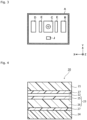
- Fig. 3 is a schematic cross-sectional view of the vacuum film-forming apparatus in the XY plane direction.
- the first sealant layer 11 wound by the film-forming drum C method is placed in an upper portion of the vacuum chamber A with the surface resin layer thereof facing downward, and the anti-deposition box H electrically grounded is located below the film-forming drum C in the vacuum chamber A.
- the evaporation source F is located at the bottom of the anti-deposition box H.
- the film-forming drum C is placed in the vacuum chamber A such that a surface of the surface resin layer of the first sealant layer 11 wound by the film-forming drum C faces the upper surface of the evaporation source F with a predetermined distance therebetween.
- the feed roller E is placed between the unwinder B and the film-forming drum C and between the film-forming drum C and the winder D.
- the vacuum chamber is coupled to a vacuum pump (not shown).
- the evaporation source F holds the deposition material I and has a heater (not shown).
- the reaction gas supply unit G is a portion for supplying a reactant gas (oxygen, nitrogen, helium, argon, a gas mixture thereof, etc.) that reacts with the evaporated deposition material.
- a reactant gas oxygen, nitrogen, helium, argon, a gas mixture thereof, etc.
- the deposition material I heated and evaporated from the evaporation source F is diffused toward the surface resin layer of the first sealant 11, and simultaneously the surface resin layer is irradiated with plasma from the plasma gun J. Thus, a vapor deposition film is formed.
- a plasma generator for use in the plasma chemical vapor deposition method may be a high-frequency plasma, pulse wave plasma, or microwave plasma generator.
- An apparatus with two or more film-forming chambers may also be used. Such an apparatus preferably has a vacuum pump to maintain a vacuum in each film-forming chamber.
- the degree of vacuum in each film-forming chamber preferably ranges from 1 ⁇ 10 to 1 ⁇ 10 -6 Pa.
- a first sealant layer is sent out to a film-forming chamber and is transported via an auxiliary roller to a cooling electrode drum at a predetermined speed.
- a gas mixture composition that contains a film-forming monomer gas containing an inorganic oxide, an oxygen gas, an inert gas, and the like is supplied from a gas supply unit into a film-forming chamber, plasma is generated by glow discharge on a surface resin layer, and the surface coating layer is irradiated with the plasma.
- a vapor deposition film containing the inorganic oxide is formed on the surface resin layer.
- An apparatus for use in a method of forming a vapor deposition film may be a continuous vapor-deposition-film-forming apparatus with a plasma pretreatment chamber and a film-forming chamber.
- One embodiment of a method of forming a vapor deposition film using the apparatus is described below.
- the surface resin layer of the first sealant layer is irradiated with plasma from a plasma supply nozzle.
- a vapor deposition film is then formed on the plasma-treated surface resin layer.
- the second sealant layer is composed of a polyethylene resin.
- a laminate with such a structure can be suitably used as a laminate to produce a mono-material packaging container.
- the polyethylene resin may be a high-density polyethylene resin, a medium-density polyethylene resin, a low-density polyethylene resin, a linear low-density polyethylene resin, or a very-low-density polyethylene resin.
- the polyethylene resin may also be a copolymer of ethylene and another monomer.
- the polyethylene resin may also be a biomass-derived polyethylene resin or a mechanically or chemically recycled polyethylene resin.
- the second sealant layer may contain the additive agent.
- the second sealant layer may have a monolayer structure or a multilayer structure.
- the second sealant layer includes a layer composed of a linear low-density polyethylene resin, a layer composed of a high-density polyethylene resin, and a layer composed of a linear low-density polyethylene resin.
- a structure can improve heat-sealing properties and strength.
- the thickness of the second sealant layer is preferably 50 ⁇ m or more and 200 ⁇ m or less, more preferably 70 ⁇ m or more and 150 ⁇ m or less.
- the second sealant layer with a thickness of 50 ⁇ m or more can further improve the laminate strength of a packaging container.
- the second sealant layer with a thickness of 200 ⁇ m or less can improve the formability of the laminate and can be used to more easily produce a packaging container.
- the second sealant layer can be laminated with a vapor deposition film or the like via a melt-extruded resin layer or an adhesive layer described below.
- the laminate according to the first embodiment includes a melt-extruded resin layer or an adhesive layer between the vapor deposition film and the second sealant layer.
- a material constituting the melt-extruded resin layer or the adhesive layer may be a known resin material or adhesive agent.
- a polyethylene resin or a polyethylene adhesive agent is preferably used to form a melt-extruded resin layer or an adhesive layer.
- the thickness of the melt-extruded resin layer or the adhesive layer may be, but is not limited to, in the range of 1 to 30 ⁇ m, for example.
- the laminate according to the first embodiment can further include a barrier coating layer on the vapor deposition film. More specifically, the barrier coating layer between the vapor deposition film and the second sealant layer can further improve the gas barrier properties of the laminate.
- the barrier coating layer is composed of a gas barrier resin, such as an ethylene-vinyl alcohol copolymer (EVOH), poly(vinyl alcohol), polyacrylonitrile, a polyamide resin, such as nylon 6, nylon 6,6, or poly(m-xylylene adipamide) (MXD6), a polyester resin, a polyurethane resin, or a (meth)acrylic resin.
- a gas barrier resin such as an ethylene-vinyl alcohol copolymer (EVOH), poly(vinyl alcohol), polyacrylonitrile, a polyamide resin, such as nylon 6, nylon 6,6, or poly(m-xylylene adipamide) (MXD6), a polyester resin, a polyurethane resin, or a (meth)acrylic resin.
- the thickness of the barrier coating layer is preferably 0.01 ⁇ m or more and 10 ⁇ m or less, more preferably 0.1 ⁇ m or more and 5 ⁇ m or less.
- the barrier coating layer with a thickness of 0.01 ⁇ m or more can further improve the gas barrier properties.
- the barrier coating layer with a thickness of 10 ⁇ m or less can improve the processability of the laminate. This also allows the laminate to be suitably used to produce a mono-material packaging container.
- the barrier coating layer can be formed by dissolving or dispersing the material in water or an appropriate solvent and applying and drying the solution or dispersion.
- the barrier coating layer is a gas barrier coating film containing at least one resin composition, such as a hydrolysate of a metal alkoxide or a hydrolytic condensate of a metal alkoxide, which is produced by polycondensation of a mixture of the metal alkoxide and a water-soluble polymer by a sol-gel method in the presence of a sol-gel method catalyst, water, an organic solvent, and the like.
- a barrier coating layer on the vapor deposition film can effectively prevent cracking in the vapor deposition film.
- the metal alkoxide is represented by the following general formula.
- R 1 n M(OR 2 ) m R 1 and R 2 independently denote an organic group having 1 to 8 carbon atoms, M denotes a metal atom, n denotes an integer of 0 or more, m denotes an integer of 1 or more, and n + m denotes the valence of M.
- the metal atom M may be silicon, zirconium, titanium, or aluminum, for example.
- Examples of the organic groups represented by R 1 and R 2 include alkyl groups, such as a methyl group, an ethyl group, a n-propyl group, an i-propyl group, a n-butyl group, and an i-butyl group.
- Examples of the metal alkoxide that satisfies the general formula include tetramethoxysilane (Si(OCH 3 ) 4 ), tetraethoxysilane (% by mass) (Si(OC 2 H 5 ) 4 ), tetrapropoxysilane (Si(OC 3 H 7 ) 4 ), and tetrabutoxysilane (Si(OC 4 H 9 ) 4 ).
- the metal alkoxide is preferably used together with a silane coupling agent.
- the silane coupling agent may be a known organoalkoxysilane with an organic reactive group.
- the water-soluble polymer is preferably poly(vinyl alcohol) or an ethylene-vinyl alcohol copolymer, and poly(vinyl alcohol) and the ethylene-vinyl alcohol copolymer are preferably used in combination in terms of oxygen barrier properties, water vapor barrier properties, water resistance, and weatherability.
- the thickness of the gas barrier coating film is preferably 0.01 ⁇ m or more and 10 ⁇ m or less, more preferably 0.1 ⁇ m or more and 5 ⁇ m or less. This can further improve the gas barrier properties.
- the gas barrier coating film with a thickness of 0.01 ⁇ m or more can improve the oxygen barrier properties and water vapor barrier properties of a barrier laminate. This can also prevent cracking in the vapor deposition film.
- the gas barrier coating film with a thickness of 10 ⁇ m or less can constitute the laminate that can be suitably used to produce a mono-material packaging container.
- the gas barrier coating film can be formed by applying a composition containing the above materials by a known means, for example, by roll coating with a gravure roll coater, by spray coating, by spin coating, by dipping, with a brush, with a bar code, or with an applicator, and performing polycondensation of the composition by a sol-gel method.
- a composition containing the above materials by a known means, for example, by roll coating with a gravure roll coater, by spray coating, by spin coating, by dipping, with a brush, with a bar code, or with an applicator, and performing polycondensation of the composition by a sol-gel method.
- An acid or an amine compound is suitable for a sol-gel method catalyst.
- the composition may further contain an acid.
- An acid is used as a catalyst for the sol-gel method, mainly as a catalyst for the hydrolysis of an alkoxide, a silane coupling agent, or the like.
- the acid may be a mineral acid, such as sulfuric acid, hydrochloric acid, or nitric acid, or an organic acid, such as acetic acid or tartaric acid.
- the composition may contain an organic solvent.
- organic solvent examples include methyl alcohol, ethyl alcohol, n-propyl alcohol, isopropyl alcohol, and n-butanol.
- a metal alkoxide, a water-soluble polymer, a sol-gel method catalyst, water, an organic solvent, and, if necessary, a silane coupling agent are mixed to prepare a composition.
- a polycondensation reaction progresses gradually in the composition.
- the composition is then applied to the vapor deposition film and is dried by the known method described above.
- the drying further promotes the polycondensation reaction of the alkoxide and the water-soluble polymer (and the silane coupling agent when the composition contains the silane coupling agent), thus forming a layer of a composite polymer.
- the gas barrier coating film can be formed by heating.
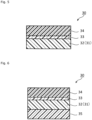
- a laminate 20 according to the second embodiment includes at least a first sealant layer 21, a vapor deposition film 22, a substrate 23, and a second sealant layer 24.
- a polyethylene resin layer of the substrate, the first sealant layer, and the second sealant layer in the laminate are composed of the same resin, that is, the polyethylene resin.
- the laminate with such a structure can be suitably used as a laminate to produce a mono-material packaging container.
- the laminate according to the second embodiment has significantly improved adhesion between the substrate and the vapor deposition film and has very high gas barrier properties.
- the substrate 23 includes at least a surface resin layer 25 and a polyethylene resin layer 26.
- the substrate 23 may include an adhesive resin layer (not shown) between the surface resin layer 25 and the polyethylene resin layer 26.
- the laminate 20 may include a melt-extruded resin layer or an adhesive layer 27 between the first sealant layer 21 and the vapor deposition film 22 and between the substrate 23 and the second sealant layer 24.
- the ratio of the polyethylene resin content to the total solid content of the laminate is preferably 95% or more by mass. This allows the laminate to be suitably used to produce a mono-material packaging container.
- Each layer of the laminate 20 is described below.
- the substrate includes at least a polyethylene resin layer and a surface resin layer.
- the substrate includes an adhesive resin layer between the polyethylene resin layer and the surface resin layer.
- the ratio of the thickness of the surface resin layer to the total thickness of the substrate is preferably 2% or more and 20% or less, more preferably 4% or more and 15% or less.
- the ratio of the thickness of the surface resin layer to the total thickness of the substrate is 2% or more, this can further improve the adhesiveness to a vapor deposition film and the gas barrier properties.
- the laminate can be suitably used to produce a mono-material packaging container. This can also further improve the film-forming properties and processability of the substrate.
- the polyethylene resin layer is composed of a polyethylene resin.
- the polyethylene resin may be the polyethylene resin described for the laminate according to the first embodiment. Thus, it is not described here.
- the polyethylene resin layer of the substrate may have a monolayer structure or a multilayer structure.
- the polyethylene resin constituting each layer may have different densities, that is, the polyethylene resin layer may have a density gradient.
- the polyethylene resin layer with a density gradient has significantly improved strength, heat resistance, and stretchability.
- the density difference between layers is preferably 0.04 g/cm 3 or less, more preferably 0.02 g/cm 3 or less.
- Embodiments of the polyethylene resin layer with a density gradient are described below.
- the structure of the polyethylene resin layer is not limited to these embodiments.
- the polyethylene resin layer with a density gradient is composed of three layers: a layer containing a high-density polyethylene resin, a layer containing a medium-density polyethylene resin, and a layer containing a high-density polyethylene resin.
- the polyethylene resin layer with a density gradient composed of the three layers has significantly improved strength, heat resistance, and stretchability. This can also effectively prevent the substrate from being curled.
- the polyethylene resin layer with a density gradient includes five layers: a layer containing a high-density polyethylene, a layer containing a medium-density polyethylene resin, a layer containing at least one of a low-density polyethylene resin and a linear low-density polyethylene resin, a layer containing a medium-density polyethylene resin, and a layer containing a high-density polyethylene resin.
- the polyethylene resin layer with a density gradient composed of the five layers has significantly improved strength, heat resistance, and stretchability. This can also effectively prevent the substrate from being curled.
- the polyethylene resin layer with such a structure can be consistently produced by an inflation method, as described below.
- a high-density polyethylene resin, a medium-density polyethylene resin, and at least one of a low-density polyethylene resin and a linear low-density polyethylene resin from the outside are coextruded in a tubular form, and layers containing at least one of a low-density polyethylene resin and a linear low-density polyethylene resin are then pressure-bonded with a rubber roller or the like.
- Production by such a method can significantly decrease the number of defective products in the production and finally improve production efficiency.
- the polyethylene resin layer with a density gradient includes seven layers: a layer containing a high-density polyethylene resin, a layer containing a blend resin of a high-density polyethylene resin and a medium-density polyethylene resin, a layer containing at least one of a low-density polyethylene resin and a linear low-density polyethylene resin, a layer containing a blend resin of a high-density polyethylene resin and a medium-density polyethylene resin, and a layer containing a high-density polyethylene resin.
- the polyethylene resin layer with a density gradient composed of the five layers has significantly improved strength, heat resistance, and stretchability. This can also effectively prevent the substrate from being curled. This can also effectively prevent delamination of the substrate.
- the polyethylene resin layer with such a structure can be consistently produced by the inflation method described above.
- the thickness of the polyethylene resin layer is preferably 10 ⁇ m or more and 50 ⁇ m or less, more preferably 10 ⁇ m or more and 40 ⁇ m or less.
- the polyethylene resin layer with a thickness of 10 ⁇ m or more can further improve the strength and heat resistance of the substrate.
- the polyethylene resin layer with a thickness of 50 ⁇ m or less can further improve the film-forming properties and processability of the substrate.
- the polyethylene resin layer may have a print layer on its surface.
- the print layer may be the same as that of the laminate according to the first embodiment. Thus, the print layer is not described here.
- the substrate of the laminate according to the second embodiment includes a surface resin layer containing a resin material with a melting point of 150°C or more on the polyethylene resin layer.
- the surface resin layer may be the same as that of the laminate according to the first embodiment. Thus, the surface resin layer is not described here.
- the substrate may include an adhesive resin layer between the polyethylene resin layer and the surface resin layer.
- the adhesive resin layer can improve the adhesion between the polyethylene resin layer and the surface resin layer.
- the adhesive resin layer may be the same as that of the laminate according to the first embodiment. Thus, the adhesive resin layer is not described here.
- the substrate is subjected to stretching, which may be uniaxial stretching or biaxial stretching.
- the stretch ratio of the substrate in the machine direction (MD) and the transverse direction (TD) is preferably 2 or more and 15 or less, more preferably 5 or more and 13 or less.
- the substrate can have further improved strength and heat resistance at a stretch ratio of 2 or more.
- the printability of the substrate can also be improved.
- the stretch ratio is preferably 15 or less in terms of the fracture limit of the substrate.
- the substrate is a coextruded film and may be produced by forming a resin film by the T-die method or the inflation method and stretching the resin film. Forming a film by the inflation method can simultaneously stretch the resin film.
- the sealant layers contain the same resin as the polyethylene resin layer of the substrate, that is, the polyethylene resin.
- a laminate with such a structure can be suitably used as a laminate to produce a mono-material packaging container.
- the polyethylene resin may be a high-density polyethylene resin (HDPE), a medium-density polyethylene resin (MDPE), a low-density polyethylene resin (LDPE), a linear low-density polyethylene resin (LLDPE), or a very-low-density polyethylene resin (VLDPE).
- HDPE high-density polyethylene resin
- MDPE medium-density polyethylene resin
- LDPE low-density polyethylene resin
- LLDPE linear low-density polyethylene resin
- VLDPE very-low-density polyethylene resin
- the polyethylene resin may also be a copolymer of ethylene and another monomer.
- the polyethylene resin may also be a biomass-derived polyethylene resin or a mechanically or chemically recycled polyethylene resin.
- the sealant layers may contain the additive agent.
- the sealant layers may have a monolayer structure or a multilayer structure.
- the sealant layers include a layer composed of a low-density polyethylene resin, a layer composed of a high-density polyethylene resin, and a layer composed of a low-density polyethylene resin.
- a structure can improve heat-sealing properties and strength.
- the sealant layers preferably have a thickness of 20 ⁇ m or more and 100 ⁇ m or less, more preferably 30 ⁇ m or more and 70 ⁇ m or less.
- the sealant layers with a thickness of 20 ⁇ m or more can further improve the laminate strength of a packaging container.
- the sealant layers with a thickness of 100 ⁇ m or less can improve the formability of the laminate and can be used to more easily produce a packaging container.
- the sealant layers may have a print layer on their surfaces. Any image, such as a letter, a pattern, a symbol, or a combination thereof, may be formed on the print layer.
- the print layer can be formed on the sealant layers using a biomass-derived ink. This can reduce the environmental load.
- the print layer may be formed by any method, for example, by a known printing method, such as a gravure printing method, an offset printing method, or a flexographic printing method.
- the sealant layers can be laminated with the substrate or the like via a melt-extruded resin layer or an adhesive layer described below.
- the first sealant layer and the second sealant layer of the laminate according to the second embodiment may have the same structure or different structures.
- the laminate according to the second embodiment includes a vapor deposition film adjacent to the surface resin layer.
- the vapor deposition film and the surface resin layer are strongly bonded together and have very high gas barrier properties, more specifically, oxygen barrier properties and water vapor barrier properties.
- a packaging container produced from the laminate including the vapor deposition film can reduce the mass loss of the contents of the packaging container.
- the vapor deposition layer may be the same as that of the laminate according to the first embodiment. Thus, the vapor deposition layer is not described here.
- the laminate includes a melt-extruded resin layer or an adhesive layer between the first sealant layer and the vapor deposition film or between the substrate and the second sealant layer.
- a material constituting the melt-extruded resin layer or the adhesive layer may be a known resin material or adhesive agent.
- a polyethylene resin or a polyethylene adhesive agent is preferably used to form a melt-extruded resin layer or an adhesive layer.
- the thickness of the melt-extruded resin layer or the adhesive layer may be, but is not limited to, in the range of 1 to 30 ⁇ m, for example.
- the laminate may further include a barrier coating layer on the vapor deposition film. More specifically, a barrier coating layer between the first sealant layer and the vapor deposition film (that is, a barrier coating layer on a side of the vapor deposition film opposite the side in contact with the surface resin layer) can further improve the gas barrier properties of the laminate.
- the barrier coating layer may be the same as that of the laminate according to the first embodiment. Thus, the barrier coating layer is not described here.
- a laminate 30 includes a substrate 31, a vapor deposition film 33, and a first sealant layer 34.
- the laminate 30 includes a second sealant layer 35 on the substrate 31 opposite the first sealant layer 34.
- the laminate 30 may include a barrier coating layer (not shown) on the vapor deposition film 33.
- the ratio of the polyethylene content to the total solid content of the laminate 30 is preferably 80% or more by mass, more preferably 90% or more by mass. This allows the laminate to be suitably used to produce a mono-material packaging container.
- the substrate includes a polyethylene resin layer.
- the substrate and a sealant layer described later are composed of the same resin material, the laminate can be used as a material with high recyclability for a mono-material packaging container or the like.
- the substrate includes a first polyethylene resin layer composed of a polyethylene resin and an olefin elastomer resin as a layer on which a vapor deposition film is to be formed.
- the polyethylene resin may be a high-density polyethylene resin (HDPE), a medium-density polyethylene resin (MDPE), a low-density polyethylene resin (LDPE), a linear low-density polyethylene resin (LLDPE), or a very-low-density polyethylene resin (VLDPE).
- HDPE high-density polyethylene resin
- MDPE medium-density polyethylene resin
- LDPE low-density polyethylene resin
- LLDPE linear low-density polyethylene resin
- VLDPE very-low-density polyethylene resin
- the polyethylene resin may also be a copolymer of ethylene and another monomer.
- the polyethylene resin may also be a biomass-derived polyethylene resin or a mechanically or chemically recycled polyethylene resin.
- the first polyethylene resin layer may contain a polyethylene resin with a density of 0.970 g/cm 3 or less.
- the polyethylene resin with a density of 0.970 g/cm 3 or less in the first polyethylene resin layer can further significantly improve the adhesiveness to a vapor deposition film.
- the melting point of the polyethylene resin in the first polyethylene resin layer is preferably 110°C or more and 140°C or less, more preferably 115°C or more and 135°C or less.
- a melting point of 110°C or more results in improved processability in terms of heat resistance in the production of the laminate.
- a melting point of 140°C or less tends to result in a smaller difference in the melting point of each layer of the multilayer structure, which facilitates stretching at a constant temperature.
- the MFR of the polyethylene resin in the first polyethylene resin layer is preferably 0.1 g/10 min or more and 5 g/10 min or less, more preferably 0.2 g/10 min or more and 4 g/10 min or less.
- a MFR of 0.1 g/10 min or more and 5 g/10 min or less results in stable film-forming properties in the inflation method.
- the polyethylene resin content of the first polyethylene resin layer is preferably 60% or more by mass and 99% or less by mass, more preferably 70% or more by mass and 95% or less by mass.
- the laminate can be suitably used to produce a mono-material packaging container.
- the polyethylene resin content of the first polyethylene resin layer is 99% or less by mass, a sufficient amount of olefin elastomer resin can be contained in the first polyethylene resin layer and can improve the adhesiveness to a vapor deposition film.
- the olefin elastomer resin is an ethylene elastomer resin.
- the use of the ethylene elastomer resin as the olefin elastomer resin allows the laminate to be suitably used to produce a mono-material packaging container.
- the olefin elastomer resin is an olefin block copolymer.
- the olefin block copolymer contained as an olefin elastomer resin in the first polyethylene resin layer can further improve the adhesion between the vapor deposition film and the first polyethylene resin layer.
- a block copolymer includes a sequence (block or segment) of the same monomer units covalently bonded to a different type of sequence.
- a block copolymer has, for example, a diblock structure A-B or a triblock structure A-B-A (wherein A denotes one block and B denotes a different block or segment).
- a multiblock copolymer can include A and B coupled in many different ways and repeated multiple times. An additional block or segment of a different type may also be further included.
- the multiblock copolymer may be a linear multiblock polymer or a multiblock star polymer (all blocks or segments are bonded to one atom or chemical moiety).
- the olefin block copolymer is an ethylene block copolymer, preferably an ethylene multiblock copolymer.
- the use of the ethylene block copolymer as the olefin block copolymer allows the laminate to be suitably used to produce a mono-material packaging container.
- the ethylene block copolymer is an ethylene/ ⁇ -olefin interpolymer, which can further improve the adhesion between the vapor deposition film and the first polyethylene resin layer.
- the ethylene/ ⁇ -olefin interpolymer includes ethylene and at least one copolymerizable ⁇ -olefin monomer in polymerized form.
- the term "interpolymer”, as used herein, refers to a polymer prepared by polymerization of at least two types of monomers.
- interpolymers include copolymers, which are polymers of two types of monomers, terpolymers, which are polymers of three types of monomers, and polymers of four or more types of monomers.
- the ethylene/ ⁇ -olefin interpolymer which is an ethylene block copolymer, includes a hard block (hard segment) composed of polyethylene and a soft block (soft segment) composed of an ⁇ -olefin monomer.
- Examples of the ⁇ -olefin monomer constituting the interpolymer include propylene, 1-butene, 1-pentene, 3-methyl-1-butene, 1-hexene, 4-methyl-1-pentene, 3-methyl-1-pentene, 1-octene, 1-decene, 1-dodecene, 1-tetradecene, 1-hexadecene, 1-eicosene, cyclopentene, cycloheptene, norbornene, 5-methyl-2-norbornene, tetracyclododecene, 2-methyl-1,4,5,8-dimethano-1,2,3,4,4a,5,8,8a-octahydronaphthalene, butadiene, isoprene, 4-methyl-1,3-pentadiene, 1,3-pentadiene, 1,4-pentadiene, 1,5-hexadiene, 1,4-hexadiene, 1,3-hexadiene, 1,
- the olefin elastomer resin may be a commercial olefin elastomer resin.
- an olefin block copolymer with a hard block composed of polyethylene and a soft block composed of an ⁇ -olefin monomer may be INFUSE 9100 manufactured by The Dow Chemical Company.
- Tafmer A-4085S manufactured by Mitsui Chemicals, Inc. may also be used.
- the olefin elastomer resin content of the first polyethylene resin layer is preferably 1% or more by mass and 40% or less by mass, more preferably 5% or more by mass and 30% or less by mass.
- the adhesion between the first polyethylene resin layer and the vapor deposition film can be further improved.
- the laminate can be suitably used to produce a mono-material packaging container.
- the first polyethylene resin layer can contain a resin material other than the polyethylene resin (another resin material). In terms of the adhesiveness to a vapor deposition film and recyclability, the first polyethylene resin layer preferably does not contain any other resin material.
- the first polyethylene resin layer may contain an additive agent, for example, a cross-linker, an antioxidant, an anti-blocking agent, a lubricant (slip) agent, an ultraviolet absorber, a light stabilizer, a filler, a reinforcing agent, an antistatic agent, a pigment, and/or a modifying resin.
- an additive agent for example, a cross-linker, an antioxidant, an anti-blocking agent, a lubricant (slip) agent, an ultraviolet absorber, a light stabilizer, a filler, a reinforcing agent, an antistatic agent, a pigment, and/or a modifying resin.
- the other polyethylene resin layer is composed of a polyethylene resin.
- the polyethylene resin may be the same as that of the laminate according to the first embodiment and the second embodiment.
- the substrate may be a monolayer or multilayer including a polyethylene resin layer.
- the substrate with a multilayer structure may be the same as that of the laminate according to the second embodiment.
- An example of the substrate of the laminate according to the third embodiment may be the following embodiment.
- One embodiment of the substrate with a multilayer structure produced by a coextrusion method as described above is, for example, a 10-layer multilayer film produced by melting resins by heating with an extruder, forming a five-layer laminate composed of first to fifth polyethylene resin layers by a feed block method, forming a tube film by the inflation method, and pressure-bonding the inside of the tube film with a rubber roller or the like.
- the multilayer film thus produced has a vertically symmetrical layer structure in the cross-sectional thickness direction.
- a laminated film with five layers composed of first to fifth polyethylene resin layers laminated with a coextruder becomes a substrate with a ten-layer structure composed of the first/second/third/fourth/fifth/fifth/fourth/third/second/first polyethylene resin layers in order from the surface.
- the two adjacent fifth polyethylene resin layers in the middle in the thickness cross-sectional direction can be regarded as one layer.
- the substrate can practically have a multilayer structure composed of nine layers consisting of the first/second/third/fourth/fifth/fourth/third/second/first polyethylene resin layers.
- a film with a multilayer structure produced by such a method is sometimes referred to as a "block film".
- Such a production method can significantly decrease the number of defective products in the production and finally improve production efficiency.
- the thickness of the substrate with a monolayer or multilayer structure is preferably 1 ⁇ m or more and 60 ⁇ m or less, more preferably 9 ⁇ m or more and 60 ⁇ m or less, still more preferably 12 ⁇ m or more and 50 ⁇ m or less.
- the substrate with a thickness of 1 ⁇ m or more can have improved heat resistance and strength.
- the substrate with a thickness of 60 ⁇ m or less can have improves processability.
- the first and second sealant layers are composed of a polyolefin, for example, a polyethylene resin, a polypropylene resin, polymethylpentene, an ethylene-propylene copolymer, or a propylene-butene copolymer, preferably a polyethylene resin in terms of recyclability.
- a polyolefin for example, a polyethylene resin, a polypropylene resin, polymethylpentene, an ethylene-propylene copolymer, or a propylene-butene copolymer, preferably a polyethylene resin in terms of recyclability.
- the first and second polyolefin resin layers contain a compatibilizer.
- the compatibilizer allows a gas barrier resin to be uniformly mixed with a polyethylene resin and can thereby effectively prevent deterioration of physical properties. This can also effectively prevent loss of transparency.
- the compatibilizer can be appropriately selected from known compatibilizers and is preferably an unsaturated carboxylic acid modified polyolefin resin, more preferably a maleic anhydride modified polyethylene resin, in terms of recyclability.
- the compatibilizer content of the first and second polyolefin resin layers is preferably 5% or more by mass and 30% or less by mass.
- the compatibilizer content of the first and second polyolefin resin layers is 5% or more by mass, the above effects can be further improved.
- the compatibilizer content of the first and second polyolefin resin layers is 30% or less by mass, the strength and heat resistance of the substrate can be improved.
- the first and second polyethylene resin layers may contain a resin material other than polyolefin resins, for example, a (meth)acrylic resin, a vinyl resin, a cellulose resin, a polyamide resin, a polyester resin, or an ionomer resin.
- a resin material other than polyolefin resins for example, a (meth)acrylic resin, a vinyl resin, a cellulose resin, a polyamide resin, a polyester resin, or an ionomer resin.
- the first and second polyolefin resin layers particularly preferably do not contain any resin other than the polyethylene resin in terms of recyclability.
- the first and second polyethylene resin layers may contain the additive agent.
- the first and second polyolefin resin layers preferably have a thickness of 5 ⁇ m or more and 100 ⁇ m or less, more preferably 10 ⁇ m or more and 50 ⁇ m or less.
- the polyolefin resin layer with a thickness of 5 ⁇ m or more can improve the strength and heat resistance of the laminate.
- the polyolefin resin layer with a thickness of 100 ⁇ m or less can improve the processability of the laminate.
- the first and second polyolefin resin layers may have the same structure or different structures.
- the laminate according to the third embodiment can further include a barrier coating layer on the vapor deposition film (between the first sealant layer and the vapor deposition film or between the vapor deposition film and the substrate). This can improve the gas barrier properties of the laminate.
- the barrier coating layer may be the same as that of the laminates according to the first embodiment and the second embodiment. Thus, the barrier coating layer is not described here.
- the laminate according to the third embodiment may include a gas barrier layer between the substrate and the second sealant layer. This can further improve the gas barrier properties of the laminate.
- the gas barrier layer includes at least a layer containing a gas barrier resin.
- the gas barrier resin is, for example, an ethylene-vinyl alcohol copolymer (EVOH), poly(vinyl alcohol), polyacrylonitrile, a polyamide, such as nylon 6, nylon 6,6 or poly(m-xylylene adipamide) (MXD6), a polyester, a polyurethane, or a (meth)acrylic resin.
- EVOH is preferred in terms of oxygen barrier properties and water vapor barrier properties.
- the gas barrier resin content of the layer containing a gas barrier resin is preferably 50% or more by mass, more preferably 75% or more by mass.
- the gas barrier resin content of the layer containing a gas barrier resin is 50% or more by mass, the oxygen barrier properties and water vapor barrier properties of the laminate can be further improved.
- the layer containing a gas barrier resin may contain the additive agent.
- the thickness of the layer containing a gas barrier resin is preferably 0.5 ⁇ m or more and 20 ⁇ m or less, more preferably 1 ⁇ m or more and 16 ⁇ m or less.
- the laminate can have improved oxygen barrier properties and water vapor barrier properties.
- the laminate can be suitably used to produce a mono-material packaging container.
- the gas barrier layer may have a multilayer structure described for a laminate according to a fourth embodiment.
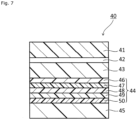
- a laminate 40 according to a fourth embodiment includes at least a first sealant layer 41, a vapor deposition film 42, a substrate 43, a gas barrier layer 44, and a second sealant layer 45.
- the substrate, the first sealant layer, and the second sealant layer in the laminate are composed of the same resin, that is, the polyethylene resin.
- the laminate with such a structure can be suitably used as a laminate to produce a mono-material packaging container.
- the laminate according to the fourth embodiment has significantly improved adhesion between the substrate and the vapor deposition film and has very high gas barrier properties.
- the ratio of the polyethylene resin content to the total solid content of the laminate is preferably 90% or more by mass. This allows the laminate to be suitably used to produce a mono-material packaging container. Each layer of the laminate 10 is described below.
- the substrate includes a polyethylene resin layer in the same manner as the first and second sealant layers composed of a polyethylene resin described later.
- the laminate can be used as a material with high recyclability for a mono-material packaging container or the like.
- the substrate may be a monolayer or multilayer including a polyethylene resin layer.
- a multilayer substrate can be produced by a coextrusion method in which polyolefin resins, such as a polyethylene resin, are melted by heating in their respective extruders, are laminated in the molten state by a coextrusion multilayer die method, a feed block method, or the like, and are formed into a film by the inflation method or the T-die method.
- a substrate with a multilayer structure formed by the coextrusion method may include a first polyethylene resin layer in contact with the vapor deposition film, a second polyethylene resin layer, a third polyethylene resin layer, a fourth polyethylene resin layer, and the like (hereinafter sometimes referred to as "another polyethylene resin layer”) in this order.
- the other polyethylene resin layer can improve the heat resistance, strength, transparency, stretchability, and the like of the laminate.
- the substrate is subjected to stretching. This can improve the strength and heat resistance of the substrate. This can also improve printability.
- the stretching may be uniaxial stretching or biaxial stretching.
- the stretch ratio of the substrate in the machine direction (MD) and the transverse direction (TD) is preferably 2 or more and 15 or less, more preferably 3 or more and 10 or less.
- the substrate can have further improved strength and heat resistance at a stretch ratio of 2 or more.
- the printability of the substrate can also be improved.
- the stretch ratio is preferably 15 or less in terms of the fracture limit of the substrate.
- the substrate includes a polyethylene resin layer composed of a polyethylene resin with a density of 0.943 g/cm 3 or less as a layer on which a vapor deposition film is to be formed.
- the polyethylene resin with a density of 0.943 g/cm 3 or less in the polyethylene resin layer may be a biomass-derived polyethylene resin or a mechanically or chemically recycled polyethylene resin.
- the amount of the polyethylene resin with a density of 0.943 g/cm 3 or less in the polyethylene resin layer is preferably 50% or more by mass, more preferably 70% or more by mass, still more preferably 80% or more by mass, particularly preferably 90% or more by mass.
- the amount of the polyethylene resin with a density of 0.943 g/cm 3 or less in the polyethylene resin layer is 50% or more by mass, the adhesion to the vapor deposition film can be further significantly improved.
- the melting point of the polyethylene resin with a density of 0.943 g/cm 3 or less in the polyethylene resin layer is preferably 60°C or more and 135°C or less, more preferably 65°C or more and 130°C or less. At a melting point of 60°C or more, the printability, strength, and heat resistance of the substrate can be further improved. At a melting point of 135°C or less, a difference in appropriate stretching temperature of each layer can be decreased.
- the MFR of the polyethylene resin with a density of 0.943 g/cm 3 or less in the polyethylene resin layer is preferably 0.1 g/10 min or more and 5 g/10 min or less, more preferably 0.2 g/10 min or more and 4 g/10 min or less.
- a MFR of 0.1 g/10 min or more and 5 g/10 min or less results in stable film-forming properties in the inflation method.
- the polyethylene resin layer may contain a resin material other than the polyethylene resin with a density of 0.943 g/cm 3 or less (another resin material).
- the polyethylene resin layer preferably does not contain the other resin material in terms of the adhesiveness to the vapor deposition film.
- the polyethylene resin layer may contain an additive agent, for example, a cross-linker, an antioxidant, an anti-blocking agent, a lubricant (slip) agent, an ultraviolet absorber, a light stabilizer, a filler, a reinforcing agent, an antistatic agent, a pigment, and/or a modifying resin.
- an additive agent for example, a cross-linker, an antioxidant, an anti-blocking agent, a lubricant (slip) agent, an ultraviolet absorber, a light stabilizer, a filler, a reinforcing agent, an antistatic agent, a pigment, and/or a modifying resin.
- the densities of polyethylene resins constituting adjacent layers may be the same or different.
- the polyethylene resin layer constituting the substrate may have a density gradient.
- Such a substrate may be the same as that of the laminate according to the third embodiment.
- the laminate includes the vapor deposition film on the polyethylene resin layer of the substrate. This can improve the gas barrier properties, more specifically, oxygen barrier properties and water vapor barrier properties, of the laminate.
- the vapor deposition film may be the same as that of the laminate according to the third embodiment. Thus, the vapor deposition layer is not described here.
- the first and second sealant layers constituting the laminate according to the fourth embodiment may be the same as the first and second sealant layers of the laminate according to the third embodiment. Thus, the first and second sealant layers are not described here.
- the laminate according to the fourth embodiment includes a gas barrier layer. This can improve the gas barrier properties of the laminate.
- the gas barrier layer may be the same as the gas barrier layer of the laminate according to the third embodiment.
- the gas barrier layer may have a multilayer structure. As illustrated in Fig. 7 , the gas barrier layer 44 has a five-layer structure composed of a first polyolefin resin layer 46, an adhesive resin layer 47, a layer 48 containing a gas barrier resin, an adhesive resin layer 49, and a second polyolefin resin layer 50.
- the adhesive resin layer and the layer containing a gas barrier resin may be the same as those described above.
- the first and second polyolefin resin layers are composed of a polyolefin, for example, a polyethylene resin, a polypropylene resin, polymethylpentene, an ethylene-propylene copolymer, or a propylene-butene copolymer, preferably a polyethylene resin in terms of recyclability.
- a polyolefin for example, a polyethylene resin, a polypropylene resin, polymethylpentene, an ethylene-propylene copolymer, or a propylene-butene copolymer, preferably a polyethylene resin in terms of recyclability.
- the first and second polyolefin resin layers contain a compatibilizer.
- the compatibilizer allows a gas barrier resin to be uniformly mixed with a polyethylene resin and can thereby effectively prevent deterioration of physical properties. This can also effectively prevent loss of transparency.
- the compatibilizer can be appropriately selected from known compatibilizers and is preferably an unsaturated carboxylic acid modified polyolefin resin, more preferably a maleic anhydride modified polyethylene resin, in terms of recyclability.
- the compatibilizer content of the first and second polyolefin resin layers is preferably 5% or more by mass and 30% or less by mass.
- the compatibilizer content of the first and second polyolefin resin layers is 5% or more by mass, the above effects can be further improved.
- the compatibilizer content of the first and second polyolefin resin layers is 30% or less by mass, the strength and heat resistance of the substrate can be improved.
- the first and second polyethylene resin layers may contain a resin material other than polyolefin resins, for example, a (meth)acrylic resin, a vinyl resin, a cellulose resin, a polyamide resin, a polyester resin, or an ionomer resin.
- the first and second polyolefin resin layers particularly preferably do not contain any resin other than the polyethylene resin in terms of recyclability.
- the first and second polyethylene resin layers may contain the additive agent.
- each of the first and second polyolefin resin layers is preferably 5 ⁇ m or more and 100 ⁇ m or less, more preferably 10 ⁇ m or more and 50 ⁇ m or less.
- the polyolefin resin layer with a thickness of 5 ⁇ m or more can improve the strength and heat resistance of the laminate.
- the polyolefin resin layer with a thickness of 100 ⁇ m or less can improve the processability of the laminate.
- the first and second polyolefin resin layers may have the same structure or different structures.
- a packaging container according to the present disclosure is produced from the laminate described above.
- Specific examples of the packaging container include laminated tubes, packaging bags, and cover materials.
- a packaging container according to the present disclosure is a laminated tube.
- a laminated tube according to the present disclosure is described below with reference to the accompanying drawings.
- Fig. 8 is a schematic view of a laminated tube 100
- Fig. 9 is a cross-sectional view taken along the line a-a in Fig. 8 .
- the laminated tube 100 includes a laminated tube body 110 with a head 111 and a trunk 112, and the trunk 112 is composed of the laminate.
- the head 111 includes a shoulder 113 connected to one end of the trunk 112 and an outlet 114 connected to the shoulder 113.
- the outlet 114 has a thread 115 for screwing a cap 120.
- the head 111 is composed of a polyethylene resin, which can improve the recyclability of the laminated tube.
- the polyethylene resin may be a high-density polyethylene resin, a medium-density polyethylene resin, a low-density polyethylene resin, a linear low-density polyethylene resin, or a very-low-density polyethylene resin.
- a high-density polyethylene resin is preferred in terms of shape retention.
- the polyethylene resin may also be a biomass-derived polyethylene resin or a mechanically or chemically recycled polyethylene resin.
- the head 111 may contain the additive agent.
- the head 111 can be produced by any method, for example, by a known method.
- the head 111 can be produced by a compression molding method (compression forming method) or an injection molding method (injection forming method) and can be joined to the trunk.
- the laminated tube 100 When the laminated tube 100 is produced by the compression molding method (compression forming method), the laminated tube 100 composed of the head 111 and the trunk 112 can be produced by mounting the trunk 112 in a male mold with a protrusion on the top, making the male mold and the female mold facing each other, supplying a material, such as a molten polyethylene resin, into the male and female molds, forming the head 111 by compression molding, and joining the head 111 to one opening of the trunk 112.
- a material such as a molten polyethylene resin
- the laminated tube 100 When the laminated tube 100 is produced by the injection molding method (injection forming method), the laminated tube 100 composed of the head 111 and the trunk 112 can be produced by mounting the trunk 112 in a male mold with a protrusion on the top, making the male mold and the female mold facing each other, supplying a material, such as a molten polyethylene resin, from a gate, forming the head 111 by injection molding, and joining the head 111 to one opening of the trunk 112.
- a material such as a molten polyethylene resin
- the trunk 112 is joined to the shoulder 113 of the head 111.
- the trunk 112 can be produced by rounding the laminate into a cylindrical shape, overlapping the first sealant layer and the second sealant layer, and heat-sealing the overlap to form a weld 116.
- the trunk 112 also includes a bottom seal 117 formed by heat-sealing the opening of the rounded laminate.
- the heat sealing method may be a known method, such as bar sealing, rotating roll sealing, belt sealing, impulse sealing, highfrequency sealing, ultrasonic sealing, or flame sealing.
- the laminated tube 100 may have the cap 120.
- the cap is detachably attached to the outlet of the head and closes the outlet.
- the cap is composed of a thermoplastic resin.
- the thermoplastic resin may be a polyolefin resin, such as polyethylene or polypropylene, a polyester, a cellulose resin, or a vinyl resin and is particularly preferably a polyethylene resin in terms of recyclability.
- the cap 120 may contain the additive agent.
- the cap may be a screw-type cap with a groove on the inner surface of the cap 120 so as to be screwed into the thread 115 of the outlet 114 or may be a plug-type cap fitted by plugging the outlet 115.
- a laminate according to the present disclosure is further described in the following examples, a laminate according to the present disclosure is not limited to these examples.
- a first sealant layer with a thickness of 125 ⁇ m was formed by the inflation method by coextruding
- a surface resin layer composed of the ethylene-vinyl alcohol copolymer had a thickness of 2 ⁇ m
- an adhesive resin layer had a thickness of 3 ⁇ m
- a polyethylene resin layer composed of the linear low-density polyethylene resin A had a thickness of 30 ⁇ m
- a polyethylene resin layer composed of the high-density polyethylene had a thickness of 60 ⁇ m
- a polyethylene resin layer composed of the linear low-density polyethylene resin B had a thickness of 30 ⁇ m.
- An aluminum vapor deposition film with a thickness of 30 nm was formed by a PVD method on a surface of the surface resin layer of the first sealant layer to form the first sealant layer with the aluminum vapor deposition film.
- a second sealant layer As a second sealant layer, a second sealant layer with a thickness of 120 ⁇ m was formed by the inflation method by coextruding
- a layer composed of the linear low-density polyethylene resin A had a thickness of 30 ⁇ m
- a layer composed of the high-density polyethylene resin had a thickness of 60 ⁇ m
- a layer composed of the linear low-density polyethylene resin B had a thickness of 30 ⁇ m.
- a low-density polyethylene (Novatec LC600A manufactured by Japan polyethylene Corporation, density: 0.918 g/cm 3 ) was melt-extruded on the vapor deposition film on the first sealant layer to form a melt-extruded polyethylene layer with a thickness of 20 ⁇ m.
- the vapor deposition film was bonded to the layer composed of the linear low-density polyethylene resin A of the second sealant layer via the melt-extruded polyethylene layer to prepare a laminate.
- the polyethylene resin content of the laminate was 97% by mass.
- a first sealant layer and a laminate were prepared in the same manner as in Example A1 except that the ethylene-vinyl alcohol copolymer was replaced with a polyamide (5033 manufactured by Ube Industries, Ltd., density: 1.14 g/cm 3 , melting point: 196°C).
- the polyethylene resin content of the laminate was 97% by mass.
- a blend resin was prepared that contained the linear low-density polyethylene (Dowlex 2098P manufactured by The Dow Chemical Company, density: 0.926 g/cm 3 ) and a compatibilizer (Retain 3000 manufactured by The Dow Chemical Company, maleic anhydride polyethylene, density: 0.87 g/cm 3 ) at a ratio of 8:2 based on mass.
- a compatibilizer Retain 3000 manufactured by The Dow Chemical Company, maleic anhydride polyethylene, density: 0.87 g/cm 3
- a first sealant layer with a thickness of 125 ⁇ m was formed by the inflation method by coextruding
- a surface resin layer composed of the ethylene-vinyl alcohol copolymer had a thickness of 2 ⁇ m
- an adhesive resin layer had a thickness of 3 ⁇ m
- a layer composed of the blend resin had a thickness of 30 ⁇ m
- a layer composed of the high-density polyethylene resin had a thickness of 60 ⁇ m
- a layer composed of the linear low-density polyethylene resin B had a thickness of 30 ⁇ m.
- a laminate was prepared in the same manner as in Example A1 except that the first sealant layer was replaced with the first sealant layer formed as described above.
- the polyethylene resin content of the laminate was 97% by mass.
- a first sealant layer and a laminate were prepared in the same manner as in Example A3 except that the ethylene-vinyl alcohol copolymer was replaced with the polyamide (5033 manufactured by Ube Industries, Ltd., density: 1.14 g/cm 3 , melting point: 196°C).
- the polyethylene resin content of the laminate was 97% by mass.
- a first sealant layer As a first sealant layer, a first sealant layer with a thickness of 120 ⁇ m was formed by the inflation method by coextruding
- a layer composed of the linear low-density polyethylene resin A had a thickness of 30 ⁇ m
- a layer composed of the high-density polyethylene resin had a thickness of 60 ⁇ m
- a layer composed of the linear low-density polyethylene resin B had a thickness of 30 ⁇ m.
- An aluminum vapor deposition film with a thickness of 30 nm was formed by the PVD method on a surface of the layer composed of the linear low-density polyethylene resin A of the first sealant layer to form the first sealant layer with the aluminum vapor deposition film.
- a laminate was prepared in the same manner as in Example A1 except that the first sealant layer was replaced with the first sealant layer formed as described above.
- the polyethylene resin content of the laminate was 98% by mass.
- a first sealant layer As a first sealant layer, a first sealant layer with a thickness of 120 ⁇ m was formed by the inflation method by coextruding
- a layer composed of the linear low-density polyethylene resin A had a thickness of 30 ⁇ m
- a layer composed of the high-density polyethylene resin had a thickness of 60 ⁇ m
- a layer composed of the linear low-density polyethylene resin B had a thickness of 30 ⁇ m.
- a biaxially stretched poly(ethylene terephthalate) (ester film E5100 manufactured by Toyobo Co., Ltd.) with a thickness of 12 ⁇ m was provided as a substrate film.
- An aluminum vapor deposition film with a thickness of 30 nm was formed on one surface of the substrate film by the PVD method to form the substrate film with the aluminum vapor deposition film.
- a urethane adhesive agent (RU004/H1 manufactured by Rock Paint Co., Ltd.) was applied to the deposited surface of the substrate film and was dried to form an adhesive layer with a thickness of 3 ⁇ m. The deposited surface was bonded to the layer composed of the linear low-density polyethylene resin A of the first sealant layer via the adhesive layer.
- a second sealant layer As a second sealant layer, a second sealant layer with a thickness of 120 ⁇ m was formed by the inflation method by coextruding
- a layer composed of the linear low-density polyethylene resin A had a thickness of 30 ⁇ m
- a layer composed of the high-density polyethylene resin had a thickness of 60 ⁇ m
- a layer composed of the linear low-density polyethylene resin B had a thickness of 30 ⁇ m.
- the low-density polyethylene (Novatec LC600A manufactured by Japan polyethylene Corporation, density: 0.918 g/cm 3 ) was melt-extruded on an undeposited film of the substrate film to form a melt-extruded polyethylene layer with a thickness of 20 ⁇ m.
- the undeposited film was bonded to the layer composed of the linear low-density polyethylene resin A of the second sealant layer via the melt-extruded polyethylene layer to prepare a laminate.
- the polyethylene resin content of the laminate was 93% by mass.
- the laminates thus prepared were processed into a slit with a width of 120 mm using a bobbin cutter. Both ends in the width direction were superposed with each other at an overlap width of approximately 1.5 mm and were then thermally fused to prepare a cylindrically bonded raw laminate.
- the raw laminate was cut to a length of 122 mm in the length direction to prepare a cylindrical trunk, which serves as a trunk of a tube container.
- a tube container as illustrated in Fig. 8 was prepared by mounting the cylindrical trunk on a mandrel for forming a tube container, and injecting a high-density polyethylene resin (Novatec HJ360 manufactured by Japan polyethylene Corporation, density: 0.951 g/cm 3 ) by injection molding to form a head composed of a truncated cone shaped shoulder and a cylindrical outlet continuous with the shoulder at one end of the cylindrical trunk.
- a high-density polyethylene resin (Novatec HJ360 manufactured by Japan polyethylene Corporation, density: 0.951 g/cm 3 ) by injection molding to form a head composed of a truncated cone shaped shoulder and a cylindrical outlet continuous with the shoulder at one end of the cylindrical trunk.
- the outlet of the head of the resulting tube container body had an outer diameter of 13 mm and a height of 1.5 mm and had a thread on the side surface of the outlet.
- the shoulder had an outer diameter of 38 mm.
- the high-density polyethylene was then injected into a mold for forming a cap to form a cap.
- a tube container according to the present disclosure was prepared.
- the polyethylene resin content of the laminate was 95% or more by mass.
- the polyethylene resin content of the laminate was less than 95% by mass.
- test specimen was cut out in a band shape with a width of 15 mm toward the bottom from the joint between the trunk and the shoulder.
- the test specimen was pulled with a tensile tester (RTC-1310A manufactured by Orientec Co., Ltd.) at a test speed of 300 mm/min to measure peel strength when the trunk was separated from the shoulder.
- RTC-1310A manufactured by Orientec Co., Ltd.
- test specimen was cut out in a band shape with a width of 15 mm in the direction perpendicular to the side seam (overlap) of the trunk and was pulled with the tensile tester at a test speed of 300 mm/min to measure breaking strength. Table 1 summarizes the measurement results.
- a cap was screwed on the outlet of the tube container body.
- the tube container body was then filled with 120 g of a commercial toothpaste as the contents through the opening of the cylindrical trunk.
- the opening of the cylindrical trunk was then heat-sealed.
- the cap was closed at a torque of 4.7 kg.cm. While left at room temperature for two weeks, the contents were visually checked for leakage every day. The leakage was evaluated on the basis of the following criteria. Table 1 summarizes the evaluation results.
- oxygen permeability measuring apparatus OX-TRAN 2/20 manufactured by MOCON
- JIS K 7126 JIS K 7126 in an environment of 23°C and a relative humidity of 90% RH.
- a substrate with a thickness of 40 ⁇ m was formed by the T-die method by coextruding
- a surface resin layer composed of the ethylene-vinyl alcohol copolymer had a thickness of 2 ⁇ m
- an adhesive resin layer had a thickness of 3 ⁇ m
- a polyethylene resin layer composed of the linear low-density polyethylene resin A had a thickness of 35 ⁇ m.
- An aluminum vapor deposition film with a thickness of 30 nm was formed on the surface of the surface resin layer of the substrate by the PVD method at a pressure of 3.0 x 10 -2 Pa. Thus, an aluminum vapor-deposited substrate was prepared.
- a first sealant layer As a first sealant layer, a first sealant layer with a thickness of 120 ⁇ m was formed by the inflation method by coextruding
- a layer composed of the linear low-density polyethylene resin B had a thickness of 30 ⁇ m
- a layer composed of the high-density polyethylene resin had a thickness of 60 ⁇ m
- a layer composed of the linear low-density polyethylene resin C had a thickness of 30 ⁇ m.
- the urethane adhesive agent (RU004/H1 manufactured by Rock Paint Co., Ltd.) was applied to the deposited surface of the substrate and was dried to form an adhesive layer with a thickness of 3 ⁇ m.
- the deposited surface was bonded to the layer composed of the linear low-density polyethylene resin B of the first sealant layer via the adhesive layer.
- a second sealant layer As a second sealant layer, a second sealant layer with a thickness of 120 ⁇ m was formed by the inflation method by coextruding
- a linear low-density polyethylene 1 had a thickness of 30 ⁇ m
- the high-density polyethylene had a thickness of 60 ⁇ m
- a linear low-density polyethylene 2 had a thickness of 30 ⁇ m.
- the low-density polyethylene (Novatec LC600A manufactured by Japan polyethylene Corporation, density: 0.918 g/cm 3 ) was melt-extruded on an undeposited film of the substrate to form a melt-extruded polyethylene layer with a thickness of 20 ⁇ m.
- the undeposited film was bonded to the layer composed of the linear low-density polyethylene resin B of the second sealant layer via the melt-extruded polyethylene layer to prepare a laminate according to the present disclosure.
- the polyethylene resin content of the laminate was 98%.
- a blend resin was prepared that contained the linear low-density polyethylene (SP 2520 manufactured by Prime Polymer Co., Ltd., density: 0.925 g/cm 3 , melting point: 122°C) and the compatibilizer (Retain 3000 manufactured by The Dow Chemical Company, maleic anhydride polyethylene, density: 0.87 g/cm 3 ) at a ratio of 8:2 based on mass.
- SP 2520 manufactured by Prime Polymer Co., Ltd., density: 0.925 g/cm 3 , melting point: 122°C
- the compatibilizer Retain 3000 manufactured by The Dow Chemical Company, maleic anhydride polyethylene, density: 0.87 g/cm 3
- a substrate with a thickness of 40 ⁇ m was formed by the T-die method by coextruding
- a surface resin layer composed of the ethylene-vinyl alcohol copolymer had a thickness of 2 ⁇ m
- an adhesive resin layer had a thickness of 3 ⁇ m
- a layer composed of the blend resin had a thickness of 20 ⁇ m
- a polyethylene resin layer composed of the linear low-density polyethylene had a thickness of 15 ⁇ M.
- a laminate according to the present disclosure was prepared in the same manner as in Example B1 except that the substrate was replaced with the substrate formed as described above.
- the polyethylene resin content of the laminate was 98%.
- a substrate and a laminate were prepared in the same manner as in Example B1 except that the ethylene-vinyl alcohol copolymer was replaced with the polyamide (5033 manufactured by Ube Industries, Ltd., melting point: 196°C, density: 1.14 g/cm 3 ).
- the polyethylene resin content of the laminate was 98%.
- a blend resin was prepared that contained the linear low-density polyethylene (SP 2520 manufactured by Prime Polymer Co., Ltd., density: 0.925 g/cm 3 , melting point: 122°C) and the compatibilizer (Retain 3000 manufactured by The Dow Chemical Company, maleic anhydride polyethylene, density: 0.87 g/cm 3 ) at a ratio of 8:2 based on mass.
- SP 2520 manufactured by Prime Polymer Co., Ltd., density: 0.925 g/cm 3 , melting point: 122°C
- the compatibilizer Retain 3000 manufactured by The Dow Chemical Company, maleic anhydride polyethylene, density: 0.87 g/cm 3
- a substrate with a thickness of 40 ⁇ m was formed by the T-die method by coextruding
- a surface resin layer composed of the polyamide had a thickness of 2 ⁇ m
- an adhesive resin layer had a thickness of 3 ⁇ m
- a layer composed of the blend resin had a thickness of 20 ⁇ m
- a polyethylene resin layer composed of the linear low-density polyethylene had a thickness of 15 ⁇ m.
- a laminate according to the present disclosure was prepared in the same manner as in Example B1 except that the substrate was replaced with the substrate formed as described above.
- the polyethylene resin content of the laminate was 98%.
- a laminate was prepared in the same manner as in Example B1 except that the substrate was replaced with the biaxially stretched poly(ethylene terephthalate) (ester film E5100 manufactured by Toyobo Co., Ltd.) with a thickness of 12 ⁇ m.
- the polyethylene resin content of the laminate was 93%.
- the laminates thus prepared were prepared as described above.
- the laminates prepared in the examples and comparative examples were evaluated in terms of recyclability, shoulder adhesive strength, side seam strength, leakage, and gas barrier properties as described above. Table 2 summarizes the evaluation results.
- the laminate strength (N/15 mm) between the vapor deposition film and the surface resin layer (examples) and between the vapor deposition film and the biaxially stretched poly(ethylene terephthalate) film (comparative examples) in samples prepared by cutting the laminates prepared in the examples and comparative examples into strips with a width of 15 mm was measured with a tensile tester (Tensilon universal testing machine manufactured by Orientec Co., Ltd.) in accordance with JIS K 6854-2 by 90-degree peeling (a T peel method) at a peel rate of 50 mm/min. Table 2 summarizes the measurement results.
- a film composed of a surface resin layer (10 ⁇ m), an adhesive resin layer (15 ⁇ m), and a polyethylene resin layer (100 ⁇ m) was formed by the inflation method by coextruding
- the film was stretched in the machine direction (MD) at a stretch ratio of 5 to form a stretched substrate with a thickness of 25 ⁇ m.
- the thickness after the stretching was 2 ⁇ m in the surface resin layer, 3 ⁇ m in the adhesive resin layer, and 20 ⁇ m in the polyethylene resin layer.
- An aluminum vapor deposition film with a thickness of 30 nm was formed on the surface of the surface resin layer of the stretched substrate by the PVD method at a pressure of 3.0 x 10 -2 Pa. Thus, an aluminum vapor-deposited substrate was prepared.
- a first sealant layer As a first sealant layer, a first sealant layer with a thickness of 120 ⁇ m was formed by the inflation method by coextruding
- a layer composed of the linear low-density polyethylene resin A had a thickness of 30 ⁇ m
- a layer composed of the high-density polyethylene resin had a thickness of 60 ⁇ m
- a layer composed of the linear low-density polyethylene resin B had a thickness of 30 ⁇ m.
- the urethane adhesive agent (RU004/H1 manufactured by Rock Paint Co., Ltd.) was applied to the deposited surface of the substrate and was dried to form an adhesive layer with a thickness of 3 ⁇ m.
- the deposited surface was bonded to the layer composed of the linear low-density polyethylene A of the first sealant layer via the adhesive layer.
- a heat-seal layer with a thickness of 120 ⁇ m was formed by the inflation method by coextruding
- a linear low-density polyethylene 1 had a thickness of 30 ⁇ m
- the high-density polyethylene had a thickness of 60 ⁇ m
- a linear low-density polyethylene 2 had a thickness of 30 ⁇ m.
- the low-density polyethylene resin (Novatec LC600A manufactured by Japan polyethylene Corporation, density: 0.918 g/cm 3 ) was melt-extruded on an undeposited film of the substrate to form a melt-extruded resin layer with a thickness of 20 ⁇ m.
- the undeposited film was bonded to the layer composed of the linear low-density polyethylene resin A of the second heat-seal layer via the melt-extruded resin layer to prepare a laminate according to the present disclosure.
- the polyethylene content of the laminate was 98%.
- a blend resin was prepared that contained a linear low-density polyethylene resin (Elite 5538 manufactured by The Dow Chemical Company, density: 0.941 g/cm 3 , melting point: 129°C) and the compatibilizer (Retain 3000 manufactured by The Dow Chemical Company, maleic anhydride polyethylene, density: 0.87 g/cm 3 ) at a ratio of 8:2 based on mass.
- a linear low-density polyethylene resin (Elite 5538 manufactured by The Dow Chemical Company, density: 0.941 g/cm 3 , melting point: 129°C)
- the compatibilizer Retain 3000 manufactured by The Dow Chemical Company, maleic anhydride polyethylene, density: 0.87 g/cm 3 ) at a ratio of 8:2 based on mass.
- a film of a surface resin layer 10 ⁇ m, an adhesive resin layer 15 ⁇ m, a layer composed of the blend resin 50 ⁇ m, and a layer composed of the medium-density polyethylene resin 50 ⁇ m was formed by the inflation method by coextruding
- the substrate film was stretched in the machine direction (MD) at a stretch ratio of 5 to form a stretched substrate with a thickness of 25 ⁇ m.
- the thickness after the stretching was 2 ⁇ m in a gas barrier resin layer, 3 ⁇ m in the adhesive resin layer, 10 ⁇ m in the layer composed of the blend resin, and 10 ⁇ m in the layer composed of the medium-density polyethylene resin.
- a laminate according to the present disclosure was prepared in the same manner as in Example C1 except that the substrate was replaced with the substrate formed as described above.
- the polyethylene resin content of the laminate was 98%.
- a substrate and a laminate were prepared in the same manner as in Example C1 except that the ethylene-vinyl alcohol copolymer was replaced with a polyamide 6-66 copolymer (NY, manufactured by Ube Industries, Ltd., trade name: 5033, density: 1.14 g/cm 3 , melting point: 196°C).
- the polyethylene resin content of the laminate was 98%.
- a blend resin was prepared that contained the linear low-density polyethylene (Elite 5538 manufactured by The Dow Chemical Company, density: 0.941 g/cm 3 , melting point: 129°C) and the compatibilizer (Retain 3000 manufactured by The Dow Chemical Company, maleic anhydride polyethylene, density: 0.87 g/cm 3 ) at a ratio of 8:2 based on mass.
- the linear low-density polyethylene Elite 5538 manufactured by The Dow Chemical Company, density: 0.941 g/cm 3 , melting point: 129°C
- the compatibilizer Retain 3000 manufactured by The Dow Chemical Company, maleic anhydride polyethylene, density: 0.87 g/cm 3
- a film composed of a surface resin layer 10 ⁇ m, an adhesive resin layer 15 ⁇ m, a layer composed of the blend resin 50 ⁇ m, and a layer composed of the medium-density polyethylene resin 50 ⁇ m was formed by an inflation molding method by coextruding
- the film was stretched in the machine direction (MD) at a stretch ratio of 5 to form a stretched substrate with a thickness of 25 ⁇ m.
- the thickness after the stretching was 2 ⁇ m in the surface resin layer, 3 ⁇ m in the adhesive resin layer, 10 ⁇ m in the layer composed of the blend resin, and 10 ⁇ m in the layer composed of the medium-density polyethylene resin.
- a laminate according to the present disclosure was prepared in the same manner as in Example C1 except that the substrate was replaced with the substrate formed as described above.
- the polyethylene resin content of the laminate was 98%.
- a laminate was prepared in the same manner as in Example C1 except that the substrate was replaced with the biaxially stretched poly(ethylene terephthalate) (manufactured by Toyobo Co., Ltd., ester film E5100) with a thickness of 12 ⁇ m.
- the polyethylene content of the laminate was 93%.
- a mixture of the polyethylene resin A and the olefin elastomer resin A (blend ratio: 8:2 (based on mass)) and the polyethylene resin A were subjected to two-layer coextrusion by the inflation method to form a film.
- the film was then stretched five times in the machine direction (MD) to prepare a substrate including a first polyethylene resin layer composed of the mixture of the polyethylene resin A and the olefin elastomer resin and a second polyethylene resin layer composed of the polyethylene resin A.
- the first polyethylene resin layer had a thickness of 2 ⁇ m
- the second polyethylene resin layer had a thickness of 23 ⁇ m.
- An aluminum vapor deposition film with a thickness of 30 nm was formed by the PVD method on the first polyethylene resin layer of the substrate thus prepared to prepare a vapor-deposited substrate.
- the optical density (OD value) of the vapor deposition film thus formed was measured to be 3.0.
- Substrates and vapor-deposited substrates were prepared in the same manner as in Example D1-1 except that the structure of the first polyethylene resin layer was changed as shown in Table 4.
- the polyethylene resin C was subjected to single layer extrusion by the inflation method to form an unstretched polyethylene resin film with a thickness of 100 ⁇ m.
- this unstretched polyethylene resin film was put on the vapor deposition film of each vapor-deposited substrate prepared in Examples D1-1 to D1-5 and Comparative Example D1-1 via a two-component curing urethane adhesive agent (RU-004/H-1 manufactured by Rock Paint Co., Ltd.) to prepare a laminate.
- a two-component curing urethane adhesive agent RU-004/H-1 manufactured by Rock Paint Co., Ltd.
- the laminate thus prepared was cut into strips with a width of 15 mm used as test specimens.
- the peel strength between the vapor deposition film and the first polyethylene resin layer in these test specimens was measured with a tensile tester (Tensilon universal testing machine manufactured by Orientec Co., Ltd.) in accordance with JIS K 6854-2. Table 4 shows the measurement results.
- the peel rate was 50 mm/min, and the peel angle was 180 degrees.
- a mixture of the polyethylene resin A and the olefin elastomer resin A (blend ratio: 8:2 (based on mass)), the polyethylene resin A, and a mixture of the polyethylene resin A and the olefin elastomer resin A (blend ratio: 8:2 (based on mass) were subjected to three-layer coextrusion by the inflation method to form a film.
- the film was then stretched five times in the machine direction (MD) to prepare a substrate including a first polyethylene resin layer composed of the mixture of the polyethylene resin A and the olefin elastomer resin, a second polyethylene resin layer composed of the polyethylene resin A, and a third polyethylene resin layer composed of the mixture of the polyethylene resin A and the olefin elastomer resin.
- the first polyethylene resin layer had a thickness of 2 ⁇ m
- the second polyethylene resin layer had a thickness of 21 ⁇ m
- the third polyethylene resin layer had a thickness of 2 ⁇ m.
- An aluminum vapor deposition film with a thickness of 30 nm was formed by the PVD method on the first polyethylene resin layer of the substrate thus prepared to prepare a vapor-deposited substrate.
- the optical density (OD value) of the vapor deposition film thus formed was measured to be 3.0.
- Substrates and vapor-deposited substrates were prepared in the same manner as in Example D2-1 except that the structures of the first polyethylene resin layer and the third polyethylene resin layer were changed as shown in Table 5.
- the polyethylene resin C was subjected to single layer extrusion by the inflation method to form an unstretched polyethylene resin film with a thickness of 100 ⁇ m.
- this unstretched polyethylene resin film was put on the vapor deposition film of each vapor-deposited substrate prepared in Examples D2-1 to D2-5 and Comparative Example D2-1 via a two-component curing urethane adhesive agent (RU-004/H-1 manufactured by Rock Paint Co., Ltd.) to prepare a laminate.
- a two-component curing urethane adhesive agent (RU-004/H-1 manufactured by Rock Paint Co., Ltd.)
- the laminate thus prepared was cut into strips with a width of 15 mm used as test specimens.
- the peel strength between the vapor deposition film and the first polyethylene resin layer in these test specimens was measured with a tensile tester (Tensilon universal testing machine manufactured by Orientec Co., Ltd.) in accordance with JIS K 6854-2. Table 5 shows the measurement results.
- the peel rate was 50 mm/min, and the peel angle was 180 degrees.
- a mixture of the polyethylene resin A and the olefin elastomer resin A (blend ratio: 8:2 (based on mass)) was subjected to single layer coextrusion by the inflation method to form a film.
- the film was then stretched five times in the machine direction (MD) to prepare a substrate including a first polyethylene resin layer composed of the mixture of the polyethylene resin A and the olefin elastomer resin A.
- the first polyethylene resin layer had a thickness of 25 ⁇ m.
- An aluminum vapor deposition film with a thickness of 30 nm was formed by the PVD method on the first polyethylene resin layer of the substrate thus prepared to prepare a vapor-deposited substrate.
- Substrates and vapor-deposited substrates were prepared in the same manner as in Example D3-1 except that the structure of the first polyethylene resin layer was changed as shown in Table 6.
- the polyethylene resin C was subjected to single layer extrusion by the inflation method to form an unstretched polyethylene resin film with a thickness of 100 ⁇ m.
- this unstretched polyethylene resin film was put on the vapor deposition film of each vapor-deposited substrate prepared in Examples D3-1 to D3-5 and Comparative Example D3-1 via a two-component curing urethane adhesive agent (RU-004/H-1 manufactured by Rock Paint Co., Ltd.) to prepare a laminate.
- the laminate thus prepared was cut into strips with a width of 15 mm used as test specimens.
- the peel strength between the vapor deposition film and the first polyethylene resin layer in these test specimens was measured with a tensile tester (Tensilon universal testing machine manufactured by Orientec Co., Ltd.) in accordance with JIS K 6854-2. Table 6 shows the measurement results.
- the peel rate was 50 mm/min, and the peel angle was 180 degrees.
- a film with a five-layer structure including a first polyethylene resin layer composed of a mixture of the polyethylene resin A and the olefin elastomer resin A, a second polyethylene resin layer composed of the polyethylene resin A, a third polyethylene resin layer composed of the polyethylene resin D, a fourth polyethylene resin layer composed of the polyethylene resin A, and a fifth polyethylene resin layer composed of a mixture of the polyethylene resin A and the olefin elastomer resin A was prepared by coextruding a mixture of the polyethylene resin A and the olefin elastomer resin A (blend ratio: 8:2 (based on mass)), the polyethylene resin A, and the polyethylene resin D by the inflation method to form a three-layer tubular film including a layer composed of the mixture of the polyethylene resin A and the olefin elastomer resin A (outer layer), a layer composed of the polyethylene resin A (intermediate layer), and a layer composed of the polyethylene resin C (inner
- This film was stretched five times in the machine direction (MD) to prepare a substrate.
- the first polyethylene resin layer had a thickness of 2 ⁇ m
- the second polyethylene resin layer had a thickness of 9.3 ⁇ m
- the third polyethylene resin had a thickness of 2.4 ⁇ m
- the fourth polyethylene resin layer had a thickness of 9.3 ⁇ m
- the fifth polyethylene resin had a thickness of 2 ⁇ m.
- An aluminum vapor deposition film with a thickness of 30 nm was formed by the PVD method on the first polyethylene resin layer of the substrate thus prepared to prepare a vapor-deposited substrate.
- the optical density (OD value) of the vapor deposition film thus formed was measured to be 3.0.
- Substrates and vapor-deposited substrates were prepared in the same manner as in Example D4-1 except that the structures of the first polyethylene resin layer and the fifth polyethylene resin layer were changed as shown in Table 7.
- the polyethylene resin C was subjected to single layer extrusion by the inflation method to form an unstretched polyethylene resin film with a thickness of 100 ⁇ m.
- this unstretched polyethylene resin film was put on the vapor deposition film of each vapor-deposited substrate prepared in Examples D4-1 to D4-4 and Comparative Examples D4-1 and D4-2 via a two-component curing urethane adhesive agent (RU-004/H-1 manufactured by Rock Paint Co., Ltd.) to prepare a laminate.
- the laminate thus prepared was cut into strips with a width of 15 mm used as test specimens.
- the peel strength between the vapor deposition film and the first polyethylene resin layer in these test specimens was measured with a tensile tester (Tensilon universal testing machine manufactured by Orientec Co., Ltd.) in accordance with JIS K 6854-2. Table 7 shows the measurement results.
- the peel rate was 50 mm/min, and the peel angle was 180 degrees.
- the polyethylene resin B was subjected to two-layer coextrusion by the inflation molding method to form a film composed of a first polyethylene resin layer (10 ⁇ m) and a second polyethylene resin layer (115 ⁇ m).
- the film was stretched five times in the machine direction (MD) to form a stretched substrate with a thickness of 25 ⁇ m.
- the thickness after the stretching was 2 ⁇ m in the first polyethylene resin layer and 23 ⁇ m in the second polyethylene resin layer.
- a vapor-deposited substrate was prepared by forming an Al vapor deposition film with a thickness of 30 nm by the PVD method on the first polyethylene resin layer of the stretched substrate thus prepared.
- the optical density (OD value) of the vapor deposition film thus formed was measured to be 3.0.
- a first sealant layer As a first sealant layer, a first sealant layer with a thickness of 100 ⁇ m was formed by the inflation method by coextruding
- a layer composed of the linear low-density polyethylene resin D had a thickness of 20 ⁇ m
- a layer composed of the high-density polyethylene resin had a thickness of 60 ⁇ m
- a layer composed of the linear low-density polyethylene resin D had a thickness of 20 ⁇ m.
- the urethane adhesive agent (RU004/H1 manufactured by Rock Paint Co., Ltd.) was applied to the deposited surface of the substrate and was dried to form an adhesive layer with a thickness of 3 ⁇ m.
- the deposited surface was bonded to one of the layers composed of the linear low-density polyethylene resin D of the first sealant layer via the adhesive layer.
- a gas barrier layer was formed by the inflation method by five-layer coextrusion of
- the gas barrier layer had a five-layer structure with a total thickness of 60 ⁇ m including a layer composed of the linear low-density polyethylene resin E with a thickness of 17.5 ⁇ m, a layer composed of the adhesive resin with a thickness of 5 ⁇ m, a layer composed of the ethylene-vinyl alcohol copolymer with a thickness of 15 ⁇ m, a layer composed of the adhesive resin with a thickness of 5 ⁇ m, and a layer composed of the linear low-density polyethylene resin E with a thickness of 17.5 ⁇ m.
- the low-density polyethylene (Novatec LC600A manufactured by Japan polyethylene Corporation, density: 0.918 g/cm 3 ) was melt-extruded on an undeposited film of the substrate to form a melt-extruded polyethylene layer with a thickness of 20 ⁇ m.
- the undeposited film was bonded to one of the layers composed of the linear low-density polyethylene resin E of the gas barrier layer via the melt-extruded polyethylene layer.
- a second sealant layer As a second sealant layer, a second sealant layer with a thickness of 100 ⁇ m was formed by the inflation method by coextruding
- a layer composed of the linear low-density polyethylene resin D had a thickness of 20 ⁇ m
- a layer composed of the high-density polyethylene resin had a thickness of 60 ⁇ m
- a layer composed of the linear low-density polyethylene resin D had a thickness of 20 ⁇ m.
- the low-density polyethylene resin (Novatec LC600A manufactured by Japan polyethylene Corporation, density: 0.918 g/cm 3 ) was melt-extruded on the other of the layers composed of the linear low-density polyethylene resin E of the gas barrier layer to form a melt-extruded polyethylene layer with a thickness of 20 ⁇ m.
- the other layer composed of the linear low-density polyethylene resin E was bonded to one of the layers composed of the linear low-density polyethylene resin D of the second sealant layer via the melt-extruded polyethylene layer to prepare a laminate according to the present disclosure.
- the polyethylene content of the laminate was 90% by mass.
- Laminates were prepared in the same manner as in Example E1-1 except that the structure of the first polyethylene resin layer was changed as shown in Table 8.
- Example Unit E1-1 E1-2 E1-3 E1-4 E1-5 Substrate layer stru ctu re Before stretching First polyethylene res in layer described below (*) ⁇ m 100 10.0 10.0 100 10.0 Second polyethylene resin layer Elite5538G ⁇ m 115.0 115.0 115.0 115.0 115.0 After stretching First polyethylene res in layer described below (*) ⁇ m 2.0 2.0 2.0 2.0 2.0 2.0 Second polyethylene resin layer Elite5538G ⁇ m 23.0 23.0 23.0 23.0 23.0 Structure of first polyethylene resin layer (*) B lend ratio Elite5538G parts by mass 1000 80.0 - - - Elite5960G parts by mass - - 90.0 80.0 70.0 INFUSE9100 parts by mass - 20.0 10.0 20.0 30.0
- the polyethylene resin B was subjected to three-layer coextrusion by the inflation molding method to form a film composed of a first polyethylene resin layer (10 ⁇ m), a second polyethylene resin layer (105 ⁇ m), and a third polyethylene resin layer (10 ⁇ m).
- the film was stretched five times in the machine direction (MD) to form a stretched substrate with a thickness of 25 ⁇ m.
- the thickness after the stretching was 2 ⁇ m in the first polyethylene resin layer, 21 ⁇ m in the second polyethylene resin layer, and 2 ⁇ m in the third polyethylene resin layer.
- a vapor-deposited substrate was prepared by forming an Al vapor deposition film with a thickness of 30 nm by the PVD method on the first polyethylene resin layer of the stretched substrate thus prepared.
- the optical density (OD value) of the vapor deposition film thus formed was measured to be 3.0.
- a first sealant layer As a first sealant layer, a first sealant layer with a thickness of 100 ⁇ m was formed by the inflation method by coextruding
- a layer composed of the linear low-density polyethylene resin D had a thickness of 20 ⁇ m
- a layer composed of the high-density polyethylene resin had a thickness of 60 ⁇ m
- a layer composed of the linear low-density polyethylene resin D had a thickness of 20 ⁇ m.
- the urethane adhesive agent (RU004/H1 manufactured by Rock Paint Co., Ltd.) was applied to the deposited surface of the substrate and was dried to form an adhesive layer with a thickness of 3 ⁇ m.
- the deposited surface was bonded to one of the layers composed of the linear low-density polyethylene resin D of the first sealant layer via the adhesive layer.
- a gas barrier layer was formed by the inflation method by five-layer coextrusion of
- the gas barrier layer had a five-layer structure with a total thickness of 60 ⁇ m including a layer composed of the linear low-density polyethylene resin E with a thickness of 17.5 ⁇ m, a layer composed of the adhesive resin with a thickness of 5 ⁇ m, a layer composed of the ethylene-vinyl alcohol copolymer with a thickness of 15 ⁇ m, a layer composed of the adhesive resin with a thickness of 5 ⁇ m, and a layer composed of the linear low-density polyethylene resin E with a thickness of 17.5 ⁇ m.
- the low-density polyethylene (Novatec LC600A manufactured by Japan polyethylene Corporation, density: 0.918 g/cm 3 ) was melt-extruded on an undeposited film of the substrate to form a melt-extruded polyethylene layer with a thickness of 20 ⁇ m.
- the undeposited film was bonded to one of the layers composed of the linear low-density polyethylene resin E of the gas barrier layer via the melt-extruded polyethylene layer.
- a second sealant layer As a second sealant layer, a second sealant layer with a thickness of 100 ⁇ m was formed by the inflation method by coextruding
- a layer composed of the linear low-density polyethylene resin D had a thickness of 20 ⁇ m
- a layer composed of the high-density polyethylene resin had a thickness of 60 ⁇ m
- a layer composed of the linear low-density polyethylene resin D had a thickness of 20 ⁇ m.
- the low-density polyethylene resin (Novatec LC600A manufactured by Japan polyethylene Corporation, density: 0.918 g/cm 3 ) was melt-extruded on the other of the layers composed of the linear low-density polyethylene resin E of the gas barrier layer to form a melt-extruded polyethylene layer with a thickness of 20 ⁇ m.
- the other layer composed of the linear low-density polyethylene resin E was bonded to one of the layers composed of the linear low-density polyethylene resin D of the second sealant layer via the melt-extruded polyethylene layer to prepare a laminate according to the present disclosure.
- the polyethylene content of the laminate was 90% by mass.
- Laminates were prepared in the same manner as in Example E2-1 except that the structures of the first and third polyethylene resin layers were changed as shown in Table 9.
- Example Unit E 2-1 E2-2 E2-3 E2-4 E2-5 Substrate layer stru ctu re Before stretching First po lyethy lene resin layer described be low (*) ⁇ m 100 10.0 10.0 100 10.0 Second polyethylene resin layer Elite5538G ⁇ m 105.0 105.0 105.0 105.0 105.0 105.0 105.0 Third polyethylene resh layer described be low (*) ⁇ m 100 10.0 10.0 100 10.0 After stretching First po lyethy lene resin layer described be low (*) ⁇ m 2.0 2.0 2.0 2.0 2.0 2.0 Second polyethylene resin layer Elite5538G ⁇ m 21.0 210 21.0 21.0 21.0 Third polyethylene resh layer described be low (*) ⁇ m 2.0 2.0 2.0 2.0 2.0 2.0 Structure of first and third polyethylene resin layers (*) B lend ratio Elite5538G parts by mass 100.0 80.0 - -
- the polyethylene resin B was subjected to single layer extrusion by the inflation molding method to form a film composed of a first polyethylene resin layer (125 ⁇ m).
- the film was stretched five times in the machine direction (MD) to form a stretched substrate with a thickness of 25 ⁇ m.
- a vapor-deposited substrate was prepared by forming an Al vapor deposition film with a thickness of 30 nm by the PVD method on the first polyethylene resin layer of the stretched substrate thus prepared.
- the optical density (OD value) of the vapor deposition film thus formed was measured to be 3.0.
- a first sealant layer As a first sealant layer, a first sealant layer with a thickness of 100 ⁇ m was formed by the inflation method by coextruding
- a layer composed of the linear low-density polyethylene resin D had a thickness of 20 ⁇ m
- a layer composed of the high-density polyethylene resin had a thickness of 60 ⁇ m
- a layer composed of the linear low-density polyethylene resin D had a thickness of 20 ⁇ m.
- the urethane adhesive agent (RU004/H1 manufactured by Rock Paint Co., Ltd.) was applied to the deposited surface of the substrate and was dried to form an adhesive layer with a thickness of 3 ⁇ m.
- the deposited surface was bonded to one of the layers composed of the linear low-density polyethylene resin D of the first sealant layer via the adhesive layer.
- a gas barrier layer was formed by the inflation method by five-layer coextrusion of
- the gas barrier layer had a five-layer structure with a total thickness of 60 ⁇ m including a layer composed of the linear low-density polyethylene resin E with a thickness of 17.5 ⁇ m, a layer composed of the adhesive resin with a thickness of 5 ⁇ m, a layer composed of the ethylene-vinyl alcohol copolymer with a thickness of 15 ⁇ m, a layer composed of the adhesive resin with a thickness of 5 ⁇ m, and a layer composed of the linear low-density polyethylene resin E with a thickness of 17.5 ⁇ m.
- the low-density polyethylene (Novatec LC600A manufactured by Japan polyethylene Corporation, density: 0.918 g/cm 3 ) was melt-extruded on an undeposited film of the substrate to form a melt-extruded polyethylene layer with a thickness of 20 ⁇ m.
- the undeposited film was bonded to one of the layers composed of the linear low-density polyethylene resin E of the gas barrier layer via the melt-extruded polyethylene layer.
- a second sealant layer As a second sealant layer, a second sealant layer with a thickness of 100 ⁇ m was formed by the inflation method by coextruding
- a layer composed of the linear low-density polyethylene resin D had a thickness of 20 ⁇ m
- a layer composed of the high-density polyethylene resin had a thickness of 60 ⁇ m
- a layer composed of the linear low-density polyethylene resin D had a thickness of 20 ⁇ m.
- the low-density polyethylene resin (Novatec LC600A manufactured by Japan polyethylene Corporation, density: 0.918 g/cm 3 ) was melt-extruded on the other of the layers composed of the linear low-density polyethylene resin E of the gas barrier layer to form a melt-extruded polyethylene layer with a thickness of 20 ⁇ m.
- the other layer composed of the linear low-density polyethylene resin E was bonded to one of the layers composed of the linear low-density polyethylene resin D of the second sealant layer via the melt-extruded polyethylene layer to prepare a laminate according to the present disclosure.
- the polyethylene content of the laminate was 90% by mass.
- Laminates were prepared in the same manner as in Example E3-1 except that the structure of the first polyethylene resin layer was changed as shown in Table 10.
- Example Unit E3-1 E3-2 E3-3 E3-4 E3-5 Substrate layer structure Before stretching First polyethylene resin layer described below (*) ⁇ m 125.0 125.0 125.0 125.0 After stretching First polyethylene resin layer described below (*) ⁇ m 25.0 25.0 25.0 25.0 25.0 Structure of first polyethylene resin layer (*) B lend ratio Elite5538G parts by mass 100.0 80.0 - - - Elite5960G parts by mass - - 90.0 80.0 70.0 INFUSE9100 parts by mass - 20.0 10.0 20.0 30.0
- a block film was prepared by coextruding the polyethylene resin B by the inflation molding method by five-layer coextrusion to form a five-layer tubular film composed of a first polyethylene resin layer (10 ⁇ m), second to fourth polyethylene resin layers (46.5 ⁇ m), and a fifth polyethylene resin layer (6 ⁇ m), and then pressure-bonding the inner layers, that is, the fifth polyethylene resin layers with a rubber roller.
- the block film was composed of the first polyethylene resin layer (10 ⁇ m), the second to fourth polyethylene resin layers (46.5 ⁇ m), the fifth polyethylene resin layer (12 ⁇ m), the second to fourth polyethylene resin layers (46.5 ⁇ m), and the first polyethylene resin layer (10 ⁇ m).
- the block film was stretched in the machine direction (MD) at a stretch ratio of 5 to form a stretched substrate film with a thickness of 25 ⁇ m.
- the thickness after the stretching was 2 ⁇ m in the first polyethylene resin layer, 9.3 ⁇ m in the second to fourth polyethylene resin layers, 2.4 ⁇ m in the fifth polyethylene resin layer, 9.3 ⁇ m in the second to fourth polyethylene resin layers, and 2 ⁇ m in the first polyethylene resin layer.
- a vapor-deposited substrate was prepared by forming an Al vapor deposition film with a thickness of 30 nm by the PVD method on the first polyethylene resin layer of the stretched substrate thus prepared.
- the optical density (OD value) of the vapor deposition film thus formed was measured to be 3.0.
- a first sealant layer As a first sealant layer, a first sealant layer with a thickness of 100 ⁇ m was formed by the inflation method by coextruding
- a layer composed of the linear low-density polyethylene resin D had a thickness of 20 ⁇ m
- a layer composed of the high-density polyethylene resin had a thickness of 60 ⁇ m
- a layer composed of the linear low-density polyethylene resin D had a thickness of 20 ⁇ m.
- the urethane adhesive agent (RU004/H1 manufactured by Rock Paint Co., Ltd.) was applied to the deposited surface of the substrate and was dried to form an adhesive layer with a thickness of 3 ⁇ m.
- the deposited surface was bonded to one of the layers composed of the linear low-density polyethylene resin D of the first sealant layer via the adhesive layer.
- a gas barrier layer was formed by the inflation method by five-layer coextrusion of
- the gas barrier layer had a five-layer structure with a total thickness of 60 ⁇ m including a layer composed of the linear low-density polyethylene resin E with a thickness of 17.5 ⁇ m, a layer composed of the adhesive resin with a thickness of 5 ⁇ m, a layer composed of the ethylene-vinyl alcohol copolymer with a thickness of 15 ⁇ m, a layer composed of the adhesive resin with a thickness of 5 ⁇ m, and a layer composed of the linear low-density polyethylene resin E with a thickness of 17.5 ⁇ m.
- the low-density polyethylene (Novatec LC600A manufactured by Japan polyethylene Corporation, density: 0.918 g/cm 3 ) was melt-extruded on an undeposited film of the substrate to form a melt-extruded polyethylene layer with a thickness of 20 ⁇ m.
- the undeposited film was bonded to one of the layers composed of the linear low-density polyethylene resin E of the gas barrier layer via the melt-extruded polyethylene layer.
- a second sealant layer As a second sealant layer, a second sealant layer with a thickness of 100 ⁇ m was formed by the inflation method by coextruding
- a layer composed of the linear low-density polyethylene resin D had a thickness of 20 ⁇ m
- a layer composed of the high-density polyethylene resin had a thickness of 60 ⁇ m
- a layer composed of the linear low-density polyethylene resin D had a thickness of 20 ⁇ m.
- the low-density polyethylene resin (Novatec LC600A manufactured by Japan polyethylene Corporation, density: 0.918 g/cm 3 ) was melt-extruded on the other of the layers composed of the linear low-density polyethylene resin E of the gas barrier layer to form a melt-extruded polyethylene layer with a thickness of 20 ⁇ m.
- the other layer composed of the linear low-density polyethylene resin E was bonded to one of the layers composed of the linear low-density polyethylene resin D of the second sealant layer via the melt-extruded polyethylene layer to prepare a laminate according to the present disclosure.
- the polyethylene content of the laminate was 90% by mass.
- Laminates were prepared in the same manner as in Example E4-1 except that the structure of the first polyethylene resin layer was changed as shown in Table 11. [Table 11] Example Unit E4-1 E4-2 E4-3 E4-4 E4-5 Before stretching Before joining two layers First polyethylene resin layer described below (*) ⁇ m 10.0 10.0 10.0 10.0 10.0 Second to fourth polyethylene resin layers Elite5538G ⁇ m 46.5 46.5 46.5 46.5 46.5 Fifth polyethylene resin byer Affinity PL1880G ⁇ m 6.0 6.0 6.0 6.0 60 After joining two layers First polyethylene resin byer described below (*) ⁇ m 10.0 10.0 10.0 10.0 10.0 Second to fourth polyethylene resin layers Elite5538G ⁇ m 46.5 46.5 46.5 46.5 46.5 46.5 46.5 Fifth polyethylene resin byer Affinity PL1880G ⁇ m 120 120 12.0 12.0 12.0 Substrate layer structure Second to fourth polyethylene resin layers Elite5538G (*) ⁇ m 46.5 46.5 46.5 46.5 46.5 First
- a gas barrier layer was formed by the inflation method by five-layer coextrusion of
- the gas barrier layer had a five-layer structure with a total thickness of 60 ⁇ m including a layer composed of the blend resin with a thickness of 17.5 ⁇ m, a layer composed of the adhesive resin with a thickness of 5 ⁇ m, a layer composed of the ethylene-vinyl alcohol copolymer with a thickness of 15 ⁇ m, a layer composed of the adhesive resin with a thickness of 5 ⁇ m, and a layer composed of the blend resin with a thickness of 17.5 ⁇ m.
- a laminate according to the present disclosure was prepared in the same manner as in Example E1-1 except that the gas barrier layer was replaced with the gas barrier layer prepared as described above.
- the polyethylene content of the laminate was 90% by mass.
- a laminate according to the present disclosure was prepared in the same manner as in Example E1-2 except that the gas barrier layer was replaced with the gas barrier layer prepared in Example E5-1.
- the polyethylene content of the laminate was 90% by mass.
- a laminate according to the present disclosure was prepared in the same manner as in Example E1-3 except that the gas barrier layer was replaced with the gas barrier layer prepared in Example E5-1.
- the polyethylene content of the laminate was 90% by mass.
- a laminate according to the present disclosure was prepared in the same manner as in Example E1-4 except that the gas barrier layer was replaced with the gas barrier layer prepared in Example E5-1.
- the polyethylene content of the laminate was 90% by mass.
- a laminate according to the present disclosure was prepared in the same manner as in Example E1-5 except that the gas barrier layer was replaced with the gas barrier layer prepared in Example E5-1.
- the polyethylene content of the laminate was 90% by mass.
- a laminate according to the present disclosure was prepared in the same manner as in Example E2-1 except that the gas barrier layer was replaced with the gas barrier layer prepared in Example E5-1.
- the polyethylene content of the laminate was 90% by mass.
- a laminate according to the present disclosure was prepared in the same manner as in Example E2-2 except that the gas barrier layer was replaced with the gas barrier layer prepared in Example E5-1.
- the polyethylene content of the laminate was 90% by mass.
- a laminate according to the present disclosure was prepared in the same manner as in Example E2-3 except that the gas barrier layer was replaced with the gas barrier layer prepared in Example E5-1.
- the polyethylene content of the laminate was 90% by mass.
- a laminate according to the present disclosure was prepared in the same manner as in Example E2-4 except that the gas barrier layer was replaced with the gas barrier layer prepared in Example E5-1.
- the polyethylene content of the laminate was 90% by mass.
- a laminate according to the present disclosure was prepared in the same manner as in Example E2-5 except that the gas barrier layer was replaced with the gas barrier layer prepared in Example E5-1.
- the polyethylene content of the laminate was 90% by mass.
- a laminate according to the present disclosure was prepared in the same manner as in Example E3-1 except that the gas barrier layer was replaced with the gas barrier layer prepared in Example E5-1.
- the polyethylene content of the laminate was 90% by mass.
- a laminate according to the present disclosure was prepared in the same manner as in Example E3-2 except that the gas barrier layer was replaced with the gas barrier layer prepared in Example E5-1.
- the polyethylene content of the laminate was 90% by mass.
- a laminate according to the present disclosure was prepared in the same manner as in Example E3-3 except that the gas barrier layer was replaced with the gas barrier layer prepared in Example E5-1.
- the polyethylene content of the laminate was 90% by mass.
- a laminate according to the present disclosure was prepared in the same manner as in Example E3-4 except that the gas barrier layer was replaced with the gas barrier layer prepared in Example E5-1.
- the polyethylene content of the laminate was 90% by mass.
- a laminate according to the present disclosure was prepared in the same manner as in Example E3-5 except that the gas barrier layer was replaced with the gas barrier layer prepared in Example E5-1.
- the polyethylene content of the laminate was 90% by mass.
- a laminate according to the present disclosure was prepared in the same manner as in Example E4-1 except that the gas barrier layer was replaced with the gas barrier layer prepared in Example E5-1.
- the polyethylene content of the laminate was 90% by mass.
- a laminate according to the present disclosure was prepared in the same manner as in Example E4-2 except that the gas barrier layer was replaced with the gas barrier layer prepared in Example E5-1.
- the polyethylene content of the laminate was 90% by mass.
- a laminate according to the present disclosure was prepared in the same manner as in Example E4-3 except that the gas barrier layer was replaced with the gas barrier layer prepared in Example E5-1.
- the polyethylene content of the laminate was 90% by mass.
- a laminate according to the present disclosure was prepared in the same manner as in Example E4-4 except that the gas barrier layer was replaced with the gas barrier layer prepared in Example E5-1.
- the polyethylene content of the laminate was 90% by mass.
- a laminate according to the present disclosure was prepared in the same manner as in Example E4-5 except that the gas barrier layer was replaced with the gas barrier layer prepared in Example E5-1.
- the polyethylene content of the laminate was 90% by mass.
- a laminate was prepared in the same manner as in Example E1-1 except that the substrate was replaced with the biaxially stretched poly(ethylene terephthalate) (manufactured by Toyobo Co., Ltd., ester film E5100) with a thickness of 12 ⁇ m.
- the polyethylene content of the laminate was 85% by mass.
- the laminates thus prepared were processed into a slit with a width of 120 mm using a bobbin cutter. Both ends in the width direction were superposed with each other at an overlap width of approximately 1.5 mm and were then thermally fused to prepare a cylindrically bonded raw laminate.
- the raw laminate was cut to a length of 122 mm in the length direction to prepare a cylindrical trunk, which serves as a trunk of a tube container.
- a tube container as illustrated in Fig. 8 was prepared by mounting the cylindrical trunk on a mandrel for forming a tube container, and injecting a high-density polyethylene resin (manufactured by Japan polyethylene Corporation, Novatec HJ360, density: 0.951 g/cm 3 ) by injection molding to form a head composed of a truncated cone shaped shoulder and a cylindrical outlet continuous with the shoulder at one end of the cylindrical trunk.
- a high-density polyethylene resin manufactured by Japan polyethylene Corporation, Novatec HJ360, density: 0.951 g/cm 3
- the outlet of the head of the resulting tube container body had an outer diameter of 13 mm and a height of 1.5 mm and had a thread on the side surface of the outlet.
- the shoulder had an outer diameter of 38 mm.
- the high-density polyethylene was then injected into a mold for forming a cap to form a cap.
- a tube container according to the present disclosure was prepared.
- test specimen was cut out in a band shape with a width of 15 mm toward the bottom from the joint between the trunk and the shoulder.
- the test specimen was pulled with a tensile tester (RTC-1310A manufactured by Orientec Co., Ltd.) at a test speed of 300 mm/min to measure peel strength when the trunk was separated from the shoulder.
- RTC-1310A manufactured by Orientec Co., Ltd.
- test specimen was cut out in a band shape with a width of 15 mm in the direction perpendicular to the side seam (overlap) of the trunk and was pulled with the tensile tester at a test speed of 300 mm/min to measure breaking strength.
- Table 12 summarizes the measurement results.
- a cap was screwed on the outlet of the tube container body.
- the tube container body was then filled with 120 g of a commercial toothpaste as the contents through the opening of the cylindrical trunk.
- the opening of the cylindrical trunk was then heat-sealed.
- the cap was closed at a torque of 4.7 kg cm. While left at room temperature for two weeks, the contents were visually checked for leakage every day. The leakage was evaluated on the basis of the following criteria.
- the present invention further relates to the following items:
Landscapes
- Engineering & Computer Science (AREA)
- Mechanical Engineering (AREA)
- Chemical & Material Sciences (AREA)
- Health & Medical Sciences (AREA)
- Chemical Kinetics & Catalysis (AREA)
- Medicinal Chemistry (AREA)
- Polymers & Plastics (AREA)
- Organic Chemistry (AREA)
- Laminated Bodies (AREA)
- Wrappers (AREA)
Applications Claiming Priority (7)
| Application Number | Priority Date | Filing Date | Title |
|---|---|---|---|
| JP2020063340A JP7631670B2 (ja) | 2020-03-31 | 2020-03-31 | 積層体および包装容器 |
| JP2020065043A JP7545650B2 (ja) | 2020-03-31 | 2020-03-31 | 蒸着膜形成用基材、蒸着基材、積層体および包装容器 |
| JP2020065053A JP7545651B2 (ja) | 2020-03-31 | 2020-03-31 | 積層体および包装容器 |
| JP2020065071A JP2021160269A (ja) | 2020-03-31 | 2020-03-31 | 積層体および包装容器 |
| JP2020065082A JP2021160270A (ja) | 2020-03-31 | 2020-03-31 | 積層体および包装容器 |
| PCT/JP2021/013269 WO2021200816A1 (ja) | 2020-03-31 | 2021-03-29 | 積層体及び積層体からなる包装容器 |
| EP21780112.5A EP4129673A4 (de) | 2020-03-31 | 2021-03-29 | Mehrschichtkörper und aus dem mehrschichtkörper gebildeter verpackungsbehälter |
Related Parent Applications (1)
| Application Number | Title | Priority Date | Filing Date |
|---|---|---|---|
| EP21780112.5A Division EP4129673A4 (de) | 2020-03-31 | 2021-03-29 | Mehrschichtkörper und aus dem mehrschichtkörper gebildeter verpackungsbehälter |
Publications (2)
| Publication Number | Publication Date |
|---|---|
| EP4488331A2 true EP4488331A2 (de) | 2025-01-08 |
| EP4488331A3 EP4488331A3 (de) | 2025-04-09 |
Family
ID=77929438
Family Applications (2)
| Application Number | Title | Priority Date | Filing Date |
|---|---|---|---|
| EP21780112.5A Pending EP4129673A4 (de) | 2020-03-31 | 2021-03-29 | Mehrschichtkörper und aus dem mehrschichtkörper gebildeter verpackungsbehälter |
| EP24213559.8A Pending EP4488331A3 (de) | 2020-03-31 | 2021-03-29 | Mehrschichtkörper und aus dem mehrschichtkörper gebildeter verpackungsbehälter |
Family Applications Before (1)
| Application Number | Title | Priority Date | Filing Date |
|---|---|---|---|
| EP21780112.5A Pending EP4129673A4 (de) | 2020-03-31 | 2021-03-29 | Mehrschichtkörper und aus dem mehrschichtkörper gebildeter verpackungsbehälter |
Country Status (3)
| Country | Link |
|---|---|
| US (1) | US20230166894A1 (de) |
| EP (2) | EP4129673A4 (de) |
| WO (1) | WO2021200816A1 (de) |
Families Citing this family (8)
| Publication number | Priority date | Publication date | Assignee | Title |
|---|---|---|---|---|
| WO2022270490A1 (ja) * | 2021-06-21 | 2022-12-29 | 凸版印刷株式会社 | ガスバリアフィルム、積層体、および包装材料 |
| JP7790101B2 (ja) * | 2021-11-10 | 2025-12-23 | Toppanホールディングス株式会社 | 樹脂組成物、これを含む物品、及びガスバリア性積層体のリサイクル方法 |
| JP7790104B2 (ja) * | 2021-11-15 | 2025-12-23 | Toppanホールディングス株式会社 | 樹脂組成物、これを含む物品、及びガスバリア性積層体のリサイクル方法 |
| WO2024071412A1 (ja) * | 2022-09-30 | 2024-04-04 | 大日本印刷株式会社 | 延伸基材、印刷基材、バリア性基材、積層体および包装容器 |
| JP2024052239A (ja) * | 2022-09-30 | 2024-04-11 | 大日本印刷株式会社 | バリア性基材、印刷基材、積層体および包装容器 |
| JP2024052248A (ja) * | 2022-09-30 | 2024-04-11 | 大日本印刷株式会社 | バリア性基材、積層体および包装容器 |
| JP2024087103A (ja) * | 2022-12-19 | 2024-07-01 | 株式会社クラレ | 多層構造体及びそれを用いた包装材料 |
| WO2024252688A1 (ja) * | 2023-06-07 | 2024-12-12 | 大日本印刷株式会社 | 延伸基材、印刷基材、バリア性基材、積層体および包装容器 |
Citations (3)
| Publication number | Priority date | Publication date | Assignee | Title |
|---|---|---|---|---|
| JP2011214089A (ja) | 2010-03-31 | 2011-10-27 | Dainippon Printing Co Ltd | 蒸着フィルム製造方法 |
| JP2012076292A (ja) | 2010-09-30 | 2012-04-19 | Dainippon Printing Co Ltd | ガスバリア性フィルム積層体 |
| WO2019087960A1 (ja) | 2017-10-30 | 2019-05-09 | 大日本印刷株式会社 | 積層フィルム、バリア性積層フィルム及び該バリア性積層フィルムを用いたガスバリア性包装材料、ガスバリア性包装体 |
Family Cites Families (20)
| Publication number | Priority date | Publication date | Assignee | Title |
|---|---|---|---|---|
| JPS56144754U (de) * | 1980-03-28 | 1981-10-31 | ||
| US20040076778A1 (en) * | 2001-02-05 | 2004-04-22 | Hirotsugu Mori | Biodegradable bags for packing foods available in high speed production |
| JP4103444B2 (ja) * | 2002-04-26 | 2008-06-18 | 凸版印刷株式会社 | 電子レンジ加熱適性を有する液体用紙容器 |
| JP2006306440A (ja) * | 2005-04-28 | 2006-11-09 | Toppan Printing Co Ltd | 液体包装用紙製容器 |
| JP5306594B2 (ja) * | 2006-12-27 | 2013-10-02 | 大日本印刷株式会社 | 複合容器 |
| KR102442752B1 (ko) | 2013-05-20 | 2022-09-14 | 가부시키가이샤 한도오따이 에네루기 켄큐쇼 | 반도체 장치 |
| JP6241162B2 (ja) * | 2013-09-17 | 2017-12-06 | 大日本印刷株式会社 | 遮光性バリア積層体 |
| KR102265771B1 (ko) | 2014-01-21 | 2021-06-16 | 루미리즈 홀딩 비.브이. | 패터닝된 캡슐화를 가지는 하이브리드 칩-온-보드 led 모듈 |
| US9676169B2 (en) * | 2014-07-31 | 2017-06-13 | Toray Plastics (America), Inc. | Biaxially oriented high density polyethylene film with improved sealant layer |
| CA2919466C (en) * | 2015-02-10 | 2023-06-27 | Nova Chemicals Corporation | Stand up pouch |
| CN111565913B (zh) * | 2017-10-24 | 2023-03-24 | 比密斯公司 | 可再循环膜和包装 |
| EP3778231A4 (de) * | 2018-03-26 | 2021-12-22 | Dai Nippon Printing Co., Ltd. | Laminat und verpackungsmaterial, verpackungsbeutel und standbeutel mit jeweils diesem laminat und mehrschichtiges substrat |
| JP7037765B2 (ja) * | 2018-06-07 | 2022-03-17 | 大日本印刷株式会社 | バリアフィルムおよび包装材料 |
| JP7127399B2 (ja) * | 2018-07-17 | 2022-08-30 | 大日本印刷株式会社 | リサイクル性積層体およびリサイクル作製された包装材料と包装体 |
| EP3845380A4 (de) * | 2018-08-31 | 2022-08-24 | Dai Nippon Printing Co., Ltd. | Heisssiegelbares laminat, schichtsubstrat, laminat für gasbarrierezwischenschicht, laminat für verpackungsmaterial und verpackungsmaterial |
| JP7476493B2 (ja) | 2018-10-11 | 2024-05-01 | 株式会社村田製作所 | 電子部品 |
| EP3640999B1 (de) | 2018-10-15 | 2022-01-05 | cynora GmbH | Blaulichtemittierende organische elektrolumineszente vorrichtung |
| JP2020063340A (ja) | 2018-10-16 | 2020-04-23 | 日本電気硝子株式会社 | 繊維強化樹脂及びその製造方法 |
| CN114423610B (zh) * | 2019-09-20 | 2024-10-11 | 三井化学东赛璐株式会社 | 包装体 |
| JP7854775B2 (ja) * | 2020-03-31 | 2026-05-07 | 大日本印刷株式会社 | 基材、蒸着基材、積層体および包装容器 |
-
2021
- 2021-03-29 EP EP21780112.5A patent/EP4129673A4/de active Pending
- 2021-03-29 US US17/995,241 patent/US20230166894A1/en active Pending
- 2021-03-29 WO PCT/JP2021/013269 patent/WO2021200816A1/ja not_active Ceased
- 2021-03-29 EP EP24213559.8A patent/EP4488331A3/de active Pending
Patent Citations (3)
| Publication number | Priority date | Publication date | Assignee | Title |
|---|---|---|---|---|
| JP2011214089A (ja) | 2010-03-31 | 2011-10-27 | Dainippon Printing Co Ltd | 蒸着フィルム製造方法 |
| JP2012076292A (ja) | 2010-09-30 | 2012-04-19 | Dainippon Printing Co Ltd | ガスバリア性フィルム積層体 |
| WO2019087960A1 (ja) | 2017-10-30 | 2019-05-09 | 大日本印刷株式会社 | 積層フィルム、バリア性積層フィルム及び該バリア性積層フィルムを用いたガスバリア性包装材料、ガスバリア性包装体 |
Also Published As
| Publication number | Publication date |
|---|---|
| EP4488331A3 (de) | 2025-04-09 |
| EP4129673A1 (de) | 2023-02-08 |
| EP4129673A4 (de) | 2024-05-08 |
| US20230166894A1 (en) | 2023-06-01 |
| WO2021200816A1 (ja) | 2021-10-07 |
Similar Documents
| Publication | Publication Date | Title |
|---|---|---|
| EP4129673A1 (de) | Mehrschichtkörper und aus dem mehrschichtkörper gebildeter verpackungsbehälter | |
| EP4039463B1 (de) | Barrierelaminat, heisssiegellaminat mit barrierelaminat und verpackungsbehälter mit heisssiegellaminat | |
| US12269240B2 (en) | Gas barrier film | |
| JP2026074248A (ja) | 積層体および包装容器 | |
| JP7545650B2 (ja) | 蒸着膜形成用基材、蒸着基材、積層体および包装容器 | |
| JP7545651B2 (ja) | 積層体および包装容器 | |
| JPWO2021065887A1 (ja) | バリア性積層体、該バリア性積層体を備えるヒートシール性積層体および該ヒートシール性積層体を備える包装容器 | |
| JP7647020B2 (ja) | 蒸着膜形成用基材、蒸着基材、積層体および包装容器 | |
| JP2025092780A (ja) | 積層体および包装容器 | |
| EP4400308A1 (de) | Laminierter schichtkörper | |
| JP2024028382A (ja) | 包装袋 | |
| JP2024045352A (ja) | 積層体および包装容器 | |
| JP2025092778A (ja) | 積層体および包装容器 | |
| JP2021195135A (ja) | チューブ容器用包材およびチューブ容器 | |
| JP2021160255A (ja) | 基材、蒸着基材、積層体および包装容器 | |
| JP2024107177A (ja) | 蒸着基材、積層体および包装容器 | |
| JP2022007962A (ja) | 積層体、レトルト用またはボイル用パウチ | |
| JP2024107186A (ja) | 積層体および包装容器 | |
| JP7631670B2 (ja) | 積層体および包装容器 | |
| TWI911481B (zh) | 多層薄膜、包裝材料及包裝體 | |
| JP7540183B2 (ja) | 蒸着基材、積層体および包装容器 | |
| WO2021074927A1 (en) | Biaxially oriented polypropylene film with enhanced heat seal strength and method of manufacturing thereof | |
| JP2021130203A (ja) | 金属蒸着用ポリプロピレン系複合フィルム、金属蒸着ポリプロピレン系複合フィルムおよびそれを用いた積層体 | |
| JP4416056B2 (ja) | 透明バリア性フィルム | |
| JP4815739B2 (ja) | チュ−ブ容器用包材およびそれを使用したチュ−ブ容器 |
Legal Events
| Date | Code | Title | Description |
|---|---|---|---|
| PUAI | Public reference made under article 153(3) epc to a published international application that has entered the european phase |
Free format text: ORIGINAL CODE: 0009012 |
|
| STAA | Information on the status of an ep patent application or granted ep patent |
Free format text: STATUS: THE APPLICATION HAS BEEN PUBLISHED |
|
| AC | Divisional application: reference to earlier application |
Ref document number: 4129673 Country of ref document: EP Kind code of ref document: P |
|
| AK | Designated contracting states |
Kind code of ref document: A2 Designated state(s): AL AT BE BG CH CY CZ DE DK EE ES FI FR GB GR HR HU IE IS IT LI LT LU LV MC MK MT NL NO PL PT RO RS SE SI SK SM TR |
|
| REG | Reference to a national code |
Ref country code: DE Ref legal event code: R079 Free format text: PREVIOUS MAIN CLASS: C08L0053000000 Ipc: B32B0027320000 |
|
| PUAL | Search report despatched |
Free format text: ORIGINAL CODE: 0009013 |
|
| AK | Designated contracting states |
Kind code of ref document: A3 Designated state(s): AL AT BE BG CH CY CZ DE DK EE ES FI FR GB GR HR HU IE IS IT LI LT LU LV MC MK MT NL NO PL PT RO RS SE SI SK SM TR |
|
| RIC1 | Information provided on ipc code assigned before grant |
Ipc: C08L 53/00 20060101ALI20250304BHEP Ipc: C08L 23/04 20060101ALI20250304BHEP Ipc: C08L 23/02 20250101ALI20250304BHEP Ipc: B65D 65/40 20060101ALI20250304BHEP Ipc: B65D 35/10 20060101ALI20250304BHEP Ipc: B32B 15/085 20060101ALI20250304BHEP Ipc: B32B 9/00 20060101ALI20250304BHEP Ipc: B32B 27/32 20060101AFI20250304BHEP |
|
| STAA | Information on the status of an ep patent application or granted ep patent |
Free format text: STATUS: REQUEST FOR EXAMINATION WAS MADE |
|
| 17P | Request for examination filed |
Effective date: 20251009 |