EP4485263A1 - Informationsverarbeitungssystem, informationsverarbeitungsverfahren und programm - Google Patents
Informationsverarbeitungssystem, informationsverarbeitungsverfahren und programm Download PDFInfo
- Publication number
- EP4485263A1 EP4485263A1 EP23759995.6A EP23759995A EP4485263A1 EP 4485263 A1 EP4485263 A1 EP 4485263A1 EP 23759995 A EP23759995 A EP 23759995A EP 4485263 A1 EP4485263 A1 EP 4485263A1
- Authority
- EP
- European Patent Office
- Prior art keywords
- information processing
- processing system
- pieces
- garment
- area
- Prior art date
- Legal status (The legal status is an assumption and is not a legal conclusion. Google has not performed a legal analysis and makes no representation as to the accuracy of the status listed.)
- Pending
Links
Images




Classifications
-
- A—HUMAN NECESSITIES
- A41—WEARING APPAREL
- A41H—APPLIANCES OR METHODS FOR MAKING CLOTHES, e.g. FOR DRESS-MAKING OR FOR TAILORING, NOT OTHERWISE PROVIDED FOR
- A41H3/00—Patterns for cutting-out; Methods of drafting or marking-out such patterns, e.g. on the cloth
- A41H3/007—Methods of drafting or marking-out patterns using computers
-
- G—PHYSICS
- G06—COMPUTING OR CALCULATING; COUNTING
- G06Q—INFORMATION AND COMMUNICATION TECHNOLOGY [ICT] SPECIALLY ADAPTED FOR ADMINISTRATIVE, COMMERCIAL, FINANCIAL, MANAGERIAL OR SUPERVISORY PURPOSES; SYSTEMS OR METHODS SPECIALLY ADAPTED FOR ADMINISTRATIVE, COMMERCIAL, FINANCIAL, MANAGERIAL OR SUPERVISORY PURPOSES, NOT OTHERWISE PROVIDED FOR
- G06Q50/00—Information and communication technology [ICT] specially adapted for implementation of business processes of specific business sectors, e.g. utilities or tourism
- G06Q50/04—Manufacturing
-
- G—PHYSICS
- G06—COMPUTING OR CALCULATING; COUNTING
- G06F—ELECTRIC DIGITAL DATA PROCESSING
- G06F30/00—Computer-aided design [CAD]
- G06F30/10—Geometric CAD
-
- G—PHYSICS
- G06—COMPUTING OR CALCULATING; COUNTING
- G06F—ELECTRIC DIGITAL DATA PROCESSING
- G06F30/00—Computer-aided design [CAD]
- G06F30/10—Geometric CAD
- G06F30/12—Geometric CAD characterised by design entry means specially adapted for CAD, e.g. graphical user interfaces [GUI] specially adapted for CAD
-
- G—PHYSICS
- G06—COMPUTING OR CALCULATING; COUNTING
- G06F—ELECTRIC DIGITAL DATA PROCESSING
- G06F30/00—Computer-aided design [CAD]
- G06F30/20—Design optimisation, verification or simulation
-
- G—PHYSICS
- G06—COMPUTING OR CALCULATING; COUNTING
- G06F—ELECTRIC DIGITAL DATA PROCESSING
- G06F30/00—Computer-aided design [CAD]
- G06F30/20—Design optimisation, verification or simulation
- G06F30/23—Design optimisation, verification or simulation using finite element methods [FEM] or finite difference methods [FDM]
-
- G—PHYSICS
- G06—COMPUTING OR CALCULATING; COUNTING
- G06F—ELECTRIC DIGITAL DATA PROCESSING
- G06F30/00—Computer-aided design [CAD]
- G06F30/20—Design optimisation, verification or simulation
- G06F30/27—Design optimisation, verification or simulation using machine learning, e.g. artificial intelligence, neural networks, support vector machines [SVM] or training a model
-
- G—PHYSICS
- G06—COMPUTING OR CALCULATING; COUNTING
- G06Q—INFORMATION AND COMMUNICATION TECHNOLOGY [ICT] SPECIALLY ADAPTED FOR ADMINISTRATIVE, COMMERCIAL, FINANCIAL, MANAGERIAL OR SUPERVISORY PURPOSES; SYSTEMS OR METHODS SPECIALLY ADAPTED FOR ADMINISTRATIVE, COMMERCIAL, FINANCIAL, MANAGERIAL OR SUPERVISORY PURPOSES, NOT OTHERWISE PROVIDED FOR
- G06Q10/00—Administration; Management
- G06Q10/10—Office automation; Time management
- G06Q10/103—Workflow collaboration or project management
-
- G—PHYSICS
- G06—COMPUTING OR CALCULATING; COUNTING
- G06F—ELECTRIC DIGITAL DATA PROCESSING
- G06F2113/00—Details relating to the application field
- G06F2113/12—Cloth
-
- G—PHYSICS
- G06—COMPUTING OR CALCULATING; COUNTING
- G06F—ELECTRIC DIGITAL DATA PROCESSING
- G06F2119/00—Details relating to the type or aim of the analysis or the optimisation
- G06F2119/18—Manufacturability analysis or optimisation for manufacturability
-
- G—PHYSICS
- G06—COMPUTING OR CALCULATING; COUNTING
- G06Q—INFORMATION AND COMMUNICATION TECHNOLOGY [ICT] SPECIALLY ADAPTED FOR ADMINISTRATIVE, COMMERCIAL, FINANCIAL, MANAGERIAL OR SUPERVISORY PURPOSES; SYSTEMS OR METHODS SPECIALLY ADAPTED FOR ADMINISTRATIVE, COMMERCIAL, FINANCIAL, MANAGERIAL OR SUPERVISORY PURPOSES, NOT OTHERWISE PROVIDED FOR
- G06Q10/00—Administration; Management
- G06Q10/04—Forecasting or optimisation specially adapted for administrative or management purposes, e.g. linear programming or "cutting stock problem"
- G06Q10/043—Optimisation of two dimensional placement, e.g. cutting of clothes or wood
-
- Y—GENERAL TAGGING OF NEW TECHNOLOGICAL DEVELOPMENTS; GENERAL TAGGING OF CROSS-SECTIONAL TECHNOLOGIES SPANNING OVER SEVERAL SECTIONS OF THE IPC; TECHNICAL SUBJECTS COVERED BY FORMER USPC CROSS-REFERENCE ART COLLECTIONS [XRACs] AND DIGESTS
- Y02—TECHNOLOGIES OR APPLICATIONS FOR MITIGATION OR ADAPTATION AGAINST CLIMATE CHANGE
- Y02P—CLIMATE CHANGE MITIGATION TECHNOLOGIES IN THE PRODUCTION OR PROCESSING OF GOODS
- Y02P80/00—Climate change mitigation technologies for sector-wide applications
- Y02P80/40—Minimising material used in manufacturing processes
-
- Y—GENERAL TAGGING OF NEW TECHNOLOGICAL DEVELOPMENTS; GENERAL TAGGING OF CROSS-SECTIONAL TECHNOLOGIES SPANNING OVER SEVERAL SECTIONS OF THE IPC; TECHNICAL SUBJECTS COVERED BY FORMER USPC CROSS-REFERENCE ART COLLECTIONS [XRACs] AND DIGESTS
- Y02—TECHNOLOGIES OR APPLICATIONS FOR MITIGATION OR ADAPTATION AGAINST CLIMATE CHANGE
- Y02P—CLIMATE CHANGE MITIGATION TECHNOLOGIES IN THE PRODUCTION OR PROCESSING OF GOODS
- Y02P90/00—Enabling technologies with a potential contribution to greenhouse gas [GHG] emissions mitigation
- Y02P90/30—Computing systems specially adapted for manufacturing
Definitions
- the present disclosure relates to an information processing system, an information processing method and a program.
- Patent Document 1 discloses a system for creating a pattern for garment.
- Patent Document 1 Japanese Patent Application, Publication No. 2001-262416
- the present disclosure provides an information processing system configured to provide a second pattern superior to a first pattern.
- an information processing system includes a controller.
- the controller is configured to execute each of the following steps.
- An acquisition step acquires data on a first pattern relating to a shape of a specific garment.
- An output step outputs, based on the data on the first pattern and reference information on production of the garment, data on a second pattern relating to the shape of the specific garment.
- the data on the second pattern includes shapes of two or more two-dimensional pieces of the specific garment, and an area where the pieces are disposed in such a manner that they do not overlap each other. In the area, the pieces are disposed in such a manner that a total number of the pieces in the area is less than or equal to a predetermined threshold.
- Such an aspect can provide an information processing system configured to provide a second pattern superior to a first pattern.
- a program for realizing a software described in the present embodiment may be provided as a non-transitory computer-readable memory medium, may be provided to be downloaded via an external server, or may be provided so that the program is activated on an external computer and the program's function is realized on a client terminal (that is, the function is provided by so-called cloud computing).
- a term "unit" in the present embodiment may include, for example, a combination of a hardware resource implemented as circuits in a broad sense and information processing of software that can be concretely realized by the hardware resource. Furthermore, various kinds of information are described in the present embodiment, and such information may be represented by, for example, physical values of signal values representing voltage and current, high and low signal values as a set of binary bits consisting of 0 or 1, or quantum superposition (so-called qubits), and communication and computation may be executed on a circuit in a broad sense.
- the circuit in a broad sense is a circuit realized by properly combining at least a circuit, circuitry, a processor, a memory, and the like.
- a circuit includes an application specific integrated circuit (ASIC), a programmable logic device (e.g., simple programmable logic device (SPLD), a complex programmable logic device (CLPD), field programmable gate array (FPGA), and the like.
- ASIC application specific integrated circuit
- SPLD simple programmable logic device
- CLPD complex programmable logic device
- FPGA field programmable gate array
- an information processing system includes one or more apparatuses or components.
- an information processing apparatus 1 may be an example of an information processing system.
- the following is a description of the hardware configuration of an information processing apparatus 1 as an example of an information processing system.
- FIG. 1 is a block diagram illustrating a hardware configuration of the information processing apparatus 1.
- the information processing apparatus 1 includes a communication unit 11, a storage unit 12, a controller 13, a display unit 14, and an input unit 15. These components are electrically connected inside the information processing apparatus 1 via a communication bus 10. Each component is further described below.
- the communication unit 11 may be wired communication means such as USB, IEEE 1394, Thunderbolt (registered trademark), wired LAN network communication, or the like, but may include wireless LAN network communication, mobile communication such as 3G/LTE/5G, Bluetooth (registered trademark) communication, or the like as needed. That is, the communication unit 11 may be implemented as a set of two or more of these communication means. In other words, the information processing apparatus 1 may communicate various information from the outside via the communication unit 11 and a network.
- the storage unit 12 stores various types of information defined by the above descriptions.
- the storage unit 12 may be implemented, for example, as a storage device such as a solid state drive (SSD) storing various programs, etc. pertaining to the information processing apparatus 1 and executed by the controller 210, or as a memory such as a random access memory (RAM) storing temporarily necessary information (arguments, sequences, etc.) pertaining to program operations.
- the storage unit 12 stores various programs, variables, etc. pertaining to the information processing apparatus 1 and executed by the controller 13.
- the storage unit 12 is an example of a memory medium.
- the controller 13 executes processing and control on the overall operation pertaining to the information processing apparatus 1.
- the controller 13 is, for example, a central processing unit (CPU) (not illustrated).
- the controller 13 reads a predetermined program stored on the storage unit 12 and thereby realizes various functions pertaining to the information processing apparatus 1.
- the controller 13 may be executed as each functional unit included in the controller13.
- the controller 13 is not limited to being a single controller and may be implemented as two or more controllers 210 for each function. Alternatively, a single controller and two or more controllers may be combined.
- the display unit 14 may, for example, be contained in a housing of the information processing apparatus 1, or may be externally attached.
- the display unit 14 displays a graphical user interface (GUI) screen operable for a user.
- GUI graphical user interface
- the display unit 14 may be implemented by using, for example, different display devices such as CRT displays, liquid crystal displays, organic EL displays, and plasma displays, depending on the type of the information processing apparatus 1.
- the input unit 15 may be contained in the housing of the information processing apparatus 1 or may be externally attached.
- the input unit 15 may be provided as a whole with the display unit 14 and implemented as a touch panel. With the touch panel, the user can provide input by operation such as taps, swipes, etc.
- a switch button, a mouse, a QWERTY keyboard, etc. may be used instead of a touch panel.
- the input unit 15 receives operation input made by the user.
- the input is transmitted to the controller 13 as an instruction signal via the communication bus 10, and the controller 13 may execute predetermined control or calculation as necessary.
- the present section describes the functional structure of the present embodiment. As described above, when information processing by software stored in the storage unit 12 is concretely realized by the controller 13 as an example of hardware, the information processing may be executed as each functional unit included in the controller 13.
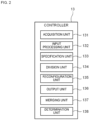
- FIG. 2 is a block diagram illustrating functions realized by the controller 13, etc. in the information processing apparatus 1.
- the controller133 includes an acquisition unit 131, an input processing unit 132, a specification unit 133, a division unit 134, a reconfiguration unit 135, an output unit 136, a merging unit 137, and a determination unit 138.
- the acquisition unit 131 is configured to acquire various types of information.
- the acquisition unit 131 may be configured to execute an acquisition step. This will be described in more detail later.
- the input processing unit 132 is configured to input various types of information to reference information IF1.
- the reference information IF1 may be a trained model having learned correlation between various pieces of information on production of garment.
- the specification unit 133 is configured to specify various types of information.
- the specification unit 133 is configured to specify the data D2 on a second pattern. This will be described in more detail later.
- the division unit 134 is configured to divide a model into two or more meshes.
- the division unit 134 may be configured to execute a division step. This will be discussed in more detail later.
- the reconfiguration unit 135 is configured to reconfigure pieces P from meshes ME. This will be described in more detail later.
- the output unit 136 is configured to output various types of information.
- the output unit 136 may be configured to execute an output step.
- the output unit 136 outputs display information for displaying desired visual information on the display unit 14.
- This display information may be visual information itself generated in a form visible to the user, such as scenes, images, icons, texts, etc., or may be rendering information for display. Alternatively, it may not be particularly limited to visual information or display information, but may be auditory information, tactile information, or a combination thereof. This will be described in more detail later.
- the merging unit 137 is configured to merge two or more pieces P into one. Details thereof will be described later.
- the determination unit 138 is configured to determine an arrangement, which meets a condition, from among two or more arrangements. Details thereof will be described later.
- Section 3 describes an information processing method executed by the above-described information processing apparatus 1 along an activity diagram, with reference to conceptual diagrams.
- FIG. 3 is an activity diagram illustrating an example of information processing by the information processing apparatus 1.
- the user inputs data D1 on a first pattern, which is a three-dimensional model M of garment to be produced, into the information processing apparatus 1 via the input unit 15.
- the acquisition unit 131 acquires the data D1 on the first pattern.
- the process in Activity A101 allows the user to upload any existing pattern data.
- the information processing apparatus 1 can execute optimization processing for a design and specifications specified by the user.
- the output unit 136 displays the model M of the read data D1 on the first pattern.
- FIG. 4 illustrates an example of model M.
- the data D1 on the first pattern relates to a shape of specific garment.
- the model M is a T-shirt.
- the model M may be associated with a type of garment.
- FIG. 5 illustrates an example of a model M divided into the regions M0.
- the model M is divided into a region M1, which is a body, and a region M2 and a region M3, which are sleeves.
- the division unit 134 may divide the model M into regions of less than or equal to a threshold.
- the threshold may depend on material applicable to the first pattern, on the size of the garment, or the like. Such a configuration can prevent division into too many regions.
- the threshold depending on material appliable to the first pattern, on the size of the garment, or the like may be stored in the storage unit 12 in advance, or may be set or changed by user's operation via the screen.
- the division in Activity A102 may be executed by a separate information processing apparatus configured to communicate with the information processing apparatus 1.
- the acquisition unit 131 may acquire the model M divided into the regions M0 from the separate information processing apparatus.
- the model M may be a region M0 of specific garment.
- the acquisition unit 131 acquires two or more models M, and the models M are associated with the type of the regions M0.
- the user sets the start edge ME1 as an edge for starting division into meshes ME.
- the acquisition unit 131 receives a setting operation via a screen or the like (Activity A103).
- a target surface ME2 which is a two-dimensional surface to be divided
- a clip surface ME3 or the like which is a two-dimensional surface not subject to the division
- FIG. 6 illustrates an example of a region M1 with a start edge ME1, a target surface ME2 and a clip surface ME3 set. As illustrated in FIG. 6 , the user selects points of the region M1 to be designated as the start edge ME1, the target surface ME2, and the clip surface ME3.
- the acquisition unit 131 acquires information thereof.
- the acquisition unit 131 may store the acquired information in the storage unit 12 as the reference information IF1.
- FIG. 6 illustrates an example when the hem of the T-shirt is set as the start edge ME1.
- the start edge ME1, the target surface ME2, the clip surface ME3, etc. is set to prevent the division from reaching deadlock.
- the specification unit 133 may specify the start edge ME1, the target surface ME2, or the clip surface ME3 on the basis of the shape of the model M and of the reference information IF1.
- the specification unit 133 may specify, based on the model M and a trained model, an edge of a large opening such as the hem of a skirt as the start edge ME1.
- the specification unit 133 may specify an opening for passing a neck, arm, leg, etc. through the garment as the clip surface ME3.
- FIG. 6 an example is given of a case where openings for the neck and arms are set as clip surfaces (ME3).
- the division unit 134 divides at least part of the model M into two or more meshes ME, the model M representing the shape of the specific garment and having been created based on the data D1 on the first pattern (Activity A104). Specifically, the division unit 134 determines, based on the model M and the reference information IF1, the shapes of the meshes ME to be two-dimensional figures, and executes division into pieces P constituting the region M0 of the garment.
- FIG. 7 illustrates part of the model M transformed into two or more two-dimensional figures.
- a mesh ME includes at least one of triangle and quadrilateral. The triangle may be isosceles triangle. The quadrilateral may be square.
- the processing in Activity A104 allows the patterned shape to be divided into such shapes that a waste amount is reduced when the meshes are arranged on a fabric cloth generally produced in quadrilateral shape.
- the reference information IF1 includes information specifying a length of at least one side of the at least one of triangle and quadrilateral (hereinafter referred to as a pitch number).
- FIG. 7 illustrates an example of a case where 5 cm is specified as the pitch number.
- the reference information IF1 further includes an environmental index in the production of the garment.
- the reference information IF1 includes an index relating to sewing of the garment.
- the index relating to sewing of garment is, for example, a diffusion value, an approximate value, a moderator for Z value, or the like.
- the reference information IF1 includes a first variable associated with a region of the regions M0 and a second variable associated with a type of garment.
- the division unit 134 may determine the shape of the mesh ME based on the first variable or the second variable. Such an aspect allows conversion into plane figures to be executed with a variable optimum for the region M0 and for the type of garment.
- the reference information IF1 may include an index relating to the strength of the garment.
- the reconfiguration unit 135 reconfigures the pieces P based on the mesh ME and on the reference information IF1 (Activity A105). Then, the output unit 136 outputs the reconfigured pieces P.
- FIG. 8 illustrates an example of reconfigured pieces P. As illustrated in FIG. 8 , pieces P1 are pieces P of isosceles triangle. Pieces P2 are pieces P of rectangular. By converting complicatedly divided shapes into a two-dimensional pattern shape that can be practically used, the processing in Activity A105 can execute conversion into pattern data usable in manufacturing. In addition, the reconfiguration unit 135 represents the correspondence between the three-dimensional shape to be realized and the two-dimensional shape required as a plan, making it easier for the user to understand it.
- the merging unit 137 merges the pieces P based on the selection operation by the user (Activity A106).
- Activity A106 allows the number of pieces to be adjusted, i.e., increased or decreased, based on the convenience of production including cutting, sewing, etc. More specifically, pieces can be reduced by being merged so that the sewing amount does not become too much.
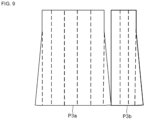
- FIG. 9 is a conceptual diagram illustrating shapes of pieces P3 acquired by merging by two or more pieces P. As illustrated in FIG. 9 , adjacent pieces P are merged with each other.
- a piece P3a illustrated in FIG. 9 is a piece P acquired by merging a piece P1a, a piece P1b, a piece P2a, a piece P2b, a piece P2c, a piece P2, and a piece P2e (see FIG. 8 ).
- a piece P3b is a piece P acquired by merging a piece P2f, a piece P2g, and a piece P1c.
- the specification unit 133 calculates two or more of arrangements differing from each other in positions where the pieces P are arranged. Thereafter, the specification unit 133 specifies such an area that meets a predetermined condition from the arrangements, and specifies two or more arrangements (Activity A107). Specifically, the determination unit 138 determines, based on a genetic algorithm, an arrangement from among the two or more arrangements. The process in Activity A107 can automatically specify an arrangement with the least waste amount.
- the output unit 136 outputs data D2 on a second pattern including the specified arrangement (Activity A108).
- the data D2 on the second pattern includes a shape of the two or more two-dimensional pieces P of the specific garment and an area R where the pieces P are arranged in such a manner that they do not overlap each other.
- FIG. 10 is a conceptual diagram illustrating an example of an arrangement. As illustrated in FIG. 10 , the area R is a single area R, which contains all or part of the pieces P inside it.
- the process in Activity A108 allows outputting line data that can be applied to apparel CAD or cutting equipment, i.e., outputting information that can practically be implemented.
- Each of the pieces P is disposed in the area R in such a manner that a value of (a total area size S2 of the pieces P / an area size S1 of the area R) is equal to or more than a predetermined threshold.
- the value of (the total area size S2 of the pieces P / the area size S1 of the area R) is, for example, 30, 35, 40, 45, 50, 55, 60, 65, 70, 75, 80, 85, 90, 95, or 99%, or may be in the range between any two of the values given as examples here.
- each of the pieces P is disposed in the area R in such a manner that the total number of the pieces P in the area R is less than or equal to a predetermined threshold.
- the total number of pieces P in the area R is, for example, 5, 10, 15, 20, 25, 30, 35, 40, 45, 50, 55, 60, 65, 70, 75, 80, 85, 90, 95, 100, 105, 110, 115, 120, 125, 130, 135, 140, 145, 150, 155, 160, 165, 170, 175, 180, 185, 190, 195, or 200, or may be in the range between any two of the values given as examples here.
- the threshold may depend on the size of the material or of the garment.
- the thresholds depending on the size of the material or of the garment may be stored in the storage unit 12 in advance, or may be set or changed based on to the operation by the user via the screen.
- the output unit 136 outputs, based on the data D1 on the first pattern and the reference information IF1 on the production of the garment, the data D2 on the second pattern relating to the shape of specific garment.
- Such above-described information processing can provide a second pattern superior to the first pattern. More specifically, it is possible to provide a second pattern with less material waste than the first pattern. As a result, the waste rate of the material can be reduced.
- the acquisition unit 131 may acquire, by physical calculation, a simulation result relating to a stretch or shrink amount of the garment produced with the data D2 on the second pattern used. Furthermore, the specification unit 133 may specify, based on the simulation result, a point where the stretch or shrink amount meets a predetermined condition in the garment. In addition, the output unit 136 may display the specified point.
- the merging unit 137 may merge adjacent meshes ME when the length between the boundary of the divided meshes ME meets a predetermined condition. Such an aspect allows the data D2 on the second pattern to be output with less effort on operation input by the user.
- An information processing method may be provided that includes each step in the information processing apparatus 1. Furthermore, the present embodiment may be implemented as a distributable program. This program causes a computer to execute each step in the information processing apparatus 1.
- the information processing system may include components besides the information processing apparatus 1.
- the information processing system may be implemented that includes the information processing apparatus 1, an unillustrated input apparatus, and an unillustrated display apparatus. Connection methods thereof are not particularly limited, and services to be provided via Internet may be provided.
- the reference information IF1 is described to be a trained model, but the reference information IF1 may be a mathematical model or the like that mathematically relates two or more pieces of information of a look-up table, a database, etc.
- the information processing apparatus 1 may omit the process in Activity A102 and Activity A103 when executing the processing.
- an operation such as clicking on the three-dimensional model inputted via the screen, etc. may trigger that the information processing apparatus 1 divides the entire garment represented as the three-dimensional model into two-dimensional figures at once.
- Such a process enables entire optimization on the entire shape of the garment at once, without dividing it into regions (e.g., into sleeves and body piece).
- the entire shape of the garment can be wholly optimized at once without setting the start edge.
- CLAIMS(1) An information processing system comprising: a controller configured to execute each of the following steps of: an acquisition step of acquiring data on a first pattern relating to a shape of a specific garment; and an output step of outputting, based on the data on the first pattern and reference information on production of the garment, data on a second pattern relating to the shape of the specific garment, the data on the second pattern including: shapes of two or more two-dimensional pieces of the specific garment; and an area where the pieces are disposed in such a manner that they do not overlap each other and that a total number of the pieces in the area is less than or equal to a predetermined threshold.
- Such an aspect can realize environmentally friendly and easy-to-sew garment.
- Such an aspect allows the garment to be produced from a single material, thereby reducing the environmental load.
- each of the pieces is disposed in the area in such a manner that: the total number of the pieces in the area is less than or equal to a predetermined threshold, and a value of (a total area size S2 of the pieces/ an area size S1 of the area) is more than or equal to a predetermined threshold.
- Such an aspect can reduce the waste amount discharged in the production of the garment, further reducing the environmental load.
- Such an aspect can reduce efforts required in producing the garment, further reducing the environmental load.
- Such an aspect allows a single system to automatically divide a necessary model into meshes for creating the data on the second pattern, thereby providing an excellent user experience.
- Such an aspect enables optimization of the piece shapes by suitably combining meshes, further reducing the environmental load.
- Such an aspect can reduce a load on a computer caused by calculations.
- Such an aspect can optimize the mesh shapes.
- Such an aspect can provide a second pattern superior to the first pattern.
- Such an aspect can provide a second pattern superior to the first pattern.
Landscapes
- Engineering & Computer Science (AREA)
- Physics & Mathematics (AREA)
- Theoretical Computer Science (AREA)
- General Physics & Mathematics (AREA)
- Business, Economics & Management (AREA)
- Geometry (AREA)
- Human Resources & Organizations (AREA)
- Evolutionary Computation (AREA)
- Strategic Management (AREA)
- General Engineering & Computer Science (AREA)
- Computer Hardware Design (AREA)
- Economics (AREA)
- General Business, Economics & Management (AREA)
- Tourism & Hospitality (AREA)
- Marketing (AREA)
- Entrepreneurship & Innovation (AREA)
- Textile Engineering (AREA)
- Operations Research (AREA)
- Pure & Applied Mathematics (AREA)
- Mathematical Optimization (AREA)
- Mathematical Analysis (AREA)
- Quality & Reliability (AREA)
- Computational Mathematics (AREA)
- Software Systems (AREA)
- Artificial Intelligence (AREA)
- Architecture (AREA)
- Game Theory and Decision Science (AREA)
- Medical Informatics (AREA)
- Development Economics (AREA)
- Computer Vision & Pattern Recognition (AREA)
- Human Computer Interaction (AREA)
- Data Mining & Analysis (AREA)
- Manufacturing & Machinery (AREA)
- Health & Medical Sciences (AREA)
- General Health & Medical Sciences (AREA)
- Primary Health Care (AREA)
- Management, Administration, Business Operations System, And Electronic Commerce (AREA)
Applications Claiming Priority (3)
| Application Number | Priority Date | Filing Date | Title |
|---|---|---|---|
| JP2022025796 | 2022-02-22 | ||
| JP2022164998A JP7240059B1 (ja) | 2022-02-22 | 2022-10-13 | 情報処理システム、情報処理方法及びプログラム |
| PCT/JP2023/006306 WO2023162994A1 (ja) | 2022-02-22 | 2023-02-21 | 情報処理システム、情報処理方法及びプログラム |
Publications (2)
| Publication Number | Publication Date |
|---|---|
| EP4485263A1 true EP4485263A1 (de) | 2025-01-01 |
| EP4485263A4 EP4485263A4 (de) | 2025-06-18 |
Family
ID=85569531
Family Applications (1)
| Application Number | Title | Priority Date | Filing Date |
|---|---|---|---|
| EP23759995.6A Pending EP4485263A4 (de) | 2022-02-22 | 2023-02-21 | Informationsverarbeitungssystem, informationsverarbeitungsverfahren und programm |
Country Status (4)
| Country | Link |
|---|---|
| US (1) | US12520895B2 (de) |
| EP (1) | EP4485263A4 (de) |
| JP (2) | JP7240059B1 (de) |
| WO (1) | WO2023162994A1 (de) |
Families Citing this family (1)
| Publication number | Priority date | Publication date | Assignee | Title |
|---|---|---|---|---|
| US12422826B2 (en) * | 2022-05-11 | 2025-09-23 | SXD, Inc. | Systems and methods for generating a zero-waste design pattern and reduction in material waste |
Family Cites Families (27)
| Publication number | Priority date | Publication date | Assignee | Title |
|---|---|---|---|---|
| US3596068A (en) * | 1968-12-30 | 1971-07-27 | California Computer Products | System for optimizing material utilization |
| US4554635B1 (en) * | 1982-07-28 | 1995-10-03 | Technology Inc Const | Method and apparatus for marking or cutting laminar patterns or forms |
| US5172326A (en) * | 1990-03-19 | 1992-12-15 | Forcam, Incorporated | Patterned web cutting method and system for operation manipulation of displayed nested templates relative to a displayed image of a patterned web |
| US5495568A (en) * | 1990-07-09 | 1996-02-27 | Beavin; William C. | Computerized clothing designer |
| JPH07120439B2 (ja) * | 1991-05-10 | 1995-12-20 | 本田技研工業株式会社 | 有限要素発生装置 |
| EP0664091B1 (de) * | 1994-01-24 | 1998-12-16 | Gerber Garment Technology, Inc. | System und Verfahren zur automatischen Herstellung von Schnittbildern |
| JPH08221467A (ja) * | 1995-02-17 | 1996-08-30 | Brother Ind Ltd | 型入れ方法及び型入れ装置 |
| JPH08246219A (ja) * | 1995-03-13 | 1996-09-24 | Toyobo Co Ltd | 3次元形状モデルからの衣類の型紙作成方法 |
| US5831857A (en) * | 1995-09-08 | 1998-11-03 | Gerber Garment Technology, Inc. | Pattern alignment and cutting system |
| JPH09128422A (ja) * | 1995-10-30 | 1997-05-16 | Toray Ind Inc | 型片の配置方法、装置及び衣服の製造方法 |
| US5815398A (en) * | 1996-01-16 | 1998-09-29 | Massachusettes Institute Of Technology | Method and apparatus for placing parts in a bounded region |
| JPH09273017A (ja) * | 1996-04-02 | 1997-10-21 | Toray Ind Inc | 衣服の着用状態表示方法、衣服の製造方法および衣服の製造支援装置 |
| EP0880910A1 (de) * | 1997-05-30 | 1998-12-02 | Assyst GmbH | Verfahren und System zur automatischen Herstellung von Schnittbildern |
| FR2785841B1 (fr) * | 1998-11-13 | 2001-03-02 | Lectra Systemes Sa | Procede de placement automatique de pieces sur des peaux pour la realisation d'articles en cuir |
| JP2001262416A (ja) | 2000-03-16 | 2001-09-26 | Toyobo Co Ltd | 衣服の型紙作成システム |
| JP2002245115A (ja) | 2001-02-20 | 2002-08-30 | Toray Ind Inc | 3次元構造体の展開状態解析方法および3次元構造体の製造支援装置 |
| US20040236457A1 (en) * | 2003-05-22 | 2004-11-25 | Kimberly-Clark Worldwide, Inc. | Method of evaluating articles used on a body in a virtual environment |
| KR100767278B1 (ko) * | 2005-04-15 | 2007-10-17 | 충남대학교산학협력단 | 3차원 곡면의 2차원 평면으로의 패턴전개를 이용한맞춤의복의 디자인 방법 |
| CN105474615A (zh) * | 2013-08-30 | 2016-04-06 | 爱克发印艺公司 | 嵌套方法和设备 |
| ES2978693T3 (es) * | 2014-02-07 | 2024-09-17 | Agfa Nv | Fabricación de piezas de trabajo decorativas por impresión por inyección de tinta |
| EP3156922B1 (de) | 2015-10-16 | 2021-07-28 | Dassault Systèmes | Computerimplementiertes verfahren zum entwurf eines herstellbaren kleidungsstücks |
| US9623578B1 (en) * | 2015-12-16 | 2017-04-18 | Amazon Technologies, Inc. | On demand apparel manufacturing |
| FR3060432B1 (fr) * | 2016-12-16 | 2019-05-24 | Lectra | Procede de partitionnement d'un placement predetermine de pieces destinees a etre decoupees dans un materiau souple en feuille |
| US11712904B2 (en) * | 2017-10-04 | 2023-08-01 | Electronics For Imaging, Inc. | Fabric printing on nested patterns, and associated print systems and products thereof |
| CN116288914A (zh) * | 2018-06-15 | 2023-06-23 | 耐克创新有限合伙公司 | 用于设计和制作针织部件的工具 |
| JP2021066964A (ja) * | 2019-10-18 | 2021-04-30 | コニカミノルタ株式会社 | 縫製情報マーキング装置及びインクジェット記録装置 |
| FR3111835B1 (fr) * | 2020-06-29 | 2022-10-14 | Lectra | Procédé et système pour la coupe automatique de pièces dans un matériau souple conditionné sous forme de rouleau |
-
2022
- 2022-10-13 JP JP2022164998A patent/JP7240059B1/ja active Active
-
2023
- 2023-02-21 EP EP23759995.6A patent/EP4485263A4/de active Pending
- 2023-02-21 WO PCT/JP2023/006306 patent/WO2023162994A1/ja not_active Ceased
- 2023-02-21 US US18/839,312 patent/US12520895B2/en active Active
- 2023-02-24 JP JP2023026990A patent/JP2023122580A/ja active Pending
Also Published As
| Publication number | Publication date |
|---|---|
| US12520895B2 (en) | 2026-01-13 |
| JP2023122580A (ja) | 2023-09-01 |
| JP2023122525A (ja) | 2023-09-01 |
| WO2023162994A1 (ja) | 2023-08-31 |
| JP7240059B1 (ja) | 2023-03-15 |
| EP4485263A4 (de) | 2025-06-18 |
| US20250151828A1 (en) | 2025-05-15 |
Similar Documents
| Publication | Publication Date | Title |
|---|---|---|
| JP6616893B2 (ja) | ネットワークトポロジー自己適応性データ可視化方法及び装置 | |
| CN108228169B (zh) | 基于eCharts工具的图表制作方法、装置、设备及介质 | |
| US10061741B2 (en) | Graph display apparatus, graph display method and program recording medium | |
| US20150294488A1 (en) | Graph generating device, graph generating method and graph generating program | |
| US12113873B2 (en) | Techniques for analyzing the proficiency of users of software applications in real-time | |
| US20140317570A1 (en) | Graph display device, graph display method and computer- readable medium recording control program | |
| CN108171804B (zh) | 三维模型剖切平面的确定方法及装置 | |
| CN107908604B (zh) | 报表图形生成方法、装置、计算机设备和存储介质 | |
| EP4485263A1 (de) | Informationsverarbeitungssystem, informationsverarbeitungsverfahren und programm | |
| US20170192658A1 (en) | Method and system for prototyping graphic user interface | |
| CN111936966A (zh) | 用于创建图形内容的设计系统 | |
| CN108984857B (zh) | 编织物意匠图的生成方法及装置 | |
| CN117493637A (zh) | 力导向图布局方法、装置、电子设备及存储介质 | |
| US9177452B1 (en) | User interface for a modeling environment | |
| US20210304006A1 (en) | Mini-batch learning apparatus, operation program of mini-batch learning apparatus, and operation method of mini-batch learning apparatus | |
| CN109634428A (zh) | 电子设备、反馈提示方法、装置及终端设备 | |
| US11900249B2 (en) | Mini-batch learning apparatus, operation program of mini-batch learning apparatus, operation method of mini-batch learning apparatus, and image processing apparatus | |
| CN115657920A (zh) | 一种拖拽式的个性化的自定工作台组件控制方法及装置 | |
| KR102772427B1 (ko) | 디자인 객체 시뮬레이션에서 분해도를 생성하는 방법 및 장치 | |
| JP2012083883A (ja) | 画面データ作成装置 | |
| CN115658988A (zh) | 一种图表配置方法、装置、电子设备及存储介质 | |
| CN117193540B (zh) | 虚拟键盘的控制方法和系统 | |
| CN114797109A (zh) | 对象编辑方法、装置、电子设备和存储介质 | |
| KR102106155B1 (ko) | 가상머신 토폴로지 상태 모니터링 방법 및 장치 | |
| JP6018014B2 (ja) | 情報処理装置、特徴量変換システム、表示制御方法及び表示制御プログラム |
Legal Events
| Date | Code | Title | Description |
|---|---|---|---|
| STAA | Information on the status of an ep patent application or granted ep patent |
Free format text: STATUS: THE INTERNATIONAL PUBLICATION HAS BEEN MADE |
|
| PUAI | Public reference made under article 153(3) epc to a published international application that has entered the european phase |
Free format text: ORIGINAL CODE: 0009012 |
|
| STAA | Information on the status of an ep patent application or granted ep patent |
Free format text: STATUS: REQUEST FOR EXAMINATION WAS MADE |
|
| 17P | Request for examination filed |
Effective date: 20240918 |
|
| AK | Designated contracting states |
Kind code of ref document: A1 Designated state(s): AL AT BE BG CH CY CZ DE DK EE ES FI FR GB GR HR HU IE IS IT LI LT LU LV MC ME MK MT NL NO PL PT RO RS SE SI SK SM TR |
|
| DAV | Request for validation of the european patent (deleted) | ||
| DAX | Request for extension of the european patent (deleted) | ||
| A4 | Supplementary search report drawn up and despatched |
Effective date: 20250520 |
|
| RIC1 | Information provided on ipc code assigned before grant |
Ipc: A41H 3/06 20060101ALI20250515BHEP Ipc: A41H 3/00 20060101ALI20250515BHEP Ipc: G06F 113/12 20200101ALI20250515BHEP Ipc: G06F 30/20 20200101ALI20250515BHEP Ipc: G06F 30/10 20200101AFI20250515BHEP |
|
| RAP3 | Party data changed (applicant data changed or rights of an application transferred) |
Owner name: SYNFLUX CO., LTD. |