EP4471010B1 - Verfahren zur herstellung von peroxyester oder peroxycarbonat - Google Patents
Verfahren zur herstellung von peroxyester oder peroxycarbonat Download PDFInfo
- Publication number
- EP4471010B1 EP4471010B1 EP24175823.4A EP24175823A EP4471010B1 EP 4471010 B1 EP4471010 B1 EP 4471010B1 EP 24175823 A EP24175823 A EP 24175823A EP 4471010 B1 EP4471010 B1 EP 4471010B1
- Authority
- EP
- European Patent Office
- Prior art keywords
- chloroformate
- acid
- methyl
- phenyl
- mixture
- Prior art date
- Legal status (The legal status is an assumption and is not a legal conclusion. Google has not performed a legal analysis and makes no representation as to the accuracy of the status listed.)
- Active
Links
Classifications
-
- C—CHEMISTRY; METALLURGY
- C07—ORGANIC CHEMISTRY
- C07C—ACYCLIC OR CARBOCYCLIC COMPOUNDS
- C07C407/00—Preparation of peroxy compounds
-
- C—CHEMISTRY; METALLURGY
- C07—ORGANIC CHEMISTRY
- C07C—ACYCLIC OR CARBOCYCLIC COMPOUNDS
- C07C67/00—Preparation of carboxylic acid esters
- C07C67/30—Preparation of carboxylic acid esters by modifying the acid moiety of the ester, such modification not being an introduction of an ester group
- C07C67/31—Preparation of carboxylic acid esters by modifying the acid moiety of the ester, such modification not being an introduction of an ester group by introduction of functional groups containing oxygen only in singly bound form
-
- C—CHEMISTRY; METALLURGY
- C07—ORGANIC CHEMISTRY
- C07C—ACYCLIC OR CARBOCYCLIC COMPOUNDS
- C07C409/00—Peroxy compounds
- C07C409/38—Peroxy compounds the —O—O— group being bound between a >C=O group and a carbon atom, not further substituted by oxygen atoms, i.e. esters of peroxy acids
-
- C—CHEMISTRY; METALLURGY
- C07—ORGANIC CHEMISTRY
- C07C—ACYCLIC OR CARBOCYCLIC COMPOUNDS
- C07C67/00—Preparation of carboxylic acid esters
- C07C67/36—Preparation of carboxylic acid esters by reaction with carbon monoxide or formates
-
- C—CHEMISTRY; METALLURGY
- C07—ORGANIC CHEMISTRY
- C07C—ACYCLIC OR CARBOCYCLIC COMPOUNDS
- C07C67/00—Preparation of carboxylic acid esters
- C07C67/48—Separation; Purification; Stabilisation; Use of additives
- C07C67/58—Separation; Purification; Stabilisation; Use of additives by liquid-liquid treatment
-
- C—CHEMISTRY; METALLURGY
- C07—ORGANIC CHEMISTRY
- C07C—ACYCLIC OR CARBOCYCLIC COMPOUNDS
- C07C69/00—Esters of carboxylic acids; Esters of carbonic or haloformic acids
- C07C69/02—Esters of acyclic saturated monocarboxylic acids having the carboxyl group bound to an acyclic carbon atom or to hydrogen
- C07C69/22—Esters of acyclic saturated monocarboxylic acids having the carboxyl group bound to an acyclic carbon atom or to hydrogen having three or more carbon atoms in the acid moiety
- C07C69/28—Esters of acyclic saturated monocarboxylic acids having the carboxyl group bound to an acyclic carbon atom or to hydrogen having three or more carbon atoms in the acid moiety esterified with dihydroxylic compounds
Definitions
- the present disclosure relates to a process for preparing a peroxyester or peroxycarbonate with improved storage stability and reduced hydroperoxide content.
- Peroxyesters and percarbonates find a wide variety of uses in the chemical field. They are typically produced by reacting an organic hydroperoxide with a reactive carbonyl species, such as an acid halide, an acid anhydride, or a haloformate.
- a reactive carbonyl species such as an acid halide, an acid anhydride, or a haloformate.
- peroxyesters and percarbonates An issue with peroxyesters and percarbonates is that they often contain undesirably high levels of hydroperoxide, which can be problematic from a regulatory and/or application viewpoint. Additionally, peroxyesters and percarbonates often have poor storage stability.
- the standard workup process for this reaction comprises one or more washing steps in an attempt to reduce the residual organic hydroperoxide present in the organic layer (e.g., EP1382596 ).
- the reaction workup was performed at pH 7.5-10, which was found by the present inventors to yield a poor product (see Comparative Example 5 below).
- the present inventors unexpectedly found that the hydroperoxide content in the peroxide product could be substantially reduced whilst simultaneously giving rise to a peroxy product with much improved storage stability by a specific process that manipulates the reaction mixture pH during the initial workup process.
- the present disclosure relates to a process for preparing a peroxyester or peroxycarbonate comprising:
- Steps a) and b) follow the normal process for producing peroxyesters or peroxycarbonates, wherein the organic hydroperoxide is reacted with an acid halide, an acid anhydride, or a haloformate, in the presence of a base.
- the equivalent amount of the reactive carbonyl compound (acid halide, acid anhydride, or haloformate) relative to the organic hydroperoxide is not particularly limited, but typically is in the range of about 0.25-5 equivalents, preferably in the range of about 0.6-1.1 equivalents, more preferably in the range of about 0.6-1 equivalents, and most preferably in the range of about 0.8 - 1 equivalents.
- the reaction conditions of step a) are conventional.
- the temperature generally is in the range of -10°C to 70°C and suitably between 0°C to 50°C.
- the pH is basic, i.e., above 7. Generally, the pH is in the range of 9-14. In practice, the pH is above 10, and the common pH range is from 11 to 13.5.
- Any suitable base may be used to adjust the pH to a basic pH, such as, but not limited to, sodium carbonate, potassium carbonate, sodium hydroxide, potassium hydroxide, and mixtures thereof. Such bases are typically used in the form of aqueous solutions thereof.
- the reaction mixture may also comprise conventional auxiliaries, such as NaCl(aq.) to assist phase separation (for step b)).
- the reaction can be performed neat or in the presence of solvent(s).
- the organic hydroperoxide may be selected from an organic hydroperoxide of the general formula (II): wherein:
- Preferred organic hydroperoxides include tert-butyl hydroperoxide, tert-amyl hydroperoxide, cumyl hydroperoxide, 1,1,3,3-tetramethylbutyl hydroperoxide, 4-hydroperoxy-4-methylpentan-2-ol, 2,5-dihydroperoxy-2,5-dimethylhex-3-yne, 2,5-dihydroperoxy-2,5-dimethylhexane, or mixtures thereof.
- the most preferred organic hydroperoxide for use in this process is tert-butyl hydroperoxide (TBHP), preferably tert-butyl hydroperoxide obtained from an air oxidation process.
- the acid halide, acid anhydride, or haloformate may be a reactive carbonyl compound of the general formulae (la) or (Ib) : wherein:
- the process uses an acid halide or a haloformate.
- the acid halide is an acid chloride.
- the acyl portion of the acid chloride corresponds to the acyl portion of any of the following carboxylic acids: acetic acid, phenylacetic acid, phenoxyacetic acid, propanoic acid, isobutyric acid, n-butyric acid, benzoic acid, 2-methyl-benzoic acid, 2-methylbutanoic acid, 2-butenoic acid, 3-phenylpropenic acid, 2,2-dimethylpropanoic acid, 2,2-dimethylbutanoic acid, 2,2-dimethylpentanoic acid, 2-ethylbutanoic acid, 3,5,5-trimethylhexanoic acid, 2-ethylhexanoic acid, neohexanoic acid, neoheptanoic acid, neodecanoic acid, octanoic acid, nonanoic acid, lauric acid, hexanedioic
- the haloformate is a chloroformate.
- Preferred haloformates include 2-(1-methylethoxy)phenyl chloroformate, 1-methylpropyl chloroformate, 4-methylphenyl chloroformate, heptyl chloroformate, cyclohexyl methyl chloroformate, ethylene glycol bis(chloroformate), phenyl chloroformate, 3-methoxybutyl chloroformate, 2-phenoxyethyl chloroformate, 2,2-dimethyl-1,3-propane diol bis(chloroformate), phenyl methyl chloroformate, 9-octadecenyl chloroformate, 2-methylphenyl chloroformate, bisphenol A bis(chloroformate), 1,3-dimethyl butyl chloroformate, 3,4-dimethyl butyl chloroformate, 3,4-dimethyl phenyl chloroformate, 1,4-butane dio
- step a After completion of step a), the reaction mixture is allowed to settle, thereby forming an aqueous layer and an organic layer (i.e., two separate/immiscible phases).
- the aqueous layer that forms upon allowing the mixture to settle is separated in step b).
- the organic layer that remains is taken through to step c).
- the reducing agent is added to the organic layer.
- the reducing agent is a sulfur based reducing agent, such as a dithionite, hydrosulfite, metabisulfite, sulfide or a sulfite.
- the reducing agent serves to reduce any remaining hydroperoxide to the corresponding alcohol.
- Preferred sulfites include metal sulfites, metal bisulfites, and/or metal metabisulfites.
- Preferred metals include the alkali and alkaline metals, such as sodium or potassium.
- the reducing agent added in step c) is sodium metabisulphite and/or sodium sulfite, preferably sodium metabisulphite.
- the reducing agent is preferably added in step c) as an aqueous solution of the reducing agent.
- the reducing agent added in step c) is an aqueous solution of sodium metabisulphite.
- the reducing agent (RA) to hydroperoxide (HP) molar ratio (RA:HP) is preferably >1:1, preferably >1:1 to about 5:1, preferably >1:1 to about 3:1, more preferably >1:1 to about 2:1, and most preferably about 1.3:1 to about 1.8:1. It is preferred if the reaction mixture is agitated (e.g., stirred) for at least about 1 minute (e.g., about 1-10 minutes) before proceeding to the next step of the process.
- the pH of the mixture of step c) is lowered to a pH of less than 6.8 before proceeding to step d), preferably to a pH of about 6.5 or lower, and most preferably to a pH within the range of about 4 to 6.5.
- the pH drop may be achieved by any conventional means, such as by adding an acid, e.g., H 2 SO 4 (aq.), by adding a buffer with a pH of less than 6.8, and/or by using a reducing agent with a pH of less than 6.8.
- the pH of the mixture of step c) may be decreased as a consequence of dosing the reducing agent to the organic layer (preferred reducing agents, such as aqueous sulfite solutions, can be weakly acidic, so dosing those acidic reducing agents to the organic layer in step c) may result in the mixture having a pH of ⁇ 6.8).
- a buffer with a pH in the range of about pH 4 - 6.5 is used to effect the pH drop.
- Preferred buffers include acetate buffer with a pH of from about 4 to 6.5 (other suitable buffers include, but are not limited to, citrate acid buffer or monopotassiumphosphate buffer).
- the mixture is preferably agitated (e.g., stirred) at this reduced pH for at least about 1 minute (e.g., about 1 to about 25 minutes) before proceeding to the next step of the process.
- Step d) ensures that the pH of the mixture of step c) is at a pH of greater than 6.8, preferably greater than 7.0, preferably greater than 7.2, and more preferably greater than 7.4.
- the pH may be >8. This is achieved either by maintaining the pH of the mixture (if the mixture of step c) is already at a pH of >6.8) or by increasing the pH of the mixture to a pH of greater than 6.8 (particularly if the pH of the mixture of step c) is adjusted to a pH of less than 6.8 before step d)).
- a pH increase may be achieved by adding a base in an amount necessary to reach the desired pH value.
- Suitable bases include, but are not limited to, sodium carbonate, potassium carbonate, sodium hydroxide, potassium hydroxide, and mixtures thereof. Such bases are typically used in the form of aqueous solutions thereof.
- step e) the pH of greater than 6.8, preferably greater than 7.0, preferably greater than 7.2, and more preferably greater than 7.4, is maintained for at least 5 seconds, preferably at least 10 seconds, preferably at least 30 seconds, preferably at least 60 seconds, and more preferably at least 120 seconds, such as from about 120 seconds to about 600 seconds.
- the mixture is preferably agitated (e.g., stirred) during step e).
- the pH drop may be achieved by any conventional means, such as by adding an acid, e.g., H 2 SO 4 (aq.) or by adding a buffer with a pH of less than 6.8.
- a buffer with a pH in the range of about pH 4 - 6.5 is used to effect the pH drop.
- Preferred buffers include acetate buffer with a pH of from about 4 to 6.5 (other suitable buffers include, but are not limited to, citrate acid buffer or monopotassium phosphate buffer).
- the pH of the mixture of step f) is preferably maintained for at least 5 seconds, preferably at least 10 seconds, preferably at least 30 seconds, preferably at least 60 seconds, such as from about 90 seconds to about 600 seconds, during which time the mixture is preferably agitated (e.g., stirred).
- the pH may be increased to a pH of greater than 6.8 (i.e., step d) may be optionally repeated at the end of step f) ).
- the aqueous layer of step f) (that forms after the mixture is allowed to settle into an aqueous layer and an organic layer, i.e., two immiscible phases) is separated, and the remaining organic layer may be subjected to one or more washing steps g) (to remove any residual water-soluble impurities, such as excess sulfite, alcohol and sulfate generated during the reaction).
- the washing step(s) may comprise one or more water washes and/or one or more alkaline aqueous washes (e.g., washing with NaOH(aq) and/or NaHCO 3 (aq)).
- the washing step(s) preferably comprises one or more neutral to alkaline aqueous washes.
- the peroxyester or peroxycarbonate is present in this organic layer.
- the final organic layer may be dried using conventional means, such as drying agents (e.g., MgSO 4 ), vacuum, and/or air drying.
- the temperature of the mixture during steps c)-g) is maintained at about 0-70°C, more preferably about 0-40°C.
- the present disclosure relates to a process for preparing a peroxyester or peroxycarbonate comprising:
- TBHP tert-butylhydroperoxide
- tert-butyl peroxyester is a peroxyester that is obtainable by reacting TBHP with an acid halide or an acid anhydride (i.e., t-Bu-OO-C(O)R), and a "tert-butyl peroxycarbonate” is a peroxycarbonate that is obtainable by reacting TBHP with a haloformate (i.e., t-Bu-OO-C(O)OR).
- Non-limiting examples of tert-butyl peroxyesters include tert-butyl peroxy-3,5,5-trimethyl hexanoate ( CAS: 13122-18-4 ), tert-Butyl peroxy-2-ethylhexanoate ( CAS: 3006-82-4 ), and tert-Butyl peroxybenzoate ( CAS: 614-45-9 ).
- the process disclosed herein is for preparing a peroxyester or peroxycarbonate, wherein the peroxyester or peroxycarbonate contains no free acid groups.
- Example 1 [ step i) - the mixture of step c) has a pH of less than 6.8 before proceeding to step d) ]
- reaction mixture was stirred for 22 minutes at a pH of 5.5.
- the pH of the reaction mixture was then increased to pH 8.0 by the dropwise addition of NaOH-25 (approximately 1g over 5 minutes) (steps d) and e)), followed by workup (see below).
- Example 2 [ step i) - the mixture of step c) has a pH of less than 6.8 before proceeding to step d); and step ii) - after completion of step e) the pH is decreased to a pH of less than 6.8 ]
- the reaction mixture was stirred for 5 minutes at a pH of 5.5.
- the pH was then increased to pH 10 by the dropwise addition of 9.0g NaOH-25 over 2 minutes (step d) ).
- the mixture was stirred for 3 minutes at pH 10 (step e) ).
- the pH was then lowered back to 5.5 by the dropwise addition of 4g HCl (15 wt% HCl in water) over 10 minutes ( step ii) ).
- the reaction mixture was stirred for 2 minutes at a pH of 5.5. Total reduction time was 22 minutes (cf. Example 1).
- the pH of the reaction mixture was then increased to pH 8.0 by the dropwise addition of NaOH-25 (approximately 1g over 5 minutes), followed by workup (see below)
- the term "four-week stability (0-4 weeks ⁇ TBHP) value" as used herein means the difference in TBHP, in ppm, between the TBHP value measured at week 0 (i.e., the initial TBHP value) and the TBHP value measured after a storage period of four weeks, wherein both the week 0 and week 4 values are determined in accordance with the above "TBHP protocol".
- the "four-week stability (0-4 weeks ⁇ TBHP) value" is determined by storing the peroxide for a period of 4 weeks at 20°C.
- reaction mixture was stirred for an additional 45 minutes at 40° C and 1300 rpm.
- the reaction mixture was cooled to 20°C and 9.0g NaOH-25 was added.
- the reaction mixture was stirred for 2 minutes.
- the reaction mixture was quenched with 72.0g demineralized water and stirred for 1 min. Agitation was stopped and the organic phase and water phase were allowed to separate. The water phase was drained from the reactor and discarded.
- buffer solution (16.3 wt% AcOH, 62.5 wt% water and 21.2 wt% NaOH-25) were added followed by the addition of 100g water.
- the temperature was kept at 20° C by jacketed temperature control.
- the pH was adjusted to pH 5.5 by addition of a few drops of NaOH-25.
- a freshly prepared sulfite solution (69 wt% water, 18 wt% sodium metabisulfite Na 2 S 2 O 5 (s) and 13 wt% NaOH-25) was added dropwise over a period of 6 minutes. During the dosing a pH of 5.5 was maintained by the addition of NaOH-25 (approximately 7g in total).
- Example 3 [step i) - the mixture of step c) has a pH of less than 6.8 before proceeding to step d) ]
- reaction mixture was stirred for 20 minutes at a pH of 5.5.
- the pH of the reaction mixture was then increased to 8.0 by the dropwise addition of approximately 1.0 gram NaOH-25 in 5 minutes (steps d) and e)), followed by workup (see below).
- Example 4 [ step i) - the mixture of step c) has a pH of less than 6.8 before proceeding to step d); and step ii) - after completion of step e) the pH is decreased to a pH of less than 6.8 ]
- the reaction mixture was stirred for 5 minutes at a pH of 5.5.
- the pH was then increased to 10 by the dropwise addition of 8.4g NaOH-25 over 5 minutes (step d) ).
- the mixture was stirred for 3 minutes at a pH of 10 ( step e) ).
- the pH was lowered back to 5.5 by the dropwise addition of 5.4g HCl (15 wt% in water) over 5 minutes ( step ii) ).
- the reaction mixture was stirred for 2 minutes at a pH of 5.5. Total reduction time was 20 minutes (cf. Example 3).
- the pH of the reaction mixture was then increased to 8.0 by the dropwise addition of approximately 1.0 gram NaOH-25 in 5 minutes, followed by workup (see below).
- Examples 3 and 4 were analyzed using the same method as is described for Examples 1 and 2 ("TBHP Protocol").
- reaction mixture was stirred for an additional 32 minutes at 20° C and 1100 rpm.
- 20.0g NaOH-25 was added and the mixture was stirred for an additional 5 minutes. Agitation was stopped, and the organic phase and water phase were allowed to separate. The water phase was drained from the reactor and discarded.
- Examples 5 and 6 To the unstirred reactor content, 45g water and 118g NaCl-25 (aq) were added, and the agitator was restarted (1100 RPM). The pH was adjusted to pH 10 with 6.2g NaOH-25. The temperature was kept at 20° C by jacketed temperature control. To the stirred solution 46g freshly prepared sulfite solution (69 wt% water, 18 wt% sodium metabisulfite Na 2 S 2 O 5 (s) and 13 wt% NaOH-25) was added dropwise over a period of 6 minutes. During the dosing a pH of 10 was maintained by the addition of NaOH-25 (approximately 8.1g in total).
- Examples 7 and 8 To the unstirred reactor content, 45g water, 118g NaCl-25 (aq.) and 10g buffer solution (16.3 wt% AcOH, 62.5 wt% water and 21.2 wt% NaOH-25) were added. The temperature was kept at 20° C by jacketed temperature control. The pH was adjusted to pH 5.5 by addition of a few drops of NaOH-25. To the buffered solution 46g of a freshly prepared sulfite solution (69 wt% water, 18 wt% sodium metabisulfite Na 2 S 2 O 5 (s) and 13 wt% NaOH-25) was added dropwise over a period of 5 minutes. During the dosing a pH of 5.5 was maintained by the addition of NaOH-25 (approximately 2g in total).
- reaction mixture was stirred for an additional 30 minutes after the sulfite solution was dosed and the pH was maintained at pH 10, followed by workup (see below).
- Example 6 [step i) - the mixture of step c) has a pH of less than 6.8 before proceeding to step d) ]
- reaction mixture was stirred for an additional 25 minutes after the sulfite solution was dosed and the pH was maintained at pH 10.
- the pH was subsequently lowered to pH 6.4 by the addition of 6.2g HCl (15 wt% in water) in 3 minutes ( step i) ).
- the reaction mixture was stirred for 2 minutes at pH of 6.4. (total time 30min; cf. Comparative Example 5).
- the pH was then brough to 10 with the addition of NaOH-25 (steps d) and e)), followed by workup (see below).
- Example 7 [step i) - the mixture of step c) has a pH of less than 6.8 before proceeding to step d) ]
- reaction mixture was stirred for 20 minutes at a pH of 5.5.
- the pH of the reaction mixture was then increased to 7.6 by the dropwise addition of approximately 5g NaOH-25 in 5 minutes (steps d) and e)), followed by workup (see below).
- Example 8 [step i) - the mixture of step c) has a pH of less than 6.8 before proceeding to step d); and step ii) - after completion of step e) the pH is decreased to a pH of less than 6.8]
- Examples 5-8 were analyzed using the same method as is described for Examples 1 and 2 ("TBHP Protocol").
- Example 5 [Comparative] 8263 9140 9350 1087
- Example 6 340 1017 1037 697
- Example 7 569 1068 1369 800
- a lower ⁇ TBHP value indicates increased storage stability C.
- Ex. 5 - pH in step c) always >6.8; no pH reduction after completion of step e)
- step e) 6 - pH in step c) ⁇ 6.8 before step d); no pH reduction after completion of step e) Ex. 7 - pH in step c) ⁇ 6.8 before step d); no pH reduction after completion of step e) Ex. 8 - pH in step c) ⁇ 6.8 before step d); pH reduction after completion of step e)
Landscapes
- Chemical & Material Sciences (AREA)
- Organic Chemistry (AREA)
- Chemical Kinetics & Catalysis (AREA)
- Organic Low-Molecular-Weight Compounds And Preparation Thereof (AREA)
Claims (14)
- Verfahren für die Herstellung eines Peroxyesters oder Peroxycarbonats, umfassend:a) Reagieren eines organischen Hydropeeroxids mit einem Säurehalogenid, einem Säureanhydrid oder einem Haloformiat in Gegenwart einer Base,b) Abtrennen der wässrigen Schicht nach Abschluss von Schritt a),c) Zusetzen eines Reduktionsmittels zu der organischen Schicht, nachdem die wässrige Schicht in Schritt b) abgetrennt worden ist, wobei das Reduktionsmittel ein Mittel ist, das dazu fähig ist, das organische Hydroperoxid zu dem entsprechenden Alkohol zu reduzieren,d) Sicherstellen, dass die Mischung aus Schritt c) einen pH-Wert über 6,8 aufweist, durch Aufrechterhalten oder Erhöhen des pH-Werts der Mischung aus Schritt c) unde) Aufrechterhalten des pH-Werts über 6,8 mindestens 5 Sekunden lang,wobei das Verfahren dadurch gekennzeichnet ist, dass:i. die Mischung aus Schritt c) vor Schritt d) einen pH-Wert unter 6,8 aufweist und in Schritt d) der pH-Wert der Mischung aus Schritt c) auf einen pH-Wert über 6,8 erhöht wird; und/oderii. nach Abschluss von Schritt e) der pH-Wert auf einen pH-Wert unter 6,8 reduziert wird.
- Verfahren nach Anspruch 1, wobei das Reduktionsmittel, das in Schritt c) zugesetzt wird, ein Sulfit ist.
- Verfahren nach Anspruch 2, wobei das Sulfit eine wässrige Sulfitlösung ist.
- Verfahren nach einem der Ansprüche 1-3, wobei in Schritt i) die Mischung aus Schritt c) einen pH-Wert von 6,5 oder weniger aufweist.
- Verfahren nach einem der Ansprüche 1-4, wobei in Schritt i) die Mischung aus Schritt c) einen pH-Wert von etwa 4 bis etwa 6,5 aufweist.
- Verfahren nach einem der Ansprüche 1-5, wobei Schritt d) Sicherstellen umfasst, dass der pH-Wert der Mischung aus Schritt c) höher als 7,0 ist.
- Verfahren nach einem der Ansprüche 1-6, wobei in Schritt ii) der pH-Wert auf einen pH-Wert von etwa 6,5 oder niedriger reduziert wird.
- Verfahren nach einem der Ansprüche 1-7, wobei das organische Hydroperoxid von einem organischen Hydroperoxid der allgemeinen Formel (II)
 ausgewählt wird,wobeiR1 und R2 unabhängig aus der Gruppe ausgewählt werden umfassend Wasserstoff, C1-C20-Alkyl, C3-C20-Cycloalkyl, C6-C20-Aryl, C7-C20-Aralkyl und C7-C20-Alkaryl oder R1 und R2 eine C3-C12-Cycloakylgruppe bilden, welche Gruppen lineare oder verzweigte Alkylanteile umfassen können und jedes von R1 und R2 wahlweise mit einer oder mehreren Gruppen substituiert sein können, die unter Hydroxy, Hydroperoxy, Alkoxy, linearem oder verzweigtem Alkyl, Aryloxy, Halogen, Ester, Carboxy, Nitril und Amido ausgewählt werden,A unabhängig von R1 und R2 aus derselben Gruppe von Substituenten wie R1 und R2 ausgewählt wird oder A die allgemeine Formel (III) aufweist:
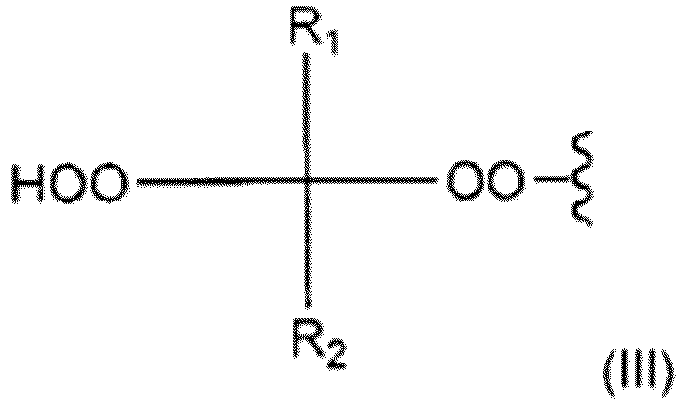 wobei R1 und R2 wie oben definiert sind.
 - Verfahren nach einem der Ansprüche 1-8, wobei das organische Hydroperoxid tert-Butylhydroperoxid, tert-Amylhydroperoxid, Cumylhydroperoxid, 1,1,3,3-Tetramethylbutylhydroperoxid, 4-Hydroperoxy-4-methylpentan-2-ol, 2,5-Dihydroperoxy-2,5-dimethylhex-3-yn, 2,5-Dihydroperoxy-2,5-dimethylhexan oder Mischungen davon ist.
- Verfahren nach einem der Ansprüche 1-9, wobei das organische Hydroperoxid tert-Butylhydroperoxid ist, das bevorzugt aus einem Luftoxidationsvorgang erhalten wird.
- Verfahren nach einem der Ansprüche 1-10, wobei das Säurehalogenid, Säureanhydrid oder Haloformiat eine reaktive Carbonylverbindung der allgemeinen Formeln (la) oder (Ib) ist:
 R3 unabhängig aus der Gruppe ausgewählt wird umfassend C1-C20-Alkyl, C3-C20-Cycloalkyl, C6-C20-Aryl, C7-C20-Aralkyl und C7-C20-Alkaryl, wobei R3 wahlweise mit einer oder mehreren Gruppen substituiert ist ausgewählt unter Hydroxy, Alkoxy, linearem oder verzweigtem Alkyl, Aryloxy, Halogen, Ester, Carboxy, Nitril und Amido undX ein Halogen oder -O-CO-R3 ist, wobei R3 unabhängig von R3 von derselben Gruppe von Substituenten wie R3 ausgewählt wird.
 - Verfahren nach einem der Ansprüche 1-11, wobei das Säurehalogenid, Säureanhydrid oder Haloformiat von irgendeiner der folgenden Carbonsäuren abgeleitet ist: Essigsäure, Phenylessigsäure, Phenoxyessigsäure, Propansäure, Isobuttersäure, n-Buttersäure, Benzoesäure, 2-Methylbenzoesäure, 2-Methylbutansäure, 2-Butensäure, 3-Phenylpropensäure, 2,2-Dimethylpropansäure, 2,2-Dimethylbutansäure, 2,2-Dimethylpentansäure, 2-Ethylbutansäure, 3,5,5-Trimethylhexansäure, 2-Ethylhexansäure, Neohexansäure, Neoheptansäure, Neodecansäure, Octansäure, Nonansäure, Laurinsäure, 3,5,5- Trimethylpentandionsäure, Hexandionsäure, 3,5,5-Trimethylhexandionsäure, 2,4,4-Trimethylhexandionsäure, Decandionsäure, Undecandionsäure, Dodecandionsäure, Cyclohexancarbonsäure, 1,4-Cyclohexandicarbonäure, Cyclohexan-1,4-diessigsäure, Maleinsäure, Zitronensäure, Methylbernsteinsäure, Citraconsäure, Fumarsäure, Oxalsäure, Terephthalsäure, Propensäure und Phthalsäure.
- Verfahren nach einem der Ansprüche 1-12, wobei bei dem Verfahren ein Säurehalogenid oder ein Haloformiat, bevorzugt ein Säurechlorid oder ein Chlorformiat verwendet wird.
- Verfahren nach Anspruch 13, wobei der Acylanteil des Säurechlorids dem Acylanteil irgendeiner der folgenden Carbonsäuren entspricht: Essigsäure, Phenylessigsäure, Phenoxyessigsäure, Propansäure, Isobuttersäure, n-Buttersäure, Benzoesäure, 2-Methylbenzoesäure, 2-Methylbutansäure, 2-Butensäure, 3-Phenylpropensäure, 2,2-Dimethylpropansäure, 2,2-Dimethylbutansäure, 2,2-Dimethylpentansäure, 2-Ethylbutansäure, 3,5,5-Trimethylhexansäure, 2-Ethylhexansäure, Neohexansäure, Neoheptansäure, Neodecansäure, Octansäure, Nonansäure, Laurinsäure, 3,5,5-Trimethylpentandionsäure, Hexandionsäure, 3,5,5-Trimethylhexandionsäure, 2,4,4-Trimethylhexandionsäure, Decandionsäure, Undecandionsäure, Dodecandionsäure, Cyclohexancarbonsäure, 1,4-Cyclohexandicarbonsäure, Cyclohexan-1,4-diessigsäure, Maleinsäure, Zitronensäure, Methylbernsteinsäure, Citraconsäure, Fumarsäure, Oxalsäure, Terephthalsäure, Propensäure und Phthalsäure; und/oder wobei das Chlorformiat ausgewählt wird unter 2-(1-Methylethoxy)phenylchlorformiat, 1-Methylpropylchlorformiat, 4-Methylphenylchlorformiat, 2,2,2-Trichlor-1,1-dimethylethylchlorformiat, Heptylchlorformiat, Cyclohexylmethylchlorformiat, Ethylenglykolbis(chlorformiat), 3-(1,1-Dimethylethyl)phenylchlorformiat, 3-(Trichlorsilyl)propylchlorformiat, Phenylchlorformiat, 3-Methoxybutylchlorformiat, 2-Phenoxyethylchlorformiat, 2,2-Dimethy1-1,3-propandiolbis(chlorformiat), Phenylmethylchlorformiat, 9-Octadecenylchlorformiat, 2-Methylphenylchlorformiat, Bisphenol-A-bis(chlorformiat), 1,3-Dimethylbutylchlorformiat, 3,4-Dimethylbutylchlorformiat, 3,4- Dimethylphenylchlorformiat, Trichlormethylchlorformiat, 1-Chlorethylchlorformiat, Chlormethylchlorformiat, 1,4-Butandiolbis(chlorformiat), 1,1-Bis(ethoxycarbo)ethylchlorformiat, 3,5-Dimethylphenylchlorformiat, Octylchlorformiat, Ethylchlorformiat, Octadecylchlorformiat, (2-Oxo-1,3-dioxolan-4-yl)methylchlorformiat, 1,6-Hexandiolbis(chlorformiat), 2-Chlorbutylchlorformiat, 4-Methoxyphenylchlorformiat, 2-Methylpropylchlorformiat, 2-(Methylsulfonyl)ethylchlorformiat, Dodecylchlorformiat, 1,4-Cyclohexandimethanolbis(chlorformiat), 2-Chlor-2-phenylethylchlorformiat, 2-Acryloyloxyethylchlorformiat, 4-Nitrophenylchlorformiat, n-Butylchlorformiat, Decylchlorformiat, 2-Ethylhexylchlorformiat, 2-Propenylchlorformiat, 2-Chlorcyclohexylchlorformiat, 2-Methyl-2-propenylchlorformiat, Cyclohexylchlorformiat, 2-Chlorethylchlorformiat, [4-(Phenylazo)phenyl]methylchlorformiat, Hexadecylchlorformiat, 1-Naphthalenylchlorformiat, 2-[2-Cyclopenty1-4-(1,1-dimethylethyl)phenoxy]-1-methylethylchlorformiat, 3,5,5-Trimethylhexylchlorformiat, Isotridecylchlorformiat, Tridecylchlorformiat, 4-(1,1-Dimethylethyl)cyclohexylchlorformiat, 2,4,5-Trichlorphenylchlorformiat, 3-Chlorpropylchlorformiat, Tetradecylchlorformiat, 9H-Fluoren-9-ylmethylchlorformiat, (4-Nitrophenyl)methylchlorformiat, Methylchlorformiat, 2-1-Methylethyl)phenylchlorformiat, Triethylenglykolbis(chlorformiat), 2-Methoxyethylchlorformiat, 1-Methylethenylchlorformiat, 3-Methylphenylchlorformiat, 2-Bromethylchlorformiat, Diethylenglykolbis(chlorformiat), 3-Methyl-5-(1-methylethyl)phenylchlorformiat, 2,2,2-Tribromethylchlorformiat, 2-Ethoxyethylchlorformiat, 3-Methy1-1,5-pentandiolbis(chlorformiat), 4-Methoxycarbophenylchlorformiat, Ethenylchlorformiat, 1-Methylethylchlorformiat, 2-(1-Methylpropyl)phenylchlorformiat, 2,2,2-Trichlorethylchlorformiat, Pentylchlorformiat, Cyclodecylchlorformiat, 4-(1,1-Dimethylethyl)phenylchlorformiat, Hexylchlorformiat, n-Propylchlorformiat, 3-Methoxy-3-methylbutylchlorformiat, 2-Propoxyethylchlorformiat, 2-Methoxy-1-methylethylchlorformiat, 2-Butoxyethylchlorformiat, 2,2-Dimethylpropylchlorformiat, 2,3-Dihydro-2,2-dimethyl -7-benzofuranylchlorformiat, 1-Chlorethylchlorformiat, Cyclobutylchlorformiat, 5-Methyl-2-(1-methylethyl)cyclohexylchlorformiat, 1,1-Dimethylethylchlorformiat, 1-Methylheptylchlorformiat und Mischungen davon.
Priority Applications (1)
| Application Number | Priority Date | Filing Date | Title |
|---|---|---|---|
| EP25172444.9A EP4635941A1 (de) | 2023-06-01 | 2024-05-14 | Verfahren zur herstellung von peroxyester oder peroxycarbonat |
Applications Claiming Priority (1)
| Application Number | Priority Date | Filing Date | Title |
|---|---|---|---|
| EP23176680 | 2023-06-01 |
Related Child Applications (2)
| Application Number | Title | Priority Date | Filing Date |
|---|---|---|---|
| EP25172444.9A Division-Into EP4635941A1 (de) | 2023-06-01 | 2024-05-14 | Verfahren zur herstellung von peroxyester oder peroxycarbonat |
| EP25172444.9A Division EP4635941A1 (de) | 2023-06-01 | 2024-05-14 | Verfahren zur herstellung von peroxyester oder peroxycarbonat |
Publications (2)
| Publication Number | Publication Date |
|---|---|
| EP4471010A1 EP4471010A1 (de) | 2024-12-04 |
| EP4471010B1 true EP4471010B1 (de) | 2025-06-04 |
Family
ID=86657286
Family Applications (2)
| Application Number | Title | Priority Date | Filing Date |
|---|---|---|---|
| EP24175823.4A Active EP4471010B1 (de) | 2023-06-01 | 2024-05-14 | Verfahren zur herstellung von peroxyester oder peroxycarbonat |
| EP25172444.9A Pending EP4635941A1 (de) | 2023-06-01 | 2024-05-14 | Verfahren zur herstellung von peroxyester oder peroxycarbonat |
Family Applications After (1)
| Application Number | Title | Priority Date | Filing Date |
|---|---|---|---|
| EP25172444.9A Pending EP4635941A1 (de) | 2023-06-01 | 2024-05-14 | Verfahren zur herstellung von peroxyester oder peroxycarbonat |
Country Status (5)
| Country | Link |
|---|---|
| US (1) | US20240400490A1 (de) |
| EP (2) | EP4471010B1 (de) |
| JP (1) | JP7820439B2 (de) |
| KR (1) | KR20240172695A (de) |
| CN (1) | CN119059951A (de) |
Family Cites Families (11)
| Publication number | Priority date | Publication date | Assignee | Title |
|---|---|---|---|---|
| US4525308A (en) * | 1983-05-20 | 1985-06-25 | Pennwalt Corporation | Hydroxy-t-alkyl peroxyesters |
| JPH08143543A (ja) * | 1994-11-21 | 1996-06-04 | Nippon Oil & Fats Co Ltd | 第三級ブチルペルオキシ化合物の製造方法 |
| US5760149A (en) * | 1996-08-23 | 1998-06-02 | Elf Atochem North America, Inc. | Poly(monoperoxycarbonates) |
| DE60013155T2 (de) * | 1999-10-13 | 2005-09-08 | Akzo Nobel N.V. | Verfahren zur herstellung von peroxiden unter verwendung von mischanhydriden |
| DE102006032166B4 (de) * | 2006-07-12 | 2018-08-02 | Evonik Degussa Gmbh | Verfahren zur Herstellung von Acylperoxiden |
| DE102006032165A1 (de) * | 2006-07-12 | 2008-01-24 | Evonik Degussa Gmbh | Kontinuierliches Verfahren zur Herstellung von Acylperoxiden |
| CN109400514A (zh) * | 2018-10-30 | 2019-03-01 | 乌鲁木齐市华泰隆化学助剂有限公司 | 一种过氧化(3,5,5-三甲基己酸)叔丁酯的制备方法 |
| CN109678773A (zh) * | 2018-12-13 | 2019-04-26 | 乌鲁木齐市华泰隆化学助剂有限公司 | 一种过氧化-2-乙基己酸叔丁酯的制备方法 |
| WO2020249689A1 (en) * | 2019-06-12 | 2020-12-17 | Nouryon Chemicals International B.V. | Process for the production of peroxyesters |
| CN112300044A (zh) | 2019-12-06 | 2021-02-02 | 广东中准新材料科技有限公司 | 高纯度过氧化-2-乙基己基碳酸叔丁酯的合成和提纯方法 |
| JP7647235B2 (ja) * | 2021-03-30 | 2025-03-18 | 日油株式会社 | パーオキシエステル組成物、及び重合開始剤 |
-
2024
- 2024-05-14 EP EP24175823.4A patent/EP4471010B1/de active Active
- 2024-05-14 EP EP25172444.9A patent/EP4635941A1/de active Pending
- 2024-05-22 JP JP2024083353A patent/JP7820439B2/ja active Active
- 2024-05-28 CN CN202410669212.2A patent/CN119059951A/zh active Pending
- 2024-05-28 KR KR1020240069231A patent/KR20240172695A/ko active Pending
- 2024-05-30 US US18/678,707 patent/US20240400490A1/en active Pending
Also Published As
| Publication number | Publication date |
|---|---|
| JP7820439B2 (ja) | 2026-02-25 |
| CN119059951A (zh) | 2024-12-03 |
| EP4471010A1 (de) | 2024-12-04 |
| KR20240172695A (ko) | 2024-12-10 |
| US20240400490A1 (en) | 2024-12-05 |
| JP2024173740A (ja) | 2024-12-12 |
| EP4635941A1 (de) | 2025-10-22 |
Similar Documents
| Publication | Publication Date | Title |
|---|---|---|
| CN1289534C (zh) | 具有低化学需氧值的高度浓缩的、稳定和安全的二酰基过氧化物和过二碳酸酯乳液 | |
| EP4471010B1 (de) | Verfahren zur herstellung von peroxyester oder peroxycarbonat | |
| CN1197794A (zh) | 氧化叔胺的制备方法 | |
| EP1362029B1 (de) | Verfahren zur herstellung von hydroxy-peroxyestern | |
| DE69812430T2 (de) | Ketonperoxidderivate, ihre herstellung und verwendung | |
| EP1247793B1 (de) | Verbessertes Verfahren zur Herstellung von 2-Ethylhexylakrylat | |
| JP3209607B2 (ja) | N−オキシル化合物の製造方法 | |
| BR102024010786A2 (pt) | Processo para preparar um peroxiéster ou peroxicarbonato, e tercbutilperóxi éster ou terc-butilperóxi carbonato | |
| EP0053319A1 (de) | Verfahren zur Herstellung von Xanthogendisulfiden und deren Verwendung als Molgewichtsregler bei der Polymerisation von Chloropren | |
| EP0780366B1 (de) | Verfahren zur Herstellung von N-monosubstituierten Hydroxylaminen | |
| JP3003287B2 (ja) | N−アルキルアミノエタンスルホン酸ナトリウムの製法 | |
| JP7101360B1 (ja) | フランジカルボン酸の製造方法 | |
| JPH08208604A (ja) | 4−ヒドロキシ−テトラオルガノピペリジニルオキシの製法 | |
| EP1747211B1 (de) | Verfahren zur herstellung von ungesättigten lactonen | |
| JP3986123B2 (ja) | β−ジカルボニル又は環状α−ジケトン化合物を用いる有機系ペルオキサイドの安定化 | |
| DE2925868A1 (de) | Verfahren zur herstellung eines peroxidicarbonats | |
| JP4518590B2 (ja) | 安定化された2,2,6,6−テトラメチル−4−ヒドロキシピペリジン−n−オキシル組成物 | |
| CN114585613A (zh) | 制备甘油碳酸酯(甲基)丙烯酸酯的方法 | |
| EP2609069B1 (de) | Verfahren für die zubereitung von di-alpha-methylbenzyladipat | |
| JPH10265459A (ja) | 1,2,3,6−テトラヒドロ−2,2,6,6−メチルピリジン−n−オキシルの製造法 | |
| JP2007001886A (ja) | (メタ)アクリル酸エステルの製造法 | |
| JP2000080067A (ja) | オキシムの製造方法 | |
| DE1643989A1 (de) | Verfahren zur Herstellung von organischen Diacylperoxyden | |
| JP2002145861A (ja) | 立体障害n−オキシル化合物の製造方法 | |
| DE1643990A1 (de) | Verfahren zur Herstellung von Gemischen aus Acylperoxykohlensaeureestern und Diacylperoxyden |
Legal Events
| Date | Code | Title | Description |
|---|---|---|---|
| PUAI | Public reference made under article 153(3) epc to a published international application that has entered the european phase |
Free format text: ORIGINAL CODE: 0009012 |
|
| STAA | Information on the status of an ep patent application or granted ep patent |
Free format text: STATUS: REQUEST FOR EXAMINATION WAS MADE |
|
| 17P | Request for examination filed |
Effective date: 20240514 |
|
| AK | Designated contracting states |
Kind code of ref document: A1 Designated state(s): AL AT BE BG CH CY CZ DE DK EE ES FI FR GB GR HR HU IE IS IT LI LT LU LV MC ME MK MT NL NO PL PT RO RS SE SI SK SM TR |
|
| P01 | Opt-out of the competence of the unified patent court (upc) registered |
Free format text: CASE NUMBER: APP_8678/2025 Effective date: 20250220 |
|
| GRAP | Despatch of communication of intention to grant a patent |
Free format text: ORIGINAL CODE: EPIDOSNIGR1 |
|
| STAA | Information on the status of an ep patent application or granted ep patent |
Free format text: STATUS: GRANT OF PATENT IS INTENDED |
|
| GRAS | Grant fee paid |
Free format text: ORIGINAL CODE: EPIDOSNIGR3 |
|
| INTG | Intention to grant announced |
Effective date: 20250407 |
|
| GRAA | (expected) grant |
Free format text: ORIGINAL CODE: 0009210 |
|
| STAA | Information on the status of an ep patent application or granted ep patent |
Free format text: STATUS: THE PATENT HAS BEEN GRANTED |
|
| AK | Designated contracting states |
Kind code of ref document: B1 Designated state(s): AL AT BE BG CH CY CZ DE DK EE ES FI FR GB GR HR HU IE IS IT LI LT LU LV MC ME MK MT NL NO PL PT RO RS SE SI SK SM TR |
|
| REG | Reference to a national code |
Ref country code: GB Ref legal event code: FG4D |
|
| REG | Reference to a national code |
Ref country code: CH Ref legal event code: EP |
|
| REG | Reference to a national code |
Ref country code: DE Ref legal event code: R096 Ref document number: 602024000174 Country of ref document: DE |
|
| REG | Reference to a national code |
Ref country code: IE Ref legal event code: FG4D |
|
| REG | Reference to a national code |
Ref country code: NL Ref legal event code: MP Effective date: 20250604 |
|
| PG25 | Lapsed in a contracting state [announced via postgrant information from national office to epo] |
Ref country code: ES Free format text: LAPSE BECAUSE OF FAILURE TO SUBMIT A TRANSLATION OF THE DESCRIPTION OR TO PAY THE FEE WITHIN THE PRESCRIBED TIME-LIMIT Effective date: 20250604 Ref country code: FI Free format text: LAPSE BECAUSE OF FAILURE TO SUBMIT A TRANSLATION OF THE DESCRIPTION OR TO PAY THE FEE WITHIN THE PRESCRIBED TIME-LIMIT Effective date: 20250604 |
|
| REG | Reference to a national code |
Ref country code: LT Ref legal event code: MG9D |
|
| PG25 | Lapsed in a contracting state [announced via postgrant information from national office to epo] |
Ref country code: GR Free format text: LAPSE BECAUSE OF FAILURE TO SUBMIT A TRANSLATION OF THE DESCRIPTION OR TO PAY THE FEE WITHIN THE PRESCRIBED TIME-LIMIT Effective date: 20250905 Ref country code: NO Free format text: LAPSE BECAUSE OF FAILURE TO SUBMIT A TRANSLATION OF THE DESCRIPTION OR TO PAY THE FEE WITHIN THE PRESCRIBED TIME-LIMIT Effective date: 20250904 |
|
| PG25 | Lapsed in a contracting state [announced via postgrant information from national office to epo] |
Ref country code: PL Free format text: LAPSE BECAUSE OF FAILURE TO SUBMIT A TRANSLATION OF THE DESCRIPTION OR TO PAY THE FEE WITHIN THE PRESCRIBED TIME-LIMIT Effective date: 20250604 |
|
| PG25 | Lapsed in a contracting state [announced via postgrant information from national office to epo] |
Ref country code: BG Free format text: LAPSE BECAUSE OF FAILURE TO SUBMIT A TRANSLATION OF THE DESCRIPTION OR TO PAY THE FEE WITHIN THE PRESCRIBED TIME-LIMIT Effective date: 20250604 |
|
| PG25 | Lapsed in a contracting state [announced via postgrant information from national office to epo] |
Ref country code: HR Free format text: LAPSE BECAUSE OF FAILURE TO SUBMIT A TRANSLATION OF THE DESCRIPTION OR TO PAY THE FEE WITHIN THE PRESCRIBED TIME-LIMIT Effective date: 20250604 |
|
| PG25 | Lapsed in a contracting state [announced via postgrant information from national office to epo] |
Ref country code: RS Free format text: LAPSE BECAUSE OF FAILURE TO SUBMIT A TRANSLATION OF THE DESCRIPTION OR TO PAY THE FEE WITHIN THE PRESCRIBED TIME-LIMIT Effective date: 20250904 |
|
| PG25 | Lapsed in a contracting state [announced via postgrant information from national office to epo] |
Ref country code: LV Free format text: LAPSE BECAUSE OF FAILURE TO SUBMIT A TRANSLATION OF THE DESCRIPTION OR TO PAY THE FEE WITHIN THE PRESCRIBED TIME-LIMIT Effective date: 20250604 |
|
| PG25 | Lapsed in a contracting state [announced via postgrant information from national office to epo] |
Ref country code: NL Free format text: LAPSE BECAUSE OF FAILURE TO SUBMIT A TRANSLATION OF THE DESCRIPTION OR TO PAY THE FEE WITHIN THE PRESCRIBED TIME-LIMIT Effective date: 20250604 |
|
| PG25 | Lapsed in a contracting state [announced via postgrant information from national office to epo] |
Ref country code: PT Free format text: LAPSE BECAUSE OF FAILURE TO SUBMIT A TRANSLATION OF THE DESCRIPTION OR TO PAY THE FEE WITHIN THE PRESCRIBED TIME-LIMIT Effective date: 20251006 |
|
| REG | Reference to a national code |
Ref country code: AT Ref legal event code: MK05 Ref document number: 1800263 Country of ref document: AT Kind code of ref document: T Effective date: 20250604 |
|
| PG25 | Lapsed in a contracting state [announced via postgrant information from national office to epo] |
Ref country code: IS Free format text: LAPSE BECAUSE OF FAILURE TO SUBMIT A TRANSLATION OF THE DESCRIPTION OR TO PAY THE FEE WITHIN THE PRESCRIBED TIME-LIMIT Effective date: 20251004 |
|
| PG25 | Lapsed in a contracting state [announced via postgrant information from national office to epo] |
Ref country code: AT Free format text: LAPSE BECAUSE OF FAILURE TO SUBMIT A TRANSLATION OF THE DESCRIPTION OR TO PAY THE FEE WITHIN THE PRESCRIBED TIME-LIMIT Effective date: 20250604 Ref country code: SM Free format text: LAPSE BECAUSE OF FAILURE TO SUBMIT A TRANSLATION OF THE DESCRIPTION OR TO PAY THE FEE WITHIN THE PRESCRIBED TIME-LIMIT Effective date: 20250604 |
|
| PG25 | Lapsed in a contracting state [announced via postgrant information from national office to epo] |
Ref country code: CZ Free format text: LAPSE BECAUSE OF FAILURE TO SUBMIT A TRANSLATION OF THE DESCRIPTION OR TO PAY THE FEE WITHIN THE PRESCRIBED TIME-LIMIT Effective date: 20250604 |
|
| PG25 | Lapsed in a contracting state [announced via postgrant information from national office to epo] |
Ref country code: EE Free format text: LAPSE BECAUSE OF FAILURE TO SUBMIT A TRANSLATION OF THE DESCRIPTION OR TO PAY THE FEE WITHIN THE PRESCRIBED TIME-LIMIT Effective date: 20250604 |
|
| PG25 | Lapsed in a contracting state [announced via postgrant information from national office to epo] |
Ref country code: SK Free format text: LAPSE BECAUSE OF FAILURE TO SUBMIT A TRANSLATION OF THE DESCRIPTION OR TO PAY THE FEE WITHIN THE PRESCRIBED TIME-LIMIT Effective date: 20250604 |