EP4464727A1 - Veresterte ethanolamine zur herstellung von isocyanuratpolymeren - Google Patents
Veresterte ethanolamine zur herstellung von isocyanuratpolymeren Download PDFInfo
- Publication number
- EP4464727A1 EP4464727A1 EP23173527.5A EP23173527A EP4464727A1 EP 4464727 A1 EP4464727 A1 EP 4464727A1 EP 23173527 A EP23173527 A EP 23173527A EP 4464727 A1 EP4464727 A1 EP 4464727A1
- Authority
- EP
- European Patent Office
- Prior art keywords
- isocyanate
- isocyanate groups
- group
- polymerizable composition
- alkyl
- Prior art date
- Legal status (The legal status is an assumption and is not a legal conclusion. Google has not performed a legal analysis and makes no representation as to the accuracy of the status listed.)
- Pending
Links
Classifications
-
- C—CHEMISTRY; METALLURGY
- C08—ORGANIC MACROMOLECULAR COMPOUNDS; THEIR PREPARATION OR CHEMICAL WORKING-UP; COMPOSITIONS BASED THEREON
- C08G—MACROMOLECULAR COMPOUNDS OBTAINED OTHERWISE THAN BY REACTIONS ONLY INVOLVING UNSATURATED CARBON-TO-CARBON BONDS
- C08G18/00—Polymeric products of isocyanates or isothiocyanates
- C08G18/02—Polymeric products of isocyanates or isothiocyanates of isocyanates or isothiocyanates only
- C08G18/022—Polymeric products of isocyanates or isothiocyanates of isocyanates or isothiocyanates only the polymeric products containing isocyanurate groups
-
- C—CHEMISTRY; METALLURGY
- C07—ORGANIC CHEMISTRY
- C07C—ACYCLIC OR CARBOCYCLIC COMPOUNDS
- C07C219/00—Compounds containing amino and esterified hydroxy groups bound to the same carbon skeleton
- C07C219/02—Compounds containing amino and esterified hydroxy groups bound to the same carbon skeleton having esterified hydroxy groups and amino groups bound to acyclic carbon atoms of the same carbon skeleton
- C07C219/04—Compounds containing amino and esterified hydroxy groups bound to the same carbon skeleton having esterified hydroxy groups and amino groups bound to acyclic carbon atoms of the same carbon skeleton the carbon skeleton being acyclic and saturated
- C07C219/06—Compounds containing amino and esterified hydroxy groups bound to the same carbon skeleton having esterified hydroxy groups and amino groups bound to acyclic carbon atoms of the same carbon skeleton the carbon skeleton being acyclic and saturated having the hydroxy groups esterified by carboxylic acids having the esterifying carboxyl groups bound to hydrogen atoms or to acyclic carbon atoms of an acyclic saturated carbon skeleton
-
- C—CHEMISTRY; METALLURGY
- C08—ORGANIC MACROMOLECULAR COMPOUNDS; THEIR PREPARATION OR CHEMICAL WORKING-UP; COMPOSITIONS BASED THEREON
- C08G—MACROMOLECULAR COMPOUNDS OBTAINED OTHERWISE THAN BY REACTIONS ONLY INVOLVING UNSATURATED CARBON-TO-CARBON BONDS
- C08G2115/00—Oligomerisation
- C08G2115/02—Oligomerisation to isocyanurate groups
Definitions
- the present invention relates to the use of esterified ethanolamines as catalysts for crosslinking aliphatically and/or cycloaliphatically bound isocyanate groups with one another.
- the catalysts according to the invention have the particular advantage that they are thermolatent.
- isocyanurate plastics by cross-linking aliphatically or cycloaliphatically bound isocyanate groups with each other, i.e. without the involvement of thiol, hydroxyl or amino groups, is basically known. It has also already been described that such materials can be used as a polymer matrix for composite materials.
- WO 2019/197638 describes isocyanate adducts of hydroxy-functional tertiary amines and the use of these compounds as trimerization catalysts.
- the addition of these adducts to polyisocyanates causes an immediate increase in the viscosity of the reaction mixtures activated with them. This continues over the intended service life of the composition.
- Many manufacturing processes for composite materials with a polyisocyanurate matrix, such as the pultrusion process are based on a fibrous filler being wetted with the matrix material in an immersion bath. The increase in viscosity therefore limits the service life of the reaction mixture used to build up the matrix. This is a hindrance, particularly in view of the use of the system in the pultrusion process for composite materials, since optimal fiber bonding cannot be reliably achieved.
- WO 2019/197639 discloses the use of hydroxy-functional tertiary amines for crosslinking aliphatic polyisocyanates in the pultrusion process for producing composite materials.
- OH group of these compounds is esterified. Even with these compounds, a disturbing increase in the viscosity of the reaction mixture can be observed.
- the object of the present invention was to provide trimerization catalysts which lead to the lowest possible increase in viscosity of a polyisocyanate composition, enable good bonding of the polyisocyanurate matrix of a composite material to the filler and lead to polyisocyanurate matrices with reliably high glass transition temperatures.
- A is NR 3 , where R 3 is selected from the group consisting of hydrogen, methyl, ethyl, propyl, isopropyl, butyl and isobutyl.
- R 3 is methyl or ethyl. Particularly preferably, R 3 is methyl.
- A is oxygen
- A is sulfur
- R 4 is selected from the group consisting of hydrogen, methyl and ethyl.
- R 4 is particularly preferably hydrogen or methyl.
- a "polyisocyanate” is understood to mean any compound which has on average at least 1.8, preferably at least 2.0 and particularly preferably 2.1 isocyanate groups.
- a “monoisocyanate” is understood to mean a compound with on average no more than 1.6 isocyanate groups per molecule, in particular only one isocyanate group per molecule.
- polyisocyanates refers equally to monomeric and/or oligomeric polyisocyanates. However, in order to understand many aspects of the invention, it is important to distinguish between monomeric diisocyanates and oligomeric polyisocyanates.
- oligomeric polyisocyanates refers to polyisocyanates that are made up of at least two monomeric diisocyanate molecules, i.e. they are compounds that represent or contain a reaction product of at least two monomeric diisocyanate molecules.
- Oligomeric isocyanates are obtained by "modification" of a monomeric isocyanate. “Modification” means the reaction of monomeric isocyanates to form oligomeric isocyanates with uretdione, isocyanurate, allophanate, biuret, iminooxadiazinedione and/or oxadiazinetrione structure. Diisocyanates are preferably used as starting materials for the production of oligomeric isocyanates.
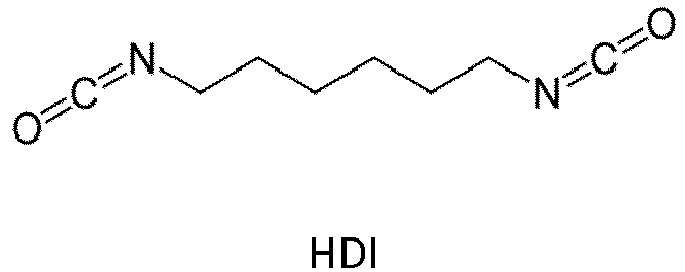
- hexamethylene diisocyanate is a "monomeric diisocyanate” because it contains two isocyanate groups and is not a reaction product of at least two polyisocyanate molecules:
- reaction products of at least two HDI molecules which still have at least two isocyanate groups, are "oligomeric polyisocyanates" within the meaning of the invention.
- oligomeric polyisocyanates based on monomeric HDI are HDI isocyanurate and HDI biuret, each of which is made up of three monomeric HDI building blocks:
- the monomeric isocyanates defined further below in this application are particularly preferably used as starting materials for the modification.
- the polymerizable composition according to the invention can contain oligomeric and polymeric polyisocyanates in any mixing ratio. Basically, for reasons of occupational safety, polymerizable compositions are preferred whose polyisocyanate component, i.e. the totality of all polyisocyanates contained in said composition, consists of at least 90% by weight, preferably at least 95% by weight and more preferably at least 98% by weight of oligomeric polyisocyanates. If desired, for example to reduce the viscosity of the polymerizable composition, the polyisocyanate component can also contain up to 20% by weight or preferably up to 50% by weight of monomeric polyisocyanates.
- all isocyanate groups are bound to a carbon atom that is part of an open carbon chain. This can be unsaturated at one or more points.
- the aliphatically bound isocyanate group or - in the case of polyisocyanates - the aliphatically bound isocyanate groups are preferably bound to the terminal carbon atoms of the carbon chain.
- Polyisocyanates with aliphatically bound isocyanate groups which are particularly suitable according to the invention are 1,4-diisocyanatobutane (BDI), 1,5-diisocyanatopentane (PDI), 1,6-diisocyanatohexane (HDI), 2-methyl-1,5-diisocyanatopentane, 1,5-diisocyanato-2,2-dimethylpentane, 2,2,4- or 2,4,4-trimethyl-1,6-diisocyanatohexane and 1,10-diisocyanatodecane.
- BDI 1,4-diisocyanatobutane
- PDI 1,5-diisocyanatopentane
- HDI 1,6-diisocyanatohexane
- 2-methyl-1,5-diisocyanatopentane 1,5-diisocyanato-2,2-dimethylpentane
- isocyanate with cycloaliphatically bonded isocyanate groups all isocyanate groups are bonded to carbon atoms that are part of a closed ring of carbon atoms. This ring can be unsaturated at one or more points, as long as the presence of double bonds does not give it aromatic character.
- Polyisocyanates with cycloaliphatically bound isocyanate groups which are particularly suitable according to the invention are 1,3- and 1,4-diisocyanatocyclohexane, 1,4-diisocyanato-3,3,5-trimethylcyclohexane, 1,3-diisocyanato-2-methylcyclohexane, 1,3-diisocyanato-4-methylcyclohexane, 1-isocyanato-3,3,5-trimethyl-5-isocyanatomethyl-cyclohexane isophorone diisocyanate; (IPDI) 4,4'-Diisocyanato-3,3'-dimethyldicyclohexylmethane, 4,4'-Diisocyanato-3,3',5,5'-tetramethyl-dicyclohexylmethane, 4,4'-Diisocyanato-1,1'-bi(cyclohexyl), 4,4'-Di
- Polyisocyanates with araliphatically bound isocyanate groups which are particularly suitable according to the invention are 1,3- and 1,4-bis-(isocyanatomethyl)benzene (xylylene diisocyanate; XDI), 1,3- and 1,4-bis(1-isocyanato-1-methylethyl)benzene (TMXDI) and bis(4-(1-isocyanato-1-methylethyl)phenyl) carbonate.
- the polymerizable composition can contain any mixtures of the above-mentioned isocyanates in monomeric and/or oligomeric form.
- Isocyanates with aromatically bound isocyanate groups which are particularly suitable according to the invention are 2,4- and 2,6-diisocyanatotoluene (TDI), 2,4'- and 4,4'-diisocyanatodiphenylmethane (MDI) and 1,5-diisocyanatonaphthalene.
- TDI 2,4- and 2,6-diisocyanatotoluene
- MDI 2,4'- and 4,4'-diisocyanatodiphenylmethane
- 1,5-diisocyanatonaphthalene 1,5-diisocyanatonaphthalene.
- Monoisocyanates which are particularly suitable according to the invention are preferably selected from the group consisting of n-butyl isocyanate, n-amyl isocyanate, n-hexyl isocyanate, n-heptyl isocyanate, n-octyl isocyanate, undecyl isocyanate, dodecyl isocyanate, tetradecyl isocyanate, cetyl isocyanate, stearyl isocyanate, cyclopentyl isocyanate, cyclohexyl isocyanate, 3- or 4-methylcyclohexyl isocyanate, methylbenzyl isocyanate, methyl isocyanate, (trimethylsilyl) isocyanate, 1-naphthyl isocyanate, 3-methyl-2-butyl isocyanate, 1-(4-methoxyphenyl)ethyl isocyanate, 1-(3-methoxyphenyl)e
- Thioisocyanates are also suitable.
- Preferred thioisocyanates are selected from the group consisting of 4-fluorobenzyl isothiocyanate, dibutyltin diisothiocyanate, 2,6-difluorophenyl isothiocyanate, 3-cyanophenyl isothiocyanate, 3-nitrophenyl isothiocyanate and phenyl isocyanate.
- a monoisocyanate selected from the group consisting of cyclohexyl isocyanate, phenyl isocyanate, octadecyl isocyanate and hexyl isocyanate.
- mono- or polyisocyanates obtained by modifying monomeric isocyanates as described above in this application.
- the totality of all monomeric and oligomeric polyisocyanates contained in the polymerizable composition is also referred to in this application as the "polyisocyanate component" of the polymerizable composition.
- a "polymerizable composition” is a composition which contains at least the components defined above and can be cured to form a polymer by crosslinking the free isocyanate groups contained in the composition.
- the compound according to formula (I) acts as a catalyst which causes the crosslinking of the isocyanate groups.
- This crosslinking of at least two isocyanate groups preferably takes place with the formation of isocyanurate and/or uretdione groups. Isocyanurate groups are predominantly formed and uretdione groups are only a by-product. If isocyanurate groups are formed, preferably three isocyanate groups are crosslinked per isocyanurate group formed.
- the ratio of the compound according to formula (I) on the one hand to the at least one polyisocyanate with isocyanate groups selected from the group consisting of aliphatically, cycloaliphatically, araliphatically and aromatically bound isocyanate groups on the other hand is chosen such that at temperatures between 80 °C and 250 °C at least 80% of the free isocyanate groups present can be crosslinked within a maximum of one hour.
- This condition is preferably met when the weight ratio between the compound according to formula (I) and the totality of the polyisocyanates contained in the polymerizable composition is between 1:1000 and 1:20, more preferably between 1:500 and 1:20, even more preferably between 1:400 and 1:20 and most preferably between 1:300 and 1:20.
- At least 80%, more preferably at least 90%, even more preferably at least 95% and particularly preferably at least 98% of the isocyanate groups contained in the polymerizable composition are aliphatically and/or cycloaliphatically bound.
- the polyisocyanate component of the polymerizable composition consists of at least 80% by weight of at least one polyisocyanate selected from the group consisting of monomeric HDI, oligomeric HDI, monomeric PDI, oligomeric PDI, monomeric IPDI and oligomeric IPDI. Most preferably, it consists of at least 90% by weight of at least one of the aforementioned polyisocyanates.
- the molar ratio of isocyanate groups to isocyanate-reactive groups in the polymerizable composition is at least 5:1 and more preferably at least 10:1.
- isocyanate-reactive groups is meant hydroxyl, thiol and amino groups.
- kit means that both components are present together, but in separate containers.
- the kit also contains operating instructions which describe the use according to the invention.
- the kit preferably contains component b) in an amount which is suitable for crosslinking at least 80% of the isocyanate groups present in component a) contained in the kit at a temperature between 80°C and 250°C in a maximum of 10 minutes.
- the polyisocyanate contained in the kit according to the invention corresponds to the "polyisocyanate component" of the polymerizable composition defined above. All definitions given there therefore also apply to the polyisocyanate contained in the kit.
- the present invention also relates to the use of at least one compound according to formula (I) as defined above for crosslinking at least two isocyanate groups selected from the group consisting of aliphatically, cycloaliphatically, araliphatically and aromatically bound isocyanate groups.
- the crosslinking of the at least two isocyanate groups selected from the group consisting of aliphatically, cycloaliphatically, araliphatically and aromatically bound isocyanate groups takes place with the formation of an isocyanurate group.
- the compound according to formula (I) is used as a thermolatent catalyst.
- isocyanate groups contained in at least one compound selected from the group consisting of HDI, PDI, IPDI, oligomeric HDI, oligomeric PDI and oligomeric IPDI are crosslinked with one another.
- chemically highly cross-linked polymers are understood to mean those which have an average chemical network length Mc of at most 1000 g/mol, preferably at most 500 g/mol, particularly preferably at most 400 g/mol and very particularly preferably at most 300 g/mol.
- the average network length is defined as the number-average molar mass between the network nodes in a polymer network.
- the average network arch length as well as the cross-linking density can be calculated by swelling measurements according to the HERMANS-FLORY-WALL method in suitable solvents or by measuring the elastic modulus in the melt in the linear elastic range at low frequencies, see also John D. Ferry: Viscoelastic properties of polymers 3rd Edition, 1980 .
- the net arch length is determined by a rheological measurement.
- highly cross-linked materials are also understood to mean those which have a storage shear modulus in the melt measured in the linear range of at least 3 ⁇ 10 6 Pa, preferably at least 5 ⁇ 10 6 Pa and very particularly preferably at least 8 ⁇ 10 6 Pa.
- thermolatent catalyst is characterized in that the catalyst is mixed with the isocyanate to be crosslinked and the resulting reaction mixture is initially stored at a temperature at which the catalyst does not show any significant catalytic activity. The temperature is then increased to a value at which the catalyst is active and the crosslinking reaction is thus started. Storage is preferably carried out at temperatures of at most 40 °C, more preferably at most 30 °C. The storage period is such that the viscosity of the reaction mixture increases by at most 200% during this time. At storage temperatures of 30 °C, this is preferably a period of 30 minutes to 5 days, more preferably 30 Minutes to 24 hours.
- the viscosity increases by a maximum of 20% within 4 hours at a storage temperature of 30 °C or less.
- the temperature is increased to 50 °C to 250 °C, preferably to 80 °C to 250 °C and more preferably to 120 °C to 250 °C.
- the present invention relates to the use of a polymerizable composition as defined above or a kit as defined above for producing a polymer.
- Said polymer is preferably the matrix material of a composite material. It is particularly preferably the matrix material of a highly filled composite material.
- composite material is well known to those skilled in the art; it basically refers to materials in which a filler is embedded in a matrix.
- this matrix is a polymer that is formed by crosslinking the isocyanate groups contained in the polyisocyanate component a).
- the filler can be any suitable organic or inorganic filler known to the person skilled in the art. It can have any geometry. Preferably, however, it is a fibrous organic or inorganic filler.
- the aspect ratio of a fibrous filler is greater than 1000, preferably greater than 5000, more preferably greater than 10,000, and most preferably greater than 50,000.
- the aspect ratio is defined as the length of the fiber divided by the diameter.
- the fibrous fillers preferably have a minimum length of 2 mm, more preferably 5 mm, even more preferably 20 mm, even more preferably 100 mm, most preferably 1000 mm, particularly preferably 50 m and most preferably 100 m.
- Preferred inorganic fibers are glass fibers, basalt fibers, boron fibers, ceramic fibers, whiskers, silica fibers and metallic reinforcing fibers.
- Preferred organic fibers are aramid fibers, carbon fibers, carbon nanotubes, polyester fibers, nylon fibers and plexiglass fibers.
- Preferred natural fibers are flax fibers, hemp fibers, wood fibers, cellulose fibers and sisal fibers.
- the ratio of the proportions of filler and polymer matrix in the composite material is referred to as the degree of filling.
- Highly filled systems are characterized by a weight proportion of filler between 50 wt.% and 90 wt.%, preferably between 60 wt.% and 85 wt.% and even more preferably between 70 and 85 wt.%, always based on the total mass of polyisocyanate component a) and filler.
- process step a) The mixing of the components in process step a) can be carried out using all suitable methods known to the person skilled in the art.
- Process step a) is preferably carried out at temperatures of at most 40 °C.
- a reaction mixture is present which corresponds to the polymerizable composition disclosed at the beginning of this patent application.
- process step a) considered on its own discloses a method for providing the polymerizable composition according to the invention.
- the ratio of isocyanate groups to isocyanate-reactive groups in the polymerizable composition is at least 5:1 and more preferably at least 10:1.
- isocyanate-reactive groups is meant hydroxyl, thiol and amino groups.
- process step b) is preferably initiated by increasing the temperature of the polymerizable composition.
- the increased temperature is preferably also maintained over the entire duration of process step b). It is preferred that a temperature of at least 50 °C is maintained throughout process step b). More preferably, the temperature during process step b) is between 50 °C and 250 °C, even more preferably between 80 °C and 250 °C and most preferably between 120 °C and 250 °C.
- the polymerizable composition obtained in process step a) can be stored for 30 to 360, preferably 30 to 249 minutes, before starting process step b) and while observing this temperature limit, without its viscosity increasing by more than 20%.
- the "curing" of the polymerizable composition occurs through the cross-linking of the isocyanate groups contained in the polyisocyanate. This creates a solid polymer network. Since the compound according to formula (I) primarily catalyzes the formation of isocyanurate groups, at least 80 mol% of isocyanurate groups are preferably formed, while the sum of uretdione, urethane, allophanate, urea, biuret, iminooxadiazinedione and oxadiazinetrione structures that are formed during curing is less than 20 mol%.
- Process step b) is completed when the liquid polymerizable composition has become a solid that retains its shape without external supports such as molds. This is preferably the case when at least 75%, more preferably at least 80%, even more preferably at least 85% and most preferably at least 90% of the isocyanate groups present in the polymerizable composition at the start of process step b) have been consumed. At temperatures between 80 °C and 250 °C, this state is preferably reached after a maximum of 20 minutes.
- the polymerizable composition must contain a filler at the beginning of process step b). This can be introduced into the polymerizable composition in different ways.
- the polymerizable composition as it is present at the end of process step a) can be mixed with the filler.
- a polyisocyanate with isocyanate groups selected from the group consisting of aliphatic, cycloaliphatic, araliphatic and aromatically bound isocyanate groups is first mixed with the filler before it is used in process step a). Suitable fillers are described further above in this application.
- process step b) a composite material is created in which the cured reaction mixture forms a polymer matrix in which the filler is embedded.
- the filler is a fibrous filler selected from the group consisting of glass fibers, basalt fibers, carbon fibers, cellulose fibers and mixtures thereof.
- cellulose fiber preferably refers to fibers that contain cellulose. It is not excluded that they contain other compounds such as pectins. Since the cellulose fibers preferred according to the invention are of plant origin, the exact chemical structure of the fibers depends on the plant in question.
- Preferred cellulose fibers are fibers made of jute, flax, hemp and cotton.
- the fibers can be present individually, but they can also be woven or knitted into mats or tiles in any form known to those skilled in the art. Preferably less than 50% by weight, more preferably less than 35% by weight, even more preferably less than 20% by weight and most preferably less than 10% by weight of the fibers used are in the form of mats or tiles.
- the process according to the invention for producing a composite material is a pultrusion process, also known under the term pultrusion process.
- Extrusion is a continuous manufacturing process for producing fiber-reinforced plastic profiles.
- the basic structure of an extrusion system consists of the fiber rack, devices for fiber guidance, impregnation equipment, hardening tools, reciprocating drawing devices and a cutting unit.
- the spools of rovings are stored in the fiber rack. From there, the fiber rovings are guided via fiber guides to the impregnation device, where the fibers are wetted with the reaction mixture from process step a).
- the fibers are usually aligned or pre-sorted to the desired profile shape via the fiber guides or the impregnation device. Fibers that have a minimum length of at least 50 m while maintaining the aspect ratio defined above are particularly suitable.
- mats, fabrics, scrims or fleeces can be integrated into the process in order to optimize the mechanical properties for the desired application.
- the impregnation of the fibers with the reaction mixture can be carried out by all methods known to the person skilled in the art in the context of the pultrusion process.
- the resin-impregnated fibers then pass through the shaping hardening tool, where the reactive groups of the reaction mixture are cross-linked to form the polymer (matrix) at elevated temperatures.
- step b) of the process This is often followed by a cooling section, e.g. air cooling, before the now finished semi-finished product is guided through the alternating pulling devices (pullers). These ensure continuous transport of the material throughout the entire pultrusion process.
- the final process step is to cut the material to the desired length.
- a "flying saw” is often used here, i.e. the saw moves along with the material at the same speed and makes the cut. This produces a straight cutting edge and prevents the profile from building up or the process from stopping during the sawing step.
- the present patent application relates to a polymer obtainable by the process described above.
- RT room temperature
- the viscosity is approx. 1200 mPa ⁇ s at 23°C (DIN EN ISO 3219/A.3).
- Catalyst 2 Catalyst adduct as in WO 2019/197638 described as catalyst KA1 Additive: Mould release agent Desmorapid AP 300, from Covestro AG, consists of organic fatty acids and esters.
- reaction mixture was prepared by mixing the polyisocyanate (Desmocomp Ultra AP 200) with an appropriate amount of catalyst and additive at 23°C in a Speedmixer DAC 150.1 FVZ from Hauschild at 2750 RPM.
- catalyst 1 0.5 wt.% was added to 99.5 wt.% of polyisocyanate and prepared according to the procedure described above.
- phase transitions using DSC were determined using DSC (Differential Scanning Calorimetry) with a Mettler DSC 12E (Mettler Toledo GmbH, G funnelen, DE) in accordance with DIN EN 61006. Calibration was carried out using the melting onset temperature of indium and lead. 5 mg of substance were weighed into standard capsules. The measurement was carried out by heating twice from -20 °C to +200 °C at a heating rate of 20 K/min followed by cooling at a cooling rate of 320 K/min. Cooling was carried out using liquid nitrogen. Nitrogen was used as the purge gas. The values given are based on the evaluation of the 2nd heating curve. The melting temperatures Tm were obtained from the temperatures at the maxima of the heat flow curves. The glass transition temperature Tg was obtained from the temperature at half the height of a glass transition step.
- the viscosity of a small amount of the reactive resin was measured at 23 °C using a Physia MCR 51 from Anton Paar (plate/plate; shear rate 1 s-1) for 4 h. As in the WO2019121349A1 described and based on ISO 6721-10.
- Table 1 shows the viscosity development of the comparative examples and the example according to the invention in direct comparison over a period of 240 minutes. It is clearly evident that the activated matrix of the example according to the invention has a stable and lower viscosity over the entire measurement period, which is below the initial viscosity of the polyisocyanate Desmocomp AP 200 used.
- Table 2 Glass transition temperatures of the cured matrix systems ⁇ /b> Activated Matrix System Comparative Example 1 Comparison Example 2 Inventive Example Glass transition temperature (Tg) according to DSC after curing 99°C 111°C 111°C
- Table 2 summarizes the measured glass transition temperatures (Tg) after the second heating of the two comparative examples 1 and 2 as well as that of the example according to the invention. All Tg values were determined from samples that had been cured for 10 minutes at 160°C.
- thermosetting composites using the pultrusion process, which exhibit a high glass transition temperature in combination with good fiber bonding.
Landscapes
- Chemical & Material Sciences (AREA)
- Organic Chemistry (AREA)
- Health & Medical Sciences (AREA)
- Chemical Kinetics & Catalysis (AREA)
- Medicinal Chemistry (AREA)
- Polymers & Plastics (AREA)
- Polyurethanes Or Polyureas (AREA)
Abstract
Die vorliegende Erfindung betrifft die Verwendung von veresterten Ethanolaminen als Katalysatoren für die Vernetzung aliphatisch und/oder cycloaliphatisch gebundener Isocyanatgruppen untereinander. Die erfindungsgemäßen Katalysatoren haben den besonderen Vorteil, dass sie thermolatent sind.
Description
- Die vorliegende Erfindung betrifft die Verwendung von veresterten Ethanolaminen als Katalysatoren für die Vernetzung aliphatisch und/oder cycloaliphatisch gebundener Isocyanatgruppen untereinander. Die erfindungsgemäßen Katalysatoren haben den besonderen Vorteil, dass sie thermolatent sind.
- Die Herstellung von Isocyanuratkunststoffen durch die Vernetzung aliphatisch oder cycloaliphatisch gebundener Isocyanatgruppen untereinander, d.h. ohne Beteiligung von Thiol-, Hydroxyl- oder Aminogruppen ist grundsätzlich bekannt. Es ist auch bereits beschrieben, dass derartige Materialien als Polymermatrix für Verbundwerkstoffe einsetzbar sind.
-
WO 2019/197638 beschreibt Isocyanataddukte von hydroxyfunktionellen tertiären Aminen und die Verwendung dieser Verbindungen als Trimerisierungskatalysatoren. Die Zugabe dieser Addukte zu Polyisocyanaten bewirkt allerdings eine unmittelbare Viskositätserhöhung der damit aktivierten Reaktionsgemische. Diese setzt sich über die angestrebte Nutzungsdauer der Zusammensetzung fort. Viele Herstellungsverfahren für Verbundwerkstoffe mit Polyisocyanuratmatrix, so z.B. das Strangziehverfahren, beruhen darauf, dass ein faserförmiger Füllstoff in einem Tauchbad mit dem Matrixmaterial benetzt wird. Deswegen beschränkt der Viskositätsanstieg die Nutzungsdauer des Reaktionsgemisches, das zum Aufbau der Matrix eingesetzt wird. Dies ist gerade vor dem Hintergrund der Verwendung des Systems im Strangziehverfahren für Verbundwerkstoffe hinderlich, da damit eine optimale Faseranbindung nicht sicher erreicht werden kann. -
WO 2019/197639 offenbart die Verwendung der hydroxyfunktionellen tertiären Amine für die Vernetzung von aliphatischen Polyisocyanaten im Strangziehverfahren zur Herstellung von Verbundwerkstoffen. Es werden aber keine Verbindungen offenbart, bei denen die OH-Gruppe dieser Verbindungen verestert ist. Auch bei diesen Verbindungen ist ein störender Viskositätsanstieg des Reaktionsgemisches zu beobachten. - Der vorliegenden Erfindung lag die Aufgabe zugrunde, Trimerisierungskatalysatoren bereitzustellen, die zu einem möglichst geringen Viskositätsanstieg einer Polyisocyanatzusammensetzung führen, eine gute Anbindung der Polyisocyanuratmatrix eines Verbundwerkstoffs an den Füllstoff ermöglichen und zu Polyisocyanuratmatrizes mit verlässlich hohen Glasübergangstemperaturen führen.
- Diese Aufgabe wird durch die Ausführungsformen der vorliegenden Erfindung gelöst, die in den Patentansprüchen und in dieser Beschreibung offenbart werden.
- In einer ersten Ausführungsform betrifft die vorliegende Erfindung eine Verbindung gemäß Formel (I)

- Wobei R1 und R2 unabhängig voneinander ausgewählt sind aus der Gruppe bestehend aus Wasserstoff, Methyl, Ethyl, Propyl, Isopropyl, Butyl und Isobutyl, verzweigtem C5-Alkyl, unverzweigtem C5-Alkyl, verzweigtem C6-Alkyl, unverzweigtem C6-Alkyl, verzweigtem C7-Alkyl und unverzweigtem C7-Alkyl;
- A ausgewählt ist aus der Gruppe bestehend aus O, S und NR3, wobei R3 ausgewählt ist aus der Gruppe bestehend aus H, Methyl, Ethyl, Propyl, Isopropyl, Butyl und Isobutyl; und
- R4 ein verzweigter oder unverzweigter Alkylrest bis zu 7 Kohlenstoffatomen oder Wasserstoff ist.
- In einer bevorzugten Ausführungsform der vorliegenden Erfindung ist A NR3, wobei R3 ausgewählt ist aus der Gruppe bestehend aus Wasserstoff, Methyl, Ethyl, Propyl, Isopropyl, Butyl und Isobutyl. Bevorzugt ist R3 Methyl oder Ethyl. Besonders bevorzugt ist R3 Methyl.
- In einer weiteren bevorzugten Ausführungsform dieser Erfindung ist A Sauerstoff.
- In noch einer weiteren bevorzugten Ausführungsform dieser Erfindung ist A Schwefel.
- In einer bevorzugten Ausführungsform der vorliegenden Erfindung ist R4 ausgewählt aus der Gruppe bestehend aus Wasserstoff, Methyl und Ethyl. Besonders bevorzugt ist R4 Wasserstoff oder Methyl.
- Unter einem "Polyisocyanat" wird in der vorliegenden Anmeldung jede Verbindung verstanden, die im Durchschnitt wenigstens 1,8, bevorzugt wenigstens 2,0 und besonders bevorzugt 2,1 Isocyanatgruppen aufweist. Hingegen wird unter einem "Monoisocyanat" eine Verbindung mit durchschnittlich höchstens 1,6 Isocyanatgruppen pro Molekül, insbesondere nur mit einer Isocyanatgruppe pro Molekül verstanden.
- Der Begriff "Polyisocyanate" bezeichnet in dieser Anmeldung monomere und/oder oligomere Polyisocyanate gleichermaßen. Zum Verständnis vieler Aspekte der Erfindung ist es jedoch wichtig, zwischen monomeren Diisocyanaten und oligomeren Polyisocyanaten zu unterscheiden. Wenn in dieser Anmeldung von "oligomeren Polyisocyanaten" die Rede ist, dann sind damit Polyisocyanate gemeint, die aus mindestens zwei monomeren Diisocyanatmolekülen aufgebaut sind, d.h. es sind Verbindungen, die ein Reaktionsprodukt aus mindestens zwei monomeren Diisocyanatmolekülen darstellen oder enthalten.
- Oligomere Isocyanate werden durch "Modifizierung" eines monomeren Isocyanats erhalten. "Modifizierung" bedeutet dabei die Reaktion monomerer Isocyanate zu oligomeren Isocyanaten mit Uretdion-, Isocyanurat-, Allophanat-, Biuret-, Iminooxadiazindion- und/oder Oxadiazintrionstruktur. Als Edukte für die Herstellung oligomerer Isocyanate werden bevorzugt Diisocyanate verwendet.
- So ist z.B. Hexamethylendiisocyanat (HDI) ein "monomeres Diisocyanat", da es zwei Isocyanat-Gruppen enthält und kein Reaktionsprodukt aus mindestens zwei Polyisocyanatmolekülen darstellt:
- Reaktionsprodukte aus mindestens zwei HDI-Molekülen, die immer noch über mindestens zwei Isocyanat-Gruppen verfügen, sind demgegenüber "oligomere Polyisocyanate" im Sinne der Erfindung. Vertreter solcher "oligomerer Polyisocyanate" sind ausgehend von dem monomeren HDI z.B. das HDI-Isocyanurat und das HDI-Biuret, die jeweils aus drei monomeren HDI Bausteinen aufgebaut sind:

- Herstellverfahren für oligomere Polyisocyanate mit Uretdion-, Isocyanurat-, Allophanat-, Biuret-, Iminooxadiazindion- und/oder Oxadiazintrionstruktur sind beispielsweise in J. Prakt. Chem. 336 (1994) 185 - 200, in
DE-A 1 670 666 ,DE-A 1 954 093 ,DE-A 2 414 413 ,DE-A 2 452 532 ,DE-A 2 641 380 ,DE-A 3 700 209 ,DE-A 3 900 053 undDE-A 3 928 503 oder inEP-A 0 336 205 ,EP A 0 339 396 undEP-A 0 798 299 beschrieben. - Besonders bevorzugt werden die weiter unten in dieser Anmeldung definierten monomeren Isocyanate als Ausgangsstoffe der Modifizierung verwendet.
- Die erfindungsgemäße polymerisierbare Zusammensetzung kann oligomere und polymere Polyisocyanate in beliebigen Mischungsverhältnissen enthalten. Grundsätzlich sind aus Gründen der Arbeitssicherheit polymerisierbare Zusammensetzungen bevorzugt, deren Polyisocyanatkomponente, d.h. die Gesamtheit aller in besagter Zusammensetzung enthaltenen Polyisocyanate, zu wenigstens 90 Gew.-%, bevorzugt wenigstens 95 Gew.-% und stärker bevorzugt wenigstens 98 Gew.-% aus oligomeren Polyisocyanaten bestehen. Soweit gewünscht, beispielsweise zur Absenkung der Viskosität der polymerisierbaren Zusammensetzung, kann die Polyisocyanatkomponente aber auch bis 20 Gew.-% oder bevorzugt bis zu 50 Gew.-% monomere Polyisocyanate enthalten.
- Bei einem Isocyanat mit aliphatisch gebundenen Isocyanatgruppen sind alle Isocyanatgruppen an ein Kohlenstoffatom gebunden, das Teil einer offenen Kohlenstoffkette ist. Diese kann an einer oder mehreren Stellen ungesättigt sein. Die aliphatisch gebundene Isocyanatgruppe oder - im Fall von Polyisocyanaten - die aliphatisch gebundenen Isocyanatgruppen sind vorzugsweise an den terminalen Kohlenstoffatomen der Kohlenstoffkette gebunden.
- Erfindungsgemäß besonders geeignete Polyisocyanate mit aliphatisch gebundenen Isocyanatgruppen sind 1,4-Diisocyanatobutan (BDI), 1,5-Diisocyanatopentan (PDI), 1,6-Diisocyanatohexan (HDI), 2-Methyl-1,5-diisocyanatopentan, 1,5-Diisocyanato-2,2-dimethylpentan, 2,2,4- bzw. 2,4,4-Trimethyl-1,6-diisocyanatohexan und 1,10-Diisocyanatodecan.
- Bei einem Isocyanat mit cycloaliphatisch gebundenen Isocyanatgruppen sind alle Isocyanatgruppen an Kohlenstoffatome gebunden, die Teil eines geschlossenen Rings aus Kohlenstoffatomen sind. Dieser Ring kann an einer oder mehreren Stellen ungesättigt sein, solange er durch das Vorliegen von Doppelbindungen keinen aromatischen Charakter erhält.
- Erfindungsgemäß besonders geeignete Polyisocyanate mit cycloaliphatisch gebundenen Isocyanatgruppen sind 1,3- und 1,4-Diisocyanatocyclohexan, 1,4-Diisocyanato-3,3,5-trimethylcyclohexan, 1,3-Diisocyanato-2-methylcyclohexan, 1,3-Diisocyanato-4-methylcyclohexan, 1-Isocyanato-3,3,5-trimethyl-5-isocyanatomethyl-cyclohexan Isophorondiisocyanat; (IPDI), 1-Isocyanato-1-methyl-4(3)-isocyanatomethylcyclohexan, 2,4'- und 4,4'-Diisocyanatodicyclohexylmethan(H12MDI), 1,3-und 1,4-Bis(isocyanatomethyl)cyclohexan, Bis-(isocyanatomethyl)-norbornan (NBDI), 4,4'-Diisocyanato-3,3'-dimethyldicyclohexylmethan, 4,4'-Diisocyanato-3,3',5,5'-tetramethyl-dicyclohexylmethan, 4,4'-Diisocyanato-1,1'-bi(cyclohexyl), 4,4'-Diisocyanato-3,3'-dimethyl-1,1'-bi(cyclohexyl), 4,4'-Diisocyanato-2,2',5,5'-tetra-methyl-1,1'-bi(cyclohexyl), 1,8-Diisocyanato-p-menthan, 1,3-Diisocyanato-adamantan und 1,3-Dimethyl-5,7-diisocyanatoadamantan .
- Bei einem Isocyanat mit araliphatisch gebundenen Isocyanatgruppen sind alle Isocyanatgruppen an Methylenreste gebunden, der ihrerseits an einen aromatischen Ring gebunden sind.
- Erfindungsgemäß besonders geeignete Polyisocyanate mit araliphatisch gebundenen Isocyanatgruppen sind 1,3- und 1,4-Bis-(iso-cyanatomethyl)benzol (Xyxlylendiisocyanat; XDI), 1,3- und 1,4-Bis(1-isocyanato-1-methyl,ethyl)-benzol (TMXDI) und Bis(4-(1-isocyanato-1-methylethyl)phenyl)-carbonat.
- Erfindungsgemäß kann die polymerisierbare Zusammensetzung beliebige Mischungen der oben genannten Isocyanate in monomerer und/oder oligomerer Form enthalten.
- Bei einem Isocyanat mit aromatisch gebundener Isocyanatgruppe sind alle Isocyanatgruppen direkt an Kohlenstoffatome gebunden, die Teil eines aromatischen Ringes sind.
- Erfindungsgemäß besonders geeignete Isocyanate mit aromatisch gebundenen Isocyanatgruppen sind 2,4- und 2,6-Diisocyanattoluol (TDI), 2,4'- und 4,4'-Diisocyanatodiphenylmethan (MDI) und 1,5-Diisocyanatonaphthalin.
- Erfindungsgemäß besonders geeignete Monoisocyanate sind vorzugsweise ausgewählt aus der Gruppe bestehend aus n-Butylisocyanat, n-Amylisocyanat, n-Hexylisocyanat, n-Heptylisocyanat, n-Octylisocyanat, Undecylisocyanat, Dodecylisocyanat, Tetradecylisocyanat, Cetylisocyanat, Stearylisocyanat, Cyclopentylisocyanat, Cyclohexylisocyanat, 3- bzw. 4-Methylcyclohexylisocyanat, Methylbenzylisocyanat, Methylisocyanat, (Trimethylsilyl)isocyanat, 1-Naphtylisocyanat, 3-Methyl-2-butylisocyanat, 1-(4-Methoxyphenyl)ethylisocyanat, 1-(3-methoxyphenyl)ethylisocyanat, 1-Phenylpropylisocyanat, 2-Octylisocyanat, 2-Heptylisocyanat, 4-butyl-2-methylphenylisocyanat, 3-(Triethoxysilyl)propylisocyanat, 2-Benzyloxycyclohexylisocyanat, 1-(4-Chlorophenyl)ethylisocyanat, 2-Nonylisocyanat, 1-(4-Bromophenyl)ethylisocyanat, 2,1,3-benzothiadiazol-4-ylisocyanat, p-Phenylazophenylisocyanat, Phenylisocyanat, Ethylisocyanat, Chlorsulfonylisocyanat, Allylisocyanat, Benzylisocyanat, Propylisocyanat, Isoproylisocyanat, Furfurylisocyanat, Propylisocyanat, Octadecylisocyanat, Trichloracetylisocyanat, Benzoylisocyanat, Phenethylisocyanat, p-Tolylisocyanat, o-Tolylisocyanat, m-Tolylisocyanat, 3,4-Dimethoxyphenylisocyanat, 2,4-Dimethoxyphenylisocyanat, 3,5-Dimethoxyphenylisocyanat, 2,5-Dimethoxyphenylisocyanat, tert-Butylisocyanat, 3,5-Dimethylphenylisocyanat, 2,6-Dimethylphenylisocyanat, 4-Ethylphenylisocyanat, 4-Methylbenzylisocyanat, 2-Methylbenzylisocyanat, 3-Methylbenzylisocyanat, 4-Methoxyphenylisocyanat, 4-tert-Butylphenylisocyanat, 2-Methoxyphenylisocyanat, 3,4,5-Trimethoxyphenylisocyanat, 2,4-Dimethoxybenzylisocyanat, 4-Phenylbutylisocyanat, 4-Ethylphenethylisocyanat, 4-Methoxybenzylisocyanat, Benzenesulfonylisocyanat, 2-Methoxybenzylisocyanat, 3-Ethoxyphenylisocyanat, 3-Methoxybenzylisocyanat, 2,2-Diphenylethylisocyanat, 1,1,3,3-Tetramethylbutylisocyanat, 2-Ethylhexylisocyanat, 4-Biphenylylisocyanat, 3-Phenylpropylisocyanat, 2,3-Dimethoxyphenethylisocyanat, Decylisocyanat, Cyclohexanmethylisocyanat, 3,4-Methylendioxyphenethylisocyanat, 3,4-Dimethoxyphenethylisocyanat, 5-Indanylisocyanat, Cycloheptylisocyanat, 2-Phenylcyclopropylisocyanat, 1-Cyclohexylethylisocyanat, 4-Nitrophenylisocyanat, 1-Adamantylisocyanat, 2-Nitrophenylisocyanat, 3-Nitrophenylisocyanat, Pyridine-3-isocyanat, Chloracetylisocyanat, 2,6-Diisopropylphenylisocyanat, Hexadecylisocyanat, 4-Acetylphenylisocyanat, 4-Phenoxyphenylisocyanat, 4-Pentylphenylisocyanat, 3-Phenoxyphenylisocyanat, p-Toluenesulfonylisocyanat, 2-Chlorethylisocyanat, 2-Bromphenylisocyanat, 3-Chlorphenylisocyanat, 2-Chlorphenylisocyanat, 4-Bromphenylisocyanat, 4-Chlorphenylisocyanat, 2-Naphthylisocyanat, 4-Fluorophenylisocyanat, 2-Bromethylisocyanat, 4-Cyanophenylisocyanat, 3,4-Dichlorphenylisocyanat, 2,3,4-Trifluorphenylisocyanat, 3-Cyanophenylisocyanat, 2,6-Dichlorphenylisocyanat, Diethoxyphosphinylisocyanat, 2,4-Dichlorphenylisocyanat, 3,3,4,4,5,5,6,6,7,7,8,8,9,9,10,10,10-Heptadecafluordecylisocyanat, 4-Fluorbenzylisocyanat, 2-Fluorphenylisocyanat, 3-Chlorpropylisocyanat, 3-Fluorphenylisocyanat, 4-lodphenylisocyanat, 3,5-Dichlorphenylisocyanat, 4-Chlorbenzenesulfonylisocyanat, 2,4,6-Tribromphenylisocyanat, 2-lodphenylisocyanat, 3,4-Difluorphenylisocyanat, 3-Bromphenylisocyanat, 2,4-Dichlorbenzylisocyanat, 2,5-Difluorphenylisocyanat, 2-Benzylphenylisocyanat, 2-Fluorbenzylisocyanat, 4-Fluorphenethylisocyanat, Pentafluorphenylisocyanat, 2,4-Dichlorphenethylisocyanat, 4-Chlorbenzylisocyanat, Diphenylmethylisocyanat, Tributylzinnisocyanat, 2-Chlorbenzolsulfonylisocyanat, 2-Chlorbenzylisocyanat, 3,3-Diphenylpropylisocyanat, , 3,4,5-Trimethoxybenzylisocyanat, 3-Chlorphenethylisocyanat, 3-Fluorbenzylisocyanat, 2,6-Difluorphenylisocyanat, 3-lodphenylisocyanat, 2,4-Difluorphenylisocyanat, 2-Cyanophenylisocyanat, 2-Fluorphenethylisocyanat, 2-Thienylisocyanat, 3,4-Dichlorbenzylisocyanat, 3,4-Dichlorphenethylisocyanat, 4-Benzylphenylisocyanat, 4-Brombenzylisocyanat, 4-Fluorbenzopsulfonylisocyanat, mPEG5K-lsocyanat, 3,5-Dimethylisoxazol-4-ylisocyanat, 2-Methoxy-5-methylphenylisocyanat, 2-(4-Biphenyl)ethylisocyanat, 2-Ethyl-6-methylphenylisocyanat, 2-Methyl-5-phenyl-3-furylisocyanat, 1-(1-Naphthyl)ethylisocyanat, 3,4-(Methylenedioxy)phenylisocyanat, 2,3-Dihydro-1-benzofuran-5-ylisocyanat, 4-Methoxy-2-nitrophenylisocyanat, 3,5-Bis(trifluormethyl)phenylisocyanat, 4-(Maleinimido)phenylisocyanat, 4-(Dimethylamino)phenylisocyanat, 3-(Trifluormethyl)phenylisocyanat, 4-(Chlorsulfonyl)phenylisocyanat, 3-Isopropenyl-α,α-dimethylbenzylisocyanat, 3-Chlor-4-methylphenylisocyanat, 4-(Trifluormethyl)phenylisocyanat, 2-(Trifluormethyl)phenylisocyanat, 4,4'-Oxybis(phenylisocyanat), 4-(Chlormethyl)phenylisocyanat, 4-Chlor-3-(trifluormethyl)phenylisocyanat, 9H-Fluoren-2-ylisocyanat, 2-(Chlormethyl)phenylisocyanat, 2-Fluor-5-(trifluormethyl)phenylisocyanat, 2-Fluor-3-(trifluormethyl)phenylisocyanat, 4-(Benzyloxy)phenylisocyanat, 4-Fluor-3-(trifluormethyl)phenylisocyanat, 4-Fluor-3-methylphenylisocyanat, 3-Fluor-5-(trifluormethyl)phenylisocyanat, 4-Chlor-2-fluorphenylisocyanat, 5-Fluor-2-methylphenylisocyanat, 2,3-Dimethyl-6-nitrophenylisocyanat, 2-(Trifluormethoxy)phenylisocyanat, 2-Fluor-5-methylphenylisocyanat, 4-(Difluormethoxy)phenylisocyanat, 4-Methyl-2-nitrophenylisocyanat, 3-Fluor-2-methylphenylisocyanat, 4-(Trifluormethylthio)phenylisocyanat, 4-Fluor-2-(trifluormethyl)phenylisocyanat, 1-(4-Fluorphenyl)ethylisocyanat, 1-Benzothiophen-5-ylisocyanat, 2-(Difluormethoxy)phenylisocyanat, 2-(Thien-2-yl)ethylisocyanat, 2-Brom-4,6-difluorphenylisocyanat, 2-Chlor-4,6-dimethylphenylisocyanat, 2-Chlor-4-(trifluoromethyl)phenylisocyanat, 2-Chlor-4-(trifluormethylthio)phenylisocyanat, 2-Chlor-5-methylphenylisocyanat, 2-Fluor-4-iodphenylisocyanat, 3-Bromo-2,4,6-trimethylphenylisocyanat, 3-Chlor-2-fluorphenylisocyanat, 3-Chlor-2-methylphenylisocyanat, 4-(Trifluormethyl)benzylisocyanat, 4-Brom-2,6-difluorphenylisocyanat, 4-Brom-2,6-dimethylphenylisocyanat, 4-Brom-2-(trifluormethyl)phenylisocyanat, 4-Brom-2-chlor-6-methylphenylisocyanat, 4-Brom-2-chlor-6-methylphenylisocyanat, 4-Brom-2-ethylphenylisocyanat, 4-Chlor-2-phenoxyphenylisocyanat, 4-Ethoxy-2-nitrophenylisocyanat, 4-Fluor-2-nitrophenylisocyanat, 5-Chlor-2-methylphenylisocyanat, 5-Chlor-2-phenoxyphenylisocyanat, 5-Methyl-2-nitrophenylisocyanat, 5-Phenyl-2-thienylisocyanat, 6-Fluor-4H-1,3-benzodioxin-8-ylisocyanat, 9H-Fluoren-9-ylisocyanat, Benzylisocyanat, Ethylisocyanat, Trichloracetylisocyanat, 1-Phenylethylisocyanat, Ethylisocyanatformat, Isocyanatphosphonicdichlorid, 2-Isocyanatthylmethacrylat, 3-Isocyanat-4-methoxybiphenyl, 2,4,6-Trichlorphenylisocyanat, Triphenylsilylisocyanat, 2,6-Dibrom-4-ethylphenylisocyanat, 2-Chlor-4-nitrophenylisocyanat, 2-tert-Butyl-6-methylphenylisocyanat, 4,4'-Methylenebis(2-chlorphenylisocyanat), 4,5-Dimethyl-2-nitrophenylisocyanat, 4-Chlor-2-(trifluormethyl)phenylisocyanat, 4-Chloro-2-nitrophenylisocyanat, 1-Isocyanat-2,3-dimethoxybenzol, 3-Isocyanatopentan, Isocyanatocyclobutan, Isocyanato(methoxy)methan, Ethyl(4-isocyanatophenyl)acetat, Ethyl4-(isocyanatomethyl)cyclohexancarboxylat, 1,1-Dimethoxy-2-isocyanatoethan, 1-Chlor-3-fluor-2-isocyanatobenzen, 2-Chlor-3-fluorphenylisocyanat, 2-Isocyanato-3-methyl-butyricsäuremethylester, 2-Isocyanato-5-methylbenzonitril, 5-Chlor-2-isocyanatobenzonitril, 5-Ethyl-2-isocyanatobenzonitril, 6-Isocyanato-hexansäuremethylester, Dimethyl-2-isocyanatoterephthalat, Ethyl-2-isocyanat-4-methylvalerat, Methyl-2-isocyanat-4-(methylsulfanyl)butanoat, Methyl-2-isocyanat-4-methylpentanoat, Ethyl-isocyanatoacetat, Phenyl-isocyanatoformat, Methyl-4-isocyanatobenzoat, Methyl-3-isocyanatobenzoat, Methyl-isocyanatoformat, Dimethyl 5-isocyanatoisophthalat und beliebigen Gemischen solcher Monoisocyanate.
- Ebenfalls geeignet sind Thioisocyanate. Bevorzugte Thioisocyanate sind ausgewählt aus der Gruppe bestehend aus 4-Fluorbenzylisothiocyanat, Dibutylzinndiisothiocyanat, 2,6-Difluorphenylisothiocyanat, 3-Cyanophenylisothiocyanat, 3-Nitrophenylisothiocyanat und Phenylisocyanat.
- Besonders bevorzugt ist ein Monoisocyanat ausgewählt aus der Gruppe bestehend aus Cyclohexylisocyanat, Phenylisocyanat, Octadecylisocyanat und Hexylisocyanat.
- Ebenfalls geeignet sind Mono- oder Polyisocyanate, die durch die Modifizierung monomerer Isocyanate wie weiter oben in dieser Anmeldung beschrieben erhalten werden.
- In einer weiteren Ausführungsform betrifft die vorliegende Erfindung eine polymerisierbare Zusammensetzung enthaltend
- a) wenigstens ein Polyisocyanat mit Isocyanatgruppen ausgewählt aus der Gruppe bestehend aus aliphatisch, cycloaliphatisch, araliphatisch und aromatisch gebundenen Isocyanatgruppen; und
- b) wenigstens eine Verbindung gemäß Formel (I);

- Wobei R1 und R2 unabhängig voneinander ausgewählt sind aus der Gruppe bestehend aus Wasserstoff, Methyl, Ethyl, Propyl, Isopropyl, Butyl, Isobutyl, verzweigtem C5-Alkyl, unverzweigtem C5-Alkyl, verzweigtem C6-Alkyl, unverzweigtem C6-Alkyl, verzweigtem C7-Alkyl und unverzweigtem C7-Alkyl;
- A ausgewählt ist aus der Gruppe bestehend aus O, S und NR3, wobei R3 ausgewählt ist aus der Gruppe bestehend aus Wasserstoff, Methyl, Ethyl, Propyl, Isopropyl, Butyl und Isobutyl; und
- R4 ein verzweigter oder unverzweigter Alkylrest bis zu 7 Kohlenstoffatomen oder Wasserstoff ist; und
- Alle weiter oben in dieser Anmeldung für die erfindungsgemäße Verbindung gegebenen Definitionen gelten auch für diese Ausführungsform.
- Die Gesamtheit aller in der polymerisierbaren Zusammensetzung enthaltenen monomeren und oligomeren Polyisocyanate wird in dieser Anmeldung auch als "Polyisocyanatkomponente" der polymerisierbaren Zusammensetzung bezeichnet.
- Eine "polymerisierbare Zusammensetzung" ist eine Zusammensetzung, welche wenigstens die oben definierten Komponenten enthält und durch Vernetzung der in der Zusammensetzung enthaltenen freien Isocyanatgruppen zu einem Polymer ausgehärtet werden kann. Hierbei wirkt die Verbindung nach Formel (I) als Katalysator, welche die Vernetzung der Isocyanatgruppen bewirkt.
- Diese Vernetzung von wenigstens zwei Isocyanatgruppen erfolgt vorzugsweise unter Ausbildung von Isocyanurat- und/oder Uretdiongruppen. Es entstehen überwiegend Isocyanuratgruppen und Uretdiongruppen stellen nur ein Nebenprodukt dar. Soweit Isocyanuratgruppen gebildet werden, werden vorzugsweise pro gebildeter Isocyanuratgruppe drei Isocyanatgruppen vernetzt.
- Das Mengenverhältnis zwischen der Verbindung gemäß Formel (I) auf der einen Seite zu dem wenigstens einen Polyisocyanat mit Isocyanatgruppen ausgewählt aus der Gruppe bestehend aus aliphatisch, cycloaliphatisch, araliphatisch und aromatisch gebundenen Isocyanatgruppen auf der anderen Seite ist so gewählt, dass bei Temperaturen zwischen 80 °C und 250 °C wenigstens 80 % der vorliegenden freien Isocyanatgruppen innerhalb von höchstens einer Stunde vernetzt werden können. Diese Bedingung wird vorzugsweise dann erfüllt, wenn das Gewichtsverhältnis zwischen der Verbindung nach Formel (I) und der Gesamtheit der in der polymerisierbaren Zusammensetzung enthaltenen Polyisocyanate zwischen 1 : 1000 und 1 :20, stärker bevorzugt zwischen 1 : 500 und 1 : 20, noch stärker bevorzugt zwischen 1 : 400 und 1:20 und am stärksten bevorzugt zwischen 1 : 300 und 1 : 20 liegt.
- Bevorzugt sind wenigstens 80 %, stärker bevorzugt wenigstens 90 %, noch stärker bevorzugt wenigstens 95 % und besonders bevorzugt wenigstens 98 % der in der polymerisierbaren Zusammensetzung enthaltenen Isocyanatgruppen aliphatisch und/oder cycloaliphatisch gebunden.
- Es ist besonders bevorzugt, dass die Polyisocyanatkomponente der polymerisierbaren Zusammensetzung zu wenigstens 80 Gew.-% aus wenigstens einem Polyisocyanat ausgewählt aus der Gruppe bestehend aus monomerem HDI, oligomerem HDI, monomerem PDI, oligomerem PDI, monomerem IPDI und oligomerem IPDI besteht. Ganz besonders bevorzugt besteht sie zu wenigstens 90 Gew.-% aus wenigstens einem der vorgenannten Polyisocyanate.
- Bevorzugt beträgt das molare Verhältnis von Isocyanatgruppen zu mit Isocyanatgruppen reaktiven Gruppen in der polymerisierbaren Zusammensetzung wenigstens 5:1 und stärker bevorzugt wenigstens 10:1. Unter "mit Isocyanat reaktiven Gruppen" werden Hydroxyl-, Thiol und Aminogruppen verstanden.
- In noch einer weiteren Ausführungsform betrifft die vorliegende Erfindung ein Kit enthaltend
- a) wenigstens ein Polyisocyanat mit Isocyanatgruppen ausgewählt aus der Gruppe bestehend aus aliphatisch, cycloaliphatisch, araliphatisch und aromatisch gebundenen Isocyanatgruppen; und
- b) wenigstens einer Verbindung gemäß Formel (I).

- Die Verbindung gemäß Formel (I) wurde weiter oben in dieser Anmeldung definiert.
- Das Vorliegen der beiden Komponenten als Kit bedeutet, dass beide Komponenten gemeinsam, aber in getrennten Behältnissen vorliegen. Das Kit enthält in einer bevorzugten Ausführungsform weiterhin eine Bedienungsanleitung, welche die erfindungsgemäße Verwendung beschreibt. Vorzugsweise enthält das Kit die Komponente b) in einer Menge, welche geeignet ist, wenigstens 80 % der Isocyanatgruppen, die in der im Kit enthaltenen Komponente a) vorliegen, bei einer Temperatur zwischen 80 °C bis 250 °C in höchstens 10 Minuten zu vernetzen.
- Das Polyisocyant, das im erfindungsgemäßen Kit enthalten ist, entspricht der "Polyisocyanatkomponente" der oben definierten polymerisierbaren Zusammensetzung. Alle dort gegebenen Definitionen gelten deswegen auch für das im Kit enthaltene Polyisocyanat.
- Die vorliegende Erfindung betrifft auch die Verwendung wenigstens einer Verbindung gemäß Formel (I) wie oben definiert

- Alle für die polymerisierbare Zusammensetzung oben gegebenen Definitionen gelten auch für diese Ausführungsform, soweit nicht explizit abweichend definiert.
- Bevorzugt erfolgt die Vernetzung der wenigstens zwei Isocyanatgruppen ausgewählt aus der Gruppe bestehend aus aliphatisch, cycloaliphatisch, araliphatisch und aromatisch gebundenen Isocyanatgruppen unter Ausbildung einer Isocyanuratgruppe.
- In einer besonders bevorzugten Ausführungsform wird die Verbindung gemäß Formel (I) als thermolatenter Katalysator verwendet.
- Besonders bevorzugt ist die Verwendung zur Vernetzung von wenigstens zwei aliphatisch und/oder cycloaliphatisch gebundenen Isocyanatgruppen. Ganz besonders bevorzugt werden in wenigstens einer Verbindung ausgewählt aus der Gruppe bestehend aus HDI, PDI, IPDI, oligomerem HDI, oligomerem PDI und oligomem IPDI enthaltene Isocyanatgruppen miteinander vernetzt.
- Die erfindungsgemäße Verwendung führt bevorzugt zu einem hochvernetzten Polymer. Im Sinne der Erfindung werden unter chemisch hochvernetzten Polymeren solche verstanden, die eine mittlere chemische Netzbogenlänge Mcvon höchstens 1000g/mol, bevorzugt höchstens 500g/mol , besonders bevorzugt höchstens 400 g/mol und ganz besonders bevorzugt höchstens 300 g/mol haben. Als mittlere Netzbogenlänge ist dabei die zahlenmittlere Molmasse zwischen den Netzknoten in einem Polymernetzwerk definiert.
- Die mittlere Netzbogenlänge, sowie auch die Vernetzungsdichte kann dabei über Quellungsmessungen nach der Methode von HERMANS-FLORY-WALL in geeigneten Lösungsmitteln oder über Messung des Elastizitätsmoduls in der Schmelze im linear-elastischen Bereich bei niedrigen Frequenzen berechnet werden, siehe auch John d. Ferry: Viscoelastic properties of polymers 3rd Edition, 1980.
- Bevorzugt wird die Netzbogenlänge über eine rheologische Messung ermittelt.
- Im Sinne der Erfindung werden unter hochvernetzten Materialien auch solche verstanden, die einen Speicherschubmodul in der Schmelze gemessen im linearen Bereich von wenigstens 3 ×10⁶ Pa bevorzugt wenigstens 5 ×10⁶ Pa und ganz besonders bevorzugt wenigstens 8 × 10⁶ Pa haben.
- Die Verwendung als thermolatenter Katalysator ist dadurch gekennzeichnet, dass der Katalysator mit dem zu vernetzenden Isocyanat vermischt wird und das dadurch entstandene Reaktionsgemisch zunächst bei einer Temperatur gelagert wird, bei der der Katalysator keine wesentliche katalytische Aktivität zeigt. Anschließend wird die Temperatur auf einen Wert erhöht, bei dem der Katalysator aktiv ist und die Vernetzungsreaktion so gestartet wird. Die Lagerung erfolgt bevorzugt bei Temperaturen von höchstens 40 °C, stärker bevorzugt höchstens 30 °C. Die Lagerdauer ist so bemessen, dass die Viskosität des Reaktionsgemisches in dieser Zeit um höchstens 200 % ansteigt. Bei Lagertemperaturen von 30 °C ist dies vorzugsweise ein Zeitraum von 30 Minuten bis 5 Tagen, stärker bevorzugt von 30 Minuten bis 24 Stunden. Insbesondere steigt die Viskosität bei einer Lagertemperatur von höchstens 30 °C innerhalb von 4 Stunden um höchstens 20 % an. Zur Aktivierung des Katalysators wird die Temperatur auf 50 °C bis 250 °C erhöht, bevorzugt auf 80 °C bis 250 °C und stärker bevorzugt auf 120 °C bis 250 °C.
- Weiterhin betrifft die vorliegende Erfindung die Verwendung einer polymerisierbaren Zusammensetzung wie weiter oben definiert oder eines Kits wie weiter oben definiert zur Herstellung eines Polymers.
- Besagtes Polymer ist vorzugsweise das Matrixmaterial eines Verbundwerkstoffs. Besonders bevorzugt ist es das Matrixmaterial eines hochgefüllten Verbundwerkstoffs.
- Der Begriff "Verbundwerkstoff" ist dem Fachmann gut bekannt, grundsätzlich handelt es sich um Werkstoffe, bei denen ein Füllstoff in eine Matrix eingebettet ist. Erfindungsgemäß ist diese Matrix ein Polymer, das durch die Vernetzung der in der Polyisocyanatkomponente a) enthaltenen Isocyanatgruppen entsteht.
- Der Füllstoff kann jeder dem Fachmann bekannte, geeignete organische oder anorganische Füllstoff sein. Er kann jede beliebige Geometrie aufweisen. Vorzugsweise handelt es sich aber um einen faserförmigen organischen oder anorganischen Füllstoff.
- Das Aspektverhältnis eines faserförmigen Füllstoffs ist größer als 1000, bevorzugt größer als 5000, stärker bevorzugt größer als 10.000 und am stärksten bevorzugt größer als 50.000. Das Aspektverhältnis ist definiert als die Länge der Faser geteilt durch den Durchmesser.
- Die faserförmigen Füllstoffe weisen bei Einhaltung des oben definierten Aspektverhältnisses bevorzugt eine Mindestlänge von 2 mm, stärker bevorzugt 5 mm, noch stärker bevorzugt 20 mm, noch stärker bevorzugt 100 mm, am stärksten bevorzugt 1000 mm, besonders bevorzugt 50 m und ganz besonders bevorzugt 100 m auf.
- Bevorzugte anorganische Fasern sind Glasfasern, Basaltfasern, Borfasern, Keramikfasern, Whisker, Kieselsäurefasern sowie metallische Verstärkungsfasern. Bevorzugte organische Fasern sind Aramidfasern, Kohlenstofffasern, Kohlenstoffnanoröhrchen, Polyester-Fasern, Nylon-Fasern sowie Plexiglas-Fasern. Bevorzugte Naturfasern sind Flachsfasern, Hanffasern, Holzfasern, Cellulosefasern sowie Sisalfasern.
- Das Verhältnis der Mengenanteile von Füllstoff und Polymermatrix im Verbundwerkstoff wird als Füllungsgrad bezeichnet. Hochgefüllte Systeme zeichnen sich durch einen Gewichtsanteil des Füllstoffs zwischen 50 Gew.-% und 90 Gew.-%, bevorzugt zwischen 60 Gew.-% und 85 Gew.-% und noch stärker bevorzugt zwischen 70 und 85 Gew.-% aus, immer bezogen auf die Gesamtmasse von Polyisocyanatkomponente a) und Füllstoff.
- In noch einer weiteren Ausführungsform betrifft die vorliegende Erfindung ein Verfahren zur Herstellung eines Polymers enthaltend die Schritte
- a) Vermischen wenigstens eines Polyisocyanats mit Isocyanatgruppen ausgewählt aus der Gruppe bestehend aus aliphatisch, cycloaliphatisch, aromatisch und araliphatisch gebundenen Isocyanatgruppen mit wenigstens einer Verbindung gemäß Formel (I);

- b) Aushärten der in Verfahrensschritt a) erhaltenen polymerisierbaren Zusammensetzung durch Erhöhung der Temperatur auf wenigstens 50 °C,
- Alle Definitionen der erfindungsgemäß einsetzbaren Polyisocyanate und der Verbindung gemäß Formel (I), die weiter oben in dieser Anmeldung gegeben wurden, gelten auch für diese Ausführungsform.
- Das Vermischen der Komponenten in Verfahrensschritt a) kann mit allen dem Fachmann bekannten geeigneten Verfahren erfolgen. Der Verfahrensschritt a) wird vorzugsweise bei Temperaturen von höchstens 40 °C durchgeführt. Am Ende des Verfahrensschritts a) liegt ein Reaktionsgemisch vor, das der am Anfang dieser Patentanmeldung offenbarten polymerisierbaren Zusammensetzung entspricht. Insofern offenbart der Verfahrensschritt a) für sich alleine betrachtet ein Verfahren zur Bereitstellung der erfindungsgemäßen polymerisierbaren Zusammensetzung.
- Geeignete Mengenverhältnisse der Komponenten sind weiter oben in Zusammenhang mit der polymerisierbaren Zusammensetzung beschrieben. Insbesondere beträgt das Verhältnis von Isocyanatgruppen zu mit Isocyanatgruppen reaktiven Gruppen in der polymerisierbaren Zusammensetzung wenigstens 5:1 und stärker bevorzugt wenigstens 10:1. Unter "mit Isocyanat reaktiven Gruppen" werden Hydroxyl-, Thiol und Aminogruppen verstanden.
- Da die Verbindung gemäß Formel (I) ein thermolatenter Katalysator ist, wird der Verfahrensschritt b) vorzugsweise durch eine Temperaturerhöhung der polymerisierbaren Zusammensetzung eingeleitet. Die erhöhte Temperatur wird vorzugsweise auch über die Gesamtdauer des Verfahrensschrittes b) gehalten. Es ist bevorzugt, dass während des gesamten Verfahrensschrittes b) eine Temperatur von wenigstens 50 °C gehalten wird. Stärker bevorzugt liegt die Temperatur während des Verfahrensschrittes b) zwischen 50 °C und 250 °C, noch stärker bevorzugt zwischen 80 °C und 250 °C und am stärksten bevorzugt zwischen 120 °C und 250 °C.
- Da die Verbindung gemäß Formel (I) bei Temperaturen bis 30 °C keine wesentliche katalytische Aktivität zeigt, kann die in Verfahrensschritt a) erhaltene polymerisierbare Zusammensetzung vor Beginn des Verfahrensschritts b) für 30 bis 360, bevorzugt 30 bis 249 Minuten und unter Einhaltung dieser Temperaturgrenze gelagert werden, ohne dass ihre Viskosität um mehr als 20 % ansteigt.
- Das "Aushärten" der polymerisierbaren Zusammensetzung erfolgt durch die Vernetzung der im Polyisocyanat enthaltenen Isocyanatgruppen. Hierdurch entsteht ein festes Polymernetzwerk. Da die Verbindung gemäß Formel (I) vor allem die Ausbildung von Isocyanuratgruppen katalysiert, werden vorzugsweise zu wenigstens 80 mol-% Isocyanuratgruppen ausgebildet, während die Summe an Uretdion-, Urethan-, Allophanat-, Harnstoff-, Biuret-, Iminooxadiazindion- und Oxadiazintrionstrukturen, die während des Aushärtens entstehen, unter 20 mol-% liegt.
- Der Verfahrensschritt b) ist abgeschlossen, wenn aus der flüssigen polymerisierbaren Zusammensetzung ein Feststoff entstanden ist, der ohne äußere Stützen wie z.B. Gießformen seine Form behält. Dies ist vorzugsweise der Fall, wenn wenigstens 75 %, stärker bevorzugt wenigstens 80 %, noch stärker bevorzugt wenigstens 85 % und am stärksten bevorzugt wenigstens 90 % der zu Beginn des Verfahrensschrittes b) in der polymerisierbaren Zusammensetzung vorliegenden Isocyanatgruppen verbraucht sind. Bei Temperaturen zwischen 80 °C und 250 °C ist dieser Zustand vorzugsweise nach maximal 20 Minuten erreicht.
- Wenn die Herstellung eines Verbundwerkstoffs beabsichtigt ist, muss die polymerisierbare Zusammensetzung zu Beginn des Verfahrensschritts b) einen Füllstoff enthalten. Dieser kann auf unterschiedlichen Wegen in die polymerisierbare Zusammensetzung eingebracht werden. Die polymerisierbare Zusammensetzung, wie sie am Ende des Verfahrensschrittes a) vorliegt, kann mit dem Füllstoff vermischt werden. Es ist aber auch möglich ein Polyisocyanat mit Isocyanatgruppen ausgewählt aus der Gruppe bestehend aus aliphatisch, cycloaliphatisch, araliphatisch und aromatisch gebundenen Isocyanatgruppen zunächst mit dem Füllstoff zu vermischen, bevor es in Verfahrensschritt a) eingesetzt wird. Geeignete Füllstoffe sind weiter oben in dieser Anmeldung beschrieben. In Verfahrensschritt b) entsteht so ein Verbundwerkstoff, bei dem das ausgehärtete Reaktionsgemisch eine Polymermatrix bildet, in die der Füllstoff eingebettet ist.
- Gemäß einer bevorzugten Ausführungsform der Erfindung ist der Füllstoff ein faserförmiger Füllstoff, ausgewählt aus der Gruppe bestehend aus Glasfasern, Basaltfasern, Kohlenstofffasern, Cellulosefasern und Mischungen daraus. Der Begriff "Cellulosefaser" bezeichnet vorzugsweise Fasern, die Cellulose enthalten. Es ist dabei nicht ausgeschlossen, dass sie weitere Verbindungen wie z.B. Pektine enthalten. Da erfindungsgemäß bevorzugte Cellulosefasern pflanzlicher Herkunft sind, hängt die genaue chemische Struktur der Fasern von der betreffenden Pflanze ab. Bevorzugte Cellulosefasern sind Fasern aus Jute, Flachs, Hanf und Baumwolle. Die Fasern können einzeln vorliegen, sie können aber auch in jeder dem Fachmann bekannten Form zu Matten oder Fliesen gewebt oder gewirkt vorliegen. Vorzugsweise liegen weniger als 50 Gew.-%, stärker bevorzugt weniger als 35 Gew.-%, noch stärker bevorzugt weniger als 20 Gew.-% und am stärksten bevorzugt weniger als 10 Gew.-% der verwendeten Fasern in Form von Matten oder Fliesen vor.
- In einer besonders bevorzugten Ausführungsform der vorliegenden Erfindung ist das erfindungsgemäße Verfahren zur Herstellung eines Verbundwerkstoffs ein Strangziehverfahren, auch unter dem Begriff Pultrusionsverfahren bekannt.
- Das Strangziehen ist ein kontinuierliches Herstellungsverfahren zur Fertigung von faserverstärkten Kunststoffprofilen. Der prinzipielle Aufbau einer Strangziehanlage besteht aus dem Faserregal, Vorrichtungen für die Faserführung, Imprägniereinrichtung, Härtungswerkzeug, reziprok- arbeitenden Ziehvorrichtungen und einer Ablängeinheit.
- Die Spulen der Rovings werden im Faserregal gelagert. Von dort werden die Faserrovings über Faserführungen zur Imprägniereinrichtung geführt, wo die Fasern mit dem Reaktionsgemisch aus Verfahrensschritt a) benetzt werden. Die Fasern werden in der Regel über die Faserführungen oder auch die Imprägniervorrichtung bereits an die später gewünschte Profilform ausgerichtet bzw. vorsortiert. Besonders geeignet sind Fasern, die unter Einhaltung des oben definierten Aspektverhältnisses eine Mindestlänge von wenigstens 50 m aufweisen.
- Zudem können wenn erforderlich Matten, Gewebe, Gelege oder Vliese in den Prozess integriert werden, um die mechanischen Eigenschaften für die gewünschte Anwendung zu optimieren. Die Imprägnierung der Fasern mit dem Reaktionsgemisch kann durch alle dem Fachmann im Kontext des Strangziehverfahrens bekannten Methoden erfolgen.
- Anschließend durchlaufen die harzgetränkten Fasern das formgebende Härtungswerkzeug, wo die Vernetzung der reaktiven Gruppen des Reaktionsgemisches zum Polymer (Matrix) durch erhöhte Temperatur erfolgt. Dies ist der Verfahrensschritt b) des Verfahrens. Im Anschluss folgt häufig eine Kühlstrecke, z.B. Luftkühlung, bevor das nun fertige Halbzeug durch die alternierend arbeitenden Ziehvorrichtungen (puller) geführt wird. Diese sorgen für einen kontinuierlichen Transport des Materials im gesamten Strangziehprozess. Als letzter Prozessschritt wird das Material auf die gewünschte Länge zugeschnitten. Häufig kommt hier eine ,fliegende Säge' zum Einsatz, d.h. dass die Säge mit der gleichen Geschwindigkeit mit dem Material mitfährt und dabei den Schnitt durchführt. Auf diese Art erhält man eine gerade Schnittkante und verhindert ein Aufstauen des Profils oder anhalten des Prozesses während des Sägeschritts.
- Weiterhin betrifft die vorliegende Patentanmeldung ein Polymer, das durch das oben beschriebene Verfahren erhältlich ist.
- Gegenüber den im Stand der Technik, insbesondere in
WO 2019/197638 undWO 2019/197639 beschriebenen Katalysatoren ergeben sich bei Einsatz der erfindungsgemäßen Katalysatoren mehrere Vorteile. Bei Zugabe der erfindungsgemäßen Katalysatoren zu einer Polyisocyanatzusammensetzung ist die Viskosität des erhaltenen Reaktionsgemisches sowohl unmittelbar nach der Zugabe als auch mehrere Stunden danach geringer als bei Verwendung der aus dem Stand der Technik bekannten Katalysatoren. - Die nachfolgenden Ausführungsbeispiele dienen nur dazu, die Erfindung zu illustrieren. Sie sollen den Schutzbereich der Patentansprüche in keiner Weise beschränken.
- Alle Prozentangaben beziehen sich, soweit nicht anders angegeben, auf Gewichtsprozente (%).
- Die Umgebungstemperatur von 23°C zum Zeitpunkt der Durchführung der Versuche wird als RT (Raumtemperatur) bezeichnet.
- Die nachfolgend beschriebenen Verfahren zur Bestimmung der relevanten Parameter wurden zur Durchführung/Auswertung der Beispiele eingesetzt und sind auch allgemein die Verfahren zur Bestimmung der erfindungsgemäß relevanten Parameter.
- Polyisocyanat, Desmocomp Ultra AP 200 (NCO-Funktionalität > 3) mit einem NCO-Gehalt von 23,0 Gew.-% der Fa. Covestro AG. Die Viskosität beträgt ca. 1200 mPa ▪ s bei 23°C (DIN EN ISO 3219/A.3). Katalysator 1: N,N,N'-Trimethylaminoethylethanolamin mit einer OH-Zahl von 384 mg KOH/g wurde von der Huntsman Corporation mit dem Handelsnamen Jeffcat-Z110 erhalten.
- Katalysator 2: Katalysatoraddukt wie in
WO 2019/197638 als Katalysator KA1 beschrieben Zusatzmittel: Entformungsmittel Desmorapid AP 300, der Fa. Covestro AG, besteht aus organischen Fettsauren und Estern. - Nach Abkühlen einer Lösung von 10,0 g 2-[2-(Dimethylamino)-ethyl]-methylamino}-ethanol und 9,53 ml Triethylamin in 100 ml Essigsäureethylester wurden 5,35 ml Acetylchlorid langsam zugegeben, wobei die Temperatur zwischen 0°C und 50°C gehalten wurde, wodurch die Ausfällung von Triethylaminhydrochlorid induziert wurde. Man ließ das Reaktionsgemisch 15 Minuten bei 0°C und 24 Stunden bei Raumtemperatur rühren. Das Reaktionsgemisch wurde filtriert und der Niederschlag mit Essigester gewaschen. Das Lösungsmittel wurde im Vakuum eingedampft und durch Vakuumdestillation des Rohproduktes erhielt man das Produkt als farblose Flüssigkeit (10,30 g, 80 % Ausbeute) (>95 % Reinheit).
- Sofern nicht anders angegeben, wurde das Reaktionsgemisch durch Mischen des Polyisocyanat (Desmocomp Ultra AP 200) mit einer entsprechenden Menge an Katalysator und Additiv bei 23°C in einem Speedmixer DAC 150.1 FVZ der Firma Hauschild bei 2750 RPM hergestellt.
- Zu 99,5 Gew.-% Polyisocyanat wurden 0,5 Gew.-% Katalysator 1 gegeben und gemäß oben ausgeführter Vorgehensweise zubereitet.
- Zu 98,8 Gew.-% Polyisocyanate wurden 1,2 Gew.-% Katalysator 2 gegeben und gemäß oben ausgeführter Vorgehensweise zubereitet.
- Zu 97,5 Gew.& Polyisocyanat wurden 2,5 Gew.-% Katalysator 3 gegeben und gemäß oben ausgeführter Vorgehensweise zubereitet.
- Bestimmung der Phasenübergänge mittels DSC: Die Phasenübergänge wurde mittels DSC (Differential Scanning Calorimetry) mit einem Mettler DSC 12E (Mettler Toledo GmbH, Gießen, DE) entsprechend DIN EN 61006 bestimmt. Eine Kalibrierung erfolgte durch die Temperatur des Schmelz-Onsets von Indium und Blei. Es wurden 5 mg Substanz in Normalkapseln eingewogen. Die Messung erfolgte durch zwei Aufheizungen von -20 °C bis +200 °C bei einer Heizrate von 20 K/min mit anschließender Abkühlung mit einer Kühlrate von 320 K/min. Die Kühlung erfolgte durch flüssigen Stickstoff. Als Spülgas wurde Stickstoff verwendet. Die angegebenen Werte basieren jeweils auf der Auswertung der 2. Aufheizkurve. Die Schmelztemperaturen Tm wurden aus den Temperaturen an den Maxima der Wärmeflusskurven erhalten. Die Glasübergangstemperatur Tg wurde aus der Temperatur bei der halben Höhe einer Glasübergangsstufe erhalten.
- Die Viskosität einer kleinen Menge des reaktiven Harzes wurde bei 23 °C mit einem Physia MCR 51 der Firma Anton Paar (platte/platte; Scherrrate 1 s-1) über 4 h gemessen. Wie auch in der
WO2019121349A1 beschrieben und in Anlehnung an ISO 6721-10.Tabelle 1: Viskositätsentwicklung über 4 Stunden der aktivierten Matrixsysteme Zeit in Minuten Vergleichsbeispiel 1 Viskosität bei 23°C Vergleichsbeispiel 2 erfindungsgemäßes Beispiel 0 1220 mPa∗s 1300 mPa∗s 897 mPa∗s 30 1240 mPa∗s 1310 mPa∗s 922 mPa∗s 60 1270 mPa∗s 1320 mPa∗s 924 mPa∗s 90 1280 mPa∗s 1330 mPa∗s 928 mPa∗s 120 1290 mPa∗s 1340 mPa∗s 931 mPa∗s 150 1300 mPa∗s 1340 mPa∗s 934 mPa∗s 180 1310 mPa∗s 1350 mPa∗s 942 mPa∗s 210 1320 mPa∗s 1360 mPa∗s 940 mPa∗s 240 1320 mPa∗s 1360 mPa∗s 946 mPa∗s - Die Tabelle 1 zeigt die Viskositätsentwicklung der Vergleichsbeispiele und des erfindungsgemäßen Beispiel im direkten Vergleich über einen Zeitraum von 240 Minuten. Es ist deutlich erkennbar, dass die aktivierte Matrix des erfindungsgemäßen Beispiels einen über den gesamten Messzeitraum stabile und niedrigere Viskosität aufweist, die unterhalb der Ausgangsviskosität des verwendeten Polyisocyanat Desmocomp AP 200 liegt.
Tabelle 2: Glasübergangstemperaturen der ausgehärteten Matrixsysteme Aktiviertes Matrixsystem Vergleichsbeispiel 1 Vergleichsbeispiel 2 Erfindungsgemäßes Beispiel Glasübergangstemperatur (Tg) gemäß DSC nach Aushärtung 99°C 111°C 111°C - In Tabelle 2 sind jeweils die gemessenen Glasübergangstemperaturen (Tg) nach der zweiten Aufheizung der beiden Vergleichsbeispiel 1 und 2 als auch die des erfindungsgemäßen Beispiels zusammengefasst. Alle Tg-Werte wurden von Proben bestimmt, die eine Aushärtung über 10 Minuten bei 160°C erfahren haben.
- Die hier aufgeführten Untersuchungen zeigen, dass es durch die Esterfunktionalisierung tertiärer Amine gelungen ist, duroplastische Verbundwerkstoffe im Strangziehverfahren herzustellen, welche eine hohe Glasübergangstemperatur in Kombination mit guter Faseranbindung zeigen.
Claims (15)
- Verbindung gemäß Formel (I)
 Wobei R1 und R2 unabhängig voneinander ausgewählt sind aus der Gruppe bestehend aus Wasserstoff, Methyl, Ethyl, Propyl, Isopropyl, Butyl, Isobutyl, verzweigtem C5-Alkyl, unverzweigtem C5-Alkyl, verzweigtem C6-Alkyl, unverzweigtem C6-Alkyl, verzweigtem C7-Alkyl und unverzweigtem C7-Alkyl;A ausgewählt ist aus der Gruppe bestehend aus O, S und NR3, wobei R3 ausgewählt ist aus der Gruppe bestehend aus Wasserstoff, Methyl, Ethyl, Propyl, Isopropyl, Butyl und Isobutyl; undR4 ein verzweigter oder unverzweigter Alkylrest bis zu 7 Kohlenstoffatomen oder Wasserstoff ist.
 - Die Verbindung gemäß Anspruch 1, wobei in Formel (I) A NR3 ist, und R3 ausgewählt ist aus der Gruppe bestehend aus Wasserstoff, Methyl, Ethyl, Propyl, Isopropyl, Butyl und Isobutyl.
- Die Verbindung gemäß Anspruch 1, wobei in Formel (I) A Sauerstoff ist.
- Die Verbindung gemäß eines der Ansprüche 1 bis 3, wobei R4 ausgewählt ist aus der Gruppe bestehend aus Wasserstoff, Methyl und Ethyl.
- Verwendung einer Verbindung gemäß eines der Ansprüche 1 bis 4 als Katalysator zur Vernetzung von wenigstens zwei Isocyanatgruppen ausgewählt aus der Gruppe bestehend aus aliphatisch, cycloaliphatisch, araliphatisch und aromatisch gebundenen Isocyanatgruppen.
- Die Verwendung gemäß Anspruch 5, wobei die Verwendung zu einem hochvernetzten Polymer führt.
- Polymerisierbare Zusammensetzung enthaltenda) wenigstens ein Polyisocyanat mit Isocyanatgruppen ausgewählt aus der Gruppe bestehend aus, aliphatisch, cycloaliphatisch, araliphatisch und aromatisch gebundenen Isocyanatgruppen; undb) wenigstens eine Verbindung gemäß eines der Ansprüche 1 bis 5;wobei das molare Verhältnis von Isocyanatgruppen zu mit Isocyanatgruppen reaktiven Gruppen in der polymerisierbaren Zusammensetzung wenigstens 2 : 1 beträgt.
- Die polymerisierbare Zusammensetzung gemäß Anspruch 7, wobei die Polyisocyanatkomponente der polymerisierbaren Zusammensetzung zu wenigstens 80 Gew.-% aus wenigstens einem Polyisocyanat ausgewählt aus der Gruppe bestehend aus monomerem HDI, oligomerem HDI, monomerem PDI, oligomerem PDI, monomerem H12MDI, oligomerem H12MDI,monomerem IPDI und oligomerem IPDI besteht.
- Kit enthaltenda) wenigstens ein Polyisocyanat mit Isocyanatgruppen ausgewählt aus der Gruppe bestehend aus aliphatisch, cycloaliphatisch, araliphatisch und aromatisch gebundenen Isocyanatgruppen undb) wenigstens eine Verbindung gemäß eines der Ansprüche 1 bis 5.
- Die Verwendung gemäß der polymerisierbaren Zusammensetzung gemäß Anspruch 7 oder 8 oder des Kits gemäß Anspruch 9 zur Herstellung eines Polymers.
- Verfahren zur Herstellung eines Polymers enthaltend die Schrittea) Vermischen wenigstens eines Polyisocyanats mit Isocyanatgruppen ausgewählt aus der Gruppe bestehend aus aliphatisch, cycloaliphatisch, araliphatisch und aromatisch gebundenen Isocyanatgruppen mit einer Verbindung gemäß eines der Ansprüche 1 bis 5; undb) Aushärten der in Verfahrensschritt a) erhaltenen polymerisierbaren Zusammensetzung durch Erhöhung der Temperatur auf wenigstens 50 °C,wobei zu Beginn des Verfahrensschritts b) das Verhältnis von Isocyanatgruppen zu mit Isocyanat reaktiven Gruppen in der polymerisierbaren Zusammensetzung wenigstens 2:1 beträgt.
- Das Verfahren nach Anspruch 11, wobei zwischen dem Ende des Verfahrensschritts a) und dem Beginn des Verfahrensschritts b) ein Zeitraum zwischen 30 Minuten und 360 Minuten liegt.
- Das Verfahren nach Anspruch 11 oder 12, dadurch gekennzeichnet, dass das in Verfahrensschritt a) erhaltene Reaktionsgemisch vor Durchführung des Verfahrensschritts b) mit einem organischen oder anorganischen Füllstoff vermischt wird.
- Das Verfahren nach Anspruch 13, dadurch gekennzeichnet, dass der organische oder anorganische Füllstoff aus Fasern mit einer Mindestlänge von 2 mm besteht und die Aushärtung in Verfahrensschritt b) in einem beheizten Werkzeug stattfindet, das dem mit dem Reaktionsgemisch benetzten Faserbündel ein Profil verleiht und dieses Profil durch die Aushärtung des Reaktionsgemisches stabilisiert.
- Ein Polymer, erhältlich durch das Verfahren gemäß Anspruch 11 oder 12 oder ein Verbundwerkstoff, erhältlich nach dem Verfahren gemäß Anspruch 13 oder 14.
Priority Applications (4)
| Application Number | Priority Date | Filing Date | Title |
|---|---|---|---|
| EP23173527.5A EP4464727A1 (de) | 2023-05-16 | 2023-05-16 | Veresterte ethanolamine zur herstellung von isocyanuratpolymeren |
| EP24726246.2A EP4713378A1 (de) | 2023-05-16 | 2024-05-14 | Veresterte ethanolamine zur herstellung von isocyanuratpolymeren |
| CN202480024524.6A CN120897941A (zh) | 2023-05-16 | 2024-05-14 | 用于制备异氰脲酸酯聚合物的酯化乙醇胺 |
| PCT/EP2024/063295 WO2024236000A1 (de) | 2023-05-16 | 2024-05-14 | Veresterte ethanolamine zur herstellung von isocyanuratpolymeren |
Applications Claiming Priority (1)
| Application Number | Priority Date | Filing Date | Title |
|---|---|---|---|
| EP23173527.5A EP4464727A1 (de) | 2023-05-16 | 2023-05-16 | Veresterte ethanolamine zur herstellung von isocyanuratpolymeren |
Publications (1)
| Publication Number | Publication Date |
|---|---|
| EP4464727A1 true EP4464727A1 (de) | 2024-11-20 |
Family
ID=86387216
Family Applications (2)
| Application Number | Title | Priority Date | Filing Date |
|---|---|---|---|
| EP23173527.5A Pending EP4464727A1 (de) | 2023-05-16 | 2023-05-16 | Veresterte ethanolamine zur herstellung von isocyanuratpolymeren |
| EP24726246.2A Pending EP4713378A1 (de) | 2023-05-16 | 2024-05-14 | Veresterte ethanolamine zur herstellung von isocyanuratpolymeren |
Family Applications After (1)
| Application Number | Title | Priority Date | Filing Date |
|---|---|---|---|
| EP24726246.2A Pending EP4713378A1 (de) | 2023-05-16 | 2024-05-14 | Veresterte ethanolamine zur herstellung von isocyanuratpolymeren |
Country Status (3)
| Country | Link |
|---|---|
| EP (2) | EP4464727A1 (de) |
| CN (1) | CN120897941A (de) |
| WO (1) | WO2024236000A1 (de) |
Citations (24)
| Publication number | Priority date | Publication date | Assignee | Title |
|---|---|---|---|---|
| DE432803C (de) * | 1924-08-01 | 1926-08-11 | J G Farbenindustrie Ag | Verfahren zur Darstellung von Derivaten basischer Acidyloxyalkylaether |
| DE1954093A1 (de) | 1968-11-15 | 1970-06-18 | Mobay Chemical Corp | Verfahren zur Herstellung von polymeren organischen Isocyanaten |
| DE1670666A1 (de) | 1966-02-02 | 1971-07-01 | Bayer Ag | Verfahren zur Herstellung von Oxadiazinonen mit NCO-Gruppen |
| DE2414413A1 (de) | 1974-03-26 | 1975-10-02 | Bayer Ag | Verfahren zur herstellung von loesungen von polyisocyanaten |
| DE2452532A1 (de) | 1974-11-06 | 1976-05-13 | Bayer Ag | Verfahren zur herstellung von polyisocyanaten mit isocyanurat-struktur |
| DE2641380A1 (de) | 1976-09-15 | 1978-03-16 | Bayer Ag | Verfahren zur herstellung von polyisocyanaten mit isocyanuratstruktur sowie ihre verwendung |
| US4239855A (en) * | 1978-07-21 | 1980-12-16 | Texaco Development Corp. | Polyurethane catalysts and method of use |
| DE3700209A1 (de) | 1987-01-07 | 1988-07-21 | Bayer Ag | Verfahren zur herstellung von polyisocyanaten mit biuretstruktur |
| EP0336205A2 (de) | 1988-04-02 | 1989-10-11 | Bayer Ag | Verfahren zur Herstellung von Isocyanuratpolyisocyanaten, die nach diesem Verfahren erhaltenen Verbindungen und ihre Verwendung |
| EP0339396A1 (de) | 1988-04-27 | 1989-11-02 | Bayer Ag | Verfahren zur Herstellung von Isocyanuratgruppen aufweisenden Polyisocyanaten |
| DE3900053A1 (de) | 1989-01-03 | 1990-07-12 | Bayer Ag | Verfahren zur herstellung von uretdion- und isocyanuratgruppen aufweisenden polyisocyanaten, die nach diesem verfahren erhaeltlichen polyisocyanate und ihre verwendung in zweikomponenten-polyurethanlacken |
| DE3928503A1 (de) | 1989-08-29 | 1991-03-07 | Bayer Ag | Verfahren zur herstellung von loesungen von isocyanuratgruppen aufweisenden polyisocyanaten in lackloesungsmitteln und ihre verwendung |
| EP0798299A1 (de) | 1996-03-26 | 1997-10-01 | Bayer Ag | Isocyanattrimerisate und Isocyanattrimerisatmischungen, deren Herstellung und Verwendung |
| WO2005081777A2 (en) * | 2004-02-17 | 2005-09-09 | Exxonmobil Research And Engineering Company | Synthesis of sterically hindered secondary aminoether alcohols |
| WO2005082835A1 (en) * | 2004-02-17 | 2005-09-09 | Exxonmobil Research And Engineering Company | Synthesis of sterically hindered secondary aminoether alcohols |
| WO2005082837A1 (en) * | 2004-02-17 | 2005-09-09 | Exxonmobil Research And Engineering Company | Synthesis of sterically hindered secondary aminoether alcohols from acid anhydride and/or acid halide and sulfur trioxide |
| WO2005082836A1 (en) * | 2004-02-17 | 2005-09-09 | Exxonmobil Research And Engineering Company | Synthesis of severely sterically hindered secondary aminoether alcohols from a ketene and/or carboxylic acid halide and/or carboxylic acid anhydride |
| US20080287537A1 (en) * | 2004-05-06 | 2008-11-20 | L'oreal | Composition, Particularly a Cosmetic Composition, Comprising ((Dialkylamino)Alkoxy) Ethanol Ester |
| CN106748826A (zh) * | 2017-01-06 | 2017-05-31 | 四川之江高新材料股份有限公司 | N,n,n’‑三甲基‑n’‑羟乙基‑乙二胺的制备法 |
| CN106748831A (zh) * | 2017-01-06 | 2017-05-31 | 四川之江高新材料股份有限公司 | N,n‑二甲基二甘醇胺的合成法 |
| WO2019121349A1 (de) | 2017-12-21 | 2019-06-27 | Covestro Deutschland Ag | Polyurethanverbundwerkstoffe basierend auf thermolatenten katalysatoren |
| WO2019197638A1 (en) | 2018-04-13 | 2019-10-17 | Covestro Deutschland Ag | Adducts of amine catalysts for producing isocyanurate polymers |
| WO2019197639A1 (de) | 2018-04-13 | 2019-10-17 | Covestro Deutschland Ag | Addukte von aminkatalysatoren zur herstellung von isocyanuratpolymeren |
| WO2022179939A1 (en) * | 2021-02-24 | 2022-09-01 | Covestro Deutschland Ag | Low viscosity catalyst compositions for producing isocyanurate polymers |
-
2023
- 2023-05-16 EP EP23173527.5A patent/EP4464727A1/de active Pending
-
2024
- 2024-05-14 CN CN202480024524.6A patent/CN120897941A/zh active Pending
- 2024-05-14 EP EP24726246.2A patent/EP4713378A1/de active Pending
- 2024-05-14 WO PCT/EP2024/063295 patent/WO2024236000A1/de not_active Ceased
Patent Citations (24)
| Publication number | Priority date | Publication date | Assignee | Title |
|---|---|---|---|---|
| DE432803C (de) * | 1924-08-01 | 1926-08-11 | J G Farbenindustrie Ag | Verfahren zur Darstellung von Derivaten basischer Acidyloxyalkylaether |
| DE1670666A1 (de) | 1966-02-02 | 1971-07-01 | Bayer Ag | Verfahren zur Herstellung von Oxadiazinonen mit NCO-Gruppen |
| DE1954093A1 (de) | 1968-11-15 | 1970-06-18 | Mobay Chemical Corp | Verfahren zur Herstellung von polymeren organischen Isocyanaten |
| DE2414413A1 (de) | 1974-03-26 | 1975-10-02 | Bayer Ag | Verfahren zur herstellung von loesungen von polyisocyanaten |
| DE2452532A1 (de) | 1974-11-06 | 1976-05-13 | Bayer Ag | Verfahren zur herstellung von polyisocyanaten mit isocyanurat-struktur |
| DE2641380A1 (de) | 1976-09-15 | 1978-03-16 | Bayer Ag | Verfahren zur herstellung von polyisocyanaten mit isocyanuratstruktur sowie ihre verwendung |
| US4239855A (en) * | 1978-07-21 | 1980-12-16 | Texaco Development Corp. | Polyurethane catalysts and method of use |
| DE3700209A1 (de) | 1987-01-07 | 1988-07-21 | Bayer Ag | Verfahren zur herstellung von polyisocyanaten mit biuretstruktur |
| EP0336205A2 (de) | 1988-04-02 | 1989-10-11 | Bayer Ag | Verfahren zur Herstellung von Isocyanuratpolyisocyanaten, die nach diesem Verfahren erhaltenen Verbindungen und ihre Verwendung |
| EP0339396A1 (de) | 1988-04-27 | 1989-11-02 | Bayer Ag | Verfahren zur Herstellung von Isocyanuratgruppen aufweisenden Polyisocyanaten |
| DE3900053A1 (de) | 1989-01-03 | 1990-07-12 | Bayer Ag | Verfahren zur herstellung von uretdion- und isocyanuratgruppen aufweisenden polyisocyanaten, die nach diesem verfahren erhaeltlichen polyisocyanate und ihre verwendung in zweikomponenten-polyurethanlacken |
| DE3928503A1 (de) | 1989-08-29 | 1991-03-07 | Bayer Ag | Verfahren zur herstellung von loesungen von isocyanuratgruppen aufweisenden polyisocyanaten in lackloesungsmitteln und ihre verwendung |
| EP0798299A1 (de) | 1996-03-26 | 1997-10-01 | Bayer Ag | Isocyanattrimerisate und Isocyanattrimerisatmischungen, deren Herstellung und Verwendung |
| WO2005081777A2 (en) * | 2004-02-17 | 2005-09-09 | Exxonmobil Research And Engineering Company | Synthesis of sterically hindered secondary aminoether alcohols |
| WO2005082835A1 (en) * | 2004-02-17 | 2005-09-09 | Exxonmobil Research And Engineering Company | Synthesis of sterically hindered secondary aminoether alcohols |
| WO2005082837A1 (en) * | 2004-02-17 | 2005-09-09 | Exxonmobil Research And Engineering Company | Synthesis of sterically hindered secondary aminoether alcohols from acid anhydride and/or acid halide and sulfur trioxide |
| WO2005082836A1 (en) * | 2004-02-17 | 2005-09-09 | Exxonmobil Research And Engineering Company | Synthesis of severely sterically hindered secondary aminoether alcohols from a ketene and/or carboxylic acid halide and/or carboxylic acid anhydride |
| US20080287537A1 (en) * | 2004-05-06 | 2008-11-20 | L'oreal | Composition, Particularly a Cosmetic Composition, Comprising ((Dialkylamino)Alkoxy) Ethanol Ester |
| CN106748826A (zh) * | 2017-01-06 | 2017-05-31 | 四川之江高新材料股份有限公司 | N,n,n’‑三甲基‑n’‑羟乙基‑乙二胺的制备法 |
| CN106748831A (zh) * | 2017-01-06 | 2017-05-31 | 四川之江高新材料股份有限公司 | N,n‑二甲基二甘醇胺的合成法 |
| WO2019121349A1 (de) | 2017-12-21 | 2019-06-27 | Covestro Deutschland Ag | Polyurethanverbundwerkstoffe basierend auf thermolatenten katalysatoren |
| WO2019197638A1 (en) | 2018-04-13 | 2019-10-17 | Covestro Deutschland Ag | Adducts of amine catalysts for producing isocyanurate polymers |
| WO2019197639A1 (de) | 2018-04-13 | 2019-10-17 | Covestro Deutschland Ag | Addukte von aminkatalysatoren zur herstellung von isocyanuratpolymeren |
| WO2022179939A1 (en) * | 2021-02-24 | 2022-09-01 | Covestro Deutschland Ag | Low viscosity catalyst compositions for producing isocyanurate polymers |
Non-Patent Citations (5)
| Title |
|---|
| BLICKE F. F. ET AL: "Antispasmodics. XVIII. Diphenylacetates and p-Aminobenzoates of Basic Alkoxyalkanols", JOURNAL OF THE AMERICAN CHEMICAL SOCIETY, vol. 76, no. 12, June 1954 (1954-06-01), pages 3163 - 3166, XP093079371, ISSN: 0002-7863, DOI: 10.1021/ja01641a015 * |
| J. PRAKT. CHEM., vol. 336, 1994, pages 185 - 200 |
| JOHN D. FERRY: "Viscoelastic properties of polymers", 1980 |
| NAKAJIMA KAZUO: "A New Method for the Preparation of Piperazines. II. Preparation of N , N '-Disubstituted Piperazines", BULLETIN OF THE CHEMICAL SOCIETY OF JAPAN, vol. 34, no. 5, May 1961 (1961-05-01), JP, pages 655 - 659, XP093079100, ISSN: 0009-2673, DOI: 10.1246/bcsj.34.655 * |
| NAKAJIMA KAZUO: "A New Method for the Preparation of Piperazines. III. Mechanism of Ring-closure Reactions with Elimination of Ester", BULLETIN OF THE CHEMICAL SOCIETY OF JAPAN, vol. 34, no. 9, September 1961 (1961-09-01), JP, pages 1218 - 1221, XP093079370, ISSN: 0009-2673, DOI: 10.1246/bcsj.34.1218 * |
Also Published As
| Publication number | Publication date |
|---|---|
| EP4713378A1 (de) | 2026-03-25 |
| WO2024236000A1 (de) | 2024-11-21 |
| CN120897941A (zh) | 2025-11-04 |
Similar Documents
| Publication | Publication Date | Title |
|---|---|---|
| EP3452529B1 (de) | Verfahren zur herstellung eines polyisocyanurat-kompositwerkstoffs | |
| EP3538585A1 (de) | Kompositwerkstoffe basierend auf isocyanuratpolymeren mit dualer härtung | |
| EP0019844B1 (de) | Neue Emulgatoren, diese Emulgatoren enthaltende wässrige Isocyanat-Emulsionen sowie deren Verwendung als Bindemittel zur Herstellung von Formkörpern | |
| EP3452528B1 (de) | Verfahren zur herstellung eines polyisocyanurat-kompositwerkstoffs | |
| WO2001002469A1 (de) | Verfahren zur herstellung von faserverbundwerkstoffen | |
| CH628655A5 (de) | Verfahren zur herstellung von anorganisch-organischem verbundmaterial. | |
| DE2014900A1 (de) | Faserverstärkte Kunstharzverbundstoffe und Verfahren zu deren Herstellung | |
| DE3328662A1 (de) | Verfahren zur herstellung von presswerkstoffen mit polyisocyanat-bindemitteln unter mitverwendung von latenten, waermeaktivierbaren katalysatoren | |
| EP3774980B1 (de) | Addukte von aminkatalysatoren zur herstellung von isocyanuratpolymeren | |
| DE69828700T2 (de) | WÄRMEHÄRTBARE PHTHALONITRIL POLYMERE UND VERBUNDMATERIALIEN VERNETZT MIT HALOGEN ENTHALTENDEN AROMATISCHEN AMINHÄRTERN und Verfahren zu ihrer Herstellung | |
| DE69613222T2 (de) | Verfahren zur bindung von lignozellulosematerial | |
| EP3774961B1 (de) | Addukte von aminkatalysatoren zur herstellung von isocyanurat-polymeren | |
| EP3743449B1 (de) | Halbzeuge basierend auf dualem vernetzungsmechanismus | |
| EP3728369B1 (de) | Polyurethanverbundwerkstoffe basierend auf thermolatenten katalysatoren | |
| EP3794049B1 (de) | Verfahren zur herstellung eines polyisocyanatpolymers und eines polyisocyanuratkunststoffs | |
| DE2722400A1 (de) | Verfahren zur herstellung von isocyanuratgruppen aufweisenden kunststoffen | |
| DE3390271T1 (de) | Acetalharzmasse | |
| DE69708967T2 (de) | Carbodiimide mit Doppelbindungen | |
| EP2623532A1 (de) | Polyurethan-Kompositwerkstoff und Verfahren zur Herstellung desselben | |
| WO2020174009A1 (de) | Polyisocyanuratwerkstoffe als elektrovergussmassen | |
| WO2024236000A1 (de) | Veresterte ethanolamine zur herstellung von isocyanuratpolymeren | |
| EP3440122B1 (de) | Gefärbte kunststoffe basierend auf vernetzten polyisocyanaten | |
| EP3794050A1 (de) | Verfahren zur herstellung von verbundwerkstoffen aus polyethylenfasern mit ultrahohem molekulargewicht und vernetzten polyisocyanaten | |
| US20240150515A1 (en) | Low Viscosity Catalyst Compositions for Producing Isocyanurate Polymers | |
| EP3997149A1 (de) | Polymerisierbare zusammensetzungen zur herstellung von polyisocyanuratkunststoffen mit verlängerter topfzeit |
Legal Events
| Date | Code | Title | Description |
|---|---|---|---|
| PUAI | Public reference made under article 153(3) epc to a published international application that has entered the european phase |
Free format text: ORIGINAL CODE: 0009012 |
|
| STAA | Information on the status of an ep patent application or granted ep patent |
Free format text: STATUS: THE APPLICATION HAS BEEN PUBLISHED |
|
| AK | Designated contracting states |
Kind code of ref document: A1 Designated state(s): AL AT BE BG CH CY CZ DE DK EE ES FI FR GB GR HR HU IE IS IT LI LT LU LV MC ME MK MT NL NO PL PT RO RS SE SI SK SM TR |