EP4439731A1 - Negative electrode active material, and electrochemical device and electronic device using negative electrode active material - Google Patents
Negative electrode active material, and electrochemical device and electronic device using negative electrode active material Download PDFInfo
- Publication number
- EP4439731A1 EP4439731A1 EP24167529.7A EP24167529A EP4439731A1 EP 4439731 A1 EP4439731 A1 EP 4439731A1 EP 24167529 A EP24167529 A EP 24167529A EP 4439731 A1 EP4439731 A1 EP 4439731A1
- Authority
- EP
- European Patent Office
- Prior art keywords
- active material
- negative active
- material layer
- lithium
- negative
- Prior art date
- Legal status (The legal status is an assumption and is not a legal conclusion. Google has not performed a legal analysis and makes no representation as to the accuracy of the status listed.)
- Pending
Links
Images
Classifications
-
- H—ELECTRICITY
- H01—ELECTRIC ELEMENTS
- H01M—PROCESSES OR MEANS, e.g. BATTERIES, FOR THE DIRECT CONVERSION OF CHEMICAL ENERGY INTO ELECTRICAL ENERGY
- H01M4/00—Electrodes
- H01M4/02—Electrodes composed of, or comprising, active material
- H01M4/36—Selection of substances as active materials, active masses, active liquids
- H01M4/58—Selection of substances as active materials, active masses, active liquids of inorganic compounds other than oxides or hydroxides, e.g. sulfides, selenides, tellurides, halogenides or LiCoFy; of polyanionic structures, e.g. phosphates, silicates or borates
- H01M4/583—Carbonaceous material, e.g. graphite-intercalation compounds or CFx
-
- B—PERFORMING OPERATIONS; TRANSPORTING
- B82—NANOTECHNOLOGY
- B82Y—SPECIFIC USES OR APPLICATIONS OF NANOSTRUCTURES; MEASUREMENT OR ANALYSIS OF NANOSTRUCTURES; MANUFACTURE OR TREATMENT OF NANOSTRUCTURES
- B82Y30/00—Nanotechnology for materials or surface science, e.g. nanocomposites
-
- C—CHEMISTRY; METALLURGY
- C01—INORGANIC CHEMISTRY
- C01B—NON-METALLIC ELEMENTS; COMPOUNDS THEREOF; METALLOIDS OR COMPOUNDS THEREOF NOT COVERED BY SUBCLASS C01C
- C01B32/00—Carbon; Compounds thereof
- C01B32/05—Preparation or purification of carbon not covered by groups C01B32/15, C01B32/20, C01B32/25, C01B32/30
-
- C—CHEMISTRY; METALLURGY
- C01—INORGANIC CHEMISTRY
- C01B—NON-METALLIC ELEMENTS; COMPOUNDS THEREOF; METALLOIDS OR COMPOUNDS THEREOF NOT COVERED BY SUBCLASS C01C
- C01B32/00—Carbon; Compounds thereof
- C01B32/20—Graphite
-
- C—CHEMISTRY; METALLURGY
- C01—INORGANIC CHEMISTRY
- C01G—COMPOUNDS CONTAINING METALS NOT COVERED BY SUBCLASSES C01D OR C01F
- C01G45/00—Compounds of manganese
- C01G45/12—Complex oxides containing manganese and at least one other metal element
- C01G45/1221—Manganates or manganites with trivalent manganese, tetravalent manganese or mixtures thereof
- C01G45/1228—Manganates or manganites with trivalent manganese, tetravalent manganese or mixtures thereof of the type (MnO2)-, e.g. LiMnO2 or Li(MxMn1-x)O2
-
- C—CHEMISTRY; METALLURGY
- C01—INORGANIC CHEMISTRY
- C01G—COMPOUNDS CONTAINING METALS NOT COVERED BY SUBCLASSES C01D OR C01F
- C01G51/00—Compounds of cobalt
- C01G51/40—Complex oxides containing cobalt and at least one other metal element
- C01G51/42—Complex oxides containing cobalt and at least one other metal element containing alkali metals, e.g. LiCoO2
- C01G51/44—Complex oxides containing cobalt and at least one other metal element containing alkali metals, e.g. LiCoO2 containing manganese
- C01G51/50—Complex oxides containing cobalt and at least one other metal element containing alkali metals, e.g. LiCoO2 containing manganese of the type (MnO2)n-, e.g. Li(CoxMn1-x)O2 or Li(MyCoxMn1-x-y)O2
-
- C—CHEMISTRY; METALLURGY
- C01—INORGANIC CHEMISTRY
- C01G—COMPOUNDS CONTAINING METALS NOT COVERED BY SUBCLASSES C01D OR C01F
- C01G53/00—Compounds of nickel
- C01G53/40—Complex oxides containing nickel and at least one other metal element
- C01G53/42—Complex oxides containing nickel and at least one other metal element containing alkali metals, e.g. LiNiO2
- C01G53/44—Complex oxides containing nickel and at least one other metal element containing alkali metals, e.g. LiNiO2 containing manganese
- C01G53/50—Complex oxides containing nickel and at least one other metal element containing alkali metals, e.g. LiNiO2 containing manganese of the type (MnO2)n-, e.g. Li(NixMn1-x)O2 or Li(MyNixMn1-x-y)O2
-
- H—ELECTRICITY
- H01—ELECTRIC ELEMENTS
- H01G—CAPACITORS; CAPACITORS, RECTIFIERS, DETECTORS, SWITCHING DEVICES, LIGHT-SENSITIVE OR TEMPERATURE-SENSITIVE DEVICES OF THE ELECTROLYTIC TYPE
- H01G11/00—Hybrid capacitors, i.e. capacitors having different positive and negative electrodes; Electric double-layer [EDL] capacitors; Processes for the manufacture thereof or of parts thereof
- H01G11/22—Electrodes
- H01G11/24—Electrodes characterised by structural features of the materials making up or comprised in the electrodes, e.g. form, surface area or porosity; characterised by the structural features of powders or particles used therefor
-
- H—ELECTRICITY
- H01—ELECTRIC ELEMENTS
- H01G—CAPACITORS; CAPACITORS, RECTIFIERS, DETECTORS, SWITCHING DEVICES, LIGHT-SENSITIVE OR TEMPERATURE-SENSITIVE DEVICES OF THE ELECTROLYTIC TYPE
- H01G11/00—Hybrid capacitors, i.e. capacitors having different positive and negative electrodes; Electric double-layer [EDL] capacitors; Processes for the manufacture thereof or of parts thereof
- H01G11/22—Electrodes
- H01G11/30—Electrodes characterised by their material
- H01G11/32—Carbon-based
-
- H—ELECTRICITY
- H01—ELECTRIC ELEMENTS
- H01G—CAPACITORS; CAPACITORS, RECTIFIERS, DETECTORS, SWITCHING DEVICES, LIGHT-SENSITIVE OR TEMPERATURE-SENSITIVE DEVICES OF THE ELECTROLYTIC TYPE
- H01G11/00—Hybrid capacitors, i.e. capacitors having different positive and negative electrodes; Electric double-layer [EDL] capacitors; Processes for the manufacture thereof or of parts thereof
- H01G11/22—Electrodes
- H01G11/30—Electrodes characterised by their material
- H01G11/50—Electrodes characterised by their material specially adapted for lithium-ion capacitors, e.g. for lithium-doping or for intercalation
-
- H—ELECTRICITY
- H01—ELECTRIC ELEMENTS
- H01M—PROCESSES OR MEANS, e.g. BATTERIES, FOR THE DIRECT CONVERSION OF CHEMICAL ENERGY INTO ELECTRICAL ENERGY
- H01M10/00—Secondary cells; Manufacture thereof
- H01M10/05—Accumulators with non-aqueous electrolyte
- H01M10/052—Li-accumulators
-
- H—ELECTRICITY
- H01—ELECTRIC ELEMENTS
- H01M—PROCESSES OR MEANS, e.g. BATTERIES, FOR THE DIRECT CONVERSION OF CHEMICAL ENERGY INTO ELECTRICAL ENERGY
- H01M10/00—Secondary cells; Manufacture thereof
- H01M10/05—Accumulators with non-aqueous electrolyte
- H01M10/052—Li-accumulators
- H01M10/0525—Rocking-chair batteries, i.e. batteries with lithium insertion or intercalation in both electrodes; Lithium-ion batteries
-
- H—ELECTRICITY
- H01—ELECTRIC ELEMENTS
- H01M—PROCESSES OR MEANS, e.g. BATTERIES, FOR THE DIRECT CONVERSION OF CHEMICAL ENERGY INTO ELECTRICAL ENERGY
- H01M4/00—Electrodes
- H01M4/02—Electrodes composed of, or comprising, active material
- H01M4/06—Electrodes for primary cells
-
- H—ELECTRICITY
- H01—ELECTRIC ELEMENTS
- H01M—PROCESSES OR MEANS, e.g. BATTERIES, FOR THE DIRECT CONVERSION OF CHEMICAL ENERGY INTO ELECTRICAL ENERGY
- H01M4/00—Electrodes
- H01M4/02—Electrodes composed of, or comprising, active material
- H01M4/13—Electrodes for accumulators with non-aqueous electrolyte, e.g. for lithium-accumulators; Processes of manufacture thereof
- H01M4/133—Electrodes based on carbonaceous material, e.g. graphite-intercalation compounds or CFx
-
- H—ELECTRICITY
- H01—ELECTRIC ELEMENTS
- H01M—PROCESSES OR MEANS, e.g. BATTERIES, FOR THE DIRECT CONVERSION OF CHEMICAL ENERGY INTO ELECTRICAL ENERGY
- H01M4/00—Electrodes
- H01M4/02—Electrodes composed of, or comprising, active material
- H01M4/36—Selection of substances as active materials, active masses, active liquids
- H01M4/58—Selection of substances as active materials, active masses, active liquids of inorganic compounds other than oxides or hydroxides, e.g. sulfides, selenides, tellurides, halogenides or LiCoFy; of polyanionic structures, e.g. phosphates, silicates or borates
- H01M4/583—Carbonaceous material, e.g. graphite-intercalation compounds or CFx
- H01M4/587—Carbonaceous material, e.g. graphite-intercalation compounds or CFx for inserting or intercalating light metals
-
- H—ELECTRICITY
- H01—ELECTRIC ELEMENTS
- H01M—PROCESSES OR MEANS, e.g. BATTERIES, FOR THE DIRECT CONVERSION OF CHEMICAL ENERGY INTO ELECTRICAL ENERGY
- H01M4/00—Electrodes
- H01M4/86—Inert electrodes with catalytic activity, e.g. for fuel cells
- H01M4/96—Carbon-based electrodes
-
- C—CHEMISTRY; METALLURGY
- C01—INORGANIC CHEMISTRY
- C01P—INDEXING SCHEME RELATING TO STRUCTURAL AND PHYSICAL ASPECTS OF SOLID INORGANIC COMPOUNDS
- C01P2002/00—Crystal-structural characteristics
- C01P2002/60—Compounds characterised by their crystallite size
-
- C—CHEMISTRY; METALLURGY
- C01—INORGANIC CHEMISTRY
- C01P—INDEXING SCHEME RELATING TO STRUCTURAL AND PHYSICAL ASPECTS OF SOLID INORGANIC COMPOUNDS
- C01P2002/00—Crystal-structural characteristics
- C01P2002/70—Crystal-structural characteristics defined by measured X-ray, neutron or electron diffraction data
- C01P2002/74—Crystal-structural characteristics defined by measured X-ray, neutron or electron diffraction data by peak-intensities or a ratio thereof only
-
- C—CHEMISTRY; METALLURGY
- C01—INORGANIC CHEMISTRY
- C01P—INDEXING SCHEME RELATING TO STRUCTURAL AND PHYSICAL ASPECTS OF SOLID INORGANIC COMPOUNDS
- C01P2002/00—Crystal-structural characteristics
- C01P2002/80—Crystal-structural characteristics defined by measured data other than those specified in group C01P2002/70
- C01P2002/82—Crystal-structural characteristics defined by measured data other than those specified in group C01P2002/70 by IR- or Raman-data
-
- C—CHEMISTRY; METALLURGY
- C01—INORGANIC CHEMISTRY
- C01P—INDEXING SCHEME RELATING TO STRUCTURAL AND PHYSICAL ASPECTS OF SOLID INORGANIC COMPOUNDS
- C01P2004/00—Particle morphology
- C01P2004/01—Particle morphology depicted by an image
- C01P2004/03—Particle morphology depicted by an image obtained by SEM
-
- C—CHEMISTRY; METALLURGY
- C01—INORGANIC CHEMISTRY
- C01P—INDEXING SCHEME RELATING TO STRUCTURAL AND PHYSICAL ASPECTS OF SOLID INORGANIC COMPOUNDS
- C01P2004/00—Particle morphology
- C01P2004/51—Particles with a specific particle size distribution
-
- C—CHEMISTRY; METALLURGY
- C01—INORGANIC CHEMISTRY
- C01P—INDEXING SCHEME RELATING TO STRUCTURAL AND PHYSICAL ASPECTS OF SOLID INORGANIC COMPOUNDS
- C01P2004/00—Particle morphology
- C01P2004/60—Particles characterised by their size
- C01P2004/61—Micrometer sized, i.e. from 1-100 micrometer
-
- C—CHEMISTRY; METALLURGY
- C01—INORGANIC CHEMISTRY
- C01P—INDEXING SCHEME RELATING TO STRUCTURAL AND PHYSICAL ASPECTS OF SOLID INORGANIC COMPOUNDS
- C01P2006/00—Physical properties of inorganic compounds
- C01P2006/10—Solid density
-
- C—CHEMISTRY; METALLURGY
- C01—INORGANIC CHEMISTRY
- C01P—INDEXING SCHEME RELATING TO STRUCTURAL AND PHYSICAL ASPECTS OF SOLID INORGANIC COMPOUNDS
- C01P2006/00—Physical properties of inorganic compounds
- C01P2006/40—Electric properties
-
- H—ELECTRICITY
- H01—ELECTRIC ELEMENTS
- H01M—PROCESSES OR MEANS, e.g. BATTERIES, FOR THE DIRECT CONVERSION OF CHEMICAL ENERGY INTO ELECTRICAL ENERGY
- H01M4/00—Electrodes
- H01M4/02—Electrodes composed of, or comprising, active material
- H01M2004/021—Physical characteristics, e.g. porosity, surface area
-
- H—ELECTRICITY
- H01—ELECTRIC ELEMENTS
- H01M—PROCESSES OR MEANS, e.g. BATTERIES, FOR THE DIRECT CONVERSION OF CHEMICAL ENERGY INTO ELECTRICAL ENERGY
- H01M4/00—Electrodes
- H01M4/02—Electrodes composed of, or comprising, active material
- H01M2004/026—Electrodes composed of, or comprising, active material characterised by the polarity
- H01M2004/027—Negative electrodes
-
- Y—GENERAL TAGGING OF NEW TECHNOLOGICAL DEVELOPMENTS; GENERAL TAGGING OF CROSS-SECTIONAL TECHNOLOGIES SPANNING OVER SEVERAL SECTIONS OF THE IPC; TECHNICAL SUBJECTS COVERED BY FORMER USPC CROSS-REFERENCE ART COLLECTIONS [XRACs] AND DIGESTS
- Y02—TECHNOLOGIES OR APPLICATIONS FOR MITIGATION OR ADAPTATION AGAINST CLIMATE CHANGE
- Y02E—REDUCTION OF GREENHOUSE GAS [GHG] EMISSIONS, RELATED TO ENERGY GENERATION, TRANSMISSION OR DISTRIBUTION
- Y02E10/00—Energy generation through renewable energy sources
- Y02E10/50—Photovoltaic [PV] energy
- Y02E10/542—Dye sensitized solar cells
-
- Y—GENERAL TAGGING OF NEW TECHNOLOGICAL DEVELOPMENTS; GENERAL TAGGING OF CROSS-SECTIONAL TECHNOLOGIES SPANNING OVER SEVERAL SECTIONS OF THE IPC; TECHNICAL SUBJECTS COVERED BY FORMER USPC CROSS-REFERENCE ART COLLECTIONS [XRACs] AND DIGESTS
- Y02—TECHNOLOGIES OR APPLICATIONS FOR MITIGATION OR ADAPTATION AGAINST CLIMATE CHANGE
- Y02E—REDUCTION OF GREENHOUSE GAS [GHG] EMISSIONS, RELATED TO ENERGY GENERATION, TRANSMISSION OR DISTRIBUTION
- Y02E60/00—Enabling technologies; Technologies with a potential or indirect contribution to GHG emissions mitigation
- Y02E60/10—Energy storage using batteries
-
- Y—GENERAL TAGGING OF NEW TECHNOLOGICAL DEVELOPMENTS; GENERAL TAGGING OF CROSS-SECTIONAL TECHNOLOGIES SPANNING OVER SEVERAL SECTIONS OF THE IPC; TECHNICAL SUBJECTS COVERED BY FORMER USPC CROSS-REFERENCE ART COLLECTIONS [XRACs] AND DIGESTS
- Y02—TECHNOLOGIES OR APPLICATIONS FOR MITIGATION OR ADAPTATION AGAINST CLIMATE CHANGE
- Y02E—REDUCTION OF GREENHOUSE GAS [GHG] EMISSIONS, RELATED TO ENERGY GENERATION, TRANSMISSION OR DISTRIBUTION
- Y02E60/00—Enabling technologies; Technologies with a potential or indirect contribution to GHG emissions mitigation
- Y02E60/30—Hydrogen technology
- Y02E60/50—Fuel cells
Definitions
- This application relates to the field of energy storage, and in particular, to a negative active material, an electrochemical device that uses same, and an electronic device.
- Electrochemical devices such as a lithium-ion battery
- a small-sized lithium-ion battery is usually used as a power supply for a portable electronic communications device (for example, a portable camcorder, a mobile phone, or a notebook computer), especially a high-performance portable device.
- a medium-sized and large-sized lithium-ion battery having high output characteristics has been used in an electric vehicle (EV) and a large-scale energy storage system (ESS).
- EV electric vehicle
- ESS large-scale energy storage system
- Improving an active material in an electrode plate is one of approaches to solving such issue.
- Embodiments of this application provide a negative active material, an electrochemical device that uses same, and an electronic device to solve at least one problem in the related art to at least some extent.
- this application provides a negative active material.
- the negative active material includes a carbon material.
- the carbon material satisfies the following relationship: 6 ⁇ Gr/K ⁇ 16, where, Gr is a graphitization degree of the carbon material, measured by means of X-ray diffraction.
- K is a ratio Id/Ig of a peak intensity Id of the carbon material at a wavenumber of 1250 cm -1 to 1650 cm -1 to a peak intensity Ig of the carbon material at a wavenumber of 1500 cm -1 to 1650 cm -1 , and is measured by using Raman spectroscopy, and K is 0.06 to 0.15.
- the carbon material satisfies the following relationship: 8 ⁇ Gr/K ⁇ 15. In some embodiments, the carbon material satisfies the following relationship: 10 ⁇ Gr/K ⁇ 12. In some embodiments, a Gr/K ratio value of the carbon material is 6.5, 7, 7.5, 8, 8.5, 9, 9.5, 10, 10.5, 11, 11.5, 12, 12.5, 13, 13.5, 14, 14.5, 15, 15.5, or within a range formed by any two thereof.
- K of the carbon material is 0.08 to 0.10. In some embodiments, K of the carbon material is 0.06, 0.07, 0.08, 0.09, 0.10, 0.11, 0.12, 0.13, 0.14, 0.15, or within a range formed by any two thereof.
- the graphitization degree Gr of the carbon material is 0.92 to 0.96. In some embodiments, the graphitization degree Gr of the carbon material is 0.92, 0.93, 0.94, 0.95, 0.96, or within a range formed by any two thereof.
- the carbon material satisfies at least one of the following relationships: Lc/S ⁇ 9 ; La/S > 20 , where
- Lc is less than 40. In some embodiments, Lc is less than 35. In some embodiments, Lc is less than 30. In some embodiments, Lc is less than 25. In some embodiments, Lc is greater than 10. In some embodiments, Lc is greater than 15. In some embodiments, Lc is greater than 20. In some embodiments, Lc is 20, 22, 25, 28, 30, 35, 40, 43, or within a range formed by any two thereof.
- La is greater than 60. In some embodiments, La is greater than 80. In some embodiments, La is greater than 100. In some embodiments, La is greater than 110. In some embodiments, La is greater than 120. In some embodiments, La is greater than 130. In some embodiments, La is greater than 150. In some embodiments, La is greater than 180. In some embodiments, La is greater than 200. In some embodiments, La is greater than 220. In some embodiments, La is less than 300. In some embodiments, La is less than 250. In some embodiments, Lc is 55, 60, 70, 80, 90, 100, 120, 150, 180, 200, 230, 250, or within a range formed by any two thereof.
- a Dv10 value and a Dv90 value of the negative active material satisfy the following relationship: Dv90/Dv10 + Dv90 > 23.0.
- the Dv10 value and the Dv90 value of the negative active material satisfy the following relationship: Dv90/Dv10 + Dv90 > 25.0.
- the Dv10 value and the Dv90 value of the negative active material satisfy the following relationship: Dv90/Dv10 + Dv90 > 28.0.
- the Dv10 value and the Dv90 value of the negative active material satisfy the following relationship: Dv90/Dv10 + Dv90 > 30.0.
- the Dv10 value and the Dv90 value of the negative active material satisfy the following relationship: Dv90/Dv10 + Dv90 ⁇ 50.0. In some embodiments, the Dv10 value and the Dv90 value of the negative active material satisfy the following relationship: Dv90/Dv10 + Dv90 ⁇ 45.0. In some embodiments, the Dv10 value and the Dv90 value of the negative active material satisfy the following relationship: Dv90/Dv10 + Dv90 ⁇ 40.0. In some embodiments, the Dv10 value and the Dv90 value of the negative active material satisfy the following relationship: Dv90/Dv10 + Dv90 ⁇ 35.0.
- this application provides an electrochemical device, including a positive electrode, an electrolytic solution, and a negative electrode.
- the negative electrode includes a negative active material layer and a negative current collector.
- the negative active material layer includes the negative active material according to this application.
- an areal density of the negative active material layer is 0.077 mg/mm 2 to 0.121 mg/mm 2
- a compacted density of the negative active material layer is 1.70 g/cm 3 to 1.92 g/cm 3 .
- the areal density of the negative active material layer is 0.080 mg/cm 2 to 0.120 mg/cm 2 . In some embodiments, the areal density of the negative active material layer is 0.085 mg/cm 2 to 0.110 mg/cm 2 . In some embodiments, the areal density of the negative active material layer is 0.090 mg/cm 2 to 0.100 mg/cm 2 .
- the areal density of the negative active material layer is 0.077 mg/mm 2 , 0.080 mg/mm 2 , 0.085 mg/mm 2 , 0.090 mg/mm 2 , 0.095 mg/mm 2 , 0.100 mg/mm 2 , 0.105 mg/mm 2 , 0.110 mg/mm 2 , 0.115 mg/mm 2 , 0.120 mg/mm 2 , 0.121 mg/mm 2 , or within a range formed by any two thereof.
- a peel-off strength between the negative active material layer and the negative current collector is 6 N/m to 15 N/m. In some embodiments, the peel-off strength between the negative active material layer and the negative current collector is 8 N/m to 14 N/m. In some embodiments, the peel-off strength between the negative active material layer and the negative current collector is 10 N/m to 12 N/m. In some embodiments, the peel-off strength between the negative active material layer and the negative current collector is 6 N/m, 7 N/m, 8 N/m, 9 N/m, 10 N/m, 11 N/m, 12 N/m, 13 N/m, 14 N/m, 15 N/m, or within a range formed by any two thereof.
- a porosity of the negative active material layer is 20% to 40%. In some embodiments, the porosity of the negative active material layer is 25% to 35%. In some embodiments, the porosity of the negative active material layer is 28% to 32%. In some embodiments, the porosity of the negative active material layer is 20%, 22%, 25%, 28%, 30%, 32%, 35%, 38%, 40%, or within a range formed by any two thereof.
- a thermal decomposition temperature of the negative active material layer in a fully charged state of the electrochemical device, is greater than or equal to 280 °C. In some embodiments, in a fully charged state of the electrochemical device, a thermal decomposition temperature of the negative active material layer is greater than or equal to300 °C. In some embodiments, in a fully charged state of the electrochemical device, the thermal decomposition temperature of the negative active material layer is greater than or equal to 320 °C. In some embodiments, in a fully charged state of the electrochemical device, the thermal decomposition temperature of the negative active material layer is greater than or equal to 340 °C.
- the thermal decomposition temperature of the negative active material layer in a fully discharged state of the electrochemical device, is greater than or equal to 130 °C. In some embodiments, in the fully discharged state of the electrochemical device, the thermal decomposition temperature of the negative active material layer is greater than or equal to 140 °C. In some embodiments, in the fully discharged state of the electrochemical device, the thermal decomposition temperature of the negative active material layer is greater than or equal to 150 °C. In some embodiments, in the fully discharged state of the electrochemical device, the thermal decomposition temperature of the negative active material layer is greater than or equal to 160 °C.
- this application provides an electronic device, including the electrochemical device according to this application.
- a list of items referred to by using the terms such as "at least one of” may mean any combination of the listed items.
- the phrases “at least one of A and B” and “at least one of A or B” mean: A alone; B alone; or both A and B.
- the phrases “at least one of A, B, and C” and “at least one of A, B, or C” mean: A alone; B alone; C alone; A and B (excluding C); A and C (excluding B); B and C (excluding A); or all of A, B, and C.
- the item A may include a single element or a plurality of elements.
- the item B may include a single element or a plurality of elements.
- the item C may include a single element or a plurality of elements.
- the negative active material includes a carbon material.
- the carbon material satisfies the following relationship: 6 ⁇ Gr/K ⁇ 16, where, Gr is a graphitization degree of the carbon material, measured by means of X-ray diffraction.
- K is a ratio Id/Ig of a peak intensity Id of the carbon material at a wavenumber of 1250 cm -1 to 1650 cm -1 to a peak intensity Ig of the carbon material at a wavenumber of 1500 cm -1 to 1650 cm -1 , and is measured by using Raman spectroscopy, and K is 0.06 to 0.15.
- K of the carbon material is 0.08 to 0.10. In some embodiments, K of the carbon material is 0.06, 0.07, 0.08, 0.09, 0.10, 0.11, 0.12, 0.13, 0.14, 0.15, or within a range formed by any two thereof.
- K of the carbon material may represent a ratio of a surface defect to a crystalline region of the material.
- K may be determined by using Raman spectroscopy: applying a 523 nm light source (at a shading intensity of 5%), picking 100 sample points in a 100 ⁇ m ⁇ 100 ⁇ m region, calculating a ratio of a peak intensity Id of the carbon material at a wavenumber of 1250 cm -1 to 1650 cm -1 to a peak intensity Ig of the carbon material at a wavenumber of 1500 cm -1 to 1650 cm -1 , and using an average value of the ratios as a K value of the carbon material.
- Graphitization degree of the carbon material means a degree to which non-graphitic carbon is transformed into graphite-like carbon when the carbon material is put under a high temperature or put through secondary heating.
- the graphitization degree and the K value of the carbon material in the negative active material affect insertion and extraction of lithium ions. For example, in a discharging process of a lithium-ion battery, lithium ions move to a negative electrode. The negative electrode receives the lithium ions.
- the graphitization degree and the K value of the carbon material affect a speed at which the lithium ions are inserted into particles of the carbon material. When the lithium-ion battery is discharged at a high Crate, if the lithium ions are unable to be quickly inserted into the particles of the carbon material or diffused inside the particles, the lithium ions will precipitate on a surface, thereby accelerating cycle attenuation of the lithium-ion battery.
- the lithium ions are extracted from a negative electrode. If the lithium ions are unable to be quickly extracted from the negative electrode, the lithium ions will generate dead lithium inside the particles of the carbon material, also accelerating the cycle attenuation of the lithium-ion battery.
- the graphitization degree and the K value of the carbon material will also affect a thickness of a solid electrolyte interface (SEI) film formed during a first cycle of the lithium-ion battery, thereby affecting first-cycle coulombic efficiency of the lithium-ion battery and thus affecting an energy density of the lithium-ion battery.
- SEI solid electrolyte interface
- the carbon material has a high graphitization degree (for example, Gr > 0.96)
- the interplanar spacing of the carbon material decreases, thereby adversely affecting extraction of the lithium ions from the carbon material.
- the carbon material has a relatively low graphitization degree (for example, Gr ⁇ 0.92)
- a relatively large quantity of SP 3 bonds exist in the carbon material. In this way, layers of the carbon material restrain each other, and a structure of the carbon material is more stable.
- the graphitization degree Gr of the carbon material and the ratio Gr/K of the graphitization degree to K of the carbon material significantly improve the energy density, the cycle performance, and the rate performance of the lithium-ion battery.
- the graphitization degree Gr of the carbon material is 0.92 to 0.96. In some embodiments, the graphitization degree Gr of the carbon material is 0.92, 0.93, 0.94, 0.95, 0.96, or within a range formed by any two thereof. When falling in the foregoing range, the graphitization degree of the carbon material helps to further improve the energy density, the cycle performance, and the rate performance the lithium-ion battery.
- the carbon material satisfies at least one of the following relationships: Lc/S ⁇ 9 ; La/S > 20 , where
- Lc is less than 40. In some embodiments, Lc is less than 35. In some embodiments, Lc is less than 30. In some embodiments, Lc is less than 25. In some embodiments, Lc is greater than 10. In some embodiments, Lc is greater than 15. In some embodiments, Lc is greater than 20. In some embodiments, Lc is 20, 22, 25, 28, 30, 35, 40, 43, or within a range formed by any two thereof.
- the size of the crystal of the carbon material affects the insertion and extraction of the lithium ions during cycles.
- a ratio S of a peak area C004 of a (004) surface to a peak area C110 of a (1 10) surface of the negative active material represents a degree of orientation of the negative active material.
- the larger the S value the more anisotropic the negative active material.
- the smaller the S value the more isotropic the negative active material.
- a Dv10 value and a Dv90 value of the negative active material satisfy the following relationship: Dv90/Dv10 + Dv90 > 23.0, and units of Dv90 and Dv10 are ⁇ m.
- Dv90 represents a particle size of the negative active material at a cumulative volume of 90% in the volume-based particle size distribution as measured by starting from small particle sizes, that is, a particle size measured when a volume of particles of the negative active material that are smaller than the particle size accounts for 90% of a total volume of the negative active material.
- Dv10 represents a particle size of the negative active material at a cumulative volume of 10% in the volume-based particle size distribution as measured by starting from small particle sizes, that is, a particle size measured when a volume of particles of the negative active material that are smaller than the particle size accounts for 10% of the total volume of the negative active material.
- the particle size of the negative active material may be measured by using a particle size analyzer (such as a Malvern particle size analyzer).
- the Dv10 value and the Dv90 value of the negative active material satisfy the following relationship: Dv90/Dv10 + Dv90 > 25.0. In some embodiments, the Dv10 value and the Dv90 value of the negative active material satisfy the following relationship: Dv90/Dv10 + Dv90 > 28.0. In some embodiments, the Dv10 value and the Dv90 value of the negative active material satisfy the following relationship: Dv90/Dv10 + Dv90 > 30.0. In some embodiments, the Dv10 value and the Dv90 value of the negative active material satisfy the following relationship: Dv90/Dv10 + Dv90 ⁇ 50.0.
- the Dv10 value and the Dv90 value of the negative active material satisfy the following relationship: Dv90/Dv10 + Dv90 ⁇ 45.0. In some embodiments, the Dv10 value and the Dv90 value of the negative active material satisfy the following relationship: Dv90/Dv10 + Dv90 ⁇ 40.0. In some embodiments, the Dv10 value and the Dv90 value of the negative active material satisfy the following relationship: Dv90/Dv10 + Dv90 ⁇ 35.0. In some embodiments, a (Dv90/Dv10+Dv90) value of the negative active material is 24, 26, 28, 30, 33, 35, or within a range formed by any two thereof. In the foregoing relational expression, units of Dv90 and Dv10 are ⁇ m.
- the lithium-ion battery When the particle size of the negative active material is larger, a specific surface area of the negative active material is smaller. Therefore, by consuming merely a small quantity of lithium ions during a first cycle, the lithium-ion battery can form a solid electrolyte interface (SEI) film with an electrolytic solution, thereby enhancing first-cycle coulombic efficiency of the lithium-ion battery. Larger particle sizes also prolong a path of insertion and extraction of the lithium ions, thereby reducing kinetic performance of the lithium-ion battery. In addition, larger particle sizes adversely affect cycle expansion of the lithium-ion battery. Conversely, when the particle size of the negative active material is smaller, the specific surface area of the negative active material is larger.
- SEI solid electrolyte interface
- the lithium-ion battery needs to consume a large quantity of lithium ions to form the SEI film with the electrolytic solution during a first cycle, thereby reducing the first-cycle coulombic efficiency of the lithium-ion battery.
- Smaller particle sizes also shorten the path of insertion and extraction of the lithium ions, thereby affecting the kinetic performance of the lithium-ion battery.
- smaller particle sizes adversely affect the cycle expansion of the lithium-ion battery.
- Dv90 and Dv10 of the negative active material help to balance various performance indicators of the lithium-ion battery and further improve the energy density, the cycle performance, and the rate performance the lithium-ion battery.
- This application further provides an electrochemical device, including a positive electrode, a negative electrode, a separator, and an electrolytic solution.
- a positive electrode positive electrode
- a negative electrode negative electrode
- a separator separator
- electrolytic solution an electrolytic solution
- a negative electrode applicable to an electrochemical device according to this application includes a negative current collector and a negative active material layer.
- the negative active material layer includes a negative active material according to this application.
- an areal density of the negative active material layer is 0.077 mg/mm 2 to 0.121 mg/mm 2
- a compacted density of the negative active material layer is 1.70 g/cm 3 to 1.92 g/cm 3 .
- the areal density of the negative active material layer is 0.080 mg/cm 2 to 0.120 mg/cm 2 . In some embodiments, the areal density of the negative active material layer is 0.085 mg/cm 2 to 0.110 mg/cm 2 . In some embodiments, the areal density of the negative active material layer is 0.090 mg/cm 2 to 0.100 mg/cm 2 .
- a ratio S' of a peak area C004' of a (004) surface to a peak area C110' of a (110) surface of the negative active material layer is within a range of 10 to 20.
- S' of the negative active material layer is within a range of 12 to 18.
- S' of the negative active material layer is within a range of 14 to 16.
- S' of the negative active material layer in a fully discharged state, as measured by an X-ray diffraction pattern, is 10, 11, 12, 13, 14, 15, 16, 17, 18, 19, 20, or within a range formed by any two thereof.
- S' may represent the degree of orientation of the negative active material layer. The larger the S' value, the more anisotropic the negative active material layer. The smaller the S' value, the more isotropic the negative active material layer.
- a peel-off strength between the negative active material layer and the negative current collector is 6 N/m to 15 N/m. In some embodiments, the peel-off strength between the negative active material layer and the negative current collector is 8 N/m to 14 N/m. In some embodiments, the peel-off strength between the negative active material layer and the negative current collector is 10 N/m to 12 N/m. In some embodiments, the peel-off strength between the negative active material layer and the negative current collector is 6 N/m, 7 N/m, 8 N/m, 9 N/m, 10 N/m, 11 N/m, 12 N/m, 13 N/m, 14 N/m, 15 N/m, or within a range formed by any two thereof.
- the peel-off strength between the negative active material layer and the negative current collector may be obtained by performing a tensile test.
- the test method is: testing bonding between the negative active material layer and the negative current collector by using an Instron tester (model: 33652), specifically, taking a 15 to 20 mm length of a negative electrode, fixing the piece of negative electrode onto a steel sheet by using a 3M double-sided tape, and sticking the tape on the surface of the negative active material layer, where one end of the double-sided tape is connected to a paper tape whose width is equal to that of the double-sided tape; adjusting a stopper of a tensile tester to an appropriate position, folding the paper tape upward, and sliding the paper tape for 40 mm at a sliding speed of 50 mm/min; and testing (that is, pulling the material in an opposite direction) the peel-off strength between the negative active material layer and the negative current collector at a temperature of 180°.
- a thermal decomposition temperature of the negative active material layer in a fully charged state of the electrochemical device, is greater than or equal to 280 °C. In some embodiments, in a fully charged state of the electrochemical device, a thermal decomposition temperature of the negative active material layer is greater than or equal to 300 °C. In some embodiments, in a fully charged state of the electrochemical device, the thermal decomposition temperature of the negative active material layer is greater than or equal to 320 °C. In some embodiments, in a fully charged state of the electrochemical device, the thermal decomposition temperature of the negative active material layer is greater than or equal to 340 °C.
- a thermal decomposition temperature of the negative active material layer can represent a high-temperature aging degree of the negative electrode.
- the higher the decomposition temperature of the negative active material the lower the high-temperature aging degree, and the higher the high-temperature cycle performance of the lithium-ion battery.
- the thermal decomposition temperature of the negative active material layer is greater than or equal to 130 °C. In some embodiments, in the fully discharged state of the electrochemical device, the thermal decomposition temperature of the negative active material layer is greater than or equal to 140 °C. In some embodiments, in the fully discharged state of the electrochemical device, the thermal decomposition temperature of the negative active material layer is greater than or equal to 150 °C. In some embodiments, in the fully discharged state of the electrochemical device, the thermal decomposition temperature of the negative active material layer is greater than or equal to 160 °C. When the electrochemical device is in a fully discharged state, all lithium ions are extracted from the negative electrode.
- the thermal decomposition temperature of the negative active material layer can indirectly represent stability of the SEI film.
- the higher the decomposition temperature of the negative active material the higher the thermal stability of the SEI film, the fewer the lithium ions needed to repair the SEI film during cycles of the lithium ion battery, and the higher the cycle performance of the lithium-ion battery.
- the thermal decomposition temperature of the negative active material layer may be measured by using differential scanning calorimetry (DSC). Specifically, the thermal decomposition temperature of the negative active material layer to be tested is measured by using a differential scanning calorimeter when the negative active material layer is heated at 0°C to 800 °C at a constant heating rate.
- DSC differential scanning calorimetry
- the negative current collector used in this application may be selected from a copper foil, a nickel foil, a stainless steel foil, a titanium foil, foamed nickel, foamed copper, a polymer substrate coated with a conductive metal, or any combination thereof.
- the negative electrode further includes a binder.
- the binder is selected from at least one of the following: polyvinyl alcohol, carboxymethyl cellulose, hydroxypropyl cellulose, diacetyl cellulose, polyvinyl chloride, carboxylated polyvinyl chloride, polyvinyl fluoride, a polymer containing ethylene oxide, polyvinylpyrrolidone, polyurethane, polytetrafluoroethylene, poly (1,1-difluoroethylene), polyethylene, polypropylene, styrene-butadiene rubber, acrylic styrene-butadiene rubber, epoxy resin, nylon, or the like.
- the positive electrode includes a positive current collector and a positive active material disposed on the positive current collector.
- Specific types of the positive active material are not limited, and may be selected according to needs.
- the positive active material includes a positive electrode material capable of absorbing and releasing lithium (Li).
- the positive active material capable of absorbing or releasing lithium (Li) may include lithium cobalt oxide, lithium nickel cobalt manganese oxide, lithium nickel cobalt aluminum oxide, lithium manganese oxide, lithium iron manganese phosphate, lithium vanadium phosphate, lithium vanadyl phosphate, lithium iron phosphate, lithium titanium oxide, and a lithium-rich manganese-based materials.
- the chemical formula of the lithium cobalt oxide may be chemical formula 1: Li x Co a M1 b O 2-c chemical formula 1 where M1 is at least one selected from nickel (Ni), manganese (Mn), magnesium (Mg), aluminum (Al), boron (B), titanium (Ti), vanadium (V), chromium (Cr), iron (Fe), copper (Cu), zinc (Zn), molybdenum (Mo), tin (Sn), calcium (Ca), strontium (Sr), tungsten (W), yttrium (Y), lanthanum (La), zirconium (Zr), and silicon (Si), and values of x, a, b, and c are in the following ranges: 0.8 ⁇ x ⁇ 1.2, 0.8 ⁇ a ⁇ 1, 0 ⁇ b ⁇ 0.2, -0.1 ⁇ c ⁇ 0.2, respectively.
- the chemical formula of lithium nickel cobalt manganese oxide or lithium nickel cobalt aluminum oxide may be chemical formula 2: Li y Ni d M2 e O 2-f chemical formula 2 where, M2 is at least one selected from cobalt (Co), manganese (Mn), magnesium (Mg), aluminum (Al), boron (B), titanium (Ti), vanadium (V), chromium (Cr), iron (Fe), copper (Cu), zinc (Zn), molybdenum (Mo), tin (Sn), calcium (Ca), strontium (Sr), tungsten (W), zirconium (Zr), and silicon (Si), and values of y, d, e, and f are in the following ranges: 0.8 ⁇ y ⁇ 1.2, 0.3 ⁇ d ⁇ 0.98, 0.02 ⁇ e ⁇ 0.7, -0.1 ⁇ f ⁇ 0.2, respectively.
- the chemical formula of the lithium manganese oxide may be chemical formula 3: Li z Mn 2-g M3 g O 4-h chemical formula 3 where, M3 is at least one selected from cobalt (Co), nickel (Ni), magnesium (Mg), aluminum (Al), boron (B), titanium (Ti), vanadium (V), chromium (Cr), iron (Fe), copper (Cu), zinc (Zn), molybdenum (Mo), tin (Sn), calcium (Ca), strontium (Sr), and tungsten (W), and values of z, g, and h are in the following ranges: 0.8 ⁇ z ⁇ 1.2, 0 ⁇ g ⁇ 1.0, and -0.2 ⁇ h ⁇ 0.2, respectively.
- the positive active material layer may have a coating on its surface, or may be mixed with another compound having a coating.
- the coating may include at least one compound of a coating element, which is selected from: an oxide of a coating element, a hydroxide of a coating element, an oxyhydroxide of a coating element, an oxycarbonate of a coating element, and a hydroxycarbonate of a coating element.
- the compound used for the coating may be amorphous or crystalline.
- the coating element included in the coating may include Mg, Al, Co, K, Na, Ca, Si, Ti, V, Sn, Ge, Ga, B, As, Zr, or F, or a mixture thereof.
- the coating may be applied in any method as long as the method does not adversely affect performance of the positive active material.
- the method may include any coating method well known to a person of ordinary skill in the art, such as spraying and infiltrating.
- the positive active material layer further includes a binder, and optionally, further includes a positive electrode conductive material.
- the positive active material layer includes a positive electrode conductive material, thereby making the electrode electrically conductive.
- the positive electrode conductive material may include any conductive material that does not cause a chemical change.
- Examples of the positive electrode conductive material include but are not limited to: a carbon-based material (for example, natural graphite, artificial graphite, carbon black, acetylene black, Ketjen black, and carbon fiber), a metal-based material (for example, metal powder, metal fiber, including copper, nickel, aluminum, silver, and the like), a conductive polymer (for example, a polyphenylene derivative), or any mixture thereof.
- the positive current collector used for the electrochemical device according to this application may be, but is not limited to, aluminum (Al).
- the electrolytic solution applicable to the embodiments of this application may be an electrolytic solution known in the prior art.
- the electrolyte applicable to the electrolytic solution according to the embodiments of this application may be but is not limited to: inorganic lithium salt, for example, LiClO 4 , LiAsF 6 , LiPF 6 , LiBF 4 , LiSbF 6 , LiSO 3 F, and LiN(FSO 2 ) 2 ; fluorine-containing organic lithium salt, for example, LiCF 3 SO 3 , LiN(FSO 2 )(CF 3 SO 2 ), LiN(CF 3 SO 2 ) 2 , LiN(C 2 F 5 SO 2 ) 2 , cyclic 1,3-hexafluoropropane disulfonimide lithium, cyclic 1,2-tetrafluoroethane disulfonimide lithium, LiN(CF 3 SO 2 )(C 4 F 9 SO 2 ), LiC(CF 3 SO 2 ) 3 , LiPF 4 (CF 3 ) 2 , LiPF 4 (C 2 F 5 ) 2 , LiPF 4 (CF 3 SO 2 ) 2
- the electrolyte includes a combination of LiPF 6 and LiBF 4 .
- the electrolyte includes a combination of an inorganic lithium salt such as LiPF 6 or LiBF 4 and a fluorine-containing organic lithium salt such as LiCF 3 SO 3 , LiN(CF 3 SO 2 ) 2 , and LiN(C 2 F 5 SO 2 ) 2 .
- the electrolyte includes LiPF 6 .
- Solvents applicable to the electrolytic solution according to the embodiments of this application include, but are not limited to, cyclic carbonate, chain carbonate, cyclic carboxylate, chain carboxylate, cyclic ether, or chain ether.
- the cyclic carbonate includes, but is not limited to, ethylene carbonate (ethylene carbonate, EC), propylene carbonate (propylene carbonate, PC), and butylene carbonate.
- the cyclic carbonate contains 3to6 carbon atoms.
- the chain carbonate includes, but is not limited to: chain carbonate such as dimethyl carbonate, ethyl methyl carbonate, diethyl carbonate (DEC), methyl n-propyl carbonate, ethyl n-propyl carbonate, and di-n-propyl carbonate; and fluorine-substituted chain carbonate, such as bis(fluoromethyl)carbonate, bis(difluoromethyl)carbonate, bis(trifluoromethyl)carbonate, bis(2-fluoroethyl)carbonate, bis(2,2-difluoroethyl)carbonate, bis(2,2,2-trifluoroethyl)carbonate, 2-fluoroethyl methyl carbonate, 2,2-difluoroethyl methyl carbonate, and 2,2,2-trifluoroethyl methyl carbonate.
- chain carbonate such as dimethyl carbonate, ethyl methyl carbonate, diethyl carbonate (DEC),
- the cyclic carboxylate includes but is not limited to gamma-butyrolactone and gamma-valerolactone.
- a part of hydrogen atoms of the cyclic carboxylate may be substituted by fluorine.
- the chain carboxylate includes, but is not limited to, methyl acetate, ethyl acetate, propyl acetate, isopropyl acetate, butyl acetate, sec-butyl acetate, isobutyl acetate, tert-butyl acetate, methyl propionate, ethyl propionate, propyl propionate, isopropyl propionate, methyl butyrate, ethyl butyrate, propyl butyrate, methyl isobutyrate, ethyl isobutyrate, methyl valerate, ethyl valerate, methyl pivalate, and ethyl pivalate.
- a part of hydrogen atoms of the chain carboxylate may be substituted by fluorine.
- the fluorine-substituted chain carboxylate includes, but is not limited to, methyl trifluoroacetate, ethyl trifluoroacetate, propyl trifluoroacetate, butyl trifluoroacetate, and 2,2,2-trifluoroethyl trifluoroacetate.
- the cyclic ether includes, but is not limited to, tetrahydrofuran, 2-methyl tetrahydrofuran, 1,3-dioxolane, 2-methyl1,3-dioxolane, 4-methyl 1,3-dioxolane, 1,3-dioxane, 1,4-dioxane, and dimethoxypropane.
- the chain ether includes, but is not limited to, dimethoxymethane, 1,1-dimethoxyethane, 1,2-dimethoxyethane, diethoxymethane, 1,1-diethoxyethane, 1,2-diethoxyethane, ethoxymethoxymethane, 1,1-ethoxymethoxyethane, and 1,2-ethoxymethoxyethane.
- the solvent used in the electrolytic solution according to this application includes one or more of the foregoing.
- the solvent used in the electrolytic solution according to this application includes cyclic carbonate, chain carbonate, cyclic carboxylate, chain carboxylate, and any combination thereof.
- the solvent used in the electrolytic solution according to this application includes an organic solvent selected from groups consisting of: ethylene carbonate, propylene carbonate, diethyl carbonate, ethyl propionate, propyl propionate, n-propyl acetate, ethyl acetate, and any combination thereof.
- the solvent used in the electrolytic solution according to this application includes: ethylene carbonate, propylene carbonate, diethyl carbonate, ethyl propionate, propyl propionate, gamma-butyrolactone, or any combination thereof.
- Additives applicable to the electrolytic solution according to the embodiments of this application include, but are not limited to, cyclic carbonate containing a carbon-carbon double bond, and a compound containing a sulfur-oxygen double bond.
- the cyclic carbonate containing a carbon-carbon double bond specifically includes, but is not limited to at least one of: vinylene carbonate, methyl vinylene carbonate, ethyl vinylene carbonate, vinyl ethylene carbonate, or 1,2-dimethyl vinylene carbonate.
- the compound containing a sulfur-oxygen double bond includes, but is not limited to at least one of: vinyl sulfate, 1,2-propylene glycol sulfate, 1,3-propane sultone, 1-fluoro-1,3-propane sultone, 2-fluoro-1,3-propane sultone, or 3-fluoro-1,3-propane sultone.
- a separator is disposed between the positive electrode and the negative electrode to prevent a short circuit.
- the material and the shape of the separator applicable to the embodiments of this application are not particularly limited, and may be based on any technology disclosed in the prior art.
- the separator includes a polymer or an inorganic compound or the like formed from a material that is stable to the electrolytic solution according to this application.
- the separator may include a substrate layer and a surface treatment layer.
- the substrate layer is a non-woven fabric, film or composite film, which, in each case, have a porous structure.
- the material of the substrate layer is selected from at least one of polyethylene, polypropylene, polyethylene terephthalate, and polyimide.
- the material of the substrate layer may be a polypropylene porous film, a polyethylene porous film, a polypropylene non-woven fabric, a polyethylene non-woven fabric, or a polypropylene-polyethylene-polypropylene porous composite film.
- the porous structure can improve heat resistance, oxidation resistance, and electrolyte infiltration performance of the separator, and enhance adhesivity between the separator and the electrode plate.
- a surface treatment layer is disposed on at least one surface of the substrate layer.
- the surface treatment layer may be a polymer layer or an inorganic compound layer, or a layer formed by mixing a polymer and an inorganic compound.
- the inorganic compound layer includes inorganic particles and a binder.
- the inorganic particles are selected from a combination of one or more of an aluminum oxide, a silicon oxide, a magnesium oxide, a titanium oxide, a hafnium dioxide, a tin oxide, a ceria, a nickel oxide, a zinc oxide, a calcium oxide, a zirconium oxide, an yttrium oxide, a silicon carbide, a boehmite, an aluminum hydroxide, a magnesium hydroxide, a calcium hydroxide, and a barium sulfate.
- the binder is selected from a combination of one or more of a polyvinylidene fluoride, a vinylidene fluoride-hexafluoropropylene copolymer, a polyamide, a polyacrylonitrile, a polyacrylate, a polyacrylic acid, a polyacrylate, a polyvinylpyrrolidone, a polyvinyl ether, a poly methyl methacrylate, a polytetrafluoroethylene, and a polyhexafluoropropylene.
- the polymer layer includes a polymer, and the material of the polymer is selected from at least one of a polyamide, a polyacrylonitrile, an acrylate polymer, a polyacrylic acid, a polyacrylate, a polyvinylpyrrolidone, a polyvinyl ether, a polyvinylidene fluoride, or a poly(vinylidene fluoride-hexafluoropropylene).
- This application further provides an electrochemical device, including a positive electrode, an electrolytic solution, and a negative electrode.
- the positive electrode includes a positive active material layer and a positive current collector.
- the negative electrode includes a negative active material layer and a negative current collector.
- the negative active material layer includes the negative active material according to this application.
- the electrochemical device includes any device in which an electrochemical reaction occurs.
- the device include all kinds of primary batteries, secondary batteries, fuel batteries, solar batteries, or capacitors.
- the electrochemical device is a lithium secondary battery, including a lithium metal secondary battery, a lithium-ion secondary battery, a lithium polymer secondary battery, or a lithium-ion polymer secondary battery.
- Another aspect of this application provides an electronic device, including the electrochemical device according to this application.
- the electrochemical device according to this application may be used for purposes not particularly limited, and may be used for any electronic device known in the prior art.
- the electrochemical device according to this application is applicable to, but without limitation: a notebook computer, a pen-inputting computer, a mobile computer, an e-book player, a portable phone, a portable fax machine, a portable photocopier, a portable printer, a stereo headset, a video recorder, a liquid crystal display television set, a handheld cleaner, a portable CD player, a mini CD-ROM, a transceiver, an electronic notepad, a calculator, a memory card, a portable voice recorder, a radio, a backup power supply, a motor, a car, a motorcycle, a power-assisted bicycle, a bicycle, a lighting appliance, a toy, a game machine, a watch, an electric tool, a flashlight, a camera, a large household battery, a lithium-ion capacitor, and the like.
- the method for preparing a negative electrode includes: pulverizing artificial graphite, sieving the artificial graphite hierarchically to control a particle size distribution, so as to make Dv90 be less than 25 ⁇ m and obtain primary particles; adding a binder into the primary particles to bond the particles, and sieving the particles hierarchically to control the particle size, so as to make Dv90 be less than 45 ⁇ m and obtain secondary particles; graphitizing the primary particles and the secondary particles at 2300 °C to 3500 °C, and then sieving the graphitized primary particles and secondary particles in a mixed manner to obtain a graphite negative electrode material; and mixing the prepared graphite as a negative electrode material, an additive, styrene butadiene rubber (SBR) as a binder, and sodium carboxymethyl cellulose (CMC) as a thickener at a mass ratio of 97:1.5:1.5; and fully stirring and mixing the mixture in an appropriate amount of deionized water to form a homogeneous non-settling negative
- the graphitization degree and the K value of the graphite material in the negative electrode may be controlled by controlling a raw material, a particle size, a graphitization temperature, and a mixing ratio of primary particles to secondary particles.
- the method for preparing a positive electrode includes: mixing lithium cobalt oxide (Li x Co a M1 b O 2-c , where x, a, b, and c fall within the following ranges: 0.8 ⁇ x ⁇ 1.2, 0.8 ⁇ a ⁇ 1, 0 ⁇ b ⁇ 0.2, -0.1 ⁇ c ⁇ 0.2; M1 is manganese (Mn), magnesium (Mg), aluminum (Al), boron (B), titanium (Ti), vanadium (V), chromium (Cr), iron (Fe), copper (Cu), zinc (Zn) ), molybdenum (Mo), or any combination thereof), acetylene black, and vinylidene difluoride (PVDF) at a mass ratio of 95:2:3; and fully stirring and mixing the mixture in an appropriate amount of N-methyl pyrrolidone (NMP) solvent to form homogeneous positive slurry; and coating a positive current collector aluminum foil with the slurry
- the method for preparing an electrolytic solution includes: mixing ethylene carbonate (EC), propylene carbonate (PC), and diethyl carbonate (DEC) in a dry argon atmosphere glovebox at a mass ratio of 1:1:1, adding 2 wt% fluoroethylene carbonate, 2 wt% 1,3-propane sultone, and 2 wt% succinonitrile, dissolving and fully stirring the mixture, and then adding lithium salt LiPF 6 , and mixing the mixture evenly to obtain an electrolytic solution, in which a concentration of LiPF 6 is 1 mol/L.
- EC ethylene carbonate
- PC propylene carbonate
- DEC diethyl carbonate
- a polyethylene (PE) porous polymer film serves as a separator.
- the method for preparing a lithium-ion battery includes: stacking the positive electrode, the separator, and the negative electrode sequentially, placing the separator between positive electrode and the negative electrode to serve a separation function, and winding them to obtain a bare cell; welding tabs and then putting the bare cell into an outer package made of an aluminum laminated film foil, and injecting the prepared electrolytic solution into the dried bare cell, and performing steps such as vacuum packaging, standing, chemical formation, reshaping, and capacity test to obtain a lithium-ion battery.
- the K value of the carbon material may be determined according to Raman spectroscopy, and the method includes: applying a 523 nm light source (at a shading intensity of 5%), picking 100 sample points in a 100 ⁇ m ⁇ 100 ⁇ m region, calculating a ratio of a peak intensity Id of the carbon material at a wavenumber of 1250 cm -1 to1650 cm -1 to a peak intensity Ig of the carbon material at a wavenumber of 1500 cm -1 to1650 cm -1 , and using an average value of the ratios as a K value of the carbon material.
- a (004) surface diffraction line pattern and a (110) surface diffraction line pattern in X-ray diffraction patterns of the negative active material and the negative active material layer are determined according to Determination Method of Artificial Graphite Lattice Parameters, JB/T 4220-2011, a machinery industry standard of the People's Republic of China. Test conditions are as follows: the X-ray adopts CuK ⁇ radiation, and the CuK ⁇ radiation is removed by a filter or a monochromator.
- a working voltage of an X-ray tube is 35 kV to 45 kV, and a working current is 30 mA to 50 mA.
- a scanning speed of a counter is 0.3 (°)/min.
- a scanning range of a diffraction angle 2 ⁇ is 52° to 58°.
- the scanning range of the diffraction angle 2 ⁇ is 70° to 79°.
- a peak area of the negative active material obtained from the diffraction line pattern of the (004) surface is denoted as C004.
- a peak area of the negative active material obtained from the diffraction line pattern of the (110) surface is denoted as C110.
- a ratio of C004 to C110 of the negative active material is calculated, and denoted as S.
- a peak area of the negative active material layer obtained from the diffraction line pattern of the (004) surface is denoted as C004'.
- a peak area of the negative active material layer obtained from the diffraction line pattern of the (110) surface is denoted as C110'.
- a ratio of C004' to C110' of the negative active material is calculated, and denoted as S'.
- the size La of the crystal of the carbon material along a horizontal axis and the size Lc of the crystal of the carbon material along a vertical axis in the negative active material are analyzed and measured by using an X-ray diffractometer.
- the particle size of the negative active material is measured by using a Malvern particle size analyzer, and the method includes: dispersing the negative active material in an ethanol dispersant, ultrasonicating the material for 30 minutes to make a sample, adding the sample into the Malvern particle size analyzer, and measuring Dv90 and Dv10 of the negative active material.
- the method for determining the peel-off strength includes: testing bonding between the negative active material layer and the negative current collector by using an Instron tension tester (model: 33652), specifically, taking a 15 mm to 20 mm length of a negative electrode, fixing the piece of negative electrode onto a steel sheet by using a 3M double-sided tape, and sticking the tape on the surface of the negative active material layer, where one end of the double-sided tape is connected to a paper tape whose width is equal to that of the double-sided tape; adjusting a stopper of a tensile tester to an appropriate position, folding the paper tape upward, and sliding the paper tape for 40 mm at a sliding speed of 50 mm/min; and testing (that is, pulling the material in an opposite direction) the peel-off strength between the negative active material layer and the negative current collector at a temperature of 180°.
- an Instron tension tester model: 33652
- Samples of the negative active material layer are made into complete wafers. For each embodiment or comparative embodiment, 30 samples are tested, and the size of each sample is approximately 0.35 cm 3 .
- the porosity of the negative active material layer is determined according to the standard of Iron ores Determination of Apparent Density, True Density And Porosity, GB / T24586-2009.
- the method for determining the infiltration time includes: adding 1 mL of electrolytic solution dropwise onto the negative active material layer and starting time counting. Time counting stops when the electrolytic solution on the surface of the negative active material layer fully disappears. 100 values of counted time are obtained for each embodiment or comparative embodiment, and an average of the values is used as the infiltration time of the negative active material layer.
- the thermal decomposition temperature of the negative active material layer disassembled in a fully charged state or a fully discharged state is measured by using a differential scanning calorimeter when the negative active material layer is heated at 0 °C to 800 °C at a constant heating rate.
- the method includes: discharging the lithium-ion battery at a constant current of 0.5 C and at a temperature of 25 °C until the voltage reaches 3.0 V, and leaving the battery to stand for 10 minutes; charging the battery at a constant current of 1.5 C until the voltage reaches 4.1 V, charging the battery at a constant voltage of 4.1 V until the current reaches 0.05 C, charging the battery at a constant current of 0.7 C until the voltage reaches 4.3 V, charging the battery at a constant voltage of 4.3 V until the current reaches 0.05 C, charging the battery at a constant current of 0.5 C until the voltage reaches 4.4 V, charging the battery at a constant voltage of 4.4 V until the current reaches 0.05 C, and finally, discharging the battery at a constant current of 0.5 C until the voltage reaches 3.0 V, and leaving the battery to stand for 10 minutes; repeating the foregoing charge and discharge processes for 10 cycles; disassembling the battery under dry conditions, taking photos to record the status of the negative electrode; and determining a lithium plating degree
- the negative electrode of the disassembled battery exhibits a gray color as a whole, golden yellow is seen in some positions of the negative electrode, and the area of the gray region accounts for 20% to 60%, it is determined that lithium plating occurs.
- the negative electrode of the disassembled battery exhibits a gray color as a whole, and the area of the gray region accounts for more than 60%, it is determined that severe lithium plating occurs.
- Table 1 shows how the characteristics of the negative active material affects the performance of the lithium-ion battery.
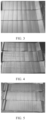
- Comparative Embodiment 1 when the ratio Gr/K of the graphitization degree Gr to K of the negative active material is less than 6 and K is greater than 0.15, the first-cycle coulombic efficiency of the lithium-ion battery is very low, the lithium plating occurs (as shown in FIG. 4 ), the cycle capacity retention rate is relatively low, and the cycle expansion rate is high.
- Comparative Embodiment 2 when the ratio Gr/K of the graphitization degree Gr to K of the negative active material is greater than 16 and K is less than 0.06, the first-cycle coulombic efficiency of the lithium-ion battery is relatively low, severe lithium plating occurs (as shown in FIG. 5 ), the cycle capacity retention rate is very low, and the cycle expansion rate is very high.
- the first-cycle coulombic efficiency and the cycle capacity retention rate of the lithium-ion battery can be significantly increased, the cycle expansion rate of lithium-ion battery can be significantly reduced, and the lithium plating of the lithium-ion battery during cycles can be significantly suppressed (as shown in FIG. 3 ).
- the significant improvement of the first-cycle coulombic efficiency indicates a significantly increased energy density of the lithium-ion battery.
- the significant increase of the cycle capacity retention rate and the significant decrease of the cycle expansion rate indicate significantly improved cycle performance of the lithium-ion battery.
- the suppression of the lithium plating helps to significantly improve the rate performance of lithium-ion battery. Therefore, the energy density, the cycle performance, and the rate performance of the lithium-ion batteries in Embodiments 1 to 36 are significantly improved.
- the size of the crystal of the carbon material in the negative active material and the degree of orientation of the negative active material satisfy the following relationship: Lc/S ⁇ 9, La/S > 20, Lc ⁇ 45, and La > 50, the first-cycle coulombic efficiency and the cycle capacity retention rate of the lithium-ion battery improved, the cycle expansion rate and/or the lithium plating of the lithium-ion battery are further suppressed, and the overall performance of the lithium-ion battery is further improved.
- the (Dv90/Dv10+Dv90) value greater than 23.0 helps to further improve the cycle capacity retention rate and suppresses the lithium plating of the lithium-ion battery and enhance the overall performance of lithium-ion battery.
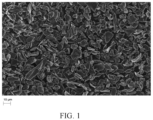
- FIG. 1 shows a scanning electron microscope (SEM) image of a negative active material used in Comparative Embodiment 2 at a magnification of 500 ⁇ .
- the negative active material in Comparative Embodiment 2 includes merely primary particles.
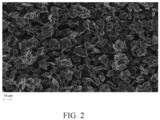
- FIG. 2 shows a scanning electron microscope (SEM) image of a negative active material used in Embodiment 5 at a magnification of 500 ⁇ .
- the negative active material in Embodiment 5 includes primary particles and secondary particles that each account for a percentage, and the graphitization degree and the K value of the carbon material can be adjusted by adjusting the percentage.
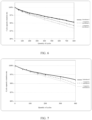
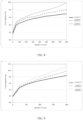
- FIG. 6 shows a curve of a cycle capacity retention rate of lithium-ion batteries disclosed in Comparative Embodiment 1, Comparative Embodiment 2, and Embodiment 5 and put through a quantity of cycles at 25 °C.
- FIG. 7 shows a curve of a cycle capacity retention rate of lithium-ion batteries disclosed in Comparative Embodiment 1, Comparative Embodiment 2, and Embodiment 5 and put through a quantity of cycles at 45 °C.
- the results show that, in contrast with Comparative Embodiments 1 and 2, the cycle capacity retention rate of the lithium-ion battery in Embodiment 5 under 25 °C and 45 °C always remains above 90%.
- FIG. 8 shows a curve of an expansion rate of lithium-ion batteries disclosed in Comparative Embodiment 1, Comparative Embodiment 2, and Embodiment 5 and put through a quantity of cycles at 25 °C.
- FIG. 9 shows a curve of an expansion rate of lithium-ion batteries disclosed in Comparative Embodiment 1, Comparative Embodiment 2, and Embodiment 5 and put through a quantity of cycles at 45 °C.
- Table 2 shows how the characteristics of the negative active material layer affects the performance of the lithium-ion battery.
- Embodiments 37 to 44 are improvements made based on Embodiment 5 shown in Table 1, and differ from Embodiment 5 only in the parameters listed in Table 2.
- the first-cycle coulombic efficiency and the cycle capacity retention rate are further improved, the cycle expansion rate and/or the lithium plating of the lithium-ion battery are further suppressed, and the overall performance of the lithium-ion battery is further enhanced when the parameters satisfy the following conditions: the areal density of the negative active material layer is 0.077 mg/mm 2 to 0.121 mg/mm 2 , the compacted density is 1.70 g/cm 3 to 1.92 g/cm 3 , S' of the lithium-ion battery in the fully discharged state is 10 to 20, the peel-off strength between the negative active material layer and the negative current collector is 6 N/m to 15 N/m, the porosity of the negative active material layer is 20% to 40%, the thermal decomposition temperature of the negative active material layer in the fully charged state is not less than 280 °C, and/or the thermal decomposition temperature of the negative active material layer in the fully discharged state is greater than or equal to 130 °C.
- the compacted density of the negative active material layer is constant, the
- references to “embodiments”, “some embodiments”, “an embodiment”, “another example”, “example”, “specific example” or “some examples” throughout the specification mean that at least one embodiment or example in this application includes specific features, structures, materials, or characteristics described in the embodiment(s) or example(s). Therefore, descriptions throughout the specification, which make references by using expressions such as “in some embodiments”, “in an embodiment”, “in one embodiment”, “in another example”, “in an example”, “in a specific example”, or “example”, do not necessarily refer to the same embodiment(s) or example(s) in this application. In addition, specific features, structures, materials, or characteristics herein may be combined in one or more embodiments or examples in any appropriate manner.
Landscapes
- Chemical & Material Sciences (AREA)
- Engineering & Computer Science (AREA)
- Organic Chemistry (AREA)
- Inorganic Chemistry (AREA)
- General Chemical & Material Sciences (AREA)
- Chemical Kinetics & Catalysis (AREA)
- Electrochemistry (AREA)
- Materials Engineering (AREA)
- Power Engineering (AREA)
- Life Sciences & Earth Sciences (AREA)
- General Life Sciences & Earth Sciences (AREA)
- Geology (AREA)
- Manufacturing & Machinery (AREA)
- Microelectronics & Electronic Packaging (AREA)
- Nanotechnology (AREA)
- Composite Materials (AREA)
- Condensed Matter Physics & Semiconductors (AREA)
- General Physics & Mathematics (AREA)
- Crystallography & Structural Chemistry (AREA)
- Physics & Mathematics (AREA)
- Battery Electrode And Active Subsutance (AREA)
- Secondary Cells (AREA)
- Primary Cells (AREA)
Priority Applications (1)
| Application Number | Priority Date | Filing Date | Title |
|---|---|---|---|
| EP24167529.7A EP4439731A1 (en) | 2020-06-04 | 2020-06-04 | Negative electrode active material, and electrochemical device and electronic device using negative electrode active material |
Applications Claiming Priority (3)
| Application Number | Priority Date | Filing Date | Title |
|---|---|---|---|
| EP20938521.0A EP3968416B1 (en) | 2020-06-04 | 2020-06-04 | Negative electrode active material, and electrochemical device and electronic device using negative electrode active material |
| EP24167529.7A EP4439731A1 (en) | 2020-06-04 | 2020-06-04 | Negative electrode active material, and electrochemical device and electronic device using negative electrode active material |
| PCT/CN2020/094385 WO2021243648A1 (zh) | 2020-06-04 | 2020-06-04 | 负极活性材料及使用其的电化学装置和电子装置 |
Related Parent Applications (2)
| Application Number | Title | Priority Date | Filing Date |
|---|---|---|---|
| EP20938521.0A Division-Into EP3968416B1 (en) | 2020-06-04 | 2020-06-04 | Negative electrode active material, and electrochemical device and electronic device using negative electrode active material |
| EP20938521.0A Division EP3968416B1 (en) | 2020-06-04 | 2020-06-04 | Negative electrode active material, and electrochemical device and electronic device using negative electrode active material |
Publications (1)
| Publication Number | Publication Date |
|---|---|
| EP4439731A1 true EP4439731A1 (en) | 2024-10-02 |
Family
ID=74301716
Family Applications (2)
| Application Number | Title | Priority Date | Filing Date |
|---|---|---|---|
| EP20938521.0A Active EP3968416B1 (en) | 2020-06-04 | 2020-06-04 | Negative electrode active material, and electrochemical device and electronic device using negative electrode active material |
| EP24167529.7A Pending EP4439731A1 (en) | 2020-06-04 | 2020-06-04 | Negative electrode active material, and electrochemical device and electronic device using negative electrode active material |
Family Applications Before (1)
| Application Number | Title | Priority Date | Filing Date |
|---|---|---|---|
| EP20938521.0A Active EP3968416B1 (en) | 2020-06-04 | 2020-06-04 | Negative electrode active material, and electrochemical device and electronic device using negative electrode active material |
Country Status (11)
| Country | Link |
|---|---|
| US (3) | US11967718B2 (pl) |
| EP (2) | EP3968416B1 (pl) |
| JP (2) | JP7250908B2 (pl) |
| KR (1) | KR102865592B1 (pl) |
| CN (2) | CN112335080B (pl) |
| DK (1) | DK3968416T3 (pl) |
| ES (1) | ES2981190T3 (pl) |
| FI (1) | FI3968416T3 (pl) |
| HU (1) | HUE067284T2 (pl) |
| PL (1) | PL3968416T3 (pl) |
| WO (1) | WO2021243648A1 (pl) |
Families Citing this family (9)
| Publication number | Priority date | Publication date | Assignee | Title |
|---|---|---|---|---|
| FI3968416T3 (fi) * | 2020-06-04 | 2024-06-13 | Ningde Amperex Technology Ltd | Negatiivinen elektrodi aktiivinen materiaali, ja sähkökemiallinen laite, ja elektroninen laite, joka käyttää negatiivista elektrodi aktiivista materiaalia |
| CN113086978B (zh) * | 2021-03-30 | 2023-08-15 | 宁德新能源科技有限公司 | 负极材料及包含其的电化学装置和电子设备 |
| KR20240047387A (ko) * | 2021-08-04 | 2024-04-12 | 에스지엘 카본 에스이 | 애노드 물질 |
| EP4184650A4 (en) * | 2021-09-30 | 2024-09-25 | Contemporary Amperex Technology Co., Limited | SECONDARY BATTERY, BATTERY MODULE COMPRISING SAME, BATTERY PACK AND ELECTRICAL DEVICE |
| JP7593966B2 (ja) * | 2022-05-31 | 2024-12-03 | トヨタ自動車株式会社 | リチウムイオン二次電池 |
| CN115312863A (zh) * | 2022-08-25 | 2022-11-08 | 珠海冠宇电池股份有限公司 | 电池电解液、电池电解液的配置方法及电池 |
| CN116598426A (zh) * | 2023-05-05 | 2023-08-15 | 宁德新能源科技有限公司 | 电化学装置和电子装置 |
| CN116314612B (zh) * | 2023-05-11 | 2023-08-18 | 中创新航科技集团股份有限公司 | 一种负极极片及其应用 |
| CN118572192A (zh) * | 2023-12-19 | 2024-08-30 | 宁德新能源科技有限公司 | 二次电池和包括该二次电池的电子设备 |
Citations (1)
| Publication number | Priority date | Publication date | Assignee | Title |
|---|---|---|---|---|
| CN109553085A (zh) * | 2018-10-10 | 2019-04-02 | 湖南晋烨高科股份有限公司 | 锂离子电池负极活性材料、锂离子电池负极、锂离子电池、电池组及电池动力车 |
Family Cites Families (25)
| Publication number | Priority date | Publication date | Assignee | Title |
|---|---|---|---|---|
| EP1361194B1 (en) | 2001-01-25 | 2014-06-25 | Hitachi Chemical Company, Ltd. | Artificial graphite particle and method for producing the same, nonaqueous electrolyte secondary battery negative electrode and method for producing the same, and lithium secondary battery |
| JP2009043641A (ja) * | 2007-08-10 | 2009-02-26 | Sanyo Electric Co Ltd | 非水電解質電池及びこの電池に用いられる負極 |
| JP5262119B2 (ja) | 2008-01-10 | 2013-08-14 | ソニー株式会社 | 負極および電池 |
| CN102362381B (zh) | 2009-03-27 | 2015-06-03 | 三菱化学株式会社 | 非水电解质二次电池用负极材料以及使用该负极材料的非水电解质二次电池 |
| US9437344B2 (en) * | 2010-07-22 | 2016-09-06 | Nanotek Instruments, Inc. | Graphite or carbon particulates for the lithium ion battery anode |
| TWI620372B (zh) * | 2010-07-30 | 2018-04-01 | 日立化成股份有限公司 | 鋰離子蓄電池用負極材料,鋰離子蓄電池用負極及鋰離子蓄電池 |
| KR102055822B1 (ko) | 2012-04-05 | 2019-12-13 | 이머리스 그래파이트 앤드 카본 스위춰랜드 리미티드 | 표면―개질된 낮은 표면적 흑연, 그의 제조방법 및 그의 응용 |
| JP5461746B1 (ja) | 2012-06-29 | 2014-04-02 | 昭和電工株式会社 | 炭素材料、電池電極用炭素材料、及び電池 |
| KR20150031288A (ko) * | 2012-07-24 | 2015-03-23 | 도요타 지도샤(주) | 전고체 전지 |
| CN104521038B (zh) * | 2012-08-06 | 2017-08-22 | 昭和电工株式会社 | 锂离子二次电池用负极材料 |
| JP5994571B2 (ja) * | 2012-10-30 | 2016-09-21 | 日立化成株式会社 | リチウムイオン二次電池用負極材及びリチウムイオン二次電池 |
| CN103078089B (zh) * | 2012-12-03 | 2015-06-03 | 湖州创亚动力电池材料有限公司 | 一种高容量锂离子电池用复合石墨负极材料及其制备方法 |
| JPWO2014092141A1 (ja) | 2012-12-13 | 2017-01-12 | 昭和電工株式会社 | リチウムイオン二次電池用負極材、リチウムイオン二次電池用負極シート及びリチウム二次電池 |
| KR102209653B1 (ko) * | 2016-09-09 | 2021-01-28 | 주식회사 엘지화학 | 스웰링 현상이 개선된 음극 및 이를 포함하는 리튬이차전지 |
| KR102484406B1 (ko) * | 2016-11-01 | 2023-01-02 | 삼성에스디아이 주식회사 | 리튬 이차 전지용 음극 및 이를 포함하는 리튬 이차 전지 |
| KR102165885B1 (ko) * | 2017-11-28 | 2020-10-14 | 주식회사 엘지화학 | 음극 활물질, 이를 포함하는 음극 및 리튬 이차전지 |
| CN108847489B (zh) * | 2018-05-04 | 2019-04-09 | 宁德时代新能源科技股份有限公司 | 负极极片及电池 |
| CN108808072A (zh) * | 2018-06-29 | 2018-11-13 | 宁德时代新能源科技股份有限公司 | 锂离子电池 |
| CN108832075B (zh) * | 2018-06-29 | 2019-03-19 | 宁德时代新能源科技股份有限公司 | 锂离子电池 |
| CN109553080B (zh) * | 2018-10-10 | 2020-05-01 | 湖南晋烨高科股份有限公司 | 锂离子电池负极活性材料、锂离子电池负极、锂离子电池、电池组及电池动力车 |
| CN109616614B (zh) * | 2018-12-14 | 2020-12-11 | 宁德新能源科技有限公司 | 负极极片和使用其的电化学装置和电子装置 |
| KR102347000B1 (ko) | 2019-01-03 | 2022-01-05 | 주식회사 엘지에너지솔루션 | 이차전지용 음극 활물질, 이를 포함하는 전극 및 이의 제조방법 |
| CN109541831B (zh) * | 2019-01-30 | 2023-04-21 | 京东方科技集团股份有限公司 | 防窥结构及调节方法、显示面板、显示装置 |
| CN112563491B (zh) * | 2019-03-21 | 2023-10-24 | 宁德新能源科技有限公司 | 负极材料及包含该负极材料的负极及电化学装置 |
| FI3968416T3 (fi) * | 2020-06-04 | 2024-06-13 | Ningde Amperex Technology Ltd | Negatiivinen elektrodi aktiivinen materiaali, ja sähkökemiallinen laite, ja elektroninen laite, joka käyttää negatiivista elektrodi aktiivista materiaalia |
-
2020
- 2020-06-04 FI FIEP20938521.0T patent/FI3968416T3/fi active
- 2020-06-04 CN CN202080003323.XA patent/CN112335080B/zh active Active
- 2020-06-04 CN CN202210287385.9A patent/CN114628625B/zh active Active
- 2020-06-04 DK DK20938521.0T patent/DK3968416T3/da active
- 2020-06-04 KR KR1020227042981A patent/KR102865592B1/ko active Active
- 2020-06-04 EP EP20938521.0A patent/EP3968416B1/en active Active
- 2020-06-04 ES ES20938521T patent/ES2981190T3/es active Active
- 2020-06-04 EP EP24167529.7A patent/EP4439731A1/en active Pending
- 2020-06-04 WO PCT/CN2020/094385 patent/WO2021243648A1/zh not_active Ceased
- 2020-06-04 PL PL20938521.0T patent/PL3968416T3/pl unknown
- 2020-06-04 JP JP2021512516A patent/JP7250908B2/ja active Active
- 2020-06-04 HU HUE20938521A patent/HUE067284T2/hu unknown
-
2022
- 2022-12-02 US US18/073,884 patent/US11967718B2/en active Active
-
2023
- 2023-02-23 US US18/173,295 patent/US11936045B2/en active Active
- 2023-03-22 JP JP2023045559A patent/JP7627297B2/ja active Active
-
2024
- 2024-03-11 US US18/601,234 patent/US20240213474A1/en active Pending
Patent Citations (1)
| Publication number | Priority date | Publication date | Assignee | Title |
|---|---|---|---|---|
| CN109553085A (zh) * | 2018-10-10 | 2019-04-02 | 湖南晋烨高科股份有限公司 | 锂离子电池负极活性材料、锂离子电池负极、锂离子电池、电池组及电池动力车 |
Non-Patent Citations (1)
| Title |
|---|
| DETERMINATION OF APPARENT DENSITY, TRUE DENSITY AND POROSITY |
Also Published As
| Publication number | Publication date |
|---|---|
| PL3968416T3 (pl) | 2024-09-23 |
| CN112335080A (zh) | 2021-02-05 |
| JP7250908B2 (ja) | 2023-04-03 |
| KR102865592B1 (ko) | 2025-09-30 |
| US11967718B2 (en) | 2024-04-23 |
| JP7627297B2 (ja) | 2025-02-05 |
| EP3968416A4 (en) | 2022-11-02 |
| CN112335080B (zh) | 2022-03-18 |
| ES2981190T3 (es) | 2024-10-07 |
| EP3968416B1 (en) | 2024-05-15 |
| CN114628625B (zh) | 2024-12-13 |
| JP2023068117A (ja) | 2023-05-16 |
| CN114628625A (zh) | 2022-06-14 |
| FI3968416T3 (fi) | 2024-06-13 |
| KR20230003290A (ko) | 2023-01-05 |
| US20230197958A1 (en) | 2023-06-22 |
| WO2021243648A1 (zh) | 2021-12-09 |
| EP3968416A1 (en) | 2022-03-16 |
| DK3968416T3 (da) | 2024-06-10 |
| JP2022539930A (ja) | 2022-09-14 |
| US20240213474A1 (en) | 2024-06-27 |
| US20230100932A1 (en) | 2023-03-30 |
| HUE067284T2 (hu) | 2024-10-28 |
| US11936045B2 (en) | 2024-03-19 |
Similar Documents
| Publication | Publication Date | Title |
|---|---|---|
| US11967718B2 (en) | Negative active material, electrochemical device that uses same, and electronic device | |
| EP4123760A1 (en) | Negative electrode active material, electrochemical device using same, and electronic apparatus | |
| CN114420998A (zh) | 一种电化学装置和电子装置 | |
| US12456730B2 (en) | Negative electrode active material and electrochemical device and electronic device using the same | |
| US20230052908A1 (en) | Negative electrode active material, and electrochemical apparatus and electronic apparatus using the same | |
| KR102668203B1 (ko) | 음극 및 이를 포함하는 전기화학장치와 전자장치 | |
| US20230049766A1 (en) | Negative electrode active material, and electrochemical apparatus and electronic apparatus using the same | |
| CN114171739B (zh) | 电化学装置和电子装置 | |
| US20230223538A1 (en) | Negative active material, electrochemical device that uses same, and electronic device | |
| US20240162434A1 (en) | Electrochemical apparatus and electric device including same | |
| EP4270532A1 (en) | Negative electrode pole piece, electrochemical device comprising same, and electronic device | |
| EP4485564A1 (en) | Negative electrode and electrochemical apparatus and electronic apparatus using same |
Legal Events
| Date | Code | Title | Description |
|---|---|---|---|
| PUAI | Public reference made under article 153(3) epc to a published international application that has entered the european phase |
Free format text: ORIGINAL CODE: 0009012 |
|
| STAA | Information on the status of an ep patent application or granted ep patent |
Free format text: STATUS: THE APPLICATION HAS BEEN PUBLISHED |
|
| AC | Divisional application: reference to earlier application |
Ref document number: 3968416 Country of ref document: EP Kind code of ref document: P |
|
| AK | Designated contracting states |
Kind code of ref document: A1 Designated state(s): AL AT BE BG CH CY CZ DE DK EE ES FI FR GB GR HR HU IE IS IT LI LT LU LV MC MK MT NL NO PL PT RO RS SE SI SK SM TR |
|
| STAA | Information on the status of an ep patent application or granted ep patent |
Free format text: STATUS: REQUEST FOR EXAMINATION WAS MADE |
|
| 17P | Request for examination filed |
Effective date: 20250401 |