EP4411028A1 - Verfahren zur herstellung eines mehrschichtigen beta-ga2o3/beta-ga2o3-körpers - Google Patents
Verfahren zur herstellung eines mehrschichtigen beta-ga2o3/beta-ga2o3-körpers Download PDFInfo
- Publication number
- EP4411028A1 EP4411028A1 EP22887161.2A EP22887161A EP4411028A1 EP 4411028 A1 EP4411028 A1 EP 4411028A1 EP 22887161 A EP22887161 A EP 22887161A EP 4411028 A1 EP4411028 A1 EP 4411028A1
- Authority
- EP
- European Patent Office
- Prior art keywords
- mol
- sub
- pbo
- multilayer body
- growth
- Prior art date
- Legal status (The legal status is an assumption and is not a legal conclusion. Google has not performed a legal analysis and makes no representation as to the accuracy of the status listed.)
- Granted
Links
Images
Classifications
-
- C—CHEMISTRY; METALLURGY
- C30—CRYSTAL GROWTH
- C30B—SINGLE-CRYSTAL GROWTH; UNIDIRECTIONAL SOLIDIFICATION OF EUTECTIC MATERIAL OR UNIDIRECTIONAL DEMIXING OF EUTECTOID MATERIAL; REFINING BY ZONE-MELTING OF MATERIAL; PRODUCTION OF A HOMOGENEOUS POLYCRYSTALLINE MATERIAL WITH DEFINED STRUCTURE; SINGLE CRYSTALS OR HOMOGENEOUS POLYCRYSTALLINE MATERIAL WITH DEFINED STRUCTURE; AFTER-TREATMENT OF SINGLE CRYSTALS OR A HOMOGENEOUS POLYCRYSTALLINE MATERIAL WITH DEFINED STRUCTURE; APPARATUS THEREFOR
- C30B29/00—Single crystals or homogeneous polycrystalline material with defined structure characterised by the material or by their shape
- C30B29/10—Inorganic compounds or compositions
- C30B29/16—Oxides
-
- C—CHEMISTRY; METALLURGY
- C30—CRYSTAL GROWTH
- C30B—SINGLE-CRYSTAL GROWTH; UNIDIRECTIONAL SOLIDIFICATION OF EUTECTIC MATERIAL OR UNIDIRECTIONAL DEMIXING OF EUTECTOID MATERIAL; REFINING BY ZONE-MELTING OF MATERIAL; PRODUCTION OF A HOMOGENEOUS POLYCRYSTALLINE MATERIAL WITH DEFINED STRUCTURE; SINGLE CRYSTALS OR HOMOGENEOUS POLYCRYSTALLINE MATERIAL WITH DEFINED STRUCTURE; AFTER-TREATMENT OF SINGLE CRYSTALS OR A HOMOGENEOUS POLYCRYSTALLINE MATERIAL WITH DEFINED STRUCTURE; APPARATUS THEREFOR
- C30B19/00—Liquid-phase epitaxial-layer growth
- C30B19/12—Liquid-phase epitaxial-layer growth characterised by the substrate
-
- C—CHEMISTRY; METALLURGY
- C30—CRYSTAL GROWTH
- C30B—SINGLE-CRYSTAL GROWTH; UNIDIRECTIONAL SOLIDIFICATION OF EUTECTIC MATERIAL OR UNIDIRECTIONAL DEMIXING OF EUTECTOID MATERIAL; REFINING BY ZONE-MELTING OF MATERIAL; PRODUCTION OF A HOMOGENEOUS POLYCRYSTALLINE MATERIAL WITH DEFINED STRUCTURE; SINGLE CRYSTALS OR HOMOGENEOUS POLYCRYSTALLINE MATERIAL WITH DEFINED STRUCTURE; AFTER-TREATMENT OF SINGLE CRYSTALS OR A HOMOGENEOUS POLYCRYSTALLINE MATERIAL WITH DEFINED STRUCTURE; APPARATUS THEREFOR
- C30B19/00—Liquid-phase epitaxial-layer growth
- C30B19/02—Liquid-phase epitaxial-layer growth using molten solvents, e.g. flux
-
- H—ELECTRICITY
- H10—SEMICONDUCTOR DEVICES; ELECTRIC SOLID-STATE DEVICES NOT OTHERWISE PROVIDED FOR
- H10P—GENERIC PROCESSES OR APPARATUS FOR THE MANUFACTURE OR TREATMENT OF DEVICES COVERED BY CLASS H10
- H10P14/00—Formation of materials, e.g. in the shape of layers or pillars
- H10P14/20—Formation of materials, e.g. in the shape of layers or pillars of semiconductor materials
- H10P14/26—Formation of materials, e.g. in the shape of layers or pillars of semiconductor materials using liquid deposition
- H10P14/263—Formation of materials, e.g. in the shape of layers or pillars of semiconductor materials using liquid deposition using melted materials
-
- H—ELECTRICITY
- H10—SEMICONDUCTOR DEVICES; ELECTRIC SOLID-STATE DEVICES NOT OTHERWISE PROVIDED FOR
- H10P—GENERIC PROCESSES OR APPARATUS FOR THE MANUFACTURE OR TREATMENT OF DEVICES COVERED BY CLASS H10
- H10P14/00—Formation of materials, e.g. in the shape of layers or pillars
- H10P14/20—Formation of materials, e.g. in the shape of layers or pillars of semiconductor materials
- H10P14/26—Formation of materials, e.g. in the shape of layers or pillars of semiconductor materials using liquid deposition
- H10P14/265—Formation of materials, e.g. in the shape of layers or pillars of semiconductor materials using liquid deposition using solutions
-
- H—ELECTRICITY
- H10—SEMICONDUCTOR DEVICES; ELECTRIC SOLID-STATE DEVICES NOT OTHERWISE PROVIDED FOR
- H10P—GENERIC PROCESSES OR APPARATUS FOR THE MANUFACTURE OR TREATMENT OF DEVICES COVERED BY CLASS H10
- H10P14/00—Formation of materials, e.g. in the shape of layers or pillars
- H10P14/20—Formation of materials, e.g. in the shape of layers or pillars of semiconductor materials
- H10P14/29—Formation of materials, e.g. in the shape of layers or pillars of semiconductor materials characterised by the substrates
- H10P14/2901—Materials
- H10P14/2918—Materials being semiconductor metal oxides
-
- H—ELECTRICITY
- H10—SEMICONDUCTOR DEVICES; ELECTRIC SOLID-STATE DEVICES NOT OTHERWISE PROVIDED FOR
- H10P—GENERIC PROCESSES OR APPARATUS FOR THE MANUFACTURE OR TREATMENT OF DEVICES COVERED BY CLASS H10
- H10P14/00—Formation of materials, e.g. in the shape of layers or pillars
- H10P14/20—Formation of materials, e.g. in the shape of layers or pillars of semiconductor materials
- H10P14/34—Deposited materials, e.g. layers
- H10P14/3402—Deposited materials, e.g. layers characterised by the chemical composition
- H10P14/3434—Deposited materials, e.g. layers characterised by the chemical composition being oxide semiconductor materials
-
- H—ELECTRICITY
- H10—SEMICONDUCTOR DEVICES; ELECTRIC SOLID-STATE DEVICES NOT OTHERWISE PROVIDED FOR
- H10P—GENERIC PROCESSES OR APPARATUS FOR THE MANUFACTURE OR TREATMENT OF DEVICES COVERED BY CLASS H10
- H10P14/00—Formation of materials, e.g. in the shape of layers or pillars
- H10P14/20—Formation of materials, e.g. in the shape of layers or pillars of semiconductor materials
- H10P14/34—Deposited materials, e.g. layers
- H10P14/3438—Doping during depositing
- H10P14/3441—Conductivity type
- H10P14/3442—N-type
-
- H—ELECTRICITY
- H10—SEMICONDUCTOR DEVICES; ELECTRIC SOLID-STATE DEVICES NOT OTHERWISE PROVIDED FOR
- H10P—GENERIC PROCESSES OR APPARATUS FOR THE MANUFACTURE OR TREATMENT OF DEVICES COVERED BY CLASS H10
- H10P14/00—Formation of materials, e.g. in the shape of layers or pillars
- H10P14/20—Formation of materials, e.g. in the shape of layers or pillars of semiconductor materials
- H10P14/34—Deposited materials, e.g. layers
- H10P14/3438—Doping during depositing
- H10P14/3441—Conductivity type
- H10P14/3444—P-type
-
- H—ELECTRICITY
- H10—SEMICONDUCTOR DEVICES; ELECTRIC SOLID-STATE DEVICES NOT OTHERWISE PROVIDED FOR
- H10P—GENERIC PROCESSES OR APPARATUS FOR THE MANUFACTURE OR TREATMENT OF DEVICES COVERED BY CLASS H10
- H10P14/00—Formation of materials, e.g. in the shape of layers or pillars
- H10P14/20—Formation of materials, e.g. in the shape of layers or pillars of semiconductor materials
- H10P14/34—Deposited materials, e.g. layers
- H10P14/3438—Doping during depositing
- H10P14/3441—Conductivity type
- H10P14/3446—Transition metal elements; Rare earth elements
-
- H—ELECTRICITY
- H10—SEMICONDUCTOR DEVICES; ELECTRIC SOLID-STATE DEVICES NOT OTHERWISE PROVIDED FOR
- H10P—GENERIC PROCESSES OR APPARATUS FOR THE MANUFACTURE OR TREATMENT OF DEVICES COVERED BY CLASS H10
- H10P14/00—Formation of materials, e.g. in the shape of layers or pillars
- H10P14/60—Formation of materials, e.g. in the shape of layers or pillars of insulating materials
- H10P14/63—Formation of materials, e.g. in the shape of layers or pillars of insulating materials characterised by the formation processes
- H10P14/6302—Non-deposition formation processes
-
- H—ELECTRICITY
- H10—SEMICONDUCTOR DEVICES; ELECTRIC SOLID-STATE DEVICES NOT OTHERWISE PROVIDED FOR
- H10P—GENERIC PROCESSES OR APPARATUS FOR THE MANUFACTURE OR TREATMENT OF DEVICES COVERED BY CLASS H10
- H10P14/00—Formation of materials, e.g. in the shape of layers or pillars
- H10P14/60—Formation of materials, e.g. in the shape of layers or pillars of insulating materials
- H10P14/69—Inorganic materials
- H10P14/692—Inorganic materials composed of oxides, glassy oxides or oxide-based glasses
- H10P14/6938—Inorganic materials composed of oxides, glassy oxides or oxide-based glasses the material containing at least one metal element, e.g. metal oxides, metal oxynitrides or metal oxycarbides
- H10P14/6939—Inorganic materials composed of oxides, glassy oxides or oxide-based glasses the material containing at least one metal element, e.g. metal oxides, metal oxynitrides or metal oxycarbides characterised by the metal
-
- H—ELECTRICITY
- H10—SEMICONDUCTOR DEVICES; ELECTRIC SOLID-STATE DEVICES NOT OTHERWISE PROVIDED FOR
- H10P—GENERIC PROCESSES OR APPARATUS FOR THE MANUFACTURE OR TREATMENT OF DEVICES COVERED BY CLASS H10
- H10P14/00—Formation of materials, e.g. in the shape of layers or pillars
- H10P14/20—Formation of materials, e.g. in the shape of layers or pillars of semiconductor materials
- H10P14/32—Formation of materials, e.g. in the shape of layers or pillars of semiconductor materials characterised by intermediate layers between substrates and deposited layers
- H10P14/3202—Materials thereof
- H10P14/3234—Materials thereof being oxide semiconducting materials
-
- Y—GENERAL TAGGING OF NEW TECHNOLOGICAL DEVELOPMENTS; GENERAL TAGGING OF CROSS-SECTIONAL TECHNOLOGIES SPANNING OVER SEVERAL SECTIONS OF THE IPC; TECHNICAL SUBJECTS COVERED BY FORMER USPC CROSS-REFERENCE ART COLLECTIONS [XRACs] AND DIGESTS
- Y02—TECHNOLOGIES OR APPLICATIONS FOR MITIGATION OR ADAPTATION AGAINST CLIMATE CHANGE
- Y02P—CLIMATE CHANGE MITIGATION TECHNOLOGIES IN THE PRODUCTION OR PROCESSING OF GOODS
- Y02P70/00—Climate change mitigation technologies in the production process for final industrial or consumer products
- Y02P70/50—Manufacturing or production processes characterised by the final manufactured product
Definitions
- the present invention relates to a method for producing a ⁇ -Ga 2 O 3 / ⁇ -Ga 2 O 3 multilayer body and a multilayer body obtained by said method.
- Power devices are one of the key devices for improving power usage efficiency to realize a low-carbon society, and are mainly used as elements to configure inverters that convert DC-AC power and adjust AC voltage and frequency.
- energy loss due to the resistance when current flows through the element and generation of wasted current due to the recovery process of charge distribution in the element, which occurs at the moment when the voltage applied to the element is switched, are inevitable.
- These loss percentages vary with power and frequency, but generally range from a few percent to about a dozen percent.
- Element structures of conventional Si-based power semiconductors have been devised but further improvement of efficiency is becoming difficult because Si is approaching its physical property limit. Therefore, SiC and GaN are being developed as alternative power device materials to Si.
- SiC and GaN have band gaps of 3.3 eV and 3.4 eV, respectively, and they are materials having wider band gaps than the band gap of Si (i.e., 1.1 eV).
- the wider the band gap of a material the higher the breakdown voltage, which represents the electric field at the boundary where charge is prevented from flowing into the semiconductor (avalanche breakdown), and thus the material can provide a device structure that can withstand higher voltages.
- ⁇ -Ga 2 O 3 is a kind of oxide semiconductor that has been adopted to transparent conductive substrates for GaN-based LEDs, solar-blind UV detectors, etc. Recently, it has attracted attention as a material for power devices and is expected to realize high-voltage and high-efficiency power semiconductors that surpass SiC and GaN. This is due to the fact that the band gap of ⁇ -Ga 2 O 3 is expected to be 4.5-4.9 eV, which is wider than those of SiC and GaN.
- Another advantage of ⁇ -Ga 2 O 3 over SiC and GaN is that it allows growing a crystal from a melt. SiC and GaN have difficulty in growing a crystal from a melt, and have an issue that their substrates are expensive.
- ⁇ -Ga 2 O 3 has a melting point at normal pressure, allows bulk crystal growth, and its study and development are progressing through the EFG (Edge-Defined Film-fed Growth) method and the vertical Bridgman method.
- the former growth method has provided commercially available 2- to 4-inch substrates, and the latter is used for the development of 4-inch substrates.
- a ⁇ -Ga 2 O 3 (epitaxial layer)/-Ga 2 O 3 (substrate) multilayer body consisting of two layers of ⁇ -Ga 2 O 3 with different residual electron densities is required.
- the thickness of the epitaxial layer needs to be around several ⁇ m to 20 ⁇ m, and vapor-phase growth methods such as metal organic chemical vapor deposition (MOCVD), molecular beam epitaxy (MBE), mist CVD, and halide vapor-phase epitaxy (HVPE) have traditionally been used.
- MOCVD metal organic chemical vapor deposition
- MBE molecular beam epitaxy
- HVPE halide vapor-phase epitaxy
- the vapor-phase growth method is a non-thermodynamic growth method and has the disadvantages of poor crystal quality and slow growth rate.
- Non-patent literature 1 discloses a method of epitaxial growth of ⁇ -Ga 2 O 3 on a sapphire substrate by the HVPE method. According to this method, the sapphire substrate and ⁇ -Ga 2 O 3 have different crystal structures, resulting in multiple rotational domains and an epitaxial layer that is not composed of a single domain. This layer is not strictly a single crystal and cannot be used for power devices.
- the full width at half maximum of the X-ray rocking curve of the epitaxial layer obtained by the same method is as high as 0.5 deg (1,800 arcsec), indicating low crystallinity.
- Patent literature 1 also discloses a method of epitaxial growth of ⁇ -Ga 2 O 3 on a ⁇ -Ga 2 O 3 substrate by the HVPE method to obtain a ⁇ -Ga 2 O 3 / ⁇ -Ga 2 O 3 multilayer body (hereinafter simply referred to as a " ⁇ -Ga 2 O 3 multilayer body").
- a ⁇ -Ga 2 O 3 / ⁇ -Ga 2 O 3 multilayer body can be obtained by this method, the growth rate of the epitaxial layer is as low as 2.7-6.0 ⁇ m/hr.
- the liquid-phase growth method has the advantage of producing a high-quality crystal more easily than the vapor-phase growth method because crystal growth proceeds in principle in thermal equilibrium.
- the melting point of ⁇ -Ga 2 O 3 is as high as 1970°C, and it is difficult to maintain a stable melt surface near the melting point, making it difficult to grow ⁇ -Ga 2 O 3 by the Czochralski method, which is employed for single-crystal silicon and the like. Therefore, a single crystal is grown by the above-mentioned EFG method or vertical Bridgman method. However, a ⁇ -Ga 2 O 3 multilayer body cannot be obtained by the EFG or the vertical Bridgman method.
- Examples of a method in which a target substance is dissolved in a suitable solvent, the temperature of the mixed solution is lowered to a supersaturated state, and the target substance is grown from the melt include the static slow-cooling method, the flux method, the floating zone method, the top seeded solution growth (TSSG) method, the solution pulling method, and the liquid-phase epitaxy (LPE) method.
- Patent literature 2 discloses a method for obtaining a ⁇ -Ga 2 O 3 epitaxial layer by the LPE method. According to this method, a ⁇ -Ga 2 O 3 single-crystal layer is stacked on a sapphire substrate by the LPE method, and a ⁇ -Ga 2 O 3 multilayer body cannot be obtained because the substrate is made of sapphire. Moreover, the crystal structure of the sapphire substrate is corundum, while the crystal structure of ⁇ -Ga 2 O 3 is monoclinic, and so they have different crystal structures. In addition, there is a problem of poor crystal quality due to inconsistent lattice constants.
- a solvent capable of dissolving ⁇ -Ga 2 O 3 is required.
- PbO and PbF 2 are exemplified as solvents, and either one of them is used.
- the melt is maintained at 1100°C.
- the melting points of PbO and PbF 2 are about 886°C and 824°C, respectively.
- Non-patent literature 1 Journal of the Japanese Association for Crystal Growth, Vol. 42, No. 2, (2015), pp. 141-147
- the present invention has an objective of solving at least one of the above-described conventional problems. Further, the present invention has an objective of providing a method for producing a ⁇ -Ga 2 O 3 / ⁇ -Ga 2 O 3 multilayer body by stacking a ⁇ -Ga 2 O 3 single crystal having high crystallinity and fast growth rate on a ⁇ -Ga 2 O3 substrate by a liquid-phase epitaxial growth method.
- a ⁇ -Ga 2 O 3 / ⁇ -Ga 2 O 3 multilayer body refers to a multilayer body in which an epitaxial layer containing ⁇ -Ga 2 O 3 is stacked on a substrate containing ⁇ -Ga 2 O 3 .
- the present invention is as follows.
- evaporation of the solvent is suppressed, and stable crystal growth with minimal composition fluctuation can be achieved. Moreover, the consumption of furnace materials is reduced, and it is not necessary for the growth furnace to be a closed system, thereby enabling manufacturing at a lower cost.
- the liquid-phase growth method is used as the crystal growth method, a ⁇ -Ga 2 O 3 single-crystal layer can be grown with high crystallinity at a high growth rate.
- the ⁇ -Ga 2 O 3 multilayer body produced by this embodiment can be used for power devices using ⁇ -Ga 2 O 3 multilayer bodies that are expected to be developed in the future.
- a first embodiment of the present invention is a method for producing a ⁇ -Ga 2 O 3 / ⁇ -Ga 2 O 3 multilayer body, the method comprising mixing and melting Ga 2 O 3 as a solute and PbO and Bi 2 O 3 as solvents, then bringing a ⁇ -Ga 2 O 3 substrate into direct contact with the resulting melt, and allowing a ⁇ -Ga 2 O 3 single crystal to grow on the ⁇ -Ga 2 O 3 substrate by a liquid-phase epitaxial growth method, thereby obtaining the ⁇ -Ga 2 O 3 / ⁇ -Ga 2 O 3 multilayer body.
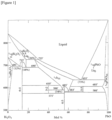
- FIG. 1 shows a phase diagram of PbO-Bi 2 O 3 (Source: Temperature/combination phase diagram of the system Bi 2 O 3 -PbO, J. Am. Chem. Soc., 64[3], 182-184, 1981 ).
- PbO and Bi 2 O 3 form a eutectic system, and they can be mixed to lower the melting point.
- the melting point of the PbO + Bi 2 O 3 mixture can be reduced to be lower than or equal to the melting point of PbO alone or Bi 2 O 3 alone. This indicates that the amount of vaporization of PbO or Bi 2 O 3 in the above PbO concentration range can be suppressed compared to that of PbO or Bi 2 O 3 alone.
- the growth rate of the layer containing a ⁇ -Ga 2 O 3 single crystal (epitaxial layer) formed by the liquid-phase epitaxial growth method is preferably 10-50 ⁇ m/hr, and more preferably 20-30 ⁇ m/hr. Growth rates lower than 10 ⁇ m/hr may result in a slow growth rate and increased cost. In addition, growth rates higher than 50 ⁇ m may result in poor crystal quality.
- the growth rate can be obtained from the difference in film thickness before and after LPE growth and the growth time.
- a second embodiment of the present invention is a method for producing a ⁇ -Ga 2 O 3 / ⁇ -Ga 2 O 3 multilayer body, the method comprising mixing and melting Ga 2 O 3 as a solute and PbO and PbF 2 as solvents, then bringing a ⁇ -Ga 2 O 3 substrate into direct contact with the resulting melt, and allowing a ⁇ -Ga 2 O 3 single crystal to grow on the ⁇ -Ga 2 O 3 substrate by a liquid-phase epitaxial growth method, thereby obtaining the ⁇ -Ga 2 O 3 / ⁇ -Ga 2 O 3 multilayer body.
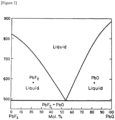
- FIG. 2 shows a phase diagram of PbO-PbF 2 (Source: C. Sandonnini Atti, Accad. Naz. Licei, C1. Sci. Fis. Mat. Nat., 23[Ser.5, Pt. 1], 962-964 (1914 )).
- PbO and PbF 2 form a eutectic system, and they can be mixed to lower the melting point.
- PbO and PbF 2 form a eutectic system, and they can be mixed to lower the melting point.
- PbO and PbF 2 form a eutectic system, and they can be mixed to lower the melting point.
- PbO and PbF 2 form a eutectic system, and they can be mixed to lower the melting point.
- the melting point of the PbO + PbF 2 mixture can be reduced to be lower than or equal to the melting point of PbO alone or PbF 2 alone. This indicates that the amount of vaporization of PbO or
- the growth rate of the layer containing a ⁇ -Ga 2 O 3 single crystal (epitaxial layer) formed by the liquid-phase epitaxial growth method is preferably 10-50 ⁇ m/hr, and more preferably 20-30 ⁇ m/hr. Growth rates lower than 10 ⁇ m/hr may result in a slow growth rate and increased cost. In addition, growth rates higher than 50 ⁇ m may result in poor crystal quality.
- the growth rate can be obtained from the difference in film thickness before and after LPE growth and the growth time.
- one or more third components can be added to the solvent to the extent that the solubility of Ga 2 O 3 and the amount of PbO + Bi 2 O 3 or PbO + PbF 2 vaporization are not significantly changed.
- the third component include B 2 O 3 , V 2 O 5 , P 2 O 5 , MoO 3 , and WO 3 .
- Bi 2 O 3 may also be added as a third component to the solvent of the second embodiment.
- the most preferred growth method for a ⁇ -Ga 2 O 3 multilayer body according to the present invention is a liquid-phase epitaxial growth method using a ⁇ -Ga 2 O 3 substrate.
- the residual electron density in the epitaxial layer needs to be controlled.
- Ga in ⁇ -Ga 2 O 3 is a trivalent oxide and generally exhibits n-type conductivity.
- the residual electron density, band gap, insulating property, etc. can be imparted by doping a foreign element into ⁇ -Ga 2 O 3 .
- doping divalent impurities MgO or ZnO into ⁇ -Ga 2 O 3 can reduce the residual electrons.
- the residual electron density can be increased by doping tetravalent impurities SiO 2 or SnO 2 .
- Fe 2 O 3 doping can provide an insulating property.
- the band gap can be increased by doping MgO or Al 2 O 3 , which has a wider band gap than ⁇ -Ga 2 O 3 , to obtain a mixed crystal.
- the band gap can be reduced by doping ZnO or CdO to obtain a mixed crystal.
- a layer containing the ⁇ -Ga 2 O 3 single crystal formed by the liquid-phase epitaxial growth method contains, one or more foreign elements selected from the group consisting of Be, Mg, Ca, Sr, Ba, Ti, Zr, Hf, Fe, Co, Ni, Cu, Zn, Cd, Al, In, Si, Ge, Sn, and Pb, preferably in the range of 0.01-20 mol%, more preferably in the range of 0.1-10 mol%. Doping amounts of foreign elements less than 0.01 mol% may result in poor properties, and doping amounts greater than 20 mol% may cause difficulties in crystal growth.
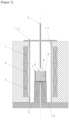
- FIG 3 shows a schematic diagram of a typical LPE growing furnace.
- a platinum crucible 7 in which raw materials are melted and stored as a melt 8 is placed on a crucible stand 9 made of mullite (a compound of aluminum oxide and silicon dioxide).
- Three-stage side heaters (upper heater 1, middle heater 2, and lower heater 3) that heat and melt the raw materials in the platinum crucible 7 are provided outside and to the side of the platinum crucible 7.
- the heater outputs are independently controlled, and the amount of heat applied to the melt 8 is independently adjusted.
- a mullite furnace core tube 11 is placed between the heaters and the inner wall of the production furnace, and a mullite furnace lid 12 is placed above the furnace core tube 11.
- a pull-up mechanism is provided above the platinum crucible 7.
- An alumina growing shaft 5 is secured to the pull-up mechanism, and a substrate holder 6 and a substrate 4 secured by the holder are provided at one end of the shaft.
- a mechanism for rotating the shaft is provided at the top of the growing shaft 5.
- a thermocouple 10 is provided at the bottom of the crucible.
- a third embodiment of the present invention is a ⁇ -Ga 2 O 3 / ⁇ -Ga 2 O 3 multilayer body having a layer containing a ⁇ -Ga 2 O 3 single crystal on a ⁇ -Ga 2 O 3 substrate, wherein the full width at half maximum of the rocking curve of the layer containing the ⁇ -Ga 2 O 3 single crystal is 5-100 arcsec.
- ⁇ -Ga 2 O 3 / ⁇ -Ga 2 O 3 multilayer body of the present invention can favorably be produced by the first and second embodiments of the present invention described above.
- the full width at half maximum of the rocking curve of the layer containing the ⁇ -Ga 2 O 3 single crystal is 5-100 arcsec, preferably 5-80 arcsec, and more preferably 5-50 arcsec.
- the full width at half maximum above 100 arcsec may result in low crystallinity and performance of the power device may be degraded.
- the ⁇ -Ga 2 O 3 / ⁇ -Ga 2 O 3 multilayer body of the present invention is characterized by its high crystallinity.
- the method described in the examples described below can be adopted as the method for measuring a full width at half maximum of a rocking curve.
- a method of depositing a ⁇ -Ga 2 O 3 epitaxial layer on a ⁇ -Ga 2 O 3 substrate will be described as a method for growing a ⁇ -Ga 2 O 3 / ⁇ -Ga 2 O 3 multilayer body according to one embodiment of the present invention.
- the present invention should not be limited in any way to the following examples.
- Three-stage side heaters (upper heater 1, middle heater 2, and lower heater 3) that heat and melt the raw materials in the platinum crucible 7 are provided outside and to the side of the platinum crucible 7.
- the heater outputs are independently controlled, and the amount of heat applied to the melt 8 is independently adjusted.
- a furnace core tube 11 is placed between the heaters and the inner wall of the production furnace, and a furnace lid 12 is placed above the furnace core tube 11.
- a pull-up mechanism is provided above the platinum crucible 7.
- An alumina growing shaft 5 is secured to the pull-up mechanism, and a substrate holder 6 and a substrate 4 ( ⁇ -Ga 2 O 3 substrate) secured by the holder are provided at one end of the shaft.
- a mechanism for rotating the shaft is provided at the top of the growing shaft 5.
- a thermocouple 10 is provided at the bottom of the crucible.
- the production furnace is heated until the raw materials are melted.
- the temperature is raised to 600-1000°C, more preferably to 700-900°C, and the raw material melt is allowed to stand for 2-3 hours to homogenize.
- a platinum plate attached to one end of the alumina shaft can be immersed in the melt to stir and homogenize the melt by rotating the shaft. It is desirable to allow a ⁇ -Ga 2 O 3 single-crystal layer to grow only directly below the substrate.
- a temperature gradient is applied to the three-stage heaters so that the temperature of the crucible bottom is a few degrees higher than that of the melt surface. After the temperature of the melt has stabilized, a seed crystal substrate is brought into contact with the melt surface.
- the temperature is kept constant, or the temperature is lowered at a rate of 0.025-5°C/hr, to allow a ⁇ -Ga 2 O 3 single-crystal layer of interest to grow on the surface of the seed crystal substrate.
- the seed crystal substrate is rotated at 5-300 rpm by the rotation of the growing shaft, and the rotation direction is reversed at regular intervals.
- the growing shaft is lifted to separate the grown crystal from the melt, and the melt attached to the surface of the grown crystal is removed by rotating the growing shaft at 50 to 300 rpm.
- the temperature is then allowed to cool to room temperature over a period of 1-24 hours to obtain the desired ⁇ -Ga 2 O 3 / ⁇ -Ga 2 O 3 multilayer body.
- a platinum crucible 7 with inner diameter of 120 mm, height of 150 mm, and thickness of 1 mm was filled with 2661.2 g of PbO (purity: 99.999%), 2777.7 g of Bi 2 O 3 (purity: 99.999%), and 561.2 g of Ga 2 O 3 (purity: 99.999%) as raw materials.
- the platinum crucible 7 fed with the raw materials was placed in a LPE furnace shown in Figure 3 , and the temperature at the bottom of the crucible was set at about 850°C to melt the raw materials. After stirring the melt using a platinum plate for 6 hours, the temperature was lowered until the temperature at the bottom of the crucible reached 750 °C, and a 11 mm x 11 mm x 650 ⁇ m thick, C-plane oriented ⁇ -Ga 2 O 3 substrate grown by the EFG method was brought into contact with it. Growth was allowed to continue for 3 hours at the same temperature while rotating the growing shaft 5 made of alumina at 60 rpm. The rotation direction was reversed every 5 minutes.
- the substrate was separated from the melt by pulling up the growing shaft 5 and the melt components were removed by rotating the growing shaft 5 at 200 rpm.
- the temperature was then allowed to cool to room temperature to obtain a ⁇ -Ga 2 O 3 / ⁇ -Ga 2 O 3 multilayer body. Melt components that could not be removed completely were removed using hydrochloric acid.
- the average thickness of the epitaxial layer was about 90 ⁇ m.
- the average growth rate was about 30 ⁇ m/hr.
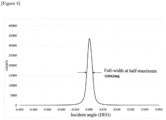
- the crystallinity of the epitaxial layer of the ⁇ -Ga 2 O 3 / ⁇ -Ga 2 O 3 multilayer body obtained in Example 1 was evaluated by the full width at half maximum of the rocking curve of the (002) plane.
- the result is shown in Figure 4 .
- the full width at half maximum of the rocking curve was measured using an X-ray diffractometer (X'pert MRD from Spectris plc).
- ⁇ -Ga 2 O 3 / ⁇ -Ga 2 O 3 multilayer bodies were obtained in the same manner as in Example 1 except that the composition of the feed was changed to give the composition shown in Table 1 below, and the temperature at which the raw materials were melted and the growth temperature were changed as shown in Table 1.
- the epitaxial layer obtained in Example 2 was a mixed layer of ⁇ -Ga 2 O 3 and MgO
- the epitaxial layer obtained in Example 5 was a mixed layer of ⁇ -Ga 2 O 3 and Al 2 O 3 .
- a ⁇ -Ga 2 O 3 / ⁇ -Ga 2 O 3 multilayer body can be produced by mixing and melting Ga 2 O 3 as a solute and PbO and Bi 2 O 3 as solvents, then bringing a ⁇ -Ga 2 O 3 substrate into direct contact with the resulting melt.
- the melting point of the solvent can be lowered by mixing PbO and Bi 2 O 3 compared to PbO or Bi 2 O 3 alone. Therefore, both the temperature at which the raw materials were melted and the growth temperature of ⁇ -Ga 2 O 3 were lower than those in the case of using a single solvent. This means that the amount of vaporization of the solvent components can be reduced.
- the present invention is a liquid-phase growth method that is close to thermal equilibrium growth. Therefore, as shown in Table 1 above, the growth rate was as fast as 13-30 ⁇ m/hr, and the full width at half maximum of the rocking curve was as narrow as 15-28 arcsec, showing high crystallinity.
- the heat applied was higher than 1000°C and the solvent volatilized at a temperature higher than 1000°C.
- a platinum crucible 7 with an inner diameter of 120 mm, a height of 150 mm, and a thickness of 1 mm was filled with 1022.3 g of PbO (purity: 99.999%), 4503.7 g of PbF 2 (99%), and 476.2 g of ⁇ -Ga 2 O 3 as raw materials.
- the platinum crucible 7 fed with the raw materials was placed in a LPE furnace shown in Figure 3 , and the temperature at the bottom of the crucible was set at about 940°C to melt the raw materials. After stirring the melt using a platinum plate for 6 hours, the temperature was lowered until the temperature at the bottom of the crucible reached 840 °C, and a 11 mm x 11 mm x 650 ⁇ m thick, C-plane oriented ⁇ -Ga 2 O 3 substrate grown by the EFG method was brought into contact with it. Growth was allowed to continue for 3 hours at the same temperature while rotating a growing shaft 5 made of alumina at 60 rpm. The shaft rotation was reversed every 5 minutes.
- the substrate was separated from the melt by pulling up the growing shaft 5 and the melt components were removed by rotating the growing shaft 5 at 200 rpm.
- the temperature was then allowed to cool to room temperature to obtain a ⁇ -Ga 2 O 3 / ⁇ -Ga 2 O 3 multilayer body. Melt components that could not be removed completely were removed using nitric acid.
- the average thickness of the epitaxial layer was about 69 ⁇ m.
- the average growth rate was about 23 ⁇ m/hr.
- ⁇ -Ga 2 O 3 / ⁇ -Ga 2 O 3 multilayer bodies were obtained in the same manner as in Example 9 except that the composition of the feed was changed to give the composition shown in Table 2 below, and the temperature at which the raw materials were melted and the growth temperature were changed as shown in Table 2.
- ⁇ -Ga 2 O 3 / ⁇ -Ga 2 O 3 multilayer bodies were obtained in the same manner as in Example 9 except that the composition of the feed was changed to give the composition shown in Table 3 below, and the temperature at which the raw materials were melted and the growth temperature were changed as shown in Table 3.
- the concentration of Ga 2 O 3 as the solute is lower than 2 mol%, the melting point becomes closer to the melting point of the solvent, and stable crystal growth may be difficult due to the viscosity of the solvent.
- a solute concentration higher than 20 mol% may result in a high growth temperature. Therefore, the concentration of Ga 2 O 3 as the solute is preferably 2-20 mol%.
- a ⁇ -Ga 2 O 3 / ⁇ -Ga 2 O 3 multilayer body can be produced by mixing and melting Ga 2 O 3 as a solute and PbO and PbF 2 as solvents, then bringing a ⁇ -Ga 2 O 3 substrate into direct contact with the resulting melt.
- the melting point of the solvent can be lowered by mixing PbO and PbF 2 compared to PbO or PbF 2 alone. Therefore, both the temperature at which the raw materials were melted and the growth temperature of ⁇ -Ga 2 O 3 were lower than those in the case of using a single solvent. This means that the amount of vaporization of the solvent components can be reduced.
- the present invention is a liquid-phase growth method that is close to thermal equilibrium growth. Therefore, as shown in Tables 2 and 3 above, the growth rate was as fast as 18-29 ⁇ m/hr, and the full width at half maximum of the rocking curve was as narrow as 35-77 arcsec, showing high crystallinity. On the other hand, in Comparative example 3, a multilayer body was not produced because the raw materials did not melt unless the heat applied was higher than 1000°C and the solvent volatilized at a temperature higher than 1000°C.
Landscapes
- Chemical & Material Sciences (AREA)
- Engineering & Computer Science (AREA)
- Crystallography & Structural Chemistry (AREA)
- Materials Engineering (AREA)
- Metallurgy (AREA)
- Organic Chemistry (AREA)
- Inorganic Chemistry (AREA)
- Crystals, And After-Treatments Of Crystals (AREA)
- Liquid Deposition Of Substances Of Which Semiconductor Devices Are Composed (AREA)
- Recrystallisation Techniques (AREA)
Applications Claiming Priority (2)
| Application Number | Priority Date | Filing Date | Title |
|---|---|---|---|
| JP2021178650 | 2021-11-01 | ||
| PCT/JP2022/040309 WO2023074836A1 (ja) | 2021-11-01 | 2022-10-28 | β-Ga2O3/β-Ga2O3積層体の製造方法 |
Publications (4)
| Publication Number | Publication Date |
|---|---|
| EP4411028A1 true EP4411028A1 (de) | 2024-08-07 |
| EP4411028A4 EP4411028A4 (de) | 2024-12-04 |
| EP4411028B1 EP4411028B1 (de) | 2026-02-25 |
| EP4411028C0 EP4411028C0 (de) | 2026-02-25 |
Family
ID=86159992
Family Applications (1)
| Application Number | Title | Priority Date | Filing Date |
|---|---|---|---|
| EP22887161.2A Active EP4411028B1 (de) | 2021-11-01 | 2022-10-28 | Verfahren zur herstellung eines mehrschichtigen beta-ga2o3/beta-ga2o3-körpers |
Country Status (7)
| Country | Link |
|---|---|
| US (1) | US20240417881A1 (de) |
| EP (1) | EP4411028B1 (de) |
| JP (2) | JP7380948B2 (de) |
| KR (1) | KR102927254B1 (de) |
| CN (1) | CN118159694A (de) |
| TW (1) | TW202328516A (de) |
| WO (1) | WO2023074836A1 (de) |
Families Citing this family (2)
| Publication number | Priority date | Publication date | Assignee | Title |
|---|---|---|---|---|
| JPWO2025177952A1 (de) * | 2024-02-22 | 2025-08-28 | ||
| CN119041012B (zh) * | 2024-10-30 | 2025-01-28 | 安徽科瑞思创晶体材料有限责任公司 | 一种利用液相外延制备稀土掺杂铁石榴石薄膜的方法 |
Family Cites Families (7)
| Publication number | Priority date | Publication date | Assignee | Title |
|---|---|---|---|---|
| JP3679097B2 (ja) * | 2002-05-31 | 2005-08-03 | 株式会社光波 | 発光素子 |
| EP1997941B1 (de) * | 2006-03-01 | 2014-12-17 | Mitsubishi Gas Chemical Company, Inc. | Verfahren zur herstellung von zno-einkristall nach der methode des flüssigphasenwachstums |
| JP2010280533A (ja) * | 2009-06-04 | 2010-12-16 | Mitsubishi Gas Chemical Co Inc | 液相エピタキシャル成長法による励起子発光型ZnOシンチレータの製造方法 |
| JP5794955B2 (ja) * | 2012-07-11 | 2015-10-14 | 信越化学工業株式会社 | β−Ga2O3単結晶膜付基板の製造方法 |
| JP5747110B1 (ja) * | 2014-06-30 | 2015-07-08 | 株式会社タムラ製作所 | Ga2O3系単結晶基板 |
| JP6744523B2 (ja) * | 2015-12-16 | 2020-08-19 | 株式会社タムラ製作所 | 半導体基板、並びにエピタキシャルウエハ及びその製造方法 |
| JP6714760B2 (ja) * | 2019-07-31 | 2020-06-24 | 株式会社タムラ製作所 | Ga2O3系単結晶基板 |
-
2022
- 2022-10-28 KR KR1020247008343A patent/KR102927254B1/ko active Active
- 2022-10-28 US US18/703,762 patent/US20240417881A1/en active Pending
- 2022-10-28 JP JP2023512692A patent/JP7380948B2/ja active Active
- 2022-10-28 WO PCT/JP2022/040309 patent/WO2023074836A1/ja not_active Ceased
- 2022-10-28 CN CN202280071198.5A patent/CN118159694A/zh active Pending
- 2022-10-28 EP EP22887161.2A patent/EP4411028B1/de active Active
- 2022-10-31 TW TW111141303A patent/TW202328516A/zh unknown
-
2023
- 2023-07-05 JP JP2023110746A patent/JP2023134567A/ja active Pending
Also Published As
| Publication number | Publication date |
|---|---|
| TW202328516A (zh) | 2023-07-16 |
| US20240417881A1 (en) | 2024-12-19 |
| EP4411028B1 (de) | 2026-02-25 |
| EP4411028A4 (de) | 2024-12-04 |
| WO2023074836A1 (ja) | 2023-05-04 |
| KR102927254B1 (ko) | 2026-02-12 |
| KR20240045295A (ko) | 2024-04-05 |
| JP2023134567A (ja) | 2023-09-27 |
| CN118159694A (zh) | 2024-06-07 |
| EP4411028C0 (de) | 2026-02-25 |
| JPWO2023074836A1 (de) | 2023-05-04 |
| JP7380948B2 (ja) | 2023-11-15 |
Similar Documents
| Publication | Publication Date | Title |
|---|---|---|
| KR101451995B1 (ko) | 액상 성장법에 의한 ZnO 단결정의 제조방법 | |
| Galazka | β-Ga2O3 for wide-bandgap electronics and optoelectronics | |
| JP5304793B2 (ja) | 炭化珪素単結晶の製造方法 | |
| JP2007254161A (ja) | Iii族窒化物結晶の製造方法およびiii族窒化物結晶の製造装置 | |
| EP4411028A1 (de) | Verfahren zur herstellung eines mehrschichtigen beta-ga2o3/beta-ga2o3-körpers | |
| Li et al. | Investigation of the crack extending downward along the seed of the β-Ga 2 O 3 crystal grown by the EFG method | |
| JP3662694B2 (ja) | 単結晶炭化珪素インゴットの製造方法 | |
| US7537659B2 (en) | Method of obtaining a CdTe or CdZnTe single crystal and the single crystal thus obtained | |
| CN110114519B (zh) | 磷化铟单结晶体和磷化铟单结晶衬底 | |
| EP4703501A1 (de) | Verfahren zur herstellung eines schichtprodukts aus ss-ga2o3/?-ga2o3 und mit diesem herstellungsverfahren hergestelltes schichtprodukt | |
| US20250129515A1 (en) | METHOD AND APPARATUS FOR PRODUCING ELECTRICALLY CONDUCTING BULK ß-GA2O3 SINGLE CRYSTALS AND ELECTRICALLY CONDUCTING BULK ß-GA2O3 SINGLE CRYSTAL | |
| KR20110003346A (ko) | ZnO 단결정의 제조방법, 그것에 의해 얻어진 자립 ZnO 단결정 웨이퍼, 및 자립 Mg함유 ZnO계 혼정 단결정 웨이퍼 및 그것에 사용하는 Mg함유 ZnO계 혼정 단결정의 제조방법 | |
| TW202432918A (zh) | 熔融生長塊狀β-(AlxGa-x)O單晶及用於製造塊狀β-(AlxGa-x)O單晶的方法 | |
| Dutta et al. | Bulk crystal growth of antimonide based III-V compounds for TPV applications | |
| TW202600920A (zh) | β-Ga2O3/β-Ga2O3疊層體之製造方法、利用該製造方法而得到的疊層體、及含有該疊層體之半導體裝置 | |
| JP2007320814A (ja) | バルク結晶の成長方法 | |
| Chernov et al. | 12 th International Conference on Vapor Growth and Epitaxy |
Legal Events
| Date | Code | Title | Description |
|---|---|---|---|
| STAA | Information on the status of an ep patent application or granted ep patent |
Free format text: STATUS: THE INTERNATIONAL PUBLICATION HAS BEEN MADE |
|
| PUAI | Public reference made under article 153(3) epc to a published international application that has entered the european phase |
Free format text: ORIGINAL CODE: 0009012 |
|
| STAA | Information on the status of an ep patent application or granted ep patent |
Free format text: STATUS: REQUEST FOR EXAMINATION WAS MADE |
|
| 17P | Request for examination filed |
Effective date: 20240502 |
|
| AK | Designated contracting states |
Kind code of ref document: A1 Designated state(s): AL AT BE BG CH CY CZ DE DK EE ES FI FR GB GR HR HU IE IS IT LI LT LU LV MC ME MK MT NL NO PL PT RO RS SE SI SK SM TR |
|
| A4 | Supplementary search report drawn up and despatched |
Effective date: 20241105 |
|
| RIC1 | Information provided on ipc code assigned before grant |
Ipc: H01L 21/02 20060101ALI20241029BHEP Ipc: C30B 19/02 20060101ALI20241029BHEP Ipc: H01L 21/368 20060101ALI20241029BHEP Ipc: H01L 21/20 20060101ALI20241029BHEP Ipc: C30B 29/16 20060101ALI20241029BHEP Ipc: C30B 19/12 20060101AFI20241029BHEP |
|
| DAV | Request for validation of the european patent (deleted) | ||
| DAX | Request for extension of the european patent (deleted) | ||
| STAA | Information on the status of an ep patent application or granted ep patent |
Free format text: STATUS: EXAMINATION IS IN PROGRESS |
|
| 17Q | First examination report despatched |
Effective date: 20250627 |
|
| GRAP | Despatch of communication of intention to grant a patent |
Free format text: ORIGINAL CODE: EPIDOSNIGR1 |
|
| STAA | Information on the status of an ep patent application or granted ep patent |
Free format text: STATUS: GRANT OF PATENT IS INTENDED |
|
| INTG | Intention to grant announced |
Effective date: 20251124 |
|
| GRAS | Grant fee paid |
Free format text: ORIGINAL CODE: EPIDOSNIGR3 |
|
| GRAA | (expected) grant |
Free format text: ORIGINAL CODE: 0009210 |
|
| STAA | Information on the status of an ep patent application or granted ep patent |
Free format text: STATUS: THE PATENT HAS BEEN GRANTED |
|
| AK | Designated contracting states |
Kind code of ref document: B1 Designated state(s): AL AT BE BG CH CY CZ DE DK EE ES FI FR GB GR HR HU IE IS IT LI LT LU LV MC ME MK MT NL NO PL PT RO RS SE SI SK SM TR |
|
| REG | Reference to a national code |
Ref country code: CH Ref legal event code: F10 Free format text: ST27 STATUS EVENT CODE: U-0-0-F10-F00 (AS PROVIDED BY THE NATIONAL OFFICE) Effective date: 20260225 Ref country code: GB Ref legal event code: FG4D |
|
| REG | Reference to a national code |
Ref country code: DE Ref legal event code: R096 Ref document number: 602022031348 Country of ref document: DE |
|
| REG | Reference to a national code |
Ref country code: IE Ref legal event code: FG4D |
|
| U01 | Request for unitary effect filed |
Effective date: 20260226 |
|
| U07 | Unitary effect registered |
Designated state(s): AT BE BG DE DK EE FI FR IT LT LU LV MT NL PT RO SE SI Effective date: 20260305 |