EP4407699A1 - Ultraviolettlichtemittierende diode und elektrische vorrichtung damit - Google Patents
Ultraviolettlichtemittierende diode und elektrische vorrichtung damit Download PDFInfo
- Publication number
- EP4407699A1 EP4407699A1 EP22852800.6A EP22852800A EP4407699A1 EP 4407699 A1 EP4407699 A1 EP 4407699A1 EP 22852800 A EP22852800 A EP 22852800A EP 4407699 A1 EP4407699 A1 EP 4407699A1
- Authority
- EP
- European Patent Office
- Prior art keywords
- layer
- emission
- light emitting
- ultraviolet light
- composition
- Prior art date
- Legal status (The legal status is an assumption and is not a legal conclusion. Google has not performed a legal analysis and makes no representation as to the accuracy of the status listed.)
- Pending
Links
Images




Classifications
-
- H—ELECTRICITY
- H10—SEMICONDUCTOR DEVICES; ELECTRIC SOLID-STATE DEVICES NOT OTHERWISE PROVIDED FOR
- H10H—INORGANIC LIGHT-EMITTING SEMICONDUCTOR DEVICES HAVING POTENTIAL BARRIERS
- H10H20/00—Individual inorganic light-emitting semiconductor devices having potential barriers, e.g. light-emitting diodes [LED]
- H10H20/80—Constructional details
- H10H20/81—Bodies
- H10H20/816—Bodies having carrier transport control structures, e.g. highly-doped semiconductor layers or current-blocking structures
- H10H20/8162—Current-blocking structures
-
- H—ELECTRICITY
- H10—SEMICONDUCTOR DEVICES; ELECTRIC SOLID-STATE DEVICES NOT OTHERWISE PROVIDED FOR
- H10H—INORGANIC LIGHT-EMITTING SEMICONDUCTOR DEVICES HAVING POTENTIAL BARRIERS
- H10H20/00—Individual inorganic light-emitting semiconductor devices having potential barriers, e.g. light-emitting diodes [LED]
- H10H20/80—Constructional details
- H10H20/81—Bodies
- H10H20/811—Bodies having quantum effect structures or superlattices, e.g. tunnel junctions
- H10H20/812—Bodies having quantum effect structures or superlattices, e.g. tunnel junctions within the light-emitting regions, e.g. having quantum confinement structures
-
- H—ELECTRICITY
- H10—SEMICONDUCTOR DEVICES; ELECTRIC SOLID-STATE DEVICES NOT OTHERWISE PROVIDED FOR
- H10H—INORGANIC LIGHT-EMITTING SEMICONDUCTOR DEVICES HAVING POTENTIAL BARRIERS
- H10H20/00—Individual inorganic light-emitting semiconductor devices having potential barriers, e.g. light-emitting diodes [LED]
- H10H20/80—Constructional details
- H10H20/81—Bodies
- H10H20/816—Bodies having carrier transport control structures, e.g. highly-doped semiconductor layers or current-blocking structures
-
- H—ELECTRICITY
- H10—SEMICONDUCTOR DEVICES; ELECTRIC SOLID-STATE DEVICES NOT OTHERWISE PROVIDED FOR
- H10H—INORGANIC LIGHT-EMITTING SEMICONDUCTOR DEVICES HAVING POTENTIAL BARRIERS
- H10H20/00—Individual inorganic light-emitting semiconductor devices having potential barriers, e.g. light-emitting diodes [LED]
- H10H20/80—Constructional details
- H10H20/81—Bodies
- H10H20/822—Materials of the light-emitting regions
- H10H20/824—Materials of the light-emitting regions comprising only Group III-V materials, e.g. GaP
- H10H20/825—Materials of the light-emitting regions comprising only Group III-V materials, e.g. GaP containing nitrogen, e.g. GaN
Definitions
- the present disclosure relates to an ultraviolet light emitting diode and an electric device equipped with same. More particularly, the present disclosure relates to an ultraviolet light emitting diode emitting far ultraviolet rays and an electric device equipped with the same.
- Solid-state light emitting devices utilizing nitride semiconductors are widely used in practical applications, for example, as blue light emitting diodes.
- Solid-state light sources have also been desired for the ultraviolet range, and ultraviolet light emitting diodes (UVLEDs) that utilize materials like those used for blue light emitting diodes have been developed.
- UVLEDs ultraviolet light emitting diodes
- a wavelength range of 350 nm or less is called the deep-UV (DUV) range
- a wavelength range of approximately 200 nm to 280 nm is called the UVC wavelength range.
- a part of this wavelength range, from 260 to 280 nm, is called a sterilization wavelength, and the development of UV LED technology for this wavelength range has been pursued actively.
- Far-UVC far ultraviolet
- the LEDs in the deep ultraviolet range are generally fabricated using nitride semiconductor AlGaN crystal.
- AlGaN including AIN and GaN
- a band gap corresponding to the wavelength range of 210 nm (AIN) to 340 nm (GaN) is generally realized, according to the composition of Al and Ga. Based on the principle alone, it is not impossible to manufacture LEDs that emit ultraviolet rays in the wavelength range of 210 nm to 340 nm.
- Non-Patent Document 1 Non-Patent Document 2
- EBL electron blocking layer
- Non-Patent Document 3 Similar attempts have been investigated in ultraviolet LEDs that emit near-UV light in the wavelength of about 360 nm (see Non-Patent Document 3) and have also been theoretically investigated in the DUV range at about 290 nm (see Non-Patent Document 4).
- the role of the thickness of the LQB in the DUV region has also been investigated (Non-Patent Document 5).
- Non-Patent Document 6 the introduction of a superlattice in the LQB of an LED device emitting at 285 nm
- Non-Patent Document 7 the introduction of a superlattice in the LQB of an LED device emitting at 270 nm (Non-Patent Document 7) have been reported.
- multiple quantum well structures are employed for increasing the overlap of the electron and hole distributions by way of wave function confinement and for generating a large number of such electron-hole pairs, thereby increasing the internal quantum efficiency.
- Far-UVC (210-230 nm) light emitting diodes (referred to as "Far-UVCLEDs") have only very low external quantum efficiencies of 0.03% or less.
- Far-UVCLEDs In order to improve the emission efficiency in Far-UVCLEDs, which emit light at any wavelength in the Far-UVC region, it is not possible to achieve good results even if technical concepts that have been employed to improve efficiency at longer wavelengths than Far-UVC are employed.
- One of the essential reasons for this is that there is little room to increase the Al composition ratio in Far-UVCLEDs in view of the high Al composition ratio of AlGaN, which is more than 0.8.
- AlGaN with an Al composition ratio of about 0.6 to 0.7 has been used for emission wavelengths in the 260 to 280 nm range.
- the Al composition ratio of AlGaN must be 0.8 or higher.
- the difference between the Al composition ratio and the upper limit of 1.0 i.e., AIN
- the method of increasing the Al composition ratio which has been employed in light emitting diodes at longer wavelengths, is insufficient in its electron blocking function as a means for suppressing serious electron overflow.
- AlGaN with a high Al composition ratio compared to those with a small Al composition ratio significantly modifies the electronic structure.
- AlGaN changes its properties at higher Al composition ratios drastically with a boundary of about 0.5 Al composition ratio.
- TM emission is more dominant than TE emission in ultraviolet light emitting diodes with AlGaN Al composition ratios above 0.5.
- TM emission is more difficult to extract than TE emission.
- the emission wavelength is 240 nm or longer, it is effective to use quantum wells in the emitting layer to increase the ratio of TE emission through the quantum confinement effect.
- the fraction of TE emission cannot be sufficiently increased even if quantum wells are employed.
- the present disclosure is aimed at solving at least one of the problems mentioned above.
- a new design concept suitable for the material properties of AlGaN with high Al composition is imperative.
- This disclosure contributes to the development of various applications that employ Far-UVCLEDs as their light sources by providing a new design concept that can also be compatible with the properties of AlGaN at high Al compositions employed in Far-UVCLEDs.
- an ultraviolet light emitting diode having an AIGaN-based crystal or an InAIGaN-based crystal, comprising: an emitting layer; a spacer layer; and an electron blocking layer; wherein the emitting layer, the spacer layer, and the electron blocking layer are stacked in this order from upstream to downstream of the electron flow, wherein an Al composition ratio in the spacer layer varies along position of a thickness direction of the layers.
- An ultraviolet light emitting diode having an AIGaN-based crystal or an InAIGaN-based crystal comprising: an emitting layer having at least one barrier layer and at least two quantum well layers sandwiching the barrier layer, wherein the barrier layer is configured as a thinned layer.
- composition gradient for the spacer layer and a thin layer for the barrier layer it is also preferable to employ a composition gradient for the spacer layer and a thin layer for the barrier layer at the same time.
- the composition distribution of the spacer layer is graded such that the Al composition ratio decreases from the emitting layer to the electron blocking layer, and it is also preferred that the composition distribution of the spacer layer is graded such that the Al composition ratio increases from the emitting layer to the electron blocking layer
- the composition distribution of the spacer layer is also preferably inclined so that the Al composition ratio increases from the emitting layer to the electron blocking layer.
- the thickness of the barrier layer is between 0.2 nm and 4 nm, and even more preferred are those in which the thickness of the barrier layer is between 1 nm and 3 nm.
- the thickness of the barrier layer in these ultraviolet light emitting diodes is preferably a thickness that makes the TE emission stronger than the TM emission in the emitting layer, and it is also preferred that the thickness of the barrier layer is less than the thickness of the quantum well layer. It is preferred that the main wavelength of the UV light emitted by these UV light emitting diodes is between 210 and 230 nm. Furthermore, embodiments in the present disclosure also provide electrical devices provided with the above-mentioned ultraviolet light emitting diodes as a source of ultraviolet light emission.
- ultraviolet rays in the Far-UVC region refer to ultraviolet rays in the wavelength range of approximately 210 to 230 nm.
- a "principal wavelength of an ultraviolet light emission” is the wavelength that characterizes the emission spectrum of a light emitting diode, which is not necessarily a single wavelength in general, and typically includes the peak wavelength of the single-peak mountain-shaped emission spectrum.
- the fact that a wavelength range is described for a principal wavelength does not mean that the wavelength range described for that principal wavelength should encompass all the emission spectrum.
- the description in this application may involve technical terms that are adapted or borrowed from the field of electronic devices and physics for visible and ultraviolet light to describe device structures and functions.
- the emitting layer includes a quantum well layer and a barrier layer.
- the quantum well layer is a layer that provides electrons with a conduction band edge potential that serves as a quantum well
- the barrier layer is a layer that provides a relatively high conduction band edge potential in relation to the quantum well layer.
- the electron blocking layer is a layer with a high conduction band edge potential that is provided for the purpose of preventing electron leakage
- the spacer layer is a layer that is placed between the quantum well layer and the electron blocking layer, which is the most downstream in the electron flow in the emitting layer, with a conduction band edge potential height between them.
- the ultraviolet light emitting diodes provided in any of the aspects of the present disclosure allow higher efficiency operation of the light emitting diodes than was previously possible.
- far-UVCLED light emitting diode
- LED light emitting diode
- common parts or elements are marked with a common reference numeral.
- each element of each embodiment in the drawing should be understood as not being drawn to scale.
- the spacer layer 136A with composition gradient is employed to suppress electron overflow.
- the LED 100A of this embodiment further provides that, in combination with it or independently without it, a barrier layer 13B located between the plurality of quantum well layers 13W is thinned to achieve a band structure in favor of TE light emission.
- a barrier layer 13B located between the plurality of quantum well layers 13W is thinned to achieve a band structure in favor of TE light emission.
- the following describes the structure of an LED that employs both a composition-graded spacer layer 136A and a thinned barrier layer 13B (1-1), then describes the composition-graded spacer layer in detail (1-2), describes the thinned barrier layer in detail (1-3), describes the combination of these layers (1-4), and finally describes a variant (1-5).
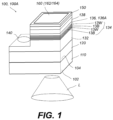
- FIG. 1 is a diagram of the schematic structure common to both a conventional LED 100 and an LED 100A of the present embodiment.
- a buffer layer 120 is epitaxially grown by a material such as AIN crystal on one side 104 of a substrate 110, which is a flat ⁇ -Al 2 O 3 single crystal (sapphire). From the side of the buffer layer 120, n-type conductive layer 132 is stacked and formed in this order.
- the n-type conductive layer 132 is followed by an emitting layer 134, a spacer layer 136, an electron blocking layer 138, a p-type contact layer 150, and an electrode 160 to act as a second electrode, stacked in this order.
- the direction of electron flow from upstream to downstream during operation is also identical to this order of stacking.
- the material of the n-type conductive layer 132 to the spacer layer 136 is typically AlGaN or InAlGaN or any of them with trace elements (Si for n-type, Mg for p-type, etc.) doped as needed.
- the electron blocking layer 138 is a single layer to provide a high barrier to electrons and is made of AlGaN with a higher Al composition ratio or AIN.
- a first electrode 140 is electrically connected to the n-type conductive layer 132.
- the electrode 160 establishes an electrical connection with the electron blocking layer 138 through the p-type contact layer 150.
- the light output L which is radiation UV, is emitted from the other side, the light extraction side 102, through the substrate 110.
- the substrate 110 is a growth substrate on which epitaxial growth of the n-type conductive layer 132 to the p-type contact layer 150 can be processed and is selected from any material that satisfies both the requirements of crystal orientation and heat resistance for growth. If the substrate 110 is remained in the final product, the substrate 110 is also required to be transmissive to radiant UV radiation.
- Typical materials for the substrate 110 are AIN single-crystal substrates, in addition to the aforementioned ⁇ -Al 2 O 3 single-crystal (sapphire), and Ga 2 O 3 substrates for radiation UV of 300 nm or longer wavelengths.
- those with the appropriate crystallographic orientation and off-angle for each material are selected as appropriate.
- the arrangement of the first electrode 140 can be different from FIG. 1 if it can be electrically connected to the n-type conductive layer 132.
- the buffer layer 120 is formed in a single or multiple layers as necessary in order to satisfy the crystal growth requirement of growing a good quality AlGaN layer (AIN layer) or InAlGaN layer crystal on the substrate 110 for increasing the internal quantum efficiency ⁇ IQE , which is fabricated to a thickness of about 2 ⁇ m, for example.
- the n-type conductive layer 132 is, for example, a layer of Al 0.85 Ga 0.15 N doped with Si to produce an n-type, i.e., an Al 0.85 Ga 0.15 N; Si layer.
- the emitting layer 134 has a MQW (multiple quantum well) stacking structure, in which the barrier layer 13B and the quantum well layer 13W are alternately stacked, and from the n-type conductive layer 132 side, the barrier layer 13B, the quantum well layer 13W, the barrier layer 13B, ... the quantum well layer 13W.
- MQW multiple quantum well
- At least two quantum well layers 13W are included in the emitting layer 134, and some barrier layers 13B are sandwiched between at least two quantum well layers 13W.
- the material of the emitting layer 134 is configured to have a composition of Al 0.94 Ga 0.06 N for the barrier layer 13B and Al 0.82 Ga 0.18 N for the quantum well layer 13W.
- the typical number of quantum wells is 3 or so, for example.
- the spacer layer 136 is an undoped AlGaN layer. A similar structure can be employed when an InAlGaN layer is employed for the UV emitting layer 130.
- the p-type contact layer 150 is a p-type AlGaN or p-type InAlGaN doped with Mg in the material of AlGaN or InAlGaN. If the Al composition ratio is appropriately chosen, the p-type contact layer 150 can have high transmittance for radiation UV.
- the first electrode 140 is a metal electrode with a stacked Ni/Au structure from the substrate side.
- the Ni is a layer of e.g. 25 nm thickness inserted between the Au and its underlying semiconductor layer to realize ohmic contact.
- a UV reflective film 164 that is highly reflective to radiation UV is employed for the reflective electrode 160.
- This UV reflective film 164 is, for example, a film made of a material containing Al, Mg, and Rh as main components.
- Ni is inserted on the substrate side for the reflective electrode 160 as well, which is the insert metal layer 162 that is part of the reflective electrode.
- the LED 100A in the present embodiment is similar to the conventional LED 100, except for the internal structure of the emitting layer 134 and the specific structure of the spacer layer 136A.
- LEDs employing quantum wells in nitride semiconductors electrons are injected through the conduction band from the n-type conductive layer 132 and holes are injected through the valence band from the p-type contact layer 150 into the quantum confined state of the quantum well layer 13W formed in the emitting layer 134.
- the electrons and holes recombine through interband transitions in their quantum wells to emit ultraviolet light.
- the inventors have focused on two issues for LEDs in the Far-UVC region: first, the overflow of electrons, and second, the polarization state of the emission.
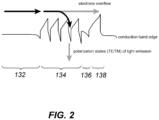
- FIG. 2 illustrates the problem to be solved in the present embodiment, showing the conduction band edge profiles of electrons in the n-type conductive layer 132, emitting layer 134, spacer layer 136, and electron blocking layer 138, from left to right, with the thickness of the layers oriented in the left-right direction of the drawing.
- Overflow is a phenomenon in which some of the carriers pass through the emitting layer 134 and current is consumed with no recombination as intended and is a problem for electrons that exhibit high mobility in nitride semiconductor carriers.
- nitride semiconductor LEDs generally have a high-barrier layer, called the electron blocking layer 138, at a position downstream of the electron flow as viewed from the emitting layer 134.
- the Al composition ratio is increased to the upper limit (100%, i.e., AIN) at most.
- the conduction band edge of the electron blocking layer 138 is not high enough in terms of the emitting layer 134, which is made of AlGaN with a high Al composition, and it is difficult to achieve the desired function of blocking electrons.
- the emission efficiency of the LED is degraded due to ineffective current that does not contribute to emission.
- the polarization state of the emission is whether the emitted ultraviolet light is transverse magnetic (TM) mode light or transverse electric (TE) mode light.
- TM mode The case where the electric field oscillates in the thickness direction of the emitting layer 134 is called TM mode, and the case where the electric field oscillates in the plane of the emitting layer 134 is called TE mode.
- TE mode the light in TE mode and the emitting operation that emits such light
- the optical transition emitting TM light has a profile that radiates in the in-plane direction of the stacked structure of the quantum well layer 13W, barrier layer 13B, etc.
- TE light can be emitted directly from the LED or, with the help of reflective electrode 160, the direction of propagation is flipped, and the light is emitted.
- TM emission becomes dominant due to the influence of the band structure, especially the electronic states serving as holes, and the light extraction efficiency is reduced.
- composition gradient spacer layer 1-2. Suppression of electron overflow by composition gradient spacer layer
- the Al composition ratio of the spacer layer 136A is continuously varied according to the position in the thickness direction.
- This continuous change is referred to as "compositional gradient" in the present embodiment because it is typical for the composition to be graded so that it increases or decreases according to the position.
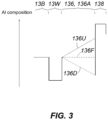
- FIG. 3 is a schematic diagram showing the relationship between the Al composition ratio and the position in the thickness direction of the layers in the barrier layer 13B, quantum well layer 13W, spacer layers 136 and 136A, and electron blocking layer 138.
- the horizontal and vertical directions of the drawing are the positions in the stacking direction and the AIN composition ratio at each position in the LEDs 100 and 100A, respectively.
- the spacer layers 136 and 136A are sandwiched between the lowest one of the plurality of quantum well layers 13W in the direction of electron flow (rightward in the drawing) and the electron blocking layer 138.
- the Al composition ratio is small in the quantum well layer 13W and large in the electron blocking layer 138.
- the spacer layers 136 and 136A are configured to have values between those of the quantum well layer 13W and the electron blocking layer 138.
- the spacer layer 136 of the conventional LED 100 is fabricated to have a flat (flat) Al composition ratio (chain line 136F in FIG.) distributed over the thickness direction regardless of the position thereof.
- the spacer layer 136A of the LED element 100A in the present embodiment has a slope 136U or a slope 136D that increases or decreases in Al composition ratio depending on the position in the thickness direction from the emitting layer 134 to the electron blocking layer 138.
- the structures such that the Al composition ratio has a slope that increases and decreases in the direction from the emitting layer 134 to the electron blocking layer 138 are also referred to as composition increase and composition decrease, respectively.
- the conduction band edge profile of the spacer layer 136 shown in FIG. 2 may be subject to piezoelectric polarization at the position where the composition changes due to the polarity of the crystal. As a result, the conduction band edge profile of the spacer layer 136 with a flat Al composition ratio is also generally accompanied by tilting and bending.
- the inventors investigated the efficiency of electron injection through theoretical calculations and then confirmed the experimental results of the actual emitting operation.
- Theoretical calculations were performed by the simulation software SiLENSe (Semiconductor Technology Research (STR), St. Moscow, Russia).
- the calculations were performed by adopting a realistic structure, and the typical conditions are as follows: for both the conventional LED 100 and the present embodiment LED 100A, the quantum well layer 13W has a thickness of 3 nm and an Al composition ratio of 0.82, and its number is 4.
- the electron blocking layer 138 has a thickness of 9 nm and an Al composition ratio of 1.0 (i.e., AIN).
- the Al composition ratio is constant at 0.94.
- the Al composition ratio is linear from 0.94 to 1.0 depending on the position in the thickness direction from the quantum well layer to the electron block layer.
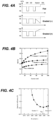
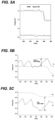
- FIGS. 4A-C illustrate the distribution of Al composition ratios in the thickness direction for the structure employed in the calculations for the present embodiment of the LED device ( FIG. 4A ), the graph of current-internal quantum efficiency obtained by the calculations ( FIG. 4B ), and of injection efficiency obtained by changing the composition gradient ( FIG. 4C ).
- the "Flat (-)," “Graded (-),” and “Graded (+)” in FIGS. 4A and B are assigned to the flat (i.e., spacer layer 136), composition-decreasing configuration in which the Al composition ratio x is decreased from 0.94 to 0.82, and composition-increasing configuration in which x is increased from 0.94 to 1.0, respectively.
- the Al composition ratio x is a fractional value that is also expressed in Al x Ga 1-x N or (AIN) x (GaN) 1-x .
- the internal quantum efficiency increases as the current increases.
- the composition gradient one has an increased internal quantum efficiency regardless of whether the gradient is increased or decreased. In other words, recombination is performed as designed in the composition-graded spacer layer 136A more than in the flat-composition spacer layer 136.
- the Al composition ratio of the spacer layer 136A was fixed to 0.94 as before at the position where it contacts the quantum well layer 13W (called “starting Al composition ratio”), and the value at the position where it reaches the electron block layer 138 (called “final Al composition ratio”) was x.
- the efficiency of electron injection with respect to x was calculated.
- the final Al composition ratio x 0.94 corresponds to the structure of the flat spacer layer 136. As shown in the figures, it was found that the injection efficiency is the smallest in the flat spacer layer 136, and the injection efficiency increases according to the composition gradient, regardless of whether the gradient is increased or decreased.
- compositional decrease and compositional increase in the compositional gradient would have opposite effects on each other.
- simulation results show a more complicated situation, and multiple mechanisms might be involved.
- physical mechanisms that may work from the structural aspect and contribute to the improved performance, including the following:
- FIGS. 5A-C are example band diagrams to illustrate the calculation to obtain the block height of the LED in the present embodiment. Illustrated are the band diagram at 100 mA operation ( FIG. 5A ), as well as an enlarged band diagram of the area giving the block height of the electrons and holes ( FIGS. 5B and 5C ).
- FIGS. 6A-B also show the calculated block heights for electrons ( FIG. 6A ) and holes ( FIG. 6B ) for flat, composition-reduced, and composition-increased cases for conventional and Far-UVCLEDs in the present embodiment.
- the block height is the energy difference between the quasi-Fermi level and the potential maximum of the block layer 138 in eV (or meV).
- the quasi-Fermi level is shown by a chain line, and the potentials for electrons and holes are shown by solid lines.
- the quasi-Fermi levels are marked with the signs E Fn (electrons) and E Fp (holes), and the potentials are marked with the signs of the conduction band edge Ec and valence band edge Ev, respectively.
- the absolute value of these differences is the block height for each carrier.
- a large value of the block height is preferred in terms of the function of the electron blocking layer, while a small value is preferred for the injection of electrons, but not for the operation of holes.
- the electron block height increases, and the hole block height decreases as a function of composition decrease compared to the flat composition.
- the composition decrease performs increasing efficiency for both electron and hole carriers, ensuring blocking of electrons as intended, and smoothing out the injection of electrons and holes.
- the electron block height decreases, and the hole block height decreases even more.
- composition increase results in insufficient blocking of electrons, but at the same time the improved injection of electrons improves the efficiency of electrons injection beyond that.
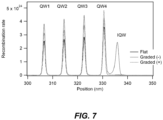
- FIG. 7 is a graph of the calculated emission recombination rates at each position in the thickness direction of the LED 100A in the present embodiment.
- the references QW1 to QW4 are identifiers provided to the quantum well layer 13W in stacking order toward the electron blocking layer 138.
- IQW refers to the interfacial quantum wells that are substantially generated at the interface between the spacer layer 136A and the electron blocking layer 138.
- the signs "Flat (-)," “Graded (-),” and “Graded (+)” are the same as in FIGS. 4A and B .
- the Al composition ratio is 0.94 for flat, 0.94 for starting Al composition ratio and 0.82 for final Al composition ratio in the case of compositional decrease, and 0.94 for starting Al composition ratio and 1.0 for final Al composition ratio in the case of compositional increase.
- FIG. 7 shows that the emission rate at each well increased from flat for both composition decrease and composition increase. In addition to that, the emission component of the interfacial quantum wells (IQWs) is also larger for composition decrease.
- IQWs interfacial quantum wells
- the composition decrease results in better performance than the flat structure for all of mechanisms A, B, and C.
- the emission peak wavelength of IQW depends on the final Al composition ratio x in composition decrease. If the final Al composition ratio x falls below 80% and the peak emission wavelength of IQW becomes separated from the wavelength of the other quantum wells, the performance could be unsuitable for LEDs. Whether or not IQWs are incorporated into the emission region and whether the peak emission wavelength of IQWs is appropriate or not depend on the applicable application.
- the optimum value of the final Al composition ratio x and its range can be determined in terms of whether the IQW emission is required or not as well as the appropriateness of the IQW emission. For example, determining the final Al composition ratio x to realize the peak emission wavelength of the IQW matching the emission wavelength of the emitting layer 134 is a typical example of this optimization. Adjusting the emission peak wavelength of the IQW so that the suppression of adverse effects on the human body, which is one of the characteristics of Far-UVC, for example, is maintained, is another typical example of this optimization.
- LED samples were prepared for each one with the spacer layer 136 with a flat composition and with the spacer layer 136A with compositional gradients of increasing and decreasing composition regarding the Al composition ratio, to correspond to the LEDs 100 and 100A in the conventional and present embodiments, then the electroluminescence was measured.
- the LED samples were fabricated by the metal-organic vapor phase epitaxy (MOVPE) method, in a manner like conventional ultraviolet LEDs made of nitride semiconductors.
- MOVPE metal-organic vapor phase epitaxy
- composition-graded spacer layer 136A To form the composition-graded spacer layer 136A, specific conditions for the ratio of TMAI (tri-methyl-aluminum), the raw material gas for Al, and TMGa (tri-methyl-gallium), the raw material gas for Ga, were changed according to whether the spacer layer would have a flat Al composition or a composition-graded spacer layer. The remaining fabrication conditions regarding the structure were identical. The electrode size was set to 0.4 mm square, and constant current operation was employed.
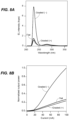
- FIG. 8A-B are the measured electroluminescence (EL) spectra ( FIG. 8A ) and current-light output characteristics ( FIG. 8B ) for the conventional and present embodiment LED samples. As shown in FIG. 8 , a significant improvement in output power was observed with composition decrease compared to flat one. On the other hand, the composition increase resulted in a slight reduction in output compared to the flat. The difference from the simulated results is attributable to a wide range of factors, including differences in physical parameters and structure.
- composition decrease to be the more practical structure that is easier to use and has better reproducibility from the viewpoint of tolerance to deviations from the ideal structure that may occur, such as structural and parameter fluctuations, and from the viewpoint of stable output improvement. Furthermore, composition decrease could be advantageous from another viewpoint as well.
- Al composition dependence of the injection efficiency obtained from the simulation FIG. 4C ) it can be understood that a flat Al composition ratio in the spacer layer results in the minimum efficiency, from which the efficiency improvement progresses as the amount of composition change (composition gradient) increases.
- the inventors have confirmed that the current structure is nearly optimal in the experimental results in terms of changes in the spacer layer thickness and final Al composition ratio. This was confirmed by varying the parameters more exhaustively through the experiments described below.
- FIG. 9 shows the EL spectra obtained from each of the samples in which the starting Al composition ratio was varied from 0.90 to 0.94 in the present embodiment of the LED.
- composition-graded LQB layers have also been investigated in the past for LEDs with emitting wavelengths longer than 240 nm (Non-Patent Document 1-7).
- the composition gradient of the spacer layer has been theoretically investigated, inter alia, in Non-Patent Document 4.
- the disclosures in those references are limited to the improvements at longer wavelengths compared to the Far-UVC (210nm to 230nm) in the present application.
- the wavelength range where the limit of the Al composition ratio is not an issue as in the present application, there is no consideration of the limitation caused by the Al composition ratio in the conventional ones.
- the effect of compositional gradient varies greatly depending on the emission wavelength and material composition to be employed.
- the Al composition ratio of the electron block layer can be widely adjusted because there is sufficient room to increase the Al composition ratio placed in the composition of the electron block layer.
- emission wavelengths longer than 240 nm the contribution of the LQB layer and the spacer layer itself to electron leakage is relatively limited. Therefore, findings at emission wavelengths longer than 240 nm are not applicable to Far-UVC.
- the experimental results in FIG. 1 which typically relates to operation in the 210-230 nm wavelength range, the experimental results in FIG.
- the inventors speculate that the principle of this operation may be because the barrier height of the electron blocking layer 138 may increase from the quasi-Fermi level of the electrons, thereby suppressing the overflow of electrons.
- This enhancement effect of the barrier height of the electron blocking layer 138 with respect to the quasi-Fermi level can occur not only with a composition decreasing slope 136D of the Al composition ratio, but also with a composition increasing slope 136U (both FIG. 3 ).
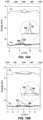
- FIG. 10A and FIG. 10B are band diagrams to illustrate the technical concept of the present embodiment by contrasting a conventional LED ( FIG. 10A ) with the LED of the present embodiment ( FIG. 10B ), focusing on the polarization of the emitted UV light.
- the simulation software nextnano was employed to calculate the band diagram, and the Al compositions of the barrier and well layers used in the calculation were 0.94 and 0.82, respectively.
- These figures show an enlarged view of a portion of the 13W quantum well layer, showing two band profiles near the conduction band edge (EC) and the valence band edge (EV) and the envelope of the wavefunction in terms of the magnitude of the amplitude at each position.
- FIG. 10A shows a structure with a 2 nm thick quantum well layer 13W and a 6 nm thick barrier layer 13B
- FIG. 10B shows a structure with a 2 nm thick quantum well layer 13W and a 1 nm thick barrier layer 13B, both under conditions of crystal growth on a polar substrate.
- the left and right directions of the drawings are in the thickness direction, but as shown in the scale, the scale in the thickness direction is enlarged in FIG. 10B than in FIG. 10A .
- the ranges of the quantum well layer 13W and the barrier layer 13B are shown above the graphs in FIG. 10A and FIG. 10B .
- the barrier layer 13B lies from the origin (0nm) to 6nm and from 8nm to 14nm in the thickness direction, while the quantum well layer 13W lies from -2nm to 0nm, from 6nm to 8nm, and from 14nm to 16nm in the thickness direction.
- the barrier layer 13B lies from -2nm to 0nm, from 6nm to 8nm, and from 14nm to 16nm in the thickness direction.
- the barrier layer 13B lies from the origin (0 nm) to 1 nm and from 3 nm to 4 nm
- the quantum well layer 13W lies from 1 nm to 3 nm and from 4 nm to 6 nm.
- the thickness of the barrier layer of 6 nm has been commonly used in the structure of conventional LEDs with an emission wavelength of about 280 nm.
- TE emission is easily extracted from the LED itself as it is emitted in the direction of the thickness of the stacked structure of the LED in FIG. 1
- TM emission is not easily emitted as it is emitted toward the in-plane direction of the stacked structure.
- a plurality of quantum well layers 13W are provided and the adjacent quantum well layers 13W are separated by a barrier layer 13B.
- the quantum well layer 13W and barrier layer 13B are depicted at the conduction band edge Ec at low and high energies, respectively.
- the two profiles near the valence band edge Ev are the opposite. This FIG is obtained by a coupled calculation of the Schrödinger and Poisson equations for a structure with periodically repeating well and barrier layers.
- the two band profiles near the conduction band edge and the valence band edge each have a slope corresponding to a crystal formed on a polar substrate.
- the lower energy conduction band edge of the quantum well layer 13W is located below the higher energy conduction band edge of the adjacent barrier layer 13B, which, when traced in the thickness direction, has a convex shape downward and acts as a quantum well.
- the electrons that contribute to emission undergo an optical transition from the state formed in that quantum well.
- the optical transition of electrons is a recombination in pairs with states at the valence band edge (hole states) that satisfy the selection rule based on spatial symmetry. In this case, in addition to the selection rule based on spatial symmetry, the optical transition with holes with the smallest energy difference is dominant, and photons with that energy difference are emitted.
- the radiation pattern depends on the direction of the electric dipole moment of the optical transition, and the direction in which the optical transition of the electric dipole moment occurs is determined by the pair of wave functions that provides the pair of starting and ending states allowed by the selection rule reflecting spatial symmetry.
- the two states near the valence band edge in FIGS. 10A and 10B are marked with the sign TE for the envelope of probability of finding electrons in the state where TE emission is dominant in the optical transitions between the quantum well layer states, and TM for those where TM emission is dominant.
- one wave function envelope is marked at the conduction band edge and two at the valence band edge.
- the number of these envelopes corresponds to the number of profiles at the conduction band edge and the valence band edge, respectively.
- the vertical position of the straight lines drawn for the reference of the amplitudes of the envelopes is depicted in the drawings in correspondence with the energy values of the scale for the band profiles shown on the left axis of each FIG, except for those in the enlarged figures.
- the inventors investigated the band structure in detail by theoretical calculations using the simulation software nextnano and found that in the case of the 6 nm barrier layer shown in FIG.
- the wave function of the electrons which is TM polarized, gives high energy at the valence band edge.
- the quantum well layer 13W is sufficiently thin with a thickness of 2 nm, but when the Al composition ratio is adjusted for an emission wavelength of about 210-230 nm, the TM emission becomes dominant if the thickness of the barrier layer 13B remains the conventional 6 nm. This was revealed to be one of the reasons for the low emission efficiency.
- TE emission is performed in LEDs designed by conventional methods, such as blue light emitting diodes, which employ GaN-based materials (including InGaN-based materials) with an Al composition ratio of 0.
- the relative ratio of TM emission increases as the Al composition ratio increases for shorter wavelengths by adopting AIGaN-based crystals, and TE and TM emission become comparable for materials with an Al composition ratio of approximately 0.5. If the Al composition ratio is continued increasing, almost 100% of the emission will eventually be TM emission.
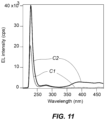
- FIG. 11 is a graph showing the measured emission spectra of LED samples fabricated with the barrier layer thickness of 6 nm (curve C1) and 1 nm (curve C2) to confirm the technical concept of the present embodiment.
- the operating conditions were room temperature (300 K) and 50 mA (device size 0.16 mm 2 ).
- FIG. 12 is a graph showing the relationship between the thickness of the barrier layer 13B and the intensity of TE emission, with the thickness of the quantum well layer fixed to 3 nm and the number thereof fixed to 4, obtained in a simulation to confirm the technical concept of the present embodiment.
- the emission intensity is generally enhanced by a factor of 2. Also, as can be seen in FIG.
- the emission intensity begins to increase significantly when the barrier layer 13B is reduced to a thickness of 4 nm or less, compared to a barrier layer 13B thickness of 6 nm.
- a barrier layer 13B thickness of 4 nm or less is preferred, 3 nm or less is even more preferred, 2 nm or less is even more preferred, and 1 nm or less is even more preferred.
- the thickness of the barrier layer 13B has no particular manufacturing problems if it is thicker than 0.25 nm, which is the thickness of a monolayer.
- the thickness of the barrier layer 13B can also be determined based on the thickness of the quantum well layer. To be specific, setting the thickness of the barrier layer 13B so that it is less than or equal to the thickness of the quantum well layer is a preferred structure.
- the thickness of barrier layer 13B is 3 nm to 4 nm or less, TE emission exceeds TM emission by about 50% of the intensity of total emission (TE emission + TM emission). Therefore, the thickness of barrier layer 13B should also be determined so that TE emission is stronger than TM emission. However, the ratio of TE emission exceeds 90% when the thickness of the barrier layer 13B is about 1 nm. Even if the thickness of the barrier layer 13B is further reduced to 0.5 nm (the equivalent of two monolayers), the TE emission ratio is not much different from that of the 1 nm case.
- the lower limit of the thickness of the barrier layer 13B can be 1 nm or less, which is easy to stably manufacture.
- the thickness of the barrier layer 13B is less than 0.25 nm, for example, 0.2 nm, in the implemented UV light emitting diode.
- the preferred thickness of the barrier layer 13B for a monolayer is 0.2 nm or more.
- the barrier layer 13B thinner is also advantageous in that the carrier distribution among the multiple quantum well layers 13W is more uniform.
- the TE emission ratio is about 20%.
- the optical transitions that cause emission are those in which the electrons are at the conduction band edge as the initial state and the electrons are at the valence band edge as the final state.
- the direction of the electric dipole moment that is realized by the value of the large dipole matrix element between the initial state and the final state determines whether the emission is TM or TE emission.
- the state that contributes to emission in a quantum well must have an energy less than the maximum energy of the barrier layer, and this state is generally the bound state.
- States with energies greater than the maximum energy are unbound states.
- the number of bound states depends on the size of the effective mass and the size of the confinement potential (energy difference between the barrier layer and the well layer), and the lighter the effective mass and the smaller the confinement potential, the smaller the number of bound states.
- the confinement potential cannot be too large to achieve short wavelengths. Therefore, in this calculation, there is only one bound state for electrons. This situation should be contrasted with the case of LEDs emitting light at 280 nm, where more than one binding state for electrons is possible.
- the number of bound states for holes is quite large, about 10 in the present calculation.
- the contribution to emission depends on the distribution of carriers in the bound states. Since the number of carriers decreases exponentially with deeper (lower in the band diagram) bound states, the emission characteristics is mostly determined by comparing the shallowest bound state with the second shallowest bound state.
- FIGS. 10A and 10B show only two levels in this sense. Note that the TE/TM emission intensity ratio in FIG. 12 is calculated by considering up to the fourth bound state, but the number of carriers in the fourth state is less than 1% of the first. This is shown in FIGS. 10A and 10B .
- the valence band edge state will try to shift toward the lower energy side (lower in FIG. 10A and FIG. 10B ) due to the quantum confinement effect, in other words, in the direction where the energy difference between the conduction band edge state and the valence band edge state widens.
- the amount of this shift is due to quantum confinement and is more fundamentally a consequence of the uncertainty principle.
- the electron has a smaller effective mass in the two states in question at the valence band edge, the one responsible for TM emission than the one responsible for TE emission. Therefore, the state responsible for TM emission, where the effective mass of the electron is smaller, is shifted significantly downward.
- the state responsible for TE emission which has a large effective mass
- the state responsible for TM emission which has a small effective mass
- the state responsible for TM emission which has a small effective mass
- the quantum confinement effect by thinning the quantum well layer 13W has been considered, but in the present embodiment, it was found for the first time that the shift can be generated even by thinning the barrier layer 13B, and it was confirmed experimentally that the shift is effective for optical transitions at wavelengths below 240 nm.
- the shift is also effective for optical transitions at wavelengths below 240 nm.
- the barrier layer 13B contributes to the quantum confinement effect may be related to the valence band edge profile, which is saw-blade shaped due to tilting and bending in the quantum well and barrier.
- a valence band edge profile reflects the fact that the crystal has a polar orientation.
- the quantum well layer 13W and the thinned barrier layer 13B affect the valence band edge profile, resulting in the shift described above.
- the effect of thinning the barrier layer 13B as a single layer is not limited to cases where the crystal has a polar orientation but can be effective even when the substrate for epitaxial growth is not a polar substrate but a semi-polar or non-polar substrate.
- FIG. 13A and FIG. 13B are graphs of the emission spectrum ( FIG. 13A ) and current light output characteristics ( FIG.
- FIG. 13B in the Far-UVCLED sample of the present embodiment, in which the composition-graded spacer layer and the thinned barrier layer are applied at the same time as in FIG. 8A .
- FIG. 13A a narrow single peak emission with an emission wavelength of 227 nm and a full width at half maximum of 10 nm was observed in the Far-UVC region during continuous operation at room temperature.
- FIG. 13B it was confirmed that a Far-UVC LED with an external quantum efficiency of 0.2% and an optical output of 1.2 mW in pulsed operation, which is a practical level, can be practiced.
- composition-graded spacer layers and thin barrier layers for TE emission enhancement are equally applicable not only to AIGaN-based crystals, but also to structures with InAIGaN-based crystals, for example, where In is also included as part of the composition of any of the layers. These technical concepts are also applicable to LEDs whose emission wavelength range is outside the 210-230 nm range.
- the LED manufacturing method that can be employed as the present embodiment is not particularly limited, and for example, in addition to the MOVPE method, the MBE (Molecular Beam Epitaxy) method can be employed.
- the composition distribution of the Al composition ratio in the spacer layer 136 is described for a structure in which the composition distribution is linearly increased or linearly decreased, various changes according to the position in the thickness direction of the stacking can also be employed as a variation of this embodiment.
- the Far-UVCLED with an improved emission efficiency of the present disclosure is used in any devices that utilize it as a UV source.
Landscapes
- Led Devices (AREA)
Applications Claiming Priority (2)
| Application Number | Priority Date | Filing Date | Title |
|---|---|---|---|
| JP2021127756 | 2021-08-03 | ||
| PCT/JP2022/027508 WO2023013374A1 (ja) | 2021-08-03 | 2022-07-13 | 紫外発光ダイオードおよびそれを備える電気機器 |
Publications (2)
| Publication Number | Publication Date |
|---|---|
| EP4407699A1 true EP4407699A1 (de) | 2024-07-31 |
| EP4407699A4 EP4407699A4 (de) | 2025-11-26 |
Family
ID=85155975
Family Applications (1)
| Application Number | Title | Priority Date | Filing Date |
|---|---|---|---|
| EP22852800.6A Pending EP4407699A4 (de) | 2021-08-03 | 2022-07-13 | Ultraviolettlichtemittierende diode und elektrische vorrichtung damit |
Country Status (4)
| Country | Link |
|---|---|
| US (1) | US20240339562A1 (de) |
| EP (1) | EP4407699A4 (de) |
| JP (1) | JPWO2023013374A1 (de) |
| WO (1) | WO2023013374A1 (de) |
Families Citing this family (3)
| Publication number | Priority date | Publication date | Assignee | Title |
|---|---|---|---|---|
| JPWO2024176782A1 (de) * | 2023-02-22 | 2024-08-29 | ||
| CN121312294A (zh) * | 2023-06-01 | 2026-01-09 | 国立大学法人三重大学 | Iii族氮化物发光器件 |
| JP2025029432A (ja) * | 2023-08-21 | 2025-03-06 | 学校法人 名城大学 | 窒化物半導体発光素子 |
Family Cites Families (9)
| Publication number | Priority date | Publication date | Assignee | Title |
|---|---|---|---|---|
| JP4538476B2 (ja) * | 2007-08-27 | 2010-09-08 | 独立行政法人理化学研究所 | 半導体構造の形成方法 |
| US8451877B1 (en) * | 2010-03-23 | 2013-05-28 | Sandia Corporation | High efficiency III-nitride light-emitting diodes |
| KR102268109B1 (ko) * | 2014-12-22 | 2021-06-22 | 엘지이노텍 주식회사 | 발광 소자 및 이를 구비한 발광 소자 패키지 |
| CN115602765A (zh) * | 2016-09-13 | 2023-01-13 | 苏州立琻半导体有限公司(Cn) | 半导体器件和包括该半导体器件的半导体器件封装 |
| JP6431013B2 (ja) * | 2016-09-21 | 2018-11-28 | シャープ株式会社 | 窒化アルミニウム系半導体深紫外発光素子 |
| JP7000062B2 (ja) * | 2017-07-31 | 2022-01-19 | Dowaホールディングス株式会社 | Iii族窒化物エピタキシャル基板、電子線励起型発光エピタキシャル基板及びそれらの製造方法、並びに電子線励起型発光装置 |
| US11043612B2 (en) * | 2017-11-15 | 2021-06-22 | Cornell University | Light emitting diodes using ultra-thin quantum heterostructures |
| US11764327B2 (en) * | 2018-06-13 | 2023-09-19 | King Abdullah University Of Science And Technology | Light emitting diode with a graded quantum barrier layer |
| CN113169255B (zh) * | 2018-12-14 | 2025-05-16 | 同和电子科技有限公司 | Iii族氮化物半导体发光元件及其制造方法 |
-
2022
- 2022-07-13 US US18/294,509 patent/US20240339562A1/en active Pending
- 2022-07-13 JP JP2023539734A patent/JPWO2023013374A1/ja active Pending
- 2022-07-13 EP EP22852800.6A patent/EP4407699A4/de active Pending
- 2022-07-13 WO PCT/JP2022/027508 patent/WO2023013374A1/ja not_active Ceased
Also Published As
| Publication number | Publication date |
|---|---|
| US20240339562A1 (en) | 2024-10-10 |
| JPWO2023013374A1 (de) | 2023-02-09 |
| WO2023013374A1 (ja) | 2023-02-09 |
| EP4407699A4 (de) | 2025-11-26 |
Similar Documents
| Publication | Publication Date | Title |
|---|---|---|
| Ren et al. | Band engineering of III-nitride-based deep-ultraviolet light-emitting diodes: a review | |
| Kneissl et al. | The emergence and prospects of deep-ultraviolet light-emitting diode technologies | |
| EP4407699A1 (de) | Ultraviolettlichtemittierende diode und elektrische vorrichtung damit | |
| JP6259611B2 (ja) | 短波長発光素子のためのp側層 | |
| EP1831933B1 (de) | Lichtemittierende heterostruktur auf nitridbasis | |
| CN102956769B (zh) | 氮化物半导体发光器件以及制造其的方法 | |
| KR101804493B1 (ko) | 변조 도핑을 갖는 광전자 디바이스 | |
| CN205004348U (zh) | 紫外光发光二极管 | |
| TWI529960B (zh) | 具有差排彎折結構之發光裝置 | |
| US8451877B1 (en) | High efficiency III-nitride light-emitting diodes | |
| JP7262965B2 (ja) | 半導体発光素子 | |
| JP2011187591A (ja) | 窒化物半導体紫外線発光素子 | |
| KR101199677B1 (ko) | 반도체 발광 소자 및 그 제조 방법 | |
| Ahmad et al. | Performance enhancement of UV quantum well light emitting diode through structure optimization | |
| Kuo et al. | Simulation and experimental study on barrier thickness of superlattice electron blocking layer in near-ultraviolet light-emitting diodes | |
| JP7291357B1 (ja) | 紫外発光素子およびそれを備える電気機器 | |
| US9673352B2 (en) | Semiconductor light emitting device | |
| CN106410001A (zh) | 一种新型AlGaN基紫外发光二极管 | |
| CN103579427A (zh) | 半导体发光器件及其制造方法 | |
| JP2014003121A (ja) | 窒化物半導体発光素子 | |
| GB2425652A (en) | A semiconductor light-emitting device | |
| US9472716B1 (en) | Lattice-constant formatted epitaxial template for light emitting devices and a method for making the same | |
| Saranya et al. | Parameter Analysis Review on Multiple Quantum Well based InGaN/GaN Light Emitting Diode | |
| TWI559571B (zh) | 氮化物半導體結構及半導體發光元件 | |
| Jain | III-nitride nanostructures: Photonics and memory device applications |
Legal Events
| Date | Code | Title | Description |
|---|---|---|---|
| STAA | Information on the status of an ep patent application or granted ep patent |
Free format text: STATUS: THE INTERNATIONAL PUBLICATION HAS BEEN MADE |
|
| PUAI | Public reference made under article 153(3) epc to a published international application that has entered the european phase |
Free format text: ORIGINAL CODE: 0009012 |
|
| STAA | Information on the status of an ep patent application or granted ep patent |
Free format text: STATUS: REQUEST FOR EXAMINATION WAS MADE |
|
| 17P | Request for examination filed |
Effective date: 20240301 |
|
| AK | Designated contracting states |
Kind code of ref document: A1 Designated state(s): AL AT BE BG CH CY CZ DE DK EE ES FI FR GB GR HR HU IE IS IT LI LT LU LV MC MK MT NL NO PL PT RO RS SE SI SK SM TR |
|
| DAV | Request for validation of the european patent (deleted) | ||
| DAX | Request for extension of the european patent (deleted) | ||
| REG | Reference to a national code |
Ref country code: DE Ref legal event code: R079 Free format text: PREVIOUS MAIN CLASS: H01L0033140000 Ipc: H10H0020812000 |
|
| R17P | Request for examination filed (corrected) |
Effective date: 20240301 |
|
| A4 | Supplementary search report drawn up and despatched |
Effective date: 20251024 |
|
| RIC1 | Information provided on ipc code assigned before grant |
Ipc: H10H 20/812 20250101AFI20251020BHEP Ipc: H10H 20/816 20250101ALI20251020BHEP Ipc: H10H 20/825 20250101ALI20251020BHEP |