EP4389701A1 - Wässrige nanodiamantdispersion - Google Patents
Wässrige nanodiamantdispersion Download PDFInfo
- Publication number
- EP4389701A1 EP4389701A1 EP22858553.5A EP22858553A EP4389701A1 EP 4389701 A1 EP4389701 A1 EP 4389701A1 EP 22858553 A EP22858553 A EP 22858553A EP 4389701 A1 EP4389701 A1 EP 4389701A1
- Authority
- EP
- European Patent Office
- Prior art keywords
- nanodiamond
- aqueous dispersion
- less
- group
- particles
- Prior art date
- Legal status (The legal status is an assumption and is not a legal conclusion. Google has not performed a legal analysis and makes no representation as to the accuracy of the status listed.)
- Pending
Links
Images


Classifications
-
- C—CHEMISTRY; METALLURGY
- C01—INORGANIC CHEMISTRY
- C01B—NON-METALLIC ELEMENTS; COMPOUNDS THEREOF; METALLOIDS OR COMPOUNDS THEREOF NOT COVERED BY SUBCLASS C01C
- C01B32/00—Carbon; Compounds thereof
- C01B32/25—Diamond
- C01B32/28—After-treatment, e.g. purification, irradiation, separation or recovery
-
- C—CHEMISTRY; METALLURGY
- C01—INORGANIC CHEMISTRY
- C01B—NON-METALLIC ELEMENTS; COMPOUNDS THEREOF; METALLOIDS OR COMPOUNDS THEREOF NOT COVERED BY SUBCLASS C01C
- C01B32/00—Carbon; Compounds thereof
- C01B32/15—Nano-sized carbon materials
-
- C—CHEMISTRY; METALLURGY
- C08—ORGANIC MACROMOLECULAR COMPOUNDS; THEIR PREPARATION OR CHEMICAL WORKING-UP; COMPOSITIONS BASED THEREON
- C08L—COMPOSITIONS OF MACROMOLECULAR COMPOUNDS
- C08L71/00—Compositions of polyethers obtained by reactions forming an ether link in the main chain; Compositions of derivatives of such polymers
-
- B—PERFORMING OPERATIONS; TRANSPORTING
- B82—NANOTECHNOLOGY
- B82Y—SPECIFIC USES OR APPLICATIONS OF NANOSTRUCTURES; MEASUREMENT OR ANALYSIS OF NANOSTRUCTURES; MANUFACTURE OR TREATMENT OF NANOSTRUCTURES
- B82Y30/00—Nanotechnology for materials or surface science, e.g. nanocomposites
-
- C—CHEMISTRY; METALLURGY
- C01—INORGANIC CHEMISTRY
- C01P—INDEXING SCHEME RELATING TO STRUCTURAL AND PHYSICAL ASPECTS OF SOLID INORGANIC COMPOUNDS
- C01P2002/00—Crystal-structural characteristics
- C01P2002/01—Crystal-structural characteristics depicted by a TEM-image
-
- C—CHEMISTRY; METALLURGY
- C01—INORGANIC CHEMISTRY
- C01P—INDEXING SCHEME RELATING TO STRUCTURAL AND PHYSICAL ASPECTS OF SOLID INORGANIC COMPOUNDS
- C01P2004/00—Particle morphology
- C01P2004/01—Particle morphology depicted by an image
- C01P2004/04—Particle morphology depicted by an image obtained by TEM, STEM, STM or AFM
-
- C—CHEMISTRY; METALLURGY
- C01—INORGANIC CHEMISTRY
- C01P—INDEXING SCHEME RELATING TO STRUCTURAL AND PHYSICAL ASPECTS OF SOLID INORGANIC COMPOUNDS
- C01P2004/00—Particle morphology
- C01P2004/51—Particles with a specific particle size distribution
-
- C—CHEMISTRY; METALLURGY
- C01—INORGANIC CHEMISTRY
- C01P—INDEXING SCHEME RELATING TO STRUCTURAL AND PHYSICAL ASPECTS OF SOLID INORGANIC COMPOUNDS
- C01P2004/00—Particle morphology
- C01P2004/60—Particles characterised by their size
- C01P2004/64—Nanometer sized, i.e. from 1-100 nanometer
-
- C—CHEMISTRY; METALLURGY
- C01—INORGANIC CHEMISTRY
- C01P—INDEXING SCHEME RELATING TO STRUCTURAL AND PHYSICAL ASPECTS OF SOLID INORGANIC COMPOUNDS
- C01P2006/00—Physical properties of inorganic compounds
- C01P2006/22—Rheological behaviour as dispersion, e.g. viscosity, sedimentation stability
-
- C—CHEMISTRY; METALLURGY
- C01—INORGANIC CHEMISTRY
- C01P—INDEXING SCHEME RELATING TO STRUCTURAL AND PHYSICAL ASPECTS OF SOLID INORGANIC COMPOUNDS
- C01P2006/00—Physical properties of inorganic compounds
- C01P2006/40—Electric properties
-
- C—CHEMISTRY; METALLURGY
- C08—ORGANIC MACROMOLECULAR COMPOUNDS; THEIR PREPARATION OR CHEMICAL WORKING-UP; COMPOSITIONS BASED THEREON
- C08L—COMPOSITIONS OF MACROMOLECULAR COMPOUNDS
- C08L71/00—Compositions of polyethers obtained by reactions forming an ether link in the main chain; Compositions of derivatives of such polymers
- C08L71/08—Polyethers derived from hydroxy compounds or from their metallic derivatives
Definitions
- the present disclosure relates to a nanodiamond aqueous dispersion including water and nanodiamond particles dispersed in the water.
- the present application claims priority to JP 2021-135080, filed in Japan on August 20, 2021 , the contents of which are incorporated herein by reference.
- Nano-sized fine substances such as nanocarbon materials are known to have novel characteristics that cannot be achieved in a bulk state.
- graphite formed of stacked layers of graphene
- graphite is a substance with a two-dimensional structure that has a large specific surface area and that exhibits excellent conductivity and excellent sensitivity to small molecules. For that reason, graphite has been used in various electrode materials.
- nanocarbon materials typically have large proportions of surface atoms, and it is known that a total van der Waals force that can act between surface atoms of adjacent particles is strong, and aggregation tends to occur. Thus, it has been very difficult to stably disperse nanodiamond particles in a dispersion medium such as water or an organic solvent.
- Patent Documents 1 and 2 a method has been reported in which a modifying group containing a polyglycerin chain is introduced into the surface of a nanodiamond particle for the purpose of suppressing aggregation of the nanodiamond and improving dispersibility in water.
- the DLS method is known as a method for evaluating the dispersibility of a nanodiamond aqueous dispersion.
- a known nanodiamond aqueous dispersion is evaluated by the DLS method, a result may be obtained in which the dispersed particle size of the nanodiamond particles is small and the dispersion has high dispersibility.
- clustered or chained nanodiamond particles may be present. Therefore, there is a demand for a nanodiamond aqueous dispersion in which nanodiamond particles are more highly dispersed than ever before.
- An object of the present disclosure is to provide a nanodiamond aqueous dispersion in which nanodiamond particles can be present in water in a highly dispersed state.
- the present disclosure provides a nanodiamond aqueous dispersion including water and nanodiamond particles dispersed in the water, wherein
- the nanodiamond aqueous dispersion preferably further includes a metal salt.
- the metal salt is preferably a light metal salt.
- the metal salt is preferably an alkali metal salt.
- the nanodiamond particles preferably include a surface-modifying group containing a hydrophilic polymer chain.
- the hydrophilic polymer chain is preferably a polyglycerin chain.
- the nanodiamond particles preferably have a zeta potential from -12 to +20 mV.
- the zeta potential of the nanodiamond particles is preferably more than 0 mV and less than or equal to +20 mV.
- nanodiamond particles can be stably present in water in a highly dispersed state.
- nanodiamond particles having high dispersibility without clustered or chained nanodiamond particles can be stably present in water even when the dispersibility is evaluated by low-temperature electron microscopy.
- the present disclosure is a nanodiamond aqueous dispersion including water and nanodiamond particles dispersed in the water, wherein
- nanodiamond aqueous dispersion of the present disclosure when a horizontal projection area of the nanodiamond particles calculated from an analysis image obtained by low-temperature electron microscopy satisfies at least one selected from the group consisting of (a) to (d) above, highly dispersible nanodiamond particles can be stably present in water without clustered or chained nanodiamond particles.
- the nanodiamond aqueous dispersion of the present disclosure preferably satisfies at least two conditions selected from the group consisting of (a) to (d) (for example, (a) and (b), (a) and (c), (a) and (d), (b) and (c), (b) and (d), and (c) and (d)), more preferably satisfies at least three conditions selected from the group consisting of (a) to (d) (for example, (a), (b), and (c); (a), (b), and (d); (b), (c), and (d)), and still more preferably satisfies all the conditions of (a) to (d).
- the percentage of the nanodiamond particles having a horizontal projection area of 100 nm 2 or more is not particularly limited as long as it is 20% or less, and is, for example, preferably 15% or less, more preferably 12% or less, still more preferably 10% or less, still more preferably 5% or less, and particularly preferably 2% or less.
- the percentage of the nanodiamond particles having a horizontal projection area of 80 nm 2 or more is not particularly limited as long as it is 24% or less, and is, for example, preferably 16% or less, more preferably 12% or less, still more preferably 8% or less, and particularly preferably 4% or less.
- the percentage of the nanodiamond particles having a horizontal projection area of 50 nm 2 or more is not particularly limited as long as it is 30% or less, and is, for example, preferably 20% or less, more preferably 15% or less, still more preferably 10% or less, and particularly preferably 7% or less.
- the percentage of the nanodiamond particles having a horizontal projection area of 30 nm 2 or more is not particularly limited as long as it is 39% or less, and is, for example, preferably 35% or less, more preferably 30% or less, still more preferably 25% or less, and particularly preferably 20% or less.
- the content of the nanodiamond particles in the nanodiamond aqueous dispersion of the present disclosure is not particularly limited, and is, for example, preferably from 0.1 mass ppm to 10 mass%, more preferably from 0.5 mass ppm to 5 mass%, and still more preferably from 1.0 mass ppm to 3 mass%.
- the content ratio of the nanodiamond particles can be calculated from the absorbance at 350 nm.
- the content ratio of the nanodiamond particles is low (for example, 2000 mass ppm or less)
- a compound that modifies the surface of the nanodiamond particles is detected by high frequency inductively coupled plasma atomic emission spectrometry (ICP atomic emission spectrometry), and the content ratio of the nanodiamond particles may also be determined based on the detected amount.
- ICP atomic emission spectrometry high frequency inductively coupled plasma atomic emission spectrometry
- the nanodiamond aqueous dispersion of the present disclosure contains nanodiamond particles in a highly dispersed state.
- the median size (particle size D50) of the nanodiamond particles in the nanodiamond aqueous dispersion of the present disclosure is, for example, 100 nm or less, preferably 60 nm or less, more preferably 50 nm or less, and still more preferably 30 nm or less.
- the lower limit of the median size of the nanodiamond particles is 5 nm, for example.
- the zeta potential of the nanodiamond particles is, for example, preferably from -15 to +20 mV, more preferably from -12 to +20 mV, still more preferably from -10 to + 15 mV, and particularly preferably from -5 to +10 mV.
- the zeta potential of the nanodiamond particles is within the above range, the nanodiamond particles having high dispersibility tend to be stably present in water.
- the zeta potential of the nanodiamond particles when the zeta potential of the nanodiamond particles is positive, more specifically, more than 0 mV and less than equal to +20 mV, the nanodiamond particles tend to be present in water in a highly dispersed state in the nanodiamond aqueous dispersion liquid of the present disclosure. It has been supposed that a high zeta potential in a known nanodiamond aqueous dispersion would lead to a high dispersion of nanodiamond particles. However, it was surprisingly found that the nanodiamond particles exhibit high dispersibility without aggregating even when the zeta potential takes a value close to 0. It is conceivable that this may be due to surface modification of the nanodiamond particles.
- the zeta potential of the nanodiamond particles can be measured by, for example, laser Doppler electrophoresis.
- the nanodiamond particles in the nanodiamond aqueous dispersion of the present disclosure preferably include primary particles of the nanodiamond particles.
- the nanodiamond particles may include secondary particles in which a plurality of the primary particles are aggregated (adhered).
- nanodiamond particles for example, a detonation nanodiamond (that is, nanodiamond produced by a detonation method) or a high-temperature high-pressure nanodiamond (that is, nanodiamond produced by a high-temperature high-pressure method) may be used.
- a detonation nanodiamond is preferred in that dispersibility in a dispersion medium is even better, that is, in that primary particles have a particle size of a single-digit nanometer.
- Examples of the detonation nanodiamond include an air-cooled detonation nanodiamond (that is, nanodiamond produced by an air-cooled detonation method) and a water-cooled detonation nanodiamond (that is, nanodiamond produced by a water-cooled detonation method).
- an air-cooled detonation nanodiamond is preferred in that primary particles are smaller than those of a water-cooled detonation nanodiamond.
- the nanodiamond particles may be unmodified nanodiamond particles or nanodiamond particles having a surface-modifying group (it may be referred to as "surface-modified nanodiamond (particles)").
- surface-modified nanodiamond (particles) it is preferable that the nanodiamond particles have a surface-modifying group containing a hydrophilic polymer chain.
- the nanodiamond particles may have one or two or more types of functional groups other than the surface-modifying group containing a hydrophilic polymer chain. Examples of the functional group include an amino group, a hydroxyl group, and a carboxyl group.
- hydrophilic polymer chain examples include a polymer chain including a structural unit derived from a monomer having a hydrophilic group, such as a polyether chain (e.g., polyethylene oxide, polypropylene oxide, and copolymers thereof) and a polyglycerin chain (e.g., C 3 H 6 O(CH 2 CH(OH)CH 2 O)n-H).
- a polyglycerin chain is preferable from the viewpoint of dispersion stability in water. That is, the hydrophilic polymer chain is preferably a polyglycerin chain.
- the nanodiamond particles of the present disclosure may contain only one type or two or more types of the hydrophilic polymer chains as the surface-modifying group.
- the polyglycerin chain is preferably a polyglycerin chain represented by the following formula (1). -(X 1 C 3 H 5 )-(OC 3 H 5 )p-(X 2 R 1 )q (1)
- X 1 represents a divalent group, the dangling bond extending to the left from X 1 in [X 1 C 3 H 5 ] binds to the nanodiamond particle.
- [X 2 R 1 ] represents a terminal of the polyglycerin chain, X 2 represents a single bond or a divalent group, and R 1 represents a hydrogen atom or a monovalent organic group.
- [X 1 C 3 H 5 ] in Formula (1) is represented by [-X 1 -CH 2 -C(-)H-CH 2 -].
- X 1 in [X 1 C 3 H 5 ] binds to the nanodiamond particles and two C bind to O in [OC 3 H 5 ] or X 2 in [X 2 R 1 ], respectively.
- X 1 in [X 1 C 3 H 5 ] represents a divalent group.
- the direction of the divalent group with respect to the nanodiamond side or the R side is not limited.
- the R a represents a hydrogen atom or a monovalent organic group.
- [OC 3 H 5 ] with p in Formula (1) is a structure derived from glycerin represented by [-O-CH 2 -C(-)H-CH 2 -], and forms a polyglycerin chain together with [X 1 C 3 H 5 ].
- p represents a repeating unit of [OC 3 H 5 ], and is an integer of 1 or more, preferably from 3 to 2000, more preferably from 5 to 500, and still more preferably from 10 to 200.
- p may be the same or different in the group containing a plurality of polyglycerin chains.
- [X 2 R 1 ] represents a terminal of a polyglycerin chain, and is bonded to C in [X 1 C 3 H 5 ] or C in [OC 3 H 5 ].
- R 1 represents a hydrogen atom or a monovalent organic group.
- X 2 in [X 2 R 1 ] represents a single bond or a divalent group.
- the divalent group include the divalent group exemplified and described as X 1 in [X 1 C 3 H 5 ] described above.
- R a and R 1 in X 2 may be bonded to each other to form a ring.
- X 1 in [X 1 C 3 H 5 ] and X 2 in [X 2 R 1 ] may be the same or different.
- the plurality of [X 2 R 1 ] may be the same or different.
- X 2 in [X 2 R 1 ] may be the same or different in the group containing a plurality of polyglycerin chains.
- q may be the same or different in the group containing a plurality of polyglycerin chains.
- Examples of the monovalent organic group in R 1 include a substituted or unsubstituted hydrocarbon group (a monovalent hydrocarbon group, in particular a monovalent aliphatic or aromatic hydrocarbon group), a substituted or unsubstituted heterocyclic group (monovalent heterocyclic group), and a group produced by bonding two or more of the monovalent hydrocarbon group and/or the monovalent heterocyclic group.
- the bonded groups may be directly bonded or may be bonded via a linking group.
- linking group examples include an amino group, an ether bond, an ester bond, a phosphinic acid group, a sulfide bond, a carbonyl group, an organic group-substituted amide group, an organic group-substituted urethane bond, an organic group-substituted imide bond, a thiocarbonyl group, a siloxane bond, and a group produced by bonding two or more of those listed above.
- R 1 is a monovalent organic group
- a plurality of R 1 in Formula (1) may be the same or different.
- Examples of the monovalent organic group in R a include those exemplified and described as the monovalent organic group in R 1 .
- examples of the monovalent organic group include a substituted or unsubstituted hydrocarbon group (monovalent hydrocarbon group), a substituted or unsubstituted heterocyclic group (monovalent heterocyclic group), and a group produced by bonding two or more of these groups.
- the monovalent organic group may have an ionic form.
- the bonded groups may be directly bonded or may be bonded via a linking group.
- the hydrocarbon group in the substituted or unsubstituted hydrocarbon group is preferably an alkyl group, more preferably an alkyl group having from 1 to 18 carbons, still more preferably an alkyl group having from 1 to 6 carbons, and particularly preferably an ethyl group, a propyl group, a butyl group, or a hexyl group.
- [X 2 R 1 ] include OH, NH 2 , CH 3 , an alkoxy group, an acyl group, a mono- or dialkylamino group, a mono- or dialkenylamino group, an alkylamide group, an alkenylamide group, a quaternary ammonium-substituted alkoxy group, a chlorine-substituted alkoxy group, a polyalkylene oxide group, a cyclic imide group, a carboxyl-substituted alkylamino group, and a carboxyl-substituted alkyloxy group.
- Two or more [X 2 R 1 ] may form a ring via R 1 .
- OH, a cyclic imide group, and a carboxyl-substituted alkylamino group are preferable from the viewpoint of more excellent water dispersibility of the surface-modified nanodiamond.
- the number-average degree of polymerization of glycerin in the polyglycerin chain is preferably from 3 to 2000, more preferably from 5 to 500, and still more preferably from 10 to 200.
- the number-average degree of polymerization is large, the repulsive force between the nanodiamond sufficiently acts, which can further improve the dispersibility of the nanodiamond particles.
- the number-average degree of polymerization is 5000 or less, entanglement of polyglycerin chains between the nanodiamond is reduced, which can further improve the dispersibility of the nanodiamond particles in water.
- the number-average degree of polymerization is defined as the number of glycidol units constituting a polyglycerin chain in a group bonded to one surface functional group of the raw material nanodiamond.
- the number of surface functional groups of the raw material nanodiamond may be determined by element analysis or acid number measurement on the raw material nanodiamond, or by these techniques in combination.
- the mass ratio of the nanodiamond particles to the surface-modifying group is not particularly limited, and is preferably from 0.5 to 1.0, and more preferably from 0.6 to 0.8.
- the mass ratio is 0.5 or more (in particular, 0.6 or more)
- the properties as a nanodiamond material are hardly impaired.
- the mass ratio is 1.0 or less (in particular, 0.8 or less)
- the modification degree of the surface-modifying group becomes sufficient, and dispersibility in water is more excellent.
- the mass ratio can be determined based on a weight loss rate as measured by a thermogravimetric analysis, with the weight loss being considered as the mass of the polyglycerin chain-containing surface-modifying group.
- the nanodiamond particles When the nanodiamond particles have a surface-modifying group containing a polyglycerin chain, the nanodiamond particles can be produced by ring-opening polymerization of glycidol directly to the nanodiamond particles.
- the nanodiamond particles inherently have carboxyl groups and hydroxyl groups generated in the production process, and the surface of the nanodiamond can be modified with a polyglycerin chain by reacting these functional groups with glycidol.
- the reaction (ring-opening polymerization) between the nanodiamond particles and glycidol may be performed, for example, by adding glycidol and a catalyst to the nanodiamond particles in an inert gas atmosphere and heating the mixture to a temperature from 50 to 100°C.
- An acidic catalyst or a basic catalyst can be used as the catalyst.
- the acidic catalyst include boron trifluoride etherate, acetic acid, and phosphoric acid.
- Examples of the basic catalyst include triethylamine, pyridine, dimethylaminopyridine, and triphenylphosphine.
- the surface-modified nanodiamond may also be produced by ring-opening polymerization of glycidol on nanodiamond particles whose surfaces are introduced with a functional group containing active hydrogen.
- the functional group containing active hydrogen is not limited, and examples thereof include an amino group, a hydroxyl group, a carboxyl group, a mercapto group (a thiol group), and a phosphinic acid group.
- a method for introducing the functional group containing active hydrogen into nanodiamond particles may be referred to, for example, JP 2012-82103 A and JP 2010-248023 A .
- the ring-opening polymerization of glycidol on the nanodiamond particles whose surfaces are introduced with a functional group containing active hydrogen may be performed in the same manner as the ring-opening polymerization of glycidol on the nanodiamond particles described above.
- the nanodiamond aqueous dispersion of the present disclosure is not particularly limited as long as it contains water and nanodiamond particles dispersed in the water, and may further contain a metal salt (for example, a light metal salt and/or a heavy metal salt).
- a metal salt for example, a light metal salt and/or a heavy metal salt.
- One type of metal salt may be used or two or more types of metal salts may be used in combination.
- the metal element constituting the metal salt is not particularly limited, and examples thereof include light metal elements such as aluminum, magnesium, beryllium, alkali metals, and alkaline earth metals; and heavy metal elements such as iron, lead, gold, silver, copper, chromium, zinc, manganese, nickel, molybdenum, and tin.
- Specific examples of the metal salt include sulfides, hydroxides, halides (such as fluorides, chlorides, bromides, and iodides), sulfates, and organic acid salts (such as acetates) containing the above-described metal elements.
- a light metal salt is preferable, an alkali metal salt and an alkaline earth metal salt are more preferable, and an alkali metal salt is still more preferable.
- alkali metal salt examples include sodium chloride, potassium chloride, sodium nitrate, potassium nitrate, and sodium acetate, and sodium chloride is particularly preferable from the viewpoint of dispersion stability in water and ease of handling.
- the concentration of the metal salt is not particularly limited, and is, for example, preferably from 1.0 ⁇ 10 -6 to 2.0 M, more preferably from 5.0 ⁇ 10 -5 to 1.0 M, and still more preferably from 1.0 ⁇ 10 -5 to 5.0 ⁇ 10 -1 M.
- concentration of the metal salt is within the above range, the dispersion stability in water is improved, and the dispersibility of the nanodiamond particles tends to be improved to such an extent that no cluster or chain is observed even when the dispersibility is evaluated with low-temperature electron microscopy.
- the content of the heavy metal in the nanodiamond aqueous dispersion of the present disclosure is 1 part by mass or less, preferably 0.1 part by mass or less, and more preferably 0.01 part by mass or less with respect to 100 parts by mass of the nanodiamond particles.
- the nanodiamond aqueous dispersion of the present disclosure may further contain components other than water, nanodiamond particles, and light metal salts.
- components other than water, nanodiamond particles, and light metal salts include a dispersion medium other than water, a surfactant, a thickener, a coupling agent, a dispersant, a rust inhibitor, a corrosion inhibitor, a freezing point depressant, an antifoaming agent, an antiwear additive, an antiseptic agent, and a colorant.
- Examples of the dispersion medium other than water include an organic solvent and an ionic liquid.
- One type of such a dispersion medium may be used or two or more types may be used in combination.
- Examples of the organic solvent mentioned above include aliphatic hydrocarbons, such as hexane, heptane, and octane (in particular, linear saturated aliphatic hydrocarbons); aromatic hydrocarbons, such as benzene, toluene, and xylene; alicyclic hydrocarbons, such as cyclohexane and methylcyclohexane; aprotic polar solvents, such as dimethylformamide (DMF), dimethylacetamide, N-methylpyrrolidone, and dimethyl sulfoxide; alcohols, such as methanol; halogenated hydrocarbons, such as chloroform, dichloromethane, dichloroethane, carbon tetrachloride, chlorobenzene, and trifluoromethylbenzene
- the content of water with respect to 100 mass% of the dispersion medium is not particularly limited, and is preferably 90 mass% or greater, more preferably 95 mass% or greater, still more preferably 99 mass% or greater, and particularly preferably 99.9 mass% or greater.
- a DLS method and low-temperature electron microscopy are known.
- a result may be obtained in which the dispersed particle size of the nanodiamond particles is small and the dispersion has high dispersibility.
- dispersibility of a known nanodiamond aqueous dispersion is evaluated by low-temperature electron microscopy, there have been cases where clustered or chained nanodiamond particles are present.
- the evaluation by the low-temperature electron microscopy suggests that there is a possibility that a known nanodiamond aqueous dispersion does not actually have desired high dispersibility although it seems to have high dispersibility in the evaluation using the DLS method.
- the reason of different evaluations of the dispersibility of the nanodiamond particles between the DLS method and the low-temperature electron microscopy is not clear, it can be said that the low-temperature electron microscopy has high reliability from the viewpoint of the evaluation of the dispersibility of the nanodiamond particles, and thus, it can be said that the water dispersibility of the nanodiamond particles in a known nanodiamond aqueous dispersion is insufficient.
- the nanodiamond particles can be present in water in a highly dispersed state without clustered or chained nanodiamond particles even in evaluation by the low-temperature electron microscopy.
- the nanodiamond aqueous dispersion of the present disclosure may be preferably used, for example, as an additive for a composite material that imparts properties (e.g., mechanical strength, high refractive index, thermal conductivity, insulating properties, antioxidant properties, crystallization promoting action, and dendrite reduction action) of fine nanodiamond particles to a resin or the like (e.g., a thermosetting or photocurable resin or a thermoplastic resin).
- properties e.g., mechanical strength, high refractive index, thermal conductivity, insulating properties, antioxidant properties, crystallization promoting action, and dendrite reduction action
- a resin or the like e.g., a thermosetting or photocurable resin or a thermoplastic resin.
- a composition produced by adding the nanodiamond aqueous dispersion of the present disclosure to a resin may be preferably used as, for example, a functional hybrid material, a thermally functional (e.g., heat resistant, heat storing, thermo-electrically conductive, and heat insulating) material, a photonic material (e.g., an organic EL element, an LED, a liquid crystal display, and an optical disk), a bio/biocompatible material, a coating material, a film material (e.g., a hard coating film for touch screens and various displays, and a thermal barrier film), a sheet material, a screen material (e.g., a transmission type transparent screen), a filler material (e.g., a filler for heat radiation or for improving mechanical properties), a heat resistant plastic substrate material (e.g., a substrate for flexible displays), and a material for lithium ion batteries.
- a functional hybrid material e.g., a thermally functional (e.g., heat resistant, heat
- nanodiamond aqueous dispersion of the present disclosure may also be used as an antifriction agent or a lubricant to be applied to medical applications, sliding parts of machine parts (e.g., automobiles and aircraft), and the like.
- a nanodiamond aqueous dispersion was produced through the following steps.
- a molded explosive attached with an electric detonator was placed inside a pressure-resistant vessel for detonation, and the vessel was sealed.
- the vessel was made of iron and had a capacity of 15 m 3 .
- As the explosive 0.50 kg of a mixture of TNT and RDX was used.
- the mass ratio of TNT to RDX (TNT/RDX) in the explosive was 50/50.
- the electric detonator was then triggered to detonate the explosive in the vessel (formation of nanodiamond by detonation method). Then, the vessel was allowed to stand at room temperature for 24 hours to lower the temperatures of the vessel and its interior.
- a nanodiamond crude product (containing the agglutinate of the nanodiamond particles and soot formed in the above detonation method), which adhered to the inner wall of the container, was scraped off with a spatula, and the nanodiamond crude product was thereby collected.
- the nanodiamond crude product produced by performing the formation as described above multiple times was then subjected to an acid treatment. Specifically, a slurry produced by adding 6 L of a 10% by mass hydrochloric acid to 200 g of the nanodiamond crude product was subjected to a heat treatment under reflux at normal pressure conditions for 1 hour. The heating temperature in this acid treatment was from 85 to 100°C. Then, after cooling, the solid content (containing the nanodiamond agglutinates and soot) was washed with water by decantation. The solid content was repeatedly washed with water by decantation until the pH of a precipitate solution reached 2 from the low pH side.
- An oxidation treatment was then performed. Specifically, 6 L of 98% by mass sulfuric acid and 1 L of 69% by mass nitric acid were added to the precipitate solution (containing the nanodiamond agglutinate) produced through decantation after the acid treatment to form a slurry, and then the slurry was subjected to heat treatment under reflux at normal pressure conditions for 48 hours. The heating temperature in this oxidation treatment was from 140 to 160°C. Then, after cooling, the solid content (containing the nanodiamond agglutinates) was washed with water by decantation. The initial supernatant liquid from the water washing was colored, and thus washing of the solid content with water by decantation was repeated until the supernatant liquid became visually transparent.
- the precipitate solution (the solution containing the nanodiamond agglutinate) produced through the water-washing treatment described above was subjected to drying to produce a dry powder (nanodiamond agglutinate). Evaporation to dryness performed with the use of an evaporator was employed as a technique for the drying treatment in the drying.
- the temperature was raised at a rate of 10°C/min to 380°C, a temperature 20°C lower than the temperature set for heating, and then at a rate of 1°C/min from 380°C to 400°C.
- the oxygen oxidation treatment was then performed on the nanodiamond powder in the furnace while maintaining the temperature condition inside the furnace at 400°C.
- the duration of the treatment was 3 hours.
- the disintegration was then performed. Specifically, first, 0.9 g of the nanodiamond powder subjected to the hydrogenation and 29.1 mL of pure water were put into a 50 mL sample bottle and mixed to produce about 30 mL of a slurry. After adjusting the pH to 4 with 1N hydrochloric acid, the slurry was subjected to an ultrasonic treatment. In the ultrasonic treatment, the slurry was subjected to ultrasonic irradiation for 2 hours using an ultrasonic irradiator (trade name "Ultrasonic Cleaner AS-3", available from AS ONE Corporation).
- bead milling was performed using a bead milling apparatus (trade name "Parallel 4-Tube Sand Grinder Model LSG-4U-2L", available from Aimex Co., Ltd.). Specifically, 30 mL of the slurry after the ultrasonic irradiation and zirconia beads with a diameter of 30 ⁇ m were charged in a vessel (available from Aimex Co., Ltd.), which was a mill vessel having a capacity of 100 mL, and the vessel was sealed. Then, the apparatus was operated to perform bead milling. In this bead milling, the amount of zirconia beads that were charged was, for example, 33 vol.% of the capacity of the mill vessel, the rotational speed of the mill vessel was 2570 rpm, and the duration of the milling was 2 hours.
- a bead milling apparatus trade name "Parallel 4-Tube Sand Grinder Model LSG-4U-2L", available from Aimex Co., Ltd.
- the slurry having undergone the disintegration as described above was subjected to centrifugation treatment (classification operation) using a centrifuge.
- the centrifugal force in this centrifugation treatment was 20000 xg, and the duration of the centrifugation was 10 minutes.
- 10 mL of supernatant of the nanodiamond-containing solution that had been subjected to this centrifugation treatment was collected.
- a nanodiamond aqueous dispersion in which nanodiamond was dispersed in pure water was thus produced.
- This nanodiamond aqueous dispersion had a solid content concentration of 2.1 mass% and a pH of 5.40.
- the median size (particle size D50) of the nanodiamond aqueous dispersion produced as described above (“nanodiamond aqueous dispersion" in Comparative Example 2 described below) was 5.0 nm.
- the nanodiamond aqueous dispersion produced through the disintegration was dried using an evaporator, resulting in a black dry powder.
- the resulting dry powder (100 mg) was added to 12 mL of glycidol placed in a glass reactor, ultrasonicated in an ultrasonic cleaner (trade name "BRANSON 2510", available from Marshall Scientific LLC.) at room temperature for 2 hours, and dissolved. This solution was allowed to react at 140°C for 20 hours while it was being stirred under a nitrogen atmosphere.
- the reaction mixture was cooled; then, after 120 mL of methanol was added, the reaction mixture was ultrasonicated and then centrifuged at 50400 xg for 2 hours, resulting in a precipitate.
- nanodiamond aqueous dispersion To 100 mL of an aqueous dispersion of the PG-ND particles, 1 mL of 1 M NaCl aqueous solution was added so that the final NaCl concentration was 0.01 M, and the mixture was subjected to ultrasonic treatment for 10 minutes to produce an intended nanodiamond aqueous dispersion.
- the content of the nanodiamond particles was 1 mass%.
- the content of the nanodiamond particles was calculated by drying the nanodiamond aqueous dispersion, collecting a solid content, and analyzing the solid content by TG-DTA.
- the zeta potential in the nanodiamond aqueous dispersion was 4.89 mV.
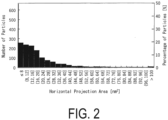
- a horizontal projection area of the nanodiamond aqueous dispersion was calculated by low-temperature electron microscopy (Cryo-TEM method, cryo-electron microscopy).
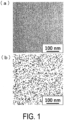
- the nanodiamond aqueous dispersion was frozen with liquid nitrogen, and a TEM image was obtained using an electronic microscope (Krios G4, manufactured by Thermo Fisher Scientific Inc.) ( FIG. 1 (a) ).
- the obtained TEM image was analyzed with Image J (particle size analysis software), and a horizontal projection area ( FIG. 2 ) was calculated from a binarized image ( FIG. 1(b) ). The results are listed in Table 1.
- FIG. 3(a) A TEM image ( FIG. 3(a) ) of a nanodiamond aqueous dispersion prepared in the same manner as in Example 1 except that no 1 M NaCl aqueous solution was used was obtained by low-temperature electron microscopy, and a horizontal projection area ( FIG. 4 ) was calculated from a binarized image ( FIG. 3(b) ) of the TEM image.
- Table 1 A TEM image ( FIG. 3(a) ) of a nanodiamond aqueous dispersion prepared in the same manner as in Example 1 except that no 1 M NaCl aqueous solution was used was obtained by low-temperature electron microscopy, and a horizontal projection area ( FIG. 4 ) was calculated from a binarized image ( FIG. 3(b) ) of the TEM image. The results are listed in Table 1.
- Example 1 A nanodiamond (unmodified with polyglycerin) aqueous dispersion described in Example 1 was prepared, a TEM image ( FIG. 5(a) ) was obtained by low-temperature electron microscopy, and a horizontal projection area ( FIG. 6 ) was calculated from a binarized image ( FIG. 5(b) ) of the TEM image. The results are listed in Table 1.
- Example 1 Percentage of projected area Division of projected area (nm 2 )
- Example 1 Comparative Example 1 Comparative Example 2 100 nm 2 or more 0.68% 21.90% 45.27% 80 nm 2 or more (including 100 nm 2 or more) 1.58% 24.38% 47.30% 50 nm 2 or more (including 80 nm 2 or more) 5.48% 30.02% 52.70% 30 nm 2 or more (including 50 nm 2 or more) 16.37% 39.95% 58.11%
- nanodiamond particles can be stably present in water in a highly dispersed state.
- nanodiamond particles having high dispersibility without clustered or chained nanodiamond particles can be stably present in water even when the dispersibility is evaluated by low-temperature electron microscopy.
Landscapes
- Chemical & Material Sciences (AREA)
- Organic Chemistry (AREA)
- Inorganic Chemistry (AREA)
- Life Sciences & Earth Sciences (AREA)
- General Life Sciences & Earth Sciences (AREA)
- Geology (AREA)
- Health & Medical Sciences (AREA)
- Chemical Kinetics & Catalysis (AREA)
- Medicinal Chemistry (AREA)
- Polymers & Plastics (AREA)
- Engineering & Computer Science (AREA)
- Materials Engineering (AREA)
- Nanotechnology (AREA)
- Carbon And Carbon Compounds (AREA)
Applications Claiming Priority (2)
| Application Number | Priority Date | Filing Date | Title |
|---|---|---|---|
| JP2021135080 | 2021-08-20 | ||
| PCT/JP2022/031474 WO2023022238A1 (ja) | 2021-08-20 | 2022-08-16 | ナノダイヤモンド水分散液 |
Publications (2)
| Publication Number | Publication Date |
|---|---|
| EP4389701A1 true EP4389701A1 (de) | 2024-06-26 |
| EP4389701A4 EP4389701A4 (de) | 2026-02-25 |
Family
ID=85239884
Family Applications (1)
| Application Number | Title | Priority Date | Filing Date |
|---|---|---|---|
| EP22858553.5A Pending EP4389701A4 (de) | 2021-08-20 | 2022-08-16 | Wässrige nanodiamantdispersion |
Country Status (6)
| Country | Link |
|---|---|
| US (1) | US20240351885A1 (de) |
| EP (1) | EP4389701A4 (de) |
| JP (1) | JP7850164B2 (de) |
| CN (1) | CN117794857A (de) |
| TW (1) | TW202321145A (de) |
| WO (1) | WO2023022238A1 (de) |
Family Cites Families (11)
| Publication number | Priority date | Publication date | Assignee | Title |
|---|---|---|---|---|
| JP5399118B2 (ja) | 2009-04-13 | 2014-01-29 | 株式会社ダイセル | 表面修飾ナノダイヤモンド及びその製造法 |
| JP5614643B2 (ja) | 2010-10-12 | 2014-10-29 | 国立大学法人滋賀医科大学 | サイズ制御された表面修飾ナノダイヤモンド |
| JP2017001916A (ja) * | 2015-06-11 | 2017-01-05 | 株式会社ダイセル | ナノダイヤモンド粉体製造方法およびナノダイヤモンド粉体 |
| JP6902015B2 (ja) * | 2016-02-17 | 2021-07-14 | 株式会社ダイセル | ナノダイヤモンド分散液、及びその製造方法 |
| JP6893769B2 (ja) * | 2016-10-28 | 2021-06-23 | 株式会社ダイセル | ナノダイヤモンド有機溶媒分散液、及びナノダイヤモンド有機溶媒分散液の製造方法 |
| JP7053153B2 (ja) * | 2016-11-11 | 2022-04-12 | ザ・キュレイターズ・オブ・ザ・ユニバーシティ・オブ・ミズーリ | ナノダイヤモンドの塩添加超音波脱凝集 |
| JP7304567B2 (ja) * | 2019-02-14 | 2023-07-07 | 株式会社ダイセル | ナノダイヤモンド分散組成物 |
| WO2020246500A1 (ja) * | 2019-06-05 | 2020-12-10 | 株式会社ダイセル | 表面修飾ナノダイヤモンド及び表面修飾ナノダイヤモンドの製造方法 |
| WO2021039521A1 (ja) * | 2019-08-30 | 2021-03-04 | 株式会社ダイセル | 表面修飾ナノダイヤモンドの製造法 |
| JP2021135080A (ja) | 2020-02-25 | 2021-09-13 | 株式会社東海理化電機製作所 | 磁場検出装置および磁場検出システム |
| CN114590807A (zh) * | 2020-12-03 | 2022-06-07 | 深圳先进技术研究院 | 一种具有小粒径的纳米金刚石分散水溶液的制备方法 |
-
2022
- 2022-08-16 EP EP22858553.5A patent/EP4389701A4/de active Pending
- 2022-08-16 JP JP2023542467A patent/JP7850164B2/ja active Active
- 2022-08-16 WO PCT/JP2022/031474 patent/WO2023022238A1/ja not_active Ceased
- 2022-08-16 CN CN202280053502.3A patent/CN117794857A/zh active Pending
- 2022-08-16 US US18/684,358 patent/US20240351885A1/en active Pending
- 2022-08-18 TW TW111131167A patent/TW202321145A/zh unknown
Also Published As
| Publication number | Publication date |
|---|---|
| WO2023022238A1 (ja) | 2023-02-23 |
| TW202321145A (zh) | 2023-06-01 |
| EP4389701A4 (de) | 2026-02-25 |
| JP7850164B2 (ja) | 2026-04-22 |
| CN117794857A (zh) | 2024-03-29 |
| JPWO2023022238A1 (de) | 2023-02-23 |
| US20240351885A1 (en) | 2024-10-24 |
Similar Documents
| Publication | Publication Date | Title |
|---|---|---|
| JP7447135B2 (ja) | グラフェン炭素ナノ粒子及び分散剤樹脂を含有する分散液 | |
| US12534374B2 (en) | Surface-modified nanodiamond and method for producing surface-modified nanodiamond | |
| US12378122B2 (en) | Surface-modified nanodiamond, nanodiamond dispersion composition, and surface-modified nanodiamond production method | |
| WO2020246501A1 (ja) | 電池用電解液及びリチウムイオン電池 | |
| Shu et al. | Electrolytes with reversible switch between liquid and solid phases | |
| EP4389701A1 (de) | Wässrige nanodiamantdispersion | |
| JP2018030741A (ja) | 表面修飾ナノダイヤモンド、前記表面修飾ナノダイヤモンドを含む分散液及び複合材料 | |
| WO2022176708A1 (ja) | ナノ炭素材料分散組成物 | |
| US12103855B2 (en) | Surface-modified nanodiamond, liquid dispersion containing surface-modified nanodiamond, and composite material | |
| Kumar et al. | Functionalization and surface modification strategies of nanofillers: Dispersion state and specific interaction between functionalized nanofillers and polymeric systems | |
| WO2020095581A1 (ja) | ナノダイヤモンド分散組成物 | |
| JP6800445B2 (ja) | 表面修飾ナノダイヤモンド、前記表面修飾ナノダイヤモンドを含む分散液、及び複合材料 | |
| EP4269339A1 (de) | Verfahren zur herstellung einer nanodiamantdispersionszusammensetzung und nanodiamantdispersionszusammensetzung | |
| US11939222B2 (en) | Nanodiamond particle dispersion | |
| WO2020158885A1 (ja) | 非水系二次電池用電極活物質及びその製造方法 | |
| RU2780325C1 (ru) | Поверхностно-модифицированный наноалмаз, дисперсная композиция наноалмаза и способ производства поверхностно-модифицированного наноалмаза | |
| Park et al. | Synthesis and characterization of nanocomposite of multi-walled carbon nanotube and polyaniline nanoparticle | |
| JP2024027659A (ja) | リチウム金属電池用電解液、リチウム金属電池、及び電気機器 | |
| Santos et al. | Influence of blending protocol on the thermal and electrical properties of HDPE/LLDPE/CNT nanocomposites |
Legal Events
| Date | Code | Title | Description |
|---|---|---|---|
| STAA | Information on the status of an ep patent application or granted ep patent |
Free format text: STATUS: THE INTERNATIONAL PUBLICATION HAS BEEN MADE |
|
| PUAI | Public reference made under article 153(3) epc to a published international application that has entered the european phase |
Free format text: ORIGINAL CODE: 0009012 |
|
| STAA | Information on the status of an ep patent application or granted ep patent |
Free format text: STATUS: REQUEST FOR EXAMINATION WAS MADE |
|
| 17P | Request for examination filed |
Effective date: 20240319 |
|
| AK | Designated contracting states |
Kind code of ref document: A1 Designated state(s): AL AT BE BG CH CY CZ DE DK EE ES FI FR GB GR HR HU IE IS IT LI LT LU LV MC MK MT NL NO PL PT RO RS SE SI SK SM TR |
|
| DAV | Request for validation of the european patent (deleted) | ||
| DAX | Request for extension of the european patent (deleted) | ||
| A4 | Supplementary search report drawn up and despatched |
Effective date: 20260123 |
|
| RIC1 | Information provided on ipc code assigned before grant |
Ipc: C01B 32/28 20170101AFI20260119BHEP Ipc: B82Y 30/00 20110101ALI20260119BHEP Ipc: C01B 32/15 20170101ALI20260119BHEP Ipc: C08L 71/08 20060101ALI20260119BHEP Ipc: C08K 3/04 20060101ALI20260119BHEP Ipc: C08L 71/00 20060101ALI20260119BHEP |