EP4371995A1 - Neuartige verbindung, elektrolytlösung für sekundärbatterie damit und sekundärbatterie damit - Google Patents
Neuartige verbindung, elektrolytlösung für sekundärbatterie damit und sekundärbatterie damit Download PDFInfo
- Publication number
- EP4371995A1 EP4371995A1 EP21950282.0A EP21950282A EP4371995A1 EP 4371995 A1 EP4371995 A1 EP 4371995A1 EP 21950282 A EP21950282 A EP 21950282A EP 4371995 A1 EP4371995 A1 EP 4371995A1
- Authority
- EP
- European Patent Office
- Prior art keywords
- unsubstituted
- substituted
- secondary battery
- electrolyte
- compound
- Prior art date
- Legal status (The legal status is an assumption and is not a legal conclusion. Google has not performed a legal analysis and makes no representation as to the accuracy of the status listed.)
- Granted
Links
Images
Classifications
-
- H—ELECTRICITY
- H01—ELECTRIC ELEMENTS
- H01M—PROCESSES OR MEANS, e.g. BATTERIES, FOR THE DIRECT CONVERSION OF CHEMICAL ENERGY INTO ELECTRICAL ENERGY
- H01M10/00—Secondary cells; Manufacture thereof
- H01M10/05—Accumulators with non-aqueous electrolyte
- H01M10/056—Accumulators with non-aqueous electrolyte characterised by the materials used as electrolytes, e.g. mixed inorganic/organic electrolytes
- H01M10/0564—Accumulators with non-aqueous electrolyte characterised by the materials used as electrolytes, e.g. mixed inorganic/organic electrolytes the electrolyte being constituted of organic materials only
- H01M10/0566—Liquid materials
- H01M10/0567—Liquid materials characterised by the additives
-
- C—CHEMISTRY; METALLURGY
- C07—ORGANIC CHEMISTRY
- C07F—ACYCLIC, CARBOCYCLIC OR HETEROCYCLIC COMPOUNDS CONTAINING ELEMENTS OTHER THAN CARBON, HYDROGEN, HALOGEN, OXYGEN, NITROGEN, SULFUR, SELENIUM OR TELLURIUM
- C07F9/00—Compounds containing elements of Groups 5 or 15 of the Periodic Table
- C07F9/02—Phosphorus compounds
- C07F9/547—Heterocyclic compounds, e.g. containing phosphorus as a ring hetero atom
- C07F9/6596—Heterocyclic compounds, e.g. containing phosphorus as a ring hetero atom having atoms other than oxygen, sulfur, selenium, tellurium, nitrogen or phosphorus as ring hetero atoms
-
- H—ELECTRICITY
- H01—ELECTRIC ELEMENTS
- H01M—PROCESSES OR MEANS, e.g. BATTERIES, FOR THE DIRECT CONVERSION OF CHEMICAL ENERGY INTO ELECTRICAL ENERGY
- H01M10/00—Secondary cells; Manufacture thereof
- H01M10/05—Accumulators with non-aqueous electrolyte
- H01M10/052—Li-accumulators
-
- H—ELECTRICITY
- H01—ELECTRIC ELEMENTS
- H01M—PROCESSES OR MEANS, e.g. BATTERIES, FOR THE DIRECT CONVERSION OF CHEMICAL ENERGY INTO ELECTRICAL ENERGY
- H01M10/00—Secondary cells; Manufacture thereof
- H01M10/05—Accumulators with non-aqueous electrolyte
- H01M10/056—Accumulators with non-aqueous electrolyte characterised by the materials used as electrolytes, e.g. mixed inorganic/organic electrolytes
- H01M10/0564—Accumulators with non-aqueous electrolyte characterised by the materials used as electrolytes, e.g. mixed inorganic/organic electrolytes the electrolyte being constituted of organic materials only
- H01M10/0566—Liquid materials
- H01M10/0568—Liquid materials characterised by the solutes
-
- H—ELECTRICITY
- H01—ELECTRIC ELEMENTS
- H01M—PROCESSES OR MEANS, e.g. BATTERIES, FOR THE DIRECT CONVERSION OF CHEMICAL ENERGY INTO ELECTRICAL ENERGY
- H01M10/00—Secondary cells; Manufacture thereof
- H01M10/05—Accumulators with non-aqueous electrolyte
- H01M10/056—Accumulators with non-aqueous electrolyte characterised by the materials used as electrolytes, e.g. mixed inorganic/organic electrolytes
- H01M10/0564—Accumulators with non-aqueous electrolyte characterised by the materials used as electrolytes, e.g. mixed inorganic/organic electrolytes the electrolyte being constituted of organic materials only
- H01M10/0566—Liquid materials
- H01M10/0569—Liquid materials characterised by the solvents
-
- C—CHEMISTRY; METALLURGY
- C07—ORGANIC CHEMISTRY
- C07C—ACYCLIC OR CARBOCYCLIC COMPOUNDS
- C07C211/00—Compounds containing amino groups bound to a carbon skeleton
- C07C211/01—Compounds containing amino groups bound to a carbon skeleton having amino groups bound to acyclic carbon atoms
- C07C211/02—Compounds containing amino groups bound to a carbon skeleton having amino groups bound to acyclic carbon atoms of an acyclic saturated carbon skeleton
- C07C211/03—Monoamines
- C07C211/05—Mono-, di- or tri-ethylamine
-
- C—CHEMISTRY; METALLURGY
- C07—ORGANIC CHEMISTRY
- C07F—ACYCLIC, CARBOCYCLIC OR HETEROCYCLIC COMPOUNDS CONTAINING ELEMENTS OTHER THAN CARBON, HYDROGEN, HALOGEN, OXYGEN, NITROGEN, SULFUR, SELENIUM OR TELLURIUM
- C07F9/00—Compounds containing elements of Groups 5 or 15 of the Periodic Table
- C07F9/02—Phosphorus compounds
- C07F9/547—Heterocyclic compounds, e.g. containing phosphorus as a ring hetero atom
-
- C—CHEMISTRY; METALLURGY
- C07—ORGANIC CHEMISTRY
- C07F—ACYCLIC, CARBOCYCLIC OR HETEROCYCLIC COMPOUNDS CONTAINING ELEMENTS OTHER THAN CARBON, HYDROGEN, HALOGEN, OXYGEN, NITROGEN, SULFUR, SELENIUM OR TELLURIUM
- C07F9/00—Compounds containing elements of Groups 5 or 15 of the Periodic Table
- C07F9/02—Phosphorus compounds
- C07F9/547—Heterocyclic compounds, e.g. containing phosphorus as a ring hetero atom
- C07F9/6564—Heterocyclic compounds, e.g. containing phosphorus as a ring hetero atom having phosphorus atoms, with or without nitrogen, oxygen, sulfur, selenium or tellurium atoms, as ring hetero atoms
-
- H—ELECTRICITY
- H01—ELECTRIC ELEMENTS
- H01M—PROCESSES OR MEANS, e.g. BATTERIES, FOR THE DIRECT CONVERSION OF CHEMICAL ENERGY INTO ELECTRICAL ENERGY
- H01M10/00—Secondary cells; Manufacture thereof
- H01M10/05—Accumulators with non-aqueous electrolyte
- H01M10/052—Li-accumulators
- H01M10/0525—Rocking-chair batteries, i.e. batteries with lithium insertion or intercalation in both electrodes; Lithium-ion batteries
-
- Y—GENERAL TAGGING OF NEW TECHNOLOGICAL DEVELOPMENTS; GENERAL TAGGING OF CROSS-SECTIONAL TECHNOLOGIES SPANNING OVER SEVERAL SECTIONS OF THE IPC; TECHNICAL SUBJECTS COVERED BY FORMER USPC CROSS-REFERENCE ART COLLECTIONS [XRACs] AND DIGESTS
- Y02—TECHNOLOGIES OR APPLICATIONS FOR MITIGATION OR ADAPTATION AGAINST CLIMATE CHANGE
- Y02E—REDUCTION OF GREENHOUSE GAS [GHG] EMISSIONS, RELATED TO ENERGY GENERATION, TRANSMISSION OR DISTRIBUTION
- Y02E60/00—Enabling technologies; Technologies with a potential or indirect contribution to GHG emissions mitigation
- Y02E60/10—Energy storage using batteries
Definitions
- the present invention relates to a novel compound, an electrolyte for a secondary battery including the compound, and a secondary battery including the electrolyte.
- a secondary battery is a battery which can be repeatedly charged and discharged, and has been applied to small electronic devices such as a mobile phone, a laptop computer, etc., as a power source thereof.
- a lithium secondary battery has a high operating voltage and a high energy density, and is advantageous in terms of a rapid charging speed and light weight.
- the lithium secondary battery is applied to electric vehicles as well as small electronic devices as a power source thereof.
- the lithium secondary battery in order for the lithium secondary battery to be used as a power source for an electric vehicle, it should have better output characteristics and life-span characteristics.
- the lithium secondary battery may include an anode including an anode active material (e.g., graphite); a cathode including a cathode active material (e.g., lithium metal oxide particles); and a non-aqueous electrolyte including a lithium salt and an organic solvent.
- anode active material e.g., graphite
- a cathode including a cathode active material e.g., lithium metal oxide particles
- a non-aqueous electrolyte including a lithium salt and an organic solvent.
- a process of intercalating and deintercalating lithium ions from lithium metal oxide particles and graphite is repeated, such that charging and discharging may be performed.
- the output characteristics and life-span characteristics of the lithium secondary battery may be improved by varying the composition of the electrolyte.
- the output characteristics of the lithium secondary battery may be improved by enhancing the conductivity of lithium ions.
- the life-span characteristics of the lithium secondary battery may be improved by firmly forming a solid electrolyte interface (SEI) film on the anode.
- SEI solid electrolyte interface
- Korean Patent Registration Publication No. 10-1999615 discloses an electrolyte for a lithium secondary battery, which can improve the life-span characteristics of the lithium secondary battery.
- An object of the present invention is to provide a novel compound.
- another object of the present invention is to provide an electrolyte including the compound for a lithium secondary battery, which may improve life-span characteristics (e.g., capacity retention rate during repeated charging and discharging), output characteristics, and the like of the lithium secondary battery.
- life-span characteristics e.g., capacity retention rate during repeated charging and discharging
- Another object of the present invention is to provide a lithium secondary battery including the electrolyte, which has improved life-span characteristics, output characteristics and the like.
- R 1 is a substituted or unsubstituted C1-C6 alkyl group; a substituted or unsubstituted C2-C6 alkenyl group; a substituted or unsubstituted C2-C6 alkynyl group; a substituted or unsubstituted C3-C7 cycloalkyl group; a substituted or unsubstituted C3-C7 cycloalkenyl group; or -OR 1 ; R 2 to R 5 are each independently halogen; or a substituted or unsubstituted C1-C6 alkyl group, M is alkali metal, and Y + is a cationic material.
- R 1 may be a substituted or unsubstituted C1-C6 alkyl group; or a substituted or unsubstituted C2-C6 alkenyl group, at least one of R 2 to R 5 may be halogen, M may be Li, Na or K; and Y + may be N + RaRbRcRd, and at least one of Ra to Rd may be hydrogen.
- R 1 may be a substituted or unsubstituted C2-C6 alkenyl group, all of R 2 to R 5 may be halogen, M may be Li, Y + may be N + RaRbRcRd, Ra may be hydrogen, and Rb to Rd may be each independently a C1-C3 alkyl group.
- R 1 is a substituted or unsubstituted C1-C6 alkyl group; a substituted or unsubstituted C2-C6 alkenyl group; a substituted or unsubstituted C2-C6 alkynyl group; a substituted or unsubstituted C3-C7 cycloalkyl group; a substituted or unsubstituted C3-C7 cycloalkenyl group; or -OR 1 , and Y + is a cationic material.
- R 2 and R3 are each independently halogen; or a substituted or unsubstituted C1-C6 alkyl group, and M + is an alkali metal ion.
- an electrolyte for a lithium secondary battery including: a lithium salt; an organic solvent; and a compound represented by Formula 1 above.
- a content of the compound represented by Formula 1 may be 0.01 to 10% by weight based on a total weight of the electrolyte.
- the organic solvent includes at least one of a linear carbonate-based solvent, a cyclic carbonate-based solvent, a linear ester-based solvent, a cyclic ester-based solvent, an ether-based solvent, a ketone-based solvent, an alcohol-based solvent, and an aprotic solvent.
- the electrolyte may further include an auxiliary additive including at least one of a fluorine-containing cyclic carbonate-based compound, a vinyl group-containing cyclic carbonate-based compound, a vinylene carbonate-based compound, a cyclic sulfate-based compound, a sultone-based compound, a fluorine-containing lithium phosphate-based compound, a lithium borate-based compound, a lactone-based compound and a sulfonyl imide-based compound.
- an auxiliary additive including at least one of a fluorine-containing cyclic carbonate-based compound, a vinyl group-containing cyclic carbonate-based compound, a vinylene carbonate-based compound, a cyclic sulfate-based compound, a sultone-based compound, a fluorine-containing lithium phosphate-based compound, a lithium borate-based compound, a lactone-based compound and a sulfonyl imide-based compound.
- a content of the auxiliary additive may be 0.01 to 10% by weight based on the total weight of the electrolyte.
- a ratio of the content of the auxiliary additive to the content of the compound represented by Formula 1 in the electrolyte may be 0.1 to 10.
- a lithium secondary battery including: a cathode; an anode disposed to face the cathode; a separation membrane interposed between the cathode and the anode; and the electrolyte for a lithium secondary battery according to exemplary embodiments.
- the compound represented by Formula 1 may be included in the electrolyte for a lithium secondary battery.
- the electrolyte for a lithium secondary battery may include the compound represented by Formula 1, such that life-span characteristics (e.g., capacity retention rate during repeated charging and discharging) and output characteristics of the lithium secondary battery may be improved.
- life-span characteristics e.g., capacity retention rate during repeated charging and discharging
- output characteristics of the lithium secondary battery may be improved.
- a novel compound represented by Formula 1 an electrolyte for a lithium secondary battery including the compound, and a lithium secondary battery including the electrolyte.
- the "X-based compound” may refer to a compound including an X unit in a matrix, a pendant group or a substituent.
- Ca-Cb may refer to "the number of carbon atoms of a to b.”
- the "5- to 7-membered rings” may refer to the case where "the number of atoms in the ring is 5 to 7.”
- novel compound according to the present invention may be represented by Formula 1 below.
- R 1 may be a substituted or unsubstituted C1-C6 alkyl group; a substituted or unsubstituted C2-C6 alkenyl group; a substituted or unsubstituted C2-C6 alkynyl group; a substituted or unsubstituted C3-C7 cycloalkyl group; a substituted or unsubstituted C3-C7 cycloalkenyl group; or -OR 1 .
- R 2 to R 5 may be each independently halogen; or a substituted or unsubstituted C1-C6 alkyl group.
- M may be alkali metal, and Y + may be a cationic material.
- bonds " between phosphorus (P) and oxygen (O); and between sulfur (S) and oxygen (O) may represent that some electrons are delocalized.
- substituted may mean that a hydrogen atom is substituted with an optional substituent, such that the optional substituent is further bonded to the corresponding substituent.
- the optional substituent may be a halogen, a C1-C6 alkyl group, a C2-C6 alkenyl group, a C2-C6 alkynyl group, a C1-C6 alkoxy group, a nitro group, a cyano group and the like.
- the optional substituent may be a halogen or a C1-C6 alkyl group.
- R 1 may be a substituted or unsubstituted C1-C6 alkyl group; or a substituted or unsubstituted C2-C6 alkenyl group.
- R 1 may be a substituted or unsubstituted C2-C6 alkenyl group. In some embodiments, R 1 may be an unsubstituted C2-C6 alkenyl group.
- At least one of R 2 to R 5 may be halogen (e.g., F, Cl, Br or I). In some embodiments, at least one of R 2 to R 5 may be F.
- all of R 2 to R 5 may be halogen. In some embodiments, all of R 2 to R 5 may be F.
- M may be Li, Na or K.
- Y + may be an alkali metal ion; an ammonium ion; or primary to quaternary ammonium ions.
- Ra to Rd may be each independently hydrogen; a substituted or unsubstituted C1-C6 alkyl group; or a substituted or unsubstituted C2-C6 alkenyl group.
- at least two of Ra to Rd may be bonded to each other to form 5- to 7-membered hetero rings.
- Re to Rh may be each independently hydrogen; a substituted or unsubstituted C1-C6 alkyl group; or a substituted or unsubstituted C2-C6 alkenyl group.
- at least two of Re to Rh may be bonded to each other to form 5- to 7-membered hetero rings.
- Y + may be N + RaRbRcRd, and at least one of Ra to Rd may be hydrogen.
- Y + may be N + RaRbRcRd, Ra may be hydrogen, and Rb to Rd may be each independently a C1-C3 alkyl group.
- the compound of Formula 1 may be prepared by reacting a sulfonate-based salt or a sulfate-based salt with an alkali metal phosphate-based salt.
- the sulfonate-based salt or sulfate-based salt may be represented by Formula 2 below.
- R 1 may be a substituted or unsubstituted C1-C6 alkyl group; a substituted or unsubstituted C2-C6 alkenyl group; a substituted or unsubstituted C2-C6 alkynyl group; a substituted or unsubstituted C3-C7 cycloalkyl group; a substituted or unsubstituted C3-C7 cycloalkenyl group; or -OR 1 .
- Y + may be a cationic material.
- R 1 may be a substituted or unsubstituted C1-C6 alkyl group; or a substituted or unsubstituted C2-C6 alkenyl group.
- R 1 may be a substituted or unsubstituted C2-C6 alkenyl group. In some embodiments, R 1 may be an unsubstituted C2-C6 alkenyl group.
- Y + may be an alkali metal ion; an ammonium ion; or primary to quaternary ammonium ions.
- Ra to Rd may be each independently hydrogen; a substituted or unsubstituted C1-C6 alkyl group; or a substituted or unsubstituted C2-C6 alkenyl group.
- at least two of Ra to Rd may be bonded to each other to form 5- to 7-membered hetero rings.
- Re to Rh may be each independently hydrogen; a substituted or unsubstituted C1-C6 alkyl group; or a substituted or unsubstituted C2-C6 alkenyl group.
- at least two of Re to Rh may be bonded to each other to form 5- to 7-membered hetero rings.
- Y + may be N + RaRbRcRd, and at least one of Ra to Rd may be hydrogen.
- Y + may be N + RaRbRcRd, Ra may be hydrogen, and Rb to Rd may be each independently a C1-C3 alkyl group.
- Ra may be a substituted or unsubstituted C1-C6 alkyl group; or a substituted or unsubstituted C2-C6 alkenyl group.
- Ra may be a substituted or unsubstituted C2-C6 alkenyl group. In some embodiments, Ra may be an unsubstituted C2-C6 alkenyl group.
- the alkali metal phosphate-based salt may be represented by Formula 3 below.
- R 2 and R3 may be each independently halogen (e.g., F, Cl, Br or I); or a substituted or unsubstituted C1-C6 alkyl group.
- At least one of R 2 and R 3 may be halogen. In some embodiments, at least one of R 2 and R 3 may be F.
- both of R 2 and R 3 may be halogen. In some embodiments, both of R 2 and R 3 may be F.
- crystals generated by reacting the sulfonate-based salt or sulfate-based salt with the alkali metal phosphate-based salt may be filtered and dried to obtain the compound represented by Formula 1.
- the reaction temperature may be 10 to 50 °C.
- a mixing molar ratio of the sulfonate-based salt or sulfate-based salt with the alkali metal phosphate-based salt may be 1:0.9 to 1:1.1.
- an electrolyte for a lithium secondary battery including the compound represented by Formula 1 above.
- the compound represented by Formula 1 may be provided as an additive of the electrolyte for a lithium secondary battery.
- the lithium secondary battery according to the exemplary embodiments may include the electrolyte for a lithium secondary battery, such that life-span characteristics (e.g., capacity retention rate during repeated charging and discharging), output characteristics, and the like may be improved.
- life-span characteristics e.g., capacity retention rate during repeated charging and discharging
- output characteristics e.g., output characteristics, and the like
- the compound represented by Formula 1 may be reduced and decomposed at a voltage of about 2.1 V to form a solid electrolyte interface (SEI) film on the surface of an anode.
- SEI solid electrolyte interface
- the SEI film may suppress decomposition of an organic solvent (e.g., ethylene carbonate, etc.) generated at a voltage of 2.9 V. Accordingly, the life-span characteristics of the lithium secondary battery may be improved.
- the compound represented by Formula 1 may reduce a cathode interface resistance. Accordingly, the output characteristics of the lithium secondary battery may be improved.
- the electrolyte for a lithium secondary battery may include a lithium salt (however, the lithium salt form of the compound represented by Formula 1 is excluded); an organic solvent; and the compound represented by Formula 1.
- a content of the compound represented by Formula 1 may be 0.01 to 10% by weight ("wt.%”), preferably 0.1 to 7.5 wt.%, and more preferably 0.3 to 5 wt.% based on a total weight of the electrolyte. Within the above range, the life-span characteristics and output characteristics of the lithium secondary battery may be further improved.
- the compound represented by Formula 1 may exist as a monomer in the electrolyte, and may exist in the form of a dimer (e.g., see Formula 4 below, substituents will not be described), a trimer, or a multimer such as a tetramer or more.
- a dimer e.g., see Formula 4 below, substituents will not be described
- a trimer e.g., a trimer
- a multimer such as a tetramer or more.
- the electrolyte for a lithium secondary battery may further include an auxiliary additive to further improve the life-span characteristics and output characteristics of the lithium secondary battery, or to improve high temperature storage characteristics and the like.
- the auxiliary additive may include a fluorine-containing cyclic carbonate-based compound, a vinyl group-containing cyclic carbonate-based compound, a vinylene carbonate-based compound, a cyclic sulfate-based compound, a sultone-based compound, a fluorine-containing lithium phosphate-based compound, a lithium borate-based compound, a lactone-based compound, a sulfonyl imide-based compound and the like.
- a content of the auxiliary additive may be 0.01 to 10 wt.%, 0.1 to 7.5 wt.%, or 0.3 to 5 wt.% based on the total weight of the electrolyte. Within the above range, the life-span characteristics, the output characteristics, the high temperature storage characteristics, and the like of the lithium secondary battery may be further improved.
- a ratio of the content of the auxiliary additive to the content of the compound represented by Formula 1 in the total weight of the electrolyte may be 0.1 to 10, preferably 0.1 to 7, and more preferably 0.5 to 5.
- the fluorine-containing cyclic carbonate-based compound may have a 5- to 7-membered cyclic structure.
- a fluorine atom may be directly bonded to a carbon atom, or a fluorine-substituted alkyl group (e.g., -CF 3 , etc.) may be bonded thereto.
- the fluorine-containing cyclic carbonate-based compound may include fluoroethylene carbonate (FEC) and the like.
- FEC fluoroethylene carbonate
- a content of the fluorine-containing cyclic carbonate-based compound may be 0.01 to 2 wt.%, or 0.1 to 1 wt.% based on the total weight of the electrolyte.
- the vinyl group-containing cyclic carbonate-based compound may include vinyl ethylene carbonate (VEC) and the like.
- VEC vinyl ethylene carbonate
- VC vinylene carbonate
- a content of the vinyl group-containing cyclic carbonate-based compound may be 0.01 to 2 wt.%, or 0.1 to 1 wt.% based on the total weight of the electrolyte.
- a content of the vinylene carbonate-based compound may be 0.01 to 2 wt.%, or 0.1 to 1 wt.% based on the total weight of the electrolyte.
- the cyclic sulfate-based compound may have a 5- to 7-membered cyclic structure.
- the cyclic sulfate-based compound may include ethylene sulfate (ESA), trimethylene sulfate (TMS), methyltrimethylene sulfate (MTMS), 1,3-propanediol cyclic sulfate and the like.
- the cyclic sulfate-based compound may include a bicyclic sulfate-bated compound.
- the bicyclic sulfate-based compound may include 2,4,8,10-Tetraoxa-3,9-dithiaspiro[5.5]undecane 3,3,9,9-tetraoxide, 4,4'-bi(1,3,2-dioxathiolane)]2,2,2',2'-tetraoxide and the like.
- a content of the cyclic sulfate-based compound may be 0.01 to 2 wt.%, or 0.1 to 1 wt.% based on the total weight of the electrolyte.
- the sultone-based compound may have a 5- to 7-membered cyclic structure.
- the sultone-based compound may include at least one of an alkyl sultone-based compound and an alkenyl sultone-based compound.
- the alkyl sultone-based compound may have only a saturated bond in a ring, and the alkenyl sultone-based compound may include a double bond in the ring.
- the alkyl sultone-based compound may include 1,3-propane sultone (PS), 1,4-butane sultone and the like.
- the alkenyl sultone-based compound may include ethene sultone, 1,3-propene sultone (PRS), 1,4-butene sultone, 1-methyl-1,3-propene sultone and the like.
- a content of the sultone-based compound may be 0.01 to 2 wt.%, or 0.1 to 1 wt.% based on the total weight of the electrolyte.
- a fluorine atom may be directly bonded to a phosphorus atom, or a fluorine-substituted alkyl group (e.g., -CF 3 ) may be bonded thereto.
- a fluorine-substituted alkyl group e.g., -CF 3
- the fluorine-containing lithium phosphate-based compound may include lithium difluorophosphate, lithium tetrafluoro oxalate phosphate, lithium difluorobis(oxalato)phosphate and the like.
- a content of the fluorine-containing lithium phosphate-based compound may be 0.01 to 2 wt.%, or 0.1 to 1 wt.% based on the total weight of the electrolyte.
- the lithium borate-based compound may include lithium tetraphenylborate, lithium bis(oxalato)borate (LiBOB), lithium difluoro(oxalato)borate (LiFOB) and the like.
- a content of the lithium borate-based compound may be 0.01 to 2 wt.%, or 0.1 to 1 wt.% based on the total weight of the electrolyte.
- the lactone-based compound may include at least one of a bicyclo lactone-based compound and a lactone-based compound including a double bond in a ring.
- the lactone-based compound may include muconic lactone and the like.
- a content of the lactone-based compound may be 0.01 to 2 wt.%, or 0.1 to 1 wt.% based on the total weight of the electrolyte.
- the sulfonyl imide-based compound may include lithium bis(fluorosulfonyl)imide and the like.
- a content of the sulfonyl imide-based compound may be 0.01 to 2 wt.%, or 0.1 to 1 wt.% based on the total weight of the electrolyte.
- the organic solvent may have sufficient solubility to the lithium salt, the compound represented by Formula 1, and the auxiliary additive.
- the organic solvent may be a non-aqueous organic solvent.
- the organic solvent may include a carbonate-based solvent, an ester-based (carboxylate-based) solvent, an ether-based solvent, a ketone-based solvent, an alcohol-based solvent, an aprotic solvent and the like.
- the carbonate-based solvent may include a linear carbonate-based solvent and a cyclic carbonate-based solvent.
- the linear carbonate-based solvent may include dimethyl carbonate (DMC), ethyl methyl carbonate (EMC), diethyl carbonate (DEC), methyl propyl carbonate, ethyl propyl carbonate, dipropyl carbonate and the like.
- DMC dimethyl carbonate
- EMC ethyl methyl carbonate
- DEC diethyl carbonate
- methyl propyl carbonate ethyl propyl carbonate
- dipropyl carbonate dipropyl carbonate and the like.
- the cyclic carbonate-based solvent may include ethylene carbonate (EC), propylene carbonate (PC), butylene carbonate and the like.
- the organic solvent may include the linear carbonate-based solvent more than the cyclic carbonate-based solvent based on a volume.
- a volume ratio of the cyclic carbonate-based solvent to the linear carbonate-based solvent may be 1:1 to 9:1, and preferably 1.5:1 to 4:1.
- the ester-based solvent may include a linear ester-based solvent and a cyclic ester-based solvent.
- the linear ester-based solvent may include methyl propionate, ethyl propionate, propyl acetate, butyl acetate, ethyl acetate and the like.
- the cyclic ester-based solvent may include butyrolactone, caprolactone, valerolactone and the like.
- the ether-based solvent may include at least one of dibutyl ether, tetraethylene glycol dimethyl ether (TEGDME), diethylene glycol dimethyl ether (DEGDME), dimethoxyethane, tetrahydrofuran (THF), and 2-methyltetrahydrofuran.
- TEGDME tetraethylene glycol dimethyl ether
- DEGDME diethylene glycol dimethyl ether
- THF tetrahydrofuran
- 2-methyltetrahydrofuran 2-methyltetrahydrofuran
- the ketone-based solvent may include cyclohexanone and the like.
- the alcohol-based solvent may include at least one of ethyl alcohol and isopropyl alcohol.
- the aprotic solvent may include at least one of a nitrile-based solvent, an amide-based solvent (e.g., dimethylformamide), a dioxolane-based solvent (e.g., 1,3-dioxolane), and a sulfolane-based solvent.
- a nitrile-based solvent e.g., dimethylformamide
- a dioxolane-based solvent e.g., 1,3-dioxolane
- sulfolane-based solvent e.g., 1,3-dioxolane
- the organic solvent may include the carbonate-based solvent
- the carbonate-based solvent may include at least one of ethylene carbonate (EC), ethylmethyl carbonate (EMC), dimethyl carbonate (DMC), and diethyl carbonate (DEC).
- the lithium salt may be represented by Li + X - .
- the anion (X-) of the lithium salt may include F - , Cl - , Br - , I - , NO 3 - , N(CN) 2 - , BF 4 -, ClO 4 - , PF 6 - , (CF 3 ) 2 PF 4 - , (CF 3 ) 3 PF 3 - , (CF 3 ) 4 PF 2 - , (CF 3 ) 5 PF - , (CF 3 ) 6 P - , CF 3 SO 3 - , CF 3 CF 2 SO 3 - , (CF 3 SO 2 ) 2 N - , (FSO 2 ) 2 N - ; CF 3 CF 2 (CF 3 ) 2 CO - , (CF 3 SO 2 ) 2 CH - , (SF 5 ) 3 C - , (CF 3 SO 2 ) 3 C - , CF 3 (CF 2 ) 7 SO 3 - , CF 3 CO 2
- the lithium salt may include LiPF 6 , LiBF 4 , LiSbF 6 , LiAsF 6 , LiClO 4 , LiN(C 2 F 5 SO 2 ) 2 , LiN(CF 3 SO 2 ) 2 , CF 3 SO 3 Li, LiC(CF 3 SO 2 ) 3 and the like.
- the lithium salt may be included in a concentration of 0.01 to 5 M, and preferably 0.01 to 2 M based on the organic solvent. Within the above concentration range, lithium ions and/or electrons may smoothly move during charging and discharging of the battery.
- a lithium secondary battery including the electrolyte for a lithium secondary battery.
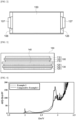
- FIGS. 2 and 3 are a schematic plan perspective view and a cross-sectional view of the lithium secondary battery according to exemplary embodiments, respectively.
- the lithium secondary battery may include a cathode 100 and an anode 130 disposed to face the cathode 100.
- the cathode 100 may include a cathode current collector 105 and a cathode active material layer 110 on the cathode current collector 105.
- the cathode active material layer 110 may include a cathode active material, and if necessary, a cathode binder and a conductive material.
- the cathode 100 may be prepared by mixing and stirring the cathode active material, the cathode binder, and the conductive material, etc. in the dispersion medium to prepare a cathode slurry, and then coating the cathode current collector 105 with the cathode slurry, followed by drying and rolling the same.
- the cathode current collector 105 may include stainless steel, nickel, aluminum, titanium, copper, or an alloy thereof.
- the cathode active material may include lithium metal oxide particles capable of reversibly intercalating and deintercalating lithium ions.
- the lithium metal oxide particles may contain nickel, cobalt, manganese, aluminum or the like.
- the lithium metal oxide particles may contain nickel, and a content of the nickel in the lithium metal oxide particles may be 80 mol% or more of all elements except for lithium and oxygen.
- the lithium metal oxide particles may be represented by LiNiO 2 , LiCoO 2 , LiMnO 2 , LiMn 2 O 4 , or Formula 5 below.
- LiNiO 2 LiCoO 2
- LiMnO 2 LiMn 2 O 4
- Formula 5 Formula 5 below.
- M may be at least one of Al, Zr, Ti, Cr, B, Mg, Mn, Ba, Si, Y, W and Sr, and x, y, a and b may be in a range of 0.9 ⁇ x ⁇ 1.2, 1.9 ⁇ y ⁇ 2.1, and 0 ⁇ a+ b ⁇ 0.5, respectively.
- a and b may satisfy 0 ⁇ a+b ⁇ 0.4, 0 ⁇ a+b ⁇ 0.3, 0 ⁇ a+b ⁇ 0.2 or 0 ⁇ a+b ⁇ 0.1.
- the cathode binder may include an organic binder such as polyvinylidene fluoride (PVDF), vinylidene fluoride-hexafluoropropylene copolymer (PVDF-co-HFP), polyacrylonitrile, polymethyl methacrylate, etc., or an aqueous binder such as styrene-butadiene rubber (SBR).
- the cathode binder may be used together with a thickener such as carboxymethyl cellulose (CMC).
- the conductive material may include a carbon-based conductive material such as graphite, carbon black, graphene, and carbon nanotubes; or a metal-based conductive material including tin, tin oxide, titanium oxide, or a perovskite material such as LaSrCoO3, and LaSrMnO3.
- a carbon-based conductive material such as graphite, carbon black, graphene, and carbon nanotubes
- a metal-based conductive material including tin, tin oxide, titanium oxide, or a perovskite material such as LaSrCoO3, and LaSrMnO3.
- the anode 130 may include an anode current collector 125 and an anode active material layer 120 on the anode current collector 125.
- the anode active material layer 120 may include an anode active material, and if necessary, an anode binder and a conductive material.
- the anode 130 may be prepared by mixing and stirring the anode active material, the anode binder, the conductive material, etc. in a solvent to prepare an anode slurry, and then coating the anode current collector 125 with the anode slurry, followed by drying and rolling the same.
- the anode current collector 125 may include gold, stainless steel, nickel, aluminum, titanium, copper or an alloy thereof, and preferably, includes copper or a copper alloy.
- the anode active material may be a material capable of intercalating and deintercalating lithium ions.
- the anode active material may include a lithium alloy, a carbon-based active material, a silicon-based active material and the like.
- the lithium alloy may include aluminum, zinc, bismuth, cadmium, antimony, silicon, lead, tin, gallium, indium and the like.
- the carbon-based active material may include crystalline carbon, amorphous carbon, carbon composite, carbon fiber and the like.
- the amorphous carbon may include hard carbon, cokes, mesocarbon microbead (MCMB) calcined at 1500°C or lower, mesophase pitch-based carbon fiber (MPCF) or the like.
- the crystalline carbon may include natural graphite, artificial graphite, graphite cokes, graphite MCMB, graphite MPCF and the like.
- the anode active material may include a silicon-based active material.
- the silicon-based active material may include Si, SiO x (0 ⁇ x ⁇ 2), Si/C, SiO/C, Si-Metal and the like.
- the anode binder and the conductive material may be substantially the same as or similar to the above-described cathode binder and the conductive material.
- the anode binder may be an aqueous binder such as styrene-butadiene rubber (SBR).
- SBR styrene-butadiene rubber
- the anode binder may be used together with a thickener such as carboxymethyl cellulose (CMC).
- a separation membrane 140 may be interposed between the cathode 100 and the anode 130.
- the anode 130 may have an area greater than that of the cathode 100. In this case, lithium ions generated from the cathode 100 may smoothly move to the anode 130 without precipitation in the middle.
- the separation membrane 140 may include a porous polymer film made of a polyolefin polymer such as ethylene homopolymer, propylene homopolymer, ethylene/butene copolymer, ethylene/hexene copolymer, ethylene/methacrylate copolymer or the like.
- the separation membrane 140 may include a nonwoven fabric made of glass fiber having a high melting point, polyethylene terephthalate fiber or the like.
- an electrode cell may be formed including the cathode 100, the anode 130, and the separation membrane 140.
- a plurality of electrode cells may be laminated to form an electrode assembly 150 (however, one electrode cell is shown in FIG. 3 for the convenience illustration).
- the electrode assembly 150 may be formed by winding, lamination, z-folding, etc. the separation membrane 140.
- the lithium secondary battery according to exemplary embodiments may include: a cathode lead 107 connected to the cathode 100 and protruding to an outside of a case 160; and an anode lead 127 connected to the anode 130 and protruding to the outside of the case 160.
- the cathode 100 and the cathode lead 107 may be electrically connected with each other.
- the anode 130 and the anode lead 127 may be electrically connected with each other.
- the cathode lead 107 may be electrically connected to the cathode current collector 105.
- the anode lead 127 may be electrically connected to the anode current collector 125.
- the cathode current collector 105 may include a protrusion part (a cathode tab 106) on one side.
- the cathode active material layer 110 may not be formed on the cathode tab 106.
- the cathode tab 106 may be formed integrally with the cathode current collector 105 or may be connected thereto by welding or the like.
- the cathode current collector 105 and the cathode lead 107 may be electrically connected with each other through the cathode tab 106.
- the anode current collector 125 may include a protrusion part (an anode tab 126) on one side.
- the anode active material layer 120 may not be formed on the anode tab.
- the anode tab 126 may be formed integrally with the anode current collector 125 or may be connected by welding or the like.
- the anode current collector 125 and the anode lead 127 may be electrically connected with each other through the anode tab 126.
- the electrode assembly 150 may include a plurality of cathodes and a plurality of anodes.
- the plurality of cathodes and the plurality of anodes may be disposed alternately with each other, and the separation membranes may be interposed between the cathodes and the anodes.
- the lithium secondary battery according to an embodiment of the present invention may include a plurality of cathode tabs and a plurality of anode tabs protruding from each of the plurality of cathodes and a plurality of anodes.
- the cathode tabs may be laminated, compressed, and welded to form a cathode tab laminate (or, an anode tab laminate).
- the cathode tab laminate may be electrically connected to the cathode lead 107.
- the anode tab laminate may be electrically connected to the anode lead 127.
- the electrode assembly 150 may be housed in the case 160 together with the electrolyte to form a lithium secondary battery.
- the lithium secondary battery may be manufactured, for example, in a cylindrical shape, a square shape, a pouch type or a coin shape.
- EC ethylene carbonate
- DMC dimethyl carbonate
- LiPO 2 F 2 lithium difluorophosphate
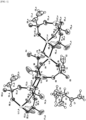
- the reaction was carried out by stirring the mixture in the reactor at room temperature for about 7 hours. After the reaction was completed, the resulting crystals were filtered, washed with DMC, and then vacuum-dried to obtain a white target product (yield about 90%).
- SC-XRD analysis data are described in Table 1 below.
- a 1.0 M LiPF 6 solution was prepared using a mixed solvent in which ethylene carbonate (EC) and ethyl methyl carbonate (EMC) were mixed in a ratio of 3:7 (v/v).
- EC ethylene carbonate
- EMC ethyl methyl carbonate
- Additives were added to the LiPF 6 solution in amounts according to Table 2 below based on the total weight of the electrolyte (100 wt.%), thus to prepare electrolytes of the examples and comparative examples.
- a cathode slurry was prepared by mixing and dispersing Li(Ni 0.6 Co 0.2 Mn 0.2 )O 2 , polyvinylidene fluoride (PVdF), and carbon black in N-methyl-2-pyrrolidone (NMP) in a weight ratio of 92:4:4.
- the cathode slurry was applied to an aluminum foil (thickness: 20 ⁇ m) having a protrusion part (hereinafter, a cathode tab) on one side (except for the protrusion part), then dried and rolled to prepare a cathode.
- a protrusion part hereinafter, a cathode tab
- An anode slurry was prepared by mixing and dispersing crystalline artificial graphite, acetylene black and PVDF in NMP in a weight ratio of 92:1:7.
- the anode slurry was applied to a copper foil (thickness: 15 ⁇ m) having a protrusion part (hereinafter, an anode tab) on one side (except for the protrusion part), then dried and rolled to prepare an anode.
- a protrusion part hereinafter, an anode tab
- a cell was formed by interposing a polyethylene separation membrane (thickness: 20 ⁇ m) between the cathode and the anode.
- a cathode lead and an anode lead were respectively welded and connected to the cathode tab and the anode tab, respectively.
- the cell was housed in a pouch so that some regions of the cathode lead and the anode lead were exposed to an outside.
- Example 1 Preparative example compound 0.5 wt.%
- Example 2 Preparative example compound 1.0 wt.%
- Example 3 Preparative example compound 1.0 wt.% + A-1 1 wt.%
- Example 4 Preparative example compound 1.0 wt.% + A-2 1 wt.%
- Example 5 Preparative example compound 1.0 wt.% + A-3 1 wt.%
- Example 6 Preparative example compound 1.0 wt.% + A-4 1 wt.%
- Example 7 Preparative example compound 1.0 wt.% + B-1 1 wt.%
- Example 8 Preparative example compound 1.0 wt.% + B-2 1 wt.%
- Example 9 Preparative example compound 1.0 wt.% + B-3 1 wt.%
- Example 10 Preparative example compound 1.0 wt.% + B-4 1 wt.%
- Example 11 Preparative example compound 1.0 wt.% + B-3 1 wt.
- the lithium secondary batteries of the examples and comparative examples were 1C CC/CV charged (4.2 V CUT-OFF), and 1C CC discharged (3 V CUT-OFF), then initial discharge capacity C1 was measured.
- the charging and discharging processes were repeatedly performed on the lithium secondary batteries of the examples and comparative examples 500 times, then the discharge capacity C2 at the 500th time was measured.
- the capacity retention rate was calculated by a percentage of C1 to C2 as follows.
- Capacity retention rate % C 2 / C 1 ⁇ 100 %
- the lithium secondary batteries of Example 2 and Comparative Example 1 were 0.2C CC/CV charged (4.2 V CUT-OFF), and 0.2C CC discharged (2.75 V CUT-OFF), then the charge/discharge capacity was differentiated by a voltage to deduce a relationship between the capacity curve and the voltage.
- the plotted differential capacity curve is illustrated in FIG. 4 .
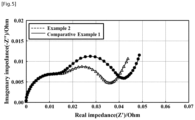
- the lithium secondary batteries of Example 2 and Comparative Example 1 were 1C CC/CV charged (4.2 V CUT-OFF), then AC impedance was measured using an impedance analyzer.
- the AC impedance graph is illustrated in FIG. 5 .
- the lithium secondary batteries of the examples and comparative examples were 1C CC/CV charged (4.2 V CUT-OFF), and then 2C CC discharged to 440 mA. Thereafter, the he lithium secondary batteries were discharged and supplementary charged for 10 seconds, respectively, while changing C-rate to 0.5C, 1C, 2C and 4C, then DCIR was measured.
- the lithium secondary batteries of Examples 1 and 2 exhibited the improved life-span characteristics and output characteristics compared to the lithium secondary batteries of Comparative Examples 1 and 17.
- the lithium secondary batteries of Examples 1 and 2 exhibited the improved capacity retention rate values of 3.9% to 6.4% compared to those of the lithium secondary batteries of Comparative Examples 1 and 17.
- the lithium secondary batteries of Examples 1 and 2 exhibited the improved output values of 7.5% to 13.4% compared to those of the lithium secondary batteries of Comparative Examples 1 and 17.
- the compound of the preparative example is reduced and decomposed at a voltage of 2.1 V to form a solid electrolyte interface (SEI) film on the anode to suppress the decomposition of ethylene carbonate (EC) generated at a voltage of 2.9 V, such that the performance of the lithium secondary battery is improved.
- SEI solid electrolyte interface
- the lithium secondary batteries of Examples 12 to 17 exhibited the improved output values of 4.7% to 7.0% compared to the lithium secondary batteries of Comparative Examples 11 to 16.
- the compound of Preparative Example 1 may modify the structure of the SEI film on the anode formed by additives C-1 to C-6. Thereby, the life-span characteristics and output characteristics of the lithium secondary battery may be further improved.
Landscapes
- Chemical & Material Sciences (AREA)
- Engineering & Computer Science (AREA)
- Chemical Kinetics & Catalysis (AREA)
- General Chemical & Material Sciences (AREA)
- Electrochemistry (AREA)
- Manufacturing & Machinery (AREA)
- Organic Chemistry (AREA)
- Inorganic Chemistry (AREA)
- Physics & Mathematics (AREA)
- General Physics & Mathematics (AREA)
- Condensed Matter Physics & Semiconductors (AREA)
- Health & Medical Sciences (AREA)
- Life Sciences & Earth Sciences (AREA)
- Biochemistry (AREA)
- General Health & Medical Sciences (AREA)
- Molecular Biology (AREA)
- Secondary Cells (AREA)
- Materials Engineering (AREA)
Applications Claiming Priority (3)
| Application Number | Priority Date | Filing Date | Title |
|---|---|---|---|
| KR20210092197 | 2021-07-14 | ||
| KR1020210166583A KR102371981B1 (ko) | 2021-07-14 | 2021-11-29 | 신규한 화합물, 이를 포함하는 이차 전지용 전해액 및 이를 포함하는 이차 전지 |
| PCT/KR2021/017825 WO2023286940A1 (ko) | 2021-07-14 | 2021-11-30 | 신규한 화합물, 이를 포함하는 이차 전지용 전해액 및 이를 포함하는 이차 전지 |
Publications (3)
| Publication Number | Publication Date |
|---|---|
| EP4371995A1 true EP4371995A1 (de) | 2024-05-22 |
| EP4371995A4 EP4371995A4 (de) | 2024-05-22 |
| EP4371995B1 EP4371995B1 (de) | 2025-10-08 |
Family
ID=80812309
Family Applications (1)
| Application Number | Title | Priority Date | Filing Date |
|---|---|---|---|
| EP21950282.0A Active EP4371995B1 (de) | 2021-07-14 | 2021-11-30 | Neuartige verbindung, elektrolytlösung für sekundärbatterie damit und sekundärbatterie damit |
Country Status (6)
| Country | Link |
|---|---|
| US (1) | US11848420B2 (de) |
| EP (1) | EP4371995B1 (de) |
| JP (1) | JP7417790B2 (de) |
| KR (1) | KR102371981B1 (de) |
| CN (1) | CN116323628B (de) |
| WO (2) | WO2023286885A1 (de) |
Families Citing this family (5)
| Publication number | Priority date | Publication date | Assignee | Title |
|---|---|---|---|---|
| CN116143666A (zh) * | 2023-02-13 | 2023-05-23 | 河北圣泰材料股份有限公司 | 乙烯磺酸二氟磷酸锂三乙胺盐(1:1:1)的制备方法 |
| KR102867463B1 (ko) * | 2023-08-22 | 2025-10-14 | 동화일렉트로라이트 주식회사 | 리튬 이차 전지 |
| CN117374388A (zh) * | 2023-11-14 | 2024-01-09 | 珠海冠宇电池股份有限公司 | 一种电解液及包括该电解液的电池 |
| CN121215888A (zh) * | 2024-06-24 | 2025-12-26 | 广州天赐高新材料股份有限公司 | 电解液添加剂、电解液和电池 |
| CN120473566B (zh) * | 2025-07-11 | 2025-10-28 | 广州天赐高新材料股份有限公司 | 电解液及锂离子电池 |
Family Cites Families (17)
| Publication number | Priority date | Publication date | Assignee | Title |
|---|---|---|---|---|
| DE60328219D1 (de) * | 2002-12-04 | 2009-08-13 | Ciba Holding Inc | Verfahren zur synthese von cycloorganylphosphanen und von di(alkali/erdalkalimetall)oligophosphandiiden |
| JP6263910B2 (ja) | 2012-09-03 | 2018-01-24 | 三菱ケミカル株式会社 | 非水系電解液及びそれを用いた非水系電解液電池 |
| KR101816949B1 (ko) * | 2013-12-16 | 2018-01-09 | 주식회사 엘지화학 | 비수성 전해액 및 이를 포함하는 리튬 이차전지 |
| KR101999615B1 (ko) | 2015-11-18 | 2019-07-12 | 주식회사 엘지화학 | 리튬 이차전지용 비수성 전해액 및 리튬 이차전지 |
| JP6436248B2 (ja) | 2016-07-01 | 2018-12-12 | 宇部興産株式会社 | セパレータおよび蓄電デバイス |
| JP6879812B2 (ja) | 2017-03-31 | 2021-06-02 | 三井化学株式会社 | リチウム塩錯化合物、電池用添加剤、電池用非水電解液、及びリチウム二次電池 |
| JP7082613B2 (ja) | 2017-04-28 | 2022-06-08 | Muアイオニックソリューションズ株式会社 | 非水電解液及びそれを用いた蓄電デバイス |
| KR102276985B1 (ko) * | 2017-05-17 | 2021-07-12 | 주식회사 엘지에너지솔루션 | 리튬 이차전지용 비수전해액 및 이를 포함하는 리튬 이차전지 |
| KR102430423B1 (ko) * | 2018-01-08 | 2022-08-09 | 주식회사 엘지에너지솔루션 | 사이클 수명 특성이 향상된 리튬 이차전지 |
| KR102655109B1 (ko) * | 2018-02-27 | 2024-04-04 | 고쿠리츠다이가쿠호진 토쿄고교 다이가꾸 | 부열팽창 재료, 복합 재료 및, 부열팽창 재료의 제조 방법 |
| WO2019181240A1 (ja) | 2018-03-23 | 2019-09-26 | ダイキン工業株式会社 | 電解液、電気化学デバイス、リチウムイオン二次電池及びモジュール |
| EP3874556A1 (de) * | 2018-10-30 | 2021-09-08 | Enevate Corporation | Energiespeichervorrichtungen auf siliciumbasis mit phosphazenhaltigen elektrolytzusätzen |
| KR102811666B1 (ko) | 2019-08-21 | 2025-05-22 | 주식회사 엘지에너지솔루션 | 리튬 이차전지용 비수전해액 및 이를 포함하는 리튬 이차전지 |
| KR102608052B1 (ko) * | 2020-03-27 | 2023-11-29 | 닝더 엠프렉스 테크놀로지 리미티드 | 전기화학장치 및 이를 포함하는 전자장치 |
| CN116404262A (zh) | 2020-06-05 | 2023-07-07 | 宁德新能源科技有限公司 | 电化学装置和电子装置 |
| CN112072179A (zh) * | 2020-09-24 | 2020-12-11 | 昆山宝创新能源科技有限公司 | 电解液及锂离子电池和车辆 |
| CN116143666A (zh) * | 2023-02-13 | 2023-05-23 | 河北圣泰材料股份有限公司 | 乙烯磺酸二氟磷酸锂三乙胺盐(1:1:1)的制备方法 |
-
2021
- 2021-07-14 WO PCT/KR2021/009053 patent/WO2023286885A1/ko not_active Ceased
- 2021-11-29 KR KR1020210166583A patent/KR102371981B1/ko active Active
- 2021-11-30 CN CN202180063382.0A patent/CN116323628B/zh active Active
- 2021-11-30 EP EP21950282.0A patent/EP4371995B1/de active Active
- 2021-11-30 WO PCT/KR2021/017825 patent/WO2023286940A1/ko not_active Ceased
- 2021-11-30 US US18/027,450 patent/US11848420B2/en active Active
- 2021-11-30 JP JP2023518338A patent/JP7417790B2/ja active Active
Also Published As
| Publication number | Publication date |
|---|---|
| JP7417790B2 (ja) | 2024-01-18 |
| WO2023286940A1 (ko) | 2023-01-19 |
| US11848420B2 (en) | 2023-12-19 |
| CN116323628A (zh) | 2023-06-23 |
| JP2023547314A (ja) | 2023-11-10 |
| US20230335796A1 (en) | 2023-10-19 |
| WO2023286885A1 (ko) | 2023-01-19 |
| EP4371995B1 (de) | 2025-10-08 |
| CN116323628B (zh) | 2024-04-02 |
| EP4371995A4 (de) | 2024-05-22 |
| KR102371981B1 (ko) | 2022-03-08 |
Similar Documents
| Publication | Publication Date | Title |
|---|---|---|
| EP4371995B1 (de) | Neuartige verbindung, elektrolytlösung für sekundärbatterie damit und sekundärbatterie damit | |
| KR102784736B1 (ko) | 리튬 이차 전지용 비수 전해액 및 이를 포함하는 리튬 이차전지 | |
| KR20120118435A (ko) | 양극 활물질 및 그것을 포함한 리튬 이차전지 | |
| KR20190118964A (ko) | 리튬 이차전지용 비수전해액 및 이를 포함하는 리튬 이차전지 | |
| EP4210144A2 (de) | Elektrolyt für lithiumsekundärbatterie und lithiumsekundärbatterie denselben umfassend | |
| KR102867463B1 (ko) | 리튬 이차 전지 | |
| KR20210157902A (ko) | 리튬 이차 전지용 비수 전해질 및 이를 포함하는 리튬 이차 전지 | |
| US20230253627A1 (en) | Electrolyte for lithium secondary battery and lithium secondary battery including the same | |
| US12051777B2 (en) | Electrolyte solution for lithium secondary battery and lithium secondary battery including the same | |
| JP2025510855A (ja) | 非水電解質およびそれを含むリチウム二次電池 | |
| KR20240052609A (ko) | 전해액 첨가제, 이를 포함하는 전지용 전해액 및 이를 포함하는 이차전지 | |
| EP4270584B1 (de) | Elektrolytlösung für lithiumsekundärbatterie und lithiumsekundärbatterie damit | |
| KR20200126336A (ko) | 리튬 이차 전지용 비수 전해질 및 이를 포함하는 리튬 이차 전지 | |
| EP4340096A1 (de) | Elektrolytlösung für lithiumsekundärbatterie und lithiumsekundärbatterie dieselbe umfassend | |
| JP7821904B2 (ja) | 非水電解液二次電池 | |
| EP4654274A1 (de) | Anodenaktivmaterial für lithiumsekundärbatterie, anode für lithiumsekundärbatterie und lithiumsekundärbatterie | |
| KR102940856B1 (ko) | 리튬 이차 전지용 전해액 및 이를 포함하는 리튬 이차 전지 | |
| US20250219089A1 (en) | Cathode for lithium secondary battery and lithium secondary battery including the same | |
| EP4366019A1 (de) | Elektrolytlösung für lithiumsekundärbatterie und lithiumsekundärbatterie damit | |
| US20230054122A1 (en) | Electrolyte Solution for Lithium Secondary Battery and Lithium Secondary Battery Including the Same | |
| KR20250137916A (ko) | 이차 전지용 전해액 및 이를 포함하는 이차 전지 | |
| KR20250089678A (ko) | 이차 전지용 전해액 및 이를 포함하는 리튬 이차 전지 | |
| KR20260024087A (ko) | 이차 전지용 전해액 및 이를 포함하는 이차 전지 | |
| KR20240172123A (ko) | 비수계 전해액 및 이를 포함하는 축전 디바이스 | |
| KR20250027951A (ko) | 리튬 이차 전지 |
Legal Events
| Date | Code | Title | Description |
|---|---|---|---|
| STAA | Information on the status of an ep patent application or granted ep patent |
Free format text: STATUS: THE INTERNATIONAL PUBLICATION HAS BEEN MADE |
|
| PUAI | Public reference made under article 153(3) epc to a published international application that has entered the european phase |
Free format text: ORIGINAL CODE: 0009012 |
|
| STAA | Information on the status of an ep patent application or granted ep patent |
Free format text: STATUS: REQUEST FOR EXAMINATION WAS MADE |
|
| 17P | Request for examination filed |
Effective date: 20230911 |
|
| A4 | Supplementary search report drawn up and despatched |
Effective date: 20240328 |
|
| AK | Designated contracting states |
Kind code of ref document: A1 Designated state(s): AL AT BE BG CH CY CZ DE DK EE ES FI FR GB GR HR HU IE IS IT LI LT LU LV MC MK MT NL NO PL PT RO RS SE SI SK SM TR |
|
| DAV | Request for validation of the european patent (deleted) | ||
| DAX | Request for extension of the european patent (deleted) | ||
| REG | Reference to a national code |
Ref country code: DE Free format text: PREVIOUS MAIN CLASS: C07F0019000000 Ref country code: DE Ref legal event code: R079 Ref document number: 602021040269 Country of ref document: DE Free format text: PREVIOUS MAIN CLASS: C07F0019000000 Ipc: C07F0009659600 |
|
| RIC1 | Information provided on ipc code assigned before grant |
Ipc: H01M 10/0569 20100101ALI20250414BHEP Ipc: H01M 10/0568 20100101ALI20250414BHEP Ipc: H01M 10/0567 20100101ALI20250414BHEP Ipc: H01M 10/052 20100101ALI20250414BHEP Ipc: C07F 9/6596 20060101AFI20250414BHEP |
|
| GRAP | Despatch of communication of intention to grant a patent |
Free format text: ORIGINAL CODE: EPIDOSNIGR1 |
|
| STAA | Information on the status of an ep patent application or granted ep patent |
Free format text: STATUS: GRANT OF PATENT IS INTENDED |
|
| INTG | Intention to grant announced |
Effective date: 20250527 |
|
| P01 | Opt-out of the competence of the unified patent court (upc) registered |
Free format text: CASE NUMBER: APP_28762/2025 Effective date: 20250617 |
|
| GRAS | Grant fee paid |
Free format text: ORIGINAL CODE: EPIDOSNIGR3 |
|
| GRAA | (expected) grant |
Free format text: ORIGINAL CODE: 0009210 |
|
| STAA | Information on the status of an ep patent application or granted ep patent |
Free format text: STATUS: THE PATENT HAS BEEN GRANTED |
|
| AK | Designated contracting states |
Kind code of ref document: B1 Designated state(s): AL AT BE BG CH CY CZ DE DK EE ES FI FR GB GR HR HU IE IS IT LI LT LU LV MC MK MT NL NO PL PT RO RS SE SI SK SM TR |
|
| REG | Reference to a national code |
Ref country code: GB Ref legal event code: FG4D Ref country code: CH Ref legal event code: F10 Free format text: ST27 STATUS EVENT CODE: U-0-0-F10-F00 (AS PROVIDED BY THE NATIONAL OFFICE) Effective date: 20251008 |
|
| REG | Reference to a national code |
Ref country code: DE Ref legal event code: R096 Ref document number: 602021040269 Country of ref document: DE |
|
| REG | Reference to a national code |
Ref country code: IE Ref legal event code: FG4D |
|
| PGFP | Annual fee paid to national office [announced via postgrant information from national office to epo] |
Ref country code: DE Payment date: 20251117 Year of fee payment: 5 |
|
| PGFP | Annual fee paid to national office [announced via postgrant information from national office to epo] |
Ref country code: GB Payment date: 20251127 Year of fee payment: 5 |
|
| PGFP | Annual fee paid to national office [announced via postgrant information from national office to epo] |
Ref country code: FR Payment date: 20251201 Year of fee payment: 5 |
|
| REG | Reference to a national code |
Ref country code: NL Ref legal event code: MP Effective date: 20251008 |
|
| REG | Reference to a national code |
Ref country code: AT Ref legal event code: MK05 Ref document number: 1844728 Country of ref document: AT Kind code of ref document: T Effective date: 20251008 |
|
| PG25 | Lapsed in a contracting state [announced via postgrant information from national office to epo] |
Ref country code: NL Free format text: LAPSE BECAUSE OF FAILURE TO SUBMIT A TRANSLATION OF THE DESCRIPTION OR TO PAY THE FEE WITHIN THE PRESCRIBED TIME-LIMIT Effective date: 20251008 |