EP4366133A1 - Stromübertragungsvorrichtung, stromempfangsvorrichtung, verfahren zur drahtlosen stromübertragung und programm - Google Patents
Stromübertragungsvorrichtung, stromempfangsvorrichtung, verfahren zur drahtlosen stromübertragung und programm Download PDFInfo
- Publication number
- EP4366133A1 EP4366133A1 EP22832737.5A EP22832737A EP4366133A1 EP 4366133 A1 EP4366133 A1 EP 4366133A1 EP 22832737 A EP22832737 A EP 22832737A EP 4366133 A1 EP4366133 A1 EP 4366133A1
- Authority
- EP
- European Patent Office
- Prior art keywords
- power transmission
- power
- reception apparatus
- transmission apparatus
- length
- Prior art date
- Legal status (The legal status is an assumption and is not a legal conclusion. Google has not performed a legal analysis and makes no representation as to the accuracy of the status listed.)
- Pending
Links
Images






Classifications
-
- H—ELECTRICITY
- H02—GENERATION; CONVERSION OR DISTRIBUTION OF ELECTRIC POWER
- H02J—ELECTRIC POWER NETWORKS; CIRCUIT ARRANGEMENTS OR SYSTEMS FOR SUPPLYING OR DISTRIBUTING ELECTRIC POWER; SYSTEMS FOR STORING ELECTRIC ENERGY
- H02J50/00—Circuit arrangements or systems for wireless supply or distribution of electric power
- H02J50/10—Circuit arrangements or systems for wireless supply or distribution of electric power using inductive coupling
-
- H—ELECTRICITY
- H02—GENERATION; CONVERSION OR DISTRIBUTION OF ELECTRIC POWER
- H02J—ELECTRIC POWER NETWORKS; CIRCUIT ARRANGEMENTS OR SYSTEMS FOR SUPPLYING OR DISTRIBUTING ELECTRIC POWER; SYSTEMS FOR STORING ELECTRIC ENERGY
- H02J50/00—Circuit arrangements or systems for wireless supply or distribution of electric power
- H02J50/60—Circuit arrangements or systems for wireless supply or distribution of electric power responsive to the presence of foreign objects, e.g. detection of living beings
-
- H—ELECTRICITY
- H02—GENERATION; CONVERSION OR DISTRIBUTION OF ELECTRIC POWER
- H02J—ELECTRIC POWER NETWORKS; CIRCUIT ARRANGEMENTS OR SYSTEMS FOR SUPPLYING OR DISTRIBUTING ELECTRIC POWER; SYSTEMS FOR STORING ELECTRIC ENERGY
- H02J50/00—Circuit arrangements or systems for wireless supply or distribution of electric power
- H02J50/80—Circuit arrangements or systems for wireless supply or distribution of electric power involving the exchange of data, concerning supply or distribution of electric power, between transmitting devices and receiving devices
Definitions
- the present disclosure relates to a wireless power transmission technique.
- Patent literature 1 discusses a method for detecting an object different from a power transmission apparatus and a power reception apparatus that transmit and receive power (foreign object detection) in the Wireless Power Consortium (WPC) standard.
- Patent literature 2 discusses a method for stopping the transmission of power and then detecting an object based on the amount of attenuation of the voltage value of a power transmission apparatus during the period when the voltage of the power transmission apparatus gradually decreases.
- the present disclosure is directed to enabling a process for detecting an object to be appropriately performed according to a state related to the transmission and reception of power.
- a power transmission apparatus includes a power transmission unit configured to wirelessly transmit power to a power reception apparatus using an antenna, a detection unit configured to, based on a measurement result of measuring at least either of a voltage and a current of the antenna at at least two or more times during a power transmission limitation period when the power to be transmitted from the power transmission unit to the power reception apparatus is limited, perform a detection process for detecting an object different from the power reception apparatus, a communication unit configured to perform communication for determining the power transmission limitation period with the power reception apparatus, and a control unit configured to, according to a state of at least either of the power transmission apparatus and the power reception apparatus after a length of the power transmission limitation period is determined, perform control so that the communication unit transmits a predetermined signal for changing the determined length of the power transmission limitation period to the power reception apparatus.
- Fig. 1 illustrates an example of the configuration of a wireless power transmission system (a wireless charging system) according to the present exemplary embodiment.
- this system includes a power reception apparatus 102 and a power transmission apparatus 100.
- the detailed configurations of the power reception apparatus 102 and the power transmission apparatus 100 will be described below.
- the power transmission apparatus 100 is an electronic device that wirelessly transmits power to the power reception apparatus 102 placed on the power transmission apparatus 100. If the power reception apparatus 102 is placed, the power transmission apparatus 100 wirelessly transmits power to the power reception apparatus 102 via a power transmission coil 101 (corresponding to a power transmission coil 304 in Fig. 3 described below).
- a power transmission coil 101 corresponding to a power transmission coil 304 in Fig. 3 described below.
- “the power reception apparatus 102 is placed on the power transmission apparatus 100” means “the state where the power reception apparatus 102 is included in the power transmittable range of the power transmission apparatus 100".
- the power transmittable range of the power transmission apparatus 100 refers to the range where the power transmission apparatus 100 can transmit power to the power reception apparatus 102 using the power transmission coil 101.
- the power reception apparatus 102 and the power transmission apparatus 100 may not need to be in contact with each other.
- the state where the power reception apparatus 102 is included in the power transmittable range in the state where the power reception apparatus 102 is not in contact with the power transmission apparatus 100 is also regarded as the state where "the power reception apparatus 102 is placed on the power transmission apparatus 100".
- a configuration may be employed in which the power reception apparatus 102 is not placed on the power transmission apparatus 100, but placed on, for example, a side surface of the power transmission apparatus 100.
- Each of the power reception apparatus 102 and the power transmission apparatus 100 can have the function of executing an application other than a wireless charging application.
- An example of the power reception apparatus 102 is an information processing terminal such as a smartphone.
- An example of the power transmission apparatus 100 is an accessory device for charging the information processing terminal.
- the information terminal device includes a display unit (a display) to which power received from a power reception coil (an antenna) is supplied and which displays information to a user.
- the power received from the power reception coil is stored in a power storage unit (a battery), and the battery supplies the power to the display unit.
- the power reception apparatus 102 may include a communication unit that communicates with another apparatus different from the power transmission apparatus 100.
- the communication unit may be compatible with a communication standard of near-field communication (NFC) communication, the fifth generation mobile communication system (5G), or the like. In this case, the communication unit may perform communication by the battery supplying the power to the communication unit.
- the power reception apparatus 102 may be a tablet terminal or a storage device such as a hard disk device or a memory device, or may be an information processing apparatus such as a personal computer (PC).
- the power reception apparatus 102 may be an imaging apparatus (a camera or a video camera).
- the power reception apparatus 102 may be an image input apparatus such as a scanner, or may be an image output apparatus such as a printer, a copying machine, or a projector.
- the power reception apparatus 102 may be a robot or a medical device.
- the power transmission apparatus 100 can be an apparatus for charging the above devices.
- the power transmission apparatus 100 may be a smartphone.
- the power reception apparatus 102 may be another smartphone, or may be wireless earphones.
- the power reception apparatus 102 may be a vehicle such as an automobile.
- the automobile as the power reception apparatus 102 may receive power from a charger (the power transmission apparatus 100) via a power transmission antenna installed in a parking lot.
- the automobile as the power reception apparatus 102 may receive power from a charger (the power transmission apparatus 100) via a power transmission coil (an antenna) embedded in a road. Power received by such an automobile is supplied to a battery.
- the power in the battery may be supplied to a motor unit (a motor or an electric-powered unit) that drives wheels, or may be used to drive a sensor used in driving assistance or drive a communication unit that communicates with an external apparatus.
- the power reception apparatus 102 may include the wheels, the battery, the motor or the sensor driven using received power, and further, a communication unit that communicates with an apparatus other than the power transmission apparatus 100.
- the power reception apparatus 102 may include an accommodation unit that accommodates a person.
- the sensor include a sensor used to measure the distance between vehicles or the distance from another obstacle.
- the communication unit may be compatible with the Global Positioning System (Global Positioning Satellite, GPS).
- the communication unit may also be compatible with a communication standard such as the fifth generation mobile communication system (5G).
- the vehicle may be a bicycle or an automatic motorcycle.
- the power reception apparatus 102 is not limited to a vehicle, and may be a moving object or a flying object including a motor unit driven using power stored in a battery.
- the power reception apparatus 102 may be a power tool or a household electrical appliance product.
- Each of these devices as the power reception apparatus 102 may include a battery and a motor driven by reception power stored in the battery.
- Each of these devices may also include a notification unit that gives a notification of the remaining amount of the battery.
- Each of these devices may also include a communication unit that communicates with another apparatus different from the power transmission apparatus 100.
- the communication unit may be compatible with a communication standard of NFC, the fifth generation mobile communication system (5G), or the like.
- the power transmission apparatus 100 may be an in-vehicle charger that transmits power to a mobile information terminal device, such as a smartphone or a tablet compatible with wireless power transmission, inside an automobile.
- a mobile information terminal device such as a smartphone or a tablet compatible with wireless power transmission
- Such an in-vehicle charger may be provided anywhere in the automobile.
- the in-vehicle charger may be installed in the console of the automobile, or may be installed in the instrument panel (the instrument panel or the dashboard), at a position between seats for passengers, on the ceiling, or on a door.
- the in-vehicle charger should not be installed at a location where the in-vehicle charger interferes with driving.
- the power transmission apparatus 100 is an in-vehicle charger
- a charger is not limited to a charger placed in a vehicle, and may be installed in transport means such as a train, an aircraft, or a vessel.
- the charger in this case may also be installed at a position between seats for passengers, on the ceiling, or on a door.
- a vehicle such as an automobile including an in-vehicle charger may be the power transmission apparatus 100.
- the power transmission apparatus 100 includes wheels and a battery and supplies power to the power reception apparatus 102 via a power transmission circuit unit and a power transmission coil (an antenna) using power in the battery.
- the power reception apparatus 102 and the power transmission apparatus 100 perform processing based on the Wireless Power Consortium (WPC) standard.
- WPC Wireless Power Consortium
- Fig. 2 is a block diagram illustrating an example of the configuration of the power reception apparatus 102.
- the power reception apparatus 102 includes a control unit 200, a power reception coil 201, a fresh stream unit 202, a voltage suppression unit 203, a communication unit 204, a charging unit 205, a battery 206, a resonance capacitor 207, and a switch 208.
- the control unit 200 controls the entirety of the power reception apparatus 102.
- the control unit 200 is composed of, for example, one or more central processing units (CPUs).
- the power reception coil 201 is an antenna (a coil) for receiving power and receives power from the power transmission apparatus 100.
- the rectification unit 202 converts an alternating-current voltage and an alternating current of the power received via the power reception coil 201 into a direct-current voltage and a direct current, respectively.
- the voltage control unit 203 converts the level of the direct-current voltage input from the rectification unit 202 into the level of a direct-current voltage at which the control unit 200 and the charging unit 205 operate.
- the voltage control unit 203 also supplies the voltage at the converted level to the charging unit 205.
- the charging unit 205 charges the battery 206.
- the communication unit 204 performs control communication for wireless charging based on the WPC standard with a communication unit 305 of the power transmission apparatus 100. This control communication is achieved by performing load modulation on the alternating-current voltage and the alternating current with which the power is received by the power reception coil 201.
- the power reception coil 201 is connected to the resonance capacitor 207 and resonates at a particular frequency F2.
- the switch 208 is a switch for short-circuiting the power reception coil 201 and the resonance capacitor 207 and is controlled by the control unit 200. If the switch 208 is turned on, the power reception coil 201 and the resonance capacitor 207 form a series resonance circuit. At this time, a current flows through only the closed circuit of the power reception coil 201, the resonance capacitor 207, and the switch 208, and a current does not flow through the rectification unit 202 and the voltage control unit 203. If the switch 208 is turned off, a current flows through the rectification unit 202 and the voltage control unit 203 via the power reception coil 201 and the resonance capacitor 207.
- the memory 209 stores a control program executed by the control unit 200, various settings, and information.
- Fig. 3 is a block diagram illustrating an example of the configuration of the power transmission apparatus 100.
- the power transmission apparatus 100 includes a control unit 301, a power supply unit 302, a power transmission unit 303, a power transmission coil 304, a communication unit 305, a memory 306, a resonance capacitor 307, and a switch 308.
- the control unit 301 controls the entirety of the power transmission apparatus 100.
- the control unit 301 is composed of, for example, one or more CPUs.
- the power supply unit 302 supplies power to the functional blocks.
- the power supply unit 302 is a commercial power supply or a battery. If the power supply unit 302 is a battery, power supplied from the commercial power supply can be stored in the battery.
- the power transmission unit 303 converts direct-current power or alternating-current power input from the power supply unit 302 into alternating-current power in a frequency range for use in wireless power transmission and inputs the alternating-current power to the power transmission coil 304, thereby generating an electromagnetic wave with which to cause the power reception apparatus 102 to receive power.
- the power transmission unit 303 causes a switching circuit having a half-bridge or full-bridge configuration using a field effect transister (FET) to convert a direct-current voltage supplied from the power supply unit 302 into an alternating-current voltage.
- the power transmission unit 303 includes a gate driver that controls the turning on and off of the FET.
- the power transmission unit 303 also adjusts a voltage (a power transmission voltage), a current (a power transmission current) to be input to the power transmission coil 304, or both the voltage and the current, or a frequency, thereby controlling the intensity of the electromagnetic wave to be output. If the power transmission voltage or the power transmission current is increased, the intensity of the electromagnetic wave strengthens. If the power transmission voltage or the power transmission current is decreased, the intensity of the electromagnetic wave weakens. Based on an instruction from the control unit 301, the power transmission unit 303 also controls the power transmission unit 303 to control the output of the alternating-current power to start or stop the power transmission coil 304.
- the power transmission unit 303 according to the present exemplary embodiment has the capability to supply power for outputting a power of at least 15 watts (W) to the charging unit 205 of the power reception apparatus 102.
- the communication unit 305 performs communication for power transmission control based on the WPC standard with the power reception apparatus 102 via the power transmission coil 304.
- the communication unit 305 performs frequency modulation (frequency shift keying (FSK)) on an alternating-current voltage and an alternating current output from the power transmission unit 303 and transmits information to the power reception apparatus 102.
- the communication unit 305 also demodulates an alternating-current voltage and an alternating current modulated by the communication unit 204 of the power reception apparatus 102, thereby acquiring information transmitted from the power reception apparatus 102. That is, the communication performed by the communication unit 305 is performed by superimposing a signal on an electromagnetic wave transmitted with power from the power transmission unit 303.
- the communication unit 305 may be configured to communicate with the power reception apparatus 102 by using a coil or an antenna different from the power transmission coil 304 by a communication method based on a standard different from the WPC standard.
- the communication unit 305 may also be configured to communicate with the power reception apparatus 102 by selectively using a plurality of types of communication.
- the memory 306 stores a control program executed by the control unit 301, and can also store the states of the power transmission apparatus 100 and the power reception apparatus 102.
- the state of the power transmission apparatus 100 can be acquired by the control unit 301
- the state of the power reception apparatus 102 can be acquired from the control unit 200 of the power reception apparatus 102 and received via the communication unit 305.
- the power transmission coil 304 is an antenna (a coil) for transmitting power to the power reception apparatus 102, is connected to the resonance capacitor 307, and resonates at a particular frequency F1.
- the switch 308 is a switch for short-circuiting the power transmission coil 304 and the resonance capacitor 307 and is controlled by the control unit 301. If the switch 308 is turned on, the power transmission coil 304 and the resonance capacitor 307 form a series resonance circuit. At this time, a current flows through only the closed circuit of the power transmission coil 304, the resonance capacitor 307, and the switch 308. If the switch 208 is turned off, power is supplied to the power transmission coil 304 and the resonance capacitor 307 from the power transmission unit 303.
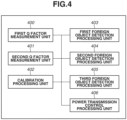
- Fig. 4 is a block diagram illustrating the functional configuration of the control unit 301 of the power transmission apparatus 100 according to the present exemplary embodiment.
- the control unit 301 includes a first quality (Q) factor measurement unit 400, a second Q factor measurement unit 401, a calibration processing unit 402, a first foreign object detection processing unit 403, a second foreign object detection processing unit 404, a third foreign object detection processing unit 405, and a power transmission control processing unit 406.
- a "foreign object” refers to an object different from the power transmission apparatus 100 and the power reception apparatus 102.
- the foreign object can be a metal piece such as a clip, an NFC tag, or an integrated circuit (IC) card.
- the power transmission apparatus 100 performs the process of determining whether the foreign object is present in the power transmittable range of the power transmission apparatus 100. In the following description, this process will also be referred to as "foreign object detection” or a “foreign object detection process”.
- the first Q factor measurement unit 400 measures a Q factor in a frequency domain (a first Q factor measurement).
- the second Q factor measurement unit 401 measures a Q factor in a time domain (a second Q factor measurement).
- the calibration processing unit 402 acquires a calibration data point and performs a creation process for creating a calibration curve.
- the first foreign object detection processing unit 403 performs a foreign object detection process based on a first Q factor measured by the first Q factor measurement unit 400 (a first foreign object detection process).
- the second foreign object detection processing unit 404 performs a foreign object detection process based on a power loss technique (a second foreign object detection process).
- the third foreign object detection processing unit 405 performs a foreign object detection process based on a second Q factor measured by the second Q factor measurement unit 401 (a third foreign object detection process).
- the power transmission control unit 406 performs processing regarding the start of the transmission of power, the stop of the transmission of power, an increase or decrease in the transmission power of the power transmission unit 303.
- the processing units illustrated in Fig. 4 are configured as independent programs, and can operate in parallel while synchronizing the programs by event processing. The details of processing performed by the blocks in Fig. 4 will be described below.
- Fig. 13 is a sequence diagram illustrating the flow of control of the power transmission apparatus and the power reception apparatus compliant with the WPC standard v1.2.3.
- the sequence illustrated in Fig. 13 corresponds to control executed by the power transmission apparatus having a configuration that meets the WPC standard.
- the power transmission apparatus and the power reception apparatus may be compliant with the WPC standard v1.2.3 or a version of the WPC standard later than the WPC standard v1.2.3, or may be compliant with a version earlier than the WPC standard v1.2.3.
- the WPC standard defines a plurality of phases including the power transfer phase where the transmission of power for charging is executed, and phases before the transmission of power for charging is performed.
- the phases before power is transmitted include (1) the selection phase, (2) the ping phase, (3) the identification & configuration phase, (4) the negotiation phase, and (5) the calibration phase.
- the identification and configuration phase will be referred to as the "I & C phase”.
- the power transmission apparatus 100 transmits power with an analog ping (hereinafter referred to as an "A-Ping") to detect an object present near the power transmission coil 304 (step F500).
- the A-Ping is pulsed power and is power for detecting an object. Even if the power reception apparatus receives the power with the A-Ping, the received power is too small to start the control unit 301 of the power reception apparatus 102.
- the power transmission apparatus 100 intermittently transmits the power with the A-Ping.
- the voltage or the current applied to the power transmission coil 209 changes between a case where an object is placed in the power transmittable range of the power transmission apparatus 100 and a case where an object is not placed in the power transmittable range of the power transmission apparatus 100.
- control unit 301 of the power transmission apparatus 100 detects at least either one of the voltage value and the current value of the power transmission coil 304 when the A-Ping is transmitted. If the voltage value falls below a certain threshold, or if the current value exceeds a certain threshold, the control unit 201 determines that an object is present. Then, a transition is made to the ping phase.
- the first Q factor measurement unit 400 of the power transmission apparatus 100 measures the quality factor (Q factor) of the power transmission coil 304 (step F501).
- the Q factor is acquired by measuring the Q factor in the frequency domain (the first Q factor measurement). If the Q factor measurement is completed, the power transmission apparatus 100 starts transmitting power with a digital ping (hereinafter referred to as a "D-Ping") (step F502).
- the D-Ping is power for starting the control unit 200 of the power reception apparatus 102 and is power greater than the A-Ping.
- step F502 From this point onward, from when the power transmission apparatus 100 starts transmitting the power with the D-Ping (step F502) to when the power transmission apparatus 100 receives an end power transfer (EPT) packet for requesting the stop of the transmission of power from the power reception apparatus 102 (step F522), the power transmission apparatus 100 continues to transmit power greater than the D-Ping. If the control unit 200 of the power reception apparatus 102 receives the power with the D-Ping and starts, the control unit 200 transmits a signal strength packet, which is data that stores the voltage value of the D-Ping with which the power is received, to the power transmission apparatus 100 (step F503).
- a signal strength packet which is data that stores the voltage value of the D-Ping with which the power is received
- the power transmission apparatus 100 receives the signal strength packet from the power transmission apparatus 101 having received the D-Ping, thereby recognizing that the object detected in the selection phase is the power reception apparatus. If the power transmission apparatus 100 receives the signal strength packet, a transition is made to the I & C phase.
- the power reception apparatus 102 transmits data that stores version information regarding the WPC standard with which the power reception apparatus 102 is compliant and an identifier (ID) including device identification information (step F504).
- the power reception apparatus 102 also transmits to the power transmission apparatus 100 a configuration packet including information indicating the maximum value of power to be supplied from the power reception apparatus 102 to a load (the battery 206) (step F505).
- the power transmission apparatus 100 receives the ID and the configuration packet, thereby determining whether the version of the power reception apparatus 102 is compatible with the WPC standard with which the power transmission apparatus 100 is compliant. Then, the power transmission apparatus 100 transmits an acknowledgement (ACK).
- ACK acknowledgement
- the power transmission apparatus 100 determines that the power reception apparatus 102 is compatible with an expansion protocol of the WPC standard v 1.2 or later (including processing in the negotiation phase described below), the power transmission apparatus 100 responds with ACK (step F506). If the power reception apparatus 101 receives the ACK, a transition is made to the negotiation phase where a negotiation on power to be transmitted and received is made.
- the power reception apparatus 102 transmits a foreign object detection (FOD) status packet to the power transmission apparatus 100 (step F507).
- the FOD status packet is represented as "FOD (Q)”.
- the first foreign object detection processing unit 403 of the power transmission apparatus 100 performs foreign object detection based on the Q factor stored in the received FOD (Q) and the Q factor measured by the Q factor measurement and transmits, to the power reception apparatus 102, ACK indicating that it is determined that there is a high possibility that the foreign object is not present (step F508).
- the power reception apparatus 102 transmits a general request (capabiliy) packet, which is data for inquiring about the capabilities of the power transmission apparatus 100 and is one of general requests defined by the WPC standard (step F535).
- the general request (capabiliy) packet will be represented as a "GRQ (CAP) packet”.
- the power transmission apparatus 100 receives the GRQ (CAP) packet, the power transmission apparatus 100 transmits a capability packet (hereinafter referred to as "CAP") that stores capability information regarding the capabilities with which the power transmission apparatus 100 is compatible (step F536).
- CAP capability packet
- the power reception apparatus 102 makes a negotiation on guaranteed power (hereinafter referred to as "GP") that is the maximum value of the power value of power that the power reception apparatus 102 makes a request to receive.
- the GP indicates the amount of power which can be used by the power reception apparatus 102 and on which agreement is reached in the negotiation with the power transmission apparatus 100. That is, the GP is the maximum value of power that can be used to supply to the load of the power reception apparatus 102 (power consumed by the charging unit 205 and the battery 206).
- the GP may be power guaranteed to be output from the power reception apparatus to the load (e.g., a circuit for charging and a battery).
- the GP indicates the power value of the power guaranteed to be output to the load in the power reception apparatus even if the positional relationship between the power reception apparatus and the power transmission apparatus changes and the power transmission efficiency between the power reception coil and the power transmission coil decreases.
- the power transmission apparatus transmits power by performing control so that power of 5 watts can be output to the load in the power reception apparatus.
- the negotiation is achieved by transmitting to the power transmission apparatus 100 a packet that stores the value of the GP requested by the power reception apparatus among specific request packets defined by the WPC standard (step F509).
- this data is represented as an "SRQ (GP) packet".
- the power transmission apparatus 100 responds to the SRQ (GP) packet in view of the power transmission capability of the power transmission apparatus 100. If it is determined that the guaranteed power is accepted, the power transmission apparatus 100 transmits ACK indicating that the request is accepted (step F510). If the negotiation on a plurality of parameters including the GP is completed, the power reception apparatus 102 transmits SRQ (EN) for requesting the end of the negotiation (end negotiation) among the specific requests to the power transmission apparatus (step F511).
- the power transmission apparatus 100 transmits ACK in response to the SRQ (EN) packet (step F512), and ends the negotiation, and a transition is made to the calibration phase where references for performing foreign object detection based on the power loss technique are created.
- the "foreign object detection” refers to the process of determining whether an object different from the power reception apparatus (hereinafter referred to as a “foreign object”) is present in the power transmittable range of the power transmission apparatus 100 or there is a possibility that the foreign object is present in the power transmittable range of the power transmission apparatus 100.
- the power reception apparatus 102 notifies the power transmission apparatus 100 of a reception power value R1 when the power reception apparatus 102 receives the power with the D-Ping in the state where power is not supplied to the load (the charging unit 205 and the battery 207).
- the power reception apparatus 102 transmits a received power packet (a mode 1) that stores the reception power value R1 (hereinafter referred to as "PR1") to the power transmission apparatus 100.
- PR1 reception power packet
- the power transmission apparatus 100 receives the RP1, the power transmission apparatus 100 transmits ACK to the power reception apparatus 101 (step F514).
- the power transmission apparatus 100 measures a transmission power value T1 of the power transmission apparatus 100 and calculates a difference ⁇ 1 between T1 and R1 as power loss.
- the power reception apparatus 102 transmits to the power transmission apparatus 100 a control error packet (hereinafter represented as "CE") that requests the power transmission apparatus 100 to increase or decrease a power reception voltage in the state where power is supplied to the load.
- CE stores a sign and a numerical value. If the sign of the numerical value stored in the CE is the plus sign, this means that the power reception apparatus 102 requests the power transmission apparatus 100 to increase the power reception voltage. If the sign of the numerical value is the minus sign, this means that the power reception apparatus 102 requests the power transmission apparatus 100 to decrease the power reception voltage. If the numerical value is zero, this means that the power reception apparatus 102 requests the power transmission apparatus 100 to maintain the power reception voltage.
- the power reception apparatus 102 transmits CE(+) indicating an increase in the power reception voltage to the power transmission apparatus 100 (step F515).
- the power transmission apparatus 100 increases the power transmission voltage by changing the setting value of a power transmission circuit (step F516). If the reception power increases in response to the CE(+), the power reception apparatus 102 supplies the received power to the load (the charging unit 205 and the battery 206). The power reception apparatus 102 also transmits RP2 (a received power packet (a mode 2) (hereinafter referred to as "RP2")) to the power transmission apparatus 100 (step F517).
- RP2 a received power packet (a mode 2) (hereinafter referred to as "RP2")) to the power transmission apparatus 100 (step F517).
- the RP2 stores a reception power value R2 in the state where the power reception apparatus 102 supplies power to the load.
- the power transmission apparatus 100 transmits ACK to the power reception apparatus (step F514).
- the power transmission apparatus 100 measures a transmission power value T2 of the power transmission apparatus 100 and calculates a difference ⁇ 2 between T2 and R2 as power loss.
- the power transmission apparatus 100 performs foreign object detection based on the power loss using as references the power loss ⁇ 1 in a case where power is not supplied to the load and the power consumption of the load is 0, and the power loss ⁇ 2 in a case where power is supplied to the load and the power consumption of the load is not 0.
- the power transmission apparatus 100 predicts power loss in the state where there is not the foreign object with any reception power value.
- the calibration processing unit 402 Based on the predicted value, the calibration processing unit 402 generates a calibration curve.
- the second foreign object detection processing unit 404 performs the foreign object detection by comparing the relationship between a transmission power value and a reception power value actually received, with the calibration curve. If the power transmission apparatus 100 transmits the ACK in response to the RP2, a transition is made to the power transfer phase.
- the power transmission apparatus 100 transmits power with which the power reception apparatus can receive a power of up to 15 watts negotiated in the negotiation phase.
- the power reception apparatus 102 periodically transmits CE and RP0 (a received power packet (a mode 0) (hereinafter referred to as "RP0")) that stores the current reception power value to the power transmission apparatus 100 (steps F519 and F520).
- RP0 a received power packet (a mode 0) (hereinafter referred to as "RP0")) that stores the current reception power value to the power transmission apparatus 100 (steps F519 and F520).
- the RP0 may be transmitted at regular intervals, or may be randomly transmitted. If the power transmission apparatus 100 receives the RP0 from the power reception apparatus, the power transmission apparatus 100 predicts power loss with any reception power based on the above ⁇ 1 and ⁇ 2 and performs foreign object detection.
- the power transmission apparatus 100 transmits ACK to the power reception apparatus (step F521). If it is determined that there is a high possibility that the foreign object is present, the power transmission apparatus 100 transmits NAK to the power reception apparatus.
- the power reception apparatus 101 transmits an end power transfer (EPT) packet for requesting the power transmission apparatus 100 to stop the transmission of power (step F522). This is the flow of the control of the power transmission apparatus 100 and the power reception apparatus compliant with the WPC standard v1.2.3.
- EPT end power transfer
- Processing performed by the first Q factor measurement unit 400, the calibration processing unit 402, the first foreign object detection processing unit 403, and the second foreign object detection processing unit 404 according to the present exemplary embodiment is as described in the above flow of the processing based on the WPC standard.
- a foreign object detection method performed by the second Q factor measurement unit 401 and the third foreign object detection processing unit 405 is described.
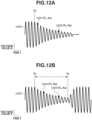
- a waveform 1200 in Fig. 12A indicates the lapse of time of the value of a high-frequency voltage applied to the power transmission coil 304 of the power transmission apparatus 100 or an end portion of a resonance capacitor (not illustrated) of the power transmission apparatus 100 (hereinafter referred to simply as "the voltage value of the power transmission coil").
- the horizontal axis represents time, and the vertical axis represents the voltage value.
- T0 the application of the high-frequency voltage (the transmission of power) is stopped.
- a point 1201 is a single point on the envelope of the high-frequency voltage and indicates the high-frequency voltage at a time T1.
- (T1, A1) in Fig. 12A indicates that the voltage value at the time T1 is A1.
- the transmission of power is stopped at T0, the present disclosure is not limited to this.
- the transmission of power may be limited so that the power to be transmitted is less than or equal to a predetermined value.
- a point 1202 is a single point on the envelope of the high-frequency voltage and indicates the high-frequency voltage at a time T2.
- T2, A2 in Fig. 12A indicates that the voltage value at the time T2 is A2.
- a Q factor measurement is performed based on a change over time in the voltage value at and after the time T0. Specifically, the Q factor is calculated using (Equation 1) based on the time between the points 1201 and 1202 on the envelope of the voltage value, the voltage value, and a frequency f of the high-frequency voltage (hereinafter referred to as an "operating frequency").
- Equation 1 ⁇ f t 2 ⁇ t 1 In A 1 A 2
- a waveform 1203 indicates the value of a high-frequency voltage applied to the power transmission coil 304, and the frequency of the high-frequency voltage is in the range between 120 kHz and 148.5 kHz, which is used in the WPC standard.
- Points 1204 and 1205 are parts of the envelope of the voltage value.
- the power transmission unit 303 of the power transmission apparatus 100 stops the transmission of power or limits the transmission of power so that the power to be transmitted is less than or equal to a predetermined value.
- the second Q factor measurement unit 401 of the power transmission apparatus 100 measures the Q factor based on a voltage value A3 (the point 1204) at a time T3, a voltage value A4 (the point 1204) at a time T4, the operating frequency of the high-frequency voltage, and (Equation 1).
- the power transmission unit 303 of the power transmission apparatus 100 resumes the transmission of power at the time T5.
- the second Q factor measurement is achieved by measuring the Q factor based on the lapse of time during a predetermined period when the power transmission apparatus 100 limits the transmission of power, the voltage value, and the operating frequency.
- the period when the transmission of power is stopped or the transmission of power is limited so that the power to be transmitted is less than or equal to the predetermined value (the period from the time T0 to the time T5 in the example of Fig. 12B ) will be referred to as a "power transmission limitation period”.
- the power transmission limitation period is determined between the power transmission apparatus 100 and the power reception apparatus 102 before the second Q factor measurement is executed.
- the length of the power transmission limitation period that can be achieved differs depending on the capability of the switch 308 or the control unit 301 of the power transmission apparatus 100. Thus, for example, if a length shorter than the length of the minimum period when the power transmission apparatus 100 can limit the transmission of power is set as the power transmission limitation period, there is a possibility that the second Q factor measurement is not appropriately performed.
- the power reception apparatus 102 cannot normally function if the reception power is limited for a certain period or more.
- the following issue can arise in the power reception apparatus. For example, if the transmission of power is limited for a certain period or more, the power reception apparatus determines that the transmission of power is completed, and ends the power reception process. Or the power reception apparatus cannot perform the process of functioning using power transmitted from the power transmission apparatus 100.
- the power transmission limitation period according to the present exemplary embodiment a period longer than the minimum length that can be achieved by the power transmission apparatus 100 is set. Moreover, as the power transmission limitation period according to the present exemplary embodiment, a period shorter than the maximum length that can be tolerated by the power reception apparatus 102 is set. The method for setting the power transmission limitation period will be described below.
- the third foreign object detection processing unit 405 determines whether the foreign object is present in the power transmittable range of the power transmission apparatus 100. For example, the determination method is as described below. In a case where the foreign object is present near the power transmission apparatus 100, the second Q factor is lower than in a case where the foreign object is not present. This is because in a case where the foreign object is present, energy is lost due to the foreign object. If attention is paid to the slope of the attenuation of the voltage value, energy is more lost due to the foreign object when the foreign object is present than when the foreign object is not present. Thus, the slope of a straight line connecting the points 1204 and 1205 in the example of Fig.
- the third foreign object detection processing unit 405 can determine that the foreign object is present or there is a high possibility that the foreign object is present.
- the determination can also be made using the slope of a straight line connecting the points 1204 and 1205 that is obtained by (A3 - A4)/(T3 - T4).
- the determination may be made using (A3 - A4) indicating the difference between voltage values or the value of the ratio (A3/A4) between voltage values.
- the determination can also be made using the value of the voltage value A4 after the lapse of a predetermined time. Yet alternatively, the determination may be made using the value of a time (T4 - T3) until the voltage value A3 reaches the predetermined voltage value A4.
- the power transmission apparatus 100 measures the voltage of the power transmission coil 304 at at least two or more times within the period when the transmission of power is limited, and acquires the values of the amount of attenuation of the voltage, the attenuation rate, and the Q factor based on the measurement results, and thereby can determine the presence or absence of the foreign object.
- a TX 402 may be configured to measure the voltage at three or more times.
- the vertical axis in each of Figs. 12A and 12B represents the current value of the current flowing through the power transmission coil 304
- the attenuation state of the current value during the power transmission limitation period changes depending on the presence or absence of the foreign object.
- the attenuation rate of the waveform is higher than in a case where the foreign object is not present.
- indices indicating the attenuation state of the current such as the second Q factor, the slope of the attenuation of the current value, the difference between current values, the ratio between current values, the absolute value of the current value, and the time until the current value reaches a predetermined current value that are obtained based on the measured value of the current, and detect the foreign object.
- foreign object detection based on both the measured value of the voltage and the measured value of the current may be performed.
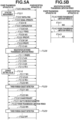
- FIG. 5A is a diagram illustrating a sequence in a case where the control process based on the WPC standard and the third foreign object detection process are combined together. Processes similar to those in Fig. 13 are designated by the same signs, and are not described.
- step F528, the power transmission apparatus 100 and the power reception apparatus 102 make a negotiation for determining the power transmission limitation period.
- Fig. 5B illustrates an example of the negotiation made in step F528.
- the power reception apparatus 102 transmits a negotiation packet including the length of the power transmission limitation period desired by the power reception apparatus 102 to the power transmission apparatus 100 (step F540). If the length of the power transmission limitation period acquired from the power reception apparatus 102 is accepted, the power transmission apparatus 100 returns ACK. If the length of the power transmission limitation period acquired from the power reception apparatus 102 is not accepted, the power transmission apparatus 100 returns NAK (step F541).
- a negotiation packet including an identifier for making a request not to provide a stop time is represented as a "power transmission limitation period (0)".
- a negotiation packet including an identifier for requesting 100 ⁇ seconds as the length of the power transmission limitation period is represented as a "power transmission limitation period (1)”.
- a negotiation packet including an identifier for requesting 120 ⁇ seconds as the length of the power transmission limitation period is represented as a "power transmission limitation period (2)”.
- a negotiation packet including an identifier for requesting 140 ⁇ seconds as the length of the power transmission limitation period is represented as a "power transmission limitation period (3)".
- the power reception apparatus 102 Until ACK is returned from the power transmission apparatus 100, the power reception apparatus 102 repeatedly transmits negotiation packets except for the power transmission limitation period (0) in ascending order of the length of the power transmission limitation period (steps F540 and F542). If ACK is transmitted from the power transmission apparatus 100, the power reception apparatus 102 determines the length of the power transmission limitation period included in a negotiation packet when the power transmission apparatus 100 transmits the ACK, as the length of the power transmission limitation period determined by the negotiation. The power reception apparatus 102 stores the determined length of the power transmission limitation period in the memory 209 and ends the negotiation on the power transmission limitation period (step F543).
- the power reception apparatus 102 If ACK is not returned from the power transmission apparatus 100 even though the power reception apparatus 102 transmits all the negotiation packets that can be transmitted except for the power transmission limitation period (0), the power reception apparatus 102 transmits a stop time (0) to the power transmission apparatus 100. The power reception apparatus 102 does not perform the third foreign object detection, and ends the negotiation on the power transmission limitation period.
- the power transmission apparatus 100 can perform the third foreign object detection with the length of the power transmission limitation period greater than or equal to 120 ⁇ seconds.
- the power reception apparatus 102 transmits the power transmission limitation period (1) to the power transmission apparatus 100 (step F540).
- the power transmission apparatus 100 determines that the length of the power transmission limitation period acquired from the power reception apparatus 102 is not accepted. Then, the power transmission apparatus 100 returns NAK (step F541).
- the power reception apparatus 102 transmits the power transmission limitation period (2) to the power reception apparatus (step F542).
- the power transmission apparatus 100 determines that a stop time of 120 ⁇ seconds is accepted. Then, the power transmission apparatus 100 returns ACK (step F543).
- the power reception apparatus 102 and the power transmission apparatus 100 determine 120 ⁇ seconds as the length of the power transmission limitation period and end the negotiation on the power transmission limitation period.
- the present exemplary embodiment has illustrated an example of the negotiation in a case where the power transmission apparatus 100 does not transmit the length of the requested power transmission limitation period to the power reception apparatus 102 during the negotiation on the power transmission limitation period.
- the power reception apparatus 102 transmits stop times to the power transmission apparatus 100 in ascending order and determines the value of a stop time for which ACK is returned first, as the length of the power transmission limitation period. Consequently, also in a configuration in which the power transmission apparatus 100 does not transmit the length of the power transmission limitation period to the power reception apparatus 102, it is possible to determine the length of the power transmission limitation period by a negotiation.
- the length of the power transmission limitation period set at this time satisfies the minimum length that can be achieved by the power transmission apparatus 100 and is the shortest length among the lengths of the power transmission limitation period requested by the power reception apparatus 102.
- the negotiation on the power transmission limitation period executed in the present exemplary embodiment is merely an example.
- the power reception apparatus 102 may request the power transmission apparatus 100 to transmit information for determining the length of the power transmission limitation period, and the power transmission apparatus 100 may transmit the length of the power transmission limitation period requested by the power transmission apparatus 100 to the power reception apparatus 102.
- the power transmission apparatus 100 may also transmit information indicating the minimum length that can be achieved by the power transmission apparatus 100.
- the power transmission apparatus transmits CAP including information indicating the length of the power transmission limitation period as a response to GRQ (CAP) to the power reception apparatus.
- the information indicating the length of the power transmission limitation period is recorded in a "reserved" field defined in the CAP packet.
- the power transmission apparatus 100 includes the information indicating the length of the power transmission limitation period in the CAP, and thereby can reduce the number of packets required for the negotiation. Further, the power transmission apparatus 100 may have means for determining whether to include the information indicating the length of the power transmission limitation period in the CAP as a response to the GRQ (CAP).
- the power transmission apparatus 100 fills the "reserved" field with zero.
- the determination of whether to include the information indicating the length of the power transmission limitation period in the CAP is made based on, for example, whether the power reception apparatus is compatible with the third foreign object detection process.
- the determination of whether the power reception apparatus is compatible with the third foreign object detection process may be made based on, for example, a version compatible with the third foreign object detection process based on version information regarding the power reception apparatus included in a configuration packet.
- the determination of whether the version of the power reception apparatus is a version compatible with the third foreign object detection process may be made based on, for example, version information included in an identification packet.
- the determination of whether the version of the power reception apparatus is compatible with the third foreign object detection process may be made based on, for example, information indicating whether the power reception apparatus is compatible with the third foreign object detection process that is included in a configuration packet or another packet. If the power reception apparatus is not compatible with the third foreign object detection process, the "reserved" field is filled with zero, whereby it is possible to reduce the risk that the power reception apparatus 102 causes a malfunction in a case where the power reception apparatus 102 is not compatible with the third foreign object detection process.
- the power transmission apparatus 100 performs the third foreign object detection process (step F529). If the length of the power transmission limitation period is determined in step F528, the power reception apparatus 102 transmits information for requesting the third foreign object detection to the power transmission apparatus 100 by including the information in the RP0. In the present exemplary embodiment, the power reception apparatus 102 transmits the RP0 including the information indicating the length of the power transmission limitation period determined by the negotiation as the information for requesting the third foreign object detection. According to the reception of the RP0 including the length of the power transmission limitation period, the power transmission apparatus 100 performs the third foreign object detection.
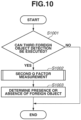
- Fig. 10 is a diagram illustrating an example of the flow of the third foreign object detection process performed in step F529.
- the power transmission apparatus 100 determines whether the third foreign object detection can be executed (step S 1001). If the foreign object detection can be executed, the processing proceeds to step S 1002. If the foreign object detection cannot be executed, the processing ends. Next, the power transmission apparatus 100 performs the second Q factor measurement (step S1002). With reference to Fig. 9 , the second Q factor measurement process is described.
- Fig. 9 is a flowchart of the second Q factor measurement process executed by the power transmission apparatus 100. In Fig.
- the power transmission control unit 406 stops the transmission of power from the power transmission unit 303 or limits the transmission of power so that the power to be transmitted is smaller than a predetermined value (step S900).
- the second Q factor measurement unit 401 controls the switch 308 to perform a short circuit process on the power transmission coil 304 and the resonance capacitor 307. Then, at the time T3, the second Q factor measurement unit 401 measures the voltage value A3 of the power transmission coil 304 (step S901). Further, at T4 after the lapse of a certain time, the second Q factor measurement unit 401 measures the voltage value A4 of the power transmission coil 304 (step S902).
- the second Q factor measurement unit 401 calculates the second Q factor from the frequency of the transmission power (the waveform 1203), the time, and the voltage value (step S903).
- the frequency of the transmission power is a resonance frequency F1 of the power transmission coil 304 and the resonance capacitor 307. If the measurement of the voltage value is completed, the second Q factor measurement unit 401 ends the short circuit process and lifts the limitation on the transmission of power (step S904).
- the lifting of the limitation means that the transmission power is returned to the amount of power before the transmission of power is limited in step S900.
- the power transmission apparatus 100 determines the presence or absence of the foreign object based on the value of the second Q factor and the result of the second foreign object detection method and ends the processing. As a result of the determination of the presence or absence of the foreign object, if it is determined that the foreign object is present or there is a high possibility that the foreign object is present, the power transmission apparatus 100 transmits NAK to the power reception apparatus 102. If it is determined that the foreign object is not present or there is a low possibility that the foreign object is present, the power transmission apparatus 100 transmits ACK to the power reception apparatus 102. In the example of Fig. 5A , it is determined that the foreign object is not present, and in step F521, ACK is transmitted.
- the power transmission apparatus 100 executes the third foreign object detection by processing similar to the above processing.
- the RP0 is used as a packet including the information for requesting the execution of the third foreign object detection.
- a configuration may be employed in which the information is included in a CE packet or another unique packet.
- the information for requesting the execution of the third foreign object detection may be included in RP1 and RP2. In this case, the power transmission apparatus 100 performs the third foreign object detection process in the calibration phase.
- the third foreign object detection process is performed by making the negotiation for determining the length of the power transmission limitation period and using the determined length as described above.
- the length of the power transmission limitation period is determined based on the capabilities of the power transmission apparatus 100 and the power reception apparatus 102.
- the characteristics of the power transmission apparatus 100 may change due to a change in the GP, a change in the transmission power, a change in the power transmission voltage, a change in the temperature of the power transmission apparatus 100, or a change in the power transmission circuit configuration.
- the length of the power transmission limitation period is made longer to perform the foreign object detection with the same accuracy as that before the state of the power transmission apparatus 100 changes.
- the proportion of the noise decreases compared to that before the state changes, it is possible to perform the foreign object detection with the same accuracy even if the stop time is shortened. In such a case, it is assumed that the power transmission efficiency is improved by making the length of the power transmission limitation period shorter.
- step F528 There can also be a possibility that the negotiation is not made in step F528 due to the combination of the power transmission apparatus 100 and the power reception apparatus 102, abnormal communication, or the settings of the apparatuses.
- the negotiation is not made, and even if a packet for requesting the execution of the third foreign object detection process is received from the power reception apparatus 102, the power transmission apparatus 100 cannot execute the third foreign object detection.
- the length of the power transmission limitation period that can be tolerated by the power reception apparatus 102 changes due to a change in the state of the power reception apparatus 102, such as a change in the reception power, a change in the power reception voltage, or a change in the temperature of the power reception apparatus 102.
- the power transmission apparatus 100 and the power reception apparatus 102 perform the process of changing the length of the power transmission limitation period in a case where the state of at least either of the power transmission apparatus and the power reception apparatus changes.
- Fig. 5A the process of changing the length of the power transmission limitation period is described.
- the power transmission apparatus 100 receives the RP0 including the length of the power transmission limitation period.
- the length of the power transmission limitation period included in the RP0 is the length determined by the negotiation.
- the power transmission apparatus 100 determines that the length of the power transmission limitation period determined by the negotiation is to be changed due to a change in the state of at least either of the power transmission apparatus 100 and the power reception apparatus 102.
- the power transmission apparatus 100 determines that the length of the power transmission limitation period is to be changed to a length greater than or equal to 130 ⁇ seconds, which is longer than 120 ⁇ seconds determined by the negotiation.
- Examples of the case where the power transmission apparatus 100 determines that the length of the power transmission limitation period is to be changed to be longer are the following cases. That is, one of the examples is a case where the temperature of at least either of the power transmission apparatus 100 and the power reception apparatus 102 changes to a temperature higher by a certain amount or more than the temperature at the time when the negotiation is made. Another one of the examples is a case where the temperature of at least either of the power transmission apparatus 100 and the power reception apparatus 102 changes to a temperature higher than a predetermined threshold after the negotiation is made.
- Another one of the examples is a case where at least either of the value of the power to be transmitted from the power transmission apparatus 100 and the value of the guaranteed power (GP) guaranteed to be output from the power reception apparatus 102 to the load changes from a value determined at the time when the negotiation is made to a value smaller by a certain amount or more.
- the transmission power and the GP can be changed by the process of performing the negotiation phase again (the renegotiation phase).
- the power transmission apparatus 100 determines that the length of the power transmission limitation period determined by the negotiation is to be changed to be longer.
- Fig. 6 is the flow of processing regarding a change in the length of the power transmission limitation period.
- the power transmission apparatus 100 determines whether to change the length of the power transmission limitation period (step S601). If the power transmission apparatus 100 determines that the length of the power transmission limitation period is to be changed, the power transmission apparatus 100 transmits a signal for requesting communication for the change (hereinafter referred to as a "change request") to the power reception apparatus 102 (step S602 and step F530). If the power transmission apparatus 100 determines that the length of the power transmission limitation period is not to be changed, the change process is not performed, and the third foreign object detection process is performed based on the length of the power transmission limitation period acquired from the power reception apparatus 102 (step F529).
- the power reception apparatus 102 transmits information indicating that the power reception apparatus 102 waits to receive a parameter from the power transmission apparatus 100 to the power transmission apparatus 100 (step F531).
- the parameter to be transmitted from the power transmission apparatus 100 is, for example, information indicating the minimum length of the power transmission limitation period when the power transmission apparatus 100 can execute the third foreign object detection process.
- the power transmission apparatus 100 uses as a trigger a signal transmitted from the power reception apparatus 102 and indicating that the power reception apparatus 102 waits to receive the parameter, the power transmission apparatus 100 transmits a predetermined signal to the power reception apparatus 102 (step S603 and step F532).
- the signal transmitted from the power reception apparatus 102 in step F531 may be "a signal permitting the power transmission apparatus 100 to transmit the parameter" or "a signal urging the power transmission apparatus 100 to transmit the parameter".
- step F532 the power transmission apparatus 100 transmits a packet including information (a parameter) indicating 130 ⁇ seconds as the length of the power transmission limitation period to the power reception apparatus 102.
- the power transmission apparatus 100 and the power reception apparatus 102 newly determine 130 ⁇ seconds as the length of the power transmission limitation period.
- the power reception apparatus 102 transmits RP0 including the information indicating 130 ⁇ seconds as the length of the power transmission limitation period to the power transmission apparatus (step F533).
- step S 1001 the power transmission apparatus 100 confirms that the length of the power transmission limitation period included in the RP0 is 130 ⁇ seconds and is greater than or equal to 130 ⁇ seconds as the minimum length with which the third foreign object detection process can be executed.
- the power transmission apparatus 100 determines that the third foreign object detection can be executed.
- the third foreign object detection process is performed (steps S 1002 and S 1003 and step F529).
- the power transmission apparatus 100 transmits a packet including information regarding the length of the power transmission limitation period. Consequently, for example, even in a case where the state of the power transmission apparatus 100 changes during the transmission of power, it is possible to execute the third foreign object detection.
- the above example is a case where the length of the power transmission limitation period is changed to be longer than the length determined by the negotiation.
- the length of the power transmission limitation period can also be changed to be shorter by performing similar processing.
- Examples of the case where the power transmission apparatus 100 determines that the length of the power transmission limitation period is to be changed to be shorter are the following cases. That is, one of the examples is a case where the temperature of at least either of the power transmission apparatus 100 and the power reception apparatus 102 changes to a temperature lower by a certain amount or more than the temperature at the time when the negotiation is made. Another one of the examples is a case where the temperature of at least either of the power transmission apparatus 100 and the power reception apparatus 102 changes to a temperature lower than a predetermined threshold after the negotiation is made.
- Another one of the examples is a case where at least either of the value of the power to be transmitted from the power transmission apparatus 100 and the value of the guaranteed power (GP) guaranteed to be output from the power reception apparatus 102 to the load changes from a value determined at the time when the negotiation is made to a value greater by a certain amount or more.
- the power transmission apparatus 100 determines that the length of the power transmission limitation period determined by the negotiation is to be changed to be shorter.
- step F532 the power transmission apparatus 100 transmits a packet indicating 110 ⁇ seconds as the length of the power transmission limitation period to the power reception apparatus 102. Consequently, it is possible to make the length of the power transmission limitation period shorter by 10 ⁇ seconds than the length determined by the negotiation and improve the power transmission efficiency compared to a case where the length of the power transmission limitation period is not changed. Every time the power transmission apparatus 100 determines that the length of the power transmission limitation period is to be changed, the above change process for changing the power transmission limitation period may be repeatedly executed.
- the power transmission apparatus 100 determines that the length of the power transmission limitation period is to be changed, then in step S802 and step F530, the power transmission apparatus 100 transmits a change request. This process, however, may be omitted. That is, if the power transmission apparatus 200 determines that the length of the power transmission limitation period is to be changed, the power transmission apparatus 100 may transmit a signal including the information indicating the length of the power transmission control period. Alternatively, a configuration may be employed in which the change request includes the information indicating the length of the power transmission control period.
- the parameter transmission process is executed.
- the parameter transmission process may be executed at another timing.
- the power transmission apparatus 100 may execute the change process. This is effective, for example, in a case where a transition is made to the power transfer phase in the state where the negotiation is not made.
- the power transmission apparatus 100 may determine that the change process is to be executed. For example, in the case of a configuration in which the power transmission apparatus 100 includes two or more power transmission circuits and can switch the power transmission circuits according to the transmission power or the power transmission voltage, the power transmission apparatus 100 may execute the parameter transmission process when the power transmission circuits are switched, and determine that the parameter is to be transmitted. Alternatively, for example, if the processing load of the control unit 301 changes by a predetermined value or more, the power transmission apparatus 100 may determine that the parameter is to be transmitted. Yet alternatively, a configuration may be employed in which, by combining at least one or more of the above determination criteria, it is determined whether to perform the change process.
- the power transmission apparatus 100 may be configured to transmit a packet including an identifier for requesting a renegotiation for changing the length of the power transmission limitation period.
- the power reception apparatus 102 After the power reception apparatus 102 receives the packet including the identifier for requesting the renegotiation, the power reception apparatus 102 transmits a renegotiate packet (hereinafter, an "RN packet") to the power transmission apparatus 100. Then, after a transition is made to the renegotiation phase, the power reception apparatus 102 requests the power transmission apparatus 100 to transmit the information indicating the length of the power transmission limitation period. Then, the power transmission apparatus 100 transmits a signal including the information regarding the length of the power transmission limitation period to the power reception apparatus 102.
- RN packet renegotiate packet
- the power transmission apparatus 100 performs the communication for changing the length of the power transmission limitation period.
- the present disclosure is not limited to this.
- the power transmission apparatus 100 may determine that the communication for changing the length of the power transmission limitation period is to be performed.
- the power transmission apparatus 100 may determine that the communication for changing the length of the power transmission limitation period is to be performed.
- the power transmission apparatus 100 may determine that the communication for changing the length of the power transmission limitation period is to be performed. In these cases, the length of the power transmission limitation period is changed to be longer.
- the power transmission apparatus 100 may determine that the communication for changing the length of the power transmission limitation period is to be performed. Yet alternatively, for example, in a case where at least either of the value of the transmission power and the value of the power guaranteed to be output from the power reception apparatus 102 to the load is greater than a predetermined threshold, the power transmission apparatus 100 may determine that the communication for changing the length of the power transmission limitation period is to be performed. In these cases, the length of the power transmission limitation period is changed to be shorter.
- the determination may be made at the following timing. That is, in a case where the power transmission apparatus 100 receives a signal (e.g., RP0) including the information indicating the length of the power transmission limitation period, the power transmission apparatus 100 identifies the states of the temperatures of the power transmission apparatus 100 and the power reception apparatus 102 and the magnitude of the transmission power. In view of the identified states, if it is determined that it is necessary to change the length of the power transmission limitation period requested by the power reception apparatus 102, the power transmission apparatus 100 determines that the length of the power transmission limitation period is to be changed.
- a signal e.g., RP0
- the negotiation is made in the power transfer phase.
- the functional configurations of the power transmission apparatus 100 and the power reception apparatus 102 are similar to those in the first exemplary embodiment, and therefore, the descriptions of the functional configurations are omitted using the same signs.
- Fig. 7A is the sequence of the processing of the power transmission apparatus 100 and the power reception apparatus 102 according to the present exemplary embodiment.
- the example of Fig. 7A indicates that the negotiation in step F528 in Fig. 5A is not made.
- Fig. 8 is a flowchart illustrating processing performed by the power reception apparatus 102.
- processes similar to those in Fig. 5A are designated by the same signs.
- a case is assumed where a transition is made to the power transfer phase in the state where the initial settings of the power transmission apparatus 100 and the power reception apparatus 102 or communication for the negotiation is not appropriately performed.
- step F700 the power reception apparatus 102 determines whether the negotiation for determining the power transmission limitation period is necessary (step S801). At this time, for example, according to the state where the length of the power transmission limitation period is not stored in the memory 209, the power reception apparatus 102 determines that the negotiation is necessary (YES in step S801). If, on the other hand, it is determined that the negotiation is not necessary, for example, because the third foreign object detection process is not to be performed (NO in step S801), the negotiation is not to be made.
- step F700 the power reception apparatus 102 transmits a signal for requesting the negotiation to the power transmission apparatus 100 (step S802).
- a renegotiate packet (RN) is used as the signal for requesting the negotiation.
- the RN is a packet for requesting the negotiation phase to be performed again (the renegotiation).
- a packet other than the RN may be used as the signal for requesting the negotiation.
- step F702 If the power reception apparatus 102 receives the ACK, a transition is made to the renegotiation phase, and the power transmission apparatus 100 and the power reception apparatus 102 make the negotiation on the power transmission limitation period (step F702). If a packet other than the RN is used as the signal for requesting the negotiation, the following processing may be performed without a transition to the renegotiation phase. In a case where a transition is made to the renegotiation phase, a process such as the determination of the GP value or the notification of the setting value of the power reception apparatus 102 may be executed in addition to the negotiation for determining the power transmission limitation period.
- the power reception apparatus 102 transmits a packet for requesting the length of the power transmission control period to the power transmission apparatus 100 (step F711).
- the power transmission apparatus 100 transmits a signal including information indicating the length of the power transmission limitation period to the power reception apparatus 102 (step F712).
- a packet of a power transmission limitation period (1) is transmitted. If the power reception apparatus 102 receives a packet including the information indicating the length of the power transmission limitation period from the power transmission apparatus 100 (step S803), the power reception apparatus 102 stores the received length of the power transmission limitation period in the memory 209 (step S804).
- the power reception apparatus 102 Based on the power transmission limitation period (1) transmitted from the power transmission apparatus 100, the power reception apparatus 102 stores 100 ⁇ seconds in the memory 209. Alternatively, a configuration may be employed in which the power reception apparatus 102 stores not the length of the power transmission limitation period itself transmitted from the power transmission apparatus 100, but a length determined in view of the state of the power reception apparatus 102. Yet alternatively, a configuration may be employed in which in step F702, the processing illustrated in Fig. 5B is performed.
- step F520 the power reception apparatus 102 transmits RP0 including the information indicating the length of the power transmission limitation period stored in the memory 209 to the power transmission apparatus 100. From this point onward, the third foreign object detection process is performed similarly to the processing in Fig. 5A .
- the power reception apparatus 102 transmits a signal for requesting the negotiation, whereby it is possible to determine the length of the power transmission limitation period.
- the negotiation is not made in step F528.
- the power reception apparatus 102 may transmit a signal for requesting the negotiation, where necessary.
- a configuration may be employed in which the determination of whether the negotiation is necessary is made by the power reception apparatus 102, using determination criteria similar to those in the first exemplary embodiment.
- the change process for changing the length of the power transmission limitation period may be performed.
- the first and second exemplary embodiments can also be carried out in appropriate combination.
- Each of the power transmission apparatus and the power reception apparatus may be an image input apparatus such as an imaging apparatus (a camera or a video camera) or a scanner, or may be an image output apparatus such as a printer, a copying machine, or a projector.
- each of the power transmission apparatus and the power reception apparatus may be a storage device such as a hard disk device or a memory device, or may be an information processing apparatus such as a personal computer (PC) or a smartphone.
- PC personal computer
- the power reception apparatus may be an information terminal device.
- the information terminal device includes a display unit (a display) to which power received from a power reception antenna is supplied and which displays information to a user.
- the power received from the power reception antenna is stored in a power storage unit (a battery), and the battery supplies the power to the display unit.
- the power reception apparatus may include a communication unit that communicates with another apparatus different from the power transmission apparatus.
- the communication unit may be compatible with a communication standard of NFC communication, the fifth generation mobile communication system (5G), or the like.
- the power reception apparatus may be a vehicle such as an automobile.
- the automobile as the power reception apparatus may receive power from a charger (the power transmission apparatus) via a power transmission antenna installed in a parking lot.
- the automobile as the power reception apparatus may receive power from a charger (the power transmission apparatus) via a power transmission antenna embedded in a road. Power received by such an automobile is supplied to a battery.
- the power in the battery may be supplied to a motor unit (a motor or an electric-powered unit) that drives wheels, or may be used to drive a sensor used in driving assistance or drive a communication unit that communicates with an external apparatus.
- the power reception apparatus may include the wheels, the battery, the motor or the sensor driven using received power, and further, a communication unit that communicates with an apparatus other than the power transmission apparatus.
- the power reception apparatus may include an accommodation unit that accommodates a person.
- the sensor include a sensor used to measure the distance between vehicles or the distance from another obstacle.
- the communication unit may be compatible with the Global Positioning System (Global Positioning Satellite, GPS).
- the communication unit may also be compatible with a communication standard of the fifth generation mobile communication system (5G), or the like.
- the vehicle may be a bicycle or an automatic motorcycle.
- the power reception apparatus may be a power tool or a household electrical appliance product.
- Each of these devices as the power reception apparatus may include a battery and a motor driven by reception power stored in the battery.
- Each of these devices may also include a notification unit that gives a notification of the remaining amount of the battery.
- Each of these devices may also include a communication unit that communicates with another apparatus different from the power transmission apparatus.
- the communication unit may be compatible with a communication standard of NFC, the fifth generation mobile communication system (5G), or the like.
- the power transmission apparatus may be an in-vehicle charger that transmits power to a mobile information terminal device, such as a smartphone or a tablet compatible with wireless power transmission, inside an automobile.
- a mobile information terminal device such as a smartphone or a tablet compatible with wireless power transmission
- Such an in-vehicle charger may be provided anywhere in the automobile.
- the in-vehicle charger may be installed in the console of the automobile, or may be installed in the instrument panel (the instrument panel or the dashboard), at a position between seats for passengers, on the ceiling, or on a door.
- the in-vehicle charger should not be installed at a location where the in-vehicle charger interferes with driving.
- the power transmission apparatus is an in-vehicle charger
- a charger is not limited to a charger placed in a vehicle, and may be installed in transport means such as a train, an aircraft, or a vessel.
- the charger in this case may also be installed at a position between seats for passengers, on the ceiling, or on a door.
- a vehicle such as an automobile including an in-vehicle charger may be the power transmission apparatus.
- the power transmission apparatus includes wheels and a battery and supplies power to the power reception apparatus via a power transmission circuit unit and a power transmission antenna using power in the battery.
- the present disclosure can also be achieved by the process of supplying a program for achieving one or more functions of the above exemplary embodiments to a system or an apparatus via a network or a storage medium, and of causing one or more processors of a computer of the system or the apparatus to read and execute the program.
- the present disclosure can also be achieved by a circuit (e.g., an application-specific integrated circuit (ASIC)) for achieving the one or more functions.
- ASIC application-specific integrated circuit
- At least parts of the flowcharts illustrated in Figs. 6 and 8 to 10 may be achieved by hardware.
- a dedicated circuit may be automatically generated on a field-programmable gate array (FPGA) according to a program for achieving steps, using a predetermined compiler.
- FPGA field-programmable gate array
- a gate array circuit may be formed similarly to the FPGA and achieved as hardware.
Landscapes
- Engineering & Computer Science (AREA)
- Computer Networks & Wireless Communication (AREA)
- Power Engineering (AREA)
- Charge And Discharge Circuits For Batteries Or The Like (AREA)
Applications Claiming Priority (2)
| Application Number | Priority Date | Filing Date | Title |
|---|---|---|---|
| JP2021107321A JP7809459B2 (ja) | 2021-06-29 | 2021-06-29 | 送電装置、受電装置、それらが行う方法、及び、プログラム |
| PCT/JP2022/022912 WO2023276580A1 (ja) | 2021-06-29 | 2022-06-07 | 送電装置、受電装置、無線電力伝送の方法、及び、プログラム |
Publications (2)
| Publication Number | Publication Date |
|---|---|
| EP4366133A1 true EP4366133A1 (de) | 2024-05-08 |
| EP4366133A4 EP4366133A4 (de) | 2025-06-25 |
Family
ID=84691335
Family Applications (1)
| Application Number | Title | Priority Date | Filing Date |
|---|---|---|---|
| EP22832737.5A Pending EP4366133A4 (de) | 2021-06-29 | 2022-06-07 | Stromübertragungsvorrichtung, stromempfangsvorrichtung, verfahren zur drahtlosen stromübertragung und programm |
Country Status (5)
| Country | Link |
|---|---|
| US (1) | US20240146121A1 (de) |
| EP (1) | EP4366133A4 (de) |
| JP (2) | JP7809459B2 (de) |
| CN (1) | CN117597853A (de) |
| WO (1) | WO2023276580A1 (de) |
Family Cites Families (31)
| Publication number | Priority date | Publication date | Assignee | Title |
|---|---|---|---|---|
| EP1164022B1 (de) * | 2000-06-16 | 2008-07-30 | Canon Kabushiki Kaisha | Tintenstrahlaufzeichnungsgerät das ein Festkörperhalbleiterbauelement verwendet |
| TWI570427B (zh) | 2015-10-28 | 2017-02-11 | 富達通科技股份有限公司 | 感應式電源供應器及其金屬異物檢測方法 |
| US10630116B2 (en) * | 2011-02-01 | 2020-04-21 | Fu Da Tong Technology Co., Ltd. | Intruding metal detection method for induction type power supply system and related supplying-end module |
| KR101832331B1 (ko) * | 2011-06-29 | 2018-02-26 | 엘지전자 주식회사 | 장치들 간의 무선 전력 전송 및 통신 |
| WO2013042229A1 (ja) * | 2011-09-21 | 2013-03-28 | トヨタ自動車株式会社 | 非接触送電装置、非接触受電装置および非接触送受電システム |
| JP5915904B2 (ja) * | 2012-06-22 | 2016-05-11 | ソニー株式会社 | 処理装置、処理方法、及び、プログラム |
| DE202013012728U1 (de) * | 2012-06-22 | 2019-01-08 | Sony Corporation | Verarbeitungsvorrichtung |
| KR102074475B1 (ko) * | 2012-07-10 | 2020-02-06 | 지이 하이브리드 테크놀로지스, 엘엘씨 | 무선 전력 전송 시스템에서 이물질 감지 장치 및 방법 |
| JP6198440B2 (ja) * | 2013-04-19 | 2017-09-20 | キヤノン株式会社 | 無線電力伝送装置、無線電力伝送装置の制御方法、プログラム |
| KR102042662B1 (ko) * | 2013-07-22 | 2019-11-11 | 삼성전자주식회사 | 무선 전력 전송 시스템에서의 통신 전력 전송 방법 및 장치 |
| JP6384991B2 (ja) * | 2013-10-28 | 2018-09-05 | パナソニック株式会社 | 送電装置及び無線電力伝送システム |
| US9939539B2 (en) | 2014-04-04 | 2018-04-10 | Texas Instruments Incorporated | Wireless power receiver and/or foreign object detection by a wireless power transmitter |
| WO2015163013A1 (ja) * | 2014-04-25 | 2015-10-29 | ソニー株式会社 | 無線通信装置、無線通信方法、及び無線通信システム |
| JP6296917B2 (ja) * | 2014-06-26 | 2018-03-20 | キヤノン株式会社 | 送電装置、送電装置の制御方法、プログラム |
| KR20160100755A (ko) * | 2015-02-16 | 2016-08-24 | 엘지이노텍 주식회사 | 무선전력 송신장치 및 송신방법 |
| EP3261214A4 (de) * | 2015-02-16 | 2018-07-04 | LG Innotek Co., Ltd. | Vorrichtung zur drahtlosen stromübertragung und verfahren zur drahtlosen stromübertragung |
| CA2981695A1 (en) * | 2015-04-02 | 2016-10-06 | Powerbyproxi Limited | Inductive power transmitter |
| KR20160132585A (ko) * | 2015-05-11 | 2016-11-21 | 엘지이노텍 주식회사 | 무선 전력 송신 장치 및 그 제어 방법과 무선 전력 수신 장치의 제어 방법과 무선 전력 전송 시스템 및 그의 무선 전력 전송 방법 |
| KR20160133140A (ko) * | 2015-05-12 | 2016-11-22 | 엘지이노텍 주식회사 | 무선 전력 송신 방법, 무선 전력 수신 방법 및 이를 위한 장치 |
| JP6401672B2 (ja) * | 2015-07-22 | 2018-10-10 | 本田技研工業株式会社 | 受電装置及び非接触送電方法 |
| JP6632299B2 (ja) * | 2015-09-29 | 2020-01-22 | ローム株式会社 | ワイヤレス送電装置、その制御回路、充電器、およびパワーロスメソッドによる異物検出のキャリブレーション方法 |
| KR102483258B1 (ko) * | 2018-02-06 | 2023-01-02 | 삼성전자주식회사 | 무선 전력 전송 장치 및 그의 무선 전력 전송 방법 |
| EP3528364A1 (de) * | 2018-02-20 | 2019-08-21 | Koninklijke Philips N.V. | System zur drahtlosen energieübertragung |
| KR102509314B1 (ko) * | 2018-05-16 | 2023-03-14 | 엘지이노텍 주식회사 | 무선 전력 전송 제어 방법 및 장치 |
| EP3815265B1 (de) * | 2018-06-27 | 2024-04-03 | Powermat Technologies Ltd. | Verbessertes verfahren zur fremdkörperdetektion |
| EP3818620A4 (de) * | 2018-07-19 | 2022-03-23 | MediaTek Singapore Pte. Ltd. | Erkennung von fremdkörpern in systemen zur drahtlosen stromübertragung |
| EP3842397B1 (de) | 2018-08-20 | 2024-10-09 | Sekisui Chemical Co., Ltd. | Zwischenschichtfilm für verbundglas, walzenkörper und verfahren zur herstellung eines verbundglassatzes |
| JP7313220B2 (ja) | 2019-07-25 | 2023-07-24 | キヤノン株式会社 | 受電装置、送電装置、それらの制御方法、およびプログラム |
| JP2021129422A (ja) * | 2020-02-13 | 2021-09-02 | キヤノン株式会社 | 送電装置、送電装置の制御方法、及び、プログラム |
| KR102805643B1 (ko) * | 2020-02-18 | 2025-05-09 | 엘지전자 주식회사 | 무선 전력 전송 장치 및 그의 동작방법 |
| JP2021132442A (ja) * | 2020-02-18 | 2021-09-09 | 旭化成エレクトロニクス株式会社 | 無線給電システム、受電装置、送電装置、無線給電システムの制御方法およびプログラム |
-
2021
- 2021-06-29 JP JP2021107321A patent/JP7809459B2/ja active Active
-
2022
- 2022-06-07 CN CN202280046880.9A patent/CN117597853A/zh active Pending
- 2022-06-07 EP EP22832737.5A patent/EP4366133A4/de active Pending
- 2022-06-07 WO PCT/JP2022/022912 patent/WO2023276580A1/ja not_active Ceased
-
2023
- 2023-12-27 US US18/397,946 patent/US20240146121A1/en active Pending
-
2026
- 2026-01-19 JP JP2026006383A patent/JP2026063227A/ja active Pending
Also Published As
| Publication number | Publication date |
|---|---|
| EP4366133A4 (de) | 2025-06-25 |
| CN117597853A (zh) | 2024-02-23 |
| US20240146121A1 (en) | 2024-05-02 |
| JP2023005429A (ja) | 2023-01-18 |
| JP7809459B2 (ja) | 2026-02-02 |
| WO2023276580A1 (ja) | 2023-01-05 |
| JP2026063227A (ja) | 2026-04-10 |
Similar Documents
| Publication | Publication Date | Title |
|---|---|---|
| US12395013B2 (en) | Power transmission apparatus, power reception apparatus, method, and storage medium | |
| JP2022191155A (ja) | 送電装置、受電装置、制御方法、および、プログラム | |
| JP7557959B2 (ja) | 受電装置、制御方法、およびプログラム | |
| WO2022185994A1 (ja) | 受電装置、受電装置の制御方法、及び、プログラム | |
| EP4366133A1 (de) | Stromübertragungsvorrichtung, stromempfangsvorrichtung, verfahren zur drahtlosen stromübertragung und programm | |
| US12556040B2 (en) | Power receiving apparatus, method for power receiving apparatus, and storage medium | |
| US20240258836A1 (en) | Power receiving apparatus, power transmission apparatus, wireless power transmission method, and storage medium | |
| EP4510423A1 (de) | Stromempfangsvorrichtung und verfahren zur steuerung davon, stromspeisungsvorrichtung und verfahren zur steuerung davon, programm und speichermedium | |
| JP2023156217A (ja) | 受電装置およびその制御方法、送電装置およびその制御方法、プログラム | |
| WO2023276711A1 (ja) | 電子機器、電子機器の制御方法およびプログラム | |
| JP7707088B2 (ja) | 受電装置および方法 | |
| US20230406142A1 (en) | Power transmitting apparatus, communication method for power transmitting apparatus, and non-transitory computer-readable storage medium | |
| WO2023002835A1 (ja) | 受電装置、受電装置の制御方法およびプログラム | |
| JP2023087891A (ja) | 受電装置、受電装置の制御方法およびプログラム | |
| JP2024005357A (ja) | 送電装置、受電装置、制御方法、およびプログラム | |
| JP2022191156A (ja) | 送電装置、受電装置、制御方法、および、プログラム | |
| WO2023090126A1 (ja) | 受電装置、無線電力伝送システムおよび受電装置の制御方法 | |
| WO2022264878A1 (ja) | 送電装置、受電装置、制御方法、および、プログラム | |
| JP2023144646A (ja) | 送電装置、受電装置、無線電力伝送の制御方法、およびプログラム |
Legal Events
| Date | Code | Title | Description |
|---|---|---|---|
| STAA | Information on the status of an ep patent application or granted ep patent |
Free format text: STATUS: THE INTERNATIONAL PUBLICATION HAS BEEN MADE |
|
| PUAI | Public reference made under article 153(3) epc to a published international application that has entered the european phase |
Free format text: ORIGINAL CODE: 0009012 |
|
| STAA | Information on the status of an ep patent application or granted ep patent |
Free format text: STATUS: REQUEST FOR EXAMINATION WAS MADE |
|
| 17P | Request for examination filed |
Effective date: 20240129 |
|
| AK | Designated contracting states |
Kind code of ref document: A1 Designated state(s): AL AT BE BG CH CY CZ DE DK EE ES FI FR GB GR HR HU IE IS IT LI LT LU LV MC MK MT NL NO PL PT RO RS SE SI SK SM TR |
|
| DAV | Request for validation of the european patent (deleted) | ||
| DAX | Request for extension of the european patent (deleted) | ||
| A4 | Supplementary search report drawn up and despatched |
Effective date: 20250523 |
|
| RIC1 | Information provided on ipc code assigned before grant |
Ipc: H02J 50/80 20160101ALI20250519BHEP Ipc: H02J 50/10 20160101ALI20250519BHEP Ipc: H02J 50/60 20160101AFI20250519BHEP |