EP4359190B1 - Method for making a support element for the human body, such as a saddle of a vehicle, support element so obtained and relative molding unit - Google Patents
Method for making a support element for the human body, such as a saddle of a vehicle, support element so obtained and relative molding unit Download PDFInfo
- Publication number
- EP4359190B1 EP4359190B1 EP22737529.2A EP22737529A EP4359190B1 EP 4359190 B1 EP4359190 B1 EP 4359190B1 EP 22737529 A EP22737529 A EP 22737529A EP 4359190 B1 EP4359190 B1 EP 4359190B1
- Authority
- EP
- European Patent Office
- Prior art keywords
- padding
- support
- component
- support component
- cavity
- Prior art date
- Legal status (The legal status is an assumption and is not a legal conclusion. Google has not performed a legal analysis and makes no representation as to the accuracy of the status listed.)
- Active
Links
Images

Classifications
-
- B—PERFORMING OPERATIONS; TRANSPORTING
- B29—WORKING OF PLASTICS; WORKING OF SUBSTANCES IN A PLASTIC STATE IN GENERAL
- B29C—SHAPING OR JOINING OF PLASTICS; SHAPING OF MATERIAL IN A PLASTIC STATE, NOT OTHERWISE PROVIDED FOR; AFTER-TREATMENT OF THE SHAPED PRODUCTS, e.g. REPAIRING
- B29C44/00—Shaping by internal pressure generated in the material, e.g. swelling or foaming ; Producing porous or cellular expanded plastics articles
- B29C44/02—Shaping by internal pressure generated in the material, e.g. swelling or foaming ; Producing porous or cellular expanded plastics articles for articles of definite length, i.e. discrete articles
- B29C44/12—Incorporating or moulding on preformed parts, e.g. inserts or reinforcements
- B29C44/14—Incorporating or moulding on preformed parts, e.g. inserts or reinforcements the preformed part being a lining
-
- B—PERFORMING OPERATIONS; TRANSPORTING
- B29—WORKING OF PLASTICS; WORKING OF SUBSTANCES IN A PLASTIC STATE IN GENERAL
- B29C—SHAPING OR JOINING OF PLASTICS; SHAPING OF MATERIAL IN A PLASTIC STATE, NOT OTHERWISE PROVIDED FOR; AFTER-TREATMENT OF THE SHAPED PRODUCTS, e.g. REPAIRING
- B29C33/00—Moulds or cores; Details thereof or accessories therefor
- B29C33/12—Moulds or cores; Details thereof or accessories therefor with incorporated means for positioning inserts, e.g. labels
- B29C33/14—Moulds or cores; Details thereof or accessories therefor with incorporated means for positioning inserts, e.g. labels against the mould wall
-
- B—PERFORMING OPERATIONS; TRANSPORTING
- B29—WORKING OF PLASTICS; WORKING OF SUBSTANCES IN A PLASTIC STATE IN GENERAL
- B29C—SHAPING OR JOINING OF PLASTICS; SHAPING OF MATERIAL IN A PLASTIC STATE, NOT OTHERWISE PROVIDED FOR; AFTER-TREATMENT OF THE SHAPED PRODUCTS, e.g. REPAIRING
- B29C33/00—Moulds or cores; Details thereof or accessories therefor
- B29C33/12—Moulds or cores; Details thereof or accessories therefor with incorporated means for positioning inserts, e.g. labels
- B29C33/14—Moulds or cores; Details thereof or accessories therefor with incorporated means for positioning inserts, e.g. labels against the mould wall
- B29C33/18—Moulds or cores; Details thereof or accessories therefor with incorporated means for positioning inserts, e.g. labels against the mould wall using vacuum
-
- B—PERFORMING OPERATIONS; TRANSPORTING
- B29—WORKING OF PLASTICS; WORKING OF SUBSTANCES IN A PLASTIC STATE IN GENERAL
- B29C—SHAPING OR JOINING OF PLASTICS; SHAPING OF MATERIAL IN A PLASTIC STATE, NOT OTHERWISE PROVIDED FOR; AFTER-TREATMENT OF THE SHAPED PRODUCTS, e.g. REPAIRING
- B29C44/00—Shaping by internal pressure generated in the material, e.g. swelling or foaming ; Producing porous or cellular expanded plastics articles
- B29C44/34—Auxiliary operations
- B29C44/58—Moulds
-
- B—PERFORMING OPERATIONS; TRANSPORTING
- B29—WORKING OF PLASTICS; WORKING OF SUBSTANCES IN A PLASTIC STATE IN GENERAL
- B29C—SHAPING OR JOINING OF PLASTICS; SHAPING OF MATERIAL IN A PLASTIC STATE, NOT OTHERWISE PROVIDED FOR; AFTER-TREATMENT OF THE SHAPED PRODUCTS, e.g. REPAIRING
- B29C45/00—Injection moulding, i.e. forcing the required volume of moulding material through a nozzle into a closed mould; Apparatus therefor
- B29C45/14—Injection moulding, i.e. forcing the required volume of moulding material through a nozzle into a closed mould; Apparatus therefor incorporating preformed parts or layers, e.g. injection moulding around inserts or for coating articles
- B29C45/14065—Positioning or centering articles in the mould
-
- B—PERFORMING OPERATIONS; TRANSPORTING
- B29—WORKING OF PLASTICS; WORKING OF SUBSTANCES IN A PLASTIC STATE IN GENERAL
- B29C—SHAPING OR JOINING OF PLASTICS; SHAPING OF MATERIAL IN A PLASTIC STATE, NOT OTHERWISE PROVIDED FOR; AFTER-TREATMENT OF THE SHAPED PRODUCTS, e.g. REPAIRING
- B29C45/00—Injection moulding, i.e. forcing the required volume of moulding material through a nozzle into a closed mould; Apparatus therefor
- B29C45/14—Injection moulding, i.e. forcing the required volume of moulding material through a nozzle into a closed mould; Apparatus therefor incorporating preformed parts or layers, e.g. injection moulding around inserts or for coating articles
- B29C45/1418—Injection moulding, i.e. forcing the required volume of moulding material through a nozzle into a closed mould; Apparatus therefor incorporating preformed parts or layers, e.g. injection moulding around inserts or for coating articles the inserts being deformed or preformed, e.g. by the injection pressure
-
- B—PERFORMING OPERATIONS; TRANSPORTING
- B29—WORKING OF PLASTICS; WORKING OF SUBSTANCES IN A PLASTIC STATE IN GENERAL
- B29C—SHAPING OR JOINING OF PLASTICS; SHAPING OF MATERIAL IN A PLASTIC STATE, NOT OTHERWISE PROVIDED FOR; AFTER-TREATMENT OF THE SHAPED PRODUCTS, e.g. REPAIRING
- B29C45/00—Injection moulding, i.e. forcing the required volume of moulding material through a nozzle into a closed mould; Apparatus therefor
- B29C45/14—Injection moulding, i.e. forcing the required volume of moulding material through a nozzle into a closed mould; Apparatus therefor incorporating preformed parts or layers, e.g. injection moulding around inserts or for coating articles
- B29C45/1418—Injection moulding, i.e. forcing the required volume of moulding material through a nozzle into a closed mould; Apparatus therefor incorporating preformed parts or layers, e.g. injection moulding around inserts or for coating articles the inserts being deformed or preformed, e.g. by the injection pressure
- B29C45/14262—Clamping or tensioning means for the insert
-
- B—PERFORMING OPERATIONS; TRANSPORTING
- B29—WORKING OF PLASTICS; WORKING OF SUBSTANCES IN A PLASTIC STATE IN GENERAL
- B29D—PRODUCING PARTICULAR ARTICLES FROM PLASTICS OR FROM SUBSTANCES IN A PLASTIC STATE
- B29D99/00—Subject matter not provided for in other groups of this subclass
- B29D99/0092—Producing upholstery articles, e.g. cushions, seats
-
- B—PERFORMING OPERATIONS; TRANSPORTING
- B62—LAND VEHICLES FOR TRAVELLING OTHERWISE THAN ON RAILS
- B62J—CYCLE SADDLES OR SEATS; AUXILIARY DEVICES OR ACCESSORIES SPECIALLY ADAPTED TO CYCLES AND NOT OTHERWISE PROVIDED FOR, e.g. ARTICLE CARRIERS OR CYCLE PROTECTORS
- B62J1/00—Saddles or other seats for cycles; Arrangement thereof; Component parts
- B62J1/18—Covers for saddles or other seats; Paddings
- B62J1/26—Paddings involving other resilient material, e.g. sponge rubber with inflatable compartments
-
- B—PERFORMING OPERATIONS; TRANSPORTING
- B29—WORKING OF PLASTICS; WORKING OF SUBSTANCES IN A PLASTIC STATE IN GENERAL
- B29C—SHAPING OR JOINING OF PLASTICS; SHAPING OF MATERIAL IN A PLASTIC STATE, NOT OTHERWISE PROVIDED FOR; AFTER-TREATMENT OF THE SHAPED PRODUCTS, e.g. REPAIRING
- B29C45/00—Injection moulding, i.e. forcing the required volume of moulding material through a nozzle into a closed mould; Apparatus therefor
- B29C45/14—Injection moulding, i.e. forcing the required volume of moulding material through a nozzle into a closed mould; Apparatus therefor incorporating preformed parts or layers, e.g. injection moulding around inserts or for coating articles
- B29C45/14065—Positioning or centering articles in the mould
- B29C2045/14155—Positioning or centering articles in the mould using vacuum or suction
-
- B—PERFORMING OPERATIONS; TRANSPORTING
- B29—WORKING OF PLASTICS; WORKING OF SUBSTANCES IN A PLASTIC STATE IN GENERAL
- B29L—INDEXING SCHEME ASSOCIATED WITH SUBCLASS B29C, RELATING TO PARTICULAR ARTICLES
- B29L2031/00—Other particular articles
- B29L2031/30—Vehicles, e.g. ships or aircraft, or body parts thereof
- B29L2031/3091—Bicycles
- B29L2031/3094—Saddles
-
- B—PERFORMING OPERATIONS; TRANSPORTING
- B29—WORKING OF PLASTICS; WORKING OF SUBSTANCES IN A PLASTIC STATE IN GENERAL
- B29L—INDEXING SCHEME ASSOCIATED WITH SUBCLASS B29C, RELATING TO PARTICULAR ARTICLES
- B29L2031/00—Other particular articles
- B29L2031/58—Upholstery or cushions, e.g. vehicle upholstery or interior padding
-
- B—PERFORMING OPERATIONS; TRANSPORTING
- B29—WORKING OF PLASTICS; WORKING OF SUBSTANCES IN A PLASTIC STATE IN GENERAL
- B29L—INDEXING SCHEME ASSOCIATED WITH SUBCLASS B29C, RELATING TO PARTICULAR ARTICLES
- B29L2031/00—Other particular articles
- B29L2031/772—Articles characterised by their shape and not otherwise provided for
Definitions
- the present invention relates to a method for the realisation of a support element for the human body, a support element thus obtained and a relative moulding unit.
- a padding in the field of support elements for the human body, such as saddles for vehicles, for example bicycles, it is known to make a padding, whether or not equipped with an external covering that wraps it at its external or visible surface, which padding - after being made - is constrained, for example by gluing, to an upper surface of a plastic support base, for example called “shell” or “felt” in bicycles.
- a "fork” can be constrained to the plastic base at its lower surface in order to bind the saddle to a seatpost of a bicycle frame.
- the padding once made, is extracted from the mould and only later bound, for example by gluing, to the plastic base.
- the padding is made of a soft material, and trimming an element such as the external covering having no support points, but finding it necessary to work on a soft support (precisely the padding), may not be easy: the trimming tool may not find a sufficiently rigid and/or conformed guide to carry out quality work.
- US4860415 A and US3833454 disclose related methods and moulding units for making seats.
- Patent IT1207441 in the name of the same Applicant, describes a method for making a saddle whereby an external covering is placed over a cavity in a female part of a mould, to which it conforms by the use of vacuum means. A material is injected into the cavity where the external covering is placed, forming the padding of the saddle itself, and the mould is then closed with a male part. Due to the properties of the respective materials, the padding adheres to the external covering and also to a felt or support base, as the male part of the mould is shaped to house said felt.
- the upper surface of the felt determines the lower surface of the padding, in the sense that these two surfaces are in contact with each other.
- a finished saddle is extracted, followed by the trimming of the excess part of the external covering.
- the object of the present invention is to overcome the drawbacks of the prior art.
- a further purpose of the present invention is to provide a method for making a support element for the human body that is practical and possibly automatable.
- Another object of the present invention is to provide a method for speeding up and making more precise the steps for obtaining a support element for the human body.
- a further purpose of the present invention is to provide a method that is relatively inexpensive.
- Another object of the present invention is to provide a support element for the human body which is easily assembled.
- a further object of the present invention is to provide a support element for the human body that is precise.
- Yet another object of the present invention is to provide a moulding unit that allows a support element, as mentioned above, to be made easily and quickly.
- Another object of the present invention is to provide a moulding unit that ensures that a support element is obtained with higher quality and efficiency than traditional moulds.
- a moulding unit according to claim 20 is provided.
- the present invention relates to a method for making a support element for the human body, a support element, such as a vehicle saddle, for example a bicycle or motorcycle saddle, or a backrest or a seat or an armrest for anatomical chairs, or similar support elements, or a part thereof, etc., thus obtained and a relative moulding unit.
- a support element such as a vehicle saddle, for example a bicycle or motorcycle saddle, or a backrest or a seat or an armrest for anatomical chairs, or similar support elements, or a part thereof, etc.
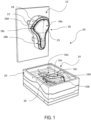
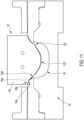
- Figure 1 shows a moulding unit 10 according to the present invention, for the production of a support element for the human body.
- unit 10 comprises a first component 12 and a second component 14.
- the first component 12 is a punch element of the moulding unit 10 while the second component 14 is a die component of the moulding unit 10.
- the first component 12 can be coupled to the second component 14.
- the moulding unit 10 when the first component 12 is in abutment against the second component 14, the moulding unit 10 is in a closed operating configuration while when the first component 12 and the second component 14 are moved away from each other, the moulding unit is in an open operating configuration.
- Means of approaching-removing the first component 12 with respect to the second component 14 are therefore provided, which are capable of moving the moulding unit 10 from the open to the closed operating configuration and vice versa, including all intermediate operating positions between open and closed.
- Such approaching-removing means may comprise an electric, pneumatic or other actuator designed to reciprocally approach and/or move the first component 12 and the second component 14 along a rectilinear or angular or rotational direction.
- This means that the first component 12 can be moved relative to the second component 14 along a predetermined rectilinear direction, or it can be moved angularly or rotating in approach-close or move away-open mode relative to the second component 14, and vice versa.
- the second component 14 is in a lower position than the first component 12. Different positions, however, can be contemplated.
- the term “upper” refers to an element that, in use, is positioned above or higher, or is facing upwards; with the term “lower”, on the other hand, refers to an element that, in use, is positioned below or lower, or is facing downwards or towards the ground.
- longitudinal refers to a direction that extends along the longest part of an element while the term “transverse” refers to a direction that extends perpendicular to the longest part of an element, or from side to side thereof.
- “Vertical” means a direction or a plane that in use goes from the bottom to the top while “horizontal” means a direction or a plane that, in use, is parallel to the ground.
- the second component 14 comprises and/or delimits a cavity 16, suitable for use to house and/or to be filled with a material adapted to form a padding 114 of a support element 100.
- This material can be inserted, poured or injected into the cavity 16 and is capable of foaming and/or hardening and/or polymerising and/or solidifying within the cavity 16.
- the material is therefore a hardenable and/or polymerisable and/or solidifiable material.
- the cavity 16 is recessed relative to the second component 14 and is shaped substantially negatively with respect to the padding 114.
- the cavity 16 is open at the top, in at least one first configuration or version of the invention.
- the cavity 16 has an opening 16a.
- the cavity 16 is formed by a shaped surface 16b, in recess, and by a perimeter edge 16c, which defines the opening 16a.
- the first component 12 includes a punch element 18.
- the punch element 18 is shaped in such a way as to abut against the cavity 16 and/or against its perimeter edge 16c, so as to determine the closure of the moulding unit 10 and/or of the cavity 16.
- the punch element 18 rises from the first component 12. It comprises a shaped area 18a and an external profile 18b.
- the external profile 18b corresponds to the perimeter edge 16c of the second component 14 and/or is adapted to come into contact with and/or abut against the perimeter edge 16c.
- abutment elements 18c for example shaped like a peg or cylinder, which can be housed in appropriate and corresponding seats 16d arranged, for example, at the perimeter edge 16c of the cavity 16.
- the position of the abutment elements 18c and of the appropriate seats 16d are matched, so that when the first component 12 comes into abutment against the second component 14, the abutment elements 18c can be housed in the seats 16d.
- the position of the abutment elements 18c and that of the relative seats 16d can be reversed, without departing from the scope of the present invention, as defined by the claims.
- the shaped surface 16b of the cavity 16 is defined by a first delimiting edge 16e.
- the shaped area 18a of the punch element 18 is defined by a second delimiting edge 18d.
- the first delimiting edge 16e and the second delimiting edge 18d abut each other.
- the shaped surface 16b and the shaped area 18a determine the upper surface 116 and the lower surface 118 of the padding 114, respectively.
- the method may comprise the following steps:
- the trimming step follows the step of hardening and/or polymerising and/or solidifying or the step of removing and/or the step of extracting.
- the padding material 114 is positioned in the cavity 16 after the step of positioning the external covering and is brought into contact with the external covering 120 itself.
- the step of locking the external covering 120 in place can be accomplished by locking an excess portion 120a of the external covering 120 by means, for example, of a retention plate 20, as better disclosed below.
- the external covering 120 can be locked in position directly by the punch element 18, in abutment against the first component 12.
- the external profile 18b in abutment against the perimeter edge 16c of the second component 14 locks in place the excess portion 120a of the external covering 120.
- the trimming phase is swift, whether carried out manually, for example by means of a special trimming machine, or in an automated manner. Thanks to the support component 122, in fact, there is no surplus material to be trimmed, since the outermost edge 122c of the support component 122 is placed at a certain distance, for example about 5 mm, or a distance between 1 mm and 10 mm, from the trim edge 114a of the padding 114.
- the trim edge 114a of the padding 114 is the edge that ideally separates the excess portion 120a of the external covering 120 from the portion thereof that is adhered to the upper surface 116 of the padding 114 itself.
- the trim edge 114a is the edge along which trimming of the external covering 120 takes place.
- trim edge 114a of the padding 114 is determined in use by the contact between the first delimiting edge 16e and the second delimiting edge 18d of the cavity 16 and the punch element 18, respectively.
- the trim edge 114a is placed inside with respect to the support base 150 and/or its outer perimeter profile 150a.
- the step of hardening and/or polymerising and/or solidifying comprising a step of obtaining, at the lower surface 118 of the padding 114, an internal area 123 at which the support component 122 is adhered to the hardened and/or polymerised and/or solidified material, and an annular area 124, surrounding the internal area 123, comprising such hardened and/or polymerised and/or solidified material.
- the internal area 123 in at least one version of the invention, is in recess with respect to the annular area 124.
- the annular area 124 is obtained adjacent to the trim edge 114a, between the latter and the outermost edge 122c of the support component 122.
- the method comprises a step of constraining a support base 150 at the support component 122 (and/or its external face 122b) and/or a lower surface 118 of the padding 114 (and/or at the annular area 124) to which the support component 122 is attached, wherein the step of constraining comprises a step of applying a glue or a gluing agent on a lower surface 118 of the padding 114 and on the support component 122 (and/or its external face 122b) and a step of gluing the support base 150 on said lower surface 118 and on the support component 122 or vice versa.
- the glue or gluing agent may comprise a polyurethane-based compound, e.g. a two component polyurethane glue, etc.
- Other components may be provided according to the specific type of materials of the elements to be glued together.
- the glue or gluing agent may also be applied several times, for example twice to the lower surface 118 of the padding 114, waiting a certain period of time between one application and the next. This can be especially useful when the glue is applied, for example, by a brush or similar tool, while it may not be necessary if the glued is sprayed on.
- the method according to the present invention may comprise the steps of preparing and/or washing and/or degreasing at least an upper surface of the support base 150, so that it can accommodate the glue or gluing agent and thus bind to the lower surface 118 of the padding 114 and/or to the support component 122.
- the method according to the present invention may also comprise steps of preparing and/or washing at least the lower surface 118 of the padding 114. For example, such steps are performed prior to that of applying the glue or gluing agent.
- the washing steps can be carried out with special washing substances, including chemical-based ones, in order to prepare the treated and/or washed surfaces.
- special washing substances including chemical-based ones, in order to prepare the treated and/or washed surfaces.
- the washing substance can lead to the breakage of double bonds present in the hardened and/or polymerised and/or solidified material of the padding 114.
- a primer and/or a compatibilising agent may be applied to the upper surface of the support base 150 in order to facilitate constraining and/or gluing to the padding 114 and/or the support component 122.
- the adhesion of the support component 122 to the material that achieves the padding 114 is, in at least one version of the invention, determined by the chemical affinity between the two materials and/or results from the reaction of hardening and/or polymerisation and/or solidification of the material that achieves the padding, a reaction that takes place near the support component 122 itself.
- the step of adhesion of the support component 122 to the padding 114 to be aided by the application, on an internal face 122a of the support component 122, of a suitable compatibilising and/or adjuvant agent and/or glue.
- the step of constraining the support base 150 at the support component 122 and/or the lower surface 118 of the padding 114 to which the support component 122 is attached may also comprise applying a glue or gluing agent to an upper surface of the support base 150.
- the step of constraining the support base 150 to the padding 114 may be carried out, for example, by means of a compression press machine, for example separate from the moulding unit 10 of the present invention.
- the support base 150 can be constrained to a male component (not shown in the attached Figures) by appropriate engagement means.
- the male component is an alternative to the first component 12.
- the male component could be removably coupled to the second component 14, bringing the support base 150 in abutment against the lower surface 118 of the padding 114 and against the support component 122.
- the support component 122 is flush with the lower surface 118 of the padding 114 and/or with the annular area 124. Therefore, and despite being made with a reduced thickness, in at least one version of the invention, the support component 122 does not protrude with respect to the padding material, the latter for example positioned at the annular area 124.
- the support component 122 is placed in a sort of corresponding imprint or recessed area (the dimensions of which correspond to those of the support component 122 and its thickness), which is in fact formed by the internal area 123, which is determined in the padding 114.
- the lower surface 118 of the padding 114 is substantially without discontinuities or steps, once realised.
- the support component 122 is to some extent embedded and/or inserted into the material forming the padding 114. This means that at least the internal face 122a of the support component 122, the one intended to come into contact with the padding 114, and the thickness of the support component 122, will be surrounded and in contact with the material of the padding 114. Conversely, an external face 122b of the support component 122, which is visible after the step of making the padding and which is adapted in use to be constrained and/or glued to the support base 150, is not in recess or projecting with respect to the material that constitutes the padding 114 and/or the annular area 124, but substantially planar and/or flush with it.
- the external face 122b is at least partially not covered by the hardened and/or polymerised and/or solidified material that constitutes the padding 114.
- the method may also include a step of abrading the material of this annular area 124, so that the annular surface becomes rough and/or wrinkled and/or has a rough and/or wrinkled pattern.
- the material that makes up the padding 114 is at least superficially compact following hardening and/or polymerisation and/or solidification.
- This abrading step is capable of making the surface of the annular area 124 more absorbent of the glue or gluing agent required for the subsequent constraint of the support base 150.
- the abrading step at least in one version of the invention, may open the chemical bonds of the material constituting the padding 114 and/or may mechanically roughen and/or wrinkle that area, so as to facilitate the gluing step.
- the abrading step may be performed by milling and/or abrasion and/or scraping and/or removal and/or mechanical etching of the surface layer of said annular area 124.
- the method according to one version of the present invention can provide that at least one of its steps and/or at least the step of abrading and/or applying a glue or a gluing agent and/or trimming is automated and/or performed by a robot, for example anthropomorphic.
- a robot for example anthropomorphic.
- the steps of the method and/or the step of trimming the external covering 120 and/or the steps of preparing the padding 114, and/or the step of abrading (as visible in Figure 9 ) and/or the step of applying a glue or a gluing agent (as visible in Figure 10 ) are carried out automatically, for example by a robot, for example anthropomorphic, instead of manually.
- the template or the appropriate tool has, for example, a shape corresponding in negative to that of the padding 114 and/or its upper surface 116, and/or comprises a vice and/or an undercut.
- the step of constraining or gluing the padding 114 to the support base 150 can be performed by placing said elements or only one of them in an oven, for example convective, which brings the entire mass of said elements or only one of them to a temperature corresponding, for example, of about 50°C. Subsequently, a coupling, for example manual, and pressing of the two elements onto each other, takes place. In this way, in at least one version of the invention, the support element 100 will be ready for marketing, without the need for further finishing and/or cleaning steps.
- the step of positioning the support component 122 onto the punch element 18 comprises a step of positioning and/or securing the support component 122 through retention means present on the punch element 18.
- retention means comprise a containment rim 22 and/or retention means 30 and appropriate seats and/or holes 130 on the support component 122 itself, as further specified below.
- the support element 100 can have a hole, preferably a through hole, in a central and/or longitudinal area thereof.
- the hole may be circular or elongated. This is particularly useful when the support element 100 is a saddle for a vehicle, as such a hole may allow better ventilation or may provide pressure relief for the user at certain points, such as prostate or soft tissue points.
- the method can comprise a step of making such a hole at the substantially central and/or longitudinal part of the external covering 120 and/or the padding 114, after the step of hardening and/or polymerisation and/or solidifying, or after the step of distancing, or after the step of extracting, possibly at the corresponding opening present in the support component 122. This can be performed, for example, by a pressure cutting element or by shearing or other similar methods.
- the padding 114 can comprise at least one insert.
- Such an insert can be made, for example, of a polyurethane material, and/or of a material having a different density with respect to the remaining material that constitutes the padding and/or in a material with different chemical and/or physical and/or mechanical properties with respect to the remaining material that constitutes the padding and/or in a material distinguishable by at least one property from the material that constitutes the rest of the padding 114.
- such at least one insert may be made of a polyurethane gel or ethylene-vinyl acetate (EVA).
- Such at least one insert may be positioned at the at least one area of the padding where it is desired to obtain a different density and/or mechanical properties than the rest of the padding, e.g. improved comfort, and/or improved cushioning and/or increased stiffness and/or firmness.
- the method according to the present invention may therefore comprise a step of providing at least one insert and positioning such at least one insert internally proximate the external covering 120 and/or the support component 122.
- the step of supplying the at least one insert may comprise either a step of supplying an already pre-shaped insert or a step of pouring a suitable material at the at least one area where such an insert is to be placed.
- the support element 100 obtained with the method according to the present invention therefore comprises a padding 114, possibly comprising at least one insert, and a support component 122.
- the at least one insert When the at least one insert is provided pre-shaped, it can be constrained, for example, to the internal face 122a of the support component 122, so that after the realisation of the padding 114 it is incorporated therein.
- the presence of such at least one insert e.g. made of EVA, makes it possible to stiffen the material at the same time, both due to the intrinsic characteristics of such an insert and to the fact that, where it is present, the volume that can be occupied by the padding 114 is reduced and thus the same material will in fact be denser and/or less expansive and/or stiffer (compared to the same material that can be positioned in a larger volume).
- the at least one insert may, for example, be glued to the support component 122.
- the insert When the insert is poured, it may be poured into specific areas of the cavity 16, prior to the insertion of the material that will constitute the padding 114. In this case, a certain period of time can be allowed to elapse, for example to enable at least partially the polymerisation and/or hardening and/or solidification of the material of the at least one insert, so that the material that constitutes the padding does not invade the areas designated to the at least one insert and/or mix with the latter.
- the support component 122 has a conformation substantially corresponding to that of the padding 114, but slightly smaller than the latter.
- both the padding 114 and the support component 122 have a first portion, front or anterior in use, of substantially elongated conformation, and a second portion, rear in use, of substantially enlarged conformation.
- the first portion is connected to the second portion, as the overall conformation of the padding 114 and/or the support component 122 is substantially triangular, with rounded edges.
- flanks or side portions connecting the first portion to the second portion are at least slightly contoured, so as to present a kind of concavity (with a cavity facing outwards and to the side).
- Such shaping may, for example, facilitate pedalling by the user.
- the support component 122 may be made of a composite material, e.g. a latex-impregnated cellulose agglomerate, such as the commercially available material Texon, and/or a synthetic material and/or a plastic and/or thermoplastic material, such as a material comprising or consisting of polyester and viscose, and/or a thermoformable material, and/or a rigid polyurethane or a soft polyurethane, etc.
- a composite material e.g. a latex-impregnated cellulose agglomerate, such as the commercially available material Texon, and/or a synthetic material and/or a plastic and/or thermoplastic material, such as a material comprising or consisting of polyester and viscose, and/or a thermoformable material, and/or a rigid polyurethane or a soft polyurethane, etc.
- the support component 122 is at least partially inserted and/or embedded in the hardened and/or polymerised and/or solidified material of the padding 114. This is except for its external face 122b.
- the support component 122 is not made of a material such as a fabric or a mesh.
- Fabric or mesh in general, do not provide the necessary stiffness desired with the support component 122 of the present invention.
- the fabric or mesh - at least the traditional one - does not help to maintain the dimensions of the padding, does not provide a "guide" for trimming the external covering, and does not prevent dimensional shrinkage of the padding material itself.
- the support component 122 is of a very slender thickness, in the order of a few millimetres or approximately 1 mm or less.
- the support component 122 provides a certain "stiffness" to the padding 114.
- the support component has a Young modulus stiffness of 500 to 3000 Mpa.
- the support component 122 is in fact stiffer than the material constituting the padding 114 and/or the material constituting the external covering 120.
- the support component 122 in at least one version of the invention, has the same stiffness as the support base 150 but of a very reduced thickness compared to the latter.
- the support component 122 may be produced, in a version of the invention, by a thermoforming process.
- the support component 122 has two major faces, having substantially the same conformation as that of the support component itself. These major faces, in fact, are spaced from each other by the thickness of the support component which, as mentioned, is very thin.
- the larger faces of the support component are an internal face 122a, adapted in use to be facing towards and/or constrained with the material of the padding 144, and an external face 122b, adapted in use to be facing towards and/or constrained with the support base 150.
- the support base 150 (for example visible in Figure 5 and Figure 8 ) may, for example, be made of a plastic and/or synthetic material such as, for example, polyamide, or a metallic or composite material.
- At least one of the internal face 122a and external face 122b is at least partially rough and/or includes unevenness, ripples, grooves and valleys that are more or less irregular or have been adjusted, etc.
- the support component 122 through its external face 122b having this particular pattern or texture, more easily retains the glue or the gluing agent that is used for the bonding with the support base 150 and/or is impregnated more easily by such glue or gluing agent. In this way, it is possible, for example, to avoid using a primer between the support component and the material that will constitute the support base 150.
- the support element 100 in a version of the invention, can comprise at least one external covering 120.
- external covering 120 may be made of a plastic or natural material, such as a fabric, leather, imitation leather, a layer of compact and/or closed cell or foamed polyurethane material, a high density material, a synthetic and/or polymeric material such as PVC or polyvinyl chloride, etc.
- a layer of primer or compatibilising agent for example based on polyurethane and/or components thereof, may be present and/or applied to facilitate adhesion of the external covering 120 to the padding 114.
- this layer is applied on a face 120c, in internal use, of the external covering 120, adapted to be facing and/or constrained with the upper surface 116 of the padding 114. It is apparent that, when the external covering 120 is present, the upper surface 116 of the padding 114 is not external or accessible from the outside or by a user, as it is covered by the external covering 120 and/or constrained thereto.
- the external covering 120 also has an external face 120b which, when present, is adapted to come into contact with the user and/or be visible from the outside.
- the material constituting the padding 114 may include a foam, a self-skimming foam, a polyurethane foam, a printed insert, e.g. by means of a three-dimensional printer, a cushioning and/or comfort insert, etc. Such material is able to expand, in at least one version of the invention. Furthermore, in one version of the invention, such material can be inserted, poured or injected into the cavity 16 of the moulding unit 10 and is adapted to foam, harden and/or polymerise and/or solidify inside the cavity 16 itself.
- the present invention therefore also relates to a support element for the human body obtainable by a method according to the present invention, wherein the support element 100 comprises the padding 114, the support component 122 and, optionally, the support base 150, wherein the padding 114 comprises a hardened and/or polymerised and/or solidified material to which the support component 122 is adhered.
- the support component 122 may be placed, in use, between the padding 114 and the support base 150, when the latter is present.
- This support component 122 is adhered to the padding 114 and/or glued to the support base 150.
- an external covering 120 which covers at least partially or completely the padding 114.
- the padding 114 constitutes a semi-finished assembly. In this case, therefore, it constitutes a part of a support element 100. In order to obtain the usable and/or complete support element 100, in fact, it is useful for the support base 150 also to be present. However, due to the presence of the support component 122, as mentioned above, the dimensional stability of the moulded padding 114 is maintained, which could then be sold as such or stored for later application of the support base 150.
- the advantage of the support component 122 is also measured in terms of effectiveness during the trimming operation of the excess portion 120a of the external covering 120. In fact, the advantage lies in having a consistent and compact component - namely, the support component 122 - which facilitates the operator in carrying out this operation.
- the present invention also has as an object a moulding unit 10. This moulding unit 10 is adapted to be used for the method according to the present invention and/or for the realisation of the support element described above.
- the moulding unit 10 may comprise vacuum means and/or a special retention plate (e.g. indicated by 20 in Figure 1 ).
- the retention plate 20 is positioned above the cavity 16, so that, when the external covering is present, a layer of material adapted to make it is positioned at the cavity 16.
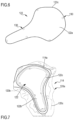
- the size of the external covering layer is larger than the size of the cavity so that, once positioned at the cavity 16, it can overlap with respect to the perimeter edge 16c and/or the first delimiting edge 16e of an excess portion 120a (visible for example in Figure 7 ).
- the retention plate 20 locks the external covering 120 in place by pressing and constraining the excess portion 120a, then the vacuum means are actuated and the external covering 120 adheres to the moulded surface 16b, assuming the conformation of the latter.
- the retention plate 20 has a substantially annular surface and is provided with a through opening corresponding to the opening 16a of the cavity 16.
- the outer covering has the external face 120b, adapted to come into contact with the cavity 16 and intended to constitute the outermost layer of the padding 114 in use, and the internal face 120c, adapted to come into contact with the padding material 114.
- the internal face 120c of the external covering 120 in use is not visible.
- the material that constitutes the padding 114 is able independently to create a more compact film and/or with more closed and/or less expanded cells (compared to the material that will constitute the remaining part of the padding 114) in contact with the shaped surface 16b.
- the punch element 18 comprises retention means for the support component 122.
- Such retention means for example placed at the shaped area 18a of the punch element 18, may comprise a containment rim 22, adapted in use to contain and/or retain a support component 122 and/or retention means 30.
- the rim 22 is able to prevent the material that constitutes the padding from passing through the rim itself and overlapping the external face 122b of the support component 122.
- the containment rim 22 is internal with respect to the external profile 18b and/or the second delimiting edge 18d of the punch element 18.
- the external profile 18b has a larger size than the second delimiting edge 18d and/or the containment rim 22.
- the containment rim 22 is located about 1 cm from the external profile 18b. Accordingly, the area enclosed by the containment rim 22 is smaller than the area enclosed by the second delimiting edge 18d, which corresponds to the shaped area 18a, which in turn is smaller than the area enclosed by the external profile 18b.
- the containment rim 22 therefore, divides the shaped area 18a into an internal area 23 at the rim 22 and an annular area 24, surrounding the internal area 23.
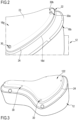
- This containment rim 22 protrudes with respect to the shaped area 18a, as shown in Figure 2 .
- the containment rim 22 could be flush with the shaped area 18a and could enclose an internal area 23, recessed with respect to the shaped area 18a.
- the depth of the indentation of this internal area may correspond to the thickness of the support component 122.
- the annular area 24 would also be flush with the rim 22.
- the shaped area 18a is shaped to correspond, as mentioned, to the lower surface 118 of the padding 114.
- the internal area 23, therefore, determines the formation of most of the lower surface 118 of the padding 114 and/or of the internal area 123 while the annular area 24 determines the formation of the annular area 124 of the padding 114.
- This inclined surface can be straight or curved, with convexity towards the inside or towards the outside of the punch element 18.
- the punch element 18 can comprise suitable retention means 30 of the support component 122, such as the coupling pins (visible in Figure 2 ).
- Such retention means 30 can be shaped, for example, as a pin 30a, having a first end constrained or connected to the shaped area 18a and a second end or free end 30b, opposite the first end, having a section greater than that of the pin 30a.
- the cross section of the peg 30a may be circular or polygonal.
- the cross section of the free end 30b may be circular or polygonal.
- the height of the peg 30a may be corresponding to or only slightly greater than the thickness of the support component 122.
- retention means 30 can have any other form suitable for the purpose, without departing from the scope of protection of the present invention, as defined by the claims.
- the retention means 30 could be present, but not the rim 22.
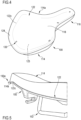
- the support component 122 When the retention means 30 are present, the support component 122 will have special seats or special through holes 130 (for example visible in Figure 4 and Figure 6 ), having a circular or polygonal section adapted to allow the passage of the retention means itself and, at the same time, to retain the support component 122 on the punch element 18.
- the retention means 30 are positioned at the shaped area 18a, or rather at the internal area 23, possibly in the vicinity of the annular area 24.
- a fork 152 of a type known in the field, can be connected to the bicycle or vehicle frame.
- the moulding unit 10 and/or at least the first component 12 is made of aluminium or other suitable metallic material.
- the first component 12 and/or the second component 14 comprise a main plate from which the punch element 18 is raised and/or in which the cavity 16 is recessed respectively.
- the first component 12 and the second component 14 may also be in contact with the respective main plates. Therefore, a sealed condition (by means of special gaskets, if desired) is created for the cavity 16 with the punch element 18 or rather with its shaped area 18a.
Landscapes
- Engineering & Computer Science (AREA)
- Mechanical Engineering (AREA)
- Manufacturing & Machinery (AREA)
- Casting Or Compression Moulding Of Plastics Or The Like (AREA)
- Moulding By Coating Moulds (AREA)
- Health & Medical Sciences (AREA)
- Physics & Mathematics (AREA)
- Oral & Maxillofacial Surgery (AREA)
- Thermal Sciences (AREA)
- Chair Legs, Seat Parts, And Backrests (AREA)
- Injection Moulding Of Plastics Or The Like (AREA)
- Lining Or Joining Of Plastics Or The Like (AREA)
- Moulds For Moulding Plastics Or The Like (AREA)
Applications Claiming Priority (2)
| Application Number | Priority Date | Filing Date | Title |
|---|---|---|---|
| IT202100016760 | 2021-06-25 | ||
| PCT/IB2022/055454 WO2022269407A1 (en) | 2021-06-25 | 2022-06-13 | Method for making a support element for the human body, such as a saddle of a vehicle, support element so obtained and relative molding unit |
Publications (2)
| Publication Number | Publication Date |
|---|---|
| EP4359190A1 EP4359190A1 (en) | 2024-05-01 |
| EP4359190B1 true EP4359190B1 (en) | 2025-04-23 |
Family
ID=78212422
Family Applications (1)
| Application Number | Title | Priority Date | Filing Date |
|---|---|---|---|
| EP22737529.2A Active EP4359190B1 (en) | 2021-06-25 | 2022-06-13 | Method for making a support element for the human body, such as a saddle of a vehicle, support element so obtained and relative molding unit |
Country Status (13)
| Country | Link |
|---|---|
| US (1) | US20240253719A1 (https=) |
| EP (1) | EP4359190B1 (https=) |
| JP (1) | JP2024525264A (https=) |
| KR (1) | KR20240026439A (https=) |
| CN (1) | CN117120234A (https=) |
| AU (1) | AU2022296922A1 (https=) |
| BR (1) | BR112023020579A2 (https=) |
| CA (1) | CA3216201A1 (https=) |
| DK (1) | DK4359190T3 (https=) |
| ES (1) | ES3036219T3 (https=) |
| PT (1) | PT4359190T (https=) |
| TW (1) | TW202402654A (https=) |
| WO (1) | WO2022269407A1 (https=) |
Families Citing this family (1)
| Publication number | Priority date | Publication date | Assignee | Title |
|---|---|---|---|---|
| CN119795590B (zh) * | 2025-03-10 | 2025-06-03 | 温岭东方红车料有限公司 | 一种自行车鞍座皮革用成型设备 |
Family Cites Families (8)
| Publication number | Priority date | Publication date | Assignee | Title |
|---|---|---|---|---|
| US3833454A (en) * | 1972-05-11 | 1974-09-03 | Northern Fibre Prod Co | Reinforced foam plastic seat bun and method of molding same |
| JPS6179487A (ja) * | 1984-09-25 | 1986-04-23 | 株式会社タチエス | シ−トバツクの組立方法 |
| FR2627426A1 (fr) * | 1988-02-23 | 1989-08-25 | Tachi S Co | Procede de fabrication de sieges moules integralement en mousse |
| US4860415A (en) * | 1988-06-13 | 1989-08-29 | Hoover Universal, Inc. | Method of making a vehicle seat assembly with pour-in-place foam body |
| ITPD980102A1 (it) * | 1998-04-24 | 1999-10-24 | S M P Selle Sas Di Schiavon Ma | Procedimento per la realizzazione di elementi imbottiti, in particola re selle, parzialmente rivestiti con inserti e prodotto ottenuto |
| ITVI20030236A1 (it) * | 2003-11-27 | 2005-05-28 | Selle Royal Spa | Metodo per la realizzazione di supporti elastici integrali, |
| JP6471748B2 (ja) * | 2014-04-15 | 2019-02-20 | 株式会社カネカ | ポリオレフィン系樹脂型内発泡成形用金型及び型内発泡成形品の製造方法並びに型内発泡成形品 |
| IT201800003144A1 (it) * | 2018-02-28 | 2019-08-28 | Selle Royal Spa | Componente maschio e rispettiva unita' di stampaggio per la produzione di un elemento di supporto per il corpo umano, quale una sella di un veicolo. |
-
2022
- 2022-06-13 CA CA3216201A patent/CA3216201A1/en active Pending
- 2022-06-13 WO PCT/IB2022/055454 patent/WO2022269407A1/en not_active Ceased
- 2022-06-13 CN CN202280026780.XA patent/CN117120234A/zh active Pending
- 2022-06-13 KR KR1020237034501A patent/KR20240026439A/ko active Pending
- 2022-06-13 JP JP2023561269A patent/JP2024525264A/ja active Pending
- 2022-06-13 ES ES22737529T patent/ES3036219T3/es active Active
- 2022-06-13 BR BR112023020579A patent/BR112023020579A2/pt unknown
- 2022-06-13 US US18/560,540 patent/US20240253719A1/en active Pending
- 2022-06-13 PT PT227375292T patent/PT4359190T/pt unknown
- 2022-06-13 AU AU2022296922A patent/AU2022296922A1/en active Pending
- 2022-06-13 DK DK22737529.2T patent/DK4359190T3/da active
- 2022-06-13 EP EP22737529.2A patent/EP4359190B1/en active Active
- 2022-06-24 TW TW111123587A patent/TW202402654A/zh unknown
Also Published As
| Publication number | Publication date |
|---|---|
| PT4359190T (pt) | 2025-07-16 |
| CN117120234A (zh) | 2023-11-24 |
| WO2022269407A1 (en) | 2022-12-29 |
| DK4359190T3 (da) | 2025-07-21 |
| BR112023020579A2 (pt) | 2024-01-23 |
| CA3216201A1 (en) | 2022-12-29 |
| US20240253719A1 (en) | 2024-08-01 |
| AU2022296922A1 (en) | 2023-10-26 |
| JP2024525264A (ja) | 2024-07-12 |
| ES3036219T3 (en) | 2025-09-16 |
| KR20240026439A (ko) | 2024-02-28 |
| TW202402654A (zh) | 2024-01-16 |
| EP4359190A1 (en) | 2024-05-01 |
Similar Documents
| Publication | Publication Date | Title |
|---|---|---|
| JP2901051B2 (ja) | 積層成形体の成形方法 | |
| US4829644A (en) | Method of molding skin-covered foamed plastic article | |
| JP4636779B2 (ja) | 少なくとも弾性ポリウレタンスキンを含む成形品の製造方法及び金型 | |
| US20060284330A1 (en) | Method for manufacturing a composite trim part for the interior of an automotive vehicle | |
| JPH06154385A (ja) | スキー板の製作方法 | |
| CA1151365A (en) | Shoe molding process | |
| EP4359190B1 (en) | Method for making a support element for the human body, such as a saddle of a vehicle, support element so obtained and relative molding unit | |
| CN110891852B (zh) | 用于支撑人体的支撑元件及其制造模具和制造方法 | |
| JP2024525264A5 (https=) | ||
| US20260070266A1 (en) | Plant and method for manufacturing a support element for the human body, such as a vehicle saddle | |
| US4886630A (en) | Method of producing skin-covered pad for seat | |
| CN111655568B (zh) | 制造具有附加凝胶衬垫的座椅的方法、由此获得的座椅和实施该方法的设备 | |
| CN1140403C (zh) | 发泡鞋体的制造方法 | |
| ATE396856T1 (de) | Verfahren zur herstellung eines formteils mit weichem einsatzteil | |
| GB2353245A (en) | A moulding technique | |
| US5106548A (en) | Method of producing skin-covered pad for seat | |
| CN1370675A (zh) | 周缘一体成型有立体轮廓的发泡鞋体的制造方法 | |
| WO2002102564A2 (en) | Shoe sole manufacturing method and product | |
| JP2567249B2 (ja) | 座席体の製造方法 | |
| CA2473240A1 (en) | Method of pre-applying a bolster assembly to an interior trim part | |
| JPH0957766A (ja) | 内装材及びその製造方法 | |
| JPH02274518A (ja) | 成形用型の製造方法 | |
| JPH0439009A (ja) | 自動車用内装部品の製造方法 | |
| JPH0651004B2 (ja) | 靴のダイレクト成形法 | |
| MXPA00011110A (es) | Metodo para fabricar un zapato con una plantilla espumosa. |
Legal Events
| Date | Code | Title | Description |
|---|---|---|---|
| STAA | Information on the status of an ep patent application or granted ep patent |
Free format text: STATUS: UNKNOWN |
|
| STAA | Information on the status of an ep patent application or granted ep patent |
Free format text: STATUS: THE INTERNATIONAL PUBLICATION HAS BEEN MADE |
|
| PUAI | Public reference made under article 153(3) epc to a published international application that has entered the european phase |
Free format text: ORIGINAL CODE: 0009012 |
|
| STAA | Information on the status of an ep patent application or granted ep patent |
Free format text: STATUS: REQUEST FOR EXAMINATION WAS MADE |
|
| 17P | Request for examination filed |
Effective date: 20230906 |
|
| AK | Designated contracting states |
Kind code of ref document: A1 Designated state(s): AL AT BE BG CH CY CZ DE DK EE ES FI FR GB GR HR HU IE IS IT LI LT LU LV MC MK MT NL NO PL PT RO RS SE SI SK SM TR |
|
| P01 | Opt-out of the competence of the unified patent court (upc) registered |
Free format text: CASE NUMBER: APP_33278/2024 Effective date: 20240604 |
|
| DAV | Request for validation of the european patent (deleted) | ||
| DAX | Request for extension of the european patent (deleted) | ||
| GRAP | Despatch of communication of intention to grant a patent |
Free format text: ORIGINAL CODE: EPIDOSNIGR1 |
|
| STAA | Information on the status of an ep patent application or granted ep patent |
Free format text: STATUS: GRANT OF PATENT IS INTENDED |
|
| RIC1 | Information provided on ipc code assigned before grant |
Ipc: B62J 1/26 20060101ALI20241029BHEP Ipc: B29C 45/14 20060101ALI20241029BHEP Ipc: B29C 33/18 20060101ALI20241029BHEP Ipc: B29C 33/14 20060101ALI20241029BHEP Ipc: B29C 44/58 20060101ALI20241029BHEP Ipc: B29C 44/14 20060101AFI20241029BHEP |
|
| INTG | Intention to grant announced |
Effective date: 20241113 |
|
| GRAS | Grant fee paid |
Free format text: ORIGINAL CODE: EPIDOSNIGR3 |
|
| GRAA | (expected) grant |
Free format text: ORIGINAL CODE: 0009210 |
|
| STAA | Information on the status of an ep patent application or granted ep patent |
Free format text: STATUS: THE PATENT HAS BEEN GRANTED |
|
| AK | Designated contracting states |
Kind code of ref document: B1 Designated state(s): AL AT BE BG CH CY CZ DE DK EE ES FI FR GB GR HR HU IE IS IT LI LT LU LV MC MK MT NL NO PL PT RO RS SE SI SK SM TR |
|
| REG | Reference to a national code |
Ref country code: GB Ref legal event code: FG4D |
|
| REG | Reference to a national code |
Ref country code: CH Ref legal event code: EP |
|
| REG | Reference to a national code |
Ref country code: DE Ref legal event code: R096 Ref document number: 602022013638 Country of ref document: DE |
|
| REG | Reference to a national code |
Ref country code: IE Ref legal event code: FG4D |
|
| REG | Reference to a national code |
Ref country code: PT Ref legal event code: SC4A Ref document number: 4359190 Country of ref document: PT Date of ref document: 20250716 Kind code of ref document: T Free format text: AVAILABILITY OF NATIONAL TRANSLATION Effective date: 20250710 |
|
| REG | Reference to a national code |
Ref country code: DK Ref legal event code: T3 Effective date: 20250715 |
|
| PGFP | Annual fee paid to national office [announced via postgrant information from national office to epo] |
Ref country code: AT Payment date: 20250721 Year of fee payment: 4 |
|
| REG | Reference to a national code |
Ref country code: NL Ref legal event code: FP |
|
| PGFP | Annual fee paid to national office [announced via postgrant information from national office to epo] |
Ref country code: NL Payment date: 20250726 Year of fee payment: 4 |
|
| REG | Reference to a national code |
Ref country code: ES Ref legal event code: FG2A Ref document number: 3036219 Country of ref document: ES Kind code of ref document: T3 Effective date: 20250916 |
|
| PG25 | Lapsed in a contracting state [announced via postgrant information from national office to epo] |
Ref country code: FI Free format text: LAPSE BECAUSE OF FAILURE TO SUBMIT A TRANSLATION OF THE DESCRIPTION OR TO PAY THE FEE WITHIN THE PRESCRIBED TIME-LIMIT Effective date: 20250423 |
|
| PGFP | Annual fee paid to national office [announced via postgrant information from national office to epo] |
Ref country code: PT Payment date: 20250718 Year of fee payment: 4 Ref country code: ES Payment date: 20250801 Year of fee payment: 4 |
|
| PGFP | Annual fee paid to national office [announced via postgrant information from national office to epo] |
Ref country code: DK Payment date: 20250725 Year of fee payment: 4 Ref country code: DE Payment date: 20250729 Year of fee payment: 4 |
|
| REG | Reference to a national code |
Ref country code: LT Ref legal event code: MG9D |
|
| PG25 | Lapsed in a contracting state [announced via postgrant information from national office to epo] |
Ref country code: NO Free format text: LAPSE BECAUSE OF FAILURE TO SUBMIT A TRANSLATION OF THE DESCRIPTION OR TO PAY THE FEE WITHIN THE PRESCRIBED TIME-LIMIT Effective date: 20250723 Ref country code: GR Free format text: LAPSE BECAUSE OF FAILURE TO SUBMIT A TRANSLATION OF THE DESCRIPTION OR TO PAY THE FEE WITHIN THE PRESCRIBED TIME-LIMIT Effective date: 20250724 |
|
| PG25 | Lapsed in a contracting state [announced via postgrant information from national office to epo] |
Ref country code: PL Free format text: LAPSE BECAUSE OF FAILURE TO SUBMIT A TRANSLATION OF THE DESCRIPTION OR TO PAY THE FEE WITHIN THE PRESCRIBED TIME-LIMIT Effective date: 20250423 |
|
| PGFP | Annual fee paid to national office [announced via postgrant information from national office to epo] |
Ref country code: IT Payment date: 20250630 Year of fee payment: 4 |
|
| PG25 | Lapsed in a contracting state [announced via postgrant information from national office to epo] |
Ref country code: BG Free format text: LAPSE BECAUSE OF FAILURE TO SUBMIT A TRANSLATION OF THE DESCRIPTION OR TO PAY THE FEE WITHIN THE PRESCRIBED TIME-LIMIT Effective date: 20250423 |
|
| PG25 | Lapsed in a contracting state [announced via postgrant information from national office to epo] |
Ref country code: HR Free format text: LAPSE BECAUSE OF FAILURE TO SUBMIT A TRANSLATION OF THE DESCRIPTION OR TO PAY THE FEE WITHIN THE PRESCRIBED TIME-LIMIT Effective date: 20250423 |
|
| PGFP | Annual fee paid to national office [announced via postgrant information from national office to epo] |
Ref country code: FR Payment date: 20250725 Year of fee payment: 4 |
|
| PG25 | Lapsed in a contracting state [announced via postgrant information from national office to epo] |
Ref country code: RS Free format text: LAPSE BECAUSE OF FAILURE TO SUBMIT A TRANSLATION OF THE DESCRIPTION OR TO PAY THE FEE WITHIN THE PRESCRIBED TIME-LIMIT Effective date: 20250723 |
|
| PGFP | Annual fee paid to national office [announced via postgrant information from national office to epo] |
Ref country code: RO Payment date: 20250725 Year of fee payment: 4 |
|
| PG25 | Lapsed in a contracting state [announced via postgrant information from national office to epo] |
Ref country code: IS Free format text: LAPSE BECAUSE OF FAILURE TO SUBMIT A TRANSLATION OF THE DESCRIPTION OR TO PAY THE FEE WITHIN THE PRESCRIBED TIME-LIMIT Effective date: 20250823 |
|
| PG25 | Lapsed in a contracting state [announced via postgrant information from national office to epo] |
Ref country code: LV Free format text: LAPSE BECAUSE OF FAILURE TO SUBMIT A TRANSLATION OF THE DESCRIPTION OR TO PAY THE FEE WITHIN THE PRESCRIBED TIME-LIMIT Effective date: 20250423 |
|
| PG25 | Lapsed in a contracting state [announced via postgrant information from national office to epo] |
Ref country code: SM Free format text: LAPSE BECAUSE OF FAILURE TO SUBMIT A TRANSLATION OF THE DESCRIPTION OR TO PAY THE FEE WITHIN THE PRESCRIBED TIME-LIMIT Effective date: 20250423 |
|
| PG25 | Lapsed in a contracting state [announced via postgrant information from national office to epo] |
Ref country code: CZ Free format text: LAPSE BECAUSE OF FAILURE TO SUBMIT A TRANSLATION OF THE DESCRIPTION OR TO PAY THE FEE WITHIN THE PRESCRIBED TIME-LIMIT Effective date: 20250423 |
|
| PG25 | Lapsed in a contracting state [announced via postgrant information from national office to epo] |
Ref country code: EE Free format text: LAPSE BECAUSE OF FAILURE TO SUBMIT A TRANSLATION OF THE DESCRIPTION OR TO PAY THE FEE WITHIN THE PRESCRIBED TIME-LIMIT Effective date: 20250423 |
|
| REG | Reference to a national code |
Ref country code: DE Ref legal event code: R097 Ref document number: 602022013638 Country of ref document: DE |
|
| PG25 | Lapsed in a contracting state [announced via postgrant information from national office to epo] |
Ref country code: SK Free format text: LAPSE BECAUSE OF FAILURE TO SUBMIT A TRANSLATION OF THE DESCRIPTION OR TO PAY THE FEE WITHIN THE PRESCRIBED TIME-LIMIT Effective date: 20250423 |
|
| REG | Reference to a national code |
Ref country code: CH Ref legal event code: H13 Free format text: ST27 STATUS EVENT CODE: U-0-0-H10-H13 (AS PROVIDED BY THE NATIONAL OFFICE) Effective date: 20260127 |
|
| PG25 | Lapsed in a contracting state [announced via postgrant information from national office to epo] |
Ref country code: MC Free format text: LAPSE BECAUSE OF FAILURE TO SUBMIT A TRANSLATION OF THE DESCRIPTION OR TO PAY THE FEE WITHIN THE PRESCRIBED TIME-LIMIT Effective date: 20250423 |
|
| PG25 | Lapsed in a contracting state [announced via postgrant information from national office to epo] |
Ref country code: LU Free format text: LAPSE BECAUSE OF NON-PAYMENT OF DUE FEES Effective date: 20250613 |
|
| REG | Reference to a national code |
Ref country code: BE Ref legal event code: MM Effective date: 20250630 |
|
| PLBE | No opposition filed within time limit |
Free format text: ORIGINAL CODE: 0009261 |
|
| STAA | Information on the status of an ep patent application or granted ep patent |
Free format text: STATUS: NO OPPOSITION FILED WITHIN TIME LIMIT |
|
| REG | Reference to a national code |
Ref country code: CH Ref legal event code: L10 Free format text: ST27 STATUS EVENT CODE: U-0-0-L10-L00 (AS PROVIDED BY THE NATIONAL OFFICE) Effective date: 20260304 |
|
| 26N | No opposition filed |
Effective date: 20260126 |
|
| PG25 | Lapsed in a contracting state [announced via postgrant information from national office to epo] |
Ref country code: IE Free format text: LAPSE BECAUSE OF NON-PAYMENT OF DUE FEES Effective date: 20250613 |
|
| PG25 | Lapsed in a contracting state [announced via postgrant information from national office to epo] |
Ref country code: BE Free format text: LAPSE BECAUSE OF NON-PAYMENT OF DUE FEES Effective date: 20250630 |
|
| PG25 | Lapsed in a contracting state [announced via postgrant information from national office to epo] |
Ref country code: CH Free format text: LAPSE BECAUSE OF NON-PAYMENT OF DUE FEES Effective date: 20250630 |