EP4351984B1 - Formkörper mit anschlusselement - Google Patents
Formkörper mit anschlusselement Download PDFInfo
- Publication number
- EP4351984B1 EP4351984B1 EP22733918.1A EP22733918A EP4351984B1 EP 4351984 B1 EP4351984 B1 EP 4351984B1 EP 22733918 A EP22733918 A EP 22733918A EP 4351984 B1 EP4351984 B1 EP 4351984B1
- Authority
- EP
- European Patent Office
- Prior art keywords
- container
- fiber material
- molded product
- connecting element
- connection element
- Prior art date
- Legal status (The legal status is an assumption and is not a legal conclusion. Google has not performed a legal analysis and makes no representation as to the accuracy of the status listed.)
- Active
Links
Images




Classifications
-
- B—PERFORMING OPERATIONS; TRANSPORTING
- B65—CONVEYING; PACKING; STORING; HANDLING THIN OR FILAMENTARY MATERIAL
- B65D—CONTAINERS FOR STORAGE OR TRANSPORT OF ARTICLES OR MATERIALS, e.g. BAGS, BARRELS, BOTTLES, BOXES, CANS, CARTONS, CRATES, DRUMS, JARS, TANKS, HOPPERS, FORWARDING CONTAINERS; ACCESSORIES, CLOSURES, OR FITTINGS THEREFOR; PACKAGING ELEMENTS; PACKAGES
- B65D1/00—Rigid or semi-rigid containers having bodies formed in one piece, e.g. by casting metallic material, by moulding plastics, by blowing vitreous material, by throwing ceramic material, by moulding pulped fibrous material or by deep-drawing operations performed on sheet material
- B65D1/02—Bottles or similar containers with necks or like restricted apertures, designed for pouring contents
- B65D1/0207—Bottles or similar containers with necks or like restricted apertures, designed for pouring contents characterised by material, e.g. composition, physical features
-
- A—HUMAN NECESSITIES
- A45—HAND OR TRAVELLING ARTICLES
- A45D—HAIRDRESSING OR SHAVING EQUIPMENT; EQUIPMENT FOR COSMETICS OR COSMETIC TREATMENTS, e.g. FOR MANICURING OR PEDICURING
- A45D40/00—Casings or accessories specially adapted for storing or handling solid or pasty toiletry or cosmetic substances, e.g. shaving soaps or lipsticks
- A45D40/0068—Jars
-
- B—PERFORMING OPERATIONS; TRANSPORTING
- B29—WORKING OF PLASTICS; WORKING OF SUBSTANCES IN A PLASTIC STATE IN GENERAL
- B29C—SHAPING OR JOINING OF PLASTICS; SHAPING OF MATERIAL IN A PLASTIC STATE, NOT OTHERWISE PROVIDED FOR; AFTER-TREATMENT OF THE SHAPED PRODUCTS, e.g. REPAIRING
- B29C65/00—Joining or sealing of preformed parts, e.g. welding of plastics materials; Apparatus therefor
- B29C65/02—Joining or sealing of preformed parts, e.g. welding of plastics materials; Apparatus therefor by heating, with or without pressure
-
- B—PERFORMING OPERATIONS; TRANSPORTING
- B29—WORKING OF PLASTICS; WORKING OF SUBSTANCES IN A PLASTIC STATE IN GENERAL
- B29C—SHAPING OR JOINING OF PLASTICS; SHAPING OF MATERIAL IN A PLASTIC STATE, NOT OTHERWISE PROVIDED FOR; AFTER-TREATMENT OF THE SHAPED PRODUCTS, e.g. REPAIRING
- B29C65/00—Joining or sealing of preformed parts, e.g. welding of plastics materials; Apparatus therefor
- B29C65/56—Joining or sealing of preformed parts, e.g. welding of plastics materials; Apparatus therefor using mechanical means or mechanical connections, e.g. form-fits
- B29C65/561—Joining or sealing of preformed parts, e.g. welding of plastics materials; Apparatus therefor using mechanical means or mechanical connections, e.g. form-fits using screw-threads being integral at least to one of the parts to be joined
-
- B—PERFORMING OPERATIONS; TRANSPORTING
- B29—WORKING OF PLASTICS; WORKING OF SUBSTANCES IN A PLASTIC STATE IN GENERAL
- B29C—SHAPING OR JOINING OF PLASTICS; SHAPING OF MATERIAL IN A PLASTIC STATE, NOT OTHERWISE PROVIDED FOR; AFTER-TREATMENT OF THE SHAPED PRODUCTS, e.g. REPAIRING
- B29C66/00—General aspects of processes or apparatus for joining preformed parts
- B29C66/01—General aspects dealing with the joint area or with the area to be joined
- B29C66/05—Particular design of joint configurations
- B29C66/10—Particular design of joint configurations particular design of the joint cross-sections
- B29C66/12—Joint cross-sections combining only two joint-segments; Tongue and groove joints; Tenon and mortise joints; Stepped joint cross-sections
- B29C66/124—Tongue and groove joints
- B29C66/1246—Tongue and groove joints characterised by the female part, i.e. the part comprising the groove
- B29C66/12463—Tongue and groove joints characterised by the female part, i.e. the part comprising the groove being tapered
-
- B—PERFORMING OPERATIONS; TRANSPORTING
- B29—WORKING OF PLASTICS; WORKING OF SUBSTANCES IN A PLASTIC STATE IN GENERAL
- B29C—SHAPING OR JOINING OF PLASTICS; SHAPING OF MATERIAL IN A PLASTIC STATE, NOT OTHERWISE PROVIDED FOR; AFTER-TREATMENT OF THE SHAPED PRODUCTS, e.g. REPAIRING
- B29C66/00—General aspects of processes or apparatus for joining preformed parts
- B29C66/01—General aspects dealing with the joint area or with the area to be joined
- B29C66/05—Particular design of joint configurations
- B29C66/10—Particular design of joint configurations particular design of the joint cross-sections
- B29C66/13—Single flanged joints; Fin-type joints; Single hem joints; Edge joints; Interpenetrating fingered joints; Other specific particular designs of joint cross-sections not provided for in groups B29C66/11 - B29C66/12
- B29C66/131—Single flanged joints, i.e. one of the parts to be joined being rigid and flanged in the joint area
- B29C66/1312—Single flange to flange joints, the parts to be joined being rigid
-
- B—PERFORMING OPERATIONS; TRANSPORTING
- B29—WORKING OF PLASTICS; WORKING OF SUBSTANCES IN A PLASTIC STATE IN GENERAL
- B29C—SHAPING OR JOINING OF PLASTICS; SHAPING OF MATERIAL IN A PLASTIC STATE, NOT OTHERWISE PROVIDED FOR; AFTER-TREATMENT OF THE SHAPED PRODUCTS, e.g. REPAIRING
- B29C66/00—General aspects of processes or apparatus for joining preformed parts
- B29C66/01—General aspects dealing with the joint area or with the area to be joined
- B29C66/05—Particular design of joint configurations
- B29C66/303—Particular design of joint configurations the joint involving an anchoring effect
- B29C66/3032—Particular design of joint configurations the joint involving an anchoring effect making use of protrusions or cavities belonging to at least one of the parts to be joined
- B29C66/30325—Particular design of joint configurations the joint involving an anchoring effect making use of protrusions or cavities belonging to at least one of the parts to be joined making use of cavities belonging to at least one of the parts to be joined
- B29C66/30326—Particular design of joint configurations the joint involving an anchoring effect making use of protrusions or cavities belonging to at least one of the parts to be joined making use of cavities belonging to at least one of the parts to be joined in the form of porosity
-
- B—PERFORMING OPERATIONS; TRANSPORTING
- B29—WORKING OF PLASTICS; WORKING OF SUBSTANCES IN A PLASTIC STATE IN GENERAL
- B29C—SHAPING OR JOINING OF PLASTICS; SHAPING OF MATERIAL IN A PLASTIC STATE, NOT OTHERWISE PROVIDED FOR; AFTER-TREATMENT OF THE SHAPED PRODUCTS, e.g. REPAIRING
- B29C66/00—General aspects of processes or apparatus for joining preformed parts
- B29C66/50—General aspects of joining tubular articles; General aspects of joining long products, i.e. bars or profiled elements; General aspects of joining single elements to tubular articles, hollow articles or bars; General aspects of joining several hollow-preforms to form hollow or tubular articles
- B29C66/51—Joining tubular articles, profiled elements or bars; Joining single elements to tubular articles, hollow articles or bars; Joining several hollow-preforms to form hollow or tubular articles
- B29C66/53—Joining single elements to tubular articles, hollow articles or bars
- B29C66/534—Joining single elements to open ends of tubular or hollow articles or to the ends of bars
- B29C66/5344—Joining single elements to open ends of tubular or hollow articles or to the ends of bars said single elements being substantially annular, i.e. of finite length, e.g. joining flanges to tube ends
-
- B—PERFORMING OPERATIONS; TRANSPORTING
- B29—WORKING OF PLASTICS; WORKING OF SUBSTANCES IN A PLASTIC STATE IN GENERAL
- B29C—SHAPING OR JOINING OF PLASTICS; SHAPING OF MATERIAL IN A PLASTIC STATE, NOT OTHERWISE PROVIDED FOR; AFTER-TREATMENT OF THE SHAPED PRODUCTS, e.g. REPAIRING
- B29C66/00—General aspects of processes or apparatus for joining preformed parts
- B29C66/50—General aspects of joining tubular articles; General aspects of joining long products, i.e. bars or profiled elements; General aspects of joining single elements to tubular articles, hollow articles or bars; General aspects of joining several hollow-preforms to form hollow or tubular articles
- B29C66/51—Joining tubular articles, profiled elements or bars; Joining single elements to tubular articles, hollow articles or bars; Joining several hollow-preforms to form hollow or tubular articles
- B29C66/54—Joining several hollow-preforms, e.g. half-shells, to form hollow articles, e.g. for making balls, containers; Joining several hollow-preforms, e.g. half-cylinders, to form tubular articles
- B29C66/543—Joining several hollow-preforms, e.g. half-shells, to form hollow articles, e.g. for making balls, containers; Joining several hollow-preforms, e.g. half-cylinders, to form tubular articles joining more than two hollow-preforms to form said hollow articles
-
- B—PERFORMING OPERATIONS; TRANSPORTING
- B29—WORKING OF PLASTICS; WORKING OF SUBSTANCES IN A PLASTIC STATE IN GENERAL
- B29C—SHAPING OR JOINING OF PLASTICS; SHAPING OF MATERIAL IN A PLASTIC STATE, NOT OTHERWISE PROVIDED FOR; AFTER-TREATMENT OF THE SHAPED PRODUCTS, e.g. REPAIRING
- B29C66/00—General aspects of processes or apparatus for joining preformed parts
- B29C66/70—General aspects of processes or apparatus for joining preformed parts characterised by the composition, physical properties or the structure of the material of the parts to be joined; Joining with non-plastics material
- B29C66/73—General aspects of processes or apparatus for joining preformed parts characterised by the composition, physical properties or the structure of the material of the parts to be joined; Joining with non-plastics material characterised by the intensive physical properties of the material of the parts to be joined, by the optical properties of the material of the parts to be joined, by the extensive physical properties of the parts to be joined, by the state of the material of the parts to be joined or by the material of the parts to be joined being a thermoplastic or a thermoset
- B29C66/737—General aspects of processes or apparatus for joining preformed parts characterised by the composition, physical properties or the structure of the material of the parts to be joined; Joining with non-plastics material characterised by the intensive physical properties of the material of the parts to be joined, by the optical properties of the material of the parts to be joined, by the extensive physical properties of the parts to be joined, by the state of the material of the parts to be joined or by the material of the parts to be joined being a thermoplastic or a thermoset characterised by the state of the material of the parts to be joined
- B29C66/7379—General aspects of processes or apparatus for joining preformed parts characterised by the composition, physical properties or the structure of the material of the parts to be joined; Joining with non-plastics material characterised by the intensive physical properties of the material of the parts to be joined, by the optical properties of the material of the parts to be joined, by the extensive physical properties of the parts to be joined, by the state of the material of the parts to be joined or by the material of the parts to be joined being a thermoplastic or a thermoset characterised by the state of the material of the parts to be joined degradable
- B29C66/73791—General aspects of processes or apparatus for joining preformed parts characterised by the composition, physical properties or the structure of the material of the parts to be joined; Joining with non-plastics material characterised by the intensive physical properties of the material of the parts to be joined, by the optical properties of the material of the parts to be joined, by the extensive physical properties of the parts to be joined, by the state of the material of the parts to be joined or by the material of the parts to be joined being a thermoplastic or a thermoset characterised by the state of the material of the parts to be joined degradable biodegradable
-
- B—PERFORMING OPERATIONS; TRANSPORTING
- B29—WORKING OF PLASTICS; WORKING OF SUBSTANCES IN A PLASTIC STATE IN GENERAL
- B29C—SHAPING OR JOINING OF PLASTICS; SHAPING OF MATERIAL IN A PLASTIC STATE, NOT OTHERWISE PROVIDED FOR; AFTER-TREATMENT OF THE SHAPED PRODUCTS, e.g. REPAIRING
- B29C66/00—General aspects of processes or apparatus for joining preformed parts
- B29C66/70—General aspects of processes or apparatus for joining preformed parts characterised by the composition, physical properties or the structure of the material of the parts to be joined; Joining with non-plastics material
- B29C66/73—General aspects of processes or apparatus for joining preformed parts characterised by the composition, physical properties or the structure of the material of the parts to be joined; Joining with non-plastics material characterised by the intensive physical properties of the material of the parts to be joined, by the optical properties of the material of the parts to be joined, by the extensive physical properties of the parts to be joined, by the state of the material of the parts to be joined or by the material of the parts to be joined being a thermoplastic or a thermoset
- B29C66/737—General aspects of processes or apparatus for joining preformed parts characterised by the composition, physical properties or the structure of the material of the parts to be joined; Joining with non-plastics material characterised by the intensive physical properties of the material of the parts to be joined, by the optical properties of the material of the parts to be joined, by the extensive physical properties of the parts to be joined, by the state of the material of the parts to be joined or by the material of the parts to be joined being a thermoplastic or a thermoset characterised by the state of the material of the parts to be joined
- B29C66/7379—General aspects of processes or apparatus for joining preformed parts characterised by the composition, physical properties or the structure of the material of the parts to be joined; Joining with non-plastics material characterised by the intensive physical properties of the material of the parts to be joined, by the optical properties of the material of the parts to be joined, by the extensive physical properties of the parts to be joined, by the state of the material of the parts to be joined or by the material of the parts to be joined being a thermoplastic or a thermoset characterised by the state of the material of the parts to be joined degradable
- B29C66/73793—General aspects of processes or apparatus for joining preformed parts characterised by the composition, physical properties or the structure of the material of the parts to be joined; Joining with non-plastics material characterised by the intensive physical properties of the material of the parts to be joined, by the optical properties of the material of the parts to be joined, by the extensive physical properties of the parts to be joined, by the state of the material of the parts to be joined or by the material of the parts to be joined being a thermoplastic or a thermoset characterised by the state of the material of the parts to be joined degradable soluble, e.g. water-soluble
-
- B—PERFORMING OPERATIONS; TRANSPORTING
- B29—WORKING OF PLASTICS; WORKING OF SUBSTANCES IN A PLASTIC STATE IN GENERAL
- B29C—SHAPING OR JOINING OF PLASTICS; SHAPING OF MATERIAL IN A PLASTIC STATE, NOT OTHERWISE PROVIDED FOR; AFTER-TREATMENT OF THE SHAPED PRODUCTS, e.g. REPAIRING
- B29C66/00—General aspects of processes or apparatus for joining preformed parts
- B29C66/70—General aspects of processes or apparatus for joining preformed parts characterised by the composition, physical properties or the structure of the material of the parts to be joined; Joining with non-plastics material
- B29C66/73—General aspects of processes or apparatus for joining preformed parts characterised by the composition, physical properties or the structure of the material of the parts to be joined; Joining with non-plastics material characterised by the intensive physical properties of the material of the parts to be joined, by the optical properties of the material of the parts to be joined, by the extensive physical properties of the parts to be joined, by the state of the material of the parts to be joined or by the material of the parts to be joined being a thermoplastic or a thermoset
- B29C66/739—General aspects of processes or apparatus for joining preformed parts characterised by the composition, physical properties or the structure of the material of the parts to be joined; Joining with non-plastics material characterised by the intensive physical properties of the material of the parts to be joined, by the optical properties of the material of the parts to be joined, by the extensive physical properties of the parts to be joined, by the state of the material of the parts to be joined or by the material of the parts to be joined being a thermoplastic or a thermoset characterised by the material of the parts to be joined being a thermoplastic or a thermoset
- B29C66/7392—General aspects of processes or apparatus for joining preformed parts characterised by the composition, physical properties or the structure of the material of the parts to be joined; Joining with non-plastics material characterised by the intensive physical properties of the material of the parts to be joined, by the optical properties of the material of the parts to be joined, by the extensive physical properties of the parts to be joined, by the state of the material of the parts to be joined or by the material of the parts to be joined being a thermoplastic or a thermoset characterised by the material of the parts to be joined being a thermoplastic or a thermoset characterised by the material of at least one of the parts being a thermoplastic
-
- B—PERFORMING OPERATIONS; TRANSPORTING
- B29—WORKING OF PLASTICS; WORKING OF SUBSTANCES IN A PLASTIC STATE IN GENERAL
- B29C—SHAPING OR JOINING OF PLASTICS; SHAPING OF MATERIAL IN A PLASTIC STATE, NOT OTHERWISE PROVIDED FOR; AFTER-TREATMENT OF THE SHAPED PRODUCTS, e.g. REPAIRING
- B29C66/00—General aspects of processes or apparatus for joining preformed parts
- B29C66/70—General aspects of processes or apparatus for joining preformed parts characterised by the composition, physical properties or the structure of the material of the parts to be joined; Joining with non-plastics material
- B29C66/74—Joining plastics material to non-plastics material
- B29C66/748—Joining plastics material to non-plastics material to natural products or their composites, not provided for in groups B29C66/742 - B29C66/746
- B29C66/7486—Paper, e.g. cardboard
-
- B—PERFORMING OPERATIONS; TRANSPORTING
- B65—CONVEYING; PACKING; STORING; HANDLING THIN OR FILAMENTARY MATERIAL
- B65D—CONTAINERS FOR STORAGE OR TRANSPORT OF ARTICLES OR MATERIALS, e.g. BAGS, BARRELS, BOTTLES, BOXES, CANS, CARTONS, CRATES, DRUMS, JARS, TANKS, HOPPERS, FORWARDING CONTAINERS; ACCESSORIES, CLOSURES, OR FITTINGS THEREFOR; PACKAGING ELEMENTS; PACKAGES
- B65D1/00—Rigid or semi-rigid containers having bodies formed in one piece, e.g. by casting metallic material, by moulding plastics, by blowing vitreous material, by throwing ceramic material, by moulding pulped fibrous material or by deep-drawing operations performed on sheet material
- B65D1/02—Bottles or similar containers with necks or like restricted apertures, designed for pouring contents
- B65D1/0223—Bottles or similar containers with necks or like restricted apertures, designed for pouring contents characterised by shape
- B65D1/023—Neck construction
- B65D1/0246—Closure retaining means, e.g. beads, screw-threads
-
- B—PERFORMING OPERATIONS; TRANSPORTING
- B65—CONVEYING; PACKING; STORING; HANDLING THIN OR FILAMENTARY MATERIAL
- B65D—CONTAINERS FOR STORAGE OR TRANSPORT OF ARTICLES OR MATERIALS, e.g. BAGS, BARRELS, BOTTLES, BOXES, CANS, CARTONS, CRATES, DRUMS, JARS, TANKS, HOPPERS, FORWARDING CONTAINERS; ACCESSORIES, CLOSURES, OR FITTINGS THEREFOR; PACKAGING ELEMENTS; PACKAGES
- B65D1/00—Rigid or semi-rigid containers having bodies formed in one piece, e.g. by casting metallic material, by moulding plastics, by blowing vitreous material, by throwing ceramic material, by moulding pulped fibrous material or by deep-drawing operations performed on sheet material
- B65D1/10—Jars, e.g. for preserving foodstuffs
-
- B—PERFORMING OPERATIONS; TRANSPORTING
- B65—CONVEYING; PACKING; STORING; HANDLING THIN OR FILAMENTARY MATERIAL
- B65D—CONTAINERS FOR STORAGE OR TRANSPORT OF ARTICLES OR MATERIALS, e.g. BAGS, BARRELS, BOTTLES, BOXES, CANS, CARTONS, CRATES, DRUMS, JARS, TANKS, HOPPERS, FORWARDING CONTAINERS; ACCESSORIES, CLOSURES, OR FITTINGS THEREFOR; PACKAGING ELEMENTS; PACKAGES
- B65D1/00—Rigid or semi-rigid containers having bodies formed in one piece, e.g. by casting metallic material, by moulding plastics, by blowing vitreous material, by throwing ceramic material, by moulding pulped fibrous material or by deep-drawing operations performed on sheet material
- B65D1/40—Details of walls
- B65D1/42—Reinforcing or strengthening parts or members
- B65D1/46—Local reinforcements, e.g. adjacent closures
-
- B—PERFORMING OPERATIONS; TRANSPORTING
- B65—CONVEYING; PACKING; STORING; HANDLING THIN OR FILAMENTARY MATERIAL
- B65D—CONTAINERS FOR STORAGE OR TRANSPORT OF ARTICLES OR MATERIALS, e.g. BAGS, BARRELS, BOTTLES, BOXES, CANS, CARTONS, CRATES, DRUMS, JARS, TANKS, HOPPERS, FORWARDING CONTAINERS; ACCESSORIES, CLOSURES, OR FITTINGS THEREFOR; PACKAGING ELEMENTS; PACKAGES
- B65D13/00—Containers having bodies formed by interconnecting two or more rigid, or substantially rigid, components made wholly or mainly of the same material, other than metal, plastics, wood or substitutes therefor
- B65D13/04—Containers having bodies formed by interconnecting two or more rigid, or substantially rigid, components made wholly or mainly of the same material, other than metal, plastics, wood or substitutes therefor of paper
-
- B—PERFORMING OPERATIONS; TRANSPORTING
- B65—CONVEYING; PACKING; STORING; HANDLING THIN OR FILAMENTARY MATERIAL
- B65D—CONTAINERS FOR STORAGE OR TRANSPORT OF ARTICLES OR MATERIALS, e.g. BAGS, BARRELS, BOTTLES, BOXES, CANS, CARTONS, CRATES, DRUMS, JARS, TANKS, HOPPERS, FORWARDING CONTAINERS; ACCESSORIES, CLOSURES, OR FITTINGS THEREFOR; PACKAGING ELEMENTS; PACKAGES
- B65D41/00—Caps, e.g. crown caps or crown seals, i.e. members having parts arranged for engagement with the external periphery of a neck or wall defining a pouring opening or discharge aperture; Protective cap-like covers for closure members, e.g. decorative covers of metal foil or paper
- B65D41/02—Caps or cap-like covers without lines of weakness, tearing strips, tags, or like opening or removal devices
- B65D41/04—Threaded or like caps or cap-like covers secured by rotation
-
- B—PERFORMING OPERATIONS; TRANSPORTING
- B65—CONVEYING; PACKING; STORING; HANDLING THIN OR FILAMENTARY MATERIAL
- B65D—CONTAINERS FOR STORAGE OR TRANSPORT OF ARTICLES OR MATERIALS, e.g. BAGS, BARRELS, BOTTLES, BOXES, CANS, CARTONS, CRATES, DRUMS, JARS, TANKS, HOPPERS, FORWARDING CONTAINERS; ACCESSORIES, CLOSURES, OR FITTINGS THEREFOR; PACKAGING ELEMENTS; PACKAGES
- B65D43/00—Lids or covers for rigid or semi-rigid containers
- B65D43/02—Removable lids or covers
- B65D43/0202—Removable lids or covers without integral tamper element
- B65D43/0225—Removable lids or covers without integral tamper element secured by rotation
- B65D43/0231—Removable lids or covers without integral tamper element secured by rotation only on the outside, or a part turned to the outside, of the mouth of the container
-
- B—PERFORMING OPERATIONS; TRANSPORTING
- B65—CONVEYING; PACKING; STORING; HANDLING THIN OR FILAMENTARY MATERIAL
- B65D—CONTAINERS FOR STORAGE OR TRANSPORT OF ARTICLES OR MATERIALS, e.g. BAGS, BARRELS, BOTTLES, BOXES, CANS, CARTONS, CRATES, DRUMS, JARS, TANKS, HOPPERS, FORWARDING CONTAINERS; ACCESSORIES, CLOSURES, OR FITTINGS THEREFOR; PACKAGING ELEMENTS; PACKAGES
- B65D65/00—Wrappers or flexible covers; Packaging materials of special type or form
- B65D65/38—Packaging materials of special type or form
- B65D65/46—Applications of disintegrable, dissolvable or edible materials
-
- B—PERFORMING OPERATIONS; TRANSPORTING
- B65—CONVEYING; PACKING; STORING; HANDLING THIN OR FILAMENTARY MATERIAL
- B65D—CONTAINERS FOR STORAGE OR TRANSPORT OF ARTICLES OR MATERIALS, e.g. BAGS, BARRELS, BOTTLES, BOXES, CANS, CARTONS, CRATES, DRUMS, JARS, TANKS, HOPPERS, FORWARDING CONTAINERS; ACCESSORIES, CLOSURES, OR FITTINGS THEREFOR; PACKAGING ELEMENTS; PACKAGES
- B65D65/00—Wrappers or flexible covers; Packaging materials of special type or form
- B65D65/38—Packaging materials of special type or form
- B65D65/46—Applications of disintegrable, dissolvable or edible materials
- B65D65/466—Bio- or photodegradable packaging materials
-
- B—PERFORMING OPERATIONS; TRANSPORTING
- B65—CONVEYING; PACKING; STORING; HANDLING THIN OR FILAMENTARY MATERIAL
- B65D—CONTAINERS FOR STORAGE OR TRANSPORT OF ARTICLES OR MATERIALS, e.g. BAGS, BARRELS, BOTTLES, BOXES, CANS, CARTONS, CRATES, DRUMS, JARS, TANKS, HOPPERS, FORWARDING CONTAINERS; ACCESSORIES, CLOSURES, OR FITTINGS THEREFOR; PACKAGING ELEMENTS; PACKAGES
- B65D85/00—Containers, packaging elements or packages, specially adapted for particular articles or materials
- B65D85/70—Containers, packaging elements or packages, specially adapted for particular articles or materials for materials not otherwise provided for
- B65D85/804—Disposable containers or packages with contents which are mixed, infused or dissolved in situ, i.e. without having been previously removed from the package
- B65D85/8043—Packages adapted to allow liquid to pass through the contents
-
- C—CHEMISTRY; METALLURGY
- C09—DYES; PAINTS; POLISHES; NATURAL RESINS; ADHESIVES; COMPOSITIONS NOT OTHERWISE PROVIDED FOR; APPLICATIONS OF MATERIALS NOT OTHERWISE PROVIDED FOR
- C09D—COATING COMPOSITIONS, e.g. PAINTS, VARNISHES OR LACQUERS; FILLING PASTES; CHEMICAL PAINT OR INK REMOVERS; INKS; CORRECTING FLUIDS; WOODSTAINS; PASTES OR SOLIDS FOR COLOURING OR PRINTING; USE OF MATERIALS THEREFOR
- C09D101/00—Coating compositions based on cellulose, modified cellulose, or cellulose derivatives
- C09D101/02—Cellulose; Modified cellulose
-
- C—CHEMISTRY; METALLURGY
- C09—DYES; PAINTS; POLISHES; NATURAL RESINS; ADHESIVES; COMPOSITIONS NOT OTHERWISE PROVIDED FOR; APPLICATIONS OF MATERIALS NOT OTHERWISE PROVIDED FOR
- C09D—COATING COMPOSITIONS, e.g. PAINTS, VARNISHES OR LACQUERS; FILLING PASTES; CHEMICAL PAINT OR INK REMOVERS; INKS; CORRECTING FLUIDS; WOODSTAINS; PASTES OR SOLIDS FOR COLOURING OR PRINTING; USE OF MATERIALS THEREFOR
- C09D105/00—Coating compositions based on polysaccharides or on their derivatives, not provided for in groups C09D101/00 or C09D103/00
- C09D105/12—Agar-agar; Derivatives thereof
-
- C—CHEMISTRY; METALLURGY
- C09—DYES; PAINTS; POLISHES; NATURAL RESINS; ADHESIVES; COMPOSITIONS NOT OTHERWISE PROVIDED FOR; APPLICATIONS OF MATERIALS NOT OTHERWISE PROVIDED FOR
- C09D—COATING COMPOSITIONS, e.g. PAINTS, VARNISHES OR LACQUERS; FILLING PASTES; CHEMICAL PAINT OR INK REMOVERS; INKS; CORRECTING FLUIDS; WOODSTAINS; PASTES OR SOLIDS FOR COLOURING OR PRINTING; USE OF MATERIALS THEREFOR
- C09D189/00—Coating compositions based on proteins; Coating compositions based on derivatives thereof
-
- C—CHEMISTRY; METALLURGY
- C09—DYES; PAINTS; POLISHES; NATURAL RESINS; ADHESIVES; COMPOSITIONS NOT OTHERWISE PROVIDED FOR; APPLICATIONS OF MATERIALS NOT OTHERWISE PROVIDED FOR
- C09D—COATING COMPOSITIONS, e.g. PAINTS, VARNISHES OR LACQUERS; FILLING PASTES; CHEMICAL PAINT OR INK REMOVERS; INKS; CORRECTING FLUIDS; WOODSTAINS; PASTES OR SOLIDS FOR COLOURING OR PRINTING; USE OF MATERIALS THEREFOR
- C09D189/00—Coating compositions based on proteins; Coating compositions based on derivatives thereof
- C09D189/005—Casein
-
- C—CHEMISTRY; METALLURGY
- C09—DYES; PAINTS; POLISHES; NATURAL RESINS; ADHESIVES; COMPOSITIONS NOT OTHERWISE PROVIDED FOR; APPLICATIONS OF MATERIALS NOT OTHERWISE PROVIDED FOR
- C09D—COATING COMPOSITIONS, e.g. PAINTS, VARNISHES OR LACQUERS; FILLING PASTES; CHEMICAL PAINT OR INK REMOVERS; INKS; CORRECTING FLUIDS; WOODSTAINS; PASTES OR SOLIDS FOR COLOURING OR PRINTING; USE OF MATERIALS THEREFOR
- C09D191/00—Coating compositions based on oils, fats or waxes; Coating compositions based on derivatives thereof
-
- C—CHEMISTRY; METALLURGY
- C09—DYES; PAINTS; POLISHES; NATURAL RESINS; ADHESIVES; COMPOSITIONS NOT OTHERWISE PROVIDED FOR; APPLICATIONS OF MATERIALS NOT OTHERWISE PROVIDED FOR
- C09D—COATING COMPOSITIONS, e.g. PAINTS, VARNISHES OR LACQUERS; FILLING PASTES; CHEMICAL PAINT OR INK REMOVERS; INKS; CORRECTING FLUIDS; WOODSTAINS; PASTES OR SOLIDS FOR COLOURING OR PRINTING; USE OF MATERIALS THEREFOR
- C09D191/00—Coating compositions based on oils, fats or waxes; Coating compositions based on derivatives thereof
- C09D191/06—Waxes
-
- C—CHEMISTRY; METALLURGY
- C09—DYES; PAINTS; POLISHES; NATURAL RESINS; ADHESIVES; COMPOSITIONS NOT OTHERWISE PROVIDED FOR; APPLICATIONS OF MATERIALS NOT OTHERWISE PROVIDED FOR
- C09D—COATING COMPOSITIONS, e.g. PAINTS, VARNISHES OR LACQUERS; FILLING PASTES; CHEMICAL PAINT OR INK REMOVERS; INKS; CORRECTING FLUIDS; WOODSTAINS; PASTES OR SOLIDS FOR COLOURING OR PRINTING; USE OF MATERIALS THEREFOR
- C09D199/00—Coating compositions based on natural macromolecular compounds or on derivatives thereof, not provided for in groups C09D101/00 - C09D107/00 or C09D189/00 - C09D197/00
-
- D—TEXTILES; PAPER
- D21—PAPER-MAKING; PRODUCTION OF CELLULOSE
- D21H—PULP COMPOSITIONS; PREPARATION THEREOF NOT COVERED BY SUBCLASSES D21C OR D21D; IMPREGNATING OR COATING OF PAPER; TREATMENT OF FINISHED PAPER NOT COVERED BY CLASS B31 OR SUBCLASS D21G; PAPER NOT OTHERWISE PROVIDED FOR
- D21H11/00—Pulp or paper, comprising cellulose or lignocellulose fibres of natural origin only
- D21H11/16—Pulp or paper, comprising cellulose or lignocellulose fibres of natural origin only modified by a particular after-treatment
- D21H11/18—Highly hydrated, swollen or fibrillatable fibres
-
- D—TEXTILES; PAPER
- D21—PAPER-MAKING; PRODUCTION OF CELLULOSE
- D21H—PULP COMPOSITIONS; PREPARATION THEREOF NOT COVERED BY SUBCLASSES D21C OR D21D; IMPREGNATING OR COATING OF PAPER; TREATMENT OF FINISHED PAPER NOT COVERED BY CLASS B31 OR SUBCLASS D21G; PAPER NOT OTHERWISE PROVIDED FOR
- D21H19/00—Coated paper; Coating material
- D21H19/10—Coatings without pigments
- D21H19/14—Coatings without pigments applied in a form other than the aqueous solution defined in group D21H19/12
- D21H19/18—Coatings without pigments applied in a form other than the aqueous solution defined in group D21H19/12 comprising waxes
-
- D—TEXTILES; PAPER
- D21—PAPER-MAKING; PRODUCTION OF CELLULOSE
- D21H—PULP COMPOSITIONS; PREPARATION THEREOF NOT COVERED BY SUBCLASSES D21C OR D21D; IMPREGNATING OR COATING OF PAPER; TREATMENT OF FINISHED PAPER NOT COVERED BY CLASS B31 OR SUBCLASS D21G; PAPER NOT OTHERWISE PROVIDED FOR
- D21H19/00—Coated paper; Coating material
- D21H19/10—Coatings without pigments
- D21H19/14—Coatings without pigments applied in a form other than the aqueous solution defined in group D21H19/12
- D21H19/34—Coatings without pigments applied in a form other than the aqueous solution defined in group D21H19/12 comprising cellulose or derivatives thereof
-
- D—TEXTILES; PAPER
- D21—PAPER-MAKING; PRODUCTION OF CELLULOSE
- D21H—PULP COMPOSITIONS; PREPARATION THEREOF NOT COVERED BY SUBCLASSES D21C OR D21D; IMPREGNATING OR COATING OF PAPER; TREATMENT OF FINISHED PAPER NOT COVERED BY CLASS B31 OR SUBCLASS D21G; PAPER NOT OTHERWISE PROVIDED FOR
- D21H19/00—Coated paper; Coating material
- D21H19/36—Coatings with pigments
- D21H19/44—Coatings with pigments characterised by the other ingredients, e.g. the binder or dispersing agent
- D21H19/50—Proteins
-
- D—TEXTILES; PAPER
- D21—PAPER-MAKING; PRODUCTION OF CELLULOSE
- D21H—PULP COMPOSITIONS; PREPARATION THEREOF NOT COVERED BY SUBCLASSES D21C OR D21D; IMPREGNATING OR COATING OF PAPER; TREATMENT OF FINISHED PAPER NOT COVERED BY CLASS B31 OR SUBCLASS D21G; PAPER NOT OTHERWISE PROVIDED FOR
- D21H19/00—Coated paper; Coating material
- D21H19/36—Coatings with pigments
- D21H19/44—Coatings with pigments characterised by the other ingredients, e.g. the binder or dispersing agent
- D21H19/54—Starch
-
- D—TEXTILES; PAPER
- D21—PAPER-MAKING; PRODUCTION OF CELLULOSE
- D21H—PULP COMPOSITIONS; PREPARATION THEREOF NOT COVERED BY SUBCLASSES D21C OR D21D; IMPREGNATING OR COATING OF PAPER; TREATMENT OF FINISHED PAPER NOT COVERED BY CLASS B31 OR SUBCLASS D21G; PAPER NOT OTHERWISE PROVIDED FOR
- D21H19/00—Coated paper; Coating material
- D21H19/80—Paper comprising more than one coating
- D21H19/82—Paper comprising more than one coating superposed
-
- D—TEXTILES; PAPER
- D21—PAPER-MAKING; PRODUCTION OF CELLULOSE
- D21H—PULP COMPOSITIONS; PREPARATION THEREOF NOT COVERED BY SUBCLASSES D21C OR D21D; IMPREGNATING OR COATING OF PAPER; TREATMENT OF FINISHED PAPER NOT COVERED BY CLASS B31 OR SUBCLASS D21G; PAPER NOT OTHERWISE PROVIDED FOR
- D21H27/00—Special paper not otherwise provided for, e.g. made by multi-step processes
- D21H27/10—Packing paper
-
- D—TEXTILES; PAPER
- D21—PAPER-MAKING; PRODUCTION OF CELLULOSE
- D21J—FIBREBOARD; MANUFACTURE OF ARTICLES FROM CELLULOSIC FIBROUS SUSPENSIONS OR FROM PAPIER-MACHE
- D21J1/00—Fibreboard
- D21J1/08—Impregnated or coated fibreboard
-
- D—TEXTILES; PAPER
- D21—PAPER-MAKING; PRODUCTION OF CELLULOSE
- D21J—FIBREBOARD; MANUFACTURE OF ARTICLES FROM CELLULOSIC FIBROUS SUSPENSIONS OR FROM PAPIER-MACHE
- D21J3/00—Manufacture of articles by pressing wet fibre pulp, or papier-mâché, between moulds
- D21J3/10—Manufacture of articles by pressing wet fibre pulp, or papier-mâché, between moulds of hollow bodies
-
- D—TEXTILES; PAPER
- D21—PAPER-MAKING; PRODUCTION OF CELLULOSE
- D21J—FIBREBOARD; MANUFACTURE OF ARTICLES FROM CELLULOSIC FIBROUS SUSPENSIONS OR FROM PAPIER-MACHE
- D21J5/00—Manufacture of hollow articles by transferring sheets, produced from fibres suspensions or papier-mâché by suction on wire-net moulds, to couch-moulds
-
- B—PERFORMING OPERATIONS; TRANSPORTING
- B29—WORKING OF PLASTICS; WORKING OF SUBSTANCES IN A PLASTIC STATE IN GENERAL
- B29L—INDEXING SCHEME ASSOCIATED WITH SUBCLASS B29C, RELATING TO PARTICULAR ARTICLES
- B29L2031/00—Other particular articles
- B29L2031/712—Containers; Packaging elements or accessories, Packages
-
- B—PERFORMING OPERATIONS; TRANSPORTING
- B29—WORKING OF PLASTICS; WORKING OF SUBSTANCES IN A PLASTIC STATE IN GENERAL
- B29L—INDEXING SCHEME ASSOCIATED WITH SUBCLASS B29C, RELATING TO PARTICULAR ARTICLES
- B29L2031/00—Other particular articles
- B29L2031/712—Containers; Packaging elements or accessories, Packages
- B29L2031/7174—Capsules
-
- Y—GENERAL TAGGING OF NEW TECHNOLOGICAL DEVELOPMENTS; GENERAL TAGGING OF CROSS-SECTIONAL TECHNOLOGIES SPANNING OVER SEVERAL SECTIONS OF THE IPC; TECHNICAL SUBJECTS COVERED BY FORMER USPC CROSS-REFERENCE ART COLLECTIONS [XRACs] AND DIGESTS
- Y02—TECHNOLOGIES OR APPLICATIONS FOR MITIGATION OR ADAPTATION AGAINST CLIMATE CHANGE
- Y02W—CLIMATE CHANGE MITIGATION TECHNOLOGIES RELATED TO WASTEWATER TREATMENT OR WASTE MANAGEMENT
- Y02W90/00—Enabling technologies or technologies with a potential or indirect contribution to greenhouse gas [GHG] emissions mitigation
- Y02W90/10—Bio-packaging, e.g. packing containers made from renewable resources or bio-plastics
Definitions
- the invention relates to a molded body made of fiber material with a connecting element.
- a container comprising a container made of fibrous material and having at least one opening, and a cover for the opening.
- the container has a biodegradable or bioinert coating, and an injection-molded connecting element locally reinforces at least the area of the opening.
- the problem of firmly connecting a connecting element to a molded body made of fibrous material is not limited to the application of locally reinforcing a container opening.
- a container in particular a coffee capsule, which is formed from a paper material and has a flange at one open end.
- a reinforcing ring extending radially beyond the flange is arranged on the flange and can be glued or welded to a cover.
- the reinforcing ring is made in particular from paper and/or another material containing at least one resin or rubber.
- a container in particular a coffee capsule, is known with a cup-shaped container made of fiber material, which can be closed by means of a cover referred to as a lid.
- the container has a flange at an opening referred to as an annular peripheral edge.
- the flange is surrounded by a reinforcing ring, which is made in particular of an uncoated cardboard material.
- the container comprises a cup-shaped container and an injection-molded outer casing.
- the container can be made, in particular, of polypropylene or another suitable material that does not react chemically with the contents of the container.
- the casing can be made, in particular, of Plexiglas or another material that combines an aesthetic appearance with the required technical properties of a casing.
- the printed matter US 2010/0252617 A1 describes a bottle made of paper pulp and made of fibre material with a cylindrical neck section, in or on the neck section a also a cylindrical connecting wall of a connecting element is inserted or plugged in.
- the connecting element has a threaded section for screwing on a screw cap.
- the publication US 8 663 419 B2 also describes a fibrous bottle made of pulp with a connecting element that has both an axially extending cylinder wall and an adjoining and radially extending retaining ring, both of which run within and bear against the shell of the fibrous bottle.
- the containers known from the state of the art are either not made exclusively of biodegradable components or they have comparatively low mechanical stability.
- the object of the invention is to reliably and permanently connect a molded body made of fiber material to a connecting element.
- This can serve the purpose of providing a container made exclusively of biodegradable components, which exhibits high gas tightness and high mechanical stability, and whose production is particularly flexible and cost-effective.
- the technology described here is also advantageous for any other molded body made of fiber material that is to be connected to any connecting element.
- the connecting element has a connecting wall with openings through which the fiber material of the molded body penetrates.
- the connecting element can therefore have a thin connecting wall in which several openings are arranged.
- the openings are preferably evenly distributed over the surface of the connecting wall.
- the connecting wall can be designed in a grid-like manner, so that the area of the openings is approximately the same size as or larger than the area of the webs remaining between the openings.
- the connecting element can be placed in a suction mold in which the molded body is formed from fiber material.
- the suction mold is immersed in a pulp, i.e. a mixture of fiber material and water.
- the water is sucked in through a porous wall of the suction mold, whereby the fiber material is deposited in a layer on the surface of the suction mold.
- the connecting wall with openings is held at a small distance of e.g. 1 mm from the porous wall of the suction mold.
- the fiber material is deposited around the connecting wall and projects through the openings, so that the connecting element is firmly anchored in the resulting fiber layer that forms the molded body.
- the sucked-in fiber material can be pressed so that the formed fiber material layer is dewatered with the molded-in section of the connecting element.
- the connecting element can have any shape and fulfill any function. It can be made of any solid material, such as wood or light metal, but in particular of a biodegradable plastic.
- the connecting element For anchoring in the fiber layer of the fiber molded body, the connecting element has a section designed as a thin connecting wall with perforations.
- the connecting wall can be embedded in a fiber layer of the fiber molded body in the manner described above.
- the molded fibrous body was developed starting from a container.
- the container comprises a container made of fibrous material with at least one opening and a cover for the opening.
- the container can be the fibrous molded body according to the invention and can have a biodegradable coating.
- the container can have a bioinert coating, in particular an SiO 2 coating, which is deposited on the inside of the container in a sol-gel process. If the molded fibrous body does not have a sealing function, the coating can be omitted.
- the molded body i.e., the container, made of fiber material
- the molded body can be produced, as described above, from an aqueous pulp containing cellulose fibers.
- the cellulose fibers are, for example, brought into a shape by a simple scooping process using a suction mold. The water is sucked out through pores in the suction mold, and the cellulose fibers are deposited on the porous surface of the suction mold.
- the molded body formed by the suction mold is transferred to a transfer mold so that it is molded on both sides. Additional thermal processing and pressing processes can be used to enhance the surface quality of the molded body.
- the resulting molded body made of fiber material is solid and dimensionally stable.
- the fibrous container produced in this way can have an opening, a base opposite the opening, and a peripheral wall surrounding the opening and the base.
- the opening and base can be round, oval, or polygonal, for example.
- a cover is attached or attachable to the opening of the container, by which the opening of the container can be closed or closed.
- the cover interacts with the container in such a way that the interior of the container is closed or closable from the environment.
- the cover can also be biodegradable.
- Fiber without a coating exhibits a certain degree of gas and water permeability. This may be desirable or at least not disadvantageous for certain applications of a molded article.
- One embodiment of a fiber container described here has a biodegradable coating, thus increasing its gas and water tightness. especially when the cover interacts with the container.
- the coating of fiber material is generally known from the prior art. Coatings can, for example, be sprayed on. Alternatively or additionally, a coating can be applied by immersing a fiber material in a coating bath and subsequent drying.
- the document WO 2020/216719 A1 the applicant a biodegradable barrier layer for a cellulose substrate, which is well suited for coating the fibrous containers described here.
- the connecting element can be arranged on the container, which can locally reinforce the container at least in the area of the opening.
- the container and the connecting element can thus form a container that is locally reinforced at least in the area of the opening.
- the connecting element can be injection-molded and/or made of biodegradable material.
- a connecting element produced by injection molding can be used that interacts with the container in such a way that the container is particularly rigid and dimensionally stable, at least in the area of the opening.
- the material of the connecting element has greater strength than the fiber material from which the container is formed.
- the container can therefore absorb greater mechanical stresses overall than a container without such a connecting element.
- the connecting element can be made of a biodegradable material
- the container can consist exclusively of biodegradable materials. Biodegradable means that the materials can decompose under certain anaerobic or aerobic conditions.
- the biodegradable material of the connecting element can also be injection-moldable. For this purpose, it can in particular be thermoplastic.
- the material from which the connecting element is formed is flowable when heated and solidifies when it cools. Such a change in consistency is reversible with thermoplastic materials.
- the injection-moldable material it is also possible for the injection-moldable material to be flowable only during processing and to cure irreversibly in the injection-molded state, similar to thermosets or elastomers.
- the injection-moldable material of the connecting element can additionally or alternatively be printable, in particular 3D-printable, and/or comprise multiple parts. Because the material of the connecting element is injection-moldable and/or printable, various geometries can be produced cost-effectively using a single production facility and, if necessary, adapted tools, making the production of the connecting element particularly flexible and cost-effective.
- thermoplastically processable starch is suitable for forming the connecting element, as described in the publications EP 0 118 240 A2 or EP 0 397 819 B1 described.
- the connecting element is made up of multiple parts, different components can be assembled according to a modular principle to create different connecting elements, increasing the flexibility and cost-effectiveness of production. Especially if the connecting element is injection-molded, a high surface quality of the connecting element can be achieved and easily reproduced.
- the connecting element can also be made of materials other than injection-moldable materials.
- the proposed connecting wall with openings through which the deposited fiber material forms the molded body penetrates, firmly anchors the connecting element in the resulting fiber layer and can fulfill any desired function.
- the primer can be applied to the interior-facing surface (the inside) of the container. Additionally or alternatively, the primer can be applied to the exterior-facing surface (the outside) of the container. As mentioned above, the coating increases the gas-tightness of the container. It can also increase its strength.
- Nanocellulose has cellulose microfibrils with a median diameter in the range of 30 to 100 nm and/or cellulose nanofibrils with a median diameter in the range of 5 to 20 nm.
- Industrially sold cellulose fibrils are often a mixture of microfibrils and nanofibrils.
- a mixture of 2 wt.% nanocellulose in 98 wt.% water has proven effective for the primer. If a higher cellulose content is selected, deformation of the container due to moisture can be reduced or avoided, and the drying time of the primer can be shortened.
- a cellulose content of 2 to 10 wt.% in the primer solution is suitable.
- casein powder can be mixed with water and denatured with calcium hydroxide.
- the casein increases the tightness and mechanical strength of the container.
- Casein denatured with calcium hydroxide also becomes somewhat water-repellent. It is also possible to denature the casein with baking soda, but this does not make it water-repellent.
- casein powder was allowed to swell with 100 ml of water for approximately 8 to 10 hours.
- 30 g of calcium hydroxide was added and stirred. After another 50 ml of water was added, the solution was sieved and used for priming.
- This primer can be applied after the cellulose fiber primer or as an alternative to the cellulose fiber primer.
- the primer can also contain both cellulose fiber and casein.
- Whey is also suitable as a primer component. Whey can be denatured by heat (90-100°C). Whey as a primer component also increases the strength of the coated container. The whey coating itself is not water-repellent and must therefore be made waterproof with a second coating.
- gel-forming ingredients such as agar agar (gelatin from algae) or psyllium husk (seed husks of the plantain species Plantago indica and Plantago afra) are suitable for adding to the primer.
- agar agar powder for example, is mixed with water and denatured for 1 minute at 100°C. Upon cooling, it hardens and gels. The gel can be applied to the container and forms a thin layer that seals the pores of the fiber, increases strength, and repels water.
- the primer components can be dissolved in water simultaneously and applied as a mixture. However, it is also possible to apply the primer to the container in several layers containing different components. All of the above-mentioned possible primer components are biodegradable.
- a coating of silicon dioxide can also be applied, which is particularly dense and resistant. Depending on the modification or degree of order of the silicon dioxide, it is only slightly soluble in water. In any case, it is bioinert, meaning that there is no chemical and/or biological interaction between silicon dioxide and other substances.
- This coating can be applied to the inside of the container, for example, using a sol-gel process. The coating can be applied either to the container only or to the container and the connecting element simultaneously.
- the material of the connecting element can be water-soluble and/or compostable.
- Water-soluble means that the connecting element dissolves in water within one week, preferably within one day, and particularly preferably within a few hours. This allows the connecting element to be biodegraded particularly quickly.
- a polymer is compostable according to the European standard EN13432 if, in an industrial composting plant, it is, among other things, converted to CO2 by microorganisms by at least 90% within six months, with the initial mass containing a maximum of 1% additives that are classified as harmless.
- the connecting element is compostable, but all components, i.e. the connecting element, the container and, if applicable, the cover, are compostable. In practice, all components can be compostable without industrially defined conditions.
- the connecting wall with openings allows a particularly stable, positive connection to be achieved.
- the connecting element has a connecting wall surrounding the opening of the container with openings through which the fiber material of the container extends, the connecting element is anchored in the region of the opening.
- the connecting element can have a thin, annular connecting wall in which openings are arranged.
- the connecting wall can be designed in the shape of a grid, so that the area of the openings is approximately the same size as or larger than the area of the webs remaining between the openings.
- the connecting element can be placed in a suction mold in which the container is formed from fiber material.
- the connecting wall is then at a small distance of, for example, 1 mm from a porous wall of the suction mold. Water can be sucked out of a pulp through the porous wall of the suction mold, so that the fiber material is deposited on the porous wall of the suction mold. In the area of the connecting wall of the connecting element with openings, the deposited fiber protrudes through the openings and thus firmly anchors the connecting element in the emerging fiber layer that forms the container. When the sucked fiber is pressed, the Pressing can be carried out, for example, by an inflatable pressing tool which is pressed against the inside of the shaped fiber container and thus dewaters the fiber container wall with the molded-in section of the connecting element.
- the fibrous molded body can be pressed with the connecting element at a temperature at which, in the case of a thermoplastic connecting element, the injection-molded material softens or melts on its surface and penetrates into the pores of the fibrous material.
- the cover of the container can in practice be designed as a sealing film.
- Sealing films can consist of densely coated fiber material. They are thin, flexible, and simultaneously gas-tight.
- the coating of the sealing film can, in particular, be identical to the coating of the container. However, it can also have a different composition. If the coating of the cover is identical to the coating of the container and/or these two coatings can be dissolved using the same solvent, the container and the cover can be joined together particularly easily and securely by means of a material bond. For example, the coated and not yet fully dried cover can be placed against the opening of the container in such a way that the opening is completely covered.
- the container and the cover can then be pressed together, whereby the coating of the container is partially dissolved and later dries together with the coating of the cover.
- the container has minimal material consumption and only a few different materials, which is advantageous for biodegradability and/or compostability.
- the cover can be made of the same material as the connecting element.
- the cover can be a lid, in particular a screw cap.
- a lid covers the opening of the container, can be removed from the opening, and can be reattached.
- the lid is positively connected to the container and/or the connecting element, for example by screwing the lid with an internal thread onto an external thread of the container or the connecting element.
- the positive connection can also be achieved through other suitable design measures, such as locking projections and complementary receptacles or a bayonet lock.
- the cover like the connecting element, is made of injection-molded material, the container has particularly high strength and tightness.
- the container can also have a plurality of covers, for example a sealing film as described above and additionally a lid arranged above it which can be screwed to the container or the connecting element.
- the primer described above can be a first coating
- the molded body/container can have a second, at least locally applied, coating.
- the second coating can be applied over the primer. If the primer is applied to only one side of the container, i.e., either the inside or the outside, it is also possible for the second coating to be applied additionally or alternatively to the side of the container to which the primer is not applied.
- the second coating can increase the gas-tightness and/or strength of the container.
- the second coating can be applied to the container in such a way that the strength of the container is increased at least in a region in which the connecting element and/or the cover are arranged. In such a region, the container can absorb high or cyclical loads from the connecting element and/or the cover particularly well due to the increased strength.
- the second coating can be made from linseed oil, carnauba wax and/or beeswax, i.e. from natural waxes and/or oils.
- Natural waxes and/or lipids consist predominantly of esters of fatty acids and, as oil-soluble products, are readily biodegradable according to the CEC-L-33-A-93 test method.
- Linseed oil improves the formability of the oil-wax mixture that forms the second coating and minimizes brittleness after drying. Only pharmaceutical-grade, i.e., completely clarified, pure linseed oil should be used. Linseed oil is one of the few hardening oils and has been used for wood impregnation for centuries. However, a linseed oil layer alone is open-pored, allowing some water and air to pass through, and is not suitable for permanently sealing food packaging.
- Carnauba wax is a very hard, tropical wax with a high melting point (approx. 85-89°C). It has hardly any odor or taste of its own and is waterproof. It is very brittle when dry and hardens within seconds. Its hardness also makes it highly resistant to abrasion. It is approved for food packaging and has long been used as a coating to increase the shelf life of mangoes, sweets, etc.
- Beeswax is a wax produced in Europe, among other places, that is less hard than carnauba wax. When mixed with carnauba wax, beeswax helps reduce brittleness. It has hardly any odor or taste of its own and is also approved for use in contact with food. Its melting point is approximately 65°C.
- the connecting element can be designed as a reinforcing ring.
- the reinforcing ring can have an axially elongated section, similar to a sleeve or a pipe section.
- the elongated section can, for example, form the connecting wall with openings.
- the reinforcing ring can be embedded, in particular, with the elongated section in the peripheral wall of the container. This provides a more secure fit for the connecting element on the container.
- the container may have a flange.
- the flange is formed integrally with the container from a coated fiber material.
- the flange may extend around the peripheral wall in the area of the opening. This provides a large surface area to which the cover can be attached.
- the reinforcing ring can also bear against a side of the flange facing the bottom of the container or an opposite side of the flange (i.e., an upward-facing side).
- Such configurations of the fiber molded body and the connecting element are particularly well suited, for example, as a portion pack for powdered beverages, in particular as a coffee capsule.
- the reinforcing ring mechanically reinforces the flange and the adjacent region of the container.
- Such reinforcement is particularly advantageous for coffee capsules with a container made of fiber, since a gripping mechanism in coffee machines for coffee capsules engages the flange in order to move the coffee capsule from a first position to a second position.
- the reinforcing ring on the flange gives the fiber coffee capsules the strength required for this purpose.
- a coffee portion pack in the form of a capsule consisting of the molded fiber body with a connecting element described here has a high level of airtightness, which is much higher than that of conventional coffee pods made of uncoated cellulose fibers, and is more environmentally friendly than conventional aluminum coffee capsules. Consequently, the coffee can be stored for a long time without producing a lot of waste.
- the coffee capsule described here is made entirely of natural raw materials and is highly biodegradable and/or compostable.
- the fiber molded body with the connecting element as described above as a container with a resealable screw cap and to fill it with cosmetics, e.g. creams, or with non-perishable products, e.g. screws.
- the container can have two coatings.
- the second coating can be applied, in particular, by immersing the container in a warm bath of natural waxes and/or oils or fats.
- the impregnated container can then be hot-pressed and cooled. Hot-pressing the impregnated container fixes its geometry, and the second coating can penetrate unfilled pores in the fiber material.
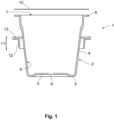
- the Figures 1 to 3 show a container 1 which is designed as a coffee capsule.
- the container 1 has a reservoir 2 and is essentially rotationally symmetrical. It has a base 3 and a peripheral wall 4 surrounding the base 3.
- a central and rotationally symmetrical recess 5 is provided in the base 3 and has a perforation area 6 which is also rotationally symmetrical and centrally arranged therein. The perforation area is pierced by at least one needle in order to allow liquid which is fed into the container 1 under pressure to escape.
- the recess 5 is oriented towards the interior of the container, i.e. towards an opening 7 of the container 2 which is opposite the base 3.
- the container 2 has a flange 8 which surrounds the opening 7 and the peripheral wall 4 in a rotationally symmetrical manner.
- the flange 8 points radially outwards from the peripheral wall 4 and is oriented essentially parallel to the base 3.
- the container 2 with the base 3, the peripheral wall 4 and the flange 8 is formed in one piece from fiber material.
- a primer (not shown) is applied to the inner side 9 of the container 2 facing the inside of the container and to the upward-facing surface of the flange 8.
- the primer can be made of cellulose and casein, for example, and is thus biodegradable. In addition or alternatively, it can also contain other biodegradable Contain ingredients such as whey, agar agar, and/or psyllium husks.
- the primer increases the gas tightness and mechanical stability of the container 2.
- the opening 7 is, as in Figure 1 indicated, covered with a cover 10, which is designed as a sealing film.
- the sealing film 10 is flexible and at the same time gas-tight. It is fixed resting on the flange 8 and thus seals the container interior from the environment.
- the sealing film 10 has the same coating (not shown) on the surface oriented towards the flange 8 as the container interior 9 and the upward-facing surface of the flange 8. The coatings of the sealing film 10 and the flange 8 are firmly bonded to one another.
- the container 1 has an injection-molded connecting element 11 made of a water-soluble and biodegradable thermoplastic.
- the biodegradable thermoplastic can be a thermoplastically processable starch, as described in the publications EP 0 118 240 A2 or EP 0 397 819 B1 described.
- the connecting element is designed as a reinforcement ring 11 with a vertical ring section 12 and a horizontal ring section 13. With the vertical ring section 12, the reinforcement ring 11 rests on the outside against an upper section of the peripheral wall 4.
- recesses 14 are arranged, with which the coffee capsule 1 can be locked in a receiving device of a coffee machine (not shown).
- the vertical ring section 12 can also be designed as a connecting wall with openings and can be embedded in the fiber material during the production of the fiber material molded body (container 2) using the fiber casting process.
- the horizontal ring section 13 protrudes radially outward from an upper end of the vertical ring section 12 beyond the flange 8.
- a radial recess for receiving the flange 8 is formed in the upper end of the horizontal ring section 13.
- the flange 8 and the horizontal ring section 13 are thus complementarily designed, so that the flange 8 and the horizontal ring section 13 end in a common plane at the top. The flange 8 is thus completely enclosed by the horizontal ring section 13 and the sealing film 10.
- the sealing film and the reinforcing ring can be bonded together by an adhesive, preferably a biodegradable adhesive.
- connecting element 11 As an alternative to the form-fitting connection between the connecting element 11 and the container 2 shown here, it is possible to connect the connecting element 11 to the container 2 by injection molding it onto the container.
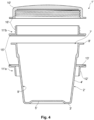
- the Figure 4 shows an alternative embodiment of the container 1' as a jar for holding cosmetic products. Unless otherwise indicated, similar construction elements of the Figure 4 provided with the same reference numerals as already mentioned above and marked with a line to distinguish it from the structural elements of the coffee capsule.
- the crucible 1' also has a container 2' with a base 3', a peripheral wall 4', a central recess 5' in the base 3', an opening 7' opposite the base 3' and a flange 8' pointing radially outwards from the peripheral wall 4'.
- the crucible 1' is essentially rotationally symmetrical.
- a primer made of biodegradable material (not shown here) is also applied to the inside 9' of the container 2', which increases the gas tightness and mechanical stability of the container 2'.
- a cover is designed as a lid 10'.
- a two-part connecting element 11' is positively connected to the container 2'.
- the two-part connecting element 11' is composed of a lower support ring 11'a and an upper threaded ring 11'b. As described above in connection with the coffee capsule 1, the lower support ring 11'a rests on the peripheral wall 4' with a vertical ring section 12' on the outside and on the flange 8' with a horizontal ring section 13'.
- the vertical ring section 12' can also be designed as a connecting wall with openings and embedded in the fiber material during the production of the fiber material molded body (container 2') using the fiber casting process.
- the horizontal ring section 13' protrudes radially beyond the flange 8'.
- the horizontal ring section 13' also has a recess in the end pointing towards the lid 10', into which the flange 8' is received.
- a surface of the flange 8' facing toward the lid 10' and a surface of the horizontal ring section 13' facing toward the lid 10' are located in the same plane.
- the upper threaded ring 11'b has the same outer diameter as the lower support ring 11'a.
- the inner diameter of the upper threaded ring 11'b essentially corresponds to the diameter of the opening 7'.
- the upper threaded ring 11'b is attached to the horizontal ring section 13' of the lower support ring 11'a, which extends radially beyond the flange 8', so that the flange 8' is enclosed by the horizontal ring section 13' of the lower support ring 11'a and by the upper threaded ring 11'b.
- the lower support ring 11'a can, for example, be inserted from below, i.e., via the base 3', over the peripheral wall 4' of the container 2'.
- a tongue and groove connection 15' between the lower support ring 11'a and the upper threaded ring 11'b can form a positive connection.
- the tongue and groove of the tongue and groove connection 15' are locked or glued together. After connection, the lower support ring 11'a and the upper threaded ring 11'b are flush with one another in the radial direction towards the outside.
- the lid 10' can be connected to and detached from the upper threaded ring 11'b via a threaded connection 16'.
- an external thread is provided on the upper threaded ring 11'b and an internal thread on the lid 10'.
- the lid 10' and the upper threaded ring 11'b are screwed together via the thread 16', the lid 10' and the upper threaded ring 11'b are flush radially on the outside, and the interior of the container is sealed gas-tight from the environment.
- the lid 10' is unscrewed from the upper threaded ring 11'b, the interior of the container is connected to the environment through the opening in the upper threaded ring 11'b.
- the Figure 5 shows a further alternative embodiment of the container 1" as a jar for holding cosmetic products. Unless otherwise indicated, similar construction elements of the Figure 5 provided with the same reference numerals as mentioned above and marked with two primes to distinguish it from the other embodiments.
- the crucible 1" also has a container 2" with a base 3", a peripheral wall 4", a central recess 5" in the base 3", an opening 7" opposite the base 3", and a flange 8" pointing radially outward from the peripheral wall 4". In the area of the opening, the container 2" is slightly widened in order to accommodate a connecting element 11".
- the crucible 1" is essentially rotationally symmetrical.
- a primer made of biodegradable material (not shown here) is also applied to the inside 9" of the container 2", which increases the gas tightness and mechanical stability of the container 2".
- the connecting element 11" in the area of the opening 7" is designed in two parts and is connected to the container 2' in a form-fitting and material-fitting manner.
- a cover is also designed in the crucible 1" shown here as a lid 10", which interacts with the connecting element 11".
- the two-part connecting element 11" is composed of an inner support ring 11"a and an outer threaded ring 11"b.
- the inner support ring 11"a has a vertical ring section 12" and a horizontal ring section 13", wherein the horizontal ring section 13" surrounds the vertical ring section 12" approximately halfway up on the outside and at a right angle.
- the vertical ring section 12" has an external thread 16"a.
- the area of the vertical ring section 12" below the horizontal ring section 13" has a substantially smooth-cylindrical outer surface, which complementary to the surface of the expanded area of the container 2". The inner support ring 11"a is thus inserted into the container 2".
- the abutting surfaces are glued together to ensure high tightness and mechanical stability.
- the bonding can also be achieved, for example, by inserting the container 2" and the vertical ring section 12" into one another and pressing them together at a temperature at which the injection-molded material softens or melts. The molten material of the vertical ring section 12" then adheres to the container 2" and possibly penetrates its pores.
- bonding is optional; a secure joint can also be achieved, for example, by a press fit.
- the vertical ring section 12" below the horizontal ring section 13" can also be designed as a connecting wall with openings and embedded in the fiber material of the container wall during the production of the fiber molded body (container 2') using the fiber casting process. Radially on the outside, the horizontal ring section 13" is flush with the flange 8".
- the inner diameter of the upper threaded ring 11'b essentially corresponds to the diameter of the opening 7'.
- the area of the vertical ring section 12" with the external thread 16"a protrudes upwards from the container 2".
- the outer threaded ring 11"b has an internal thread 16"b on the inward-facing side, which is complementary to the external thread 16"a of the inner support ring 11"a.
- the outward-facing surface of the outer threaded ring 11"b is smooth-cylindrical, and its diameter is smaller than the diameter of the horizontal ring section 13".
- the cover 10" has a curved cover surface 10"a and a ring section 10"b surrounding it.
- the inner diameter of the ring section 10"b corresponds to the outer diameter of the outer threaded ring 11"b.
- the cover 10" can be inserted and removed from above onto the outer threaded ring 11"b.
- the lid 10', 10", the lower support ring 11'a, the inner support ring 11"a, the upper threaded ring 11'b and the outer threaded ring 11”b are injection-molded from a water-soluble and compostable thermoplastic.
- the connecting element 11', 11" it is possible to form the connecting element 11', 11" in one piece and/or to connect the connecting element 11', 11" to the container 2', 2" by injection molding.
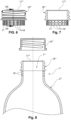
- FIGS. 6 and 7 show a side view and a longitudinal section of another embodiment of a connecting element 11"' and Figure 8 shows a container 1"' designed as a bottle with this connecting element 11"' and a container 2"'.
- the upper section of the connecting element 11"' again has an external thread 16"', onto which a cover 10"' designed as a screw cap can be screwed.
- the container 2"' can, for example, hold a beverage, a dishwashing detergent or another liquid, gel-like or powdery material.
- the container 1"' is tightly closed by the screw cap 10"'.
- the connecting element In order to ensure that the connecting element is connected to the container 2"' in a particularly tight and durable manner, it has a thin annular connecting wall 17 below the external thread 16"', which surrounds the opening 7"' of the container 2"'.
- the connecting wall 17 is provided with a plurality of openings 18, between which webs are located, which form the connecting wall 17.
- the Figures 9 - 11 show an upper section of a multi-part suction mold 19 with a porous wall 20 for producing the container from Fig. 8
- the suction mold 19 has two, three, four, or more parts to enable the removal of the molded body formed in the suction mold 19.
- the porous wall of the suction mold can be achieved in a conventional manner by a base body made of plastic or metal with suction channels, into which a sieve-like structure is inserted, forming the porous wall.
- the porous wall 20 of the suction mold 19 is produced using a 3D printing process, with liquid-permeable channels being embedded in the material of the porous wall 20.
- the suction mold 19 has an upper receiving section 21 for the injection-molded connecting element 11"'.
- the connecting element 11"' is inserted into the receiving section 21 of the suction mold 19 such that the connecting wall 17 of the connecting element 11"' has a small distance d of the order of 1 mm from the porous wall 20 of the suction mold 19.
- the suction mold 19 is then immersed in pulp, and water is sucked off through the porous wall 20, so that a layer of fiber 22 is deposited on the porous wall 20 of the suction mold 19.
- the fiber 22 penetrates through the openings 18 of the connecting wall 17 of the connecting element 11"' and projects through the openings 18.
- the fiber layer of the container 2"' can then be compacted by pressing an inflatable pressing tool (not shown) against the inside of the deposited fiber layer.
- the fiber layer is thereby dewatered and compacted and firmly encloses the webs between the openings 18 in the connecting wall 17.
- the drawings show rotationally symmetrical containers.
- the openings have a circular clear cross-section.
- the person skilled in the art will recognize that the containers and their Openings can have a shape other than circular.
- the containers and their openings can be square.
- the connecting elements also have the shape of a square ring enclosing a square opening.
Landscapes
- Engineering & Computer Science (AREA)
- Mechanical Engineering (AREA)
- Chemical & Material Sciences (AREA)
- Life Sciences & Earth Sciences (AREA)
- Wood Science & Technology (AREA)
- Organic Chemistry (AREA)
- Materials Engineering (AREA)
- Ceramic Engineering (AREA)
- Biodiversity & Conservation Biology (AREA)
- Manufacturing & Machinery (AREA)
- Oil, Petroleum & Natural Gas (AREA)
- Food Science & Technology (AREA)
- Composite Materials (AREA)
- Closures For Containers (AREA)
- Containers Having Bodies Formed In One Piece (AREA)
- Packages (AREA)
- Injection Moulding Of Plastics Or The Like (AREA)
- Paints Or Removers (AREA)
- Biological Depolymerization Polymers (AREA)
- Paper (AREA)
- Optical Couplings Of Light Guides (AREA)
Applications Claiming Priority (3)
| Application Number | Priority Date | Filing Date | Title |
|---|---|---|---|
| DE102021114725.5A DE102021114725A1 (de) | 2021-06-08 | 2021-06-08 | Biologisch abbaubares Behältnis |
| DE102022103327 | 2022-02-14 | ||
| PCT/EP2022/065588 WO2022258707A1 (de) | 2021-06-08 | 2022-06-08 | Formkörper mit anschlusselement |
Publications (3)
| Publication Number | Publication Date |
|---|---|
| EP4351984A1 EP4351984A1 (de) | 2024-04-17 |
| EP4351984B1 true EP4351984B1 (de) | 2025-05-28 |
| EP4351984C0 EP4351984C0 (de) | 2025-05-28 |
Family
ID=82019532
Family Applications (1)
| Application Number | Title | Priority Date | Filing Date |
|---|---|---|---|
| EP22733918.1A Active EP4351984B1 (de) | 2021-06-08 | 2022-06-08 | Formkörper mit anschlusselement |
Country Status (5)
| Country | Link |
|---|---|
| US (1) | US20240270433A1 (https=) |
| EP (1) | EP4351984B1 (https=) |
| JP (1) | JP2024533925A (https=) |
| CA (1) | CA3222060A1 (https=) |
| WO (2) | WO2022258707A1 (https=) |
Families Citing this family (14)
| Publication number | Priority date | Publication date | Assignee | Title |
|---|---|---|---|---|
| HUE048430T2 (hu) * | 2014-12-22 | 2020-07-28 | Celwise Ab | Egy termék formázási metódusa, amely cellulóz szuszpenzió felhasználásával és az ilyen eljárásban használt szerszám vagy szerszámrész segítségével történik |
| DE102019110593A1 (de) * | 2019-04-24 | 2020-10-29 | PAPACKS SALES GmbH | Barriereschicht für Cellulosesubstrat |
| DE102021125561A1 (de) * | 2021-10-01 | 2023-04-06 | B. Braun Melsungen Aktiengesellschaft | Medizinischer Fluidbehälter |
| DE102022104645A1 (de) * | 2022-02-25 | 2023-08-31 | PAPACKS SALES GmbH | Behältnis mit wiederverschließbarem Deckel |
| DE102022120574A1 (de) * | 2022-08-16 | 2024-02-22 | PAPACKS SALES GmbH | Rasierapparat |
| FR3139556B1 (fr) * | 2022-09-09 | 2024-11-22 | Oreal | Ensemble de conditionnement de produit cosmétique comprenant un récipient en matériau cellulosique et un élément d’obturation |
| DE102022134098A1 (de) * | 2022-12-20 | 2024-06-20 | Krones Aktiengesellschaft | Verfahren zum Herstellen eines Fasern umfassenden Behälters mit einer Fasern umfassenden Krempe, Fasern umfassender Behälter und Vorrichtung zum Ausführen des Verfahrens |
| DE102023110435B4 (de) | 2023-04-24 | 2026-04-02 | PAPACKS SALES GmbH | Verfahren und vorrichtung zur herstellung eines faserformkörpers |
| EP4702188A1 (en) | 2023-04-24 | 2026-03-04 | PAPACKS SALES GmbH | Biodegradable three-dimensional products molded from natural fibers |
| US20260069501A1 (en) * | 2023-07-13 | 2026-03-12 | Robert T. Wheeler | Paper bottle system for pharmaceuticals |
| USD1064827S1 (en) * | 2023-07-24 | 2025-03-04 | PAPACKS SALES GmbH | Pot packaging |
| WO2025080905A1 (en) | 2023-10-11 | 2025-04-17 | The Procter & Gamble Company | A biodegradable container with a personal care composition |
| FR3159733A1 (fr) * | 2024-02-29 | 2025-09-05 | Coty Inc. | Ensemble emballage secondaire pour un produit cosmétique |
| LU508268B1 (fr) * | 2024-09-13 | 2026-03-16 | Brain Corp Sa | Procede de fabrication d'une capsule destinee a recevoir une substance pour la preparation d'une boisson |
Family Cites Families (106)
| Publication number | Priority date | Publication date | Assignee | Title |
|---|---|---|---|---|
| US1995703A (en) * | 1933-06-09 | 1935-03-26 | Skinner & Sherman Inc | Container |
| US3434615A (en) * | 1967-09-11 | 1969-03-25 | Int Equipment Co | Centrifuge bottle and closure therefor |
| US3784039A (en) * | 1972-01-10 | 1974-01-08 | Illinois Tool Works | Nursing bottle construction and assembly |
| US3899096A (en) * | 1972-03-07 | 1975-08-12 | Illinois Tool Works | Reformed plastic article and method of manufacture |
| JPS5147882A (https=) * | 1974-10-23 | 1976-04-23 | Yamamura Glass Co Ltd | |
| US4256231A (en) * | 1976-10-21 | 1981-03-17 | Henkel Kommanditgesellschaft Auf Aktien (Henkel Kgaa) | Container with a synthetic lining impermeable to liquids and method of making |
| US4240560A (en) * | 1979-07-13 | 1980-12-23 | Carluccio John F | Cosmetic jar |
| BG46154A3 (bg) | 1983-02-18 | 1989-10-16 | Warner-Lambert Company Llc | Метод за получаване на капсули |
| JPS60183334A (ja) * | 1984-03-02 | 1985-09-18 | 日精エー・エス・ビー機械株式会社 | 耐熱性及びガスバリヤ−性に優れた2軸配向容器 |
| IE66735B1 (en) | 1988-11-03 | 1996-02-07 | Biotec Biolog Naturverpack | Thermoplastically workable starch and a method for the manufacture thereof |
| DE69022516T2 (de) * | 1989-07-31 | 1996-04-04 | Yamamura Glass Co Ltd | Flaschenhalsstruktur und deren Herstellungsverfahren. |
| US5174460A (en) * | 1992-02-26 | 1992-12-29 | Sunbeam Plastics Corporation | Dual seal closure-adaptor |
| US5213223A (en) * | 1992-03-23 | 1993-05-25 | Sunbeam Plastics Corporation | Child resistant closure-adaptor |
| FR2741042B1 (fr) | 1995-11-10 | 1997-12-19 | Verchere Plastiques Ind | Recipient, notamment destine a contenir un produit cosmetique |
| US5772056A (en) * | 1996-05-24 | 1998-06-30 | Plastipak Packaging, Inc. | Plastic blow molded container |
| US6116440A (en) * | 1996-11-01 | 2000-09-12 | Colgate - Palmolive Company | Resealable thermoformed container |
| US6510957B2 (en) * | 1996-11-18 | 2003-01-28 | William A. Gardner | Apparatus for opening a bottle sealed with a cork stopper |
| US5927525A (en) * | 1997-04-28 | 1999-07-27 | Plastipak Packaging, Inc. | Multi-layer containers and preforms |
| DE59808812D1 (de) * | 1998-02-16 | 2003-07-31 | Obrist & Co Ag Reinach H | Behälterverschlussanordnung mit Garantieelement |
| FR2775206B1 (fr) * | 1998-02-26 | 2000-04-21 | Cebal | Procede pour realiser un boitier aerosol a col filete |
| US6099923A (en) * | 1998-03-24 | 2000-08-08 | Kitei; Robert | Non-stick coating for the threads of a storage container of a liquid which hardens when dry |
| US6677013B1 (en) * | 1998-04-17 | 2004-01-13 | Pechiney Emballage Flexible Europe | Transparent multilayer polypropylene container with barrier protection |
| JP3118707B2 (ja) * | 1998-05-07 | 2000-12-18 | 花王株式会社 | 中空容器 |
| TW430552B (en) * | 1998-06-09 | 2001-04-21 | Nippon Oxygen Co Ltd | A transparent insulated container and its manufacture method |
| FR2783806B1 (fr) * | 1998-09-24 | 2000-11-03 | Oreal | Element de bouchage a vissage freine |
| JP2001225826A (ja) * | 2000-02-18 | 2001-08-21 | Toyoda Gosei Co Ltd | パルプモールド成形品及びその製造方法 |
| US6341706B1 (en) * | 2000-06-01 | 2002-01-29 | Color Access, Inc. | Snap-on plastic neck for glass containers |
| WO2002070820A1 (fr) * | 2001-03-07 | 2002-09-12 | Nissin Shokuhin Kabushiki Kaisha | Materiau d'emballage et receptacle |
| JP4852798B2 (ja) * | 2001-06-26 | 2012-01-11 | 凸版印刷株式会社 | 生分解性を有する紙シート及び紙容器の製造方法 |
| US6877625B2 (en) * | 2001-10-01 | 2005-04-12 | Matthew W. Alley | Container closure member with vented and unvented closing positions |
| US20030132188A1 (en) * | 2001-11-08 | 2003-07-17 | Beek Alex Van Der | Threading method of a metallic bottle |
| US20040166263A1 (en) * | 2003-02-26 | 2004-08-26 | Nahill Thomas E. | Container preform assembly and method of manufacture |
| US20050061764A1 (en) * | 2003-09-18 | 2005-03-24 | Masaharu Tamashiro | Variable volume beverage container |
| CA2547280C (en) * | 2003-11-26 | 2010-09-14 | Yoshino Kogyosho Co., Ltd. | Synthetic resin container |
| US20050142311A1 (en) * | 2003-12-24 | 2005-06-30 | Nahill Thomas E. | Finish assembly for a plastic container or preform |
| MXPA06013089A (es) * | 2004-05-11 | 2007-05-16 | Elan Vital Uk Ltd | Contenedores de fluido que se pueden colapsar. |
| ATE423068T1 (de) * | 2004-11-18 | 2009-03-15 | Pathtainer Systems Internat Pt | Zweiteiliger verschluss für einen behälter |
| US20070051687A1 (en) * | 2005-09-07 | 2007-03-08 | Omnitech International, Inc | Reclosable metal bottle |
| DE102005048182B4 (de) * | 2005-10-06 | 2008-09-04 | Henkel Ag & Co. Kgaa | Faserguss-Verpackung mit Innenbeutel |
| US20070080128A1 (en) * | 2005-10-10 | 2007-04-12 | Laveault Richard A | Beverage container with threaded plastic drinking sleeve |
| US7946436B2 (en) * | 2005-10-10 | 2011-05-24 | Rieke Corporation | Beverage container with threaded plastic drinking sleeve |
| KR100757795B1 (ko) * | 2006-06-21 | 2007-09-11 | 채동석 | 마개 및 이 마개가 구비된 용기 |
| JP4771315B2 (ja) * | 2006-08-31 | 2011-09-14 | 株式会社吉野工業所 | 多層ブロー容器 |
| US20080083693A1 (en) * | 2006-10-05 | 2008-04-10 | Gottlieb Norman J | Pressure equalization cap and bottle for use therewith |
| EP2101715A4 (en) * | 2006-12-20 | 2014-03-26 | Playtex Products Inc | Vent valve assemblies for baby bottles |
| US20080156803A1 (en) * | 2007-01-03 | 2008-07-03 | Mcclellan Ruth | Beverage containing assembly |
| US8292102B2 (en) * | 2007-06-21 | 2012-10-23 | Amcor Limited | Container thread design |
| US20090025977A1 (en) * | 2007-07-25 | 2009-01-29 | Anderson Timothy W | Removable cable gland |
| US7959034B2 (en) * | 2007-08-17 | 2011-06-14 | The Dial Corporation | Liquid product pouring and measuring package with drain-back spout fitment and tight-sealing measuring cup assembly |
| US20120260487A1 (en) * | 2008-01-28 | 2012-10-18 | Patrick Myron Nichols | Replaceable bottle cap assembly |
| US20090236301A1 (en) * | 2008-03-24 | 2009-09-24 | Ue-Ming Yang | Spillage free fluid bottle |
| EP2291459A4 (en) * | 2008-04-25 | 2012-03-28 | Seanet Dev Inc | COVER ASSEMBLY FOR CELLULOSE FIBER CONTAINER, MOLDED, RECYCLABLE AND COMPOSTABLE |
| US8607999B2 (en) * | 2008-06-30 | 2013-12-17 | Yoshino Kogyosho Co., Ltd. | Laminated synthetic resin bottle, injection molding device, and process for molding a laminated preform |
| US9452863B2 (en) * | 2008-10-01 | 2016-09-27 | Greater Good, Inc. | Biodegradable container for liquid and/or semi-solid products |
| CA2747515C (en) * | 2008-12-19 | 2014-07-29 | Brandimage-Desgrippes & Laga | Environmentally friendly liquid container and method of manufacture |
| TW201028342A (en) * | 2009-01-22 | 2010-08-01 | Minima Technology Co Ltd | Environmental paper container |
| US20100230405A1 (en) * | 2009-03-11 | 2010-09-16 | Nuvision Bioplastics, Llc | Biodegradable Resin Composition Utilized in the Manufacture of Biodegradable Containers, Biodegradable Containers, and Method of Manufacture |
| US20100301109A1 (en) * | 2009-06-02 | 2010-12-02 | Famis Brands, Inc. | Disposable cup assembly and method of making and using same |
| US20110006028A1 (en) * | 2009-07-10 | 2011-01-13 | Greg Caldwell Company, Llc | Coated glass bottles and articles and methods of manufacture |
| ITBO20100219A1 (it) * | 2010-04-09 | 2011-10-10 | Gino Rapparini | Perfezionamenti ad un contenitore permeabile filtrante ottenuto per termoformatura partendo da nastro di materiale piano , contenente prodotti idrosolubili o da infusione atti ad ottenere bevande |
| US8360266B2 (en) * | 2009-11-13 | 2013-01-29 | The Coca-Cola Corporation | Shaped metal vessel |
| US9598200B2 (en) * | 2009-11-17 | 2017-03-21 | Jeong-min Lee | Connection die coupled with container neck in use |
| US20120074091A1 (en) * | 2010-09-24 | 2012-03-29 | Himelstein Walter D | Safety-coated glass bottle |
| US8663419B2 (en) * | 2010-11-30 | 2014-03-04 | Ecologic | Manual container assembly and liner integration fixture for pulp-molded shell with polymer liner container systems |
| US20130043245A1 (en) * | 2011-03-25 | 2013-02-21 | Shawn Griffis | Scented Attachment for Containers |
| US9278785B2 (en) * | 2011-05-05 | 2016-03-08 | Guala Closures S.P.A. | Container for recyclable closure and container closure assembly with said container |
| EP2522591A1 (fr) * | 2011-05-09 | 2012-11-14 | Amcor Flexibles Capsules France | Capsule de bouchage à vis |
| EP3181471B8 (en) * | 2011-07-19 | 2019-06-26 | Lgab Llc | Biodegradable bottle for liquids |
| US8763829B2 (en) * | 2011-07-22 | 2014-07-01 | Craig Allen Madaus | Collapsible container for holding liquids or objects |
| WO2013044079A1 (en) * | 2011-09-21 | 2013-03-28 | Hydros Bottle, Llc | Water bottle |
| ITBS20110129A1 (it) | 2011-09-26 | 2013-03-27 | Capitani Srl | Capsula per la produzione di una bevanda infusa |
| WO2013047262A1 (ja) * | 2011-09-30 | 2013-04-04 | 東洋製罐株式会社 | 発泡延伸プラスチック容器及びその製造方法 |
| CA2861849C (en) * | 2012-02-07 | 2016-11-22 | Toyo Seikan Group Holdings, Ltd. | Vapor-deposited foamed body |
| US20130256255A1 (en) * | 2012-03-30 | 2013-10-03 | Susan Van Volkenburg | Stackable spill resistant container |
| US9132612B2 (en) * | 2012-03-30 | 2015-09-15 | Graphic Packaging International, Inc. | Composite package |
| JP2015522484A (ja) * | 2012-05-17 | 2015-08-06 | プラセル・プラスティック・リミテッド | 固締アセンブリおよび当該固締アセンブリを備えるコンテナ |
| EP2877404A4 (en) * | 2012-07-25 | 2016-01-13 | Greater Good Inc | LIQUID CONTAINER |
| JP6011929B2 (ja) * | 2012-10-31 | 2016-10-25 | 株式会社吉野工業所 | 2軸延伸ブロー成形容器及びその製造方法 |
| US8746485B1 (en) * | 2012-11-29 | 2014-06-10 | Briggs & Stratton Corporation | Snap-on fuel cap cover |
| US20140190923A1 (en) * | 2013-01-04 | 2014-07-10 | Marc E. Alpern | Glass neck adapter for plastic beverage container |
| WO2014121838A1 (en) * | 2013-02-07 | 2014-08-14 | Klaus Kroesen | Apparatus for dispensing a beverage |
| FR3002519B1 (fr) * | 2013-02-22 | 2015-08-07 | Sleever Int | Procede de protection d'un recipient, et recipient ainsi protege |
| US9821926B2 (en) * | 2013-03-15 | 2017-11-21 | Ball Corporation | Method and apparatus for forming a threaded neck on a metallic bottle |
| US9950844B2 (en) * | 2013-03-15 | 2018-04-24 | Taptango, Llc | Child-resistant closure systems for containers |
| DE102013105760A1 (de) * | 2013-06-04 | 2014-12-04 | Krones Ag | Getränkeflasche mit Zuführmöglichkeit für gasförmiges Medium |
| EP3152134B1 (en) * | 2014-06-04 | 2022-02-09 | Gino Rapparini | Reinforcement ring for capsules for obtaining beverages |
| US20160106628A1 (en) * | 2014-10-16 | 2016-04-21 | Handi-Craft Company | Dual configuration bottle assembly |
| US20160159533A1 (en) * | 2014-12-09 | 2016-06-09 | Plastek Industries, Inc. | Child-Resistant Closure |
| US11147309B2 (en) * | 2015-06-10 | 2021-10-19 | R.J. Reynolds Tobacco Company | Container for smokeless tobacco products comprising a pulp material and related packaged product assembly and method |
| US10220983B1 (en) * | 2015-07-27 | 2019-03-05 | James R. Gilliam | Threaded bottle ring and method of fabrication and attachment |
| EP3344558A1 (en) * | 2015-09-04 | 2018-07-11 | H. Hoffnabb-La Roche Ag | Adapter for connecting a dispenser to a container |
| ES2949403T3 (es) * | 2017-11-08 | 2023-09-28 | Kikkoman Corp | Recipiente multicapa hecho de resina sintética |
| US10442586B2 (en) * | 2017-11-14 | 2019-10-15 | KushCo Holdings | Child-resistant container |
| JP6910735B2 (ja) * | 2017-12-28 | 2021-07-28 | 株式会社吉野工業所 | 合成樹脂製容器、プリフォーム、及び合成樹脂製容器の製造方法 |
| JP7180335B2 (ja) * | 2018-12-04 | 2022-11-30 | 東洋製罐株式会社 | プリフォーム、及び合成樹脂製容器 |
| DE202019005348U1 (de) * | 2018-12-14 | 2020-04-08 | Lambert Dustin Dinzinger | Becher aus Cellulosehydrat und/ oder Pappe/ Zellstoff-Stärke-Mix mit Cellulosehydrat-Beschichtung |
| DE102019101545A1 (de) | 2019-01-22 | 2020-07-23 | Weyhmüller Verpackungstechnik GmbH | Getränkeportionskapsel aus faserbasiertem Werkstoff sowie Verfahren zu deren Herstellung |
| DE102019110593A1 (de) * | 2019-04-24 | 2020-10-29 | PAPACKS SALES GmbH | Barriereschicht für Cellulosesubstrat |
| US11148847B2 (en) * | 2019-05-01 | 2021-10-19 | Pepsico, Inc. | Plastic neck outsert for metal beverage container |
| DE102019127556A1 (de) * | 2019-10-14 | 2021-04-15 | Kiefel Gmbh | Portionierbehältnis aus umweltverträglich abbaubarem fasermaterial |
| CN115298012A (zh) * | 2020-03-13 | 2022-11-04 | Lgab有限责任公司 | 一种具有模制内部衬里的纸浆瓶及其制造方法 |
| JP7418303B2 (ja) * | 2020-07-31 | 2024-01-19 | 株式会社吉野工業所 | 二重容器 |
| DE102021114743A1 (de) * | 2021-06-08 | 2022-12-08 | PAPACKS SALES GmbH | Stabiles biologisch abbaubares Behältnis |
| SE2250048A1 (en) * | 2022-01-19 | 2023-07-20 | Celwise Ab | A closure system comprising a pulp molded cap and a pulp molded container, a pulp molded container, a pulp molded cap, a method and a tool for producing a cap or cap part from a pulp slurry |
| USD1039968S1 (en) * | 2023-07-24 | 2024-08-27 | PAPACKS SALES GmbH | Coffee pod |
| USD1064827S1 (en) * | 2023-07-24 | 2025-03-04 | PAPACKS SALES GmbH | Pot packaging |
-
2021
- 2021-06-08 US US18/568,084 patent/US20240270433A1/en active Pending
-
2022
- 2022-06-08 WO PCT/EP2022/065588 patent/WO2022258707A1/de not_active Ceased
- 2022-06-08 CA CA3222060A patent/CA3222060A1/en active Pending
- 2022-06-08 JP JP2023575886A patent/JP2024533925A/ja active Pending
- 2022-06-08 WO PCT/EP2022/065572 patent/WO2022258697A1/de not_active Ceased
- 2022-06-08 EP EP22733918.1A patent/EP4351984B1/de active Active
Also Published As
| Publication number | Publication date |
|---|---|
| JP2024533925A (ja) | 2024-09-18 |
| CA3222060A1 (en) | 2022-12-15 |
| WO2022258707A1 (de) | 2022-12-15 |
| EP4351984A1 (de) | 2024-04-17 |
| US20240270433A1 (en) | 2024-08-15 |
| EP4351984C0 (de) | 2025-05-28 |
| WO2022258697A1 (de) | 2022-12-15 |
Similar Documents
| Publication | Publication Date | Title |
|---|---|---|
| EP4351984B1 (de) | Formkörper mit anschlusselement | |
| EP4351983A2 (de) | Stabiles biologisch abbaubares behältnis und verfahren zu dessen herstellung | |
| EP3400184B1 (de) | Portionsbehälter für extrahierbare substanzen zur herstellung eines getränks | |
| EP0850270B1 (de) | Verfahren zur herstellung von formkörpern mit barriereschicht aus biologisch abbaubarem material und formkörper | |
| WO2015121489A1 (de) | Behälter aus biologisch abbaubarem material mit barrierefunktion | |
| EP0850269B1 (de) | Verfahren zur herstellung von formkörpern aus biologisch abbaubarem material und formkörper | |
| EP3856649B9 (de) | Becher aus rein pflanzlichen materialien | |
| WO2020216719A1 (de) | Barriereschicht für cellulosesubstrat | |
| DE102018201187B3 (de) | Portionsbehälter aus mit Biokunststoff compoundiertem Holzmaterial | |
| WO2017186743A1 (de) | Verfahren zur herstellung eines bio-kunststoffprodukts | |
| DE102019127556A1 (de) | Portionierbehältnis aus umweltverträglich abbaubarem fasermaterial | |
| DE102017214469A1 (de) | Ein Verfahren zum Herstellen eines Behälters aus einem Behälterrohling, insbesondere mit einem Verringern einer Höhe des Behälterrohlings | |
| EP2502850B1 (de) | Verpackungsbehälter und Verfahren zu seiner Herstellung | |
| EP3670370A1 (de) | Verpackung für kosmetika | |
| EP2647586B1 (de) | Verpackungsbehälter | |
| DE102021114725A1 (de) | Biologisch abbaubares Behältnis | |
| CN117460678A (zh) | 具有连接元件的模塑体 | |
| EP4596446A2 (de) | Behältnis mit wiederverschliessbarem deckel | |
| EP3724101A1 (de) | Kapsel | |
| DE102019131233A1 (de) | Barriereschicht für Cellulosesubstrat | |
| EP3656700A1 (de) | Portionskapsel zur zubereitung eines getränks in einer getränkeherstellungsmaschine | |
| AT521685A4 (de) | Brühbehälter einer Kaffeekapsel | |
| DE4321045A1 (de) | Zweischichtiger Verbundwerkstoff und Verfahren zu dessen Herstellung | |
| WO2025040233A1 (de) | Faserstoff-behältnis mit deckel | |
| DE102022125702A1 (de) | Verschlußkappe zum Verschließen eines Ausgießers und Verfahren zu deren Herstellung |
Legal Events
| Date | Code | Title | Description |
|---|---|---|---|
| STAA | Information on the status of an ep patent application or granted ep patent |
Free format text: STATUS: UNKNOWN |
|
| STAA | Information on the status of an ep patent application or granted ep patent |
Free format text: STATUS: THE INTERNATIONAL PUBLICATION HAS BEEN MADE |
|
| PUAI | Public reference made under article 153(3) epc to a published international application that has entered the european phase |
Free format text: ORIGINAL CODE: 0009012 |
|
| STAA | Information on the status of an ep patent application or granted ep patent |
Free format text: STATUS: REQUEST FOR EXAMINATION WAS MADE |
|
| 17P | Request for examination filed |
Effective date: 20240102 |
|
| AK | Designated contracting states |
Kind code of ref document: A1 Designated state(s): AL AT BE BG CH CY CZ DE DK EE ES FI FR GB GR HR HU IE IS IT LI LT LU LV MC MK MT NL NO PL PT RO RS SE SI SK SM TR |
|
| DAV | Request for validation of the european patent (deleted) | ||
| DAX | Request for extension of the european patent (deleted) | ||
| GRAP | Despatch of communication of intention to grant a patent |
Free format text: ORIGINAL CODE: EPIDOSNIGR1 |
|
| STAA | Information on the status of an ep patent application or granted ep patent |
Free format text: STATUS: GRANT OF PATENT IS INTENDED |
|
| INTG | Intention to grant announced |
Effective date: 20250131 |
|
| GRAS | Grant fee paid |
Free format text: ORIGINAL CODE: EPIDOSNIGR3 |
|
| GRAA | (expected) grant |
Free format text: ORIGINAL CODE: 0009210 |
|
| STAA | Information on the status of an ep patent application or granted ep patent |
Free format text: STATUS: THE PATENT HAS BEEN GRANTED |
|
| AK | Designated contracting states |
Kind code of ref document: B1 Designated state(s): AL AT BE BG CH CY CZ DE DK EE ES FI FR GB GR HR HU IE IS IT LI LT LU LV MC MK MT NL NO PL PT RO RS SE SI SK SM TR |
|
| REG | Reference to a national code |
Ref country code: GB Ref legal event code: FG4D Free format text: NOT ENGLISH |
|
| REG | Reference to a national code |
Ref country code: CH Ref legal event code: EP |
|
| REG | Reference to a national code |
Ref country code: IE Ref legal event code: FG4D Free format text: LANGUAGE OF EP DOCUMENT: GERMAN Ref country code: DE Ref legal event code: R096 Ref document number: 502022004083 Country of ref document: DE |
|
| PGFP | Annual fee paid to national office [announced via postgrant information from national office to epo] |
Ref country code: AT Payment date: 20250721 Year of fee payment: 4 |
|
| U01 | Request for unitary effect filed |
Effective date: 20250623 |
|
| U07 | Unitary effect registered |
Designated state(s): AT BE BG DE DK EE FI FR IT LT LU LV MT NL PT RO SE SI Effective date: 20250701 |
|
| U20 | Renewal fee for the european patent with unitary effect paid |
Year of fee payment: 4 Effective date: 20250627 |
|
| PG25 | Lapsed in a contracting state [announced via postgrant information from national office to epo] |
Ref country code: ES Free format text: LAPSE BECAUSE OF FAILURE TO SUBMIT A TRANSLATION OF THE DESCRIPTION OR TO PAY THE FEE WITHIN THE PRESCRIBED TIME-LIMIT Effective date: 20250528 |
|
| PG25 | Lapsed in a contracting state [announced via postgrant information from national office to epo] |
Ref country code: GR Free format text: LAPSE BECAUSE OF FAILURE TO SUBMIT A TRANSLATION OF THE DESCRIPTION OR TO PAY THE FEE WITHIN THE PRESCRIBED TIME-LIMIT Effective date: 20250829 Ref country code: NO Free format text: LAPSE BECAUSE OF FAILURE TO SUBMIT A TRANSLATION OF THE DESCRIPTION OR TO PAY THE FEE WITHIN THE PRESCRIBED TIME-LIMIT Effective date: 20250828 |
|
| PG25 | Lapsed in a contracting state [announced via postgrant information from national office to epo] |
Ref country code: PL Free format text: LAPSE BECAUSE OF FAILURE TO SUBMIT A TRANSLATION OF THE DESCRIPTION OR TO PAY THE FEE WITHIN THE PRESCRIBED TIME-LIMIT Effective date: 20250528 |
|
| PG25 | Lapsed in a contracting state [announced via postgrant information from national office to epo] |
Ref country code: HR Free format text: LAPSE BECAUSE OF FAILURE TO SUBMIT A TRANSLATION OF THE DESCRIPTION OR TO PAY THE FEE WITHIN THE PRESCRIBED TIME-LIMIT Effective date: 20250528 |
|
| PG25 | Lapsed in a contracting state [announced via postgrant information from national office to epo] |
Ref country code: RS Free format text: LAPSE BECAUSE OF FAILURE TO SUBMIT A TRANSLATION OF THE DESCRIPTION OR TO PAY THE FEE WITHIN THE PRESCRIBED TIME-LIMIT Effective date: 20250828 |
|
| PG25 | Lapsed in a contracting state [announced via postgrant information from national office to epo] |
Ref country code: IS Free format text: LAPSE BECAUSE OF FAILURE TO SUBMIT A TRANSLATION OF THE DESCRIPTION OR TO PAY THE FEE WITHIN THE PRESCRIBED TIME-LIMIT Effective date: 20250928 |
|
| PG25 | Lapsed in a contracting state [announced via postgrant information from national office to epo] |
Ref country code: SM Free format text: LAPSE BECAUSE OF FAILURE TO SUBMIT A TRANSLATION OF THE DESCRIPTION OR TO PAY THE FEE WITHIN THE PRESCRIBED TIME-LIMIT Effective date: 20250528 |
|
| PG25 | Lapsed in a contracting state [announced via postgrant information from national office to epo] |
Ref country code: CZ Free format text: LAPSE BECAUSE OF FAILURE TO SUBMIT A TRANSLATION OF THE DESCRIPTION OR TO PAY THE FEE WITHIN THE PRESCRIBED TIME-LIMIT Effective date: 20250528 |
|
| PG25 | Lapsed in a contracting state [announced via postgrant information from national office to epo] |
Ref country code: SK Free format text: LAPSE BECAUSE OF FAILURE TO SUBMIT A TRANSLATION OF THE DESCRIPTION OR TO PAY THE FEE WITHIN THE PRESCRIBED TIME-LIMIT Effective date: 20250528 |
|
| REG | Reference to a national code |
Ref country code: CH Ref legal event code: H13 Free format text: ST27 STATUS EVENT CODE: U-0-0-H10-H13 (AS PROVIDED BY THE NATIONAL OFFICE) Effective date: 20260127 |
|
| PG25 | Lapsed in a contracting state [announced via postgrant information from national office to epo] |
Ref country code: MC Free format text: LAPSE BECAUSE OF FAILURE TO SUBMIT A TRANSLATION OF THE DESCRIPTION OR TO PAY THE FEE WITHIN THE PRESCRIBED TIME-LIMIT Effective date: 20250528 |
|
| PLBE | No opposition filed within time limit |
Free format text: ORIGINAL CODE: 0009261 |
|
| STAA | Information on the status of an ep patent application or granted ep patent |
Free format text: STATUS: NO OPPOSITION FILED WITHIN TIME LIMIT |
|
| REG | Reference to a national code |
Ref country code: CH Ref legal event code: L10 Free format text: ST27 STATUS EVENT CODE: U-0-0-L10-L00 (AS PROVIDED BY THE NATIONAL OFFICE) Effective date: 20260409 |
|
| PG25 | Lapsed in a contracting state [announced via postgrant information from national office to epo] |
Ref country code: IE Free format text: LAPSE BECAUSE OF NON-PAYMENT OF DUE FEES Effective date: 20250608 |
|
| PG25 | Lapsed in a contracting state [announced via postgrant information from national office to epo] |
Ref country code: CH Free format text: LAPSE BECAUSE OF NON-PAYMENT OF DUE FEES Effective date: 20250630 |