EP4302984A1 - Abfallentfernungsvorrichtung für beutelherstellungsmaschine und beutelherstellungsmaschine - Google Patents
Abfallentfernungsvorrichtung für beutelherstellungsmaschine und beutelherstellungsmaschine Download PDFInfo
- Publication number
- EP4302984A1 EP4302984A1 EP22762835.1A EP22762835A EP4302984A1 EP 4302984 A1 EP4302984 A1 EP 4302984A1 EP 22762835 A EP22762835 A EP 22762835A EP 4302984 A1 EP4302984 A1 EP 4302984A1
- Authority
- EP
- European Patent Office
- Prior art keywords
- waste
- crosscut
- blade
- removing device
- upper blade
- Prior art date
- Legal status (The legal status is an assumption and is not a legal conclusion. Google has not performed a legal analysis and makes no representation as to the accuracy of the status listed.)
- Pending
Links
- 239000002699 waste material Substances 0.000 title claims abstract description 121
- 238000004519 manufacturing process Methods 0.000 title 2
- 239000002985 plastic film Substances 0.000 claims abstract description 27
- 229920006255 plastic film Polymers 0.000 claims abstract description 27
- 230000005540 biological transmission Effects 0.000 claims description 27
- 239000004033 plastic Substances 0.000 abstract description 40
- 229920003023 plastic Polymers 0.000 abstract description 40
- 239000000463 material Substances 0.000 description 82
- 239000005001 laminate film Substances 0.000 description 8
- 239000000565 sealant Substances 0.000 description 6
- 238000011144 upstream manufacturing Methods 0.000 description 6
- 230000005611 electricity Effects 0.000 description 5
- 230000003068 static effect Effects 0.000 description 5
- 239000000853 adhesive Substances 0.000 description 2
- 230000001070 adhesive effect Effects 0.000 description 2
- 210000004209 hair Anatomy 0.000 description 2
- 230000008018 melting Effects 0.000 description 2
- 238000002844 melting Methods 0.000 description 2
- 239000011347 resin Substances 0.000 description 2
- 229920005989 resin Polymers 0.000 description 2
- 238000010408 sweeping Methods 0.000 description 2
- 239000004698 Polyethylene Substances 0.000 description 1
- 239000004809 Teflon Substances 0.000 description 1
- 229920006362 Teflon® Polymers 0.000 description 1
- 239000011248 coating agent Substances 0.000 description 1
- 238000000576 coating method Methods 0.000 description 1
- 238000010276 construction Methods 0.000 description 1
- 238000001514 detection method Methods 0.000 description 1
- 230000000694 effects Effects 0.000 description 1
- 230000009931 harmful effect Effects 0.000 description 1
- 238000012423 maintenance Methods 0.000 description 1
- 230000003287 optical effect Effects 0.000 description 1
- 230000037361 pathway Effects 0.000 description 1
- -1 polyethylene Polymers 0.000 description 1
- 229920000573 polyethylene Polymers 0.000 description 1
- 238000005488 sandblasting Methods 0.000 description 1
- 239000000126 substance Substances 0.000 description 1
- 230000002195 synergetic effect Effects 0.000 description 1
Images


Classifications
-
- B—PERFORMING OPERATIONS; TRANSPORTING
- B26—HAND CUTTING TOOLS; CUTTING; SEVERING
- B26D—CUTTING; DETAILS COMMON TO MACHINES FOR PERFORATING, PUNCHING, CUTTING-OUT, STAMPING-OUT OR SEVERING
- B26D7/00—Details of apparatus for cutting, cutting-out, stamping-out, punching, perforating, or severing by means other than cutting
- B26D7/18—Means for removing cut-out material or waste
- B26D7/1845—Means for removing cut-out material or waste by non mechanical means
- B26D7/1863—Means for removing cut-out material or waste by non mechanical means by suction
-
- B—PERFORMING OPERATIONS; TRANSPORTING
- B26—HAND CUTTING TOOLS; CUTTING; SEVERING
- B26D—CUTTING; DETAILS COMMON TO MACHINES FOR PERFORATING, PUNCHING, CUTTING-OUT, STAMPING-OUT OR SEVERING
- B26D1/00—Cutting through work characterised by the nature or movement of the cutting member or particular materials not otherwise provided for; Apparatus or machines therefor; Cutting members therefor
- B26D1/01—Cutting through work characterised by the nature or movement of the cutting member or particular materials not otherwise provided for; Apparatus or machines therefor; Cutting members therefor involving a cutting member which does not travel with the work
- B26D1/04—Cutting through work characterised by the nature or movement of the cutting member or particular materials not otherwise provided for; Apparatus or machines therefor; Cutting members therefor involving a cutting member which does not travel with the work having a linearly-movable cutting member
- B26D1/06—Cutting through work characterised by the nature or movement of the cutting member or particular materials not otherwise provided for; Apparatus or machines therefor; Cutting members therefor involving a cutting member which does not travel with the work having a linearly-movable cutting member wherein the cutting member reciprocates
- B26D1/065—Cutting through work characterised by the nature or movement of the cutting member or particular materials not otherwise provided for; Apparatus or machines therefor; Cutting members therefor involving a cutting member which does not travel with the work having a linearly-movable cutting member wherein the cutting member reciprocates for thin material, e.g. for sheets, strips or the like
-
- B—PERFORMING OPERATIONS; TRANSPORTING
- B26—HAND CUTTING TOOLS; CUTTING; SEVERING
- B26D—CUTTING; DETAILS COMMON TO MACHINES FOR PERFORATING, PUNCHING, CUTTING-OUT, STAMPING-OUT OR SEVERING
- B26D1/00—Cutting through work characterised by the nature or movement of the cutting member or particular materials not otherwise provided for; Apparatus or machines therefor; Cutting members therefor
- B26D1/01—Cutting through work characterised by the nature or movement of the cutting member or particular materials not otherwise provided for; Apparatus or machines therefor; Cutting members therefor involving a cutting member which does not travel with the work
- B26D1/04—Cutting through work characterised by the nature or movement of the cutting member or particular materials not otherwise provided for; Apparatus or machines therefor; Cutting members therefor involving a cutting member which does not travel with the work having a linearly-movable cutting member
- B26D1/06—Cutting through work characterised by the nature or movement of the cutting member or particular materials not otherwise provided for; Apparatus or machines therefor; Cutting members therefor involving a cutting member which does not travel with the work having a linearly-movable cutting member wherein the cutting member reciprocates
- B26D1/08—Cutting through work characterised by the nature or movement of the cutting member or particular materials not otherwise provided for; Apparatus or machines therefor; Cutting members therefor involving a cutting member which does not travel with the work having a linearly-movable cutting member wherein the cutting member reciprocates of the guillotine type
- B26D1/085—Cutting through work characterised by the nature or movement of the cutting member or particular materials not otherwise provided for; Apparatus or machines therefor; Cutting members therefor involving a cutting member which does not travel with the work having a linearly-movable cutting member wherein the cutting member reciprocates of the guillotine type for thin material, e.g. for sheets, strips or the like
-
- B—PERFORMING OPERATIONS; TRANSPORTING
- B26—HAND CUTTING TOOLS; CUTTING; SEVERING
- B26D—CUTTING; DETAILS COMMON TO MACHINES FOR PERFORATING, PUNCHING, CUTTING-OUT, STAMPING-OUT OR SEVERING
- B26D7/00—Details of apparatus for cutting, cutting-out, stamping-out, punching, perforating, or severing by means other than cutting
- B26D7/08—Means for treating work or cutting member to facilitate cutting
- B26D7/088—Means for treating work or cutting member to facilitate cutting by cleaning or lubricating
-
- B—PERFORMING OPERATIONS; TRANSPORTING
- B26—HAND CUTTING TOOLS; CUTTING; SEVERING
- B26D—CUTTING; DETAILS COMMON TO MACHINES FOR PERFORATING, PUNCHING, CUTTING-OUT, STAMPING-OUT OR SEVERING
- B26D7/00—Details of apparatus for cutting, cutting-out, stamping-out, punching, perforating, or severing by means other than cutting
- B26D7/18—Means for removing cut-out material or waste
-
- B—PERFORMING OPERATIONS; TRANSPORTING
- B31—MAKING ARTICLES OF PAPER, CARDBOARD OR MATERIAL WORKED IN A MANNER ANALOGOUS TO PAPER; WORKING PAPER, CARDBOARD OR MATERIAL WORKED IN A MANNER ANALOGOUS TO PAPER
- B31B—MAKING CONTAINERS OF PAPER, CARDBOARD OR MATERIAL WORKED IN A MANNER ANALOGOUS TO PAPER
- B31B70/00—Making flexible containers, e.g. envelopes or bags
- B31B70/14—Cutting, e.g. perforating, punching, slitting or trimming
-
- B—PERFORMING OPERATIONS; TRANSPORTING
- B31—MAKING ARTICLES OF PAPER, CARDBOARD OR MATERIAL WORKED IN A MANNER ANALOGOUS TO PAPER; WORKING PAPER, CARDBOARD OR MATERIAL WORKED IN A MANNER ANALOGOUS TO PAPER
- B31B—MAKING CONTAINERS OF PAPER, CARDBOARD OR MATERIAL WORKED IN A MANNER ANALOGOUS TO PAPER
- B31B70/00—Making flexible containers, e.g. envelopes or bags
- B31B70/14—Cutting, e.g. perforating, punching, slitting or trimming
- B31B70/16—Cutting webs
- B31B70/18—Cutting webs longitudinally
-
- B—PERFORMING OPERATIONS; TRANSPORTING
- B31—MAKING ARTICLES OF PAPER, CARDBOARD OR MATERIAL WORKED IN A MANNER ANALOGOUS TO PAPER; WORKING PAPER, CARDBOARD OR MATERIAL WORKED IN A MANNER ANALOGOUS TO PAPER
- B31B—MAKING CONTAINERS OF PAPER, CARDBOARD OR MATERIAL WORKED IN A MANNER ANALOGOUS TO PAPER
- B31B70/00—Making flexible containers, e.g. envelopes or bags
- B31B70/60—Uniting opposed surfaces or edges; Taping
- B31B70/64—Uniting opposed surfaces or edges; Taping by applying heat or pressure
- B31B70/644—Making seals parallel to the direction of movement, i.e. longitudinal sealing
-
- B—PERFORMING OPERATIONS; TRANSPORTING
- B31—MAKING ARTICLES OF PAPER, CARDBOARD OR MATERIAL WORKED IN A MANNER ANALOGOUS TO PAPER; WORKING PAPER, CARDBOARD OR MATERIAL WORKED IN A MANNER ANALOGOUS TO PAPER
- B31B—MAKING CONTAINERS OF PAPER, CARDBOARD OR MATERIAL WORKED IN A MANNER ANALOGOUS TO PAPER
- B31B70/00—Making flexible containers, e.g. envelopes or bags
- B31B70/60—Uniting opposed surfaces or edges; Taping
- B31B70/64—Uniting opposed surfaces or edges; Taping by applying heat or pressure
- B31B70/645—Making seals transversally to the direction of movement
-
- B—PERFORMING OPERATIONS; TRANSPORTING
- B31—MAKING ARTICLES OF PAPER, CARDBOARD OR MATERIAL WORKED IN A MANNER ANALOGOUS TO PAPER; WORKING PAPER, CARDBOARD OR MATERIAL WORKED IN A MANNER ANALOGOUS TO PAPER
- B31B—MAKING CONTAINERS OF PAPER, CARDBOARD OR MATERIAL WORKED IN A MANNER ANALOGOUS TO PAPER
- B31B70/00—Making flexible containers, e.g. envelopes or bags
- B31B70/74—Auxiliary operations
-
- B—PERFORMING OPERATIONS; TRANSPORTING
- B26—HAND CUTTING TOOLS; CUTTING; SEVERING
- B26D—CUTTING; DETAILS COMMON TO MACHINES FOR PERFORATING, PUNCHING, CUTTING-OUT, STAMPING-OUT OR SEVERING
- B26D1/00—Cutting through work characterised by the nature or movement of the cutting member or particular materials not otherwise provided for; Apparatus or machines therefor; Cutting members therefor
- B26D1/0006—Cutting members therefor
- B26D2001/0066—Cutting members therefor having shearing means, e.g. shearing blades, abutting blades
-
- B—PERFORMING OPERATIONS; TRANSPORTING
- B31—MAKING ARTICLES OF PAPER, CARDBOARD OR MATERIAL WORKED IN A MANNER ANALOGOUS TO PAPER; WORKING PAPER, CARDBOARD OR MATERIAL WORKED IN A MANNER ANALOGOUS TO PAPER
- B31B—MAKING CONTAINERS OF PAPER, CARDBOARD OR MATERIAL WORKED IN A MANNER ANALOGOUS TO PAPER
- B31B2155/00—Flexible containers made from webs
- B31B2155/002—Flexible containers made from webs by joining superimposed webs, e.g. with separate bottom webs
-
- B—PERFORMING OPERATIONS; TRANSPORTING
- B31—MAKING ARTICLES OF PAPER, CARDBOARD OR MATERIAL WORKED IN A MANNER ANALOGOUS TO PAPER; WORKING PAPER, CARDBOARD OR MATERIAL WORKED IN A MANNER ANALOGOUS TO PAPER
- B31B—MAKING CONTAINERS OF PAPER, CARDBOARD OR MATERIAL WORKED IN A MANNER ANALOGOUS TO PAPER
- B31B2160/00—Shape of flexible containers
- B31B2160/10—Shape of flexible containers rectangular and flat, i.e. without structural provision for thickness of contents
-
- B—PERFORMING OPERATIONS; TRANSPORTING
- B31—MAKING ARTICLES OF PAPER, CARDBOARD OR MATERIAL WORKED IN A MANNER ANALOGOUS TO PAPER; WORKING PAPER, CARDBOARD OR MATERIAL WORKED IN A MANNER ANALOGOUS TO PAPER
- B31B—MAKING CONTAINERS OF PAPER, CARDBOARD OR MATERIAL WORKED IN A MANNER ANALOGOUS TO PAPER
- B31B2170/00—Construction of flexible containers
- B31B2170/10—Construction of flexible containers interconnected
-
- B—PERFORMING OPERATIONS; TRANSPORTING
- B31—MAKING ARTICLES OF PAPER, CARDBOARD OR MATERIAL WORKED IN A MANNER ANALOGOUS TO PAPER; WORKING PAPER, CARDBOARD OR MATERIAL WORKED IN A MANNER ANALOGOUS TO PAPER
- B31B—MAKING CONTAINERS OF PAPER, CARDBOARD OR MATERIAL WORKED IN A MANNER ANALOGOUS TO PAPER
- B31B70/00—Making flexible containers, e.g. envelopes or bags
- B31B70/02—Feeding or positioning sheets, blanks or webs
- B31B70/10—Feeding or positioning webs
-
- Y—GENERAL TAGGING OF NEW TECHNOLOGICAL DEVELOPMENTS; GENERAL TAGGING OF CROSS-SECTIONAL TECHNOLOGIES SPANNING OVER SEVERAL SECTIONS OF THE IPC; TECHNICAL SUBJECTS COVERED BY FORMER USPC CROSS-REFERENCE ART COLLECTIONS [XRACs] AND DIGESTS
- Y02—TECHNOLOGIES OR APPLICATIONS FOR MITIGATION OR ADAPTATION AGAINST CLIMATE CHANGE
- Y02W—CLIMATE CHANGE MITIGATION TECHNOLOGIES RELATED TO WASTEWATER TREATMENT OR WASTE MANAGEMENT
- Y02W30/00—Technologies for solid waste management
- Y02W30/50—Reuse, recycling or recovery technologies
- Y02W30/62—Plastics recycling; Rubber recycling
Definitions
- This application relates to a waste removing device for an apparatus which makes bags from films, and a bag making apparatus.
- plastic films are intermittently fed by feed rollers and slit along its longitudinal slit line. Then, the plastic films are crosscut by a crosscut device when being stopped temporarily so that the plastic bags are made.
- the plastic films are punched and corner-cut at its corner by a corner-cut device when being stopped temporarily. Then, the plastic films are crosscut by the crosscut device.
- the crosscut device operates twice at both sides spaced across a width cut reference line of the plastic films so as to crosscut the plastic films twice. As a result, any projected uneven edge is not formed at the corner cut area of the plastic bag.
- a linear waste is formed widthwise of the plastic film because the plastic film is crosscut twice at both sides spaced across its width cut reference line after the plastic films are slit and punched.
- the crosscut device comprises upper and lower blades.
- the plastic film is composed of a laminate film. Static electricity is readily generated on the laminate film so that the waste may be attached to the upper or lower blade by the static electricity generation.
- the laminate film is composed of a base layer and a sealant layer laminated to each other.
- the sealant layer is composed of a material with a low melting point so as to function as an adhesive when being heat-sealed.
- the sealant layer of the waste may be attached to the upper or lower blade when the laminate film receives a great shear force by the operation of the crosscut device.
- the waste may blunt the subsequent crosscut performance when being attached to the upper or lower blade.
- the waste attached to the upper or lower blade may be further cut shorter and mixed into the plastic bag as a fine foreign material.
- the waste is mixed into the plastic bag and the content thereof.
- the waste can be suctioned in and discharged from a suction path.
- the apparatus comprises an optical sensor for detecting the wastes when suctioning it.
- the apparatus can determine whether all of wastes of each area are discharged.
- the apparatus can determine whether the wastes are discharged but cannot prevent the waste from being attached to the upper or lower blade of the crosscut device.
- Patent Document 1 JP2805515B
- Patent Document 2 JP 2018-199215A
- the present application provides a waste removing device for a bag making apparatus attached to the bag making apparatus which makes a bag from plastic film, wherein the apparatus comprises a crosscut device configured to crosscut the plastic film, the crosscut device comprises upper and lower blades, and the waste removing device comprises a scraper portion configured to sweep a waste from the upper or lower blade, the waste being made from the plastic film with the crosscut device.
- the scraper portion comprises a main body portion, and a brush portion mounted on the main body portion and configured to sweep the waste from the upper or lower blade.
- the waste removing device comprises a transmission mechanism configured to transmit elevation and descent of the upper blade, and the scraper portion is movable close to an edge of the upper blade according to the descent of the upper blade and away from the edge of the upper blade according to the elevation of the upper blade by the transmission mechanism.
- the transmission mechanism is configured to rotate the scraper portion according to the elevation and descent of the upper blade.
- the transmission mechanism comprises a plate configured to be moved upwardly and downwardly according to the elevation and descent of the upper blade, a cam groove mounted on the plate, and a cam follower fitted into the cam groove.
- the waste removing device further comprises a suction mechanism configured to suction the waste swept from the upper or lower blade.
- the suction mechanism comprises a cover portion configured to cover the scraper portion and come in contact with the lower blade.
- the waste removing device for the bag making apparatus and the bag making apparatus can prevent a waste from being attached to the upper or lower blade of the crosscut device.
- Directions X, Y and Z are at right angles to each other.
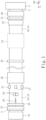
- Fig. 1 is a plan view showing a plastic bag making apparatus.
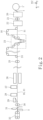
- Fig. 2 is a side view showing the plastic bag making apparatus.
- the plastic bag making apparatus shown in Figs. 1 and 2 can make plastic bags two by two.
- the plastic bag making apparatus comprises an accumulator 20 and feed rollers 21.
- a plastic film web 1 having a width in a direction Y is continuously drawn by the feed rollers 21 from a roll 1' through the accumulator 20 at a constant speed.
- the plastic bag making apparatus comprises a slitter 22.
- the plastic film 1 is slit along the longitudinal direction of the plastic film 1 (the direction X) by the slitter 22 so that two panel materials 10, 11 are formed.
- the panel materials 10, 11 are opposed to each other in the direction Z and fed in the direction X.
- the plastic bag making apparatus comprises a dancer device 23.
- the panel materials 10, 11 are pass through the dancer device 23.
- the dancer device 23 can appropriately transform the feed of the panel materials 10, 11 from a continuous feed into an intermittent feed. Therefore, the panel materials 10, 11 are intermittently fed from the downstream of the dancer device 23. Specifically, the panel materials 10, 11 are fed, suspended and fed again at the downstream of the dancer device 23.
- the intermittent feed has a stop-and-go feeding condition.
- the plastic bag making apparatus comprises guide rollers 24.
- the panel materials 10, 11 are guided to the guide rollers 24 and superposed with each other at the guide rollers 24.
- the plastic bag making apparatus comprises feed rollers 25.
- the panel materials 10, 11 superposed with each other are intermittently fed by the feed rollers 25 in the direction X.
- the plastic bag making apparatus comprises a heat seal device 26.
- the heat seal device 26 comprises longitudinal seal devices (not shown) extended in the direction X.
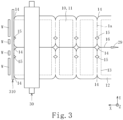
- the longitudinal seal device heat-seals the panel materials 10, 11 in the longitudinal direction thereof (the direction X) using heat seal members and so on during the suspend of the intermittent feed. Therefore, predetermined portions of the panel materials 10, 11 are heat sealed so that longitudinal sealed portions 12 ( Fig. 3 ) can be formed.
- the heat seal device 26 further comprises cross-seal devices (not shown) extended in the direction Y.
- the cross-seal device heat-seals the panel materials 10, 11 widthwise (in the direction Y) using heat seal members and so on during the suspend of the intermittent feed. Therefore, predetermined portions of the panel materials 10, 11 are heat sealed so that width sealed portions 13 ( Fig. 3 ) can be formed.
- the plastic bag making apparatus comprises three corner cut devices 27 disposed in the direction Y.
- the corner cut device 27 punches the panel materials 10, 11 using a punch blade or a Thomson blade and so on in each of the suspends of the intermittent feed so as to form corner cut areas 14 ( Fig. 3 ).
- the corner cut areas 14 are disposed on the inside of the width sealed portions 13 and at the opposite sides and center widthwise of the panel materials 10, 11 (in the direction Y).
- the plastic bag making apparatus comprises two notch forming devices 28 arranged in the direction Y.
- the notch forming device 28 punches the panel materials 10, 11 using a punch blade and so on in each of the suspends of the intermittent feed so as to form notch areas 15 ( Fig. 3 ).
- the notch areas 15 are disposed on the inside of the width sealed portions 13 and widthwise of the panel materials 10, 11 (in the direction Y) at a predetermined interval.
- the plastic bag making apparatus comprises a slitter 29.
- the slitter 29 slits the panel materials 10, 11 in its longitudinal direction (direction X) at the center of the width of the panel materials 10, 11 (in the direction Y). Therefore, a slit line 16 ( Fig. 3 ) is formed in the longitudinal direction of the panel materials 10, 11 (direction X) at the center of the width of the panel materials 10, 11 (in the direction Y).
- the plastic bag making apparatus comprises feed rollers 30.
- the panel materials 10, 11 are intermittently fed in the direction X by the feed rollers 30.
- the plastic bag making apparatus comprises a crosscut device 31.
- the crosscut device 31 comprises upper and lower blades 310, 311.
- the upper blade 310 is moved by a drive mechanism (not shown) in a vertical direction (direction Z) and the lower blade 311 is fixed and unmoved.
- the drive mechanism can be composed of a well-known art such as a crank mechanism.
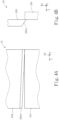
- the upper end of the lower blade 311 is composed of a flat surface extended in a horizontal direction (direction Y), see Fig. 4B .
- the edge 310a of the upper blade 310 is inclined relative to the horizontal direction (direction Y).
- One end side (right side of Fig.
- the crosscut device 31 crosscuts the panel materials 10, 11 in the width direction of the panel materials 10, 11 (direction Y) using the upper and lower blades 310, 311 in each of the suspends of the intermittent feed.
- the portion to be crosscut is disposed on the inside of the width sealed portions 13 of the panel materials 10, 11.
- the plastic bag making apparatus can make plastic bags two by two so that two plastic bags are made from the panel materials 10, 11 in each of crosscuts.
- the plastic bag making apparatus comprises a feed device 32.
- the feed device 32 comprises a pair of conveyers opposed to each other in the direction Z.
- the feed device 32 is configured to feed the plastic bag made from the panel materials 10, 11 intermittently according to the timing of the crosscut.
- the crosscut device 31 can be moved between the upstream and downstream sides of the direction X at a predetermined interval D using a drive mechanism (not shown).
- the drive mechanism is composed of a well-known art such as a ball screw mechanism.
- the panel materials 10, 11 are crosscut by the crosscut device 31.
- the panel materials 10, 11 are moved to both sides of the cut reference line 1a ( Fig. 3 ) in the width direction (direction Y) spaced at the interval D and the crosscut device 31 crosscuts the panel materials 10, 11 twice. As a result, any projected uneven edge is not formed at the notch areas 15 and the corner cut areas 14.
- the panel materials 10, 11 are crosscut twice at both sides of the cut reference line 1a widthwise spaced at the interval D so that wastes W having the width of the interval D are made when the panel materials 10, 11 are crosscut. That is to say, the waste W is extended between the notch areas 15 and the corner cut areas 14 of the panel materials 10, 11 and has the width of the interval D. Therefore, in the embodiment, the four linear wastes W are made, as shown in Fig. 3 .
- the panel materials 10, 11 are composed of the plastic film 1.
- the plastic film 1 is composed of a laminate film. Static electricity is readily generated on the laminate film so that the waste W may be attached to the upper or lower blade 310, 311 of the crosscut device 31 by the static electricity generation.
- the laminate film is composed of a base layer and a sealant layer laminated to each other.
- the sealant layer is composed of a material with a low melting point so as to function as an adhesive when being heat-sealed by the heat seal device 26.
- the sealant layer of the waste W may be attached to the upper or lower blade 310, 311 when the laminate film receives a great shear force by the operation of the crosscut device 31.
- the waste W may blunt the subsequent crosscut performance when being attached to the upper or lower blade 310, 311.
- the waste W attached to the upper or lower blade 310, 311 may be further cut shorter and mixed into the plastic bag as a fine foreign material.
- the waste W is mixed into the plastic bag and the content thereof.
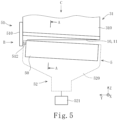
- the apparatus comprises a waste removing device 5 configured to reliably remove the waste W from the upper and lower blades 310, 311. As shown in Figs 1 and 2 , the waste removing device 5 is adjacent to the downstream side of the crosscut device 31. The waste removing device 5 together with the crosscut device 31 can be moved between the upstream and downstream sides of the direction X at the interval D using a drive mechanism (not shown).
- the waste removing device 5 comprises a scraper portion 50.
- the scraper portion 50 is extended to have the approximately same length as the width of the panel materials 10, 11 and the length of the upper and lower blades 310, 311.
- the scraper portion 50 is configured to sweep the waste W from the upper or lower blade 310, 311.
- the panel materials 10, 11 are crosscut by the crosscut device 31 so that the waste W may be made from the panel materials 10, 11 and attached to any point of the upper or lower blade 310, 311.
- the scraper portion 50 is extended longer than the width of the panel materials 10, 11 so as to sweep the waste W attached to any point of the upper or lower blade 310, 311. Therefore, the scraper portion 50 can sweep the waste W from the upper or lower blade 310, 311 regardless the position of the waste W made from the panel materials 10, 11.
- the upper end of the scraper portion 50 is inclined relative to the horizontal direction (direction Y) and parallel to the upper end of the upper blade 310 similarly to the upper blade 310.
- the panel materials 10, 11 are subject to be shear by the movement upwardly and downwardly of the upper blade 310 so that the waste W is often attached to the upper blade 310.
- the scraper portion 50 is parallel to the upper blade 310 so as to reliably sweep the waste W from the upper blade 310.
- the scraper portion 50 comprises a main body portion 500 and a brush portion 501 disposed along the upper end of the main body portion 500.
- the brush portion 501 is extended from the main body portion 500 to the upper and lower blades 310, 311 in the direction X.
- the brush portion 501 is composed of a plurality of hairs made from synthetic or native resin and so on and attached to the main body portion 500 so as to have a predetermined thickness in the direction Z. Therefore, it is possible to create more area where the brush portion 501 can sweep the waste W from the upper and lower blades 310, 311. As a result, it is possible to sweep the waste W from the upper and lower blades 310, 311 reliably.
- the waste removing device 5 comprises a transmission mechanism 51 configured to transmit the movement of the upper blade 310 upwardly and downwardly.
- the scraper portion 50 is movable close to the edge 310a of the upper blade 310 according to the descent of the upper blade 310 and away from the edge 310a of the upper blade 310 according to the elevation of the upper blade 310 by the transmission mechanism 51.
- the transmission mechanism 51 comprises a plate 510 attached to the upper blade 310 and moved upwardly and downwardly according to the movement of the upper blade 310.
- the plate 510 is extended in the direction Z.
- the transmission mechanism 51 comprises a cam groove 511 mounted on the plate 510 ( Fig. 7 ).
- the cam groove 511 is shaped and extended in the direction Z.
- the transmission mechanism 51 comprises a cylindrical cam follower 512 attached to and projected from the main body portion 500 of the scraper portion 50 in the direction Y.
- the cam follower 512 is fitted into the cam groove 511.
- the transmission mechanism 51 is mounted not only on the one side of the upper blade 310 but also on the both sides thereof.
- the transmission mechanism 51 is configured to move the plate 510 upwardly and downwardly according to the elevation and descent of the upper blade 310 so as to move the cam groove 511 according to the elevation and descent of the plate 510, and then the main body portion 500 of the scraper portion 50 is moved according to the elevation and descent of the cam groove 511.
- the transmission mechanism 51 is composed of a mechanical structure with the cam groove 511, the cam follower 512 and so on so as to be a simple structure having low parts count and excellent in productivity and reduce failures.
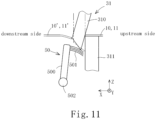
- the scraper portion 50 comprises a rotational shaft 502 at the lower end of the main body portion 500 so as to be rotated about the rotational shaft 502.
- the scraper portion 50 is rotated so as to reciprocate the brush portion 501 relative to the upper and lower blades 310, 311.
- the brush portion 501 is away from the upper blade 310 before crosscutting the panel materials 10, 11 so as not to be an obstacle in the crosscut of the crosscut device 31.
- the brush portion 501 is close to the upper blade 310 after crosscutting the panel materials 10, 11 so as to sweep the waste W attached to the upper and lower blades 310, 311 reliably.
- the waste removing device 5 comprises a suction mechanism 52.
- the suction mechanism 52 is configured to suction the waste W swept from the upper and lower blades 310, 311.
- the suction mechanism 52 comprises a cover portion 520 to cover the scraper portion 50.
- the cover 520 is fun-shaped in a front view ( Fig. 5 ), U-shaped in a plan view ( Fig. 8 ) and comes in contact with the lower blade 311. As a result, an enclosure is formed between the cover portion 520 and the lower blade 311 ( Fig. 8 ).
- the scraper portion 50 is placed inside the enclosure.
- the suction mechanism 52 comprises a suction source 521 connected with the lower end of the cover portion 520.
- the suction source 521 is configure to suction the inside of the cover portion 520.
- the inside of the cover portion 520 is enclosed to enhance efficiency of suction so that a downward airflow can be generated from the upper side of the brush portion 501 by the suction source 521 so as to reliably suction and remove the waste W swept by the scraper portion 50.
- the panel materials 10, 11 are fed to the crosscut device 31 and suspended ( Fig. 9A ).
- the panel materials 10, 11 are gripped by the feed device 32 under tension.
- the upper blade 310 stays at an upper dead point, and the panel materials 10, 11 suspend between the upper and lower blades 310, 311.
- the scraper portion 50 the main body portion 500 is extended in the direction Z, and the brush portion 501 is away from the upper and lower blades 310, 311 so as not to be an obstacle in the crosscut of the crosscut device 31.
- the upper blade 310 lowers from the upper dead point while the panel materials 10, 11 suspend ( Fig. 9B ). As a result, the panel materials 10, 11 are cut from its one end ( Fig. 4A ). Then, the upper blade 310 further lowers ( Fig. 9C ) to the lower dead point ( Fig. 9D ) so that the panel materials 10, 11 are cut in the width direction (direction Y).
- the plate 510 of the transmission mechanism 51 lowers according to the descent of the upper blade 310 ( Fig. 5 ).
- the cam groove 511 lowers according to the descent of the plate 510.
- the cam follower 512 mounted on the main body portion 500 of the scraper portion 50 is moved along the cam groove 511. Therefore, the main body portion 500 rotates about the rotational shaft 502 so that the brush portion 501 is close to the upper blade 310 ( Figs. 9C and 9D ). Then, the upper blade 310 elevates ( Fig. 9E ), whereby the crosscut is completed.
- the plate 510 ( Fig. 5 ) of the transmission mechanism 51 elevates according to the elevation of the upper blade 310.
- the cam groove 511 elevates according to the elevation of the plate 510.
- the cam follower 512 mounted on the main body portion 500 of the scraper portion 50 is moved along the cam groove 511. Therefore, the main body portion 500 rotates about the rotational shaft 502 and returns so that the brush portion 501 is away from the upper blade 310. As a result, the brush portion 501 is away from the upper and lower blades 310, 311 so as not to be an obstacle in the crosscut of the crosscut device 31.
- the crosscut device 31 and the waste removing device 5 are moved toward the upstream side in the direction X by the distance D while the panel materials 10, 11 suspend ( Fig. 10A ).
- the crosscut downstream end of the panel materials 10, 11 projects to the downstream from the edge of the upper blade 310 by the distance D.
- the upper blade 310 lowers from the upper dead point while the panel materials 10, 11 suspend ( Fig. 10B ). As a result, the panel materials 10, 11 are cut from its one end ( Fig. 4A ). Then, the upper blade 310 further lowers ( Fig. 10C ). The panel materials 10, 11 are cut in the width direction (direction Y) when the upper blade 310 lowers to the lower dead point ( Fig. 10D ). As such, the crosscut device 31 is twice operated at both sides of the cut reference line 1a ( Fig. 3 ) in the width direction (direction Y) of the panel materials 10, 11 spaced at the interval D so that the panel materials 10, 11 are crosscut twice, whereby any projected uneven edge is not formed at the notch areas 15 and the corner cut areas 14 of the plastic bag.
- the panel materials 10, 11 are crosscut twice at both sides of the width cut reference line 1a by the interval D, whereby the waste W having a width of the interval D ( Fig. 10D ) is formed when the panel materials 10, 11 are crosscut. That is to say, the waste W is extended between the notch areas 15 and the corner cut areas 14 of the panel materials 10, 11 and has the width of the interval D. Therefore, in the embodiment, the four linear wastes W are made, as shown in Fig. 3 .
- the plate 510 ( Fig. 5 ) of the transmission mechanism 51 lowers according to the descent of the upper blade 310.
- the cam groove 511 lowers according to the descent of the plate 510.
- the cam follower 512 mounted on the main body portion 500 of the scraper portion 50 is moved along the cam groove 511. Therefore, the main body portion 500 rotates about the rotational shaft 502 so that the brush portion 501 is close to the upper blade 310 ( Figs. 10C and 10D ).
- the waste W is attached to the surface of the upper blade 310 at first, on the other hand the brush portion 501 brushes the surface of the upper blade 310. Therefore, the brush portion 501 can sweep the waste W attached to the upper and the lower blades 310, 311 reliably.
- the brush portion 501 is parallel to the upper end of the scraper portion 50, inclined relative to the horizontal direction (direction Y) and parallel to the upper end of the upper blade 310.
- the operation of the brush portion 501 sweeping the upper blade 310 is performed along the entire length of the width direction (direction Y) of the panel materials 10, 11 at almost the same timing as the descent of the upper blade 310. Therefore, the brush portion 501 can sweep the waste W attached to the upper and lower blades 310, 311 reliably.
- a suction air is already started by the suction source 521 of the suction mechanism 52 ( Fig. 5 ) when the panel materials 10, 11 are crosscut ( Fig. 10D ).
- an air is generated downwardly in a narrow pathway between the edge of the brush portion 501 and the surface of the lower blade 311, and further the brush portion 501 is moved downwardly along the surface of the lower blade 311.
- the synergetic effect of the two actions makes the waste W removed downward reliably.
- the upper blade 310 elevates ( Fig. 10E ), whereby the crosscut is completed.
- the plate 510 ( Fig. 5 ) of the transmission mechanism 51 elevates according to the elevation of the upper blade 310.
- the cam groove 511 elevates according to the elevation of the plate 510.
- the cam follower 512 mounted on the main body portion 500 of the scraper portion 50 is moved along the cam groove 511. Therefore, the main body portion 500 rotates about the rotational shaft 502 and returns so that the brush portion 501 is away from the upper blade 310. As a result, the brush portion 501 is away from the upper and lower blades 310, 311 so as not to be an obstacle in the crosscut of the crosscut device 31.
- the crosscut device 31 and the waste removing device 5 are moved to the downstream side by the interval D and returned to their original positions.
- the panel materials 10, 11 are moved in the direction X and then suspended.
- the panel materials 10, 11 are moved to both sides of the cut reference line 1a spaced at the interval D and crosscut twice.
- the first crosscut is operated to the panel materials 10, 11, and the crosscut device 31 and the waste removing device 5 are moved to the upstream side in direction X by the distance D, and then the second crosscut is operated to the panel materials 10, 11.
- the upstream end of the panel materials 10, 11 being cut at the downstream side is disposed to interfere with the downstream end of the upper blade 310, a harmful effect can be generated during the cut of the waste W that followed. Therefore, it is preferred that the panel materials 10, 11 being cut at the downstream side is fed by the feed device 32 immediately after the first crosscut is operated to the panel materials 10, 11.
- the upper blade 310 when the upper blade 310 lowers to the lower dead point, the upper blade 310 may be inclined clockwise in Fig. 1 (the upper portion of the upper blade 310 is inclined) to be away from the lower blade 311. It is preferred that this operation is performed immediately after the first crosscut is operated to the panel materials 10, 11 ( Fig. 9 ), on the other hand this operation is not performed after the second crosscut ( Fig. 10 ).
- This operation can be performed by a well-known structure, for example, an air cylinder (not shown) being disposed adjacent to the upper portion of the upper blade 310. The air cylinder presses the upper portion of the upper blade 310 to the upstream side when the upper blade 310 lowers to the lower dead point so that the operations can be performed.
- the panel materials 10', 11' crosscut at the downstream side are quickly moved to the downstream side after the first crosscut is operated to the panel materials 10, 11 by the operation.
- the crosscut panel materials 10', 11' do not interfere with the second crosscut. Therefore, the waste W made by the second crosscut is prevented from flying to the downstream side carelessly.
- the craw portion can be made with a flexible substance so as to be deformed along the surface of the upper or lower blade 310, 311. As a result, the craw portion can sweep the waste W from the upper or lower blade 310, 311.
- the drive mechanism can be composed of a known mechanism such as a stepping motor connected with the rotational shaft 502.
- the waste W can be reliably suctioned by the constant suction.
- the constant suction can be controlled easily so that it is excellent in productivity and cost.
- the waste removing device for the plastic bag making apparatus is attached to the apparatus for making plastic bags from plastic films.
- the apparatus comprises a crosscut device configured to crosscut the plastic films.
- the crosscut device comprises upper and lower blades.
- the waste removing device comprises a scraper portion configured to sweep the waste made by the crosscut device from the upper and lower blades.
- the waste removing device for the plastic bag making apparatus and the plastic bag making apparatus can prevent the waste from being attached to the upper or lower blade of the crosscut device.
- the scraper portion can prevent the waste from being attached to the upper or lower blade by sweeping the waste even if the waste is attached to the upper or lower blade once.
- the scraper portion comprises a main body portion and a brush portion mounted on the main body portion and configured to sweep the waste from the upper or lower blade.
- the brush portion can sweep the waste from the upper or lower blade reliably.
- the brush portion comprises a plurality of flexible hairs made from synthetic or native resin and so on attached to the main body portion. Therefore, it is possible to create more area where the brush portion can sweep the waste from the upper blade. As a result, it is possible to sweep and drop the waste from the upper blade reliably.
- the waste removing device comprises a transmission mechanism configured to transmit the elevation and descent of the upper blade.
- the scraper portion is movable close to the edge of the upper blade according to the descent of the upper blade and away from the edge of the upper blade according to the elevation of the upper blade by the transmission mechanism.
- the upper blade is moved downwardly when crosscutting so that the waste may be attached to the surface of the upper blade.
- the scraper portion is close to the edge of the upper blade so as to reliably sweep and drop the waste attached to the upper or lower blade.
- the upper blade is moved upwardly after crosscutting so that the scraper portion is away from the edge of the upper blade so as not to be an obstacle in the crosscut.
- the transmission mechanism is configured to transmit the elevation and descent of the upper blade so as to rotate the scraper portion.
- the scraper portion can be close to and away from the upper and lower blades by rotating so as to be simple structure and excellent in productivity and maintenance.
- the scraper portion can be away from the upper blade before crosscutting the panel materials so as not to be an obstacle in the crosscut of the crosscut device. Further, the scraper portion can be close to the upper blade after crosscutting the panel materials so as to reliably sweep and drop the waste attached to the upper or lower blade.
- the bag is made from plastic but not limited.
- the bag may be made from a material based on paper, a simple material of polyethylene and so on not plastic nor laminate.
- the transmission mechanism comprises a plate configured to be moved upwardly and downwardly according to the elevation and descent of the upper blade, a cam groove mounted on the plate and a cam follower fitted into the cam groove.
- the transmission mechanism is composed of a mechanical structure such as the cam groove, the cam follower and so on, the parts of the device can be few in number, a simple structure, excellent in productivity and reduce failure.
- the waste removing device for the bag apparatus comprises a suction mechanism configured to suction the waste swept from the upper or lower blade.
- the suction mechanism suctions the waste swept from the upper or lower blade by the scraper portion so as to reliably remove the waste from the upper or lower blade.
- the waste swept from the upper or lower blade may be attached to it again by static electricity, however the suction mechanism suctions the waste so as to reliably prevent the waste from being attached to the upper or lower blade.
- a cover portion configured to cover the scraper portion and come in contact with the lower blade.
- An enclosure is formed between the cover portion and the lower blade.
- the scraper portion is placed inside the enclosure.
- the inside of the cover portion is enclosed to enhance efficiency of suction so as to reliably suction and remove the waste swept by the scraper portion.
Landscapes
- Life Sciences & Earth Sciences (AREA)
- Forests & Forestry (AREA)
- Engineering & Computer Science (AREA)
- Mechanical Engineering (AREA)
- Making Paper Articles (AREA)
- Details Of Cutting Devices (AREA)
- Nonmetal Cutting Devices (AREA)
Applications Claiming Priority (2)
| Application Number | Priority Date | Filing Date | Title |
|---|---|---|---|
| JP2021031783 | 2021-03-01 | ||
| PCT/JP2022/002390 WO2022185776A1 (ja) | 2021-03-01 | 2022-01-24 | 製袋機用カス排除装置及び製袋機 |
Publications (2)
| Publication Number | Publication Date |
|---|---|
| EP4302984A1 true EP4302984A1 (de) | 2024-01-10 |
| EP4302984A4 EP4302984A4 (de) | 2024-11-20 |
Family
ID=83155329
Family Applications (1)
| Application Number | Title | Priority Date | Filing Date |
|---|---|---|---|
| EP22762835.1A Pending EP4302984A4 (de) | 2021-03-01 | 2022-01-24 | Abfallentfernungsvorrichtung für beutelherstellungsmaschine und beutelherstellungsmaschine |
Country Status (5)
| Country | Link |
|---|---|
| US (1) | US20250010509A1 (de) |
| EP (1) | EP4302984A4 (de) |
| JP (1) | JP7226884B2 (de) |
| CN (1) | CN116847976A (de) |
| WO (1) | WO2022185776A1 (de) |
Families Citing this family (1)
| Publication number | Priority date | Publication date | Assignee | Title |
|---|---|---|---|---|
| CN120382526A (zh) * | 2025-05-22 | 2025-07-29 | 广东联华环保科技有限公司 | 一种能收集废料的切纸吸风装置及方法 |
Family Cites Families (11)
| Publication number | Priority date | Publication date | Assignee | Title |
|---|---|---|---|---|
| DE3101911A1 (de) * | 1981-01-22 | 1982-09-02 | Karl Mohr | "vorrichtung zum schneiden von papier, pappe oder dgl.." |
| JPS6247674A (ja) * | 1985-08-27 | 1987-03-02 | Canon Inc | クリ−ニング装置 |
| JP2805515B2 (ja) | 1989-12-27 | 1998-09-30 | トタニ技研工業株式会社 | プラスチック袋製造装置 |
| JPH04111218U (ja) * | 1991-03-11 | 1992-09-28 | 新明和工業株式会社 | 被覆剥取装置におけるストリツプカス除去装置 |
| JP2008023666A (ja) * | 2006-07-21 | 2008-02-07 | Dainippon Printing Co Ltd | 製袋ユニット |
| JP5398379B2 (ja) * | 2009-06-26 | 2014-01-29 | キヤノン株式会社 | シート穿孔装置及びシート穿孔装置を備えた画像形成装置 |
| JP5264971B2 (ja) * | 2010-10-14 | 2013-08-14 | キヤノン株式会社 | シート処理装置及び画像形成装置 |
| JP6392925B1 (ja) * | 2017-04-19 | 2018-09-19 | トタニ技研工業株式会社 | 製袋機 |
| JP6936066B2 (ja) * | 2017-07-21 | 2021-09-15 | 東芝テック株式会社 | カッター装置、およびラベルプリンタ |
| JP6804771B2 (ja) * | 2018-07-30 | 2020-12-23 | トタニ技研工業株式会社 | 製袋機 |
| CN111390988B (zh) * | 2020-03-30 | 2021-08-17 | 可可琳纳食品海门有限公司 | 一种便于清理的食品工业生产用切割装置 |
-
2022
- 2022-01-24 EP EP22762835.1A patent/EP4302984A4/de active Pending
- 2022-01-24 JP JP2022526819A patent/JP7226884B2/ja active Active
- 2022-01-24 WO PCT/JP2022/002390 patent/WO2022185776A1/ja not_active Ceased
- 2022-01-24 CN CN202280010790.4A patent/CN116847976A/zh active Pending
- 2022-01-24 US US18/262,752 patent/US20250010509A1/en active Pending
Also Published As
| Publication number | Publication date |
|---|---|
| WO2022185776A1 (ja) | 2022-09-09 |
| CN116847976A (zh) | 2023-10-03 |
| US20250010509A1 (en) | 2025-01-09 |
| JP7226884B2 (ja) | 2023-02-21 |
| EP4302984A4 (de) | 2024-11-20 |
| JPWO2022185776A1 (de) | 2022-09-09 |
Similar Documents
| Publication | Publication Date | Title |
|---|---|---|
| US20060137827A1 (en) | Guillotine cutter and tape affixing apparatus | |
| EP4302984A1 (de) | Abfallentfernungsvorrichtung für beutelherstellungsmaschine und beutelherstellungsmaschine | |
| EP2813359A1 (de) | Beutelherstellungsmaschine | |
| US6648808B2 (en) | Plastic big making apparatus | |
| CN1646404A (zh) | 倾斜的产品传输器 | |
| US5359915A (en) | Web cutter | |
| JP2012520185A (ja) | 包装材製造機械内における扁平な基材の移送装置 | |
| US8640584B2 (en) | Device for decelerating sheets to be placed on a stack, especially paper or cardboard sheets | |
| CN107414921A (zh) | 一种标签感应剪切装置 | |
| WO2004062859A1 (ja) | フィルム切断装置 | |
| US20130133499A1 (en) | Device for processing or generating break lines in flat products | |
| CN115742447B (zh) | 一种纸箱生产工艺 | |
| US4510009A (en) | Veneer splicing apparatus | |
| JP6118604B2 (ja) | ミシン目加工装置、およびこれを用いたミシン目付きフィルムの製造方法 | |
| SE1050793A1 (sv) | Skärutrustning för avskärning, perforering och bigning av ett tunt böjligt material och förfarande för detsamma | |
| EP3831561B1 (de) | Blasvorrichtung für eine maschine zum einlegen von zwischenblättern für aufschnittprodukte | |
| JP4524836B2 (ja) | 裁断機 | |
| SE458428B (sv) | Apparat foer att skaera ett haal med en utvald icke linjaer konfiguration i en bana av ett tunt material | |
| CN108529302A (zh) | 一种胶带截断装置 | |
| CN207088667U (zh) | 一种平贴机跟踪切断装置及使用其的平贴机 | |
| CN212765045U (zh) | 一种纯生物降解膜热封热切机的热封装置 | |
| US12420513B2 (en) | Machine for production of stand up pouches | |
| CN214448875U (zh) | 一种下切式圆压圆模切工作站 | |
| CN110640832A (zh) | 同模多段异步模切装置 | |
| US20230089787A1 (en) | Punching machine and spout attaching device |
Legal Events
| Date | Code | Title | Description |
|---|---|---|---|
| STAA | Information on the status of an ep patent application or granted ep patent |
Free format text: STATUS: THE INTERNATIONAL PUBLICATION HAS BEEN MADE |
|
| PUAI | Public reference made under article 153(3) epc to a published international application that has entered the european phase |
Free format text: ORIGINAL CODE: 0009012 |
|
| STAA | Information on the status of an ep patent application or granted ep patent |
Free format text: STATUS: REQUEST FOR EXAMINATION WAS MADE |
|
| 17P | Request for examination filed |
Effective date: 20230906 |
|
| AK | Designated contracting states |
Kind code of ref document: A1 Designated state(s): AL AT BE BG CH CY CZ DE DK EE ES FI FR GB GR HR HU IE IS IT LI LT LU LV MC MK MT NL NO PL PT RO RS SE SI SK SM TR |
|
| DAV | Request for validation of the european patent (deleted) | ||
| DAX | Request for extension of the european patent (deleted) | ||
| A4 | Supplementary search report drawn up and despatched |
Effective date: 20241018 |
|
| RIC1 | Information provided on ipc code assigned before grant |
Ipc: B26D 1/00 20060101ALN20241014BHEP Ipc: B31B 170/10 20170101ALI20241014BHEP Ipc: B31B 160/10 20170101ALI20241014BHEP Ipc: B31B 155/00 20170101ALI20241014BHEP Ipc: B31B 70/74 20170101ALI20241014BHEP Ipc: B31B 70/18 20170101ALI20241014BHEP Ipc: B31B 70/14 20170101ALI20241014BHEP Ipc: B31B 70/10 20170101ALI20241014BHEP Ipc: B26D 7/18 20060101ALI20241014BHEP Ipc: B26D 1/06 20060101ALI20241014BHEP Ipc: B26D 7/08 20060101ALI20241014BHEP Ipc: B31B 70/64 20170101ALI20241014BHEP Ipc: B26D 1/08 20060101ALI20241014BHEP Ipc: B31B 70/16 20170101AFI20241014BHEP |