EP4298137B1 - Neuartige phosphonierte fluorelastomere (pfkms), phosphonierte perfluorelastomere (pffkms), deren herstellungsverfahren und ihre anwendung in elektromembrananwendungen - Google Patents
Neuartige phosphonierte fluorelastomere (pfkms), phosphonierte perfluorelastomere (pffkms), deren herstellungsverfahren und ihre anwendung in elektromembrananwendungen Download PDFInfo
- Publication number
- EP4298137B1 EP4298137B1 EP22757204.7A EP22757204A EP4298137B1 EP 4298137 B1 EP4298137 B1 EP 4298137B1 EP 22757204 A EP22757204 A EP 22757204A EP 4298137 B1 EP4298137 B1 EP 4298137B1
- Authority
- EP
- European Patent Office
- Prior art keywords
- phosphonated
- polymer
- membranes
- polymers
- fkm
- Prior art date
- Legal status (The legal status is an assumption and is not a legal conclusion. Google has not performed a legal analysis and makes no representation as to the accuracy of the status listed.)
- Active
Links
Images


Classifications
-
- B—PERFORMING OPERATIONS; TRANSPORTING
- B01—PHYSICAL OR CHEMICAL PROCESSES OR APPARATUS IN GENERAL
- B01J—CHEMICAL OR PHYSICAL PROCESSES, e.g. CATALYSIS OR COLLOID CHEMISTRY; THEIR RELEVANT APPARATUS
- B01J39/00—Cation exchange; Use of material as cation exchangers; Treatment of material for improving the cation exchange properties
- B01J39/04—Processes using organic exchangers
- B01J39/05—Processes using organic exchangers in the strongly acidic form
-
- B—PERFORMING OPERATIONS; TRANSPORTING
- B01—PHYSICAL OR CHEMICAL PROCESSES OR APPARATUS IN GENERAL
- B01J—CHEMICAL OR PHYSICAL PROCESSES, e.g. CATALYSIS OR COLLOID CHEMISTRY; THEIR RELEVANT APPARATUS
- B01J39/00—Cation exchange; Use of material as cation exchangers; Treatment of material for improving the cation exchange properties
- B01J39/08—Use of material as cation exchangers; Treatment of material for improving the cation exchange properties
- B01J39/16—Organic material
- B01J39/18—Macromolecular compounds
- B01J39/20—Macromolecular compounds obtained by reactions only involving unsaturated carbon-to-carbon bonds
-
- B—PERFORMING OPERATIONS; TRANSPORTING
- B01—PHYSICAL OR CHEMICAL PROCESSES OR APPARATUS IN GENERAL
- B01J—CHEMICAL OR PHYSICAL PROCESSES, e.g. CATALYSIS OR COLLOID CHEMISTRY; THEIR RELEVANT APPARATUS
- B01J47/00—Ion-exchange processes in general; Apparatus therefor
- B01J47/12—Ion-exchange processes in general; Apparatus therefor characterised by the use of ion-exchange material in the form of ribbons, filaments, fibres or sheets, e.g. membranes
-
- C—CHEMISTRY; METALLURGY
- C08—ORGANIC MACROMOLECULAR COMPOUNDS; THEIR PREPARATION OR CHEMICAL WORKING-UP; COMPOSITIONS BASED THEREON
- C08C—TREATMENT OR CHEMICAL MODIFICATION OF RUBBERS
- C08C19/00—Chemical modification of rubber
- C08C19/24—Incorporating phosphorus atoms into the molecule
-
- C—CHEMISTRY; METALLURGY
- C08—ORGANIC MACROMOLECULAR COMPOUNDS; THEIR PREPARATION OR CHEMICAL WORKING-UP; COMPOSITIONS BASED THEREON
- C08C—TREATMENT OR CHEMICAL MODIFICATION OF RUBBERS
- C08C19/00—Chemical modification of rubber
- C08C19/25—Incorporating silicon atoms into the molecule
-
- C—CHEMISTRY; METALLURGY
- C08—ORGANIC MACROMOLECULAR COMPOUNDS; THEIR PREPARATION OR CHEMICAL WORKING-UP; COMPOSITIONS BASED THEREON
- C08F—MACROMOLECULAR COMPOUNDS OBTAINED BY REACTIONS ONLY INVOLVING CARBON-TO-CARBON UNSATURATED BONDS
- C08F214/00—Copolymers of compounds having one or more unsaturated aliphatic radicals, each having only one carbon-to-carbon double bond, and at least one being terminated by a halogen
- C08F214/18—Monomers containing fluorine
-
- C—CHEMISTRY; METALLURGY
- C08—ORGANIC MACROMOLECULAR COMPOUNDS; THEIR PREPARATION OR CHEMICAL WORKING-UP; COMPOSITIONS BASED THEREON
- C08F—MACROMOLECULAR COMPOUNDS OBTAINED BY REACTIONS ONLY INVOLVING CARBON-TO-CARBON UNSATURATED BONDS
- C08F8/00—Chemical modification by after-treatment
- C08F8/40—Introducing phosphorus atoms or phosphorus-containing groups
-
- C—CHEMISTRY; METALLURGY
- C08—ORGANIC MACROMOLECULAR COMPOUNDS; THEIR PREPARATION OR CHEMICAL WORKING-UP; COMPOSITIONS BASED THEREON
- C08J—WORKING-UP; GENERAL PROCESSES OF COMPOUNDING; AFTER-TREATMENT NOT COVERED BY SUBCLASSES C08B, C08C, C08F, C08G or C08H
- C08J5/00—Manufacture of articles or shaped materials containing macromolecular substances
- C08J5/20—Manufacture of shaped structures of ion-exchange resins
- C08J5/22—Films, membranes or diaphragms
- C08J5/2206—Films, membranes or diaphragms based on organic and/or inorganic macromolecular compounds
- C08J5/2218—Synthetic macromolecular compounds
- C08J5/2231—Synthetic macromolecular compounds based on macromolecular compounds obtained by reactions involving unsaturated carbon-to-carbon bonds
- C08J5/2243—Synthetic macromolecular compounds based on macromolecular compounds obtained by reactions involving unsaturated carbon-to-carbon bonds obtained by introduction of active groups capable of ion-exchange into compounds of the type C08J5/2231
- C08J5/225—Synthetic macromolecular compounds based on macromolecular compounds obtained by reactions involving unsaturated carbon-to-carbon bonds obtained by introduction of active groups capable of ion-exchange into compounds of the type C08J5/2231 containing fluorine
-
- H—ELECTRICITY
- H01—ELECTRIC ELEMENTS
- H01M—PROCESSES OR MEANS, e.g. BATTERIES, FOR THE DIRECT CONVERSION OF CHEMICAL ENERGY INTO ELECTRICAL ENERGY
- H01M4/00—Electrodes
- H01M4/02—Electrodes composed of, or comprising, active material
- H01M4/62—Selection of inactive substances as ingredients for active masses, e.g. binders, fillers
- H01M4/621—Binders
- H01M4/622—Binders being polymers
- H01M4/623—Binders being polymers fluorinated polymers
-
- H—ELECTRICITY
- H01—ELECTRIC ELEMENTS
- H01M—PROCESSES OR MEANS, e.g. BATTERIES, FOR THE DIRECT CONVERSION OF CHEMICAL ENERGY INTO ELECTRICAL ENERGY
- H01M50/00—Constructional details or processes of manufacture of the non-active parts of electrochemical cells other than fuel cells, e.g. hybrid cells
- H01M50/40—Separators; Membranes; Diaphragms; Spacing elements inside cells
- H01M50/409—Separators, membranes or diaphragms characterised by the material
- H01M50/411—Organic material
- H01M50/414—Synthetic resins, e.g. thermoplastics or thermosetting resins
- H01M50/426—Fluorocarbon polymers
-
- H—ELECTRICITY
- H01—ELECTRIC ELEMENTS
- H01M—PROCESSES OR MEANS, e.g. BATTERIES, FOR THE DIRECT CONVERSION OF CHEMICAL ENERGY INTO ELECTRICAL ENERGY
- H01M50/00—Constructional details or processes of manufacture of the non-active parts of electrochemical cells other than fuel cells, e.g. hybrid cells
- H01M50/40—Separators; Membranes; Diaphragms; Spacing elements inside cells
- H01M50/489—Separators, membranes, diaphragms or spacing elements inside the cells, characterised by their physical properties, e.g. swelling degree, hydrophilicity or shut down properties
- H01M50/497—Ionic conductivity
-
- H—ELECTRICITY
- H01—ELECTRIC ELEMENTS
- H01M—PROCESSES OR MEANS, e.g. BATTERIES, FOR THE DIRECT CONVERSION OF CHEMICAL ENERGY INTO ELECTRICAL ENERGY
- H01M8/00—Fuel cells; Manufacture thereof
- H01M8/10—Fuel cells with solid electrolytes
- H01M8/1016—Fuel cells with solid electrolytes characterised by the electrolyte material
- H01M8/1018—Polymeric electrolyte materials
- H01M8/102—Polymeric electrolyte materials characterised by the chemical structure of the main chain of the ion-conducting polymer
- H01M8/1023—Polymeric electrolyte materials characterised by the chemical structure of the main chain of the ion-conducting polymer having only carbon, e.g. polyarylenes, polystyrenes or polybutadiene-styrenes
-
- H—ELECTRICITY
- H01—ELECTRIC ELEMENTS
- H01M—PROCESSES OR MEANS, e.g. BATTERIES, FOR THE DIRECT CONVERSION OF CHEMICAL ENERGY INTO ELECTRICAL ENERGY
- H01M8/00—Fuel cells; Manufacture thereof
- H01M8/10—Fuel cells with solid electrolytes
- H01M8/1016—Fuel cells with solid electrolytes characterised by the electrolyte material
- H01M8/1018—Polymeric electrolyte materials
- H01M8/102—Polymeric electrolyte materials characterised by the chemical structure of the main chain of the ion-conducting polymer
- H01M8/1034—Polymeric electrolyte materials characterised by the chemical structure of the main chain of the ion-conducting polymer having phosphorus, e.g. sulfonated polyphosphazenes [S-PPh]
-
- H—ELECTRICITY
- H01—ELECTRIC ELEMENTS
- H01M—PROCESSES OR MEANS, e.g. BATTERIES, FOR THE DIRECT CONVERSION OF CHEMICAL ENERGY INTO ELECTRICAL ENERGY
- H01M8/00—Fuel cells; Manufacture thereof
- H01M8/10—Fuel cells with solid electrolytes
- H01M8/1016—Fuel cells with solid electrolytes characterised by the electrolyte material
- H01M8/1018—Polymeric electrolyte materials
- H01M8/1039—Polymeric electrolyte materials halogenated, e.g. sulfonated polyvinylidene fluorides
-
- H—ELECTRICITY
- H01—ELECTRIC ELEMENTS
- H01M—PROCESSES OR MEANS, e.g. BATTERIES, FOR THE DIRECT CONVERSION OF CHEMICAL ENERGY INTO ELECTRICAL ENERGY
- H01M8/00—Fuel cells; Manufacture thereof
- H01M8/10—Fuel cells with solid electrolytes
- H01M8/1016—Fuel cells with solid electrolytes characterised by the electrolyte material
- H01M8/1018—Polymeric electrolyte materials
- H01M8/1041—Polymer electrolyte composites, mixtures or blends
- H01M8/1044—Mixtures of polymers, of which at least one is ionically conductive
-
- H—ELECTRICITY
- H01—ELECTRIC ELEMENTS
- H01M—PROCESSES OR MEANS, e.g. BATTERIES, FOR THE DIRECT CONVERSION OF CHEMICAL ENERGY INTO ELECTRICAL ENERGY
- H01M8/00—Fuel cells; Manufacture thereof
- H01M8/10—Fuel cells with solid electrolytes
- H01M8/1016—Fuel cells with solid electrolytes characterised by the electrolyte material
- H01M8/1018—Polymeric electrolyte materials
- H01M8/1069—Polymeric electrolyte materials characterised by the manufacturing processes
- H01M8/1072—Polymeric electrolyte materials characterised by the manufacturing processes by chemical reactions, e.g. in situ polymerisation or in situ crosslinking
-
- C—CHEMISTRY; METALLURGY
- C08—ORGANIC MACROMOLECULAR COMPOUNDS; THEIR PREPARATION OR CHEMICAL WORKING-UP; COMPOSITIONS BASED THEREON
- C08F—MACROMOLECULAR COMPOUNDS OBTAINED BY REACTIONS ONLY INVOLVING CARBON-TO-CARBON UNSATURATED BONDS
- C08F2810/00—Chemical modification of a polymer
-
- C—CHEMISTRY; METALLURGY
- C08—ORGANIC MACROMOLECULAR COMPOUNDS; THEIR PREPARATION OR CHEMICAL WORKING-UP; COMPOSITIONS BASED THEREON
- C08J—WORKING-UP; GENERAL PROCESSES OF COMPOUNDING; AFTER-TREATMENT NOT COVERED BY SUBCLASSES C08B, C08C, C08F, C08G or C08H
- C08J2327/00—Characterised by the use of homopolymers or copolymers of compounds having one or more unsaturated aliphatic radicals, each having only one carbon-to-carbon double bond, and at least one being terminated by a halogen; Derivatives of such polymers
- C08J2327/22—Characterised by the use of homopolymers or copolymers of compounds having one or more unsaturated aliphatic radicals, each having only one carbon-to-carbon double bond, and at least one being terminated by a halogen; Derivatives of such polymers modified by chemical after-treatment
-
- H—ELECTRICITY
- H01—ELECTRIC ELEMENTS
- H01M—PROCESSES OR MEANS, e.g. BATTERIES, FOR THE DIRECT CONVERSION OF CHEMICAL ENERGY INTO ELECTRICAL ENERGY
- H01M8/00—Fuel cells; Manufacture thereof
- H01M8/10—Fuel cells with solid electrolytes
- H01M2008/1095—Fuel cells with polymeric electrolytes
-
- Y—GENERAL TAGGING OF NEW TECHNOLOGICAL DEVELOPMENTS; GENERAL TAGGING OF CROSS-SECTIONAL TECHNOLOGIES SPANNING OVER SEVERAL SECTIONS OF THE IPC; TECHNICAL SUBJECTS COVERED BY FORMER USPC CROSS-REFERENCE ART COLLECTIONS [XRACs] AND DIGESTS
- Y02—TECHNOLOGIES OR APPLICATIONS FOR MITIGATION OR ADAPTATION AGAINST CLIMATE CHANGE
- Y02E—REDUCTION OF GREENHOUSE GAS [GHG] EMISSIONS, RELATED TO ENERGY GENERATION, TRANSMISSION OR DISTRIBUTION
- Y02E60/00—Enabling technologies; Technologies with a potential or indirect contribution to GHG emissions mitigation
- Y02E60/30—Hydrogen technology
- Y02E60/50—Fuel cells
Definitions
- phosphonated systems are based on aryl polymers synthesized by nucleophilic substitution (Michaelis-Arbusow and Michaelis-Becker rearrangement) of aryl halides and di- or trialkyl phosphite, as is the case, for example, in DE 10 2011 015 212 A1 described.
- the inventive step is based on finding new phosphonated compounds that are proton-conducting and chemically and mechanically stable, even in the dry state and at high temperatures. These compounds should also be easy to synthesize. This is achieved by phosphonating non-conductive polymers such as FKM or FFKM (fluorocarbon rubber) with trialkyl phosphites such as tris(trimethylsilyl)phosphite (TTMSP).
- FKM and FFKM fluorocarbon rubber
- TTMSP tris(trimethylsilyl)phosphite
- the base rubbers FKM and FFKM already possess high mechanical flexibility, both at very low and very high temperatures, and are chemically stable. They retain these good mechanical and chemical properties after phosphonation, are very good proton conductors, even at temperatures above 100°C, and are soluble in organic solvents.
- the reaction should be as efficient and simple as possible, which is the case here, since the unused phosphoning agent can be recovered.
- the phosphonated polymers should be soluble in common solvents in order to be able to produce membranes from them.
- the invention is based on the reaction of a reactive group -X of the fluororubbers and perfluororubbers with TTMSP or a side chain consisting of a bisphenol AF which is already linked to the aliphatic backbone.
- the reactive group -X ( Fig. 1 ), depending on the base material, can be -I, -Br, -Cl, -H or the free -OH of the bisphenol AF side chain, or a pseudohalogen (-CN, -N3, -OCN, -NCO, -CNO, -SCN, -NCS, -SeCN).
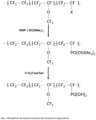
- Fig. 1 the basic structure of a perfluoroelastomer (FFKM) is shown, where n, m, z can be mixed in any ratio, with the building block z determining the number of phosphonable sites.
- FFKM perfluoroelastomer
- the phosphonated polymers may still contain free reactive groups -X. These free groups can be used to subsequently covalently crosslink the phosphonated polymers.
- the base polymers can be dissolved in ethyl acetate, butanone, N-methylpyrolidone (NMP), dimethylacetamide (DMAc), Dimethyl sulfoxide (DMSO), etc.
- TTMSP can be added either before, directly during the dissolution process, or after the polymers have dissolved.
- 0.1 wt.% (low degree of phosphonation) to 5000 wt.% (high degree of phosphonation) are added, based on the polymer weight.
- the base material dissolves in the solvent before phosphonation or only after phosphonation has taken place.
- TMS-X Trimethylsilyl-X
- reaction temperature 60-200°C
- FKM/FFKM FKM/FFKM and solvent used
- TMS-X and excess TTMSP are then removed by distillation.
- the phosphonated polymer remains in the solvent in the form of the trimethylsilyl ester of pFKM or pFFKM.
- the polymer solution is then poured into water and, depending on the degree of phosphonation, precipitates as a solid (low degree of phosphonation) or dissolves (high degree of phosphonation). Boiling the water/polymer mixture hydrolyzes the phosphonated polymer from its trimethylsilyl ester form to the free polymeric phosphonic acid.
- the polymer can be washed in water, depending on the degree of phosphonation.
- Non-water-soluble pFKM/pFFKM or fractions can be filtered off, and water-soluble ones can be purified by dialysis.
- Another option is not to precipitate the polymer solution in water, but to directly process the polymer solution into a membrane and then hydrolyze it in hot water.
- the resulting polymers and membranes can be used in electrochemical cells.
- the polymers or blend membranes can be used in low or They can be used in medium-temperature fuel cells operating at temperatures ranging from -30°C to 250°C or in low- or medium-temperature electrolyzers operating at temperatures ranging from 0°C to 250°C.
- the membranes can be used in chemical synthesis reactors operating at temperatures ranging from -70°C to 250°C.
- the membranes can also be used as separators in primary and secondary batteries or as binders in primary and secondary battery electrodes.
- one of the phosphonated polymers with different degrees of phosphonation is described as an example, along with its ion exchange capacity, conductivity up to 180°C and an electrolysis test as a proof of concept.
- a membrane was produced from the phosphonated polymer with an IEC of 2.6 mmol/g and measured in an electrolysis cell, demonstrating that the application in electromembrane processes works. ( Fig. 3 ).
Landscapes
- Chemical & Material Sciences (AREA)
- Chemical Kinetics & Catalysis (AREA)
- General Chemical & Material Sciences (AREA)
- Electrochemistry (AREA)
- Engineering & Computer Science (AREA)
- Manufacturing & Machinery (AREA)
- Organic Chemistry (AREA)
- Polymers & Plastics (AREA)
- Health & Medical Sciences (AREA)
- Medicinal Chemistry (AREA)
- Sustainable Development (AREA)
- Sustainable Energy (AREA)
- Life Sciences & Earth Sciences (AREA)
- Materials Engineering (AREA)
- Inorganic Chemistry (AREA)
- Composite Materials (AREA)
- Crystallography & Structural Chemistry (AREA)
- Manufacture Of Macromolecular Shaped Articles (AREA)
- Compositions Of Macromolecular Compounds (AREA)
- Separation Using Semi-Permeable Membranes (AREA)
- Conductive Materials (AREA)
- Battery Electrode And Active Subsutance (AREA)
- Fuel Cell (AREA)
- Addition Polymer Or Copolymer, Post-Treatments, Or Chemical Modifications (AREA)
- Cell Separators (AREA)
Description
- Neuartige phosphonierte Fluorelastomere (pFKMs), phosphonierte Perfluorelastomere (pFFKMs), deren Herstellungsverfahren und ihre Anwendung in Elektromembrananwendungen
- Die am häufigsten beschriebenen phosphonierten Systeme beruhen auf Arylpolymeren, die mittels nucleophiler Substitution (Michaelis-Arbusow- und Michaelis-Becker Umlagerung) von Arylhalogeniden und Di- bzw. Trialkylphosphit synthetisiert werden, wie dies beispielsweise in der
DE 10 2011 015 212 A1 beschrieben ist. - Diese phosphonierten Arylpolymere sind dadurch gekennzeichnet, dass diese eine hohe thermische und chemische Stabilität besitzen. Zudem zeigen sie eine gute Protonenleitfähigkeit, auch im nicht befeuchteten Zustand bei Temperaturen oberhalb von 100°C. [1]
- Nachteile der phosphonierten Arylpolymere z. B. aus
DE 10 2011 015 212 A1 ist, dass diese im nicht hydrierten Zustand, also trocken, mechanisch instabil sind und brechen. [1-5] - Die erfinderische Tätigkeit beruht darauf, neue phosphonierte Verbindungen, die auch im trockenen Zustand und bei hohen Temperaturen protonenleitend, chemisch und mechanisch stabil sind, zu finden. Diese Verbindungen sollten darüber hinaus einfach zu synthetisieren sein. Dies wird erreicht, in dem man nicht leitfähige Polymere wie FKM bzw. FFKM (Flour-Kautschuk) mit Trialkylphosphiten wie z. B. Tris(trimethylsilyl)phosphit (TTMSP) phosphoniert. Die Basiskautschuke FKM und FFKM besitzen bereits eine hohe mechanische Flexibilität, sowohl bei sehr niedrigen, als auch bei sehr hohen Temperaturen und sind chemisch stabil. Diese guten mechanischen und chemischen Eigenschaften behalten sie nach der Phosphonierung bei, sind sehr gut protonenleitend, auch bei Temperaturen über 100°C und löslich in organischen Lösungsmitteln.
- Bisher sind keine Verbindungen bekannt, die diese positiven Eigenschaften aufweisen bzw. so hergestellt werden. Somit handelt es sich bei den hier synthetisierten Polymeren um eine neue Materialklasse und dem dazugehörigen Herstellungsprozess.
- Die Reaktion soll möglichst effizient und einfacher Art sein, was hier gegeben ist, da das nicht verbrauchte Phosphonierungsmittel wieder zurückgewonnen werden kann.
- Die phosphonierten Polymere sollen in gängigen Lösungsmitteln löslich sein, um daraus Membranen herstellen zu können.
- Die Phosphonierungsreaktion kann mit allen FKM, FFKM Derivaten in der aufgeführten Klassifizierung Typ 1 - Typ 5 durchgeführt werden, dabei ist es irrelevant aus welchen Monomer Verhältnissen das FKM bzw. FFKM aufgebaut ist, einzige Bedingung ist, dass Monomerbausteine mit einer reaktiven Gruppe -X im FKM bzw. FFKM vorhanden sind, siehe Beispielhaft
Abb. 1 . - Typ 1 Copolymere bestehend aus Vinylidenfluorid (VDF) und Hexafluoropropylene (HFP),
- Typ 2 Terpolymere bestehend aus VDF, HFP und Tetrafluoroethylen (TFE)
- Typ 3 bestehend aus VDF, TFE und Perfluoroalkylvinylether (PAVE)
- Typ 4 bestehend aus TFE, VDF und Propylen
- Typ 5 bestehend aus VDF, HFP, TFE, PAVE, Ethylen und Perfluorelastomere hauptsächlich bestehend aus TFE und PAVE
- Die Erfindung beruht auf der Reaktion einer reaktiven Gruppe -X der Fluorkautschuke und Perfluorkautschuke mit TTMSP bzw. einer Seitenkette, bestehend aus einem Bisphenol AF welche bereits mit dem aliphatischen Backbone verbunden ist. Die reaktive Gruppe -X (
Abb. 1 ), kann je nach Basismaterial -I, -Br, -Cl, -H bzw. das freie -OH der Bisphenol AF Seitenkette sein, oder ein Pseudohalogen (-CN, -N3, -OCN, -NCO, -CNO, -SCN, -NCS, -SeCN). - Als nicht einschränkendes Beispiel ist in
Abb. 1 die Grundstruktur eines Perfluorelastomers (FFKM) gezeigt, wobei n, m, z in beliebigen Verhältnissen gemischt werden kann, wobei der Baustein z, die Anzahl der phosphonierbaren Stellen bestimmt. - Einzig wichtig für die Phosphonierung ist, dass es eine reaktive Gruppe -X im FKM/FFKM gibt, die mit TTMSP reagieren kann.
- Die phosphonierten Polymere können je nach Phosponierungsgrad noch freie reaktive Gruppen -X enthalten. Diese freien Gruppen können verwendet werden, um die phosphonierten Polymere nachträglich kovalent zu vernetzen.
- Die Phosphonierung zum pFKM und pFFKM findet in Lösung statt. Hierfür können die Basispolymere in Essigsäureethylester, Butanon, N-Methylpyrolidon (NMP), Dimethylacetamid (DMAc), Dimethylsulfoxid (DMSO) etc. gelöst werden. TTMSP kann wahlweise vorher, direkt beim Lösevorgang bzw. nachdem die Polymere gelöst sind zugegeben werden. Je nach gewünschtem Phosphonierungsgrad werden 0,1 Gew.% (Gewichtsprozent), geringer Phosphonierungsgrad, bis 5000 Gew.%, hoher Phosphonierungsgrad, bezogen auf die Polymereinwaage zugegeben.
- Je nach verwendetem FKM/FFKM löst sich das Basismaterial bereits im Lösungsmittel vor der Phosphonierung oder erst wenn die Phosphonierung stattgefunden hat.
- Am besten und schnellsten funktioniert die Reaktion in hoch siedenden aprotischen Lösungsmitteln wie beispielsweise NMP, DMAc und DMSO. Während der Reaktion ist eine Gasentwicklung zu beobachten, die anzeigt, wann die Reaktion startet. Dabei entsteht als Nebenprodukt Trimethylsilyl-X (TMS-X)
- Die Reaktion wird so lange auf Reaktionstemperatur (60-200°C), abhängig vom verwendeten FKM/FFKM und Lösungsmittel, gehalten, bis die Gasentwicklung stoppt. Anschließend wird die Reaktion weitere 2-8 Stunden auf Temperatur gehalten, um sicher zu sein, dass die Reaktion vollständig ist.
- Anschließend wird das TMS-X und überschüssiges TTMSP mittels Destillation entfernt. Das phosphonierte Polymer bleibt, in Form des Trimethylsilylesters des pFKM oder pFFKM, im Lösungsmittel zurück.
- Die Polymerlösung wird nun in Wasser gegossen und fällt je nach Phosphonierungsgrad als Feststoff aus (niedriger Phosphonierungsgrad) bzw. geht in Lösung (hoher Phosphonierunsgrad). Durch kochen der Wasser/Polymermischung wird das phosphonierte Polymer von seiner Trimethylsilylesterform zur freien polymeren Phosphonsäure hydrolysiert.
- Zum vollständigen Abtrennen von Hydrolysenebenprodukten kann das Polymer je nach Phosponierungsgrad in Wasser gewaschen werden. Nicht wasserlösliche pFKM/pFFKM bzw. Anteile können abfiltriert werden bzw. wasserlösliche können durch Dialyse aufgereinigt werden.
- Eine weitere Variante ist, die Polymerlösung nicht in Wasser auszufällen, sondern direkt die Polymerlösung zu einer Membran weiter zu verarbeiten und diese anschließend in heißem Wasser zu hydrolysieren.
- Die entstandenen Polymere und Membrane können in elektrochemischen Zellen verwendet werden. Vorzugsweise können die Polymere beziehungsweise Blendmembrane in Nieder- oder Mitteltemperaturbrennstoffzellen im Temperaturbereich von -30°C bis 250°C oder in Nieder- oder Mitteltemperaturelektrolyseuren im Temperaturbereich von 0°C bis 250°C eingesetzt werden. Darüber hinaus können die Membrane in chemischen Synthesereaktoren von -70°C bis 250°C verwendet werden. Die Membrane können auch als Separator in Primär- und Sekundärbatterien oder als Binder in Elektroden von Primär- und Sekundärbatterien verwendet werden.
- 10 g eines FKM werden mit 90 g N-Methylpyrolidon (NMP) versetzt, gerührt, erhitzt und aufgelöst. Nun gibt man 50 g TTMSP hinzu und erhitzt die Lösung auf 160°C. Nach wenigen Minuten setzt eine Gasentwicklung ein, die sich zunächst beschleunigt und dann langsam zum Erliegen kommt und das Ende der Reaktion anzeigt. Die Lösung wir noch 2 - 12 Stunden auf Reaktionstemperatur gehalten, um sicher zu gehen, dass die Reaktion vollständig ist. Nun können die Nebenprodukte und überschüssiges TTMSP mittels Destillation entfernt werden. Das im NMP gelöste pFKM kann nun entweder in Wasser ausgefällt werden oder direkt eine Membran aus der Reaktionslösung hergestellt werden. Sowohl die ausgefällte als auch die Variante der direkten Ziehung müssen noch in heißem bis kochenden Wasser nachbehandelt werden bzw. mit heißem Wasserdampf nachbehandelt werden um die Phosphonsäureform zu erhalten.
- Hier wird Beispielhaft eins der phosphonierten Polymere mit unterschiedlichen Phosphonierungsgraden beschrieben, dessen Ionenaustauscherkapazität, Leitfähigkeit bis 180°C und einem Elektrolysetest als proof of concept.
- 100 mg des fertig aufbereiteten Polymers werden mit einer gesättigten NaCl Lösung überschichtet und ca. 2h gerührt und 2 Tropfen Bromthymolblau als Indikator zugegeben. Dabei tauschen die Protonen des phosphonierten pFKM mit den Na-Ionen und es entsteht HCl. Die entstandene HCl wird mittels Titration mit 0,1 mol NaOH nachgewiesen. Daraus lässt sich der IECdirekt bestimmen. Um den Gesamt IECGesamt zu bestimmen, werden zur selben Lösung 3ml NaOH 0,1M im Überschuss dazu gegeben, wieder 2h gerührt und anschließend mit HCl zurück titriert.
- Für den Versuch in [0018] erhält man einen IECdirekt= 0,99 mmol/g und IECGesamt = 2,62 mmol/g.
- Wenn man denselben Versuch mit 10g FKM und 10g TTMSP durchführt, erhält man einen IECdirekt= 0,56 mmol/g und IECGesamt = 0,8 mmol/g. Hier erkennt man eindeutig den Zusammenhang zwischen den Edukt Verhältnissen, dem Phosphonierungsgrad und der Leitfähigkeit (
Abb. 2 ). - In
Abb. 2 kann man den Einfluss des Phosphonierungsgrades auf die Leitfähigkeit sehr gut erkennen und zudem, dass die Leitfähigkeit weit über 100°C nicht abnimmt und somit neue Arten von elektrochemischen Zellen, weit über 150°C, möglich sind. Zum Vergleich ist eine Nafion 212 mit denselben Messbedingungen aufgeführt. - Aus dem phosphonierten Polymer mit dem IEC=2,6 mmol/g wurde eine Membran hergestellt und diese in einer Elektrolysezelle vermessen, womit gezeigt ist, dass die Anwendung in Elektromembranverfahren funktioniert. (
Abb. 3 ). -
- [1] Vladimir Atanasov and Jochen Kerres Highly Phosphonated Polypentafluorostyrene; Macromolecules 2011, 44, 16, 6416-6423
- [2] Vladimir Atanasov, Dietrich Gudat, Bastian Ruffmann, Jochen Kerres, Highly phosphonated polypentafluorostyrene: Characterization and blends with polybenzimidazole, European Polymer Journal, Volume 49, Issue 12, 2013, Pages 3977-3985,
- [3] Vladimir Atanasov, Matthias Bürger, Sandrine Lyonnard, Lionel Porcar, Jochen Kerres, Sulfonated poly(pentafluorostyrene): Synthesis & characterization, Solid State Ionics,Volume 252, 2013, Pages 75-83,
- [4] Vladimir Atanasov, Jochen Kerres, ETFE-g-pentafluorostyrene: Functionalization and proton conductivity, European Polymer Journal, Volume 63, 2015, Pages 168-176,
- [5] Vladimir Atanasov, Andrey Oleynikov, Jiabing Xia, Sandrine Lyonnard, Jochen Kerres, Phosphonic acid functionalized poly(pentafluorostyrene) as polyelectrolyte membrane for fuel cell application Journal of Power Sources, Volume 343, 2017, Pages 364-372
Claims (18)
- Phosphonierte aliphatische Fluorpolymerkautschuke (pFKM) und phosphonierte aliphatische Perfluorpolymerkautschuke (pFFKM), synthetisiert aus Fluorpolymerkautschuk (FKM) und Perfluorpolymerkautschuk (FFKM),
dadurch gekennzeichnet, dass
die Phosphonsäuregruppe direkt an der Hauptkette bzw. an einer Seitenkette des Polymers vorliegt und die Seitenkette aliphatischen bzw. Arylcharakter hat - Phosphonierte teil- und perfluorierte aliphatische Fluor- oder Perfluorkautschuke nach Anspruch 1,
dadurch gekennzeichnet, dass
der Phosphonierungsgrad bis zu einer Phosphonsäuregruppe pro Wiederholungseinheit aufweisen kann und sich daraus Membranen herstellen lassen. - Phosphonierte Polymere nach Anspruch 1 oder 2,
dadurch gekennzeichnet, dassnicht abreagierte reaktiven Gruppen -X vorhanden sind (Phosphonierungsgrad <1), die anschließend kovalent vernetzt werden können und daraus kovalent vernetzte Membranen hergestellt werden können,wobei -X mindestens ein Mitglied, ausgewählt aus der Gruppe bestehend aus -I, -Br, - Cl, -H,-CN, -N3, -OCN, -NCO, -CNO, -SCN, -NCS, -SeCN bzw. das freie -OH der Bisphenol AF Seitenkette, ist - Phosphonierte Polymermembranen nach einem der Ansprüche 1 bis 3,
dadurch gekennzeichnet, dass
die erhaltenen phosphonierten Polymere mit basischen Polymeren, wie z. B. Polybenzimidazol oder Anionentauscherpolymeren, zu Säure-Base-Blendmembranen, kovalent-vernetzten Membranen und kovalent-vernetzten Säure-Base Blendmembranen geblendet werden können - Phosphonierte Polymermembranen nach Anspruch 4,
dadurch gekennzeichnet, dass
das Mischungsverhältnis zwischen phosphoniertem und basischem Polymer zwischen 99 mol% phosphoniertes Polymer/1 mol% basisches Polymer und 1 mol% phosphoniertes Polymer/99 mol% basisches Polymer beträgt. - Phosphonierte Polymermembranen nach einem der Ansprüche 1 - 5,
dadurch gekennzeichnet, dass
dem Blend noch zusätzlich ein beliebiges sulfoniertes Polymer in beliebiger Menge hinzugefügt werden kann. - Phosphonierte Polymermembranen nach einem der Ansprüche 4 bis 6,
dadurch gekennzeichnet, dass
die Blendmembran noch zusätzlich mit Phosphorsäure in beliebiger Menge dotiert werden kann. - Phosphonierte Polymermembranen nach Anspruch 7,
dadurch gekennzeichnet, dass
als Phosphorsäure-Dotierungsgrad Werte zwischen 40% und 500% bevorzugt werden. - Verfahren zur Herstellung phosphonierter Polymere und Membranen, pFKM oder pFFKM, , dadurch gekennzeichnet, dass das FKM oder FFKM im Phosphonierungsmittel gelöst oder suspendiert wird, auf Temperaturen zwischen 40°C und 200°C erhitzt wird, zwischen 30 Minuten und 12 Stunden erhitzt wird, danach das überschüssige Phosphonierungsmittel abdestilliert oder anders entfernt wird und das Polymer durch Dialysieren oder Ausfällen isoliert wird,
wobei das FKM oder FFKM über zumindest eine reaktive Gruppe -X verfügt, wobei -X mindestens ein Mitglied, ausgewählt aus der Gruppe bestehend aus -I, -Br, -Cl, -H,-CN, -N3, -OCN, -NCO, -CNO, -SCN, -NCS, -SeCN bzw. das freie -OH der Bisphenol AF Seitenkette ist - Verfahren nach Anspruch 9,
dadurch gekennzeichnet, dass
das FKM oder FFKM unter Hinzufügung zumindest eines weiteren Lösungsmittels in dem Phosponierungsmittel gelöst oder suspendiert wird. - Verfahren nach Anspruch 10
dadurch gekennzeichnet, dass
das Lösungsmittel zumindest ein Mitglied, ausgewählt aus der Gruppe bestehend aus N-Methylpyrolidon (NMP), Dimethylecetamid (DMAc) oder Dimethylsulfoxid (DMSO), ist. - Verfahren nach einem der Ansprüche 9 bis 11
dadurch gekennzeichnet, dass
das Phosphonierungsmittel Tris(trimethylsilyl)phosphit ist. - Verwendung der Polymere und Membranen nach den Ansprüchen 1 bis 8 in elektrochemischen Zellen.
- Verwendung der Membranen bzw. Blendmembranen nach Anspruch 13 in Nieder- oder Mitteltemperaturbrennstoffzellen im Temperaturbereich von -30°C bis 250°C.
- Verwendung der Membranen nach Anspruch 13 in Nieder- oder Mitteltemperaturelektrolyseuren im Temperaturbereich von 0°C bis 250°C.
- Verwendung der Membranen nach Anspruch 13 in chemischen Synthesereaktoren von -70°C bis 250°C.
- Verwendung der Membranen nach Anspruch 13 als Separator in Primär- und Sekundärbatterien
- Verwendung der Polymere nach Anspruch 1-4 als Binder in Elektroden von Primär- und Sekundärbatterien
Applications Claiming Priority (2)
| Application Number | Priority Date | Filing Date | Title |
|---|---|---|---|
| DE102021003229.2A DE102021003229A1 (de) | 2021-06-23 | 2021-06-23 | Neuartige phosphonierte Fluorelastomere (pFKMs), phosphonierte Perfluorelastomere (pFFKMs), deren Herstellungsverfahren und Ihre Anwendung in Elektromembrananwendungen |
| PCT/DE2022/100467 WO2022268266A1 (de) | 2021-06-23 | 2022-06-23 | Neuartige phosphonierte fluorelastomere (pfkms), phosphonierte perfluorelastomere (pffkms), deren herstellungsverfahren und ihre anwendung in elektromembrananwendungen |
Publications (3)
| Publication Number | Publication Date |
|---|---|
| EP4298137A1 EP4298137A1 (de) | 2024-01-03 |
| EP4298137B1 true EP4298137B1 (de) | 2025-04-02 |
| EP4298137C0 EP4298137C0 (de) | 2025-04-02 |
Family
ID=82942794
Family Applications (1)
| Application Number | Title | Priority Date | Filing Date |
|---|---|---|---|
| EP22757204.7A Active EP4298137B1 (de) | 2021-06-23 | 2022-06-23 | Neuartige phosphonierte fluorelastomere (pfkms), phosphonierte perfluorelastomere (pffkms), deren herstellungsverfahren und ihre anwendung in elektromembrananwendungen |
Country Status (9)
| Country | Link |
|---|---|
| US (1) | US20240218138A1 (de) |
| EP (1) | EP4298137B1 (de) |
| JP (1) | JP2024527299A (de) |
| KR (1) | KR20240011788A (de) |
| CN (1) | CN117321094A (de) |
| CA (1) | CA3216071A1 (de) |
| DE (1) | DE102021003229A1 (de) |
| WO (1) | WO2022268266A1 (de) |
| ZA (1) | ZA202309186B (de) |
Family Cites Families (9)
| Publication number | Priority date | Publication date | Assignee | Title |
|---|---|---|---|---|
| US3970533A (en) * | 1973-10-10 | 1976-07-20 | The Firestone Tire & Rubber Company | Process for conversion of elastomeric phosphazene |
| JPS5550051A (en) * | 1978-10-07 | 1980-04-11 | Daikin Ind Ltd | Blend composition for cocrosslinking of new fluoroelastomer |
| JP2009500505A (ja) * | 2005-07-09 | 2009-01-08 | ウニヴェルズィテート シュトゥットガルト | 芳香族求核置換によるホスホン酸エステル、ホスホン酸およびスルホン酸のモノマー、オリゴマーおよびポリマーの製造方法 |
| WO2011145588A1 (ja) * | 2010-05-21 | 2011-11-24 | 株式会社クラレ | 高分子電解質及びそれからなる高分子電解質膜 |
| DE102011015212A1 (de) | 2011-03-25 | 2012-09-27 | Universität Stuttgart | Phosphonierte fluorierte Monomere und Polymere |
| FR3043084B1 (fr) * | 2015-10-29 | 2017-10-27 | Arkema France | Copolymeres fluores fonctionnalises |
| US10961336B2 (en) * | 2017-08-22 | 2021-03-30 | Colorado School Of Mines | Method of functionalizing fluoropolymers with acidic side chains exhibiting improved properties, the fluoropolymers thereof, and methods of using |
| US20210253761A1 (en) * | 2018-05-17 | 2021-08-19 | Solvay Specialty Polymers Italy S.P.A. | Flexible vdf polymers |
| DE102019008024A1 (de) * | 2019-11-18 | 2021-05-20 | Universität Stuttgart | Kationenaustauscher- und Anionenaustauscherpolymere und -(blend)membranen aus hochfluorierte aromatische Gruppen enthaltenden Polymeren mittlels nucleophiler Substitution |
-
2021
- 2021-06-23 DE DE102021003229.2A patent/DE102021003229A1/de not_active Withdrawn
-
2022
- 2022-06-23 KR KR1020237044335A patent/KR20240011788A/ko active Pending
- 2022-06-23 WO PCT/DE2022/100467 patent/WO2022268266A1/de not_active Ceased
- 2022-06-23 US US18/570,118 patent/US20240218138A1/en active Pending
- 2022-06-23 CA CA3216071A patent/CA3216071A1/en active Pending
- 2022-06-23 EP EP22757204.7A patent/EP4298137B1/de active Active
- 2022-06-23 JP JP2023579617A patent/JP2024527299A/ja active Pending
- 2022-06-23 CN CN202280034943.9A patent/CN117321094A/zh active Pending
-
2023
- 2023-09-29 ZA ZA2023/09186A patent/ZA202309186B/en unknown
Also Published As
| Publication number | Publication date |
|---|---|
| EP4298137A1 (de) | 2024-01-03 |
| US20240218138A1 (en) | 2024-07-04 |
| DE102021003229A1 (de) | 2022-12-29 |
| JP2024527299A (ja) | 2024-07-24 |
| CN117321094A (zh) | 2023-12-29 |
| CA3216071A1 (en) | 2022-12-29 |
| ZA202309186B (en) | 2024-10-30 |
| KR20240011788A (ko) | 2024-01-26 |
| EP4298137C0 (de) | 2025-04-02 |
| WO2022268266A1 (de) | 2022-12-29 |
Similar Documents
| Publication | Publication Date | Title |
|---|---|---|
| DE102009020175B4 (de) | Aus Mischungen von PFSA und sulfonierten PFCB-Polymeren zusammengesetzte Polyelektrolytmembranen | |
| DE69930474T2 (de) | Festpolymerelektrolyte | |
| DE102009020181B4 (de) | Sulfonierte Perfluorcyclobutanblockcopolymere und protonenleitende Polymermembranen | |
| US6987163B2 (en) | Modified polybenzimidazole (PBI) membranes for enhanced polymer electrochemical cells | |
| DE60214166T2 (de) | Polymerelektrolyt für eine brennstoffzelle des festpolymertyps und brennstoffzelle | |
| EP1971635B1 (de) | Protonenleitende polymermembran | |
| DE102014009170A1 (de) | Kombinatorisches Materialsystem für Ionenaustauschermembranen und dessen Verwendung in elektrochemischen Prozessen | |
| DE102006019414B4 (de) | Blockcopolymere mit Säuregruppen | |
| EP3511947B1 (de) | Feste polymerelektrolytmembran und verfahren zur herstellung derselben | |
| DE102004021074A1 (de) | Sulfonimid enthaltende Poly(Arylenether) und Poly(Arylenethersulfone), Verfahren zu deren Herstellung und Verwendung derselben | |
| EP1420039B1 (de) | Protonenleitfähige Membran für elektrochemische Anwendungen | |
| DE10347530A1 (de) | Blockcopolymer und dessen Verwendung | |
| EP4298137B1 (de) | Neuartige phosphonierte fluorelastomere (pfkms), phosphonierte perfluorelastomere (pffkms), deren herstellungsverfahren und ihre anwendung in elektromembrananwendungen | |
| Martschin et al. | Preparation of a new class of phosphonated hydrocarbon polymers based on polysulfone | |
| EP4298150B1 (de) | Phosphonierte nichtfluorierte und teilfluorierte arylpolymere aus sulfonierten arylpolymeren und polymere perfluorphosphonsäuren aus polymeren perfluorsulfonsäuren, deren herstellungsverfahren und anwendung in elektromembrananwendungen | |
| DE102012002781B4 (de) | Polyperfluorcyclobutanionomer mit phosphonsäuregruppen für hochtemperatur-brennstoffzellen | |
| DE102009038252B4 (de) | Aus Mischungen von PFSA und sulfonierten PFCB-Polymeren zugesetzte Polyelektrolytmenbranen | |
| DE112008001421T5 (de) | Protonen-Austauschmembran für eine Brennstoffzelle | |
| DE102011016350B4 (de) | Kombination von Hauptketten- und Seitenketten-Sulfonierungvon PFCB-6F-Hochtemperatur-Brennstoffzellmembranen | |
| DE112010005034T5 (de) | Polyarylen-Ionomere | |
| HK40099116A (zh) | 新型膦酰化氟代弹性体(pfkm)、膦酰化全氟弹性体(pffkm)、其制备方法及其在电学膜应用中的用途 | |
| HK40099115A (zh) | 由磺化芳基聚合物形成的新型膦酰化未氟化和部分氟化的芳基聚合物以及由聚合物型全氟磺酸形成的新型聚合物型全氟膦酸、其制备方法及在电学膜应用中的用途 | |
| DE102012223817A1 (de) | Organokupfer-reagenzien zur bindung von perfluorsulfonsäuregruppen an polyolefine | |
| DE102011013840A1 (de) | Aus löslichen Perfluorcyclobutanpolymeren mit Sulfonylchloridgruppen abgeleitete Polyelektrolytmembranen |
Legal Events
| Date | Code | Title | Description |
|---|---|---|---|
| STAA | Information on the status of an ep patent application or granted ep patent |
Free format text: STATUS: UNKNOWN |
|
| STAA | Information on the status of an ep patent application or granted ep patent |
Free format text: STATUS: THE INTERNATIONAL PUBLICATION HAS BEEN MADE |
|
| PUAI | Public reference made under article 153(3) epc to a published international application that has entered the european phase |
Free format text: ORIGINAL CODE: 0009012 |
|
| STAA | Information on the status of an ep patent application or granted ep patent |
Free format text: STATUS: REQUEST FOR EXAMINATION WAS MADE |
|
| 17P | Request for examination filed |
Effective date: 20230929 |
|
| AK | Designated contracting states |
Kind code of ref document: A1 Designated state(s): AL AT BE BG CH CY CZ DE DK EE ES FI FR GB GR HR HU IE IS IT LI LT LU LV MC MK MT NL NO PL PT RO RS SE SI SK SM TR |
|
| DAV | Request for validation of the european patent (deleted) | ||
| DAX | Request for extension of the european patent (deleted) | ||
| GRAP | Despatch of communication of intention to grant a patent |
Free format text: ORIGINAL CODE: EPIDOSNIGR1 |
|
| STAA | Information on the status of an ep patent application or granted ep patent |
Free format text: STATUS: GRANT OF PATENT IS INTENDED |
|
| INTG | Intention to grant announced |
Effective date: 20241021 |
|
| GRAS | Grant fee paid |
Free format text: ORIGINAL CODE: EPIDOSNIGR3 |
|
| GRAA | (expected) grant |
Free format text: ORIGINAL CODE: 0009210 |
|
| STAA | Information on the status of an ep patent application or granted ep patent |
Free format text: STATUS: THE PATENT HAS BEEN GRANTED |
|
| AK | Designated contracting states |
Kind code of ref document: B1 Designated state(s): AL AT BE BG CH CY CZ DE DK EE ES FI FR GB GR HR HU IE IS IT LI LT LU LV MC MK MT NL NO PL PT RO RS SE SI SK SM TR |
|
| REG | Reference to a national code |
Ref country code: GB Ref legal event code: FG4D Free format text: NOT ENGLISH |
|
| REG | Reference to a national code |
Ref country code: CH Ref legal event code: EP |
|
| REG | Reference to a national code |
Ref country code: IE Ref legal event code: FG4D Free format text: LANGUAGE OF EP DOCUMENT: GERMAN |
|
| REG | Reference to a national code |
Ref country code: DE Ref legal event code: R096 Ref document number: 502022003462 Country of ref document: DE |
|
| U01 | Request for unitary effect filed |
Effective date: 20250428 |
|
| U07 | Unitary effect registered |
Designated state(s): AT BE BG DE DK EE FI FR IT LT LU LV MT NL PT RO SE SI Effective date: 20250508 |
|
| U20 | Renewal fee for the european patent with unitary effect paid |
Year of fee payment: 4 Effective date: 20250625 |
|
| PG25 | Lapsed in a contracting state [announced via postgrant information from national office to epo] |
Ref country code: ES Free format text: LAPSE BECAUSE OF FAILURE TO SUBMIT A TRANSLATION OF THE DESCRIPTION OR TO PAY THE FEE WITHIN THE PRESCRIBED TIME-LIMIT Effective date: 20250402 |
|
| PG25 | Lapsed in a contracting state [announced via postgrant information from national office to epo] |
Ref country code: GR Free format text: LAPSE BECAUSE OF FAILURE TO SUBMIT A TRANSLATION OF THE DESCRIPTION OR TO PAY THE FEE WITHIN THE PRESCRIBED TIME-LIMIT Effective date: 20250703 Ref country code: NO Free format text: LAPSE BECAUSE OF FAILURE TO SUBMIT A TRANSLATION OF THE DESCRIPTION OR TO PAY THE FEE WITHIN THE PRESCRIBED TIME-LIMIT Effective date: 20250702 |
|
| PG25 | Lapsed in a contracting state [announced via postgrant information from national office to epo] |
Ref country code: PL Free format text: LAPSE BECAUSE OF FAILURE TO SUBMIT A TRANSLATION OF THE DESCRIPTION OR TO PAY THE FEE WITHIN THE PRESCRIBED TIME-LIMIT Effective date: 20250402 |
|
| PG25 | Lapsed in a contracting state [announced via postgrant information from national office to epo] |
Ref country code: HR Free format text: LAPSE BECAUSE OF FAILURE TO SUBMIT A TRANSLATION OF THE DESCRIPTION OR TO PAY THE FEE WITHIN THE PRESCRIBED TIME-LIMIT Effective date: 20250402 |
|
| PGFP | Annual fee paid to national office [announced via postgrant information from national office to epo] |
Ref country code: CH Payment date: 20250701 Year of fee payment: 4 |
|
| PG25 | Lapsed in a contracting state [announced via postgrant information from national office to epo] |
Ref country code: RS Free format text: LAPSE BECAUSE OF FAILURE TO SUBMIT A TRANSLATION OF THE DESCRIPTION OR TO PAY THE FEE WITHIN THE PRESCRIBED TIME-LIMIT Effective date: 20250702 |
|
| PG25 | Lapsed in a contracting state [announced via postgrant information from national office to epo] |
Ref country code: IS Free format text: LAPSE BECAUSE OF FAILURE TO SUBMIT A TRANSLATION OF THE DESCRIPTION OR TO PAY THE FEE WITHIN THE PRESCRIBED TIME-LIMIT Effective date: 20250802 |
|
| PG25 | Lapsed in a contracting state [announced via postgrant information from national office to epo] |
Ref country code: SM Free format text: LAPSE BECAUSE OF FAILURE TO SUBMIT A TRANSLATION OF THE DESCRIPTION OR TO PAY THE FEE WITHIN THE PRESCRIBED TIME-LIMIT Effective date: 20250402 |
|
| PG25 | Lapsed in a contracting state [announced via postgrant information from national office to epo] |
Ref country code: CZ Free format text: LAPSE BECAUSE OF FAILURE TO SUBMIT A TRANSLATION OF THE DESCRIPTION OR TO PAY THE FEE WITHIN THE PRESCRIBED TIME-LIMIT Effective date: 20250402 |
|
| PG25 | Lapsed in a contracting state [announced via postgrant information from national office to epo] |
Ref country code: SK Free format text: LAPSE BECAUSE OF FAILURE TO SUBMIT A TRANSLATION OF THE DESCRIPTION OR TO PAY THE FEE WITHIN THE PRESCRIBED TIME-LIMIT Effective date: 20250402 |
|
| PG25 | Lapsed in a contracting state [announced via postgrant information from national office to epo] |
Ref country code: MC Free format text: LAPSE BECAUSE OF FAILURE TO SUBMIT A TRANSLATION OF THE DESCRIPTION OR TO PAY THE FEE WITHIN THE PRESCRIBED TIME-LIMIT Effective date: 20250402 |
|
| PLBE | No opposition filed within time limit |
Free format text: ORIGINAL CODE: 0009261 |
|
| STAA | Information on the status of an ep patent application or granted ep patent |
Free format text: STATUS: NO OPPOSITION FILED WITHIN TIME LIMIT |
|
| REG | Reference to a national code |
Ref country code: CH Ref legal event code: L10 Free format text: ST27 STATUS EVENT CODE: U-0-0-L10-L00 (AS PROVIDED BY THE NATIONAL OFFICE) Effective date: 20260211 |