EP4286345B1 - Verfahren zum thermoformen eines transparenten elements - Google Patents
Verfahren zum thermoformen eines transparenten elements Download PDFInfo
- Publication number
- EP4286345B1 EP4286345B1 EP22825269.8A EP22825269A EP4286345B1 EP 4286345 B1 EP4286345 B1 EP 4286345B1 EP 22825269 A EP22825269 A EP 22825269A EP 4286345 B1 EP4286345 B1 EP 4286345B1
- Authority
- EP
- European Patent Office
- Prior art keywords
- transparent
- transparent substrate
- lower mold
- electronic device
- transparent member
- Prior art date
- Legal status (The legal status is an assumption and is not a legal conclusion. Google has not performed a legal analysis and makes no representation as to the accuracy of the status listed.)
- Active
Links
Images



Classifications
-
- H—ELECTRICITY
- H05—ELECTRIC TECHNIQUES NOT OTHERWISE PROVIDED FOR
- H05K—PRINTED CIRCUITS; CASINGS OR CONSTRUCTIONAL DETAILS OF ELECTRIC APPARATUS; MANUFACTURE OF ASSEMBLAGES OF ELECTRICAL COMPONENTS
- H05K5/00—Casings, cabinets or drawers for electric apparatus
- H05K5/02—Details
- H05K5/03—Covers
-
- H—ELECTRICITY
- H04—ELECTRIC COMMUNICATION TECHNIQUE
- H04M—TELEPHONIC COMMUNICATION
- H04M1/00—Substation equipment, e.g. for use by subscribers
- H04M1/02—Constructional features of telephone sets
- H04M1/0202—Portable telephone sets, e.g. cordless phones, mobile phones or bar type handsets
-
- B—PERFORMING OPERATIONS; TRANSPORTING
- B29—WORKING OF PLASTICS; WORKING OF SUBSTANCES IN A PLASTIC STATE IN GENERAL
- B29C—SHAPING OR JOINING OF PLASTICS; SHAPING OF MATERIAL IN A PLASTIC STATE, NOT OTHERWISE PROVIDED FOR; AFTER-TREATMENT OF THE SHAPED PRODUCTS, e.g. REPAIRING
- B29C43/00—Compression moulding, i.e. applying external pressure to flow the moulding material; Apparatus therefor
- B29C43/02—Compression moulding, i.e. applying external pressure to flow the moulding material; Apparatus therefor of articles of definite length, i.e. discrete articles
-
- B—PERFORMING OPERATIONS; TRANSPORTING
- B29—WORKING OF PLASTICS; WORKING OF SUBSTANCES IN A PLASTIC STATE IN GENERAL
- B29C—SHAPING OR JOINING OF PLASTICS; SHAPING OF MATERIAL IN A PLASTIC STATE, NOT OTHERWISE PROVIDED FOR; AFTER-TREATMENT OF THE SHAPED PRODUCTS, e.g. REPAIRING
- B29C43/00—Compression moulding, i.e. applying external pressure to flow the moulding material; Apparatus therefor
- B29C43/32—Component parts, details or accessories; Auxiliary operations
-
- B—PERFORMING OPERATIONS; TRANSPORTING
- B29—WORKING OF PLASTICS; WORKING OF SUBSTANCES IN A PLASTIC STATE IN GENERAL
- B29C—SHAPING OR JOINING OF PLASTICS; SHAPING OF MATERIAL IN A PLASTIC STATE, NOT OTHERWISE PROVIDED FOR; AFTER-TREATMENT OF THE SHAPED PRODUCTS, e.g. REPAIRING
- B29C51/00—Shaping by thermoforming, i.e. shaping sheets or sheet like preforms after heating, e.g. shaping sheets in matched moulds or by deep-drawing; Apparatus therefor
- B29C51/26—Component parts, details or accessories; Auxiliary operations
- B29C51/266—Auxiliary operations after the thermoforming operation
- B29C51/267—Two sheets being thermoformed in separate mould parts and joined together while still in the mould
-
- C—CHEMISTRY; METALLURGY
- C03—GLASS; MINERAL OR SLAG WOOL
- C03B—MANUFACTURE, SHAPING, OR SUPPLEMENTARY PROCESSES
- C03B23/00—Re-forming shaped glass
- C03B23/02—Re-forming glass sheets
-
- C—CHEMISTRY; METALLURGY
- C03—GLASS; MINERAL OR SLAG WOOL
- C03B—MANUFACTURE, SHAPING, OR SUPPLEMENTARY PROCESSES
- C03B23/00—Re-forming shaped glass
- C03B23/02—Re-forming glass sheets
- C03B23/023—Re-forming glass sheets by bending
- C03B23/03—Re-forming glass sheets by bending by press-bending between shaping moulds
-
- C—CHEMISTRY; METALLURGY
- C03—GLASS; MINERAL OR SLAG WOOL
- C03B—MANUFACTURE, SHAPING, OR SUPPLEMENTARY PROCESSES
- C03B23/00—Re-forming shaped glass
- C03B23/02—Re-forming glass sheets
- C03B23/023—Re-forming glass sheets by bending
- C03B23/03—Re-forming glass sheets by bending by press-bending between shaping moulds
- C03B23/0302—Re-forming glass sheets by bending by press-bending between shaping moulds between opposing full-face shaping moulds
-
- C—CHEMISTRY; METALLURGY
- C03—GLASS; MINERAL OR SLAG WOOL
- C03B—MANUFACTURE, SHAPING, OR SUPPLEMENTARY PROCESSES
- C03B23/00—Re-forming shaped glass
- C03B23/02—Re-forming glass sheets
- C03B23/023—Re-forming glass sheets by bending
- C03B23/03—Re-forming glass sheets by bending by press-bending between shaping moulds
- C03B23/0307—Press-bending involving applying local or additional heating, cooling or insulating means
-
- B—PERFORMING OPERATIONS; TRANSPORTING
- B29—WORKING OF PLASTICS; WORKING OF SUBSTANCES IN A PLASTIC STATE IN GENERAL
- B29K—INDEXING SCHEME ASSOCIATED WITH SUBCLASSES B29B, B29C OR B29D, RELATING TO MOULDING MATERIALS OR TO MATERIALS FOR MOULDS, REINFORCEMENTS, FILLERS OR PREFORMED PARTS, e.g. INSERTS
- B29K2995/00—Properties of moulding materials, reinforcements, fillers, preformed parts or moulds
- B29K2995/0018—Properties of moulding materials, reinforcements, fillers, preformed parts or moulds having particular optical properties, e.g. fluorescent or phosphorescent
- B29K2995/0026—Transparent
-
- B—PERFORMING OPERATIONS; TRANSPORTING
- B29—WORKING OF PLASTICS; WORKING OF SUBSTANCES IN A PLASTIC STATE IN GENERAL
- B29L—INDEXING SCHEME ASSOCIATED WITH SUBCLASS B29C, RELATING TO PARTICULAR ARTICLES
- B29L2031/00—Other particular articles
- B29L2031/34—Electrical apparatus, e.g. sparking plugs or parts thereof
- B29L2031/3431—Telephones, Earphones
- B29L2031/3437—Cellular phones
-
- H—ELECTRICITY
- H04—ELECTRIC COMMUNICATION TECHNIQUE
- H04M—TELEPHONIC COMMUNICATION
- H04M1/00—Substation equipment, e.g. for use by subscribers
- H04M1/02—Constructional features of telephone sets
- H04M1/0202—Portable telephone sets, e.g. cordless phones, mobile phones or bar type handsets
- H04M1/0249—Details of the mechanical connection between the housing parts or relating to the method of assembly
-
- H—ELECTRICITY
- H04—ELECTRIC COMMUNICATION TECHNIQUE
- H04M—TELEPHONIC COMMUNICATION
- H04M1/00—Substation equipment, e.g. for use by subscribers
- H04M1/02—Constructional features of telephone sets
- H04M1/0202—Portable telephone sets, e.g. cordless phones, mobile phones or bar type handsets
- H04M1/026—Details of the structure or mounting of specific components
- H04M1/0264—Details of the structure or mounting of specific components for a camera module assembly
Definitions
- thermoforming a transparent member Various embodiments disclosed herein relate to a method of thermoforming a transparent member.
- An electronic device may have an angular shape as well as a curved edge portion to improve aesthetics.
- an electronic device may have a surface that has a plurality of heights in order to dispose components (e.g., a camera) of the electronic device.
- at least one surface of the electronic device may have glass. The glass protects the external portion of the electronic device.
- the glass formed on the external portion of the electronic device may have a shape corresponding to the shape of the surfaces of the electronic device.
- the shape of the glass may be made by using a polishing method of manufacturing a curved surface by grinding the glass surface with a grinder, or by using a thermoforming method of heating glass and then bending or pressing the glass to form the glass.
- thermoforming glass In the case of forming glass using the thermoforming method, flat glass may be placed between upper and lower molds. The molds are pressed at a certain temperature and pressure. The foregoing produces glass corresponding to the shape of a cavity defined in the molds.
- CN106746526 A teaches a method for forming three-dimensional glass substrates by pressing several of them at once using a lower mold with several cavities and a corresponding upper mold.
- a corresponding teaching as in CN106746526 A is also disclosed in KR20180085522 A and US2017349472 A1 .
- a method of grinding a glass surface such as a Computerized Numerical Control (CNC) process may be used.
- CNC Computerized Numerical Control
- a post-process e.g., a polishing process
- the manufacturing cost is increased, and the forming time is long, which may cause a problem in that the productivity is decreased.
- Various embodiments disclosed herein are able to provide a transparent member including bending glass including a curved surface or glass having a partially asymmetric shape in the thickness of one surface, and a method of thermoforming the transparent member with molds.
- a transparent member forming method includes, as defined in claim 1: a process of putting a first transparent substrate and a second transparent substrate into a first cavity of a lower mold that has a first depth and a second cavity of a lower mold that is connected to the first cavity and has a second depth, respectively; a process of disposing an upper mold, which corresponds to the lower mold and includes a pressing portion having at least one pressing surface, on an upper portion of the lower mold; a process of preheating at least one of the lower mold in which the transparent substrates are disposed or the upper mold to a predetermined temperature; and a process of thermoforming the preheated transparent substrates by pressing the preheated transparent substrates in a manner of pressing the upper mold.
- thermoforming process it is possible to provide a transparent member formed through a thermoforming process using molds without a separate CNC process and a method for thermoforming a transparent member. Due to this, the time required for a CNC machining process and a polishing process for removing a CNC tool mark may be reduced.
- transparent substrates corresponding a thick portion and a thin film portion are separately put into a transparent member thermoforming mold, and the respective transparent substrates are bonded to each other during thermoforming. Therefore, it is possible to implement a curved shape or a shape having a partially different thickness on one surface.
- the lower mold since the lower mold includes at least one air passage, it is possible to prevent pores, which are generated melting and bonding of the transparent substrates, from being formed in the transparent member.
- thermoforming process it is possible to provide a transparent member formed through a thermoforming process using molds without a separate CNC process and a method for thermoforming a transparent member. Due to this, the time required for a CNC machining process and a polishing process for removing a CNC tool mark may be reduced.
- transparent substrates corresponding a thick portion and a thin film portion are separately put into a transparent member thermoforming mold, and the respective transparent substrates are bonded to each other during thermoforming. Therefore, it is possible to implement a curved shape or a shape having a partially different thickness on one surface.
- the lower mold since the lower mold includes at least one air passage, it is possible to prevent pores, which are generated melting and bonding of the transparent substrates, from being formed in the transparent member.
- An electronic device may include at least one of, for example, a smartphone, a tablet personal computer (PC), a mobile phone, a video phone, an electronic book reader (e-book reader), a desktop PC, a laptop PC, a netbook computer, a workstation, a server, a personal digital assistant (PDA), a portable multimedia player (PMP), a MPEG-1 audio layer-3 (MP3) player, a mobile medical device, a camera, and a wearable device.
- a smartphone a tablet personal computer (PC), a mobile phone, a video phone, an electronic book reader (e-book reader), a desktop PC, a laptop PC, a netbook computer, a workstation, a server, a personal digital assistant (PDA), a portable multimedia player (PMP), a MPEG-1 audio layer-3 (MP3) player, a mobile medical device, a camera, and a wearable device.
- PC personal computer
- PMP portable multimedia player
- MP3 MPEG-1 audio layer-3
- the wearable device may include at least one of an accessory type (e.g., watch, ring, bracelet, anklet, necklace, glasses, contact lens, or head-mounted device (HMD)), a fabric or clothing-integrated type (e.g., electronic clothing), a body-mounted type (e.g., skin pad, or tattoo), and a bio-implantable type (e.g., implantable circuit).
- an accessory type e.g., watch, ring, bracelet, anklet, necklace, glasses, contact lens, or head-mounted device (HMD)
- a fabric or clothing-integrated type e.g., electronic clothing
- a body-mounted type e.g., skin pad, or tattoo
- a bio-implantable type e.g., implantable circuit
- the electronic device may include at least one of, for example, a television, a digital video disk (DVD) player, an audio, a refrigerator, an air conditioner, a vacuum cleaner, an oven, a microwave oven, a washing machine, an air purifier, a set-top box, a home automation control panel, a security control panel, a TV box, a game console, an electronic dictionary, an electronic key, a camcorder, and an electronic photo frame.
- a television a digital video disk (DVD) player
- an audio for example, a television, a digital video disk (DVD) player, an audio, a refrigerator, an air conditioner, a vacuum cleaner, an oven, a microwave oven, a washing machine, an air purifier, a set-top box, a home automation control panel, a security control panel, a TV box, a game console, an electronic dictionary, an electronic key, a camcorder, and an electronic photo frame.
- DVD digital video disk
- the electronic device 1500 may include a housing 1510 including a first surface (or a front surface) 1510A, a second surface (or a rear surface) 1510B, and a side surface 1510C surrounding the space between the first surface 1510A and the second surface 1510B.
- the housing may mean a structure defining some of the first surface 1510A of FIG. 1 , the second surface 1510B, and the side surface 1510C of FIG. 2 .
- at least a portion of the first surface 1510A may be defined by a substantially transparent front plate 1502 (e.g., a glass plate or a polymer plate including various coating layers as the front plate).
- the front plate 1502 may be coupled to the housing 1510 so as to define an inner space with the housing 1510.
- the term "internal space” may mean a space accommodating at least a portion of the display 1501 as an internal space of the housing 1510.
- the second surface 1510B may be defined by a substantially opaque rear plate 1511.
- the rear plate 1511 may be made of, for example, coated or colored glass, ceramic, polymer, metal (e.g., aluminum, stainless steel (STS), or magnesium), or a combination of two or more of these materials.
- the side surface 1510C may be provided by a side bezel structure (or a "side member") 1518 coupled to the front plate 1502 and the rear plate 1511 and including a metal and/or a polymer.
- the rear plate 1511 and the side bezel structure 1518 may be integrally configured, and may include the same material (e.g., a metal material such as aluminum).
- the front plate 1502 may include two first regions 1510D (e.g., curved regions), which are bent from the first surface 1510A toward the rear plate 1511 and extend seamlessly, at the long opposite side edges thereof.
- the rear plate 1511 may include two second regions 1510E (e.g., curved regions), which are bent from the second face 1510B toward the front plate 1502 and extend seamlessly, at the long opposite side edges thereof.
- the front plate 1502 (or the rear plate 1511) may include only one of the first regions 1510D (or the second regions 1510E). In another embodiment, some of the first regions 1510D or the second regions 1510E may not be included.
- the side bezel structure 1518 when viewed from a side of the electronic device 1500, may have a first thickness (or width) on the side surface in which the first regions 1510D or the second regions 1510E are not included (e.g., the side surface in which the connector hole 1508 is disposed), and may have a second thickness, which is smaller than the first thickness, on the side surface in which the first regions 1510D or the second regions 1510E are included (e.g., the side surfaces in which the key input devices 1517 are disposed).
- the electronic device 1500 may include at least one of a display 1501, audio modules 1503, 1507, and 1514, sensor modules 1504, camera modules 1505 and 1555, key input devices 1517, light-emitting elements 1506, and connector holes 1508 and 1509.
- at least one of the components e.g., the key input devices 1517 or the light-emitting elements 1506 may be omitted from the electronic device 1500, or the electronic device 1500 may additionally include other components.
- the display 1501 may be visually exposed through, for example, a considerable portion of the front plate 1502. In various embodiments, at least a portion of the display 1501 may be visually exposed through the front plate 1502 defining the first surface 1510A and the first regions 1510D of the side surfaces 1510C. In various embodiments, the edges of the display 1501 may be configured to be substantially the same as the contour shape of the front plate 1502 adjacent thereto. In another embodiment (not illustrated), the distance between the periphery of the display 1501 and the periphery of the front plate 1502 may be substantially constant in order to increase the exposed area of the display 1501.
- recesses or openings may be provided in a portion of a screen display region (e.g., an active region) or a region (e.g., a non-active region) out of the screen display region of the display 1501, and at least one of the audio module 1514, the sensor modules 1504, the camera modules 1505 and 1555, and the light-emitting elements 1506, which are aligned with the recesses or the openings, may be included.
- the rear surface of the screen display region of the display 1501 may include at least one of the audio module 1514, the sensor modules 1504, the camera modules 1505 and 1555, and the light-emitting elements 1506.
- the display 1501 may be coupled to or disposed adjacent to a touch-sensing circuit, a pressure sensor capable of measuring the intensity of a touch (pressure), and/or a digitizer that detects an electromagnetic-field-type stylus pen.
- a touch-sensing circuit capable of measuring the intensity of a touch (pressure)
- a digitizer capable of measuring the intensity of a touch (pressure)
- at least some of the sensor modules 1504 and/or at least some of the key input devices 1517 may be disposed in the first regions 1510D and/or the second regions 1510E.
- the audio modules 1503, 1507, and 1514 may include a microphone hole 1503 and speaker holes 1507 and 1514.
- the microphone hole 1503 may include a microphone disposed therein so as to acquire external sound, and in various embodiments, multiple microphones may be disposed therein so as to detect the direction of sound.
- the speaker holes 1507 and 1514 may include an external speaker hole 1507 and a call receiver hole 1514.
- the speaker holes 1507 and 1514 and the microphone hole 1503 may be implemented as a single hole, or a speaker (e.g., a piezo speaker) may be included without the speaker holes 1507 and 1514.
- the sensor module 1504 may generate electrical signals or data values corresponding to the internal operating states or the external environmental states of the electronic device 1500.
- the sensor modules 1504 may include, for example, a first sensor module 1504 (e.g., a proximity sensor), a second sensor module (not illustrated) (e.g., a fingerprint sensor) disposed on the first surface 1510A of the housing 1510, and/or another sensor module (not illustrated) (e.g., an HRM sensor or a fingerprint sensor) disposed on the second surface 1510B of the housing 1510.
- the fingerprint sensor may be disposed not only on the first surface 1510A (e.g., the display 1501) of the housing 1510, but also on the second surface 1510B.
- the electronic device 1500 may further include at least one of sensor modules (not illustrated), such as a gesture sensor, a gyro sensor, an atmospheric pressure sensor, a magnetic sensor, an acceleration sensor, a grip sensor, a color sensor, an infrared (IR) sensor, a biometric sensor, a temperature sensor, a humidity sensor, or an illuminance sensor.
- sensor modules such as a gesture sensor, a gyro sensor, an atmospheric pressure sensor, a magnetic sensor, an acceleration sensor, a grip sensor, a color sensor, an infrared (IR) sensor, a biometric sensor, a temperature sensor, a humidity sensor, or an illuminance sensor.
- the camera modules 1505 and 1555 may include a first camera device 1505 disposed on the first surface 1510A of the electronic device 1500 and a second camera device 1555 disposed on the second surface 1510B of the electronic device 1500.
- the camera modules 1505 and 1555 may include one or more lenses, an image sensor, and/or an image signal processor.
- a flash (not illustrated) may be disposed on the second surface 1510B.
- the flash may include, for example, a light-emitting diode or a xenon lamp.
- two or more lenses e.g., an infrared camera lens, a wide-angle lens, and a telephoto lens
- image sensors may be disposed on one surface of the electronic device 1500.
- the key input devices 1517 may be disposed on the side surface 1510C of the housing 1510.
- the electronic device 1500 may not include some or all of the above-mentioned key input devices 1517, and a key input device 1517, which is not included in the above mentioned key input devices, may be implemented in another form, like a soft key, on the display 1501.
- the light-emitting elements 1506 may be disposed, for example, on the first surface 1510A of the housing 1510.
- the light-emitting elements 1506 may provide, for example, information about the state of the electronic device 1500 in an optical form.
- the light-emitting elements 1506 may provide a light source that is interlocked with, for example, the operation of the camera modules 1505.
- the light emitting elements 1506 may include, for example, an LED, an IR LED, and a xenon lamp.
- the connector holes 1508 and 1509 may include a first connector hole 1508, which is capable of accommodating a connector (e.g., a USB connector) for transmitting/receiving power and/or data to/from an external electronic device, and/or a second connector hole 1509, which is capable of accommodating a connector (e.g., an earphone jack) for transmitting/receiving an audio signal to/from an external electronic device.
- a connector e.g., a USB connector
- a second connector hole 1509 which is capable of accommodating a connector (e.g., an earphone jack) for transmitting/receiving an audio signal to/from an external electronic device.
- a method of grinding a glass surface such as a Computerized Numerical Control (CNC) process may be used.
- CNC Computerized Numerical Control
- a post-process e.g., a polishing process
- This increases the manufacturing costs and production time.
- Certain embodiments disclosed herein are able to provide a transparent member including bending glass including a curved surface or glass having a partially asymmetric shape in the thickness of one surface, and a method of thermoforming the transparent member with molds.
- FIG. 3 is a flowchart illustrating a method of forming a transparent member according to an embodiment.
- a transparent member forming method (100) may include a process of putting a transparent substrate into a lower mold (101), a process of disposing an upper mold (103), a process of preheating the molds (105), and a process of thermoforming the transparent substrates by pressing the upper mold (107).
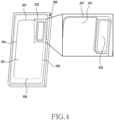
- FIG. 4 is a perspective view illustrating a lower mold according to an embodiment.
- FIG. 5 is a perspective view illustrating a state in which transparent substrates are put into the lower mold according to an embodiment.
- the lower mold may be used in operation 101.
- the lower mold 200 may include a cavity, which is a space in which a transparent substrate is formed.
- the cavity may include a first cavity 201 and a second cavity 202.
- the first cavity 201 and the second cavity 202 may be connected to each other.
- the first cavity 201 may have a first depth 201a.
- the second cavity 202 may have a second depth 202a.
- the second depth 202a may be greater than the first depth 201a.
- the shape of the cavities may have a shape different from the shape illustrated in FIGS. 4 and 5 . For example, referring to the cross section (A-A' section) of FIG.
- the second cavity 202 may further have a third depth 202b.
- the cavity may be defined to correspond to the shape of the transparent member to be formed.
- the first cavity 201 may have a shape corresponding to the shape of the thin film portion of the rear cover of the electronic device.
- the second cavity 202 may have a shape corresponding to a thick portion including a rear camera hole of the electronic device.
- the thick portion may refer to a portion protruding from the exterior of the electronic device compared to the thin film portion.
- the lower mold 200 may include a bottom portion, first and second sidewalls 204 and 205, and third and fourth sidewalls 206 and 207.
- the first sidewall 204 and the second sidewall 205 may face each other.
- the third sidewall 206 and the fourth sidewall 207 may face each other.
- At least one of the first sidewall 204, the second sidewall 205, the third sidewall 206, and the fourth sidewall 207 may have a curved shape.
- the sidewalls may include a curved shape that is seamlessly extended by being bent in a direction from the bottom portion toward the upper mold 400. For this reason, an edge of the transparent member thermoformed by the molds may include a curved portion.
- the cavities according to an embodiment may be spaces defined by at least some of the bottom portion, the first and second sidewalls 204 and 205, and the third and fourth sidewalls 206 and 207. Accordingly, a step may be present between the bottom portion corresponding to the first cavity 201 and the bottom portion corresponding to the second cavity 202.
- the lower mold 200 may include a one-sided core 203. This will be described later with reference to FIG. 6 .
- the transparent substrates in the process of putting the transparent substrates into the lower mold (101), the transparent substrates may be put into the lower mold.
- the first transparent substrate 301 and the second transparent substrate 302 may be separately put into the lower mold.
- the first transparent substrate 301 may be disposed in the first cavity 201.
- the second transparent substrate 302 may be disposed in the second cavity 202.
- the thickness of the first transparent substrate 301 according to an embodiment may be approximately 0.6 T.
- the thickness of the second transparent substrate 302 according to an embodiment may be approximately 2.85 T.
- the disclosure is not limited thereto.
- the first transparent substrate 301 and the second transparent substrate 302 may have the same color.
- the physical properties of the first transparent substrate 301 and the second transparent substrate 302 may be substantially the same.
- the transparent substrates can be translucent and have colors.
- the physical properties of the first transparent substrate 301 and the second transparent substrate 302 may be also different from each other.
- the physical properties thereof may be different from each other.
- the first transparent substrate 301 and the second transparent substrate 302 may be disposed such that a gap 210 is formed therebetween.
- the width of the gap 210 may increase from the inner side toward the outer side (e.g., in the +x-axis direction or the +y-axis direction in FIG. 5 ) with reference to the surface of the completed transparent member.
- the width of the gap 210 may increase toward a sidewall (e.g., the first sidewall 204) of the lower mold 200.
- the first transparent substrate 301 and the second transparent substrate 302 When the first transparent substrate 301 and the second transparent substrate 302 are disposed such that the width of the gap increases from the inner side to the outer side with reference to the plane on which the surface of the completed transparent member is disposed and the transparent substrates are melted, the first transparent substrate 301 and the second transparent substrate 302 may be bonded to each other from a portion having a smaller gap. Accordingly, it is possible to prevent pores, which would be generated due to the melting and boding of the transparent substrates, from being generated in the transparent member. The pores may be generated in at least one of the inside or the outside of the bonded portion in which the first transparent substrate 301 and the second transparent substrate 302 are bonded to each other.
- the region in which the first transparent substrate 301 and the second transparent substrate 302 face each other may be melted from the inner side by heating the transparent substrates from the centers of the cavities in which the transparent substrates are placed, respectively.
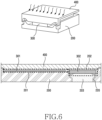
- FIG. 6 illustrates a perspective view and a cross-sectional view illustrating a process of disposing the upper mold and a process of preheating the molds according to an embodiment, which can be used during operation 103 of FIG. 3 .
- the upper mold 400 in the process of disposing the upper mold (103), the upper mold 400 may be disposed on the top surface of the transparent substrate 300.
- the upper mold 400 may include a pressing portion.
- the pressing portion may include at least one pressing surface corresponding to the lower mold 200.
- the pressing surface may have a shape of a protrusion including a curved edge.
- the disclosure is not limited thereto.
- the mold may be heated by an external heating member.
- the molds may be preheated by putting the molds into a thermoforming machine.
- the disclosure is not limited thereto.
- the pressing portion may include a heating mechanism that generates heat. As the pressing portion is heated by the heating mechanism, heat from the pressing portion may be transferred to the transparent substrate 300.
- the transparent substrate 300 may be melted by the heat.
- the transparent substrate 300 may have fluidity for thermoforming.
- the transparent substrate 300 with secured fluidity may flow along the inside of the mold (e.g., the lower mold 200).
- fluidity may be secured such that the first transparent substrate is capable of flowing along the inside of the first cavity 201.
- fluidity may be secured such that the second transparent substrate is capable of flowing along the inside of the second cavity 202.
- the lower mold 200 may include at least one air passage.
- the at least one air passage may be connected to the second cavity 202.
- the disclosure is not limited thereto.
- the lower mold 200 according to an embodiment may further include at least one one-sided core 203 disposed in the air passage.
- the one-sided core 203 may be connected to the second cavity 202.
- the disclosure is not limited thereto.
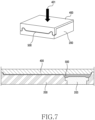
- the transparent substrate 300 in the process of thermoforming the transparent substrates by pressing the transparent substrates with the upper mold (107), the transparent substrate 300 may be pressed with the upper mold 400.
- the lower mold 200 and the upper mold 400 in which the transparent substrate 300 is disposed may be transferred to a press line or a press apparatus may be transferred to the molds to press the transparent substrate 300.
- the transparent substrate 300 may be pressed in a first direction 401.
- the disclosure is not limited thereto.
- the first transparent substrate (301 in FIG. 6 ) and the second transparent substrate (302 in FIG. 6 ) may be melted and bonded to each other.
- the first transparent substrate and the second transparent substrate which are bonded to each other may form one transparent member 500.
- the first transparent substrate 301 and the second transparent substrate 302 may be disposed such that the width of the gap therebetween increases from the inner side to the outer side with reference to the surface of the transparent member.
- the transparent substrates When the transparent substrates are melted, the transparent substrates may be bonded to each other starting from a portion in which the width of the gap is smaller. Accordingly, it is possible to prevent pores, which are generated when air is trapped in the process of melting and bonding the transparent substrates, from being generated in the transparent member.
- the thickness of a region corresponding to the first transparent substrate 301 may be 0.5T.
- the thickness of a region corresponding to the second transparent substrate 302 may be 2T.
- the disclosure is not limited thereto.
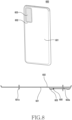
- FIG. 8 illustrates a cross-sectional view and a perspective view illustrating a transparent member according to an embodiment.
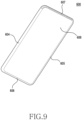
- FIG. 9 is a perspective view illustrating the inner surface of the transparent member according to an embodiment.
- the transparent substrate in the process of reinforcing the transparent substrate, may be reinforced.
- the reinforcing process may be performed at a temperature lower than a strain point of the transparent substrates and above a predetermined temperature.
- the disclosure is not limited thereto.
- a target surface compressive stress and reinforcing depth may be achieved in the transparent member.
- the transparent member 600 may include a first region 601, a second region 603, and a bonded portion 602.
- the first region 601 may have a first thickness 601a.
- the second region 603 may have a second thickness 603a. According to an embodiment, the second thickness 603a may be greater than the first thickness 601a.
- a difference in thickness between the first region 601 and the second region 603 may be within a range of 0.15 mm to 2.5 mm.
- the disclosure is not limited thereto.
- the first region 601 may have a plate shape.
- the second region 603 may have a shape protruding from a plane including the surface of the first region 601.
- the inner surface of the first region 601 and the inner surface of the second region 603 may include a plate shape.
- the disclosure is not limited thereto.
- the inner surface of the second region 603 may be concave (not illustrated) to face the protruding direction.
- a camera module of the electronic device may be inserted into the concave portion.
- the camera module of the electronic device may be protected by being inserted into the protruding portion.
- the concave portion allows the camera module to be inserted thereinto, thereby preventing the camera module from excessively protruding from the rear plate of the electronic device.
- the first region 601 and the second region 603 may be at least partially melted and bonded to each other. It shall be understood that melting and bonding of the first region 601 and the second region 603 result in different structural characteristics from a similarly shaped transparent member 600, formed as one piece.
- the first region 601 may have structural properties similar to the first transparent substrate 301 and the second region 603 may have structural properties that are similar to the second transparent substrate 302.
- the bonded portion 602 may be formed the first transparent substrate 301 and the second transparent substrate 302 are melted and bonded to each other.
- the bonded portion 602 may refer to a portion in which the first transparent substrate 301 and the second transparent substrate 302 are melted and bonded to each other.
- the transparent member 600 may be translucent or include at least one color.
- the first region 601 may include a first color.
- the second region 603 may include a second color.
- the bonded portion 602 may include a mixture of the first color and the second color, or a third color that results from mixing the first color and the second color.
- the transparent member formed through the transparent member forming method (100) may include one or more microbubbles.
- the one or more microbubbles may be formed in the bonded portion 602.
- the microbubbles may be formed during short-time thermoforming.
- the microbubbles may be formed in the entire region of the bonded portion 602. Accordingly, when the width of the gap increases from the inner side to the outer side with reference to the surface of the completed transparent member, it is possible to prevent the microbubbles from being formed in the entire region of the bonded portion.
- the size of the microbubbles may be smaller than 200 um. According to an embodiment, the size of the microbubbles may be 0 to 10 um. Accordingly, the microbubbles may be observed with a microscope. However, the disclosure is not limited thereto.
- the side portions may include a curved surface.
- the first side portion 604 and the second side portion 605 may be bent from the first region (601 in FIG. 8 ) toward the inner surface 608 of the transparent member 600 to extend seamlessly.
- the third side portion 606 and the fourth side portion 607 may be bent from the first region (601 in FIG. 9 ) to extend seamlessly in a direction in which the inner surface 608 of the transparent member 600 is oriented.
- the electronic device may include the transparent member 600.
- the transparent member 600 may be referred to by a transparent member 500 formed through the transparent member forming method (100) of FIGS. 3 to 7 .
- the same reference numerals are used for the same or substantially the same components as those described above, and overlapping descriptions will be omitted.
Landscapes
- Engineering & Computer Science (AREA)
- Chemical & Material Sciences (AREA)
- Materials Engineering (AREA)
- Organic Chemistry (AREA)
- Mechanical Engineering (AREA)
- Microelectronics & Electronic Packaging (AREA)
- Signal Processing (AREA)
- Devices For Indicating Variable Information By Combining Individual Elements (AREA)
Claims (8)
- Verfahren (100) zum Ausbilden eines transparenten Elements (600), umfassend:Einsetzen eines ersten transparenten Substrats (301) und eines zweiten transparenten Substrats (302) in einen ersten Hohlraum (201) einer unteren Form (200), der eine erste Tiefe (201a) aufweist, beziehungsweise einen zweiten Hohlraum (202) einer unteren Form, der mit dem ersten Hohlraum verbunden ist und eine zweite Tiefe (202a) aufweist;Positionieren einer oberen Form (400) auf der unteren Form, wobei die obere Form der unteren Form entspricht und einen Pressabschnitt enthält, der mindestens eine Pressoberfläche aufweist;Vorwärmen mindestens einer von der unteren Form oder der oberen Form auf eine vorbestimmte Temperatur, dadurch Entstehen vorgewärmter transparenter Substrate; undPressen der oberen Form auf die untere Form, dadurch Thermoformen der vorgewärmten transparenten Substrate.
- Verfahren nach Anspruch 1, wobei das Thermoformen der vorgewärmten transparenten Substrate Folgendes umfasst: Schmelzen und Binden des ersten transparenten Substrats und des zweiten transparenten Substrats aneinander in einer Reihenfolge von einer Innenseite zu einer Außenseite eines dazwischenliegenden Kontaktbereichs.
- Verfahren nach Anspruch 1, wobei die untere Form mindestens einen Luftkanal enthält, der mit dem zweiten Hohlraum verbunden ist.
- Verfahren nach Anspruch 3, wobei die untere Form ferner einen einseitigen Kern (203) enthält, der in dem mindestens einen Luftkanal angeordnet ist.
- Verfahren nach Anspruch 1, ferner umfassend:
Polieren mindestens eines Abschnitts einer Oberfläche jedes der thermogeformten transparenten Substrate. - Verfahren nach Anspruch 1, ferner umfassend:
Verstärken der thermogeformten transparenten Substrate. - Verfahren nach Anspruch 1, wobei das Einsetzen des ersten transparenten Substrats und des zweiten transparenten Substrats in die untere Form ferner Einsetzen des ersten transparenten Substrats und des zweiten transparenten Substrats derart, sodass ein Spalt (210) dazwischen ausgebildet wird, umfasst.
- Verfahren nach Anspruch 7, wobei der Spalt eine Breite aufweist, die in Bezug auf eine Oberfläche des transparenten Elements von einer Innenseite zu einer Außenseite zunimmt.
Applications Claiming Priority (2)
| Application Number | Priority Date | Filing Date | Title |
|---|---|---|---|
| KR1020210076829A KR20220167619A (ko) | 2021-06-14 | 2021-06-14 | 투명 부재, 이를 포함하는 전자 장치 및 투명 부재의 열성형 방법 |
| PCT/KR2022/008383 WO2022265344A1 (ko) | 2021-06-14 | 2022-06-14 | 투명 부재, 이를 포함하는 전자 장치 및 투명 부재의 열성형 방법 |
Publications (3)
| Publication Number | Publication Date |
|---|---|
| EP4286345A1 EP4286345A1 (de) | 2023-12-06 |
| EP4286345A4 EP4286345A4 (de) | 2024-07-31 |
| EP4286345B1 true EP4286345B1 (de) | 2025-04-16 |
Family
ID=84525808
Family Applications (1)
| Application Number | Title | Priority Date | Filing Date |
|---|---|---|---|
| EP22825269.8A Active EP4286345B1 (de) | 2021-06-14 | 2022-06-14 | Verfahren zum thermoformen eines transparenten elements |
Country Status (4)
| Country | Link |
|---|---|
| US (1) | US12439539B2 (de) |
| EP (1) | EP4286345B1 (de) |
| KR (1) | KR20220167619A (de) |
| WO (1) | WO2022265344A1 (de) |
Families Citing this family (2)
| Publication number | Priority date | Publication date | Assignee | Title |
|---|---|---|---|---|
| CN116395943B (zh) * | 2023-03-28 | 2025-04-04 | 维达力科技股份有限公司 | 成型模具、玻璃盖板的成型方法及玻璃盖板 |
| KR102933743B1 (ko) | 2025-07-18 | 2026-03-04 | 주식회사 에이이엠모빌리티 | 곡면 엣지를 갖는 디스플레이 커버글라스 제조방법 |
Family Cites Families (20)
| Publication number | Priority date | Publication date | Assignee | Title |
|---|---|---|---|---|
| US3149948A (en) * | 1957-10-07 | 1964-09-22 | Pittsburgh Plate Glass Co | Method for forming multifocal lens blanks |
| JPH08277136A (ja) | 1995-04-05 | 1996-10-22 | Olympus Optical Co Ltd | ガラスセルの製造方法 |
| KR101248111B1 (ko) * | 2010-02-05 | 2013-03-28 | (주)에스알지텍 | 전자제품 윈도우 패널용 입체 강화 유리 제조장치 및 제조방법 |
| CN102557402B (zh) * | 2010-12-11 | 2014-07-09 | 富泰华工业(深圳)有限公司 | 曲面玻璃板的成型方法与其采用的模具 |
| WO2013081119A1 (ja) | 2011-11-30 | 2013-06-06 | Hoya株式会社 | 電子機器用カバーガラスブランク及びその製造方法、並びに電子機器用カバーガラス及びその製造方法 |
| JP2014091655A (ja) | 2012-11-05 | 2014-05-19 | Konica Minolta Inc | ガラス成形品の製造方法および製造装置 |
| JP2014094849A (ja) | 2012-11-08 | 2014-05-22 | Konica Minolta Inc | ガラス成形品の製造方法および製造装置 |
| KR20140111403A (ko) | 2013-03-11 | 2014-09-19 | 엘지전자 주식회사 | 성형유리 제조 장치 및 제조 방법 |
| JP6394110B2 (ja) * | 2013-07-08 | 2018-09-26 | 日本電気硝子株式会社 | 強化ガラスの製造方法 |
| KR101697158B1 (ko) * | 2014-12-19 | 2017-01-17 | 삼성전자주식회사 | 글래스 곡면 성형장치 및 이를 이용한 글래스 곡면 성형방법 |
| KR101598337B1 (ko) | 2015-08-13 | 2016-03-02 | 디케이 유아이엘 주식회사 | 휴대 단말기 및 휴대 단말기용 백 커버 제조장치 |
| KR101621216B1 (ko) | 2015-09-15 | 2016-05-16 | (주)대호테크 | 곡면 글라스 성형기 |
| KR20170131128A (ko) | 2016-05-20 | 2017-11-29 | 임홍주 | 3d 유리 성형장치 및 방법 |
| TWM567177U (zh) | 2016-10-31 | 2018-09-21 | 正達國際光電股份有限公司 | 成型模具 |
| CN106746526B (zh) * | 2016-12-09 | 2022-09-30 | 东莞华清光学科技有限公司 | 一种玻璃加热石墨模具及其制作方法 |
| KR102656442B1 (ko) * | 2017-01-19 | 2024-04-12 | 삼성전자주식회사 | 곡면 글라스 성형장치 |
| JP7102984B2 (ja) | 2017-08-31 | 2022-07-20 | Agc株式会社 | 3dカバーガラスの製造方法 |
| KR20190072017A (ko) | 2017-12-15 | 2019-06-25 | 경상대학교산학협력단 | 유도 가열을 이용한 유리 성형 장치 |
| CN111757858A (zh) | 2018-02-27 | 2020-10-09 | Agc株式会社 | 三维形状的晶化玻璃、三维形状的化学强化玻璃以及它们的制造方法 |
| KR20200064694A (ko) | 2018-11-29 | 2020-06-08 | 공석태 | 액체를 이용한 유리 패널 열성형 제조방법 |
-
2021
- 2021-06-14 KR KR1020210076829A patent/KR20220167619A/ko active Pending
-
2022
- 2022-06-14 WO PCT/KR2022/008383 patent/WO2022265344A1/ko not_active Ceased
- 2022-06-14 EP EP22825269.8A patent/EP4286345B1/de active Active
- 2022-11-25 US US17/994,135 patent/US12439539B2/en active Active
Also Published As
| Publication number | Publication date |
|---|---|
| US20230088012A1 (en) | 2023-03-23 |
| KR20220167619A (ko) | 2022-12-21 |
| EP4286345A4 (de) | 2024-07-31 |
| WO2022265344A1 (ko) | 2022-12-22 |
| US12439539B2 (en) | 2025-10-07 |
| EP4286345A1 (de) | 2023-12-06 |
Similar Documents
| Publication | Publication Date | Title |
|---|---|---|
| US11516930B2 (en) | Method for manufacturing exterior housing and electronic device comprising same | |
| CN112512789B (zh) | 盖玻璃及包括该盖玻璃的电子装置 | |
| EP3880471B1 (de) | Zierfolie und elektronische vorrichtung damit | |
| US11292651B2 (en) | Protective film attachable to electronic device, and protective film package including same | |
| US12439539B2 (en) | Transparent member, electronic device including same, and thermoforming method of transparent member | |
| US20210074690A1 (en) | Glass member and electronic device including the same | |
| KR20200112228A (ko) | 후면 플레이트를 포함하는 전자 장치 및 이의 제조하는 방법 | |
| KR20220002197A (ko) | 외관 하우징, 이의 제작 방법 및 이를 구비한 전자 장치 | |
| US20180361630A1 (en) | Housing including patterned-structure layer and method thereof | |
| US12171080B2 (en) | Cover of electronic device, and method for manufacturing same | |
| US11877405B2 (en) | Electronic device including display | |
| KR102512848B1 (ko) | 글라스 성형 장치 및 그 제조 방법 | |
| KR102658205B1 (ko) | 필름이 접합된 커버를 포함하는 전자 장치, 및 상기 커버의 제조 방법 | |
| US11974405B2 (en) | Electronic device housing and electronic device including the same | |
| KR20220016731A (ko) | 백 커버를 포함하는 전자 장치 | |
| KR20210080690A (ko) | 접착부를 포함하는 전자 장치 | |
| KR20200143316A (ko) | 외관 하우징, 이의 제작 방법 및 이를 구비한 전자 장치 | |
| KR20220117066A (ko) | 글라스 성형 장치 |
Legal Events
| Date | Code | Title | Description |
|---|---|---|---|
| STAA | Information on the status of an ep patent application or granted ep patent |
Free format text: STATUS: THE INTERNATIONAL PUBLICATION HAS BEEN MADE |
|
| PUAI | Public reference made under article 153(3) epc to a published international application that has entered the european phase |
Free format text: ORIGINAL CODE: 0009012 |
|
| STAA | Information on the status of an ep patent application or granted ep patent |
Free format text: STATUS: REQUEST FOR EXAMINATION WAS MADE |
|
| 17P | Request for examination filed |
Effective date: 20230830 |
|
| AK | Designated contracting states |
Kind code of ref document: A1 Designated state(s): AL AT BE BG CH CY CZ DE DK EE ES FI FR GB GR HR HU IE IS IT LI LT LU LV MC MK MT NL NO PL PT RO RS SE SI SK SM TR |
|
| A4 | Supplementary search report drawn up and despatched |
Effective date: 20240702 |
|
| RIC1 | Information provided on ipc code assigned before grant |
Ipc: H04M 1/02 20060101ALI20240626BHEP Ipc: B29C 43/32 20060101ALI20240626BHEP Ipc: B29C 43/02 20060101ALI20240626BHEP Ipc: C03B 23/03 20060101AFI20240626BHEP |
|
| DAV | Request for validation of the european patent (deleted) | ||
| DAX | Request for extension of the european patent (deleted) | ||
| GRAP | Despatch of communication of intention to grant a patent |
Free format text: ORIGINAL CODE: EPIDOSNIGR1 |
|
| STAA | Information on the status of an ep patent application or granted ep patent |
Free format text: STATUS: GRANT OF PATENT IS INTENDED |
|
| RIC1 | Information provided on ipc code assigned before grant |
Ipc: H04M 1/02 20060101ALI20250116BHEP Ipc: B29C 43/32 20060101ALI20250116BHEP Ipc: B29C 43/02 20060101ALI20250116BHEP Ipc: C03B 23/03 20060101AFI20250116BHEP |
|
| INTG | Intention to grant announced |
Effective date: 20250131 |
|
| GRAS | Grant fee paid |
Free format text: ORIGINAL CODE: EPIDOSNIGR3 |
|
| GRAA | (expected) grant |
Free format text: ORIGINAL CODE: 0009210 |
|
| STAA | Information on the status of an ep patent application or granted ep patent |
Free format text: STATUS: THE PATENT HAS BEEN GRANTED |
|
| AK | Designated contracting states |
Kind code of ref document: B1 Designated state(s): AL AT BE BG CH CY CZ DE DK EE ES FI FR GB GR HR HU IE IS IT LI LT LU LV MC MK MT NL NO PL PT RO RS SE SI SK SM TR |
|
| REG | Reference to a national code |
Ref country code: GB Ref legal event code: FG4D |
|
| REG | Reference to a national code |
Ref country code: CH Ref legal event code: EP |
|
| REG | Reference to a national code |
Ref country code: IE Ref legal event code: FG4D |
|
| REG | Reference to a national code |
Ref country code: DE Ref legal event code: R096 Ref document number: 602022013334 Country of ref document: DE |
|
| PGFP | Annual fee paid to national office [announced via postgrant information from national office to epo] |
Ref country code: DE Payment date: 20250520 Year of fee payment: 4 |
|
| PGFP | Annual fee paid to national office [announced via postgrant information from national office to epo] |
Ref country code: AT Payment date: 20250721 Year of fee payment: 4 |
|
| REG | Reference to a national code |
Ref country code: NL Ref legal event code: MP Effective date: 20250416 |
|
| PG25 | Lapsed in a contracting state [announced via postgrant information from national office to epo] |
Ref country code: NL Free format text: LAPSE BECAUSE OF FAILURE TO SUBMIT A TRANSLATION OF THE DESCRIPTION OR TO PAY THE FEE WITHIN THE PRESCRIBED TIME-LIMIT Effective date: 20250416 |
|
| REG | Reference to a national code |
Ref country code: AT Ref legal event code: MK05 Ref document number: 1785581 Country of ref document: AT Kind code of ref document: T Effective date: 20250416 |
|
| PG25 | Lapsed in a contracting state [announced via postgrant information from national office to epo] |
Ref country code: ES Free format text: LAPSE BECAUSE OF FAILURE TO SUBMIT A TRANSLATION OF THE DESCRIPTION OR TO PAY THE FEE WITHIN THE PRESCRIBED TIME-LIMIT Effective date: 20250416 Ref country code: FI Free format text: LAPSE BECAUSE OF FAILURE TO SUBMIT A TRANSLATION OF THE DESCRIPTION OR TO PAY THE FEE WITHIN THE PRESCRIBED TIME-LIMIT Effective date: 20250416 Ref country code: PT Free format text: LAPSE BECAUSE OF FAILURE TO SUBMIT A TRANSLATION OF THE DESCRIPTION OR TO PAY THE FEE WITHIN THE PRESCRIBED TIME-LIMIT Effective date: 20250818 |
|
| REG | Reference to a national code |
Ref country code: LT Ref legal event code: MG9D |
|
| PG25 | Lapsed in a contracting state [announced via postgrant information from national office to epo] |
Ref country code: NO Free format text: LAPSE BECAUSE OF FAILURE TO SUBMIT A TRANSLATION OF THE DESCRIPTION OR TO PAY THE FEE WITHIN THE PRESCRIBED TIME-LIMIT Effective date: 20250716 Ref country code: GR Free format text: LAPSE BECAUSE OF FAILURE TO SUBMIT A TRANSLATION OF THE DESCRIPTION OR TO PAY THE FEE WITHIN THE PRESCRIBED TIME-LIMIT Effective date: 20250717 |
|
| PG25 | Lapsed in a contracting state [announced via postgrant information from national office to epo] |
Ref country code: PL Free format text: LAPSE BECAUSE OF FAILURE TO SUBMIT A TRANSLATION OF THE DESCRIPTION OR TO PAY THE FEE WITHIN THE PRESCRIBED TIME-LIMIT Effective date: 20250416 |
|
| PG25 | Lapsed in a contracting state [announced via postgrant information from national office to epo] |
Ref country code: BG Free format text: LAPSE BECAUSE OF FAILURE TO SUBMIT A TRANSLATION OF THE DESCRIPTION OR TO PAY THE FEE WITHIN THE PRESCRIBED TIME-LIMIT Effective date: 20250416 |
|
| PG25 | Lapsed in a contracting state [announced via postgrant information from national office to epo] |
Ref country code: HR Free format text: LAPSE BECAUSE OF FAILURE TO SUBMIT A TRANSLATION OF THE DESCRIPTION OR TO PAY THE FEE WITHIN THE PRESCRIBED TIME-LIMIT Effective date: 20250416 Ref country code: AT Free format text: LAPSE BECAUSE OF FAILURE TO SUBMIT A TRANSLATION OF THE DESCRIPTION OR TO PAY THE FEE WITHIN THE PRESCRIBED TIME-LIMIT Effective date: 20250416 |
|
| PG25 | Lapsed in a contracting state [announced via postgrant information from national office to epo] |
Ref country code: RS Free format text: LAPSE BECAUSE OF FAILURE TO SUBMIT A TRANSLATION OF THE DESCRIPTION OR TO PAY THE FEE WITHIN THE PRESCRIBED TIME-LIMIT Effective date: 20250716 |
|
| PG25 | Lapsed in a contracting state [announced via postgrant information from national office to epo] |
Ref country code: IS Free format text: LAPSE BECAUSE OF FAILURE TO SUBMIT A TRANSLATION OF THE DESCRIPTION OR TO PAY THE FEE WITHIN THE PRESCRIBED TIME-LIMIT Effective date: 20250816 |
|
| PG25 | Lapsed in a contracting state [announced via postgrant information from national office to epo] |
Ref country code: LV Free format text: LAPSE BECAUSE OF FAILURE TO SUBMIT A TRANSLATION OF THE DESCRIPTION OR TO PAY THE FEE WITHIN THE PRESCRIBED TIME-LIMIT Effective date: 20250416 |
|
| PG25 | Lapsed in a contracting state [announced via postgrant information from national office to epo] |
Ref country code: SM Free format text: LAPSE BECAUSE OF FAILURE TO SUBMIT A TRANSLATION OF THE DESCRIPTION OR TO PAY THE FEE WITHIN THE PRESCRIBED TIME-LIMIT Effective date: 20250416 Ref country code: DK Free format text: LAPSE BECAUSE OF FAILURE TO SUBMIT A TRANSLATION OF THE DESCRIPTION OR TO PAY THE FEE WITHIN THE PRESCRIBED TIME-LIMIT Effective date: 20250416 |
|
| REG | Reference to a national code |
Ref country code: DE Ref legal event code: R097 Ref document number: 602022013334 Country of ref document: DE |
|
| PG25 | Lapsed in a contracting state [announced via postgrant information from national office to epo] |
Ref country code: CZ Free format text: LAPSE BECAUSE OF FAILURE TO SUBMIT A TRANSLATION OF THE DESCRIPTION OR TO PAY THE FEE WITHIN THE PRESCRIBED TIME-LIMIT Effective date: 20250416 |
|
| PG25 | Lapsed in a contracting state [announced via postgrant information from national office to epo] |
Ref country code: EE Free format text: LAPSE BECAUSE OF FAILURE TO SUBMIT A TRANSLATION OF THE DESCRIPTION OR TO PAY THE FEE WITHIN THE PRESCRIBED TIME-LIMIT Effective date: 20250416 |
|
| PG25 | Lapsed in a contracting state [announced via postgrant information from national office to epo] |
Ref country code: SK Free format text: LAPSE BECAUSE OF FAILURE TO SUBMIT A TRANSLATION OF THE DESCRIPTION OR TO PAY THE FEE WITHIN THE PRESCRIBED TIME-LIMIT Effective date: 20250416 |
|
| REG | Reference to a national code |
Ref country code: CH Ref legal event code: H13 Free format text: ST27 STATUS EVENT CODE: U-0-0-H10-H13 (AS PROVIDED BY THE NATIONAL OFFICE) Effective date: 20260127 |
|
| PG25 | Lapsed in a contracting state [announced via postgrant information from national office to epo] |
Ref country code: IT Free format text: LAPSE BECAUSE OF FAILURE TO SUBMIT A TRANSLATION OF THE DESCRIPTION OR TO PAY THE FEE WITHIN THE PRESCRIBED TIME-LIMIT Effective date: 20250416 |
|
| PG25 | Lapsed in a contracting state [announced via postgrant information from national office to epo] |
Ref country code: MC Free format text: LAPSE BECAUSE OF FAILURE TO SUBMIT A TRANSLATION OF THE DESCRIPTION OR TO PAY THE FEE WITHIN THE PRESCRIBED TIME-LIMIT Effective date: 20250416 |
|
| PG25 | Lapsed in a contracting state [announced via postgrant information from national office to epo] |
Ref country code: LU Free format text: LAPSE BECAUSE OF NON-PAYMENT OF DUE FEES Effective date: 20250614 |
|
| PLBE | No opposition filed within time limit |
Free format text: ORIGINAL CODE: 0009261 |
|
| STAA | Information on the status of an ep patent application or granted ep patent |
Free format text: STATUS: NO OPPOSITION FILED WITHIN TIME LIMIT |
|
| REG | Reference to a national code |
Ref country code: CH Ref legal event code: L10 Free format text: ST27 STATUS EVENT CODE: U-0-0-L10-L00 (AS PROVIDED BY THE NATIONAL OFFICE) Effective date: 20260225 |
|
| REG | Reference to a national code |
Ref country code: BE Ref legal event code: MM Effective date: 20250630 |
|
| PG25 | Lapsed in a contracting state [announced via postgrant information from national office to epo] |
Ref country code: RO Free format text: LAPSE BECAUSE OF FAILURE TO SUBMIT A TRANSLATION OF THE DESCRIPTION OR TO PAY THE FEE WITHIN THE PRESCRIBED TIME-LIMIT Effective date: 20250416 |
|
| 26N | No opposition filed |
Effective date: 20260119 |