EP4286154A1 - Oberflächenmodifizierungsfolie, laminat, oberflächenmodifizierungselement, lackiertes objekt, verfahren zur herstellung eines oberflächenmodifizierungselements und verfahren zur herstellung eines lackierten objekts - Google Patents
Oberflächenmodifizierungsfolie, laminat, oberflächenmodifizierungselement, lackiertes objekt, verfahren zur herstellung eines oberflächenmodifizierungselements und verfahren zur herstellung eines lackierten objekts Download PDFInfo
- Publication number
- EP4286154A1 EP4286154A1 EP22745768.6A EP22745768A EP4286154A1 EP 4286154 A1 EP4286154 A1 EP 4286154A1 EP 22745768 A EP22745768 A EP 22745768A EP 4286154 A1 EP4286154 A1 EP 4286154A1
- Authority
- EP
- European Patent Office
- Prior art keywords
- modifying
- modifying layer
- resin
- resin member
- layer
- Prior art date
- Legal status (The legal status is an assumption and is not a legal conclusion. Google has not performed a legal analysis and makes no representation as to the accuracy of the status listed.)
- Pending
Links
Images
Classifications
-
- C—CHEMISTRY; METALLURGY
- C08—ORGANIC MACROMOLECULAR COMPOUNDS; THEIR PREPARATION OR CHEMICAL WORKING-UP; COMPOSITIONS BASED THEREON
- C08J—WORKING-UP; GENERAL PROCESSES OF COMPOUNDING; AFTER-TREATMENT NOT COVERED BY SUBCLASSES C08B, C08C, C08F, C08G or C08H
- C08J5/00—Manufacture of articles or shaped materials containing macromolecular substances
- C08J5/18—Manufacture of films or sheets
-
- B—PERFORMING OPERATIONS; TRANSPORTING
- B29—WORKING OF PLASTICS; WORKING OF SUBSTANCES IN A PLASTIC STATE IN GENERAL
- B29C—SHAPING OR JOINING OF PLASTICS; SHAPING OF MATERIAL IN A PLASTIC STATE, NOT OTHERWISE PROVIDED FOR; AFTER-TREATMENT OF THE SHAPED PRODUCTS, e.g. REPAIRING
- B29C63/00—Lining or sheathing, i.e. applying preformed layers or sheathings of plastics; Apparatus therefor
- B29C63/02—Lining or sheathing, i.e. applying preformed layers or sheathings of plastics; Apparatus therefor using sheet or web-like material
-
- B—PERFORMING OPERATIONS; TRANSPORTING
- B29—WORKING OF PLASTICS; WORKING OF SUBSTANCES IN A PLASTIC STATE IN GENERAL
- B29C—SHAPING OR JOINING OF PLASTICS; SHAPING OF MATERIAL IN A PLASTIC STATE, NOT OTHERWISE PROVIDED FOR; AFTER-TREATMENT OF THE SHAPED PRODUCTS, e.g. REPAIRING
- B29C70/00—Shaping composites, i.e. plastics material comprising reinforcements, fillers or preformed parts, e.g. inserts
- B29C70/04—Shaping composites, i.e. plastics material comprising reinforcements, fillers or preformed parts, e.g. inserts comprising reinforcements only, e.g. self-reinforcing plastics
- B29C70/28—Shaping operations therefor
- B29C70/30—Shaping by lay-up, i.e. applying fibres, tape or broadsheet on a mould, former or core; Shaping by spray-up, i.e. spraying of fibres on a mould, former or core
- B29C70/34—Shaping by lay-up, i.e. applying fibres, tape or broadsheet on a mould, former or core; Shaping by spray-up, i.e. spraying of fibres on a mould, former or core and shaping or impregnating by compression, i.e. combined with compressing after the lay-up operation
-
- B—PERFORMING OPERATIONS; TRANSPORTING
- B32—LAYERED PRODUCTS
- B32B—LAYERED PRODUCTS, i.e. PRODUCTS BUILT-UP OF STRATA OF FLAT OR NON-FLAT, e.g. CELLULAR OR HONEYCOMB, FORM
- B32B27/00—Layered products comprising a layer of synthetic resin
- B32B27/06—Layered products comprising a layer of synthetic resin as the main or only constituent of a layer, which is next to another layer of the same or of a different material
- B32B27/08—Layered products comprising a layer of synthetic resin as the main or only constituent of a layer, which is next to another layer of the same or of a different material of synthetic resin
-
- B—PERFORMING OPERATIONS; TRANSPORTING
- B32—LAYERED PRODUCTS
- B32B—LAYERED PRODUCTS, i.e. PRODUCTS BUILT-UP OF STRATA OF FLAT OR NON-FLAT, e.g. CELLULAR OR HONEYCOMB, FORM
- B32B27/00—Layered products comprising a layer of synthetic resin
- B32B27/18—Layered products comprising a layer of synthetic resin characterised by the use of special additives
- B32B27/20—Layered products comprising a layer of synthetic resin characterised by the use of special additives using fillers, pigments, thixotroping agents
-
- B—PERFORMING OPERATIONS; TRANSPORTING
- B32—LAYERED PRODUCTS
- B32B—LAYERED PRODUCTS, i.e. PRODUCTS BUILT-UP OF STRATA OF FLAT OR NON-FLAT, e.g. CELLULAR OR HONEYCOMB, FORM
- B32B27/00—Layered products comprising a layer of synthetic resin
- B32B27/38—Layered products comprising a layer of synthetic resin comprising epoxy resins
-
- B—PERFORMING OPERATIONS; TRANSPORTING
- B32—LAYERED PRODUCTS
- B32B—LAYERED PRODUCTS, i.e. PRODUCTS BUILT-UP OF STRATA OF FLAT OR NON-FLAT, e.g. CELLULAR OR HONEYCOMB, FORM
- B32B37/00—Methods or apparatus for laminating, e.g. by curing or by ultrasonic bonding
- B32B37/06—Methods or apparatus for laminating, e.g. by curing or by ultrasonic bonding characterised by the heating method
-
- B—PERFORMING OPERATIONS; TRANSPORTING
- B32—LAYERED PRODUCTS
- B32B—LAYERED PRODUCTS, i.e. PRODUCTS BUILT-UP OF STRATA OF FLAT OR NON-FLAT, e.g. CELLULAR OR HONEYCOMB, FORM
- B32B37/00—Methods or apparatus for laminating, e.g. by curing or by ultrasonic bonding
- B32B37/10—Methods or apparatus for laminating, e.g. by curing or by ultrasonic bonding characterised by the pressing technique, e.g. using action of vacuum or fluid pressure
-
- B—PERFORMING OPERATIONS; TRANSPORTING
- B32—LAYERED PRODUCTS
- B32B—LAYERED PRODUCTS, i.e. PRODUCTS BUILT-UP OF STRATA OF FLAT OR NON-FLAT, e.g. CELLULAR OR HONEYCOMB, FORM
- B32B7/00—Layered products characterised by the relation between layers; Layered products characterised by the relative orientation of features between layers, or by the relative values of a measurable parameter between layers, i.e. products comprising layers having different physical, chemical or physicochemical properties; Layered products characterised by the interconnection of layers
- B32B7/02—Physical, chemical or physicochemical properties
- B32B7/022—Mechanical properties
-
- C—CHEMISTRY; METALLURGY
- C08—ORGANIC MACROMOLECULAR COMPOUNDS; THEIR PREPARATION OR CHEMICAL WORKING-UP; COMPOSITIONS BASED THEREON
- C08J—WORKING-UP; GENERAL PROCESSES OF COMPOUNDING; AFTER-TREATMENT NOT COVERED BY SUBCLASSES C08B, C08C, C08F, C08G or C08H
- C08J7/00—Chemical treatment or coating of shaped articles made of macromolecular substances
- C08J7/04—Coating
- C08J7/0427—Coating with only one layer of a composition containing a polymer binder
-
- C—CHEMISTRY; METALLURGY
- C08—ORGANIC MACROMOLECULAR COMPOUNDS; THEIR PREPARATION OR CHEMICAL WORKING-UP; COMPOSITIONS BASED THEREON
- C08J—WORKING-UP; GENERAL PROCESSES OF COMPOUNDING; AFTER-TREATMENT NOT COVERED BY SUBCLASSES C08B, C08C, C08F, C08G or C08H
- C08J7/00—Chemical treatment or coating of shaped articles made of macromolecular substances
- C08J7/08—Heat treatment
-
- C—CHEMISTRY; METALLURGY
- C09—DYES; PAINTS; POLISHES; NATURAL RESINS; ADHESIVES; COMPOSITIONS NOT OTHERWISE PROVIDED FOR; APPLICATIONS OF MATERIALS NOT OTHERWISE PROVIDED FOR
- C09J—ADHESIVES; NON-MECHANICAL ASPECTS OF ADHESIVE PROCESSES IN GENERAL; ADHESIVE PROCESSES NOT PROVIDED FOR ELSEWHERE; USE OF MATERIALS AS ADHESIVES
- C09J177/00—Adhesives based on polyamides obtained by reactions forming a carboxylic amide link in the main chain; Adhesives based on derivatives of such polymers
- C09J177/06—Polyamides derived from polyamines and polycarboxylic acids
-
- C—CHEMISTRY; METALLURGY
- C09—DYES; PAINTS; POLISHES; NATURAL RESINS; ADHESIVES; COMPOSITIONS NOT OTHERWISE PROVIDED FOR; APPLICATIONS OF MATERIALS NOT OTHERWISE PROVIDED FOR
- C09J—ADHESIVES; NON-MECHANICAL ASPECTS OF ADHESIVE PROCESSES IN GENERAL; ADHESIVE PROCESSES NOT PROVIDED FOR ELSEWHERE; USE OF MATERIALS AS ADHESIVES
- C09J7/00—Adhesives in the form of films or foils
- C09J7/40—Adhesives in the form of films or foils characterised by release liners
- C09J7/403—Adhesives in the form of films or foils characterised by release liners characterised by the structure of the release feature
-
- B—PERFORMING OPERATIONS; TRANSPORTING
- B29—WORKING OF PLASTICS; WORKING OF SUBSTANCES IN A PLASTIC STATE IN GENERAL
- B29C—SHAPING OR JOINING OF PLASTICS; SHAPING OF MATERIAL IN A PLASTIC STATE, NOT OTHERWISE PROVIDED FOR; AFTER-TREATMENT OF THE SHAPED PRODUCTS, e.g. REPAIRING
- B29C63/00—Lining or sheathing, i.e. applying preformed layers or sheathings of plastics; Apparatus therefor
- B29C63/0017—Lining or sheathing, i.e. applying preformed layers or sheathings of plastics; Apparatus therefor characterised by the choice of the material
-
- B—PERFORMING OPERATIONS; TRANSPORTING
- B32—LAYERED PRODUCTS
- B32B—LAYERED PRODUCTS, i.e. PRODUCTS BUILT-UP OF STRATA OF FLAT OR NON-FLAT, e.g. CELLULAR OR HONEYCOMB, FORM
- B32B2255/00—Coating on the layer surface
- B32B2255/10—Coating on the layer surface on synthetic resin layer or on natural or synthetic rubber layer
-
- B—PERFORMING OPERATIONS; TRANSPORTING
- B32—LAYERED PRODUCTS
- B32B—LAYERED PRODUCTS, i.e. PRODUCTS BUILT-UP OF STRATA OF FLAT OR NON-FLAT, e.g. CELLULAR OR HONEYCOMB, FORM
- B32B2255/00—Coating on the layer surface
- B32B2255/26—Polymeric coating
-
- B—PERFORMING OPERATIONS; TRANSPORTING
- B32—LAYERED PRODUCTS
- B32B—LAYERED PRODUCTS, i.e. PRODUCTS BUILT-UP OF STRATA OF FLAT OR NON-FLAT, e.g. CELLULAR OR HONEYCOMB, FORM
- B32B2262/00—Composition or structural features of fibres which form a fibrous or filamentary layer or are present as additives
-
- B—PERFORMING OPERATIONS; TRANSPORTING
- B32—LAYERED PRODUCTS
- B32B—LAYERED PRODUCTS, i.e. PRODUCTS BUILT-UP OF STRATA OF FLAT OR NON-FLAT, e.g. CELLULAR OR HONEYCOMB, FORM
- B32B2305/00—Condition, form or state of the layers or laminate
- B32B2305/07—Parts immersed or impregnated in a matrix
- B32B2305/076—Prepregs
-
- B—PERFORMING OPERATIONS; TRANSPORTING
- B32—LAYERED PRODUCTS
- B32B—LAYERED PRODUCTS, i.e. PRODUCTS BUILT-UP OF STRATA OF FLAT OR NON-FLAT, e.g. CELLULAR OR HONEYCOMB, FORM
- B32B2307/00—Properties of the layers or laminate
- B32B2307/70—Other properties
- B32B2307/732—Dimensional properties
- B32B2307/737—Dimensions, e.g. volume or area
- B32B2307/7375—Linear, e.g. length, distance or width
- B32B2307/7376—Thickness
-
- C—CHEMISTRY; METALLURGY
- C08—ORGANIC MACROMOLECULAR COMPOUNDS; THEIR PREPARATION OR CHEMICAL WORKING-UP; COMPOSITIONS BASED THEREON
- C08J—WORKING-UP; GENERAL PROCESSES OF COMPOUNDING; AFTER-TREATMENT NOT COVERED BY SUBCLASSES C08B, C08C, C08F, C08G or C08H
- C08J2363/00—Characterised by the use of epoxy resins; Derivatives of epoxy resins
-
- C—CHEMISTRY; METALLURGY
- C08—ORGANIC MACROMOLECULAR COMPOUNDS; THEIR PREPARATION OR CHEMICAL WORKING-UP; COMPOSITIONS BASED THEREON
- C08J—WORKING-UP; GENERAL PROCESSES OF COMPOUNDING; AFTER-TREATMENT NOT COVERED BY SUBCLASSES C08B, C08C, C08F, C08G or C08H
- C08J2377/00—Characterised by the use of polyamides obtained by reactions forming a carboxylic amide link in the main chain; Derivatives of such polymers
-
- C—CHEMISTRY; METALLURGY
- C08—ORGANIC MACROMOLECULAR COMPOUNDS; THEIR PREPARATION OR CHEMICAL WORKING-UP; COMPOSITIONS BASED THEREON
- C08J—WORKING-UP; GENERAL PROCESSES OF COMPOUNDING; AFTER-TREATMENT NOT COVERED BY SUBCLASSES C08B, C08C, C08F, C08G or C08H
- C08J2427/00—Characterised by the use of homopolymers or copolymers of compounds having one or more unsaturated aliphatic radicals, each having only one carbon-to-carbon double bond, and at least one being terminated by a halogen; Derivatives of such polymers
- C08J2427/02—Characterised by the use of homopolymers or copolymers of compounds having one or more unsaturated aliphatic radicals, each having only one carbon-to-carbon double bond, and at least one being terminated by a halogen; Derivatives of such polymers not modified by chemical after-treatment
- C08J2427/12—Characterised by the use of homopolymers or copolymers of compounds having one or more unsaturated aliphatic radicals, each having only one carbon-to-carbon double bond, and at least one being terminated by a halogen; Derivatives of such polymers not modified by chemical after-treatment containing fluorine atoms
- C08J2427/14—Homopolymers or copolymers of vinyl fluoride
-
- C—CHEMISTRY; METALLURGY
- C08—ORGANIC MACROMOLECULAR COMPOUNDS; THEIR PREPARATION OR CHEMICAL WORKING-UP; COMPOSITIONS BASED THEREON
- C08J—WORKING-UP; GENERAL PROCESSES OF COMPOUNDING; AFTER-TREATMENT NOT COVERED BY SUBCLASSES C08B, C08C, C08F, C08G or C08H
- C08J2433/00—Characterised by the use of homopolymers or copolymers of compounds having one or more unsaturated aliphatic radicals, each having only one carbon-to-carbon double bond, and only one being terminated by only one carboxyl radical, or of salts, anhydrides, esters, amides, imides, or nitriles thereof; Derivatives of such polymers
- C08J2433/04—Characterised by the use of homopolymers or copolymers of compounds having one or more unsaturated aliphatic radicals, each having only one carbon-to-carbon double bond, and only one being terminated by only one carboxyl radical, or of salts, anhydrides, esters, amides, imides, or nitriles thereof; Derivatives of such polymers esters
- C08J2433/06—Characterised by the use of homopolymers or copolymers of compounds having one or more unsaturated aliphatic radicals, each having only one carbon-to-carbon double bond, and only one being terminated by only one carboxyl radical, or of salts, anhydrides, esters, amides, imides, or nitriles thereof; Derivatives of such polymers esters of esters containing only carbon, hydrogen, and oxygen, the oxygen atom being present only as part of the carboxyl radical
- C08J2433/10—Homopolymers or copolymers of methacrylic acid esters
Definitions
- the present invention relates to a surface-modifying sheet, a laminate, a surface-modified member, a coated article, a method for producing the surface-modified member, and a method for producing the coated article.
- resins which are lightweight and have excellent impact resistance are used in members of transporting machines such as railroad cars, aircrafts, ships, and motor vehicles, electronic appliances, housing equipment, etc., and surfaces thereof have adherends of various materials bonded thereto.
- Such resin members have coating films having various functions.
- adhesives for such use are curable resin compositions based on a rubber epoxy.
- resin members have a poor affinity for adhesives and sufficient bonding strength is not obtained with conventional adhesives or adhesive sheets. Furthermore, resin members having excellent strength, such as carbon-fiber composite materials (CFRPs), are required to have a high level of bonding strength.
- CFRPs carbon-fiber composite materials
- one means for imparting sufficient bonding strength to a resin member by performing an adhesion-facilitating treatment is a technique in which a surface-modifying sheet is used.
- Patent Document 1 describes a surface-modifying sheet capable of imparting sufficient bonding strength to thermoplastic resins.
- Patent Document 2 a technique for producing a surface-modified member having a smooth surface using a surface-modifying sheet and a technique (Patent Document 3) in which a surface-modified member is inhibited from wrinkling using a release sheet having low linear expansion.
- an object of the present invention is to provide a surface-modifying sheet which can form a surface-modifying layer having excellent bonding strength, makes appearance changing decrease even in high-temperature high-humidity environments, and enables to integrally shape the surface-modifying layer and a resin member when forming a surface modified member.
- Other objects are to provide a laminate, a surface-modified member, and a coated article which are obtained using the surface-modifying sheet, and to provide a method for producing the surface-modified member and a method for producing the coated article, in which the surface-modifying sheet is used.
- the present inventors diligently made investigations in order to solve the problem. As a result, they have found that by forming a sheet-shaped surface-modifying layer and regulating the surface-modifying layer so as to have a storage modulus and a surface tension which are in respective specific ranges, this surface-modifying layer has excellent bonding strength, makes appearance changing decrease even in high-temperature high-humidity environments, and enables to integrally shape the surface-modifying layer and a resin member when forming a surface modified member.
- the present invention has been thus completed.
- Means for solving the problem are as follows.
- the surface-modifying sheet according to an embodiment of the present invention can form a surface-modifying layer having an excellent bonding strength, makes appearance changing decrease even in high-temperature high-humidity environments, and enables to integrally shape the surface-modifying layer and a resin member when forming a surface modified member.
- the surface-modifying sheet according to an embodiment of the present invention includes a release sheet and a surface-modifying layer, and
- the surface-modifying layer is sheet-shaped; thus, the surface-modifying layer is not disposed by coating on a surface of a resin member, but can be integrally shaped therewith through a heat treatment while placed on a resin material. Because of this, the occurrence of unevenness due to cissing, etc. can be prevented and a surface-modifying layer can be formed in an even thickness on the surface of the resin member. In cases when a surface-modifying layer is formed on some of surfaces of a resin member, a decrease in yield due to protrusion or the like can be prevented.
- the surface-modifying layer has a 160°C storage modulus of 5.0 ⁇ 10 3 to 1.0 ⁇ 10 7 Pa, the surface-modifying layer can be inhibited from deforming in high-humidity hot environments. Since the surface-modifying layer has a surface tension of 38 mN/m or higher, the surface-modifying layer can have enhanced activity and have adhesiveness to coating films. Consequently, in a case where a surface-modified member is formed, changing in appearance can be decreased even in high-temperature high-humidity environments and adhesiveness to coating films also can be obtained.
- the surface-modifying layer in the surface-modifying sheet according to the embodiment of the present invention has a 160°C storage modulus of 5.0 ⁇ 10 3 to 1.0 ⁇ 10 7 Pa and has a surface tension of 38 mN/m or higher, a surface-modified member formed therewith can be inhibited from changing in appearance even when exposed to a high-temperature high-humidity environment, because the surface-modifying layer is inhibited from flowing and the reinforcing material in the resin member is hence prevented from moving to the surface-modifying layer.
- the surface-modifying layer has a 160°C storage modulus of 5.0 ⁇ 10 3 to 1.0 ⁇ 10 7 Pa and a surface tension of 38 mN/m or higher.
- Regulating the 160°C storage modulus of the surface-modifying layer to 5.0 ⁇ 10 3 Pa or higher has an advantage in reducing the flowability of the surface-modifying layer.
- Regulating the 160°C storage modulus of the surface-modifying layer to 1.0 ⁇ 10 7 Pa or less has an advantage in that the surface-modifying layer can conform to curved surfaces.
- the 160°C storage modulus of the surface-modifying layer is preferably 1.0 ⁇ 10 6 Pa or less, more preferably 5.0 ⁇ 10 5 Pa or less, still more preferably 1.0 ⁇ 10 5 Pa or less, and is preferably 1.0 ⁇ 10 4 Pa or higher, more preferably 3.0 ⁇ 10 4 Pa or higher, still more preferably 5.0 ⁇ 10 4 Pa or higher.
- this surface-modifying layer In case where the 160°C storage modulus of the surface-modifying layer exceeds 1.0 ⁇ 10 7 Pa, this surface-modifying layer is higher in storage modulus than the release sheet and has poor conformability to curved surfaces. In case where the 160°C storage modulus thereof is less than 5.0 ⁇ 10 3 Pa, this surface-modifying layer has impaired thickness evenness or shows enhanced flowability in high-temperature high-humidity environments, resulting in a decrease in appearance attractiveness.
- the term "storage modulus” means a storage modulus measured by the following method using a laminated article, as a test sample, in which surface-modifying layers constituting a portion to be examined is stacked in a thickness of 500 ⁇ m. Specifically, the laminated article is cut to produce a test piece having a diameter of 25 mm. A jig having a diameter of 25 mm is used to perform a temperature-dispersion examination at 25 to 300°C with viscoelastometer ARES-G2, manufactured by TA Instruments Inc. This examination was conducted at a heating rate of 5 °C/min and a frequency of 1 Hz. The value of modulus measured at 160°C is taken as the storage modulus.
- the surface-modifying layer needs to have a surface tension of 38 mN/m or higher.
- the surface tension of the surface-modifying layer is preferably 41 mN/m or higher, more preferably 44 mN/m or higher, still more preferably 48 mN/m or higher.
- the surface tension of the surface-modifying layer can be measured, for example, by a wetting tension test method (JIS K6768). Specifically, the surface tension of the surface-modifying layer can be measured by the method described in the Examples.
- the average thickness of the surface-modifying layer is not particularly limited.
- the average thickness thereof is preferably 0.1 ⁇ m to 2,000 ⁇ m, more preferably 0.5 ⁇ m to 1,000 ⁇ m, still more preferably 1 ⁇ m to 500 ⁇ m, yet still more preferably 1 ⁇ m to 200 ⁇ m, especially preferably 1 ⁇ m to 100 ⁇ m, more especially preferably 3 ⁇ m to 50 ⁇ m, most preferably 5 ⁇ m to 30 ⁇ m.
- the thickness of the surface-modifying layer can be determined by measuring the thickness of the surface-modifying sheet with a dial thickness gauge (e.g., Peacock GC-9), removing the surface-modifying layer in the portion where the thickness measurement was made, measuring the thickness of the release sheet in that portion, and taking the difference therebetween as the thickness of the surface-modifying layer.
- a dial thickness gauge e.g., Peacock GC-9
- the average thickness of the surface-modifying layer is an average of values measured on ten points.
- the surface-modifying layer (or a material for the surface-modifying layer) preferably includes a polymeric component, and it is more preferable that the polymeric component has a nonpolar unit and a polar unit including a polar group.
- the content of the polymeric component in the surface-modifying layer is preferably 50 to 100 mass%, more preferably 70 to 100 mass%, still more preferably 90 to 100 mass%, especially preferably 92 to 100 mass%, most preferably 95 to 100 mass%.
- nonpolar unit in the polymeric component examples include a polyethylene unit, a polypropylene unit, and a polystyrene unit.
- the nonpolar units may be of one kind only or may be of two or more kinds thereof.
- Examples of the polar unit including a polar group in the polymeric component include an epoxy group, a carboxyl group, a nitrile group, an amide group, an ester group, a hydroxyl group, an acid anhydride, and a silanol group.
- Examples of polar units having such polar groups include a glycidyl methacrylate unit, a vinyl acetate unit, an acrylonitrile unit, an amide unit, a (meth)acrylic acid ester unit, a hydroxyethyl (meth)acrylate unit, and a maleic anhydride unit.
- the polar units may be of one kind only or may be of two or more kinds thereof.
- the polymeric component which the surface-modifying layer (or a material for the surface-modifying layer) can include may be at least one polymer selected from among a methoxymethyl-group-containing polymer, a hydroxyl-group-containing polymer, a carboxyl-group-containing polymer, an amino-group-containing polymer, and an amide-group-containing polymer.
- Such polymeric components which the surface-modifying layer (or a material for the surface-modifying layer) can include are preferably addition type hardeners, more preferably addition type hardeners which react with an epoxy group.
- methoxymethyl-group-containing polymer any desired appropriate polymer containing a methoxymethyl group (-CH 2 -OCH 3 ) can be employed unless this polymer lessens the effects of the invention.
- methoxymethyl-group-containing polymers include methoxymethyl-group-containing polyamide resins.
- methoxymethyl-group-containing polymer commercial products may be employed.
- commercial products include "Fine Resin” (registered trademark) series (manufactured by Namariichi Co., Ltd.).
- One kind of the methoxymethyl-group-containing polymer may be employed, or two or more kinds thereof may be employed.
- the methoxymethyl-group-containing polymer has a weight-average molecular weight (Mw) of preferably 1,000 to 1,000,000, more preferably 3,000 to 500,000, still more preferably 5,000 to 100,000, especially preferably 7,000 to 70,000, most preferably 10,000 to 50,000.
- Mw weight-average molecular weight
- any desired appropriate polymer containing a hydroxyl group (-OH) can be employed unless this polymer lessens the effects of the invention.
- examples of such hydroxyl-group-containing polymers include hydroxyl-group-containing acrylic polymers.
- hydroxyl-group-containing polymer commercial products may be employed.
- commercial products include "ARUFON (registered trademark) UH-2000 series” (manufactured by Toagosei Co., Ltd.).
- One kind of the hydroxyl-group-containing polymer may be employed, or two or more kinds thereof may be employed.
- the hydroxyl-group-containing polymer has a weight-average molecular weight (Mw) of preferably 500 to 1,000,000, more preferably 700 to 500,000, still more preferably 1,000 to 100,000, especially preferably 1,500 to 70,000, most preferably 2,000 to 50,000.
- Mw weight-average molecular weight
- carboxyl-group-containing polymer any desired appropriate polymer containing a carboxyl group (-COOH) can be employed unless this polymer lessens the effects of the invention.
- carboxyl-group-containing polymers include carboxyl-group-containing acrylic polymers.
- carboxyl-group-containing polymer commercial products may be employed.
- examples of such commercial products include "ARUFON (registered trademark) UC-3000 series” and “ARUFON (registered trademark) UC-3510 series” (manufactured by Toagosei Co., Ltd.).
- One kind of the carboxyl-group-containing polymer may be employed, or two or more of these may be employed.
- the carboxyl-group-containing polymer has a weight-average molecular weight (Mw) of preferably 500 to 1,000,000, more preferably 700 to 500,000, still more preferably 1,000 to 100,000, especially preferably 1,500 to 70,000, most preferably 2,000 to 50,000.
- Mw weight-average molecular weight
- the values of weight-average molecular weight (Mw) used herein are molecular weights in terms of polystyrene measured by GPC.
- amino-group-containing polymer any desired appropriate polymer containing an amino group (-NH 2 ) can be employed unless this polymer lessens the effects of the invention.
- amino-group-containing polymer commercial products may be employed.
- One kind of the amino-group-containing polymer may be employed, or two or more kinds thereof may be employed.
- the surface-modifying layer (or a material for the surface-modifying layer) may contain at least one compound selected from among tertiary-amine-containing compounds and strong acids.
- Such tertiary-amine-containing compounds and strong acids which the surface-modifying layer (or a material for the surface-modifying layer) can contain are preferably catalyst type hardeners, more preferably catalyst type hardeners which react with an epoxy group.
- tertiary-amine-containing compounds any desired appropriate compounds containing a tertiary amine can be employed unless the compounds lessen the effects of the invention.
- examples of such tertiary-amine-containing compounds include imidazole derivatives and polyethyleneimine.
- tertiary-amine-containing compounds commercial products may be employed.
- imidazole derivatives include "Curesol” series (imidazole-based epoxy resin hardeners manufactured by Shikoku Chemicals Corp.).
- polyethyleneimine examples include "Epomine” (registered trademark) series (manufactured by Nippon Shokubai Co., Ltd.).
- One kind of the tertiary-amine-containing compound may be employed, or two or more kinds thereof may be employed.
- any desired appropriate strong acids can be employed unless the strong acids lessen the effects of the invention.
- strong acids include trifluoroborane, ionic liquids, and Nafion.
- Examples of the ionic liquids include BF 3 -C 2 H 5 NH 2 and HMI-PF 6 .
- One kind of the strong acid may be employed, or two or more kinds thereof may be employed.
- any desired appropriate polymer containing an amide group (-CO-NH 2 ) can be employed unless this polymer lessens the effects of the invention.
- Examples of such amide-group-containing polymers include copolyamide resins.
- amide-group-containing polymer As the amide-group-containing polymer, commercial products may be employed. Examples of such commercial products include "Amilan CM8000” (manufactured by Toray Industries, Inc.).
- One kind of the amide-group-containing polymer may be employed, or two or more kinds thereof may be employed.
- the amide-group-containing polymer has a weight-average molecular weight (Mw) of preferably 1,000 to 1,000,000, more preferably 3,000 to 500,000, still more preferably 5,000 to 200,000, especially preferably 10,000 to 100,000, most preferably 20,000 to 70,000.
- Mw weight-average molecular weight
- the surface-modifying layer (which may be a material for the surface-modifying layer) may further contain a crosslinking agent as an additive.
- the crosslinking agent contained in the surface-modifying layer can be in any of: the form of the crosslinking agent which has undergone a crosslinking reaction, the form of the crosslinking agent which has not undergone any crosslinking reaction, the form of the crosslinking agent which has partly undergone a crosslinking reaction, a form which is intermediate between these or a combination of these, etc.
- the polymer comes to have a three-dimensional network structure to make it easy to regulate the storage modulus of the surface-modifying layer to a value within the desired range. Hence, the effect of inhibiting appearance change is easy to obtain even in high-temperature high-humidity environments.
- crosslinking agent examples include isocyanate-based crosslinking agents, epoxy-based crosslinking agents, amine-based crosslinking agents, thiol-based crosslinking agents, unsaturated-compound crosslinking agents, oxazoline-based crosslinking agents, aziridine-based crosslinking agents, carbodiimide-based crosslinking agents, metal-chelate-based crosslinking agents, and peroxide-based crosslinking agents.
- crosslinking agents Only one kind of such crosslinking agents may be contained in the surface-modifying layer, or two or more of these may be contained.
- the content of the crosslinking agent which can be contained in the surface-modifying layer is preferably 0.01 part by mass or higher, more preferably 0.05 parts by mass or higher, still more preferably 0.1 part by mass or higher, per 100 parts by mass of the polymer from the standpoint of heightening the modulus. Meanwhile, from the standpoint of imparting a high surface tension, the content thereof is preferably 20 parts by mass or less, more preferably 10 parts by mass or less, still more preferably 5 parts by mass or less.
- crosslinking agents which can be contained in the surface-modifying layer can be appropriately set in accordance with intended uses and desired properties.
- the content thereof per 100 parts by mass of the polymer is preferably 0.01 part by mass or higher, more preferably 0.05 parts by mass or higher, still more preferably 0.1 part by mass or higher. From the standpoint of imparting a high surface tension, the content thereof is preferably 5 parts by mass or less, more preferably 3 parts by mass or less, still more preferably 1 part by mass or less.
- the surface-modifying layer (or a material for the surface-modifying layer) may further contain a filler, e.g., fine particles, as an additive. That is, the surface-modifying layer according to the embodiment of the present invention may include a filler.
- the filler may be a non-particulate filler, e.g., a fibrous, platy, acicular, or indefinite-shape filler, or may be fine particles or secondary particles (aggregates) of fine particles.
- the surface-modifying layer contains a filler, e.g., fine particles
- a high modulus can be imparted and this makes it easy to regulate the storage modulus of the surface-modifying layer to a value within the desired range.
- the effect of inhibiting appearance change is easy to obtain even in high-temperature high-humidity environments.
- the fine particles may be either inorganic fine particles or organic fine particles.
- inorganic fine particles examples include fine silicon oxide particles (e.g., fumed silica, colloidal silica, precipitated silica, silica gel, silica aerogel, and quartz glass), fine titanium oxide particles, fine aluminum oxide particles, fine zinc oxide particles, fine tin oxide particles, fine calcium carbonate particles, and fine barium sulfate particles.
- fine silicon oxide particles e.g., fumed silica, colloidal silica, precipitated silica, silica gel, silica aerogel, and quartz glass
- fine titanium oxide particles fine aluminum oxide particles
- fine zinc oxide particles fine tin oxide particles
- fine calcium carbonate particles fine barium sulfate particles
- organic fine particles examples include poly(methyl methacrylate) resin powders (fine PMMA particles), silicone resin powders, polystyrene resin powders, polycarbonate resin powders, acrylic/styrene resin powders, benzoguanamine resin powders, melamine resin powders, polyolefin resin powders, polyester resin powders, polyamide resin powders, polyimide resin powders, and polyethylene fluoride) resin powders.
- fine PMMA particles poly(methyl methacrylate) resin powders (fine PMMA particles), silicone resin powders, polystyrene resin powders, polycarbonate resin powders, acrylic/styrene resin powders, benzoguanamine resin powders, melamine resin powders, polyolefin resin powders, polyester resin powders, polyamide resin powders, polyimide resin powders, and polyethylene fluoride) resin powders.
- the fine particles are preferably inorganic fine particles. From the standpoint of the dispersion stability of coating fluids, the fine particles are more preferably fine silicon oxide particles.
- the fibrous filler use can be made of various synthetic fibers and natural fibers.
- the synthetic fibers include glass fibers, carbon fibers, e.g., carbon nanofibers, graphite fibers, steel fibers, potassium titanate, aramid fibers, vinylon fibers, and polyester fibers.
- the natural fibers include wood fibers such as cellulose nanofibers, kenaf fibers, hemp fibers, cotton, and bamboo fibers.
- mineral and synthetic fillers such as clay, mica, talc, kaolin, smectite, calcium sulfate, metal hydroxides, e.g., aluminum hydroxide, and glass flakes.
- Fillers of various indefinite shapes e.g., carbon black, may also be used. Any of the compounds mentioned above as fine particles may also be used when the compound can have a non-particulate shape.
- the filler e.g., fine particles, to be used may be one which has undergone a surface treatment (modification) according to need.
- fillers containing polar groups are fillers containing polar groups.
- the surface-modifying layer includes a filler containing polar groups
- the filler containing polar groups and the polymeric component interact with each other at the boundary therebetween to make the surface-modifying layer less apt to break and the surface-modifying sheet have a higher modulus.
- the surface of the filler containing polar groups may be an untreated surface of may have undergone a surface treatment. It is preferred to use a filler containing polar groups which has surface functional groups of at least one kind selected from the group consisting of silanol, hydroxyl, amino, mercapto, carboxyl, isocyanate, and epoxy groups.
- Examples of the surface treatment include a modification of the filler surface with polydimethylsiloxane (PDMS), etc.
- PDMS polydimethylsiloxane
- Examples of the filler containing polar groups include silica particles such as fumed silica, colloidal silica, precipitated silica, silica gel, silica aerogel, quartz glass, and glass fibers. Preferred of these are fumed silica and colloidal silica, from the standpoint of improving the elongation at break.
- the filler is not particularly limited in average primary-particle diameter.
- the average primary-particle diameter of the filler is usually appropriately 10 ⁇ m or less, preferably 1 ⁇ m or less, and may be 0.1 ⁇ m or less. In cases when the average primary-particle diameter of the filler is 10 ⁇ m or less, the surface-modifying layer is excellent in terms of transparency and mechanical strength. Meanwhile, the average primary-particle diameter of the filler may be, for example, 5 nm or larger, 10 nm or larger, or 15 nm or larger. That the average primary -particle diameter thereof is not too small can be advantageous from the standpoint of the handleability and dispersibility of the filler.
- the average primary-particle diameter of the filler is preferably smaller than the thickness of the surface-modifying layer.
- An average primary-particle diameter of a filler can be determined by methods well known to a person skilled in the art.
- the average primary-particle diameter can be determined with a scanning electron microscope (SEM) or a transmission electron microscope (TEM) or by dynamic light scattering (DLS), static light scattering, etc.
- SEM scanning electron microscope
- TEM transmission electron microscope
- DLS dynamic light scattering
- primary-particle diameters are measured by an optical evaluation with a transmission electron microscope and an average for a hundred particles can be adopted.
- the surface-modifying layer may contain only one kind of the filler or contain two or more kind of the fillers.
- the content of the filler which can be contained in the surface-modifying layer is preferably 0.1 part by mass or higher, more preferably 1 part by mass or higher, still more preferably 5 parts by mass or higher, per 100 parts by mass of the polymer from the standpoint of heightening the modulus. Meanwhile, from the standpoint of film-forming property, the content thereof is preferably 200 parts by mass or less, more preferably 150 parts by mass or less, still more preferably 120 parts by mass or less, most preferably 100 parts by mass or less.
- the kinds, combinations, contents, etc. of fillers which can be contained in the surface-modifying layer can be appropriately set in accordance with intended uses and desired properties.
- the release sheet is not particularly limited. However, the release sheet preferably has a heat resistance of 100°C or higher and preferably has a 100°C tensile modulus of 1 GPa or less. Although the release sheet may be either a non-silicone resin sheet or a silicone resin sheet, it is preferably a non-silicone resin sheet.
- Examples thereof include fluororesin sheet films (Nitoflon, manufactured by Nitto Denko Corp.), polyester-based resin sheets, polymethylpentene-based resin sheets (Opulent (registered trademark), manufactured by Mitsui Chemical Tohcello, Inc.), polystyrene-based resin sheets (Oidys (registered trademark), manufactured by Kurabo Industries Ltd.), polyamide-based resin sheets, and polyolefin-based resin sheets.
- release sheets usable in the surface-modifying sheet include unstretched polyamide-6, unstretched polyamide-66, biaxially stretched polyamide-6, biaxially stretched polyamide-66, biaxially stretched polypropylene, biaxially stretched polyethylene terephthalate), biaxially stretched poly(butylene terephthalate), easy-to-shape poly(ethylene terephthalate), cast-shaped polytetrafluoroethylene, an unstretched extrusion-shaped tetrafluoroethylene/ethylene copolymer (ETFE), an unstretched extrusion-shaped tetrafluoroethylene/perfluoroalkoxyethylene copolymer (PFA), an unstretched extrusion-shaped tetrafluoroethylene/hexafluoropropylene copolymer (FEP), and laminated articles including these as main layers.
- EFE unstretched extrusion-shaped tetrafluoroethylene/ethylene copolymer
- PFA unstretched ex
- the thickness of the release sheet is preferably 1-1,000 ⁇ m, more preferably 10-200 ⁇ m, still more preferably 15-100 ⁇ m, especially preferably 20-50 ⁇ m, from the standpoint of conformability to shapes.
- the surface of the release sheet which is to face the surface-modifying layer or both surfaces of the release sheet may be subjected to a release treatment with a suitable releasing agent, e.g., a silicone.
- a suitable releasing agent e.g., a silicone.
- the surface-modifying sheet can be produced by any desired appropriate method. Examples thereof include: a method in which a release sheet is dipped in a solution (surface-modifying composition) including a solvent and a material for a surface-modifying layer and thereafter it is dried according to need; a method in which a solution including a solvent and a material for a surface-modifying layer is applied to a surface of a release sheet with a brush and thereafter it is dried according to need; a method in which a solution including a solvent and a material for a surface-modifying layer is applied to a surface of a release sheet with any of various coaters and it is thereafter dried according to need; and a method in which a solution including a solvent and a material for a surface-modifying layer is applied to a surface of a release sheet by spraying and it is thereafter dried according to need.
- this surface-modifying layer can be produced by obtaining a surface-modifying sheet having a thin surface-modifying layer (about 10- ⁇ m thick) by any of those methods, superposing the surface-modifying layer of another surface-modifying sheet produced in the same manner on the surface-modifying layer of that surface-modifying sheet, laminating the superposed surface-modifying layer by heating, etc., and repeating such laminating of a surface-modifying layer until the desired thickness is reached.
- Examples of the surface-modifying composition include a solution obtained by dissolving a material for the surface-modifying layer in a solvent.
- the solvent examples include: water; alcohols such as methanol, ethanol, and isopropyl alcohol (IPA); ketones such as methyl ethyl ketone; esters; aliphatic, alicyclic, and aromatic hydrocarbons; halogenated hydrocarbons; amides such as dimethylformamide; sulfoxides such as dimethyl sulfoxide; and ethers such as dimethyl ether and tetrahydrofuran.
- alcohols such as methanol, ethanol, and isopropyl alcohol (IPA)
- ketones such as methyl ethyl ketone
- esters aliphatic, alicyclic, and aromatic hydrocarbons
- halogenated hydrocarbons amides such as dimethylformamide
- sulfoxides such as dimethyl sulfoxide
- ethers such as dimethyl ether and tetrahydrofuran.
- Preferred from the standpoint of inhibiting production of gelled substance is ethanol or a solvent mixed with ethanol
- the solid concentration of the surface-modifying composition can be suitably set in accordance with intended uses. From the standpoint of the thickness accuracy of the surface-modifying layer, the solid concentration thereof in terms of mass proportion is preferably 1-40 mass%, more preferably 10-35 mass%, still more preferably 15-30 mass%.
- the surface-modifying composition may contain various additives such as pH regulators, crosslinking agents, viscosity regulators (e.g., thickeners), leveling agents, release regulators, plasticizers, softeners, fillers, colorants (e.g., pigments and dyes), surfactants, antistatic agents, antiseptics, aging inhibitors, ultraviolet absorbers, antioxidants, and light stabilizers according to need.
- various additives such as pH regulators, crosslinking agents, viscosity regulators (e.g., thickeners), leveling agents, release regulators, plasticizers, softeners, fillers, colorants (e.g., pigments and dyes), surfactants, antistatic agents, antiseptics, aging inhibitors, ultraviolet absorbers, antioxidants, and light stabilizers according to need.
- the colorant examples include dyes and pigments.
- the colorant may be a fluorescent material which can be visually recognized in black light.
- the laminate according to the embodiment of the present invention is a laminate in which the surface-modifying layer of the surface-modifying sheet is laminated to at least a part of a surface of a resin material.
- the resin material may be a prepreg.
- the surface-modified prepreg according to the embodiment of the present invention is a surface-modified prepreg in which the surface-modifying layer of the surface-modifying sheet is laminated to at least a part of a surface of a resin material.
- the laminate according to the embodiment of the present invention which is the resin material having the surface-modifying layer, can be produced by laminating the surface-modifying sheet on the surface-modifying-layer side to at least a part of a surface of an unshaped resin material.
- the resin included in the resin material may be either a thermoplastic resin or a heat-curable resin.
- thermoplastic resin examples include PP (polypropylene), PA (polyamides), PPE (poly(phenylene ether)s), PPS (poly(phenylene sulfide)), PET (poly(ethylene terephthalate)), PBT (poly(butylene terephthalate)), POM (polyacetals), PEEK (polyetheretherketones), PC (polycarbonates), PES (poly(ether sulfide)s), and EP (epoxies).
- PP polypropylene
- PA polyamides
- PPE poly(phenylene ether)s
- PPS poly(phenylene sulfide)
- PET poly(ethylene terephthalate)
- PBT poly(butylene terephthalate)
- POM polyacetals
- PEEK polyetheretherketones
- PC polycarbonates
- PES poly(ether sulfide)s
- EP epoxies
- thermoplastic resins examples include PPS (poly(phenylene sulfide)s), PA (polyamides), PES (poly(ether sulfide)s), and EP (epoxies).
- thermoplastic resin a fiber-reinforced thermoplastic resin (FRTR) can be employed.
- FRTR fiber-reinforced thermoplastic resin
- FRTR fiber-reinforced thermoplastic resin
- CFRTP carbon-fiber-reinforced thermoplastic resins
- GFRTP glass-fiber-reinforced thermoplastic resins
- CFRTP carbon-fiber-reinforced thermoplastic resins
- PPS-based thermoplastic resins examples include carbon-fiber-reinforced PPS-based thermoplastic resins, carbon-fiber-reinforced PA-based thermoplastic resins, carbon-fiber-reinforced PES-based thermoplastic resins, carbon-fiber-reinforced EP-based thermoplastic resins, and carbon-fiber-reinforced PP-based thermoplastic resins.
- glass-fiber-reinforced thermoplastic resins examples include glass-fiber-reinforced PPS-based thermoplastic resins, glass-fiber-reinforced PA-based thermoplastic resins, and glass-fiber-reinforced PP-based thermoplastic resins.
- heat-curable resin examples include unsaturated polyester resins, vinyl ester resins, epoxy resins, melamine resins, phenolic resins, urethane resins, polyisocyanate resins, polyisocyanurate resins, and polyimide resins.
- Examples of the shape of the resin material include a plate shape having flat surfaces, a plate shape having curved surfaces, a sheet shape, and a film shape.
- the thickness of the resin material is, for example, 0.001-10 mm.
- At least a part of a surface of a resin material means at least a part of all the surfaces of the resin material.
- that expression means, for example, some of at least one surface thereof or all of at least one surface thereof.
- prepreg means a material obtained by impregnating a reinforcing material, e.g., carbon fibers or glass fibers, with a resin containing additives, e.g., a hardener, and heating or drying the impregnated reinforcing material to a semi-cured state.
- a reinforcing material e.g., carbon fibers or glass fibers
- a resin containing additives e.g., a hardener
- the surface-modified member according to the embodiment of the present invention is one in which the surface-modifying layer of the surface-modifying sheet is laminated to at least a part of a surface of a resin member.
- the surface-modified member according to the embodiment of the present invention is obtained by shaping a resin material having the surface-modifying layer attached thereto and includes a mixture layer that the resin member and the surface-modifying layer are mixed, between the resin member and the surface-modifying layer.
- shaping means the act of processing a material into a given shape regardless of whether a mold is used or not, while the term “molding” means the act of processing a material into a given shape using a mold.
- the resin member can be obtained by shaping a resin material.
- the resin included in the resin member may be either a heat-curable resin or a thermoplastic resin.
- the resin is preferably a heat-curable resin, especially preferably a heat-curable epoxy resin.
- the mixture layer is a layer in which the resin member and the surface-modifying layer are mixed.
- the mixture layer is a mixed-portion layer obtained by disposing the surface-modifying layer on at least a part of a surface of a resin material, followed by heating and shaping so that interface between the surface-modifying layer and resin member is welded and mixed, or chemical bonded by melt-contacting.
- the formation of the mixture layer improves the strength of bonding between the resin member and the surface-modifying layer.
- the resin included in the resin member has preferably been bonded, through a chemical reaction, e.g., covalent bonding, to the polymeric component included in the surface-modifying layer.
- the chemical reaction e.g., covalent bonding
- the boundary between the resin member and the surface-modifying layer disappears and the resin member is united with the surface-modifying layer. Hence, further improved bonding strength is obtained.
- the thickness of the mixture layer can be suitably decided in accordance with conditions for the heating and shaping and with the kinds of the resin member and surface-modifying layer.
- the thickness of the mixture layer is preferably 1.5 nm or larger, more preferably 2.0 nm or larger.
- the heating and shaping may be conducted simultaneously with the lamination of the resin material and the surface-modifying layer or may be conducted after the surface-modifying sheet is laminated on the resin material.
- a method for producing the surface-modified member can be also a method for treating a surface of a resin member (surface-treatment method for a resin member).
- the method for producing a surface-modified member according to the embodiment of the present invention is not particularly limited.
- the surface-modifying sheet which is a laminate including a release sheet and a surface-modifying layer, is placed on at least a part of a surface of a resin material so that the surface-modifying layer faces the resin material, and the resin material and the surface-modifying layer are heated and shaped.
- a surface-modified member can be produced.
- the heating and shaping causes the polymeric component included in the surface-modifying layer to melt-mix with the resin included in the resin material or to react and chemically combine with the resin.
- interface between the surface-modifying layer and resin material is welded and mixed, or chemical bonded by melt-contacting, thereby forming a surface-modified member.
- the heating and shaping may be conducted simultaneously with the placement of the surface-modifying sheet or may be conducted after the surface-modifying sheet is placed.
- a method for producing the surface-modified member can be also a method for treating a surface of a resin member (surface-treatment method for a resin member).
- At least a part of a surface of a resin member means at least a part of all the surfaces of the resin member.
- that expression means, for example, some of at least one surface thereof or all of at least one surface thereof.
- thermoplastic resin in cases when the resin included in the resin member is a thermoplastic resin, it is preferred to dispose the surface-modifying layer on at least a part of a surface of the thermoplastic resin and conduct heat welding at a temperature of (T 1 -50)°C or higher, where T 1 (°C) is the melting point of the thermoplastic resin.
- the temperature for the heat welding is preferably (T 1 -50)°C to (T 1 +150)°C, more preferably (T 1 -25)°C to (T 1 +100)°C, still more preferably (T 1 -10)°C to (T 1 +75)°C, especially preferably (T 1 )°C to (T 1 +50)°C.
- thermoplastic resin member By performing a surface treatment of the resin member by such method at a heat-shaping temperature, i.e., shaping temperature, within that range, boundary portions of the surface-modifying layer and thermoplastic resin member are brought into contact with each other in a molten state, resulting in welding and mixing. Hence, sufficient bonding strength can be imparted to the thermoplastic resin member. This impartation can be attained with high production efficiency and at low cost.
- a heat-shaping temperature i.e., shaping temperature
- the surface-modifying layer may be disposed on the molten-state surface of the thermoplastic resin member.
- the surface-modifying layer is welded and mixed due to the heat of the surface of the thermoplastic resin member and sufficient bonding strength can be imparted to the thermoplastic resin member.
- the surface-modifying layer In producing a surface-modified member, in cases when the resin included in the resin member is a heat-curable resin, it is preferred to dispose the surface-modifying layer on at least a part of a surface of the heat-curable resin and conduct heating and shaping at a temperature of (T 2 -50)°C or higher, where T 2 (°C) is a curing temperature of the heat-curable resin.
- the curing temperature is a peak temperature in an exotherm curve determined by DSC.
- the heat-shaping temperature is preferably (T 2 50)°C to (T 2 +50)°C, more preferably (T 2 40)°C to (T 2 +40)°C, still more preferably (T 2 -30)°C to (T 2 +30)°C, especially preferably (T 2 -20)°C to (T 2 +20)°C.
- Use can be made of a method in which at least a part of a surface of the resin member is brought into a molten state or softened state before the surface-modifying layer is disposed on the molten-state or softened-state surface of the resin member.
- molten state means that at least a part of the surface of the resin member is in a molten state, and this state is preferably attained by heating the resin member to a temperature of its melting point or more.
- softened state means that at least a part of the surface of the resin member is in a softened state, and this state is preferably attained by heating the resin member to a temperature of its softening point or more.
- the “chemical bonding” can be attained when chemical covalent bonds are formed between the materials of the resin member and the surface-modifying layer.
- heating and shaping examples include oven heating, infrared heating, high-frequency heating, and heat pressing.
- the heating and shaping is conducted preferably by resin shaping, more preferably by heat pressing (press shaping).
- the period of the heating and shaping is preferably 1 second to 2 hours.
- the method for producing a surface-modified member according to the embodiment of the present invention is a method for producing a surface-modified member using the surface-modifying sheet and may include a laminating step of laminating the surface-modifying layer to a resin member by heat pressing.
- the resin included in the resin member may be either a heat-curable resin or a thermoplastic resin, and is preferably a heat-curable resin, especially preferably a heat-curable epoxy resin.
- the surface-modifying sheet is placed on at least a part of a surface of a resin member in a shaping machine (e.g., a press) so that the surface-modifying layer of the surface-modifying sheet faces the resin member, and the resin member and the surface-modifying sheet are subjected to shaping accompanied with heating (e.g., integral shaping by heat pressing).
- a shaping machine e.g., a press
- the resin member and the surface-modifying sheet are subjected to shaping accompanied with heating (e.g., integral shaping by heat pressing).
- the shaping of the resin member may be injection shaping, SMC shaping, BMC shaping, internal-pressure shaping, or autoclave shaping.
- the injection shaping use can be made of an injection molding machine equipped with a movable mold half and a fixed mold half.
- the surface-modifying sheet is placed on a recessed portion of the cavity of the movable mold half so that the release sheet faces the recessed portion, and the movable mold half and the fixed fold half are clamped. Subsequently, a molten resin is injected into the cavity.
- the resin is then cooled and solidified in the mold before the movable mold half is separated from the fixed mold half.
- a surface-modified member is obtained in which the surface-modifying sheet has been united with the resin member.
- a surface-modified member including the surface-modifying layer provided to a surface thereof is obtained.
- the peeling of the release sheet is not particularly limited, and the release sheet may be, for example, peeled off by hand or peeled off using a peeling apparatus therefor.
- the release sheet is preferably removed, the surface-modifying sheet being the laminate of the release sheet and the surface-modifying layer.
- the surface-modifying layer is transferred to the surface of the resin member, and the surface-modified member (sometimes called a multilayer member, which includes the resin member and the surface-modifying layer) is obtained.
- the surface-modified member preferably includes a mixture layer where the resin member and the surface-modifying layer are mixed, between the resin member and the surface-modifying layer.
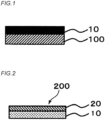
- a surface-modifying layer 10 is disposed on a surface of a resin member 100, thereby obtaining a surface-modified member as shown in FIG. 1 .
- the surface-modifying layer 10 is laminated to the surface of the resin member 100.
- the surface-modified member includes a mixture layer (not shown) that the resin member and the surface-modifying layer are mixed, between the resin member 100 and the surface-modifying layer 10.
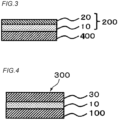
- the surface-modifying sheet which is the laminate of the release sheet and the surface-modifying layer, is a surface-modifying sheet 200 which is a laminate of a release sheet 20 and a surface-modifying layer 10, as shown in FIG. 2 .
- the configuration such that the surface-modifying sheet is the laminate of the release sheet and the surface-modifying layer, and that the surface-modifying sheet on the surface-modifying-layer side is placed on at least a part of a surface of the resin member is the following one: as shown in FIG. 3 , the surface-modifying sheet 200 is placed on the surface of a resin material 400 such that the surface-modifying sheet 200 on the surface-modifying-layer 10 side faces the surface of the resin material 400.
- the coated article according to the embodiment of the present invention is one including the surface-modified member and a coating film provided to at least a part of the surface-modified member.
- the coating film has been provided to at least a part of the surface thereof on the surface-modifying-layer side.
- the coating film may be at least one film selected from among a coating, a printed layer, a vapor-deposited layer, and a plating layer.
- FIG. 4 shows a coated article 300 including: a surface-modified member in which a surface-modifying layer 10 is disposed on a surface of a resin member 100; and a coating film 30 provided to the surface of the surface-modified member on the surface-modifying-layer side.
- the surface-modifying layer is not formed by coating to a surface of a member but is formed by using the sheet-shaped surface-modifying sheet, the occurrence of unevenness due to cissing, etc. can be prevented. Because of this, the surface-modifying layer can be formed in an even thickness on the surface of the resin member and a coating film can be coated and provided thereon in an even film thickness. Furthermore, in cases when a surface-modifying layer was disposed on the surface of the resin member in a molten-state or softened-state, the surface-modifying layer has undergone welding and mixing, or chemical bonding due to the heat of the surface of the resin member and the strength of bonding between the surface-modifying layer and the resin member is high; hence, a coating film having excellent adhesion can be formed.
- the surface-modifying layer and the resin member can be integrally shaped in forming the coated article, there is no need of performing a treatment for removing a release agent, such as a cleaning step with an organic solvent or a polishing step, before a coating film is formed, which can bring excellent safety and mitigate environmental burden and working burden.
- the coating film is not particularly limited. Examples thereof include various coating films including epoxy-based, polyester/melamine-based, alkyd/melamine-based, acrylic/melamine-based, acrylic/urethane-based, and acrylic/polyacidic-hardener-based coating films.
- the thickness of the coating film is not particularly limited, and may be 1 to 1,000 ⁇ m and is more preferably 3 to 300 ⁇ m, still more preferably 5 to 100 ⁇ m, especially preferably 10 to 50 ⁇ m.
- Coating methods for forming the coating film are not particularly limited, and use can be made of common methods including brushing, roller coating, spray coating, and coating by various coaters.
- the amount in which the coating fluid is to be applied is not particularly limited.
- the time period, temperature, etc. in heating the coating film can be suitably decided in accordance with the coating fluid to be used, application amount, etc.
- a method for producing a coated article according to a first embodiment of the present invention is a method for producing a coated article using the surface-modifying sheet according to the embodiment of the present invention, and includes: a step in which the surface-modifying layer is laminated to a resin member by heat pressing to form a surface-modified member; and a step in which a coating film is formed on the surface-modified member on the side where the surface-modifying layer is present.
- At least a part of a surface of a resin member means at least a part of all the surfaces of the resin member.
- that expression means, for example, some of at least one surface thereof or all of at least one surface thereof.
- the resin included in the resin member may be either a heat-curable resin or a thermoplastic resin, and is preferably a heat-curable resin, especially a heat-curable epoxy resin.
- heat-curable resin examples include vinyl ester resins, unsaturated polyester resins, epoxy resins, melamine resins, phenolic resins, phenolic resins, urethane resins, polyisocyanate resins, polyisocyanurate resins, and polyimide resins.
- the surface-modified member may be formed by resin shaping.
- the resin shaping include injection shaping and press shaping.
- thermoplastic resin thermoplastic resin, heat-curable resin, surface-modifying sheet, surface-modifying layer, and surface-modified member, the explanations given above can be used as such.
- the coating film is not particularly limited. Examples thereof include various coating films including acrylic-based, urethane-based, epoxy-based, fluorochemical-based, silicone-based, polyester/melamine-based, alkyd/melamine-based, acrylic/melamine-based, acrylic/urethane-based, and acrylic/polyacidic-hardener-based coating films.
- Coating methods for forming the coating film are not particularly limited, and use can be made of common methods including brushing, roller coating, spray coating, and coating by various coaters.
- the amount in which the coating fluid is to be applied is not particularly limited.
- the time period, temperature, etc. in heating the coating film can be suitably decided in accordance with the coating fluid to be used, application amount, etc.
- a method for producing a coated article according to a second embodiment of the present invention is a method for producing a coated article including: a surface-modified member in which the surface-modifying layer according to the embodiment of the present invention is laminated to a resin member; and a coating film provided to at least a part of the surface-modified member.
- the resin included in the resin member is a thermoplastic resin having a melting point of T 1 °C
- this method includes: a step in which the surface-modifying layer is disposed on at least a part of a surface of the resin member and heat welding is conducted at a temperature of (T 1 -50)°C or higher, thereby forming a surface-modified member; and a step in which a coating film is formed on the surface-modified member on the side where the surface-modifying layer is present.
- high bonding strength is obtained and, preferably, surface treatment steps which have been conducted hitherto can be omitted.
- a surface treatment is conducted simultaneously with shaping and this makes the use of a release agent unnecessary and enables release-agent removal steps (e.g., sandblasting and degreasing) to be omitted.
- the surface-modifying layer is disposed on at least a part of a surface of a resin member (thermoplastic resin member) including a thermoplastic resin having a melting point of T 1 °C and heat welding is conducted at a temperature of (T 1 -50)°C or higher.
- the temperature for the heat welding is preferably (T 1 -50)°C to (T 1 +150)°C, more preferably (T 1 -25)°C to (T 1 +100)°C, still more preferably (T 1 -10)°C to (T 1 +75)°C, especially preferably (T 1 )°C to (T 1 +50)°C.
- thermoplastic resin included in the resin member according to the embodiment of the present invention examples include PP (polypropylene), PA (polyamides), PPE (poly(phenylene ether)s), PPS (poly(phenylene sulfide)), PET (poly(ethylene terephthalate)), PBT (poly(butylene terephthalate)), POM (polyacetals), PEEK (polyetheretherketones), and PC (polycarbonates).
- thermoplastic resins which enable the effects of the present invention to be advantageously exhibited include PPS (poly(phenylene sulfide)s), PA (polyamides), and PP (polypropylene).
- thermoplastic resin a fiber-reinforced thermoplastic resin (FRTR) can be employed.
- FRTR fiber-reinforced thermoplastic resin
- FRTR fiber-reinforced thermoplastic resin
- CFRTPs carbon-fiber-reinforced thermoplastic resins
- GFRTPs glass-fiber-reinforced thermoplastic resins
- CFRTPs carbon-fiber-reinforced thermoplastic resins
- PPS-based thermoplastic resins carbon-fiber-reinforced PPS-based thermoplastic resins
- PA-based thermoplastic resins carbon-fiber-reinforced PA-based thermoplastic resins
- PP-based thermoplastic resins examples include carbon-fiber-reinforced PP-based thermoplastic resins.
- glass-fiber-reinforced thermoplastic resins examples include glass-fiber-reinforced PPS-based thermoplastic resins, glass-fiber-reinforced PA-based thermoplastic resins, and glass-fiber-reinforced PP-based thermoplastic resins.
- a method for producing a coated article according to a third embodiment of the present invention is a method for producing a coated article including: a surface-modified member in which the surface-modifying layer according to the embodiment of the present invention is laminated to a resin member; and a coating film provided to at least a part of the surface-modified member.
- the resin included in the resin member is a heat-curable resin having a curing temperature of T 2 °C
- this method includes: a step in which the surface-modifying layer is disposed on at least a part of a surface of the resin member and heat-shaping is conducted at a temperature of T 2 °C or higher, thereby forming a surface-modified member; and a step in which a coating film is formed on the surface-modified member on the surface-modifying-layer side.
- high bonding strength is obtained and, preferably, surface treatment steps which have been conducted hitherto can be omitted.
- a surface treatment is conducted simultaneously with shaping and this makes the use of a release agent unnecessary and enables release-agent removal steps (e.g., sandblasting and degreasing) to be omitted.
- the surface-modifying layer is disposed on at least a part of a surface of a resin member (heat-curable resin member) including a heat-curable resin having a curing temperature of T 2 °C and heat-shaping is conducted at a temperature of T 2 °C or higher.
- the temperature for the heat-shaping is preferably (T 2 -50)°C to (T 2 +50)°C, more preferably (T 2 -40)°C to (T 2 +40)°C, still more preferably (T 2 -30)°C to (T 2 +30)°C, especially preferably (T 2 -20)°C to (T 2 +20)°C.
- Examples of the heat-curable resin included in the resin member according to the embodiment of the present invention include unsaturated polyester resins, vinyl ester resins, epoxy resins, melamine resins, phenolic resins, urethane resins, polyisocyanate resins, polyisocyanurate resins, and polyimide resins.
- the heat-curable resin may be a fiber-reinforced heat-curable resin.
- fiber-reinforced heat-curable resin examples include carbon-fiber-reinforced curable plastic resins and glass-fiber-reinforced heat-curable resins.
- thermoplastic resin member and "at least a part of a surface of a heat-curable resin member” mean at least a part of all the surfaces of the thermoplastic resin member or heat-curable resin member.
- the expressions mean, for example, some of at least one surface thereof or all of at least one surface thereof.
- thermoplastic resin member or heat-curable resin member examples include a plate shape having flat surfaces, a plate shape having curved surfaces, a sheet shape, and a film shape.
- the thicknesses of the thermoplastic resin member and heat-curable resin member are, for example, 0.001-10 mm.
- Examples of methods for disposing a surface-modifying layer on at least a part of a surface of a thermoplastic resin member or heat-curable resin member in the method for producing a coated article according to the second embodiment of the present invention or in the method for producing a coated article according to the third embodiment include: a method in which a solution including a material for the surface-modifying layer and a solvent is applied to at least a part of a surface of the thermoplastic resin member or heat-curable resin member; a method in which a surface-modifying layer is disposed by melt extrusion on at least a part of a surface of the thermoplastic resin member or heat-curable resin member; and a method in which a sheet-form surface-modifying layer is laminated to at least a part of a surface of the thermoplastic resin member or heat-curable resin member.
- Examples of methods for the application of the solution including a material for the surface-modifying layer and a solvent include: a method in which the thermoplastic resin member or heat-curable resin member is dipped in the solution including a material for the surface-modifying layer and a solvent; a method in which the solution including a material for the surface-modifying layer and a solvent is applied with a brush to at least a part of a surface of the thermoplastic resin member or heat-curable resin member; a method in which the solution including a material for the surface-modifying layer and a solvent is applied with any of various coaters to at least a part of a surface of the thermoplastic resin member or heat-curable resin member; and a method in which the solution including a material for the surface-modifying layer and a solvent is applied by spraying to at least a part of a surface of the thermoplastic resin member or heat-curable resin member.
- Examples of the solution including a material for the surface-modifying layer and a solvent include a surface-modifying composition obtained by dissolving the material for the surface-modifying layer in any desired appropriate solvent to such a degree that the effects of the invention are not lessened.
- the solvent is then removed by drying. This drying is only required to remove at least a part of the solvent.
- preferably 50 mass% or more of the solvent is removed, more preferably 80 mass% or more of the solvent is removed, still more preferably 90 mass% or more of the solvent is removed, especially preferably 95 mass% or more of the solvent is removed, and most preferably all of the solvent is removed.
- any desired appropriate method capable of removing the solvent such as oven heating, infrared heating, or high-frequency heating, can be employed unless the effects of the invention are lessened thereby.
- Any desired appropriate drying temperature can be used in accordance with the boiling point of the solvent to be used.
- Examples of methods for disposing a surface-modifying layer by melt extrusion include a method in which a material for the surface-modifying layer is melt-extruded with a melting extruder or the like and disposed on at least a part of a surface of the thermoplastic resin member or heat-curable resin member.
- Examples of methods for laminating a sheet-form surface-modifying layer include a method in which a surface-modifying sheet (laminate including a release sheet and a surface-modifying layer), such as that described in the section "Method for producing surface-modified member" according to the embodiment of the present invention, is laminated to at least a part of a surface of the thermoplastic resin member or heat-curable resin member so that the surface-modifying layer of the surface-modifying sheet faces the resin member.
- a surface-modifying sheet laminate including a release sheet and a surface-modifying layer
- Examples of methods for the heat-shaping include oven heating, infrared heating, high-frequency heating, and heat pressing. Heat pressing is preferred.
- the period of the heat-shaping is preferably 1 second to 2 hours.
- a surface-modifying layer is disposed on a surface of a thermoplastic resin member or heat-curable resin member to obtain a surface-modified member (sometimes called a multilayer member, which includes the thermoplastic resin member or heat-curable resin member, and the surface-modifying layer), and a coating film is formed on the surface-modified member on the side where the surface-modifying layer is present.
- a coated article is obtained.
- a mixture layer that the thermoplastic resin member or heat-curable resin member, and the surface-modifying layer is mixed is provided between the thermoplastic resin member or heat-curable resin member and the surface-modifying layer.
- the thickness of this mixture layer is preferably 1.5 nm or larger, more preferably 2.0 nm or larger.
- the thickness of the surface-modifying layer is preferably 0.1-2,000 ⁇ m, more preferably 1-1,000 ⁇ m, still more preferably 3-200 ⁇ m, especially preferably 5-30 ⁇ m.
- a method for producing a coated article according to a fourth embodiment of the present invention is a method for producing a coated article including: a surface-modified member in which a surface-modifying layer is laminated to a resin member; and a coating film formed on the surface-modified member on the side where the surface-modifying layer is present.
- a surface-modifying layer is disposed on the molten-state or softened-state surface of the resin member.
- a coated article In the method for producing a coated article according to the fourth embodiment of the present invention, at least a part of a surface of a resin member is brought into a molten state or softened state and a surface-modifying layer is disposed on the surface.
- molten state means that at least a part of the surface of the resin member is in a molten state, and this can be attained preferably by heating the resin member to a temperature of its melting point of more.
- softened state means that at least a part of the surface of the resin member is in a softened state, and this can be attained preferably by heating the resin member to a temperature of its softening temperature or more.
- the surface-modifying layer is welded and mixed by the heat of the surface of the resin member and sufficient bonding strength can be imparted to the resin member.
- this impartation can be attained with high production efficiency and at low cost.
- Examples of methods for disposing the surface-modifying layer on the molten-state or softened-state surface of the resin member in the method for producing the coated article according to the fourth embodiment of the present invention include a method in which the surface-modifying sheet is the laminate of the release sheet and the surface-modifying layer, and which the surface-modifying sheet on the surface-modifying-layer side is placed on the molten-state or softened-state surface of the resin member.
- the surface-modifying layer can be rendered visible, for example, by incorporating an additive, such as a dye, a pigment, or a crystalline substance, into a surface-modifying composition or into the surface-modifying layer, making the production steps easy to control.
- an additive such as a dye, a pigment, or a crystalline substance
- Examples of methods for process control include a method in which a portion colored by a surface treatment is discriminated by visually ascertaining it or by examining an image thereof captured with a camera.
- the surface tension (m)N/m of each surface-modifying layer was measured by the wetting tension test method (JIS K6768-1999). Several drops of a mixture solution for wetting tension test which had been regulated so as to have an appropriate surface tension were dropped onto the surface-modifying layer of a surface-modified resin member and spread with a cotton swab. In cases when the applied mixture solution for wetting tension test retained the applied state for 2 seconds or longer without breaking, this surface-modifying layer was deemed to be wet.
- the mixture solution for wetting tension test used was the one manufactured by FUJIFILM Wako Pure Chemical Corp.
- the thickness of a coating film was determined with a dial gauge (GC-9, manufactured by Peacock).
- the coated article and the surface-modified resin member on which the coating film had not been formed were examined for thickness, and the difference therebetween was regarded as the thickness ( ⁇ m) of the coating film.
- the average thickness ( ⁇ m) is an average of measured values for ten points.
- 60° glossiness at room temperature was measured by a measurement of specular gloss (JIS Z8741-1997).
- a glossmeter micro-tri-gloss manufactured by BYK GmbH was placed on a surface of a coated article to measure the glossiness of the coating film.
- the average glossiness is an average of measured values for five points.
- the coated article was held for 24 hours in a thermo-hygrostatic chamber set in an environment of a temperature of 85°C and a humidity of 85% RH and was then examined for 60° gloss.
- a decrease in 60° glossiness was calculated from the 60° glossiness at room temperature (25°C) above and the 60° glossiness measured after 24-hour holding in the environment having the temperature of 85°C and the humidity of 85% RH, using the following equation.
- Decrease in glossiness % glossiness 25 ° C ⁇ glossiness 85 ° C/85%RH / glossiness 25 ° C ) ⁇ 100
- the thickness of a surface-modifying layer was determined with a dial gauge (GC-9, manufactured by Peacock). The thickness of the surface-modifying sheet was measured. The surface-modifying layer in the portion where the thickness measurement was made was removed, and the thickness ( ⁇ m) of the release sheet in that portion was measured. The difference therebetween was taken as the thickness ( ⁇ m) of the surface-modifying layer.
- the average thickness ( ⁇ m) is an average of measured values for ten points.
- the coated articles produced in the Examples and Comparative Examples were each evaluated for crosscut adhesion by the crosscut method described in JIS K5600-5-6, and the number of peeled coating-film squares was counted. In cases when the number of peeled coating-film squares among the hundred squares was 0, the coating was deemed to have satisfactory adhesion.
- a hundred parts by mass of a copolyamide resin (Amilan CM8000, manufactured by Toray Industries, Inc.) and 1 part by mass of a polyfunctional epoxy resin (TETRAD-C, manufactured by Mitsubishi Gas Chemical Co., Ltd.) were dissolved in a 40°C solvent mixed with ethanol (EtOH)/water/isopropyl alcohol (IPA) 68 mass%/12 mass%/20 mass% to produce a solution (surface-modifying composition) having a solid content of 20 mass%.
- the produced surface-modifying composition was filtered with a nylon sieve having an opening size of 188 ⁇ m and then applied to a release sheet (Nitoflon 900 UL, manufactured by Nitto Denko Corp.; fluororesin sheet film [polytetrafluoroethylene (PTFE) (thickness, 0.05 mm; dimensions, 250 mm (width) ⁇ 450 mm (length))] with an applicator.
- the applied composition was dried in a thermostatic drying oven at 100°C for 2 minutes to produce a surface-modifying sheet (1) including the release sheet and a surface-modifying layer.
- the surface-modifying sheet (1) produced above was stacked on a carbon-fiber-reinforced heat-curable epoxy resin prepreg (Torayca, manufactured by Toray Industries, Inc.) (dimensions, 150 mm (width) ⁇ 120 mm (length) ⁇ 1 mm (thickness)), and the stacked one was heated and welded by pressing (150°C, 5 minutes) to produce a surface-modified member (1).
- a carbon-fiber-reinforced heat-curable epoxy resin prepreg Torayca, manufactured by Toray Industries, Inc.
- the release sheet of the surface-modified member (1) produced above was peeled off, and V-Top H (two-pack type curable urethane coating material), manufactured by Dai Nippon Toryo Co., Ltd., was applied to the surface-modifying layer with an applicator.
- the coating film was cured at ordinary temperature for 3 days or more to produce a coated article (1).
- a hundred parts by mass of a copolyamide resin (Amilan CM8000, manufactured by Toray Industries, Inc.) and 12.5 parts by mass of untreated fumed silica (M5 Cab-o-sil, manufactured by CABOT Corp.) were dispersed or dissolved in a 40°C solvent mixed with ethanol (EtOH)/water/isopropyl alcohol (IPA) 68 mass%/12 mass%/20 mass% to produce a solution (surface-modifying composition) having a solid content of 20 mass%.
- EtOH ethanol
- IPA isopropyl alcohol
- the produced surface-modifying composition was filtered with a nylon sieve having an opening size of 188 ⁇ m and then applied to a release sheet (Nitoflon 900 UL, manufactured by Nitto Denko Corp.; fluororesin sheet film [polytetrafluoroethylene (PTFE) (thickness, 0.05 mm; dimensions, 250 mm (width) ⁇ 450 mm (length))] with an applicator.
- the applied composition was dried in a thermostatic drying oven at 100°C for 2 minutes to produce a surface-modifying sheet including the release sheet and a 20- ⁇ m surface-modifying layer disposed thereon.
- Two surface-modifying sheets thus produced were superposed so that the surface-modifying layers faced each other, and laminated to each other with heating at 150°C to obtain a multilayer surface-modifying-sheet object.
- One of the release sheets of the laminate was peeled off, and a surface-modifying sheet produced separately was superposed on that laminate so that the surface-modifying layer of the surface-modifying sheet faced the exposed surface-modifying layer of the laminate.
- This stack was subjected to thermal laminating at 150°C. This step was repeated several times until the surface-modifying-layer thickness reached 200 ⁇ m , thereby obtaining a surface-modifying sheet (23).
- a surface-modified member and a coated article were produced in the same manners as in Example 1, except that the surface-modifying sheet was replaced by the surface-modifying sheet (23) and the thickness of the coating film was changed as shown in Table 2.
- a surface-modifying sheet, a surface-modified member, and a coated article were produced in the same manners as in Example 23, except that the surface-modifying sheet was produced so as to have a surface-modifying-layer thickness of 1,000 ⁇ m.
- a surface-modifying sheet produced in the same manner as in Example 5 was superposed on a carbon-fiber-reinforced thermoplastic poly(phenylene sulfide) resin (carbon-fiber-reinforced thermoplastic poly(phenylene sulfide) resin manufactured by Bond Laminates) (dimensions, 150 mm (width) ⁇ 120 mm (length) ⁇ 1 mm (thickness)), and the stack was heated and welded by pressing (300°C, 1 minute) to produce a surface-modified member (25).
- a carbon-fiber-reinforced thermoplastic poly(phenylene sulfide) resin carbon-fiber-reinforced thermoplastic poly(phenylene sulfide) resin manufactured by Bond Laminates
- a coated article was produced in the same manner as in Example 1, except that the surface-modified member was replaced by the surface-modified member (25) and the thickness of the coating film was changed as shown in Table 2.
- a surface-modified member and a coated article were produced in the same manners as in Example 1, except that the release sheet on which no surface-modifying layer had been disposed was used in place of the surface-modifying sheet.
- a surface-modified member and a coated article were produced in the same manners as in Example 25, except that a surface-modifying sheet produced in the same manner as in Comparative Example 1 was used.
- a surface-modified member and a coated article were produced in the same manners as in Example 25, except that the release sheet on which no surface-modifying layer had been disposed was used in place of the surface-modifying sheet.
- a surface-modifying sheet, a surface-modified member, and a coated article were produced in the same manners as in Example 23, except that the addition of 12.5 parts by mass of untreated fumed silica (M5 Cab-o-sil, manufactured by CABOT Corp.) was omitted.
- M5 Cab-o-sil manufactured by CABOT Corp.
- Example 12 Polymer CM8000 (copolymer nylon) 100 100 100 100 100 100 100 100 100 100 100 100 100 100 100 100 100 100 100 TETRAD-C (polyfunctional epoxy) 1 3 NYPER BMT-K40 (benzoyl peroxide) 0.3 UC-3510 (acrylic oligomer) 2 2 2 M5 (unmodified fumed silica) to 20 TS720 (PDMS-modified fumed silica) 10 20 30 AEROSIL50 (untreated fumed silica) 10 AEROSIL300 (untreated fumed silica) 10 Fine particles E-1011 (surfactant-treated wet-process silica) 15 AZ-204 (untreated wet-process silica) 15 SP-200 (untreated wet-process silica) 15 Surface-modifying layer Average primary-particle diameter (nm) 12 12 12 12 12 30 7 20 10 15 Production method coating coating coating coating coating coating coating coating coating coating coating coating coating Solid content (mas)
- Example 14 Example 15 Example 16 Example 17 Example 18 Example 19 Example 20
- Example 21 Example 22
- Example 23 Example 24
- Polymer CM8000 copolymer nylon
- Fine particles M5 unmodified fumed silica) 10 12.5 12.5
- ST-OS untreated colloidal silica
- ST-O untreated colloidal silica
- ST-O-40 untreated colloidal silica
- 30 70
- ST-OUP untreated colloidal silica
- 20 Average primary-particle diameter (nm) 9 12 22 22 22 22 12 12 12 12 12 12 12 12
- Surface-modifying layer Platy filler Sumecton-SEN organic-synthesis hectorite
- Sumecton SEN organic-synthesis hectorite (manufactured by Kunimine Industries Co., Ltd.)
- Celloxane SCC surface-treated cellulose nanofibers (manufactured by Sihs React Co., Ltd.)
- the surface-modifying sheet according to the embodiment of the present invention can form a surface-modifying layer having excellent bonding strength, makes appearance changing decrease even in high-temperature high-humidity environments, and enables to integrally shape the surface-modifying layer and a resin member when forming a surface modified member.
Landscapes
- Chemical & Material Sciences (AREA)
- Engineering & Computer Science (AREA)
- Organic Chemistry (AREA)
- Chemical Kinetics & Catalysis (AREA)
- Manufacturing & Machinery (AREA)
- Polymers & Plastics (AREA)
- Mechanical Engineering (AREA)
- Health & Medical Sciences (AREA)
- Medicinal Chemistry (AREA)
- Physics & Mathematics (AREA)
- Fluid Mechanics (AREA)
- Composite Materials (AREA)
- Materials Engineering (AREA)
- Thermal Sciences (AREA)
- Laminated Bodies (AREA)
- Application Of Or Painting With Fluid Materials (AREA)
Applications Claiming Priority (3)
| Application Number | Priority Date | Filing Date | Title |
|---|---|---|---|
| JP2021013342 | 2021-01-29 | ||
| JP2021160127 | 2021-09-29 | ||
| PCT/JP2022/002299 WO2022163547A1 (ja) | 2021-01-29 | 2022-01-21 | 表面改質シート、積層体、表面改質部材、塗装物、表面改質部材の製造方法、及び塗装物の製造方法 |
Publications (2)
| Publication Number | Publication Date |
|---|---|
| EP4286154A1 true EP4286154A1 (de) | 2023-12-06 |
| EP4286154A4 EP4286154A4 (de) | 2025-01-01 |
Family
ID=82653545
Family Applications (1)
| Application Number | Title | Priority Date | Filing Date |
|---|---|---|---|
| EP22745768.6A Pending EP4286154A4 (de) | 2021-01-29 | 2022-01-21 | Oberflächenmodifizierungsfolie, laminat, oberflächenmodifizierungselement, lackiertes objekt, verfahren zur herstellung eines oberflächenmodifizierungselements und verfahren zur herstellung eines lackierten objekts |
Country Status (6)
| Country | Link |
|---|---|
| US (1) | US20240026100A1 (de) |
| EP (1) | EP4286154A4 (de) |
| JP (1) | JPWO2022163547A1 (de) |
| KR (1) | KR20230141781A (de) |
| TW (1) | TW202243864A (de) |
| WO (1) | WO2022163547A1 (de) |
Families Citing this family (1)
| Publication number | Priority date | Publication date | Assignee | Title |
|---|---|---|---|---|
| JP7810914B2 (ja) * | 2023-09-25 | 2026-02-04 | ダイキン工業株式会社 | 組成物、シート及び金属張積層体 |
Family Cites Families (14)
| Publication number | Priority date | Publication date | Assignee | Title |
|---|---|---|---|---|
| JPS60141873A (ja) * | 1983-12-27 | 1985-07-26 | Rishiyou Kogyo Kk | 化学メツキ用接着剤組成物 |
| JP4444426B2 (ja) * | 2000-01-26 | 2010-03-31 | 帝人株式会社 | プリプレグ用保護フィルム |
| JP2006282973A (ja) * | 2004-05-11 | 2006-10-19 | Hitachi Chem Co Ltd | 接着フィルム、接着フィルム付きリードフレーム及びこれらを用いた半導体装置 |
| CN102746722B (zh) * | 2011-04-19 | 2015-01-21 | 顺安涂布科技(昆山)有限公司 | 聚乙烯膜表面处理组成物及其标签 |
| JP2015193754A (ja) * | 2014-03-31 | 2015-11-05 | 大日本印刷株式会社 | 粘着シートおよびそれを用いた粘着剤層付き光学部材 |
| CN108834419A (zh) | 2016-01-14 | 2018-11-16 | 日东电工株式会社 | 表面改性热塑性树脂的制造方法、接合结构体的制造方法、接合结构体、热转印表面改性片、带有热转印表面改性片的热塑性树脂、以及表面改性热塑性树脂 |
| JP2017160417A (ja) * | 2016-03-02 | 2017-09-14 | 日東電工株式会社 | 粘着シート |
| EP3505552B1 (de) * | 2016-08-29 | 2021-04-14 | Mitsubishi Chemical Corporation | Wärmehärtende harzzusammensetzung, prepreg, faserverstärkter kunststoffformkörper und verfahren zur herstellung davon |
| KR20210005870A (ko) | 2018-04-26 | 2021-01-15 | 닛토덴코 가부시키가이샤 | 표면 개질 시트, 표면 개질 부재, 도장물, 및 도장물의 제조 방법 |
| CN118494029A (zh) * | 2018-07-11 | 2024-08-16 | 汤振华 | 一种适于宽幅面离散图案打印的打印方法及打印机 |
| JP2020163831A (ja) | 2019-03-29 | 2020-10-08 | 日東電工株式会社 | 積層体の製造方法、塗装物の製造方法、接合構造体の製造方法、熱転写シート、及び積層体 |
| EP3950375A4 (de) * | 2019-03-29 | 2022-12-21 | Nitto Denko Corporation | Verfahren zur herstellung eines laminierten körpers, verfahren zur herstellung eines lackierobjekts, verbindungsstrukturherstellungsverfahren, thermotransferfolie und laminierter körper |
| JP6706373B1 (ja) | 2019-07-12 | 2020-06-03 | サントリーホールディングス株式会社 | ビールテイスト飲料、およびビールテイスト飲料の製造方法 |
| JP2021160127A (ja) | 2020-03-31 | 2021-10-11 | 出光ユニテック株式会社 | 積層シート、容器、および積層シートの製造方法 |
-
2022
- 2022-01-21 WO PCT/JP2022/002299 patent/WO2022163547A1/ja not_active Ceased
- 2022-01-21 JP JP2022578343A patent/JPWO2022163547A1/ja active Pending
- 2022-01-21 US US18/274,936 patent/US20240026100A1/en active Pending
- 2022-01-21 EP EP22745768.6A patent/EP4286154A4/de active Pending
- 2022-01-21 KR KR1020237026049A patent/KR20230141781A/ko active Pending
- 2022-01-28 TW TW111103862A patent/TW202243864A/zh unknown
Also Published As
| Publication number | Publication date |
|---|---|
| KR20230141781A (ko) | 2023-10-10 |
| EP4286154A4 (de) | 2025-01-01 |
| JPWO2022163547A1 (de) | 2022-08-04 |
| WO2022163547A1 (ja) | 2022-08-04 |
| US20240026100A1 (en) | 2024-01-25 |
| TW202243864A (zh) | 2022-11-16 |
Similar Documents
| Publication | Publication Date | Title |
|---|---|---|
| CN113646182A (zh) | 层叠体的制造方法、涂装物的制造方法、接合结构体的制造方法、热转印片、及层叠体 | |
| KR20210005870A (ko) | 표면 개질 시트, 표면 개질 부재, 도장물, 및 도장물의 제조 방법 | |
| EP4224601A1 (de) | Aussenmaterial für energiespeichervorrichtungen, verfahren zur herstellung davon und energiespeichervorrichtung | |
| KR20210148131A (ko) | 적층체의 제조 방법, 도장물의 제조 방법, 접합 구조체의 제조 방법, 열 전사 시트, 및 적층체 | |
| KR20210120121A (ko) | 적층 필름, 및 그 제조 방법 | |
| EP4286154A1 (de) | Oberflächenmodifizierungsfolie, laminat, oberflächenmodifizierungselement, lackiertes objekt, verfahren zur herstellung eines oberflächenmodifizierungselements und verfahren zur herstellung eines lackierten objekts | |
| TWI869472B (zh) | 積層體之製造方法、塗裝物之製造方法、接合構造體之製造方法、熱轉印片材、及積層體 | |
| JPWO2020235534A1 (ja) | 蓄電デバイス用外装材、その製造方法、蓄電デバイス、及びポリアミドフィルム | |
| JP6918546B2 (ja) | 表面被覆フィルム | |
| JP6056601B2 (ja) | 積層フィルムおよびその製造方法 | |
| JP6994584B2 (ja) | 表面被覆フィルム並びに表面被覆繊維強化樹脂成形品及びその製造方法 | |
| US20240170771A1 (en) | Battery packaging material | |
| WO2023054278A1 (ja) | 積層体 | |
| CN116829354A (zh) | 表面改性片材、层叠体、表面改性部件、涂装物、表面改性部件的制造方法及涂装物的制造方法 | |
| CN116997466B (zh) | 表面改性部件、涂装物、表面改性部件的制造方法及涂装物的制造方法 | |
| EP4316809A1 (de) | Oberflächenmodifizierungsfolie, laminat, oberflächenmodifiziertes element, beschichteter gegenstand, herstellungsverfahren für oberflächenmodifiziertes element und herstellungsverfahren für beschichteten gegenstand | |
| TW202330268A (zh) | 表面改質片材、積層體、表面改質構件、塗裝物、表面改質構件之製造方法、及塗裝物之製造方法 | |
| WO2019208666A1 (ja) | 表面改質シート、表面改質部材、塗装物、及び塗装物の製造方法 | |
| WO2023163076A1 (ja) | 表面改質シート、積層体、表面改質部材、塗装物、接合体、表面改質部材の製造方法、塗装物の製造方法、及び接合体の製造方法 | |
| WO1996012599A1 (en) | Synthetic resin molding method |
Legal Events
| Date | Code | Title | Description |
|---|---|---|---|
| STAA | Information on the status of an ep patent application or granted ep patent |
Free format text: STATUS: THE INTERNATIONAL PUBLICATION HAS BEEN MADE |
|
| PUAI | Public reference made under article 153(3) epc to a published international application that has entered the european phase |
Free format text: ORIGINAL CODE: 0009012 |
|
| STAA | Information on the status of an ep patent application or granted ep patent |
Free format text: STATUS: REQUEST FOR EXAMINATION WAS MADE |
|
| 17P | Request for examination filed |
Effective date: 20230803 |
|
| AK | Designated contracting states |
Kind code of ref document: A1 Designated state(s): AL AT BE BG CH CY CZ DE DK EE ES FI FR GB GR HR HU IE IS IT LI LT LU LV MC MK MT NL NO PL PT RO RS SE SI SK SM TR |
|
| DAV | Request for validation of the european patent (deleted) | ||
| DAX | Request for extension of the european patent (deleted) | ||
| A4 | Supplementary search report drawn up and despatched |
Effective date: 20241202 |
|
| RIC1 | Information provided on ipc code assigned before grant |
Ipc: C09J 7/00 20180101ALI20241126BHEP Ipc: B32B 7/022 20190101ALI20241126BHEP Ipc: B32B 5/28 20060101ALI20241126BHEP Ipc: B29C 70/34 20060101ALI20241126BHEP Ipc: B29C 63/02 20060101ALI20241126BHEP Ipc: B32B 27/00 20060101AFI20241126BHEP |