EP4276178B1 - Esterasemutante und verwendung davon - Google Patents
Esterasemutante und verwendung davon Download PDFInfo
- Publication number
- EP4276178B1 EP4276178B1 EP21922007.6A EP21922007A EP4276178B1 EP 4276178 B1 EP4276178 B1 EP 4276178B1 EP 21922007 A EP21922007 A EP 21922007A EP 4276178 B1 EP4276178 B1 EP 4276178B1
- Authority
- EP
- European Patent Office
- Prior art keywords
- pet
- esterase
- reaction
- substrate
- cell
- Prior art date
- Legal status (The legal status is an assumption and is not a legal conclusion. Google has not performed a legal analysis and makes no representation as to the accuracy of the status listed.)
- Active
Links
Classifications
-
- C—CHEMISTRY; METALLURGY
- C12—BIOCHEMISTRY; BEER; SPIRITS; WINE; VINEGAR; MICROBIOLOGY; ENZYMOLOGY; MUTATION OR GENETIC ENGINEERING
- C12N—MICROORGANISMS OR ENZYMES; COMPOSITIONS THEREOF; PROPAGATING, PRESERVING, OR MAINTAINING MICROORGANISMS; MUTATION OR GENETIC ENGINEERING; CULTURE MEDIA
- C12N15/00—Mutation or genetic engineering; DNA or RNA concerning genetic engineering, vectors, e.g. plasmids, or their isolation, preparation or purification; Use of hosts therefor
- C12N15/09—Recombinant DNA-technology
- C12N15/63—Introduction of foreign genetic material using vectors; Vectors; Use of hosts therefor; Regulation of expression
- C12N15/70—Vectors or expression systems specially adapted for E. coli
-
- C—CHEMISTRY; METALLURGY
- C12—BIOCHEMISTRY; BEER; SPIRITS; WINE; VINEGAR; MICROBIOLOGY; ENZYMOLOGY; MUTATION OR GENETIC ENGINEERING
- C12N—MICROORGANISMS OR ENZYMES; COMPOSITIONS THEREOF; PROPAGATING, PRESERVING, OR MAINTAINING MICROORGANISMS; MUTATION OR GENETIC ENGINEERING; CULTURE MEDIA
- C12N15/00—Mutation or genetic engineering; DNA or RNA concerning genetic engineering, vectors, e.g. plasmids, or their isolation, preparation or purification; Use of hosts therefor
- C12N15/09—Recombinant DNA-technology
- C12N15/63—Introduction of foreign genetic material using vectors; Vectors; Use of hosts therefor; Regulation of expression
- C12N15/79—Vectors or expression systems specially adapted for eukaryotic hosts
- C12N15/80—Vectors or expression systems specially adapted for eukaryotic hosts for fungi
- C12N15/81—Vectors or expression systems specially adapted for eukaryotic hosts for fungi for yeasts
-
- C—CHEMISTRY; METALLURGY
- C12—BIOCHEMISTRY; BEER; SPIRITS; WINE; VINEGAR; MICROBIOLOGY; ENZYMOLOGY; MUTATION OR GENETIC ENGINEERING
- C12N—MICROORGANISMS OR ENZYMES; COMPOSITIONS THEREOF; PROPAGATING, PRESERVING, OR MAINTAINING MICROORGANISMS; MUTATION OR GENETIC ENGINEERING; CULTURE MEDIA
- C12N9/00—Enzymes; Proenzymes; Compositions thereof; Processes for preparing, activating, inhibiting, separating or purifying enzymes
- C12N9/14—Hydrolases (3)
- C12N9/16—Hydrolases (3) acting on ester bonds (3.1)
- C12N9/18—Carboxylic ester hydrolases (3.1.1)
-
- C—CHEMISTRY; METALLURGY
- C12—BIOCHEMISTRY; BEER; SPIRITS; WINE; VINEGAR; MICROBIOLOGY; ENZYMOLOGY; MUTATION OR GENETIC ENGINEERING
- C12P—FERMENTATION OR ENZYME-USING PROCESSES TO SYNTHESISE A DESIRED CHEMICAL COMPOUND OR COMPOSITION OR TO SEPARATE OPTICAL ISOMERS FROM A RACEMIC MIXTURE
- C12P41/00—Processes using enzymes or microorganisms to separate optical isomers from a racemic mixture
- C12P41/003—Processes using enzymes or microorganisms to separate optical isomers from a racemic mixture by ester formation, lactone formation or the inverse reactions
- C12P41/005—Processes using enzymes or microorganisms to separate optical isomers from a racemic mixture by ester formation, lactone formation or the inverse reactions by esterification of carboxylic acid groups in the enantiomers or the inverse reaction
-
- C—CHEMISTRY; METALLURGY
- C12—BIOCHEMISTRY; BEER; SPIRITS; WINE; VINEGAR; MICROBIOLOGY; ENZYMOLOGY; MUTATION OR GENETIC ENGINEERING
- C12P—FERMENTATION OR ENZYME-USING PROCESSES TO SYNTHESISE A DESIRED CHEMICAL COMPOUND OR COMPOSITION OR TO SEPARATE OPTICAL ISOMERS FROM A RACEMIC MIXTURE
- C12P7/00—Preparation of oxygen-containing organic compounds
- C12P7/40—Preparation of oxygen-containing organic compounds containing a carboxyl group including Peroxycarboxylic acids
-
- C—CHEMISTRY; METALLURGY
- C12—BIOCHEMISTRY; BEER; SPIRITS; WINE; VINEGAR; MICROBIOLOGY; ENZYMOLOGY; MUTATION OR GENETIC ENGINEERING
- C12Y—ENZYMES
- C12Y301/00—Hydrolases acting on ester bonds (3.1)
- C12Y301/01—Carboxylic ester hydrolases (3.1.1)
Definitions
- the present disclosure relates to the field of biotechnologies, in particular to an esterase mutant and use thereof.
- a new-type organic synthesis technology must have the following characteristics: high chemical selectivity, regional selectivity and stereoselectivity; mild reaction conditions; and less pollution to the environment caused by reaction medium post-treatment and the like.
- a biocatalytic technology has exactly these characteristics, the biocatalytic reaction conditions are mild, and it is usually performed at neutral and room temperatures, or close to such conditions; in most cases, the biocatalytic reaction is performed in an aqueous phase, so the environmental pollution is less; and the biocatalytic reaction usually has the characteristics of high chemical selectivity, regional selectivity and stereoselectivity and the like. Therefore, the application of the biocatalytic technology in organic synthesis has the great scientific significance and practical application value.
- Esterase refers to the general name of a class of enzymes with the ability to hydrolyze an ester bond, widely exists in animals, plants and microorganisms, is a class of hydrolase widely used in organic synthesis, and is also the most widely researched enzyme in genetic engineering. It is divided into eight groups which are classified according to the types of substrates: carboxylate, thioester, phosphate monoester, phosphate diester, phospholipid sulfate, and sulfate. The esterases from different sources have the different catalytic characteristics and catalytic activities.
- a marine pseudomonas strain is screened from deep-sea samples, an esterase gene PHE14 is obtained, and an expression vector is constructed and transformed into an expression strain.
- a recombinant expression esterase PHE14 is obtained, and it may be used to prepare chiral methyl lactate; and in a patent ( CN104988165B ), an esterase gene est4 is extracted from deep-sea sludge, and a genetically engineered strain containing the esterase gene est4 is constructed to achieve the heterologous expression of the gene est4, and is successfully used in reactions such as the catalytic synthesis of a variety of short-chain terpene esters and the kinetic resolution of a variety of aromatic secondary alcohols.
- wild-type biocatalysts usually have the better reactivity and selectivity for their natural substrates, their reactivity, stability and selectivity for non-natural substrates are often unsatisfactory. While the biocatalysts are used in organic synthesis, they are non-natural substrates in most cases. In general, wild enzymes may be modified by means of directed evolution, as to improve their reactivity, stability and selectivity (including chemical selectivity, regional selectivity and stereoselectivity) to the non-natural substrates, and thereby it may be used in production.
- the present disclosure aims to provide an esterase mutant and use thereof, as to improve the specificity of the enzyme.
- an esterase mutant consisting of the amino acid sequence shown in SEQ ID NO: 1 containing the mutation N51G.
- the mutation consisting of the amino acid sequence shown in SEQ ID NO: 1 containing the mutations: N51G+T117M+S140G, N51G+T117M+S140N, N51G+T117M+S140C, N51G+T117M+S140T, N51G+T117M+S140A, N51G+T117M+A142V, N51G+T117M+A142P, N51G+T117M+A142S, N51G+T117M+A142L, N51G+T117M+D217Q, N51G+T117M+D217A, N51G+T117M+D217S, N51G+T117M+D217G, N51G+T117M+L231I, N51G+T117M+S140C+M52F, N51G+T117M+S140C+M52L, N51G+T117M+S140C+M52N, N51G+T117M+S
- a DNA molecule is provided.
- the DNA molecule encodes the above esterase mutant.
- a recombinant plasmid contains any one of the above DNA molecules.
- the recombinant plasmid is pET-22a(+), pET-22b(+), pET-3a(+), pET-3d(+), pET-11a(+), pET-12a(+), pET-14b, pET-15b(+), pET-16b(+), pET-17b(+), pET-19b(+), pET-20b(+), pET-21a(+), pET-23a(+), pET-23b(+), pET-24a(+), pET-25b(+), pET-26b(+), pET-27b(+), pET-28a(+), pET-29a(+), pET-30a(+), pET-31b(+), pET-32a(+), pET-35b(+), pET-38b(+), pET-39b(+), pET-40b(+), pET-41a(+),
- a host cell contains any one of the above recombinant plasmids.
- the host cell includes a prokaryotic cell or a eukaryotic cell; and preferably, the prokaryotic cell is Escherichia coli BL21 cell or Escherichia coli DH5 ⁇ competent cell, and the eukaryotic cell is yeast.
- a method for producing a chiral acid includes a step of catalyzing a reaction of an ester compound by an esterase, and the esterase is any one of the above esterase mutants.
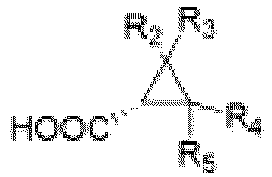
- ester compound is and a reaction product is herein
- R 1 represents -CH 3 , -CH 2 CH 3 , -CH 2 CH 2 CH 3 or -CHCH 3 CH 3
- R 2 , R 3 , R 4 and R 5 each independently represent -H, -F, -Cl, -Br, -CH 3 or -CH 2 CH 3
- the ester compound is or
- a pH of the reaction catalyzed by an esterase mutant is 8.5 to 9.0, and a reaction temperature is 30°C to 35°C.
- the esterase mutant of the present disclosure is based on the esterase shown in SEQ ID NO: 1, and is mutated by a method of site-directed mutation, as to change its amino acid sequence and achieve changes of the protein structure and function, and then the esterase with the above mutation site is obtained by a method of directional screening. Therefore, these esterase mutants have the advantage of greatly improving enzyme specificity, and the enzyme activity is also correspondingly improved, thus the usage amount of the enzyme is greatly reduced, and the cost in industrial production is reduced.
- the present disclosure improves the specificity of esterase and reduces the usage amount of esterase by a method of directed evolution.
- the template amino acid sequence of the present disclosure (derived from Bacillus sp.01-855, National Center of Biotechnology Information (NCBI) Serial Number: AY640622, and Website: https://www.ncbi.nlm.nih.gov/nuccore/AY640622) is SEQ ID NO: 1 (MGSNNDNMGKRGGNLMITIPTVHKVSLPNGEVMGYRKRDGGEKTILLVHGNMTSSKHWDLFFET FPASYTLVAIDMRGFGESSYNKRVEGIEDFAQDLKFFVDQLGLNDFTMIGWSTGGAVCMQFEAQY PGYCDKIVLISSASTRGYPFFGTHSDGTPDLNQRLKTVDDIEKDPMRTIPIQQAYDTGNRALLKTIW NSLIYTHNQPEEKRYEAYVDDMMTQRNLADVYHALNTFNISSVTNGLT
- a mutation site is introduced into the esterase by a mode of site-directed mutation, and the specificity of the mutant is detected to select the mutant with improved specificity.
- the specificity of the mutant N51G is increased significantly.
- the mutant N51G is used as a template to continue the mutation in order to obtain a mutant with improved catalytic activity.
- site-directed mutation referring to introduction of required changes (usually changes that represent favorable directions) into a target DNA segment (either a genome or a plasmid) by a polymerase chain reaction (PCR) or other methods, including base addition, deletion, point mutation and the like.
- PCR polymerase chain reaction
- the site-directed mutation may rapidly and efficiently improve the character and representation of a target protein expressed by DNA, and is a very useful means in gene research work.
- a method of introducing the site-directed mutation by the whole-plasmid PCR is simple and effective, and is more widely used at present.
- the principle thereof is that a pair of primers (forward and reverse) containing mutation sites are annealed with a template plasmid, "cyclic extension" is performed by using a polymerase, and the so-called cyclic extension is that the polymerase extends the primer according to the template, is returned to a 5'-terminal of the primer and terminated after one circle, and subjected to a cycle of repeatedly heated and annealed extension, this reaction is different from rolling circle amplification, and does not form multiple tandem copies.
- Extension products of the forward and reverse primers are paired to form an open-circle plasmid with an incision after annealed.
- a Dpn I enzyme-digested extension product because the original template plasmid is derived from conventional Escherichia coli, is modified by dam methylation, and is sensitive to Dpn I so as to be shredded, but a plasmid with a mutant sequence synthesized in vitro is not cut because it is not methylated, so it may be successfully transformed in subsequent transformation, and a clone of a mutant plasmid may be obtained.
- the mutant plasmid is transformed into Escherichia coli cells, and then a crude enzyme is obtained by ultrasonic cell-break.
- the mutant plasmid described above is transformed into the Escherichia coli cells and overexpressed in the Escherichia coli. Then the crude enzyme is obtained by the method of ultrasonic cell-break.
- the optimum condition for induced expression of the esterase is: 25 °C, and inducing in 0.1 mM isopropyl- ⁇ -d-thiogalactoside (IPTG) for 16 h.
- an esterase mutant is provided.
- the esterase mutant has an amino acid sequence obtained by the mutation of the amino acid sequence shown in SEQ ID NO: 1, and the mutation comprises a mutation site N51G.
- the mutation includes at least one of the following mutation sites: N51G, M52F/UN/Y/G/W, W115P, T117L/M/F/W/A/I, S140A/G/N/C/T/V/L/P, A142V/UP/S, V167M, I195L/F/T/V, W196I/L/V, D217M/Q/A/S/G, L231T/I, V267E/C/I/V and S295T/A/Y/F/M/N, herein "/" means "or".
- the mutation comprises any one of the following mutation site combinations: N51G+T117M+S140G, N51G+T117M+S140N, N51G+T117M+S140C, N51G+T117M+S140T, N51G+T117M+S140A, N51G+T117M+A142V, N51G+T117M+A142P, N51G+T117M+A142S, N51G+T117M+A142L, N51G+T117M+D217Q, N51G+T117M+D217A, N51G+T117M+D217S, N51G+T117M+D217G, N51G+T117M+L2311, N51G+T117M+S140C+M52F, N51G+T117M+S140C+M52L, N51G+T117M+S140C+M52N, N51G+T117M+S140C+M52Y, N51G
- the esterase mutant of the present disclosure is based on the esterase shown in SEQ ID NO: 1, and is mutated by a method of site-directed mutation, as to change its amino acid sequence and achieve changes of the protein structure and function, and then the esterase with the above mutation site is obtained by a method of directional screening. Therefore, these esterase mutants have the advantage of greatly improving enzyme specificity, and the enzyme activity is also correspondingly improved, thus the usage amount of the enzyme is greatly reduced, and the cost in industrial production is reduced.
- a DNA molecule is provided.
- the esterase encoded by the above DNA may improve the enzyme activity and stability, the usage amount of the enzyme in the industrial production of amino acids may be reduced, and the difficulty of post-treatment is reduced.
- the above DNA molecule of the disclosure may also exist in the form of an "expression cassette".
- the "expression cassette” refers to a linear or circular nucleic acid molecule that encompasses DNA and RNA sequences capable of guiding expression of a specific nucleotide sequence in an appropriate host cell. Generally, including a promoter which is effectively linked with a target nucleotide, it is optionally effectively linked with a termination signal and/or other control elements.
- the expression cassette may also include a sequence required for proper translation of the nucleotide sequence.
- a coding region usually encodes a target protein, but also encodes a target function RNA in a sense or antisense direction, for example an antisense RNA or an untranslated RNA.
- the expression cassette including a target polynucleotide sequence may be chimeric, which means that at least one of components thereof is heterologous to at least one of the other components thereof.
- the expression cassette may also be existent naturally, but obtained with effective recombinant formation for heterologous expression.
- a recombinant plasmid is provided.
- the recombinant plasmid contains any one of the above DNA molecules.
- the DNA molecule in the above recombinant plasmid is placed in an appropriate position of the recombinant plasmid, so that the above DNA molecule may be correctly and smoothly replicated, transcribed or expressed.
- plasmid used in the present disclosure includes any plasmid, cosmid, bacteriophage or agrobacterium binary nucleic acid molecule in double-stranded or single-stranded linear or circular form, preferably a recombinant expression plasmid, which may be a prokaryotic expression plasmid or may be a eukaryotic expression plasmid, preferably the prokaryotic expression plasmid, in some embodiments, the recombinant plasmid is selected from pET-22a (+) , pET-22b (+) , pET-3a (+) , pET-3d (+) , pET-11a (+) , pET-12a (+) , pET-14b (+) , pET-15b (+) , pET-16b (+) , pET-17b (+) , pET-19b (+) , pET-20b (+) , pET-21a (+) , pET-
- a host cell contains any one of the above recombinant plasmids.
- the host cell applicable to the present disclosure includes but is not limited to a prokaryotic cell or a eukaryotic cell.
- the prokaryotic cell is Escherichia coli BL21 cell or Escherichia coli DH5 ⁇ competent cell
- the eukaryotic cell is yeast.
- a method for producing a chiral acid includes a step of catalyzing a reaction of an ester compound by an esterase, and the esterase is any one of the above esterase mutants. Because the above esterase of the present disclosure has the better specificity and even higher enzyme catalytic activity, the preparation of the chiral acid using the esterase mutant of the present disclosure may not only reduce the production cost, but also obtain a higher enantiomeric excess (ee) value of the amino acid.
- the ester compound is and a reaction product is herein
- R 1 represents -CH 3 , -CH 2 CH 3 , -CH 2 CH 2 CH 3 or -CHCH 3 CH 3
- R 2 , R 3 , R 4 and R 5 each independently represent -H, -F, -Cl, -Br, -CH 3 or -CH 2 CH 3
- the ester compound is
- a pH of the reaction catalyzed by an esterase mutant is 8.5 to 9.0, and a reaction temperature is 30°C to 35°C.
- Table 1 Enzyme Substrate 1 Substrate 2 Substrate 3 Activity e.e.(%) Activity e.e.(%) Activity e.e.(%) WT -14.0 -30 -25 N51G - *** - ** + *** N51G+W115P - ** - ** + ** N51G+T117L + *** + *** + ** N51G+T117M ++ **** ++ **** ++ **** N51G+T117F - *** - *** - * N51G+T117W - *** - ** - *** N51G+T117A ++ *** + * + *** N51G+T117I + *** - *** - ** N51G+A142V +++ *** + ** - *** N51G+V167M + * - * - ** N51
- the times of decrease and increase in activity are as follows: --- represents decrease by 10-50 times, -- represents decrease by 5-10 times, - represents decrease by 1-5 times, + represents increase by 1-5 times, ++ represents increase by 5-10 times, +++ represents increase by 10-50 times, and ++++ represents increase by more than 50 times.
- * represents the ee value less than 0%
- ** represents the ee value of 0-50%
- *** represents the ee value of 50-95%
- **** represents the ee value greater than 95%.
- Substrate 5 as described in Substrate 4, established reaction and treatment modes of the same system. Results were shown in Table 2.
- Table 2 Enzyme Substrate 4 Substrate 5 Activity e.e.(%) Activity e.e.(%) WT -20.0 -10
- the times of decrease and increase in activity are as follows: --- represents decrease by 10-50 times, -- represents decrease by 5-10 times, - represents decrease by 1-5 times, + represents increase by 1-5 times, ++ represents increase by 5-10 times, +++ represents increase by 10-50 times, and ++++ represents increase by more than 50 times.
- * represents the ee value less than 0%
- ** represents the ee value of 0-50%
- *** represents the ee value of 50-95%
- **** represents the ee value greater than 95%.
- the mutation is continued, the ee value of a product is increased, the substrate concentration is increased, and the reaction volume is reduced.
- the times of decrease and increase in activity are as follows: --- represents decrease by 10-50 times, -- represents decrease by 5-10 times, - represents decrease by 1-5 times, + represents increase by 1-5 times, ++ represents increase by 5-10 times, +++ represents increase by 10-50 times, and ++++ represents increase by more than 50 times.
- * represents the ee value less than 0%
- ** represents the ee value of 0-50%
- *** represents the ee value of 50-95%
- **** represents the ee value greater than 95%.
- the times of decrease and increase in activity are as follows: --- represents decrease by 10-50 times, -- represents decrease by 5-10 times, - represents decrease by 1-5 times, + represents increase by 1-5 times, ++ represents increase by 5-10 times, +++ represents increase by 10-50 times, and ++++ represents increase by more than 50 times.
- * represents the ee value less than 0%
- ** represents the ee value of 0-50%
- *** represents the ee value of 50-95%
- **** represents the ee value greater than 95%.
- the beneficial mutation sites are further combined to further increase the substrate concentration and reduce the reaction volume.
- the times of decrease and increase in activity are as follows: --- represents decrease by 10-50 times, -- represents decrease by 5-10 times, - represents decrease by 1-5 times, + represents increase by 1-5 times, ++ represents increase by 5-10 times, +++ represents increase by 10-50 times, and ++++ represents increase by more than 50 times.
- * represents the ee value less than 0%
- ** represents the ee value of 0-50%
- *** represents the ee value of 50-95%
- **** represents the ee value greater than 95%.
- the times of decrease and increase in activity are as follows: --- represents decrease by 10-50 times, -- represents decrease by 5-10 times, - represents decrease by 1-5 times, + represents increase by 1-5 times, ++ represents increase by 5-10 times, +++ represents increase by 10-50 times, and ++++ represents increase by more than 50 times.
- * represents the ee value less than 0%
- ** represents the ee value of 0-50%
- *** represents the ee value of 50-95%
- **** represents the ee value greater than 95%.
- the times of decrease and increase in activity are as follows: --- represents decrease by 10-50 times, -- represents decrease by 5-10 times, - represents decrease by 1-5 times, + represents increase by 1-5 times, ++ represents increase by 5-10 times, +++ represents increase by 10-50 times, and ++++ represents increase by more than 50 times.
- * represents the ee value less than 0%
- ** represents the ee value of 0-50%
- *** represents the ee value of 50-95%
- **** represents the ee value greater than 95%.
- an amplification reaction of 10 g of the substrate is performed.
- an amplification reaction was performed. 10 g of Substrate 1 added, 100 mL of a reaction system, 250 mg of esterase (N51G+T117M+S140C+S295N), 5 mL of N,N-dimethylformamide, and 0.5 M Tris-HCl pH 9.0 buffer. It was reacted at 30 °C, the reaction time was tracked, a sample was taken for detection, and pH was adjusted to about 9.0. While it was reacted for 50 h, the transformation rate was 48%, and the e.e. value was 98%. After post-treatment was performed on a reaction sample, 6 M of HCl was added, and pH was adjusted between 2 ⁇ 3.
- an amplification reaction was performed. 10 g of Substrate 4 added, 100 mL of a reaction system, 250 mg of esterase (N51G+T117M+S140C+S295N), 5 mL of N,N-dimethylformamide, and 0.5 M Tris-HCl pH 9.0 buffer. It was reacted at 30°C, the reaction time was tracked, a sample was taken for detection, and pH was adjusted to about 9.0. While it was reacted for 60 h, the transformation rate was 48%, and the e.e. value was 98%. After post-treatment was performed on a reaction sample, 6 M of HCl was added, and pH was adjusted between 2 ⁇ 3.
Landscapes
- Life Sciences & Earth Sciences (AREA)
- Health & Medical Sciences (AREA)
- Genetics & Genomics (AREA)
- Chemical & Material Sciences (AREA)
- Engineering & Computer Science (AREA)
- Organic Chemistry (AREA)
- Zoology (AREA)
- Wood Science & Technology (AREA)
- Bioinformatics & Cheminformatics (AREA)
- General Engineering & Computer Science (AREA)
- Biotechnology (AREA)
- Biomedical Technology (AREA)
- Biochemistry (AREA)
- General Health & Medical Sciences (AREA)
- Microbiology (AREA)
- Molecular Biology (AREA)
- Physics & Mathematics (AREA)
- Biophysics (AREA)
- Plant Pathology (AREA)
- Mycology (AREA)
- Chemical Kinetics & Catalysis (AREA)
- General Chemical & Material Sciences (AREA)
- Medicinal Chemistry (AREA)
- Analytical Chemistry (AREA)
- Enzymes And Modification Thereof (AREA)
- Preparation Of Compounds By Using Micro-Organisms (AREA)
- Micro-Organisms Or Cultivation Processes Thereof (AREA)
Claims (12)
- Esterase-Mutante, bestehend aus der Aminosäuresequenz, gezeigt in SEQ ID NO: 1, enthaltend die Mutation N51G.
- Esterase-Mutante, bestehend aus der Aminosäuresequenz, gezeigt in SEQ ID NO: 1, enthaltend die Mutationen: N51G+T117M+S140G, N51G+T117M+S140N, N51G+T117M+S140C, N51G+T117M+S140T, N51G+T117M+S140A, N51G+T117M+A142V, N51G+T117M+A142P, N51G+T117M+A142S, N51G+T117M+A142L, N51G+T117M+D217Q, N51G+T117M+D217A, N51G+T117M+D217S, N51G+T117M+D217G, N51G+T117M+L231I, N51G+T117M+S140C+M52F, N51G+T117M+S140C+M52L, N51G+T117M+S140C+M52N, N51G+T117M+S140C+M52Y, N51G+T117M+S140C+M52G, N51G+T117M+S140C+M52W, N51G+T117M+S140C+I195F, N51G+T117M+S140C+I195L, N51G+T117M+S140C+I195T, N51G+T117M+S140C+I195V, N51G+T117M+S140C+D217S, N51G+T117M+S140C+L231I, N51G+T117M+S140C+V267I, N51G+T117M+S140C+I268V, N51G+T117M+S140C+S295F, N51G+T117M+S140C+S295M, N51G+T117M+S140C+S295N, N51G+T117M+S140C+S295G, oder N51G+T117M+S140C+S295D.
- DNA-Molekül, das für die Esterase-Mutante nach Anspruch 1 oder 2 codiert.
- Rekombinantes Plasmid, das das DNA-Molekül nach Anspruch 3 enthält.
- Rekombinantes Plasmid nach Anspruch 4, wobei das rekombinante Plasmid pET-22b(+), pET-22b(+), pET-3a(+), pET-3d(+), pET-11a(+), pET-12a(+), pET-14b, pET-15b(+), pET-16b(+), pET-17b(+), pET-19b(+), pET-20b(+), pET-21a(+), pET-23a(+), pET-23b(+), pET-24a(+), pET-25b(+), pET-26b(+), pET-27b(+), pET-28a(+), pET-29a(+), pET-30a(+), pET-31b(+), pET-32a(+), pET-35b(+), pET-38b(+), pET-39b(+), pET-40b(+), pET-41 a(+), pET-41 b(+), pET-42a(+), pET-43a(+), pET-43b(+), pET-44a(+), pET-49b(+), pQE2, pQE9, pQE30, pQE31, pQE32, pQE40, pQE70, pQE80, pRSET-A, pRSET-B, pRSET-C, pGEX-5X-1, pGEX-6p-1, pGEX-6p-2, pBV220, pBV221, pBV222, pTrc99A, pTwin1, pEZZ18, pKK232-8, pUC-18, oder pUC-19 ist.
- Wirtszelle, die das rekombinante Plasmid nach Anspruch 4 oder 5 enthält.
- Wirtszelle nach Anspruch 6, wobei die Wirtszelle eine prokaryontische Zelle oder eine eukaryontische Zelle umfasst.
- Wirtszelle nach Anspruch 7, wobei die prokaryontische Zelle eine Escherichia coli-BL21-Zelle oder eine kompetente Escherichia coli-DH5α-Zelle ist und die eukaryontische Zelle Hefe ist.
- Verfahren zur Herstellung chiraler Säuren, umfassend einen Schritt zum Katalysieren einer Reaktion einer Esterverbindung durch eine Esterase, wobei die Esterase die Esterase-Mutante nach Anspruch 1 oder 3 ist.
- Verfahren nach Anspruch 9, wobei die Esterverbindung

- Verfahren nach Anspruch 10, wobei die Esterverbindung


- Verfahren nach Anspruch 10, wobei ein pH-Wert der durch eine Esterase-Mutante katalysierten Reaktion 8,5 bis 9,0 beträgt und eine Reaktionstemperatur 30 °C bis 35 °C beträgt.
Applications Claiming Priority (2)
| Application Number | Priority Date | Filing Date | Title |
|---|---|---|---|
| CN202110107053.3A CN112430585B (zh) | 2021-01-27 | 2021-01-27 | 酯酶突变体及其应用 |
| PCT/CN2021/078738 WO2022160408A1 (zh) | 2021-01-27 | 2021-03-02 | 酯酶突变体及其应用 |
Publications (4)
| Publication Number | Publication Date |
|---|---|
| EP4276178A1 EP4276178A1 (de) | 2023-11-15 |
| EP4276178A4 EP4276178A4 (de) | 2024-07-31 |
| EP4276178B1 true EP4276178B1 (de) | 2025-06-04 |
| EP4276178C0 EP4276178C0 (de) | 2025-06-04 |
Family
ID=74697293
Family Applications (1)
| Application Number | Title | Priority Date | Filing Date |
|---|---|---|---|
| EP21922007.6A Active EP4276178B1 (de) | 2021-01-27 | 2021-03-02 | Esterasemutante und verwendung davon |
Country Status (5)
| Country | Link |
|---|---|
| US (1) | US20240093167A1 (de) |
| EP (1) | EP4276178B1 (de) |
| JP (1) | JP7713021B2 (de) |
| CN (1) | CN112430585B (de) |
| WO (1) | WO2022160408A1 (de) |
Families Citing this family (3)
| Publication number | Priority date | Publication date | Assignee | Title |
|---|---|---|---|---|
| CN112430585B (zh) * | 2021-01-27 | 2021-04-27 | 凯莱英生命科学技术(天津)有限公司 | 酯酶突变体及其应用 |
| CN113308450B (zh) * | 2021-07-28 | 2021-11-12 | 凯莱英医药集团(天津)股份有限公司 | 酯酶突变体及其应用 |
| CN117070494B (zh) * | 2023-10-13 | 2024-01-19 | 天津凯莱英生物科技有限公司 | 酯酶突变体及其应用 |
Family Cites Families (8)
| Publication number | Priority date | Publication date | Assignee | Title |
|---|---|---|---|---|
| US20050089895A1 (en) * | 2003-08-13 | 2005-04-28 | Cheung Siu T. | Compositions and methods for prognosis and therapy of liver cancer |
| EP1878786A1 (de) * | 2006-07-14 | 2008-01-16 | Consejo Superior De Investigaciones Cientificas (Csic) | Flüssige und stabile Ölfraktionen |
| CN102796714B (zh) * | 2012-01-18 | 2014-06-25 | 上海交通大学 | 磷酸三酯酶突变体及其制备方法和应用 |
| CN104988165B (zh) | 2015-06-19 | 2018-03-23 | 华东理工大学 | 酯酶est4、酯酶EST4、重组质粒和基因工程菌株及其应用 |
| CN105802935B (zh) | 2016-05-05 | 2019-06-25 | 中国科学院南海海洋研究所 | 一种酯酶phe14及其编码基因和应用 |
| CN106754818B (zh) | 2016-12-02 | 2020-04-28 | 华南理工大学 | 一种耐热酯酶突变体及其制备方法和应用 |
| CN110184254B (zh) | 2019-03-21 | 2022-07-22 | 复旦大学 | 一种具有高耐碱性的酯酶突变体及其应用 |
| CN112430585B (zh) * | 2021-01-27 | 2021-04-27 | 凯莱英生命科学技术(天津)有限公司 | 酯酶突变体及其应用 |
-
2021
- 2021-01-27 CN CN202110107053.3A patent/CN112430585B/zh active Active
- 2021-03-02 US US18/262,480 patent/US20240093167A1/en active Pending
- 2021-03-02 EP EP21922007.6A patent/EP4276178B1/de active Active
- 2021-03-02 JP JP2023545184A patent/JP7713021B2/ja active Active
- 2021-03-02 WO PCT/CN2021/078738 patent/WO2022160408A1/zh not_active Ceased
Also Published As
| Publication number | Publication date |
|---|---|
| JP7713021B2 (ja) | 2025-07-24 |
| EP4276178A1 (de) | 2023-11-15 |
| JP2024504439A (ja) | 2024-01-31 |
| WO2022160408A1 (zh) | 2022-08-04 |
| EP4276178A4 (de) | 2024-07-31 |
| CN112430585A (zh) | 2021-03-02 |
| EP4276178C0 (de) | 2025-06-04 |
| CN112430585B (zh) | 2021-04-27 |
| KR20230145092A (ko) | 2023-10-17 |
| US20240093167A1 (en) | 2024-03-21 |
Similar Documents
| Publication | Publication Date | Title |
|---|---|---|
| CN108048417B (zh) | 酮还原酶突变体及其应用 | |
| CN112375751B (zh) | 脂肪酶突变体及其应用 | |
| EP4276178B1 (de) | Esterasemutante und verwendung davon | |
| CN110257351B (zh) | 酮还原酶突变体及生产手性醇的方法 | |
| JP6473175B2 (ja) | ジカルボニル還元酵素突然変異体及びその応用 | |
| CN110713992B (zh) | 酮还原酶突变体及生产手性醇的方法 | |
| EP3839045B1 (de) | Aminosäure-dehydrogenase mutante und deren verwendung | |
| EP4261280A1 (de) | Aminosäuredehydrogenasemutant und anwendung davon | |
| JP6988000B6 (ja) | ケトレダクターゼ変異体及びその応用 | |
| CN115851649B (zh) | 转氨酶突变体及其应用 | |
| EP3677674B1 (de) | Transaminase-mutant und verwendung davon | |
| JP7375052B2 (ja) | ケトレダクターゼ突然変異体及びキラルアルコールの生産方法 | |
| KR20240039032A (ko) | 에스테라아제 돌연변이체 및 이의 응용 | |
| KR102897172B1 (ko) | 에스테라아제 돌연변이체 및 이의 응용 | |
| KR20240122532A (ko) | 아미노기 전이효소 돌연변이체 및 이의 응용 | |
| CN114807066B (zh) | 一种酮还原酶突变体 | |
| CN117070494B (zh) | 酯酶突变体及其应用 | |
| CN114807246A (zh) | 一种生产手性醇的方法 | |
| EP1408107B1 (de) | Gen für Chlorohydrin und Hydroxycarbonsäureester asymmetrische Hydrolase | |
| JP7534403B2 (ja) | ケトレダクターゼ突然変異体及びキラルアルコールの生産方法 | |
| CN117402839A (zh) | 一种酮还原酶及其在制备(r)-4-氯-3-羟基丁酸乙酯中的应用 | |
| JP4485081B2 (ja) | プラバスタチンの生産に関与するdnaおよびその使用 | |
| JP2008194037A (ja) | 生体触媒による4−ハロ−3−ヒドロキシ酪酸エステルの光学分割法 |
Legal Events
| Date | Code | Title | Description |
|---|---|---|---|
| STAA | Information on the status of an ep patent application or granted ep patent |
Free format text: STATUS: THE INTERNATIONAL PUBLICATION HAS BEEN MADE |
|
| PUAI | Public reference made under article 153(3) epc to a published international application that has entered the european phase |
Free format text: ORIGINAL CODE: 0009012 |
|
| STAA | Information on the status of an ep patent application or granted ep patent |
Free format text: STATUS: REQUEST FOR EXAMINATION WAS MADE |
|
| 17P | Request for examination filed |
Effective date: 20230810 |
|
| AK | Designated contracting states |
Kind code of ref document: A1 Designated state(s): AL AT BE BG CH CY CZ DE DK EE ES FI FR GB GR HR HU IE IS IT LI LT LU LV MC MK MT NL NO PL PT RO RS SE SI SK SM TR |
|
| DAV | Request for validation of the european patent (deleted) | ||
| DAX | Request for extension of the european patent (deleted) | ||
| A4 | Supplementary search report drawn up and despatched |
Effective date: 20240701 |
|
| RIC1 | Information provided on ipc code assigned before grant |
Ipc: C12P 41/00 20060101ALI20240624BHEP Ipc: C12P 7/40 20060101ALI20240624BHEP Ipc: C12N 1/19 20060101ALI20240624BHEP Ipc: C12N 1/21 20060101ALI20240624BHEP Ipc: C12N 15/81 20060101ALI20240624BHEP Ipc: C12N 15/70 20060101ALI20240624BHEP Ipc: C12N 15/55 20060101ALI20240624BHEP Ipc: C12N 9/18 20060101AFI20240624BHEP |
|
| STAA | Information on the status of an ep patent application or granted ep patent |
Free format text: STATUS: EXAMINATION IS IN PROGRESS |
|
| 17Q | First examination report despatched |
Effective date: 20241008 |
|
| GRAP | Despatch of communication of intention to grant a patent |
Free format text: ORIGINAL CODE: EPIDOSNIGR1 |
|
| STAA | Information on the status of an ep patent application or granted ep patent |
Free format text: STATUS: GRANT OF PATENT IS INTENDED |
|
| INTG | Intention to grant announced |
Effective date: 20250227 |
|
| GRAS | Grant fee paid |
Free format text: ORIGINAL CODE: EPIDOSNIGR3 |
|
| GRAA | (expected) grant |
Free format text: ORIGINAL CODE: 0009210 |
|
| STAA | Information on the status of an ep patent application or granted ep patent |
Free format text: STATUS: THE PATENT HAS BEEN GRANTED |
|
| AK | Designated contracting states |
Kind code of ref document: B1 Designated state(s): AL AT BE BG CH CY CZ DE DK EE ES FI FR GB GR HR HU IE IS IT LI LT LU LV MC MK MT NL NO PL PT RO RS SE SI SK SM TR |
|
| REG | Reference to a national code |
Ref country code: GB Ref legal event code: FG4D |
|
| REG | Reference to a national code |
Ref country code: CH Ref legal event code: EP |
|
| REG | Reference to a national code |
Ref country code: DE Ref legal event code: R096 Ref document number: 602021031965 Country of ref document: DE |
|
| REG | Reference to a national code |
Ref country code: IE Ref legal event code: FG4D |
|
| U01 | Request for unitary effect filed |
Effective date: 20250703 |
|
| U07 | Unitary effect registered |
Designated state(s): AT BE BG DE DK EE FI FR IT LT LU LV MT NL PT RO SE SI Effective date: 20250710 |
|
| PG25 | Lapsed in a contracting state [announced via postgrant information from national office to epo] |
Ref country code: ES Free format text: LAPSE BECAUSE OF FAILURE TO SUBMIT A TRANSLATION OF THE DESCRIPTION OR TO PAY THE FEE WITHIN THE PRESCRIBED TIME-LIMIT Effective date: 20250604 |
|
| PG25 | Lapsed in a contracting state [announced via postgrant information from national office to epo] |
Ref country code: NO Free format text: LAPSE BECAUSE OF FAILURE TO SUBMIT A TRANSLATION OF THE DESCRIPTION OR TO PAY THE FEE WITHIN THE PRESCRIBED TIME-LIMIT Effective date: 20250904 Ref country code: GR Free format text: LAPSE BECAUSE OF FAILURE TO SUBMIT A TRANSLATION OF THE DESCRIPTION OR TO PAY THE FEE WITHIN THE PRESCRIBED TIME-LIMIT Effective date: 20250905 |
|
| PG25 | Lapsed in a contracting state [announced via postgrant information from national office to epo] |
Ref country code: PL Free format text: LAPSE BECAUSE OF FAILURE TO SUBMIT A TRANSLATION OF THE DESCRIPTION OR TO PAY THE FEE WITHIN THE PRESCRIBED TIME-LIMIT Effective date: 20250604 |
|
| PG25 | Lapsed in a contracting state [announced via postgrant information from national office to epo] |
Ref country code: HR Free format text: LAPSE BECAUSE OF FAILURE TO SUBMIT A TRANSLATION OF THE DESCRIPTION OR TO PAY THE FEE WITHIN THE PRESCRIBED TIME-LIMIT Effective date: 20250604 |
|
| PG25 | Lapsed in a contracting state [announced via postgrant information from national office to epo] |
Ref country code: RS Free format text: LAPSE BECAUSE OF FAILURE TO SUBMIT A TRANSLATION OF THE DESCRIPTION OR TO PAY THE FEE WITHIN THE PRESCRIBED TIME-LIMIT Effective date: 20250904 |