EP4273119A1 - Verfahren zur herstellung von c5-aldehyden - Google Patents
Verfahren zur herstellung von c5-aldehyden Download PDFInfo
- Publication number
- EP4273119A1 EP4273119A1 EP22171287.0A EP22171287A EP4273119A1 EP 4273119 A1 EP4273119 A1 EP 4273119A1 EP 22171287 A EP22171287 A EP 22171287A EP 4273119 A1 EP4273119 A1 EP 4273119A1
- Authority
- EP
- European Patent Office
- Prior art keywords
- solvent
- gas
- rhodium
- ligand
- aldehydes
- Prior art date
- Legal status (The legal status is an assumption and is not a legal conclusion. Google has not performed a legal analysis and makes no representation as to the accuracy of the status listed.)
- Pending
Links
Images
Classifications
-
- C—CHEMISTRY; METALLURGY
- C07—ORGANIC CHEMISTRY
- C07C—ACYCLIC OR CARBOCYCLIC COMPOUNDS
- C07C45/00—Preparation of compounds having >C = O groups bound only to carbon or hydrogen atoms; Preparation of chelates of such compounds
- C07C45/49—Preparation of compounds having >C = O groups bound only to carbon or hydrogen atoms; Preparation of chelates of such compounds by reaction with carbon monoxide
- C07C45/50—Preparation of compounds having >C = O groups bound only to carbon or hydrogen atoms; Preparation of chelates of such compounds by reaction with carbon monoxide by oxo-reactions
- C07C45/505—Asymmetric hydroformylation
-
- C—CHEMISTRY; METALLURGY
- C07—ORGANIC CHEMISTRY
- C07C—ACYCLIC OR CARBOCYCLIC COMPOUNDS
- C07C45/00—Preparation of compounds having >C = O groups bound only to carbon or hydrogen atoms; Preparation of chelates of such compounds
- C07C45/49—Preparation of compounds having >C = O groups bound only to carbon or hydrogen atoms; Preparation of chelates of such compounds by reaction with carbon monoxide
- C07C45/50—Preparation of compounds having >C = O groups bound only to carbon or hydrogen atoms; Preparation of chelates of such compounds by reaction with carbon monoxide by oxo-reactions
-
- B—PERFORMING OPERATIONS; TRANSPORTING
- B01—PHYSICAL OR CHEMICAL PROCESSES OR APPARATUS IN GENERAL
- B01J—CHEMICAL OR PHYSICAL PROCESSES, e.g. CATALYSIS OR COLLOID CHEMISTRY; THEIR RELEVANT APPARATUS
- B01J31/00—Catalysts comprising hydrides, coordination complexes or organic compounds
- B01J31/16—Catalysts comprising hydrides, coordination complexes or organic compounds containing coordination complexes
- B01J31/18—Catalysts comprising hydrides, coordination complexes or organic compounds containing coordination complexes containing nitrogen, phosphorus, arsenic or antimony as complexing atoms, e.g. in pyridine ligands, or in resonance therewith, e.g. in isocyanide ligands C=N-R or as complexed central atoms
- B01J31/1845—Catalysts comprising hydrides, coordination complexes or organic compounds containing coordination complexes containing nitrogen, phosphorus, arsenic or antimony as complexing atoms, e.g. in pyridine ligands, or in resonance therewith, e.g. in isocyanide ligands C=N-R or as complexed central atoms the ligands containing phosphorus
- B01J31/185—Phosphites ((RO)3P), their isomeric phosphonates (R(RO)2P=O) and RO-substitution derivatives thereof
-
- C—CHEMISTRY; METALLURGY
- C07—ORGANIC CHEMISTRY
- C07C—ACYCLIC OR CARBOCYCLIC COMPOUNDS
- C07C45/00—Preparation of compounds having >C = O groups bound only to carbon or hydrogen atoms; Preparation of chelates of such compounds
- C07C45/78—Separation; Purification; Stabilisation; Use of additives
- C07C45/81—Separation; Purification; Stabilisation; Use of additives by change in the physical state, e.g. crystallisation
- C07C45/82—Separation; Purification; Stabilisation; Use of additives by change in the physical state, e.g. crystallisation by distillation
-
- C—CHEMISTRY; METALLURGY
- C07—ORGANIC CHEMISTRY
- C07C—ACYCLIC OR CARBOCYCLIC COMPOUNDS
- C07C45/00—Preparation of compounds having >C = O groups bound only to carbon or hydrogen atoms; Preparation of chelates of such compounds
- C07C45/78—Separation; Purification; Stabilisation; Use of additives
- C07C45/81—Separation; Purification; Stabilisation; Use of additives by change in the physical state, e.g. crystallisation
- C07C45/82—Separation; Purification; Stabilisation; Use of additives by change in the physical state, e.g. crystallisation by distillation
- C07C45/83—Separation; Purification; Stabilisation; Use of additives by change in the physical state, e.g. crystallisation by distillation by extractive distillation
-
- C—CHEMISTRY; METALLURGY
- C07—ORGANIC CHEMISTRY
- C07C—ACYCLIC OR CARBOCYCLIC COMPOUNDS
- C07C45/00—Preparation of compounds having >C = O groups bound only to carbon or hydrogen atoms; Preparation of chelates of such compounds
- C07C45/78—Separation; Purification; Stabilisation; Use of additives
- C07C45/86—Use of additives, e.g. for stabilisation
-
- C—CHEMISTRY; METALLURGY
- C07—ORGANIC CHEMISTRY
- C07C—ACYCLIC OR CARBOCYCLIC COMPOUNDS
- C07C47/00—Compounds having —CHO groups
- C07C47/02—Saturated compounds having —CHO groups bound to acyclic carbon atoms or to hydrogen
-
- B—PERFORMING OPERATIONS; TRANSPORTING
- B01—PHYSICAL OR CHEMICAL PROCESSES OR APPARATUS IN GENERAL
- B01J—CHEMICAL OR PHYSICAL PROCESSES, e.g. CATALYSIS OR COLLOID CHEMISTRY; THEIR RELEVANT APPARATUS
- B01J2231/00—Catalytic reactions performed with catalysts classified in B01J31/00
- B01J2231/30—Addition reactions at carbon centres, i.e. to either C-C or C-X multiple bonds
- B01J2231/32—Addition reactions to C=C or C-C triple bonds
- B01J2231/321—Hydroformylation, metalformylation, carbonylation or hydroaminomethylation
-
- B—PERFORMING OPERATIONS; TRANSPORTING
- B01—PHYSICAL OR CHEMICAL PROCESSES OR APPARATUS IN GENERAL
- B01J—CHEMICAL OR PHYSICAL PROCESSES, e.g. CATALYSIS OR COLLOID CHEMISTRY; THEIR RELEVANT APPARATUS
- B01J2531/00—Additional information regarding catalytic systems classified in B01J31/00
- B01J2531/80—Complexes comprising metals of Group VIII as the central metal
- B01J2531/82—Metals of the platinum group
- B01J2531/822—Rhodium
-
- B—PERFORMING OPERATIONS; TRANSPORTING
- B01—PHYSICAL OR CHEMICAL PROCESSES OR APPARATUS IN GENERAL
- B01J—CHEMICAL OR PHYSICAL PROCESSES, e.g. CATALYSIS OR COLLOID CHEMISTRY; THEIR RELEVANT APPARATUS
- B01J2531/00—Additional information regarding catalytic systems classified in B01J31/00
- B01J2531/80—Complexes comprising metals of Group VIII as the central metal
- B01J2531/84—Metals of the iron group
- B01J2531/845—Cobalt
Definitions
- the present invention relates to a process for producing C5 aldehydes by hydroformylation of butenes with synthesis gas in the presence of a homogeneous catalyst system and a solvent.
- the process is characterized by the fact that the aldehyde concentration in the reaction mixture is limited.
- Hydroformylation of olefins is a well-known chemical reaction to produce aldehydes.
- olefins are converted into aldehydes with synthesis gas (mixture of CO and H 2 ) in the presence of a homogeneous catalyst system, which can comprise a transition metal, for example rhodium or cobalt, and a ligand.
- synthesis gas mixture of CO and H 2
- a homogeneous catalyst system which can comprise a transition metal, for example rhodium or cobalt, and a ligand.
- Cycle gas processes are usually used for the hydroformylation of shorter olefins, i.e. H. Olefins with a maximum of 5 carbon atoms are used because the aldehydes formed are sufficiently volatile to be able to leave the reaction zone with the gas phase.
- the problem with cycle gas processes is that the ligands can be broken down by the conditions prevailing during hydroformylation.
- the degradation reactions in which the ligands are destroyed can be various processes, e.g. E.g. hydrolysis, oxidation, Abramov reaction, transesterification, which can also occur simultaneously next to each other.
- hydroformylation there is a continuous loss of ligands.
- the ligand must be replenished permanently and continuously in order to continue to be economical, i.e. H. to be able to work with sufficient reaction conversions.
- the object of the present invention was to provide a process for hydroformylation in which the degradation reactions of the ligand are reduced or completely avoided.
- a further object of the present invention was to provide such a method in which no great preparative or technical effort has to be made in order to achieve the goal, i.e. reducing or avoiding the degradation reactions of the ligand.
- the present invention therefore relates to a process for the production of C5 aldehydes by hydroformylation of butenes, in which the butenes are reacted with synthesis gas in at least one reaction zone in the presence of a homogeneous catalyst system and a solvent and in which a circulating gas is removed from the reaction zone, which contains at least some of the product aldehydes, unreacted butenes and butanes, characterized in that the aldehyde concentration in the liquid reaction mixture in the reactor is kept below 15% by mass by the circulating gas.
- the reduction in the aldehyde concentration is achieved by increasing the circulating gas quantities.
- other measures are also conceivable.
- the product aldehydes formed can be removed more quickly from the at least one reaction zone.
- the above-mentioned degradation reactions of the ligand are reduced.
- the process according to the invention can therefore be operated in such a way that, compared to conventional processes, less ligand has to be added for similar conversions. The process is therefore more resource-efficient than comparable processes. In addition, costs are saved, which is why the process according to the invention can be operated more economically overall.
- butenes ie linear butenes (n-butene, i.e. 1-butene and 2-butene) and/or branched butenes (iso-butene), are used as starting materials, which are then mixed with synthesis gas (mixture of CO and H 2 ) can be converted into the desired C5 aldehydes in the presence of a homogeneous catalyst.
- synthesis gas mixture of CO and H 2
- the butenes to be hydroformylated can be used in pure form or provided in technically available mixtures as a feed mixture for the hydroformylation according to the invention.
- feed mixture is to be understood as referring to any type of butene-containing mixtures which contain the butenes in an amount that enables the hydroformylation to be carried out economically.
- feed mixtures also contain the corresponding alkanes, i.e. butanes.
- butene mixtures suitable for the process according to the invention can be obtained from the C4 fraction of a steam cracker, for example the raffinate I, the raffinate II or the raffinate III.
- Another butene-containing mixture which can be used as a feed mixture in the present invention is crude butane. It is also possible to use 1-butene as a feed mixture.
- Butene-containing mixtures preferred according to the invention Hydrocarbon streams which have a butene content of at least 15% by weight are used as a feed mixture.
- the butene-containing mixtures for use as a feed mixture are free of dienes and alkynes, ie the content of dienes and alkynes is in each case less than 100 ppm, preferably less than 10 ppm, particularly preferably less than 1 ppm.
- C5 aldehydes include n-pentanal (valeraldehyde), iso-pentanal (isovaleradelhyde), sec-pentanal (2-methylbutanal), and tert-pentanal (pivalaldehyde).
- the process described is a process for producing n-pentanal (valeraldehyde).
- the process according to the invention is also carried out using a solvent in which the homogeneous catalyst system is dissolved. At least the solvent and the homogeneous catalyst system dissolved therein form the reaction mixture, which is present as a liquid phase in the at least one reactor.
- the solvent has a higher boiling point than the butenes used and the product aldehydes.
- Solvents known to those skilled in the art can be used as solvents. In particular, INB (isononyl benzoate) or DINCH (1,2-cyclohexanedicarboxylic acid diisononyl ester) can be used as solvents for the process according to the invention.
- the catalyst system used in the process according to the invention comprises or consists of a metal from Group 8 or 9 of the Periodic Table of the Elements and at least one organic phosphorus-containing ligand.
- the metal is selected from iron, ruthenium, iridium, cobalt and rhodium.
- Preferred metals for the catalyst system according to the invention are cobalt and rhodium, rhodium is particularly preferred.
- Mono- or biphosphite ligands which are generally known to those skilled in the art, are preferably used as ligands.
- Suitable ligands are, for example, in the patent applications WO 2017/080690 A1 , WO 2014/056732 A1 , WO 2014/056735 A1 , WO 2014/056736 A1 , WO 2014/056737 A1 and DE 10 2008 002 187 A1 disclosed.
- a particularly preferred ligand is a compound of formula (1):
- a catalyst system comprising rhodium and a ligand according to formula (1) shown above is used in the process according to the invention.
- the molar ratio of the rhodium to the mono- or bisphosphite ligands is preferably in a range from 1 to 100. There are therefore 1 to 100 mono- or bisphosphite ligands for each rhodium.
- the ligand/rhodium ratio is further preferably in the range from 1 to 20, particularly preferably in the range from 1 to 2.
- the concentration of rhodium in the liquid reaction mixture is in a range from 1 to 1000 ppm by mass, in particular in a range from 20 to 300 ppm by mass and especially in the range from 40 to 150 ppm by mass.
- the homogeneous catalyst system is preferably not introduced into the process as a ready-to-use, active complex, but is produced in situ, i.e. in the reactor.
- the active complex is produced within the at least one reactor in the presence of ligands made from rhodium compounds as a precursor.
- Suitable rhodium compounds for this are, for example, rhodium (II) and rhodium (III) salts, such as rhodium (III) chloride, rhodium (III) nitrate, rhodium (III) sulfate, potassium rhodium sulfate, rhodium (II) or rhodium (III) carboxylate, rhodium (II) and rhodium (III) acetate, rhodium (II) octanoate, rhodium (II) nonanoate, rhodium (III) oxide, salts of rhodium (III) acid, trisammonium hexachlororhodate (III).
- rhodium (II) and rhodium (III) salts such as rhodium (III) chloride, rhodium (III) nitrate, rh
- Rhodium complexes such as rhodium biscarbonyl acetylacetonate and acetylacetonatobisethylene rhodium (I) are also suitable. Rhodium acetate, rhodium octanoate and rhodium nonanoate are particularly suitable.
- the hydroformylation is additionally carried out in the presence of a stabilizer.
- the stabilizer is preferably an organic amine compound, particularly preferably an organic amine compound, which contains at least one 2,2,6,6-tetramethylpiperidine unit according to formula (I):
- the stabilizer is selected from the group consisting of the compounds of the following formulas (I.1), (I.2), (I.3), (I.4), (1.5) , (I.6), (I.7) and (I.8).
- n corresponds to an integer from 1 to 20; where n corresponds to an integer from 1 to 12; where n corresponds to an integer from 1 to 17; where R corresponds to a C6 to C20 alkyl group.
- the organic amine is a sebacic acid di-4-(2,2,6,6-tetramethylpiperidinyl) ester, which is available, for example, under the brand name Tinuvin® 770 DF.
- the molar ratio of the ligands to the stabilizer is preferably in the range from 0.1 to 10 to 10 to 1, in particular in a range from 5 to 10 to 10 to 5 and most particularly in a range from 0.8 to 1 to 1 to 0.8.
- a reaction zone comprises at least one reactor, preferably more than one reactor.
- the individual reactors within the reaction zone can be connected in parallel or in series.
- the reaction zone has at least two reactors connected in parallel.
- the at least one reactor there is a liquid phase which comprises at least the solvent and the homogeneous catalyst system dissolved therein. If a stabilizer is present, it is also present in the liquid phase in the at least one reactor.
- the at least one reactor also includes a gaseous phase. However, the reaction takes place in the liquid phase because the catalyst system is also present there.
- the addition of the educts or the The feed mixture, which contains the butenes and the butanes, and the synthesis gas is preferably carried out at the bottom of the reactor, in particular via suitable devices such as nozzles known to those skilled in the art. In a particularly preferred embodiment of the present invention, the addition takes place in a quantity-controlled manner
- the hydroformylation process described here can in principle be carried out continuously or discontinuously. However, the process is preferably carried out continuously.
- the typical conditions for hydroformylation are those of the person skilled in the art.
- the hydroformylation is preferably carried out at a temperature in the range from 65 to 200 °C, more preferably at a temperature in the range from 75 to 175 °C and particularly preferably at a temperature in the range from 85 to 135 °C.
- the pressure during the hydroformylation is preferably 10 to 200 bar, more preferably 12.5 to 100 bar, particularly preferably 15 to 25 bar.
- a cycle gas which contains at least some of the product aldehydes, unreacted butenes and butanes is removed from the reaction zone or from the at least one reactor.
- the removed cycle gas can then be led to an aerosol separator in order to remove entrained liquid suspended particles contained in the cycle gas from the cycle gas.
- the liquid mixture separated from the circulating gas in the aerosol separator can be returned to the reaction zone or the reactor(s).
- the structure and operation of an aerosol separator are familiar to those skilled in the art. For better separation of the aerosols, these separators can also be supplied with a washing liquid or appropriate washing columns, as are also familiar to those skilled in the art, can be used.
- the cycle gas can be led to a condenser after the aerosol separator, whereby the product aldehydes contained in the cycle gas, the unreacted butene, the butane and the solvent are at least partially condensed out.
- the condenser is preferably operated at a temperature below the reaction temperature.
- the temperature in the condenser can be between 30 and 100 °C. A temperature of 70 to 90 °C is particularly preferred.
- the synthesis gas remains in the gas phase and is not condensed out.
- the condenser then contains a liquid phase in which the at least partially condensed components, i.e. the product aldehydes, the unreacted butene, the butane and the solvent, are present, and a gas phase which comprises the synthesis gas.
- the condensed liquid phase and the gas phase can be separated from each other in a phase separator.
- the gas phase obtained is preferably over a Cycle gas compressor is returned to the reaction zone or the reactor or reactors.
- the condensed liquid phase is preferably subjected to a crude product separation, which can consist of one or more distillation columns.
- the unreacted butenes and the butanes (residual C4) are separated from the raw product, which contains at least the aldehydes formed and possibly high-boiling by-products and/or the solvent.
- the conditions for distillation are known to those skilled in the art.
- the crude product can then be used in subsequent reaction steps.
- INB is used as a solvent
- additional solvent removal may be advantageous and possibly necessary for complete removal of the solvent.
- INB is comparatively volatile, which means that when the amount of recycle gas increases, more INB is discharged with the recycle gas. However, the INB can cause problems in subsequent process or reaction steps and must therefore be separated.
- the solvent separation that can be used for this purpose consists of at least one distillation column. The raw product from the raw product separation is used and the solvent and, if necessary, the high-boiling by-products are separated from the C5 aldehydes. The solvent can then be returned to the reactor. If high-boiling by-products are present, it may be advantageous to provide a purge, i.e. removing part of the recyclate, in order not to accumulate the high-boiling by-products in the reactor.
- DINCH is used as a solvent, additional solvent separation is not necessary.
- DINCH has a higher boiling point and is less volatile than INB. Despite an increase in the amount of circulating gas, no or at least no more solvent is discharged with the circulating gas.
- the product aldehyde obtained can be subjected to a subsequent reaction step, for example hydrogenation, aldolization (aldol condensation), oxidation to a carboxylic acid or conversion to the amine.
- a subsequent reaction step for example hydrogenation, aldolization (aldol condensation), oxidation to a carboxylic acid or conversion to the amine.
- a further subject matter within the scope of the present invention is a liquid mixture comprising an aldehyde, cobalt or rhodium, an organic phosphorus-containing ligand and a solvent, the aldehyde concentration in the liquid mixture being below 15% by mass.
- Solvents known to those skilled in the art can be used as solvents.
- INB isononyl benzoate
- DINCH 1,2-cyclohexanedicarboxylic acid diisononyl ester
- the ligand used is preferably phosphorus ester compounds, in particular mono- or biphosphite ligands, which are generally known to those skilled in the art. Suitable ligands have already been mentioned above and mean in particular a ligand according to the formula (1).
- This mixture is in particular the liquid reaction mixture from the process according to the invention for producing C5 aldehydes.
- a reaction vessel (1) in which a liquid reaction phase (I), consisting of solvent and the homogeneously dissolved catalyst system, is present.
- the reaction vessel (1) also contains a free gas phase (II) and can also be heated or cooled via an internal heat exchanger (16).
- Synthesis gas (VI) and educt (V), i.e. the olefin used or an olefin-containing hydrocarbon stream, are continuously fed into the reaction container (1), whereby the educt (V) can be added either in gaseous or liquid form.
- Additional hydrogen (VII) can optionally be added to the synthesis gas (VI).
- a ligand solution (IV) and/or the solvent (III) can be supplied in liquid form to the reaction container (1) in order to compensate for any losses.
- the circulating gas system which in this scheme consists of a compressor (13), an aerosol separator (7), a condenser (8), a phase separation container (9) and a piping system (6,11), which connects the components of the circulating gas system a continuous gas stream is removed from the reaction container (1).
- This gas flow is built up by the compressor (13) and can be actively changed.
- the gas stream is passed from below into the liquid reaction phase (I).
- the supplied educt (V) and the synthesis gas (VI) react in the liquid phase to form the corresponding aldehydes. Via their partial pressure, the resulting products and unreacted starting materials pass into the gas phase (II) and leave the reaction container (1).
- the removed gas stream is then passed through an aerosol separator (7), in which the entrained components of the reaction phase (I) are separated and returned to the reaction container (1).
- the gas stream obtained then passes to a subsequent condenser (8), where the temperature is reduced to such an extent that the remaining educts and products at least partially condense out of the gas phase.
- the resulting liquid phase (containing product) and the gaseous phase are passed together into the phase separation container (9). There the product-containing liquid phase and gas phase are separated from each other.
- the liquid raw product (IX) is passed via the pipeline (10) for further processing.
- the gas phase from the phase separation container (9) is directed to the suction side of the compressor (13) and returned to the reaction container (1).
- the system pressure can be regulated via the pipe (14) via the exhaust gas (IIX).
- reaction phase was placed in the reaction container before starting.
- the circulating gas compressor was started up.
- the reaction phase was heated to 120°C.
- the later reaction pressure of 17 bar (abs) was set via a control valve in the exhaust gas flow. Excess pressure in the reaction system was reduced in this way during the heating phase.
- the educt metering was started at 4500 kg/h.
- the synthesis gas was run in a stoichiometric ratio of 1:1.2 to the butene content in the educt.
- a C4 stream with a composition of 35% butenes (mixture of 1 and 2 butenes) and 65% n-butane was used as the starting material.
- the addition of the starting material and the reaction increased the volume of the reaction phase to 50 m 3 .
- the circulating gas was adjusted accordingly.
- the proportion of ligand not bound in the complex was determined by regular sampling and analysis using HPLC and ligand degraded by oxidation was replaced by dosage of ligands.
- the ligand and Tinuvin 770 DF were dissolved in C4-free crude aldehyde under inert conditions and entered into the reaction phase. This kept the ratio between rhodium in the reaction and the unbound ligand constant.
- the traced mass of ligand and the mass of aldehyde produced result in a ligand usage factor in kg of ligand per ton of aldehyde produced.
- this is set to 100% under these conditions and serves as a reference for example 2.
- the aldehyde content in the reaction solution was determined from the sample using gas chromatographic analysis. On average, the aldehyde content was 15% by mass.
- Example 2 The experiment was set up and started analogously to Example 1. However, the amount of circulating gas was controlled so that the aldehyde concentration in the reaction phase was on average 13%. Standing losses were compensated for by adding solvent, in this case INB.
- Example 1 Analogous to Example 1, the proportions of the free ligand and the yield were also determined in this example. As in Example 1, the ligand usage factor is determined in kg per ton of aldehyde produced. The ligand usage factor was only 75% based on Example 1. An overview of the data determined can be found in Table 1. Table 1: Overview of the reaction data Example 1 (not according to the invention) Example 2 (according to the invention) Usage factor 100% 75% Aldehyde concentration in the reaction phase 15% 13% yield 60% 55%
Landscapes
- Chemical & Material Sciences (AREA)
- Organic Chemistry (AREA)
- Chemical Kinetics & Catalysis (AREA)
- Inorganic Chemistry (AREA)
- Engineering & Computer Science (AREA)
- Materials Engineering (AREA)
- Crystallography & Structural Chemistry (AREA)
- Organic Low-Molecular-Weight Compounds And Preparation Thereof (AREA)
- Low-Molecular Organic Synthesis Reactions Using Catalysts (AREA)
- Catalysts (AREA)
Abstract
Description
- Die vorliegende Erfindung betrifft ein Verfahren zur Herstellung von C5-Aldehyden durch Hydroformylierung von Butenen mit Synthesegas in Anwesenheit eines homogen Katalysatorsystems und eines Lösemittels. Das Verfahren zeichnet sich dadurch aus, dass die Aldehydkonzentration in der Reaktionsmischung begrenzt wird.
- Die Hydroformylierung von Olefinen ist eine bekannte chemische Reaktion zur Herstellung von Aldehyden. In der chemischen Industrie werden mit Hydroformylierungsreaktionen weltweit jedes Jahr Millionen Tonnen Aldehyde hergestellt. Bei der Hydroformylierung werden die Olefine in Anwesenheit eines homogen Katalysatorsystem, das ein Übergangsmetall, beispielsweise Rhodium oder Cobalt, und einen Liganden umfassen kann, mit Synthesegas (Mischung aus CO und H2) zu Aldehyden umgesetzt.
- Ein Teil der Hydroformylierungsverfahren wird als sogenanntes Kreisgasverfahren durchgeführt, bei dem ein gasförmiger, produkthaltiger Austrag aus der Reaktionszone entnommen wird. Kreisgasverfahren werden üblicherweise für die Hydroformylierung kürzerer Olefine, d. h. Olefine mit maximal 5 Kohlenstoffatomen, eingesetzt, da die gebildeten Aldehyde ausreichend flüchtig sind, um mit der Gasphase die Reaktionszone verlassen zu können.
- Das Problem bei Kreisgasverfahren ist, dass die Liganden, durch die bei der Hydroformylierung vorherrschenden Bedingungen abgebaut werden können. Die Abbaureaktionen, bei denen die Liganden zerstört werden, können verschiedene Prozesse sein, z. B. Hydrolyse, Oxidation, Abramov-Reaktion, Umesterung, die auch gleichzeitig nebeneinander ablaufen können. Während der Hydroformylierung kommt es dann zu einem kontinuierlichen Verlust an Liganden. In so einem Fall muss der Ligand dauerhaft und kontinuierlich nachdosiert werden, um weiter wirtschaftlich, d. h. mit ausreichenden Reaktionsumsätzen, arbeiten zu können.
- Die Aufgabe der vorliegenden Erfindung bestand darin ein Verfahren zur Hydroformylierung bereitzustellen, bei dem die Abbaureaktionen des Liganden reduziert oder ganz vermieden werden. Eine weitere Aufgabe der vorliegenden Erfindung war die Bereitstellung eines solchen Verfahrens, bei dem kein großer präparativer oder anlagentechnischer Aufwand getrieben werden muss, um das Ziel, also die Reduzierung oder Vermeidung der Abbaureaktionen des Liganden, zu erreichen.
- Überraschenderweise wurde gefunden, dass durch ein Absenken der Aldehydkonzentration in der Reaktionsphase weniger Ligand nachdosiert werden muss und das Verfahren trotzdem wirtschaftlich durchgeführt werden kann. Die Abbaureaktionen des Liganden werden offensichtlich verringert.
- Die Aufgabe konnte mit einem Verfahren nach Anspruch 1 gelöst werden. Bevorzugte Ausführungsformen sind in den Unteransprüchen angegeben. Die vorliegende Erfindung betrifft demnach ein Verfahren zur Herstellung von C5-Aldehyden durch Hydroformylierung von Butenen, bei der die Butene mit Synthesegas in mindestens einer Reaktionszone in Gegenwart eines homogen Katalysatorsystems und eines Lösemittels umgesetzt werden und bei dem aus der Reaktionszone ein Kreisgas entnommen wird, welches zumindest einen Teil der Produktaldehyde, nicht umgesetzte Butene und Butane enthält, dadurch gekennzeichnet, dass die Aldehydkonzentration in der flüssigen Reaktionsmischung im Reaktor durch das Kreisgas unter 15 Masse % gehalten wird.
- Die Absenkung der Aldehydkonzentration wird im Rahmen der vorliegenden Erfindung durch Anheben der Kreisgasmengen erreicht. Technisch sind aber auch andere Maßnahmen denkbar. Durch die Erhöhung der Kreisgasmenge lässt sich erreichen, dass die gebildeten Produktaldehyde schneller aus der mindestens einen Reaktionszone entfernt werden. Zudem werden die oben genannten Abbaureaktionen des Liganden reduziert. Das erfindungsgemäße Verfahren lässt sich also so betreiben, dass im Vergleich zu konventionellen Verfahren bei ähnlichen Umsätzen weniger Ligand nachdosiert werden muss. Das Verfahren ist also ressourcenschonender als vergleichbare Verfahren. Außerdem werden Kosten gespart, weshalb das erfindungsgemäße Verfahren insgesamt wirtschaftlicher betrieben werden kann.
- Bei der erfindungsgemäßen Hydroformylierung werden als Edukte Butene, d. h. lineare Butene (n-Buten, also 1-Buten und 2-Buten) und/oder verzweigte Butene (iso-Buten), eingesetzt, die dann mit Synthesegas (Mischung aus CO und H2) in Gegenwart eines homogenen Katalysators zu den gewünschten C5-Aldehyden umgesetzt werden. Die zu hydroformylierenden Butene können in reiner Form eingesetzt oder in technisch verfügbaren Mischungen als Einsatzgemisch für die erfindungsgemäße Hydroformylierung bereitgestellt werden. Der Begriff Einsatzgemisch ist so zu verstehend, dass er jegliche Art von butenhaltigen Gemischen betrifft, die die Butene in einer Menge enthalten, die es ermöglicht, die Hydroformylierung wirtschaftlich zu betreiben. Solche Einsatzgemisches enthalten neben Butenen auch die entsprechenden Alkane, also Butane.
- Technische Gemische, die Butene und Butane enthalten und als Einsatzgemisch für das vorliegende Verfahren eingesetzt werden können, sind Leichtbenzinfraktionen aus Raffinerien, C4-Fraktionen aus FC- oder Steamcrackern, Gemische aus Fischer-Tropsch-Synthesen, Gemische aus der Dehydrierung von Butanen und durch Metathese oder aus anderen technischen Prozessen entstandene Gemische. Für das erfindungsgemäße Verfahren geeignete Butengemische können aus der C4-Fraktion eines Steamcrackers gewonnen werden, beispielsweise das Raffinat I , das Raffinat II oder das Raffinat III. Ein anderes butenhaltiges Gemisch, welches in der vorliegenden Erfindung als Einsatzgemisch eingesetzt werden kann, ist das Rohbutan. Es ist auch möglich 1-Buten als Einsatzgemisch einzusetzen. Erfindungsgemäß bevorzugte butenhaltige Gemische zur Verwendung als Einsatzgemisch sind Kohlenwasserstoffströme, die einen Butengehalt von mindestens 15 Gew.-% aufweisen. In einer bevorzugten Ausführungsform der vorliegenden Erfindung sind die butenhaltigen Gemisch zur Verwendung als Einsatzgemisch frei von Dienen und Alkinen, d.h. der Gehalt von Dienen und Alkinen liegt jeweils unter 100 ppm, vorzugsweise unter 10 ppm, besonders bevorzugt unter 1 ppm.
- Durch die erfindungsgemäße Hydroformylierung von Butenen lassen sich Aldehyde mit fünf Kohlenstoffatomen (C5-Aldehyde) herstellen. Zu den C5-Aldehyden gehören n-Pentanal (Valeraldehyd), iso-Pentanal (Isovaleradelhyd), sec-Pentanal (2-Methylbutanal) und tert-Pentanal (Pivalaldehyd). In einer bevorzugten Ausführungsform der vorliegenden Erfindung ist das beschriebene Verfahren ein Verfahren zur Herstellung von n-Pentanal (Valeraldehyd).
- Das erfindungsgemäße Verfahren wird außerdem unter Verwendung eines Lösemittels durchgeführt, in dem das homogene Katalysatorsystem gelöst vorliegt. Zumindest das Lösemittel und das darin gelöste homogene Katalysatorsystem bilden das Reaktionsgemisch, welches als flüssige Phase in dem mindestens einen Reaktor vorliegt In einer bevorzugten Ausführungsform weist das Lösemittel einen höheren Siedepunkt als die eingesetzten Butene und die Produktaldehyde auf. Als Lösemittel können dem Fachmann bekannte Lösemittel eingesetzt werden. Als Lösemittel für das erfindungsgemäße Verfahren können insbesondere INB (Isononylbenzoat) oder DINCH (1,2-Cyclohexandicarbonsäurediisononylester) eingesetzt werden.
- Das bei dem erfindungsgemäßen Verfahren eingesetzte Katalysatorsystem umfasst oder besteht aus einem Metall aus der 8. oder 9. Gruppe des Periodensystems der Elemente und mindestens einen organischen Phosphor-enthaltenden Liganden. Das Metall ist ausgewählt aus Eisen, Ruthenium, Iridium, Cobalt und Rhodium. Bevorzugte Metalle für das erfindungsgemäße Katalysatorsystem sind Cobalt und Rhodium ist, besonders bevorzugt ist Rhodium. Als Ligand werden vorzugsweise Mono- oder Biphosphitliganden eingesetzt, die dem Fachmann grundsätzlich bekannt sind. Geeignete Liganden sind beispielsweise in den Patentanmeldungen
WO 2017/080690 A1 ,WO 2014/056732 A1 ,WO 2014/056735 A1 ,WO 2014/056736 A1 ,WO 2014/056737 A1 undDE 10 2008 002 187 A1 offenbart. Ein besonders bevorzugter Ligand ist eine Verbindung der Formel (1):
- In einer besonders bevorzugten Ausführungsform wird bei dem erfindungsgemäßen Verfahren ein Katalysatorsystem umfassend Rhodium und einen Ligand nach der oben gezeigten Formel (1) eingesetzt.
- Das molare Verhältnis des Rhodiums zu den Mono- oder Bisphosphit-Liganden (Ligand/Rhodium-Verhältnis) liegt vorzugsweise in einem Bereich von 1 bis 100. Auf jedes Rhodium kommen demnach 1 bis 100 Mono- oder Bisphosphit-Liganden. Das Ligand/Rhodium-Verhältnis liegt weiterhin bevorzugt im Bereich von 1 bis 20, besonders bevorzugt liegt es im Bereich von 1 bis 2. Die Konzentration des Rhodiums im flüssigen Reaktionsgemisch liegt in einem Bereich von 1 bis 1000 Massen-ppm, insbesondere in einem Bereich von 20 bis 300 Massen-ppm und ganz besonders im Bereich von 40 bis 150 Massen-ppm.
- Das homogene Katalysatorsystem wird vorzugsweise nicht als einsatzbereiter, aktiver Komplex in das Verfahren eingebracht, sondern wird in situ, also im Reaktor herstellt werden. Hierfür wird der aktive Komplex innerhalb des mindestens einen Reaktors in Gegenwart Liganden aus Rhodiumverbindungen als Precursor hergestellt. Geeignete Rhodiumverbindungen dafür sind zum Beispiel Rhodium(II)- und Rhodium(III)-salze, wie Rhodium(III)chlorid, Rhodium(III)nitrat, Rhodium(III)sulfat, Kalium-Rhodiumsulfat, Rhodium(II)- bzw. Rhodium(III)-carboxylat, Rhodium(II)- und Rhodium(III)acetat, Rhodium(II)octanoat, Rhodium(II)nonanoat, Rhodium(III)oxid, Salze der Rhodium(III)säure, Trisammoniumhexachlororhodat(III). Weiterhin eignen sich Rhodiumkomplexe, wie Rhodiumbiscarbonylacetylacetonat, Acetylacetonatobisethylenrhodium(I). Besonders geeignet sind Rhodiumacetat, Rhodiumoctanoat und Rhodiumnonanoat.
- In einer besonders bevorzugten Ausführungsform der vorliegenden Erfindung wird die Hydroformylierung zusätzlich in Anwesenheit eines Stabilisators durchgeführt. Der Stabilisator ist vorzugsweise eine organische Aminverbindung, besonders bevorzugt eine organische Aminverbindung, die mindestens eine 2,2,6,6-Tetramethylpiperidineinheit nach Formel (I) enthält:

- In einer besonders bevorzugten Ausführungsform der vorliegenden Erfindung ist der Stabilisator ausgewählt aus der Gruppe, bestehend aus den Verbindungen der nachfolgenden Formeln (I.1), (I.2), (I.3), (I.4), (1.5), (I.6), (I.7) und (I.8).
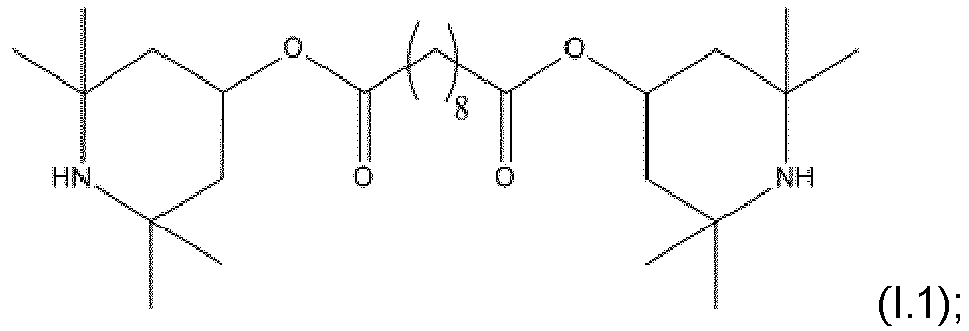


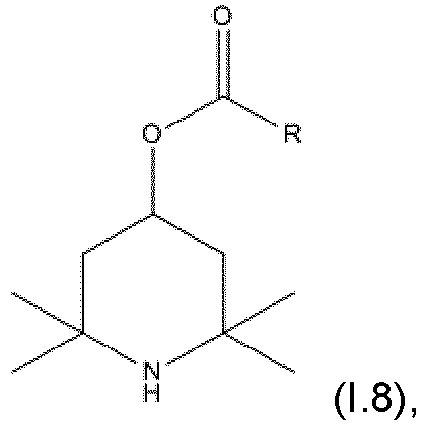
- Ganz besonders bevorzugt handelt es sich bei dem organischen Amin um ein Sebacinsäuredi-4-(2,2,6,6-tetramethylpiperidinyl)-ester, der beispielsweise ist unter dem Markennamen Tinuvin® 770 DF erhältlich ist. Das molare Verhältnis der Liganden zu dem Stabilisator liegt vorzugsweise im Bereich von 0.1 zu 10 bis 10 zu 1, insbesondere in einem Bereich von 5 zu 10 bis 10 zu 5 und ganz besonders in einem Bereich von 0.8 zu 1 bis 1 zu 0.8.
- Das Verfahren gemäß der vorliegenden Erfindung wird in mindestens einer Reaktionszone, vorzugsweise in einer einzigen Reaktionszone durchgeführt. Eine Reaktionszone umfasst im Sinne der vorliegenden Erfindung mindestens einen Reaktor, vorzugsweise mehr als einen Reaktor. Die einzelnen Reaktoren innerhalb der Reaktionszone können parallel oder in Reihe geschaltet vorliegen. In einer besonders bevorzugten Ausführungsform weist die Reaktionszone mindestens zwei parallel geschaltete Reaktoren auf.
- In dem mindestens einen Reaktor liegt eine flüssige Phase vor, die zumindest das Lösemittel und das darin gelöste homogene Katalysatorsystem umfasst. Ist ein Stabilisator anwesend liegt dieser ebenfalls in der flüssigen Phase in dem mindestens einen Reaktor vor. Der mindestens eine Reaktor umfasst auch eine gasförmige Phase. Die Reaktion findet aber in der flüssigen Phase statt, da dort auch das Katalysatorsystem vorhanden ist. Die Zugabe der Edukte, bzw. des Einsatzgemisches, welches die Butene und die Butane enthält, und des Synthesegases erfolgt vorzugsweise am Boden des Reaktors, insbesondere über geeignete und dem Fachmann bekannte Vorrichtungen wie Düsen. Die Zugabe erfolgt in eines besonders bevorzugten Ausführungsform der vorliegenden Erfindung mengengeregelt
- Das hier beschriebene Hydroformylierungsverfahren kann grundsätzlich kontinuierlich oder diskontinuierlich durchgeführt werden. Vorzugsweise wird das Verfahren aber kontinuierlich durchgeführt.
- Die typischen Bedingungen bei der Hydroformylierung sind dem Fachmann. Die Hydroformylierung wird vorzugsweise bei einer Temperatur im Bereich von 65 bis 200 °C, weiterhin bevorzugt bei einer Temperatur im Bereich von 75 bis 175 °C und besonders bevorzugt bei einer Temperatur im Bereich von 85 bis 135 °C, durchgeführt. Der Druck beträgt bei der Hydroformylierung vorzugsweise 10 bis 200 bar, weiterhin bevorzugt 12,5 bis 100 bar, besonders bevorzugt 15 bis 25 bar.
- Wie erwähnt wird bei dem erfindungsgemäßen Verfahren ein Kreisgas, welches zumindest einen Teil der Produktaldehyde, nicht umgesetzte Butene und Butane enthält, aus der Reaktionszone bzw. aus dem mindestens einen Reaktor entnommen. Das entnommene Kreisgas kann anschließend zu einem Aerosolabscheider geführt werden, um mitgerissene und im Kreisgas enthaltene flüssige Schwebeteilchen aus dem Kreisgas zu entfernen. Das im Aerosolabscheider aus dem Kreisgas abgetrennte flüssige Gemisch kann zur Reaktionszone bzw. dem oder den Reaktor(en) zurückgeführt werden. Der Aufbau und die Betriebsweise eines Aerosolabscheiders sind dem Fachmann geläufig. Zur besseren Abscheidung der Aerosole können diese Abscheider auch mit einer Waschflüssigkeit beaufschlagt werden oder entsprechende Waschkolonnen, wie sie ebenfalls dem Fachmann geläufig sind, eingesetzt werden.
- Das Kreisgas kann nach dem Aerosolabscheider zu einem Kondensator geführt werden, wodurch die im Kreisgas enthaltenen Produktaldehyde, das nicht umgesetzte Buten, das Butan und das Lösemittel zumindest partiell auskondensiert werden. Der Kondensator wird vorzugsweise bei einer Temperatur unterhalb der Reaktionstemperatur betrieben. Die Temperatur im Kondensator kann zwischen 30 bis 100 °C betragen. Besonders bevorzugt ist eine Temperatur von 70 bis 90 °C. Das Synthesegas bleibt dabei in der Gasphase und wird nicht auskondensiert. Im Kondensator sind dann also eine flüssige Phase, in der die zumindest partiell auskondensierten Bestandteile, also die Produktaldehyde, das nicht umgesetzte Buten, das Butan und das Lösemittel, enthalten sind, und eine Gasphase, die das Synthesegas umfasst, vorhanden.
- Die auskondensierte flüssige Phase und die Gasphase können in einem Phasentrenner voneinander getrennt werden. Die erhaltene Gasphase wird vorzugsweise über einen Kreisgasverdichter zur Reaktionszone bzw. dem oder den Reaktoren zurückgeführt. Die auskondensierte flüssige Phase wird vorzugsweise einer Rohproduktabtrennung unterworfen, die aus einer oder mehreren Destillationskolonnen bestehen kann. Dabei werden die nicht umgesetzten Butene und die Butane (Rest-C4) vom Rohprodukt, welches zumindest die gebildeten Aldehyde und ggf. hochsiedende Nebenprodukte und/oder das Lösemittel enthält, abgetrennt. Dem Fachmann sind die Bedingungen für die Destillation bekannt. Das Rohprodukt kann dann in nachfolgenden Reaktionsschritten eingesetzt werden.
- Sofern INB als Lösemittel eingesetzt wird, kann für die vollständige Abtrennung des Lösemittels eine zusätzliche Lösemittelabtrennung vorteilhaft und gegebenenfalls notwendig sein. INB ist vergleichsweise leicht flüchtig, was bei einer Erhöhung der Kreisgasmenge dazu führt, dass verstärkt INB mit dem Kreisgas ausgetragen wird. Das INB kann in nachfolgenden Verfahrens- oder Reaktionsschritten jedoch zu Problemen führen und muss daher abgetrennt werden. Die dazu einsetzbare Lösemittelabtrennung besteht aus mindestens einer Destillationskolonne. Dabei wird das Rohprodukt aus der Rohproduktabtrennung eingesetzt und das Lösemittel und ggf. die hochsiedenden Nebenprodukte von den C5-Aldehyden abgetrennt. Das Lösemittel kann dann zurück zum Reaktor geführt werden. Sofern hochsiedende Nebenprodukte vorhanden sind, kann es vorteilhaft sein einen Purge, also ein Ausschleusen eines Teils des Rezyklats vorzusehen, um die hochsiedenden Nebenprodukte nicht im Reaktor anzureichern.
- Es ist aber auch möglich die Rohprodukteabtrennung und die Lösemittelabtrennung in einer einzigen Destillationskolonne vorzusehen. Das ist beispielsweise mit einer Trennwandkolonne möglich, wo das Rest-C4 am Kopf anfällt, das Lösemittel und ggf. die hochsiedenden Nebenprodukte im Sumpf anfallen und die C5-Aldehyde dazwischen abgenommen werden können.
- Wird DINCH als Lösemittel eingesetzt, ist eine zusätzliche Lösemittelabtrennung nicht erforderlich. DINCH hat einen höheren Siedepunkt und ist weniger flüchtig als INB. Trotz einer Erhöhung der Kreisgasmenge wird kein oder zumindest nicht mehr Lösemittel mit dem Kreisgas ausgetragen.
- Der erhaltene Produktaldehyd kann in einer bevorzugten Ausführungsform einem nachfolgenden Reaktionsschritt, beispielsweise einer Hydrierung, einer Aldolisierung (Aldolkondensation), einer Oxidation zu einer Carbonsäure oder einer Umsetzung zum Amin unterworfen werden.
- Ein weiterer Gegenstand im Rahmen der vorliegenden Erfindung ist ein flüssiges Gemisch, umfassend ein Aldehyd, Cobalt oder Rhodium, einen organischen Phosphor-enthaltenden Liganden und ein Lösemittel, wobei die Aldehydkonzentration in dem flüssigen Gemisch unter 15 Masse-% liegt. Als Lösemittel können dem Fachmann bekannte Lösemittel eingesetzt werden. Als Lösemittel für das erfindungsgemäße Verfahren können insbesondere INB (Isononylbenzoat) oder DINCH (1,2-Cyclohexandicarbonsäurediisononylester) eingesetzt werden. Als Ligand werden vorzugsweise Phosphoresterverbindungen, insbesondere Mono- oder Biphosphitliganden eingesetzt, die dem Fachmann grundsätzlich bekannt sind. Geeignete Liganden sind oben bereits genannt worden und meinen insbesondere einen Liganden nach der Formel (1). Dieses Gemisch ist insbesondere das flüssigen Reaktionsgemisch aus dem erfindungsgemäßen Verfahren zur Herstellung von C5-Aldehyden.
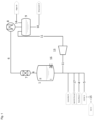
- In der
Fig. 1 wird das erfindungsgemäße Verfahren exemplarisch erläutert. Das Verfahren findet in einem Reaktionsbehälter (1) statt, in dem eine flüssige Reaktionsphase (I), bestehend aus Lösemittel und dem homogen gelösten Katalysatorsystem, vorliegt. Der Reaktionsbehälter (1) enthält auch eine freie Gasphase (II) und kann zudem über einen internen Wärmetauscher (16) geheizt oder gekühlt werden. Es werden kontinuierlich Synthesegas (VI) und Edukt (V), also das eingesetzte Olefin bzw. ein olefinhaltiger Kohlenwasserstoffstrom, in den In den Reaktionsbehälter (1) gefahren, wobei das Edukt (V) wahlweise in gasförmiger oder flüssiger Form zugegeben werden kann. Dem Synthesegas (VI) kann wahlweise zusätzlich Wasserstoff (VII) zugegeben werden. Weiterhin kann dem Reaktionsbehälter (1) eine Ligandenlösung (IV) und/oder das Lösemittel (III) in flüssiger Form zugeführt werden, um eventuelle Verluste auszugleichen. - Über das Kreisgassystem, welches in diesem Schema aus einem Verdichter (13), einem Aerosolabscheider (7), einem Kondensator (8), einem Phasentrennbehälter (9) und einem Rohrleitungssystem (6,11), welches die Komponenten des Kreisgassystems miteinander verbindet, wird ein kontinuierlicher Gasstrom aus dem Reaktionsbehälter (1) entnommen. Dieser Gasstrom wird durch den Verdichter (13) aufgebaut und kann aktiv verändert werden. Der Gasstrom wird von unten in die flüssige Reaktionsphase (I) geleitet. Das zugeführte Edukt (V) und das Synthesegas (VI) reagieren in der flüssigen Phase zu den entsprechenden Aldehyden. Über deren Partialdruck gehen die entstandenen Produkte und nicht umgesetzte Edukte in die Gasphase (II) über und verlassen den Reaktionsbehälter (1). Der entnommene Gasstrom wird anschließend durch einen Aerosolabscheider (7) geleitet, in dem die mitgerissenen Anteile der Reaktionsphase (I) abgeschieden und wieder in den Reaktionsbehälter (1) zurückgeleitet werden. Der erhaltene Gasstrom gelangt dann zu einem nachfolgenden Kondensator (8), wo die Temperatur so weit abgesenkt wird, dass die verbliebenden Edukte und Produkte zumindest teilweise aus der Gasphase auskondensiert. Die dadurch entstehende flüssige Phase (produkthaltig) und die gasförmige Phase werden zusammen in den Phasentrennbehälter (9) geleitet. Dort werden die produkthaltige Flüssigphase und Gasphase voneinander getrennt. Über die Rohrleitung (10) wird das flüssige Rohprodukt (IX) zur weiteren Aufarbeitung geleitet. Die Gasphase aus dem Phasentrennbehälter (9) wird auf die Saugseite des Verdichters (13) geleitet und zurück zum Reaktionsbehälter (1) geführt. Der Anlagendruck kann mit der Rohrleitung (14) über das Abgas (IIX) geregelt werden.
- Die vorliegende Erfindung wird nachfolgend anhand von Beispielen erläutert. Diese Beispiele sind nur eine Veranschaulichung der vorliegenden Erfindung und nicht einschränkend zu verstehen.
- Vor Start der Reaktion wurde das gesamte System mit Stickstoff inertisiert und anschließend mit Synthesegas stickstofffrei (kleiner 5% N2) gespült und anschließend bis auf 14bar (abs.) mit Synthesegas aufgedrückt. Insgesamt wurden in den Reaktionsbehälter vor Start etwa 30m3 Reaktionsphase vorgelegt.
- Diese wurde zuvor wie folgt angesetzt. Jeweils 5 m3 Isononylbenzoat (INB) wurden in einem inertisierten Ansatzbehälter für 5h mit Stickstoff durchspült, um gelösten Sauerstoff zu entfernen. Als nächstes wurden 140kg Tinuvin 770DF, 130 kg Ligand mit der in Formel (1) gezeigten Struktur und 11 kg Acetylacetonato(dicarbonyl)rhodium(I) über eine mit Stickstoff inertisierte Pulverschleuse zum INB gegeben. Dieser Ansatz wurde auf 60°C aufgeheizt und nachdem sich der Feststoff aufgelöst hatte, wurde der Inhalt in den Reaktionsbehälter gefahren. Die Verfolgung der Ligandenkonzentration in der Reaktionsphase ist durch eine Probennahme aus dem Reaktionssystem mit anschließender Analytik über eine HPLC Methode möglich. Bei dieser Methode kann ebenfalls der oxidierte Anteil des Liganden bestimmt werden. Der Oxidationsanteil lag unter 10% der eingesetzten Ligandenmenge.
- Im nächsten Schritt wurde der Kreisgasverdichter angefahren. Die Reaktionsphase wurde auf 120°C aufgeheizt. Der spätere Reaktionsdruck vom 17bar (abs) wurde über ein Regelventil im Abgasstrom eingestellt. Überschüssiger Druck im Reaktionssystem wurde während der Aufheizphase über diesen Weg abgebaut.
- Nach Erreichen der Reaktionstemperatur wurde die Eduktdosierung mit 4500 kg/h gestartet. Das Synthesegas wurde in einem stöchiometrischem Verhältnis von 1:1.2 zum Butengehalt im Edukt gefahren. Als Edukt kam ein C4-Strom mit einer Zusammensetzung von 35% Butenen (Mischung aus 1 und 2 Butenen) und 65% n-Butan zum Einsatz.
- Durch die Zugabe des Eduktes und durch die Reaktion erhöhte sich das Volumen der Reaktionsphase auf 50 m3. Um den Stand auf einem konstanten Niveau zu halten, wurde das Kreisgas entsprechend angepasst. Der Anteil des nicht im Komplex gebundenen Liganden wurde durch regelmäßige Probenahme und Analytik mittels HPLC bestimmt und durch Oxidation abgebauter Ligand wurde durch Dosierung von Liganden ersetzt. Dazu wurde unter inerten Bedingungen der Ligand und Tinuvin 770 DF im C4-freien Rohaldehyd gelöst und in die Reaktionsphase gefahren. Dadurch wurde das Verhältnis zwischen Rhodium in der Reaktion und dem nichtgebundenen Liganden konstant gehalten.
- Aus der nachgefahrenen Masse Ligand und der produzierten Masse an Aldehyd ergibt sich ein Ligandeneinsatzfaktor in kg Ligand pro Tonne hergestelltem Aldehyd. Der Einsatzfaktor Ligand berechnet sich wie folgt:

- Dieser wird in diesem Beispiel gleich 100% unter diesen Bedingungen gesetzt und dient als Referenz für Beispiel 2. Gleichzeitig wurde aus der Probe, mittels gaschromatographischer Analyse, der Aldehydgehalt in der Reaktionslösung bestimmt. Im Mittel betrug der Aldehydgehalt 15 Masse%.
- Aus den stündliche hergestellten Molen Aldehyd und stündlich eingesetzten Molen Butene wurde zudem die Ausbeute nach der folgenden Formel errechnet. Es stelle sich eine Ausbeute von 60% ein.

- Der Versuch wurde analog zu Beispiel 1 angesetzt und gestartet. Allerdings wurde die Kreisgasmenge so gefahren, dass die Aldehydkonzentration in der Reaktionsphase im Mittel 13% betrug. Standverluste wurden durch Nachfahren von Lösemittel, in diesem Fall INB, ausgeglichen.
- Analog zum Beispiel 1 wurden auch in diesem Beispiel die Anteile des freien Liganden und die Ausbeute bestimmt. Wie auch schon im Beispiel 1 wird der Ligandeneinsatzfaktor in kg pro Tonne hergestelltem Aldehyd bestimmt. Der Ligandeneinsatzfaktor betrug nur 75% bezogen auf Beispiel 1. Eine Übersicht über die ermittelten Daten findet sich in Tabelle 1.
Tabelle 1: Übersicht über die Reaktionsdaten Beispiel 1 (nicht erfindungsgemäß) Beispiel 2 (erfindungsgemäß) Einsatzfaktor 100 % 75 % Aldehydkonzentration in der Reaktionsphase 15% 13 % Ausbeute 60% 55 %
Claims (15)
- Verfahren zur Herstellung von C5-Aldehyden durch Hydroformylierung von Butenen, bei der die Butene mit Synthesegas in mindestens einer Reaktionszone in Gegenwart eines homogen Katalysatorsystems und eines Lösemittels umgesetzt werden, wobei aus der Reaktionszone ein Kreisgas entnommen wird, welches zumindest einen Teil der Produktaldehyde, nicht umgesetzte Butene und Butane enthält, dadurch gekennzeichnet, dass die Aldehydkonzentration in der flüssigen Reaktionsmischung im Reaktor durch das Kreisgas unter 15 Masse-% gehalten wird.
- Verfahren nach Anspruch 1, wobei das aus der Reaktionszone entnommene Kreisgas zunächst zu einem Aerosolabscheider geführt wird.
- Verfahren nach Anspruch 2, wobei das Kreisgas nach dem Aerosolabscheider zu einem Kondensator geführt wird, wodurch die im Kreisgas enthaltenen Produktaldehyde, nicht umgesetzte Butene und das Lösemittel auskondensiert werden.
- Verfahren nach Anspruch 3, wobei die kondensierte, flüssige Phase und die Gasphase in einem Phasentrenner voneinander getrennt werden.
- Verfahren nach Anspruch 4, wobei die Gasphase über einen Kreisgasverdichter zur Reaktionszone zurückgeführt wird.
- Verfahren nach Anspruch 4 oder 5, wobei die kondensierte flüssige Phase einer C4/C5-Trennung geführt wird, die aus einer oder mehreren Destillationskolonnen besteht.
- Verfahren nach Anspruch 6, wobei die vorher abgetrennten Produktaldehyde und das Lösemittel in einer Lösemittelabtrennung voneinander getrennt werden und das Lösemittel zurück zum Reaktor geführt wird.
- Verfahren nach einem der Ansprüche 1 bis 7, wobei das Lösemittel einen höheren Siedepunkt als die Produktaldehyde aufweist.
- Verfahren nach einem der Ansprüche 1 bis 8, wobei das Lösemittel INB (Isononylbenzoat) oder DINCH (1,2-Cyclohexandicarbonsäurediisononylester) ist.
- Verfahren nach einem der Ansprüche 1 bis 9, wobei die Hydroformylierung in der Reaktionszone zusätzlich in Anwesenheit eines Stabilisators stattfindet.
- Verfahren nach Anspruch 10, wobei der Stabilisator eine organische Aminverbindung ist, die mindestens eine 2,2,6,6-Tetramethylpiperidineinheit nach Formel (I) enthält:

- Verfahren nach einem der Ansprüche 1 bis 11, wobei das homogene Katalysatorsystem ein Metall aus der 8. oder 9. Gruppe des Periodensystems der Elemente und mindestens einen organischen Phosphor-enthaltenden Liganden umfasst, vorzugsweise einen Mono- oder Biphosphitliganden.
- Verfahren nach Anspruch 12, wobei das Metall Eisen, Ruthenium, Iridium, Cobalt oder Rhodium, vorzugsweise Cobalt und Rhodium ist.
- Verfahren nach einem der Ansprüche 1 bis 13, wobei das homogene Katalysatorsystem Rhodium und einen Liganden mit der Struktur nach Formel (1) umfasst:

- Flüssiges Gemisch, umfassend ein Aldehyd, Cobalt oder Rhodium, einen organischen Phosphor-enthaltenden Liganden und ein Lösemittel, wobei die Aldehydkonzentration in dem flüssigen Gemisch unter 15 Masse-% liegt.
Priority Applications (6)
| Application Number | Priority Date | Filing Date | Title |
|---|---|---|---|
| EP22171287.0A EP4273119A1 (de) | 2022-05-03 | 2022-05-03 | Verfahren zur herstellung von c5-aldehyden |
| CN202310431990.3A CN117003624A (zh) | 2022-05-03 | 2023-04-20 | 制备c5醛的方法 |
| KR1020230055117A KR20230155356A (ko) | 2022-05-03 | 2023-04-27 | C5 알데히드를 제조하는 방법 |
| JP2023072990A JP2023165642A (ja) | 2022-05-03 | 2023-04-27 | C5アルデヒドの調製方法 |
| US18/310,975 US11840506B2 (en) | 2022-05-03 | 2023-05-02 | Process for preparing C5 aldehydes |
| MYPI2023002649A MY209145A (en) | 2022-05-03 | 2023-05-03 | Process for preparing c5 aldehydes |
Applications Claiming Priority (1)
| Application Number | Priority Date | Filing Date | Title |
|---|---|---|---|
| EP22171287.0A EP4273119A1 (de) | 2022-05-03 | 2022-05-03 | Verfahren zur herstellung von c5-aldehyden |
Publications (1)
| Publication Number | Publication Date |
|---|---|
| EP4273119A1 true EP4273119A1 (de) | 2023-11-08 |
Family
ID=81580163
Family Applications (1)
| Application Number | Title | Priority Date | Filing Date |
|---|---|---|---|
| EP22171287.0A Pending EP4273119A1 (de) | 2022-05-03 | 2022-05-03 | Verfahren zur herstellung von c5-aldehyden |
Country Status (6)
| Country | Link |
|---|---|
| US (1) | US11840506B2 (de) |
| EP (1) | EP4273119A1 (de) |
| JP (1) | JP2023165642A (de) |
| KR (1) | KR20230155356A (de) |
| CN (1) | CN117003624A (de) |
| MY (1) | MY209145A (de) |
Citations (3)
| Publication number | Priority date | Publication date | Assignee | Title |
|---|---|---|---|---|
| DE102008002187A1 (de) | 2008-06-03 | 2009-12-10 | Evonik Oxeno Gmbh | Verfahren zur Herstellung von C5-Aldehydgemischen mit hohem n-Pentanalanteil |
| WO2014056736A1 (de) | 2012-10-12 | 2014-04-17 | Evonik Degussa Gmbh | Gemisch von bisphosphiten und dessen verwendung als katalysatorgemisch in der hydroformylierung |
| WO2017080690A1 (de) | 2015-11-09 | 2017-05-18 | Evonik Degussa Gmbh | Wirtschaftliche herstellung von 2-propylheptanol |
-
2022
- 2022-05-03 EP EP22171287.0A patent/EP4273119A1/de active Pending
-
2023
- 2023-04-20 CN CN202310431990.3A patent/CN117003624A/zh active Pending
- 2023-04-27 JP JP2023072990A patent/JP2023165642A/ja active Pending
- 2023-04-27 KR KR1020230055117A patent/KR20230155356A/ko active Pending
- 2023-05-02 US US18/310,975 patent/US11840506B2/en active Active
- 2023-05-03 MY MYPI2023002649A patent/MY209145A/en unknown
Patent Citations (6)
| Publication number | Priority date | Publication date | Assignee | Title |
|---|---|---|---|---|
| DE102008002187A1 (de) | 2008-06-03 | 2009-12-10 | Evonik Oxeno Gmbh | Verfahren zur Herstellung von C5-Aldehydgemischen mit hohem n-Pentanalanteil |
| WO2014056736A1 (de) | 2012-10-12 | 2014-04-17 | Evonik Degussa Gmbh | Gemisch von bisphosphiten und dessen verwendung als katalysatorgemisch in der hydroformylierung |
| WO2014056735A1 (de) | 2012-10-12 | 2014-04-17 | Evonik Degussa Gmbh | Gemische konstitutionsisomerer bisphosphite |
| WO2014056737A1 (de) | 2012-10-12 | 2014-04-17 | Evonik Degussa Gmbh | Gemisch aus verschiedenen unsymmetrischen bisphosphiten und dessen verwendung als katalysatorgemisch in der hydroformylierung |
| WO2014056732A1 (de) | 2012-10-12 | 2014-04-17 | Evonik Industries Ag | Langzeitstabiles verfahren zur herstellung von c5-aldehyden |
| WO2017080690A1 (de) | 2015-11-09 | 2017-05-18 | Evonik Degussa Gmbh | Wirtschaftliche herstellung von 2-propylheptanol |
Also Published As
| Publication number | Publication date |
|---|---|
| US20230357117A1 (en) | 2023-11-09 |
| CN117003624A (zh) | 2023-11-07 |
| JP2023165642A (ja) | 2023-11-16 |
| KR20230155356A (ko) | 2023-11-10 |
| MY209145A (en) | 2025-06-24 |
| US11840506B2 (en) | 2023-12-12 |
Similar Documents
| Publication | Publication Date | Title |
|---|---|---|
| EP2802550B1 (de) | Langzeitstabiles verfahren zur herstellung von c5-aldehyden | |
| DE69017346T2 (de) | Verfahren zur Hydroformylierung von Olefinen. | |
| EP1193239B1 (de) | Stabilisierung von Rhodiumkatalysatoren für die Hydroformylierung von Olefinen | |
| EP1674441B1 (de) | Verfahren zur Hydroformylierung von Olefinen | |
| EP0114611B2 (de) | Verfahren zur kontinuierlichen Hydroformylierung olefinisch ungesättigter Verbindungen | |
| DE69916755T2 (de) | Verfahren zur Herstellung von Alkoholen | |
| DE2715685C2 (de) | Kontinuierliches Verfahren zur Herstellung von Aldehyden mit 3 bis 6 Kohlenstoffatomen durch Hydroformylierung von α-Olefinen | |
| WO2021160448A1 (de) | Niederdruckhydroformylierung von diisobuten | |
| DE3232557A1 (de) | Verfahren zur herstellung eines alkohols durch hydroformylierung | |
| DE69414361T2 (de) | Verfahren zur herstellung von acetanhydrid oder einer mischung von acetanhydrid und essigsäure | |
| EP1231198B1 (de) | Hydroformylierung | |
| DE69108567T2 (de) | Kontinuierliches verfahren zur herstellung von essigsäureanhydrid oder einer mischung von essigsäureanhydrid und essigsäure. | |
| DE2531103C3 (de) | Verfahren zur Herstellung von Alkoholen | |
| EP0008412B1 (de) | Verfahren zur Herstellung von Butandicarbonsäureestern | |
| DE102009016651B4 (de) | Verfahren zur Herstellung von Aldehyden | |
| EP2448892B1 (de) | Verfahren zur herstellung von geruchsarmem n-butan | |
| DE2802923C2 (de) | Verfahren zur kontinuierlichen Herstellung von Butyraldehyden | |
| EP0042928B1 (de) | Verfahren zur Herstellung von Fettsäureestern | |
| DE3220316A1 (de) | Verfahren zur herstellung von carbonsaeureestern | |
| EP4008709B1 (de) | Verfahren zur herstellung polyzyklischer aliphatischer dialdehyde | |
| EP3301084B1 (de) | Kontinuierliches herstellungsverfahren für 2-methylenalkanale | |
| EP0053792B1 (de) | Verfahren zur Herstellung von Ethanol und n-Propanol aus Methanol | |
| DE3017651A1 (de) | Verfahren zur hydroformylierung von olefinen | |
| DE10035370A1 (de) | Verfahren zur Hydroformylierung von Olefinen mit 2 bis 4 Kohlenstoffatomen in einem zweistufigen Reaktionssystem | |
| EP0003985A1 (de) | Verfahren zur Hydroformylierung von Olefinen |
Legal Events
| Date | Code | Title | Description |
|---|---|---|---|
| PUAI | Public reference made under article 153(3) epc to a published international application that has entered the european phase |
Free format text: ORIGINAL CODE: 0009012 |
|
| STAA | Information on the status of an ep patent application or granted ep patent |
Free format text: STATUS: THE APPLICATION HAS BEEN PUBLISHED |
|
| AK | Designated contracting states |
Kind code of ref document: A1 Designated state(s): AL AT BE BG CH CY CZ DE DK EE ES FI FR GB GR HR HU IE IS IT LI LT LU LV MC MK MT NL NO PL PT RO RS SE SI SK SM TR |
|
| RAP1 | Party data changed (applicant data changed or rights of an application transferred) |
Owner name: EVONIK OXENO GMBH & CO. KG |
|
| STAA | Information on the status of an ep patent application or granted ep patent |
Free format text: STATUS: REQUEST FOR EXAMINATION WAS MADE |
|
| 17P | Request for examination filed |
Effective date: 20231127 |
|
| RBV | Designated contracting states (corrected) |
Designated state(s): AL AT BE BG CH CY CZ DE DK EE ES FI FR GB GR HR HU IE IS IT LI LT LU LV MC MK MT NL NO PL PT RO RS SE SI SK SM TR |