EP4254601A1 - Verfahren zur rückgewinnung eines lithiumvorläufers aus verbrauchtem lithiumsekundärbatteriepositivelektrodenmaterial - Google Patents
Verfahren zur rückgewinnung eines lithiumvorläufers aus verbrauchtem lithiumsekundärbatteriepositivelektrodenmaterial Download PDFInfo
- Publication number
- EP4254601A1 EP4254601A1 EP21900950.3A EP21900950A EP4254601A1 EP 4254601 A1 EP4254601 A1 EP 4254601A1 EP 21900950 A EP21900950 A EP 21900950A EP 4254601 A1 EP4254601 A1 EP 4254601A1
- Authority
- EP
- European Patent Office
- Prior art keywords
- positive electrode
- lithium
- electrode material
- secondary battery
- mixture
- Prior art date
- Legal status (The legal status is an assumption and is not a legal conclusion. Google has not performed a legal analysis and makes no representation as to the accuracy of the status listed.)
- Pending
Links
Images
Classifications
-
- C—CHEMISTRY; METALLURGY
- C01—INORGANIC CHEMISTRY
- C01D—COMPOUNDS OF ALKALI METALS, i.e. LITHIUM, SODIUM, POTASSIUM, RUBIDIUM, CAESIUM, OR FRANCIUM
- C01D1/00—Oxides or hydroxides of sodium, potassium or alkali metals in general
- C01D1/04—Hydroxides
- C01D1/28—Purification; Separation
- C01D1/30—Purification; Separation by crystallisation
-
- H—ELECTRICITY
- H01—ELECTRIC ELEMENTS
- H01M—PROCESSES OR MEANS, e.g. BATTERIES, FOR THE DIRECT CONVERSION OF CHEMICAL ENERGY INTO ELECTRICAL ENERGY
- H01M10/00—Secondary cells; Manufacture thereof
- H01M10/54—Reclaiming serviceable parts of waste accumulators
-
- C—CHEMISTRY; METALLURGY
- C01—INORGANIC CHEMISTRY
- C01D—COMPOUNDS OF ALKALI METALS, i.e. LITHIUM, SODIUM, POTASSIUM, RUBIDIUM, CAESIUM, OR FRANCIUM
- C01D15/00—Lithium compounds
- C01D15/02—Oxides; Hydroxides
-
- C—CHEMISTRY; METALLURGY
- C22—METALLURGY; FERROUS OR NON-FERROUS ALLOYS; TREATMENT OF ALLOYS OR NON-FERROUS METALS
- C22B—PRODUCTION AND REFINING OF METALS; PRETREATMENT OF RAW MATERIALS
- C22B1/00—Preliminary treatment of ores or scrap
- C22B1/02—Roasting processes
-
- C—CHEMISTRY; METALLURGY
- C22—METALLURGY; FERROUS OR NON-FERROUS ALLOYS; TREATMENT OF ALLOYS OR NON-FERROUS METALS
- C22B—PRODUCTION AND REFINING OF METALS; PRETREATMENT OF RAW MATERIALS
- C22B23/00—Obtaining nickel or cobalt
- C22B23/04—Obtaining nickel or cobalt by wet processes
- C22B23/0407—Leaching processes
- C22B23/0415—Leaching processes with acids or salt solutions except ammonium salts solutions
- C22B23/043—Sulfurated acids or salts thereof
-
- C—CHEMISTRY; METALLURGY
- C22—METALLURGY; FERROUS OR NON-FERROUS ALLOYS; TREATMENT OF ALLOYS OR NON-FERROUS METALS
- C22B—PRODUCTION AND REFINING OF METALS; PRETREATMENT OF RAW MATERIALS
- C22B23/00—Obtaining nickel or cobalt
- C22B23/04—Obtaining nickel or cobalt by wet processes
- C22B23/0453—Treatment or purification of solutions, e.g. obtained by leaching
- C22B23/0461—Treatment or purification of solutions, e.g. obtained by leaching by chemical methods
-
- C—CHEMISTRY; METALLURGY
- C22—METALLURGY; FERROUS OR NON-FERROUS ALLOYS; TREATMENT OF ALLOYS OR NON-FERROUS METALS
- C22B—PRODUCTION AND REFINING OF METALS; PRETREATMENT OF RAW MATERIALS
- C22B26/00—Obtaining alkali, alkaline earth metals or magnesium
- C22B26/10—Obtaining alkali metals
- C22B26/12—Obtaining lithium
-
- C—CHEMISTRY; METALLURGY
- C22—METALLURGY; FERROUS OR NON-FERROUS ALLOYS; TREATMENT OF ALLOYS OR NON-FERROUS METALS
- C22B—PRODUCTION AND REFINING OF METALS; PRETREATMENT OF RAW MATERIALS
- C22B3/00—Extraction of metal compounds from ores or concentrates by wet processes
- C22B3/04—Extraction of metal compounds from ores or concentrates by wet processes by leaching
- C22B3/06—Extraction of metal compounds from ores or concentrates by wet processes by leaching in inorganic acid solutions, e.g. with acids generated in situ; in inorganic salt solutions other than ammonium salt solutions
- C22B3/08—Sulfuric acid, other sulfurated acids or salts thereof
-
- C—CHEMISTRY; METALLURGY
- C22—METALLURGY; FERROUS OR NON-FERROUS ALLOYS; TREATMENT OF ALLOYS OR NON-FERROUS METALS
- C22B—PRODUCTION AND REFINING OF METALS; PRETREATMENT OF RAW MATERIALS
- C22B47/00—Obtaining manganese
-
- C—CHEMISTRY; METALLURGY
- C22—METALLURGY; FERROUS OR NON-FERROUS ALLOYS; TREATMENT OF ALLOYS OR NON-FERROUS METALS
- C22B—PRODUCTION AND REFINING OF METALS; PRETREATMENT OF RAW MATERIALS
- C22B7/00—Working up raw materials other than ores, e.g. scrap, to produce non-ferrous metals and compounds thereof; Methods of a general interest or applied to the winning of more than two metals
- C22B7/005—Separation by a physical processing technique only, e.g. by mechanical breaking
-
- H—ELECTRICITY
- H01—ELECTRIC ELEMENTS
- H01M—PROCESSES OR MEANS, e.g. BATTERIES, FOR THE DIRECT CONVERSION OF CHEMICAL ENERGY INTO ELECTRICAL ENERGY
- H01M10/00—Secondary cells; Manufacture thereof
- H01M10/05—Accumulators with non-aqueous electrolyte
- H01M10/052—Li-accumulators
-
- H—ELECTRICITY
- H01—ELECTRIC ELEMENTS
- H01M—PROCESSES OR MEANS, e.g. BATTERIES, FOR THE DIRECT CONVERSION OF CHEMICAL ENERGY INTO ELECTRICAL ENERGY
- H01M10/00—Secondary cells; Manufacture thereof
- H01M10/05—Accumulators with non-aqueous electrolyte
- H01M10/052—Li-accumulators
- H01M10/0525—Rocking-chair batteries, i.e. batteries with lithium insertion or intercalation in both electrodes; Lithium-ion batteries
-
- H—ELECTRICITY
- H01—ELECTRIC ELEMENTS
- H01M—PROCESSES OR MEANS, e.g. BATTERIES, FOR THE DIRECT CONVERSION OF CHEMICAL ENERGY INTO ELECTRICAL ENERGY
- H01M4/00—Electrodes
- H01M4/02—Electrodes composed of, or comprising, active material
- H01M4/36—Selection of substances as active materials, active masses, active liquids
- H01M4/48—Selection of substances as active materials, active masses, active liquids of inorganic oxides or hydroxides
- H01M4/50—Selection of substances as active materials, active masses, active liquids of inorganic oxides or hydroxides of manganese
- H01M4/505—Selection of substances as active materials, active masses, active liquids of inorganic oxides or hydroxides of manganese of mixed oxides or hydroxides containing manganese for inserting or intercalating light metals, e.g. LiMn2O4 or LiMn2OxFy
-
- H—ELECTRICITY
- H01—ELECTRIC ELEMENTS
- H01M—PROCESSES OR MEANS, e.g. BATTERIES, FOR THE DIRECT CONVERSION OF CHEMICAL ENERGY INTO ELECTRICAL ENERGY
- H01M4/00—Electrodes
- H01M4/02—Electrodes composed of, or comprising, active material
- H01M4/36—Selection of substances as active materials, active masses, active liquids
- H01M4/48—Selection of substances as active materials, active masses, active liquids of inorganic oxides or hydroxides
- H01M4/52—Selection of substances as active materials, active masses, active liquids of inorganic oxides or hydroxides of nickel, cobalt or iron
- H01M4/525—Selection of substances as active materials, active masses, active liquids of inorganic oxides or hydroxides of nickel, cobalt or iron of mixed oxides or hydroxides containing iron, cobalt or nickel for inserting or intercalating light metals, e.g. LiNiO2, LiCoO2 or LiCoOxFy
-
- H—ELECTRICITY
- H01—ELECTRIC ELEMENTS
- H01M—PROCESSES OR MEANS, e.g. BATTERIES, FOR THE DIRECT CONVERSION OF CHEMICAL ENERGY INTO ELECTRICAL ENERGY
- H01M6/00—Primary cells; Manufacture thereof
- H01M6/52—Reclaiming serviceable parts of waste cells or batteries, e.g. recycling
-
- Y—GENERAL TAGGING OF NEW TECHNOLOGICAL DEVELOPMENTS; GENERAL TAGGING OF CROSS-SECTIONAL TECHNOLOGIES SPANNING OVER SEVERAL SECTIONS OF THE IPC; TECHNICAL SUBJECTS COVERED BY FORMER USPC CROSS-REFERENCE ART COLLECTIONS [XRACs] AND DIGESTS
- Y02—TECHNOLOGIES OR APPLICATIONS FOR MITIGATION OR ADAPTATION AGAINST CLIMATE CHANGE
- Y02W—CLIMATE CHANGE MITIGATION TECHNOLOGIES RELATED TO WASTEWATER TREATMENT OR WASTE MANAGEMENT
- Y02W30/00—Technologies for solid waste management
- Y02W30/50—Reuse, recycling or recovery technologies
- Y02W30/84—Recycling of batteries or fuel cells
Definitions
- the present invention relates to a method for recovering a lithium precursor from a waste lithium secondary battery positive electrode material.
- the demand for the lithium secondary battery has increased.
- the amount of waste lithium secondary batteries has also increased.
- a positive electrode material accounts for more than 60% of the cost of the lithium secondary battery, lithium cobalt oxide (LiCoO 2 ), which has an excellent reversibility, a low self-discharge rate, a high capacity, and a high energy density, and is easy to synthesize, has been used as the positive electrode material.
- lithium has been used in the form of complex oxides such as lithium nickel cobalt manganese oxide (Li(Ni, Co, Mn)O 2 ) containing Ni and Mn, lithium manganese oxide (LiMnO 2 ), and lithium iron phosphate oxide (LiFePO 4 ). Since the positive electrode material as described above contains about 5 to 7% of lithium, a method for recovering a lithium compound from a waste lithium secondary battery positive electrode material has attracted significant attention.
- a process of extracting a waste positive electrode material with strong acids such as hydrochloric acid, sulfuric acid, and nitric acid and then neutralizing the extracted waste positive electrode material with an alkali to precipitate and recover cobalt, nickel, and the like with a hydroxide, or a process of dissolving a positive electrode material with sulfuric acid or nitric acid in the presence of hydrogen peroxide and then separating and recovering metals by neutralization precipitation has been generally used.
- a strong acid should be used in the extraction process, problems such as serious environmental pollution due to evaporation of the acid into the air, in particular, corrosion of equipment by the acid, are serious.
- An object of the present invention is to provide a method for recovering lithium hydroxide from a waste lithium secondary battery positive electrode material with a high yield at a low temperature.
- a method for recovering a lithium precursor includes:
- the firing temperature may be 450°C to 600°C.
- the step b) may be performed in an inert gas atmosphere.
- the water washing may be performed at 20°C to 90°C.
- a lithium hydroxide aqueous solution may be produced through the water washing.
- the step c) may further include crystallizing lithium hydroxide.
- the urea may be mixed in an amount of 5 to 50 parts by weight with respect to 100 parts by weight of the positive electrode material.
- the positive electrode material may be represented by the following Chemical Formula 1: [Chemical Formula 1] Li x Ni a Co b M (1-a-b) O y (in Chemical Formula 1, M is selected from the group consisting of Mn, Na, Mg, Ca, Ti, V, Cr, Cu, Zn, Ge, Sr, Ag, Ba, Zr, Nb, Mo, Al, Ga, and B, 0 ⁇ x ⁇ 1.1, 2 ⁇ y ⁇ 2.02, 0.5 ⁇ a ⁇ 1, and 0 ⁇ b ⁇ 0.5).
- a recovery rate of lithium hydroxide from the waste lithium secondary battery positive electrode material may be 50% or more.
- the method for recovering a lithium precursor from a waste lithium secondary battery positive electrode material according to the present invention has an advantage of recovering lithium hydroxide with a high yield even at a low temperature of 600°C or lower using urea as a reducing agent.
- lithium hydroxide may be efficiently recovered without using a strong acid such as sulfuric acid.
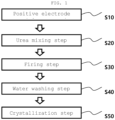
- FIG. 1 is a flowchart illustrating a lithium precursor recovery method according to an embodiment of the present invention.
- precursor used in the present specification is used to comprehensively refer to a compound containing a specific metal to provide the specific metal contained in an electrode active material.
- Batteries for IT devices such as a laptop computer and a smartphone have led the lithium secondary battery market in the past, but recently, high-capacity lithium secondary batteries are leading the market in accordance with the rapid growth of the electric vehicle market.
- lithium hydroxide which may increase the capacity of the lithium secondary battery and is easily synthesized with nickel, has been used as a main raw material.
- nickel has a property of not synthesizing well with lithium at a high temperature.
- the present invention provides a method for recovering a lithium precursor containing lithium hydroxide from a waste lithium secondary battery positive electrode material.
- the recovery method includes a) mixing a waste lithium secondary battery positive electrode material with urea to prepare a first mixture; b) firing the first mixture to prepare a second mixture containing lithium hydroxide; and c) subjecting the second mixture to water washing to separate a lithium precursor, and has an advantage of recovering lithium hydroxide with a high yield at a low temperature.
- the step a) is a step of mixing a waste lithium secondary battery positive electrode material with urea, which is a solid reducing agent, and the recovery method may further include, before the step a), a step of obtaining a positive electrode material from a waste lithium secondary battery.
- the waste lithium secondary battery may include a positive electrode, a negative electrode, and a separator interposed between the positive electrode and the negative electrode, and the positive electrode and the negative electrode may each include a positive electrode or negative electrode active material layer coated onto a positive electrode or negative electrode current collector.
- the waste lithium secondary battery may include a lithium secondary battery that cannot be reused (charged and discharged), for example, a lithium secondary battery whose charge and discharge performance is significantly reduced due to long-term use or a lithium secondary battery destroyed by physical impact or chemical reaction.
- Lithium or a lithium derivative may be recovered by separating a positive electrode from the waste lithium secondary battery and recovering a waste positive electrode.
- the waste positive electrode may include a positive electrode current collector and a positive electrode active material layer, and the positive electrode active material layer may contain a positive electrode active material, a conductive material, and a binder.
- the conductive material may include carbon-based materials such as graphite, carbon black, graphene, and carbon nanotubes
- the binder may include a vinylidene fluoride-hexafluoropropylene copolymer (PVDF-co-HFP), polyvinylidene fluoride (PVDF), polyacrylonitrile, and polymethylmethacrylate.
- the recovered waste positive electrode may be subjected to a heat treatment in an oxidizing atmosphere at 100 to 500°C and preferably 350 to 450°C. Accordingly, substantially all of the conductive material and the binder contained in the positive electrode active material layer may be removed, and may be removed to 95 wt% or more without limitation.
- the waste positive electrode subjected to the heat treatment may be prepared in a powder form by detaching the positive electrode current collector through pulverization. Specifically, the waste positive electrode is pulverized, and then a positive electrode material may be obtained by using a 5 to 100 ⁇ m mesh screening. In this case, the pulverization may be performed using a ball mill, but is not limited thereto.
- Positive electrode current collector components are substantially removed through the process described above, and a positive electrode material from which 90 wt% or more of the carbon-based components derived from the conductive material and the binder are removed may be obtained.
- the positive electrode material may be represented by the following Chemical Formula 1: [Chemical Formula 1] Li x Ni a Co b M (1-a-b) Oy (in Chemical Formula 1, M is selected from the group consisting of Mn, Na, Mg, Ca, Ti, V, Cr, Cu, Zn, Ge, Sr, Ag, Ba, Zr, Nb, Mo, Al, Ga, and B, 0 ⁇ x ⁇ 1.1, 2 ⁇ y ⁇ 2.02, 0.5 ⁇ a ⁇ 1, and 0 ⁇ b ⁇ 0.5).
- a first mixture may be prepared by mixing the urea in an amount of 5 to 50 parts by weight, preferably 7 to 30 parts by weight, and more preferably 10 to 25 parts by weight, with respect to 100 parts by weight of the positive electrode material.
- the mixing may be dry mixing rather than mixing according to addition of a liquid material such as a solvent, and may be performed in a fluidized bed reactor. Specifically, the mixing may be performed at 15 to 90°C,and preferably at 25 to 50°C for 1 to 3 hours.
- the positive electrode material is sufficiently reduced to increase a conversion rate to lithium hydroxide, such that lithium hydroxide may be recovered with a high yield after the step c).
- the step b) is a step of firing the first mixture prepared in the step a) to prepare a second mixture, and may be performed at 450 to 600°C, preferably 470 to 600°C, and more preferably 500 to 550°C for 1 to 4 hours and preferably 2 to 3 hours.
- the firing may be performed in an inert gas atmosphere, and as a non-limiting example, the inert gas may contain argon or nitrogen.
- the inside of the reactor may be replaced with an inert gas atmosphere through a method of purging the inert gas described above.
- the recovery refers to a recovery rate of lithium hydroxide from the waste lithium secondary battery positive electrode material, and specifically, the recovery rate may be a value calculated by analyzing the total content of lithium in the positive electrode material before recovery for use as a reference of 100% and analyzing a content of lithium in the recovered lithium hydroxide.
- the second mixture prepared in the step b) may contain lithium hydroxide (LiOH) and a transition metal-containing mixture.
- the transition metal-containing mixture may contain a transition metal and a transition metal-containing oxide, and the transition metal may include nickel, cobalt, magnesium, and the like.
- the transition metal in the transition metal-containing mixture may be formed by separating the transition metal component in the process of converting the lithium composite oxide, which is the positive electrode material, into lithium hydroxide through the firing in the step b).
- the step c) is a step of subjecting the second mixture prepared in the step b) to water washing, and may be performed at 20 to 90°C and preferably 20 to 60°C.
- distilled water, pure water, or soft water may be used as a washing liquid for the water washing.
- the second mixture and the washing liquid may be mixed at a high liquid ratio of 10 g/L to 500 g/L.
- the water washing may be repeated one to three times, and a process time of one water washing may be 30 minutes to 2 hours.
- an aqueous solution containing lithium hydroxide may be separated from the second mixture.
- the transition metal-containing mixture in the second mixture may be precipitated in the aqueous solution, and a lithium precursor containing high-purity lithium hydroxide may be obtained through a filtration treatment.
- the transition metal-containing mixture separated by precipitation may be treated with an acid solution to form a precursor in the form of each transition metal salt.
- an acid solution may be used as the acid solution to recover transition metal precursors NiSO 4 , MnSO 4 , and CoSO 4 , respectively.
- the step c) may further include a step of crystallizing lithium hydroxide in the separated aqueous solution.
- crystalline lithium hydroxide may be obtained through a process of concentrating the aqueous solution.
- the concentration method may be selected and used without limitation as long as it may be used as a concentration method for obtaining a crystalline form in an aqueous solution, such as vacuum concentration, freeze concentration, evaporation concentration, heat concentration, precipitation concentration, and reverse osmosis concentration.
- FIG. 1 is a view illustrating a flowchart for recovering a lithium precursor from a waste lithium secondary battery according to an embodiment of the present invention.
- lithium hydroxide may be obtained from a waste lithium secondary battery positive electrode material through preparing a waste lithium secondary battery positive electrode material (S10); mixing the positive electrode material with a urea reducing agent (S20); firing the mixed positive electrode material and urea (S30); subjecting the fired product to water washing (S40); and crystallizing the water-washed product (S50).
- S10 waste lithium secondary battery positive electrode material
- S20 urea reducing agent
- S30 urea reducing agent
- S40 water washing
- Step 1 Preparation of Waste Lithium Secondary Battery Positive Electrode Material
- the waste positive electrode After a waste positive electrode separated from a waste lithium secondary battery was subjected to a heat treatment at 400°C for 3 hours, the waste positive electrode was pulverized by milling and then sieved through a sieve having a mesh size of 80 ⁇ m, thereby obtaining a powdered positive electrode material.
- the positive electrode includes a positive electrode active material layer containing LiNi 0.8 Co 0.1 Mn 0.1 O 2 as a positive electrode active material, Denka black as a conductive material, and PVDF as a binder at a weight ratio of 92:5:3.
- Step 2 Recovery of Lithium Precursor from Waste Lithium Secondary Battery Positive Electrode Material
- the lithium conversion rate represents the ratio of the content of lithium in the aqueous solution obtained in the water washing to the total content of lithium in the positive electrode material before the reaction
- the contents (wt%) of the lithium carbonate, lithium hydroxide, and lithium oxide represent the contents with respect to the total weight of the preliminary precursor mixture obtained in the step 2
- the recovery rate of lithium hydroxide represents the content of lithium in the recovered lithium hydroxide with respect to the total content of lithium in the positive electrode material before recovery.
- Comparative Example 1 in which solid carbon was used as a reducing agent, although a firing process was performed under the same conditions as those of Example 1, the contents of lithium hydroxide and lithium carbonate in the obtained product were zero. That is, in a case where solid carbon was used as a reducing agent, it could be appreciated that lithium hydroxide was not produced at all at a temperature of 450°C, and the conversion rate of lithium was also significantly low at 6%.
Landscapes
- Chemical & Material Sciences (AREA)
- Engineering & Computer Science (AREA)
- Organic Chemistry (AREA)
- Materials Engineering (AREA)
- Manufacturing & Machinery (AREA)
- Metallurgy (AREA)
- Mechanical Engineering (AREA)
- Chemical Kinetics & Catalysis (AREA)
- General Chemical & Material Sciences (AREA)
- Inorganic Chemistry (AREA)
- Geology (AREA)
- General Life Sciences & Earth Sciences (AREA)
- Environmental & Geological Engineering (AREA)
- Life Sciences & Earth Sciences (AREA)
- Electrochemistry (AREA)
- Geochemistry & Mineralogy (AREA)
- Secondary Cells (AREA)
- Manufacture And Refinement Of Metals (AREA)
- Inorganic Compounds Of Heavy Metals (AREA)
Applications Claiming Priority (2)
| Application Number | Priority Date | Filing Date | Title |
|---|---|---|---|
| KR1020200166203A KR102915798B1 (ko) | 2020-12-02 | 2020-12-02 | 폐 리튬이차전지 양극재로부터 리튬전구체의 회수방법 |
| PCT/KR2021/017806 WO2022119262A1 (ko) | 2020-12-02 | 2021-11-30 | 폐 리튬이차전지 양극재로부터 리튬전구체의 회수방법 |
Publications (2)
| Publication Number | Publication Date |
|---|---|
| EP4254601A1 true EP4254601A1 (de) | 2023-10-04 |
| EP4254601A4 EP4254601A4 (de) | 2024-06-26 |
Family
ID=81854213
Family Applications (1)
| Application Number | Title | Priority Date | Filing Date |
|---|---|---|---|
| EP21900950.3A Pending EP4254601A4 (de) | 2020-12-02 | 2021-11-30 | Verfahren zur rückgewinnung eines lithiumvorläufers aus verbrauchtem lithiumsekundärbatteriepositivelektrodenmaterial |
Country Status (6)
| Country | Link |
|---|---|
| US (2) | US12258279B2 (de) |
| EP (1) | EP4254601A4 (de) |
| JP (1) | JP2023551615A (de) |
| KR (1) | KR102915798B1 (de) |
| CN (1) | CN116635330A (de) |
| WO (1) | WO2022119262A1 (de) |
Families Citing this family (8)
| Publication number | Priority date | Publication date | Assignee | Title |
|---|---|---|---|---|
| KR102847293B1 (ko) * | 2020-03-19 | 2025-08-14 | 에스케이이노베이션 주식회사 | 양극 활물질용 분급기 및 이를 이용한 리튬 전구체 재생 방법 |
| US12548847B2 (en) | 2022-12-07 | 2026-02-10 | Samsung Sdi Co., Ltd. | Rechargeable battery module |
| KR102745891B1 (ko) * | 2023-05-12 | 2024-12-23 | 주식회사 이지마이닝 | 수소 포집 방법 |
| TW202444646A (zh) * | 2023-05-12 | 2024-11-16 | 南韓商易希麥寧股份有限公司 | 收集氫氣之方法 |
| KR102720389B1 (ko) * | 2023-07-18 | 2024-10-23 | (주)에코프로머티리얼즈 | 폐전지 소재 및 폐양극재로부터 유가 금속을 회수하는 방법 |
| CN118970253B (zh) * | 2024-06-12 | 2025-04-01 | 苏州四面体新能源科技有限公司 | 一种废旧磷酸铁锂正极材料的回收利用方法 |
| KR20260034951A (ko) * | 2024-09-05 | 2026-03-12 | 포스코에이치와이클린메탈 주식회사 | 리튬인산철 양극재용 원료의 제조방법 |
| CN119528101A (zh) * | 2024-11-11 | 2025-02-28 | 孝感楚能新能源创新科技有限公司 | 一种废旧磷酸铁锂电池正极材料回收再生方法、正极材料、正极片、二次电池和用电装置 |
Family Cites Families (26)
| Publication number | Priority date | Publication date | Assignee | Title |
|---|---|---|---|---|
| JP3485208B2 (ja) | 1994-10-13 | 2004-01-13 | 三井金属鉱業株式会社 | ニッケル−水素吸蔵合金二次電池からの有効成分回収方法 |
| CN101499547A (zh) | 2008-02-01 | 2009-08-05 | 比亚迪股份有限公司 | 一种废锂离子电池正极材料的回收方法 |
| US8709126B1 (en) * | 2010-02-03 | 2014-04-29 | Stc.Unm | Generation of metal and alloy micron, submicron, or nano particles in simple, rapid process |
| JP2013001951A (ja) * | 2011-06-16 | 2013-01-07 | Hitachi Ltd | 透析促進剤および金属回収方法 |
| US20160028105A1 (en) * | 2013-04-05 | 2016-01-28 | Brookhaven Science Associates, Llc | Cubic Ionic Conductor Ceramics for Alkali Ion Batteries |
| KR101598186B1 (ko) * | 2014-09-16 | 2016-02-26 | 국방과학연구소 | 양극 활물질용 복합금속산화물의 제조방법 및 이를 이용한 전극, 리튬 이차전지, 커패시터 |
| KR101802071B1 (ko) | 2016-05-20 | 2017-11-27 | (주)이엠티 | 습식 분쇄법을 이용하여 폐 리튬전지 양극물질로부터 리튬화합물을 회수하는 방법 |
| KR101731213B1 (ko) | 2016-05-26 | 2017-04-27 | (주)이엠티 | 폐 리튬전지로부터 리튬화합물을 회수하는 방법 |
| KR101828168B1 (ko) | 2016-08-23 | 2018-02-09 | 부경대학교 산학협력단 | 탄산리튬 회수 방법 및 탄산리튬 회수 시스템 |
| KR101682217B1 (ko) | 2016-09-02 | 2016-12-05 | 주식회사 재영텍 | 폐 리튬이온 2차전지의 양극재로부터 리튬을 회수하여 고순도 탄산리튬을 제조하는 방법 |
| US11621416B2 (en) * | 2017-10-09 | 2023-04-04 | Csir Campus | Cathode material |
| CA3083334A1 (en) * | 2017-12-19 | 2019-06-27 | Basf Se | Battery recycling by treatment of the leach with metallic nickel |
| KR101897134B1 (ko) * | 2018-04-09 | 2018-09-10 | 에스케이이노베이션 주식회사 | 리튬 전구체 재생 방법 |
| CN108649291A (zh) * | 2018-05-24 | 2018-10-12 | 北京化工大学 | 一种以废旧锂离子电池为原料回收镍钴锰酸锂正极材料的工艺 |
| CN110643814B (zh) * | 2018-06-26 | 2020-09-04 | 中南大学 | 一种除铝以及废旧磷酸铁锂电池回收的方法 |
| PL3821043T3 (pl) | 2018-07-10 | 2026-02-02 | Basf Se | Sposób recyklingu zużytych ogniw litowo-jonowych |
| CN109817904B (zh) * | 2018-12-29 | 2020-05-12 | 广东邦普循环科技有限公司 | 一种高电压长循环高镍单晶正极材料及其制备方法和应用 |
| CN110137469A (zh) * | 2019-05-16 | 2019-08-16 | 湖南鸿捷新材料有限公司 | 一种废旧锂离子电池石墨负极材料再生的方法 |
| TWI877188B (zh) * | 2019-07-26 | 2025-03-21 | 德商巴斯夫歐洲公司 | 自廢鋰離子電池中回收鋰之方法 |
| CN111115712A (zh) * | 2019-12-24 | 2020-05-08 | 赵世福 | 一种分解钴酸锂的方法 |
| CN111333123A (zh) | 2020-02-14 | 2020-06-26 | 中南大学 | 一种从废旧锂离子三元正极材料中浸出有价金属和制备三元正极材料前驱体的方法 |
| CN111807417B (zh) * | 2020-04-28 | 2023-01-20 | 廊坊师范学院 | 一种利用聚二醇/硫脲型低共熔溶剂溶解提取钴酸锂的方法 |
| CN111600089A (zh) | 2020-06-01 | 2020-08-28 | 宁波大学 | 一种废旧三元锂电池正极材料回收循环利用工艺 |
| CN111600090A (zh) * | 2020-06-02 | 2020-08-28 | 南方科技大学 | 一种回收废旧锂电池的工艺 |
| CN112054265A (zh) * | 2020-09-30 | 2020-12-08 | 合肥国轩高科动力能源有限公司 | 废旧三元锂离子电池正极材料回收再利用方法 |
| CN112397804B (zh) * | 2020-11-27 | 2021-09-24 | 唐山学院 | 一种从锂电池正极回收四氧化三铁/碳材料和锂盐的方法 |
-
2020
- 2020-12-02 KR KR1020200166203A patent/KR102915798B1/ko active Active
-
2021
- 2021-11-30 WO PCT/KR2021/017806 patent/WO2022119262A1/ko not_active Ceased
- 2021-11-30 US US18/255,807 patent/US12258279B2/en active Active
- 2021-11-30 EP EP21900950.3A patent/EP4254601A4/de active Pending
- 2021-11-30 CN CN202180081599.4A patent/CN116635330A/zh active Pending
- 2021-11-30 JP JP2023533893A patent/JP2023551615A/ja active Pending
-
2025
- 2025-02-21 US US19/059,260 patent/US20250187936A1/en active Pending
Also Published As
| Publication number | Publication date |
|---|---|
| JP2023551615A (ja) | 2023-12-11 |
| CN116635330A (zh) | 2023-08-22 |
| WO2022119262A1 (ko) | 2022-06-09 |
| EP4254601A4 (de) | 2024-06-26 |
| US20250187936A1 (en) | 2025-06-12 |
| KR20220077354A (ko) | 2022-06-09 |
| US12258279B2 (en) | 2025-03-25 |
| KR102915798B1 (ko) | 2026-01-21 |
| US20230416103A1 (en) | 2023-12-28 |
Similar Documents
| Publication | Publication Date | Title |
|---|---|---|
| EP4254601A1 (de) | Verfahren zur rückgewinnung eines lithiumvorläufers aus verbrauchtem lithiumsekundärbatteriepositivelektrodenmaterial | |
| US12519150B2 (en) | Method for recovering active metal of lithium secondary battery | |
| CN111430829B (zh) | 一种生物质废料协助下的废旧锂电池正极材料回收再生方法 | |
| US20240039070A1 (en) | Method of recycling positive electrode active material and recycled positive electrode active material prepared by the same | |
| EP4152476A1 (de) | Verfahren zur rückgewinnung von kathodenmaterial | |
| KR20190119329A (ko) | 리튬이온 2차전지의 폐 양극재를 이용한 수산화리튬 일수화물의 제조방법 | |
| KR20170052012A (ko) | 리튬 이차전지의 제조공정에 있어서의 폐 리튬 이차전지 전극의 재활용 방법 | |
| US20240262703A1 (en) | Method for recovering lithium precursor from lithium secondary battery | |
| KR20220134387A (ko) | 폐양극활물질로부터 유가 금속을 회수하는 방법 | |
| EP4029830A1 (de) | Rückgewinnungsverfahren für lithium-vorläufer | |
| KR20210009133A (ko) | 리튬 이차전지용 폐 양극물질로부터 리튬 또는 리튬 화합물, 및 유가금속의 회수방법 | |
| US20230420761A1 (en) | Method for preparing pretreated product for recovering valuable metals of lithium secondary battery | |
| CN114867690B (zh) | 回收正极活性物质前体的方法 | |
| TW201213236A (en) | Lithium iron silicate cathode material and its production | |
| JP7672420B2 (ja) | 正極活物質前駆体材料およびリチウム二次電池用正極活物質の製造方法、およびこれによって製造されたリチウム二次電池用正極活物質 | |
| KR20200071987A (ko) | 리튬이온 2차전지의 폐양극재로부터 수산화리튬의 분리추출방법 | |
| US20230238599A1 (en) | Method for recovering active metals from lithium secondary battery | |
| US20260116769A1 (en) | Method of producing lithium compounds from lithium-ion battery waste | |
| KR102356291B1 (ko) | 아르곤 분위기 열처리를 이용한 리튬 이차전지용 폐 양극물질로부터 리튬 또는 리튬 화합물 회수방법 | |
| US20220194806A1 (en) | Lithium oxide recovery method from lithium manganese oxide (lmo) | |
| EP4715959A1 (de) | Verfahren zur regenerierung eines kathodenaktivmaterials und daraus hergestelltes regeneriertes kathodenaktivmaterial | |
| JP2025136331A (ja) | リチウムイオン二次電池用正極活物質の製造方法 | |
| KR20260024970A (ko) | 리튬 이차 전지의 전이 금속 회수 | |
| CN121399765A (zh) | 正极活性材料的再生方法和使用其再生的正极活性材料 |
Legal Events
| Date | Code | Title | Description |
|---|---|---|---|
| STAA | Information on the status of an ep patent application or granted ep patent |
Free format text: STATUS: THE INTERNATIONAL PUBLICATION HAS BEEN MADE |
|
| PUAI | Public reference made under article 153(3) epc to a published international application that has entered the european phase |
Free format text: ORIGINAL CODE: 0009012 |
|
| STAA | Information on the status of an ep patent application or granted ep patent |
Free format text: STATUS: REQUEST FOR EXAMINATION WAS MADE |
|
| 17P | Request for examination filed |
Effective date: 20230626 |
|
| AK | Designated contracting states |
Kind code of ref document: A1 Designated state(s): AL AT BE BG CH CY CZ DE DK EE ES FI FR GB GR HR HU IE IS IT LI LT LU LV MC MK MT NL NO PL PT RO RS SE SI SK SM TR |
|
| DAV | Request for validation of the european patent (deleted) | ||
| DAX | Request for extension of the european patent (deleted) | ||
| REG | Reference to a national code |
Ref country code: DE Ref legal event code: R079 Free format text: PREVIOUS MAIN CLASS: H01M0010540000 Ipc: C22B0026120000 |
|
| A4 | Supplementary search report drawn up and despatched |
Effective date: 20240527 |
|
| RIC1 | Information provided on ipc code assigned before grant |
Ipc: H01M 10/0525 20100101ALN20240521BHEP Ipc: C22B 3/00 20060101ALI20240521BHEP Ipc: C22B 47/00 20060101ALI20240521BHEP Ipc: C22B 23/00 20060101ALI20240521BHEP Ipc: C22B 7/00 20060101ALI20240521BHEP Ipc: C22B 3/08 20060101ALI20240521BHEP Ipc: C22B 1/02 20060101ALI20240521BHEP Ipc: H01M 4/505 20100101ALI20240521BHEP Ipc: H01M 4/525 20100101ALI20240521BHEP Ipc: C01D 15/02 20060101ALI20240521BHEP Ipc: H01M 10/54 20060101ALI20240521BHEP Ipc: C22B 26/12 20060101AFI20240521BHEP |