EP4252429B1 - Lautsprechersystem - Google Patents
Lautsprechersystem Download PDFInfo
- Publication number
- EP4252429B1 EP4252429B1 EP21778237.4A EP21778237A EP4252429B1 EP 4252429 B1 EP4252429 B1 EP 4252429B1 EP 21778237 A EP21778237 A EP 21778237A EP 4252429 B1 EP4252429 B1 EP 4252429B1
- Authority
- EP
- European Patent Office
- Prior art keywords
- loudspeaker
- loudspeaker unit
- loudspeaker system
- socket
- mounting device
- Prior art date
- Legal status (The legal status is an assumption and is not a legal conclusion. Google has not performed a legal analysis and makes no representation as to the accuracy of the status listed.)
- Active
Links
Images



Classifications
-
- H—ELECTRICITY
- H04—ELECTRIC COMMUNICATION TECHNIQUE
- H04R—LOUDSPEAKERS, MICROPHONES, GRAMOPHONE PICK-UPS OR LIKE ACOUSTIC ELECTROMECHANICAL TRANSDUCERS; ELECTRIC HEARING AIDS; PUBLIC ADDRESS SYSTEMS
- H04R1/00—Details of transducers, loudspeakers or microphones
- H04R1/02—Casings; Cabinets ; Supports therefor; Mountings therein
- H04R1/025—Arrangements for fixing loudspeaker transducers, e.g. in a box, furniture
-
- B—PERFORMING OPERATIONS; TRANSPORTING
- B60—VEHICLES IN GENERAL
- B60R—VEHICLES, VEHICLE FITTINGS, OR VEHICLE PARTS, NOT OTHERWISE PROVIDED FOR
- B60R11/00—Arrangements for holding or mounting articles, not otherwise provided for
- B60R11/02—Arrangements for holding or mounting articles, not otherwise provided for for radio sets, television sets, telephones, or the like; Arrangement of controls thereof
- B60R11/0217—Arrangements for holding or mounting articles, not otherwise provided for for radio sets, television sets, telephones, or the like; Arrangement of controls thereof for loud-speakers
-
- H—ELECTRICITY
- H04—ELECTRIC COMMUNICATION TECHNIQUE
- H04R—LOUDSPEAKERS, MICROPHONES, GRAMOPHONE PICK-UPS OR LIKE ACOUSTIC ELECTROMECHANICAL TRANSDUCERS; ELECTRIC HEARING AIDS; PUBLIC ADDRESS SYSTEMS
- H04R1/00—Details of transducers, loudspeakers or microphones
- H04R1/06—Arranging circuit leads; Relieving strain on circuit leads
-
- H—ELECTRICITY
- H04—ELECTRIC COMMUNICATION TECHNIQUE
- H04R—LOUDSPEAKERS, MICROPHONES, GRAMOPHONE PICK-UPS OR LIKE ACOUSTIC ELECTROMECHANICAL TRANSDUCERS; ELECTRIC HEARING AIDS; PUBLIC ADDRESS SYSTEMS
- H04R2400/00—Loudspeakers
- H04R2400/11—Aspects regarding the frame of loudspeaker transducers
-
- H—ELECTRICITY
- H04—ELECTRIC COMMUNICATION TECHNIQUE
- H04R—LOUDSPEAKERS, MICROPHONES, GRAMOPHONE PICK-UPS OR LIKE ACOUSTIC ELECTROMECHANICAL TRANSDUCERS; ELECTRIC HEARING AIDS; PUBLIC ADDRESS SYSTEMS
- H04R2499/00—Aspects covered by H04R or H04S not otherwise provided for in their subgroups
- H04R2499/10—General applications
- H04R2499/13—Acoustic transducers and sound field adaptation in vehicles
Definitions
- the invention relates to a loudspeaker system, having at least one loudspeaker unit, at least one mounting device, wherein the at least one loudspeaker unit can be connected to the at least one mounting device.
- JP S48 47331 U shows a loudspeaker system according to the introductory part of claim 1.
- EP 3 473 496 A1 shows a loudspeaker system with an integrally formed connector on the outside of the basket.
- US 4 852 178 A shows details on how to mount a loudspeaker system in a motor vehicle installation situation.
- the object of the invention is therefore to provide a loudspeaker system that offers a high degree of variability and flexibility during installation.
- the loudspeaker system consists of various individual parts.
- the loudspeaker system has at least one loudspeaker unit and at least one mounting device, wherein the at least one loudspeaker unit can be connected to the at least one mounting device.
- the mounting device it is possible for the mounting device to be constructed as a mounting frame for a plurality of loudspeakers. It is also possible for several loudspeakers, which are combined as a loudspeaker unit, such as a midrange speaker and a tweeter, and which are arranged concentrically one above the other, to be accommodated in a mounting frame.
- the at least one mounting device is designed as a cover, which has at least two countersunk grooves on the inside, which correspond to projections on the outside of the at least one loudspeaker unit when the cover accommodates the at least one loudspeaker unit.
- the at least two countersunk grooves each have a tangential offset approximately in the middle, with a locking projection in the path of the tangential offset, which gives the projections on the outside of the at least one loudspeaker unit a clamping fit.
- the loudspeaker unit which can consist of a single loudspeaker or can also comprise more than one loudspeaker, has two springs on the outer circumference, in the sense of a tongue and groove connection, or individual projections, which engage in the countersunk grooves of the cover, in the case of a circular structure of the loudspeaker.
- the spring on the outer circumference of the loudspeaker unit can be locked in the countersunk groove by rotating it around its own axis within the countersunk groove.
- inserting the at least one loudspeaker unit into the cover is similar to a bayonet lock. In fact, however, it is not identical to a bayonet lock because there is no tension spring to hold the insert in the bayonet lock's slot.
- the at least one loudspeaker unit and the at least one mounting device are circular in the area of the cover.
- the circular design makes it possible to fix the loudspeaker within the mounting device by twisting it.
- the at least one mounting device can be connected to the at least one loudspeaker unit both forwards and backwards.
- the loudspeaker unit can therefore be lowered into the cover from the front, with "front” being the side of the loudspeaker unit that the listener is facing.
- the cover it is also possible for the cover to be thrown over the circumference of the loudspeaker unit from the back, with “back” being the side of the loudspeaker unit that faces away from the listener when the loudspeaker unit is being used as intended.
- the tangential offset in the countersunk groove can be so long that the projections on the outside of the at least one loudspeaker unit can be moved over the locking projection when engaging in the cover. This removes the clamping fit and the spring or projection on the loudspeaker unit is caught in the offset.
- the way the entire loudspeaker system is constructed makes it possible to combine a loudspeaker, which is more expensive to produce than assembly parts, with various assembly elements.
- an assembly insert can be created for each vehicle make and combined with standardized loudspeaker units.
- the quality of the loudspeaker units can also vary. Very high-quality loudspeaker units with a very pure sound can be installed, but also Speaker units with a lower quality sound and therefore usually lower costs.
- the loudspeaker systems to be installed must not only accommodate different installation frames and positions, but also different electrical installation conditions. Since vehicle wiring harnesses often contain more than 100 different end points with connectors that deliberately have a different shape, it is not unusual for each loudspeaker to have a very individual electrical plug contact type between different vehicle models or different vehicle brands. The shape of the plug contacts is therefore varied in order to achieve a clear cable assignment. Due to the complexity of the wiring harnesses, it is hardly possible to follow the route of each individual cable within a reasonable amount of time. Instead, the approach is that each plug fits into the corresponding plug contact like a key.
- the invention provides that at least one receiving socket is present on the at least one loudspeaker unit, within which at least one stud bolt in the form of a wire pin is present as an electrical contact, wherein the at least one receiving socket corresponds to a socket insert of the loudspeaker system, which has an opening in the area of the stud bolt.
- the socket insert acts like a locking cylinder that is inserted into an existing lock.
- the opening in the socket insert has a shape that corresponds to the electrical plug contact in the existing cable harness.
- the separation between the socket insert and the receiving socket means that socket inserts with a wide variety of shapes can be manufactured inexpensively and connected to the loudspeaker unit. In this way, a socket insert customized for the vehicle type can be selected for each vehicle type that has a predetermined plug architecture.
- the invention can be designed so that the socket insert has at least one locking projection that corresponds to a locking opening in the at least one receiving socket.
- the socket insert is pushed once into the socket insert, whereby the plastic socket insert is slightly elastically deformed until the locking projection engages in the locking opening and the receiving socket elastically deforms back.
- This cover has three countersunk grooves 122 on the inside 121, which correspond to projections 112 on the outside 111 of the loudspeaker unit 110 shown here, specifically when the cover accommodates the at least one loudspeaker unit 120.
- the two countersunk grooves 122 each have a tangential offset 123 approximately in the middle, with a locking projection 124 being present in the path of the tangential offset 123, which provides the projections 112, which are arranged on the outside 111 of the at least one loudspeaker unit 110, with a clamping fit in the connection intended here in this embodiment.
- the locking projection 124 is explained in more detail in the following figures.
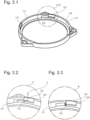
- a mounting device 120 is shown as a cover from the loudspeaker system 100 according to the invention with highlighted detail A, B.
- the view shown here is centered on a countersunk groove 122, the detail A, B on the inside 121 of the mounting device 120.
- the countersunk groove 122 is open on the side that is located at the top here.
- the projections 112 of the loudspeaker unit 110 are pushed into this opening of the countersunk groove 122 that is located at the top when connecting to the loudspeaker unit 110.
- At the base of the first step of the countersunk groove 122 there is a tangential offset 123 of the countersunk groove 122.
- the loudspeaker unit 110 can be rotated in the mounting device 120 in the direction of the tangential offset that lies in the plane of the cover.
- the path of a projection 112 on the loudspeaker unit 110 is shown in detail A in Figure 3 . 2 highlighted.
- Arrow P shows the path of a projection 112 on the loudspeaker unit 110 in the countersunk groove 122, which first begins with a vertical lowering movement, then turns in a tangential direction and then runs downwards again in a vertical direction if the offset 123 is far enough. It is also possible for the offset 123 to be so short that the second vertical downward movement does not take place.
- the embodiment shown here is constructed such that the countersunk grooves 122 are arranged on the inside of the cover and that the projections 112 are arranged on the outer circumference of the loudspeaker unit 110. According to the idea of the invention, however, it is also possible for the structure to be inverted. For example, it can be provided that the projections 112 are arranged on the inside of the cover and the countersunk grooves 122 are arranged on the outside 111 of the at least one loudspeaker unit 110.
- the countersunk groove 122 has a locking projection 124.
- the locking projection 124 leads to a clamping fit of a projection 112 on the loudspeaker unit 110, whereby the loudspeaker unit is fixed.
- a projection 112 on the loudspeaker unit 110 is pushed over this locking projection 124 and is caught in the offset 123.
- FIG 4 In Figure 4 . 1 in the first row at the top, three views of a socket insert 140 of the loudspeaker system 100 according to the invention are shown; in the second row at the bottom, three views of the opening of various socket inserts 140 for various plug contacts 160 are shown.
- the socket inserts 140 behave in a similar way to locking cylinders in a lock.
- the socket inserts 140 themselves have differently shaped openings 141, which form a positive connection with the shape of a plug contact 160 that is special for a vehicle type, for example, and correspond with this plug contact 160.
- one or more locking projections 142 can be present on the outside of the socket insert 140, each of which engages in a corresponding locking opening 132 of the receiving socket 132.
- the plug-in contact-typical opening 142 leaves space for stud bolts 131 in the receiving socket 130, which are present in the form of a wire pin at the bottom of the receiving socket 130.
- FIG. 5 a further detail is shown to show how a protective or decorative grille 150 for the loudspeaker membrane 129 of the loudspeaker unit 110 can be inserted into the mounting device 120.
- the protective or decorative grille 150 is inserted into the mounting device designed as a cover and then the loudspeaker unit 110 is pushed into the cover so that the protective or decorative grille 150 is clamped between the cover and the loudspeaker unit 110.
Landscapes
- Engineering & Computer Science (AREA)
- Physics & Mathematics (AREA)
- Acoustics & Sound (AREA)
- Signal Processing (AREA)
- Mechanical Engineering (AREA)
- Fittings On The Vehicle Exterior For Carrying Loads, And Devices For Holding Or Mounting Articles (AREA)
Description
- Die Erfindung betrifft ein Lautsprechersystem, aufweisend mindestens eine Lautsprechereinheit, mindestens eine Montagevorrichtung, wobei die mindestens eine Lautsprechereinheit mit der mindestens einen Montagevorrichtung verbindbar ist. Zum Einbau von Lautsprechern in Möbel, in Kraftfahrzeuge oder in feste Inneneinrichtungen ist es bekannt, Ausnehmungen in Oberflächen einzubringen, die an das zu verbauende Lautsprechersystem angepasst sind. Im Kraftfahrzeugbau ist es üblich, für Lautsprechersysteme vorgefertigte Ausnehmungen in der Türinnenverkleidung vorzusehen oder auch in anderen Einzelteilen der Fahrzeuginneneinrichtung. Einige Fahrzeughersteller sehen dafür eigene Lautsprechersysteme vor, die in die vorgefertigten Standardöffnungen eingebaut werden können. Dabei unterscheiden sich die Einbauöffnungen verschiedener Hersteller. Eine länderübergreifende Norm für Öffnungen zum Einbau von Lautsprechersystemen gibt es nicht.
- In Kraftfahrzeugen ist der Einbau von Lautsprechern häufig durch den vorhandenen Kabelbaum vorbereitet. In einem Kraftfahrzeug-Kabelbaum können über einhundert verschiedene Steck- und Kopplungspunkte vorhanden sein.
JP S48 47331 U EP 3 473 496 A1 zeigt ein Lautsprechersystem mit integral außen am Korb geformten Anschluss.US 4 852 178 A zeigt Details zur Befestigung eines Lautsprechersystems in einer Einbausituation in einem Kraftfahrzeug. - Aufgabe der Erfindung ist es daher, ein Lautsprechersystem zur Verfügung zu stellen, das eine hohe Variabilität und Flexibilität beim Einbau aufweist.
- Die der Erfindung zugrunde liegende Aufgabe wird erfüllt durch ein Lautsprechersystem mit den Merkmalen nach Anspruch 1. Weitere vorteilhafte Ausgestaltungen sind in den Unteransprüchen zu Anspruch 1 angegeben.
- Nach der Erfindung ist also vorgesehen, dass das Lautsprechersystem aus verschiedenen Einzelteilen besteht. Dabei weist das Lautsprechersystem mindestens eine Lautsprechereinheit und mindestens eine Montagevorrichtung auf, wobei die mindestens eine Lautsprechereinheit mit der mindestens einen Montagevorrichtung verbindbar ist. Hierzu ist es möglich, dass die Montagevorrichtung als Montagerahmen für eine Mehrzahl an Lautsprechern aufgebaut ist. Es ist auch möglich, dass in einen Montagerahmen mehrere Lautsprecher, die als eine Lautsprechereinheit zusammengefasst sind, wie ein Mitteltöner und ein Hochtöner, und die konzentrisch übereinander angeordnet sind, in einem Montagerahmen aufgenommen sind. Dabei ist nach dem Gedanken der Erfindung vorgesehen, dass die mindestens eine Montagevorrichtung als Überwurf ausgestaltet ist, der zur Innenseite mindestens zwei Senknuten aufweist, welche mit Vorsprüngen an der Außenseite der mindestens einen Lautsprechereinheit korrespondieren, wenn der Überwurf die mindestens eine Lautsprechereinheit aufnimmt. In dem Überwurf weisen die mindestens zwei Senknuten jeweils etwa mittig einen tangentialen Versatz auf, wobei im Weg des tangentialen Versatzes ein Riegelvorsprung vorhanden ist, welcher den Vorsprüngen an der Außenseite der mindestens einen Lautsprechereinheit einen Klemmsitz verleiht. Die Lautsprechereinheit, die aus einem einzigen Lautsprecher bestehen kann oder auch mehr als einen Lautsprecher umfassen kann, weist bei einem kreisförmigen Aufbau des Lautsprechers am äußeren Umfang zwei Federn, im Sinne einer Nut-und-Federverbindung, oder einzelne Vorsprünge auf, welche in die Senknuten des Überwurfs eingreifen. Innerhalb der Senknut im Überwurf ist in der Ebene des Überwurfs ein Versatz vorhanden. Die Feder am äußeren Umfang der Lautsprechereinheit kann in der Senknut durch Verdrehen um die eigene Achse innerhalb der Senknut verriegelt werden. Insofern ähnelt das Einsetzen der mindestens einen Lautsprechereinheit in den Überwurf einem Bajonett-Verschluss. Tatsächlich aber ist es nicht identisch mit einem Bajonett-Verschluss, weil keine Spannfeder vorhanden ist, welche den Einsatz in der Kulisse des Bajonett-Verschlusses festhält.
- In einer ersten Ausgestaltung des erfindungsgemäßen Lautsprechersystems ist vorgesehen, dass die mindestens eine Lautsprechereinheit und die mindestens eine Montagevorrichtung im Bereich des Überwurfs kreisrund ausgeführt sind. Durch die kreisrunde Ausführungsform ist es möglich, den Lautsprecher innerhalb der Montagevorrichtung durch Verdrehen zu fixieren. Alternativ ist es auch möglich, den Überwurf und den Lautsprecher rechteckig auszuführen. Zum Verriegeln kann dann die Lautsprechereinheit innerhalb des Überwurfs verschoben statt verdreht werden und zwar so weit, wie es der Versatz in der Senknut es zulässt.
- In Ausgestaltung der Erfindung kann es vorgesehen sein, dass die mindestens eine Montagevorrichtung mit der mindestens einen Lautsprechereinheit vorwärts als auch rückwärts verbindbar ist. Die Lautsprechereinheit kann also von vorn in den Überwurf eingesenkt werden, wobei "vorne" die Seite der Lautsprechereinheit ist, zu der der Zuhörer gewandt ist. Alternativ ist es auch möglich, dass der Überwurf von hinten über den Umfang der Lautsprechereinheit geworfen wird, wobei "hinten" die Seite der Lautsprechereinheit ist, die beim bestimmungsgemä-βen Gebrauch der Lautsprechereinheit vom Zuhörer abgewandt ist.
- Der tangentiale Versatz in der Senknut kann in Ausgestaltung der Erfindung so lang sein, dass die Vorsprünge an der Außenseite der mindestens einen Lautsprechereinheit beim Eingriff in den Überwurf über den Riegelvorsprung hinweg bewegbar sind. Dadurch wird der Klemmsitz wieder aufgehoben und die Feder oder Vorsprung an der Lautsprechereinheit sind in dem Versatz gefangen.
- Durch die Art des Aufbaus des gesamten Lautsprechersystems ist es möglich, einen Lausprecher, der in der Produktion höhere Kosten verursacht als Montageteile, mit verschiedenen Montagelementen zu kombinieren. So kann ein Montageeinsatz beispielsweise pro Fahrzeugfabrikat erstellt werden und mit standardisierten Lautsprechereinheiten kombiniert werden. Dabei kann die Qualität der Lautsprechereinheiten ebenso variieren. Es können sehr hochwertige Lautsprechereinheiten mit einem sehr reinen Klang verbaut werden, aber auch Lautsprechereinheiten mit einem weniger hochwertigen Klang und damit einhergehend meist geringeren Kosten.
- Die einzubauenden Lautsprechersysteme müssen aber nicht nur unterschiedlichen Einbaurahmen und -positionen genügen, sondern auch unterschiedlichen elektrischen Einbaubedingungen. Da in Kraftfahrzeug-Kabelbäumen nicht selten mehr als 100 verschiedene Endpunkte mit Steckverbindern vorhanden sind, die bewusst eine unterschiedliche Form aufweisen, ist es zwischen verschiedenen Kraftfahrzeug-Modellen oder verschiedenen Kraftfahrzeug-Marken nicht unüblich, dass jeder Lautsprecher einen sehr individuellen, elektrischen Steckkontakt-Typ aufweist. Das Variieren der Form der Steck-Kontakte wird deswegen unternommen, um eine Eindeutigkeit der Kabelbelegung zu erreichen. Aufgrund der Komplexität der Kabelbäume ist es kaum noch möglich, mit vertretbarem Zeitaufwand den Verlauf eines jeden einzelnen Kabels zu verfolgen. Stattdessen wird der Ansatz verfolgt, dass jeder Stecker wie ein Schlüssel in den dazu korrespondierenden Steckkontakt passt. Um dieser großen Variantenvielfalt gerecht zu werden, ist entsprechend der Erfindung vorgesehen, dass an der mindestens einen Lautsprechereinheit mindestens eine Aufnahmebuchse vorhanden ist, innerhalb der mindestens ein Stehbolzen in Form eines Drahtstifts als elektrischer Kontakt vorhanden ist, wobei die mindestens eine Aufnahmebuchse mit einem Buchseneinsatz des Lautsprechersystems korrespondiert, der im Bereich des Stehbolzens eine Öffnung aufweist. Der Buchseneinsatz wirkt wie ein Schließzylinder, der in ein vorhandenes Schloss eingesetzt wird. Dabei weist die Öffnung in dem Buchsneinsatz eine Form auf, die zu dem elektrischen Steckkontakt in dem vorhandenen Kabelbaum korrespondiert. Durch die Trennung zwischen Buchseneinsatz und der Aufnahmebuchse können Buchseneinsätze mit großer Formenvielfalt günstig hergestellt werden und mit der Lautsprechereinheit verbunden werden. So kann für jeden Fahrzeugtyp, der eine vorbestimmte Steckerarchitektur aufweist, ein für den Fahrzeugtyp individualisierter Buchsenseinsatz ausgewählt werden.
- Um den Buchseneinsatz möglichst kostengünstig und schnell mit der Aufnahmebuchse zu verbinden, kann in Ausgestaltung der Erfindung vorgesehen sein, dass der Buchseneinsatz mindestens einen Rastvorsprung aufweist, der mit je einer Rastöffnung in der mindestens einen Aufnahmebuchse korrespondiert. Zum Befestigen wird der Buchseneinsatz einmal in den Buchseneinsatz geschoben, wobei sich der aus Kunststoff bestehende Buchseneinsatz geringfügig elastisch verformt, bis der Rastvorsprung in die Rastöffnung eingreift und sich die Aufnahmebuchse elastisch zurückverformt.
- Je nach Steckertyp kann es notwendig sein, dass die Ausrichtung des Buchseneinsatzes in einer bestimmten Richtung zur Lautsprechereinheit ausgerichtet ist. Dies ist insbesondere der Fall für Steckerleisten oder festen Mehrfachsteckern, die an die Form des Lautsprechers angepasst sind. Um die Ausrichtung des Buchseneinsatzes zu vereinheitlichen, kann es nach weiterer Ausgestaltung der Erfindung vorgesehen sein, dass auf der Innenseite der mindestens einen Aufnahmebuchse ein Führungsvorsprung oder eine Führungsnut vorhanden ist, welcher mit einer Führungsnut oder einem Führungsvorsprung auf der Außenseite des Buchseinsatzes korrespondiert.
- Um eine Schmuckabdeckung oder eine Schutzabdeckung der empfindlichen Lautsprechermembran zur Verfügung zu stellen, kann es in einer weiteren Ausgestaltung der Erfindung vorgesehen sein, dass zwischen die Lautsprechereinheit und dem Überwurf ein Gitter einsetzbar ist, welches sich über die Fläche einer Lautsprechermembran der mindestens einen Lautsprechereinheit erstreckt. Das Gitter kann aus einzelnen Speichen bestehen, über das ein Textil gespannt ist. Es ist aber auch möglich, ein regelmäßiges oder gemustertes, in zwei Dimensionen perforiertes, Lochblech einzusetzen.
- Das hier vorgestellte Lautsprechersystem kann einzeln aus Lautsprechereinheit, Montagevorrichtung als Überwurf und Buchseneinsätzen und gegebenenfalls auch dem Abdeckgitter vertrieben werden. Es ist aber auch möglich, höherwertigere Lautsprechersysteme als Set zu vertreiben, wobei dieses zusammengestellt wird aus der Lautsprechereinheit und mehr als einer Montagevorrichtung und / oder mehr als einem Buchseneinsatz zum Einbau in unterschiedliche Kraftfahrzeuge.
- Die Erfindung wird anhand der folgenden Figuren näher erläutert. Es zeigt:
- Fig. 1
- ein erfindungsgemäßes Lautsprechersystem in einer perspektivischen Ansicht von hinten, der dem Zuhörer abgewandten Seite,
- Fig. 2
- ein erfindungsgemäßes Lautsprechersystem in einer perspektivischen Ansicht von vorne, der dem Zuhörer zugewandten Seite,
- Fig. 3.1
- eine Montagevorrichtung als Überwurf aus dem erfindungsgemäßen Lautsprechersystem mit hervorgehobenem Detail A, B
- Fig. 3.2
- Detail A aus
Figur 3.1 , - Fig 3.3
- Detail B mit der erfindungsgemäßen Ausführungsvariante der Montagevorrichtung im korrespondierenden Set,
- Fig. 4.1
- in der ersten Reihe oben drei Ansichten auf einen Buchseneinsatz des erfindungsgemäßen Lautsprechersystems; in der zweiten Reihe unten drei Ansichten auf die Öffnung verschiedener Buchseneinsätze für verschiedene Steckkontakte,
- Fig. 4.2
- eine Darstellung zur Verdeutlichung, wie der Buchseneinsatz gemäß
Fig. 4.1 mit dem Lautsprechersystem vereint wird, - Fig. 5
- eine Darstellung zur Demonstration des Einsatzes eines Schutz- oder Schmuckgitters für die Membran der Lautsprechereinheit.
- In
Figur 1 ist eine perspektivische Explosionsansicht auf ein erfindungsgemäßes Lautsprechersystem 100 in einer Darstellung von hinten, also der dem Zuhörer abgewandten Seite gezeigt. Das Lautsprechersystem 100 weist mindestens eine Lautsprechereinheit 110 auf. Es ist auch möglich, dass mehr als ein Lautsprecher konzentrisch und übereinander in einer Lautsprechereinheit 110 angeordnet ist oder auch, dass mehr als ein Lautsprecher in einer gemeinsamen Montagevorrichtung 120 aufgenommen ist. Des Weiteren weist das Lautsprechersystem 100 die mindestens eine Montagevorrichtung 120 auf. Die mindestens eine Lautsprechereinheit 110 ist mit der mindestens einen Montagevorrichtung 120 verbindbar. Nach der hier vorliegenden Ausgestaltung des Lautsprechersystems 100 ist eine Montagevorrichtung 120 als Überwurf ausgestaltet. Dieser Überwurf weist zur Innenseite 121 drei Senknuten 122 auf, welche mit Vorsprüngen 112 an der Außenseite 111 der hier gezeigten Lautsprechereinheit 110 korrespondieren, und zwar dann, wenn der Überwurf die mindestens eine Lautsprechereinheit 120 aufnimmt. Die zwei Senknuten 122 weisen jeweils etwa mittig einen tangentialen Versatz 123 auf, wobei im Weg des tangentialen Versatzes 123 ein Riegelvorsprung 124 vorhanden ist, welcher den Vorsprüngen 112, die an der Außenseite 111 der mindestens einen Lautsprechereinheit 110 angeordnet sind, bei der hier in dieser Ausführungsform bestimmungsgemäßen Verbindung einen Klemmsitz verleiht. Der Riegelvorsprung 124 ist in den folgenden Figuren näher erläutert. - Die hier gezeigte Variante des Lautsprechersystems 100 ist des Weiteren an der Lautsprechereinheit 110 mit einer Aufnahmebuchse 130 ausgestattet. In dieser Aufnahmebuchse 130 ist in der Öffnung mindestens ein Stehbolzen 131 in Form eines Drahtstifts als elektrischer Kontakt vorhanden. Je nach Art des Lautsprechers kann nur ein einzelner Kontakt vorhanden sein, der gegen Masse, einem metallischen Rahmen des Lautsprechers, arbeitet. Es ist aber auch möglich, massefreie Kontakte unterzubringen und für jeden einzelnen Lautsprecher der Lautsprechereinheit 110 je zwei elektrische Pole als Kontaktstifte anzuordnen. Die Aufnahmebuchse 130 korrespondiert mit einem Buchseneinsatz 140, der im Bereich des Stehbolzens 131 selbst eine Öffnung 141 freilässt. In diese Öffnung 141 passt ein korrespondierender Steckkontakt 160 eines Kabelbaums, wobei hier nur der Steckkontakt, nicht jedoch die Leitungen des Kabelbaums gezeigt sind.
- In
Figur 2 ist zur Verdeutlichung sämtlicher Merkmale inFigur 1 das gleiche Lautsprechersystem 100 in einer perspektivischen Ansicht von vorne, also der dem Zuhörer zugewandten Seite in einer Explosionsdarstellung gezeigt. Die Figurenbeschreibung zuFigur 1 ist auch auf dieseFigur 2 zu lesen. - In
Figur 3 .1 ist eine Montagevorrichtung 120 als Überwurf aus dem erfindungsgemäßen Lautsprechersystem 100 mit hervorgehobenem Detail A, B gezeigt. Die hier dargestellte Ansicht ist auf eine Senknut 122 zentriert, dem Detail A, B auf der Innenseite 121 der Montagevorrichtung 120. Die Senknut 122 ist zur hier oben liegenden Seite offen. In diese hier oben liegende Öffnung der Senknut 122 werden beim Verbinden mit der Lautsprechereinheit 110 die Vorsprünge 112 der Lautsprechereinheit 110 eingeschoben. Am Grund der ersten Stufe der Senknut 122 ist ein tangentialer Versatz 123 der Senknut 122 vorhanden. Ist ein Vorsprung 112 am Grund der ersten Stufe angelangt, so kann die Lautsprechereinheit 110 in der Montagevorrichtung 120 in Richtung des tangentialen Versatzes, der in der Ebene des Überwurfs liegt, gedreht werden. Der Weg eines Vorsprungs 112 an der Lautsprechereinheit 110 ist in Detail A inFigur 3 .2 hervorgehoben. Pfeil P zeigt den Weg eines Vorsprungs 112 an der Lautsprechereinheit 110 in der Senknut 122, der erst mit einer vertikalen Senkbewegung beginnt, sodann in einer tangentialen Richtung abbiegt und sodann wieder in vertikaler Richtung abwärts verläuft, wenn der Versatz 123 weit genug ist. Es ist auch möglich, dass der Versatz 123 nur so kurz ist, dass die zweite vertikale Abwärtsbewegung nicht stattfindet. Die hier gezeigte Ausführungsform ist so aufgebaut, dass die Senknuten 122 auf der Innenseite des Überwurfs angeordnet sind und dass die Vorsprünge 112 am äußeren Umfang der Lautsprechereinheit 110 angeordnet sind. Es ist nach dem Gedanken der Erfindung aber auch möglich, dass der Aufbau dazu invertiert vorliegt. So kann es vorgesehen sein, dass die Vorsprünge 112 auf der Innenseite des Überwurfs angeordnet sind und die Senknuten 122 auf der der Außenseite 111 der mindestens einen Lautsprechereinheit 110 angeordnet sind. - In
Figur 3.3 ist nun ein erfindungsgemäßes Detail in Detail B gezeigt. Die Senknut 122 weist einen Riegelvorsprung 124 auf. Es ist je nach Länge des Versatzes 123 möglich, dass der Riegelvorsprung 124 zu einem Klemmsitz eines Vorsprungs 112 an der Lautsprechereinheit 110 führt, womit die Lautsprechereinheit fixiert ist. Es ist bei einem längeren Versatz 123 aber auch möglich, dass ein Vorsprung 112 an der Lautsprechereinheit 110 über diesen Riegelvorsprung 124 hinweggeschoben wird und in dem Versatz 123 gefangen ist. - In
Figur 4 .1 sind in der ersten Reihe oben drei Ansichten auf einen Buchseneinsatz 140 des erfindungsgemäßen Lautsprechersystems 100 dargestellt; in der zweiten Reihe unten sind drei Ansichten auf die Öffnung verschiedener Buchseneinsätze 140 für verschiedene Steckkontakte 160 gezeigt. Die Buchseneinsätze 140 verhalten sich ähnlich wie Schließzylinder in einem Schloss. Die Buchseneinsätze 140 weisen hierzu selbst verschieden geformte Öffnungen 141 auf, die mit der Form eines beispielsweise für einen Fahrzeugtyp speziellen Steckkontaktes 160 einen Formschluss ausbilden und mit diesem Steckkontakt 160 korrespondieren. Um den Buchseneinsatz 140 in einer Aufnahmebuchse 130 an der Lautsprechereinheit 110 zu befestigen, können an der Außenseite des Buchseneinsatzes 140 ein oder mehrere Rastvorsprünge 142 vorhanden sein, die jeweils in eine entsprechende Rastöffnung 132 der Aufnahmebuchse 132 eingreifen. Die steckkontakttypische Öffnung 142 lässt Raum für in der Aufnahmebuchse 130 vorhandenen Stehbolzen 131, die in Form eines Drahtstiftes am Boden der Aufnahmebuchse 130 vorhanden sind. - In
Figur 4 .2 ist zur Verdeutlichung, wie der Buchseneinsatz 140 gemäßFig. 4.1 mit der Lautsprechereinheit 110 vereint wird, die Lautsprechereinheit 110 dargestellt. Der breite Pfeil zeigt, wie ein Buchseneinsatz 140 in die Aufnahmebuchse 130 eingesetzt wird. In dieser Darstellung weist der Buchseneinsatz 140 auf der Außenseite eine Führungsnut 145 auf, welche mit einem Führungsvorsprung 135 auf der Innenseite der Aufnahmebuchse 130 zusammenwirkt, so dass der Buchseneinsatz 140 nur in einer Weise in der Aufnahmebuchse 130 eingesteckt werden kann. - In
Figur 5 ist schließlich ein weiteres Detail gezeigt, um zu zeigen, wie ein Schutz- oder Schmuckgitter 150 für die Lautsprechermembran 129 der Lautsprechereinheit 110 in die Montagevorrichtung 120 eingelegt werden kann. Dabei wird das Schutz- oder Schmuckgitter 150 in die als Überwurf gestaltete Montagevorrichtung eingelegt und sodann die Lautsprechereinheit 110 in den Überwurf eingeschoben, so dass das Schutz- oder Schmuckgitter 150 zwischen Überwurf und Lautsprechereinheit 110 eingeklemmt ist.BEZUGSZEICHENLISTE 100 Lautsprechersystem 135 Führungsvorsprung 110 Lautsprechereinheit 111 Außenseite 140 Buchseneinsatz 112 Vorsprung 141 Öffnung 142 Rastvorsprung 120 Montagevorrichtung 145 Führungsnut 121 Innenseite 146 Außenseite 122 Senknut 123 Versatz 150 Gitter 124 Riegelvorsprung 129 Lautsprechermembran 160 Steckkontakt 130 Aufnahmebuchse A Detail 131 Stehbolzen B Detail 132 Rastöffnung P Pfeil 134 Innenseite
Claims (10)
- Lautsprechersystem (100), aufweisend- mindestens eine Lautsprechereinheit (110),- mindestens eine Montagevorrichtung (120),wobei die mindestens eine Lautsprechereinheit (110) mit der mindestens einen Montagevorrichtung (120) verbindbar ist, wobeidie mindestens eine Montagevorrichtung (120) als Überwurf ausgestaltet ist, der zur Innenseite (121) mindestens zwei Senknuten (122) aufweist, welche mit Vorsprüngen (112) an der Außenseite (111) der mindestens einen Lautsprechereinheit (110) korrespondieren, wenn der Überwurf die mindestens eine Lautsprechereinheit (120) aufnimmt,dadurch gekennzeichnet, dassdie mindestens zwei Senknuten (122) jeweils etwa mittig einen tangentialen Versatz (123) aufweisen, wobei im Weg des tangentialen Versatzes (123) ein Riegelvorsprung (124) vorhanden ist, welcher den Vorsprüngen (112) an der Außenseite (111) der mindestens einen Lautsprechereinheit (110) einen Klemmsitz verleiht, und wobeian der mindestens einen Lautsprechereinheit (110) mindestens eine Aufnahmebuchse (130) vorhanden ist, innerhalb der mindestens ein Stehbolzen (131) in Form eines Drahtstifts als elektrischer Kontakt vorhanden ist, wobei die mindestens eine Aufnahmebuchse (130) mit einem Buchseneinsatz (140) des Lautsprechersytems korrespondiert, der im Bereich des Stehbolzens (131) eine Öffnung (141) aufweist.
- Lautsprechersystem nach Anspruch 1,
dadurch gekennzeichnet, dass
die mindestens eine Lautsprechereinheit (110) und die mindestens eine Montagevorrichtung (120) im Bereich des Überwurfs kreisrund ausgeführt sind. - Lautsprechersystem nach Anspruch 1 oder 2,
dadurch gekennzeichnet, dass
die mindestens eine Montagevorrichtung (120) mit der mindestens einen Lautsprechereinheit (110) vorwärts als auch rückwärts verbindbar ist. - Lautsprechersystem nach einem der Ansprüche 1 bis 3,
dadurch gekennzeichnet, dass
der tangentiale Versatz (123) so lang ist, dass die Vorsprünge (112) an der Außenseite (111) der mindestens einen Lautsprechereinheit (110) über den Riegelvorsprung (124) hinweg bewegbar sind. - Lautsprechersystem nach Anspruch 4,
dadurch gekennzeichnet, dass
der Buchseneinsatz (140) mindestens einen Rastvorsprung (142) aufweist, der mit je einer Rastöffnung (132) in der mindestens einen Aufnahmebuchse (130) korrespondiert. - Lautsprechersystem nach Anspruch 5,
dadurch gekennzeichnet, dass
auf der Innenseite (134) der mindestens einen Aufnahmebuchse (130) ein Führungsvorsprung (135) oder eine Führungsnut vorhanden ist, welcher mit einer Führungsnut (145) oder einem Führungsvorsprung auf der Außenseite (146) des Buchseinsatzes (140) korrespondiert. - Lautsprechersystem nach einem der Ansprüche 1 bis 6,
dadurch gekennzeichnet, dass
zwischen der mindestens einen Lautsprechereinheit (110) und der mindestens einen Montagevorrichtung (120) ein Gitter (150) einsetzbar ist, welches sich über die Fläche einer Lautsprechermembran (129) der mindestens einen Lautsprechereinheit (110) erstreckt. - Lautsprechersystem nach einem der Ansprüche 1 bis 7,
dadurch gekennzeichnet, dass
die Vorsprünge (112) auf der Innenseite des Überwurfs angeordnet sind und die Senknuten (122) auf der der Außenseite (111) der mindestens einen Lautsprechereinheit (110) angeordnet sind. - Lautsprechersystem-Set, aufweisend,mindestens ein Lautsprechersystem nach den Ansprüchen 1 bis 6, undmindestens zwei auf der Außenseite unterschiedlich geformte Montagevorrichtungen.
- Lautsprechersystem-Set, aufweisend,mindestens ein Lautsprechersystem nach den Ansprüchen 5 bis 6, undmindestens zwei Buchseneinsätze, die jeweils eine voneinander unterschiedliche Innenform der Öffnung aufweisen.
Applications Claiming Priority (2)
| Application Number | Priority Date | Filing Date | Title |
|---|---|---|---|
| DE102020131094.3A DE102020131094B3 (de) | 2020-11-24 | 2020-11-24 | Lautsprechersystem |
| PCT/IB2021/058570 WO2022112870A1 (de) | 2020-11-24 | 2021-09-21 | Lautsprechersystem |
Publications (2)
| Publication Number | Publication Date |
|---|---|
| EP4252429A1 EP4252429A1 (de) | 2023-10-04 |
| EP4252429B1 true EP4252429B1 (de) | 2024-11-20 |
Family
ID=77659364
Family Applications (1)
| Application Number | Title | Priority Date | Filing Date |
|---|---|---|---|
| EP21778237.4A Active EP4252429B1 (de) | 2020-11-24 | 2021-09-21 | Lautsprechersystem |
Country Status (5)
| Country | Link |
|---|---|
| US (1) | US11937034B2 (de) |
| EP (1) | EP4252429B1 (de) |
| CN (1) | CN116530095B (de) |
| DE (1) | DE102020131094B3 (de) |
| WO (1) | WO2022112870A1 (de) |
Family Cites Families (21)
| Publication number | Priority date | Publication date | Assignee | Title |
|---|---|---|---|---|
| DE548759C (de) | 1930-03-06 | 1932-04-18 | Der Holler Schen Carlshuette B | Kochtopf mit abnehmbarem Flanschenring |
| JPS4847331U (de) | 1971-10-06 | 1973-06-21 | ||
| DE3318346A1 (de) | 1983-05-20 | 1984-11-22 | Blaupunkt-Werke Gmbh, 3200 Hildesheim | Steckerhalter fuer kontaktstecker eines lautsprechers |
| US4592611A (en) | 1984-09-27 | 1986-06-03 | Amp Incorporated | Electrical connector intended for use in confined areas |
| US4852178A (en) | 1987-10-02 | 1989-07-25 | Motorola, Inc. | Speaker retaining assembly |
| DE3918053A1 (de) | 1989-06-02 | 1990-12-06 | Nokia Unterhaltungselektronik | Lautsprecher mit bajonettverschluss |
| US5867583A (en) | 1996-03-28 | 1999-02-02 | Harman International Industries, Inc. | Twist-lock-mountable versatile loudspeaker mount |
| JP2001023742A (ja) | 1999-07-02 | 2001-01-26 | Mitsumi Electric Co Ltd | 電気コネクタ |
| JP2004180247A (ja) * | 2002-11-29 | 2004-06-24 | Pioneer Electronic Corp | スピーカユニットの取り付け構造 |
| JP4266349B2 (ja) * | 2004-01-14 | 2009-05-20 | パイオニア株式会社 | スピーカ装置およびその製造方法 |
| DE102005041264B4 (de) | 2005-08-05 | 2024-02-01 | Hänsch Warnsysteme GmbH | Lautsprechereinheit und Sondersignalanlage mit Lautsprechereinheit |
| DE102005051338B3 (de) * | 2005-09-28 | 2007-02-15 | Daimlerchrysler Ag | Flansch zur Ankopplung eines Lautsprechers an ein Hohlraumvolumen in einem Kraftfahrzeug |
| JP2007124448A (ja) | 2005-10-31 | 2007-05-17 | Pioneer Electronic Corp | スピーカユニット及びスピーカ取付用ブラケット |
| KR100693684B1 (ko) * | 2005-12-28 | 2007-03-12 | 엘지전자 주식회사 | 음향각도 조절이 가능한 톨보이 타입 스피커 |
| US8265320B2 (en) * | 2009-01-27 | 2012-09-11 | Star Headlight & Lantern Co., Inc. | Loudspeaker |
| DE102009058894A1 (de) * | 2009-12-18 | 2010-08-05 | Daimler Ag | Befestigungsvorrichtung für einen Lautsprecher |
| WO2013014829A1 (ja) * | 2011-07-25 | 2013-01-31 | パナソニック株式会社 | スピーカ装置 |
| JP2016015530A (ja) * | 2012-11-13 | 2016-01-28 | パナソニック株式会社 | スピーカおよびこのスピーカを用いた電子機器、移動体装置 |
| DE102015120769A1 (de) * | 2015-11-30 | 2017-06-01 | Mahler Engineering | Lautsprechersystem |
| US10264338B2 (en) | 2017-04-10 | 2019-04-16 | Tyler Humphreys | Adjustable speaker frame |
| DE202017106399U1 (de) | 2017-10-23 | 2017-11-02 | Dr. Schneider Kunststoffwerke Gmbh | Haltevorrichtung und Baugruppe mit einer Haltevorrichtung |
-
2020
- 2020-11-24 DE DE102020131094.3A patent/DE102020131094B3/de active Active
-
2021
- 2021-09-21 US US18/252,900 patent/US11937034B2/en active Active
- 2021-09-21 CN CN202180079034.2A patent/CN116530095B/zh active Active
- 2021-09-21 EP EP21778237.4A patent/EP4252429B1/de active Active
- 2021-09-21 WO PCT/IB2021/058570 patent/WO2022112870A1/de not_active Ceased
Also Published As
| Publication number | Publication date |
|---|---|
| CN116530095B (zh) | 2025-12-30 |
| CN116530095A (zh) | 2023-08-01 |
| DE102020131094B3 (de) | 2021-09-30 |
| US11937034B2 (en) | 2024-03-19 |
| EP4252429A1 (de) | 2023-10-04 |
| WO2022112870A1 (de) | 2022-06-02 |
| US20230396906A1 (en) | 2023-12-07 |
Similar Documents
| Publication | Publication Date | Title |
|---|---|---|
| DE69502190T2 (de) | Datenübertragungsverbinder | |
| DE202013103611U1 (de) | Halterahmen für Steckverbinder | |
| EP0198359B1 (de) | Lautsprechereinheit | |
| DE102006012730B3 (de) | Befestigungssystem zum Befestigen eines Kabinenausstattungselements an einer Trägerstruktur eines Flugzeugs | |
| DE102013113975A1 (de) | Halterahmen für einen Steckverbinder | |
| EP2823536B1 (de) | Steckverbinder umfassend eine schutzleiterbrücke | |
| DE102016116842B3 (de) | Steckverbinder zum elektrischen Verbinden von zwei elektrischen Baugruppen | |
| DE102013220348A1 (de) | Relais, Relaismodul und elektrische Anschlussdose | |
| DE69316826T2 (de) | Erdungsblock | |
| DE102007005737A1 (de) | Kopfstützensystem für einen Fahrzeugsitz | |
| DE102018125337B3 (de) | Abgewinkelter steckverbinder mit abschirmung und verfahren zur herstellung | |
| DE102013217787A1 (de) | Elektrische Anschlussdose | |
| EP4252429B1 (de) | Lautsprechersystem | |
| EP3473496B1 (de) | Haltevorrichtung und baugruppe mit einer haltevorrichtung | |
| DE10223271B4 (de) | Steckverbinder | |
| DE102009049489A1 (de) | Anschlussklemme und Elektroinstallationsgerät mit einer Anschlussklemme | |
| DE102016120304A1 (de) | Abgewinkelter steckverbinder und verfahren für dessen herstellung | |
| DE112017005681B4 (de) | Abschirmhülse | |
| DE102009048932A1 (de) | Installationsschaltgerät und Verfahren zur Montage eines solchen | |
| DE68919928T2 (de) | Bedienungspultsystem für Türsprechanlagen. | |
| DE102021205086A1 (de) | Verbindungsstecker | |
| DE102020008071A1 (de) | Lautsprechersystem | |
| DE102017212598A1 (de) | Stecker und Stecksystem mit einem Stecker | |
| DE102016117451B4 (de) | Elektronikgehäuse | |
| DE102018213188A1 (de) | Befestigungsstruktur für elektronische Einheit |
Legal Events
| Date | Code | Title | Description |
|---|---|---|---|
| STAA | Information on the status of an ep patent application or granted ep patent |
Free format text: STATUS: UNKNOWN |
|
| STAA | Information on the status of an ep patent application or granted ep patent |
Free format text: STATUS: THE INTERNATIONAL PUBLICATION HAS BEEN MADE |
|
| PUAI | Public reference made under article 153(3) epc to a published international application that has entered the european phase |
Free format text: ORIGINAL CODE: 0009012 |
|
| STAA | Information on the status of an ep patent application or granted ep patent |
Free format text: STATUS: REQUEST FOR EXAMINATION WAS MADE |
|
| 17P | Request for examination filed |
Effective date: 20230425 |
|
| AK | Designated contracting states |
Kind code of ref document: A1 Designated state(s): AL AT BE BG CH CY CZ DE DK EE ES FI FR GB GR HR HU IE IS IT LI LT LU LV MC MK MT NL NO PL PT RO RS SE SI SK SM TR |
|
| DAV | Request for validation of the european patent (deleted) | ||
| DAX | Request for extension of the european patent (deleted) | ||
| GRAP | Despatch of communication of intention to grant a patent |
Free format text: ORIGINAL CODE: EPIDOSNIGR1 |
|
| STAA | Information on the status of an ep patent application or granted ep patent |
Free format text: STATUS: GRANT OF PATENT IS INTENDED |
|
| INTG | Intention to grant announced |
Effective date: 20240708 |
|
| GRAS | Grant fee paid |
Free format text: ORIGINAL CODE: EPIDOSNIGR3 |
|
| GRAA | (expected) grant |
Free format text: ORIGINAL CODE: 0009210 |
|
| STAA | Information on the status of an ep patent application or granted ep patent |
Free format text: STATUS: THE PATENT HAS BEEN GRANTED |
|
| AK | Designated contracting states |
Kind code of ref document: B1 Designated state(s): AL AT BE BG CH CY CZ DE DK EE ES FI FR GB GR HR HU IE IS IT LI LT LU LV MC MK MT NL NO PL PT RO RS SE SI SK SM TR |
|
| REG | Reference to a national code |
Ref country code: GB Ref legal event code: FG4D Free format text: NOT ENGLISH |
|
| REG | Reference to a national code |
Ref country code: CH Ref legal event code: EP |
|
| REG | Reference to a national code |
Ref country code: DE Ref legal event code: R096 Ref document number: 502021005884 Country of ref document: DE |
|
| REG | Reference to a national code |
Ref country code: IE Ref legal event code: FG4D Free format text: LANGUAGE OF EP DOCUMENT: GERMAN |
|
| REG | Reference to a national code |
Ref country code: LT Ref legal event code: MG9D |
|
| REG | Reference to a national code |
Ref country code: NL Ref legal event code: MP Effective date: 20241120 |
|
| PG25 | Lapsed in a contracting state [announced via postgrant information from national office to epo] |
Ref country code: PT Free format text: LAPSE BECAUSE OF FAILURE TO SUBMIT A TRANSLATION OF THE DESCRIPTION OR TO PAY THE FEE WITHIN THE PRESCRIBED TIME-LIMIT Effective date: 20250320 Ref country code: IS Free format text: LAPSE BECAUSE OF FAILURE TO SUBMIT A TRANSLATION OF THE DESCRIPTION OR TO PAY THE FEE WITHIN THE PRESCRIBED TIME-LIMIT Effective date: 20250320 Ref country code: HR Free format text: LAPSE BECAUSE OF FAILURE TO SUBMIT A TRANSLATION OF THE DESCRIPTION OR TO PAY THE FEE WITHIN THE PRESCRIBED TIME-LIMIT Effective date: 20241120 |
|
| PG25 | Lapsed in a contracting state [announced via postgrant information from national office to epo] |
Ref country code: FI Free format text: LAPSE BECAUSE OF FAILURE TO SUBMIT A TRANSLATION OF THE DESCRIPTION OR TO PAY THE FEE WITHIN THE PRESCRIBED TIME-LIMIT Effective date: 20241120 Ref country code: NL Free format text: LAPSE BECAUSE OF FAILURE TO SUBMIT A TRANSLATION OF THE DESCRIPTION OR TO PAY THE FEE WITHIN THE PRESCRIBED TIME-LIMIT Effective date: 20241120 |
|
| PG25 | Lapsed in a contracting state [announced via postgrant information from national office to epo] |
Ref country code: BG Free format text: LAPSE BECAUSE OF FAILURE TO SUBMIT A TRANSLATION OF THE DESCRIPTION OR TO PAY THE FEE WITHIN THE PRESCRIBED TIME-LIMIT Effective date: 20241120 |
|
| PG25 | Lapsed in a contracting state [announced via postgrant information from national office to epo] |
Ref country code: ES Free format text: LAPSE BECAUSE OF FAILURE TO SUBMIT A TRANSLATION OF THE DESCRIPTION OR TO PAY THE FEE WITHIN THE PRESCRIBED TIME-LIMIT Effective date: 20241120 |
|
| PG25 | Lapsed in a contracting state [announced via postgrant information from national office to epo] |
Ref country code: NO Free format text: LAPSE BECAUSE OF FAILURE TO SUBMIT A TRANSLATION OF THE DESCRIPTION OR TO PAY THE FEE WITHIN THE PRESCRIBED TIME-LIMIT Effective date: 20250220 |
|
| PG25 | Lapsed in a contracting state [announced via postgrant information from national office to epo] |
Ref country code: LV Free format text: LAPSE BECAUSE OF FAILURE TO SUBMIT A TRANSLATION OF THE DESCRIPTION OR TO PAY THE FEE WITHIN THE PRESCRIBED TIME-LIMIT Effective date: 20241120 Ref country code: GR Free format text: LAPSE BECAUSE OF FAILURE TO SUBMIT A TRANSLATION OF THE DESCRIPTION OR TO PAY THE FEE WITHIN THE PRESCRIBED TIME-LIMIT Effective date: 20250221 |
|
| PG25 | Lapsed in a contracting state [announced via postgrant information from national office to epo] |
Ref country code: PL Free format text: LAPSE BECAUSE OF FAILURE TO SUBMIT A TRANSLATION OF THE DESCRIPTION OR TO PAY THE FEE WITHIN THE PRESCRIBED TIME-LIMIT Effective date: 20241120 |
|
| PG25 | Lapsed in a contracting state [announced via postgrant information from national office to epo] |
Ref country code: RS Free format text: LAPSE BECAUSE OF FAILURE TO SUBMIT A TRANSLATION OF THE DESCRIPTION OR TO PAY THE FEE WITHIN THE PRESCRIBED TIME-LIMIT Effective date: 20250220 |
|
| PG25 | Lapsed in a contracting state [announced via postgrant information from national office to epo] |
Ref country code: SM Free format text: LAPSE BECAUSE OF FAILURE TO SUBMIT A TRANSLATION OF THE DESCRIPTION OR TO PAY THE FEE WITHIN THE PRESCRIBED TIME-LIMIT Effective date: 20241120 |
|
| PG25 | Lapsed in a contracting state [announced via postgrant information from national office to epo] |
Ref country code: DK Free format text: LAPSE BECAUSE OF FAILURE TO SUBMIT A TRANSLATION OF THE DESCRIPTION OR TO PAY THE FEE WITHIN THE PRESCRIBED TIME-LIMIT Effective date: 20241120 |
|
| PG25 | Lapsed in a contracting state [announced via postgrant information from national office to epo] |
Ref country code: EE Free format text: LAPSE BECAUSE OF FAILURE TO SUBMIT A TRANSLATION OF THE DESCRIPTION OR TO PAY THE FEE WITHIN THE PRESCRIBED TIME-LIMIT Effective date: 20241120 |
|
| PG25 | Lapsed in a contracting state [announced via postgrant information from national office to epo] |
Ref country code: RO Free format text: LAPSE BECAUSE OF FAILURE TO SUBMIT A TRANSLATION OF THE DESCRIPTION OR TO PAY THE FEE WITHIN THE PRESCRIBED TIME-LIMIT Effective date: 20241120 |
|
| PG25 | Lapsed in a contracting state [announced via postgrant information from national office to epo] |
Ref country code: SK Free format text: LAPSE BECAUSE OF FAILURE TO SUBMIT A TRANSLATION OF THE DESCRIPTION OR TO PAY THE FEE WITHIN THE PRESCRIBED TIME-LIMIT Effective date: 20241120 |
|
| PG25 | Lapsed in a contracting state [announced via postgrant information from national office to epo] |
Ref country code: CZ Free format text: LAPSE BECAUSE OF FAILURE TO SUBMIT A TRANSLATION OF THE DESCRIPTION OR TO PAY THE FEE WITHIN THE PRESCRIBED TIME-LIMIT Effective date: 20241120 |
|
| PG25 | Lapsed in a contracting state [announced via postgrant information from national office to epo] |
Ref country code: IT Free format text: LAPSE BECAUSE OF FAILURE TO SUBMIT A TRANSLATION OF THE DESCRIPTION OR TO PAY THE FEE WITHIN THE PRESCRIBED TIME-LIMIT Effective date: 20241120 |
|
| REG | Reference to a national code |
Ref country code: DE Ref legal event code: R097 Ref document number: 502021005884 Country of ref document: DE |
|
| PG25 | Lapsed in a contracting state [announced via postgrant information from national office to epo] |
Ref country code: SE Free format text: LAPSE BECAUSE OF FAILURE TO SUBMIT A TRANSLATION OF THE DESCRIPTION OR TO PAY THE FEE WITHIN THE PRESCRIBED TIME-LIMIT Effective date: 20241120 |
|
| PLBE | No opposition filed within time limit |
Free format text: ORIGINAL CODE: 0009261 |
|
| STAA | Information on the status of an ep patent application or granted ep patent |
Free format text: STATUS: NO OPPOSITION FILED WITHIN TIME LIMIT |
|
| PGFP | Annual fee paid to national office [announced via postgrant information from national office to epo] |
Ref country code: DE Payment date: 20250917 Year of fee payment: 5 |
|
| PGFP | Annual fee paid to national office [announced via postgrant information from national office to epo] |
Ref country code: AT Payment date: 20251020 Year of fee payment: 5 |
|
| 26N | No opposition filed |
Effective date: 20250821 |