EP4251573B1 - Schichtniobate für die verwendung in photokatalysatoren - Google Patents
Schichtniobate für die verwendung in photokatalysatoren Download PDFInfo
- Publication number
- EP4251573B1 EP4251573B1 EP21806740.3A EP21806740A EP4251573B1 EP 4251573 B1 EP4251573 B1 EP 4251573B1 EP 21806740 A EP21806740 A EP 21806740A EP 4251573 B1 EP4251573 B1 EP 4251573B1
- Authority
- EP
- European Patent Office
- Prior art keywords
- layered
- layered niobate
- niobate
- nitric acid
- photocatalyst
- Prior art date
- Legal status (The legal status is an assumption and is not a legal conclusion. Google has not performed a legal analysis and makes no representation as to the accuracy of the status listed.)
- Active
Links
Images



Classifications
-
- B—PERFORMING OPERATIONS; TRANSPORTING
- B01—PHYSICAL OR CHEMICAL PROCESSES OR APPARATUS IN GENERAL
- B01J—CHEMICAL OR PHYSICAL PROCESSES, e.g. CATALYSIS OR COLLOID CHEMISTRY; THEIR RELEVANT APPARATUS
- B01J23/00—Catalysts comprising metals or metal oxides or hydroxides, not provided for in group B01J21/00
- B01J23/007—Mixed salts
-
- B—PERFORMING OPERATIONS; TRANSPORTING
- B01—PHYSICAL OR CHEMICAL PROCESSES OR APPARATUS IN GENERAL
- B01J—CHEMICAL OR PHYSICAL PROCESSES, e.g. CATALYSIS OR COLLOID CHEMISTRY; THEIR RELEVANT APPARATUS
- B01J23/00—Catalysts comprising metals or metal oxides or hydroxides, not provided for in group B01J21/00
- B01J23/16—Catalysts comprising metals or metal oxides or hydroxides, not provided for in group B01J21/00 of arsenic, antimony, bismuth, vanadium, niobium, tantalum, polonium, chromium, molybdenum, tungsten, manganese, technetium or rhenium
- B01J23/20—Vanadium, niobium or tantalum
-
- B—PERFORMING OPERATIONS; TRANSPORTING
- B01—PHYSICAL OR CHEMICAL PROCESSES OR APPARATUS IN GENERAL
- B01J—CHEMICAL OR PHYSICAL PROCESSES, e.g. CATALYSIS OR COLLOID CHEMISTRY; THEIR RELEVANT APPARATUS
- B01J23/00—Catalysts comprising metals or metal oxides or hydroxides, not provided for in group B01J21/00
- B01J23/38—Catalysts comprising metals or metal oxides or hydroxides, not provided for in group B01J21/00 of noble metals
- B01J23/54—Catalysts comprising metals or metal oxides or hydroxides, not provided for in group B01J21/00 of noble metals combined with metals, oxides or hydroxides provided for in groups B01J23/02 - B01J23/36
- B01J23/56—Platinum group metals
- B01J23/64—Platinum group metals with arsenic, antimony, bismuth, vanadium, niobium, tantalum, polonium, chromium, molybdenum, tungsten, manganese, technetium or rhenium
- B01J23/648—Vanadium, niobium or tantalum or polonium
- B01J23/6484—Niobium
-
- B—PERFORMING OPERATIONS; TRANSPORTING
- B01—PHYSICAL OR CHEMICAL PROCESSES OR APPARATUS IN GENERAL
- B01J—CHEMICAL OR PHYSICAL PROCESSES, e.g. CATALYSIS OR COLLOID CHEMISTRY; THEIR RELEVANT APPARATUS
- B01J35/00—Catalysts, in general, characterised by their form or physical properties
- B01J35/30—Catalysts, in general, characterised by their form or physical properties characterised by their physical properties
- B01J35/39—Photocatalytic properties
-
- B—PERFORMING OPERATIONS; TRANSPORTING
- B01—PHYSICAL OR CHEMICAL PROCESSES OR APPARATUS IN GENERAL
- B01J—CHEMICAL OR PHYSICAL PROCESSES, e.g. CATALYSIS OR COLLOID CHEMISTRY; THEIR RELEVANT APPARATUS
- B01J35/00—Catalysts, in general, characterised by their form or physical properties
- B01J35/30—Catalysts, in general, characterised by their form or physical properties characterised by their physical properties
- B01J35/391—Physical properties of the active metal ingredient
-
- C—CHEMISTRY; METALLURGY
- C01—INORGANIC CHEMISTRY
- C01B—NON-METALLIC ELEMENTS; COMPOUNDS THEREOF; METALLOIDS OR COMPOUNDS THEREOF NOT COVERED BY SUBCLASS C01C
- C01B3/00—Hydrogen; Gaseous mixtures containing hydrogen; Separation of hydrogen from mixtures containing it; Purification of hydrogen; Reversible storage of hydrogen
- C01B3/02—Production of hydrogen; Production of gaseous mixtures containing hydrogen
- C01B3/04—Production of hydrogen; Production of gaseous mixtures containing hydrogen by decomposition of inorganic compounds
- C01B3/042—Decomposition of water
-
- C—CHEMISTRY; METALLURGY
- C01—INORGANIC CHEMISTRY
- C01G—COMPOUNDS CONTAINING METALS NOT COVERED BY SUBCLASSES C01D OR C01F
- C01G33/00—Compounds of niobium
- C01G33/006—Compounds containing niobium, with or without oxygen or hydrogen, and containing two or more other elements
-
- C—CHEMISTRY; METALLURGY
- C01—INORGANIC CHEMISTRY
- C01P—INDEXING SCHEME RELATING TO STRUCTURAL AND PHYSICAL ASPECTS OF SOLID INORGANIC COMPOUNDS
- C01P2002/00—Crystal-structural characteristics
- C01P2002/20—Two-dimensional structures
-
- C—CHEMISTRY; METALLURGY
- C01—INORGANIC CHEMISTRY
- C01P—INDEXING SCHEME RELATING TO STRUCTURAL AND PHYSICAL ASPECTS OF SOLID INORGANIC COMPOUNDS
- C01P2002/00—Crystal-structural characteristics
- C01P2002/70—Crystal-structural characteristics defined by measured X-ray, neutron or electron diffraction data
- C01P2002/72—Crystal-structural characteristics defined by measured X-ray, neutron or electron diffraction data by d-values or two theta-values, e.g. as X-ray diagram
-
- C—CHEMISTRY; METALLURGY
- C01—INORGANIC CHEMISTRY
- C01P—INDEXING SCHEME RELATING TO STRUCTURAL AND PHYSICAL ASPECTS OF SOLID INORGANIC COMPOUNDS
- C01P2002/00—Crystal-structural characteristics
- C01P2002/70—Crystal-structural characteristics defined by measured X-ray, neutron or electron diffraction data
- C01P2002/77—Crystal-structural characteristics defined by measured X-ray, neutron or electron diffraction data by unit-cell parameters, atom positions or structure diagrams
-
- C—CHEMISTRY; METALLURGY
- C01—INORGANIC CHEMISTRY
- C01P—INDEXING SCHEME RELATING TO STRUCTURAL AND PHYSICAL ASPECTS OF SOLID INORGANIC COMPOUNDS
- C01P2002/00—Crystal-structural characteristics
- C01P2002/80—Crystal-structural characteristics defined by measured data other than those specified in group C01P2002/70
- C01P2002/85—Crystal-structural characteristics defined by measured data other than those specified in group C01P2002/70 by XPS, EDX or EDAX data
-
- Y—GENERAL TAGGING OF NEW TECHNOLOGICAL DEVELOPMENTS; GENERAL TAGGING OF CROSS-SECTIONAL TECHNOLOGIES SPANNING OVER SEVERAL SECTIONS OF THE IPC; TECHNICAL SUBJECTS COVERED BY FORMER USPC CROSS-REFERENCE ART COLLECTIONS [XRACs] AND DIGESTS
- Y02—TECHNOLOGIES OR APPLICATIONS FOR MITIGATION OR ADAPTATION AGAINST CLIMATE CHANGE
- Y02E—REDUCTION OF GREENHOUSE GAS [GHG] EMISSIONS, RELATED TO ENERGY GENERATION, TRANSMISSION OR DISTRIBUTION
- Y02E60/00—Enabling technologies; Technologies with a potential or indirect contribution to GHG emissions mitigation
- Y02E60/30—Hydrogen technology
- Y02E60/36—Hydrogen production from non-carbon containing sources, e.g. by water electrolysis
Definitions
- the first photocatalysts based on titanium dioxide were introduced in the 1970s, but it was not possible to increase the efficiency of this process to such an extent that hydrogen could be produced in large quantities.
- One class of compounds that is considered promising in this respect are layered perovskites of the Dion-Jacobson type with the general formula MA n-1 B n O 3n+1 , where M is an alkali metal, A is an alkaline earth metal or rare earth metal and B is a pentavalent metal, usually tantalum or niobium, whereby in the case of niobium these compounds are also called layered niobates.
- These compounds are made up of negatively charged perovskite main layers of the general formula [A n-1 (B n O 3n+1 )] - , between which the alkali metal ions are embedded as positive intermediate layers. Due to their layered structure and the relatively large distance between the layers, these compounds can be easily modified by ion exchange. For example, the alkali metal ions are replaced by protons and water molecules in the intermediate layers, which can increase the photocatalytic activity, i.e. the amount of hydrogen produced when irradiated with light, of such compounds.
- Domen et al investigated in their article "Ion exchangeable layeredniobates as a noble series of photocatalysts", published in 1994 in Res. Chem. Intermed., Vol. 20, No. 9, pages 895 to 908 , the dependence of the layer spacing and the hydrogen evolution for KCa 2 Nb 3 O 10 . It was found that the layer spacing increased gradually with increasing degree of protonation, whereby the gradual increase in the layer spacing was attributed to the different degrees of hydration, i.e. the incorporation of water molecules together with the protons into the intermediate layers.
- a layer spacing of 15.04 ⁇ is given, which was 16.53 ⁇ after reaction with acid to give HSr 2 Nb 3 O 10 .
- the hydrogen evolution from 10 % methanol solution under irradiation with a mercury vapor lamp showed higher values for the protonated compound HSr 2 Nb 3 O 10 than for the standard photocatalyst TiO 2 P25.
- layered niobate nanosheets are prepared by exfoliation of the corresponding Dion-Jacobson layered perovskites (HCa 2 Nb 3 O 10 , HSr 2 Nb 3 O 10 and HL a Nb 2 O 7 ) with tetra(n-butyl)ammonium and subsequent treatment with hydrochloric acid and their photocatalytic properties were measured and compared with those of conventional compounds.
- the layered niobate according to the invention is preferably one of the layered perovskites of the Dion-Jacobson type M[Sr 2 Nb 3 O 10 ], where M stands for [H a A b ], as defined above.
- the layered niobate according to the invention is characterized in that between the negatively charged main layers [Sr 2 Nb 3 O 10 ] - the positively charged elements M + are embedded. The distances between the individual layers, which can be determined by XRD measurements, correlate with the size of the embedded elements M + .
- the layer niobate according to the invention has two phases.
- the phase with the larger layer spacing is assumed to be a hydrated phase, while the phase with the smaller layer spacing is interpreted as a phase without additional water incorporation in the intermediate layers.
- the photocatalytic activity of the layer niobate according to the invention increases greatly with the appearance of the two phases, hydrated and dehydrated.
- an embodiment of the present invention is preferred in which the layer niobate has a hydrated phase and a dehydrated phase.
- the hydrated phase contains water molecules and/or hydrated hydronium ions (H 3 O + *H 2 O) in the interlayers, while the dehydrated phase contains no corresponding molecules in the interlayers.
- the photocatalytic activity of layered perovskites can be increased if at least some of the alkali metal ions usually stored in the intermediate layers are exchanged with protons. Therefore, an embodiment of the present invention is preferred in which the layered niobate has a degree of protonation of at least 60%, preferably more than 70%, particularly preferably 80 to 100%.
- the degree of protonation refers to the proportion of alkali metal ions in the intermediate layers that have been exchanged by protons, so that the degree of protonation can be determined by determining the content of the exchanged alkali metal ion, for example by means of EDX.
- a degree of protonation of 60% is therefore to be understood as meaning that 60% of the alkali metal ions usually stored in the intermediate layers have been replaced by protons.
- the degree of protonation can be measured by comparing the alkali metal ion content to the unprotonated compound, as described above.
- the layered niobate according to the invention is characterized in particular by the fact that it has two phases with different layer spacings. These phases can be identified by means of XRD measurements.
- the 002 and 004 X-ray diffraction reflections of the layered niobate according to the invention occur as two reflections ("double peak").
- double peak In the XRD spectrum of the layered niobate according to the invention, the above-mentioned reflections therefore appear as double reflections, instead of as single reflections as in the spectra of conventional layered niobates.
- the photocatalytic activity of the layered niobates according to the invention can be increased by replacing at least some of the alkali metal ions stored in the intermediate layers with protons.
- This exchange has proven to be particularly efficient when the alkali metal ions are potassium ions. Therefore, an embodiment of the present invention is particularly preferred in which A is a potassium ion. Without being bound to a specific theory, it is assumed that it is in particular the protonation step that contributes to the formation of the special structure of the layered niobates according to the invention.
- the layered niobate is prepared by treating a compound of the formula ASr 2 Nb 3 O 10 , where A is an element from the group K + , Cs + and Rb + , with aqueous nitric acid (HNO 3 ).
- the treatment with the aqueous nitric acid is preferably carried out at a temperature of 40 to 70 °C, preferably 50 to 65 °C.
- the duration of the treatment depends on the desired degree of protonation and can be 3 to 24 hours, preferably 5 to 20 hours and particularly preferably 12 to 18 hours in a preferred embodiment. It has also proven advantageous to renew the aqueous nitric acid during the treatment.
- the aqueous nitric acid solution is replaced with a fresh solution every 4 to 10 hours, preferably every 5 to 8 hours.
- the concentration of the aqueous nitric acid solution is 0.5 to 2.5 M, preferably 0.5 to 1.5 M.
- the present invention further relates to a process for producing the layered niobate according to the invention, the process comprising treating a compound of the general formula ASr 2 Nb 3 O 10 , where A is an element from the group consisting of elements K + , Cs + and Rb + , with aqueous nitric acid (HNO 3 ) at a temperature of 40 to 70 °C, preferably 50 to 65 °C.
- A is an element from the group consisting of elements K + , Cs + and Rb +
- HNO 3 aqueous nitric acid
- the duration of the treatment depends on the desired degree of protonation and in a preferred embodiment can be 3 to 24 hours, preferably 5 to 20 hours and particularly preferably 12 to 18 hours. It has also proven advantageous to renew the aqueous nitric acid during the treatment.
- the aqueous nitric acid solution is replaced every 4 to 10 hours, preferably every 5 to 8 hours by a fresh solution is exchanged.
- the concentration of the aqueous nitric acid solution is 0.5 to 2.5 M, preferably 0.5 to 1.5 M.
- the compound of the general formula ASr 2 Nb 3 O 10 which serves as starting compound in the preparation of the layered niobates according to the invention, is preferably prepared by means of molten salt synthesis or solid phase synthesis.
- the layered niobates according to the invention are characterized by a high photocatalytic activity. Therefore, a further subject of the present invention is the use of the layered niobate according to the invention as a photocatalyst, preferably as a photocatalyst in photoinduced water splitting.
- the present invention further relates to a photocatalyst which comprises a layered niobate according to the present invention. It has surprisingly been found that the amount of hydrogen produced by the photocatalyst according to the invention is higher than that achieved by conventional photocatalysts under the same conditions.
- the photocatalyst according to the invention preferably also comprises a rhodium cocatalyst.
- KSr 2 Nb 3 O 10 was prepared by molten salt synthesis, for example by Kulischow et al in Catal. Today 2017, 287, 65-69 described.
- KSr 2 Nb 3 O 10 was stirred in 1M HNO 3 solution at 60 °C for different time intervals. The degree of protonation was monitored by energy dispersive X-ray spectroscopy (EDX).
- EDX energy dispersive X-ray spectroscopy
- EDX elemental analysis was performed using a Philips LEO Gemini 928 field emission SEM at 20 kV accelerating voltage.
- the photocatalytic investigations were carried out as in Kulischow et al in Catal. Today 2017, 287, 65-69 described in a double-walled quartz reactor. To exclude thermal influences, the reactor was cooled to 10 °C. A 350 W Hg lamp was used as the light source. A Shimadzu GC-2014 gas chromatograph equipped with a thermal conductivity detector (TCD) and RESTEK ShinCarbon ST 100/120 column was used to detect the hydrogen produced. The column was kept at a temperature of 35 °C during the measurement and the elution time for H 2 was 1 minute.
- TCD thermal conductivity detector
- RESTEK ShinCarbon ST 100/120 column was used to detect the hydrogen produced. The column was kept at a temperature of 35 °C during the measurement and the elution time for H 2 was 1 minute.
- layered niobates were produced by varying the temperature and duration of the acid treatment.
- the treatment with 1M HNO 3 was carried out at 20 °C, 55 °C, 60 °C and 80 °C.
- the duration of the treatments was adjusted so that a similar degree of protonation was achieved in all experiments at the end of the acid treatment, with the longest treatment (172h) being necessary at 20 °C.
- the chemical analysis of the layered niobates obtained is summarized in Table 1, with the starting compound KSr 2 Nb 3 O 10 listed for comparison.
- the corresponding XRD diagrams are shown in Figure 5
- the aim of the photocatalyst development is solar water splitting.
- Hg lamps generate a high proportion of high-energy UV radiation, which increases the photocatalytic hydrogen development but is not contained in the sunlight spectrum.
- a quartz glass cuvette with the photocatalyst suspension of the layered niobates from Table 1 with Rh(NH 3 ) 5 Cl)Cl 2 as cocatalyst as described above was irradiated with a xenon arc lamp (Perkin Elmer Cermax E300BF) through a solar simulator filter instead of the Hg lamp.
- a water filter was used to avoid an increase in temperature.
- the illuminance was 1283.9 mW/cm 2 on the cuvette.
- the measured amount of hydrogen after 5 hours is summarized in Table 2: sample See 1 Example 1
Landscapes
- Chemical & Material Sciences (AREA)
- Organic Chemistry (AREA)
- Engineering & Computer Science (AREA)
- Materials Engineering (AREA)
- Chemical Kinetics & Catalysis (AREA)
- Inorganic Chemistry (AREA)
- Health & Medical Sciences (AREA)
- General Health & Medical Sciences (AREA)
- Combustion & Propulsion (AREA)
- Catalysts (AREA)
- Inorganic Compounds Of Heavy Metals (AREA)
Description
- Die vorliegende Erfindung betrifft Schichtniobate der Formel HaAbSr2Nb3O10, wobei H für eine Gruppe steht, die die Elemente H+ und H3O+ umfasst und A für ein Element der Gruppe K+, Cs+ und Rb+ steht, mit 0,6 ≤ a ≤ 1 und 0 ≤ b ≤ 0,4, mit a+b = 1, die sich dadurch auszeichnen, dass sie unterschiedliche Schichtabstände aufweisen, ein Verfahren zu deren Herstellung sowie deren Verwendung in Photokatalysatoren.
- Bei der Fotosynthese wird Sonnenlicht in chemische Energie umgewandelt, wobei aus Kohlendioxid und Wasser Zucker gebildet wird, der in Pflanzen in Form von Zellulose gespeichert wird, wobei die ursprüngliche Energie durch Verbrennung der Pflanzen wieder nutzbar wird. Auf einem ähnlichen Prinzip beruht die Speicherung von Sonnenenergie in Form von Wasserstoff. Wasser kann mit Hilfe von Sonnenlicht in Gegenwart eines Katalysators in Wasserstoff und Sauerstoff gespalten werden. Wird der Wasserstoff wiederum verbrannt, setzt er dabei Energie und Wasser frei und kann somit beispielsweise als alternative Energiequelle genutzt werden. Diese Form der Energiegewinnung hat den Vorteil, dass, anders als etwa bei der Verbrennung von Holz oder anderen fossilen Rohstoffen, keine umweltschädigenden Nebenprodukte entstehen und sie im Gegensatz zur Wind- oder Solarenergie unabhängig von Tageszeit und Wetterlage ist. Gegenüber der klassischen Wasserelektrolyse weist die photokatalytische Wasserspaltung weiterhin die Vorteile moderater Reaktionsbedingungen und relativ geringen technischen Anforderungen auf.
- Erste Photokatalysatoren auf Basis von Titandioxid wurden bereits in den 1970er Jahren vorgestellt, allerdings gelang es nicht, die Effizienz dieses Prozesses so weit zu steigern, dass sich Wasserstoff in großen Mengen produzieren ließ. Eine Verbindungsklasse, die in dieser Hinsicht als vielversprechend angesehen wird, sind Schichtperowskite des Dion-Jacobson-Typs der allgemeinen Formel
MAn-1BnO3n+1,
wobei M für ein Alkalimetall, A für ein Erdalkalimetall oder Seltenerdmetall und B für ein fünfwertiges Metall, in der Regel Tantal oder Niob, steht, wobei im Fall von Niob diese Verbindungen auch als Schichtniobate bezeichnet werden. Diese Verbindungen sind aus negativ geladenen Perowskit-Hauptschichten der allgemeinen Formel [An-1(BnO3n+1)]- aufgebaut, zwischen denen die Alkalimetall-Ionen als positive Zwischenschichten eingelagert sind. Aufgrund ihrer Schichtstruktur und dem relativ großen Abstand zwischen den Schichten lassen sich diese Verbindungen leicht durch Ionenaustausch modifizieren. So können beispielweise die Alkalimetall-Ionen durch Protonen und Wassermoleküle in den Zwischenschichten ersetzt werden, wodurch die photokatalytische Aktivität, also die Menge an produziertem Wasserstoff bei Bestrahlung mit Licht, solcher Verbindungen gesteigert werden kann. - In der Literatur sind umfangreiche Untersuchungen zu Schichtperowskiten und ihrer Aktivität bezüglich photokatalytischer Wasserstoffentwicklung veröffentlicht.
- Domen et al untersuchten in ihrem Artikel "Ion exchangeable layeredniobates as a noble series of photocatalysts", veröffentlicht 1994 in Res. Chem. Intermed., Vol. 20, Nr. 9, Seiten 895 bis 908, die Abhängigkeit des Schichtabstands und der Wasserstoffentwicklung für KCa2Nb3O10. Dabei wurde gefunden, dass der Schichtabstand mit zunehmendem Protonierungsgrad stufenweise zunahm, wobei die stufenweise Erhöhung des Schichtabstands auf die unterschiedlichen Hydratationsgrade, also den Einbau von Wassermolekülen zusammen mit den Protonen in die Zwischenschichten, zurückgeführt wurde. Ab einem Austauschgrad von 60% wurde ein deutlicher Anstieg der Wasserstoffbildungsrate beobachtet, der damit erklärt wurde, dass bei hohen Schichtabständen Methanol-Moleküle in die Zwischenschichten gelangen und dort als Elektronenlochfänger fungieren. Die Autoren gehen davon aus, dass auf diese Weise die Rekombinationsrate zwischen Elektronen und Elektronenlöchern verringert werden kann, so dass mehr Elektronen für die Reduktion der Wassermoleküle zu Wasserstoff zur Verfügung stehen.
- Huang et al zeigen in dem Artikel "Photocatalytic property of partially substituted Ptintercalated layeredperovskite, ASr2TaxNb3-xO10 (A = K, H; x = 0, 1, 1.5, 2 and 3)", erschienen in Solar Energy Materials & Solar Cells 95, (2011) 1019-1027, XRD-Spektren und Wasserstoffbildungsraten unter anderem für HSr2(Ta/Nb)3O10. Für diese Verbindung wird ein Schichtabstand von 15.04 Å angegeben, der nach Umsetzung mit Säure zu HSr2Nb3O10 bei 16.53 Å lag. Die Wasserstoffentwicklung aus 10 %iger Methanollösung unter Bestrahlung mit einer Quecksilberdampflampe zeigte für die protonierte Verbindung HSr2Nb3O10 höhere Werte als für den Standardphotokatalysator TiO2 P25.
- In der Veröffentlichung "Comparison of two- and three-layer restacked Dion-Jacobson phase niobate nanosheets as catalysts for photochemical hydrogen evolution" von Maeda et al in J. Mater. Chem, 2009, 19, 4813-4818, werden geschichtete Niobat-Nanosheets durch Exfolierung der entsprechenden Dion-Jacobson-Schichtperowskite (HCa2Nb3O10, HSr2Nb3O10 und HLaNb2O7) mit Tetra(n-butyl)ammonium und anschließender Behandlung mit Salzsäure hergestellt und ihre photokatalytischen Eigenschaften vermessen und mit denen herkömmlicher Verbindungen verglichen.
- Fang et al beschreiben im Journal of Wuhan University of Technology - Mater. Sei. Ed., 2002, Vol. 7, Nr. 2, unter dem Titel "Synthesis and characterization of a new triple-layered Perovskite KSr2Nb3O10 and its protonated compounds " die Herstellung von KSr2Nb3O10 durch Festkörpersynthese, gefolgt von einer Behandlung mit Säure, um mittels Protonenaustausch die Verbindung HSr2Nb3O10*1,5 H2O zu erhalten. Als Schichtabstände werden für die beiden Verbindungen 15,0 Å (KSr2Nb3O10) beziehungsweise 16,4 Å (HSr2Nb3O10*1,5 H2O) angegeben.
- Im Auszug aus Wang Xuefeng: "Determination of Local Structures of Layered Niobate, Niobate Nanosheet and Mesoporous Niobium Oxide by Solid State NMR and PXRD - Dissertation for The degree of Doctor of Philosophy in the Department of Chemistry", 1. Januar 2009 (2009-01-01), Seiten 1-215, wird die Herstellung von HSr2Nb3O10 beschrieben, wobei KSr2Nb3O10 mit wässriger Salpetersäure bei einer Temperatur von 80°C behandelt wird.
- Auch wenn bereits eine Reihe von Verbindungen bekannt sind, die eine gute photokatalytische Aktivität aufweisen, besteht weiterhin der Bedarf nach Photokatalysatoren mit einer verbesserten Effizienz, die für die solarchemische Spaltung von Wasser eingesetzt werden können.
- Es wurde überraschend gefunden, dass diese Aufgabe durch neuartige Schichtniobate gelöst wird, die sich dadurch auszeichnen, dass sie im protonierten Zustand unterschiedliche Schichtabstände aufweisen.
- Daher ist ein erster Gegenstand der vorliegenden Erfindung ein Schichtniobat der Formel [HaAb]+[Sr2Nb3O10]-, wobei [Sr2Nb3O10]- die Hauptschichten und [HaAb]+ die Zwischenschichten bilden, wobei H für eine Gruppe steht, die aus den Elementen H+ und H3O+ besteht und A für ein Element der Gruppe K+, Cs+ und Rb+ steht, mit 0,6 ≤ a ≤ 1 und 0 ≤ b ≤ 0,4, mit a + b = 1, dadurch gekennzeichnet, dass das Schichtniobat unterschiedliche Abstände zwischen den Hauptschichten aufweist.
- Vorzugsweise handelt es sich bei dem erfindungsgemäßen Schichtniobat um eines mit der Zusammensetzung [HaAb]+[Sr2Nb3O10]- mit 0,6 < a ≤ 1 und 0 ≤ b ≤ 0,4, mit a + b = 1, vorzugsweise 0,7 < a ≤ 1 und 0 ≤ b ≤ 0,3, besonders bevorzugt 0,8 < a ≤ 1 und 0 ≤ b ≤ 0,2, jeweils mit a + b = 1.
- Bei dem erfindungsgemäßen Schichtniobat handelt es sich vorzugsweise um eines vom Typ der Schichtperowskite vom Dion-Jacobson-Typ M[Sr2Nb3O10], wobei M für [HaAb] steht, wie oben definiert. So zeichnet sich das erfindungsgemäße Schichtniobat dadurch aus, dass zwischen den negativ geladenen Hauptschichten [Sr2Nb3O10]- die positiv geladenen Elemente M+ eingelagert sind. Die Abstände zwischen den einzelnen Schichten, die mittels XRD-Messungen bestimmt werden können, korrelieren mit der Größe der eingelagerten Elemente M+. Im erfindungsgemäßen Fall wurde überraschend gefunden, dass sich in dem Schichtniobat unterschiedliche Schichtabstände ausbilden, was sich im XRD-Diagramm durch die Verdopplung der entsprechenden Reflexe ausdrückt ("Doppelpeak"). Ohne an eine bestimmte Theorie gebunden zu sein, wird angenommen, dass ein inhomogener Einbau von Wasser und/oder hydratisierten Hydroniumionen in die Zwischenschichten dazu führt, dass der Schichtabstand zwischen einigen Schichten größer ist als zwischen anderen, das erfindungsgemäße Schichtniobat also zwei Phasen aufweist. Die Phase mit dem größeren Schichtabstand wird als eine hydratisierte Phase angenommen, während die Phase mit dem niedrigeren Schichtabstand als eine Phase ohne zusätzlichen Wassereinbau in den Zwischenschichten interpretiert wird. Überraschenderweise wurde festgestellt, dass die photokatalytische Aktivität des erfindungsgemäßen Schichtniobats mit Auftreten der beiden Phasen, hydratisiert und dehydratisiert, stark zunimmt. Insofern ist eine Ausführungsform der vorliegenden Erfindung bevorzugt, in der das Schichtniobat eine hydratisierte Phase und eine dehydratisierte Phase aufweist. Dabei weist die hydratisierte Phase Wassermoleküle und/oder hydratisierte Hydroniumionen (H3O+*H2O) in den Zwischenschichten auf, während die dehydratisierte Phase keine entsprechenden Moleküle in den Zwischenschichten aufweist.
- Aus dem Stand der Technik ist bekannt, dass die photokatalytische Aktivität von Schichtperowskiten gesteigert werden kann, wenn zumindest ein Teil der üblicherweise in den Zwischenschichten eingelagerten Alkalimetall-Ionen mit Protonen ausgetauscht wird. Daher ist eine Ausführungsform der vorliegenden Erfindung bevorzugt, in der das Schichtniobat einen Protonierungsgrad von mindestens 60% aufweist, vorzugsweise mehr als 70%, besonders bevorzugt 80 bis 100%. Im Rahmen der vorliegenden Erfindung wird unter Protonierungsgrad der Anteil an Alkalimetall-Ionen in den Zwischenschichten bezeichnet, der durch Protonen ausgetauscht wurde, so dass der Protonierungsgrad durch Gehaltsbestimmung des ausgetauschten Alkalimetall-Ions beispielsweise mittels EDX bestimmt werden kann. Ein Protonierungsgrad von 60% ist daher dahingehend zu verstehen, dass 60% der üblicherweise in den Zwischenschichten eingelagerten Alkalimetall-Ionen durch Protonen ersetzt wurden. Der Protonierungsgrad kann dabei durch Vergleich des Alkalimetall-Ionengehalts zur unprotonierten Verbindung gemessen werden, wie oben beschrieben.
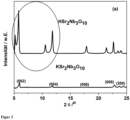
- Das erfindungsgemäße Schichtniobat zeichnet sich insbesondere dadurch aus, dass es zwei Phasen mit unterschiedlichen Schichtabständen aufweist. Diese Phasen lassen sich mittels XRD-Messungen identifizieren. In einer bevorzugten Ausführungsform treten die 002- und 004-Röntgenbeugungsreflexe des erfindungsgemäßen Schichtniobats als zwei Reflexe ("Doppelpeak") auf. Im XRD-Spektrum des erfindungsgemäßen Schichtniobats treten daher die genannten Reflexe als Doppelreflexe auf, anstatt als Einzelreflexe wie in den Spektren herkömmlicher Schichtniobate.
- Die photokatalytische Aktivität der erfindungsgemäßen Schichtniobate lässt sich dadurch steigern, dass zumindest ein Teil der in den Zwischenschichten eingelagerten Alkalimetall-Ionen durch Protonen ersetzt wird. Als besonders effizient hat sich dieser Austausch dann erwiesen, wenn es sich bei den Alkalimetall-Ionen um Kaliumionen handelt. Daher ist eine Ausführungsform der vorliegenden Erfindung besonders bevorzugt in der A ein Kaliumion ist. Ohne an eine bestimmte Theorie gebunden zu sein, wird davon ausgegangen, dass es insbesondere der Schritt der Protonierung ist, der zur Ausbildung der speziellen Struktur der erfindungsgemäßen Schichtniobate beiträgt. Daher wird in einer Ausführungsform das Schichtniobat dadurch hergestellt, dass eine Verbindung der Formel ASr2Nb3O10, wobei A für ein Element der Gruppe K+, Cs+ und Rb+ steht, mit wässriger Salpetersäure (HNO3) behandelt wird. Vorzugsweise erfolgt die Behandlung mit der wässrigen Salpetersäure bei einer Temperatur von 40 bis 70 °C, vorzugsweise 50 bis 65 °C. Die Dauer der Behandlung richtet sich nach dem gewünschten Protonierungsgrad und kann in einer bevorzugten Ausführungsform 3 bis 24 Stunden, vorzugsweise 5 bis 20 Stunden und besonders bevorzugt 12 bis 18 Stunden betragen. Weiterhin hat es sich als vorteilhaft erwiesen, die wässrige Salpetersäure während der Behandlung zu erneuern. Daher ist eine Ausführungsform besonders bevorzugt, bei der die wässrige Salpetersäurelösung alle 4 bis 10 Stunden, vorzugsweise alle 5 bis 8 Stunden durch eine frische Lösung ausgetauscht wird. In einer weiterhin bevorzugten Ausführungsform beträgt die Konzentration der wässrigen Salpetersäurelösung 0,5 bis 2,5 M, vorzugsweise 0,5 bis 1,5 M.
- Ein weiterer Gegenstand der vorliegenden Erfindung ist ein Verfahren zur Herstellung des erfindungsgemäßen Schichtniobats, wobei das Verfahren das Behandeln einer Verbindung der allgemeinen Formel ASr2Nb3O10, wobei A für ein Element der Gruppe Elemente K+, Cs+ und Rb+ steht, mit wässriger Salpetersäure (HNO3) bei einer Temperatur von 40 bis 70 °C, vorzugsweise 50 bis 65 °C umfasst. Die Dauer der Behandlung richtet sich nach dem gewünschten Protonierungsgrad und kann in einer bevorzugten Ausführungsform 3 bis 24 Stunden, vorzugsweise 5 bis 20 Stunden und besonders bevorzugt 12 bis 18 Stunden betragen. Weiterhin hat es sich als vorteilhaft erwiesen, die wässrige Salpetersäure während der Behandlung zu erneuern. Daher ist eine Ausführungsform besonders bevorzugt, bei der die wässrige Salpetersäurelösung alle 4 bis 10 Stunden, vorzugsweise alle 5 bis 8 Stunden durch eine frische Lösung ausgetauscht wird. In einer weiterhin bevorzugten Ausführungsform beträgt die Konzentration der wässrigen Salpetersäurelösung 0,5 bis 2,5 M, vorzugsweise 0,5 bis 1,5 M.
- Die Verbindung der allgemeinen Formel ASr2Nb3O10, die als Ausgangsverbindung bei der Herstellung der erfindungsgemäßen Schichtniobate dient, wird vorzugsweise mittels Salzschmelzsynthese oder Festphasensynthese hergestellt.
- Die erfindungsgemäßen Schichtniobate zeichnen sich durch eine hohe photokatalytische Aktivität aus. Daher ist ein weiterer Gegenstand der vorliegenden Erfindung die Verwendung des erfindungsgemäßen Schichtniobats als Photokatalysator, vorzugsweise als Photokatalysator in der photoinduzierten Wasserspaltung.
- Ein weiterer Gegenstand der vorliegenden Erfindung ist ein Photokatalysator, der ein Schichtniobat gemäß der vorliegenden Erfindung umfasst. Es hat sich überraschend gezeigt, dass die Menge an Wasserstoff, die durch den erfindungsgemäßen Photokatalysator erzeugt wird, höher ist als die, die durch herkömmliche Photokatalysatoren unter gleichen Bedingungen erzielt wird. Vorzugsweise weist der erfindungsgemäße Photokatalysator weiterhin einen Rhodium-Cokatalysator auf.
- Die Erfindung wird im Folgenden anhand von Beispielen näher erläutert, wobei diese keinesfalls als Einschränkung des Erfindungsgedankens zu verstehen sind.
- KSr2Nb3O10 wurde mittels Salzschmelzsynthese hergestellt, wie beispielsweise durch Kulischow et al in Catal. Today 2017, 287, 65-69 beschrieben.
- KSr2Nb3O10wurde in 1M HNO3-Lösung bei 60 °C für verschiedene Zeitintervalle gerührt. Der Protonierungsgrad wurde mittels energiedispersiver Röntgenspektroskopie (energy dispersive X-ray spectroscopy, EDX) verfolgt.
- Röntgenbeugungsanalysen wurden mittels eines PANalytical MPD Diffraktometers mit Cu-Kα-Strahlung (λ = 0,1541 nm) im 2Θ-Bereich von 5° bis 30° durchgeführt.
- EDX-Elementaranalyse wurde mit einem Philips LEO Gemini 928 Feldemission-SEM bei 20 kV Beschleunigungsspannung durchgeführt.
- Die photokatalytischen Untersuchungen wurden wie in Kulischow et al in Catal. Today 2017, 287, 65-69 beschrieben in einem doppelwandigen Quarz-Reaktor durchgeführt. Um thermische Einflüsse auszuschließen, wurde der Reaktor auf 10 °C gekühlt. Als Lichtquelle wurde eine 350 W Hg-Lampe verwendet. Zur Detektion des entstehenden Wasserstoffs wurde ein Shimadzu GC-2014 Gaschromatograph, ausgestattet mit einem Detektor für die thermische Leitfähigkeit (TCD) und RESTEK ShinCarbon ST 100/120-Säule, verwendet. Die Säule wurde während der Messung bei einer Temperatur von 35 °C gehalten und die Elutionszeit für H2 betrug 1 Minute.
- In einem typischen Experiment wurden 0,3 g des erfindungsgemäßen Schichtniobats mit 0,3 Gew.-% Rh(NH3)5Cl)Cl2 als Cokatalysator unter Ultraschallbehandlung in 600 ml wässriger Methanollösung (10% v/v) suspendiert und dann mit der 350 W Hg-Lampe bestrahlt. Der Ausgangs-pH-Wert der Lösung wurde mit Perchlorsäure auf 3 eingestellt. Vor der Bestrahlung wurde das System mit Argon gespült, um die komplette Entfernung von Luft zu garantieren. Die Ergebnisse dieser photokatalytischen Messungen mit der 350 W Hg-Lampe an den Materialien mit unterschiedlichem Protonierungsgrad sind in
Figur 4 dargestellt. - Weitere Schichtniobate wurden hergestellt, indem die Temperatur und die Dauer der Säurebehandlung variiert wurden. Die Behandlung mit 1M HNO3 wurde bei 20 °C, 55 °C, 60 °C und 80 °C durchgeführt. Die Dauer der Behandlungen wurde so abgestimmt, dass bei allen Experimenten am Ende der Säurebehandlung ein ähnlicher Protonierungsgrad erzielt wurde, wobei bei 20 °C die längste Behandlung (172h) notwendig war. Die chemische Analyse der erhaltenen Schichtniobate ist in Tabelle 1 zusammengefasst, wobei zum Vergleich die Ausgangsverbindung KSr2Nb3O10 aufgeführt ist. Die verwendeten Proben wiesen jeweils einen Austausch- beziehungsweise Protonierungsgrad von 83% auf, wobei jedoch nur die Proben der Beispiele 1 und 2, bei denen die Säurebehandlung bei 55 °C beziehungsweise 60 °C durchgeführt wurde, die erfindungsgemäßen unterschiedlichen Schichtabstände zeigten. Die entsprechenden XRD-Diagramme sind in
Figur 5 wiedergegeben. Die Säurebehandlungen bei 20 °C beziehungsweise 80 °C (Vergleichsbeispiele 1 bzw. 2) zeigten in den XRD Diagrammen jeweils nur einen 002- und 004-Peak auf.Tabelle 1: Analysen Molverhältnisse bezogen auf Nb = 3 Temperatur [°C] K [Gew.-%] Sr [Gew.-%] Nb [Gew.-%] H (1-K) K Sr Nb KSr2Nb3O10 - 5,86 26,75 42,82 - 0,98 1,99 3 Vgl. 1 20 1,06 27,84 44,35 0,83 0,17 2,00 3 Bsp. 1 55 1,05 27,83 44,26 0,83 0,17 2,00 3 Bsp. 2 60 1,05 27,81 44,14 0,83 0,17 2,00 3 Vgl. 2 80 1,07 27,84 44,22 0,83 0,17 2,00 3 - Ziel der Photokatalysator-Entwicklung ist die solare Wasserspaltung. Hg-Lampen erzeugen einen hohen Anteil an hochenergetischer UV-Strahlung, die zwar die photokatalytische Wasserstoffentwicklung erhöht, im Sonnenlichtspektrum jedoch nicht enthalten ist. Um die Anwendung für die solare Wasserspaltung zu prüfen, wurde eine Quarzglasküvette mit der Photokatalysator-Suspension aus den Schichtniobaten der Tabelle 1 mit Rh(NH3)5Cl)Cl2 als Cokatalysator wie oben beschrieben anstelle der Hg-Lampe mit einer Xenon-Bogenlampe (Perkin Elmer Cermax E300BF) durch einen Solarsimulator-Filter bestrahlt. Um eine Temperaturerhöhung zu vermeiden, wurde ein Wasserfilter verwendet. Die Beleuchtungsstärke betrug 1283,9 mW/cm2 auf der Küvette. Die gemessene Menge an Wasserstoff nach 5 Stunden ist in Tabelle 2 zusammengefasst:
Probe Vgl. 1 Bsp. 1 Bsp. 2 Vgl. 2 H2 [µmol/h] 400 493 545 418 - Wie Tabelle 2 zu entnehmen ist, konnte durch die Verwendung der erfindungsgemäßen Schichtniobate (Bsp. 1 und Bsp. 2) eine deutlich höhere Wasserstoffproduktion erreicht werden.
-
Figur 1 zeigt ein XRD-Diagramm eines erfindungsgemäßen Schichtperovskits der Formel [HaKb]Sr2Nb3O10 (A) mit unterschiedlichen Protonierungsgraden, wobei K+ gegen H+ ausgetauscht wurde mit (a) Referenzdiagramm der 100% protonengetauschten, vollständig trockenen Verbindung und (b) Referenzdiagramm der 100% protonengetauschten, vollständig hydratisierten Verbindung. -
Figur 2 zeigt einen vergrößerten Ausschnitt aus einem XRD-Diagramm eines erfindungsgemäßen Schichtniobats, wobei deutlich die 00l-Peaks des doppelstrukturierten Schichtniobats HSr2Nb3O10* x H2O zu erkennen sind. Der Abstand zwischen den Schichten beträgt 15,3 Å beziehungsweise 16,9 Å. -
Figur 3 zeigt die Länge der c-Achse beziehungsweise den Schichtabstand in einem erfindungsgemäßen Schichtniobat in Abhängigkeit vom Austauschgrad K+ gegen H+. -
Figur 4 zeigt die Abhängigkeit der Wasserstoffbildungsrate vom Austauschgrad K+ gegen H+ in einem erfindungsgemäßen Schichtniobat. -
Figur 5 zeigt einen Vergleich der XRD-Diagramme der Schichtniobate der Tabelle 1, die in den beschriebenen Beispielen eingesetzt wurden, wobei deutlich die Aufspaltung der Schichtabstände ("Doppelpeak") zu erkennen ist (Bsp. 1 und Bsp. 2).
Claims (12)
- Schichtniobat der Formel [HaAb]+[Sr2Nb3O10]-, wobei [Sr2Nb3O10]- die Hauptschichten und [HaAb]+ die Zwischenschichten bilden, wobei H für eine Gruppe steht, die aus H+ und H3O+ besteht und A für ein Element der Gruppe K+, Cs+ und Rb+ steht, mit 0,6 ≤ a ≤ 1 und 0 ≤ b ≤ 0,4, mit a + b = 1, dadurch gekennzeichnet, dass das Schichtniobat unterschiedliche Abstände zwischen den Hauptschichten aufweist.
- Schichtniobat gemäß Anspruch 1, dadurch gekennzeichnet, dass es sich bei dem Schichtniobat um ein Schichtperowskit vom Dion-Jacobson-Typ handelt.
- Schichtniobat gemäß wenigstens einem der vorangehenden Ansprüche, dadurch gekennzeichnet, dass das Schichtniobat eine hydratisierte und eine dehydratisierte Phase aufweist.
- Schichtniobat gemäß wenigstens einem der vorangehenden Ansprüche, dadurch gekennzeichnet, dass das Schichtniobat einen Protonierungsgrad von wenigstens 60% aufweist, vorzugsweise mehr als 70%, besonders bevorzugt 80 bis 100%, wobei der Protonierungsgrad mittels EDX bestimmt wird.
- Schichtniobat gemäß wenigstens einem der vorangehenden Ansprüche, dadurch gekennzeichnet, dass A ein Kalium-Ion ist.
- Schichtniobat gemäß wenigstens einem der vorangehenden Ansprüche, dadurch gekennzeichnet, dass das Schichtniobat dadurch hergestellt wird, dass eine Verbindung der Formel ASr2Nb3O10, wobei A für ein Element der Gruppe K+, Cs+ und Rb+ steht, mit wässriger Salpetersäure (HNO3) bei einer Temperatur von 40 bis 70 °C behandelt wird.
- Schichtniobat gemäß Anspruch 6, dadurch gekennzeichnet, dass die Behandlung mit der wässrigen Salpetersäure bei einer Temperatur von 50 bis 65 °C erfolgt.
- Schichtniobat gemäß wenigstens einem der Ansprüche 6 oder 7, dadurch gekennzeichnet, dass die Konzentration der wässrigen Salpetersäurelösung 0,5 bis 2,5 M, vorzugsweise 0,5 bis 1,5 M beträgt.
- Verfahren zur Herstellung eines Schichtniobats gemäß wenigstens einem der Ansprüche 1 bis 8, umfassend das Behandeln einer Verbindung der allgemeinen Formel ASr2Nb3O10, wobei A für ein Element der Gruppe K+, Cs+ und Rb+ steht, mit wässriger Salpetersäure (HNO3), dadurch gekennzeichnet, dass das Behandeln bei einer Temperatur von 40 bis 70 °C, vorzugsweise 50 bis 65 °C erfolgt.
- Verwendung eines Schichtniobats gemäß wenigstens einem der Ansprüche 1 bis 8 als Photokatalysator, vorzugsweise für die photoinduzierte Wasserspaltung.
- Photokatalysator umfassend ein Schichtniobat gemäß wenigstens einem der Ansprüche 1 bis 8.
- Photokatalysator gemäß Anspruch 11, dadurch gekennzeichnet, dass der Photokatalysator weiterhin einen Rhodium-Cokatalysator aufweist.
Applications Claiming Priority (2)
| Application Number | Priority Date | Filing Date | Title |
|---|---|---|---|
| DE102020214923.2A DE102020214923A1 (de) | 2020-11-27 | 2020-11-27 | Schichtniobate für die Verwendung in Photokatalysatoren |
| PCT/EP2021/081245 WO2022112002A1 (de) | 2020-11-27 | 2021-11-10 | Schichtniobate für die verwendung in photokatalysatoren |
Publications (2)
| Publication Number | Publication Date |
|---|---|
| EP4251573A1 EP4251573A1 (de) | 2023-10-04 |
| EP4251573B1 true EP4251573B1 (de) | 2024-08-28 |
Family
ID=78617417
Family Applications (1)
| Application Number | Title | Priority Date | Filing Date |
|---|---|---|---|
| EP21806740.3A Active EP4251573B1 (de) | 2020-11-27 | 2021-11-10 | Schichtniobate für die verwendung in photokatalysatoren |
Country Status (11)
| Country | Link |
|---|---|
| US (1) | US20230405558A1 (de) |
| EP (1) | EP4251573B1 (de) |
| JP (1) | JP7789069B2 (de) |
| CN (1) | CN116600896A (de) |
| AU (1) | AU2021386535A1 (de) |
| DE (1) | DE102020214923A1 (de) |
| ES (1) | ES2991535T3 (de) |
| PL (1) | PL4251573T3 (de) |
| PT (1) | PT4251573T (de) |
| WO (1) | WO2022112002A1 (de) |
| ZA (1) | ZA202305179B (de) |
Family Cites Families (12)
| Publication number | Priority date | Publication date | Assignee | Title |
|---|---|---|---|---|
| US4831005A (en) * | 1984-12-28 | 1989-05-16 | Mobil Oil Company | Method for intercalating organic-swelled layered metal chalcogenide with a polymeric chalcogenide by plural treatments with polymeric chalcogenide precursor |
| US4859648A (en) * | 1984-12-28 | 1989-08-22 | Mobil Oil Corporation | Layered metal chalcogenides containing interspathic polymeric chalcogenides |
| JP2730111B2 (ja) * | 1988-12-26 | 1998-03-25 | 株式会社ニコン | 新規な水の光分解触媒 |
| JP5672726B2 (ja) | 2010-03-11 | 2015-02-18 | 独立行政法人物質・材料研究機構 | 薄片状ペロブスカイト酸化物粒子を配合した有機溶媒分散体及びその製造方法並びにそれを用いたペロブスカイト酸化物薄膜及びその製造方法 |
| JP5740645B2 (ja) | 2010-04-13 | 2015-06-24 | 国立研究開発法人産業技術総合研究所 | 配向ペロブスカイト酸化物薄膜 |
| KR101398553B1 (ko) | 2013-01-29 | 2014-05-27 | 한국과학기술연구원 | 나이오베이트 유전체 조성물 및 이를 사용하는 나노시트 박막 |
| CN103191714B (zh) | 2013-04-16 | 2015-05-20 | 桂林理工大学 | 一种层状复合氧化物作为可见光响应的光催化剂的应用 |
| JP6156822B2 (ja) * | 2013-12-09 | 2017-07-05 | 国立大学法人 東京大学 | 光触媒及び水分解反応用電極並びに水素及び/又は酸素の製造方法 |
| JP6749015B2 (ja) | 2016-08-09 | 2020-09-02 | 国立研究開発法人物質・材料研究機構 | 水和膨潤性層状金属酸化物、その組成物、その薄膜およびそれらの製造方法 |
| KR102325821B1 (ko) | 2017-03-31 | 2021-11-11 | 삼성전자주식회사 | 2차원 페로브스카이트 소재, 이를 포함하는 유전체 및 적층형 커패시터 |
| KR102469184B1 (ko) | 2017-10-27 | 2022-11-18 | 삼성전자주식회사 | 세라믹 전자 부품 및 그 제조 방법과 전자장치 |
| KR102868047B1 (ko) | 2019-10-10 | 2025-10-01 | 삼성전자주식회사 | 유전체 단층 박막, 이를 포함하는 커패시터 및 반도체 소자, 및 이의 제조방법 |
-
2020
- 2020-11-27 DE DE102020214923.2A patent/DE102020214923A1/de active Granted
-
2021
- 2021-11-10 WO PCT/EP2021/081245 patent/WO2022112002A1/de not_active Ceased
- 2021-11-10 PT PT218067403T patent/PT4251573T/pt unknown
- 2021-11-10 AU AU2021386535A patent/AU2021386535A1/en active Pending
- 2021-11-10 EP EP21806740.3A patent/EP4251573B1/de active Active
- 2021-11-10 ES ES21806740T patent/ES2991535T3/es active Active
- 2021-11-10 CN CN202180078971.6A patent/CN116600896A/zh active Pending
- 2021-11-10 PL PL21806740.3T patent/PL4251573T3/pl unknown
- 2021-11-10 JP JP2023532345A patent/JP7789069B2/ja active Active
- 2021-11-10 US US18/038,214 patent/US20230405558A1/en active Pending
-
2023
- 2023-05-10 ZA ZA2023/05179A patent/ZA202305179B/en unknown
Also Published As
| Publication number | Publication date |
|---|---|
| US20230405558A1 (en) | 2023-12-21 |
| JP2023553364A (ja) | 2023-12-21 |
| AU2021386535A1 (en) | 2023-06-15 |
| PT4251573T (pt) | 2024-09-23 |
| WO2022112002A1 (de) | 2022-06-02 |
| ZA202305179B (en) | 2024-03-27 |
| EP4251573A1 (de) | 2023-10-04 |
| ES2991535T3 (es) | 2024-12-03 |
| PL4251573T3 (pl) | 2025-01-13 |
| CN116600896A (zh) | 2023-08-15 |
| AU2021386535A9 (en) | 2024-08-08 |
| JP7789069B2 (ja) | 2025-12-19 |
| DE102020214923A1 (de) | 2022-06-02 |
Similar Documents
| Publication | Publication Date | Title |
|---|---|---|
| EP0694982B1 (de) | Platinlegierungskatalysator für Brennstoffzellen und Verfahren zu dessen Herstellung | |
| DE60222534T2 (de) | Oxidsulfidphotokatalysator zur verwendung bei der zersetzung von wasser durch sichtbares licht | |
| EP2490804B1 (de) | Katalysator für die wasserdampfreformierung von methanol | |
| DE2636447C2 (de) | Mangandioxidelektroden | |
| WO2022136484A1 (de) | Iridiumhaltiger katalysator für die wasserelektrolyse | |
| EP2581971A1 (de) | Katalysatorbeschichtung und Verfahren zu ihrer Herstellung | |
| WO2021004716A1 (de) | Katalysator für die sauerstoffentwicklungsreaktion bei der wasserelektrolyse | |
| DE112015001452B4 (de) | Sauerstoffreduktionskatalysator und Herstellungsverfahren dafür | |
| DE102020216592A1 (de) | Katalysator und verfahren zur herstellung desselben | |
| DE102021209816A1 (de) | Katalysator für eine brennstoffzelle und ein verfahren zum herstellen desselben | |
| DE102020126795A1 (de) | Sauerstoffevolutionskatalysator, Herstellung und Verwendung desselben, Membranelektrodenanordnung und Brennstoffzelle bzw. Elektrolysezelle | |
| DE69521588T2 (de) | Stabile Beschichtungslösungen zur Bildung von elektrokatalytischen Beschichtungen aus gemischten Oxyden auf Metall oder metallisierten Trägern und Verfahren zur Herstellung von dimensionstabilen Anoden unter Verwendung dieser Lösungen | |
| EP4267781A1 (de) | Beschichtete membran für die wasserelektrolyse | |
| EP1652816A1 (de) | Verfahren zur herstellung von oxidiertem graphit | |
| DE69508689T2 (de) | Elektrode für elektrochemisches Verfahren und deren Verwendung | |
| EP4066935A1 (de) | Verfahren zur herstellung eines lithium-adsorbens | |
| DE2030394C3 (de) | Verfahren zur Herstellung eines Elektrolytkondensators | |
| DE102020214923A1 (de) | Schichtniobate für die Verwendung in Photokatalysatoren | |
| DE1471800C3 (de) | Brennstoffelektrode | |
| DE102021206994A1 (de) | Intermetallischer katalysator und verfahren zu seiner herstellung | |
| EP3817110A1 (de) | Katalysator hoher stabilität für eine elektrochemische zelle | |
| DE2263636A1 (de) | Brennstoffelement | |
| DE102021208372A1 (de) | Ternärer legierungskatalysator und verfahren zum herstellen desselben | |
| DE102006037314A1 (de) | Verwendung eines Katalysators auf Basis von Zeolithen bei der Umsetzung von Oxygenaten zu niederen Olefinen sowie Verfahren hierzu | |
| DE2710802B2 (de) | Verfahren zur Herstellung von Elektroden für Elektrolysezellen |
Legal Events
| Date | Code | Title | Description |
|---|---|---|---|
| STAA | Information on the status of an ep patent application or granted ep patent |
Free format text: STATUS: UNKNOWN |
|
| STAA | Information on the status of an ep patent application or granted ep patent |
Free format text: STATUS: THE INTERNATIONAL PUBLICATION HAS BEEN MADE |
|
| PUAI | Public reference made under article 153(3) epc to a published international application that has entered the european phase |
Free format text: ORIGINAL CODE: 0009012 |
|
| STAA | Information on the status of an ep patent application or granted ep patent |
Free format text: STATUS: REQUEST FOR EXAMINATION WAS MADE |
|
| 17P | Request for examination filed |
Effective date: 20230627 |
|
| AK | Designated contracting states |
Kind code of ref document: A1 Designated state(s): AL AT BE BG CH CY CZ DE DK EE ES FI FR GB GR HR HU IE IS IT LI LT LU LV MC MK MT NL NO PL PT RO RS SE SI SK SM TR |
|
| DAV | Request for validation of the european patent (deleted) | ||
| DAX | Request for extension of the european patent (deleted) | ||
| GRAP | Despatch of communication of intention to grant a patent |
Free format text: ORIGINAL CODE: EPIDOSNIGR1 |
|
| STAA | Information on the status of an ep patent application or granted ep patent |
Free format text: STATUS: GRANT OF PATENT IS INTENDED |
|
| INTG | Intention to grant announced |
Effective date: 20240411 |
|
| RIN1 | Information on inventor provided before grant (corrected) |
Inventor name: LADASIU CIOLACU, FLAVIU CALIN Inventor name: KULISCHOW, NATALIA Inventor name: MARSCHALL, ROLAND Inventor name: ALBRECHT, SVEN Inventor name: SCHNITTER, CHRISTOPH |
|
| GRAS | Grant fee paid |
Free format text: ORIGINAL CODE: EPIDOSNIGR3 |
|
| GRAA | (expected) grant |
Free format text: ORIGINAL CODE: 0009210 |
|
| STAA | Information on the status of an ep patent application or granted ep patent |
Free format text: STATUS: THE PATENT HAS BEEN GRANTED |
|
| AK | Designated contracting states |
Kind code of ref document: B1 Designated state(s): AL AT BE BG CH CY CZ DE DK EE ES FI FR GB GR HR HU IE IS IT LI LT LU LV MC MK MT NL NO PL PT RO RS SE SI SK SM TR |
|
| REG | Reference to a national code |
Ref country code: CH Ref legal event code: EP |
|
| REG | Reference to a national code |
Ref country code: DE Ref legal event code: R096 Ref document number: 502021004994 Country of ref document: DE |
|
| REG | Reference to a national code |
Ref country code: PT Ref legal event code: SC4A Ref document number: 4251573 Country of ref document: PT Date of ref document: 20240923 Kind code of ref document: T Free format text: AVAILABILITY OF NATIONAL TRANSLATION Effective date: 20240916 |
|
| REG | Reference to a national code |
Ref country code: IE Ref legal event code: FG4D Free format text: LANGUAGE OF EP DOCUMENT: GERMAN |
|
| REG | Reference to a national code |
Ref country code: NL Ref legal event code: FP |
|
| REG | Reference to a national code |
Ref country code: ES Ref legal event code: FG2A Ref document number: 2991535 Country of ref document: ES Kind code of ref document: T3 Effective date: 20241203 |
|
| REG | Reference to a national code |
Ref country code: LT Ref legal event code: MG9D |
|
| PG25 | Lapsed in a contracting state [announced via postgrant information from national office to epo] |
Ref country code: NO Free format text: LAPSE BECAUSE OF FAILURE TO SUBMIT A TRANSLATION OF THE DESCRIPTION OR TO PAY THE FEE WITHIN THE PRESCRIBED TIME-LIMIT Effective date: 20241128 |
|
| PG25 | Lapsed in a contracting state [announced via postgrant information from national office to epo] |
Ref country code: FI Free format text: LAPSE BECAUSE OF FAILURE TO SUBMIT A TRANSLATION OF THE DESCRIPTION OR TO PAY THE FEE WITHIN THE PRESCRIBED TIME-LIMIT Effective date: 20240828 |
|
| PG25 | Lapsed in a contracting state [announced via postgrant information from national office to epo] |
Ref country code: BG Free format text: LAPSE BECAUSE OF FAILURE TO SUBMIT A TRANSLATION OF THE DESCRIPTION OR TO PAY THE FEE WITHIN THE PRESCRIBED TIME-LIMIT Effective date: 20240828 |
|
| PG25 | Lapsed in a contracting state [announced via postgrant information from national office to epo] |
Ref country code: LV Free format text: LAPSE BECAUSE OF FAILURE TO SUBMIT A TRANSLATION OF THE DESCRIPTION OR TO PAY THE FEE WITHIN THE PRESCRIBED TIME-LIMIT Effective date: 20240828 |
|
| PG25 | Lapsed in a contracting state [announced via postgrant information from national office to epo] |
Ref country code: IS Free format text: LAPSE BECAUSE OF FAILURE TO SUBMIT A TRANSLATION OF THE DESCRIPTION OR TO PAY THE FEE WITHIN THE PRESCRIBED TIME-LIMIT Effective date: 20241228 |
|
| PG25 | Lapsed in a contracting state [announced via postgrant information from national office to epo] |
Ref country code: HR Free format text: LAPSE BECAUSE OF FAILURE TO SUBMIT A TRANSLATION OF THE DESCRIPTION OR TO PAY THE FEE WITHIN THE PRESCRIBED TIME-LIMIT Effective date: 20240828 |
|
| PG25 | Lapsed in a contracting state [announced via postgrant information from national office to epo] |
Ref country code: RS Free format text: LAPSE BECAUSE OF FAILURE TO SUBMIT A TRANSLATION OF THE DESCRIPTION OR TO PAY THE FEE WITHIN THE PRESCRIBED TIME-LIMIT Effective date: 20241128 |
|
| REG | Reference to a national code |
Ref country code: GR Ref legal event code: EP Ref document number: 20240402770 Country of ref document: GR Effective date: 20250120 |
|
| PG25 | Lapsed in a contracting state [announced via postgrant information from national office to epo] |
Ref country code: RS Free format text: LAPSE BECAUSE OF FAILURE TO SUBMIT A TRANSLATION OF THE DESCRIPTION OR TO PAY THE FEE WITHIN THE PRESCRIBED TIME-LIMIT Effective date: 20241128 Ref country code: NO Free format text: LAPSE BECAUSE OF FAILURE TO SUBMIT A TRANSLATION OF THE DESCRIPTION OR TO PAY THE FEE WITHIN THE PRESCRIBED TIME-LIMIT Effective date: 20241128 Ref country code: LV Free format text: LAPSE BECAUSE OF FAILURE TO SUBMIT A TRANSLATION OF THE DESCRIPTION OR TO PAY THE FEE WITHIN THE PRESCRIBED TIME-LIMIT Effective date: 20240828 Ref country code: IS Free format text: LAPSE BECAUSE OF FAILURE TO SUBMIT A TRANSLATION OF THE DESCRIPTION OR TO PAY THE FEE WITHIN THE PRESCRIBED TIME-LIMIT Effective date: 20241228 Ref country code: HR Free format text: LAPSE BECAUSE OF FAILURE TO SUBMIT A TRANSLATION OF THE DESCRIPTION OR TO PAY THE FEE WITHIN THE PRESCRIBED TIME-LIMIT Effective date: 20240828 Ref country code: FI Free format text: LAPSE BECAUSE OF FAILURE TO SUBMIT A TRANSLATION OF THE DESCRIPTION OR TO PAY THE FEE WITHIN THE PRESCRIBED TIME-LIMIT Effective date: 20240828 Ref country code: BG Free format text: LAPSE BECAUSE OF FAILURE TO SUBMIT A TRANSLATION OF THE DESCRIPTION OR TO PAY THE FEE WITHIN THE PRESCRIBED TIME-LIMIT Effective date: 20240828 |
|
| PG25 | Lapsed in a contracting state [announced via postgrant information from national office to epo] |
Ref country code: RO Free format text: LAPSE BECAUSE OF FAILURE TO SUBMIT A TRANSLATION OF THE DESCRIPTION OR TO PAY THE FEE WITHIN THE PRESCRIBED TIME-LIMIT Effective date: 20240828 Ref country code: DK Free format text: LAPSE BECAUSE OF FAILURE TO SUBMIT A TRANSLATION OF THE DESCRIPTION OR TO PAY THE FEE WITHIN THE PRESCRIBED TIME-LIMIT Effective date: 20240828 Ref country code: SM Free format text: LAPSE BECAUSE OF FAILURE TO SUBMIT A TRANSLATION OF THE DESCRIPTION OR TO PAY THE FEE WITHIN THE PRESCRIBED TIME-LIMIT Effective date: 20240828 |
|
| PG25 | Lapsed in a contracting state [announced via postgrant information from national office to epo] |
Ref country code: EE Free format text: LAPSE BECAUSE OF FAILURE TO SUBMIT A TRANSLATION OF THE DESCRIPTION OR TO PAY THE FEE WITHIN THE PRESCRIBED TIME-LIMIT Effective date: 20240828 |
|
| PG25 | Lapsed in a contracting state [announced via postgrant information from national office to epo] |
Ref country code: CZ Free format text: LAPSE BECAUSE OF FAILURE TO SUBMIT A TRANSLATION OF THE DESCRIPTION OR TO PAY THE FEE WITHIN THE PRESCRIBED TIME-LIMIT Effective date: 20240828 |
|
| PG25 | Lapsed in a contracting state [announced via postgrant information from national office to epo] |
Ref country code: SK Free format text: LAPSE BECAUSE OF FAILURE TO SUBMIT A TRANSLATION OF THE DESCRIPTION OR TO PAY THE FEE WITHIN THE PRESCRIBED TIME-LIMIT Effective date: 20240828 |
|
| REG | Reference to a national code |
Ref country code: DE Ref legal event code: R097 Ref document number: 502021004994 Country of ref document: DE |
|
| REG | Reference to a national code |
Ref country code: CH Ref legal event code: PL |
|
| PLBE | No opposition filed within time limit |
Free format text: ORIGINAL CODE: 0009261 |
|
| STAA | Information on the status of an ep patent application or granted ep patent |
Free format text: STATUS: NO OPPOSITION FILED WITHIN TIME LIMIT |
|
| PG25 | Lapsed in a contracting state [announced via postgrant information from national office to epo] |
Ref country code: MC Free format text: LAPSE BECAUSE OF FAILURE TO SUBMIT A TRANSLATION OF THE DESCRIPTION OR TO PAY THE FEE WITHIN THE PRESCRIBED TIME-LIMIT Effective date: 20240828 |
|
| PG25 | Lapsed in a contracting state [announced via postgrant information from national office to epo] |
Ref country code: LU Free format text: LAPSE BECAUSE OF NON-PAYMENT OF DUE FEES Effective date: 20241110 |
|
| REG | Reference to a national code |
Ref country code: CH Ref legal event code: PL |
|
| PG25 | Lapsed in a contracting state [announced via postgrant information from national office to epo] |
Ref country code: CH Free format text: LAPSE BECAUSE OF NON-PAYMENT OF DUE FEES Effective date: 20241130 |
|
| 26N | No opposition filed |
Effective date: 20250530 |
|
| PG25 | Lapsed in a contracting state [announced via postgrant information from national office to epo] |
Ref country code: SE Free format text: LAPSE BECAUSE OF FAILURE TO SUBMIT A TRANSLATION OF THE DESCRIPTION OR TO PAY THE FEE WITHIN THE PRESCRIBED TIME-LIMIT Effective date: 20240828 |
|
| REG | Reference to a national code |
Ref country code: CH Ref legal event code: K11 Free format text: ST27 STATUS EVENT CODE: U-0-0-K10-K11 (AS PROVIDED BY THE NATIONAL OFFICE) Effective date: 20251006 |
|
| PGFP | Annual fee paid to national office [announced via postgrant information from national office to epo] |
Ref country code: PL Payment date: 20250912 Year of fee payment: 5 Ref country code: NL Payment date: 20250912 Year of fee payment: 5 |
|
| PGFP | Annual fee paid to national office [announced via postgrant information from national office to epo] |
Ref country code: GB Payment date: 20250918 Year of fee payment: 5 |
|
| PGFP | Annual fee paid to national office [announced via postgrant information from national office to epo] |
Ref country code: FR Payment date: 20250908 Year of fee payment: 5 |
|
| PG25 | Lapsed in a contracting state [announced via postgrant information from national office to epo] |
Ref country code: IE Free format text: LAPSE BECAUSE OF NON-PAYMENT OF DUE FEES Effective date: 20241110 |
|
| PGFP | Annual fee paid to national office [announced via postgrant information from national office to epo] |
Ref country code: PT Payment date: 20251106 Year of fee payment: 5 |
|
| PGFP | Annual fee paid to national office [announced via postgrant information from national office to epo] |
Ref country code: DE Payment date: 20250916 Year of fee payment: 5 |
|
| PGFP | Annual fee paid to national office [announced via postgrant information from national office to epo] |
Ref country code: AT Payment date: 20260113 Year of fee payment: 5 |
|
| PGFP | Annual fee paid to national office [announced via postgrant information from national office to epo] |
Ref country code: IT Payment date: 20251022 Year of fee payment: 5 |
|
| PGFP | Annual fee paid to national office [announced via postgrant information from national office to epo] |
Ref country code: TR Payment date: 20251031 Year of fee payment: 5 Ref country code: GR Payment date: 20251014 Year of fee payment: 5 Ref country code: BE Payment date: 20251003 Year of fee payment: 5 |
|
| PGFP | Annual fee paid to national office [announced via postgrant information from national office to epo] |
Ref country code: ES Payment date: 20251210 Year of fee payment: 5 |
|
| PG25 | Lapsed in a contracting state [announced via postgrant information from national office to epo] |
Ref country code: HU Free format text: LAPSE BECAUSE OF FAILURE TO SUBMIT A TRANSLATION OF THE DESCRIPTION OR TO PAY THE FEE WITHIN THE PRESCRIBED TIME-LIMIT; INVALID AB INITIO Effective date: 20211110 |
|
| REG | Reference to a national code |
Ref country code: CH Ref legal event code: K12 Free format text: ST27 STATUS EVENT CODE: U-0-0-K10-K12 (AS PROVIDED BY THE NATIONAL OFFICE) Effective date: 20260311 |
|
| PG25 | Lapsed in a contracting state [announced via postgrant information from national office to epo] |
Ref country code: CY Free format text: LAPSE BECAUSE OF FAILURE TO SUBMIT A TRANSLATION OF THE DESCRIPTION OR TO PAY THE FEE WITHIN THE PRESCRIBED TIME-LIMIT; INVALID AB INITIO Effective date: 20211110 |