EP4234632A2 - Kern- und schalenpolymere für den 3d-druck - Google Patents
Kern- und schalenpolymere für den 3d-druck Download PDFInfo
- Publication number
- EP4234632A2 EP4234632A2 EP23177724.4A EP23177724A EP4234632A2 EP 4234632 A2 EP4234632 A2 EP 4234632A2 EP 23177724 A EP23177724 A EP 23177724A EP 4234632 A2 EP4234632 A2 EP 4234632A2
- Authority
- EP
- European Patent Office
- Prior art keywords
- core
- shell
- polymer
- amorphous
- polymers
- Prior art date
- Legal status (The legal status is an assumption and is not a legal conclusion. Google has not performed a legal analysis and makes no representation as to the accuracy of the status listed.)
- Pending
Links
Images


Classifications
-
- C—CHEMISTRY; METALLURGY
- C08—ORGANIC MACROMOLECULAR COMPOUNDS; THEIR PREPARATION OR CHEMICAL WORKING-UP; COMPOSITIONS BASED THEREON
- C08J—WORKING-UP; GENERAL PROCESSES OF COMPOUNDING; AFTER-TREATMENT NOT COVERED BY SUBCLASSES C08B, C08C, C08F, C08G or C08H
- C08J3/00—Processes of treating or compounding macromolecular substances
- C08J3/12—Powdering or granulating
- C08J3/126—Polymer particles coated by polymer, e.g. core shell structures
-
- B—PERFORMING OPERATIONS; TRANSPORTING
- B29—WORKING OF PLASTICS; WORKING OF SUBSTANCES IN A PLASTIC STATE IN GENERAL
- B29C—SHAPING OR JOINING OF PLASTICS; SHAPING OF MATERIAL IN A PLASTIC STATE, NOT OTHERWISE PROVIDED FOR; AFTER-TREATMENT OF THE SHAPED PRODUCTS, e.g. REPAIRING
- B29C64/00—Additive manufacturing, i.e. manufacturing of three-dimensional [3D] objects by additive deposition, additive agglomeration or additive layering, e.g. by 3D printing, stereolithography or selective laser sintering
- B29C64/10—Processes of additive manufacturing
- B29C64/106—Processes of additive manufacturing using only liquids or viscous materials, e.g. depositing a continuous bead of viscous material
-
- B—PERFORMING OPERATIONS; TRANSPORTING
- B29—WORKING OF PLASTICS; WORKING OF SUBSTANCES IN A PLASTIC STATE IN GENERAL
- B29C—SHAPING OR JOINING OF PLASTICS; SHAPING OF MATERIAL IN A PLASTIC STATE, NOT OTHERWISE PROVIDED FOR; AFTER-TREATMENT OF THE SHAPED PRODUCTS, e.g. REPAIRING
- B29C64/00—Additive manufacturing, i.e. manufacturing of three-dimensional [3D] objects by additive deposition, additive agglomeration or additive layering, e.g. by 3D printing, stereolithography or selective laser sintering
- B29C64/10—Processes of additive manufacturing
- B29C64/141—Processes of additive manufacturing using only solid materials
- B29C64/153—Processes of additive manufacturing using only solid materials using layers of powder being selectively joined, e.g. by selective laser sintering or melting
-
- B—PERFORMING OPERATIONS; TRANSPORTING
- B33—ADDITIVE MANUFACTURING TECHNOLOGY
- B33Y—ADDITIVE MANUFACTURING, i.e. MANUFACTURING OF THREE-DIMENSIONAL [3D] OBJECTS BY ADDITIVE DEPOSITION, ADDITIVE AGGLOMERATION OR ADDITIVE LAYERING, e.g. BY 3D PRINTING, STEREOLITHOGRAPHY OR SELECTIVE LASER SINTERING
- B33Y10/00—Processes of additive manufacturing
-
- B—PERFORMING OPERATIONS; TRANSPORTING
- B33—ADDITIVE MANUFACTURING TECHNOLOGY
- B33Y—ADDITIVE MANUFACTURING, i.e. MANUFACTURING OF THREE-DIMENSIONAL [3D] OBJECTS BY ADDITIVE DEPOSITION, ADDITIVE AGGLOMERATION OR ADDITIVE LAYERING, e.g. BY 3D PRINTING, STEREOLITHOGRAPHY OR SELECTIVE LASER SINTERING
- B33Y70/00—Materials specially adapted for additive manufacturing
-
- C—CHEMISTRY; METALLURGY
- C08—ORGANIC MACROMOLECULAR COMPOUNDS; THEIR PREPARATION OR CHEMICAL WORKING-UP; COMPOSITIONS BASED THEREON
- C08G—MACROMOLECULAR COMPOUNDS OBTAINED OTHERWISE THAN BY REACTIONS ONLY INVOLVING UNSATURATED CARBON-TO-CARBON BONDS
- C08G65/00—Macromolecular compounds obtained by reactions forming an ether link in the main chain of the macromolecule
- C08G65/34—Macromolecular compounds obtained by reactions forming an ether link in the main chain of the macromolecule from hydroxy compounds or their metallic derivatives
- C08G65/48—Polymers modified by chemical after-treatment
-
- C—CHEMISTRY; METALLURGY
- C08—ORGANIC MACROMOLECULAR COMPOUNDS; THEIR PREPARATION OR CHEMICAL WORKING-UP; COMPOSITIONS BASED THEREON
- C08G—MACROMOLECULAR COMPOUNDS OBTAINED OTHERWISE THAN BY REACTIONS ONLY INVOLVING UNSATURATED CARBON-TO-CARBON BONDS
- C08G65/00—Macromolecular compounds obtained by reactions forming an ether link in the main chain of the macromolecule
- C08G65/34—Macromolecular compounds obtained by reactions forming an ether link in the main chain of the macromolecule from hydroxy compounds or their metallic derivatives
- C08G65/48—Polymers modified by chemical after-treatment
- C08G65/485—Polyphenylene oxides
-
- C—CHEMISTRY; METALLURGY
- C08—ORGANIC MACROMOLECULAR COMPOUNDS; THEIR PREPARATION OR CHEMICAL WORKING-UP; COMPOSITIONS BASED THEREON
- C08L—COMPOSITIONS OF MACROMOLECULAR COMPOUNDS
- C08L25/00—Compositions of, homopolymers or copolymers of compounds having one or more unsaturated aliphatic radicals, each having only one carbon-to-carbon double bond, and at least one being terminated by an aromatic carbocyclic ring; Compositions of derivatives of such polymers
- C08L25/02—Homopolymers or copolymers of hydrocarbons
- C08L25/04—Homopolymers or copolymers of styrene
- C08L25/06—Polystyrene
-
- C—CHEMISTRY; METALLURGY
- C08—ORGANIC MACROMOLECULAR COMPOUNDS; THEIR PREPARATION OR CHEMICAL WORKING-UP; COMPOSITIONS BASED THEREON
- C08L—COMPOSITIONS OF MACROMOLECULAR COMPOUNDS
- C08L25/00—Compositions of, homopolymers or copolymers of compounds having one or more unsaturated aliphatic radicals, each having only one carbon-to-carbon double bond, and at least one being terminated by an aromatic carbocyclic ring; Compositions of derivatives of such polymers
- C08L25/02—Homopolymers or copolymers of hydrocarbons
- C08L25/04—Homopolymers or copolymers of styrene
- C08L25/08—Copolymers of styrene
- C08L25/12—Copolymers of styrene with unsaturated nitriles
-
- C—CHEMISTRY; METALLURGY
- C08—ORGANIC MACROMOLECULAR COMPOUNDS; THEIR PREPARATION OR CHEMICAL WORKING-UP; COMPOSITIONS BASED THEREON
- C08L—COMPOSITIONS OF MACROMOLECULAR COMPOUNDS
- C08L33/00—Compositions of homopolymers or copolymers of compounds having one or more unsaturated aliphatic radicals, each having only one carbon-to-carbon double bond, and only one being terminated by only one carboxyl radical, or of salts, anhydrides, esters, amides, imides or nitriles thereof; Compositions of derivatives of such polymers
- C08L33/04—Homopolymers or copolymers of esters
- C08L33/06—Homopolymers or copolymers of esters of esters containing only carbon, hydrogen and oxygen, which oxygen atoms are present only as part of the carboxyl radical
- C08L33/08—Homopolymers or copolymers of acrylic acid esters
-
- C—CHEMISTRY; METALLURGY
- C08—ORGANIC MACROMOLECULAR COMPOUNDS; THEIR PREPARATION OR CHEMICAL WORKING-UP; COMPOSITIONS BASED THEREON
- C08L—COMPOSITIONS OF MACROMOLECULAR COMPOUNDS
- C08L33/00—Compositions of homopolymers or copolymers of compounds having one or more unsaturated aliphatic radicals, each having only one carbon-to-carbon double bond, and only one being terminated by only one carboxyl radical, or of salts, anhydrides, esters, amides, imides or nitriles thereof; Compositions of derivatives of such polymers
- C08L33/04—Homopolymers or copolymers of esters
- C08L33/06—Homopolymers or copolymers of esters of esters containing only carbon, hydrogen and oxygen, which oxygen atoms are present only as part of the carboxyl radical
- C08L33/10—Homopolymers or copolymers of methacrylic acid esters
- C08L33/12—Homopolymers or copolymers of methyl methacrylate
-
- C—CHEMISTRY; METALLURGY
- C08—ORGANIC MACROMOLECULAR COMPOUNDS; THEIR PREPARATION OR CHEMICAL WORKING-UP; COMPOSITIONS BASED THEREON
- C08L—COMPOSITIONS OF MACROMOLECULAR COMPOUNDS
- C08L55/00—Compositions of homopolymers or copolymers, obtained by polymerisation reactions only involving carbon-to-carbon unsaturated bonds, not provided for in groups C08L23/00 - C08L53/00
- C08L55/02—ABS [Acrylonitrile-Butadiene-Styrene] polymers
-
- C—CHEMISTRY; METALLURGY
- C08—ORGANIC MACROMOLECULAR COMPOUNDS; THEIR PREPARATION OR CHEMICAL WORKING-UP; COMPOSITIONS BASED THEREON
- C08L—COMPOSITIONS OF MACROMOLECULAR COMPOUNDS
- C08L61/00—Compositions of condensation polymers of aldehydes or ketones; Compositions of derivatives of such polymers
- C08L61/04—Condensation polymers of aldehydes or ketones with phenols only
- C08L61/16—Condensation polymers of aldehydes or ketones with phenols only of ketones with phenols
-
- C—CHEMISTRY; METALLURGY
- C08—ORGANIC MACROMOLECULAR COMPOUNDS; THEIR PREPARATION OR CHEMICAL WORKING-UP; COMPOSITIONS BASED THEREON
- C08L—COMPOSITIONS OF MACROMOLECULAR COMPOUNDS
- C08L69/00—Compositions of polycarbonates; Compositions of derivatives of polycarbonates
-
- C—CHEMISTRY; METALLURGY
- C08—ORGANIC MACROMOLECULAR COMPOUNDS; THEIR PREPARATION OR CHEMICAL WORKING-UP; COMPOSITIONS BASED THEREON
- C08L—COMPOSITIONS OF MACROMOLECULAR COMPOUNDS
- C08L71/00—Compositions of polyethers obtained by reactions forming an ether link in the main chain; Compositions of derivatives of such polymers
- C08L71/08—Polyethers derived from hydroxy compounds or from their metallic derivatives
- C08L71/10—Polyethers derived from hydroxy compounds or from their metallic derivatives from phenols
- C08L71/12—Polyphenylene oxides
- C08L71/123—Polyphenylene oxides not modified by chemical after-treatment
-
- C—CHEMISTRY; METALLURGY
- C08—ORGANIC MACROMOLECULAR COMPOUNDS; THEIR PREPARATION OR CHEMICAL WORKING-UP; COMPOSITIONS BASED THEREON
- C08L—COMPOSITIONS OF MACROMOLECULAR COMPOUNDS
- C08L79/00—Compositions of macromolecular compounds obtained by reactions forming in the main chain of the macromolecule a linkage containing nitrogen with or without oxygen or carbon only, not provided for in groups C08L61/00 - C08L77/00
-
- C—CHEMISTRY; METALLURGY
- C08—ORGANIC MACROMOLECULAR COMPOUNDS; THEIR PREPARATION OR CHEMICAL WORKING-UP; COMPOSITIONS BASED THEREON
- C08L—COMPOSITIONS OF MACROMOLECULAR COMPOUNDS
- C08L81/00—Compositions of macromolecular compounds obtained by reactions forming in the main chain of the macromolecule a linkage containing sulfur with or without nitrogen, oxygen or carbon only; Compositions of polysulfones; Compositions of derivatives of such polymers
- C08L81/02—Polythioethers; Polythioether-ethers
-
- C—CHEMISTRY; METALLURGY
- C08—ORGANIC MACROMOLECULAR COMPOUNDS; THEIR PREPARATION OR CHEMICAL WORKING-UP; COMPOSITIONS BASED THEREON
- C08L—COMPOSITIONS OF MACROMOLECULAR COMPOUNDS
- C08L81/00—Compositions of macromolecular compounds obtained by reactions forming in the main chain of the macromolecule a linkage containing sulfur with or without nitrogen, oxygen or carbon only; Compositions of polysulfones; Compositions of derivatives of such polymers
- C08L81/04—Polysulfides
-
- C—CHEMISTRY; METALLURGY
- C08—ORGANIC MACROMOLECULAR COMPOUNDS; THEIR PREPARATION OR CHEMICAL WORKING-UP; COMPOSITIONS BASED THEREON
- C08L—COMPOSITIONS OF MACROMOLECULAR COMPOUNDS
- C08L81/00—Compositions of macromolecular compounds obtained by reactions forming in the main chain of the macromolecule a linkage containing sulfur with or without nitrogen, oxygen or carbon only; Compositions of polysulfones; Compositions of derivatives of such polymers
- C08L81/06—Polysulfones; Polyethersulfones
-
- C—CHEMISTRY; METALLURGY
- C08—ORGANIC MACROMOLECULAR COMPOUNDS; THEIR PREPARATION OR CHEMICAL WORKING-UP; COMPOSITIONS BASED THEREON
- C08L—COMPOSITIONS OF MACROMOLECULAR COMPOUNDS
- C08L9/00—Compositions of homopolymers or copolymers of conjugated diene hydrocarbons
- C08L9/06—Copolymers with styrene
-
- C—CHEMISTRY; METALLURGY
- C08—ORGANIC MACROMOLECULAR COMPOUNDS; THEIR PREPARATION OR CHEMICAL WORKING-UP; COMPOSITIONS BASED THEREON
- C08J—WORKING-UP; GENERAL PROCESSES OF COMPOUNDING; AFTER-TREATMENT NOT COVERED BY SUBCLASSES C08B, C08C, C08F, C08G or C08H
- C08J2300/00—Characterised by the use of unspecified polymers
- C08J2300/12—Polymers characterised by physical features, e.g. anisotropy, viscosity or electrical conductivity
-
- C—CHEMISTRY; METALLURGY
- C08—ORGANIC MACROMOLECULAR COMPOUNDS; THEIR PREPARATION OR CHEMICAL WORKING-UP; COMPOSITIONS BASED THEREON
- C08J—WORKING-UP; GENERAL PROCESSES OF COMPOUNDING; AFTER-TREATMENT NOT COVERED BY SUBCLASSES C08B, C08C, C08F, C08G or C08H
- C08J2325/00—Characterised by the use of homopolymers or copolymers of compounds having one or more unsaturated aliphatic radicals, each having only one carbon-to-carbon double bond, and at least one being terminated by an aromatic carbocyclic ring; Derivatives of such polymers
- C08J2325/02—Homopolymers or copolymers of hydrocarbons
- C08J2325/04—Homopolymers or copolymers of styrene
- C08J2325/06—Polystyrene
-
- C—CHEMISTRY; METALLURGY
- C08—ORGANIC MACROMOLECULAR COMPOUNDS; THEIR PREPARATION OR CHEMICAL WORKING-UP; COMPOSITIONS BASED THEREON
- C08J—WORKING-UP; GENERAL PROCESSES OF COMPOUNDING; AFTER-TREATMENT NOT COVERED BY SUBCLASSES C08B, C08C, C08F, C08G or C08H
- C08J2325/00—Characterised by the use of homopolymers or copolymers of compounds having one or more unsaturated aliphatic radicals, each having only one carbon-to-carbon double bond, and at least one being terminated by an aromatic carbocyclic ring; Derivatives of such polymers
- C08J2325/02—Homopolymers or copolymers of hydrocarbons
- C08J2325/04—Homopolymers or copolymers of styrene
- C08J2325/08—Copolymers of styrene
- C08J2325/12—Copolymers of styrene with unsaturated nitriles
-
- C—CHEMISTRY; METALLURGY
- C08—ORGANIC MACROMOLECULAR COMPOUNDS; THEIR PREPARATION OR CHEMICAL WORKING-UP; COMPOSITIONS BASED THEREON
- C08J—WORKING-UP; GENERAL PROCESSES OF COMPOUNDING; AFTER-TREATMENT NOT COVERED BY SUBCLASSES C08B, C08C, C08F, C08G or C08H
- C08J2333/00—Characterised by the use of homopolymers or copolymers of compounds having one or more unsaturated aliphatic radicals, each having only one carbon-to-carbon double bond, and only one being terminated by only one carboxyl radical, or of salts, anhydrides, esters, amides, imides, or nitriles thereof; Derivatives of such polymers
- C08J2333/04—Characterised by the use of homopolymers or copolymers of compounds having one or more unsaturated aliphatic radicals, each having only one carbon-to-carbon double bond, and only one being terminated by only one carboxyl radical, or of salts, anhydrides, esters, amides, imides, or nitriles thereof; Derivatives of such polymers esters
- C08J2333/06—Characterised by the use of homopolymers or copolymers of compounds having one or more unsaturated aliphatic radicals, each having only one carbon-to-carbon double bond, and only one being terminated by only one carboxyl radical, or of salts, anhydrides, esters, amides, imides, or nitriles thereof; Derivatives of such polymers esters of esters containing only carbon, hydrogen, and oxygen, the oxygen atom being present only as part of the carboxyl radical
- C08J2333/10—Homopolymers or copolymers of methacrylic acid esters
- C08J2333/12—Homopolymers or copolymers of methyl methacrylate
-
- C—CHEMISTRY; METALLURGY
- C08—ORGANIC MACROMOLECULAR COMPOUNDS; THEIR PREPARATION OR CHEMICAL WORKING-UP; COMPOSITIONS BASED THEREON
- C08J—WORKING-UP; GENERAL PROCESSES OF COMPOUNDING; AFTER-TREATMENT NOT COVERED BY SUBCLASSES C08B, C08C, C08F, C08G or C08H
- C08J2355/00—Characterised by the use of homopolymers or copolymers, obtained by polymerisation reactions only involving carbon-to-carbon unsaturated bonds, not provided for in groups C08J2323/00 - C08J2353/00
- C08J2355/02—Acrylonitrile-Butadiene-Styrene [ABS] polymers
-
- C—CHEMISTRY; METALLURGY
- C08—ORGANIC MACROMOLECULAR COMPOUNDS; THEIR PREPARATION OR CHEMICAL WORKING-UP; COMPOSITIONS BASED THEREON
- C08J—WORKING-UP; GENERAL PROCESSES OF COMPOUNDING; AFTER-TREATMENT NOT COVERED BY SUBCLASSES C08B, C08C, C08F, C08G or C08H
- C08J2379/00—Characterised by the use of macromolecular compounds obtained by reactions forming in the main chain of the macromolecule a linkage containing nitrogen with or without oxygen, or carbon only, not provided for in groups C08J2361/00 - C08J2377/00
- C08J2379/02—Polyamines
-
- C—CHEMISTRY; METALLURGY
- C08—ORGANIC MACROMOLECULAR COMPOUNDS; THEIR PREPARATION OR CHEMICAL WORKING-UP; COMPOSITIONS BASED THEREON
- C08J—WORKING-UP; GENERAL PROCESSES OF COMPOUNDING; AFTER-TREATMENT NOT COVERED BY SUBCLASSES C08B, C08C, C08F, C08G or C08H
- C08J2381/00—Characterised by the use of macromolecular compounds obtained by reactions forming in the main chain of the macromolecule a linkage containing sulfur with or without nitrogen, oxygen, or carbon only; Polysulfones; Derivatives of such polymers
- C08J2381/06—Polysulfones; Polyethersulfones
-
- C—CHEMISTRY; METALLURGY
- C08—ORGANIC MACROMOLECULAR COMPOUNDS; THEIR PREPARATION OR CHEMICAL WORKING-UP; COMPOSITIONS BASED THEREON
- C08J—WORKING-UP; GENERAL PROCESSES OF COMPOUNDING; AFTER-TREATMENT NOT COVERED BY SUBCLASSES C08B, C08C, C08F, C08G or C08H
- C08J2469/00—Characterised by the use of polycarbonates; Derivatives of polycarbonates
-
- C—CHEMISTRY; METALLURGY
- C08—ORGANIC MACROMOLECULAR COMPOUNDS; THEIR PREPARATION OR CHEMICAL WORKING-UP; COMPOSITIONS BASED THEREON
- C08J—WORKING-UP; GENERAL PROCESSES OF COMPOUNDING; AFTER-TREATMENT NOT COVERED BY SUBCLASSES C08B, C08C, C08F, C08G or C08H
- C08J2471/00—Characterised by the use of polyethers obtained by reactions forming an ether link in the main chain; Derivatives of such polymers
-
- C—CHEMISTRY; METALLURGY
- C08—ORGANIC MACROMOLECULAR COMPOUNDS; THEIR PREPARATION OR CHEMICAL WORKING-UP; COMPOSITIONS BASED THEREON
- C08J—WORKING-UP; GENERAL PROCESSES OF COMPOUNDING; AFTER-TREATMENT NOT COVERED BY SUBCLASSES C08B, C08C, C08F, C08G or C08H
- C08J2471/00—Characterised by the use of polyethers obtained by reactions forming an ether link in the main chain; Derivatives of such polymers
- C08J2471/08—Polyethers derived from hydroxy compounds or from their metallic derivatives
- C08J2471/10—Polyethers derived from hydroxy compounds or from their metallic derivatives from phenols
- C08J2471/12—Polyphenylene oxides
-
- C—CHEMISTRY; METALLURGY
- C08—ORGANIC MACROMOLECULAR COMPOUNDS; THEIR PREPARATION OR CHEMICAL WORKING-UP; COMPOSITIONS BASED THEREON
- C08J—WORKING-UP; GENERAL PROCESSES OF COMPOUNDING; AFTER-TREATMENT NOT COVERED BY SUBCLASSES C08B, C08C, C08F, C08G or C08H
- C08J2481/00—Characterised by the use of macromolecular compounds obtained by reactions forming in the main chain of the macromolecule a linkage containing sulfur with or without nitrogen, oxygen, or carbon only; Polysulfones; Derivatives of such polymers
- C08J2481/04—Polysulfides
-
- C—CHEMISTRY; METALLURGY
- C08—ORGANIC MACROMOLECULAR COMPOUNDS; THEIR PREPARATION OR CHEMICAL WORKING-UP; COMPOSITIONS BASED THEREON
- C08L—COMPOSITIONS OF MACROMOLECULAR COMPOUNDS
- C08L2207/00—Properties characterising the ingredient of the composition
- C08L2207/53—Core-shell polymer
-
- G—PHYSICS
- G03—PHOTOGRAPHY; CINEMATOGRAPHY; ANALOGOUS TECHNIQUES USING WAVES OTHER THAN OPTICAL WAVES; ELECTROGRAPHY; HOLOGRAPHY
- G03G—ELECTROGRAPHY; ELECTROPHOTOGRAPHY; MAGNETOGRAPHY
- G03G15/00—Apparatus for electrographic processes using a charge pattern
- G03G15/22—Apparatus for electrographic processes using a charge pattern involving the combination of more than one step according to groups G03G13/02 - G03G13/20
- G03G15/221—Machines other than electrographic copiers, e.g. electrophotographic cameras, electrostatic typewriters
- G03G15/224—Machines for forming tactile or three dimensional images by electrographic means, e.g. braille, 3d printing
Definitions
- the present disclosure relates to materials and methods of making same for additive manufacturing, and, more particularly, to pulverulent polymer particles each having a polymer core and a polymer shell that may be well suited for additive manufacturing applications.
- additive manufacturing such as three-dimensional printing (3D-printing), like FDM printing for example, constitutes a significant advance in the development of not only printing technologies, but also of product development, prototyping, and experimental capabilities.
- Capabilities of 3D-printing include forming physical objects of virtually any geometry. By way of non-limiting example, gears, sprockets, toys, models, prototypes, and countless other physical objects can now be built using a 3D printer.
- an object to be built is first created as a 3D digitally-modeled image.
- CAD computer-aided design
- the modeled image is virtually created.
- the object model is virtually "sliced” into thin layers, which ultimately comprise instructions of how the model will be physically built by the 3D printer.
- This virtual "slicing" is useful because conventional methods of 3D-printing involve a print head that successively deposits material in thin layers according to the geometry of the modeled image based on the printing instructions for each layer.
- the physical object is then produced by depositing successive layers of material one on top of another, according to the layer-instructions, such as from bottom to top.
- the print head may be capable of depositing the heated material while moving in multiple linear directions, while the base moves in three-dimensions. The print head continues depositing the material until the top, or last, layer of the object is reached and the object is thus fully formed.
- SLS Selective laser sintering
- HSS High speed sintering
- MJF Multi jet fusion
- Electrophotography 3D-printing employs a rotating photoconductor that builds the object layer-by-layer from the base.
- SLS, MJF, and HSS 3D-printing generally use a free floating, non- fixed, powder bed used for the production of an object. They share similar material requirements for compatibility with the printing process since the free body diagram of the additively built object will have the same stresses applied, only with different heating mechanism to obtain the melt phase.
- the free body diagram of a 3D printed object can be used to determine the residual stresses expected in the object. If a residual stress is too high, the object may deform into the printing region and be displaced in the part bed by the printing processes such as the powder deposition blade or roller.
- both the elastic modulus and the volumetric change of the molten phase should be suitably low. This facilitates that selectively molten areas do not induce large enough residual stresses into the object that it departs from a build plane.
- a process for addressing residual stresses for these powder bed-based 3D printers is to use a polymer with a sufficiently large operating window between its melting temperature and its recrystallization temperature. Therefore, keeping the molten region a low elastic modulus and uncrystallized minimizes large strain until the entire object is built.
- few polymers have a broad enough window between the two aforementioned phase transitionals to allow the SLS, HSS, and MJF processes to build the object with a low desirably residual stress.
- the breadth of the operating window is a significant process parameter.
- Physical characteristics of a suitable polymer include a melting temperature that is higher than its recrystallization temperature, and a suitability for effective localized melting. It is, therefore, gap size between the melting point and the recrystallization temperature of the polymer that forms a suitable operational window to better allow for polymer printing in SLS, HSS, and MJF 3D-printing systems.
- the physical properties of the polymers, and processes that may change their physical properties and expand the operating windows must be considered.
- ABS acrylonitrile butadiene styrene
- ASA acrylonitrile styrene acrylate
- PMMA polymethyl methacrylate
- SAN styrene-acrylonitrile
- PEI polyethylenimine
- PS polystyrene
- PES polyethersulfone
- Disclosed Compositions, systems and methods according to certain embodiments of the invention employ amorphous, semicrystalline, and combinations thereof pulverulent polymers for use in SLS, HSS, MJF, and electrophotography powder-based 3D-printing applications.
- An illustrative embodiment of the present disclosure may provide a core/shell polymer material suitable for use of additive manufacturing such as three-dimensional printing.
- a core/shell polymer may include: at least one amorphous polymer as a core particle; at least one polymer as a shell material surrounding the core particle; the shell polymer surrounding the core material having a higher transition glass temperature than the at least one amorphous polymer core; wherein, when the shell is heated above the Tg of the shell material, the core particle, which is already in its liquid phase, diffuses into the shell; and wherein the transition glass temperature of the shell material will lower due to alloying with the at least one amorphous polymer core particle.
- the core/shell polymer material may further include: the object printed in an additive fashion not being subject to substantial residual stresses that deforms the object during build; the shell material being miscible with the core particle; the at least one amorphous polymer as the core particle being selected from the group consisting at least one of acrylonitrile butadiene styrene (ABS), acrylonitrile styrene acrylate (ASA), polymethyl methacrylate (PMMA), Styrene-acrylonitrile resin (SAN), polyethylenimine (PEI), Polystyrene (PS), and polyethersulfone (PES); the at least one amorphous polymer as the core particle being an amorphous thermoplastic polymer having the properties of ABS; the at least one amorphous polymer as the core particle being an amorphous thermoplastic polymer having the properties of ASA; the at least one amorphous polymer as the core particle being an amorphous thermoplastic polymer
- Another embodiment of the present invention includes a method of making a core/shell polymer material suitable for three-dimensional printing.
- the method includes the steps of: placing the core polymer into a solution, suspension, or emulsion; adding a smaller quantity of shell polymer to a solvent; adding the core and shell solvents together forming a composition; agitating the composition to cause the shell material to adhere onto the core polymer particles; coagulating the composition out of solution; and polymerizing the shell onto the surface of the core.
- the method further comprises optimizing the thickness of the shell versus the diameter of the core; obtaining a sufficient Tg from alloying the amorphous semicrystalline polymers; optimizing miscibility; optimizing the Tg values between the core and shell; and optimizing molecular weight.
- the method may further comprise: the composition being re-precipitated, and the composition being mixed in different ratios or particle sizes.
- first, second, third, etc. may be used herein to describe various elements, components, regions, layers and/or sections, these elements, components, regions, layers and/or sections should not be limited by these terms. These terms may be only used to distinguish one element, component, region, layer or section from another element, component, region, layer or section. Terms such as “first,” “second,” and other numerical terms when used herein do not imply a sequence or order unless clearly indicated by the context. Thus, a first element, component, region, layer or section discussed below could be termed a second element, component, region, layer or section without departing from the teachings of the embodiments.
- Embodiments of the present invention relate to employing amorphous pulverulent polymers for use in SLS, HSS, MJF, and/or electrophotography powder-based 3D-printing applications. Such materials are previously known to generally be less suitable for such applications.
- An embodiment of the present disclosure provides employing an amorphous polymer as a core particle surrounded by a shell material having a higher transition glass temperature (Tg) than the amorphous core polymer.
- Tg transition glass temperature
- the core/shell polymer is heated above the Tg of the shell polymer, it is believed the core (with its lower Tg) will already be in liquid phase and will defuse into the shell polymer. This will cause the core and shell polymers to alloy, which may cause the overall Tg of the shell to actually lower. This may lower the elastic modulus, which is useful for powder-based 3D printing.
- the result is an amorphous polymer suitable for use in a 3D-print application without internal stresses building up in the object during printing.
- Each particle of the polymer may include a core material surrounded by a thin shell of a second polymer.
- the core polymer may have a lower Tg than the shell polymer.
- the core polymer will already be melted. This may cause the core polymer to begin difusing into the shell polymer.
- This polymeric diffusion or alloying is believed to lower the overall Tg of the particle, making it more conducive for powder-based 3D-printing.
- alloying the polymers is believed to lower the temperature window that the polymers will melt.
- the core/shell particles can be deposited in successive layers, one-on-top-of-another, without undesirable high internal stresses being built up during cooling.
- the core/shell arrangement is believed to create a particle having a lower elastic modulus and a higher melting temperature than its resolidification temperature.
- the solid portion of core/shell material may thus serve as a supporting structure for the emulsified portion of the core/shell material.
- the built up object is believed to not undergo a substantial volumetric change when cooling through the polymer's glass transition temperature. This is believed to be due to the core/shell polymer being substantially amorphous.
- amorphous powdered polymers as the core, and surrounding each powdered particle with a semicrystalline polymer shell, may result in a composition having a lower elastic modulus, lower volumetric change of the printed object, and that will maintain itself as a solid until directly subjected to an IR heat or laser.
- the core polymer and shell polymer may be miscible with each other. This means that when heating the polymer to the point the shell begins to soften, the core is already liquefied and may diffuse into the shell. This diffusion may retard the crystallization kinetics of the semi-crystalline polymer, reducing the recrystallization temperature and the total amount of crystallinity formable in the shell.
- the larger volume of the core material will account for the majority of the volumetric characteristics of the selectively melted polymer, and as such have significantly lower elastic modulus than if the powder completely composed of the shell. It is further believed that, according to the Flory-Fox equation, for example, the Tg and elastic modulus of the core/shell polymer should lower. In addition, depending on the polymers chosen for the core and shell, favorable cohesion properties between the particles may be produced.
- Such amorphous polymers that are may be used in certain embodiments of the invention as the core material may include acrylonitrile butadiene styrene (ABS), acrylonitrile styrene acrylate (ASA), polymethyl methacrylate (PMMA), Styrene-acrylonitrile resin (SAN), polyethylenimine (PEI), Polystyrene (PS), polycarbonate (PC), polyphenylene Oxide (PPO), polyetheylene terephthalate glycol (PETG) amorphous polyamides such as Polayamide 6-3-T and polyethersulfone (PES).
- ABS polymers suitable for use in certain embodiments of the invention as a core material may include Cadon (Bayer), Cycolac
- ASA polymers include Centrex, (Monsanto), Lurans (BASF), and Geloy (General Electric). It is appreciated that ASA is similar to ABS and that other similar amorphous polymers may also be used according to embodiments of the invention.
- Still another example of such amorphous polymers useful as a core material may include PMMA polymers.
- Illustrative PMMA polymers contemplated within embodiments of the invention include Acorylite (Evonik), Lucite (DuPont), R-Cast (Reynolds), Plexiglass (ELF APOCHEM), Optix (Plaskolite), Perspex (Imperial China Industries), Oroglas (Rohm & Haas), Altuglas (Rohm & Haas), Cyrolite (Cyro), and Zylar (Nova). It is appreciated that similar amorphous thermoplastic polymers may also be used.
- SAN polymers include SAN polymers.
- Illustrative SAN polymers contemplated for use as a core may include Luran (BASF). It is appreciated that other similar amorphous copolymers having similar properties to SAN may also be used.
- amorphous polymers include PEI polymers.
- Illustrative PEI polymers for use as a core may include Lucent PEI (A. Schulman), Arro-Lite (Azdel), Comco (Comco), Hydel (Ensinger), Tecapei (Ensinger), Inelect (Infinity), Luvocom (Lehman & Voss), Colorfast (Color Compounders), Lihan (Nanjing Lihan), Unitem (Nyteff), Poticon (Otsuka), Complete (Plasticomp), Dynapath (Polymer Dynamix), Pyramid (Polymics), Edgetek (PolyOne), Integra (Polysource), Duratoron (Quadrant), Ultem (Stratasys), Electrafill (Techmer), Titalon (Titan), Tynel (Tyne), and Tempalux (West Lake).
- PEI polystyrene-maleic anhydride copolymer
- Polyaziridine and Poly[imino (1, 2-ethanedily)] may also be within the scope of this disclosure.
- PS polymers include PS polymers.
- Illustrative PS polymers for use as a core may include Hiloy (A. Schulman), Arrolene (Aaron), Styron (American's Styrenics), Altuglas (Arkema), Neopor (BASF), Styrodure (BASF), Wyndform (CRP), Styrol (Denka), Aim (Dow), Hyrene (Entec), Vestyron (Evonik), Zylar (Ineos), Lucon (LG), Dylark (Nova), Edistir (Polimeri), Edgetek (PolyOne), Remak (SPS), Polystyrol (Styrolution), Hyfill (Techmer), Finaprene (Total Atofina), and Hips (West Lake). It is also appreciated that other amorphous polymers made from monomer styrene having the similar characteristics such as Thermocol TM may be used.
- Such illustrative PC polymers contemplated within the scope of this disclosure may include Caliber TM (Dow), Lexan TM (General Electric), Makrolon TM (Bayer), Merlon TM (Bayer), Accucomp TM (A. Schulman), Anjacom TM (Almaak), Michlex TM (API Polymers), Desloy TM (Desco), Hydel TC TM (Ensinger), Tecanat TM (Ensinger), Hylex TM (Entec), and Ecogran TM (Eurocompound). It is appreciated that other similar thermoplastic polymers may also be used.
- amorpohous polymers may include PPO polymers.
- Illustrative PPO polymers for use as the shell may include Noryl (Ensigner). It is appreciated that other thermoplastic polymers similar to PPO may be included.
- Another amorphous polymer may include PES.
- Illustrative PES polymers contemplated may include Ultrason (BASF) and Sumitoly (Sumitomo). It is appreciated that other similar polysulfone amorphous thermoplastic polymers may also be included as a core material.
- amorphous nylongs such as Evonik tragamide T500, EMS TR30, TR90.
- polyethylene terephthalate glycal-modified such as SK 2008 or PETG from, Eastman, and Huntsman.
- semicrystalline illustrative polymers may be suitable for use as part of the shell material may include polyetherether ketone (PEEK), Nylon 6, Nylon 6,10, Nylon 6,6, polyetheyelene terephthalate (PET), and polyphenylene sulfide (PPS).
- PEEK polyetherether ketone
- Nylon 6, Nylon 6,10 Nylon 6,6, polyetheyelene terephthalate (PET), and polyphenylene sulfide (PPS).
- PES polyphenylene sulfide
- Illustrative PEEK polymers suitable for use as the shell may include Tecapeek (Ensinger), Ketron (Quadrant), EMI (RTP), Aptiv (Victrex), Luvocom (Lehman & Voss), Thermocomp (LNP), Edgetek (PolyOne), Meldin (Saint-Gobain), Avaspire (Solvay), PEEK (West Lake), Zedex (Wolf Kunststoffoff). It is also appreciated that other thermoplastic polymer having similar characteristics to PEEK may also be used.
- Illustrative PPS polymers suitable for use as the shell within the scope may include Tueder (Albis), Dic.PPS (Dic), Durafide (Poly Plastics), Ecotran (Schulman), Fortron (Celanese), Ryton (Solvay), and Torelina (Toray). It is appreciated that like the other shell polymers, any polymer having similar characteristics to PPS may also be used.
- an increased operating window includes the characteristics of at least one of a wider range between the melting and resolidification temperatures, a larger enthalpy upon melting, and low volumetric change during resolidification.
- a wider range between the melting and resolidification temperatures By modifying the polymer's characteristics, its particles may soften at lower temperatures but not fuse together until exposed directly to the heat source, such as a laser. It is appreciated that these polymers may be sinterable from about room temperature to less than 240 degrees Celsius. With these Tg's and sinter temperature ranges it is less likely the polymers will suffer thermal degradation during the printing process, among other advantages.
- the core polymer has a lower Tg, than the shell polymer.
- the shell polymer is miscible with the core so that the core can diffuse into the shell once sufficiently heated.
- the core which is already in its liquid phase may diffuse into the shell.
- the Tg of the shell will then lower due to the alloying of the lower Tg material. This may create or enhance the operating window for additive manufacturing. This also enables an object to be printed in an additive fashion, without inducing residual stresses that deform the object during build.
- suitable core/shell polymers may include at least one amorphous polymer as the core, and at least one polymer as the shell at least substantially encapsulating the core.
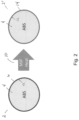
- An illustrative diagrammatic view of a core/shell polymer 2 (unheated) and 2' (heated) is shown in Fig. 2 . It is appreciated that quantities of these particles are aggregated to form a quantity of usable powder for the powder-based printing process. As shown, each particle 2 includes a core 4 that composes the bulk of the particle. It will be appreciated by the skilled artisan, in light of the discussion herein, that an advantage of embodiments of the present invention is that amorphous polymers are generally less expensive than semicrystalline counterparts.
- amorphous polymer 4 may take the form or include one or more of ABS, ASA, PMMA, SAN, PEI, PS, or PES, all by way of example. It is further appreciated that other amorphous polymers might be used as well.
- polymer core 4 is encircled by shell polymer 6.
- shell polymer 6 is a thin layer of polymer that is formed around amorphous particle core 4.
- the amorphous polymer is distinct from the shell polymer.
- the shell can be thought of as a distinct coating on a core.
- the core polymer also has a lower Tg than the Tg of shell polymer. But when heat is applied, the characteristics of the polymers may change.
- the entire core/shell particle can be placed in a part bed, at a temperature lower than the shell polymers melting point and higher than the cores melting point. Leaving the core molten and the shell rigid. Further applying sufficient heat, such as the MJF heat represented by reference numeral 10 in Fig. 2 , raises the temperature of the shell material, so that it is also molten. The shell and core polymers will then be free to diffuse with one another, alloying the shell material and therefore dropping the overall resolidification temperature of the shell. In certain embodiments the resolidification temperature is lower than the part bed temperature.
- this core/shell particle still at least substantially holds its form even though the applied heat 10 melts the amorphous polymer core 4.
- Compatible core/shell polymers used may be miscible (i.e., able to form a homogeneous mixture) with each other. This means that as the core polymer is melted and the shell polymer softens, core polymer 4 begins mixing with shell polymer 6 at boundary 12. By mixing these two polymers in this fashion, the particle of amorphous polymer is still in particle form that can be used in powder-based 3D-printing applications.
- particle 2' has a shell 14 composed of a blend of amorphous and either a semicrystalline, or higher Tg amorphous polymer with the semicrystalline portions or higher Tg portions still holding the particle shape.
- this results in a particle having a lower elastic modulus than the semicrystalline polymer above, as well as lower Tg, and lower volumetric shrink.
- the bulk of the polymer is still an amorphous polymer.
- the combination of these characteristics may be conducive to powder-based 3D-printing applications.
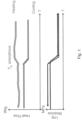
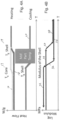
- FIG. 3A Illustrative DSC and Modulus vs. Temperature graphs of Core/shell 2 are shown in Figs. 3A and 3B . It is appreciated that these graphs are also exemplary to demonstrate expected characteristics, but are not borne of a specific set of data.
- line 16 which represents core 4 from Fig. 2
- line 18 This graphically depicts how core 4 melts at temperatures that shell 6 will not.
- this graph also shows how the alloyed polymer, represented by 2' in Fig.
- the elastic modulus versus temperature graph shown in Fig. 3B depicts the behavior of the alloyed shell of 2'.
- the elastic modulus decreases at the Tg of the shell as indicated by line 26, and is then melted as shown by line 28.
- a reduction in temperature still maintains the low elastic modulus (which translates into less strain during cooling) until the material has sufficiently cooled to reach its glass transition at line 32 which then increases the elastic modulus as shown, until it resolidifies and becomes solid again, represented by line 34.
- the temperature operating window for the 3D-printing process maintains the elastic modulus of the shell alloy. So long as the built object maintains the temperature within that window, the elastic modulus is not expected to increase.
- each particle does not fully melt while in the temperature range usable for powder-based 3D-printing, which would otherwise occur if using only an amorphous polymer.
- the resolidification does not occur within the operating window which means the object should not fully solidify until it is completely formed.
- the chart of Fig. 5 depicts illustrative combinations of core and shell materials that may be alloyed to produce a suitable 3D-printing powder.
- the first column is a list of amorphous polymers; the second column is either amorphous or semicrystalline polymers; and the third column is the alloyed core/shell polymer.
- one illustrative embodiment of this disclosure includes an ABS amorphous polymer core encapsulated by a PC shell that forms a PC/ABS alloyed polymer shell upon heating.
- Another embodiment is an ASA amorphous polymer core encapsulated by a PC semicrystalline shell to form a PC/ASA shell alloy.
- Another embodiment includes a PMMA amorphous polymer core encapsulated by a PC shell forming a PC/PMMA alloyed shell.
- Another illustrative embodiment includes a SAN amorphous polymer core encapsulated by a PC shell to form a PC/SAN shell alloy upon heating.
- Another illustrative embodiment includes a PEI amorphous polymer core encapsulated by a PEEK semi-crystalline shell to form a PEEK/PEI alloyed shell.
- Another embodiment includes a PS amorphous polymer core encapsulated by a PPO shell to form a PPO/PS alloy shell upon heating.
- Another illustrative embodiment includes a PES amorphous polymer core encapsulated by a PPS semi-crystalline shell to form a PPS/PES alloyed shell upon heating. It is appreciated that this is not the extent of the potential combinations or possibilities contemplated in the present disclosure. So long as the core and shell are compatible polymers with a Tg difference between the two where the shell has a higher Tg than the core, it is believed this process will be operable as disclosed.
- a component of developing the core/shell particle is optimizing the thickness of the shell versus the diameter of the core.
- the core needs to be sizable enough to supply the structure of the particle.
- the shell needs to have some degree of thickness so the printing system can handle the polymer powder when it is near the operating window temperature. That said, the shell cannot be too thick because the overall particle's Tg may not lower sufficiently to obtain the desired operating window. For example, if 50% of the particle diameter is shell there will not be enough core to diffuse all the way to the exterior of the shell. This lack of alloying is what may prevent the Tg from lowering sufficiently. Obtaining a sufficient Tg from alloying the amorphous semicrystalline polymers is part of optimizing the relative core and shell sizes.
- miscibility As far as selecting the core and the shell, miscibility, or how much each polymer is attracted to each other, is a factor. Polymers that are fully miscible have enthalpic drive to want to be into the other polymer. This miscible interaction may help diffusion, which may, in turn, help drop Tg of shell material. For example, combining polymethyl methacrylate having a Tg of about 105 degrees Celsius and a polycarbonate having a Tg of about 145 degrees Celsius at about a 50/50 ratio, may have a crystallization Tg of about 125 degrees Celsius. Semi-miscible polymers may be included as well. In at least some methods of manufacturing, miscibility may be useful to cause diffusion because the method may not include any stirring or agitation for certain powder systems. Blending may rely on the mobility of the polymers at 0-sheer and elevated temperature to promote diffusion.
- the Tg values between the core and shell materials may have a substantive difference. It is believed that when the materials are miscible with each other and have a Tg separation gap, the Tg of the resulting polymer will drop essentially linearly based on the weight percent of each polymer system. Conversely, a small distance between the Tg's may mean a smaller reduction in the Tg of the shell even if alloying occurs. If the Tg of the core polymer is only slightly less that the Tg of the shell polymer, the core may not be able to diffuse enough into the shell to reduce the shell's Tg. Again, depending on the particular 3D-printing application, different polymers having different Tgs may be chosen based on the Tg separation gap between the polymers to create a desired result.
- molecular weight is a function of miscibility. Varying the molecular weight may result in either having full miscibility at low molecular weights, or zero miscibility at very high molecular weights. To have sufficient diffusion as the shell reaches its Tg, the amorphous core polymer needs to be at optimum molecular weight (or weights) to sufficiently diffuse into the shell polymer to lower its Tg.
- polyetherimide an amorphous high temperature polymer which is fully miscible with PEEK
- PEEK is very expensive. Using only a small amount as the shell for the polyetherimide may result in a polymer alloy that maintains the chemical resistance of PEEK but may still be cost-effective.
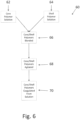
- Method 60 includes placing the core polymer into a solution at 62.
- Such polymer may alternatively be placed in suspension or emulsion with the solvent. Suspending the core may be assisted by a surfactant.
- the shell may be placed in a second solvent and added to the first solution. This will be mixed and the polymer will coagulate at the core-shell interface.
- the particular solvent type will be dependant on the polymer system.
- the relatively smaller quantity of shell polymer is added to a solvent at 64, which is then added to suspension/emulsion/solution 62 at 66.
- the composition may then be agitated at 68 to cause the shell material to adhere onto the core polymer particles.
- miscibility may be a factor in determining which amorphous and semi-crystalline polymers are used. Such polymers with higher miscibility may tend to adhere to each other better than those that do not. It is believed that having amorphous polymer characteristics that are mismatched with semi-crystalline polymer characteristics may also make better core/shell combinations than combinations having similar material characteristics.
- these polymers may also be re-precipitated. It is further appreciated that different temperatures, pressures, times, and stir rates may be applied to these precipitation methods to modify the various characteristics of the polymers.
- the polymers may be mixed in different ratios and particle sizes. This may have the effect of changing or controlling the properties of the resulting pulverulent powdered polymer.
- Particle-size distribution may be determined by laser scattering. Melting point and enthalpy may be determined through DSC. Powder flow may be measured using Method A of VIN EN ISO 6186. Modulus of elasticity and tensile strength may be determined pursuant the DIN/EN/ISO 527 standard.
Landscapes
- Chemical & Material Sciences (AREA)
- Medicinal Chemistry (AREA)
- Organic Chemistry (AREA)
- Polymers & Plastics (AREA)
- Health & Medical Sciences (AREA)
- Chemical Kinetics & Catalysis (AREA)
- Materials Engineering (AREA)
- Engineering & Computer Science (AREA)
- Manufacturing & Machinery (AREA)
- Physics & Mathematics (AREA)
- Optics & Photonics (AREA)
- Mechanical Engineering (AREA)
- Crystallography & Structural Chemistry (AREA)
- General Chemical & Material Sciences (AREA)
Applications Claiming Priority (3)
| Application Number | Priority Date | Filing Date | Title |
|---|---|---|---|
| US201762456482P | 2017-02-08 | 2017-02-08 | |
| PCT/US2018/017344 WO2018148359A1 (en) | 2017-02-08 | 2018-02-08 | Core and shell polymers for 3d-printing |
| EP18751746.1A EP3580264B1 (de) | 2017-02-08 | 2018-02-08 | Kern- und schalenpolymere für den 3d-druck |
Related Parent Applications (1)
| Application Number | Title | Priority Date | Filing Date |
|---|---|---|---|
| EP18751746.1A Division EP3580264B1 (de) | 2017-02-08 | 2018-02-08 | Kern- und schalenpolymere für den 3d-druck |
Publications (2)
| Publication Number | Publication Date |
|---|---|
| EP4234632A2 true EP4234632A2 (de) | 2023-08-30 |
| EP4234632A3 EP4234632A3 (de) | 2023-10-04 |
Family
ID=63107562
Family Applications (2)
| Application Number | Title | Priority Date | Filing Date |
|---|---|---|---|
| EP23177724.4A Pending EP4234632A3 (de) | 2017-02-08 | 2018-02-08 | Kern- und schalenpolymere für den 3d-druck |
| EP18751746.1A Active EP3580264B1 (de) | 2017-02-08 | 2018-02-08 | Kern- und schalenpolymere für den 3d-druck |
Family Applications After (1)
| Application Number | Title | Priority Date | Filing Date |
|---|---|---|---|
| EP18751746.1A Active EP3580264B1 (de) | 2017-02-08 | 2018-02-08 | Kern- und schalenpolymere für den 3d-druck |
Country Status (4)
| Country | Link |
|---|---|
| US (3) | US11447629B2 (de) |
| EP (2) | EP4234632A3 (de) |
| CN (1) | CN110268006B (de) |
| WO (1) | WO2018148359A1 (de) |
Families Citing this family (14)
| Publication number | Priority date | Publication date | Assignee | Title |
|---|---|---|---|---|
| US11639053B2 (en) | 2019-03-29 | 2023-05-02 | Xerox Corporation | Process for preparing a three-dimensional printing composition |
| EP3797863B1 (de) | 2019-09-27 | 2025-03-05 | SHPP Global Technologies B.V. | Verfahren zur herstellung von polymerkeramik-kern-hülle-partikel |
| EP3805300B1 (de) * | 2019-10-11 | 2022-12-21 | SHPP Global Technologies B.V. | Polymerkeramikverbundgehäuse und -gehäuseteile für tragbare elektronische vorrichtungen |
| EP3812416A1 (de) | 2019-10-23 | 2021-04-28 | Acondicionamiento Tarrasense | Verfahren zur herstellung von pulverförmigen polymeren |
| US11718080B2 (en) | 2020-01-08 | 2023-08-08 | The Boeing Company | Coated sheets for improved additive manufacturing parts |
| US11904533B2 (en) * | 2020-01-08 | 2024-02-20 | The Boeing Company | Coated powder for improved additive manufacturing parts |
| US11498264B2 (en) | 2020-01-08 | 2022-11-15 | The Boeing Company | Coated filament for improved additive manufacturing parts |
| ES2961161T3 (es) * | 2020-03-09 | 2024-03-08 | Airbus Operations Slu | Método de fabricación de una pieza |
| US12391828B2 (en) | 2020-06-15 | 2025-08-19 | Shpp Global Technologies B.V. | Polymer-ceramic composite articles with low dissipation factor and high dielectric constant, and core-shell particle powders and processes for making such articles |
| US20220363944A1 (en) * | 2021-04-29 | 2022-11-17 | Industrial Technology Research Institute | Inkjet ink, 3d printing method, and 3d printing object |
| CN113502029B (zh) * | 2021-06-25 | 2022-08-19 | 上海制驰智能科技有限公司 | 一种3d打印用pc/abs合金材料及其制备方法 |
| EP4373866A4 (de) | 2021-07-22 | 2025-05-21 | Braskem America, Inc. | Polypropylenpolymere zur generativen fertigung auf pulverbettfusionsbasis |
| CN115975130B (zh) * | 2023-02-13 | 2024-05-07 | 江南大学 | 一种核壳聚合物微球及其应用 |
| US12325154B2 (en) * | 2023-03-01 | 2025-06-10 | GM Global Technology Operations LLC | Systems for polymer powder performance improvements in additive manufacturing using encapsulation |
Family Cites Families (8)
| Publication number | Priority date | Publication date | Assignee | Title |
|---|---|---|---|---|
| US10144828B2 (en) * | 2012-11-21 | 2018-12-04 | Stratasys, Inc. | Semi-crystalline build materials |
| US9745458B2 (en) * | 2013-07-26 | 2017-08-29 | Hewlett-Packard Development Company, L.P. | Composite support material for three-dimensional printing |
| ES2650265T3 (es) * | 2013-12-18 | 2018-01-17 | Ineos Styrolution Group Gmbh | Masas moldeables que se basan en copolímeros de compuesto aromático de vinilo para la impresión 3D |
| US10544311B2 (en) * | 2014-01-16 | 2020-01-28 | Hewlett-Packard Development Company, L.P. | Polymeric powder composition for three-dimensional (3D) printing |
| JP6412752B2 (ja) * | 2014-09-19 | 2018-10-24 | ポリプラスチックス株式会社 | 3dプリンター用造形材料 |
| KR20170003450A (ko) * | 2015-06-30 | 2017-01-09 | 코오롱인더스트리 주식회사 | 폴리머 비드, 폴리머 비드의 제조방법 및 이를 이용한 광학용 필름 |
| JP6791165B2 (ja) * | 2015-11-30 | 2020-11-25 | コニカミノルタ株式会社 | 粉末材料、立体造形物の製造方法および立体造形装置 |
| EP3260279A1 (de) * | 2016-06-20 | 2017-12-27 | Evonik Röhm GmbH | Verwendung von kern-schale-(schale-)partikeln im binder jetting verfahren |
-
2018
- 2018-02-08 CN CN201880011040.2A patent/CN110268006B/zh active Active
- 2018-02-08 EP EP23177724.4A patent/EP4234632A3/de active Pending
- 2018-02-08 WO PCT/US2018/017344 patent/WO2018148359A1/en not_active Ceased
- 2018-02-08 US US16/482,798 patent/US11447629B2/en active Active
- 2018-02-08 EP EP18751746.1A patent/EP3580264B1/de active Active
-
2022
- 2022-09-16 US US17/946,703 patent/US11649328B2/en active Active
-
2023
- 2023-05-10 US US18/195,519 patent/US20230272170A1/en active Pending
Also Published As
| Publication number | Publication date |
|---|---|
| EP3580264A4 (de) | 2020-11-25 |
| US20230017838A1 (en) | 2023-01-19 |
| EP3580264A1 (de) | 2019-12-18 |
| US11649328B2 (en) | 2023-05-16 |
| CN110268006A (zh) | 2019-09-20 |
| US20230272170A1 (en) | 2023-08-31 |
| EP4234632A3 (de) | 2023-10-04 |
| CN110268006B (zh) | 2022-09-16 |
| WO2018148359A1 (en) | 2018-08-16 |
| US20210277229A1 (en) | 2021-09-09 |
| US11447629B2 (en) | 2022-09-20 |
| EP3580264B1 (de) | 2023-06-07 |
Similar Documents
| Publication | Publication Date | Title |
|---|---|---|
| US11649328B2 (en) | Core and shell polymers for 3D-printing | |
| JP6512869B2 (ja) | 三次元造形物の製造方法 | |
| KR102306559B1 (ko) | 수지 압출 조형 방식의 3차원 프린터용 필라멘트의 제조방법 | |
| Rešetič et al. | Polymer-dispersed liquid crystal elastomers | |
| CN107803983B (zh) | 用于熔融沉积打印的形状记忆聚合物复合4d打印线的制备方法及应用方法 | |
| US12139621B2 (en) | Precipitation of thermoplastic polyurethane to enhance operational window for three dimensional printing | |
| EP3272501B1 (de) | Verfahren für selektives lasersintern | |
| Al Noman et al. | Field assisted additive manufacturing for polymers and metals: materials and methods | |
| JP7145099B2 (ja) | レーザ焼結用粉末 | |
| JP2016064649A (ja) | 立体物の製造に用いられる造形粒子、それを含む粉体、及びそれを用いた立体物の製造方法 | |
| CN107428075A (zh) | 三次元造形物的制造方法及三次元造形物制造用的丝 | |
| CN106280201A (zh) | 三维打印线材 | |
| JP2017213813A (ja) | 立体造形用フィラメント材料及びその製造方法、並びに立体造形用フィラメント材料セット、及び立体造形物の製造方法 | |
| WO2010106870A1 (ja) | 特定の樹脂の粉末を用いた粉末焼結積層造形方法 | |
| KR102487292B1 (ko) | 불포화 결정질 폴리에스테르를 포함하는 3d 프린트용 조성물 | |
| KR20170116325A (ko) | 수지 압출 조형 방식의 3차원 프린터용 필라멘트의 제조방법 | |
| WO2016047549A1 (ja) | 立体物の製造に用いられる造形粒子、それを含む粉体、及びそれを用いた立体物の製造方法 | |
| JP4464667B2 (ja) | オリゴ糖を含む有機組成物及び有機固体粒子の製造方法 | |
| CN117264394A (zh) | 一种3d打印材料、打印方法以及制备方法 | |
| An et al. | Design considerations for additive manufacturing of feed channel spacers for spiral wound membrane modules | |
| JP2000173811A (ja) | 樹脂磁石用組成物、それを用いた磁性部材及びその製造方法 | |
| Purohit et al. | Issues in dual material fused deposition modelling with polycarbonate-Acrylonitrile butadiene styrene (PC-ABS) on a desktop 3D printer | |
| JP6237555B2 (ja) | 静電潜像現像用トナー | |
| CN103282186A (zh) | 可再循环热塑性包装 | |
| JPH10286825A (ja) | 粉体を搬送及び/又は溶融混練する方法 |
Legal Events
| Date | Code | Title | Description |
|---|---|---|---|
| PUAI | Public reference made under article 153(3) epc to a published international application that has entered the european phase |
Free format text: ORIGINAL CODE: 0009012 |
|
| STAA | Information on the status of an ep patent application or granted ep patent |
Free format text: STATUS: THE APPLICATION HAS BEEN PUBLISHED |
|
| REG | Reference to a national code |
Ref country code: DE Ref legal event code: R079 Free format text: PREVIOUS MAIN CLASS: C08L0055020000 Ipc: C08J0003120000 |
|
| AC | Divisional application: reference to earlier application |
Ref document number: 3580264 Country of ref document: EP Kind code of ref document: P |
|
| AK | Designated contracting states |
Kind code of ref document: A2 Designated state(s): AL AT BE BG CH CY CZ DE DK EE ES FI FR GB GR HR HU IE IS IT LI LT LU LV MC MK MT NL NO PL PT RO RS SE SI SK SM TR |
|
| PUAL | Search report despatched |
Free format text: ORIGINAL CODE: 0009013 |
|
| AK | Designated contracting states |
Kind code of ref document: A3 Designated state(s): AL AT BE BG CH CY CZ DE DK EE ES FI FR GB GR HR HU IE IS IT LI LT LU LV MC MK MT NL NO PL PT RO RS SE SI SK SM TR |
|
| RIC1 | Information provided on ipc code assigned before grant |
Ipc: C08G 65/48 20060101ALI20230828BHEP Ipc: G03G 15/22 20060101ALI20230828BHEP Ipc: B33Y 70/00 20200101ALI20230828BHEP Ipc: B33Y 10/00 20150101ALI20230828BHEP Ipc: B29C 64/153 20170101ALI20230828BHEP Ipc: B29C 64/106 20170101ALI20230828BHEP Ipc: C08L 33/12 20060101ALI20230828BHEP Ipc: C08L 69/00 20060101ALI20230828BHEP Ipc: C08L 81/02 20060101ALI20230828BHEP Ipc: C08L 71/02 20060101ALI20230828BHEP Ipc: C08L 71/12 20060101ALI20230828BHEP Ipc: C08L 79/02 20060101ALI20230828BHEP Ipc: C08L 25/12 20060101ALI20230828BHEP Ipc: C08L 33/20 20060101ALI20230828BHEP Ipc: C08L 55/02 20060101ALI20230828BHEP Ipc: C08J 3/12 20060101AFI20230828BHEP |
|
| STAA | Information on the status of an ep patent application or granted ep patent |
Free format text: STATUS: REQUEST FOR EXAMINATION WAS MADE |
|
| 17P | Request for examination filed |
Effective date: 20240206 |
|
| RBV | Designated contracting states (corrected) |
Designated state(s): AL AT BE BG CH CY CZ DE DK EE ES FI FR GB GR HR HU IE IS IT LI LT LU LV MC MK MT NL NO PL PT RO RS SE SI SK SM TR |
|
| STAA | Information on the status of an ep patent application or granted ep patent |
Free format text: STATUS: EXAMINATION IS IN PROGRESS |
|
| 17Q | First examination report despatched |
Effective date: 20240614 |
|
| 17Q | First examination report despatched |
Effective date: 20240627 |