EP4234584A2 - Molécule hétérodimère fondée sur un domaine structurel ch3, son procédé de préparation et son utilisation - Google Patents
Molécule hétérodimère fondée sur un domaine structurel ch3, son procédé de préparation et son utilisation Download PDFInfo
- Publication number
- EP4234584A2 EP4234584A2 EP23162270.5A EP23162270A EP4234584A2 EP 4234584 A2 EP4234584 A2 EP 4234584A2 EP 23162270 A EP23162270 A EP 23162270A EP 4234584 A2 EP4234584 A2 EP 4234584A2
- Authority
- EP
- European Patent Office
- Prior art keywords
- domain
- mutation
- chain
- amino acid
- heterodimer
- Prior art date
- Legal status (The legal status is an assumption and is not a legal conclusion. Google has not performed a legal analysis and makes no representation as to the accuracy of the status listed.)
- Granted
Links
Images
Classifications
-
- C—CHEMISTRY; METALLURGY
- C12—BIOCHEMISTRY; BEER; SPIRITS; WINE; VINEGAR; MICROBIOLOGY; ENZYMOLOGY; MUTATION OR GENETIC ENGINEERING
- C12N—MICROORGANISMS OR ENZYMES; COMPOSITIONS THEREOF; PROPAGATING, PRESERVING, OR MAINTAINING MICROORGANISMS; MUTATION OR GENETIC ENGINEERING; CULTURE MEDIA
- C12N15/00—Mutation or genetic engineering; DNA or RNA concerning genetic engineering, vectors, e.g. plasmids, or their isolation, preparation or purification; Use of hosts therefor
- C12N15/09—Recombinant DNA-technology
- C12N15/11—DNA or RNA fragments; Modified forms thereof; Non-coding nucleic acids having a biological activity
- C12N15/62—DNA sequences coding for fusion proteins
-
- C—CHEMISTRY; METALLURGY
- C07—ORGANIC CHEMISTRY
- C07K—PEPTIDES
- C07K16/00—Immunoglobulins [IG], e.g. monoclonal or polyclonal antibodies
- C07K16/46—Hybrid immunoglobulins
- C07K16/468—Immunoglobulins having two or more different antigen binding sites, e.g. multifunctional antibodies
-
- A—HUMAN NECESSITIES
- A61—MEDICAL OR VETERINARY SCIENCE; HYGIENE
- A61K—PREPARATIONS FOR MEDICAL, DENTAL OR TOILETRY PURPOSES
- A61K39/00—Medicinal preparations containing antigens or antibodies
- A61K39/395—Antibodies; Immunoglobulins; Immune serum, e.g. antilymphocytic serum
-
- C—CHEMISTRY; METALLURGY
- C07—ORGANIC CHEMISTRY
- C07K—PEPTIDES
- C07K16/00—Immunoglobulins [IG], e.g. monoclonal or polyclonal antibodies
-
- C—CHEMISTRY; METALLURGY
- C07—ORGANIC CHEMISTRY
- C07K—PEPTIDES
- C07K16/00—Immunoglobulins [IG], e.g. monoclonal or polyclonal antibodies
- C07K16/46—Hybrid immunoglobulins
-
- C—CHEMISTRY; METALLURGY
- C07—ORGANIC CHEMISTRY
- C07K—PEPTIDES
- C07K19/00—Hybrid peptides, i.e. peptides covalently bound to nucleic acids, or non-covalently bound protein-protein complexes
-
- C—CHEMISTRY; METALLURGY
- C12—BIOCHEMISTRY; BEER; SPIRITS; WINE; VINEGAR; MICROBIOLOGY; ENZYMOLOGY; MUTATION OR GENETIC ENGINEERING
- C12N—MICROORGANISMS OR ENZYMES; COMPOSITIONS THEREOF; PROPAGATING, PRESERVING, OR MAINTAINING MICROORGANISMS; MUTATION OR GENETIC ENGINEERING; CULTURE MEDIA
- C12N15/00—Mutation or genetic engineering; DNA or RNA concerning genetic engineering, vectors, e.g. plasmids, or their isolation, preparation or purification; Use of hosts therefor
- C12N15/09—Recombinant DNA-technology
- C12N15/11—DNA or RNA fragments; Modified forms thereof; Non-coding nucleic acids having a biological activity
-
- C—CHEMISTRY; METALLURGY
- C12—BIOCHEMISTRY; BEER; SPIRITS; WINE; VINEGAR; MICROBIOLOGY; ENZYMOLOGY; MUTATION OR GENETIC ENGINEERING
- C12P—FERMENTATION OR ENZYME-USING PROCESSES TO SYNTHESISE A DESIRED CHEMICAL COMPOUND OR COMPOSITION OR TO SEPARATE OPTICAL ISOMERS FROM A RACEMIC MIXTURE
- C12P21/00—Preparation of peptides or proteins
-
- C—CHEMISTRY; METALLURGY
- C07—ORGANIC CHEMISTRY
- C07K—PEPTIDES
- C07K2317/00—Immunoglobulins specific features
- C07K2317/30—Immunoglobulins specific features characterized by aspects of specificity or valency
- C07K2317/31—Immunoglobulins specific features characterized by aspects of specificity or valency multispecific
-
- C—CHEMISTRY; METALLURGY
- C07—ORGANIC CHEMISTRY
- C07K—PEPTIDES
- C07K2317/00—Immunoglobulins specific features
- C07K2317/50—Immunoglobulins specific features characterized by immunoglobulin fragments
- C07K2317/52—Constant or Fc region; Isotype
- C07K2317/524—CH2 domain
-
- C—CHEMISTRY; METALLURGY
- C07—ORGANIC CHEMISTRY
- C07K—PEPTIDES
- C07K2317/00—Immunoglobulins specific features
- C07K2317/50—Immunoglobulins specific features characterized by immunoglobulin fragments
- C07K2317/52—Constant or Fc region; Isotype
- C07K2317/526—CH3 domain
-
- C—CHEMISTRY; METALLURGY
- C07—ORGANIC CHEMISTRY
- C07K—PEPTIDES
- C07K2317/00—Immunoglobulins specific features
- C07K2317/90—Immunoglobulins specific features characterized by (pharmaco)kinetic aspects or by stability of the immunoglobulin
- C07K2317/94—Stability, e.g. half-life, pH, temperature or enzyme-resistance
-
- C—CHEMISTRY; METALLURGY
- C07—ORGANIC CHEMISTRY
- C07K—PEPTIDES
- C07K2319/00—Fusion polypeptide
-
- C—CHEMISTRY; METALLURGY
- C07—ORGANIC CHEMISTRY
- C07K—PEPTIDES
- C07K2319/00—Fusion polypeptide
- C07K2319/70—Fusion polypeptide containing domain for protein-protein interaction
- C07K2319/74—Fusion polypeptide containing domain for protein-protein interaction containing a fusion for binding to a cell surface receptor
Definitions
- the present disclosure relates to the field of antibody engineering, and in particular, provides a heterodimer molecule based on CH3 domain, and preparation method and use thereof.
- monoclonal antibody drugs have rapidly developed, becoming a growing point in the pharmaceutical industry. Since 1996, about 30 monoclonal antibody drugs have been approved to come into the market, among which 9 monoclonal antibody drugs obtain annual sales of more than USD 1 billion. In 2010, the total sales of monoclonal antibody drugs were more than USD 30 billion with the annual average growth rate of more than 10%.
- a monoclonal antibody exhibits strong target specificity, and therefore can only inhibit a single target site. However, for many diseases, including tumors, autoimmune diseases, etc., it is necessary to inhibit multiple signaling pathways to avoid compensatory effects. For viral infection diseases, due to high mutation rate of viruses, it is usually necessary to inhibit a plurality of antigen sites to avoid escape. In addition, bifunctional antibodies and proteins are used to specifically activate the human immune system (Wolf, Hofmeister et al. 2005).
- a typical application example of a heterodimer is a bispecific antibody (BsAbs), which is an immunoglobulin molecule containing two different ligand binding sites.
- BsAbs bispecific antibody
- a bispecific antibody is active to at least two different antigens(Carter 2001). It replaces the form of two identical Fab arms in a classic antibody with the form of two Fab arms with different sequences. Therefore, two Y type arms can bind to different antigens.
- the application of bispecific antibodies in treating cancers has been summarized by many literatures (Carter 2001; Chames and Baty 2009; Chames and Baty 2009).
- bispecific antibody there is no bispecific antibody in a natural state, which can be prepared only by a special method.
- the prior preparation methods of bispecific antibodies include chemical crosslinking, hybridizing F(ab')2 molecules, murine hybridoma method, etc.
- bispecific antibodies produced by the chemical crosslinking method they exhibit heterogenicity, instability of products between batches, and the characteristic thereof that antibody specificity can be easily changed by some modifications or improper bindings, thus they are not suitable for use in vivo.
- a bispecific hybrid molecule produced from a mercapto-crosslinked proteinase digestion fragment F(ab') has a relatively homogeneous ingredient, but the preparation process is time-consuming and labor-consuming with a very low yield.
- Bispecific antibodies produced by the hybridoma method have a reliable source, but randomly pairing between light chains and heavy chains will produce a plurality of possible antibody forms, making the production and purification of bispecific antibodies very difficult as a result.
- Carter et al. modified some amino acids in heavy chains of antibodies by a "knob into hole” model, and relatively successfully achieved the preparation of bispecific antibodies (Ridgway, Presta et al. 1996; Carter 2001).
- the "knob into hole” model was originally proposed by Crick to solve the problem of amino acid side chain folding between adjacent ⁇ -spirals (Crick 1952). Carter et al.
- the invention according to the present disclosure has obtained an optimal CH3 mutant sequence, which is more inclined to form a heterodimer rather than a homodimer, thereby greatly improving the yield of the heterodimer molecule.
- the present disclosure relates to a heterodimer molecule, comprising a first polypeptide chain and a second polypeptide chain, wherein said first polypeptide chain comprises a first CH3 domain of an antibody heavy chain constant region, said second polypeptide chain comprises a second CH3 domain of an antibody heavy chain constant region, and comparing to a corresponding wild-type CH3 domain of a human antibody heavy chain constant region, said first CH3 domain and said second CH3 domain comprise an amino acid mutation selected from the following groups (1) to (3):
- said first CH3 domain and said second CH3 domain comprise said amino acid mutation selected from said group (2) or (3), but do not comprise mutation Y349C or D356C.
- said first CH3 domain and/or said second CH3 domain further comprise a mutation selected from the following groups:
- said first CH3 domain and/or said second CH3 domain optionally further comprise a mutation selected from the following groups:
- said first CH3 domain and/or said second CH3 domain optionally further comprise a mutation selected from the following groups:
- said amino acid mutations are independently selected from: a mutation from a non-charged amino acid to a charged amino acid, a mutation from a charged amino acid to a non-charged amino acid, or a mutation from a charged amino acid to an oppositely charged amino acid.
- said mutation in said first CH3 structural domain and/or said second CH3 structural domain comprises one or more mutations selected from the following group consisting of: Y349C, Y349D, D356C, T366W, T366S, L368A, L368E, L368G, F405K, Y407V, Y407A, K409E, K409A, K360E, Q347E, Q347R, K392D, D399S, E357A and S354D.
- the mutation may be one or more mutations selected from the following mutations: Y349C, Y349D, D356C, T366W, T366S, L368A, L368E, L368G, F405K, Y407V, Y407A, K409E, K409A, K360E, Q347E, Q347R, K392D, D399S, E357A and S354D.
- said first CH3 domain comprises a mutation at one or more residues (e.g., at least one residue, at least two residues, at least three residues, at least four residues, at least five residues, at least six residues, at least seven residues, or at least eight residues) selected from the group consisting of: Y349, T366, F405, K409, L368, K392, S354 and D399.
- residues e.g., at least one residue, at least two residues, at least three residues, at least four residues, at least five residues, at least six residues, at least seven residues, or at least eight residues
- said second CH3 domain comprises a mutation at one or more residues (e.g., at least one residue, at least two residues, at least three residues, at least four residues, at least five residues, at least six residues, at least seven residues, at least eight residues or at least nine residues) selected from the group consisting of: D356, T366, L368, Y407, F405, D399, E357, K409 and K392.
- residues e.g., at least one residue, at least two residues, at least three residues, at least four residues, at least five residues, at least six residues, at least seven residues, at least eight residues or at least nine residues
- said first CH3 domain comprises a mutation at one or more residues (e.g., at least one residue, at least two residues, at least three residues, at least four residues, at least five residues, at least six residues, at least seven residues, or at least eight residues) selected from the group consisting of: Y349, T366, F405, K409, L368, K392, S354 and D399; and said second CH3 domain comprises a mutation at one or more residues (e.g., at least one residue, at least two residues, at least three residues, at least four residues, at least five residues, at least six residues, at least seven residues, at least eight residues or at least nine residues) selected from the group consisting of: D356, T366, L368, Y407, F405, D399, E357, K409 and K392.
- residues e.g., at least one residue, at least two residues, at least three residues, at least four residues,
- said first CH3 domain comprises one or more mutations (e.g., at least one mutation, at least two mutations, at least three mutations, at least four mutations, at least five mutations, at least six mutations, at least seven mutations, at least eight mutations or at least nine mutations) selected from the group consisting of: Y349C, T366W, F405K, K409A, L368E, K392D, Y349D, S354D and D399S.
- mutations e.g., at least one mutation, at least two mutations, at least three mutations, at least four mutations, at least five mutations, at least six mutations, at least seven mutations, at least eight mutations or at least nine mutations
- said second CH3 domain comprises one or more mutations (e.g., at least one mutation, at least two mutations, at least three mutations, at least four mutations, at least five mutations, at least six mutations, at least seven mutations, at least eight mutations, at least nine mutations, at least ten mutations, or at least eleven mutations) selected from the group consisting of: D356C, T366S, L368A, Y407V, F405K, D399S, L368G, Y407A, E357A, K409A and K392D.
- mutations e.g., at least one mutation, at least two mutations, at least three mutations, at least four mutations, at least five mutations, at least six mutations, at least seven mutations, at least eight mutations, at least nine mutations, at least ten mutations, or at least eleven mutations
- said first CH3 domain comprises one or more mutations (e.g., at least one mutation, at least two mutations, at least three mutations, at least four mutations, at least five mutations, at least six mutations, at least seven mutations, at least eight mutations or at least nine mutations) selected from the group consisting of: Y349C, T366W, F405K, K409A, L368E, K392D, Y349D, S354D and D399S; and said second CH3 domain comprises one or more mutations (e.g., at least one mutation, at least two mutations, at least three mutations, at least four mutations, at least five mutations, at least six mutations, at least seven mutations, at least eight mutations or at least nine mutations) selected from the group consisting: D356C, T366S, L368A, Y407V, F405K, D399S, L368G, Y407A, E357A,
- mutations
- said first CH3 domain and said second CH3 domain comprise one group of mutations selected from the following groups:
- said first CH3 domain and said second CH3 domain contain one group of mutations selected from the following groups:
- said first polypeptide chain and said second polypeptide chain further comprise a CH2 domain of an antibody heavy chain constant region, respectively.
- the said CH2 domain is located at the N-terminal of the CH3 domain, and is linked directly or through a linker peptide to the N-terminal of the CH3 domain.
- said first polypeptide chain and said second polypeptide chain further comprise a hinge region of an antibody heavy chain constant region or a part thereof, respectively.
- said part of said hinge region is D221-P230.
- said hinge region or a part thereof is located at the N-terminal of the CH3 domain. And when there is a said CH2 domain, said hinge region or a part thereof is further located at the N-terminal of the CH2 domain, and is linked directly or through a linker peptide to the CH2 or CH3 domain.
- said wild-type CH3 domain of the human antibody heavy chain constant region is selected from the group consisting of a CH3 domain of a human IgG (e.g., IgG1, IgG2, IgG3 or IgG4) heavy chain constant region, a CH3 domain of a human IgA (e.g., IgA1, IgA2) heavy chain constant region, a CH3 domain of a human IgD heavy chain constant region, a CH3 domain of a human IgE heavy chain constant region and a CH3 domain of a human IgM heavy chain constant region.
- a human IgG e.g., IgG1, IgG2, IgG3 or IgG4
- a CH3 domain of a human IgA e.g., IgA1, IgA2 heavy chain constant region
- CH3 domain of a human IgD heavy chain constant region e.g., IgA1, IgA2 heavy chain constant region
- said wild-type CH3 domain of the human antibody heavy chain constant region is a CH3 domain of a human IgG1 heavy chain constant region.
- said first polypeptide chain and/or said second polypeptide chain further comprise a molecule binding region, and said molecule binding region is selected from the group consisting of an antigen binding region, a receptor binding region and an enzyme binding region.
- said antigen binding region comprises an antibody variable region.
- said heterodimer molecule is a bispecific antibody, a bispecific fusion protein or an antibody-fusion protein chimera.
- the present disclosure relates to a composition (e.g., a pharmaceutical composition), comprising the heterodimer molecule according to the present disclosure, and optionally a pharmaceutically acceptable carrier or excipient.
- a composition e.g., a pharmaceutical composition
- a pharmaceutical composition comprising the heterodimer molecule according to the present disclosure, and optionally a pharmaceutically acceptable carrier or excipient.
- the present disclosure provides a nucleic acid molecule, encoding said first polypeptide chain or said second polypeptide chain of the heterodimer molecule according to the present disclosure, or encoding said first polypeptide chain and said second polypeptide chain of the heterodimer molecule according to the present disclosure.
- the present disclosure provides a vector, comprising the nucleic acid molecule according to the present disclosure.
- the present disclosure provides a host cell, comprising the vector according to the present disclosure.
- the present disclosure provides a use of the heterodimer molecule, the composition, the nucleic acid, the vector or the host cell in the manufacture of a bispecific antibody, a bispecific fusion protein or an antibody-fusion protein chimera according to the present disclosure.
- the present disclosure provides a method for preparing a heterodimer molecule, comprising expressing the heterodimer molecule using the host cell according to the present disclosure.
- the host cell comprises a vector encoding said first polypeptide chain and said second polypeptide chain of the heterodimer molecule, and the method comprises expressing, recovering and obtaining the heterodimer molecule using the host cell.
- the host cell comprises a first group of cells comprising a vector encoding said first polypeptide chain of the heterodimer molecule
- a second group of cells comprises a vector encoding said second polypeptide chain of the heterodimer molecule
- the method comprises expressing said first polypeptide chain in said first group of cells to form a homodimer of said first polypeptide chain, expressing said second polypeptide chain in said second group of cells to form a homodimer of said second polypeptide chain, and then mixing the homodimer of said first polypeptide chain with the homodimer of said second polypeptide chain under a condition to form the heterodimer molecule.
- said method further comprises reducing the homodimer of said first polypeptide chain and the homodimer of said second polypeptide chain to monomers, mixing and oxidizing the monomers, and then purifying the obtained heterodimer molecule.
- said host cell comprises a vector encoding said first polypeptide chain and said second polypeptide chain of the heterodimer molecule, said first polypeptide chain and said second polypeptide chain are expressed respectively in two said host cells to form a homodimer of said first polypeptide chain and a homodimer of said second polypeptide chain, and then reducing, mixing, oxidizing and purifying the homodimer of said first polypeptide chain and the homodimer of said second polypeptide chain under a proper condition to obtain said heterodimer molecule.
- said first group of cells and said second group of cells were transfected with a construct or vector which comprises said first polypeptide chain or said second polypeptide chain, respectively.
- Said transfection may be transient transfection.
- the molar ratio of said construct or vector comprising said first polypeptide chain to said construct or vector comprising said second polypeptide chain may be 1:4 to 4:1, for example, 1:2 to 2:1, for example, about 1:1.
- both of said first polypeptide chain and said second polypeptide chain comprise a CH3 domain of an antibody Fc region, and the said two polypeptide chains interact with each other through the CH3 domain or the Fc region which comprises the CH3 domain to form a dimer, especially a heterodimer.
- Two polypeptide chains of the heterodimer may be different combinations.
- said first polypeptide chain is an antibody and said second polypeptide chain is a fusion protein, or both of the two polypeptide chains are fusion protein, or both of two polypeptide chains is an antibody (e.g., antibodies targeting to different antigen or antigen epitope).
- the fusion protein comprises an antibody Fc region and an extracellular domain of a cell adhesion molecule, it is also known as an immune adhesin.
- Said cell adhesion molecule mainly refers to a molecule capable of identifying specific ligand cell surface receptor, for example, comprising cadherin, selectin, immunoglobulin superfamily, integrin and hyaladherin.
- said CH3 domain is derived from a Fc region of an antibody, e.g., from a Fc region of human antibody (e.g., a Fc region of a human antibody heavy chain constant region).
- said CH3 domain is derived from a Fc region of a human immunoglobulin (Ig) heavy chain constant region, e.g., from a Fc region of a heavy chain constant region of IgM, IgG (e.g., IgG1, IgG2, IgG3, IgG4), IgA (e.g., IgA1, IgA2), IgE and/or IgD.
- Ig immunoglobulin
- said CH3 domain (e.g., a wild-type CH3 domain of human antibody heavy chain constant region) is derived from wild-type IgG1 of human, e.g., a wild-type CH3 domain of a human IgG1 antibody heavy chain constant region.
- said CH3 domain of the Fc region of human antibody is derived from a corresponding wild-type Fc region of human antibody.
- a wild-type human antibody Fc region refers to an antibody Fc region in a natural human population, e.g., a Fc region of human antibody that is not artificially induced or artificially modified.
- the Fc region of human antibody according to the present disclosure also comprises particular amino acid mutation of a corresponding wild-type human antibody Fc sequence, e.g., comprising amino acid mutations at a glycosylation site or other nonsense mutations, and also comprising particular amino acid mutations including according to the "knob -hole" model.
- a corresponding wild-type human antibody Fc sequence e.g., comprising amino acid mutations at a glycosylation site or other nonsense mutations
- particular amino acid mutations including according to the "knob -hole" model e.g., for CH3 and CH2 domains, except for mutations mentioned in the present disclosure, there may also be other mutations that do not affect the functions of antibodies (especially Fc region).
- first polypeptide chain and/or the second polypeptide chain comprise a hinge region
- said hinge region is linked between the two polypeptide chains as a flexible chain to ensure the functions of each polypeptide chain.
- Those skilled in the art can select the length of the hinge region as required, for example, selecting a full-length sequence or a part of the sequence thereof.
- said amino acid of said Fc region or CH2, CH3 domain or hinge region is numbered according to the EU index of the Kabat numbering.
- site numbers of the amino acids determined according to the standard sequences of EU index of the Kabat numbering remain unchanged.
- a human antibody heavy chain constant region may comprise a combination of two or more domains in CH1, CH2, CH3 and CH4 domain in heavy chains with an antibody hinge region.
- said human antibody Fc region comprises at least one antibody hinge region, one CH2 domain and one CH3 domain.
- said CH2 domain is a CH2 domain of a human IgG1 heavy chain constant region, which corresponds to amino acids 228-340 according to the EU index numbering system.
- the CH2 domain corresponds to a corresponding region of any other isotypic antibody described in the present disclosure.
- said CH3 domain is a CH3 domain of a human IgG1 heavy chain constant region, which corresponds to amino acids 341-447 according to the EU index numbering system. In some embodiments, the CH3 domain corresponds to a corresponding region of any other isotypic antibody described in the present disclosure.
- the charged amino acid comprises arginine, lysine, aspartic acid and glutamic acid.
- the heterodimer molecule can be purified from a host cell using a standard experimental method.
- a heterodimer protein comprises a Fc region of an antibody
- it can be purified using protein A.
- the purification method comprises, but not limited to, a chromatographic technique, such as size exclusion, ion exchange, affinity chromatography and ultrafiltration, or an appropriate combination of the methods thereof.
- EU index is described in, e.g., Kabat, etc., Sequences of Proteins of Immunological Interest, Public Health Service 5th edition, National Institutes of Health, Bethesda, MD. (1991 ).
- a preferred CH3 mutant sequence being more inclined to form a heterodimer rather than a homodimer was screened, thereby greatly enhancing the yield of the heterodimer molecule.
- a heterodimer protein crystal comprising a Fc region was prepared, and the crystal structure was analyzed and a three-dimensional structure model was established to further understand the direct interaction between interfacial amino acids, and the previous view that a stable disulfide bond is bound to be formed between two cysteines on Y349C and D356C was abandoned.
- a mutation combination formed on this basis is more inclined to form heterodimers, rather than homodimers, thus greatly reducing the proportion of homodimers while greatly enhancing the proportion of heterodimers.
- a total of 48 crystal structures of human IgG1 antibody comprising a Fc domain were acquired from Protein Database (PDB, www.pdb.org), and a structural similarity search algorithm (Reference: Yuzhen Ye and Adam Godzik. FATCAT: a web server for flexible structure comparison and structure similarity searching. Nucleic Acids Res., 2004, 32(Web Server issue): W582-585 .) was used to conclude that the Fc regions of the 48 antibodies were derived from 1DN2 (PDB number).
- an interfacial amino acid refers to an amino acid with the distance between a heavy atom on a side chain and a heavy atom of any one amino acid on the other chain less than a threshold value.
- the threshold value is 4.5 ⁇ , and may also be 5.5 ⁇ (e.g., manuscript: B. Erman, I. Bahar and R. L. Jernigan. Equilibrium states of rigid bodies with multiple interaction sites. Application to protein helices.
- Table 1 shows 34 interfacial amino acids of an antibody 1DN2 screened by amino acid contact (that is, the distance between two amino acid molecules is less than 4.5 ⁇ ), where chain A and chain B represent a first chain and a second chain of the antibody 1DN2, respectively.
- the following amino acid was numbered according to the EU index of the KABAT numbering of the antibody Fc region. Table 1.
- an amino acid pair containing a charged amino was selected from said contacting amino acid pairs, and one amino on one chain therein was mutated (a non-charged amino acid became a charged amino acid, or a charged amino acid became a non-charged amino acid, or a charged amino acid became oppositely charged), so that the ionic action between a Fc chain A and a Fc chain B was unbalanced, thus the probability of homodimer formation was decreased, and/or the heterodimer was increased.
- Phe405 of chain A was mutated to Phe405Lys (may also be written as F405K), and chain B remained unchanged. Because the contacting amino acid residue on the chain B, which was around 405th amino acid residue comprised two Lys, both of which were positively charged amino acids, when a chain A paired with a chain A, positive charges carried by an F405K mutation on the two chains would introduce a great repulsive force; while when a chain A paired with a chain B, only one chain (chain A) exhibited the repulsive force introduced by the F405K mutation, and the other chain (chain B) maintained as Phe405 without introducing a repulsive force. Under this condition, there was very significant mutual repulsion between two chains A, which is much greater than the mutual repulsion between the chain A and the chain B or between the two chains B, and therefore can effectively reduce the formation of AA homodimer.
- Table 2 List of Mutation Combinations of Heterodimers Combination Fc chain Mutation Corresponding SEQ ID NO KH A Y349C+T366W 6 B D356C+T366S+L368A+Y407V 7 1 A Y349C+T366W 6 B D356C+T366S+L368A+Y407V+F405K 8 2 A Y349C+T366W+F405K 9 B D356C+T366S+L368A+Y407V 7 3 A Y349C+T366W+K409E 10 B D356C+T366S+L368A+Y407V+F405K 8 4 A Y349C+T366W+K409A 11 B D356C+T366S+L368A+Y407V+F405K 8
- an amino acid sequence (P01857) of a human immunoglobulin gamma1 (IgG1) constant region in a protein database (Uniprot) an amino acid sequence (SEQ ID NO:1) of a human IgG1-Fc region was obtained.
- SEQ ID NO:2 a nucleic acid fragment which encodes human IgG1-Fc was obtained from total RNA of human PBMC.
- a ScFv-Fc fusion protein coding gene (ScFv therein refers to an anti-HER2 single chain antibody) as shown in SEQ ID NO: 5 was obtained by artificial synthesis.
- the gene encoding a ScFv-Fc fusion protein sequence is shown in SEQ ID: 4, and was then subcloned to a mammalian cell expression vector pcDNA4 (Invitrogen, cat V86220) to obtain a recombinant expression vector for expressing the ScFv-Fc fusion protein in mammalian cells.
- a mutation combination of ScFv-Fc and Fc coding genes was performed by overlapping PCR, where the mutation of the chain A was located on the ScFv-Fc fusion protein, and the mutation of the chain B was located on the Fc protein.
- the mutant gene was subcloned to pcDNA4 (Invitrogen, cat V86220) to finally obtain the ScFv-Fc fusion protein to express mutations in mammalian cells and a recombinant expression vector of mutant Fc protein, respectively.
- KH combination (as a reference group) and a wild-type combination (i.e., unmutated ScFv-Fc fusion protein and Fc protein as negative control group) were transfected into 293H suspension-culture cell (ATCC CRL-1573).
- Each mutation combination included cotransfection of recombinant expression vectors of the corresponding chain A (referring to ScFv-Fc fusion protein chain) and the chain B (referring to Fc protein chain), and the cotransfection ratio of recombinant expression vectors of the chain A to that of chain B was 1: 1.
- transiently expressed culture supernatant was collected, and preliminarily purified transient transfection products of 4 groups of mutation combinations, KH mutation combination and wild-type negative control group were obtained by ProteinA affinity chromatography.
- Each of these transient transfection products contained different proportions of homodimer proteins (ScFv-Fc/ScFv-Fc, Fc/Fc) and heterodimer protein (ScFv-Fc/Fc).
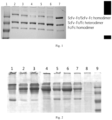
- the compositions of the homodimer protein (ScFv-Fc/ScFv-Fc, Fc/Fc) and the heterodimer protein (ScFv-Fc/Fc) in the product of each group could be detected by SDS-PAGE electrophoresis under non-reducing conditions, and the proportion of the homodimer protein (ScFv-Fc/ScFv-Fc, Fc/Fc) to the heterodimer protein (ScFv-Fc/Fc) was analyzed with Imagelab professional image analysis software provided by BioRad company.
- combination 1 and combination 2 both introduced the F405K mutation to increase the repulsive force between homodimers, but combination 2 showed better effect than combination 1 in enhancing the heterodimer content (heterodimer content in the mutation combination 2 is about 70%, while combination 1 is about 58%).
- the heterodimer content was increased (77%) resulted from non-charged mutation in the mutation combination 4, which was more significant than that resulted from oppositely charged mutation in the mutation combination 3 (57%).
- similar effects should be resulted from the two mutation combination 1 and 4 if simply considering the superposition of the two interactions in theory.
- the cotransfection expression vectors used in two superior mutation combinations (2 and 4) and the KH combination were transfected with PEI to 293H suspension-culture cells (ATCC CRL-1573) at a ratio of 4:1 and 1:4, respectively, and the cell culture supernatant was collected after 5-6 days of cultivation.
- the respective transient transfection products were obtained through Protein A affinity chromatography.
- compositions of homodimer proteins (ScFv-Fc/ScFv-Fc, Fc/Fc) and heterodimer proteins (ScFv-Fc/Fc) were detected by SDS-PAGE electrophoresis under non-reducing conditions.
- the specific results are shown in Table 4.
- the cotransfection ratio of recombinant expression vectors had a significant influence on the ratio of homodimers and heterodimers in the product.
- the content of heterodimers in the product is significantly reduced at a cotransfection ratio of 4:1 and 1:4.
- interfacial amino acid mutation was further introduced according to the disclosed three-dimensional crystal structure of wild-type Fc, so as to further reduce the mutual attraction between the chain A and the chain A and between the chain B and the chain B, and inhibit the formation of homodimer proteins.
- an amino acid paired with a charged amino acid was further selected from contacting amino acids near mutation sites in the mutation combination 2 or mutation combination 4, and one amino acid on one chain therein (a non-charged amino acid was mutated to a charged amino acid, or a charged amino acid was mutated to a non-charged amino acid, or a charged amino acid was mutated to oppositely charged) was mutated in order to further improve the unbalance property of the ionic action between the chain A and the chain B, as well as to decrease the probability of homodimers formation or to increase the probability of formation of heterodimers at the same time.
- the contacting amino acid pair of Lys360 on chain A and Gln347 on chain B was mutated to change the ionic action therebetween.
- the two amino acid residues on one chain (e.g., chain A) thereof were mutated to negatively charged amino acid residues by, e.g., introducing mutations K360E and Q347E; non-charged amino acid residues on the other chain (e.g., chain B) were mutated to positively charged amino acid residues by, e.g., introducing mutation Q347R.
- the amino acid residue of Leu368 was also investigated.
- the residue was surrounded by two charged amino acid residues: Glu357 and Lys409.
- Leu368 on the Fc chain into which the K409A mutation was introduced was further mutated to a negatively charged amino acid residue (e.g., 368E).
- Table 5 List of Mutation Combinations of Heterodimers-2 Combination Fc chain Mutation Corresponding SEQ ID NO 5 A Y349C+T366W+F405K+K360E+Q347E 12 B D356C+T366S+L368A+Y407V+Q347R 13 6 A Y349C+T366W+F405K+Q347R 14 B D356C+T366S+L368A+Y407V+K360E+Q347E 15 7 A Y349C+T366W+K409A+K360E+Q347E 16 B D356C+T366S+L368A+Y407V+F405K+Q347R 17 8 A Y349C+T366W+K409
- a recombined mutation of ScFv-Fc and Fc encoding genes was performed by overlapping PCR with the recombinant expression vector of the wild-type ScFv-Fc and Fc proteins constructed in Example 2 as the template, where the mutation of the chain A was located on the ScFv-Fc fusion protein, and the mutation of the chain B was located on the FC protein.
- the mutant gene was subcloned to pcDNA4 (Invitrogen, cat V86220) to finally obtain the ScFv-Fc fusion protein to express a new round of mutations in mammalian cells and a recombinant expression vector of the mutant Fc protein.
- the 5 new mutation combinations (5 to 9) and the first round of preferred mutation combinations (2 and 4) was transiently expressed using 293H cells (ATCC CRL-1573).
- the cotransfection ratio of recombinant expression vector of the chain A to that of the chain B was 1:1.
- the transiently expressed culture supernatant was collected, and 5 groups of preliminarily purified new mutation combinations and 2 groups of the first round of preferred combinations of transient transfection products were obtained by Protein A affinity chromatography.
- Each of these transient transfection products contained different proportions of homodimer proteins (ScFv-Fc/ScFv-Fc, Fc/Fc) and heterodimer protein (ScFv-Fc/Fc).
- the three proteins ScFv-Fc/ScFv-Fc, Fc/Fc, and ScFv-Fc/Fc
- the compositions of the homodimer protein (ScFv-Fc/ScFv-Fc, Fc/Fc) and the heterodimer protein (ScFv-Fc/Fc) in the product of each group can be detected by SDS-PAGE electrophoresis under non-reducing conditions, and the proportion of the homodimer protein (ScFv-Fc/ScFv-Fc, Fc/Fc) to the heterodimer protein (ScFv-Fc/Fc) was analyzed with ImageLab professional image analysis software provided by Biorad company.
- Example 2 The results were consistent with the results obtained in Example 2, and further proved the feasibility of preliminary investigation of the tendency of forming homodimer using the method.
- the expression levels of all the B chains were far lower than those of the chain A. It was found through separate transient expression of the wild-type chain A and the wild-type chain B that, when not any mutation was introduced, the expression level of homodimers of the wild-type chain B was lower than that of the wild-type chain A (the former was about half of the latter). Therefore, it was inferred that the N-terminal of the Fc sequence in the chain A was fused with the ScFv sequence, which helped to enhance its expression level.
- Mutation combination 4 was selected to obtain a heterodimer protein of mutation combination 4 by transient expression in 293H cells (ATCC CRL-1573) and purification, and the crystal structure was analyzed.
- a fragment of His-tag sequence was inserted into the C-terminal of the chain B of the mutation combination 4 using molecular cloning, so as to obtain a pure AB heterodimer protein using the IMAC method for crystallization after Protein A affinity chromatography.
- Crystallographic structure was analyzed as follows: The heterodimer Fc crystal was formed under the following conditions: mixing 2 ⁇ L of a crystallization buffer (15% PEG3350, 1 M LiCl and 0.1 M MES at pH6.0) with L of a protein solution (10 mg/mL target protein, 10 mM Tris and 150 mM NaCl at pH 7.4), and was left to stand for crystallization at 22 °C. The crystal grew about 3 days later. The crystal was then placed in the following solution: 17% PEG3350, 1M LiCl, 0.1M MES and 20% glycerin at pH6.0; and then quickly infiltrated and frozen in liquid nitrogen. The X-diffraction data was collected by SSRF BL17U. The structure of the wild-type Fc (PDB landing number: 3AVE) was used as the framework to analyze the molecular replacement structure.
- a crystallization buffer (15% PEG3350, 1 M LiCl and 0.1 M MES at pH6.0
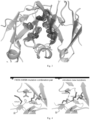
- the crystal structure showed that the overall structure of the mutant Fc heterodimer was similar to that of the wild-type Fc, but was changed on some degree on the CH3 interface into which mutations were introduced due to the interaction between different side chain groups.
- the specific crystal structure of the CH3 interface is shown in Fig. 3 .
- a new candidate mutation was further screened according to the result of the crystal structure of the mutation combination 4.
- mutations were further introduced near a pair of mutated amino acid residues F405K-K409A to change the ionic bonding and hydrogen bonding. If K409A was on chain A, and F405K was on chain B, then K392D mutation would be introduced into the chain A, and D399S mutation would be introduced into the chain B. As shown in Fig. 4 , for the interaction between the chain A and the chain B, the ionic bond between K392D and F405K and the hydrogen bond between K392D and D399S were added to the newly introduced mutation pair, which was expected to improve the tendency of forming heterodimers.
- a mutation combination as shown in Table 8 was obtained by introducing the above mutation on the basis of the mutation combination 4: Table 8: List of Mutation Combinations of Heterodimers-3 Combination Fc chain Mutation Corresponding SEQ ID NO 10 A T366W+K409A+K392D 21 B T366S+L368A+Y407V+D399S+F405K 22 11 A T366W+K409A 23 B T366S+L368G+Y407A+F405K 24 12 A T366W+K409A+Y349D 21 B T366S+L368A+Y407V+F405K+E357A 25 13 A T366W+K409A+Y349D+S354D 26 B T366S+L368A+Y407V+F405K+E357A 25
- Table 9 List of Mutation Combinations of Heterodimers-4 Combination Fc chain Mutation Corresponding SEQ ID NO 14 A T366W+F405K 27 B T366S+L368A+Y407V+K409A 28 15 A T366W+F405K+D399S 29 B T366S+L368A+Y407V+K409A+K392D 30 16 A T366W+F405K 27 B T366S+L368G+Y407A+K409A 31 17 A T366W+F405K+Y349D 32 B T366S+L368A+Y407V+K409A+E357A 33 18 A T366W+F405K+Y349D+S354D 34 B T366S+L368A+Y
- VhH variable region sequence of a single domain antibody of a camel was fused at the N terminal of the original B chain (simple Fc chain).
- a gene encoding VhH-Fc fusion protein is shown in SEQ ID NO: 36 obtained by artificial synthesis.
- This gene encodes a VhH-Fc fusion protein which has a sequence shown in SEQ ID:35, and the gene was then subcloned to a mammalian cell expression vector pcDNA4 (Invitrogen, cat V86220) to obtain a recombinant expression vector for expressing the VhH-Fc fusion protein in mammalian cells.
- pcDNA4 Invitrogen, cat V86220
- a combined mutation of ScFv-Fc and VhH-Fc encoding genes (SEQ ID NO:5 and SEQ ID NO:36) was performed by overlapping PCR with the recombinant expression vector of the wild-type ScFv-Fc protein constructed in Example 2 and the recombinant expression vector of the VhH-Fc fusion protein as the templates, where the mutation of the chain A was located on the ScFv-Fc fusion protein, and the mutation of the chain B was located on the VhH-Fc protein.
- the mutant gene was subcloned to pcDNA4 (Invitrogen, cat V86220) to finally obtain the ScFv-Fc fusion protein to express a third round of mutations in mammalian cells and a recombinant expression vector of the mutant VhH-Fc protein (SEQ ID NO:4 to SEQ ID NO:35).
- the 4 mutation combinations (10 to 13) in Table 8 and the mutation combination 4 were transiently expressed using 293H cells (ATCC CRL-1573).
- the cotransfection ratio of recombinant expression vector of the chain A to that of the chain B was 4: 1, 1: 1 and 1:4.
- the transiently expressed culture supernatant was collected, and 4 groups of preliminarily purified new mutation of combinations and transient transfection products of the mutation combination 4 were obtained by Protein A affinity chromatography.
- Each of these transient transfection products contained different proportions of homodimer proteins (ScFv-Fc/ScFv-Fc, VhH-Fc/VhH-Fc) and heterodimer protein (ScFv-Fc/VhH-Fc).
- the compositions of the homodimer protein (ScFv-Fc/ScFv-Fc, VhH-Fc/VhH-Fc) and the heterodimer protein (ScFv-Fc/VhH-Fc) in the product of each group could be detected by SDS-PAGE electrophoresis under non-reducing conditions, and the proportions of the homodimer protein (ScFv-Fc/ScFv-Fc, VhH-Fc/VhH-Fc) and the heterodimer protein (ScFv-Fc/VhH-Fc) were analyzed with ImageLab professional image analysis software provided by Biorad company at the same time.
- mutation combination 15, 16 and 18 were further selected to investigate their influence on the formation of heterodimers by transient expression.
- the 3 mutation combinations (15,16 and 18) in Table 9 and the mutation combination 2 were transiently expressed using 293H cells (ATCC CRL-1573).
- the cotransfection ratio of recombinant expression vector of the chain A to that of the chain B was 4: 1, 1: 1 and 1:4.
- the transiently expressed culture supernatant was collected after 5-6 days of cultivation.
- transient transfection products of 3 new preliminarily purified mutation combinations and the mutation combination 2 were obtained by Protein A affinity chromatography.
- Each of these transient transfection products contained different proportions of homodimer proteins (ScFv-Fc/ScFv-Fc, VhH-Fc/VhH-Fc) and heterodimer protein (ScFv-Fc/VhH-Fc).
- Heterodimers of the mutation combinations 4, 11 and 16 were selected for accelerated stability test with PBS as the buffer at a temperature of 45°C with an experimental period of 31 days.
- the heterodimers were tested with non-reducing CE-SDS on 0th day, 8th day, 18th day and 31st day, which were compared with the corresponding wild-type Fc protein.
- the SDS-PAGE results of the 31-day accelerated stability test showed that each of the main peak contents of the three mutation samples and wild-type control samples decreased by no more than 2% until the 31st day. It can be concluded that the heterodimer exhibited same thermal stability as the wild-type one.
Landscapes
- Health & Medical Sciences (AREA)
- Chemical & Material Sciences (AREA)
- Life Sciences & Earth Sciences (AREA)
- Organic Chemistry (AREA)
- Genetics & Genomics (AREA)
- Engineering & Computer Science (AREA)
- Molecular Biology (AREA)
- General Health & Medical Sciences (AREA)
- Biochemistry (AREA)
- Immunology (AREA)
- Biomedical Technology (AREA)
- Bioinformatics & Cheminformatics (AREA)
- Wood Science & Technology (AREA)
- Zoology (AREA)
- Biophysics (AREA)
- Medicinal Chemistry (AREA)
- General Engineering & Computer Science (AREA)
- Biotechnology (AREA)
- Microbiology (AREA)
- Proteomics, Peptides & Aminoacids (AREA)
- Plant Pathology (AREA)
- Physics & Mathematics (AREA)
- Animal Behavior & Ethology (AREA)
- General Chemical & Material Sciences (AREA)
- Epidemiology (AREA)
- Mycology (AREA)
- Public Health (AREA)
- Veterinary Medicine (AREA)
- Chemical Kinetics & Catalysis (AREA)
- Pharmacology & Pharmacy (AREA)
- Peptides Or Proteins (AREA)
- Micro-Organisms Or Cultivation Processes Thereof (AREA)
- Preparation Of Compounds By Using Micro-Organisms (AREA)
- Medicines That Contain Protein Lipid Enzymes And Other Medicines (AREA)
- Medicines Containing Antibodies Or Antigens For Use As Internal Diagnostic Agents (AREA)
- Organic Low-Molecular-Weight Compounds And Preparation Thereof (AREA)
Applications Claiming Priority (3)
| Application Number | Priority Date | Filing Date | Title |
|---|---|---|---|
| CN201510938995.0A CN106883297B (zh) | 2015-12-16 | 2015-12-16 | 基于ch3结构域的异二聚体分子、其制备方法及用途 |
| EP16874885.3A EP3392276B1 (fr) | 2015-12-16 | 2016-12-16 | Molécule hétérodimère fondée sur un domaine structurel ch3, son procédé de préparation et son utilisation |
| PCT/CN2016/110252 WO2017101828A1 (fr) | 2015-12-16 | 2016-12-16 | Molécule hétérodimère fondée sur un domaine structurel ch3, son procédé de préparation et son utilisation |
Related Parent Applications (2)
| Application Number | Title | Priority Date | Filing Date |
|---|---|---|---|
| EP16874885.3A Division-Into EP3392276B1 (fr) | 2015-12-16 | 2016-12-16 | Molécule hétérodimère fondée sur un domaine structurel ch3, son procédé de préparation et son utilisation |
| EP16874885.3A Division EP3392276B1 (fr) | 2015-12-16 | 2016-12-16 | Molécule hétérodimère fondée sur un domaine structurel ch3, son procédé de préparation et son utilisation |
Publications (4)
| Publication Number | Publication Date |
|---|---|
| EP4234584A2 true EP4234584A2 (fr) | 2023-08-30 |
| EP4234584A3 EP4234584A3 (fr) | 2023-09-27 |
| EP4234584B1 EP4234584B1 (fr) | 2025-07-16 |
| EP4234584C0 EP4234584C0 (fr) | 2025-07-16 |
Family
ID=59055700
Family Applications (2)
| Application Number | Title | Priority Date | Filing Date |
|---|---|---|---|
| EP16874885.3A Active EP3392276B1 (fr) | 2015-12-16 | 2016-12-16 | Molécule hétérodimère fondée sur un domaine structurel ch3, son procédé de préparation et son utilisation |
| EP23162270.5A Active EP4234584B1 (fr) | 2015-12-16 | 2016-12-16 | Molécule hétérodimère fondée sur un domaine structurel ch3, son procédé de préparation et son utilisation |
Family Applications Before (1)
| Application Number | Title | Priority Date | Filing Date |
|---|---|---|---|
| EP16874885.3A Active EP3392276B1 (fr) | 2015-12-16 | 2016-12-16 | Molécule hétérodimère fondée sur un domaine structurel ch3, son procédé de préparation et son utilisation |
Country Status (9)
| Country | Link |
|---|---|
| US (3) | US11168149B2 (fr) |
| EP (2) | EP3392276B1 (fr) |
| JP (3) | JP7103603B2 (fr) |
| CN (4) | CN106883297B (fr) |
| CA (1) | CA3007427C (fr) |
| DK (1) | DK3392276T5 (fr) |
| ES (1) | ES2944553T3 (fr) |
| FI (1) | FI3392276T3 (fr) |
| WO (1) | WO2017101828A1 (fr) |
Families Citing this family (36)
| Publication number | Priority date | Publication date | Assignee | Title |
|---|---|---|---|---|
| CN106883297B (zh) | 2015-12-16 | 2019-12-13 | 苏州康宁杰瑞生物科技有限公司 | 基于ch3结构域的异二聚体分子、其制备方法及用途 |
| SG10201913263SA (en) | 2016-09-29 | 2020-03-30 | Beijing Hanmi Pharmaceutical Co Ltd | Heterodimeric immunoglobulin constructs and preparation methods thereof |
| WO2018090950A1 (fr) | 2016-11-18 | 2018-05-24 | 北京韩美药品有限公司 | Anticorps bispécifique de type structure d'anticorps naturel anti-pd -1/anti-her2 de forme hétérodimère et sa préparation |
| WO2018228442A1 (fr) * | 2017-06-14 | 2018-12-20 | Dingfu Biotarget Co., Ltd. | Hétérodimère protéique et utilisation de celui-ci |
| WO2018233624A1 (fr) | 2017-06-20 | 2018-12-27 | 和迈生物科技有限公司 | Nanocorps anti-her2, séquence de codage et utilisation associée |
| WO2019014912A1 (fr) * | 2017-07-21 | 2019-01-24 | 赵磊 | Protéine hétérodimère et son procédé de préparation |
| CN111315767B (zh) * | 2017-08-22 | 2025-03-18 | 萨纳生物有限责任公司 | 可溶性干扰素受体及其用途 |
| WO2019047885A1 (fr) | 2017-09-07 | 2019-03-14 | Dingfu Biotarget Co., Ltd. | Immunoconjugués comprenant une protéine alpha régulatrice de signal |
| JP7356726B2 (ja) * | 2017-09-25 | 2023-10-05 | ディンフー バイオターゲット カンパニー リミテッド | タンパク性ヘテロ二量体及びその使用 |
| US11883503B2 (en) | 2017-09-25 | 2024-01-30 | Dingfu Biotarget Co., Ltd. | Methods and compositions for cancer treatment |
| CA3084626A1 (fr) | 2017-12-04 | 2019-06-13 | Beijing Hanmi Pharmaceutical Co., Ltd. | Anticorps bispecifique anti-pd-l1/anti-cd47 ayant une structure d'un anticorps naturel et sous forme d'un heterodimere, et preparation associee |
| WO2019153200A1 (fr) | 2018-02-08 | 2019-08-15 | 北京韩美药品有限公司 | Anticorps bispécifique de type structure d'anticorps naturel anti-pd -1/anti-her2 sous forme hétérodimère et sa préparation |
| US11827697B2 (en) | 2018-02-11 | 2023-11-28 | Beijing Hanmi Pharmaceutical Co., Ltd. | Anti-PD-1/anti-VEGF natural antibody structure like heterodimeric form bispecific antibody and preparation thereof |
| CN108640997A (zh) * | 2018-05-22 | 2018-10-12 | 蔡毓旻 | 一种双特异性抗体 |
| US20220227827A1 (en) * | 2019-03-25 | 2022-07-21 | Dingfu Biotarget Co., Ltd. | Proteinaceous heterodimer and use thereof |
| JP2022525275A (ja) * | 2019-03-28 | 2022-05-12 | エービー ストゥーディオ インコーポレイテッド | ヘテロ多量体タンパク質及びその使用法 |
| EP3959237A1 (fr) * | 2019-04-25 | 2022-03-02 | F. Hoffmann-La Roche AG | Polypeptides thérapeutiques multispécifiques activés par échange de chaînes polypeptidiques |
| AU2020263910A1 (en) * | 2019-04-25 | 2021-10-21 | F. Hoffmann-La Roche Ag | Activatable therapeutic multispecific polypeptides with extended half-life |
| JP7812230B2 (ja) * | 2019-04-25 | 2026-02-09 | エフ. ホフマン-ラ ロシュ アーゲー | ポリペプチド鎖交換による抗体由来ポリペプチドの生成 |
| CA3149939A1 (fr) | 2019-09-06 | 2021-03-11 | Stephen J. Demarest | Proteines comprenant des domaines constants de recepteur de lymphocytes t |
| CN113121696A (zh) * | 2019-12-31 | 2021-07-16 | 周易 | Fab改造诱导形成的双特异性抗体及其制备方法和用途 |
| CN113121697B (zh) * | 2019-12-31 | 2023-06-09 | 周易 | Ch3结构域改造诱导形成的异源二聚体及其制备方法和应用 |
| TWI920054B (zh) * | 2020-01-23 | 2026-04-01 | 瑞士商天演藥業公司 | 具有Fc突變之異二聚蛋白質 |
| WO2022032005A2 (fr) | 2020-08-05 | 2022-02-10 | Synthekine, Inc. | Molécules de liaison à l'il10rb et leurs procédés d'utilisation |
| WO2022031890A1 (fr) | 2020-08-05 | 2022-02-10 | Synthekine, Inc. | Molécules de liaison à ifngr2 et procédés d'utilisation |
| JP7743500B2 (ja) | 2020-08-05 | 2025-09-24 | シンセカイン インコーポレイテッド | Il10受容体結合性分子および使用方法 |
| US20230279125A1 (en) * | 2020-08-05 | 2023-09-07 | Synthekine, Inc. | Il28ra binding molecules and methods of use |
| US12122839B2 (en) | 2020-08-05 | 2024-10-22 | Synthekine, Inc. | IFNGR binding synthetic cytokines and methods of use |
| WO2022093857A1 (fr) * | 2020-10-26 | 2022-05-05 | City Of Hope | Compositions de virus oncolytiques et méthodes de traitement du cancer |
| CN112977908B (zh) * | 2021-03-02 | 2022-12-02 | 康宁杰瑞(吉林)生物科技有限公司 | 灌装加塞机及其灌装的方法 |
| KR20240028452A (ko) * | 2021-07-02 | 2024-03-05 | 제넨테크, 인크. | 암을 치료하기 위한 방법 및 조성물 |
| IL309120A (en) * | 2021-07-28 | 2024-02-01 | Hoffmann La Roche | Methods and compositions for the treatment of cancer |
| KR20240116743A (ko) * | 2021-11-09 | 2024-07-30 | 한양대학교 산학협력단 | Fc 변이체를 포함하는 이종이합체 및 이의 제조방법 |
| CN116948029A (zh) * | 2022-04-20 | 2023-10-27 | 南京融捷康生物科技有限公司 | 一种包含IgG类Fc区变体的抗体及其用途 |
| WO2025224084A1 (fr) | 2024-04-22 | 2025-10-30 | Engimmune Therapeutics Ag | Protéines comprenant des domaines constants du récepteur des lymphocytes t |
| US20260109746A1 (en) | 2024-10-22 | 2026-04-23 | Gilead Sciences, Inc. | Cd4-targeted il-15 molecules and methods of use |
Family Cites Families (21)
| Publication number | Priority date | Publication date | Assignee | Title |
|---|---|---|---|---|
| US5731168A (en) * | 1995-03-01 | 1998-03-24 | Genentech, Inc. | Method for making heteromultimeric polypeptides |
| US7951917B1 (en) * | 1997-05-02 | 2011-05-31 | Genentech, Inc. | Method for making multispecific antibodies having heteromultimeric and common components |
| EP3663318A1 (fr) | 2008-01-07 | 2020-06-10 | Amgen Inc. | Procédé de fabrication de molécules hétérodimères fc d'anticorps utilisant les effets de conduite électrostatique |
| US20130089554A1 (en) * | 2009-12-29 | 2013-04-11 | Emergent Product Development Seattle, Llc | RON Binding Constructs and Methods of Use Thereof |
| CN103429620B (zh) | 2010-11-05 | 2018-03-06 | 酵活有限公司 | 在Fc结构域中具有突变的稳定异源二聚的抗体设计 |
| JP2014511836A (ja) | 2011-03-25 | 2014-05-19 | グレンマーク ファーマシューティカルズ, エセ.アー. | ヘテロ二量体免疫グロブリン |
| UA117901C2 (uk) * | 2011-07-06 | 2018-10-25 | Ґенмаб Б.В. | Спосіб посилення ефекторної функції вихідного поліпептиду, його варіанти та їх застосування |
| US9574010B2 (en) * | 2011-11-04 | 2017-02-21 | Zymeworks Inc. | Stable heterodimeric antibody design with mutations in the Fc domain |
| CN102558355B (zh) * | 2011-12-31 | 2015-02-25 | 苏州康宁杰瑞生物科技有限公司 | 基于电荷网络的异二聚体fc改造方法及异二聚体蛋白的制备方法 |
| WO2013157953A1 (fr) * | 2012-04-20 | 2013-10-24 | Merus B.V. | Procédés et moyens de production de molécules de type ig |
| JP6351572B2 (ja) * | 2012-05-10 | 2018-07-04 | ザイムワークス,インコーポレイテッド | Fcドメインに突然変異を有する免疫グロブリン重鎖のヘテロ多量体構築物 |
| BR112015000798A2 (pt) | 2012-07-13 | 2017-06-27 | Zymeworks Inc | heterodímeros assimétricos biespecíficos compreendendo construtos anti-cd3 |
| CN102851338A (zh) | 2012-07-25 | 2013-01-02 | 苏州康宁杰瑞生物科技有限公司 | 利用电荷排斥作用制备同二聚体蛋白混合物的方法 |
| EA032681B1 (ru) * | 2012-11-27 | 2019-07-31 | Аджоу Юниверсити Индастри-Академик Кооперейшн Фаундейшн | ГЕТЕРОДИМЕР Fc ИММУНОГЛОБУЛИНА, СОДЕРЖАЩИЙ ВАРИАНТ ДОМЕНА CH3 ДЛЯ ОБРАЗОВАНИЯ АНТИТЕЛА ИЛИ ГИБРИДНОГО БЕЛКА С ГЕТЕРОМЕРНЫМ Fc С ВЫСОКОЙ ЭФФЕКТИВНОСТЬЮ, СПОСОБ ДЛЯ ЕГО ПОЛУЧЕНИЯ И ИСПОЛЬЗОВАНИЯ |
| MX385344B (es) * | 2012-11-28 | 2025-03-18 | Zymeworks Bc Inc | Pares de cadena pesada-cadena ligera de inmunoglobulina modificados genéticamente y usos de estos. |
| CN106883297B (zh) * | 2015-12-16 | 2019-12-13 | 苏州康宁杰瑞生物科技有限公司 | 基于ch3结构域的异二聚体分子、其制备方法及用途 |
| KR20180104148A (ko) * | 2016-02-05 | 2018-09-19 | 젠맵 에이/에스 | 개선된 내재화 특징을 갖는 다중특이적 항원-결합 분자 |
| WO2018228442A1 (fr) * | 2017-06-14 | 2018-12-20 | Dingfu Biotarget Co., Ltd. | Hétérodimère protéique et utilisation de celui-ci |
| WO2019047885A1 (fr) * | 2017-09-07 | 2019-03-14 | Dingfu Biotarget Co., Ltd. | Immunoconjugués comprenant une protéine alpha régulatrice de signal |
| JP7356726B2 (ja) * | 2017-09-25 | 2023-10-05 | ディンフー バイオターゲット カンパニー リミテッド | タンパク性ヘテロ二量体及びその使用 |
| US11883503B2 (en) * | 2017-09-25 | 2024-01-30 | Dingfu Biotarget Co., Ltd. | Methods and compositions for cancer treatment |
-
2015
- 2015-12-16 CN CN201510938995.0A patent/CN106883297B/zh active Active
-
2016
- 2016-12-16 EP EP16874885.3A patent/EP3392276B1/fr active Active
- 2016-12-16 FI FIEP16874885.3T patent/FI3392276T3/fi active
- 2016-12-16 WO PCT/CN2016/110252 patent/WO2017101828A1/fr not_active Ceased
- 2016-12-16 DK DK16874885.3T patent/DK3392276T5/da active
- 2016-12-16 EP EP23162270.5A patent/EP4234584B1/fr active Active
- 2016-12-16 CN CN202210544074.6A patent/CN115057937B/zh active Active
- 2016-12-16 ES ES16874885T patent/ES2944553T3/es active Active
- 2016-12-16 JP JP2018531643A patent/JP7103603B2/ja active Active
- 2016-12-16 CN CN202511005700.4A patent/CN120842427A/zh active Pending
- 2016-12-16 US US16/062,405 patent/US11168149B2/en active Active
- 2016-12-16 CN CN201680073286.3A patent/CN108473592B/zh active Active
- 2016-12-16 CA CA3007427A patent/CA3007427C/fr active Active
-
2021
- 2021-10-07 US US17/496,240 patent/US12281177B2/en active Active
-
2022
- 2022-06-28 JP JP2022103464A patent/JP7444381B2/ja active Active
-
2024
- 2024-02-13 JP JP2024019083A patent/JP7788113B2/ja active Active
-
2025
- 2025-03-19 US US19/084,362 patent/US20250257150A1/en active Pending
Non-Patent Citations (2)
| Title |
|---|
| B. ERMANI. BAHARR. L. JERNIGAN: "Equilibrium states of rigid bodies with multiple interaction sites. Application to protein helices.", J. CHEM. PHYS., vol. 107, 1997, pages 2046 - 2059 |
| YUZHEN YEADAM GODZIK: "FATCAT: a web server for flexible structure comparison and structure similarity searching", NUCLEIC ACIDS RES., vol. 32, 2004, pages 582 - 585 |
Also Published As
| Publication number | Publication date |
|---|---|
| CN106883297A (zh) | 2017-06-23 |
| EP3392276B1 (fr) | 2023-04-19 |
| WO2017101828A1 (fr) | 2017-06-22 |
| JP2019502701A (ja) | 2019-01-31 |
| DK3392276T5 (da) | 2024-09-23 |
| JP7788113B2 (ja) | 2025-12-18 |
| EP3392276A1 (fr) | 2018-10-24 |
| US20180362668A1 (en) | 2018-12-20 |
| ES2944553T3 (es) | 2023-06-22 |
| EP3392276A4 (fr) | 2019-09-18 |
| FI3392276T3 (fi) | 2023-05-05 |
| EP4234584B1 (fr) | 2025-07-16 |
| US20250257150A1 (en) | 2025-08-14 |
| HK1253248A1 (zh) | 2019-06-14 |
| CN115057937A (zh) | 2022-09-16 |
| JP2024056829A (ja) | 2024-04-23 |
| JP7444381B2 (ja) | 2024-03-06 |
| DK3392276T3 (da) | 2023-05-01 |
| CN108473592B (zh) | 2022-05-03 |
| CA3007427C (fr) | 2024-04-23 |
| CN115057937B (zh) | 2025-07-18 |
| EP4234584A3 (fr) | 2023-09-27 |
| CA3007427A1 (fr) | 2017-06-22 |
| US11168149B2 (en) | 2021-11-09 |
| CN106883297B (zh) | 2019-12-13 |
| EP4234584C0 (fr) | 2025-07-16 |
| US12281177B2 (en) | 2025-04-22 |
| CN108473592A (zh) | 2018-08-31 |
| CN120842427A (zh) | 2025-10-28 |
| JP2022130568A (ja) | 2022-09-06 |
| JP7103603B2 (ja) | 2022-07-20 |
| US20220017643A1 (en) | 2022-01-20 |
Similar Documents
| Publication | Publication Date | Title |
|---|---|---|
| US12281177B2 (en) | Heterodimer molecule based on CH3 domain, and preparation method and use thereof | |
| US11851476B2 (en) | Antigen-binding molecule having regulated conjugation between heavy-chain and light-chain | |
| KR101851380B1 (ko) | 효모접합을 이용한 항체 ch3 도메인 이종이중체 돌연변이쌍 제조 방법 및 이에 의하여 제조된 ch3 돌연변이체 쌍 | |
| EP2889313B1 (fr) | Procédé de préparation d'un mélange de protéines homodimères par l'utilisation d'un effet de répulsion de charges | |
| CN111936514A (zh) | 多价抗体 | |
| AU2013352812A1 (en) | CH3 domain variant pair inducing formation of heterodimer of heavy chain constant region of antibody at high efficiency, method for preparing same, and use thereof | |
| JP2024510811A (ja) | Upar抗体及びその融合タンパク質 | |
| WO2024120199A1 (fr) | Anticorps bispécifiques/multi-spécifiques et leurs utilisations | |
| HK1259059B (en) | Antigen-binding molecule having regulated conjugation between heavy-chain and light-chain | |
| HK1259058B (en) | Antigen-binding molecule having regulated conjugation between heavy-chain and light-chain | |
| HK1253248B (en) | Heterodimer molecule based on ch3 structural domain, and preparation method therefor and use thereof | |
| HK1197429A (en) | Antigen-binding molecule having regulated conjugation between heavy-chain and light-chain |
Legal Events
| Date | Code | Title | Description |
|---|---|---|---|
| PUAI | Public reference made under article 153(3) epc to a published international application that has entered the european phase |
Free format text: ORIGINAL CODE: 0009012 |
|
| STAA | Information on the status of an ep patent application or granted ep patent |
Free format text: STATUS: REQUEST FOR EXAMINATION WAS MADE |
|
| PUAL | Search report despatched |
Free format text: ORIGINAL CODE: 0009013 |
|
| 17P | Request for examination filed |
Effective date: 20230316 |
|
| AC | Divisional application: reference to earlier application |
Ref document number: 3392276 Country of ref document: EP Kind code of ref document: P |
|
| AK | Designated contracting states |
Kind code of ref document: A2 Designated state(s): AL AT BE BG CH CY CZ DE DK EE ES FI FR GB GR HR HU IE IS IT LI LT LU LV MC MK MT NL NO PL PT RO RS SE SI SK SM TR |
|
| AK | Designated contracting states |
Kind code of ref document: A3 Designated state(s): AL AT BE BG CH CY CZ DE DK EE ES FI FR GB GR HR HU IE IS IT LI LT LU LV MC MK MT NL NO PL PT RO RS SE SI SK SM TR |
|
| RIC1 | Information provided on ipc code assigned before grant |
Ipc: A61K 39/395 20060101ALI20230823BHEP Ipc: C12N 15/11 20060101ALI20230823BHEP Ipc: C12P 21/00 20060101ALI20230823BHEP Ipc: C07K 16/00 20060101ALI20230823BHEP Ipc: C07K 16/46 20060101AFI20230823BHEP |
|
| STAA | Information on the status of an ep patent application or granted ep patent |
Free format text: STATUS: EXAMINATION IS IN PROGRESS |
|
| 17Q | First examination report despatched |
Effective date: 20240801 |
|
| GRAP | Despatch of communication of intention to grant a patent |
Free format text: ORIGINAL CODE: EPIDOSNIGR1 |
|
| STAA | Information on the status of an ep patent application or granted ep patent |
Free format text: STATUS: GRANT OF PATENT IS INTENDED |
|
| INTG | Intention to grant announced |
Effective date: 20250212 |
|
| GRAS | Grant fee paid |
Free format text: ORIGINAL CODE: EPIDOSNIGR3 |
|
| GRAA | (expected) grant |
Free format text: ORIGINAL CODE: 0009210 |
|
| STAA | Information on the status of an ep patent application or granted ep patent |
Free format text: STATUS: THE PATENT HAS BEEN GRANTED |
|
| AC | Divisional application: reference to earlier application |
Ref document number: 3392276 Country of ref document: EP Kind code of ref document: P |
|
| AK | Designated contracting states |
Kind code of ref document: B1 Designated state(s): AL AT BE BG CH CY CZ DE DK EE ES FI FR GB GR HR HU IE IS IT LI LT LU LV MC MK MT NL NO PL PT RO RS SE SI SK SM TR |
|
| REG | Reference to a national code |
Ref country code: GB Ref legal event code: FG4D |
|
| REG | Reference to a national code |
Ref country code: CH Ref legal event code: EP Ref country code: DE Ref legal event code: R096 Ref document number: 602016092962 Country of ref document: DE |
|
| REG | Reference to a national code |
Ref country code: IE Ref legal event code: FG4D |
|
| U01 | Request for unitary effect filed |
Effective date: 20250807 |
|
| U07 | Unitary effect registered |
Designated state(s): AT BE BG DE DK EE FI FR IT LT LU LV MT NL PT RO SE SI Effective date: 20250819 |
|
| REG | Reference to a national code |
Ref country code: CH Ref legal event code: U11 Free format text: ST27 STATUS EVENT CODE: U-0-0-U10-U11 (AS PROVIDED BY THE NATIONAL OFFICE) Effective date: 20260101 |
|
| PG25 | Lapsed in a contracting state [announced via postgrant information from national office to epo] |
Ref country code: IS Free format text: LAPSE BECAUSE OF FAILURE TO SUBMIT A TRANSLATION OF THE DESCRIPTION OR TO PAY THE FEE WITHIN THE PRESCRIBED TIME-LIMIT Effective date: 20251116 |
|
| PGFP | Annual fee paid to national office [announced via postgrant information from national office to epo] |
Ref country code: GB Payment date: 20251215 Year of fee payment: 10 |
|
| PG25 | Lapsed in a contracting state [announced via postgrant information from national office to epo] |
Ref country code: NO Free format text: LAPSE BECAUSE OF FAILURE TO SUBMIT A TRANSLATION OF THE DESCRIPTION OR TO PAY THE FEE WITHIN THE PRESCRIBED TIME-LIMIT Effective date: 20251016 |
|
| PG25 | Lapsed in a contracting state [announced via postgrant information from national office to epo] |
Ref country code: HR Free format text: LAPSE BECAUSE OF FAILURE TO SUBMIT A TRANSLATION OF THE DESCRIPTION OR TO PAY THE FEE WITHIN THE PRESCRIBED TIME-LIMIT Effective date: 20250716 |
|
| PG25 | Lapsed in a contracting state [announced via postgrant information from national office to epo] |
Ref country code: GR Free format text: LAPSE BECAUSE OF FAILURE TO SUBMIT A TRANSLATION OF THE DESCRIPTION OR TO PAY THE FEE WITHIN THE PRESCRIBED TIME-LIMIT Effective date: 20251017 |
|
| U20 | Renewal fee for the european patent with unitary effect paid |
Year of fee payment: 10 Effective date: 20251215 |
|
| PG25 | Lapsed in a contracting state [announced via postgrant information from national office to epo] |
Ref country code: PL Free format text: LAPSE BECAUSE OF FAILURE TO SUBMIT A TRANSLATION OF THE DESCRIPTION OR TO PAY THE FEE WITHIN THE PRESCRIBED TIME-LIMIT Effective date: 20250716 |
|
| PG25 | Lapsed in a contracting state [announced via postgrant information from national office to epo] |
Ref country code: RS Free format text: LAPSE BECAUSE OF FAILURE TO SUBMIT A TRANSLATION OF THE DESCRIPTION OR TO PAY THE FEE WITHIN THE PRESCRIBED TIME-LIMIT Effective date: 20251016 |
|
| PG25 | Lapsed in a contracting state [announced via postgrant information from national office to epo] |
Ref country code: ES Free format text: LAPSE BECAUSE OF FAILURE TO SUBMIT A TRANSLATION OF THE DESCRIPTION OR TO PAY THE FEE WITHIN THE PRESCRIBED TIME-LIMIT Effective date: 20250716 |
|
| PG25 | Lapsed in a contracting state [announced via postgrant information from national office to epo] |
Ref country code: SM Free format text: LAPSE BECAUSE OF FAILURE TO SUBMIT A TRANSLATION OF THE DESCRIPTION OR TO PAY THE FEE WITHIN THE PRESCRIBED TIME-LIMIT Effective date: 20250716 |
|
| PG25 | Lapsed in a contracting state [announced via postgrant information from national office to epo] |
Ref country code: CZ Free format text: LAPSE BECAUSE OF FAILURE TO SUBMIT A TRANSLATION OF THE DESCRIPTION OR TO PAY THE FEE WITHIN THE PRESCRIBED TIME-LIMIT Effective date: 20250716 |
|
| PGFP | Annual fee paid to national office [announced via postgrant information from national office to epo] |
Ref country code: CH Payment date: 20260101 Year of fee payment: 10 |
|
| PG25 | Lapsed in a contracting state [announced via postgrant information from national office to epo] |
Ref country code: SK Free format text: LAPSE BECAUSE OF FAILURE TO SUBMIT A TRANSLATION OF THE DESCRIPTION OR TO PAY THE FEE WITHIN THE PRESCRIBED TIME-LIMIT Effective date: 20250716 |
|
| PLBE | No opposition filed within time limit |
Free format text: ORIGINAL CODE: 0009261 |
|
| STAA | Information on the status of an ep patent application or granted ep patent |
Free format text: STATUS: NO OPPOSITION FILED WITHIN TIME LIMIT |
|
| REG | Reference to a national code |
Ref country code: CH Ref legal event code: L10 Free format text: ST27 STATUS EVENT CODE: U-0-0-L10-L00 (AS PROVIDED BY THE NATIONAL OFFICE) Effective date: 20260528 |
|
| 26N | No opposition filed |
Effective date: 20260417 |
|
| PG25 | Lapsed in a contracting state [announced via postgrant information from national office to epo] |
Ref country code: MC Free format text: LAPSE BECAUSE OF FAILURE TO SUBMIT A TRANSLATION OF THE DESCRIPTION OR TO PAY THE FEE WITHIN THE PRESCRIBED TIME-LIMIT Effective date: 20250716 |