EP4223679A1 - Conveyance apparatus and image forming apparatus - Google Patents
Conveyance apparatus and image forming apparatus Download PDFInfo
- Publication number
- EP4223679A1 EP4223679A1 EP23152488.5A EP23152488A EP4223679A1 EP 4223679 A1 EP4223679 A1 EP 4223679A1 EP 23152488 A EP23152488 A EP 23152488A EP 4223679 A1 EP4223679 A1 EP 4223679A1
- Authority
- EP
- European Patent Office
- Prior art keywords
- sheet
- roller pair
- conveyance
- curved portion
- guide
- Prior art date
- Legal status (The legal status is an assumption and is not a legal conclusion. Google has not performed a legal analysis and makes no representation as to the accuracy of the status listed.)
- Pending
Links
- 230000001105 regulatory effect Effects 0.000 abstract description 2
- 238000010586 diagram Methods 0.000 description 9
- 238000012986 modification Methods 0.000 description 5
- 230000004048 modification Effects 0.000 description 5
- 238000000926 separation method Methods 0.000 description 4
- 238000005452 bending Methods 0.000 description 3
- 238000011144 upstream manufacturing Methods 0.000 description 3
- 238000001514 detection method Methods 0.000 description 2
- 238000000034 method Methods 0.000 description 2
- 239000000470 constituent Substances 0.000 description 1
- 230000007423 decrease Effects 0.000 description 1
- 239000000463 material Substances 0.000 description 1
- 230000000452 restraining effect Effects 0.000 description 1
Images


Classifications
-
- B—PERFORMING OPERATIONS; TRANSPORTING
- B65—CONVEYING; PACKING; STORING; HANDLING THIN OR FILAMENTARY MATERIAL
- B65H—HANDLING THIN OR FILAMENTARY MATERIAL, e.g. SHEETS, WEBS, CABLES
- B65H5/00—Feeding articles separated from piles; Feeding articles to machines
- B65H5/06—Feeding articles separated from piles; Feeding articles to machines by rollers or balls, e.g. between rollers
- B65H5/062—Feeding articles separated from piles; Feeding articles to machines by rollers or balls, e.g. between rollers between rollers or balls
-
- B—PERFORMING OPERATIONS; TRANSPORTING
- B65—CONVEYING; PACKING; STORING; HANDLING THIN OR FILAMENTARY MATERIAL
- B65H—HANDLING THIN OR FILAMENTARY MATERIAL, e.g. SHEETS, WEBS, CABLES
- B65H5/00—Feeding articles separated from piles; Feeding articles to machines
- B65H5/36—Article guides or smoothers, e.g. movable in operation
-
- B—PERFORMING OPERATIONS; TRANSPORTING
- B65—CONVEYING; PACKING; STORING; HANDLING THIN OR FILAMENTARY MATERIAL
- B65H—HANDLING THIN OR FILAMENTARY MATERIAL, e.g. SHEETS, WEBS, CABLES
- B65H5/00—Feeding articles separated from piles; Feeding articles to machines
- B65H5/36—Article guides or smoothers, e.g. movable in operation
- B65H5/38—Article guides or smoothers, e.g. movable in operation immovable in operation
-
- B—PERFORMING OPERATIONS; TRANSPORTING
- B65—CONVEYING; PACKING; STORING; HANDLING THIN OR FILAMENTARY MATERIAL
- B65H—HANDLING THIN OR FILAMENTARY MATERIAL, e.g. SHEETS, WEBS, CABLES
- B65H7/00—Controlling article feeding, separating, pile-advancing, or associated apparatus, to take account of incorrect feeding, absence of articles, or presence of faulty articles
-
- B—PERFORMING OPERATIONS; TRANSPORTING
- B65—CONVEYING; PACKING; STORING; HANDLING THIN OR FILAMENTARY MATERIAL
- B65H—HANDLING THIN OR FILAMENTARY MATERIAL, e.g. SHEETS, WEBS, CABLES
- B65H85/00—Recirculating articles, i.e. feeding each article to, and delivering it from, the same machine work-station more than once
-
- B—PERFORMING OPERATIONS; TRANSPORTING
- B65—CONVEYING; PACKING; STORING; HANDLING THIN OR FILAMENTARY MATERIAL
- B65H—HANDLING THIN OR FILAMENTARY MATERIAL, e.g. SHEETS, WEBS, CABLES
- B65H9/00—Registering, e.g. orientating, articles; Devices therefor
- B65H9/004—Deskewing sheet by abutting against a stop, i.e. producing a buckling of the sheet
-
- B—PERFORMING OPERATIONS; TRANSPORTING
- B65—CONVEYING; PACKING; STORING; HANDLING THIN OR FILAMENTARY MATERIAL
- B65H—HANDLING THIN OR FILAMENTARY MATERIAL, e.g. SHEETS, WEBS, CABLES
- B65H9/00—Registering, e.g. orientating, articles; Devices therefor
- B65H9/06—Movable stops or gauges, e.g. rising and falling front stops
-
- G—PHYSICS
- G03—PHOTOGRAPHY; CINEMATOGRAPHY; ANALOGOUS TECHNIQUES USING WAVES OTHER THAN OPTICAL WAVES; ELECTROGRAPHY; HOLOGRAPHY
- G03G—ELECTROGRAPHY; ELECTROPHOTOGRAPHY; MAGNETOGRAPHY
- G03G15/00—Apparatus for electrographic processes using a charge pattern
- G03G15/22—Apparatus for electrographic processes using a charge pattern involving the combination of more than one step according to groups G03G13/02 - G03G13/20
- G03G15/23—Apparatus for electrographic processes using a charge pattern involving the combination of more than one step according to groups G03G13/02 - G03G13/20 specially adapted for copying both sides of an original or for copying on both sides of a recording or image-receiving material
- G03G15/231—Arrangements for copying on both sides of a recording or image-receiving material
- G03G15/232—Arrangements for copying on both sides of a recording or image-receiving material using a single reusable electrographic recording member
- G03G15/234—Arrangements for copying on both sides of a recording or image-receiving material using a single reusable electrographic recording member by inverting and refeeding the image receiving material with an image on one face to the recording member to transfer a second image on its second face, e.g. by using a duplex tray; Details of duplex trays or inverters
-
- G—PHYSICS
- G03—PHOTOGRAPHY; CINEMATOGRAPHY; ANALOGOUS TECHNIQUES USING WAVES OTHER THAN OPTICAL WAVES; ELECTROGRAPHY; HOLOGRAPHY
- G03G—ELECTROGRAPHY; ELECTROPHOTOGRAPHY; MAGNETOGRAPHY
- G03G15/00—Apparatus for electrographic processes using a charge pattern
- G03G15/65—Apparatus which relate to the handling of copy material
- G03G15/6529—Transporting
-
- G—PHYSICS
- G03—PHOTOGRAPHY; CINEMATOGRAPHY; ANALOGOUS TECHNIQUES USING WAVES OTHER THAN OPTICAL WAVES; ELECTROGRAPHY; HOLOGRAPHY
- G03G—ELECTROGRAPHY; ELECTROPHOTOGRAPHY; MAGNETOGRAPHY
- G03G15/00—Apparatus for electrographic processes using a charge pattern
- G03G15/65—Apparatus which relate to the handling of copy material
- G03G15/6555—Handling of sheet copy material taking place in a specific part of the copy material feeding path
- G03G15/6558—Feeding path after the copy sheet preparation and up to the transfer point, e.g. registering; Deskewing; Correct timing of sheet feeding to the transfer point
-
- G—PHYSICS
- G03—PHOTOGRAPHY; CINEMATOGRAPHY; ANALOGOUS TECHNIQUES USING WAVES OTHER THAN OPTICAL WAVES; ELECTROGRAPHY; HOLOGRAPHY
- G03G—ELECTROGRAPHY; ELECTROPHOTOGRAPHY; MAGNETOGRAPHY
- G03G15/00—Apparatus for electrographic processes using a charge pattern
- G03G15/65—Apparatus which relate to the handling of copy material
- G03G15/6555—Handling of sheet copy material taking place in a specific part of the copy material feeding path
- G03G15/6558—Feeding path after the copy sheet preparation and up to the transfer point, e.g. registering; Deskewing; Correct timing of sheet feeding to the transfer point
- G03G15/6567—Feeding path after the copy sheet preparation and up to the transfer point, e.g. registering; Deskewing; Correct timing of sheet feeding to the transfer point for deskewing or aligning
-
- G—PHYSICS
- G03—PHOTOGRAPHY; CINEMATOGRAPHY; ANALOGOUS TECHNIQUES USING WAVES OTHER THAN OPTICAL WAVES; ELECTROGRAPHY; HOLOGRAPHY
- G03G—ELECTROGRAPHY; ELECTROPHOTOGRAPHY; MAGNETOGRAPHY
- G03G15/00—Apparatus for electrographic processes using a charge pattern
- G03G15/65—Apparatus which relate to the handling of copy material
- G03G15/6555—Handling of sheet copy material taking place in a specific part of the copy material feeding path
- G03G15/6573—Feeding path after the fixing point and up to the discharge tray or the finisher, e.g. special treatment of copy material to compensate for effects from the fixing
- G03G15/6576—Decurling of sheet material
-
- B—PERFORMING OPERATIONS; TRANSPORTING
- B65—CONVEYING; PACKING; STORING; HANDLING THIN OR FILAMENTARY MATERIAL
- B65H—HANDLING THIN OR FILAMENTARY MATERIAL, e.g. SHEETS, WEBS, CABLES
- B65H2404/00—Parts for transporting or guiding the handled material
- B65H2404/60—Other elements in face contact with handled material
- B65H2404/61—Longitudinally-extending strips, tubes, plates, or wires
- B65H2404/611—Longitudinally-extending strips, tubes, plates, or wires arranged to form a channel
- B65H2404/6111—Longitudinally-extending strips, tubes, plates, or wires arranged to form a channel and shaped for curvilinear transport path
-
- B—PERFORMING OPERATIONS; TRANSPORTING
- B65—CONVEYING; PACKING; STORING; HANDLING THIN OR FILAMENTARY MATERIAL
- B65H—HANDLING THIN OR FILAMENTARY MATERIAL, e.g. SHEETS, WEBS, CABLES
- B65H2404/00—Parts for transporting or guiding the handled material
- B65H2404/60—Other elements in face contact with handled material
- B65H2404/61—Longitudinally-extending strips, tubes, plates, or wires
- B65H2404/612—Longitudinally-extending strips, tubes, plates, or wires and shaped for curvilinear transport path
-
- B—PERFORMING OPERATIONS; TRANSPORTING
- B65—CONVEYING; PACKING; STORING; HANDLING THIN OR FILAMENTARY MATERIAL
- B65H—HANDLING THIN OR FILAMENTARY MATERIAL, e.g. SHEETS, WEBS, CABLES
- B65H2601/00—Problem to be solved or advantage achieved
- B65H2601/50—Diminishing, minimizing or reducing
- B65H2601/51—Diminishing, minimizing or reducing entities relating to handled material
-
- B—PERFORMING OPERATIONS; TRANSPORTING
- B65—CONVEYING; PACKING; STORING; HANDLING THIN OR FILAMENTARY MATERIAL
- B65H—HANDLING THIN OR FILAMENTARY MATERIAL, e.g. SHEETS, WEBS, CABLES
- B65H2701/00—Handled material; Storage means
- B65H2701/10—Handled articles or webs
- B65H2701/11—Dimensional aspect of article or web
- B65H2701/113—Size
- B65H2701/1131—Size of sheets
-
- B—PERFORMING OPERATIONS; TRANSPORTING
- B65—CONVEYING; PACKING; STORING; HANDLING THIN OR FILAMENTARY MATERIAL
- B65H—HANDLING THIN OR FILAMENTARY MATERIAL, e.g. SHEETS, WEBS, CABLES
- B65H2801/00—Application field
- B65H2801/03—Image reproduction devices
- B65H2801/06—Office-type machines, e.g. photocopiers
-
- G—PHYSICS
- G03—PHOTOGRAPHY; CINEMATOGRAPHY; ANALOGOUS TECHNIQUES USING WAVES OTHER THAN OPTICAL WAVES; ELECTROGRAPHY; HOLOGRAPHY
- G03G—ELECTROGRAPHY; ELECTROPHOTOGRAPHY; MAGNETOGRAPHY
- G03G2215/00—Apparatus for electrophotographic processes
- G03G2215/00362—Apparatus for electrophotographic processes relating to the copy medium handling
- G03G2215/00535—Stable handling of copy medium
- G03G2215/00679—Conveying means details, e.g. roller
Definitions
- the present invention relates to a conveyance apparatus for conveying a sheet, and an image forming apparatus employing the conveyance apparatus.
- an image forming apparatus such as a copying machine, a printer, and a facsimile machine, includes a conveyance unit (conveyance apparatus) for conveying a sheet.
- a conveyance unit conveying a sheet.
- Japanese Patent Application Laid-open No. 2020-73406 discusses an image forming apparatus including a two-sided conveyance path configured to guide a sheet to a transfer unit again after forming an image on a first surface of the sheet with the transfer unit so that images can be formed on both sides of the sheet.
- a sheet passes through the conveyance path curving in an S shape when the sheet is conveyed from a sheet stacking unit to a discharge tray via an image forming unit.
- the two-sided conveyance path is disposed under a conveyance path (one-sided conveyance path) through which a sheet passes when one-sided printing is performed.
- a force acts on the sheet in a direction in which the sheet conveyance is hindered by the sheet contacting other components.
- a force resistance force
- the curvature of the conveyance path becomes large to increase the resistance force, at a position near a joint portion of the one-sided conveyance path and the two-sided conveyance path. Further, if the resistance force acting on the sheet is large, the sheet may buckle.
- the present invention is directed to a conveyance apparatus for conveying a sheet capable of restraining buckling of a sheet.
- a conveyance apparatus as specified in claims 1 to 17.
- an image forming apparatus as specified in claims 18 and 19.
- Fig. 1 is a cross-section diagram schematically illustrating the configuration of the printer 100 according to the present embodiment.
- the printer 100 is a laser beam printer that forms an image using an electrophotographic method to record the image on a recording medium (sheet).
- the printer 100 that forms an image on a sheet S includes an apparatus main body 100A, a sheet feed cassette 20 as a sheet stacking unit for stacking sheets S, a sheet feed-conveyance unit 30, an image forming unit 40, a fixing unit 50, a discharge sheet reversing unit 60, and a two-sided conveyance unit 70.
- the printer 100 includes a control unit 100B for executing an image forming operation on the sheet S.
- a portion having a function of conveying the sheet S can also be referred to as a conveyance apparatus of the sheet S.
- the printer 100 can also be said to include the conveyance apparatus for the sheet S.
- the sheet feed cassette 20, the sheet feed-conveyance unit 30, a photosensitive drum 403 (described below), a transfer roller 404, the fixing unit 50, the discharge sheet reversing unit 60, the two-sided conveyance unit 70, and a sheet discharge tray 604 (described below) are part of the conveyance apparatus according to the present embodiment.
- the conveyance apparatus may include a conveyance path through which the sheet S passes, and a guide member that forms the conveyance path to guide the sheet S.
- the sheet feed-conveyance unit 30 includes a pick roller (sheet feed roller or pickup roller) 300, a conveyance roller 301, a separation roller 302 contacting the conveyance roller 301, an intermediate roller pair 303, a registration roller pair 304, and a registration shutter (shutter) 306, which is also referred to as a moving member.
- the registration roller pair 304 is a first conveyance roller pair conveying the sheet S toward the image forming unit 40.
- the registration roller pair 304 includes a registration roller (first roller) 304b and a drive roller (first opposing roller) 304a.
- the registration roller 304b and the drive roller 304a oppose and contact each other.
- the registration roller 304b is rotated by the drive roller 304a.
- a path through which the sheet S conveyed from the sheet feed cassette 20 toward the image forming unit 40 passes is referred to as a first conveyance path 307.
- the conveyance roller 301, the separation roller 302, the intermediate roller pair 303, the registration roller pair 304, and the shutter 306 are disposed on the first conveyance path 307.
- the first conveyance path 307 may include a path extending from the image forming unit 40 to the discharge sheet reversing unit 60.
- the image forming unit 40 forms an image on the sheet S conveyed from the sheet feed cassette 20.
- the image forming unit 40 includes the photosensitive drum (image baring member) 403 that bears an electrostatic latent image, and a developing roller (developer bearing member) 402 that bears toner serving as developer and develops with the toner the electrostatic latent image formed on the photosensitive drum 403.
- the image forming unit 40 also includes a laser scanner 401 serving as an exposure device and the transfer roller (transfer member) 404 disposed opposing the photosensitive drum 403.
- the laser scanner 401 exposes the photosensitive drum 403 with a laser beam to form on the photosensitive drum 403 the electrostatic latent image corresponding to image information.
- a cartridge P including the photosensitive drum 403, toner, and the developing roller 402 is detachably attached to the apparatus main body 100A of the printer 100.
- the printer 100 When the image information and an image forming instruction are output to the printer 100 from an external apparatus, such as a computer, connected to the printer 100, the printer 100 starts an image forming process (image forming operation) performed by the image forming unit 40 on the sheet S based on the image information.
- an image forming process image forming operation
- the photosensitive drum 403 is charged by a charging device (not illustrated).
- the laser scanner 401 radiates a laser beam to the photosensitive drum 403 based on the input image information.
- the radiated laser beam forms an electrostatic latent image corresponding to the image information on the photosensitive drum 403.
- toner is supplied to the photosensitive drum 403 from the developing roller 402, and a toner image is formed on the photosensitive drum 403.
- a sheet S stacked in the sheet feed cassette 20 is conveyed by the pick roller 300.
- one sheet S is separated from the plurality of sheets S at a separation nip formed between the conveyance roller 301 and the separation roller 302, and conveyed.
- the conveyed sheet S is further conveyed to the registration roller pair 304 via the intermediate roller pair 303.
- the shutter 306 is disposed near the registration roller 304b.
- the shutter 306 is configured to be coaxially rotatable with the registration roller 304b.
- the shutter 306 and the registration roller 304b are configured to be rotatable around a first axis line common in the shutter 306 and the registration roller 304b.
- the shutter 306 is a movable or moving member movable between a restricting position at which the shutter 306 restricts the sheet S from reaching the registration roller pair 304, and a retracting position retracted from the restricting position.
- the sheet S can contact the registration roller pair 304 when the shutter 306 is moved to the retracting position.
- the shutter 306 is moved from the restricting position to the retracting position by being pushed by the sheet S.
- the shutter 306 is positioned at the restricting position when the shutter 306 is not in contact with the sheet S.
- the sheet S is bent to form a loop.
- the skew of the sheet S is corrected.
- the shutter 306 is pushed up by a force received from the conveyed sheet S, and moved to the retracting position.
- the shutter 306 is pushed up, the sheet S reaches a nip portion of the registration roller pair 304 formed by the registration roller 304b and the drive roller 304a, and conveyed by the registration roller pair 304.
- the sheet S is conveyed by the registration roller pair 304 toward a transfer nip (transfer portion) formed by the photosensitive drum 403 and the transfer roller 404.
- a transfer bias is applied to the transfer roller 404 from a power source (not illustrated), and the toner image formed on the photosensitive drum 403 is transferred onto the sheet S at the transfer nip.
- the fixing unit 50 includes a fixing roller 501 and a pressure roller 502.
- the sheet S having passed through the transfer nip is heated and pressurized by the fixing roller 501 and the pressure roller 502, to fix the toner image onto the sheet S.
- the discharge sheet reversing unit 60 includes a discharge roller 601, a first driven roller 602, and a second driven roller 603.
- the sheet discharge tray 604 is provided on top of the apparatus main body 100A.
- the sheet S on which the toner image has been fixed is conveyed by the discharge roller 601 and the first driven roller 602 to be discharged onto the sheet discharge tray 604.
- the sheet S on which the toner image has been fixed is not discharged onto the sheet discharge tray 604, and conveyed toward the two-sided conveyance unit 70.
- a movable reversing guide 605 is disposed on the downstream side of the fixing unit 50.
- the sheet S with a toner image fixed on a first surface (front surface) thereof is guided to a reversing conveyance path 606 by the reversing guide 605, and conveyed to a predetermined position by the discharge roller 601 and the second driven roller 603. Thereafter, the driving direction of the discharge roller 601 is reversed to reverse the conveyance direction of the sheet S, and the sheet S is conveyed to a two-sided conveyance path 701.
- the two-sided conveyance path 701 is a second conveyance path through which the sheet S conveyed toward the image forming unit 40 again after the image is formed by the image forming unit 40 passes.
- the two-sided conveyance path 701 is connected with the first conveyance path 307 at a junction 701a. After passing through the image forming unit 40 (more specifically, transfer portion), the sheet S passes through the two-sided conveyance path 701, enters the first conveyance path 307 from the junction 701a, and is conveyed again toward the image forming unit 40 and the transfer portion.
- the registration roller pair 304 and the shutter 306 are disposed between the junction 701a and the image forming unit 40.
- a two-sided conveyance roller pair 702 is provided through which the sheet S is conveyed toward the registration roller pair 304.
- the sheet S conveyed to the two-sided conveyance path 701 passes through a relay conveyance path 704, which is a part of the two-sided conveyance path 701, by the two-sided conveyance roller pair 702, is curved by an outside turn guide 707, and is conveyed again to the registration roller pair 304.
- an image is formed on a second surface (back surface) of the sheet S by the image forming unit 40.
- toner is transferred on the second surface at the transfer nip.
- the sheet S with the toner transferred on the second surface thereof is discharged, similarly to the case of the one-sided printing, onto the sheet discharge tray 604 via the fixing unit 50.
- the sheet S is conveyed so as to form a locus of an S shape, from the sheet feed cassette 20 to the discharge sheet reversing unit 60.
- the sheet S is conveyed so as to contact a lower part of the photosensitive drum 403, after being bent in a direction opposite to a direction in which the sheet S is fed out from the sheet feed cassette 20.
- rotational axises of a two-sided conveyance roller 702a, a driven roller 702b, the drive roller 304a, the registration roller 304b, the pick roller 300, and the photosensitive drum 403 are parallel to each other.
- the distance between the pick roller 300 and one end (first end) of the apparatus main body 100A is shorter in the horizontal direction than the distance between the pick roller 300 and the other end (second end opposite to first end) of the apparatus main body 100A.
- the pick roller 300 is located nearer to the one end of the apparatus main body 100A than to the other end of the apparatus main body 100A.
- the distance between the discharge sheet reversing unit 60 and the other end of the apparatus main body 100A is shorter than the distance between the discharge sheet reversing unit 60 and the one end of the apparatus main body 100A.
- the discharge sheet reversing unit 60 is located nearer to the other end of the apparatus main body 100A than to the one end of the apparatus main body 100A.
- the two-sided conveyance path 701 passes below the photosensitive drum 403 and above the sheet feed cassette 20. In the horizontal direction, the two-sided conveyance path 701 extends from one side of the photosensitive drum 403 to the other side of the photosensitive drum 403.
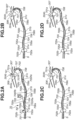
- FIGs. 2A, 2B, 2C, and 2D are cross-section diagrams illustrating the two-sided conveyance unit 70 according to the present embodiment.
- the two-sided conveyance unit 70 includes the two-sided conveyance pair (second conveyance roller pair) 702, the outside turn guide 707, an inside turn guide 708, an upper side conveyance guide 705, and a lower side conveyance guide 706 (described below).
- the two-sided conveyance roller pair 702 In a conveyance path extending from the two-sided conveyance roller pair 702 to the registration roller pair 304, the two-sided conveyance roller pair 702 is disposed next to the registration roller pair 304, and delivers the leading edge of the sheet S to the registration roller pair 304. More specifically, the two-sided conveyance roller pair 702 conveys the sheet S immediately before the registration roller pair 304 to convey the sheet S so that the sheet S reaches a position at which the sheet S contacts the registration roller pair 304. In other words, the two-sided conveyance roller pair 702 conveys the sheet S until the leading edge of the sheet S passes over the nip portion of the registration roller pair 304 formed by the registration roller 304b and the drive roller 304a.
- the two-sided conveyance roller pair 702 includes the two-sided conveyance roller (second roller) 702a and the driven roller (second opposing roller) 702b. The two-sided conveyance roller 702a and the driven roller 702b oppose and contact each other.
- a sheet of a minimum size that can be handled by the printer 100 due to the specification of the printer 100 is referred to as a minimum sheet.
- the minimum sheet is a sheet having a minimum size from among sheets S that can be conveyed and on which image forming operation can be performed by the printer 100.
- the minimum sheet in the present embodiment refers to a sheet on which two-sided printing can be performed, and more specifically, refers to a sheet having a minimum size from among the sheets S that can be conveyed by the registration roller pair 304 and the two-sided conveyance roller pair 702.
- the length of the sheet S along the conveyance direction thereof is referred to as a sheet length.
- the sheet length of the minimum sheet is specifically referred to as a shortest length.
- the position of the two-sided conveyance roller pair 702 with respect to the registration roller pair 304 is set based on the distance with which both of the two-sided conveyance roller pair 702 and the registration roller pair 304 can nip the minimum sheet at a time (e.g., at the same time). In this way, the minimum sheet can be delivered from the two-sided conveyance roller pair 702 to the registration roller pair 304.
- the position of the two-sided conveyance roller pair 702 with respect to the registration roller pair 304 is set based on the following formula.
- (Nip position N1 of registration roller pair 304) - (nip position N2 of two-sided conveyance roller pair 702) (shortest length) - (maximum bending amount) - (minimum sheet tolerance) - (leading edge projecting amount) - (trailing edge projecting amount) ⁇ (1)
- the nip position N1 is a position at which the registration roller pair 304 nips the sheet S, and is a position of a contact portion (first nip portion or first contact portion) at which the registration roller 304b and the drive roller 304a contact.
- the nip position N2 is a position at which the two-sided conveyance roller pair 702 nips the sheet S, and is a position of a contact portion (second nip portion or second contact portion) at which the two-sided conveyance roller 702a and the driven roller 702b contact.
- the maximum bending amount is a value used for taking in consideration an influence exerted when the minimum sheet bends most in the conveyance path between the registration roller pair 304 and the two-sided conveyance roller pair 702.
- the sheet S with the two-sided conveyance roller pair 702 and the registration roller pair 304 it is desirable to convey the sheet S with the two-sided conveyance roller pair 702 until the leading edge of the sheet S overruns the first nip portion by a predetermined amount. Further, it is desirable that the trailing edge of the sheet S is in a state of projecting from the second nip portion by a predetermined amount, when the leading edge of the sheet S has projected from the first nip portion by a predetermined amount.
- the projecting amount of the leading edge side of the sheet S from the first nip portion is referred to as a leading edge projecting amount
- the projecting amount of the trailing edge side of the sheet S from the second nip portion is referred to as a trailing edge projecting amount.
- the two-sided conveyance roller pair 702 may be disposed at a position far from the registration roller pair 304 and the outside turn guide 707.
- the degree of freedom of design of the printer 100 increases if the two-sided conveyance roller pair 702 can be disposed at a position far from the registration roller pair 304 and the outside turn guide 707.
- the distance between the two-sided conveyance roller pair 702 and the registration roller pair 304 along the conveyance path of the sheet S can be 45% or more of the shortest length.
- the minimum sheet for the printer 100 is an A5 size sheet
- the shortest length is 210 mm (millimeters).
- the distance between the two-sided conveyance roller pair 702 and the registration roller pair 304 along the conveyance path of the sheet S is 85% or more and 95% or less (more specifically, 90%) of the shortest length.
- a part of 85% or more and 95% or less (more specifically, 90%) of the shortest length is located between the registration roller pair 304 and the two-sided conveyance roller pair 702, when the minimum sheet is nipped by the registration roller pair 304 and the two-sided conveyance roller pair 702.
- 180 mm or more of the sheet S is located between the registration roller pair 304 and the two-sided conveyance roller pair 702, accordingly.
- the printer 100 may include a detection unit 305 for detecting the sheet length of the sheet S to be conveyed.
- the control unit 100B may restrict the image forming operation on the sheet S or the conveyance operation of the sheet S when the detection unit 305 detects that the sheet length is out of a predetermined range. For example, in a case where the sheet length of the conveyed sheet S is shorter than the shortest length, the control unit 100B may restrict the image forming operation on the sheet S or the conveyance operation of the sheet S.
- the outside turn guide 707 and the inside turn guide 708 are disposed on the upstream side of the registration roller pair 304, the shutter 306, and the junction 701a in the conveyance direction of the sheet S from the two-sided conveyance roller pair 702 toward the registration roller pair 304.
- the outside turn guide (U turn guide, bending guide, return guide, second guide, or second curved guide) 707 and the inside turn guide 708 are disposed on the two-sided conveyance path 701, and more specifically, disposed between the relay conveyance path 704 and the junction 701a.
- the outside turn guide 707 guides the sheet S that has been conveyed by the two-sided conveyance roller pair 702 toward the registration roller pair 304.
- the sheet S is bent by contacting the outside turn guide 707, and the moving direction of the leading edge of the sheet S is changed from a direction away from the registration roller pair 304 and the shutter 306, to a direction approaching the registration roller pair 304 and the shutter 306.
- the outside turn guide 707 turns around the sheet S and guides the sheet S toward the registration roller pair 304 and the shutter 306.
- the linear distance between the leading edge of the sheet S, and the registration roller pair 304 and the shutter 306 increases.
- the linear distance between the leading edge of the sheet S, and the registration roller pair 304 and the shutter 306 decreases.
- a return path (U-turn path) 703 is formed between the outside turn guide 707 and the inside turn guide 708, a return path (U-turn path) 703 is formed.
- the sheet S which is bent and turned around as described above passes through the return path 703.
- the outside turn guide 707 is disposed outside (outside in a radial direction of the curvature) the curved return path 703, and the inside turn guide 708 is disposed inside (inside in the radial direction of the curvature) the curved return path 703.
- the upper side conveyance guide (first guide or first curved guide) 705, and the lower side conveyance guide (first opposing guide or first opposing curved guide) 706 opposing the upper side conveyance guide 705 are disposed on the two-sided conveyance path 701.
- the upper side conveyance guide 705 and the lower side conveyance guide 706 are configured to guide the sheet S conveyed by the two-sided conveyance roller pair 702.
- the upper side conveyance guide 705 and the lower side conveyance guide 706 are located between the shutter 306 and the two-sided conveyance roller pair 702.
- the upper side conveyance guide 705 and the lower side conveyance guide 706 can also be said to be located between the registration roller pair 304 and the two-sided conveyance roller pair 702, or to be located between the outside turn guide 707 and the two-sided conveyance roller pair 702.
- the relay conveyance path 704 of the two-sided conveyance path 701 is formed between the upper side conveyance guide 705 and the lower side conveyance guide 706.
- the upper side conveyance guide 705 is disposed above the lower side conveyance guide 706 in the vertical direction.
- a frictional resistance received from the outside turn guide 707 acts on the sheet S. Further, on the sheet S, a reaction force received from the shutter 306 acts.
- the frictional resistance of the sheet S received from the outside turn guide 707 and the reaction force received from the shutter 306 can be referred to as a force (resistance force or conveyance resistance force) acting in the direction in which the conveyance of the sheet S is hindered.
- the radius of the outside turn guide 707 In the conveyance path of the printer 100 according to the present embodiment or the like, it is preferable to reduce the radius of the outside turn guide 707 to increase the curvature thereof in order to reduce the size of the printer 100.
- the frictional resistance which the sheet S receives from the outside turn guide 707 also increases.
- the two-sided conveyance roller pair 702 is disposed at a position far from the registration roller pair 304, the distance of the two-sided conveyance roller pair 702 from each of the registration roller pair 304, the shutter 306, and the outside turn guide 707 is long.
- the sheet S buckles to cause a plurality of small creases to occur, and, for example, it may become hard to push up the shutter 306 appropriately.
- This phenomenon is likely to occur when a thin sheet S is used. Further, as the distance from the upstream side conveyance roller pair (e.g., two-sided conveyance roller pair 702) to the downstream side conveyance roller pair (e.g., registration roller pair 304) is longer, the phenomenon is more likely to occur.
- the phenomenon is likely to occur in a case where the sheet S is located between the registration roller pair 304 and the two-sided conveyance roller pair 702 for a distance of 100 mm or more.
- the phenomenon is more likely to occur in a case where the sheet S is located between the registration roller pair 304 and the two-sided conveyance roller pair 702 for a distance of 180 mm or more.
- making the distance long between the registration roller pair 304 and the two-sided conveyance roller pair 702 brings an advantage to increase the degree of freedom of design of the printer 100, but brings the buckling of the sheet S to occur easily.
- the printer 100 restrains the buckling of the sheet S by providing a curved portion in each of the upper side conveyance guide 705 and the lower side conveyance guide 706 to bend the sheet S largely.
- Figs. 2A to 2D are diagrams viewed along the rotational axis direction of the two-sided conveyance roller 702a.
- a direction orthogonal to the conveyance direction and the thickness direction of the sheet S is referred to as a width direction of the sheet S.
- the width direction is parallel to the direction of the rotational axis of each of the two-sided conveyance roller 702a, the driven roller 702b, the drive roller 304a, and the registration roller 304b.
- the upper side conveyance guide 705 includes a first upper side curved portion (first curved portion) 705a, a second upper side curved portion 705b, and a third upper side curved portion (third curved portion) 705c each having a predetermined curvature.
- the second upper side curved portion 705b is disposed between the first upper side curved portion 705a and the third upper side curved portion 705c.
- the first upper side curved portion 705a and the third upper side curved portion 705c are disposed at positions apart from each other.
- the lower side conveyance guide 706 includes a first lower side curved portion 706a, a second lower side curved portion (second curved portion) 706b, and a third lower side curved portion 706c each having a predetermined curvature.
- the second lower side curved portion 706b is disposed between the first lower side curved portion 706a and the third lower side curved portion 706c.
- the first lower side curved portion 706a and the third lower side curved portion 706c are disposed at positions apart from each other.
- Each of the first upper side curved portion 705a and the third upper side curved portion 705c is a curved portion (curved surface) curving such that the surface thereof opposing the sheet S or the relay conveyance path 704 becomes concave.
- Each of the first upper side curved portion 705a and the third upper side curved portion 705c can be said to be a curved surface curving in a direction away from the sheet S or the relay conveyance path 704 in the thickness direction of the sheet S (i.e., direction orthogonal to the conveyance direction and the width direction of the sheet S).
- the second upper side curved portion 705b is a curved portion (curved surface) curving such that the surface thereof opposing the sheet S or the relay conveyance path 704 becomes convex.
- the second upper side curved portion 705b can be said to be a curved surface curving in a direction approaching the sheet S or the relay conveyance path 704 in the thickness direction of the sheet S.
- each of the first upper side curved portion 705a, the second upper side curved portion 705b, and the third upper side curved portion 705c has an arc shape.
- Each of the first lower side curved portion 706a and the third lower side curved portion 706c is a curved portion (curved surface) curving such that the surface thereof opposing the sheet S or the relay conveyance path 704 becomes convex.
- Each of the first lower side curved portion 706a and the third lower side curved portion 706c can be said to be a curved surface curving in a direction approaching the sheet S or the relay conveyance path 704 in the thickness direction of the sheet S (i.e., direction orthogonal to the conveyance direction and the width direction of the sheet S).
- the second lower side curved portion 706b is a curved portion (curved surface) curving such that the surface opposing the sheet S or the relay conveyance path 704 becomes concave.
- the second lower side curved portion 706b can be said to be a curved surface curving in a direction away from the sheet S or the relay conveyance path 704 in the thickness direction of the sheet S.
- each of the first lower side curved portion 706a, the second lower side curved portion 706b, and the third lower side curved portion 706c has an arc shape.
- the first upper side curved portion 705a and the first lower side curved portion 706a oppose each other to form a curved conveyance path through which the sheet S passes.
- the second upper side curved portion 705b and the second lower side curved portion 706b oppose each other to form a curved conveyance path through which the sheet S passes.
- the third upper side curved portion 705c and the third lower side curved portion 706c oppose each other to form a curved conveyance path through which the sheet S passes.
- the two-sided conveyance roller pair 702 conveys the sheet S so that the sheet S contacts the first upper side curved portion 705a, and the second lower side curved portion 706b in this order, to thereafter contact the third upper side curved portion 705c.
- a straight line connecting the rotational center of the two-sided conveyance roller 702a and the rotational center of the driven roller 702b is defined as a first straight line L1.
- a straight line orthogonal to the first straight line L1 and passing through the position (second nip portion N2) at which the two-sided conveyance roller 702a and the driven roller 702b contact is defined as a second straight line L2.
- the second straight line L2 is a tangent line (common tangent line) of the two-sided conveyance roller 702a and the driven roller 702b.
- the two-sided conveyance roller pair 702 pushes out the sheet S along the second straight line L2.
- the direction in which the two-sided conveyance roller pair 702 pushes out and conveys the sheet S is referred to as a push-out direction N2f.
- the push-out direction N2f is a moving direction of the sheet S at a portion between the two-sided conveyance roller 702a and the driven roller 702b.
- the first upper side curved portion 705a is disposed on the downstream side of the two-sided conveyance roller pair 702 in the conveyance direction of the sheet S by the two-sided conveyance roller pair 702 so that the second straight line L2 and the first upper side curved portion 705a intersect.
- an upper guide entrance portion (parallel portion) 705d is disposed between the two-sided conveyance roller pair 702 and the first upper side curved portion 705a to be parallel to the second straight line L2.
- the sheet S passing through the two-sided conveyance path 701 is nipped by the two-sided conveyance roller pair 702 to proceed to the push-out direction N2f, and the sheet S proceeds along the upper guide entrance portion 705d, to thereafter contact the first upper side curved portion 705a.
- the sheet S contacting the first upper side curved portion 705a is guided by the first upper side curved portion 705a from the upper side conveyance guide 705 toward the lower side conveyance guide 706 so as to form an arc S1a, and the sheet S contacts the second lower side curved portion 706b.
- the sheet S contacting the second lower side curved portion 706b is guided by the second lower side curved portion 706b from the lower side conveyance guide 706 toward the upper side conveyance guide 705 so as to form an arc S1b, and the sheet S contacts the third upper side curved portion 705c.
- the sheet S contacting the third upper side curved portion 705c is guided by the third upper side curved portion 705c from the upper side conveyance guide 705 toward the lower side conveyance guide 706 so as to form an arc S1c, and the sheet S contacts the outside turn guide 707.
- the sheet S is then conveyed along the outside turn guide 707 as illustrated in Fig. 2B .
- the sheet S is in a state of being likely to buckle due to the frictional resistance received from the outside turn guide 707.
- the arcs S1a, S1b, and S1c are formed on the sheet S along the first upper side curved portion 705a, the second lower side curved portion 706b, and the third upper side curved portion 705c, the sheet S is kept bent with a desired curvature and the occurrence of the buckling can be prevented.
- the leading edge of the sheet S reaches the shutter 306 as illustrated in Fig. 2C .
- the leading edge of the sheet S is regulated by the shutter 306, a loop is formed in the sheet S, and the skew of the sheet S is corrected.
- the sheet S is in a state of being likely to buckle due to the reaction force received from the shutter 306.
- the arcs S1a, S1b, and S1c are formed on the sheet S along the first upper side curved portion 705a, the second lower side curved portion 706b, and the third upper side curved portion 705c, the sheet S is kept bent with a desired curvature and the occurrence of the buckling can be prevented.
- the entire sheet S in the width direction presses the shutter 306.
- the conveyance force (pressing force) of the sheet S becomes larger than the holding force of holding the shutter 306 at the restricting position
- the sheet S pushes up the shutter 306 and proceeds as illustrated in Fig. 2D .
- the sheet S having pushed up the shutter 306 to the retracting position reaches the first nip portion of the registration roller pair 304, and the sheet S is conveyed by the registration roller pair 304.
- the two-sided conveyance roller pair 702 is configured to convey the sheet such that the sheet (the sheet being conveyed by the two-sided conveyance roller pair 702) moves the shutter 306 from the restricting position to the retracting position and reaches a position at which the sheet contacts the first conveyance roller pair 304.
- the shutter 306 may also be positioned at the restricting position with its own weight, or with an urging member such as a spring.
- the buckling of the sheet S can be restrained when the sheet S receives the frictional resistance from the outside turn guide 707. Further, when the sheet S receives the reaction force from the shutter 306, the buckling of the sheet S can be restrained.
- the conveyance force use for the sheet S is applied, and the sheet S is conveyed to the registration roller pair 304. More specifically, the sheet S is curved by the first upper side curved portion 705a, the second lower side curved portion 706b, and the third upper side curved portion 705c, conveyed by the two-sided conveyance roller pair 702 in the curved state, and delivered to the registration roller pair 304. As a result, it is possible to restrain the buckling of the sheet S occurring between the two-sided conveyance roller pair 702 and the registration roller pair 304, or between the two-sided conveyance roller pair 702 and the shutter 306.
- a radius 705Ra of the first upper side curved portion 705a, a radius 706Rb of the second lower side curved portion 706b, and a radius 705Rc of the third upper side curved portion 705c are larger than a radius 707R of the outside turn guide 707.
- the frictional resistances relieved from the first upper side curved portion 705a, the second lower side curved portion 706b, and the third upper side curved portion 705c are therefore smaller than the frictional resistance received from the outside turn guide 707.
- the buckling of the sheet S caused by the first upper side curved portion 705a, the second lower side curved portion 706b, and the third upper side curved portion 705c can be restrained.
- the gap size between the first lower side curved portion 706a and the first upper side curved portion 705a is desirably 10 mm or less, and more desirably is 5 mm or less.
- the gap size between the second upper side curved portion 705b and the second lower side curved portion 706b, and the gap size between the third lower side curved portion 706c and the third upper side curved portion 705c are the same as the gap size described above.
- first lower side curved portion 706a and the first upper side curved portion 705a are concentrically disposed
- the second upper side curved portion 705b and the second lower side curved portion 706b are concentrically disposed
- third lower side curved portion 706c and the third upper side curved portion 705c are concentrically disposed.
- first lower side curved portion 706a, the second upper side curved portion 705b, and the third lower side curved portion 706c are not limited to the configurations described above.
- the center of the radius of the first lower side curved portion 706a and the center of the radius 705Ra of the first upper side curved portion 705a may be different.
- the radius of the first lower side curved portion 706a may be the same as or different from the radius 705Ra of the first upper side curved portion 705a.
- the relationship between the second upper side curved portion 705b and the second lower side curved portion 706b, and the relationship between the third upper side curved portion 705c and the third lower side curved portion 706c are also similar to the relationship between the first lower side curved portion 706a and the first upper side curved portion 705a. Further, at least a part of each of the first lower side curved portion 706a, the second upper side curved portion 705b, and the third lower side curved portion 706c may be formed in a straight manner.
- the radius 705Ra of the first upper side curved portion 705a, the radius 706Rb of the second lower side curved portion 706b, and the radius 705Rc of the third upper side curved portion 705c are desirably set to be 90 mm or more and 160 mm or less to restrain the buckling of the sheet S. This corresponds to a length of approximately 40% or more and 80% or less of the shortest length (210 mm).
- the radius 705Ra of the first upper side curved portion 705a can be made larger than the radius 706Rb of the second lower side curved portion 706b.
- the radius 705Rc of the third upper side curved portion 705c can be made larger than the radius 705Ra of the first upper side curved portion 705a.
- the radius 705Ra of the first upper side curved portion 705a can be made to be 125 mm or more and 145 mm or less.
- the radius 706Rb of the second lower side curved portion 706b can be made to be 90 mm or more and 110 mm or less.
- the radius 705Rc of the third upper side curved portion 705c can be made to be 140 mm or more and 160 mm or less.
- FIGs. 3A to 3D are cross-section diagrams illustrating a two-sided conveying unit 170 according to the comparison example.
- the two-sided conveying unit 170 according to the comparison example includes an upper side conveyance guide 1705 and the lower side conveyance guide 1706 different in shape from the upper side conveyance guide 705 and the lower side conveyance guide 706, respectively.
- the two-sided conveying unit 170 has the same configuration as that of the two-sided conveyance unit 70.
- Each of the upper side conveyance guide 1705 and the lower side conveyance guide 1706 has no curved portion, and is formed linearly.
- a relay conveyance path 1704 is formed between the upper side conveyance guide 1705 and the lower side conveyance guide 1706.
- the sheet S conveyed through the two-sided conveyance path 701 is conveyed to the relay conveyance path 1704 by the two-sided conveyance roller pair 702.
- the sheet S proceeds almost straight along the lower side conveyance guide 1706 to reach the outside turn guide 707.
- the sheet S is conveyed along the outside turn guide 707. At this time, the sheet S receives a frictional resistance from the outside turn guide 707. When the conveyance force of the sheet S becomes smaller than the frictional resistance, a small buckling begins to occur near the center of the sheet S in the relay conveyance path 1704.
- the leading edge of the sheet S reaches the shutter 306 as illustrated in Fig. 3C .
- a loop is formed when the leading edge of the sheet S is brought into contact with the shutter 306, and the skew of the sheet S is corrected.
- the buckling further occurs in the relay conveyance path 1704 at a portion of the sheet S near the center to the trailing edge thereof when the sheet S receives the reaction force from the shutter 306.
- the sheet S cannot push up the shutter 306 and cannot reach the first nip portion of the registration roller pair 304 as illustrated in Fig. 3D .
- the buckling of the sheet S further occurs in the relay conveyance path 1704. As a result, the normal conveyance of the sheet S is hindered.
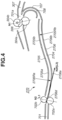
- Fig. 4 is a cross-section diagram illustrating a two-sided conveying unit 270 according to the modification example.
- the two-sided conveying unit 270 according to the modification example includes an upper side conveyance guide 2705 and a lower side conveyance guide 2706 respectively different in shape from the upper side conveyance guide 705 and the lower side conveyance guide 706.
- the two-sided conveying unit 270 has the same configuration as that of the two-sided conveyance unit 70.
- the sheet S conveyed by the two-sided conveyance roller pair 702 successively contacts the first upper side curved portion 705a, the second lower side curved portion 706b, and the third upper side curved portion 705c in this order.
- the curved portions corresponding to the first upper side curved portion 705a and the third upper side curved portion 705c may be provided on one of the upper side conveyance guide 705 and the lower side conveyance guide 706, and the curved portion corresponding to the second lower side curved portion 706b can be provided on the other one of the upper side conveyance guide 705 and the lower side conveyance guide 706. Further, the curved portion corresponding to the third upper side curved portion 705c can be omitted.
- the lower side conveyance guide 2706 includes a first lower side curved portion (first curved portion) 2706a and a second lower side curved portion 2706b each having a predetermined curvature, as illustrated in Fig. 4 .
- the upper side conveyance guide 2705 includes a first upper side curved portion 2705a and a second upper side curved portion (second curved portion) 2705b each having a predetermined curvature.
- the upper side conveyance guide 2705 is disposed above the lower side conveyance guide 2706 in the vertical direction.
- a relay conveyance path 2704 is formed between the upper side conveyance guide 2705 and the lower side conveyance guide 2706.
- the first lower side curved portion 2706a is a curved portion (curved surface) curving such that the surface thereof opposing the sheet S or the relay conveyance path 2704 becomes concave.
- the first lower side curved portion 2706a can be said to be a curved surface curving in a direction away from the sheet S or the relay conveyance path 2704 in the thickness direction of the sheet S.
- the second lower side curved portion 2706b is a curved portion (curved surface) curving such that the surface thereof opposing the sheet S or the relay conveyance path 2704 becomes convex.
- the second lower side curved portion 2706b can be said to be a curved surface curving in a direction approaching the sheet S or the relay conveyance path 2704 in the thickness direction of the sheet S.
- each of the first lower side curved portion 2706a and the second lower side curved portion 2706b has an arc shape.
- the first upper side curved portion 2705a is a curved portion (curved surface) curving such that the surface thereof opposing the sheet S or the relay conveyance path 2704 becomes convex.
- the first upper side curved portion 2705a can be said to be a curved surface curving in a direction approaching the sheet S or the relay conveyance path 2704 in the thickness direction of the sheet S (direction orthogonal to the conveyance direction and the width direction of sheet S).
- the second upper side curved portion 2705b is a curved portion (curved surface) curving such that the surface thereof opposing the sheet S or the relay conveyance path 2704 becomes concave.
- the second upper side curved portion 2705b can be said to be a curved surface curving in a direction away from the sheet S or the relay conveyance path 2704 in the thickness direction of the sheet S.
- each of the first upper side curved portion 2705a and the second upper side curved portion 2705b has an arc shape.
- the first lower side curved portion 2706a and the first upper side curved portion 2705a oppose each other and form a curved conveyance path through which the sheet S passes.
- the second lower side curved portion 2706b and the second upper side curved portion 2705b oppose each other, and form a curved conveyance path through which the sheet S passes.
- the two-sided conveyance roller pair 702 conveys the sheet S such that the sheet S contacts the first lower side curved portion 2706a, and thereafter, the sheet S contacts the second upper side curved portion 2705b.
- the buckling of the sheet S can be restrained by the sheet S curving along the first lower side curved portion (first curved portion) 2706a and the second upper side curved portion (second curved portion) 2705b.
- the first lower side curved portion 2706a is disposed on the downstream side of the two-sided conveyance roller pair 702 in the conveyance direction of the sheet S by the two-sided conveyance roller pair 702 so that the second straight line L2 and the first lower side curved portion 2706a intersect. Further, a lower guide entrance portion (parallel portion) 2706d is disposed between the two-sided conveyance roller pair 702 and the first lower side curved portion 2706a to be parallel to the second straight line L2.
- a radius 2706Ra of the first lower side curved portion 2706a is the same as the above-described radius 705Ra.
- a radius 2705Rb of the second upper side curved portion 2705b is the same as the above-described radius 706Rb.
- the gap size between the first lower side curved portion 2706a and the first upper side curved portion 2705a is the same as the gap size between the above-described first upper side curved portion 705a and the first lower side curved portion 706a.
- the gap size between the second upper side curved portion 2705b and the second lower side curved portion 2706b is the same as the gap between the second lower side curved portion 706b and the second upper side curved portion 705b.
- the first lower side curved portion 2706a and the first upper side curved portion 2705a are concentrically disposed, and the second upper side curved portion 2705b and the second lower side curved portion 2706b are concentrically disposed.
- each of the first upper side curved portion 2705a and the second lower side curved portion 2706b is not limited to the above-described configuration.
- the center of the radius of the first upper side curved portion 2705a and the center of the radius of the first lower side curved portion 2706a may be different.
- the radius of the first upper side curved portion 2705a may be the same as or different from the radius of the first lower side curved portion 2706a.
- the relationship between the second lower side curved portion 2706b and the second upper side curved portion 2705b is the same as that described above. At least a part of each of the first upper side curved portion 2705a and the second lower side curved portion 2706b may be formed straight.
- the occurrence of the buckling of the sheet S can be restrained to convey the sheet S stably, by providing the first curved portion on one of the upper side conveyance guide 705 (2705) and the lower side conveyance guide 706 (2706), and providing the second curved portion on the other one of the upper side conveyance guide 705 (2705) and the lower side conveyance guide 706 (2706).
- the registration roller pair 304 it is possible to increase the distance from the registration roller pair 304 to the two-sided conveyance roller pair 702 that conveys the sheet S immediately before the registration roller pair 304.
- the registration roller pair 304 in the state where the minimum sheet is nipped by both the registration roller pair 304 and the two-sided conveyance roller pair 702, the registration roller pair 304 is located near the downstream side edge of the minimum sheet and the two-sided conveyance roller pair 702 is located near the upstream side edge of the minimum sheet.
- the present invention is applicable, not only to the laser printer, but also to a copying machine, a so-called light emitting diode (LED) printer that uses a light emitting diode, and an ink-jet printer.
- LED light emitting diode
- the upper side conveyance guide 705 (2705) and the lower side conveyance guide 706 (2706) are disposed on the two-sided conveyance path 701, but they may be disposed on a conveyance path other than the two-sided conveyance path 701. However, there may be a case where the curling occurs on the sheet S when the sheet S passes through the fixing unit 50, and the buckling of the sheet S is likely to occur. In this case also, like the printer 100 according to the present embodiment, it is possible to restrain the occurrence of the buckling of the sheet S by disposing the upper side conveyance guide 705 (2705) and the lower side conveyance guide 706 (2706) on the two-sided conveyance path 701 on the downstream side of the fixing unit 50.
- the present invention it is possible to restrain the buckling of the sheet S in the conveyance apparatus configured to convey the sheet.
- the present application discloses at least the following.
- a conveyance apparatus configured to convey a sheet, the conveyance apparatus comprising:
- the conveyance apparatus according to configuration 1, further comprising a second guide configured to guide the sheet conveyed by the second conveyance roller pair toward the first conveyance roller pair, wherein the second guide is a U-turn guide configured to turn around the sheet conveyed by the second conveyance roller pair.
- the conveyance apparatus further comprising a second guide configured to guide the sheet conveyed by the second conveyance roller pair toward the first conveyance roller pair, wherein the second guide configured to curve the sheet such that a moving direction of a leading edge of the sheet changes from a direction away from the first conveyance roller pair to a direction approaching the first conveyance roller pair.
- the conveyance apparatus according to any one of configurations 1 to 9, wherein, viewed in a rotational axis direction of the second roller, when a straight line connecting a center of the second roller and a center of the second opposing roller is defined as a first straight line, and a straight line orthogonal to the first straight line and passing through a contact position at which the second roller and the second opposing roller contact is defined as a second straight line, the first curved portion is disposed so that the second straight line and the first curved portion intersect.
- the conveyance apparatus according to any one of configurations 1 to 12, wherein in a case where a sheet having a minimum size of the sheet conveyable by the first conveyance roller pair and the second conveyance roller pair is defined as a minimum sheet, and when the minimum sheet is nipped by the first conveyance roller pair and the second conveyance roller pair, the first conveyance roller pair and the second conveyance roller pair are disposed such that 45% or more of a length of the minimum sheet in a conveyance direction of the minimum sheet by the first conveyance roller pair and the second conveyance roller pair is located between the first conveyance roller pair and the second conveyance roller pair.
- a radius of the first curved portion is greater than or equal to 90 mm (millimeters) and smaller than or equal to 160 mm.
- a radius of the second curved portion is greater than or equal to 90 mm and smaller than or equal to 160 mm.
- the conveyance apparatus according to any one of configurations 1 to 15, wherein, when the sheet is nipped by the first conveyance roller pair and the second conveyance roller pair, the first conveyance roller pair and the second conveyance roller pair are disposed such that greater than or equal to 100 mm of the sheet is located between the first conveyance roller pair and the second conveyance roller pair.
- the conveyance apparatus according to any one of configurations 1 to 16, wherein, when the sheet is nipped by the first conveyance roller pair and the second conveyance roller pair, the first conveyance roller pair and the second conveyance roller pair are disposed such that greater than or equal to 180 mm of the sheet is located between the first conveyance roller pair and the second conveyance roller pair.
- An image forming apparatus configured to form an image on a sheet, the image forming apparatus comprising:
Landscapes
- Engineering & Computer Science (AREA)
- Mechanical Engineering (AREA)
- Physics & Mathematics (AREA)
- General Physics & Mathematics (AREA)
- Registering Or Overturning Sheets (AREA)
- Feeding Of Articles By Means Other Than Belts Or Rollers (AREA)
- Paper Feeding For Electrophotography (AREA)
- Delivering By Means Of Belts And Rollers (AREA)
Applications Claiming Priority (1)
| Application Number | Priority Date | Filing Date | Title |
|---|---|---|---|
| JP2022014684A JP2023112773A (ja) | 2022-02-02 | 2022-02-02 | 画像形成装置、搬送装置 |
Publications (1)
| Publication Number | Publication Date |
|---|---|
| EP4223679A1 true EP4223679A1 (en) | 2023-08-09 |
Family
ID=85017852
Family Applications (1)
| Application Number | Title | Priority Date | Filing Date |
|---|---|---|---|
| EP23152488.5A Pending EP4223679A1 (en) | 2022-02-02 | 2023-01-19 | Conveyance apparatus and image forming apparatus |
Country Status (5)
| Country | Link |
|---|---|
| US (2) | US12358742B2 (https=) |
| EP (1) | EP4223679A1 (https=) |
| JP (1) | JP2023112773A (https=) |
| KR (1) | KR102932843B1 (https=) |
| CN (1) | CN116540509A (https=) |
Citations (5)
| Publication number | Priority date | Publication date | Assignee | Title |
|---|---|---|---|---|
| JPH061488A (ja) * | 1992-06-19 | 1994-01-11 | Fuji Xerox Co Ltd | 画像形成装置の用紙案内装置 |
| US6934505B2 (en) * | 2002-08-12 | 2005-08-23 | Samsung Electronics Co., Ltd. | Image forming apparatus |
| US9238560B1 (en) * | 2014-09-19 | 2016-01-19 | Fuji Xerox Co., Ltd. | Conveyance device, image reading device and image forming apparatus |
| US20170357190A1 (en) * | 2016-06-09 | 2017-12-14 | Ricoh Company, Ltd. | Sheet transfer guide, image forming apparatus incorporating the sheet transfer guide, and image reading device incorporating the sheet transfer guide |
| JP2020073406A (ja) | 2015-06-19 | 2020-05-14 | キヤノン株式会社 | 画像形成装置 |
Family Cites Families (11)
| Publication number | Priority date | Publication date | Assignee | Title |
|---|---|---|---|---|
| JP2964703B2 (ja) | 1991-05-14 | 1999-10-18 | 富士ゼロックス株式会社 | 画像形成装置の用紙送り装置 |
| JP3768578B2 (ja) * | 1996-01-08 | 2006-04-19 | キヤノン株式会社 | シート斜行補正装置及びシート搬送装置及び画像形成装置 |
| JP5340007B2 (ja) | 2009-04-17 | 2013-11-13 | キヤノン株式会社 | 画像形成装置 |
| KR20120035520A (ko) | 2010-10-05 | 2012-04-16 | 삼성전자주식회사 | 화상형성장치 |
| JP5591057B2 (ja) * | 2010-10-13 | 2014-09-17 | キヤノン株式会社 | シート搬送装置及び画像形成装置 |
| KR101453140B1 (ko) * | 2010-11-30 | 2014-10-27 | 캐논 가부시끼가이샤 | 시트 반송 장치 및 화상 형성 장치 |
| GB201221216D0 (en) | 2012-11-26 | 2013-01-09 | Hanna Moore & Curley | Printer with criss-cross duplexer |
| US9676572B2 (en) * | 2014-04-03 | 2017-06-13 | Canon Kabushiki Kaisha | Sheet conveying apparatus and image forming apparatus |
| JP6548401B2 (ja) * | 2015-02-16 | 2019-07-24 | キヤノン株式会社 | シート搬送装置及び画像形成装置 |
| JP6545028B2 (ja) * | 2015-07-27 | 2019-07-17 | キヤノン株式会社 | シート搬送装置及び画像形成装置 |
| JP7313837B2 (ja) * | 2019-02-08 | 2023-07-25 | キヤノン株式会社 | シート搬送装置及び画像形成装置 |
-
2022
- 2022-02-02 JP JP2022014684A patent/JP2023112773A/ja active Pending
-
2023
- 2023-01-19 EP EP23152488.5A patent/EP4223679A1/en active Pending
- 2023-01-25 US US18/159,615 patent/US12358742B2/en active Active
- 2023-01-25 KR KR1020230009208A patent/KR102932843B1/ko active Active
- 2023-01-30 CN CN202310104057.5A patent/CN116540509A/zh active Pending
-
2025
- 2025-06-24 US US19/248,003 patent/US20250320076A1/en active Pending
Patent Citations (5)
| Publication number | Priority date | Publication date | Assignee | Title |
|---|---|---|---|---|
| JPH061488A (ja) * | 1992-06-19 | 1994-01-11 | Fuji Xerox Co Ltd | 画像形成装置の用紙案内装置 |
| US6934505B2 (en) * | 2002-08-12 | 2005-08-23 | Samsung Electronics Co., Ltd. | Image forming apparatus |
| US9238560B1 (en) * | 2014-09-19 | 2016-01-19 | Fuji Xerox Co., Ltd. | Conveyance device, image reading device and image forming apparatus |
| JP2020073406A (ja) | 2015-06-19 | 2020-05-14 | キヤノン株式会社 | 画像形成装置 |
| US20170357190A1 (en) * | 2016-06-09 | 2017-12-14 | Ricoh Company, Ltd. | Sheet transfer guide, image forming apparatus incorporating the sheet transfer guide, and image reading device incorporating the sheet transfer guide |
Also Published As
| Publication number | Publication date |
|---|---|
| JP2023112773A (ja) | 2023-08-15 |
| US20230242362A1 (en) | 2023-08-03 |
| US12358742B2 (en) | 2025-07-15 |
| KR20230117702A (ko) | 2023-08-09 |
| KR102932843B1 (ko) | 2026-03-03 |
| CN116540509A (zh) | 2023-08-04 |
| US20250320076A1 (en) | 2025-10-16 |
Similar Documents
| Publication | Publication Date | Title |
|---|---|---|
| US8146916B2 (en) | Sheet conveying apparatus and image forming apparatus | |
| CN108732889B (zh) | 片材传送装置和成像设备 | |
| US11713204B2 (en) | Sheet conveying apparatus, image reading apparatus, and image forming apparatus | |
| JP6143537B2 (ja) | 画像形成装置 | |
| US11192740B2 (en) | Sheet conveying apparatus and image forming apparatus | |
| US10773918B2 (en) | Sheet discharging apparatus and image forming apparatus | |
| EP1225147B1 (en) | Sheet folding apparatus and image forming apparatus having the same | |
| US20210101768A1 (en) | Image forming apparatus | |
| JP2009196803A (ja) | 用紙搬送装置 | |
| JP7596174B2 (ja) | 搬送装置および画像形成装置 | |
| JP3938073B2 (ja) | 画像形成装置 | |
| EP4223679A1 (en) | Conveyance apparatus and image forming apparatus | |
| US11319178B2 (en) | Sheet conveyance apparatus and image forming apparatus | |
| US10543999B2 (en) | Sheet conveyance apparatus and image forming apparatus | |
| EP0485786B1 (en) | Sheet feeding apparatus | |
| US12466675B2 (en) | Image forming apparatus | |
| JP6873709B2 (ja) | シート処理装置及び画像形成装置 | |
| US12411448B2 (en) | Image forming apparatus | |
| JP6929132B2 (ja) | シート搬送装置及び画像形成装置 | |
| US12025946B2 (en) | Image forming apparatus having duplex driven roller unit | |
| US20260050233A1 (en) | Transport device and image forming apparatus | |
| US20240051773A1 (en) | Sheet conveyance apparatus and image forming apparatus | |
| JP2009149391A (ja) | シート搬送装置及び画像形成装置 | |
| JP2009137681A (ja) | 画像形成装置 | |
| US20210243318A1 (en) | Image reading apparatus and image forming apparatus |
Legal Events
| Date | Code | Title | Description |
|---|---|---|---|
| PUAI | Public reference made under article 153(3) epc to a published international application that has entered the european phase |
Free format text: ORIGINAL CODE: 0009012 |
|
| STAA | Information on the status of an ep patent application or granted ep patent |
Free format text: STATUS: THE APPLICATION HAS BEEN PUBLISHED |
|
| AK | Designated contracting states |
Kind code of ref document: A1 Designated state(s): AL AT BE BG CH CY CZ DE DK EE ES FI FR GB GR HR HU IE IS IT LI LT LU LV MC ME MK MT NL NO PL PT RO RS SE SI SK SM TR |
|
| STAA | Information on the status of an ep patent application or granted ep patent |
Free format text: STATUS: REQUEST FOR EXAMINATION WAS MADE |
|
| 17P | Request for examination filed |
Effective date: 20240209 |
|
| RBV | Designated contracting states (corrected) |
Designated state(s): AL AT BE BG CH CY CZ DE DK EE ES FI FR GB GR HR HU IE IS IT LI LT LU LV MC ME MK MT NL NO PL PT RO RS SE SI SK SM TR |