EP4196532B1 - Silikonformulierung mit einen oximvernetzer, gehärtete silikonformulierung und verwendungen davon - Google Patents
Silikonformulierung mit einen oximvernetzer, gehärtete silikonformulierung und verwendungen davon Download PDFInfo
- Publication number
- EP4196532B1 EP4196532B1 EP21759289.8A EP21759289A EP4196532B1 EP 4196532 B1 EP4196532 B1 EP 4196532B1 EP 21759289 A EP21759289 A EP 21759289A EP 4196532 B1 EP4196532 B1 EP 4196532B1
- Authority
- EP
- European Patent Office
- Prior art keywords
- silane
- crosslinker
- methyl
- silicone formulation
- group
- Prior art date
- Legal status (The legal status is an assumption and is not a legal conclusion. Google has not performed a legal analysis and makes no representation as to the accuracy of the status listed.)
- Active
Links
Classifications
-
- C—CHEMISTRY; METALLURGY
- C08—ORGANIC MACROMOLECULAR COMPOUNDS; THEIR PREPARATION OR CHEMICAL WORKING-UP; COMPOSITIONS BASED THEREON
- C08L—COMPOSITIONS OF MACROMOLECULAR COMPOUNDS
- C08L83/00—Compositions of macromolecular compounds obtained by reactions forming in the main chain of the macromolecule a linkage containing silicon with or without sulfur, nitrogen, oxygen or carbon only; Compositions of derivatives of such polymers
- C08L83/04—Polysiloxanes
-
- C—CHEMISTRY; METALLURGY
- C08—ORGANIC MACROMOLECULAR COMPOUNDS; THEIR PREPARATION OR CHEMICAL WORKING-UP; COMPOSITIONS BASED THEREON
- C08G—MACROMOLECULAR COMPOUNDS OBTAINED OTHERWISE THAN BY REACTIONS ONLY INVOLVING UNSATURATED CARBON-TO-CARBON BONDS
- C08G77/00—Macromolecular compounds obtained by reactions forming a linkage containing silicon with or without sulfur, nitrogen, oxygen or carbon in the main chain of the macromolecule
- C08G77/04—Polysiloxanes
- C08G77/06—Preparatory processes
- C08G77/08—Preparatory processes characterised by the catalysts used
-
- C—CHEMISTRY; METALLURGY
- C08—ORGANIC MACROMOLECULAR COMPOUNDS; THEIR PREPARATION OR CHEMICAL WORKING-UP; COMPOSITIONS BASED THEREON
- C08G—MACROMOLECULAR COMPOUNDS OBTAINED OTHERWISE THAN BY REACTIONS ONLY INVOLVING UNSATURATED CARBON-TO-CARBON BONDS
- C08G77/00—Macromolecular compounds obtained by reactions forming a linkage containing silicon with or without sulfur, nitrogen, oxygen or carbon in the main chain of the macromolecule
- C08G77/04—Polysiloxanes
- C08G77/14—Polysiloxanes containing silicon bound to oxygen-containing groups
- C08G77/16—Polysiloxanes containing silicon bound to oxygen-containing groups to hydroxyl groups
-
- C—CHEMISTRY; METALLURGY
- C08—ORGANIC MACROMOLECULAR COMPOUNDS; THEIR PREPARATION OR CHEMICAL WORKING-UP; COMPOSITIONS BASED THEREON
- C08G—MACROMOLECULAR COMPOUNDS OBTAINED OTHERWISE THAN BY REACTIONS ONLY INVOLVING UNSATURATED CARBON-TO-CARBON BONDS
- C08G77/00—Macromolecular compounds obtained by reactions forming a linkage containing silicon with or without sulfur, nitrogen, oxygen or carbon in the main chain of the macromolecule
- C08G77/04—Polysiloxanes
- C08G77/38—Polysiloxanes modified by chemical after-treatment
- C08G77/382—Polysiloxanes modified by chemical after-treatment containing atoms other than carbon, hydrogen, oxygen or silicon
- C08G77/388—Polysiloxanes modified by chemical after-treatment containing atoms other than carbon, hydrogen, oxygen or silicon containing nitrogen
-
- C—CHEMISTRY; METALLURGY
- C08—ORGANIC MACROMOLECULAR COMPOUNDS; THEIR PREPARATION OR CHEMICAL WORKING-UP; COMPOSITIONS BASED THEREON
- C08K—Use of inorganic or non-macromolecular organic substances as compounding ingredients
- C08K3/00—Use of inorganic substances as compounding ingredients
- C08K3/34—Silicon-containing compounds
- C08K3/36—Silica
-
- C—CHEMISTRY; METALLURGY
- C08—ORGANIC MACROMOLECULAR COMPOUNDS; THEIR PREPARATION OR CHEMICAL WORKING-UP; COMPOSITIONS BASED THEREON
- C08K—Use of inorganic or non-macromolecular organic substances as compounding ingredients
- C08K5/00—Use of organic ingredients
- C08K5/0008—Organic ingredients according to more than one of the "one dot" groups of C08K5/01 - C08K5/59
- C08K5/0025—Crosslinking or vulcanising agents; including accelerators
-
- C—CHEMISTRY; METALLURGY
- C08—ORGANIC MACROMOLECULAR COMPOUNDS; THEIR PREPARATION OR CHEMICAL WORKING-UP; COMPOSITIONS BASED THEREON
- C08K—Use of inorganic or non-macromolecular organic substances as compounding ingredients
- C08K5/00—Use of organic ingredients
- C08K5/54—Silicon-containing compounds
- C08K5/541—Silicon-containing compounds containing oxygen
- C08K5/5415—Silicon-containing compounds containing oxygen containing at least one Si—O bond
- C08K5/5419—Silicon-containing compounds containing oxygen containing at least one Si—O bond containing at least one Si—C bond
-
- C—CHEMISTRY; METALLURGY
- C08—ORGANIC MACROMOLECULAR COMPOUNDS; THEIR PREPARATION OR CHEMICAL WORKING-UP; COMPOSITIONS BASED THEREON
- C08K—Use of inorganic or non-macromolecular organic substances as compounding ingredients
- C08K5/00—Use of organic ingredients
- C08K5/54—Silicon-containing compounds
- C08K5/544—Silicon-containing compounds containing nitrogen
- C08K5/5465—Silicon-containing compounds containing nitrogen containing at least one C=N bond
-
- C—CHEMISTRY; METALLURGY
- C08—ORGANIC MACROMOLECULAR COMPOUNDS; THEIR PREPARATION OR CHEMICAL WORKING-UP; COMPOSITIONS BASED THEREON
- C08K—Use of inorganic or non-macromolecular organic substances as compounding ingredients
- C08K5/00—Use of organic ingredients
- C08K5/56—Organo-metallic compounds, i.e. organic compounds containing a metal-to-carbon bond
- C08K5/57—Organo-tin compounds
-
- C—CHEMISTRY; METALLURGY
- C09—DYES; PAINTS; POLISHES; NATURAL RESINS; ADHESIVES; COMPOSITIONS NOT OTHERWISE PROVIDED FOR; APPLICATIONS OF MATERIALS NOT OTHERWISE PROVIDED FOR
- C09J—ADHESIVES; NON-MECHANICAL ASPECTS OF ADHESIVE PROCESSES IN GENERAL; ADHESIVE PROCESSES NOT PROVIDED FOR ELSEWHERE; USE OF MATERIALS AS ADHESIVES
- C09J183/00—Adhesives based on macromolecular compounds obtained by reactions forming in the main chain of the macromolecule a linkage containing silicon, with or without sulfur, nitrogen, oxygen, or carbon only; Adhesives based on derivatives of such polymers
- C09J183/04—Polysiloxanes
-
- C—CHEMISTRY; METALLURGY
- C08—ORGANIC MACROMOLECULAR COMPOUNDS; THEIR PREPARATION OR CHEMICAL WORKING-UP; COMPOSITIONS BASED THEREON
- C08G—MACROMOLECULAR COMPOUNDS OBTAINED OTHERWISE THAN BY REACTIONS ONLY INVOLVING UNSATURATED CARBON-TO-CARBON BONDS
- C08G2170/00—Compositions for adhesives
-
- C—CHEMISTRY; METALLURGY
- C08—ORGANIC MACROMOLECULAR COMPOUNDS; THEIR PREPARATION OR CHEMICAL WORKING-UP; COMPOSITIONS BASED THEREON
- C08G—MACROMOLECULAR COMPOUNDS OBTAINED OTHERWISE THAN BY REACTIONS ONLY INVOLVING UNSATURATED CARBON-TO-CARBON BONDS
- C08G2190/00—Compositions for sealing or packing joints
-
- C—CHEMISTRY; METALLURGY
- C08—ORGANIC MACROMOLECULAR COMPOUNDS; THEIR PREPARATION OR CHEMICAL WORKING-UP; COMPOSITIONS BASED THEREON
- C08K—Use of inorganic or non-macromolecular organic substances as compounding ingredients
- C08K2201/00—Specific properties of additives
- C08K2201/014—Additives containing two or more different additives of the same subgroup in C08K
Definitions
- the present invention relates to a silicone formulation comprising an oxime crosslinker, the corresponding cured silicone formulation, uses of the cured silicone formulation and uses of oxime crosslinkers in the area of silicone formulations.
- the present invention also relates to an oxime crosslinker.
- Room temperature vulcanizable compositions comprising a polydiorganosiloxane, also referred to as RTV silicones, are well known and used in various applications. The most prominent use is in the area of building and construction, where the RTV silicones are used as sealant, adhesive or coating.
- Such silicones typically comprise a polydiorganosiloxane having reactive hydroxyl end-groups as the base polymer in combination with a crosslinking agent and optional components such as catalysts, fillers, pigments, dyes, lubricants, plasticizers, adhesion promoters, thickening agents etc.
- a RTV silicone may be formulated as a single component wherein all ingredients are blended, or as a multi-component formulation wherein different components comprise different (portions of) ingredients and need to be combined before use.
- the most commonly employed silicone formulations are single component (RTV1) or two-component (RTV2) formulations, which are typically moisture curable and employ a tri- or tetrafunctional silane (or its corresponding siloxane condensation product) as crosslinker.
- the ready-to-use moisture-curable silicones are traditionally sold and used with the polydiorganosiloxane and the silane crosslinker pre-condensed in the form of a so-called "prepolymer” or "end-capped” polysiloxane.
- the terminal hydroxyl groups of the polydiorganosiloxane are reacted with the tri- or tetrafunctional silane (or its corresponding siloxane condensation product) crosslinker to form the so-called "prepolymer”, which is then capable of curing by cross-linking under the influence of atmospheric moisture.
- This first reaction step is also referred to as "end-capping", i.e.
- this step leads to the formation of a “prepolymer”, i.e. a compound suitable for further polymerisation, this reaction step is often also referred to as “prepolymerisation”. This step prepares the reactive polymer for the subsequent polymerization reaction without itself being a polymerization reaction.
- the end-capped polymer has two (if the silane crosslinker was trifunctional) or three (if the silane crosslinker was tetrafunctional) remaining reactive groups.
- moisture from the environment after application of the silicone paste, hydrolyses these remaining reactive groups into even more reactive silanol groups which in turn form crosslinks with other end-capped polymer chains. Because the cross-linking agent has brought to each end of the original polydiorganosiloxane two or three reactive groups, in this way a three dimensional, cross-linked final structure may be formed.
- silane crosslinkers are acidic (e.g. ethyl-tris(acetoxy)silane) or neutrally crosslinking (e.g. methyl-tris(methylethylketoxime) silane) based on the leaving groups which are released during hydrolysis.
- Acidic crosslinkers are historically the most important group. However, in view of potential substrate deterioration caused by the acid released during crosslinking, suboptimal substrate adhesion, and the often intense and unpleasant odor, more and more systems based on neutral crosslinkers such as oxime silanes are presently being developed.
- oxime silane crosslinker employs methyl ethyl ketoxime (MEKO).
- MEKO methyl ethyl ketoxime
- RTV silicones utilizing MEKO or similar oxime based silane crosslinkers have a number of shortcomings.
- many known oxime crosslinkers are solid or highly viscous at room temperature or are prone to form solid particles resulting from crystallisation of the oxime leaving group, which complicates manufacturing of the silicone formulation.
- some oxime crosslinker hydrolysis products such as 2-butanone oxime (generated from MEKO-endcapped siloxane hydrolysis during curing) have been associated with a carcinogenic effect.
- RTV silicone formulations not only need to have desirable physical properties post-cure but also need to be 'workable', for example by having an appropriate skinning time and exhibiting low or preferably no early cracking behaviour.
- the skinning time of a silicone formulation is known as the time from application to the beginning of superficial solidification ('skin formation') and characterizes the time during which it is possible to manipulate the sealant after application (e.g. extrusion from a container).
- a sufficiently large skinning time is important as in practice a sealant is first applied in a joint and subsequently needs to be 'smoothened' using a detergent-dipped finger or a specific tool.
- US5534588A discloses a room temperature vulcanizable silicone rubber composition which can be used as caulking material, adhesives, coatings and encapsulating materials amongst others.
- Example 1 discloses a silicone formulation comprising a silanol-terminated polydimethylsiloxane and phenyl substituted tris-functional ketoximino silane crosslinking agent.
- US5359108A discloses silanes which are used as intermediates in one-component roomtemperature-curing sealant, adhesive and coating applications among other silicone polymer applications.
- Example 2 discloses a silicone formulation comprising a silanol-terminated polydimethylsiloxane and vinyl tris-(methyl amyl ketoximino) silane.
- silicone formulations employing known oxime based silane crosslinkers exhibit short skinning time and/or a large early cracking window.
- silicone formulations employing an oxime silane crosslinker comprising 5-methyl-3-heptanone oxime exhibit significantly improved early cracking behaviour and/or skin formation time compared to silicone formulations employing conventional oxime silane crosslinkers.
- the 5-methyl-3-heptanone oxime released during moisture-curing of the silicone formulation has low volatility and may have reduced or no carcinogenic effects and/or malodor compared to known oxime silane crosslinkers such as MEKO silanes.
- the present inventors have furthermore found that the improved early cracking behaviour and/or skin formation time may be obtained by employing said oximes as their tri- or tetrafunctional silanes tris(5-methyl-3-heptanoneoxime)silane or tetra(5-methyl-3-heptanoneoxime)silane as well as when employing 5-methyl-3-heptanoneoxime as free oxime in combination with any silane or siloxane crosslinker.
- the present inventors believe that the combination of 5-methyl-3-heptanoneoxime as free oxime with any silane or siloxane crosslinker results in the in-situ formation of a 5-methyl-3-heptanone oxime silane.
- the invention provides a silicone formulation comprising a hydroxy-terminated polydiorganosiloxane and a first crosslinker selected from silanes according to formula (I) and hydrolysis or condensation products thereof: wherein:
- the compound according to formula (I) is an oxime silane crosslinker comprising at least one 5-methyl-3-heptanone oxime moiety.
- the present invention provides an oxime silane or siloxane crosslinker selected from silanes according to formula (I) and hydrolysis or condensation products thereof: wherein: a, b, c, R 1 , R 2 , R 3 and R 4 are as defined herein before.
- a cured silicone elastomer obtainable by curing the silicone formulation as described herein, preferably obtainable by moisture-curing the silicone formulation as described herein.
- the silicone formulation provided herein or the cured silicone elastomer provided herein, as a sealant, grouting compound or adhesive, preferably as a sealant.
- first crosslinker selected from silanes according to formula (I) and hydrolysis or condensation products thereof as described herein are provided.
- a substance, component or ingredient may gain an identity, property, or character through a chemical reaction or transformation during the course of contacting, blending, or mixing if conducted in accordance with this disclosure with the application of common sense and the ordinary skills of an average chemist.
- definitions of substances, components, or ingredients and their relative amounts concern the composition as it is prepared at the time of first contacting the ingredients, unless expressly indicated otherwise.
- contacting a hydroxy-terminated polydiorganosiloxane as described herein with a silane crosslinker as described herein may result in end-capping of the polydiorganosiloxane.
- end-capping is typically performed on purpose by blending the polydiorganosiloxane with the crosslinker and optionally a catalyst before addition of the remaining ingredients.
- compositions or the preparation of a composition comprising a hydroxy-terminated polydiorganosiloxane, a crosslinker and optionally further ingredients, unless indicated otherwise this expressly includes compositions wherein the hydroxy-terminated polydiorganosiloxane has been end-capped with a crosslinker or with the crosslinker referenced in the composition.
- the invention provides a silicone formulation comprising a hydroxy-terminated polydiorganosiloxane and a first crosslinker selected from silanes according to formula (I) and hydrolysis or condensation products thereof: wherein:
- the silicone formulation as defined herein further comprises a catalyst, preferably an organometal catalyst which is present in an amount of 0.01-10 wt.% (by total weight of the silicone formulation).
- silicone formulations employing a crosslinker selected from silanes according to formula (I) possess several particular and advantageous properties, such as a reduced or even no early cracking behaviour, increased skin formation time, reduced generation of hazardous (e.g. carcinogenic) compounds or odor during curing.
- silane crosslinkers may be employed as such, or may be (partially) hydrolysed and/or condensed to form corresponding short-chain polysiloxanes. Such hydrolysis and/or condensation often already occurs to some extent due to interaction of the silane crosslinker with trace amounts of water before, during or after preparing the silicone formulation.
- the silane crosslinkers described herein may be provided as such or in the form of a hydrolysis or condensation product thereof.
- the first crosslinker selected from silanes according to formula (I) and hydrolysis or condensation products thereof is selected from silanes according to formula (I).
- the silicone formulation comprising a first crosslinker selected from silanes according to formula (I) and hydrolysis or condensation products thereof as described herein is provided wherein:
- the silicone formulation comprising a first crosslinker selected from silanes according to formula (I) and hydrolysis or condensation products thereof as described herein is provided wherein:
- this embodiment corresponds to employing the oximes according to the invention as a trifunctional tris(5-methyl-3-heptanoneoxime)silane or as the tetrafunctional tetra(5-methyl-3-heptanoneoxime)silane.
- R 2 trifunctional methyl silanes
- R 2 is vinyl
- the cured silicones are not sticky.
- the latter is in particular an issue with the corresponding phenyl silanes (i.e. R 2 is phenyl) which remain sticky for a long time after curing.
- the silicone formulation comprising a first crosslinker selected from silanes according to formula (I) and hydrolysis or condensation products thereof as described herein is provided wherein the first crosslinker selected from silanes according to formula (I) and hydrolysis or condensation products thereof is a tris(5-methyl-3-heptanoneoxime)silane, preferably a tris(5-methyl-3-heptanoneoxime)silane selected from the group consisting of methyl tris(5-methyl-3-heptanoneoxime)silane, vinyl tris(5-methyl-3-heptanoneoxime)silane and phenyl tris(5-methyl-3-heptanoneoxime)silane, most preferably methyl tris(5-methyl-3-heptanoneoxime)silane.
- the silicone formulation comprising a first crosslinker selected from silanes according to formula (I) and hydrolysis or condensation products thereof as described herein is provided wherein the first crosslinker selected from silanes according to formula (I) and hydrolysis or condensation products thereof is tetra(5-methyl-3-heptanoneoxime)silane.
- the silicone formulation comprising a first crosslinker selected from silanes according to formula (I) and hydrolysis or condensation products thereof as described herein is provided wherein:
- this embodiment corresponds to employing 5-methyl-3-heptanone as free oxime in combination with a silane or siloxane crosslinker.
- a silane or siloxane crosslinker results in the in-situ formation of a 5-methyl-3-heptanone oxime silane or siloxane.
- the present inventors have found that the combination of 5-methyl-3-heptanone as free oxime with an oxime silane or siloxane crosslinker is particularly advantageous.
- the combination with 2-pentanonoxime silanes also referred to as methylpropyl-ketoximosilanes
- the silicone formulation comprising a first crosslinker selected from silanes according to formula (I) and hydrolysis or condensation products thereof as described herein is provided wherein
- the silicone formulation comprising a first crosslinker selected from silanes according to formula (I) and hydrolysis or condensation products thereof as described herein is provided wherein the total amount of silanes according to formula (I) and hydrolysis or condensation products thereof is in the range of 0.1 to 15 wt.% (by total weight of the silicone formulation), preferably in the range of 0.5 to 10 wt.%, more preferably in the range of 1-6 wt.%.
- the silicone formulation as described herein is provided wherein the hydroxy-terminated polydiorganosiloxane is at least partially end-capped with the first crosslinker.
- the silicone formulations according to the invention may comprise one or more additional crosslinking agents.
- the silicone formulation comprising a first crosslinker selected from silanes according to formula (I) and hydrolysis or condensation products thereof described herein is provided further comprising a second silane or siloxane crosslinker.
- the silicone formulation comprising a first crosslinker selected from silanes according to formula (I) and hydrolysis or condensation products thereof described herein is provided further comprising a second silane or siloxane crosslinker selected from silanes according to formula (II) and hydrolysis or condensation products thereof: wherein
- the second silane or siloxane crosslinker selected from silanes according to formula (II) and hydrolysis or condensation products thereof is different from the first crosslinker selected from silanes according to formula (I) and hydrolysis or condensation products thereof.
- the silicone formulation comprising a first crosslinker selected from silanes according to formula (I) and hydrolysis or condensation products thereof described herein is provided further comprising a second silane or siloxane crosslinker selected from silanes according to formula (II) and hydrolysis or condensation products thereof wherein the silane according to formula (II) is selected from the group consisting of methyltrimethoxysilane, chloromethyltrimethoxysilane, ethyltrimethoxysilane, propyltrimethoxysilane, vinyltrimethoxysilane, methyltriethoxysilane, vinyltriethoxysilane, phenyltriethoxysilane, methyltripropoxysilane, phenyltripropoxysilane, tetramethoxysilane, tetraethoxysilane, tetra-n-propoxysilane, tetra-n-butoxysilane, 2-aminoe
- the silicone formulation described herein comprising a first crosslinker selected from silanes according to formula (I) as described herein and hydrolysis or condensation products thereof and a second silane or siloxane crosslinker according to formula (II) as described herein, wherein the weight ratio of the second crosslinker to the first crosslinker is in the range of 0.5 to 20, preferably in the range of 2 to 15, more preferably within the range of 6 to 12, most preferably within the range of 8 to 10.
- the silicone formulation described herein comprising a first crosslinker selected from silanes according to formula (I) as described herein and hydrolysis or condensation products thereof and a second silane or siloxane crosslinker selected from silanes according to formula (II) as described herein and hydrolysis or condensation products thereof, wherein the weight ratio of the second crosslinker to the first crosslinker is in the range of 0.5 to 20, preferably in the range of 2 to 15, more preferably within the range of 6 to 12, most preferably within the range of 8 to 10; and wherein the total amount of silane or siloxane crosslinkers is within the range of 2-8 wt.% (by total weight of the silicone formulation), preferably within the range of 4-6 wt.%, most preferably within the range of 4.5-5.5 wt.%.
- the silicone formulation will inevitably comprise a second silane or siloxane crosslinker (i.e. the unreacted portion of the silane or siloxane crosslinker used to generate the silane according to formula (I)).
- the silicone formulation described herein comprising a first crosslinker selected from silanes according to formula (I) as described herein and hydrolysis or condensation products thereof and a second silane or siloxane crosslinker selected from silanes according to formula (II) as described herein and hydrolysis or condensation products thereof, wherein the hydroxy-terminated polydiorganosiloxane is at least partially end-capped with the first crosslinker and the second crosslinker. More preferably, substantially all terminal hydroxy groups of the polydiorganosiloxane have been end-capped with the first crosslinker or the second crosslinker.
- Silicone formulation obtainable by combining free oxime and silane crosslinker
- the present inventors have found that the improved early cracking behaviour and/or skin formation time may also be obtained by employing 5-methyl-3-heptanone as free oxime in combination with any silane or siloxane crosslinker. Without wishing to be bound by any theory, the present inventors believe that the combination of 5-methyl-3-heptanoneoxime as free oxime with any silane or siloxane crosslinker results in the in-situ formation of a 5-methyl-3-heptanone oxime bearing silane.
- the hydroxy-terminated polydiorganosiloxane included in the silicone formulations described herein may be any linear or branched polydiorganosiloxane conventionally used in silicone formulations and is not particularly limited.
- the hydroxy-terminated polydiorganosiloxane comprises repeating diorganosiloxane units having the structure [-SiR a R b -O-] n wherein n is such that the dynamic viscosity at 25°C of the resulting polymer is in the range of 100 and 500000 mPa s and wherein R a and R b are independently selected from the group consisting of methyl, ethyl, propyl, butyl, phenyl, methylphenyl, ethylphenyl, vinyl, ally, cyclohexyl, tolyl, isopropyl chloropropyl, 3,3,3-trifluoropropyl, chlorophenyl, beta-(perfluorobutyl)ethyl and chlorocyclohexyl, preferably R a and R b are independently selected from the group consisting of methyl, ethyl, phenyl, vinyl or
- the hydroxy-terminated polydiorganosiloxane is a hydroxy-terminated polydialkylsiloxane, preferably hydroxy-terminated polydimethylsiloxane.
- the hydroxy-terminated polydiorganosiloxane has a dynamic viscosity at 25°C of at least 200 mPa s, preferably at least 2000 mPa s, more preferably at least 10000 mPa ⁇ s.
- the hydroxy-terminated polydiorganosiloxane has a dynamic viscosity at 25°C of less than 350000 mPa s, preferably less than 200000 mPa s, more preferably less than 130000 mPa s.
- the hydroxy-terminated polydiorganosiloxane is a hydroxy-terminated polydialkylsiloxane, preferably a hydroxy-terminated polydimethylsiloxane, having a dynamic viscosity at 25°C within the range of 200-350000 mPa s, more preferably 2000-200000 mPa s, most preferably 10000-130000 mPa s.
- the hydroxy-terminated polydiorganosiloxane as described herein is present in an amount of more than 10 wt.% (by total weight of the silicone formulation), preferably more than 20 wt.%, more preferably more than 30 wt.%.
- the total amount of any hydroxy-terminated polydiorganosiloxanes present in the formulation is within the range of 20-95 wt.% (by total weight of the silicone formulation), preferably 25-90 wt.%, more preferably 30-80 wt.%.
- the silicone formulations described herein may further comprise a catalyst.
- the catalyst is an organometal catalyst which is present in an amount of 0.01-10 wt.% (by total weight of the silicone formulation).
- the catalyst may be any catalyst conventionally used in silicone formulations, such as organic bases, metal complexes, amines and/or carbenes and is not particularly limited.
- Suitable organic bases are guanidine or amidines, such as C 1 -C 4 alkyl amidines.
- Suitable amines include secondary amines and tertiary amines, such as diazabicyclo-undecenes.
- Suitable catalysts are e.g. the catalysts which are available under the brand name TIB KAT ® , such as types 216, 217, 218, 219, 221, 223, 226, 229, 232, 233, 248, 318 and 417 from the company TIB Chemicals AG.
- the silicone formulations described herein are provided further comprising a catalyst which is an organometal catalyst wherein the metal is selected from the group consisting of Al, Bi, Co, Fe, Ga, La, Mn, Pb, Pd, Pt, Rh, Sc, Sn, Sr, Ti, TI, Y, Zn, and Zr, more preferably comprising a catalyst which is an organotin compound, more preferably an organotin compound selected from the group consisting of dimethyltin di-2-ethylhexanoate, dimethyltin dilaurate, di-n-butyltin diacetate, di-n-butyltin di-2-ethylhexanoate, din-butyltin dicaprylate, di-n-butyltin di-2,2-dimethyloctanoate, di-n-butyltin dilaurate, di-n-butyltin distearate, di-n-buty
- the silicone formulations described herein are provided further comprising a catalyst as described herein, preferably an organometal catalyst as described herein wherein the catalyst is present in an amount of more than 0.01 wt.% (by total weight of the silicone formulation), preferably more than 0.05 wt.%, more preferably more than 0.1 wt.%.
- the silicone formulations described herein are provided further comprising a catalyst as described herein wherein the catalyst is present in an amount of less than 10 wt.% (by total weight of the silicone formulation), preferably less than 5 wt.%, more preferably less than 1 wt.%.
- the silicone formulations described herein are provided further comprising a catalyst as described herein wherein the catalyst is present in an amount within the range of 0.01-10 wt.% (by total weight of the silicone formulation), preferably within the range of 0.05-5 wt.%, more preferably within the range of 0.1-1 wt.%.
- the total combined amount of metal catalysts present is less than 10 wt.% (by total weight of the silicone formulation), preferably less than 5 wt.%.
- the silicone formulations described herein may further comprise a filler.
- the filler may be any filler conventionally used in silicone formulations and is not particularly limited.
- the term filler is meant to encompass reinforcing fillers (e.g. fumed silica, precipitated calcium carbonate or carbon black) as well as non-reinforcing fillers (e.g. ground calcium carbonate). Fillers may also function as rheology modifiers and vice versa (e.g. fumed silica).
- the silicone formulations described herein are provided further comprising a filler which is also a thickening agent.
- a preferred filler which is also a thickening agent is silica, also called silicic acid.
- Silicic acid is a weak acid derived from silicon dioxide, SiOz, having as general formula SiO 2 .nH 2 O, whereby n may differ. Silicic acid is preferred because it bonds/interacts with the backbone of the polymer, bringing a significant enhancement of the physical and mechanical properties of the final product.
- silica may be used as thickener, but fumed silica (also called “pyrogenic silica”) is preferred because of its superior effect on mechanical properties of the final cured product (such as the tear strength).
- Suitable fillers which function as thickening agent are e.g. available as HDK ® V15, V15A, N20, H13L, H15, H18 from the company Wacker, as Cabosil ® L-90, LM-150, M-5, TS-610, TS-622 from the company Cabott, as Aerosil ® 130, 150, 200, R972, R974 from Evonik.
- the silicone formulations described herein are provided further comprising a filler selected from the group consisting of mineral fillers, metal oxide fillers, fly ash, bottom ash, carbon black, and combinations thereof, preferably selected from the group consisting of: chalk, calcium hydroxide; natural, ground or precipitated calcium carbonates; dolomites; fumed silica; carbon black; calcined kaolins; boehmite; clay; talc; aluminium silicates; magnesium aluminium silicates; zirconium silicates; finely ground quartz; finely ground cristobalite; diatomaceous earth; mica; iron oxides; titanium oxides; zirconium oxide and combinations thereof, more preferably selected from the group consisting of chalk, dolomite, fumed silica and combinations thereof.
- a filler selected from the group consisting of mineral fillers, metal oxide fillers, fly ash, bottom ash, carbon black, and combinations thereof, preferably selected from the group consisting of: chalk, calcium hydroxide; natural, ground or precipit
- the filler may be surface modified.
- Surface modification of fillers is known to the skilled person. Preferred surface modifications include surface treatment with a fatty acid (e.g. stearic acid) or a silane (e.g. an alkoxysilane).
- the filler may be a reinforcing filler which has a BET surface area of 90 to 300 m 2 /g, preferably 100 to 200 m 2 /g, more preferably 130 to 170 m 2 /g.
- the filler may be a non-reinforcing filler or semi-reinforcing filler, which has a BET surface area of 2 to 90 m 2 /g, preferably 2 to 50 m 2 /g, more preferably 2 to 10 m 2 /g.
- the silicone formulations described herein are provided further comprising a filler as described herein wherein the filler is present in an amount of more than 1 wt.% (by total weight of the silicone formulation), preferably more than 3 wt.%, more preferably more than 5 wt.%.
- the silicone formulations described herein are provided further comprising a filler as described herein wherein the filler is present in an amount of less than 60 wt.% (by total weight of the silicone formulation), preferably less than 50 wt.%, more preferably less than 30 wt.%.
- the silicone formulations described herein are provided further comprising a filler as described herein wherein the filler is present in an amount within the range of 1-60 wt.% (by total weight of the silicone formulation), preferably within the range of 3-50 wt.%, more preferably within the range of 5-30 wt.%.
- the silicone formulations described herein further comprise 1-60 wt.% (by total weight of the silicone formulation), preferably within the range of 3-50 wt.%, more preferably within the range of 5-30 wt.% of a filler selected from the group consisting of mineral fillers, metal oxide fillers, fly ash, bottom ash, carbon black, and combinations thereof, preferably selected from the group consisting of: calcium hydroxide; natural, ground or precipitated calcium carbonates; dolomites; fumed silica; carbon black; calcined kaolins; boehmite; clay; talc aluminium silicates; magnesium aluminium silicates; zirconium silicates; finely ground quartz; finely ground cristobalite; diatomaceous earth; mica; iron oxides; titanium oxides; zirconium oxide, more preferably selected from the group consisting of dolomite and fumed silica.
- a filler selected from the group consisting of mineral fillers, metal oxide fillers, fly ash, bottom
- the total combined amount of fillers present is less than 60 wt.% (by total weight of the silicone formulation), preferably less than 50 wt.%.
- the silicone formulations described herein may further comprise an adhesion promotor.
- the adhesion promotor may be any adhesion promotor conventionally used in silicone formulations and is not particularly limited.
- the silicone formulations described herein are provided further comprising an organosilane adhesion promotor selected from the group consisting of aminosilanes, alkoxysilanes and epoxysilanes, preferably selected from the group consisting of aminoalkyltrialkoxysilanes, aminoalkylalkyldialkoxysilanes, bis(alkyltrialkoxysilyl)amines, tris(alkyltrialkoxysilyl)amines, tris(alkyltrialkoxysilyl)cyanuarates, tris (alkyl-trialkoxy-silyl)isocyanuarates, alkoxy terminated polydimethylsiloxanes comprising aminoalkyl sidegroups (such as ethoxy terminated (3-aminopropyl)(methyl)polysiloxane)), hydroxy-terminated polydimethylsiloxane end-capped with N-(3-trimethoxysilyl
- the silicone formulations described herein are provided further comprising an adhesion promotor which is selected from the group consisting of 3-aminopropyl triethoxy silane, 3-aminopropyl trimethoxy silane, N-(2-aminoethyl)-3-aminopropyl trimethoxy silane, 3-(2-amino ⁇ ethylamino)propyl triacetoxy silane, N-(3-trimethoxysilylpropyl) diethylene-triamine, bis-(3-methoxysilylpropyl)-amine, amino ethylaminopropyl methyl dimethoxy silane, N-(2-aminoethyl)-3-aminopropyl dimethoxy methyl silane, N-(n-butyl)-3-aminopropyl trimethoxy silane, N-(n-butyl)-3-aminopropyl trimethoxy silane, 3-aminopropyl trimethoxy
- Suitable adhesion promoters may e.g. be found in the families of products that are offered as Geniosil ® from the company Wacker, as Silquest ® from Momentive Performance Materials, and as Dynasylan ® from Evonik.
- the silicone formulations described herein are provided further comprising an adhesion promotor as described herein wherein the adhesion promotor is present in an amount of more than 0.01 wt.% (by total weight of the silicone formulation), preferably more than 0.05 wt.%, more preferably more than 0.1 wt.%.
- the silicone formulations described herein are provided further comprising an adhesion promotor as described herein wherein the adhesion promotor is present in an amount of less than 10 wt.% (by total weight of the silicone formulation), preferably less than 5 wt.%, more preferably less than 3 wt.%.
- the silicone formulations described herein are provided further comprising an adhesion promotor as described herein wherein the adhesion promotor is present in an amount within the range of 0.01-10 wt.% (by total weight of the silicone formulation), preferably within the range of 0.05-5 wt.%, more preferably within the range of 0.1-2 wt.%.
- the total combined amount of adhesion promotors present is less than 15 wt.% (by total weight of the silicone formulation), preferably less than 10 wt.%.
- the silicone formulations described herein may further comprise a plasticiser.
- the plasticiser may be any plasticiser conventionally used in silicone formulations and is not particularly limited.
- Preferred plasticizers are silicon oils, which may be partially or completely replaced by C 10 -C 30 hydrocarbons.
- the silicone formulations described herein are provided further comprising a plasticizer which is a linear or branched polydialkylsiloxane which contains two or less hydrolyzable Si-O bonds, preferably a plasticizer which is a trialkylsilyl-terminated polydialkylsiloxane, preferably a trimethylsilyl-terminated polydimethylsiloxane.
- Said linear or branched polydialkylsiloxane preferably has a dynamic viscosity at 25°C in the range of 1-10000 mPa s, preferably a viscosity in the range of 10-12500 mPa ⁇ s.
- the silicone formulations described herein are provided further comprising a hydrocarbon plasticizer consisting of one or more C 10 -C 30 hydrocarbons, preferably consisting of one or more C 10 -C 20 hydrocarbons.
- a hydrocarbon plasticizer consisting of one or more C 10 -C 30 hydrocarbons, preferably consisting of one or more C 10 -C 20 hydrocarbons.
- said hydrocarbon plasticizer comprses ⁇ 10wt.% (by total weight of hydrocarbon plasticizer) aromatics, preferably less than 3 wt.% aromatics.
- Such products are, for example, offered as Exxsol ® D60, D80, D100, D120, or D140, or as Isopar ® H, J, K, L, M, N, or V from the company ExxonMobil Chemical, or Ketrul ® D100, Hydroseal ® G232H, G240H, G3H , G250H, G270H, G400H, G310H, G315H, G340H from the company Total, or Shellsol ® D60, D80, D100 from the company Shell, Pilot ® 261, 291, 321, 400, 600, 900 from the company Petrochem Carless, or Nyflex ® 8120, 8131, 800 from the company Nynas.
- the silicone formulations described herein are provided further comprising a plasticizer which is an alkyl endcapped poly(alkylene)glycol, preferably C 1 -C 4 endcapped polyethylene or polypropylene glycol.
- the silicone formulations described herein are provided further comprising a plasticizer as described herein wherein the plasticizer is present in an amount of more than 1 wt.% (by total weight of the silicone formulation), preferably more than 3 wt.%, more preferably more than 5 wt.%.
- the silicone formulations described herein are provided further comprising a plasticizer as described herein wherein the plasticizer is present in an amount of less than 40 wt.% (by total weight of the silicone formulation), preferably less than 35 wt.%, more preferably less than 30 wt.%.
- the silicone formulations described herein are provided further comprising a plasticizer as described herein wherein the plasticizer is present in an amount within the range of 1-60 wt.% (by total weight of the silicone formulation), preferably within the range of 10-50 wt.%, more preferably within the range of 20-35 wt.% by total weight of the silicone formulation.
- the total combined amount of plasticizers present is less than 50 wt.% (by total weight of the silicone formulation), preferably less than 35 wt.%.
- the silicone formulations described herein may comprise further ingredients (such as biocides, pigments, etc.) and the combined amount of all ingredients employed in the silicone formulations is 100 wt.% (by total weight of the silicone formulation).
- the silicone formulations described herein are provided wherein the total combined amount of any silane or siloxane crosslinker present is in the range of 0.1 to 15 wt.% (by total weight of the silicone formulation), preferably in the range of 0.5 to 10 wt.%, more preferably in the range of 1-6 wt.%.
- the formulations provided herein are room temperature (e.g. 23°C) vulcanizable, preferably under the influence of moisture and thus moisture-curable.
- the formulations provided herein are moisture-curable, one component room temperature vulcanizable (RTV1) silicone sealant formulations.
- the silicone formulations described herein may be provided as one or multi-component (e.g. two-component) systems.
- the silicone formulations described herein are preferably one component systems.
- silicone formulations described herein are provided as a multi-component system, it is to be understood that the relative amounts of the ingredients as defined throughout the present disclosure are calculated based on the total formulation as if the different components were combined.
- silane or siloxane crosslinkers comprising at least one vinyl group (e.g. tris(alkoxy)vinylsilane or tris(alkoxime)vinylsilane) may be employed to improve the early cracking behaviour of known oxime silane or siloxane crosslinkers
- the silicone formulation of the present invention require less or even no silane or siloxane crosslinkers comprising at least one vinyl group in order to be free of early cracking.
- compositions of the present invention thus not only increase skinning time, improve early cracking behaviour and improve one or more mechanical properties as explained herein elsewhere, they also allow a reduced amount of silane or siloxane crosslinkers comprising at least one vinyl group to be used, resulting additional advantages, such as a cost reduction, and reduced or no gelling during end-capping (which is a typical issue with vinyl silanes).
- the silicone formulations described herein are provided comprising less than 4 wt.% silane or siloxane crosslinkers comprising at least one vinyl group (by total weight of the silicone formulation), preferably less than 1 wt.%, more preferably less than 0.1 wt.%.
- the silicone formulation is substantially free of a vinyl substituted silane or siloxane crosslinker.
- the silicone formulations described herein are provided comprising less than 4 wt.% silane or siloxane crosslinkers comprising at least one phenyl group (by total weight of the silicone formulation), preferably less than 1 wt.%, more preferably less than 0.1 wt.%.
- the silicone formulation is substantially free of a phenyl substituted silane or siloxane crosslinker.
- the silicone formulations described herein are provided with low vinyl substituted silane or siloxane crosslinker and low phenyl substituted silane or siloxane crosslinker.
- silicone formulations described herein are provided having one or both of the following characteristics:
- the skinning time is determined according to the following method, performed at room temperature (about 23°C) and about 50% Relative humidity:
- the present inventors have found that the particular silanes comprising 5-methyl-3-heptanone oxime are useful as crosslinking agent in silicone formulations, especially silicone sealant formulations.
- the present invention provides an oxime silane or siloxane crosslinker selected from silanes according to formula (I) and hydrolysis or condensation products thereof: wherein:
- the oxime silane or siloxane crosslinker selected from silanes according to formula (I) and hydrolysis or condensation products thereof is provided wherein:
- the oxime silane or siloxane crosslinker selected from silanes according to formula (I) and hydrolysis or condensation products thereof is provided wherein:
- the oxime silane or siloxane crosslinker selected from silanes according to formula (I) and hydrolysis or condensation products thereof is provided wherein:
- the oxime silane or siloxane crosslinker selected from silanes according to formula (I) and hydrolysis or condensation products thereof, preferably selected from silanes according to formula (I) is provided wherein the silane according to formula (I) is a tris(5-methyl-3-heptanoneoxime)silane, preferably methyl tris(5-methyl-3-heptanoneoxime)silane, vinyl tris(5-methyl-3-heptanoneoxime)silane or phenyl tris(5-methyl-3-heptanoneoxime)silane, most preferably methyl tris(5-methyl-3-heptanoneoxime)silane.
- the silane according to formula (I) is a tris(5-methyl-3-heptanoneoxime)silane, preferably methyl tris(5-methyl-3-heptanoneoxime)silane, vinyl tris(5-methyl-3-heptanoneoxime)silane or phenyl tris(
- the oxime silane or siloxane crosslinker selected from silanes according to formula (I) and hydrolysis or condensation products thereof is provided wherein:
- the oxime silane or siloxane crosslinker selected from silanes according to formula (I) and hydrolysis or condensation products thereof is provided wherein:
- a cured silicone formulation obtainable by curing a silicone formulation as described herein, preferably by moisture-curing a silicone formulation as described herein.
- a cured silicone formulation obtainable by curing a silicone formulation as described herein at a temperature within the range of 5-40°C, preferably by moisture-curing a silicone formulation as described herein at a temperature within the range of 5-40°C.
- a cured silicone formulation as described herein which has one, two, three or four of the following characteristics:
- a first crosslinker selected from silanes according to formula (I) and hydrolysis or condensation products thereof as described herein, to improve early cracking behaviour and/or to increase skin formation time of a silicone formulation.
- the invention also provides the use of a crosslinker selected from silanes according to formula (I) and hydrolysis or condensation products thereof as described herein, to reduce the amount of vinyl silane employed in a silicone formulation.
- the invention also provides the use of a crosslinker selected from silanes according to formula (I) and hydrolysis or condensation products thereof as described herein, to reduce the carcinogenicity of a silicone formulation, preferably while maintaining or improving early cracking behaviour and/or to increase skin formation time.
- the invention also provides the use of a crosslinker selected from silanes according to formula (I) and hydrolysis or condensation products thereof as described herein, to reduce the malodor caused by the curing of a silicone formulation, preferably while maintaining or improving early cracking behaviour and/or skin formation time.
- the uses described herein preferably concern the use of a tris(5-methyl-3-heptanoneoxime)silane, preferably a tris(5-methyl-3-heptanoneoxime)silane selected from the group consisting of methyl tris(5-methyl-3-heptanoneoxime)silane, vinyl tris(5-methyl-3-heptanoneoxime)silane and phenyl tris(5-methyl-3-heptanoneoxime)silane, most preferably methyl tris(5-methyl-3-heptanoneoxime)silane.
- a tris(5-methyl-3-heptanoneoxime)silane preferably a tris(5-methyl-3-heptanoneoxime)silane selected from the group consisting of methyl tris(5-methyl-3-heptanoneoxime)silane, vinyl tris(5-methyl-3-heptanoneoxime)silane and phenyl tris(5-methyl-3-h
- step (i) and (ii) may be performed by any conventional means, such as by blending, mixing or stirring, preferably under a moisture-free atmosphere.
- the method is not to be construed as strictly limited to these ingredients.
- step (iii) may include combining any optional further ingredients in order to obtain a silicone formulation as described herein.
- step (ii.2) are first combined, thereby forming a crosslinker preblend, which is subsequently combined with the compound provided in step (i) and any other optional further ingredients provided in step (iii).
- ingredients provided in steps (i) and (ii) are combined before addition of optional further ingredients such as catalysts, plasticizers, adhesion promotors, etc.
- This method results in the so-called end-capping of the siloxane base polymer with the crosslinking agent and provides a more efficient curing of the resulting silicone formulation.
- the method for the preparation of the silicone formulations as described herein further comprises a step of: (v) packaging the silicone formulation in an airtight container, such as an aluminium foil or plastic tube.
- the elastic modulus, tensile strength and elongation at break are determined in accordance with DIN53504 (2017-03) using a film thickness of 2 mm cured for 1 week at room temperature (23°C) and the shore A hardness is determined in accordance with ISO868 (2003) using a film thickness of 6 mm.
- the early cracking time and the skinning time were determined according to the methods described herein earlier.
- the sealant formulations comprise the following ingredients: hydroxyl-terminated polydimethylsiloxane (PDMS) having a dynamic viscosity at 25°C of 80000 mPa s, PDMS silicone oil having a dynamic viscosity at 25°C of 1000 mPa s, an oxime crosslinker as detailed in the following tables, hydrophilic fumed silica having a surface area of 150 m 2 /g (filler and thixotropic agent), aminopropyl tris methoxy silane (AMMO) (adhesion promotor) and dioctyl tin oxide (DOTO) (catalyst).
- PDMS hydroxyl-terminated polydimethylsiloxane
- silicone oil having a dynamic viscosity at 25°C of 1000 mPa s
- an oxime crosslinker as detailed in the following tables
- hydrophilic fumed silica having a surface area of 150 m 2 /g (filler and
- the silicone formulations were prepared with a speed mixer using the following mixing steps:
- the formulations comprising Me(MAKO) 3 Si or Me(trem) 3 Si have an increased skinning time and show little or no cracking behaviour. It further demonstrated that a combination of Me(MAKO) 3 Si and Me(2PO) 3 Si, either added separately or as a preblended mixture to the silicone formulation, also results in a silicone formulation having an increased skinning time and/or showing little or no cracking behaviour and additionally has increased shore A hardness compared to Me(MAKO) 3 Si alone.
- Example 1 Example 2 Example 3 Comparative Example 4 Me(MAKO) 3 Si Me(MAKO) 3 Si Me(trem) 3 Si Me(MiAKO) 3 Si OH-functional PDMS (80000 mPa ⁇ s; g) 65 65 65 65 PDMS (1000 mPa ⁇ s; g) 21.5 21.5 21.5 21.5 Crosslinker (g) 5 7.1 5 5 Hydrophilic fumed silica (g) 8 8 8 8 AMMO (g) 0.4 0.4 0.4 0.4 DOTO (g) 0.3 0.3 0.3 0.3 Skinning time (min) 18 18 23 13 Early cracking start (min) / / / 10 Early cracking end (min) / / / 35 Elasticity modulus (MPa, DIN 53504) 0.19 0.18 0.20 0.24 Maximum tension (MPa, DIN 53504) 1.07 1.05 1.27 1.53 Elongation at break (%; DIN 53504) 1200 1270 1250 1230 Shore A 12 12 10 14 Comparative example 5 Comparative example 5 Comparative example 5 Compar
- Example 17 a Example 18 a Example 19 a Crosslinker 1 Me(MAKO) 3 Si/ Me(2PO) 3 Si (Ratio 60/40) Me(2PO) 3 Si/ MAKO (Ratio 5/0,5 ) Me(2PO) 3 Si/ MAKO (Ratio 5/3) OH-functional PDMS (80000 mPa ⁇ s; g) 65 65 65 PDMS (1000 mPa ⁇ s; g) 21.5 21.5 21.5 Crosslinker 1 (g) 5 5 5 5 5 5 5 5 5 5 Hydrophilic fumed silica (g) 8 8 8 AMMO (g) 0.4 0.4 0.4 DOTO (g) 0.3 0.3 0.3 Skinning time (min) 18 8 14 Early cracking start (min) / 15 / Early cracking end (min) / 25 / Elasticity modulus (MPa, DIN 53504) 0.22 0.25 0.17 Maximum tension (MPa, DIN 53504) 1.20 1.41 0.99 Elongation at break (%; DIN 5
- Example 20 Example 21 a Comparative Example 22 a crosslinker 1 Me(MAKO) 3 Si/ Me(ACO)Si/ MAKO Ratio (5/0,5) Me(2PO)) 3 Si/ MEKO (ratio 5/0.5) crosslinker 2 Me(ACO) 3 Si / / OH-functional PDMS (80000 mPa ⁇ s; g) 65 65 65 PDMS (1000 mPa ⁇ s; g) 21.5 21.5 21.5 crosslinker 1 (g) 0.5 5 5 crosslinker 2 (g) 4.5 / / Hydrophilic fumed silica (g) 8 8 8 AMMO (g) 0.4 0.4 0.4 DOTO (g) 0.3 0.3 0.3 Skinning time (min) 3 7 6 Early cracking start (min) / / 10 Early cracking end (min) / / 50 Elasticity modulus (MPa, DIN 53504) 0.38 0.38 0.33 Maximum tension (MPa, DIN 53504) 1.16 1.33 1.44 Elongation at break (%;
- Comparative Example 23 Comparative Example 24 a crosslinker 1 Vinyl(2PO) 3 Si Ph(2PO) 3 Si OH-functional PDMS (80000 mPa ⁇ s; g) 65 65 PDMS (1000 mPa ⁇ s; g) 21.5 21.5 crosslinker 1 (g) 5 5 Hydrophilic fumed silica (g) 8 8 AMMO (g) 0.4 0.4 DOTO (g) 0.3 0.3 Skinning time (min) 3 18 Early cracking start (min) 5 / Early cracking end (min) 10 / Elasticity modulus (MPa, DIN 53504) 0.35 0.30 Maximum tension (MPa, DIN 53504) 1.45 1.40 Elongation at break (%; DIN 53504) 740 960 Shore A 19 16 a The silicone formulation becomes sticky after curing.
- Example 25 Comparative Example 26
- Example 27 Comparative Example 28 crosslinker 1 Me(MAKO)) 3 Si Me(MEKO)) 3 Si Me(MAKO)) 3 Si Me(MEKO)) 3 Si OH-functional PDMS (80000 mPa ⁇ s; g) 65 65 34 34 PDMS (1000 mPas; g) / / 26 26
- Hydrophilic fumed silica (g) 8 8 4.3 4.3 Coated CaCO 3 (g) / / 30
- AMMO g
- 0.4 0.4 0.4 0.4 0.4 DOTO g) 0.3 0.3 0.3 0.3 Skinning time (min) 14 6 18 10 Early cracking start (min) 15 5 10 5 Early cracking end (min) 30 45 35 60 Elasticity modulus (MPa, DIN 53504) 0.24 0.40 0.21 0.30 Maximum tension (MPa, DIN 53504) 1.14 1.38 1.03 1.12 E
- Me(trem) 3 Si was synthesized as follows: A two liter, three-necked, round bottomed flask, fitted with a thermometer, overhead stirrer and addition funnel was charged with 436.8 g (3.05 mol) of 5-Methyl-3-heptanone oxime and 1000 ml of hexane. While stirring the contents in the flask, 74.5 g (0.5 mol) of methyltrichlorosilane was added dropwise from the addition funnel over a period of 30 minutes. During the addition, the reaction temperature was maintained at 35-41 ° C. After the addition was complete, the reaction mixture was allowed to stand for 10 minutes.
- the top phase containing hexane and the product was separated from the heavy 5-Methyl-3-heptanone oxime hydrochloride bottom phase using a separator funnel.
- the top phase was neutralized with ammonia gas by bubbling the ammonia through the liquid for 10 minutes.
- Solid ammonium chloride was filtered off and hexane was removed from the filtrate by distillation under reduced pressure to give 214.9 g (91.5%) of a colourless liquid.
Landscapes
- Chemical & Material Sciences (AREA)
- Chemical Kinetics & Catalysis (AREA)
- Organic Chemistry (AREA)
- Health & Medical Sciences (AREA)
- Medicinal Chemistry (AREA)
- Polymers & Plastics (AREA)
- General Chemical & Material Sciences (AREA)
- Compositions Of Macromolecular Compounds (AREA)
- Silicon Polymers (AREA)
Claims (15)
- Silikonformulierung umfassend ein hydroxyterminiertes Polydiorganosiloxan und einen ersten Vernetzer, ausgewählt aus Silanen gemäß Formel (I) und deren Hydrolyse- oder Kondensationsprodukten:
 a 0, 1, 2 oder 3 istb 0 oder 1 ist;c 1, 2, 3 oder 4 ist;a+b+c 4 ist;jedes Vorkommen von R1 und R2 einzeln ausgewählt ist aus der Gruppe bestehend aus Wasserstoff und optional substituierten monovalenten Kohlenwasserstoffresten mit 1 bis 30 Kohlenstoffatomen; undR3 und R4 so beschaffen sind, dass jedes Vorkommen von R3 Methyl ist und R4 Wasserstoff ist.
 - Silikonformulierung nach Anspruch 1, weiter umfassend einen Katalysator, vorzugsweise einen metallorganischen Katalysator, der in einer Menge von 0,01-10 Gew.-% (bezogen auf das Gesamtgewicht der Silikonformulierung) vorhanden ist.
- Silikonformulierung nach Anspruch 1 oder 2, wobeijedes Vorkommen von R1 einzeln ausgewählt ist aus der Gruppe bestehend aus Wasserstoff, C1-C8-Alkyl, C1-C8-Halogenalkyl, C1-C8-Aminoalkyl, C2-C8-Alkenyl, C3-C8-Cycloalkyl, C4-C8-Cycloalkenyl, C6-C10-Aryl, -C(O)R5, -N=CR6R7 und -N=CR8;R5, R6 und R7 ausgewählt sind aus der Gruppe bestehend aus C1-C8-Alkyl, C2-C8-Alkenyl, C3-C8-Cycloalkyl, C4-C8-Cycloalkenyl und C6-C10-Aryl;R8 ein bivalenter C2-C8-Alkylrest ist, so dass -N=CR8 ein Cycloalkyl ist; undR2 ausgewählt ist aus der Gruppe bestehend aus Wasserstoff, C1-C4-Alkyl, C2-C4-Alkenyl und Phenyl.
- Silikonformulierung nach Anspruch 3, wobeia 0 ist;b 0 oder 1 ist, vorzugsweise 1;c 3 oder 4 ist, vorzugsweise 3;a+b+c 4 ist; undR2 ausgewählt ist aus der Gruppe bestehend aus Wasserstoff, C1-C4-Alkyl, C2-C4-Alkenyl und Phenyl, vorzugsweise ist R2 ausgewählt aus der Gruppe bestehend aus Wasserstoff, Methyl, Ethyl, Vinyl und Phenyl, besonders bevorzugt ist R2 Methyl.
- Silikonformulierung nach einem der Ansprüche 1-4, vorzugsweise nach Anspruch 4, umfassend einen zweiten Silan- oder Siloxanvernetzer, ausgewählt aus Silanen gemäß Formel (II) und deren Hydrolyse- oder Kondensationsprodukten
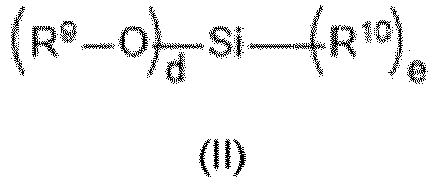 d 3 oder 4 ist, vorzugsweise 3;e 1 oder 0 ist, vorzugsweise 1;d+e 4 ist;jedes Vorkommen von R9 einzeln ausgewählt ist aus der Gruppe bestehend aus Wasserstoff und optional substituierten monovalenten Kohlenwasserstoff-resten mit 1 bis 30 Kohlenstoffatomen,vorzugsweise jedes Vorkommen von R9 einzeln ausgewählt ist aus der Gruppe bestehend aus Wasserstoff, C1-C8-Alkyl, C1-C8-Halogenalkyl, C1-C8-Aminoalkyl, C2-C8-Alkenyl, C3-C8-Cycloalkyl, C4-C8-Cycloalkenyl, C6-C10-Aryl, -C(O)R11,-N=CR12R13 und -N=CR14, bevorzugter ist jedes Vorkommen von R9 einzeln ausgewählt aus der Gruppe bestehend aus C1-C4-Alkyl, C2-C4-Alkenyl, Phenyl, -C(O)R11, -N=CR12R13 und -N=CR14, am meisten bevorzugt ist R9 -N=CR12R13;R11, R12 und R13 ausgewählt sind aus der Gruppe bestehend aus C1-C8-Alkyl, C2-C8-Alkenyl, C3-C8-Cycloalkyl, C4-C8-Cycloalkenyl und C6-C10-Aryl, vorzugsweise sind R11, R12 und R13 ausgewählt aus der Gruppe bestehend aus C1-C4-Alkyl, am meisten bevorzugt sind R11 und R12 Methyl und R13 ist Propyl;R14 ein bivalenter C2-C8-Alkylrest ist, so dass -N=CR14 ein Cycloalkyl ist; undR10 ausgewählt ist aus der Gruppe bestehend aus Wasserstoff und optional substituierten monovalenten Kohlenwasserstoffresten mit 1 bis 30 Kohlenstoffatomen, vorzugsweise ist R10 ausgewählt aus der Gruppe bestehend aus Wasserstoff, Methyl, Ethyl, Vinyl und Phenyl, besonders bevorzugt ist R10 Methyl, undwobei der zweite Silan- oder Siloxanvernetzer, der ausgewählt ist aus Silanen gemäß Formel (II) und deren Hydrolyse- oder Kondensationsprodukten, sich von dem ersten Vernetzer, der ausgewählt ist aus Silanen gemäß Formel (I) und deren Hydrolyse- oder Kondensationsprodukten, unterscheidet.
 - Silikonformulierung nach Anspruch 5, wobei das Gewichtsverhältnis des zweiten Vernetzers zu dem ersten Vernetzer im Bereich von 0,5 bis 20, vorzugsweise im Bereich von 2 bis 15, besonders bevorzugt im Bereich von 6 bis 12, am meisten bevorzugt im Bereich von 8 bis 10 liegt; und wobei die Gesamtmenge der Silan- oder Siloxanvernetzer im Bereich von 2 bis 8 Gew.-% (bezogen auf das Gesamtgewicht der Silikonformulierung), vorzugsweise im Bereich von 4 bis 6 Gew.-%, am meisten bevorzugt im Bereich von 4,5 bis 5,5 Gew.-% liegt.
- Silikonformulierung nach einem der Ansprüche 1-6, wobei das hydroxyterminierte Polydiorganosiloxan zumindest teilweise mit dem ersten Vernetzer endverkappt ist.
- Silikonformulierung nach einem der Ansprüche 1-7, weiter umfassend 1-60 Gew.-% (bezogen auf das Gesamtgewicht der Silikonformulierung), vorzugsweise im Bereich von 3-50 Gew.-%, noch bevorzugter im Bereich von 5-30 Gew.-% eines Füllstoffs, der aus der Gruppe ausgewählt ist, die aus mineralischen Füllstoffen, Metalloxidfüllstoffen, Flugasche, Bodenasche, Ruß und Kombinationen davon besteht, vorzugsweise ausgewählt aus der Gruppe bestehend aus: Kalziumhydroxid; natürlichen, gemahlenen oder gefällten Kalziumkarbonaten; Dolomiten; pyrogener Kieselsäure; Ruß; kalzinierten Kaolinen; Böhmit; Ton; Talk-Aluminium-Silikaten; Magnesium-Aluminium-Silikaten; Zirkonium-Silikaten; fein gemahlenem Quarz; fein gemahlenem Cristobalit; Kieselgur; Glimmer; Eisenoxiden; Titanoxiden; Zirkoniumoxiden, besonders bevorzugt ausgewählt aus der Gruppe bestehend aus Dolomit und pyrogener Kieselsäure.
- Silikonformulierung nach einem der Ansprüche 1-8, die eine oder beide der folgenden Eigenschaften aufweist:• eine Hautbildungszeit von mehr als 10 Minuten, vorzugsweise mehr als 15 Minuten, wie bestimmt nach der in der ausführlichen Beschreibung beschriebenen Methode; und• eine Frühriss-Endzeit von weniger als 30 Minuten, vorzugsweise weniger als 20 Minuten, bevorzugter weniger als 10 Minuten, am meisten bevorzugt keine frühe Rissbildung, wie bestimmt nach der in der ausführlichen Beschreibung beschriebenen Methode.
- Gehärtetes Silikonelastomer, erhältlich durch Härten der Silikonformulierung nach einem der Ansprüche 1-9, vorzugsweise erhältlich durch Feuchtigkeitshärtung der Silikonformulierung nach einem der Ansprüche 1-9.
- Verwendung der Silikonformulierung nach einem der Ansprüche 1-9 oder des gehärteten Silikonelastomers nach Anspruch 10 als Dichtstoff, Fugenmasse oder Klebstoff, vorzugsweise als Dichtstoff.
- Verwendung eines ersten Vernetzers, ausgewählt aus Silanen gemäß Formel (I) und deren Hydrolyse- oder Kondensationsprodukten nach einem der Ansprüche 1, 3 und 4, vorzugsweise eines Vernetzers, ausgewählt aus Silanen der Formel (I) und deren Hydrolyse- oder Kondensationsprodukten, wie in Anspruch 4 definiert, um• das Frührissverhalten einer Silikonformulierung zu verbessern; und/oder• die Hautbildungszeit einer Silikonformulierung zu erhöhen; und/oder• die Menge des in einer Silikonformulierung eingesetzten Vinylsilans zu verringern; und/oder• die Karzinogenität einer Silikonformulierung zu verringern, vorzugsweise unter Beibehaltung oder Verbesserung des Frührissverhaltens und/oder der Hautbildungszeit; und/oder• den durch die Aushärtung einer Silikonformulierung verursachten üblen Geruch zu reduzieren, vorzugsweise unter Beibehaltung oder Verbesserung des Frührissverhaltens und/oder der Hautbildungszeit.
- Verfahren zur Herstellung einer Silikonformulierung nach einem der Ansprüche 1-9, umfassend die folgenden Schritte:(i) Bereitstellen mindestens eines hydroxyterminierten Polydiorganosiloxans;(ii) Bereitstellen:(ii.1) eines ersten Vernetzers, ausgewählt aus Silanen der Formel (I) und deren Hydrolyse- oder Kondensationsprodukten, wie in einem der Ansprüche 1, 3 und 4 definiert, vorzugsweise eines Vernetzers ausgewählt aus Silanen gemäß Formel (I) und deren Hydrolyse- oder Kondensationsprodukten, wie in Anspruch 4 definiert; und(ii.2) optional eines zweiten Silan- oder Siloxanvernetzers, ausgewählt aus Silanen gemäß Formel (II) und deren Hydrolyse- oder Kondensationsprodukten, wie in Anspruch 5 beschrieben;(iii) optional Bereitstellen weiterer Inhaltsstoffe; und(iv) Kombinieren der in den Schritten (i), (ii) und optional (iii) bereitgestellten Inhaltsstoffe.
- Oximsilan oder Siloxan-Vernetzer, ausgewählt aus Silanen der Formel (I) und deren Hydrolyse- oder Kondensationsprodukten, wie in Anspruch 1 definiert.
- Oximsilan oder Siloxan-Vernetzer nach Anspruch 14, wobei das Silan nach Formel (I) ein Tris(5-methyl-3-heptanonoxim)silan ist, vorzugsweise Methyltris(5-methyl-3-heptanonoxim)silan, Vinyltris(5-methyl-3-heptanonoxim)silan oder Phenyltris(5-methyl-3-heptanonoxim)silan, am meisten bevorzugt Methyltris(5-methyl-3-heptanonoxim)silan.
Applications Claiming Priority (2)
| Application Number | Priority Date | Filing Date | Title |
|---|---|---|---|
| EP20190862 | 2020-08-13 | ||
| PCT/EP2021/072390 WO2022034141A1 (en) | 2020-08-13 | 2021-08-11 | Silicone formulation comprising an oxime crosslinker, cured silicone formulation and uses thereof |
Publications (3)
| Publication Number | Publication Date |
|---|---|
| EP4196532A1 EP4196532A1 (de) | 2023-06-21 |
| EP4196532B1 true EP4196532B1 (de) | 2024-09-18 |
| EP4196532C0 EP4196532C0 (de) | 2024-09-18 |
Family
ID=72086725
Family Applications (3)
| Application Number | Title | Priority Date | Filing Date |
|---|---|---|---|
| EP21762418.8A Pending EP4196533A1 (de) | 2020-08-13 | 2021-08-11 | Silikonformulierung mit einem oximvernetzer, gehärtete silikonformulierung und verwendungen davon |
| EP21759289.8A Active EP4196532B1 (de) | 2020-08-13 | 2021-08-11 | Silikonformulierung mit einen oximvernetzer, gehärtete silikonformulierung und verwendungen davon |
| EP21762419.6A Pending EP4196544A1 (de) | 2020-08-13 | 2021-08-11 | Silikonformulierung mit einem oximvernetzer, gehärtete silikonformulierung und verwendungen davon |
Family Applications Before (1)
| Application Number | Title | Priority Date | Filing Date |
|---|---|---|---|
| EP21762418.8A Pending EP4196533A1 (de) | 2020-08-13 | 2021-08-11 | Silikonformulierung mit einem oximvernetzer, gehärtete silikonformulierung und verwendungen davon |
Family Applications After (1)
| Application Number | Title | Priority Date | Filing Date |
|---|---|---|---|
| EP21762419.6A Pending EP4196544A1 (de) | 2020-08-13 | 2021-08-11 | Silikonformulierung mit einem oximvernetzer, gehärtete silikonformulierung und verwendungen davon |
Country Status (6)
| Country | Link |
|---|---|
| US (2) | US20230340206A1 (de) |
| EP (3) | EP4196533A1 (de) |
| KR (2) | KR20230118547A (de) |
| CN (2) | CN116438258B (de) |
| BE (2) | BE1028517B1 (de) |
| WO (3) | WO2022034141A1 (de) |
Families Citing this family (2)
| Publication number | Priority date | Publication date | Assignee | Title |
|---|---|---|---|---|
| CN114989780B (zh) * | 2022-07-18 | 2023-03-21 | 广东高士高科实业有限公司 | 一种耐油型硅酮密封胶及其制备方法和应用 |
| CN116285866B (zh) * | 2023-03-20 | 2025-02-14 | 福建省三棵树新材料有限公司 | 硅酮胶及其制备方法 |
Citations (1)
| Publication number | Priority date | Publication date | Assignee | Title |
|---|---|---|---|---|
| US6413354B1 (en) * | 1998-06-17 | 2002-07-02 | Loctite Corporation | Oil resistant silicones |
Family Cites Families (5)
| Publication number | Priority date | Publication date | Assignee | Title |
|---|---|---|---|---|
| US5359108A (en) * | 1992-09-17 | 1994-10-25 | Alliedsignal Inc. | Di-, tri- and tetrafunctional methyl isobutyl and methyl amyl ketoxime-based silanes |
| US5534588A (en) * | 1994-05-24 | 1996-07-09 | Alliedsignal Inc. | Room temperature vulcanizable silicone compositions employing phenyl substituted tris-functional ketoxime silanes |
| CN102924494B (zh) * | 2012-10-19 | 2015-08-19 | 北京天山新材料技术有限公司 | 一种有机肟基硅化合物及其制备方法和应用 |
| EP2886584A1 (de) * | 2013-12-19 | 2015-06-24 | Sika Technology AG | Kondensationsvernetzende Silikone mit verbesserter Temperaturstabilität |
| US20170044400A1 (en) * | 2015-08-11 | 2017-02-16 | Csl Silicones Inc. | Superhydrophobic elastomeric silicone coatings |
-
2021
- 2021-08-11 EP EP21762418.8A patent/EP4196533A1/de active Pending
- 2021-08-11 EP EP21759289.8A patent/EP4196532B1/de active Active
- 2021-08-11 KR KR1020237007975A patent/KR20230118547A/ko active Pending
- 2021-08-11 WO PCT/EP2021/072390 patent/WO2022034141A1/en not_active Ceased
- 2021-08-11 CN CN202180069158.2A patent/CN116438258B/zh active Active
- 2021-08-11 US US18/040,827 patent/US20230340206A1/en active Pending
- 2021-08-11 US US18/040,828 patent/US20230323038A1/en active Pending
- 2021-08-11 BE BE20215639A patent/BE1028517B1/nl active IP Right Grant
- 2021-08-11 EP EP21762419.6A patent/EP4196544A1/de active Pending
- 2021-08-11 CN CN202180069159.7A patent/CN116419950A/zh active Pending
- 2021-08-11 WO PCT/EP2021/072380 patent/WO2022034137A1/en not_active Ceased
- 2021-08-11 KR KR1020237007976A patent/KR20230118068A/ko active Pending
- 2021-08-11 WO PCT/EP2021/072381 patent/WO2022034138A1/en not_active Ceased
- 2021-08-11 BE BE20215640A patent/BE1028518B1/nl active IP Right Grant
Patent Citations (1)
| Publication number | Priority date | Publication date | Assignee | Title |
|---|---|---|---|---|
| US6413354B1 (en) * | 1998-06-17 | 2002-07-02 | Loctite Corporation | Oil resistant silicones |
Also Published As
| Publication number | Publication date |
|---|---|
| BE1028517A1 (nl) | 2022-02-18 |
| EP4196532A1 (de) | 2023-06-21 |
| CN116438258A (zh) | 2023-07-14 |
| WO2022034141A1 (en) | 2022-02-17 |
| CN116438258B (zh) | 2025-11-21 |
| CN116419950A (zh) | 2023-07-11 |
| EP4196533A1 (de) | 2023-06-21 |
| BE1028517B1 (nl) | 2022-04-11 |
| WO2022034138A1 (en) | 2022-02-17 |
| KR20230118547A (ko) | 2023-08-11 |
| US20230323038A1 (en) | 2023-10-12 |
| EP4196532C0 (de) | 2024-09-18 |
| KR20230118068A (ko) | 2023-08-10 |
| WO2022034137A1 (en) | 2022-02-17 |
| US20230340206A1 (en) | 2023-10-26 |
| EP4196544A1 (de) | 2023-06-21 |
| BE1028518A1 (nl) | 2022-02-18 |
| BE1028518B1 (nl) | 2022-04-11 |
Similar Documents
| Publication | Publication Date | Title |
|---|---|---|
| JP5770225B2 (ja) | グアニジン構造を有する化合物及びそのオルガノポリシロキサン重縮合触媒としての使用 | |
| JP6522625B2 (ja) | 湿気硬化性組成物 | |
| KR102207422B1 (ko) | 다성분계 실온 경화성 오르가노폴리실록산 조성물, 해당 조성물의 경화물 및 해당 경화물을 포함하는 성형물 | |
| CN104114598B (zh) | 湿固化的有机聚硅氧烷组合物 | |
| US12043738B2 (en) | Silicone sealant having adjustable flow properties | |
| US20160208151A1 (en) | Combination of rtv-1 silicone formulation and accelerator with enhanced cure characteristics | |
| CA3091354A1 (en) | Moisture curable silicone polymer and uses thereof | |
| EP4196532B1 (de) | Silikonformulierung mit einen oximvernetzer, gehärtete silikonformulierung und verwendungen davon | |
| WO2014086638A1 (de) | Silikonformulierung mit verbesserter lagerstabilität | |
| JP2007106944A (ja) | 室温硬化性オルガノポリシロキサン組成物 | |
| JP5817626B2 (ja) | 室温硬化性オルガノポリシロキサン組成物 | |
| JP2003221506A (ja) | 室温硬化性オルガノポリシロキサン組成物 | |
| EP0916702A1 (de) | Härtbare Polyorganosiloxane Zusammensetzung | |
| JP2001302929A (ja) | 硬化性組成物 | |
| JP2025162699A (ja) | 室温硬化性オルガノポリシロキサン組成物 | |
| KR20240115744A (ko) | 실온 경화성 오르가노폴리실록산 조성물의 제조 방법 및 실온 경화성 오르가노폴리실록산 조성물 | |
| JP2010106210A (ja) | 二液型縮合硬化性オルガノポリシロキサン組成物 | |
| JP2001302931A (ja) | 硬化性組成物 |
Legal Events
| Date | Code | Title | Description |
|---|---|---|---|
| STAA | Information on the status of an ep patent application or granted ep patent |
Free format text: STATUS: UNKNOWN |
|
| STAA | Information on the status of an ep patent application or granted ep patent |
Free format text: STATUS: THE INTERNATIONAL PUBLICATION HAS BEEN MADE |
|
| PUAI | Public reference made under article 153(3) epc to a published international application that has entered the european phase |
Free format text: ORIGINAL CODE: 0009012 |
|
| STAA | Information on the status of an ep patent application or granted ep patent |
Free format text: STATUS: REQUEST FOR EXAMINATION WAS MADE |
|
| 17P | Request for examination filed |
Effective date: 20230228 |
|
| AK | Designated contracting states |
Kind code of ref document: A1 Designated state(s): AL AT BE BG CH CY CZ DE DK EE ES FI FR GB GR HR HU IE IS IT LI LT LU LV MC MK MT NL NO PL PT RO RS SE SI SK SM TR |
|
| DAV | Request for validation of the european patent (deleted) | ||
| DAX | Request for extension of the european patent (deleted) | ||
| GRAP | Despatch of communication of intention to grant a patent |
Free format text: ORIGINAL CODE: EPIDOSNIGR1 |
|
| STAA | Information on the status of an ep patent application or granted ep patent |
Free format text: STATUS: GRANT OF PATENT IS INTENDED |
|
| INTG | Intention to grant announced |
Effective date: 20240402 |
|
| GRAS | Grant fee paid |
Free format text: ORIGINAL CODE: EPIDOSNIGR3 |
|
| GRAA | (expected) grant |
Free format text: ORIGINAL CODE: 0009210 |
|
| STAA | Information on the status of an ep patent application or granted ep patent |
Free format text: STATUS: THE PATENT HAS BEEN GRANTED |
|
| AK | Designated contracting states |
Kind code of ref document: B1 Designated state(s): AL AT BE BG CH CY CZ DE DK EE ES FI FR GB GR HR HU IE IS IT LI LT LU LV MC MK MT NL NO PL PT RO RS SE SI SK SM TR |
|
| REG | Reference to a national code |
Ref country code: GB Ref legal event code: FG4D |
|
| REG | Reference to a national code |
Ref country code: CH Ref legal event code: EP |
|
| REG | Reference to a national code |
Ref country code: DE Ref legal event code: R096 Ref document number: 602021019012 Country of ref document: DE |
|
| REG | Reference to a national code |
Ref country code: IE Ref legal event code: FG4D |
|
| U01 | Request for unitary effect filed |
Effective date: 20241011 |
|
| U07 | Unitary effect registered |
Designated state(s): AT BE BG DE DK EE FI FR IT LT LU LV MT NL PT RO SE SI Effective date: 20241030 |
|
| PG25 | Lapsed in a contracting state [announced via postgrant information from national office to epo] |
Ref country code: NO Free format text: LAPSE BECAUSE OF FAILURE TO SUBMIT A TRANSLATION OF THE DESCRIPTION OR TO PAY THE FEE WITHIN THE PRESCRIBED TIME-LIMIT Effective date: 20241218 |
|
| PG25 | Lapsed in a contracting state [announced via postgrant information from national office to epo] |
Ref country code: GR Free format text: LAPSE BECAUSE OF FAILURE TO SUBMIT A TRANSLATION OF THE DESCRIPTION OR TO PAY THE FEE WITHIN THE PRESCRIBED TIME-LIMIT Effective date: 20241219 |
|
| PG25 | Lapsed in a contracting state [announced via postgrant information from national office to epo] |
Ref country code: HR Free format text: LAPSE BECAUSE OF FAILURE TO SUBMIT A TRANSLATION OF THE DESCRIPTION OR TO PAY THE FEE WITHIN THE PRESCRIBED TIME-LIMIT Effective date: 20240918 |
|
| PG25 | Lapsed in a contracting state [announced via postgrant information from national office to epo] |
Ref country code: RS Free format text: LAPSE BECAUSE OF FAILURE TO SUBMIT A TRANSLATION OF THE DESCRIPTION OR TO PAY THE FEE WITHIN THE PRESCRIBED TIME-LIMIT Effective date: 20241218 |
|
| PG25 | Lapsed in a contracting state [announced via postgrant information from national office to epo] |
Ref country code: RS Free format text: LAPSE BECAUSE OF FAILURE TO SUBMIT A TRANSLATION OF THE DESCRIPTION OR TO PAY THE FEE WITHIN THE PRESCRIBED TIME-LIMIT Effective date: 20241218 Ref country code: NO Free format text: LAPSE BECAUSE OF FAILURE TO SUBMIT A TRANSLATION OF THE DESCRIPTION OR TO PAY THE FEE WITHIN THE PRESCRIBED TIME-LIMIT Effective date: 20241218 Ref country code: HR Free format text: LAPSE BECAUSE OF FAILURE TO SUBMIT A TRANSLATION OF THE DESCRIPTION OR TO PAY THE FEE WITHIN THE PRESCRIBED TIME-LIMIT Effective date: 20240918 Ref country code: GR Free format text: LAPSE BECAUSE OF FAILURE TO SUBMIT A TRANSLATION OF THE DESCRIPTION OR TO PAY THE FEE WITHIN THE PRESCRIBED TIME-LIMIT Effective date: 20241219 |
|
| PG25 | Lapsed in a contracting state [announced via postgrant information from national office to epo] |
Ref country code: IS Free format text: LAPSE BECAUSE OF FAILURE TO SUBMIT A TRANSLATION OF THE DESCRIPTION OR TO PAY THE FEE WITHIN THE PRESCRIBED TIME-LIMIT Effective date: 20250118 |
|
| PG25 | Lapsed in a contracting state [announced via postgrant information from national office to epo] |
Ref country code: SM Free format text: LAPSE BECAUSE OF FAILURE TO SUBMIT A TRANSLATION OF THE DESCRIPTION OR TO PAY THE FEE WITHIN THE PRESCRIBED TIME-LIMIT Effective date: 20240918 |
|
| PG25 | Lapsed in a contracting state [announced via postgrant information from national office to epo] |
Ref country code: ES Free format text: LAPSE BECAUSE OF FAILURE TO SUBMIT A TRANSLATION OF THE DESCRIPTION OR TO PAY THE FEE WITHIN THE PRESCRIBED TIME-LIMIT Effective date: 20240918 |
|
| PG25 | Lapsed in a contracting state [announced via postgrant information from national office to epo] |
Ref country code: CZ Free format text: LAPSE BECAUSE OF FAILURE TO SUBMIT A TRANSLATION OF THE DESCRIPTION OR TO PAY THE FEE WITHIN THE PRESCRIBED TIME-LIMIT Effective date: 20240918 Ref country code: PL Free format text: LAPSE BECAUSE OF FAILURE TO SUBMIT A TRANSLATION OF THE DESCRIPTION OR TO PAY THE FEE WITHIN THE PRESCRIBED TIME-LIMIT Effective date: 20240918 |
|
| PG25 | Lapsed in a contracting state [announced via postgrant information from national office to epo] |
Ref country code: SK Free format text: LAPSE BECAUSE OF FAILURE TO SUBMIT A TRANSLATION OF THE DESCRIPTION OR TO PAY THE FEE WITHIN THE PRESCRIBED TIME-LIMIT Effective date: 20240918 |
|
| PLBE | No opposition filed within time limit |
Free format text: ORIGINAL CODE: 0009261 |
|
| STAA | Information on the status of an ep patent application or granted ep patent |
Free format text: STATUS: NO OPPOSITION FILED WITHIN TIME LIMIT |
|
| 26N | No opposition filed |
Effective date: 20250619 |
|
| U20 | Renewal fee for the european patent with unitary effect paid |
Year of fee payment: 5 Effective date: 20250812 |
|
| REG | Reference to a national code |
Ref country code: CH Ref legal event code: H13 Free format text: ST27 STATUS EVENT CODE: U-0-0-H10-H13 (AS PROVIDED BY THE NATIONAL OFFICE) Effective date: 20260324 |