EP4178837B1 - Anordnung zur unterstützung einer feststellbremse und entsprechender nachrüstbausatz, sowie feststellbremse - Google Patents
Anordnung zur unterstützung einer feststellbremse und entsprechender nachrüstbausatz, sowie feststellbremse Download PDFInfo
- Publication number
- EP4178837B1 EP4178837B1 EP21745924.7A EP21745924A EP4178837B1 EP 4178837 B1 EP4178837 B1 EP 4178837B1 EP 21745924 A EP21745924 A EP 21745924A EP 4178837 B1 EP4178837 B1 EP 4178837B1
- Authority
- EP
- European Patent Office
- Prior art keywords
- parking brake
- arrangement
- brake
- assisting
- brake lever
- Prior art date
- Legal status (The legal status is an assumption and is not a legal conclusion. Google has not performed a legal analysis and makes no representation as to the accuracy of the status listed.)
- Active
Links
Images


Classifications
-
- B—PERFORMING OPERATIONS; TRANSPORTING
- B60—VEHICLES IN GENERAL
- B60T—VEHICLE BRAKE CONTROL SYSTEMS OR PARTS THEREOF; BRAKE CONTROL SYSTEMS OR PARTS THEREOF, IN GENERAL; ARRANGEMENT OF BRAKING ELEMENTS ON VEHICLES IN GENERAL; PORTABLE DEVICES FOR PREVENTING UNWANTED MOVEMENT OF VEHICLES; VEHICLE MODIFICATIONS TO FACILITATE COOLING OF BRAKES
- B60T7/00—Brake-action initiating means
- B60T7/02—Brake-action initiating means for personal initiation
- B60T7/08—Brake-action initiating means for personal initiation hand actuated
- B60T7/10—Disposition of hand control
- B60T7/102—Disposition of hand control by means of a tilting lever
-
- B—PERFORMING OPERATIONS; TRANSPORTING
- B60—VEHICLES IN GENERAL
- B60T—VEHICLE BRAKE CONTROL SYSTEMS OR PARTS THEREOF; BRAKE CONTROL SYSTEMS OR PARTS THEREOF, IN GENERAL; ARRANGEMENT OF BRAKING ELEMENTS ON VEHICLES IN GENERAL; PORTABLE DEVICES FOR PREVENTING UNWANTED MOVEMENT OF VEHICLES; VEHICLE MODIFICATIONS TO FACILITATE COOLING OF BRAKES
- B60T7/00—Brake-action initiating means
- B60T7/02—Brake-action initiating means for personal initiation
- B60T7/08—Brake-action initiating means for personal initiation hand actuated
- B60T7/10—Disposition of hand control
- B60T7/102—Disposition of hand control by means of a tilting lever
- B60T7/104—Disposition of hand control by means of a tilting lever with a locking mechanism
-
- B—PERFORMING OPERATIONS; TRANSPORTING
- B60—VEHICLES IN GENERAL
- B60T—VEHICLE BRAKE CONTROL SYSTEMS OR PARTS THEREOF; BRAKE CONTROL SYSTEMS OR PARTS THEREOF, IN GENERAL; ARRANGEMENT OF BRAKING ELEMENTS ON VEHICLES IN GENERAL; PORTABLE DEVICES FOR PREVENTING UNWANTED MOVEMENT OF VEHICLES; VEHICLE MODIFICATIONS TO FACILITATE COOLING OF BRAKES
- B60T13/00—Transmitting braking action from initiating means to ultimate brake actuator with power assistance or drive; Brake systems incorporating such transmitting means, e.g. air-pressure brake systems
- B60T13/10—Transmitting braking action from initiating means to ultimate brake actuator with power assistance or drive; Brake systems incorporating such transmitting means, e.g. air-pressure brake systems with fluid assistance, drive, or release
- B60T13/58—Combined or convertible systems
- B60T13/588—Combined or convertible systems both fluid and mechanical assistance or drive
-
- G—PHYSICS
- G05—CONTROLLING; REGULATING
- G05G—CONTROL DEVICES OR SYSTEMS INSOFAR AS CHARACTERISED BY MECHANICAL FEATURES ONLY
- G05G7/00—Manually-actuated control mechanisms provided with one single controlling member co-operating with one single controlled member; Details thereof
- G05G7/02—Manually-actuated control mechanisms provided with one single controlling member co-operating with one single controlled member; Details thereof characterised by special provisions for conveying or converting motion, or for acting at a distance
- G05G7/04—Manually-actuated control mechanisms provided with one single controlling member co-operating with one single controlled member; Details thereof characterised by special provisions for conveying or converting motion, or for acting at a distance altering the ratio of motion or force between controlling member and controlled member as a function of the position of the controlling member
-
- B—PERFORMING OPERATIONS; TRANSPORTING
- B60—VEHICLES IN GENERAL
- B60T—VEHICLE BRAKE CONTROL SYSTEMS OR PARTS THEREOF; BRAKE CONTROL SYSTEMS OR PARTS THEREOF, IN GENERAL; ARRANGEMENT OF BRAKING ELEMENTS ON VEHICLES IN GENERAL; PORTABLE DEVICES FOR PREVENTING UNWANTED MOVEMENT OF VEHICLES; VEHICLE MODIFICATIONS TO FACILITATE COOLING OF BRAKES
- B60T11/00—Transmitting braking action from initiating means to ultimate brake actuator without power assistance or drive or where such assistance or drive is irrelevant
- B60T11/04—Transmitting braking action from initiating means to ultimate brake actuator without power assistance or drive or where such assistance or drive is irrelevant transmitting mechanically
-
- G—PHYSICS
- G05—CONTROLLING; REGULATING
- G05G—CONTROL DEVICES OR SYSTEMS INSOFAR AS CHARACTERISED BY MECHANICAL FEATURES ONLY
- G05G1/00—Controlling members, e.g. knobs or handles; Assemblies or arrangements thereof; Indicating position of controlling members
- G05G1/04—Controlling members for hand actuation by pivoting movement, e.g. levers
Definitions
- the present invention relates to an arrangement for supporting a parking brake, in particular for a vehicle.
- the present invention also relates to a retrofit kit comprising the support arrangement according to the invention and a parking brake designed as a handbrake, which can be equipped with the support arrangement.
- a parking brake is mandatory as a braking device.
- a parking brake blocks at least the wheels on one axle permanently when the vehicle is parked and can be operated in stages independently of a service brake.
- a corresponding braking device comprises a brake lever which, in the case of a handbrake, can be operated by hand as a hand lever or alternatively by foot as a brake pedal and can be pivoted about a pivot bearing between a release position and a locking position.
- a conventional braking arrangement can be actuated by the transferable force between the brake lever and a brake cable or brake rod.
- an actuator can generally be activated on a hand lever of a handbrake to release the locking position.
- known parking brake arrangements comprise a support arrangement to reduce the force or load required to operate the arrangement and/or to control the release, which could otherwise lead to damage to the arrangements involved due to the release of energy in the event of undamped release.
- lifting elements or lifting generators can be used, which are arranged between the brake lever and a stationary element.
- an arrangement of the lifting element in which, with the exception of the so-called dead center position, its line of action always has a distance from the swivel bearing of the lifting element on the stationary element that changes with the movement of the brake lever.
- the expansive and preloadable lifting element thus provides graduated support for the movement of the brake lever. According to this arrangement, the preload of the lifting element can be increased before the dead center position and a support torque can be provided after the dead center position has been exceeded, which increases depending on the position of the brake lever.
- Lifting elements act as energy storage and/or as a counterweight.
- Lifting elements designed as gas springs are known to contain a fluid, for example compressible gas, typically pressurized nitrogen gas, or a hydraulic fluid.
- a gas spring designed as a closed, hermetically sealed pneumatic actuator, comprises a piston with a piston rod guided in a cylinder.
- the piston, the piston rod and also existing seals are lubricated by means of a certain amount of lubricant.
- the lubricating oil and the gas moving in the cylinder create a damping effect when the piston moves.
- gas springs can have a relatively flat spring characteristic curve in order to provide a controlled force and speed, as well as damping at the end of the stroke.
- a parking brake the operation of which is supported by a spring, is known from the published patent application DE 41 22 447 A1 known.
- the object of the present invention is therefore to provide an arrangement for supporting a parking brake, whereby the effort required to operate the parking brake is reduced to a minimum, so that a parking brake designed as a handbrake in particular can be applied and released quickly and easily.
- the arrangement for supporting according to the invention should also be designed as a module or retrofit kit in order to be able to be used to retrofit existing parking brake arrangements.
- the arrangement for supporting a parking brake, referred to as "the arrangement" for short, according to claim 1, by a retrofit kit according to claim 9 and a parking brake with the inventive support arrangement according to claim 12.
- the arrangement according to the invention is designed to support a parking brake, which comprises a brake lever which is mounted in a carrier device so as to be pivotable between a release position and a locking position and which can be coupled to a brake system by means of transmission means.
- the transmission means can comprise, among other things, a brake cable, e.g. a Bowden cable and/or a brake linkage.
- the arrangement according to the invention comprises a lifting element with an energy storage unit, which can be arranged relative to the carrier device and can be brought into operative connection with the brake lever.
- the arrangement is characterized in that the operative connection between the lifting element and the brake lever comprises a deflection element, which can be arranged pivotably about a pivot axis relative to the carrier device and couples the lifting element with the brake lever.
- the support of the movement of the Brake lever is based on a purely mechanical mechanism which is designed to move a manually operable brake lever almost automatically, in particular into its end positions, i.e. a locking position and a release position.
- the lifting element and the deflection element can be arranged relative to the support device using appropriate brackets and are therefore independent of the parking brake support device, it is possible to retrofit an existing parking brake.
- the arrangement and design of the elements of the support arrangement can be individually adapted to the structural conditions.
- the brackets can be designed to be connected to the parking brake support device, depending on the installation situation, or to be fixed in place relative to it.
- the deflection element is designed in the form of a rocker with a first lever section and a second lever section, which extend in opposite directions from the pivot axis.
- the deflection element can be connected to the lifting element in an articulated manner with the first lever section and to the brake lever with the second lever section.
- the rocker-shaped deflection element can be formed in a simple manner from a sheet metal part, with the pivot axis being accommodated in a bearing sleeve that can be connected to the sheet metal part.
- the deflection element creates kinematic conditions that allow optimal operation of the brake lever of the parking brake with the support of the lifting element.
- the lifting element can comprise a gas pressure spring as an energy storage unit.
- the gas pressure spring can be viewed as a hydropneumatic adjustment element with a self-contained energy storage device.
- a piston with a piston rod can be guided in a sealed manner in a cylinder tube, which is filled with a compressible gas, so that an expansive and pre-tensionable adjustment element is available.
- the operative connection between the lifting element and the brake lever comprises, in addition to the deflection element, an adjustment element for connecting the deflection element to the brake lever.
- the adjustment element can be connected to the brake lever in an articulated manner, for example by means of a ball joint bearing comprising a ball socket and a joint head.
- the adjustment element is designed to be adjustable in length. A suitable length of the adjustment element can thus be selected depending on the installation situation of the parking brake and the design of the brake lever, whereby the arrangement according to the invention can be flexibly combined.
- the lifting element can be arranged relative to the deflection element in such a way that, following a movement of the brake lever between the release position and the locking position, a line of action of the force of the lifting element outside of its dead center position has a changing distance from the pivot axis.
- the dead center position is a position of the lifting element in which its line of action of the force runs through the pivot axis of the deflection element.
- the deflection element moves with it so that it pivots about the pivot axis.
- This pivoting movement of the deflection element is coupled to a displacement of the piston of the expansive lifting element along the line of action of the force.
- the distance between the pivot axis and the line of action of the force changes in a plane that runs perpendicularly through the horizontal pivot axis.
- the distance of the line of action of the force from the pivot axis causes a torque that acts on the deflection element and therefore indirectly on the brake lever.
- the torque increases as the distance of the line of action of the force from the pivot axis increases so that the movement of the brake lever receives additional support for the movement of the brake lever regardless of the energy stored in the lifting element.
- the distance between the line of action of the force and the pivot axis is almost maximum compared to the dead center position.
- the arrangement of the elements of the support arrangement i.e. lifting element, deflection element and possibly adjustment element, is selected so that the distance between the line of action of the force and the pivot axis is then so large that a torque generated thereby and acting on the deflection element is sufficient for this.
- the arrangement of lifting element, deflection element and possibly adjustment element is provided as a retrofit kit for an existing parking brake.
- the lifting element and the deflection element are held in brackets.
- the brackets are provided in order to arrange the lifting element on the one hand and the deflection element on the other hand relative to the manually operable brake lever or the carrier device of the parking brake.
- the retrofit kit comprises a first holder for the lifting element and a second holder for the deflection element.
- a common holding means can be provided in which the lifting element and the deflection element are held.
- One end of the lifting element is connected to the first holder in an articulated manner, e.g. by means of a ball joint bearing.
- the second holder comprises a bearing for the pivot axis of the deflection element.
- the first and second holders can be assembled from simple parts, e.g. by means of a plug connection, and can be fixed in a suitable position relative to the brake lever.
- the lifting element and/or the deflection element can also be held directly on the carrier device or on a common holder.
- the present invention relates to a parking brake which comprises the inventive arrangement for assisting.
- a parking brake which comprises the inventive arrangement for assisting.
- Such a parking brake can be used almost universally in different vehicles and trailers.
- the parking brake 10 shown with an arrangement for support which is referred to below as arrangement 1 for short, comprises a hand-operated brake lever 12 as a manually operable release device for actuating a braking device.
- the brake lever 12 can be pivoted about a rotation axis which is mounted in a carrier device 14.
- the brake lever 12 is connected to an adjustment means designed as a brake cable or brake wire and/or brake rod in order to transmit a force from the brake lever 12 to a braking system.
- the braking system can be designed, for example, as a drum brake or disc brake in order to immobilize the wheels.
- a pawl connected to the brake lever 12 is provided, which can be brought into engagement with a grid segment.
- the pawl can be connected via a cable-shaped or rod-shaped connecting means to an actuator accommodated on the brake lever 12, which in a pressed position releases the pawl from the engagement with the grid segment.
- a brake cable is hinged to a hinge point, designed as a Bowden cable, which is connected to the wheel brakes to be activated by means of the brake rod.
- a hinge point designed as a Bowden cable
- other functional elements can be integrated in the entire braking system.
- the arrangement 1, which can be connected to the parking brake 10 to support the movement of the same, comprises a lifting element 20, which has an energy storage device 22, for example through a gas pressure spring.
- the lifting element 20 is operatively connected at one end to a deflection element 30, which can be pivoted about a central pivot axis 32 in the form of a rocker.
- the pivot axis 32 is preferably arranged parallel to the axis of rotation about which the brake lever 12 can be pivoted.
- the Deflection element 30 has a first lever portion 34 for articulated connection to the lifting element 20 and a second lever portion 36 for articulated connection to the brake lever 12.
- the lifting element 20 is arranged relative to the deflection element 30, for which a first holder 50 is provided.
- the first holder 50 can be arranged relative to the carrier device 14, for example it can be received in a recess formed on the carrier device 14 and fixed in position.
- the lifting element 20 is connected to the deflection element 30 at one end and is held in an articulated manner on the holder 50 at an opposite end. Accordingly, a piston of the lifting element 20 moves along a force action line 24, wherein this force action line 24, starting from the first end of the lifting element 20 and coupled to the movement of the brake lever 12, sweeps over a segment of a circle.
- the deflection element 30 is held by means of a second holder 52 relative to the elements of the parking brake 10 and relative to the lifting element 20.
- the second holder 52 can also be fixed in relation to the carrier device 14.
- An adjusting element 40 is arranged between the deflection element 30 and the brake lever 12 to provide the operative connection, which can be connected in an articulated manner to the brake lever 12 on the one hand and in an articulated manner to the second lever section 36 on the other.
- the adjusting element 40 can be designed as an element that is adjustable in length, for example as a threaded rod.
- the mounting of the adjusting element 40 on the brake lever 12 can comprise a ball joint mounting 60.
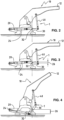
- the release position of the brake lever 12 is in Figure 3
- the elements of the arrangement 1 for assisting the parking brake 10 are positioned relative to one another in such a way that a small torque is generated on the pivot axis 32, due to a distance 26 between the pivot axis 32 and the line of action of force 24 in a vertical plane through the pivot axis 32. This torque facilitates the movement of the brake lever 12 from the release position shown.
- FIG 4 the brake lever 12 is shown in a locking position in which the wheels of an axle are locked.
- the line of action of the force 24 of the lifting element 20 intersects the plane running perpendicularly through the pivot axis 32 at a large distance 26 from it. Accordingly, a high torque acts on the deflection element 30 so that the movement of the brake lever 12 into the locking position is supported. The torque generated is so large that the movement of the brake lever 12 into the locking position takes place almost automatically.
- the lifting element 20 and deflection element 30 of the arrangement 1 for supporting the parking brake 10 are shown in a perspective detailed view in the dead center position ( Figure 5 ), in the release position ( Figure 6 ) and in the locking position ( Figure 7 ) is shown.
- the distance 26 between the line of action of force 24 and the pivot axis 32 is shown, which varies depending on the position taken.
- the lifting element 20 and deflection element 30 together with the first bracket 50 and the second bracket 52 form a retrofit kit 100.
- This retrofit kit 100 can be used in different installation situations in order to support a parking brake 10.
- the first bracket 50 and also the second bracket 52 can be assembled from several individual parts, in particular plugged together.
- the first bracket 50 and the second bracket 52 can be fixed in place in relation to the existing parking brake 10 by means of appropriate screw connections.
Landscapes
- Engineering & Computer Science (AREA)
- Transportation (AREA)
- Mechanical Engineering (AREA)
- Physics & Mathematics (AREA)
- General Physics & Mathematics (AREA)
- Automation & Control Theory (AREA)
- Braking Elements And Transmission Devices (AREA)
Description
- Die vorliegende Erfindung bezieht sich auf eine Anordnung zur Unterstützung einer Feststellbremse, insbesondere für ein Fahrzeug. Ferner bezieht sich die vorliegende Erfindung auf ein Nachrüstbausatz, umfassend die erfindungsgemässe Unterstützungsanordnung und eine als Handbremse ausgebildete Feststellbremse, welche mit der Unterstützungsanordnung ausrüstbar ist.
- Für Fahrzeuge, d.h. PKW, landwirtschaftliche Fahrzeuge, etc. oder für bestimmte Anhänger, ist eine Feststellbremse als Bremseinrichtung zwingend vorgesehen. Eine solche Feststellbremse blockiert beim Abstellen des Fahrzeugs zumindest die Räder auf einer Achse dauerhaft und kann unabhängig von einer Betriebsbremse abstufbar betätigt werden. Eine entsprechende Bremseinrichtung umfasst einen Bremshebel, welcher im Falle einer Handbremse mittels Hand als Handhebel oder alternativ mittels Fuss als Bremspedal betätigbar ist und zwischen einer Freigabestellung und einer Feststellposition um ein Schwenklager schwenkbar ist. Eine herkömmliche Bremsanordnung ist durch die übertragbare Kraft zwischen dem Bremshebel und einem Bremszug oder Bremsgestänge betätigbar. Ferner ist im Allgemeinen an einem Handhebel einer Handbremse zur Freigabe der Feststellposition ein Aktor aktivierbar.
- Generell umfassen bekannte Feststellbremsanordnungen eine Unterstützungsanordnung, um sowohl die zum Betrieb der Anordnung aufzuwendende Kraft bzw. Last zu reduzieren und/oder auch um die Freigabe zu steuern, welche ansonsten durch eine Energiefreisetzung bei ungedämpfter Freigabe zur Schädigung von beteiligten Anordnungen führen könnte. Hierfür sind Hubelemente oder Huberzeuger einsetzbar, welche zwischen dem Bremshebel und einem ortsfesten Element angeordnet sind. Insbesondere kann eine Anordnung des Hubelements vorgesehen sein, bei welcher mit Ausnahme der sogenannten Totpunktlage seine Kraftwirkungslinie stets einen sich mit der Bewegung des Bremshebels ändernden Abstand zum Schwenklager des Hubelements am ortsfesten Element aufweist. Damit wird durch das expansive und vorspannfähige Hubelement eine abgestufte Unterstützung der Bewegung des Bremshebels bereitgestellt. Gemäss dieser Anordnung kann vor der Totpunktlage die Vorspannung des Hubelements erhöht und nach Überschreiten der Totpunktlage ein Unterstützungsmoment bereitgestellt werden, welches in Abhängigkeit von der Stellung des Bremshebels ansteigt.
- Hubelemente fungieren als Energiespeicher und/oder als Gegengewicht. Bekannt sind als Gasfedern ausgebildete Hubelemente mit einem Fluid, beispielsweise komprimierbarem Gas, typischerweise unter Druck stehendem Stickstoffgas, oder eine Hydraulikflüssigkeit. Eine Gasfeder, ausgebildet als abgeschlossener, hermetisch abgedichteter pneumatischer Aktuator, umfasst einen in einem Zylinder geführten Kolben mit einer Kolbenstange. Der Kolben, die Kolbenstange und auch vorhandene Dichtungen werden mittels einer gewissen Menge an Schmierstoff geschmiert. Das im Zylinder bewegte Schmieröl und das Gas erzeugen einen dämpfenden Effekt bei der Bewegung des Kolbens. Infolgedessen können Gasfedern eine relativ flache Federkennlinie aufweisen, um eine kontrollierte Kraft und Geschwindigkeit, sowie eine Dämpfung am Ende des Hubs bereitzustellen.
- Allerdings muss zur Betätigung bekannter Feststellbremsanordnungen weiterhin eine gewisse nicht unerhebliche Kraft aufgewendet werden, insbesondere für die Bewegung des Bremshebels in die Feststellposition, beim Lösen des angezogenen Bremshebels und für die Bewegung in die Freigabestellung. Dies kann insbesondere bei einer regelmässigen Betätigung der Feststellbremse ein Hindernis für den Fahrer bzw. die Fahrerin darstellen, was unter Umständen dazu führen kann, dass die Feststellbremse nicht immer betätigt wird. Dies wiederum kann mitunter gravierende Konsequenzen haben, dann nämlich, wenn das Fahrzeug an steilem, geneigtem oder einem vermeintlich flachen, jedoch in Realität geneigtem Geländeabschnitt abgestellt wird. In diesem Fall kann nicht ausgeschlossen werden, dass das Fahrzeug durch die Einwirkung der Gravitation selbstständig wegrollt und in einen Verkehrsunfall verwickelt wird.
- Eine Feststellbremse, deren Betätigung durch eine Feder unterstützt wird, ist aus der Offenlegungsschrift
DE 41 22 447 A1 bekannt. - Aufgabe der vorliegenden Erfindung ist es demnach, eine Anordnung zur Unterstützung einer Feststellbremse vorzusehen, wodurch der Kraftaufwand zur Betätigung der Feststellbremse auf ein Minimum reduziert ist, so dass Anziehen und Lösen insbesondere einer als Handbremse ausgebildeten Feststellbremse schnell und einfach erfolgen kann. Die erfindungsgemässe Anordnung zur Unterstützung soll darüber hinaus als Modul bzw. Nachrüstbausatz ausgebildet sein, um zur Nachrüstung bestehender Feststellbremsanordnungen eingesetzt werden zu können.
- Gelöst werden die Aufgaben durch eine Anordnung zur Unterstützung einer Feststellbremse, kurz «die Anordnung" genannt, gemäss Anspruch 1, durch einen Nachrüstbausatz gemäss Anspruch 9 und eine Feststellbremse mit der erfindungsgemässen Unterstützungsanordnung gemäss Anspruch 12.
- Die erfindungsgemässe Anordnung ist zur Unterstützung einer Feststellbremse ausgebildet, welche einen Bremshebel umfasst, der in einer Trägereinrichtung schwenkbar zwischen einer Freigabestellung und einer Feststellposition gelagert und mittels Übertragungsmitteln mit einem Bremssystem koppelbar ist. Die Übertragungsmittel können unteranderem ein Bremszug, z.B. Bowdenzug und/oder ein Bremsgestänge umfassen.
- Die erfindungsgemässe Anordnung umfasst ein Hubelement mit Energiespeichereinheit, welches relativ zu der Trägereinrichtung anordenbar und mit dem Bremshebel in Wirkverbindung bringbar ist. Die Anordnung zeichnet sich dadurch aus, dass die Wirkverbindung zwischen dem Hubelement und dem Bremshebel ein Umlenkelement umfasst, welches relativ zur Trägereinrichtung schwenkbar um eine Schwenkachse anordenbar ist und das Hubelement mit dem Bremshebel koppelt. Die Unterstützung der Bewegung des Bremshebels basiert auf einem rein mechanischen Mechanismus, welcher eingerichtet ist, um einen handbetätigbaren Bremshebel insbesondere in seine Endpositionen, d.h. eine Feststellposition und eine Freigabestellung, quasi selbsttätig zu überführen.
- Da das Hubelement und das Umlenkelement relativ zu der Trägereinrichtung mittels entsprechender Halterungen anordenbar und damit unabhängig von der Trägereinrichtung der Feststellbremse sind, ist eine Nachrüstung einer bestehenden Feststellbremse möglich. Dabei kann die Anordnung und Gestaltung der Elemente der Unterstützungsanordnung individuell an die baulichen Begebenheiten angepasst werden. Die Halterungen können ausgebildet sein, um je nach Einbausituation mit der Trägereinrichtung der Feststellbremse verbunden zu werden, oder relativ zu dieser ortsfest fixiert zu werden.
- In einer Ausführungsform der erfindungsgemässen Unterstützungsanordnung ist das Umlenkelement in Form einer Wippe mit einem ersten Hebelabschnitt und mit einem zweiten Hebelabschnitt ausgebildet, die sich, ausgehend von der Schwenkachse, jeweils in entgegengesetzte Richtungen erstrecken. Insbesondere ist das Umlenkelement mit dem ersten Hebelabschnitt gelenkig mit dem Hubelement und mit dem zweiten Hebelabschnitt mit dem Bremshebel verbindbar. Das wippenförmige Umlenkelement kann in einfacher Weise aus einem Blechteil geformt werden, wobei die Schwenkachse in einer mit dem Blechteil verbindbare Lagerhülse aufnehmbar ist. Mittels des Umlenkelements werden kinematische Bedingungen geschaffen, welche eine optimale Bedienung des Bremshebels der Feststellbremse mit Unterstützung des Hubelements erlauben.
- Das Hubelement kann eine Gasdruckfeder als Energiespeichereinheit umfassen. Die Gasdruckfeder kann als ein hydropneumatisches Verstellelement mit einem in sich geschlossenen Energiespeicher angesehen werden. Dabei ist in einem Zylinderrohr ein Kolben mit einer Kolbenstange dichtend führbar, welches mit einem komprimierbaren Gas gefüllt ist, so dass ein expansives und vorspannbares Verstellelement bereitsteht.
- In einer bevorzugten Ausführungsform der vorliegenden Erfindung umfasst die Wirkverbindung zwischen dem Hubelement und dem Bremshebel neben dem Umlenkelement ein Einstellelement zur Verbindung des Umlenkelements mit dem Bremshebel. Insbesondere ist das Einstellelement mit dem Bremshebel gelenkig verbindbar, beispielsweise mittels einer Kugelgelenk-Lagerung, umfassend Kugelpfanne und Gelenkkopf. Das Einstellelement ist eingerichtet, um in seiner Länge verstellbar zu sein. Somit kann in Abhängigkeit von der Einbausituation der Feststellbremse und der Gestaltung des Bremshebels eine geeignete Länge des Einstellelements gewählt werden, wodurch die erfindungsgemässe Anordnung flexibel kombinierbar ist.
- In einer Ausführungsform der vorliegenden Erfindung ist das Hubelement derart relativ zum Umlenkelement anordenbar, dass folgend mit einer Bewegung des Bremshebels zwischen der Freigabestellung und der Feststellposition eine Kraftwirkungslinie des Hubelements ausserhalb seiner Totpunktlage einen sich verändernden Abstand zu der Schwenkachse aufweist. Als Totpunktlage wird eine Stellung des Hubelements bezeichnet, in dem seine Kraftwirkungslinie durch die Schwenkachse des Umlenkelements verläuft.
- Bei Bewegung des handbetätigbaren Bremshebels zwischen der Freigabestellung, d.h. einer unteren Stellung und der Feststellposition, d.h. einer oberen Stellung, wird das Umlenkelement mitbewegt, so dass es um die Schwenkachse schwenkt. Diese Schwenkbewegung des Umlenkelements ist gekoppelt an eine Verschiebung des Kolbens des expansiven Hubelements entlang der Kraftwirkungslinie. Mit Bewegung des Hubelements, bedingt durch die von dem handbetätigbaren Bremshebel ausgehende Schwenkbewegung des Umlenkelements, ausserhalb der Totpunktlage, ändert sich der Abstand zwischen Schwenkachse und Kraftwirkungslinie in einer Ebene, welche senkrecht durch die horizontale Schwenkachse verläuft. Der Abstand der Kraftwirkungslinie zur Schwenkachse verursacht ein Drehmoment, welches auf das Umlenkelement und demnach indirekt auf den Bremshebel wirkt. Das Drehmoment nimmt in dem Mass zu, in dem sich der Abstand der Kraftwirkungslinie zur Schwenkachse vergrössert, so dass die Bewegung des Bremshebels eine zusätzliche Unterstützung der Bewegung des Bremshebels unabhängig von der im Hubelement gespeicherten Energie erfährt.
- In den Positionen, in welchen der Bremshebel in der Nähe der Freigabestellung oder in der Nähe der Feststellposition ist, und demnach sich das Hubelement am weitesten entfernt von seiner Totpunktlage befindet, ist der Abstand zwischen Kraftwirkungslinie und Schwenkachse nahezu maximal im Vergleich zur Totpunktlage. Um den Bremshebel nach Aktivierung quasi selbsttätig in die Freigabestellung bzw. Feststellposition überführen zu können, wird die Anordnung der Elemente der Unterstützungsanordnung, d.h. Hubelement, Umlenkelement und eventuell Einstellelement, so gewählt, dass der Abstand der Kraftwirkungslinie zu der Schwenkachse dann so gross ist, dass ein dadurch erzeugtes, auf das Umlenkelement wirkendes Drehmoment hierfür ausreichend ist.
- In einer bevorzugten Ausführungsform der erfindungsgemässen Anordnung ist die Anordnung aus Hubelement, Umlenkelement und eventuell Einstellelement als Nachrüstbausatz für eine bestehende Feststellbremse vorgesehen. Das Hubelement und das Umlenkelement sind in Halterungen gehalten. Die Halterungen werden bereitgestellt, um das Hubelement einerseits und das Umlenkelement andererseits relativ zu dem handbetätigbaren Bremshebel bzw. der Trägereinrichtung der Feststellbremse anzuordnen.
- In einer bevorzugten Ausführungsform umfasst der Nachrüstbausatz eine erste Halterung für das Hubelement und eine zweite Halterung für das Umlenkelement. Alternativ kann ein gemeinsames Haltemittel vorgesehen sein, in welchem das Hubelement und das Umlenkelement gehalten sind. Ein Ende des Hubelements ist mit der ersten Halterung gelenkig verbunden, z.B. mittels einer Kugelgelenk-Lagerung. Die zweite Halterung umfasst eine Lagerung der Schwenkachse des Umlenkelements. Die ersten und zweiten Halterungen können aus einfachen Teilen, z.B. mittels Steckverbindung, gefügt und in geeigneter Position relativ zu dem Bremshebel ortsfest fixierbar sein. Das Hubelement und/oder das Umlenkelement können aber auch unmittelbar an der Trägereinrichtung gehalten werden oder an einer gemeinsamen Halterung.
- Ferner bezieht sich die vorliegende Erfindung auf eine Feststellbremse, welche die erfindungsgemässe Anordnung zur Unterstützung umfasst. Eine derartige Feststellbremse ist nahezu universell in unterschiedlichen Fahrzeugen und Anhängern einsetzbar.
- Eine bevorzugte Ausführungsform der Erfindung wird im Folgenden anhand von Zeichnungen dargestellt, die lediglich zur Erläuterung dienen und nicht einschränkend auszulegen sind. Aus den Zeichnungen offenbar werdende Merkmale der Erfindung sollen einzeln und in jeder Kombination als zur Offenbarung der Erfindung gehörend betrachtet werden. In den Zeichnungen zeigen:
-
Figur 1 eine schematische perspektivische Ansicht einer Feststellbremse mit Bremshebel und Trägereinrichtung einschliesslich einer erfindungsgemässen Unterstützungsanordnung gemäss einer ersten Ausführungsform; -
Figur 2 eine schematische teilweise aufgebrochene Seitenansicht der Unterstützungsanordnung mit Hubelement, Umlenkelement und Einstellelement gemäss der ersten Ausführungsform in einer Totpunktlage; -
Figur 3 eine schematische teilweise aufgebrochene Seitenansicht der Unterstützungsanordnung gemässFigur 2 in einer Position, in der sich der Bremshebel der Feststellbremse in einer Freigabestellung befindet; -
Figur 4 eine schematische teilweise aufgebrochene Seitenansicht der Unterstützungsanordnung gemässFigur 2 in einer Position, in der sich der Bremshebel der Feststellbremse in einer Feststellposition befindet; -
Figur 5 eine perspektivische Ansicht des Hubelements der Unterstützungsanordnung gelagert an einer ersten Halterung und des Umlenkelements mit einer zweiten Halterung in einer Totpunktlage; -
Figur 6 eine perspektivische Ansicht des Hubelements und des Umlenkelements der Unterstützungsanordnung mit ihren Halterungen in einer Freigabestellung, -
Figur 7 eine perspektivische Ansicht des Hubelements und des Umlenkelements der Unterstützungsanordnung mit ihren Halterungen in einer Feststellposition. - Die in der
Figur 1 dargestellte Feststellbremse 10 mit einer Anordnung zur Unterstützung, welche folgend kurz als Anordnung 1 bezeichnet wird, umfasst einen handbetätigbaren Bremshebel 12 als manuell bedienbare Auslösevorrichtung zur Betätigung einer Bremsvorrichtung. Der Bremshebel 12 ist um eine Drehachse schwenkbar, welche in einer Trägereinrichtung 14 gelagert ist. - Nicht dargestellt ist, dass der Bremshebel 12 mit einem als Bremsseil bzw. Bremszug und/oder Bremsgestänge ausgebildeten Verstellmittel verbunden ist, um eine Kraft vom Bremshebel 12 auf ein Bremssystem zu übertragen. Das Bremssystem kann z.B. als Trommelbremse oder Scheibenbremse ausgebildet sein, um die Räder festzusetzen. Ferner ist eine mit dem Bremshebel 12 verbundene Sperrklinke vorgesehen, welche mit einem Rastersegment in Eingriff bringbar ist. Die Sperrklinke kann über ein seilförmiges oder stangenförmiges Verbindungsmittel mit einem am Bremshebel 12 aufgenommenen Aktor verbunden sein, welcher in einer gedrückten Position die Sperrklinke aus dem Eingriff am Rastersegment löst. Im Allgemeinen ist ferner vorgesehen, dass an einem Anlenkpunkt ein Bremszug angelenkt ist, ausgebildet als Bowdenzug, welcher mittels dem Bremsgestänge in Verbindung zu den zu aktivierenden Radbremsen steht. Darüber hinaus können noch weitere Funktionselemente im gesamten Bremssystem integriert sein.
- Die mit der Feststellbremse 10 verbindbare Anordnung 1 zur Unterstützung des Bewegungsablaufs derselben umfasst ein Hubelement 20, welches beispielsweise durch eine Gasdruckfeder über einen Energiespeicher 22 verfügt. Das Hubelement 20 steht an einem Ende in Wirkverbindung mit einem Umlenkelement 30, welches in Form einer Wippe um eine zentrale Schwenkachse 32 schwenkbar ist. Die Schwenkachse 32 ist vorzugsweise parallel zu der Drehachse angeordnet, um die der Bremshebel 12 schwenkbar ist. Das Umlenkelement 30 weist einen ersten Hebelabschnitt 34 zur gelenkigen Verbindung mit dem Hubelement 20 und einen zweiten Hebelabschnitt 36 zur gelenkigen Verbindung mit dem Bremshebel 12 auf.
- Das Hubelement 20 ist relativ zum Umlenkelement 30 angeordnet, wofür eine erste Halterung 50 vorgesehen ist. Die erste Halterung 50 kann relativ zur Trägereinrichtung 14 angeordnet sein, beispielsweise an der Trägereinrichtung 14 in einer ausgebildeten Ausnehmung aufgenommen sein und in Position fixiert werden. Das Hubelement 20 ist an einem Ende mit dem Umlenkelement 30 verbunden und mit einem entgegengesetzten Ende gelenkig an der Halterung 50 gehalten. Demnach bewegt sich ein Kolben des Hubelements 20 entlang einer Kraftwirkungslinie 24, wobei diese Kraftwirkungslinie 24, ausgehend von dem ersten Ende des Hubelements 20 gekoppelt an die Bewegung des Bremshebels 12, ein Kreissegment überstreicht.
- Das Umlenkelement 30 ist mittels einer zweiten Halterung 52 relativ zu den Elementen der Feststellbremse 10 und relativ zum Hubelement 20 gehalten. Die zweite Halterung 52 kann ebenfalls in Bezug zur Trägereinrichtung 14 fixiert werden.
- Zwischen Umlenkelement 30 und Bremshebel 12 ist zur Bereitstellung der Wirkverbindung ein Einstellelement 40 angeordnet, welches einerseits gelenkig am Bremshebel 12 und andererseits gelenkig mit dem zweiten Hebelabschnitt 36 verbindbar ist. Das Einstellelement 40 kann als in der Länge einstellbares Element ausgebildet sein, beispielsweise als Gewindestange. Die Lagerung des Einstellelements 40 an dem Bremshebel 12 kann eine Kugelgelenk-Lagerung 60 umfassen.
- In einer sogenannten Totpunktstellung verläuft die Kraftwirkungslinie 24 nahezu horizontal durch die Mitte der Schwenkachse 32, dargestellt in
Figur 2 . In dieser Stellung wirkt an der Schwenkachse 32 des Umlenkelements 30 kein Drehmoment. Der Bremshebel 12 befindet sich in einer Stellung, welche nahezu der Freigabestellung entspricht. - Die Freigabestellung des Bremshebels 12 ist in
Figur 3 dargestellt. Die Elemente der Anordnung 1 zur Unterstützung der Feststellbremse 10 sind derart in Bezug zueinander positioniert, dass an der Schwenkachse 32 ein kleines Drehmoment erzeugt wird, bedingt durch einen Abstand 26 zwischen der Schwenkachse 32 und der Kraftwirkungslinie 24 in einer senkrechten Ebene durch die Schwenkachse 32. Dieses Drehmoment erleichtert die Bewegung des Bremshebels 12 aus der dargestellten Freigabestellung. - In
Figur 4 ist der Bremshebel 12 in einer Feststellposition dargestellt, in welcher die Räder einer Achse festgestellt sind. Die Kraftwirkungslinie 24 des Hubelements 20 schneidet die Ebene, senkrecht durch die Schwenkachse 32 verlaufend, in einem grossen Abstand 26 zu dieser. Demnach wirkt ein hohes Drehmoment auf das Umlenkelement 30, so dass die Bewegung des Bremshebels 12 in die Feststellposition unterstützt wird. Das erzeugte Drehmoment ist insbesondere so gross, dass die Bewegung des Bremshebels 12 in die Feststellposition nahezu selbsttätig erfolgt. - In den
Figuren 5, 6 und 7 sind zur Verdeutlichung die Elemente Hubelement 20 und Umlenkelement 30 der Anordnung 1 zur Unterstützung der Feststellbremse 10 in einer perspektivischen Detailansicht in der Totpunktlage (Figur 5 ), in der Freigabestellung (Figur 6 ) und in der Feststellposition (Figur 7 ) dargestellt. Verdeutlicht ist der Abstand 26 zwischen Kraftwirkungslinie 24 und Schwenkachse 32, welche je nach eingenommener Stellung variiert. Insbesondere bilden die Elemente Hubelement 20 und Umlenkelement 30 zusammen mit der ersten Halterung 50 und der zweiten Halterung 52 einen Nachrüstbausatz 100. Dieser Nachrüstbausatz 100 kann in unterschiedliche Einbausituationen eingesetzt werden, um eine Unterstützung einer Feststellbremse 10 zu erzielen. - Die erste Halterung 50 und auch die zweite Halterung 52 können aus mehreren Einzelteilen gefügt werden, insbesondere gesteckt werden. Die erste Halterung 50 und die zweite Halterung 52 können mittels entsprechender Schraubverbindungen ortsfest in Bezug zu der bestehenden Feststellbremse 10 fixiert werden.
Claims (12)
- Anordnung (1) zur Unterstützung einer Feststellbremse (10), welche Feststellbremse (10) einen Bremshebel (12) umfasst, der in einer Trägereinrichtung (14) zwischen einer Freigabestellung und einer Feststellposition schwenkbar gelagert ist und mittels eines Übertragungsmittels mit einem Bremssystem koppelbar, wobei die Anordnung (1) ein Hubelement (20) mit einer Energiespeichereinheit (22) umfasst, wobei das Hubelement (20) mit dem Bremshebel (12) in Wirkverbindung steht,
dadurch gekennzeichnet, dass
die Wirkverbindung ein Umlenkelement (30) umfasst, welches schwenkbar um eine Schwenkachse (32) gelagert ist, und derart angeordnet ist, dass das Umlenkelement (30) das Hubelement (20) mit dem Bremshebel (12) koppelt. - Anordnung (1) zur Unterstützung einer Feststellbremse (10) nach Anspruch 1, dadurch gekennzeichnet, dass das Umlenkelement (30) in Form einer Wippe schwenkbar um die Schwenkachse (32) ist, umfassend einen ersten Hebelabschnitt (34), um mit dem Hubelement (20) gelenkig verbindbar zu sein und einen zweiten Hebelabschnitt (36), um mit dem Bremshebel (12) verbindbar zu sein.
- Anordnung (1) zur Unterstützung einer Feststellbremse (10) nach Anspruch 1 oder 2, dadurch gekennzeichnet, dass das Hubelement (12) eine Gasdruckfeder umfasst.
- Anordnung (1) zur Unterstützung einer Feststellbremse (10) nach einem der vorhergehenden Ansprüche, dadurch gekennzeichnet, dass die Wirkverbindung ferner ein Einstellelement (40) umfasst, welches zwischen Bremshebel (12) und Umlenkelement (30) angeordnet und in seiner Länge einstellbar ist.
- Anordnung (1) zur Unterstützung einer Feststellbremse (10) nach Anspruch 4, dadurch gekennzeichnet, dass das Umlenkelement (30) mittels des Einstellelements (40) mit dem Bremshebel (12) verbindbar ist.
- Anordnung (1) zur Unterstützung einer Feststellbremse (10) nach einem der vorhergehenden Ansprüche, dadurch gekennzeichnet, dass das Hubelement (20) relativ zu dem Umlenkelement (30) anordenbar ist, so dass bei einer Bewegung des Bremshebels (12) zwischen der Freigabestellung und der Feststellposition eine Kraftwirkungslinie (24) des Hubelements (20) ausserhalb seiner Totpunktlage einen sich verändernden Abstand (26) zu der Schwenkachse (32) aufweist.
- Anordnung (1) zur Unterstützung einer Feststellbremse (12) nach Anspruch 6, dadurch gekennzeichnet, dass der Abstand (26) dann maximal ist, wenn sich der Bremshebel (12) in der Nähe der Freigabestellung oder der Feststellposition befindet.
- Anordnung (1) zur Unterstützung einer Feststellbremse (10) nach Anspruch 7, dadurch gekennzeichnet, dass der Abstand (26) so gross ist, dass ein dadurch erzeugtes, auf das Umlenkelement (30) wirkendes Drehmoment ausreicht, um den Bremshebel (12) selbsttätig in die Freigabestellung bzw. Feststellposition zu überführen.
- Nachrüstbausatz (100) für eine Feststellbremse (10), umfassend eine Anordnung (1) zur Unterstützung der Feststellbremse (10) gemäss einem der vorhergehenden Ansprüche, umfassend ein Einstellelement (40), ferner Halterungen (50, 52) aufweisend, um das Hubelement (20) und das Umlenkelement (30) relativ zu dem Bremshebel (12) anzuordnen.
- Nachrüstbausatz (100) für eine Feststellbremse (10) nach Anspruch 9, dadurch gekennzeichnet, dass eine erste Halterung (50) vorgesehen ist, um ein Ende des Hubelements (20) gelenkig zu lagern und eine zweite Halterung (52), um die Schwenkachse (32) des Umlenkelements (30) zu lagern.
- Nachrüstbausatz (100) für eine Feststellbremse (10) nach Anspruch 9 oder 10, dadurch gekennzeichnet, dass zur gelenkigen Lagerung des Hubelements (20) und/oder des Einstellelements (40) eine Kugelgelenk-Lagerung (60) vorgesehen ist.
- Feststellbremse (10), umfassend eine Anordnung (1) zur Unterstützung derselben nach einem der Ansprüche 1 bis 9, zum Einsatz in einem Fahrzeug, wie einem PKW, landwirtschaftlichem Fahrzeug, Kommunalfahrzeug und/oder einem Anhänger.
Applications Claiming Priority (2)
| Application Number | Priority Date | Filing Date | Title |
|---|---|---|---|
| CH00852/20A CH717625A2 (de) | 2020-07-10 | 2020-07-10 | Anordung zur Unterstützung einer Feststellbremse und entsprechender Nachrüstbausatz, sowie Feststellbremse. |
| PCT/EP2021/068454 WO2022008410A1 (de) | 2020-07-10 | 2021-07-05 | Anordnung zur unterstützung einer feststellbremse und entsprechender nachrüstbausatz, sowie feststellbremse |
Publications (2)
| Publication Number | Publication Date |
|---|---|
| EP4178837A1 EP4178837A1 (de) | 2023-05-17 |
| EP4178837B1 true EP4178837B1 (de) | 2024-08-07 |
Family
ID=77050965
Family Applications (1)
| Application Number | Title | Priority Date | Filing Date |
|---|---|---|---|
| EP21745924.7A Active EP4178837B1 (de) | 2020-07-10 | 2021-07-05 | Anordnung zur unterstützung einer feststellbremse und entsprechender nachrüstbausatz, sowie feststellbremse |
Country Status (4)
| Country | Link |
|---|---|
| US (1) | US12060047B2 (de) |
| EP (1) | EP4178837B1 (de) |
| CH (1) | CH717625A2 (de) |
| WO (1) | WO2022008410A1 (de) |
Family Cites Families (10)
| Publication number | Priority date | Publication date | Assignee | Title |
|---|---|---|---|---|
| DE1915811U (de) | 1965-02-10 | 1965-05-13 | Herbert Dr Ing Merz | Mechanisché handbremseinrichtung, insbesondere fuer fahrzeuge. |
| NL6506212A (de) | 1965-05-14 | 1966-11-15 | ||
| US4907468A (en) * | 1986-11-14 | 1990-03-13 | Topre Corporation | Pedal effort-reduction apparatus |
| DE4029155A1 (de) * | 1989-10-04 | 1991-04-11 | Volkswagen Ag | Vorrichtung zum betaetigen einer lamellenfeder-kupplung eines kraftfahrzeuges |
| AT394691B (de) * | 1991-01-15 | 1992-05-25 | Rinner Josef Achsenfab | Handbremseinrichtung fuer eine auflaufbremse eines anhaengers |
| DE4122447A1 (de) | 1991-07-06 | 1993-01-07 | Porsche Ag | Vorrichtung zum betaetigen einer bremse eines kraftfahrzeugs |
| AU2003297843A1 (en) * | 2002-12-09 | 2004-06-30 | Orscheln Products Llc | Load assisting system for mechanical lever assemblies |
| FR2862591B1 (fr) * | 2003-11-21 | 2006-01-21 | Renault Sas | Commande de frein de parking excentree |
| DE102005000804B4 (de) * | 2005-01-05 | 2011-06-16 | FICO CABLES S.A. Technological Centre Pujol & Tarragó | Handbremshebelsystem |
| DE102010047852A1 (de) * | 2010-10-07 | 2012-04-12 | Gm Global Technology Operations Llc (N.D.Ges.D. Staates Delaware) | Hand-Feststellbremse mit Übertotpunktfeder |
-
2020
- 2020-07-10 CH CH00852/20A patent/CH717625A2/de unknown
-
2021
- 2021-07-05 EP EP21745924.7A patent/EP4178837B1/de active Active
- 2021-07-05 WO PCT/EP2021/068454 patent/WO2022008410A1/de not_active Ceased
- 2021-07-05 US US18/015,148 patent/US12060047B2/en active Active
Also Published As
| Publication number | Publication date |
|---|---|
| US20230234542A1 (en) | 2023-07-27 |
| EP4178837A1 (de) | 2023-05-17 |
| US12060047B2 (en) | 2024-08-13 |
| CH717625A2 (de) | 2022-01-14 |
| WO2022008410A1 (de) | 2022-01-13 |
Similar Documents
| Publication | Publication Date | Title |
|---|---|---|
| DE2646870C2 (de) | Betriebs- und Feststell-/Hilfsbremsbetätigungseinrichtung für Vollbelagscheibenbremsen | |
| DE69918572T2 (de) | Radaufhängungsanordnung bei einem fahrzeug | |
| EP3388297B1 (de) | Fahrzeuganhänger mit energierückgewinnungseinrichtung | |
| DE102013211660B4 (de) | Verfahren und Vorrichtung zur Höhenverstellung des Aufbaus eines Kraftfahrzeugs | |
| DE602004002543T2 (de) | Pneumatisch betätigte Parkbremse für ein elektronisches Bremssystem | |
| EP4178837B1 (de) | Anordnung zur unterstützung einer feststellbremse und entsprechender nachrüstbausatz, sowie feststellbremse | |
| EP3786013A1 (de) | Lastabhängiges bremsdruckventil | |
| DE1680828C3 (de) | Hydraulische Betatigungsvorrich tung einer Reibungsbremse, insbesondere Teilbelagscheibenbremse, fur Kraftfahr zeuge | |
| DE102018208304A1 (de) | Verfahren und Vorrichtung zum Ausgleichen des Fahrzeug-Höhenstandes nach einer Änderung der Beladung des Fahrzeugs | |
| DE20213535U1 (de) | Bremseinrichtung für Fahrzeuganhänger mit Nachstelleinrichtung | |
| EP4261088B1 (de) | Arretiereinrichtung und abs-bremseinrichtung | |
| DE102014200636B4 (de) | Bremsvorrichtung mit einem als Niederhalteelement ausgebildeten Federelement | |
| DE4230550C1 (de) | Klotzbremseinheit zur einseitigen Beaufschlagung eines Rades im Drehgestell von Schienenfahrzeugen | |
| EP1778998A1 (de) | Hydraulisch betätigbare fahrzeugbremse mit druckentlastung | |
| DE19950657A1 (de) | Kupplungsbetätigungseinrichtung, insbesondere für Kraftfahrzeuge | |
| DE19858259A1 (de) | Arretiervorrichtung zwischen einem Fahrzeugaufbau und einem Radführungsteil | |
| DE957017C (de) | Auflaufbremse | |
| DE1294838B (de) | Parkvorrichtung fuer Kraftfahrzeuge | |
| EP0324990A1 (de) | Auflaufbremsanlage für Anhänger | |
| DE8905939U1 (de) | Hydraulische Auflaufbremsvorrichtung | |
| EP4484265A1 (de) | Drehmomentstütze für gefederte fahrzeuganhänger mit radschwinge | |
| DE3402718A1 (de) | Auflaufbremsanlage | |
| AT359382B (de) | Gleitschutzeinrichtung fuer fahrzeugraeder, insbesondere fuer die treibraeder von traktoren | |
| DE1455871C (de) | Bremsvorrichtung, insbesondere für Flurförderfahrzeuge | |
| DE10253342B4 (de) | Feststellbremse |
Legal Events
| Date | Code | Title | Description |
|---|---|---|---|
| STAA | Information on the status of an ep patent application or granted ep patent |
Free format text: STATUS: UNKNOWN |
|
| STAA | Information on the status of an ep patent application or granted ep patent |
Free format text: STATUS: THE INTERNATIONAL PUBLICATION HAS BEEN MADE |
|
| PUAI | Public reference made under article 153(3) epc to a published international application that has entered the european phase |
Free format text: ORIGINAL CODE: 0009012 |
|
| STAA | Information on the status of an ep patent application or granted ep patent |
Free format text: STATUS: REQUEST FOR EXAMINATION WAS MADE |
|
| 17P | Request for examination filed |
Effective date: 20221221 |
|
| AK | Designated contracting states |
Kind code of ref document: A1 Designated state(s): AL AT BE BG CH CY CZ DE DK EE ES FI FR GB GR HR HU IE IS IT LI LT LU LV MC MK MT NL NO PL PT RO RS SE SI SK SM TR |
|
| DAV | Request for validation of the european patent (deleted) | ||
| DAX | Request for extension of the european patent (deleted) | ||
| RIC1 | Information provided on ipc code assigned before grant |
Ipc: G05G 1/04 20060101ALI20231208BHEP Ipc: G05G 7/04 20060101ALI20231208BHEP Ipc: B60T 7/10 20060101AFI20231208BHEP |
|
| GRAP | Despatch of communication of intention to grant a patent |
Free format text: ORIGINAL CODE: EPIDOSNIGR1 |
|
| STAA | Information on the status of an ep patent application or granted ep patent |
Free format text: STATUS: GRANT OF PATENT IS INTENDED |
|
| INTG | Intention to grant announced |
Effective date: 20240216 |
|
| GRAS | Grant fee paid |
Free format text: ORIGINAL CODE: EPIDOSNIGR3 |
|
| GRAA | (expected) grant |
Free format text: ORIGINAL CODE: 0009210 |
|
| STAA | Information on the status of an ep patent application or granted ep patent |
Free format text: STATUS: THE PATENT HAS BEEN GRANTED |
|
| AK | Designated contracting states |
Kind code of ref document: B1 Designated state(s): AL AT BE BG CH CY CZ DE DK EE ES FI FR GB GR HR HU IE IS IT LI LT LU LV MC MK MT NL NO PL PT RO RS SE SI SK SM TR |
|
| REG | Reference to a national code |
Ref country code: GB Ref legal event code: FG4D Free format text: NOT ENGLISH |
|
| REG | Reference to a national code |
Ref country code: CH Ref legal event code: EP |
|
| REG | Reference to a national code |
Ref country code: IE Ref legal event code: FG4D Free format text: LANGUAGE OF EP DOCUMENT: GERMAN |
|
| REG | Reference to a national code |
Ref country code: DE Ref legal event code: R096 Ref document number: 502021004719 Country of ref document: DE |
|
| REG | Reference to a national code |
Ref country code: LT Ref legal event code: MG9D |
|
| REG | Reference to a national code |
Ref country code: NL Ref legal event code: MP Effective date: 20240807 |
|
| PG25 | Lapsed in a contracting state [announced via postgrant information from national office to epo] |
Ref country code: NO Free format text: LAPSE BECAUSE OF FAILURE TO SUBMIT A TRANSLATION OF THE DESCRIPTION OR TO PAY THE FEE WITHIN THE PRESCRIBED TIME-LIMIT Effective date: 20241107 |
|
| PG25 | Lapsed in a contracting state [announced via postgrant information from national office to epo] |
Ref country code: NL Free format text: LAPSE BECAUSE OF FAILURE TO SUBMIT A TRANSLATION OF THE DESCRIPTION OR TO PAY THE FEE WITHIN THE PRESCRIBED TIME-LIMIT Effective date: 20240807 Ref country code: GR Free format text: LAPSE BECAUSE OF FAILURE TO SUBMIT A TRANSLATION OF THE DESCRIPTION OR TO PAY THE FEE WITHIN THE PRESCRIBED TIME-LIMIT Effective date: 20241108 Ref country code: PL Free format text: LAPSE BECAUSE OF FAILURE TO SUBMIT A TRANSLATION OF THE DESCRIPTION OR TO PAY THE FEE WITHIN THE PRESCRIBED TIME-LIMIT Effective date: 20240807 Ref country code: FI Free format text: LAPSE BECAUSE OF FAILURE TO SUBMIT A TRANSLATION OF THE DESCRIPTION OR TO PAY THE FEE WITHIN THE PRESCRIBED TIME-LIMIT Effective date: 20240807 Ref country code: PT Free format text: LAPSE BECAUSE OF FAILURE TO SUBMIT A TRANSLATION OF THE DESCRIPTION OR TO PAY THE FEE WITHIN THE PRESCRIBED TIME-LIMIT Effective date: 20241209 |
|
| PG25 | Lapsed in a contracting state [announced via postgrant information from national office to epo] |
Ref country code: BG Free format text: LAPSE BECAUSE OF FAILURE TO SUBMIT A TRANSLATION OF THE DESCRIPTION OR TO PAY THE FEE WITHIN THE PRESCRIBED TIME-LIMIT Effective date: 20240807 |
|
| PG25 | Lapsed in a contracting state [announced via postgrant information from national office to epo] |
Ref country code: LV Free format text: LAPSE BECAUSE OF FAILURE TO SUBMIT A TRANSLATION OF THE DESCRIPTION OR TO PAY THE FEE WITHIN THE PRESCRIBED TIME-LIMIT Effective date: 20240807 |
|
| PG25 | Lapsed in a contracting state [announced via postgrant information from national office to epo] |
Ref country code: IS Free format text: LAPSE BECAUSE OF FAILURE TO SUBMIT A TRANSLATION OF THE DESCRIPTION OR TO PAY THE FEE WITHIN THE PRESCRIBED TIME-LIMIT Effective date: 20241207 |
|
| PG25 | Lapsed in a contracting state [announced via postgrant information from national office to epo] |
Ref country code: HR Free format text: LAPSE BECAUSE OF FAILURE TO SUBMIT A TRANSLATION OF THE DESCRIPTION OR TO PAY THE FEE WITHIN THE PRESCRIBED TIME-LIMIT Effective date: 20240807 |
|
| PG25 | Lapsed in a contracting state [announced via postgrant information from national office to epo] |
Ref country code: ES Free format text: LAPSE BECAUSE OF FAILURE TO SUBMIT A TRANSLATION OF THE DESCRIPTION OR TO PAY THE FEE WITHIN THE PRESCRIBED TIME-LIMIT Effective date: 20240807 Ref country code: RS Free format text: LAPSE BECAUSE OF FAILURE TO SUBMIT A TRANSLATION OF THE DESCRIPTION OR TO PAY THE FEE WITHIN THE PRESCRIBED TIME-LIMIT Effective date: 20241107 |
|
| PG25 | Lapsed in a contracting state [announced via postgrant information from national office to epo] |
Ref country code: RS Free format text: LAPSE BECAUSE OF FAILURE TO SUBMIT A TRANSLATION OF THE DESCRIPTION OR TO PAY THE FEE WITHIN THE PRESCRIBED TIME-LIMIT Effective date: 20241107 Ref country code: PT Free format text: LAPSE BECAUSE OF FAILURE TO SUBMIT A TRANSLATION OF THE DESCRIPTION OR TO PAY THE FEE WITHIN THE PRESCRIBED TIME-LIMIT Effective date: 20241209 Ref country code: PL Free format text: LAPSE BECAUSE OF FAILURE TO SUBMIT A TRANSLATION OF THE DESCRIPTION OR TO PAY THE FEE WITHIN THE PRESCRIBED TIME-LIMIT Effective date: 20240807 Ref country code: NO Free format text: LAPSE BECAUSE OF FAILURE TO SUBMIT A TRANSLATION OF THE DESCRIPTION OR TO PAY THE FEE WITHIN THE PRESCRIBED TIME-LIMIT Effective date: 20241107 Ref country code: NL Free format text: LAPSE BECAUSE OF FAILURE TO SUBMIT A TRANSLATION OF THE DESCRIPTION OR TO PAY THE FEE WITHIN THE PRESCRIBED TIME-LIMIT Effective date: 20240807 Ref country code: LV Free format text: LAPSE BECAUSE OF FAILURE TO SUBMIT A TRANSLATION OF THE DESCRIPTION OR TO PAY THE FEE WITHIN THE PRESCRIBED TIME-LIMIT Effective date: 20240807 Ref country code: IS Free format text: LAPSE BECAUSE OF FAILURE TO SUBMIT A TRANSLATION OF THE DESCRIPTION OR TO PAY THE FEE WITHIN THE PRESCRIBED TIME-LIMIT Effective date: 20241207 Ref country code: HR Free format text: LAPSE BECAUSE OF FAILURE TO SUBMIT A TRANSLATION OF THE DESCRIPTION OR TO PAY THE FEE WITHIN THE PRESCRIBED TIME-LIMIT Effective date: 20240807 Ref country code: GR Free format text: LAPSE BECAUSE OF FAILURE TO SUBMIT A TRANSLATION OF THE DESCRIPTION OR TO PAY THE FEE WITHIN THE PRESCRIBED TIME-LIMIT Effective date: 20241108 Ref country code: FI Free format text: LAPSE BECAUSE OF FAILURE TO SUBMIT A TRANSLATION OF THE DESCRIPTION OR TO PAY THE FEE WITHIN THE PRESCRIBED TIME-LIMIT Effective date: 20240807 Ref country code: ES Free format text: LAPSE BECAUSE OF FAILURE TO SUBMIT A TRANSLATION OF THE DESCRIPTION OR TO PAY THE FEE WITHIN THE PRESCRIBED TIME-LIMIT Effective date: 20240807 Ref country code: BG Free format text: LAPSE BECAUSE OF FAILURE TO SUBMIT A TRANSLATION OF THE DESCRIPTION OR TO PAY THE FEE WITHIN THE PRESCRIBED TIME-LIMIT Effective date: 20240807 |
|
| PG25 | Lapsed in a contracting state [announced via postgrant information from national office to epo] |
Ref country code: DK Free format text: LAPSE BECAUSE OF FAILURE TO SUBMIT A TRANSLATION OF THE DESCRIPTION OR TO PAY THE FEE WITHIN THE PRESCRIBED TIME-LIMIT Effective date: 20240807 Ref country code: SM Free format text: LAPSE BECAUSE OF FAILURE TO SUBMIT A TRANSLATION OF THE DESCRIPTION OR TO PAY THE FEE WITHIN THE PRESCRIBED TIME-LIMIT Effective date: 20240807 |
|
| PG25 | Lapsed in a contracting state [announced via postgrant information from national office to epo] |
Ref country code: EE Free format text: LAPSE BECAUSE OF FAILURE TO SUBMIT A TRANSLATION OF THE DESCRIPTION OR TO PAY THE FEE WITHIN THE PRESCRIBED TIME-LIMIT Effective date: 20240807 |
|
| PG25 | Lapsed in a contracting state [announced via postgrant information from national office to epo] |
Ref country code: CZ Free format text: LAPSE BECAUSE OF FAILURE TO SUBMIT A TRANSLATION OF THE DESCRIPTION OR TO PAY THE FEE WITHIN THE PRESCRIBED TIME-LIMIT Effective date: 20240807 |
|
| PG25 | Lapsed in a contracting state [announced via postgrant information from national office to epo] |
Ref country code: SK Free format text: LAPSE BECAUSE OF FAILURE TO SUBMIT A TRANSLATION OF THE DESCRIPTION OR TO PAY THE FEE WITHIN THE PRESCRIBED TIME-LIMIT Effective date: 20240807 |
|
| REG | Reference to a national code |
Ref country code: DE Ref legal event code: R097 Ref document number: 502021004719 Country of ref document: DE |
|
| PLBE | No opposition filed within time limit |
Free format text: ORIGINAL CODE: 0009261 |
|
| STAA | Information on the status of an ep patent application or granted ep patent |
Free format text: STATUS: NO OPPOSITION FILED WITHIN TIME LIMIT |
|
| 26N | No opposition filed |
Effective date: 20250508 |
|
| PG25 | Lapsed in a contracting state [announced via postgrant information from national office to epo] |
Ref country code: SE Free format text: LAPSE BECAUSE OF FAILURE TO SUBMIT A TRANSLATION OF THE DESCRIPTION OR TO PAY THE FEE WITHIN THE PRESCRIBED TIME-LIMIT Effective date: 20240807 |
|
| PGFP | Annual fee paid to national office [announced via postgrant information from national office to epo] |
Ref country code: DE Payment date: 20250722 Year of fee payment: 5 |
|
| PGFP | Annual fee paid to national office [announced via postgrant information from national office to epo] |
Ref country code: AT Payment date: 20251020 Year of fee payment: 5 |
|
| PGFP | Annual fee paid to national office [announced via postgrant information from national office to epo] |
Ref country code: CH Payment date: 20250801 Year of fee payment: 5 |
|
| PG25 | Lapsed in a contracting state [announced via postgrant information from national office to epo] |
Ref country code: IT Free format text: LAPSE BECAUSE OF FAILURE TO SUBMIT A TRANSLATION OF THE DESCRIPTION OR TO PAY THE FEE WITHIN THE PRESCRIBED TIME-LIMIT Effective date: 20240807 |
|
| PG25 | Lapsed in a contracting state [announced via postgrant information from national office to epo] |
Ref country code: LU Free format text: LAPSE BECAUSE OF NON-PAYMENT OF DUE FEES Effective date: 20250705 |
|
| GBPC | Gb: european patent ceased through non-payment of renewal fee |
Effective date: 20250705 |
|
| REG | Reference to a national code |
Ref country code: BE Ref legal event code: MM Effective date: 20250731 |
|
| PG25 | Lapsed in a contracting state [announced via postgrant information from national office to epo] |
Ref country code: GB Free format text: LAPSE BECAUSE OF NON-PAYMENT OF DUE FEES Effective date: 20250705 |
|
| PG25 | Lapsed in a contracting state [announced via postgrant information from national office to epo] |
Ref country code: RO Free format text: LAPSE BECAUSE OF FAILURE TO SUBMIT A TRANSLATION OF THE DESCRIPTION OR TO PAY THE FEE WITHIN THE PRESCRIBED TIME-LIMIT Effective date: 20240807 Ref country code: BE Free format text: LAPSE BECAUSE OF NON-PAYMENT OF DUE FEES Effective date: 20250731 |
|
| PG25 | Lapsed in a contracting state [announced via postgrant information from national office to epo] |
Ref country code: FR Free format text: LAPSE BECAUSE OF NON-PAYMENT OF DUE FEES Effective date: 20250731 |