EP4178488B1 - Segel- und schürzenbefestigungskonfigurationen an den rahmen von herzklappenprothesen - Google Patents
Segel- und schürzenbefestigungskonfigurationen an den rahmen von herzklappenprothesen Download PDFInfo
- Publication number
- EP4178488B1 EP4178488B1 EP21748770.1A EP21748770A EP4178488B1 EP 4178488 B1 EP4178488 B1 EP 4178488B1 EP 21748770 A EP21748770 A EP 21748770A EP 4178488 B1 EP4178488 B1 EP 4178488B1
- Authority
- EP
- European Patent Office
- Prior art keywords
- junction
- suture
- strut
- section
- primary
- Prior art date
- Legal status (The legal status is an assumption and is not a legal conclusion. Google has not performed a legal analysis and makes no representation as to the accuracy of the status listed.)
- Active
Links
Images





Classifications
-
- A—HUMAN NECESSITIES
- A61—MEDICAL OR VETERINARY SCIENCE; HYGIENE
- A61F—FILTERS IMPLANTABLE INTO BLOOD VESSELS; PROSTHESES; DEVICES PROVIDING PATENCY TO, OR PREVENTING COLLAPSING OF, TUBULAR STRUCTURES OF THE BODY, e.g. STENTS; ORTHOPAEDIC, NURSING OR CONTRACEPTIVE DEVICES; FOMENTATION; TREATMENT OR PROTECTION OF EYES OR EARS; BANDAGES, DRESSINGS OR ABSORBENT PADS; FIRST-AID KITS
- A61F2/00—Filters implantable into blood vessels; Prostheses, i.e. artificial substitutes or replacements for parts of the body; Appliances for connecting them with the body; Devices providing patency to, or preventing collapsing of, tubular structures of the body, e.g. stents
- A61F2/02—Prostheses implantable into the body
- A61F2/24—Heart valves ; Vascular valves, e.g. venous valves; Heart implants, e.g. passive devices for improving the function of the native valve or the heart muscle; Transmyocardial revascularisation [TMR] devices; Valves implantable in the body
- A61F2/2427—Devices for manipulating or deploying heart valves during implantation
- A61F2/243—Deployment by mechanical expansion
-
- A—HUMAN NECESSITIES
- A61—MEDICAL OR VETERINARY SCIENCE; HYGIENE
- A61F—FILTERS IMPLANTABLE INTO BLOOD VESSELS; PROSTHESES; DEVICES PROVIDING PATENCY TO, OR PREVENTING COLLAPSING OF, TUBULAR STRUCTURES OF THE BODY, e.g. STENTS; ORTHOPAEDIC, NURSING OR CONTRACEPTIVE DEVICES; FOMENTATION; TREATMENT OR PROTECTION OF EYES OR EARS; BANDAGES, DRESSINGS OR ABSORBENT PADS; FIRST-AID KITS
- A61F2/00—Filters implantable into blood vessels; Prostheses, i.e. artificial substitutes or replacements for parts of the body; Appliances for connecting them with the body; Devices providing patency to, or preventing collapsing of, tubular structures of the body, e.g. stents
- A61F2/02—Prostheses implantable into the body
- A61F2/24—Heart valves ; Vascular valves, e.g. venous valves; Heart implants, e.g. passive devices for improving the function of the native valve or the heart muscle; Transmyocardial revascularisation [TMR] devices; Valves implantable in the body
- A61F2/2412—Heart valves ; Vascular valves, e.g. venous valves; Heart implants, e.g. passive devices for improving the function of the native valve or the heart muscle; Transmyocardial revascularisation [TMR] devices; Valves implantable in the body with soft flexible valve members, e.g. tissue valves shaped like natural valves
- A61F2/2418—Scaffolds therefor, e.g. support stents
-
- A—HUMAN NECESSITIES
- A61—MEDICAL OR VETERINARY SCIENCE; HYGIENE
- A61F—FILTERS IMPLANTABLE INTO BLOOD VESSELS; PROSTHESES; DEVICES PROVIDING PATENCY TO, OR PREVENTING COLLAPSING OF, TUBULAR STRUCTURES OF THE BODY, e.g. STENTS; ORTHOPAEDIC, NURSING OR CONTRACEPTIVE DEVICES; FOMENTATION; TREATMENT OR PROTECTION OF EYES OR EARS; BANDAGES, DRESSINGS OR ABSORBENT PADS; FIRST-AID KITS
- A61F2/00—Filters implantable into blood vessels; Prostheses, i.e. artificial substitutes or replacements for parts of the body; Appliances for connecting them with the body; Devices providing patency to, or preventing collapsing of, tubular structures of the body, e.g. stents
- A61F2/02—Prostheses implantable into the body
- A61F2/24—Heart valves ; Vascular valves, e.g. venous valves; Heart implants, e.g. passive devices for improving the function of the native valve or the heart muscle; Transmyocardial revascularisation [TMR] devices; Valves implantable in the body
- A61F2/2412—Heart valves ; Vascular valves, e.g. venous valves; Heart implants, e.g. passive devices for improving the function of the native valve or the heart muscle; Transmyocardial revascularisation [TMR] devices; Valves implantable in the body with soft flexible valve members, e.g. tissue valves shaped like natural valves
-
- A—HUMAN NECESSITIES
- A61—MEDICAL OR VETERINARY SCIENCE; HYGIENE
- A61F—FILTERS IMPLANTABLE INTO BLOOD VESSELS; PROSTHESES; DEVICES PROVIDING PATENCY TO, OR PREVENTING COLLAPSING OF, TUBULAR STRUCTURES OF THE BODY, e.g. STENTS; ORTHOPAEDIC, NURSING OR CONTRACEPTIVE DEVICES; FOMENTATION; TREATMENT OR PROTECTION OF EYES OR EARS; BANDAGES, DRESSINGS OR ABSORBENT PADS; FIRST-AID KITS
- A61F2/00—Filters implantable into blood vessels; Prostheses, i.e. artificial substitutes or replacements for parts of the body; Appliances for connecting them with the body; Devices providing patency to, or preventing collapsing of, tubular structures of the body, e.g. stents
- A61F2/02—Prostheses implantable into the body
- A61F2/24—Heart valves ; Vascular valves, e.g. venous valves; Heart implants, e.g. passive devices for improving the function of the native valve or the heart muscle; Transmyocardial revascularisation [TMR] devices; Valves implantable in the body
- A61F2/2442—Annuloplasty rings or inserts for correcting the valve shape; Implants for improving the function of a native heart valve
-
- A—HUMAN NECESSITIES
- A61—MEDICAL OR VETERINARY SCIENCE; HYGIENE
- A61F—FILTERS IMPLANTABLE INTO BLOOD VESSELS; PROSTHESES; DEVICES PROVIDING PATENCY TO, OR PREVENTING COLLAPSING OF, TUBULAR STRUCTURES OF THE BODY, e.g. STENTS; ORTHOPAEDIC, NURSING OR CONTRACEPTIVE DEVICES; FOMENTATION; TREATMENT OR PROTECTION OF EYES OR EARS; BANDAGES, DRESSINGS OR ABSORBENT PADS; FIRST-AID KITS
- A61F2220/00—Fixations or connections for prostheses classified in groups A61F2/00 - A61F2/26 or A61F2/82 or A61F9/00 or A61F11/00 or subgroups thereof
- A61F2220/0025—Connections or couplings between prosthetic parts, e.g. between modular parts; Connecting elements
- A61F2220/0075—Connections or couplings between prosthetic parts, e.g. between modular parts; Connecting elements sutured, ligatured or stitched, retained or tied with a rope, string, thread, wire or cable
-
- A—HUMAN NECESSITIES
- A61—MEDICAL OR VETERINARY SCIENCE; HYGIENE
- A61F—FILTERS IMPLANTABLE INTO BLOOD VESSELS; PROSTHESES; DEVICES PROVIDING PATENCY TO, OR PREVENTING COLLAPSING OF, TUBULAR STRUCTURES OF THE BODY, e.g. STENTS; ORTHOPAEDIC, NURSING OR CONTRACEPTIVE DEVICES; FOMENTATION; TREATMENT OR PROTECTION OF EYES OR EARS; BANDAGES, DRESSINGS OR ABSORBENT PADS; FIRST-AID KITS
- A61F2220/00—Fixations or connections for prostheses classified in groups A61F2/00 - A61F2/26 or A61F2/82 or A61F9/00 or A61F11/00 or subgroups thereof
- A61F2220/0025—Connections or couplings between prosthetic parts, e.g. between modular parts; Connecting elements
- A61F2220/0091—Connections or couplings between prosthetic parts, e.g. between modular parts; Connecting elements connected by a hinged linkage mechanism, e.g. of the single-bar or multi-bar linkage type
Definitions
- the present invention relates to implantable prosthetic devices, such as prosthetic heart valves, and to attachment configurations and methods of attaching soft components, such as leaflets or skirts, to frames of such prosthetic valves.
- Native heart valves such as the aortic, pulmonary and mitral valves, function to assure adequate directional flow from, and to, the heart, and between the heart's chambers, to supply blood to the whole cardiovascular system.
- Various valvular diseases can render the valves ineffective and require replacement with artificial valves.
- Surgical procedures can be performed to repair or replace a heart valve. Since surgeries are prone to an abundance of clinical complications, alternative less invasive techniques of delivering a prosthetic heart valve over a catheter and implanting it over the native malfunctioning valve have been developed over the years.
- prosthetic heart valves including balloon expandable valve, self-expandable valves and mechanically-expandable valves.
- Different methods of delivery and implantation are also known, and may vary according to the site of implantation and the type of prosthetic valve.
- One exemplary technique includes utilization of a delivery assembly for delivering a prosthetic valve in a crimped configuration, from an incision which can be located at the patient's femoral or iliac artery, toward the native malfunctioning valve. Once the prosthetic valve is properly positioned at the desired site of implantation, it can be expanded against the surrounding anatomy, such as an annulus of a native valve, and the delivery assembly can be retrieved thereafter.
- Thrombus may be formed by tissue ingrowth in fabric components of the prosthetic valves, such as fabrics utilized as intermediaries for coupling leaflets of a prosthetic valve to its frame.
- the present disclosure is directed toward prosthetic heart valves that include an expandable frame and a leaflet assembly, wherein the leaflets are coupled to struts of the frame via a primary suture threaded in an in-and-out pattern along the cusp end portions of the leaflets, and a secondary suture is threaded through the primary suture and around the struts, having a plurality of self-tightening constructs configured to constrict under tension over the struts.
- a prosthetic valve comprising a frame movable between a radially compressed configuration and a radially expanded configuration, and a leaflet assembly mounted within the frame and comprising a plurality of leaflets configured to regulate flow through the prosthetic valve.
- the frame comprises a plurality of intersecting struts.
- Each leaflet comprises a rounded cusp end portion defining a cusp edge, a free edge opposite to the cusp edge, and a pair of oppositely-directed tabs separating the cusp edge and the free edge.
- Each cusp end portion is coupled to at least one strut via at least one primary suture threaded at penetration points therethrough in an in-and-out pattern, and a secondary suture threaded through the primary suture and around at least one section of at least one strut, wherein the secondary suture comprises a plurality of self-tightening constructs, and wherein each self-tightening construct comprises at least one loop configured to constrict under tension around the strut.
- the leaflet comprises a leaflet inner surface and a leaflet outer surface
- the primary suture comprises a plurality of inner stitch portions disposed along the leaflet inner surface, and plurality of outer stitch portions disposed along the leaflet outer surface, each inner stitch portion and each outer stitch portion defined between respective penetration points.
- the self-tightening construct is defined between two penetrations points that define at least one outer stitch portion there-between.
- the at least one loop of each self-tightening construct comprises two loops.
- each self-tightening construct further comprises a u-shaped section partially extending between the at least one loop and the strut.
- the secondary suture further comprises a plurality of suture pull portions extending over the leaflet inner surface.
- At least one of the suture pull portions spans over more than one inner or outer stitch portions.
- the suture pull portions are pressed against portions of the at least one primary suture.
- the diameter of the secondary suture is smaller than the diameter of the primary suture.
- a secondary to primary sutures diameter ratio is equal to or smaller than 0.8.
- a secondary to primary sutures diameter ratio is equal to or smaller than 0.5.
- a secondary to primary sutures diameter ratio is equal to or smaller than 0.3.
- the cusp end portion of each leaflet comprises a series of pre-formed apertures.
- the apertures are dimensioned to accept the at least one primary suture, thereby serving as the penetration points.
- the apertures are equally spaced from each other.
- the diameter of the apertures is equal to or smaller than the diameter of the primary suture.
- the diameter of the apertures is equal to or smaller than the combined diameters of the primary suture and the secondary suture.
- the secondary suture is threaded through all successive penetration points.
- the at least one primary suture comprises two primary sutures, which are inversely threaded in an in-and-out pattern, through the same penetration points.
- the diameter of the apertures is equal to or smaller than the diameter of the two primary sutures.
- the diameter of the apertures is equal to or smaller than the combined diameters of the two primary sutures and the secondary suture.
- the at least one primary suture tracks the curvature of the at least one cusp edge.
- the primary suture comprises a multi-filament suture.
- the secondary suture comprises an ultra-high-molecular-weight polyethylene.
- the prosthetic valve is devoid of fabric strips and/or cloth between the cusp end portions of the leaflets and the struts they are attached to.
- a method of assembling a prosthetic valve comprises threading a primary suture in an in-and-out pattern through a cusp end portion of a leaflet.
- the method further comprises approximating the cusp end portion with the primary suture threaded there-through to at least one strut of a frame of the prosthetic valve.
- the method further comprises stitching a secondary suture through the primary suture and around the at least one strut, in a manner that forms a plurality of self-tightening constructs, wherein each self-tightening construct is formed to comprise at least one loop configured to constrict under tension around the strut.
- the stitching a secondary suture includes threading the secondary suture radially outward through the primary suture at a penetration point, thereby forming the at least one loop around the at least one strut.
- the stitching a secondary suture comprises looping the secondary suture again around the at least one strut after forming a first loop, thereby forming two loops for each self-tightening construct.
- the stitching a secondary suture comprises passing the secondary suture under the at least one loop, between the at least one loop and the at least one strut, to form a u-shaped section.
- the method comprises a further step of extending the secondary suture over a leaflet inner surface, and then threading the secondary suture once again through the primary suture in a radially-outward direction, thereby forming at least one suture pull portion extending over the leaflet inner surface.
- the cusp end portion of each leaflet comprises a series of pre-formed apertures
- the step of threading a primary suture comprises threading the primary suture in an in-and-out pattern through the series of pre-formed apertures
- a prosthetic valve comprising a frame movable between a radially compressed configuration and a radially expanded configuration, and a leaflet assembly mounted within the frame and comprising a plurality of leaflets configured to regulate flow through the prosthetic valve.
- the frame comprises a plurality of strut sections intersecting at junctions. Each junction is defined between: two opposite axial sides comprising a junction proximal side and a junction distal side; two opposite radial sides comprising a junction inner side and a junction outer side; and two opposite lateral sides comprising a junction first lateral side and a junction second lateral side.
- Each leaflet comprises a rounded cusp end portion defining a cusp edge, a free edge opposite to the cusp edge, and a pair of oppositely-directed tabs separating the cusp edge and the free edge.
- Each cusp end portion is coupled to at least one strut section via at least one primary suture threaded at penetration points therethrough in an in-and-out pattern, and a secondary suture threaded through the primary suture and wrapped around the strut section in a series of whip stitches spaced from each other along the length of the strut section
- the cusp end portion is further coupled to at least one junction at an end of the strut section via a junction lock-knot formed by the second suture, wherein the junction lock-knot is configured to maintain tension on the plurality of the whip stitches wrapped around the corresponding strut section leading to the junction first lateral section.
- each junction lock-knot comprises: (1) a transition section extending over one axial side of the junction, in a direction from the junction first lateral side to the junction second lateral side, (2) a first loop extending from the transition section and around a strut section extending from the junction second lateral side, and (3) a second loop extending from the first loop, between the transition section and the junction, and folded over itself to extend through the first loop.
- the transition section extends in a diagonal direction from one radial side of the junction toward the opposite radial side of the junction, as well as from one lateral side of the junction to the opposite lateral side of the junction.
- both the first loop and the second loop are tightly tensioned around the junction.
- each plurality of whip stitches wrapped around a single strut section are angled whip stitches, oriented in the same direction along the length of the corresponding strut section.
- the cusp end portion is sutured to at least two strut sections extending from both lateral sides of a selected junction, via a plurality of whip stitches wrapped around each of the respective strut sections and a junction lock-knot around the junction positioned there-between, wherein the plurality of whip stitches around one of the strut sections are angled in a direction opposite to that of the plurality of the whip stitches wrapped around the other strut section.
- the diameter of the secondary suture is smaller than the diameter of the primary suture.
- a secondary to primary sutures diameter ratio is equal to or smaller than 0.8.
- a secondary to primary sutures diameter ratio is equal to or smaller than 0.5.
- a secondary to primary sutures diameter ratio is equal to or smaller than 0.3.
- the cusp end portion of each leaflet comprises a series of pre-formed apertures.
- the apertures are dimensioned to accept the at least one primary suture, thereby serving as the penetration points.
- the apertures are equally spaced from each other.
- the diameter of the apertures is equal to or smaller than the diameter of the primary suture.
- the diameter of the apertures is equal to or smaller than the combined diameters of the primary suture and the secondary suture.
- the at least one primary suture comprises two primary sutures, which are inversely threaded in an in-and-out pattern, through the same penetration points.
- the diameter of the apertures is equal to or smaller than the diameter of the two primary sutures.
- the diameter of the apertures is equal to or smaller than the combined diameters of the two primary sutures and the secondary suture.
- the at least one primary suture tracks the curvature of the at least one cusp edge.
- the primary suture comprises a multi-filament suture.
- the secondary suture comprises an ultra-high-molecular-weight polyethylene.
- the prosthetic valve is devoid of fabric strips and/or cloth between the cusp end portions of the leaflets and the strut sections and junctions they are attached to
- a method of assembling a prosthetic valve comprises threading a primary suture in an in-and-out pattern through a cusp end portion of a leaflet.
- the method further comprises approximating the cusp end portion with the primary suture threaded there-through to at least one strut section of a frame of the prosthetic valve.
- the method further comprises stitching a secondary suture through the primary suture and around the at least one strut section, in a manner that forms a plurality of whip stitches wrapped around the strut section up to a final whip stitch.
- the method further comprises forming a junction lock-knot extending from the final whip stitch around a junction at a respective end of the corresponding strut section, wherein the junction lock is configured to maintain tension on the plurality of whip stitches wrapped around the strut section leading to the junction first lateral section.
- the step of forming a junction lock-knot comprises extending the secondary suture from the final whip stitch disposed at a first lateral side of the junction, over one axial side of the junction, in a direction toward a second lateral side of the junction, thereby forming a transition section of the junction lock-knot.
- the step of forming a junction lock-knot further comprises extending the secondary suture from the transition section around a strut section extending from the second lateral side of the junction, thereby forming a first loop of the junction lock-knot.
- the step of forming a junction lock-knot further comprises extending the secondary suture from the first loop, between the transition section and the junction, folding the secondary suture back over itself and passing it through the first loop, thereby forming a second loop of the junction lock-knot.
- the step of forming a junction lock-knot further comprises forcibly pulling the tail of the second loop to tighten both the first loop and the second loop around the junction.
- forming the transition section comprises extending the secondary suture in a diagonal direction from one radial side of the junction toward an opposite radial side of the junction, as well as from one lateral side of the junction to the opposite lateral side of the junction.
- forming the plurality of whip stitches around any single strut section comprises forming a plurality of angled whip stitches oriented in the same direction around the length of the corresponding strut section.
- stitching the secondary suture around the at least one strut section comprises stitching around at least two strut sections separated from each other by a mutual junction, such that all whip stitches around one of the strut sections are formed as angled whip stitches oriented in one direction, while all whip stitches around the other strut section are formed as angled whip stitched oriented in a second direction, opposite to the first direction.
- the cusp end portion of each leaflet comprises a series of pre-formed apertures
- the step of threading a primary suture comprises threading the primary suture in an in-and-out pattern through the series of pre-formed apertures
- a prosthetic valve comprising a frame movable between a radially compressed configuration and a radially expanded configuration, and a leaflet assembly mounted within the frame and comprising a plurality of leaflets configured to regulate flow through the prosthetic valve.
- the frame comprises a plurality of strut sections intersecting at junctions.
- Each leaflet comprises a rounded cusp end portion defining a cusp edge, a free edge opposite to the cusp edge, and a pair of oppositely-directed tabs separating the cusp edge and the free edge.
- Each cusp end portion is coupled to at least one strut section via at least one primary suture threaded therethrough in an in-and-out pattern, and a secondary suture forming a series of non-penetrating whip stitches spaced from each other along the length of the strut section.
- Each non-penetrating whip stitch comprises a strut-wrapping section looped around the strut section, and a primary-suture-wrapping section extending therefrom, looped around the primary suture and passing between the primary suture and the leaflet.
- the primary suture defines a series of running stitch portions, wherein each primary-suture-wrapping section is looped around a corresponding running stitch portion and extends between the running stitch portion and the rounded cusp end portion.
- the secondary suture does not penetrate through the leaflet.
- the secondary suture does not penetrate through the primary suture.
- the cusp end portion is further coupled to at least one junction at an end of the strut section via a junction lock-knot formed by the second suture.
- Each junction is defined between: two opposite axial sides comprising a junction proximal side and a junction distal side; two opposite radial sides comprising a junction inner side and a junction outer side; and two opposite lateral sides comprising a junction first lateral side and a junction second lateral side.
- Each junction lock-knot is configured to maintain tension on the plurality of the non-penetrating whip stitches wrapped around the corresponding strut section leading to the junction first lateral section.
- each junction lock-knot comprises: (1) a transition section extending over one axial side of the junction, in a direction from the junction first lateral side to the junction second lateral side, (2) a first loop extending from the transition section and around a strut section extending from the junction second lateral side, and (3) a second loop extending from the first loop, between the transition section and the junction, and folded over itself to extend through the first loop.
- the transition section extends in a diagonal direction from one radial side of the junction toward the opposite radial side of the junction, as well as from one lateral side of the junction to the opposite lateral side of the junction.
- the transition section extends in a diagonal direction from one radial side of the junction toward the opposite radial side of the junction, as well as from one lateral side of the junction to the opposite lateral side of the junction.
- both the first loop and the second loop are tightly tensioned around the junction.
- each plurality of non-penetrating whip stitches wrapped around a single strut section are angled non-penetrating whip stitches, oriented in the same direction along the length of the corresponding strut section.
- the cusp end portion is sutured to at least two strut sections extending from both lateral sides of a selected junction, via a plurality of non-penetrating whip stitches wrapped around each of the respective strut sections and a junction lock-knot around the junction positioned there-between, wherein the plurality of non-penetrating whip stitches around one of the strut sections are angled in a direction opposite to that of the plurality of the non-penetrating whip stitches wrapped around the other strut section.
- the at least one primary suture comprises two primary sutures, which are inversely threaded in an in-and-out pattern.
- the at least one primary suture tracks the curvature of the at least one cusp edge.
- the primary suture comprises a multi-filament suture.
- the secondary suture comprises an ultra-high-molecular-weight polyethylene.
- the prosthetic valve is devoid of fabric strips and/or cloth between the cusp end portions of the leaflets and the strut sections they are attached to.
- a method of assembling a prosthetic valve comprises threading a primary suture in an in-and-out pattern through a cusp end portion of a leaflet.
- the method further comprises approximating the cusp end portion with the primary suture threaded there-through to at least one strut section of a frame of the prosthetic valve.
- the method further comprises looping a secondary suture around the at least one strut section and around the primary suture, in a manner that forms a plurality of non-penetrating whip stitches wrapped around the strut section up to a final non-penetrating whip stitch.
- Each non-penetrating whip stitch comprises a strut-wrapping section looped around the strut section and a primary-suture-wrapping section extending therefrom, passing between the primary suture and the leaflet and looped around the primary suture.
- forming each non-penetration whip stitch comprises forming the strut-wrapping section by: extending the secondary suture across one radial side of the strut section, folding it over an axial side of the strut, and extending it backward across the opposite radial side of the strut.
- forming each non-penetration whip stitch further comprises forming the primary-suture-wrapping section by: passing the secondary suture between a running stitch portion of the primary suture and the cusp end portion of the leaflet, and folding it over the running stitch portion.
- forming each non-penetration whip stitch further comprises forming the primary-suture-wrapping section by: passing the secondary suture over a running stitch portion of the primary suture, and looping it back over the running stitch portion and between the running stitch portion and the cusp end portion of the leaflet.
- the running stitch portion is an outer stitch portion of the primary suture.
- the method further comprises a step of forming a junction lock-knot extending from the final non-penetrating whip stitch around a junction at a respective end of the corresponding strut section, wherein the junction lock is configured to maintain tension on the plurality of non-penetrating whip stitches wrapped around the strut section leading to the junction first lateral section.
- the step of forming a junction lock-knot comprises extending the secondary suture from the final non-penetrating whip stitch disposed at a first lateral side of the junction, over one axial side of the junction, in a direction toward a second lateral side of the junction, thereby forming a transition section of the junction lock-knot.
- the step of forming a junction lock-knot further comprises extending the secondary suture from the transition section around a strut section extending from the second lateral side of the junction, thereby forming a first loop of the junction lock-knot.
- the step of forming a junction lock-knot further comprises extending the secondary suture from the first loop, between the transition section and the junction, folding the secondary suture back over itself and passing it through the first loop, thereby forming a second loop of the junction lock-knot.
- the step of forming a junction lock-knot further comprises forcibly pulling the tail of the second loop to tighten both the first loop and the second loop around the junction.
- forming the transition section comprises extending the secondary suture in a diagonal direction from one radial side of the junction toward an opposite radial side of the junction, as well as from one lateral side of the junction to the opposite lateral side of the junction.
- forming the plurality of whip stitches around any single strut section comprises forming a plurality of angled whip stitches oriented in the same direction around the length of the corresponding strut section.
- forming the plurality of whip stitches around the at least one strut section comprises forming a plurality of whip stitches around at least two strut sections separated from each other by a mutual junction, such that all whip stitches around one of the strut sections are formed as angled whip stitches oriented in one direction, while all whip stitches around the other strut section are formed as angled whip stitched oriented in a second direction, opposite to the first direction.
- a prosthetic valve comprising a frame, a leaflet assembly mounted within the frame, and a skirt disposed around the frame.
- the frame is movable between a radially compressed configuration and a radially expanded configuration, and comprises a plurality of strut sections intersecting at junctions.
- the leaflet assembly comprises a plurality of leaflets configured to regulate flow through the prosthetic valve.
- the skirt comprises a skirt proximal end and a skirt distal end.
- Each junction is defined between: two opposite axial sides comprising a junction proximal side and a junction distal side; two opposite radial sides comprising a junction inner side and a junction outer side; and two opposite lateral sides comprising a junction first lateral side and a junction second lateral side.
- the skirt proximal end is coupled to at least one strut section via at least one primary suture threaded at penetration points therethrough in an in-and-out pattern, and a secondary suture threaded through the primary suture and wrapped around the strut section in a series of whip stitches spaced from each other along the length of the strut section.
- the skirt proximal end is further coupled to at least one junction at an end of the strut section via a junction lock-knot formed by the second suture, wherein the junction lock-knot is configured to maintain tension on the plurality of the whip stitches wrapped around the corresponding strut section leading to the junction first lateral section.
- the skirt proximal end follows a zig-zag pattern.
- the at least one primary suture tracks the zig-zag pattern of the skirt proximal end.
- each junction lock-knot comprises: (1) a transition section extending over one axial side of the junction, in a direction from the junction first lateral side to the junction second lateral side, (2) a first loop extending from the transition section and around a strut section extending from the junction second lateral side, and (3) a second loop extending from the first loop, between the transition section and the junction, and folded over itself to extend through the first loop.
- the transition section extends in a diagonal direction from one radial side of the junction toward the opposite radial side of the junction, as well as from one lateral side of the junction to the opposite lateral side of the junction.
- both the first loop and the second loop are tightly tensioned around the junction.
- each plurality of whip stitches wrapped around a single strut section are angled whip stitches, oriented in the same direction along the length of the corresponding strut section.
- the skirt proximal end is sutured to at least two strut sections extending from both lateral sides of a selected junction, via a plurality of whip stitches wrapped around each of the respective strut sections and a junction lock-knot around the junction positioned there-between, wherein the plurality of whip stitches around one of the strut sections are angled in a direction opposite to that of the plurality of the whip stitches wrapped around the other strut section.
- the skirt distal end is coupled to at least one strut section at an inflow end portion of the valve via at least one additional primary suture threaded at penetration points therethrough in an in-and-out pattern, and an additional secondary suture threaded through the primary suture and wrapped around the strut section at the inflow end portion in a series of whip stitches spaced from each other along the length of the strut section, wherein the skirt distal end is further coupled to at least one junction at an end of the strut section at the inflow end portion via an additional junction lock-knot.
- the additional primary suture tracks the shape of the strut sections disposed around the inflow end portion.
- the diameter of the secondary suture is smaller than the diameter of the primary suture.
- a secondary to primary sutures diameter ratio is equal to or smaller than 0.8.
- a secondary to primary sutures diameter ratio is equal to or smaller than 0.5.
- a secondary to primary sutures diameter ratio is equal to or smaller than 0.3.
- the skirt proximal end comprises a series of pre-formed apertures.
- the apertures are dimensioned to accept the at least one primary suture, thereby serving as the penetration points.
- the apertures are equally spaced from each other.
- the diameter of the apertures is equal to or smaller than the diameter of the primary suture.
- the diameter of the apertures is equal to or smaller than the combined diameters of the primary suture and the secondary suture.
- the at least one primary suture comprises two primary sutures, which are inversely threaded in an in-and-out pattern, through the same penetration points.
- the diameter of the apertures is equal to or smaller than the diameter of the two primary sutures.
- the diameter of the apertures is equal to or smaller than the combined diameters of the two primary sutures and the secondary suture.
- the primary suture comprises a multi-filament suture.
- the secondary suture comprises an ultra-high-molecular-weight polyethylene.
- the skirt is an outer skirt, disposed around an outer surface of the frame.
- a method of assembling a prosthetic valve comprises threading a primary suture in an in-and-out pattern through a skirt proximal end of a skirt.
- the method further comprises approximating the skirt proximal end with the primary suture threaded there-through to at least one strut section of a frame of the prosthetic valve.
- the method further comprises stitching a secondary suture through the primary suture and around the at least one strut section, in a manner that forms a plurality of whip stitches wrapped around the strut section up to a final whip stitch.
- the method further comprises forming a junction lock-knot extending from the final whip stitch around a junction at a respective end of the corresponding strut section, wherein the junction lock-knot is configured to maintain tension on the plurality of whip stitches wrapped around the strut section leading to the junction first lateral section.
- the step of forming a junction lock-knot comprises extending the secondary suture from the final whip stitch disposed at a first lateral side of the junction, over one axial side of the junction, in a direction toward a second lateral side of the junction, thereby forming a transition section of the junction lock-knot.
- the step of forming a junction lock-knot further comprises extending the secondary suture from the transition section around a strut section extending from the second lateral side of the junction, thereby forming a first loop of the junction lock-knot.
- the step of forming a junction lock-knot further comprises extending the secondary suture from the first loop, between the transition section and the junction, folding the secondary suture back over itself and passing it through the first loop, thereby forming a second loop of the junction lock-knot.
- the step of forming a junction lock-knot further comprises forcibly pulling the tail of the second loop to tighten both the first loop and the second loop around the junction.
- forming the transition section comprises extending the secondary suture in a diagonal direction from one radial side of the junction toward an opposite radial side of the junction, as well as from one lateral side of the junction to the opposite lateral side of the junction.
- forming the plurality of whip stitches around any single strut section comprises forming a plurality of angled whip stitches oriented in the same direction around the length of the corresponding strut section.
- stitching the secondary suture around the at least one strut section comprises stitching around at least two strut sections separated from each other by a mutual junction, such that all whip stitches around one of the strut sections are formed as angled whip stitches oriented in one direction, while all whip stitches around the other strut section are formed as angled whip stitched oriented in a second direction, opposite to the first direction.
- the skirt proximal end comprises a series of pre-formed apertures
- the step of threading a primary suture comprises threading the primary suture in an in-and-out pattern through the series of pre-formed apertures
- the skirt is an outer skirt, disposed around an outer surface of the frame.
- a prosthetic valve comprising a frame, a leaflet assembly mounted within the frame, and a skirt disposed around the frame.
- the frame is movable between a radially compressed configuration and a radially expanded configuration, and comprises a plurality of strut sections intersecting at junctions.
- the leaflet assembly comprises a plurality of leaflets configured to regulate flow through the prosthetic valve.
- the skirt comprises a skirt proximal end and a skirt distal end.
- the skirt proximal end is coupled to at least one strut section via at least one primary suture threaded therethrough in an in-and-out pattern, and a secondary suture forming a series of non-penetrating whip stitches spaced from each other along the length of the strut section, each non-penetrating whip stitch comprising a strut-wrapping section looped around the strut section and a primary-suture-wrapping section extending therefrom, looped around the primary suture and passing between the primary suture and the leaflet.
- the skirt proximal end follows a zig-zag pattern.
- the at least one primary suture tracks the zig-zag pattern of the skirt proximal end.
- the primary suture defines a series of running stitch portions, wherein each primary-suture-wrapping section is looped around a corresponding running stitch portion and extends between the running stitch portion and the skirt proximal end.
- the secondary suture does not penetrate through the skirt.
- the secondary suture does not penetrate through the primary suture.
- each junction is defined between: two opposite axial sides comprising a junction proximal side and a junction distal side; two opposite radial sides comprising a junction inner side and a junction outer side; and two opposite lateral sides comprising a junction first lateral side and a junction second lateral side.
- the skirt proximal end is further coupled to at least one junction at an end of the strut section via a junction lock-knot formed by the second suture, and wherein the junction lock-knot is configured to maintain tension on the plurality of the non-penetrating whip stitches wrapped around the corresponding strut section leading to the junction first lateral section.
- each junction lock-knot comprises: (1) a transition section extending over one axial side of the junction, in a direction from the junction first lateral side to the junction second lateral side, (2) a first loop extending from the transition section and around a strut section extending from the junction second lateral side, and (3) a second loop extending from the first loop, between the transition section and the junction, and folded over itself to extend through the first loop.
- the transition section extends in a diagonal direction from one radial side of the junction toward the opposite radial side of the junction, as well as from one lateral side of the junction to the opposite lateral side of the junction.
- both the first loop and the second loop are tightly tensioned around the junction.
- each plurality of whip stitches wrapped around a single strut section are angled whip stitches, oriented in the same direction along the length of the corresponding strut section.
- the skirt proximal end is sutured to at least two strut sections extending from both lateral sides of a selected junction, via a plurality of non-penetrating whip stitches wrapped around each of the respective strut sections and a junction lock-knot around the junction positioned there-between, wherein the plurality of non-penetrating whip stitches around one of the strut sections are angled in a direction opposite to that of the plurality of the non-penetrating whip stitches wrapped around the other strut section.
- the skirt distal end is coupled to at least one strut section at an inflow end portion of the valve via at least one additional primary suture threaded at penetration points therethrough in an in-and-out pattern, and an additional secondary suture threaded through the primary suture and wrapped around the strut section at the inflow end portion in a series of whip stitches spaced from each other along the length of the strut section, wherein the skirt distal end is further coupled to at least one junction at an end of the strut section at the inflow end portion via an additional junction lock-knot
- the additional primary suture tracks the shape of the strut sections disposed around the inflow end portion.
- the primary suture comprises a multi-filament suture.
- the secondary suture comprises an ultra-high-molecular-weight polyethylene.
- the skirt is an outer skirt, disposed around an outer surface of the frame.
- a method of assembling a prosthetic valve comprises threading a primary suture in an in-and-out pattern through a skirt proximal end of a skirt.
- the method further comprises approximating the skirt proximal end with the primary suture threaded there-through to at least one strut section of a frame of the prosthetic valve.
- the method further comprises looping a secondary suture around the at least one strut section and around the primary suture, in a manner that forms a plurality of non-penetrating whip stitches wrapped around the strut section up to a final non-penetrating whip stitch, each non-penetrating whip stitch comprising a strut-wrapping section looped around the strut section and a primary-suture-wrapping section extending therefrom, passing between the primary suture and the skirt proximal end around the primary suture.
- forming each non-penetration whip stitch comprises forming the strut-wrapping section by: extending the secondary suture across one radial side of the strut section, folding it over an axial side of the strut section, and extending it backward across the opposite radial side of the strut section.
- forming each non-penetration whip stitch further comprises forming the primary-suture-wrapping section by: passing the secondary suture between a running stitch portion of the primary suture and the skirt proximal end, and folding it over the running stitch portion.
- forming each non-penetration whip stitch further comprises forming the primary-suture-wrapping section by: passing the secondary suture over a running stitch portion of the primary suture, and looping it back over the running stitch portion and between the running stitch portion and the skirt proximal end.
- the skirt is an outer skirt and the running stitch portion is an inner stitch portion of the primary suture.
- the method further comprises a step of forming a junction lock-knot extending from the final non-penetrating whip stitch around a junction at a respective end of the corresponding strut section, wherein the junction lock-knot is configured to maintain tension on the plurality of non-penetrating whip stitches wrapped around the strut section leading to the junction first lateral section.
- the step of forming a junction lock-knot comprises extending the secondary suture from the final non-penetrating whip stitch disposed at a first lateral side of the junction, over one axial side of the junction, in a direction toward a second lateral side of the junction, thereby forming a transition section of the junction lock-knot.
- the step of forming a junction lock-knot further comprises extending the secondary suture from the transition section around a strut section extending from the second lateral side of the junction, thereby forming a first loop of the junction lock-knot.
- the step of forming a junction lock-knot further comprises extending the secondary suture from the first loop, between the transition section and the junction, folding the secondary suture back over itself and passing it through the first loop, thereby forming a second loop of the junction lock-knot.
- the step of forming a junction lock-knot further comprises forcibly pulling the tail of the second loop to tighten both the first loop and the second loop around the junction.
- forming the plurality of whip stitches around any single strut section comprises forming a plurality of angled whip stitches oriented in the same direction around the length of the corresponding strut section.
- forming the plurality of whip stitches around the at least one strut section comprises forming a plurality of whip stitches around at least two strut sections separated from each other by a mutual junction, such that all whip stitches around one of the strut sections are formed as angled whip stitches oriented in one direction, while all whip stitches around the other strut section are formed as angled whip stitched oriented in a second direction, opposite to the first direction.
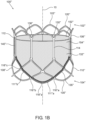
- Figs. 1A and 1B show perspective views of two exemplary types of a prosthetic valve 100, according to some embodiments. It will be appreciated that reference numerals with prime marks (') or double prime marks (") are used throughout Figs. 1A-1B to denote different embodiments of the same elements. Embodiments of the disclosed devices and systems may include any combination of different embodiments of the same elements. Specifically, any reference to an element without single or double prime marks may refer to any alternative embodiment of the same element denoted with a single prime mark or double prime marks.
- the prosthetic valve 100 is deliverable to a patient's target site over a catheter (not shown), and is radially expandable and compressible between a radially compressed, or crimped, configuration, and a radially expanded configuration- shown in Figs. 1A-1B .
- the expanded configuration may include a range of diameters to which the valve 100 may expand, between the compressed configuration and a maximal diameter reached at a fully expanded configuration.
- a plurality of partially expanded configurations may relate to any expansion diameter between radially compressed or crimped configuration, and maximally expanded configuration.
- a prosthetic valve 100 of the current disclosure may include any prosthetic valve configured to be mounted within the native aortic valve, the native mitral valve, the native pulmonary valve, and the native tricuspid valve.
- a prosthetic valve 100 can be delivered to the site of implantation via a delivery assembly carrying the valve 100 in a radially compressed or crimped configuration, toward the target site, to be mounted against the native anatomy, by expanding the valve 100 via various expansion mechanisms.
- Fig. 1A shows an exemplary mechanically expandable valve 100', wherein all reference numerals with prime marks (') shown in Fig. 1A refer to like elements comprised within a mechanically expandable valve.
- Mechanically expandable valves are a category of prosthetic valves that rely on a mechanical actuation mechanism for expansion.
- the mechanical actuation mechanism usually includes a plurality of actuator assemblies, releasably coupled to respective actuation arm assemblies of the delivery apparatus, controlled via a handle of the delivery apparatus for actuating the actuator assemblies to expand the prosthetic valve to a desired diameter.
- Fig. 1B shows an exemplary balloon expandable valve 100", wherein all reference numerals with double prime marks (") shown in Fig. 1B refer to like elements comprised within a balloon expandable valve.
- Balloon expandable valves generally involve a procedure of inflating a balloon within a prosthetic valve, thereby expanding the prosthetic valve 100 within the desired implantation site. Once the valve is sufficiently expanded, the balloon is deflated and retrieved along with the delivery apparatus. While mechanically expandable valves 100' and balloon expandable valves 100" are described and illustrated in conjunction with Figs. 1A-1B , it will be clear that a prosthetic valve 100 may include other expansion mechanisms, such as self-expandable valves. Self-expandable valves include a frame that is shape-set to automatically expand as soon as an outer retaining structure, such as a capsule or a portion of a shaft (not shown), is withdrawn proximally relative to the prosthetic valve.
- a prosthetic valve 100 can comprise an inflow end portion 104 defining an inflow end 105, and an outflow end portion 102 defining an outflow end 103.
- the prosthetic valve 100 can define a valve longitudinal axis 10 extending through the inflow end portion 104 and the outflow end portion 102.
- the outflow end 103 is the proximal end of the prosthetic valve 100
- the inflow end 105 is the distal end of the prosthetic valve 100.
- the outflow end can be the proximal end of the prosthetic valve
- the inflow end can be the distal end of the prosthetic valve.
- proximal generally refers to a position, direction, or portion of any device or a component of a device, which is closer to the user and further away from the implantation site.
- distal generally refers to a position, direction, or portion of any device or a component of a device, which is further away from the user and closer to the implantation site.
- outflow refers to a region of the prosthetic valve through which the blood flows through and out of the valve 100, for example between the valve longitudinal axis 10 and the outflow end 103.
- inflow refers to a region of the prosthetic valve through which the blood flows into the valve 100, for example between inflow end 105 and the valve longitudinal axis 10.
- the valve 100 comprises an annular frame 106 movable between a radially compressed configuration and a radially expanded configuration, and a leaflet assembly 130 mounted within the frame 106.
- the frame 106 can be made of various suitable materials, including plastically-deformable materials such as, but not limited to, stainless steel, a nickel based alloy (e.g., a cobalt-chromium or a nickel-cobalt-chromium alloy such as MP35N alloy), polymers, or combinations thereof.
- the frame 106 When constructed of a plastically-deformable materials, the frame 106, such as frame 106" (and thus the balloon expandable valve 100") can be crimped to a radially compressed configuration on a delivery shaft (not shown), and then expanded inside a patient by an inflatable balloon or equivalent expansion mechanism.
- the frame 106" can be made of shape-memory materials such as, but not limited to, nickel titanium alloy (e.g., Nitinol).
- the frame 106 When constructed of a shape-memory material, the frame 106, such as frame 106' (and thus the mechanically expandable valve 100') can be crimped to a radially compressed configuration and restrained in the compressed configuration by insertion into a shaft or equivalent mechanism of a delivery apparatus (not shown).
- the frame 106 is an annular, stent-like structure comprising a plurality of intersecting struts 110.
- strut encompasses vertical struts, angled struts, attachment posts, commissure windows, and any similar structures described by U.S. Pat. Nos. 7,993,394 and 9,393 110 .
- a strut 110 may be any elongated member or portion of the frame 106.
- the frame 106 can have one or more multiple rows of cells 108 defined by intersecting struts 110.
- the frame 106 can have a cylindrical or substantially cylindrical shape having a constant diameter from an inflow end 105 to an outflow end 103 of the frame as shown, or the frame can vary in diameter along the height of the frame, as disclosed in US Pat. No. 9,155,6 19 .
- the end portions of the struts 110 are forming apices 120 at the outflow end 103 and apices 118 at the inflow end 105.
- the struts 110 can intersect at additional non-apical junctions 116 formed between the outflow apices 120 and the inflow apices 118.
- the non-apical junctions 116 can be equally or unequally spaced apart from each other, and/or from the apices 120, 118, between the outflow end 103 and the inflow end 105.
- the struts 110 are arranged in a lattice-type pattern.
- the struts 110' are positioned diagonally, or offset at an angle relative to, and radially offset from, the valve longitudinal axis 10, when the valve 100' is in an expanded position. It will be clear that the struts 110' can be offset by other angles than those shown in Fig 1B , such as being oriented substantially parallel to the valve longitudinal axis 10.
- the struts 110 include a plurality of angled struts and vertical struts.
- the frame 106" comprises a plurality of angled struts 110", and axially extending struts 114.
- the struts are not necessarily coupled to each other via respective hinges, but are otherwise pivotable or bendable relative to each other, so as to permit frame expansion or compression.
- the frame 106" can be formed from a single piece of material, such as a metal tube, via various processes such as, but not limited to, laser cutting, electroforming, and/or physical vapor deposition, while retaining the ability to collapse/expand radially in the absence of hinges and like.
- the leaflet assembly 130 comprises a plurality of leaflets 132 (e.g., three leaflets), positioned at least partially within the frame 106, and configured to regulate flow of blood through the prosthetic valve 100 from the inflow end 105 to the outflow end 103. While three leaflets 132 arranged to collapse in a tricuspid arrangement, are shown in the exemplary embodiment illustrated in Figs. 1A-1B , it will be clear that a prosthetic valve 100 can include any other number of leaflets 132.
- the leaflets 132 are made of a flexible material, derived from biological materials (e.g., bovine pericardium or pericardium from other sources), biocompatible synthetic materials, or other suitable materials as known in the art and described, for example, in U.S. Pat. Nos. 6,730,118 , 6,767,362 and 6,908,481 .
- the lower edge of the resulting leaflet assembly 130 desirably has an undulating, curved scalloped shape.
- stresses on the leaflets 132 are reduced which, in turn, improves durability of the valve.
- folds and ripples at the belly of each leaflet which can cause early calcification in those areas, can be eliminated or at least minimized.
- the scalloped geometry also reduces the amount of tissue material used to form the leaflet structure, thereby allowing a smaller, more even crimped profile at the inflow end of the valve.
- the actuator assemblies 122 can further serve as commissure posts, to which commissures 140 of the leaflet assembly 130 can be coupled. Details regarding the structure and operation of mechanically expandable valves and delivery system thereof are described in US Patent No. 9,827,093 , U.S. Patent Application Publication Nos. 2019/0060057 , 2018/0153689 and 2018/0344456 , and US Patent Application Nos. 62/870,372 and 62/776,348 .
- the upper row of cells comprises a plurality of axially extending window frame portions 112 (which define commissure windows) and a plurality of axially extending struts 114.
- Each axial strut 114 and each window frame portion 112 extends from a junction 116" defined by the convergence of the lower ends of two angled struts 110" to another junction 116" defined by the convergence of the upper ends of two angled struts 110".
- Each commissure window frame portion 112 mounts a respective commissure 140 of the leaflet structure 130.
- Additional frame configurations may include commissure posts attached to the frame, configured to accept commissures 140 extending either through window portions defined therein, or supporting commissure attachment thereto in various other manners.
- some of the cells 108 may be configured to receive commissures 140 attached thereto.
- the uppermost row of cells 108 can be configured to receive tabs 138 of the leaflets 132.
- prosthetic valves including the manner in which commissures may be mounted to their frames, are described in U.S. Patent Nos. 6,730,118 , 7,393,360 , 7,510,575 , 7,993,394 , 8,252,202 , and 9,393,110 ; U.S. Publication Nos.
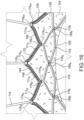
- the prosthetic valve 100 can further comprise a skirt 123, such as an outer skirt 124 (shown for example in Figs. 15 and 17 ) mounted on the outer surface of the frame 106, configure to function, for example, as a sealing member retained between the frame 106 and the surrounding tissue of the native annulus against which the prosthetic valve 100 is mounted, thereby reducing risk of paravalvular leakage past the prosthetic valve 100.
- a skirt 123 such as an outer skirt 124 (shown for example in Figs. 15 and 17 ) mounted on the outer surface of the frame 106, configure to function, for example, as a sealing member retained between the frame 106 and the surrounding tissue of the native annulus against which the prosthetic valve 100 is mounted, thereby reducing risk of paravalvular leakage past the prosthetic valve 100.
- Such an outer skirt can be made of various suitable biocompatible materials, such as, but not limited to, various synthetic materials (e.g., PET) or natural tissue (e.g. pericardial tissue).
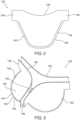
- a primary suture 144 is threaded through the cusp end portion 134 in an in-and-out pattern, also known in the art as a running stitch pattern.
- Fig. 3 shows primary sutures 144 stitched along the cusp end portions 134 of the leaflets 132.
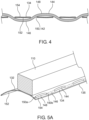
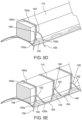
- Fig. 4 shows an enlarged sectional view through a cusp end portion 134 and the primary suture 144 threaded there-through.
- a technique for coupling a leaflet 132 along its cusp end portion 134 to at least one section of at least one strut 110 of a frame 106 will now be discussed in accordance with the present teachings.
- the cusp end portion 134 with the primary suture threaded there-through in an in-and-out pattern, is approximated to a strut 110, such that the cusp end portion 134 is preferably positioned radially inward (and optionally in contact with) the inner side of the strut 110.
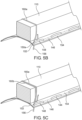
- a secondary suture 156 is stitched through the primary suture 144 and around at least one section of at least one strut 110, wherein the secondary suture 156 comprises a plurality of self-tightening constructs 158.
- Each self-tightening construct 158 includes at least one loop configured to constrict under tension around the strut 110.
- strut 110 is shown to have a rectangular cross-section in Figs. 5A-5E , it will be clear that this is merely for illustrative purpose, and that the cross-section of a strut 110 can have a rounded, circular, having a polygonal shape, have an irregular shape, or have a shape that changes along the length of the strut.
- the cross-sections of the struts can also remain the same shape, but change size along the length of the strut.
- a self-tightening construct 158 is formed by threading the secondary suture 156 radially outward through the primary suture 144 at penetration point 150a, and forming at least one loop 160 around the strut, such as loop 160a shown in Fig. 5B .
- the self-tightening construct 158 includes more than one loop 160 around the strut 110.
- the secondary suture may be looped again to form a second loop 160b around the strut 110 as shown in Fig. 5C .
- the self-tightening construct 158 can include, in alternative variations, any other number of loops.
- the secondary suture 156 is then passed under the at least one loop 160, such as between both loops 160a, 160b and the strut 110, to form a generally horseshoe-shaped, or u-shaped section 162, which is threaded thereafter through the primary suture 144 in a radially inward direction at penetration point 150b.
- the resulting self-tightening construct 158 is defined between two penetrations points 150 that define at least one outer stitch portion 148 there-between.
- the secondary suture 156 further comprises a plurality of suture pull portions 164 extending over the leaflet inner surface 152, and may be defined between consecutive self-tightening constructs 158.
- a suture pull portion 164 of the secondary suture 156 is defined by extending the secondary suture 156 over the leaflet inner surface 152, for example - in parallel to at least one inner stitch portion 146, and then threading the secondary suture 156 once again through the primary suture 144 in a radially-outward direction, at a consecutive penetration point 150c, at which point another self-tightening construct 158 can be formed in a similar manner.
- Fig. 5E shows a section of a stitch pattern that includes three exemplary self-tightening constructs 158.
- the self-tightening constructs 158 are configured to tighten their grip on the leaflets 132 the more their cusp end portions 134 are pulled radially inward.
- the leaflets 132 collapse radially inward to effectively close the prosthetic valve. This collapse exerts pull forces oriented radially inward in the cusp end portions 134, which tend to pull the suture pull portions 164 radially inward therewith.
- the suture pull portions 164 disposed over the leaflet inner surfaces 152, pull the tails on both sides of each self-tightening construct 158 there-along, which causes the at least one loop 160 to constrict about the strut 110.
- the primary suture 144 which is threaded in an in-and-out pattern through the cusp end portion 134, may serve as a pledget or cushion between the secondary suture 156 and the leaflet 132.
- the suture pull portion 164 disposed over the leaflet inner surface 152, may be pressed during the repetitive systolic and diastolic cycles against the inner stitch portions 146 of the primary suture 144, which serves as a pledget or cushion so as to prevent direct abrasion that may be otherwise applied to the leaflet 132.
- the secondary suture 156 (as well as secondary suture 170 that will be described further down below) can include ultra-high-molecular-weight polyethylene (UHMwPE), such as a FORCE FIBER ® suture (Teleflex, Wayne, Pa) or DYNEEMA ® fiber (Koninklijke DSM, the Netherlands), among other types of sutures.
- UHMwPE ultra-high-molecular-weight polyethylene
- FORCE FIBER ® suture Teleflex, Wayne, Pa
- DYNEEMA ® fiber Koninklijke DSM, the Netherlands
- the diameter of the secondary suture 156 is sufficiently smaller than that of the primary suture 144, so that threading the secondary suture 156 through the primary suture 144 does not tear or disrupt the primary suture 144.
- a ratio of the diameter of the secondary suture 156 to the diameter of the primary suture 144 is defined as the secondary to primary sutures diameter ratio.
- the secondary to primary sutures diameter ratio is less than 0.8.
- the secondary to primary sutures diameter ratio is less than 0.5.
- the secondary to primary sutures diameter ratio is less than 0.3.
- an inner skirt is attached to an inner surface of the frame, so as to form a more suitable attachment surface for the leaflets.
- the currently disclosed attachment configuration does not require utilization of intermediate fabric strips, since the primary suture 144 serves as a support structure through which the leaflet 132 may be attached to the frame 106, via a secondary suture 156 threaded through the primary suture 144.
- Fabric strips along the inner surface of the frame 106 pose a risk of promoting tissue ingrowth and proliferation after implantation.
- the absence of such fabric or cloth components along the inner side of the frame may significantly reduce such risks, thereby improving the valve's long-term durability and functionality.
- leaflet attachment to the frame of a prosthetic valve along the scalloped edge of the leaflets is devoid of intermediate fabric strips and/or cloth there-between. While tissue ingrowth may still occur along suture materials, such as the primary suture 144, the overall surface area of a suture is significantly smaller than that of traditionally used fabric strips that serve, for example, as inner skirt components.
- the attachment of the leaflets 132 to the struts 110 of the frame 106 is achieved via the secondary suture 156, which is threaded through the primary suture 144 instead of being threaded directly through the leaflet material.
- the primary suture 144 serves as a reinforcement member that resists suture tear-through along the cusp end portions 134, thereby reducing stress concentrations on the leaflets 132 in the vicinity of the scallop line.
- the forces applied to the leaflets 132 during transitioning between the open and closed or coapting states, at the regions of leaflets attachment to the frame are distributed along the length of the primary sutures 144.
- the primary suture 144 serves as a force-distributing element which enhances the durability of the leaflets 132 over time, because the forces are distributed over the primary suture 144 in a substantially equal manner along its length.
- the leaflet 132 can be provided, in some embodiments, with a series of apertures 142 pre-formed along its cusp end portion 134, configured to accept the primary suture 144 and define penetration points 150 through which it may extend in an in-and-out pattern.
- the apertures 142 may serve as the penetration points 150.
- the apertures 142 can be equally spaced from each other in some embodiments.
- the secondary suture 156 is threaded through the primary suture 144 at the penetration points 150, potentially within the apertures 142. According to some embodiments, the secondary suture 156 extends through the primary suture 144 at each penetration point 150. Alternatively, the secondary suture 156 may extend through only some of the penetration points 150, as will be further disclosed herein below.
- the primary suture 144 is threaded through pre-formed apertures 142 along the cusp end portion 134, accuracy of the penetration points 150 for the primary and/or secondary suture 144 and/or 156, respectively, can be pre-set, leading to more accurate placement of the sutures and less errors.
- the apertures 142 are dimensioned to accept the primary suture 144.
- the diameter of the apertures 142 is equal to or smaller than the diameter of the primary suture 144, such that when the primary suture 144 is pass there-through, each aperture 142 tightly retains the primary suture 144 extending there-through.
- the secondary suture 156 extends the boundaries the primary suture 144 at the penetration zones outward, alternative embodiments may include apertures 142 having a diameter that is equal to or smaller than the combined diameters of the primary suture 144 and the secondary suture 156, such that when the secondary suture 156 extends through the primary suture 144 within the aperture 142, the aperture 142 tightly retains them both therein.
- the cusp end portions 134 include markings that may follow the undulating scallop line, such as by tracking the curvature of the cusp edges 135. Such markings, which may be utilized either alternatively to, or in addition to, apertures 142, can further assist the assembler in stitching of the primary suture 144 there-along.
- the secondary suture 156 is threaded through all successive penetration points 150, such that each self-tightening construct 158 is positioned over a single outer stitch portion 148, and each suture pull portion 164 spans over a length of a single inner stitch portion 146.
- the secondary suture 156 is not necessarily threaded through all successive penetration points 150, and may actually skip over one or more penetration point 150, such that a single suture pull portion 164 may span over more than one inner 146 or outer 148 stitch portions.
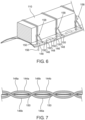
- Fig. 6 shows an exemplary configuration in which each self-tightening construct 158 is positioned over a single outer stitch portion 148, while the suture pull portion 164 spans over two inner stitch portions 146 and a single outer stitch portion 148 positioned there-between. It will be understood that other configurations are contemplated, wherein either the self-tightening construct 158 and/or the suture pull portion 164 is threaded through non-successive penetration points 150.
- non-successive penetration points refers to any couple of penetration points that include at least one additional penetration point 150 there-between.
- the self-tightening configuration of the secondary suture 156 enables it to be threaded through non-successive penetrations points 150, while retaining a sufficient grip to prevent or at least significantly reduce lateral movement of the cusp end portions 134 over the struts 110.
- the number and position of the self-tightening constructs 158 can be designed and modified in various different manners, based on the desired attachment points, and to facilitate easier attachment by an assembler of the valve 100.
- two primary sutures 144 are inversely threaded in an in-and-out pattern, through the same penetration points 150.
- Fig. 7 shows a sectional view of a cusp end portion 134 which is similar to the view shown in Fig. 4 , except that two primary sutures 144a and 144b are threaded in opposite directions, through the same penetration points 150, such that each couple of successive penetration points 150 define both an inner stitch portion 146 of one of the primary sutures, and an outer stitch portion 148 of the other primary suture.
- Fig. 8 shows a secondary suture 156 threaded through a cusp end portion 134 that includes two primary sutures 144 as shown in Fig. 7 .
- this configuration results in a pattern in which an outer stitch portion 148 and an inner stitch portion 146 extend between each couple of successive penetration points 150, thereby simplifying the assembly procedure by allowing the assembler to thread the secondary suture 156 through any penetration points 150 conveniently available during such a procedure.
- the diameter of the apertures 142 is equal to or smaller than the diameter of two primary sutures 144, such that when both primary sutures 144 extend there-through, each aperture 142 tightly retains them both. Since the secondary suture 156 extends the boundaries of at least one of the primary sutures 144 at the penetration zones outward, alternative embodiments may include apertures 142 having a diameter that is equal to or smaller than the combined diameters of two primary suture 144 and the secondary suture 156.
- threading sutures through a leaflet 132 involves using a needle or other sharp tool that can pierce through leaflet 132.
- a needle or other sharp tools might lead to unintended cuts, punctures, or other damage to the leaflets 132. Such damage is also difficult to foresee or predict by the manufacturer, and can also be difficult to detect by the end user even when it occurs.
- the primary suture 144 is threaded in an in-and-out manner through penetration points 150, that also serve as the penetration sites through which the secondary suture 156 is threaded.
- penetration points 150 that also serve as the penetration sites through which the secondary suture 156 is threaded.
- the proposed arrangement enables utilization of a secondary suture 156 to attach the leaflet 132 to the struts of the frame, without further puncturing the tissue of the leaflet, thereby improving the leaflets' long-term durability.
- a stitching pattern that includes self-tightening constructs 158 for directly attaching leaflets 132 to the struts 110 of the frame 106, according to any of the embodiments described above, can be implemented for any type of prosthetic valves 100, such as either mechanically expandable valves 100' or balloon expandable valves 100".
- the advantage of self-tightening constructs 158 is more prominent for mechanically expandable valve 100' of the type illustrated in Fig. 1A , shown to include two layers of intersecting struts 110', namely inner struts and outer struts, that intersect (for example, via pins or other hinges) at the junctions 116'.
- a unique challenge with such double-layered frames 106' is the difficulty to form knots of the sutures at the pivot junctions 116', as relative movement between the intersecting struts 110' can exert scissor-like shearing forces that may compromise the integrity of the sutures in such regions.
- frames of prosthetic valve formed with a unitary frame such as the frame 106" of balloon expandable valves 100" shown, for example, in Fig. 1B
- stitching pattern utilized to directly couple leaflets 132 to such frames 106" can include knot formed around non-apical junctions 116" in a manner that will preserve tight attachment there-between, without necessarily utilizing self-tightening constructs.
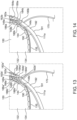
- FIGs. 9A-9D an exemplary technique for coupling leaflets 132 along their cusp end portions 134 to strut sections 111 interconnected at non-apical junctions 116 will now be discussed in accordance with the present teachings.
- the views illustrated in Figs. 9A-9D are taken from a bottom view point of a section of a prosthetic valve, such as a section of prosthetic valve 100".
- a strut section 111 refers to any section of a strut defined between two non-apical junctions 116 of a frame 106.
- the frame 106" of the exemplary balloon expandable valve 100" illustrated in Fig. 1B is shown to include flat inflow apices 118" (as well as flat outflow apices 120").
- a strut section can be either a relatively linear strut section, such as strut section 111"b shown in Fig.
- the peak of the curvature of a curved strut section can define an apex, such as inflow apex 118"a defined by curved strut section 111"a.
- each strut section 111 and each non-apical junction 116 is defined between opposite axial sides and opposite radial sides.
- each strut section 111 is defined between a strut proximal side 190 facing the outflow end 103, and a strut distal side 191 facing the inflow end 105 (sides 190 and 191 being the opposite axial sides of the strut section).
- Each strut section 111 is also defined between a strut inner side 192 facing the valve longitudinal axis 10, and a strut outer side 193 facing away from the axis 10 (sides 192 and 193 being the opposite radial sides of the strut section).
- each of the sides 190, 191, 192, 193 can be defined by a corresponding planar face of the strut. Nevertheless, as mentioned above, other cross-sectional shapes for the struts are contemplated, such that a side may not necessarily include a planar face.
- Each non-apical junction 116 is defined between a junction proximal side 194 facing the outflow end 103, and a junction distal side 195 facing the inflow end 105 (sides 194 and 195 being the opposite axial sides of the junction).
- Each non-apical junction 116 is similarly defined between a junction inner side 196 facing the valve longitudinal axis 10, and a junction outer side 197 facing away from the axis 10 (sides 196 and 197 being the opposite radial sides of the junction).
- Each junction is also defined between two opposite lateral sides, namely a junction first lateral side 198 and a junction second lateral side 199.
- two strut sections 111 converge on each lateral side of a non-apical junction 116.
- a primary suture 144 can be threaded through the cusp end portions 134 in an in-and-out pattern, in the same manner described above in conjunction with Fig. 4 .
- two primary sutures 144a and 144b are threaded in opposite direction through penetration point 150, in a similar manner to that described above in conjunction with Fig. 8 .
- any reference to a primary suture described below in conjunction with Figs. 9A-10 can refer either to a configuration of a single primary suture or to two oppositely threaded sutures, with equal force.
- the cusp end portion 134 As shown in Figs. 9A-B , the cusp end portion 134, with the primary suture 144 threaded there-through in an in-and-out pattern, is approximated to a strut section 111, such that the cusp end portion 134 is preferably positioned radially inward (and optionally in contact with) the strut inner side 192.
- a secondary suture 170 is stitched through the primary suture 144 and around the strut section 111 in a manner that forms a series of loops or whip stitches 172 spaced from each other along the length of the strut section 111.
- the secondary suture 170 can be similar to any embodiment of the secondary suture 156, except that the secondary suture 170 does not form self-tightening constructs 158, but rather wraps around at least one strut section 111 by a series of whip stitches and includes at least one junction lock-knot 174 around at least one non-apical junction 116, as will be described in greater detail below.
- a whip stitch 172 is formed by threading the secondary suture 170 through the primary suture 144 at a penetration point 150, extending the secondary suture 170 around the strut section 111 and back toward the primary suture 144, and then threading secondary suture 170 once again through the primary suture 144 at a consecutive penetration point 150, at which point another whip stitch can be formed in a similar manner.
- whip stitch 172b shown in Fig. 9B is formed by threading the secondary suture 170 radially outward through the primary suture 144 at penetration point 150 (shown in Fig. 9B between loops 172a and 172b), extending it around the strut segment 111 (in the illustrated example, radially outward over the strut proximal side 190, then along the strut outer side 193 which is hidden from view, and radially inward over the strut distal side 195) back (along strut inner side 192) toward the primary suture 144, threading it through the next sequential penetration point 150 to form the next whip stitch 172c in a similar manner.
- the primary suture 144 is positioned proximal or adjacent to the strut proximal side 191.
- An angled whip stitch can be defined as a stitch having at least one portion extending between opposite sides of the strut section 111, oriented at a nonperpendicular angle with respect to a strut section axis defined as tangent to the strut section 111 at the region of the respective stitch.
- the portion extending along the strut distal side 191 between the strut outer side 193 and the strut inner side 192, and the portion extending along the strut inner side 192 (optionally at least partly over the leaflet inner surface 152) between the strut distal side 191 and the strut proximal side 190, are oriented at a nonperpendicular angle relative to a strut section axis which is tangent to the strut 111a at the region of whip stitch 172b.
- each angled whip stitch 172 has a portion extending over one axial side of the strut section 111 wrapped thereby, closer to a junction 116 (at the end of the respective strut section) than the opposite portion extending over the opposite axial side of the strut section.
- the portions of whip stitches 172 extending over the proximal side 190 of strut section 111a are closer to junction 116b than the opposite portions extending over the strut distal side 191.
- an opposite orientation of the whip stitches 172 can include the portions extending over the strut distal side 191 being closer to such a junction 116 than the portions extending over the strut proximal side 190.
- a series of whip stitches 172 wrapped over a single strut section 111 defined between two junction 116 will generally follow the same angled orientation.
- the diameter of the secondary suture 170 is sufficiently smaller than that of the primary suture 144, so that threading the secondary suture 170 through the primary suture 144 does not tear or disrupt the primary suture 144.
- a secondary to primary sutures diameter ratio with respect to secondary sutures 170 can be defined in the same manner described above with respect to secondary sutures 156.
- the secondary to primary sutures diameter ratio is less than 0.8.
- the secondary to primary sutures diameter ratio is less than 0.5.
- the secondary to primary sutures diameter ratio is less than 0.3.
- a series of angled whip stitches 172 (such as stitches 172a, 172b, 172c), up to a final whip stitch 172n defined as the whip stitch which is closest to the non-apical junction 116 on an end of the strut section 111 (junction 116b in Fig. 9B ), wherein the final whip stitch 172n extends up to a final penetration point 150n, after which the secondary suture 170 is utilized to form a junction lock-knot 174 over the corresponding non-apical junction 116.
- a series of angled whip stitches 172 such as stitches 172a, 172b, 172c
- a final whip stitch 172n defined as the whip stitch which is closest to the non-apical junction 116 on an end of the strut section 111 (junction 116b in Fig. 9B )
- the final whip stitch 172n extends up to a final penetration point 150n, after which the secondary suture 170 is utilized to form a junction lock-knot
- a junction lock-knot 174 includes a transition section 176, a first loop 178 and a second loop 180.
- the transition section 176 extends along one axial side of the junction 116, in a direction from the junction first lateral side 198 to the junction second lateral side 199.
- the secondary suture 170 extend over the outer side 193 of strut section 111a from the final penetration point 150n at the strut proximal side 190 to the strut distal side 191, in proximity of the first lateral side 198 of junction 116b.
- the transition section 176 is then formed by extending the secondary suture 170 along the junction distal side 195 in a diagonal direction, such as radially inward from the junction outer side 197 toward the junction inner side 196 and laterally from the junction first lateral side 198 to the junction second lateral side 199.
- the first loop 178 is then formed by extending the secondary suture 170 around a strut section 111 extending from the junction second lateral side 199. Struts sections 111b and 111m are shown to extend from the second lateral side 199 of junction 116b. In the example illustrated in Figs. 9B-C , the first loop 178 is formed by extending the secondary suture 170 from the transition section 176 around strut section 111m.
- the second loop 180 is formed by passing the tail of the secondary suture 170 from the first loop 178, between the transition section 176 and the junction 116, and then looping it back to extend through the first loop 178.
- the secondary suture 170 extending from the first loop 178, is passed, for example in an axial direction (e.g., upward toward outflow end 103), and is then folded over itself backward (e.g., in the distal/downward direction), passing through the first loop 178.
- the tail of the secondary suture is then forcibly pulled to tighten both loops 178, 180 and lock the resulting knot 174.
- the procedure can then be repeated by forming a series of whip stitches 172 attaching the leaflet 132 to the subsequent strut section 111 extending from the junction 116, such as strut section 111b, and forming similar junction lock-knots 174 over all respective junction 116 along the path of the rounded cusp end portions 134.
- this type of stitching pattern facilitates the valve assembly procedure because the knots 174 around the junctions 116 maintain a tight connection between the leaflets and the junctions during assembly.
- the junction lock-knots 174 will maintain tight connection of all whip stitches 172 around the strut section 111 leading to the respective junction 116, relieving the assembler from the need to keep all previous stitches tensioned, and even allowing continuation of the assembly procedure at a later time without the risk of any of the previous loops of knots being loosened.
- the tight connection of the knot 174 keeps all whip stitches 172 along the strut section 111 leading thereto, tightly connected to the strut section 111 as well, thereby reducing relative motion between the suture 170 and strut sections 111 under normal operation of the valve 100 after implantation.
- junction lock-knot 174 also separates between the series of whip stitches 172 around the strut sections 111 extending from both sides of the junction 116.
- the orientation of angled whip stitches 172 formed subsequent to junction lock-knot 174 are not dependent on the configuration of the whip stitches 172 leading to the knot 174, and in fact can have a similar or different angular orientation, as well as similar or different stitching density, and so on. This allows the assembler to switch the angular orientation of angled whip stitched in any desired direction that may be convenient during the assembly procedure, which may differ for different strut portion 111 along the circumference of the valve 100.
- Fig. 10 shows an example of a portion of a leaflet assembly 130 sutured to the frame 106 (view is from the inside of the valve). As shown, the procedure can be repeated to attach one or more other leaflets 132 to strut sections 111 and junction 116, including formation of similar junction lock-knots 174 around junctions 116 that interconnect two adjacent leaflets 132, such as junction 116d aligned with commissure 140 between leaflets 132a and 132b shown in Fig. 10 .
- the cusp end portion of leaflet 132a is sutured to strut sections 111a, 111b and 111c
- the cusp end portion of leaflet 132b is sutured to strut sections 111d, 111e and 111f.
- the angular orientation of the whip stitches 172 around strut sections 111a, 111b and 111c is generally similar (having their upper/proximal ends closer to junction 116d, for example, than their lower/distal ends).
- the orientation of the whip stitches 172 around strut sections 111d and 116e is reversed to a generally opposite direction, and as shown, after the junction lock-knot 174 around junction 116f, the orientation of the whip stitches 172 around strut section 111f is switched again (to an orientation similar to that of the whip stitches looped over struts section 111a-c).
- the ability to change the orientation of the whip stitches wrapped around each strut segment separately can facilitate the valve assembly process.
- Figs. 11A-11D show an exemplary technique for coupling leaflets 132 along their cusp end portions 134 to strut sections 111.
- the views illustrated in Figs. 11A-11D are taken from a bottom view point of a section of a prosthetic valve, such as a section of prosthetic valve 100", similar to the view angle of Figs. 9A-9D .
- a primary suture 144 can be threaded through the cusp end portions 134 in an in-and-out pattern, in the same manner described above in conjunction with Fig. 4 , forming a plurality of running stitch portions, including inners stitch portions extending over the leaflet inner surface (hidden from view) and outer stitch portions 148 extending over the leaflet outer surface 154 between penetration points 150, such as outer stitch portions 148a, 148b and 148c shown in Fig. 11A .
- two primary sutures 144a and 144b are threaded in opposite direction through penetration point 150, in a similar manner to that described above in conjunction with Fig. 8 .
- any reference to a primary suture described below in conjunction with Figs. 11A-11D can refer either to a configuration of a single primary suture or to two oppositely threaded sutures, with equal force.
- the cusp end portion 134 As shown in Fig. 11A , the cusp end portion 134, with the primary suture 144 threaded there-through in an in-and-out pattern, is approximated to a strut section 111, such that the cusp end portion 134 is preferably positioned radially inward (and optionally in contact with) the strut inner side 192.
- a secondary suture 170 is looped around the outer stitch portions 148 of the primary suture 144 and around the strut section 111 in a manner that forms a series non-penetrating whip stitches 182 spaced from each other along the length of the strut section 111.
- the secondary suture 170 can be similar to any embodiment described above in conjunction with Figs.
- the non-penetrating whip-stitch 182 is not threaded through the primary suture 144 at penetration point 150 or any other region of the primary suture 144, and does not penetrate through the leaflet from one side to the other side.
- a non-penetrating whip-stitch 182 is formed by looping the secondary suture 170 around the strut section 111, thereby forming a strut-wrapping section 184, and then looping the secondary suture around an outer stitch portion 148, thereby forming a primary-suture-wrapping section 186. This can be repeated to form a series of following non-penetrating whip stitches 182 in a similar manner along the strut section 111.
- Fig. 11A shows two non-penetration whip stitches 182a and 182b, each including a corresponding strut-wrapping section 184 and a corresponding primary-suture-wrapping section 186.
- a following non-penetration whip stitch 182c is formed by looping the tail of the secondary suture 170, extending from primary-suture-wrapping section 186b (looped around outer stitch portion 148b), around the strut section 111, and back toward the following stitch portion 148c of the primary suture 144, as shown in Fig. 11B .
- the strut-wrapping section 184c is formed by extending the secondary suture 170 across one radial side of the strut section (e.g., strut outer side 193) from one axial side to the opposite axial side of the strut (e.g., from strut proximal side 190 to strut distal side 191), folding it over the corresponding axial side of the strut (e.g., over strut distal side 191), and extending it across the opposite radial side (e.g., strut inner side 192) back toward the primary suture 144 (e.g., from strut distal side 191 toward strut proximal side 190).
- the primary suture 144 e.g., from strut distal side 191 toward strut proximal side 190.
- the secondary suture 170 is then passed beneath the consecutive outer stitch portion 148c, between the outer stitch portion and the leaflet 132 (i.e., between outer stitch portion 148 and leaflet inner surface 152).
- the secondary suture 170 is then folded over outer stitch portion 148c, thereby forming primary-suture-wrapping section 186c.
- the suture can then pass across the strut section 111 (such as across strut outer side 193 toward strut distal side 191 in the example illustrated in Fig. 11C ), repeating these steps to form a following non-penetration whip stitch 182 (such as non-penetration whip stitch 182d).
- this procedure can be repeated up to a final non-penetration whip stitch 182n defined as the whip stitch which is closest to the non-apical junction 116 on an end of the strut section 111, wherein the secondary suture 170 can be utilized to form a junction lock-knot 174 following the same steps described above in conjunction with Figs. 9A-9D , with the exception that the transition zone 176 of the junction lock-knot 174 extends from the final primary-suture-wrapping section 186n of the final non-penetration whip stitch 182n, instead of from a final penetration point 150n.
- Figs. 12A-12D shows another exemplary technique for coupling leaflets 132 along their cusp end portions 134 to strut sections 111 via a series of non-penetrating whip stitches 182, which can be identical to the technique described in conjunction with figs. 11A-11D , except that instead of passing the secondary suture 170 extending from a strut-wrapping section 184 beneath an outer stitch portion 148 and then folding it over the outer stitch portion 148, to form the primary-suture-wrapping section 186 (as shown in Figs. 11B-11C ), the secondary suture 170 is passed over the outer stitch portion 148 (see Fig.
- Fig. 13 shows another stitching configuration which is similar to that shown in Figs. 12A-12D , except that two non-penetration whip stitches 182 pass through each outer stitch portion 148.
- non-penetrating whip stitch 182a' comprises strut-wrapping section 184a' looped around strut section 111, and primary-suture-wrapping section 186a' extending therefrom and looped around outer stitch portion 148a.
- the secondary suture 170 then extends to form strut wrapping section 184a" of non-penetrating whip stitch 182a", and primary-suture-wrapping section 186a' looped around the same outer stitch portion 148a.
- the secondary suture 170 then extends to form subsequent non-penetrating whip stitches 182b' and 182b" in a similar manner, having their primary-suture-wrapping sections 186b' and 186b" looped around outer stitch portion 148b. It is to be understood that while two non-penetration whip stitches 182 passing through a single outer stitch portion 148 are illustrated in Fig. 13 , any other number of non-penetration whip stitches 182 can pass through any single outer stitch portion 148 in a similar manner.
- Fig. 14 shows yet another stitching configuration which is also similar to that shown in Figs. 12A-12D , except that each non-penetrating whip stitch 182 further includes a strut-looping section 185 extending from the respective primary-suture-wrapping section 186, looped solely over the strut section 111.
- non-penetrating whip stitch 182a comprises strut-wrapping section 184a looped around strut section 111, primary-suture-wrapping section 186a extending therefrom and looped around outer stitch portion 148a, and strut-looping section 185a extending from the primary-suture-wrapping section 186a and looped again around the strut section.
- strut-looping section 185a is formed by extending the secondary suture 170 from the primary-suture-wrapping section 186a across one radial side of the strut section, such as strut outer side 193, around the strut distal side 191, over the other radial side, such as strut inner side 192, toward and over the strut proximal side 190.
- the secondary suture is then extended to form the strut-wrapping section 184b, primary-suture-wrapping section 186b, and strut-looping section 185b, together forming the subsequent non-penetrating whip stitch 182b in a similar manner.
- a non-penetrating whip stitch 182 can similarly include a plurality of single strut-looping sections 185 looped one after the other around the strut section 111, before forming the subsequent non-penetrating whip stitch 182.
- any primary-suture-wrapping section 186 can be looped around any running stitch portion, including around inner stitch portion 146 of the primary suture 144.
- the cusp end portion 134 can be folded over itself such that the cusp edge 135 is rests over the leaflet outer surface 152 facing outward, such that the outer stitch portions 148 are concealed and the inner stitch portions 146 are facing the strut sections 111.
- the non-penetration whip stitches can be formed in the same manner described above, except that the secondary suture is looped around the inner stitch portions 146 instead of around the outer stitch portions.
- attachment of a leaflet 132 along its rounded cusp end portion 134 to one or more strut section 111 can include a combination of one or more single non-penetrating whip stitches 182 passing through corresponding running stitch portions (as illustrated in Figs. 12A-12D ), together with one or more double non-penetrating whip stitches 182 passing through corresponding single running stitch portions (as illustrated in Fig. 13 ), and/or together with one or more single non-penetrating whip stitches 182 looped twice around the strut section 111 (as illustrated in Fig. 14 ).
- Single-pattern or combined-pattern configurations can be implemented along the same strut section 111, or around different strut section of the same valve.
- Attachment of the leaflets 132 to the frame 106, and more specifically, to strut section 111 of the frame 106, by non-penetrating whip stitches 182, can advantageously improve long-term durability of the leaflets and their attachment to the frame along the scalloped line, due to the reduced damage to the leaflet material resulting from the fact that the secondary suture 170 does not need to penetrate through the tissue material.
- non-penetrating whip stitches 182, with or without junction lock-knots 174 are described and illustrated above with respect to attachment of leaflets 132 to the frame 106, such attachment configurations can be similarly utilized for attachment of other soft components of the valve 100 to the frame 106, such as skirts 123 that may include any of an inner skirt (not shown) or an outer skirt 124.
- Fig. 15 shows a prosthetic valve 100 with an outer skirt 124, according to some embodiments.
- the prosthetic valve can be similar in all respects to prosthetic valve 100" described in conjunction with Fig. 1B , and in the interest of brevity will not be described further.
- a skirt 123 such as outer skirt 124 shown in Fig. 15 , extends between a skirt proximal end 128 and a skirt distal end 129, and defines a skirt inner surface 125 facing (and is at least partially in contact with) the frame 106, and an opposite skirt outer surface 126 facing away from the frame (toward the native anatomy when implanted in a patient's body).
- the proximal end of the outer skirt follows a zig-zag pattern, corresponding to a zig-zag pattern of strut section 111 to which it may be sutured.
- the skirt distal end 128 is substantially linear (for example, being straight when the skirt is flattened), meaning that it is retained at the same axial level, disposed circumferentially around the inflow end portion 104 of the valve 100.
- a primary suture 144 (one or more) is sutured along portions of the skirt 123 which are aligned with strut sections 111 of the frame 106 in an in-and-out pattern, and a secondary suture 170 (one or more) formed a plurality of non-penetrating whip stitches 182 to couple the skirt 123 to the strut section 111 of the frame 106.
- the primary suture 144 can be stitched through the skirt 123 in an in-and-out pattern according to any of the embodiments disclosed hereinabove, mutatis mutandis.
- any type of non-penetrating whip stitches 182 disclosed above with respect to attachment of leaflets 132 to struts 111 can be similarly adapted to attach the skirt 123 to struts 111 in the same manner, mutatis mutandis.
- Fig. 16 shows a partial view or the outer skirt 124 coupled to struts 111 of the frame 106 of the valve 100 shown in Fig. 15 , from a valve-internal view angle.
- the leaflet assembly 130 is omitted from view in Fig. 16 for simplicity.
- a primary suture 144 is stitched in an in-and-out pattern along the skirt proximal end 129, for example tracking its zig-zagged shape.
- the primary suture 144 can define a series of running stitch portions that include inner stitch portion 146, disposed over skirt inner surface 125, and outer skirt portion 148, disposed over skirt outer surface 126.
- non-penetrating whip stitches 182 similar to those described in conjunction with Figs. 12A-D , is illustrated in Fig. 16 , for example along strut sections 111m, 111n, 111o, and 111p, it is to be understood that the skirt can be sutured to the corresponding strut section 111 by implementing any of the suturing patterns and methods described above in conjunction with Figs. 11A-14 , mutatis mutandis.
- junction lock-knots 174 are similarly used to attach the skirt 123, such as outer skirt 124, to junctions 116 disposed between strut section 111 to which the skirt is sutured via non-penetrating whip stitches 182, such as junction lock-knots 174m, 174n, 174o, 174p and 174q formed over respective junctions 116m, 116n, 116o, 116p and 116q in the illustrated example.
- the configuration and methods of forming such junction lock-knots 174 is similar to that described hereinabove with respect to attachment of leaflets 132 to junction 116, mutatis mutandis.
- the skirt 123 is coupled to additional junctions 116, which are not necessarily disposed between strut section 111 around which non-penetrating whip stitches 182 extend, via additional knots, which are not necessarily the junction lock-knots 172 but may be implemented as other knots known in the art, as schematically shown in Fig. 16 for knots 166r, 166s and 166t around respective junctions 116r, 116s and 116t, for example.
- Fig. 17 shows another valve 100 comprising an outer skirt 124 that can be similar to the valve and skirt of Fig. 15 , except that the skirt distal end 128 is not linear but rather tracks the shape of the strut sections 111 along the inflow end portion 104 of the valve, which can be undulated or arc-shaped as illustrated in Fig. 17 , or can otherwise be zig-zagged or otherwise shaped to follow other paths defines by distal strut sections of the valve.
- Fig. 18 shows a partial view or the outer skirt 124 coupled to struts 111 of the frame 106 of the valve 100 shown in Fig. 17 , from valve-bottom-internal view angle.
- the leaflet assembly 130 is omitted from view in Fig. 18 for simplicity.
- a primary suture 144 is stitched in an in-and-out pattern along the skirt distal end 129, for example tracking its undulating shape. This can be in addition to the primary suture 144 stitched along the skirt proximal end 129, implemented in the same manner described above.
- a plurality of non-penetrating whip stitches 182 are then looped around the strut sections 111 (of the inflow end portion 104) by a series of strut-wrapping sections 184, and around running stitch portion of the primary suture 144, such as over and between inner stitch portions 146 and the skirt inner surface 125. While a specific embodiment of non-penetrating whip stitches 182, similar to those described in conjunction with Figs. 12A-D , is illustrated in Fig. 18 , for example along strut sections 111u and 111w, it is to be understood that the skirt can be sutured to the corresponding strut section 111 by implementing any of the suturing patterns and methods described above in conjunction with Figs. 11A-14 , mutatis mutandis.
- junction lock-knots 174 are similarly used to attach the outer skirt 124 to junctions 116 along the inflow end portion 104, such as junction lock-knots 174r, 174s and 174t formed around respective junctions 116r, 116s and 116t in the illustrated example, following the same configuration and methods described hereinabove with respect to attachment of leaflets 132 to junction 116, mutatis mutandis.
- the skirt 123 is attached to additional strut sections 111 disposed between the skirt proximal end 129 and skirt distal end 128 via non-penetrating whip stitches 182 in the same manner and according to all optional embodiments described above.
- primary suture 144 one or more
- a series of non-penetrating whip stitches 182, implemented according to any of the embodiments described above with respect to Figs. 11A-14 can be utilized to attached the skirt to the corresponding strut section 111, as shown for example in Fig. 18 along strut sections 111r, 111s, 111t and 111v.
- the skirt 123 such as outer skirt 124, is attached to additional junctions 116 disposed between the skirt proximal end 129 and skirt distal end 128 via junction lock-knots 174 in the same manner and according to all optional embodiments described above.
- Some valve are provided with an inner skirt (not shown) disposed around the inner surface of the frame. While outer skirts 124 are illustrated for demonstrating various attachment configurations thereof to the frames throughout Figs. 15-18 , it is to be understood that the same embodiments described above with respect to outer skirt attachment, may be implemented in a similar manner for attachment of inner skirts to the frame, mutatis mutandis.
- junction lock-knots 174 can be utilized for attachment of a skirt 123 (including any of an inner skirt or an outer skirt) to junctions 116 along any of the skirt proximal end 129, skirt distal end 128, and/or to junctions 116 disposed between the skirt proximal end 129 and skirt distal end 128 (when the skirt is attached to the frame), without the use of non-penetrating whip stitches 182 around strut sections 111.
- a skirt can be sutured to corresponding strut sections 111 along any of the skirt proximal end 129, skirt distal end 128, and/or to strut sections 111 disposed between the skirt proximal end 129 and skirt distal end 128 (when the skirt is attached to the frame) via a series of whip stitches 172 that can penetrate through the primary suture 144, with junction lock-knots 174 formed around junction 116 disposed between such strut sections 111, in the same manner and following similar methods described above in Figs. 10A-11 for attachment of leaflets 132 to the frame 106, mutatis mutandis.
Landscapes
- Health & Medical Sciences (AREA)
- Cardiology (AREA)
- Engineering & Computer Science (AREA)
- Biomedical Technology (AREA)
- Heart & Thoracic Surgery (AREA)
- Transplantation (AREA)
- Oral & Maxillofacial Surgery (AREA)
- Vascular Medicine (AREA)
- Life Sciences & Earth Sciences (AREA)
- Animal Behavior & Ethology (AREA)
- General Health & Medical Sciences (AREA)
- Public Health (AREA)
- Veterinary Medicine (AREA)
- Mechanical Engineering (AREA)
- Prostheses (AREA)
Claims (15)
- Prothetische Klappe (100; 100'; 100"), umfassend:einen Rahmen (106; 106'; 106"), der zwischen einer radial komprimierten Konfiguration und einer radial expandierten Konfiguration beweglich ist, wobei der Rahmen (106; 106'; 106") eine Vielzahl von Strebenteilen (111) umfasst, die sich an Verbindungsstellen (116) schneiden, undeine Segelanordnung (130), die innerhalb des Rahmens (106; 106'; 106") angebracht ist und eine Vielzahl von Segeln (132) umfasst, die dazu ausgelegt sind, einen Fluss durch die prothetische Klappe (100; 100'; 100") zu regulieren, wobei jedes Segel (132) einen abgerundeten Cuspenendabschnitt (135) aufweist, der eine Cuspenkante (135), eine freie Kante (136) gegenüber der Cuspenkante (135), und ein Paar von entgegengesetzt gerichteten Laschen (138), die die Cuspenkante (135) und die freie Kante (136) trennen, definiert;wobei jeder Cuspenendabschnitt (134) an zumindest einem Strebenteil (111) mit zumindest einer Primärnaht (144) befestigt ist, die dort in einem Rein-Raus-Muster hindurchgefädelt ist, und mit einer Sekundärnaht (156; 170), die eine Abfolge von nicht-durchstoßenden Peitschenstichen (172) bildet, die voneinander entlang der Länge des Strebenteils (111) beabstandet sind, wobei jeder nicht-durchstoßende Peitschenstich (172) einen um den Strebenteil (111) geschlungenen Strebenumwicklungsteil (184) und einen sich davon erstreckenden, um die Primärnaht (144) geschlungenen Primärnahtumwicklungsteil (186), der zwischen der Primärnaht (144) und dem Segel (132) hindurchgeht, umfasst.
- Prothetische Klappe (100; 100'; 100") gemäß Anspruch 1, wobei die Primärnaht (144) eine Abfolge von Vorstichabschnitten definiert, und wobei jeder Primärnahtumwicklungsteil (186) um einen entsprechenden Vorstichabschnitt geschlungen ist und sich zwischen dem Vorstichabschnitt und dem Cuspenendabschnitt (134) erstreckt; und/oder wobei die Sekundärnaht (156; 170) nicht durch das Segel (132) durchstößt.
- Prothetische Klappe (100; 100'; 100") gemäß Anspruch 1 oder 2, wobei die Sekundärnaht (156; 170) nicht durch die Primärnaht (144) durchstößt.
- Prothetische Klappe (100; 100'; 100") gemäß einem der Ansprüche 1 bis 3, wobei jede Verbindungsstelle (116) definiert ist zwischen: zwei entgegengesetzten Axialseiten, umfassend eine Verbindungsstellen-Proximalseite (194) und eine Verbindungsstellen-Distalseite (195); zwei entgegengesetzten Radialseiten umfassend eine Verbindungsstellen-Innenseite (196) und eine Verbindungsstellen-Außenseite (197); und zwei entgegengesetzten Lateralseiten umfassend eine erste Verbindungsstellen-Lateralseite (198) und eine zweite Verbindungsstellen-Lateralseite (199); wobei der Cuspenendabschnitt (134) darüber hinaus verbunden ist mit zumindest einer Verbindungsstelle (116) an einem Ende des Strebenteils durch einen Verbindungsstellen-Verriegelungsknoten (174), gebildet aus der Sekundärnaht (156; 170), und wobei der Verbindungsstellen-Verriegelungsknoten (174) dazu ausgelegt ist, eine Spannung auf der Vielzahl der nicht-durchstoßenden Peitschenstiche (172) zu erhalten, die um den entsprechenden Strebenteil (111), der zu dem ersten Verbindungsstellen-Lateralteil (198) führt, gewickelt sind.
- Prothetische Klappe (100; 100'; 100") gemäß Anspruch 4, wobei jeder Verbindungsstellen-Verriegelungsknoten (174) umfasst:einen Übergangsteil (176), der sich über eine Axialseite der Verbindungsstelle (116) in einer Richtung von der ersten Verbindungsstellen-Lateralseite (198) zu der zweiten Verbindungsstellen-Lateralseite (199) erstreckt;eine erste Schlinge (178), die sich von dem Übergangsteil (176) und um ein Strebenteil (111) erstreckt, der sich von der zweiten Verbindungsstellen-Lateralseite (199) erstreckt; undeine zweite Schlinge (180), die sich von der ersten Schlinge (178) zwischen dem Übergangsteil (176) und der Verbindungsstelle (116) erstreckt und über sich selbst gefaltet ist, um sich durch die erste Schlinge (178) zu erstrecken; insbesondere wobei sich der Übergangsteil (176) in einer Diagonalrichtung von einer Radialseite der Verbindungsstelle (116) in Richtung zu der entgegengesetzten Radialseite der Verbindungsstelle (116) sowie von einer Lateralseite der Verbindungsstelle (116) zu der entgegengesetzten Lateralseite der Verbindungsstelle (116) erstreckt.
- Prothetische Klappe (100; 100'; 100") gemäß Anspruch 5, wobei sowohl die erste Schlinge (178) als auch die zweite Schlinge (180) straff um die Verbindungsstelle (116) gespannt sind.
- Prothetische Klappe (100; 100'; 100") gemäß einem der Ansprüche 4 bis 6, wobei jede Vielzahl der nicht-durchstoßenden Peitschenstiche (172), die um einen einzelnen Strebenteil (111) gewickelt sind, angewinkelte nicht-durchstoßende Peitschenstiche (172) sind, die in der gleichen Richtung entlang der Länge des entsprechenden Strebenteils (111) orientiert sind; insbesondere wobei der Cuspenendabschnitt (134) an zumindest zwei Strebenteilen (111), die sich von beiden Lateralseiten einer ausgewählten Verbindungsstelle (116) erstrecken, durch eine Vielzahl von nicht-durchstoßenden Peitschenstichen (172) angenäht ist, die um jeden der entsprechenden Strebenteile (111) und einen Verbindungsstellen-Verriegelungsknoten (174) um die dazwischen positionierte Verbindungsstelle (116) gewickelt sind, und wobei die Vielzahl von nicht-durchstoßenden Peitschenstichen (172) um einen der Strebenteile (111) in einer Richtung entgegengesetzt zu derjenigen der Vielzahl von nicht-durchstoßenden Peitschenstiche (172), die um den anderen Strebenteil (111) gewickelt sind, angewinkelt ist.
- Prothetische Klappe (100; 100'; 100") gemäß einem der Ansprüche 1 bis 7, wobei die prothetische Klappe (100; 100'; 100") frei von Gewebestreifen und/oder Stoff ist zwischen den Cuspenendabschnitten (134) der Segel (132) und den Strebenteilen (111), an denen sie befestigt sind.
- Prothetische Klappe (100; 100'; 100"), umfassend:einen Rahmen (106; 106'; 106"), der zwischen einer radial komprimierten Konfiguration und radial expandierten Konfiguration beweglich ist, wobei der Rahmen (106; 106'; 106") eine Vielzahl von Strebenteilen (111) umfasst, die sich an Verbindungsstellen (116) schneiden;eine Segelanordnung (130), die innerhalb des Rahmens (106; 106'; 106") angebracht ist und eine Vielzahl von Segeln (132) umfasst, die dazu ausgelegt sind, einen Fluss durch die prothetische Klappe zu regulieren; undeine Schürze (123; 124), die um den Rahmen (106; 106'; 106") angeordnet ist, wobei die Schürze (123; 124) ein Schürzen-Proximalende (128) und ein Schürzen-Distalende (129) umfasst,wobei das Schürzen-Proximalende (128) zumindest an einem Strebenteil (111) durch zumindest eine Primärnaht (144) angebracht ist, die dort in einem Rein-Raus-Muster hindurchgefädelt ist, und eine Sekundärnaht (156; 170), die eine Reihe von nicht-durchstoßenden Peitschenstichen (172) bildet, die voneinander entlang der Länge des Strebenteils (111) beabstandet sind, wobei jeder nicht-durchstoßende Peitschenstich (172) einen um den Strebenteil (111) geschlungenen Strebenumwicklungsteil (184) und einen sich davon erstreckenden Primärnahtumwicklungsteil (186), der um die Primärnaht (144) geschlungen ist und zwischen der Primärnaht (144) und dem Segel (132) hindurchgeht, umfasst.
- Prothetische Klappe (100; 100'; 100") gemäß Anspruch 9, wobei die Primärnaht (144) eine Abfolge von Vorstichabschnitten definiert, und wobei jeder Primärnahtumwickelungsteil (186) um einen entsprechenden Vorstichabschnitt geschlungen ist und sich zwischen dem Vorstichabschnitt und dem Schürzen-Proximalende (128) erstreckt; und/oder wobei die Sekundärnaht (156; 170) nicht durch die Schürze (123; 124) und/oder die Primärnaht (144) durchstößt.
- Prothetische Klappe (100; 100'; 100") gemäß einem der Ansprüche 9 oder 10, wobei jede Verbindungsstelle (116) definiert ist zwischen: zwei entgegengesetzten Axialseiten umfassend eine Verbindungsstellen-Proximalseite (194) und eine Verbindungsstellen-Distalseite (195); zwei entgegengesetzten Radialseiten umfassend eine Verbindungsstellen-Innenseite (196) und eine Verbindungsstellen-Außenseite (197); und zwei entgegengesetzten Lateralseiten umfassend eine erste Verbindungsstellen-Lateralseite (198) und eine zweite Verbindungsstellen-Lateralseite (199); wobei das Schürzen-Proximalende (128) darüber hinaus mit zumindest einer Verbindungsstelle (116) an einem Ende des Strebenteils (111) durch einen aus der Sekundärnaht (156; 170) gebildeten Verbindungsstellen-Verriegelungsknoten (174) verbunden ist, und wobei der Verbindungsstellen-Verriegelungsknoten (174) dazu ausgelegt ist, eine Spannung auf der Vielzahl der nicht-durchstoßenden Peitschenstiche (172) zu erhalten, die um den entsprechenden Strebenteil (111), der zu dem ersten Verbindungsstellen-Lateralteil (198) führt, gewickelt sind.
- Prothetische Klappe (100; 100'; 100") gemäß Anspruch 11, wobei jeder Verbindungsstellen-Verriegelungsknoten (174) umfasst:einen Übergangsteil (176), der sich über eine Axialseite der Verbindungsstelle (116) in einer Richtung von der ersten Verbindungsstellen-Lateralseite (198) zu der zweiten Verbindungsstellen-Lateralseite (199) erstreckt;eine erste Schlinge (178), die sich von dem Übergangsteil (176) und um einen Strebenteil (111) erstreckt, der sich von der zweiten Verbindungsstellen-Lateralseite (199) erstreckt; undeine zweite Schlinge (180), die sich von der ersten Schlinge (178) zwischen dem Übergangsteil (176) und der Verbindungsstelle (116) erstreckt und über sich selbst gefaltet ist, um sich durch die erste Schlinge (178) zu erstrecken; insbesondere wobei sich der Übergangsteil (176) in einer Diagonalrichtung von einer Radialseite der Verbindungsstelle (116) in Richtung zu der entgegengesetzten Radialseite der Verbindungsstelle (116) sowie von einer Lateralseite der Verbindungsstelle (116) zu der entgegengesetzten Lateralseite der Verbindungsstelle (116) erstreckt.
- Prothetische Klappe (100; 100'; 100") gemäß Anspruch 12, wobei sowohl die erste Schlinge (178) als auch die zweite Schlinge (180) straff um die Verbindungsstelle (116) gespannt sind.
- Prothetische Klappe (100; 100'; 100") gemäß einem der Ansprüche 11 bis 13, wobei jede Vielzahl der nicht-durchstoßenden Peitschenstiche (172), die um einen einzelnen Strebenteil (111) gewickelt sind, angewinkelte nicht-durchstoßende Peitschenstiche (172) sind, die in der gleichen Richtung entlang der Länge des entsprechenden Strebenteils (111) orientiert sind.
- Prothetische Klappe (100; 100'; 100") gemäß Anspruch 14, wobei das Schürzen-Proximalende (128) an zumindest zwei Strebenteilen (111) angenäht ist, die sich von beiden Lateralseiten einer ausgewählten Verbindungsstelle (116) erstrecken, durch eine Vielzahl von nicht-durchstoßenden Peitschenstichen (172), die um jeden der entsprechenden Strebenteile (111) gewickelt sind, und einen Verbindungsstellen-Verriegelungsknoten (174) um die dazwischen positionierte Verbindungsstelle (116), und wobei die Vielzahl von nicht-durchstoßenden Peitschenstichen (172) um einen der Strebenteile (111) angewinkelt sind in einer Richtung entgegengesetzt zu derjenigen der Vielzahl von nicht-durchstoßenden Peitschenstiche (172), die um den anderen Strebenteil (111) gewickelt sind.
Priority Applications (1)
| Application Number | Priority Date | Filing Date | Title |
|---|---|---|---|
| EP25177652.2A EP4582061A3 (de) | 2020-07-10 | 2021-07-09 | Segel- und schürzenbefestigungskonfigurationen an den rahmen von herzklappenprothesen |
Applications Claiming Priority (3)
| Application Number | Priority Date | Filing Date | Title |
|---|---|---|---|
| US202063050657P | 2020-07-10 | 2020-07-10 | |
| US202163211417P | 2021-06-16 | 2021-06-16 | |
| PCT/US2021/041002 WO2022011209A1 (en) | 2020-07-10 | 2021-07-09 | Leaflet and skirt attachment configurations to the frames of prosthetic valves |
Related Child Applications (1)
| Application Number | Title | Priority Date | Filing Date |
|---|---|---|---|
| EP25177652.2A Division EP4582061A3 (de) | 2020-07-10 | 2021-07-09 | Segel- und schürzenbefestigungskonfigurationen an den rahmen von herzklappenprothesen |
Publications (2)
| Publication Number | Publication Date |
|---|---|
| EP4178488A1 EP4178488A1 (de) | 2023-05-17 |
| EP4178488B1 true EP4178488B1 (de) | 2025-05-21 |
Family
ID=77127122
Family Applications (2)
| Application Number | Title | Priority Date | Filing Date |
|---|---|---|---|
| EP21748770.1A Active EP4178488B1 (de) | 2020-07-10 | 2021-07-09 | Segel- und schürzenbefestigungskonfigurationen an den rahmen von herzklappenprothesen |
| EP25177652.2A Pending EP4582061A3 (de) | 2020-07-10 | 2021-07-09 | Segel- und schürzenbefestigungskonfigurationen an den rahmen von herzklappenprothesen |
Family Applications After (1)
| Application Number | Title | Priority Date | Filing Date |
|---|---|---|---|
| EP25177652.2A Pending EP4582061A3 (de) | 2020-07-10 | 2021-07-09 | Segel- und schürzenbefestigungskonfigurationen an den rahmen von herzklappenprothesen |
Country Status (6)
| Country | Link |
|---|---|
| US (2) | US12502275B2 (de) |
| EP (2) | EP4178488B1 (de) |
| JP (2) | JP7801302B2 (de) |
| CN (3) | CN113907917B (de) |
| ES (1) | ES3041700T3 (de) |
| WO (1) | WO2022011209A1 (de) |
Families Citing this family (5)
| Publication number | Priority date | Publication date | Assignee | Title |
|---|---|---|---|---|
| EP4178488B1 (de) * | 2020-07-10 | 2025-05-21 | Edwards Lifesciences Corporation | Segel- und schürzenbefestigungskonfigurationen an den rahmen von herzklappenprothesen |
| US12383395B2 (en) * | 2020-12-22 | 2025-08-12 | Medtronic, Inc. | Skirt-reinforcement members for prosthetic valve devices |
| CA3265500A1 (en) * | 2022-08-31 | 2024-03-07 | Edwards Lifesciences Corporation | ASSEMBLIES AND METHODS FOR FIXING VALVE PROSTHETIC COMPONENTS TO A CARDIAC VALVE PROSTHETIC STRUCTURE |
| CN117481870A (zh) * | 2023-12-01 | 2024-02-02 | 江苏臻亿医疗科技有限公司 | 瓣膜支架及人工瓣膜 |
| WO2026006535A1 (en) * | 2024-06-27 | 2026-01-02 | Edwards Lifesciences Corporation | Prosthetic heart valve |
Family Cites Families (319)
| Publication number | Priority date | Publication date | Assignee | Title |
|---|---|---|---|---|
| GB1127325A (en) | 1965-08-23 | 1968-09-18 | Henry Berry | Improved instrument for inserting artificial heart valves |
| US3587115A (en) | 1966-05-04 | 1971-06-28 | Donald P Shiley | Prosthetic sutureless heart valves and implant tools therefor |
| US3548417A (en) | 1967-09-05 | 1970-12-22 | Ronnie G Kischer | Heart valve having a flexible wall which rotates between open and closed positions |
| USRE30912E (en) | 1968-09-16 | 1982-04-27 | Hancock Laboratories, Inc. | Stent for heart valve |
| US3671979A (en) | 1969-09-23 | 1972-06-27 | Univ Utah | Catheter mounted artificial heart valve for implanting in close proximity to a defective natural heart valve |
| US3657744A (en) | 1970-05-08 | 1972-04-25 | Univ Minnesota | Method for fixing prosthetic implants in a living body |
| US3714671A (en) | 1970-11-30 | 1973-02-06 | Cutter Lab | Tissue-type heart valve with a graft support ring or stent |
| US3755823A (en) | 1971-04-23 | 1973-09-04 | Hancock Laboratories Inc | Flexible stent for heart valve |
| GB1402255A (en) | 1971-09-24 | 1975-08-06 | Smiths Industries Ltd | Medical or surgical devices of the kind having an inflatable balloon |
| US4035849A (en) | 1975-11-17 | 1977-07-19 | William W. Angell | Heart valve stent and process for preparing a stented heart valve prosthesis |
| CA1069652A (en) | 1976-01-09 | 1980-01-15 | Alain F. Carpentier | Supported bioprosthetic heart valve with compliant orifice ring |
| US4056854A (en) | 1976-09-28 | 1977-11-08 | The United States Of America As Represented By The Department Of Health, Education And Welfare | Aortic heart valve catheter |
| US4297749A (en) | 1977-04-25 | 1981-11-03 | Albany International Corp. | Heart valve prosthesis |
| US4265694A (en) | 1978-12-14 | 1981-05-05 | The United States Of America As Represented By The Department Of Health, Education And Welfare | Method of making unitized three leaflet heart valve |
| US4222126A (en) | 1978-12-14 | 1980-09-16 | The United States Of America As Represented By The Secretary Of The Department Of Health, Education & Welfare | Unitized three leaflet heart valve |
| US4574803A (en) | 1979-01-19 | 1986-03-11 | Karl Storz | Tissue cutter |
| GB2056023B (en) | 1979-08-06 | 1983-08-10 | Ross D N Bodnar E | Stent for a cardiac valve |
| US4373216A (en) | 1980-10-27 | 1983-02-15 | Hemex, Inc. | Heart valves having edge-guided occluders |
| US4388735A (en) | 1980-11-03 | 1983-06-21 | Shiley Inc. | Low profile prosthetic xenograft heart valve |
| US4339831A (en) | 1981-03-27 | 1982-07-20 | Medtronic, Inc. | Dynamic annulus heart valve and reconstruction ring |
| US4470157A (en) | 1981-04-27 | 1984-09-11 | Love Jack W | Tricuspid prosthetic tissue heart valve |
| US4345340A (en) | 1981-05-07 | 1982-08-24 | Vascor, Inc. | Stent for mitral/tricuspid heart valve |
| US4406022A (en) | 1981-11-16 | 1983-09-27 | Kathryn Roy | Prosthetic valve means for cardiovascular surgery |
| SE445884B (sv) | 1982-04-30 | 1986-07-28 | Medinvent Sa | Anordning for implantation av en rorformig protes |
| IT1212547B (it) | 1982-08-09 | 1989-11-30 | Iorio Domenico | Strumento di impiego chirurgico destinato a rendere piu' facili e piu' sicuri gli interventi per l'impianto di bioprotesi in organi umani |
| GB8300636D0 (en) | 1983-01-11 | 1983-02-09 | Black M M | Heart valve replacements |
| US4535483A (en) | 1983-01-17 | 1985-08-20 | Hemex, Inc. | Suture rings for heart valves |
| US4612011A (en) | 1983-07-22 | 1986-09-16 | Hans Kautzky | Central occluder semi-biological heart valve |
| US4787899A (en) | 1983-12-09 | 1988-11-29 | Lazarus Harrison M | Intraluminal graft device, system and method |
| US4627436A (en) | 1984-03-01 | 1986-12-09 | Innoventions Biomedical Inc. | Angioplasty catheter and method for use thereof |
| US4592340A (en) | 1984-05-02 | 1986-06-03 | Boyles Paul W | Artificial catheter means |
| US5007896A (en) | 1988-12-19 | 1991-04-16 | Surgical Systems & Instruments, Inc. | Rotary-catheter for atherectomy |
| US4883458A (en) | 1987-02-24 | 1989-11-28 | Surgical Systems & Instruments, Inc. | Atherectomy system and method of using the same |
| US4979939A (en) | 1984-05-14 | 1990-12-25 | Surgical Systems & Instruments, Inc. | Atherectomy system with a guide wire |
| DE3426300A1 (de) | 1984-07-17 | 1986-01-30 | Doguhan Dr.med. 6000 Frankfurt Baykut | Zweiwegeventil und seine verwendung als herzklappenprothese |
| DE3442088A1 (de) | 1984-11-17 | 1986-05-28 | Beiersdorf Ag, 2000 Hamburg | Herzklappenprothese |
| SU1271508A1 (ru) | 1984-11-29 | 1986-11-23 | Горьковский государственный медицинский институт им.С.М.Кирова | Искусственный клапан сердца |
| US4759758A (en) | 1984-12-07 | 1988-07-26 | Shlomo Gabbay | Prosthetic heart valve |
| FR2587614B1 (fr) | 1985-09-23 | 1988-01-15 | Biomasys Sa | Valve cardiaque prothetique |
| US4733665C2 (en) | 1985-11-07 | 2002-01-29 | Expandable Grafts Partnership | Expandable intraluminal graft and method and apparatus for implanting an expandable intraluminal graft |
| DE3640745A1 (de) | 1985-11-30 | 1987-06-04 | Ernst Peter Prof Dr M Strecker | Katheter zum herstellen oder erweitern von verbindungen zu oder zwischen koerperhohlraeumen |
| CH672247A5 (de) | 1986-03-06 | 1989-11-15 | Mo Vysshee Tekhnicheskoe Uchil | |
| US4878906A (en) | 1986-03-25 | 1989-11-07 | Servetus Partnership | Endoprosthesis for repairing a damaged vessel |
| US4777951A (en) | 1986-09-19 | 1988-10-18 | Mansfield Scientific, Inc. | Procedure and catheter instrument for treating patients for aortic stenosis |
| US4762128A (en) | 1986-12-09 | 1988-08-09 | Advanced Surgical Intervention, Inc. | Method and apparatus for treating hypertrophy of the prostate gland |
| US4878495A (en) | 1987-05-15 | 1989-11-07 | Joseph Grayzel | Valvuloplasty device with satellite expansion means |
| US4796629A (en) | 1987-06-03 | 1989-01-10 | Joseph Grayzel | Stiffened dilation balloon catheter device |
| US4829990A (en) | 1987-06-25 | 1989-05-16 | Thueroff Joachim | Implantable hydraulic penile erector |
| US4851001A (en) | 1987-09-17 | 1989-07-25 | Taheri Syde A | Prosthetic valve for a blood vein and an associated method of implantation of the valve |
| US5266073A (en) | 1987-12-08 | 1993-11-30 | Wall W Henry | Angioplasty stent |
| US5032128A (en) | 1988-07-07 | 1991-07-16 | Medtronic, Inc. | Heart valve prosthesis |
| DE8815082U1 (de) | 1988-11-29 | 1989-05-18 | Biotronik Meß- und Therapiegeräte GmbH & Co Ingenieurbüro Berlin, 1000 Berlin | Herzklappenprothese |
| US4856516A (en) | 1989-01-09 | 1989-08-15 | Cordis Corporation | Endovascular stent apparatus and method |
| US4966604A (en) | 1989-01-23 | 1990-10-30 | Interventional Technologies Inc. | Expandable atherectomy cutter with flexibly bowed blades |
| US4994077A (en) | 1989-04-21 | 1991-02-19 | Dobben Richard L | Artificial heart valve for implantation in a blood vessel |
| US5609626A (en) | 1989-05-31 | 1997-03-11 | Baxter International Inc. | Stent devices and support/restrictor assemblies for use in conjunction with prosthetic vascular grafts |
| DE69016426T2 (de) | 1989-05-31 | 1995-08-17 | Baxter Int | Biologische klappenprothese. |
| US5047041A (en) | 1989-08-22 | 1991-09-10 | Samuels Peter B | Surgical apparatus for the excision of vein valves in situ |
| US4986830A (en) | 1989-09-22 | 1991-01-22 | Schneider (U.S.A.) Inc. | Valvuloplasty catheter with balloon which remains stable during inflation |
| US5089015A (en) | 1989-11-28 | 1992-02-18 | Promedica International | Method for implanting unstented xenografts and allografts |
| US5591185A (en) | 1989-12-14 | 1997-01-07 | Corneal Contouring Development L.L.C. | Method and apparatus for reprofiling or smoothing the anterior or stromal cornea by scraping |
| US5037434A (en) | 1990-04-11 | 1991-08-06 | Carbomedics, Inc. | Bioprosthetic heart valve with elastic commissures |
| US5059177A (en) | 1990-04-19 | 1991-10-22 | Cordis Corporation | Triple lumen balloon catheter |
| US5085635A (en) | 1990-05-18 | 1992-02-04 | Cragg Andrew H | Valved-tip angiographic catheter |
| US5411552A (en) | 1990-05-18 | 1995-05-02 | Andersen; Henning R. | Valve prothesis for implantation in the body and a catheter for implanting such valve prothesis |
| DK124690D0 (da) | 1990-05-18 | 1990-05-18 | Henning Rud Andersen | Klapprotes til implantering i kroppen for erstatning af naturlig klap samt kateter til brug ved implantering af en saadan klapprotese |
| US5152771A (en) | 1990-12-31 | 1992-10-06 | The Board Of Supervisors Of Louisiana State University | Valve cutter for arterial by-pass surgery |
| US5282847A (en) | 1991-02-28 | 1994-02-01 | Medtronic, Inc. | Prosthetic vascular grafts with a pleated structure |
| JPH05184611A (ja) | 1991-03-19 | 1993-07-27 | Kenji Kusuhara | 弁輪支持器具及びその取り付け方法 |
| US5295958A (en) | 1991-04-04 | 1994-03-22 | Shturman Cardiology Systems, Inc. | Method and apparatus for in vivo heart valve decalcification |
| US5167628A (en) | 1991-05-02 | 1992-12-01 | Boyles Paul W | Aortic balloon catheter assembly for indirect infusion of the coronary arteries |
| US5397351A (en) | 1991-05-13 | 1995-03-14 | Pavcnik; Dusan | Prosthetic valve for percutaneous insertion |
| US5558644A (en) | 1991-07-16 | 1996-09-24 | Heartport, Inc. | Retrograde delivery catheter and method for inducing cardioplegic arrest |
| US5584803A (en) | 1991-07-16 | 1996-12-17 | Heartport, Inc. | System for cardiac procedures |
| US5769812A (en) | 1991-07-16 | 1998-06-23 | Heartport, Inc. | System for cardiac procedures |
| US5370685A (en) | 1991-07-16 | 1994-12-06 | Stanford Surgical Technologies, Inc. | Endovascular aortic valve replacement |
| US5192297A (en) | 1991-12-31 | 1993-03-09 | Medtronic, Inc. | Apparatus and method for placement and implantation of a stent |
| US5756476A (en) | 1992-01-14 | 1998-05-26 | The United States Of America As Represented By The Department Of Health And Human Services | Inhibition of cell proliferation using antisense oligonucleotides |
| US5163953A (en) | 1992-02-10 | 1992-11-17 | Vince Dennis J | Toroidal artificial heart valve stent |
| US5683448A (en) | 1992-02-21 | 1997-11-04 | Boston Scientific Technology, Inc. | Intraluminal stent and graft |
| US5628792A (en) | 1992-03-13 | 1997-05-13 | Jcl Technic Ab | Cardiac valve with recessed valve flap hinges |
| US5332402A (en) | 1992-05-12 | 1994-07-26 | Teitelbaum George P | Percutaneously-inserted cardiac valve |
| DE4327825C2 (de) | 1992-11-24 | 1996-10-02 | Mannesmann Ag | Drosselrückschlagelement |
| US6346074B1 (en) | 1993-02-22 | 2002-02-12 | Heartport, Inc. | Devices for less invasive intracardiac interventions |
| GB9312666D0 (en) | 1993-06-18 | 1993-08-04 | Vesely Ivan | Bioprostetic heart valve |
| CA2125258C (en) | 1993-08-05 | 1998-12-22 | Dinah B Quiachon | Multicapsule intraluminal grafting system and method |
| US5545209A (en) | 1993-09-30 | 1996-08-13 | Texas Petrodet, Inc. | Controlled deployment of a medical device |
| US5480424A (en) | 1993-11-01 | 1996-01-02 | Cox; James L. | Heart valve replacement using flexible tubes |
| US5609627A (en) | 1994-02-09 | 1997-03-11 | Boston Scientific Technology, Inc. | Method for delivering a bifurcated endoluminal prosthesis |
| US5728068A (en) | 1994-06-14 | 1998-03-17 | Cordis Corporation | Multi-purpose balloon catheter |
| US5554185A (en) | 1994-07-18 | 1996-09-10 | Block; Peter C. | Inflatable prosthetic cardiovascular valve for percutaneous transluminal implantation of same |
| US5639274A (en) | 1995-06-02 | 1997-06-17 | Fischell; Robert E. | Integrated catheter system for balloon angioplasty and stent delivery |
| US5716417A (en) | 1995-06-07 | 1998-02-10 | St. Jude Medical, Inc. | Integral supporting structure for bioprosthetic heart valve |
| US5571175A (en) | 1995-06-07 | 1996-11-05 | St. Jude Medical, Inc. | Suture guard for prosthetic heart valve |
| DE19532846A1 (de) | 1995-09-06 | 1997-03-13 | Georg Dr Berg | Ventileinrichtung |
| US5591195A (en) | 1995-10-30 | 1997-01-07 | Taheri; Syde | Apparatus and method for engrafting a blood vessel |
| DE19546692C2 (de) | 1995-12-14 | 2002-11-07 | Hans-Reiner Figulla | Selbstexpandierende Herzklappenprothese zur Implantation im menschlichen Körper über ein Kathetersystem |
| FR2742994B1 (fr) | 1995-12-28 | 1998-04-03 | Sgro Jean-Claude | Ensemble de traitement chirurgical d'une lumiere intracorporelle |
| US5855602A (en) | 1996-09-09 | 1999-01-05 | Shelhigh, Inc. | Heart valve prosthesis |
| EP0808614B1 (de) | 1996-05-23 | 2003-02-26 | Samsung Electronics Co., Ltd. | Flexibler, selbstexpandierbarer Stent und Verfahren zu dessen Herstellung |
| US5855601A (en) | 1996-06-21 | 1999-01-05 | The Trustees Of Columbia University In The City Of New York | Artificial heart valve and method and device for implanting the same |
| US6217585B1 (en) | 1996-08-16 | 2001-04-17 | Converge Medical, Inc. | Mechanical stent and graft delivery system |
| US5749890A (en) | 1996-12-03 | 1998-05-12 | Shaknovich; Alexander | Method and system for stent placement in ostial lesions |
| NL1004827C2 (nl) | 1996-12-18 | 1998-06-19 | Surgical Innovations Vof | Inrichting voor het reguleren van de bloedsomloop. |
| EP0850607A1 (de) | 1996-12-31 | 1998-07-01 | Cordis Corporation | Klappenprothese zur Implantation in Körperkanälen |
| GB9701479D0 (en) | 1997-01-24 | 1997-03-12 | Aortech Europ Ltd | Heart valve |
| US5957949A (en) | 1997-05-01 | 1999-09-28 | World Medical Manufacturing Corp. | Percutaneous placement valve stent |
| US6206917B1 (en) | 1997-05-02 | 2001-03-27 | St. Jude Medical, Inc. | Differential treatment of prosthetic devices |
| US6245102B1 (en) | 1997-05-07 | 2001-06-12 | Iowa-India Investments Company Ltd. | Stent, stent graft and stent valve |
| US5855597A (en) | 1997-05-07 | 1999-01-05 | Iowa-India Investments Co. Limited | Stent valve and stent graft for percutaneous surgery |
| US5925063A (en) | 1997-09-26 | 1999-07-20 | Khosravi; Farhad | Coiled sheet valve, filter or occlusive device and methods of use |
| US6769161B2 (en) | 1997-10-16 | 2004-08-03 | Scimed Life Systems, Inc. | Radial stent crimper |
| US5910170A (en) | 1997-12-17 | 1999-06-08 | St. Jude Medical, Inc. | Prosthetic heart valve stent utilizing mounting clips |
| US6530952B2 (en) | 1997-12-29 | 2003-03-11 | The Cleveland Clinic Foundation | Bioprosthetic cardiovascular valve system |
| EP2138132B1 (de) | 1997-12-29 | 2012-06-06 | The Cleveland Clinic Foundation | Fernmanipulationssystem zur entfernten Manipulation einer zugehörigen medizinischen Vorrichtung |
| EP0935978A1 (de) | 1998-02-16 | 1999-08-18 | Medicorp S.A. | Katheter zur Durchführung einer Angioplastie und zum Einbringen eines Stents |
| US6174327B1 (en) | 1998-02-27 | 2001-01-16 | Scimed Life Systems, Inc. | Stent deployment apparatus and method |
| EP0943300A1 (de) | 1998-03-17 | 1999-09-22 | Medicorp S.A. | Vorrichtung zum reversiblen Einbringen eines Stents |
| US6527979B2 (en) | 1999-08-27 | 2003-03-04 | Corazon Technologies, Inc. | Catheter systems and methods for their use in the treatment of calcified vascular occlusions |
| US6334873B1 (en) | 1998-09-28 | 2002-01-01 | Autogenics | Heart valve having tissue retention with anchors and an outer sheath |
| DE19857887B4 (de) | 1998-12-15 | 2005-05-04 | Fraunhofer-Gesellschaft zur Förderung der angewandten Forschung e.V. | Verankerungsstütze für eine Herzklappenprothese |
| SG76636A1 (en) | 1998-12-22 | 2000-11-21 | Medinol Ltd | Apparatus and method for securing a stent on a balloon |
| FR2788217A1 (fr) | 1999-01-12 | 2000-07-13 | Brice Letac | Valvule prothetique implantable par catheterisme, ou chirurgicalement |
| US6350277B1 (en) | 1999-01-15 | 2002-02-26 | Scimed Life Systems, Inc. | Stents with temporary retaining bands |
| EP1990024A3 (de) | 1999-01-26 | 2014-05-28 | Edwards Lifesciences Corporation | Flexible Herzklappe |
| US6896690B1 (en) | 2000-01-27 | 2005-05-24 | Viacor, Inc. | Cardiac valve procedure methods and devices |
| US6425916B1 (en) | 1999-02-10 | 2002-07-30 | Michi E. Garrison | Methods and devices for implanting cardiac valves |
| DE19907646A1 (de) | 1999-02-23 | 2000-08-24 | Georg Berg | Ventileinrichtung zum Einsetzen in ein Hohlorgan |
| US6210408B1 (en) | 1999-02-24 | 2001-04-03 | Scimed Life Systems, Inc. | Guide wire system for RF recanalization of vascular blockages |
| US6231602B1 (en) | 1999-04-16 | 2001-05-15 | Edwards Lifesciences Corporation | Aortic annuloplasty ring |
| BR0010096A (pt) | 1999-04-28 | 2002-02-19 | St Jude Medical | Prótese valvular cardìaca, kit, processo para ligar uma prótese valvular cardìaca em um paciente, e, aplicador prendedor para implantar uma prótese valvular cardìaca |
| EP1057460A1 (de) | 1999-06-01 | 2000-12-06 | Numed, Inc. | Ersatzventileinrichtung und Verfahren zu ihrer Implantierung |
| US7628803B2 (en) | 2001-02-05 | 2009-12-08 | Cook Incorporated | Implantable vascular device |
| US6299637B1 (en) | 1999-08-20 | 2001-10-09 | Samuel M. Shaolian | Transluminally implantable venous valve |
| US6352547B1 (en) | 1999-09-22 | 2002-03-05 | Scimed Life Systems, Inc. | Stent crimping system |
| IT1307268B1 (it) | 1999-09-30 | 2001-10-30 | Sorin Biomedica Cardio Spa | Dispositivo per interventi di riparazione o sostituzione valvolarecardiaca. |
| US6689150B1 (en) | 1999-10-27 | 2004-02-10 | Atritech, Inc. | Filter apparatus for ostium of left atrial appendage |
| FR2815844B1 (fr) | 2000-10-31 | 2003-01-17 | Jacques Seguin | Support tubulaire de mise en place, par voie percutanee, d'une valve cardiaque de remplacement |
| FR2800984B1 (fr) | 1999-11-17 | 2001-12-14 | Jacques Seguin | Dispositif de remplacement d'une valve cardiaque par voie percutanee |
| US7018406B2 (en) | 1999-11-17 | 2006-03-28 | Corevalve Sa | Prosthetic valve for transluminal delivery |
| DE19955490A1 (de) | 1999-11-18 | 2001-06-13 | Thermamed Gmbh | Medizintechnische Wärmevorrichtung |
| US6458153B1 (en) | 1999-12-31 | 2002-10-01 | Abps Venture One, Ltd. | Endoluminal cardiac and venous valve prostheses and methods of manufacture and delivery thereof |
| DE60134625D1 (de) | 2000-01-27 | 2008-08-14 | 3F Therapeutics Inc | Herzklappenprothese |
| CA2398640C (en) | 2000-01-31 | 2011-06-14 | Cook Biotech Incorporated | Stent valves and uses of same |
| DE10010074B4 (de) | 2000-02-28 | 2005-04-14 | Fraunhofer-Gesellschaft zur Förderung der angewandten Forschung e.V. | Vorrichtung zur Befestigung und Verankerung von Herzklappenprothesen |
| DE10010073B4 (de) | 2000-02-28 | 2005-12-22 | Fraunhofer-Gesellschaft zur Förderung der angewandten Forschung e.V. | Verankerung für implantierbare Herzklappenprothesen |
| US6454799B1 (en) | 2000-04-06 | 2002-09-24 | Edwards Lifesciences Corporation | Minimally-invasive heart valves and methods of use |
| WO2002022054A1 (en) | 2000-09-12 | 2002-03-21 | Gabbay S | Valvular prosthesis and method of using same |
| US7510572B2 (en) | 2000-09-12 | 2009-03-31 | Shlomo Gabbay | Implantation system for delivery of a heart valve prosthesis |
| US6461382B1 (en) | 2000-09-22 | 2002-10-08 | Edwards Lifesciences Corporation | Flexible heart valve having moveable commissures |
| DE10047614C2 (de) | 2000-09-26 | 2003-03-27 | Generis Gmbh | Vorrichtung zum schichtweisen Aufbau von Modellen |
| DE10049813C1 (de) | 2000-10-09 | 2002-04-18 | Universitaetsklinikum Freiburg | Vorrichtung zum lokalen Abtrag einer Aortenklappe am menschlichen oder tierischen Herz |
| DE10049815B4 (de) | 2000-10-09 | 2005-10-13 | Universitätsklinikum Freiburg | Vorrichtung zum lokalen Abtrag einer Aortenklappe am menschlichen oder tierischen Herz |
| DE10049812B4 (de) | 2000-10-09 | 2004-06-03 | Universitätsklinikum Freiburg | Vorrichtung zum Ausfiltern makroskopischer Teilchen aus der Blutbahn beim lokalen Abtrag einer Aortenklappe am menschlichen oder tierischen Herz |
| DE10049814B4 (de) | 2000-10-09 | 2006-10-19 | Universitätsklinikum Freiburg | Vorrichtung zur Unterstützung chirurgischer Maßnahmen innerhalb eines Gefäßes, insbesondere zur minimalinvasiven Explantation und Implantation von Herzklappen |
| US6482228B1 (en) | 2000-11-14 | 2002-11-19 | Troy R. Norred | Percutaneous aortic valve replacement |
| CA2436803C (en) | 2000-11-21 | 2009-09-15 | Rex Medical, L.P. | Percutaneous aortic valve |
| US6440764B1 (en) | 2000-11-22 | 2002-08-27 | Agere Systems Guardian Corp. | Enhancement of carrier concentration in As-containing contact layers |
| US6494909B2 (en) | 2000-12-01 | 2002-12-17 | Prodesco, Inc. | Endovascular valve |
| ES2253325T3 (es) | 2000-12-15 | 2006-06-01 | ANGIOMED GMBH & CO. MEDIZINTECHNIK KG | Protesis endovascular con valvula. |
| US6716244B2 (en) | 2000-12-20 | 2004-04-06 | Carbomedics, Inc. | Sewing cuff assembly for heart valves |
| US6468660B2 (en) | 2000-12-29 | 2002-10-22 | St. Jude Medical, Inc. | Biocompatible adhesives |
| US6783542B2 (en) | 2001-02-22 | 2004-08-31 | Scimed Life Systems, Inc | Crimpable balloon/stent protector |
| US6488704B1 (en) | 2001-05-07 | 2002-12-03 | Biomed Solutions, Llc | Implantable particle measuring apparatus |
| US6503272B2 (en) | 2001-03-21 | 2003-01-07 | Cordis Corporation | Stent-based venous valves |
| US7556646B2 (en) | 2001-09-13 | 2009-07-07 | Edwards Lifesciences Corporation | Methods and apparatuses for deploying minimally-invasive heart valves |
| US6733525B2 (en) | 2001-03-23 | 2004-05-11 | Edwards Lifesciences Corporation | Rolled minimally-invasive heart valves and methods of use |
| US7374571B2 (en) | 2001-03-23 | 2008-05-20 | Edwards Lifesciences Corporation | Rolled minimally-invasive heart valves and methods of manufacture |
| EP1245203B1 (de) | 2001-03-30 | 2006-03-08 | Terumo Kabushiki Kaisha | Stent |
| EP1385455A1 (de) | 2001-05-01 | 2004-02-04 | Imperial Medical Devices Limited | Klappenprothese |
| US6936067B2 (en) | 2001-05-17 | 2005-08-30 | St. Jude Medical Inc. | Prosthetic heart valve with slit stent |
| EP1427469A4 (de) | 2001-08-22 | 2007-03-28 | Hasan Semih Oktay | Flexibler mems-aktivierter stent mit kontrollierter expansion |
| US6893460B2 (en) | 2001-10-11 | 2005-05-17 | Percutaneous Valve Technologies Inc. | Implantable prosthetic valve |
| AU2002347579A1 (en) | 2001-11-23 | 2003-06-10 | Mindguard Ltd. | Expandable delivery appliance particularly for delivering intravascular devices |
| US7182779B2 (en) | 2001-12-03 | 2007-02-27 | Xtent, Inc. | Apparatus and methods for positioning prostheses for deployment from a catheter |
| US7141064B2 (en) | 2002-05-08 | 2006-11-28 | Edwards Lifesciences Corporation | Compressed tissue for heart valve leaflets |
| US20040024452A1 (en) | 2002-08-02 | 2004-02-05 | Kruse Steven D. | Valved prostheses with preformed tissue leaflets |
| US6878162B2 (en) | 2002-08-30 | 2005-04-12 | Edwards Lifesciences Ag | Helical stent having improved flexibility and expandability |
| US7137184B2 (en) | 2002-09-20 | 2006-11-21 | Edwards Lifesciences Corporation | Continuous heart valve support frame and method of manufacture |
| US7316710B1 (en) | 2002-12-30 | 2008-01-08 | Advanced Cardiovascular Systems, Inc. | Flexible stent |
| US7571133B2 (en) | 2003-03-10 | 2009-08-04 | Chicago Mercantile Exchange, Inc. | Derivatives trading methods that use a variable order price and a hedge transaction |
| US7399315B2 (en) | 2003-03-18 | 2008-07-15 | Edwards Lifescience Corporation | Minimally-invasive heart valve with cusp positioners |
| US7096554B2 (en) | 2003-04-04 | 2006-08-29 | Boston Scientific Scimed, Inc. | Protective loading of stents |
| CA2523262C (en) | 2003-04-24 | 2012-01-24 | Cook Incorporated | Artificial valve prosthesis with improved flow dynamics |
| EP1635736A2 (de) | 2003-06-05 | 2006-03-22 | FlowMedica, Inc. | Systeme und verfahren zur durchführung von bilateralen interventionen oder diagnose in verzweigten körperlumen |
| US7959665B2 (en) | 2003-07-31 | 2011-06-14 | Abbott Cardiovascular Systems Inc. | Intravascular stent with inverted end rings |
| US8021421B2 (en) | 2003-08-22 | 2011-09-20 | Medtronic, Inc. | Prosthesis heart valve fixturing device |
| US20050075725A1 (en) | 2003-10-02 | 2005-04-07 | Rowe Stanton J. | Implantable prosthetic valve with non-laminar flow |
| US20050075718A1 (en) | 2003-10-06 | 2005-04-07 | Nguyen Tuoc Tan | Minimally invasive valve replacement system |
| US20060259137A1 (en) | 2003-10-06 | 2006-11-16 | Jason Artof | Minimally invasive valve replacement system |
| US9579194B2 (en) | 2003-10-06 | 2017-02-28 | Medtronic ATS Medical, Inc. | Anchoring structure with concave landing zone |
| WO2005055883A1 (en) | 2003-12-04 | 2005-06-23 | The Brigham And Women's Hospital, Inc. | Aortic valve annuloplasty rings |
| US8182528B2 (en) | 2003-12-23 | 2012-05-22 | Sadra Medical, Inc. | Locking heart valve anchor |
| US8828078B2 (en) | 2003-12-23 | 2014-09-09 | Sadra Medical, Inc. | Methods and apparatus for endovascular heart valve replacement comprising tissue grasping elements |
| US20050137686A1 (en) | 2003-12-23 | 2005-06-23 | Sadra Medical, A Delaware Corporation | Externally expandable heart valve anchor and method |
| US7959666B2 (en) | 2003-12-23 | 2011-06-14 | Sadra Medical, Inc. | Methods and apparatus for endovascularly replacing a heart valve |
| US7470285B2 (en) | 2004-02-05 | 2008-12-30 | Children's Medical Center Corp. | Transcatheter delivery of a replacement heart valve |
| US7225518B2 (en) | 2004-02-23 | 2007-06-05 | Boston Scientific Scimed, Inc. | Apparatus for crimping a stent assembly |
| US7207204B2 (en) | 2004-02-26 | 2007-04-24 | Boston Scientific Scimed, Inc. | Crimper |
| AU2005218326A1 (en) | 2004-02-27 | 2005-09-15 | Aortx, Inc. | Prosthetic heart valve delivery systems and methods |
| ITTO20040135A1 (it) | 2004-03-03 | 2004-06-03 | Sorin Biomedica Cardio Spa | Protesi valvolare cardiaca |
| EP2308425B2 (de) | 2004-03-11 | 2023-10-18 | Percutaneous Cardiovascular Solutions Pty Limited | Perkutane Herzklappenprothese |
| US20060004323A1 (en) | 2004-04-21 | 2006-01-05 | Exploramed Nc1, Inc. | Apparatus and methods for dilating and modifying ostia of paranasal sinuses and other intranasal or paranasal structures |
| EP1753374A4 (de) | 2004-04-23 | 2010-02-10 | 3F Therapeutics Inc | Implantierbares protheseventil |
| EP1768630B1 (de) | 2004-06-16 | 2015-01-07 | Machine Solutions, Inc. | Stent-Komprimiervorrichtung |
| US7276078B2 (en) | 2004-06-30 | 2007-10-02 | Edwards Lifesciences Pvt | Paravalvular leak detection, sealing, and prevention |
| US7462191B2 (en) | 2004-06-30 | 2008-12-09 | Edwards Lifesciences Pvt, Inc. | Device and method for assisting in the implantation of a prosthetic valve |
| CA2580053C (en) | 2004-09-14 | 2014-07-08 | Edwards Lifesciences Ag. | Device and method for treatment of heart valve regurgitation |
| CA3050938C (en) | 2004-10-02 | 2021-10-19 | Edwards Lifesciences Cardiaq Llc | Methods and devices for repair or replacement of heart valves or adjacent tissue without the need for full cardiopulmonary support |
| US7316148B2 (en) | 2005-02-15 | 2008-01-08 | Boston Scientific Scimed, Inc. | Protective sheet loader |
| US8062359B2 (en) | 2005-04-06 | 2011-11-22 | Edwards Lifesciences Corporation | Highly flexible heart valve connecting band |
| SE531468C2 (sv) | 2005-04-21 | 2009-04-14 | Edwards Lifesciences Ag | En anordning för styrning av blodflöde |
| US7914569B2 (en) | 2005-05-13 | 2011-03-29 | Medtronics Corevalve Llc | Heart valve prosthesis and methods of manufacture and use |
| EP1883375B1 (de) | 2005-05-24 | 2016-12-07 | Edwards Lifesciences Corporation | Prothetische herzklappe zum schnellen einsatz |
| US7681430B2 (en) | 2005-05-25 | 2010-03-23 | Boston Scientific Scimed, Inc. | Method and apparatus for reducing a stent |
| US7238200B2 (en) | 2005-06-03 | 2007-07-03 | Arbor Surgical Technologies, Inc. | Apparatus and methods for making leaflets and valve prostheses including such leaflets |
| US7780723B2 (en) | 2005-06-13 | 2010-08-24 | Edwards Lifesciences Corporation | Heart valve delivery system |
| US20080058856A1 (en) | 2005-06-28 | 2008-03-06 | Venkatesh Ramaiah | Non-occluding dilation device |
| US8167932B2 (en) | 2005-10-18 | 2012-05-01 | Edwards Lifesciences Corporation | Heart valve delivery system with valve catheter |
| US8778017B2 (en) | 2005-10-26 | 2014-07-15 | Cardiosolutions, Inc. | Safety for mitral valve implant |
| US7785366B2 (en) | 2005-10-26 | 2010-08-31 | Maurer Christopher W | Mitral spacer |
| US8449606B2 (en) | 2005-10-26 | 2013-05-28 | Cardiosolutions, Inc. | Balloon mitral spacer |
| US8764820B2 (en) | 2005-11-16 | 2014-07-01 | Edwards Lifesciences Corporation | Transapical heart valve delivery system and method |
| EP1959864B1 (de) | 2005-12-07 | 2018-03-07 | Medtronic, Inc. | Verbindungssysteme für zweistückige prothetische herzklappenanordnungen |
| US20070213813A1 (en) | 2005-12-22 | 2007-09-13 | Symetis Sa | Stent-valves for valve replacement and associated methods and systems for surgery |
| US9078781B2 (en) | 2006-01-11 | 2015-07-14 | Medtronic, Inc. | Sterile cover for compressible stents used in percutaneous device delivery systems |
| CN101415379B (zh) | 2006-02-14 | 2012-06-20 | 萨德拉医学公司 | 用于输送医疗植入物的系统 |
| US8147541B2 (en) | 2006-02-27 | 2012-04-03 | Aortx, Inc. | Methods and devices for delivery of prosthetic heart valves and other prosthetics |
| US8219229B2 (en) | 2006-03-02 | 2012-07-10 | Edwards Lifesciences Corporation | Virtual heart valve |
| US8075615B2 (en) | 2006-03-28 | 2011-12-13 | Medtronic, Inc. | Prosthetic cardiac valve formed from pericardium material and methods of making same |
| WO2007130880A1 (en) | 2006-04-29 | 2007-11-15 | Arbor Surgical Technologies, Inc | Guide shields for multiple component prosthetic heart valve assemblies and apparatus and methods for using them |
| US20080021546A1 (en) | 2006-07-18 | 2008-01-24 | Tim Patz | System for deploying balloon-expandable heart valves |
| WO2008015257A2 (en) | 2006-08-02 | 2008-02-07 | Syntach Ag | Luminal implant with large expansion ratio |
| US8876895B2 (en) | 2006-09-19 | 2014-11-04 | Medtronic Ventor Technologies Ltd. | Valve fixation member having engagement arms |
| US8029556B2 (en) | 2006-10-04 | 2011-10-04 | Edwards Lifesciences Corporation | Method and apparatus for reshaping a ventricle |
| US7655034B2 (en) | 2006-11-14 | 2010-02-02 | Medtronic Vascular, Inc. | Stent-graft with anchoring pins |
| US7832251B2 (en) | 2006-11-15 | 2010-11-16 | Abbott Laboratories | Patterned mold for medical device |
| US8236045B2 (en) | 2006-12-22 | 2012-08-07 | Edwards Lifesciences Corporation | Implantable prosthetic valve assembly and method of making the same |
| EP2111190B1 (de) | 2007-01-19 | 2013-10-09 | Medtronic, Inc. | Gestentete Herzklappenvorrichtungen für atrioventrikulären Klappenersatz |
| EP2109418A4 (de) | 2007-01-26 | 2013-03-06 | 3F Therapeutics Inc | Verfahren und systeme zur verringerung von paravalvulärem leck bei herzklappen |
| US20080183271A1 (en) | 2007-01-31 | 2008-07-31 | Abbott Laboratories | Compliant crimping sheath |
| US20080208327A1 (en) | 2007-02-27 | 2008-08-28 | Rowe Stanton J | Method and apparatus for replacing a prosthetic valve |
| US7896915B2 (en) | 2007-04-13 | 2011-03-01 | Jenavalve Technology, Inc. | Medical device for treating a heart valve insufficiency |
| US8002817B2 (en) | 2007-05-04 | 2011-08-23 | Abbott Cardiovascular Systems Inc. | Stents with high radial strength and methods of manufacturing same |
| US8388673B2 (en) | 2008-05-02 | 2013-03-05 | Abbott Cardiovascular Systems Inc. | Polymeric stent |
| KR101454052B1 (ko) | 2007-05-17 | 2014-10-27 | 디아이씨 가부시끼가이샤 | 네마틱 액정 조성물 및 쌍안정성 네마틱 액정 디스플레이 |
| US20080294248A1 (en) | 2007-05-25 | 2008-11-27 | Medical Entrepreneurs Ii, Inc. | Prosthetic Heart Valve |
| JP5367700B2 (ja) | 2007-06-04 | 2013-12-11 | セント ジュード メディカル インコーポレイテッド | 人工心臓弁 |
| US9814611B2 (en) | 2007-07-31 | 2017-11-14 | Edwards Lifesciences Cardiaq Llc | Actively controllable stent, stent graft, heart valve and method of controlling same |
| US9566178B2 (en) | 2010-06-24 | 2017-02-14 | Edwards Lifesciences Cardiaq Llc | Actively controllable stent, stent graft, heart valve and method of controlling same |
| JP5419875B2 (ja) | 2007-08-24 | 2014-02-19 | セント ジュード メディカル インコーポレイテッド | 人工大動脈心臓弁 |
| DE102007043830A1 (de) | 2007-09-13 | 2009-04-02 | Lozonschi, Lucian, Madison | Herzklappenstent |
| US8425593B2 (en) | 2007-09-26 | 2013-04-23 | St. Jude Medical, Inc. | Collapsible prosthetic heart valves |
| CA2703665C (en) | 2007-10-25 | 2016-05-10 | Symetis Sa | Stents, valved-stents and methods and systems for delivery thereof |
| ES2380555T3 (es) | 2007-11-05 | 2012-05-16 | St. Jude Medical, Inc. | Válvulas protésicas del corazón plegables/expansibles con soportes de stent no expansible y características de recuperación |
| US9510942B2 (en) | 2007-12-14 | 2016-12-06 | Edwards Lifesciences Corporation | Leaflet attachment frame for a prosthetic valve |
| EP3572045B1 (de) | 2008-01-24 | 2022-12-21 | Medtronic, Inc. | Stents für herzklappenprothesen |
| US8313525B2 (en) | 2008-03-18 | 2012-11-20 | Medtronic Ventor Technologies, Ltd. | Valve suturing and implantation procedures |
| WO2009129481A1 (en) | 2008-04-18 | 2009-10-22 | Cook Incorporated | Branched vessel prosthesis |
| US20090276040A1 (en) | 2008-05-01 | 2009-11-05 | Edwards Lifesciences Corporation | Device and method for replacing mitral valve |
| US9061119B2 (en) | 2008-05-09 | 2015-06-23 | Edwards Lifesciences Corporation | Low profile delivery system for transcatheter heart valve |
| ATE554731T1 (de) | 2008-05-16 | 2012-05-15 | Sorin Biomedica Cardio Srl | Atraumatische prothetische herzklappenprothese |
| US8291570B2 (en) | 2008-05-30 | 2012-10-23 | Boston Scientific Scimed, Inc. | Methods for abluminally coating medical devices |
| HUE047762T2 (hu) | 2008-06-06 | 2020-05-28 | Edwards Lifesciences Corp | Kis profilú transzkatéteres szívbillentyû |
| US8323335B2 (en) | 2008-06-20 | 2012-12-04 | Edwards Lifesciences Corporation | Retaining mechanisms for prosthetic valves and methods for using |
| EP4215162A1 (de) | 2008-07-15 | 2023-07-26 | St. Jude Medical, LLC | Zusammenklappbare und neuexpandierbare prothetische herzklappenmanschettenentwürfe und komplementäre technologische anwendungen |
| JP6023427B2 (ja) | 2008-07-21 | 2016-11-09 | ジェニファー ケー. ホワイト, | 再配置可能な管腔内支持構造およびその適用 |
| US8652202B2 (en) | 2008-08-22 | 2014-02-18 | Edwards Lifesciences Corporation | Prosthetic heart valve and delivery apparatus |
| US9375310B2 (en) * | 2012-12-31 | 2016-06-28 | Edwards Lifesciences Corporation | Surgical heart valves adapted for post-implant expansion |
| CA2749026C (en) | 2008-09-29 | 2018-01-09 | Impala, Inc. | Heart valve |
| AU2009317876B2 (en) | 2008-11-21 | 2014-01-16 | Percutaneous Cardiovascular Solutions Pty Limited | Heart valve prosthesis and method |
| AU2010236288A1 (en) | 2009-04-15 | 2011-10-20 | Cardiaq Valve Technologies, Inc. | Vascular implant and delivery system |
| US8075611B2 (en) | 2009-06-02 | 2011-12-13 | Medtronic, Inc. | Stented prosthetic heart valves |
| US8348998B2 (en) | 2009-06-26 | 2013-01-08 | Edwards Lifesciences Corporation | Unitary quick connect prosthetic heart valve and deployment system and methods |
| US8439970B2 (en) | 2009-07-14 | 2013-05-14 | Edwards Lifesciences Corporation | Transapical delivery system for heart valves |
| US8449599B2 (en) | 2009-12-04 | 2013-05-28 | Edwards Lifesciences Corporation | Prosthetic valve for replacing mitral valve |
| US8795354B2 (en) | 2010-03-05 | 2014-08-05 | Edwards Lifesciences Corporation | Low-profile heart valve and delivery system |
| US8641757B2 (en) | 2010-09-10 | 2014-02-04 | Edwards Lifesciences Corporation | Systems for rapidly deploying surgical heart valves |
| EP3459500B1 (de) | 2010-09-23 | 2020-09-16 | Edwards Lifesciences CardiAQ LLC | Künstliche herzklappen und einsetzvorrichtungen |
| RS61073B1 (sr) | 2010-10-05 | 2020-12-31 | Edwards Lifesciences Corp | Protetski srčani zalistak |
| US8568475B2 (en) | 2010-10-05 | 2013-10-29 | Edwards Lifesciences Corporation | Spiraled commissure attachment for prosthetic valve |
| US8888843B2 (en) | 2011-01-28 | 2014-11-18 | Middle Peak Medical, Inc. | Device, system, and method for transcatheter treatment of valve regurgitation |
| US9155619B2 (en) | 2011-02-25 | 2015-10-13 | Edwards Lifesciences Corporation | Prosthetic heart valve delivery apparatus |
| US8945209B2 (en) | 2011-05-20 | 2015-02-03 | Edwards Lifesciences Corporation | Encapsulated heart valve |
| US8795357B2 (en) | 2011-07-15 | 2014-08-05 | Edwards Lifesciences Corporation | Perivalvular sealing for transcatheter heart valve |
| US20130331929A1 (en) | 2011-09-09 | 2013-12-12 | Endoluminal Sciences Pty Ltd. | Means for Controlled Sealing of Endovascular Devices |
| US20130190857A1 (en) | 2011-09-09 | 2013-07-25 | Endoluminal Sciences Pty Ltd. | Means for controlled sealing of endovascular devices |
| US9827093B2 (en) | 2011-10-21 | 2017-11-28 | Edwards Lifesciences Cardiaq Llc | Actively controllable stent, stent graft, heart valve and method of controlling same |
| CA3201836C (en) | 2011-12-09 | 2025-04-08 | Edwards Lifesciences Corporation | PROSTHETIC VALVE WITH IMPROVED COMMISSURE SUPPORTS |
| EP3300697A1 (de) | 2012-01-10 | 2018-04-04 | Jennifer K. White | Gelenkige tragestruktur mit sekundären streben |
| US20130274873A1 (en) | 2012-03-22 | 2013-10-17 | Symetis Sa | Transcatheter Stent-Valves and Methods, Systems and Devices for Addressing Para-Valve Leakage |
| US9554902B2 (en) * | 2012-06-28 | 2017-01-31 | St. Jude Medical, Cardiology Division, Inc. | Leaflet in configuration for function in various shapes and sizes |
| US9132007B2 (en) | 2013-01-10 | 2015-09-15 | Medtronic CV Luxembourg S.a.r.l. | Anti-paravalvular leakage components for a transcatheter valve prosthesis |
| US9439763B2 (en) | 2013-02-04 | 2016-09-13 | Edwards Lifesciences Corporation | Prosthetic valve for replacing mitral valve |
| US9636222B2 (en) | 2013-03-12 | 2017-05-02 | St. Jude Medical, Cardiology Division, Inc. | Paravalvular leak protection |
| US8986375B2 (en) | 2013-03-12 | 2015-03-24 | Medtronic, Inc. | Anti-paravalvular leakage component for a transcatheter valve prosthesis |
| SG11201507947SA (en) | 2013-03-13 | 2015-11-27 | Jenesis Surgical Llc | Articulated commissure valve stents and methods |
| US9326856B2 (en) | 2013-03-14 | 2016-05-03 | St. Jude Medical, Cardiology Division, Inc. | Cuff configurations for prosthetic heart valve |
| WO2014179761A1 (en) | 2013-05-03 | 2014-11-06 | Medtronic Inc. | Medical devices for implanting in a valve and associated methods |
| CA3134578C (en) | 2013-05-20 | 2024-01-02 | Edwards Lifesciences Corporation | Prosthetic heart valve delivery apparatus |
| EP3043745B2 (de) | 2013-09-12 | 2026-01-28 | St. Jude Medical, Cardiology Division, Inc. | Stententwürfe für herzklappenprothesen |
| CN111419472B (zh) | 2013-11-11 | 2023-01-10 | 爱德华兹生命科学卡迪尔克有限责任公司 | 用于制造支架框架的系统和方法 |
| US10098734B2 (en) | 2013-12-05 | 2018-10-16 | Edwards Lifesciences Corporation | Prosthetic heart valve and delivery apparatus |
| EP4527350A3 (de) | 2013-12-19 | 2025-06-18 | St. Jude Medical, Cardiology Division, Inc. | Befestigungen für klappensegelkappe für herzklappenprothese |
| CN103690272B (zh) * | 2014-01-15 | 2016-08-17 | 梁宏亮 | 膨胀瓣裙主动脉机械瓣膜 |
| CR20170597A (es) * | 2015-07-02 | 2018-04-20 | Edwards Lifesciences Corp | Válvulas cardíacas hibridas integradas |
| US9974650B2 (en) | 2015-07-14 | 2018-05-22 | Edwards Lifesciences Corporation | Prosthetic heart valve |
| US10350062B2 (en) * | 2016-07-21 | 2019-07-16 | Edwards Lifesciences Corporation | Replacement heart valve prosthesis |
| US11096781B2 (en) | 2016-08-01 | 2021-08-24 | Edwards Lifesciences Corporation | Prosthetic heart valve |
| US10575944B2 (en) * | 2016-09-22 | 2020-03-03 | Edwards Lifesciences Corporation | Prosthetic heart valve with reduced stitching |
| US10603165B2 (en) | 2016-12-06 | 2020-03-31 | Edwards Lifesciences Corporation | Mechanically expanding heart valve and delivery apparatus therefor |
| US11135056B2 (en) | 2017-05-15 | 2021-10-05 | Edwards Lifesciences Corporation | Devices and methods of commissure formation for prosthetic heart valve |
| US10869759B2 (en) | 2017-06-05 | 2020-12-22 | Edwards Lifesciences Corporation | Mechanically expandable heart valve |
| US11026785B2 (en) | 2017-06-05 | 2021-06-08 | Edwards Lifesciences Corporation | Mechanically expandable heart valve |
| EP3644904B1 (de) | 2017-06-30 | 2025-01-01 | Ohio State Innovation Foundation | Herzklappenprothese mit dreifachsegel für perkutanen klappenersatz |
| US10806573B2 (en) | 2017-08-22 | 2020-10-20 | Edwards Lifesciences Corporation | Gear drive mechanism for heart valve delivery apparatus |
| US10988332B2 (en) | 2017-08-31 | 2021-04-27 | Seiko Epson Corporation | Processing apparatus and feed unit |
| JP7068444B2 (ja) * | 2017-09-27 | 2022-05-16 | ダブリュ.エル.ゴア アンド アソシエイツ,インコーポレイティド | 拡張可能なフレームを備えた人工弁、並びに関連するシステム及び方法 |
| EP4178488B1 (de) * | 2020-07-10 | 2025-05-21 | Edwards Lifesciences Corporation | Segel- und schürzenbefestigungskonfigurationen an den rahmen von herzklappenprothesen |
-
2021
- 2021-07-09 EP EP21748770.1A patent/EP4178488B1/de active Active
- 2021-07-09 EP EP25177652.2A patent/EP4582061A3/de active Pending
- 2021-07-09 CN CN202110777556.1A patent/CN113907917B/zh active Active
- 2021-07-09 ES ES21748770T patent/ES3041700T3/es active Active
- 2021-07-09 JP JP2023501292A patent/JP7801302B2/ja active Active
- 2021-07-09 WO PCT/US2021/041002 patent/WO2022011209A1/en not_active Ceased
- 2021-07-09 CN CN202121558190.0U patent/CN216570344U/zh not_active Withdrawn - After Issue
- 2021-07-09 CN CN202511432801.XA patent/CN121512744A/zh active Pending
-
2023
- 2023-01-10 US US18/095,440 patent/US12502275B2/en active Active
-
2025
- 2025-10-31 US US19/376,795 patent/US20260053621A1/en active Pending
- 2025-12-25 JP JP2025282924A patent/JP2026069506A/ja active Pending
Also Published As
| Publication number | Publication date |
|---|---|
| US12502275B2 (en) | 2025-12-23 |
| CN113907917A (zh) | 2022-01-11 |
| JP2023533048A (ja) | 2023-08-01 |
| CN216570344U (zh) | 2022-05-24 |
| WO2022011209A1 (en) | 2022-01-13 |
| EP4178488A1 (de) | 2023-05-17 |
| EP4582061A3 (de) | 2025-10-08 |
| EP4582061A2 (de) | 2025-07-09 |
| JP2026069506A (ja) | 2026-04-23 |
| CN113907917B (zh) | 2025-10-28 |
| CN121512744A (zh) | 2026-02-13 |
| US20230143332A1 (en) | 2023-05-11 |
| JP7801302B2 (ja) | 2026-01-16 |
| US20260053621A1 (en) | 2026-02-26 |
| ES3041700T3 (en) | 2025-11-13 |
Similar Documents
| Publication | Publication Date | Title |
|---|---|---|
| US12186185B2 (en) | Prosthetic heart valve | |
| JP7612636B2 (ja) | 人工心臓弁を備えるシステム | |
| EP4582061A2 (de) | Segel- und schürzenbefestigungskonfigurationen an den rahmen von herzklappenprothesen | |
| US20240285398A1 (en) | Leaflet assemblies and methods for attaching leaflets to a frame of an expandable prosthetic heart valve | |
| CN216962746U (zh) | 假体心脏瓣膜 | |
| AU2010209672A1 (en) | Stent for the positioning and anchoring of a valvular prosthesis in an implantation site in the heart of a patient | |
| JP7736575B2 (ja) | 人工心臓弁 | |
| US20250195215A1 (en) | Prosthetic valves with non-uniform valvular structures | |
| WO2022016066A1 (en) | Commissure assemblies formed from tabs of asymmetric leaflets | |
| US20250177126A1 (en) | Assemblies and methods for attaching prosthetic valve components to a frame of a prosthetic heart valve | |
| US20240099835A1 (en) | Leaflets and leaflet separators for prosthetic valves | |
| JP2023521684A (ja) | 人工半心臓弁 | |
| JP2022534585A (ja) | 人工心臓弁 | |
| US20250099238A1 (en) | Suture pattern for tent height reduction in a heart valve prosthesis |
Legal Events
| Date | Code | Title | Description |
|---|---|---|---|
| STAA | Information on the status of an ep patent application or granted ep patent |
Free format text: STATUS: UNKNOWN |
|
| STAA | Information on the status of an ep patent application or granted ep patent |
Free format text: STATUS: THE INTERNATIONAL PUBLICATION HAS BEEN MADE |
|
| PUAI | Public reference made under article 153(3) epc to a published international application that has entered the european phase |
Free format text: ORIGINAL CODE: 0009012 |
|
| STAA | Information on the status of an ep patent application or granted ep patent |
Free format text: STATUS: REQUEST FOR EXAMINATION WAS MADE |
|
| 17P | Request for examination filed |
Effective date: 20230210 |
|
| AK | Designated contracting states |
Kind code of ref document: A1 Designated state(s): AL AT BE BG CH CY CZ DE DK EE ES FI FR GB GR HR HU IE IS IT LI LT LU LV MC MK MT NL NO PL PT RO RS SE SI SK SM TR |
|
| DAV | Request for validation of the european patent (deleted) | ||
| DAX | Request for extension of the european patent (deleted) | ||
| P01 | Opt-out of the competence of the unified patent court (upc) registered |
Effective date: 20230928 |
|
| GRAP | Despatch of communication of intention to grant a patent |
Free format text: ORIGINAL CODE: EPIDOSNIGR1 |
|
| STAA | Information on the status of an ep patent application or granted ep patent |
Free format text: STATUS: GRANT OF PATENT IS INTENDED |
|
| INTG | Intention to grant announced |
Effective date: 20241213 |
|
| GRAS | Grant fee paid |
Free format text: ORIGINAL CODE: EPIDOSNIGR3 |
|
| GRAA | (expected) grant |
Free format text: ORIGINAL CODE: 0009210 |
|
| STAA | Information on the status of an ep patent application or granted ep patent |
Free format text: STATUS: THE PATENT HAS BEEN GRANTED |
|
| AK | Designated contracting states |
Kind code of ref document: B1 Designated state(s): AL AT BE BG CH CY CZ DE DK EE ES FI FR GB GR HR HU IE IS IT LI LT LU LV MC MK MT NL NO PL PT RO RS SE SI SK SM TR |
|
| REG | Reference to a national code |
Ref country code: GB Ref legal event code: FG4D |
|
| REG | Reference to a national code |
Ref country code: CH Ref legal event code: EP |
|
| REG | Reference to a national code |
Ref country code: DE Ref legal event code: R096 Ref document number: 602021031147 Country of ref document: DE |
|
| REG | Reference to a national code |
Ref country code: IE Ref legal event code: FG4D |
|
| REG | Reference to a national code |
Ref country code: NL Ref legal event code: MP Effective date: 20250521 |
|
| PG25 | Lapsed in a contracting state [announced via postgrant information from national office to epo] |
Ref country code: FI Free format text: LAPSE BECAUSE OF FAILURE TO SUBMIT A TRANSLATION OF THE DESCRIPTION OR TO PAY THE FEE WITHIN THE PRESCRIBED TIME-LIMIT Effective date: 20250521 Ref country code: PT Free format text: LAPSE BECAUSE OF FAILURE TO SUBMIT A TRANSLATION OF THE DESCRIPTION OR TO PAY THE FEE WITHIN THE PRESCRIBED TIME-LIMIT Effective date: 20250922 |
|
| PGFP | Annual fee paid to national office [announced via postgrant information from national office to epo] |
Ref country code: ES Payment date: 20250818 Year of fee payment: 5 |
|
| PGFP | Annual fee paid to national office [announced via postgrant information from national office to epo] |
Ref country code: DE Payment date: 20250818 Year of fee payment: 5 |
|
| REG | Reference to a national code |
Ref country code: LT Ref legal event code: MG9D |
|
| PG25 | Lapsed in a contracting state [announced via postgrant information from national office to epo] |
Ref country code: GR Free format text: LAPSE BECAUSE OF FAILURE TO SUBMIT A TRANSLATION OF THE DESCRIPTION OR TO PAY THE FEE WITHIN THE PRESCRIBED TIME-LIMIT Effective date: 20250822 Ref country code: NO Free format text: LAPSE BECAUSE OF FAILURE TO SUBMIT A TRANSLATION OF THE DESCRIPTION OR TO PAY THE FEE WITHIN THE PRESCRIBED TIME-LIMIT Effective date: 20250821 |
|
| PG25 | Lapsed in a contracting state [announced via postgrant information from national office to epo] |
Ref country code: NL Free format text: LAPSE BECAUSE OF FAILURE TO SUBMIT A TRANSLATION OF THE DESCRIPTION OR TO PAY THE FEE WITHIN THE PRESCRIBED TIME-LIMIT Effective date: 20250521 Ref country code: PL Free format text: LAPSE BECAUSE OF FAILURE TO SUBMIT A TRANSLATION OF THE DESCRIPTION OR TO PAY THE FEE WITHIN THE PRESCRIBED TIME-LIMIT Effective date: 20250521 |
|
| PGFP | Annual fee paid to national office [announced via postgrant information from national office to epo] |
Ref country code: IT Payment date: 20250725 Year of fee payment: 5 |
|
| PG25 | Lapsed in a contracting state [announced via postgrant information from national office to epo] |
Ref country code: BG Free format text: LAPSE BECAUSE OF FAILURE TO SUBMIT A TRANSLATION OF THE DESCRIPTION OR TO PAY THE FEE WITHIN THE PRESCRIBED TIME-LIMIT Effective date: 20250521 |
|
| PGFP | Annual fee paid to national office [announced via postgrant information from national office to epo] |
Ref country code: GB Payment date: 20250814 Year of fee payment: 5 |
|
| PG25 | Lapsed in a contracting state [announced via postgrant information from national office to epo] |
Ref country code: HR Free format text: LAPSE BECAUSE OF FAILURE TO SUBMIT A TRANSLATION OF THE DESCRIPTION OR TO PAY THE FEE WITHIN THE PRESCRIBED TIME-LIMIT Effective date: 20250521 |
|
| PGFP | Annual fee paid to national office [announced via postgrant information from national office to epo] |
Ref country code: FR Payment date: 20250820 Year of fee payment: 5 |
|
| PG25 | Lapsed in a contracting state [announced via postgrant information from national office to epo] |
Ref country code: RS Free format text: LAPSE BECAUSE OF FAILURE TO SUBMIT A TRANSLATION OF THE DESCRIPTION OR TO PAY THE FEE WITHIN THE PRESCRIBED TIME-LIMIT Effective date: 20250821 |
|
| PG25 | Lapsed in a contracting state [announced via postgrant information from national office to epo] |
Ref country code: IS Free format text: LAPSE BECAUSE OF FAILURE TO SUBMIT A TRANSLATION OF THE DESCRIPTION OR TO PAY THE FEE WITHIN THE PRESCRIBED TIME-LIMIT Effective date: 20250921 |
|
| REG | Reference to a national code |
Ref country code: CH Ref legal event code: U11 Free format text: ST27 STATUS EVENT CODE: U-0-0-U10-U11 (AS PROVIDED BY THE NATIONAL OFFICE) Effective date: 20251028 |
|
| PG25 | Lapsed in a contracting state [announced via postgrant information from national office to epo] |
Ref country code: LV Free format text: LAPSE BECAUSE OF FAILURE TO SUBMIT A TRANSLATION OF THE DESCRIPTION OR TO PAY THE FEE WITHIN THE PRESCRIBED TIME-LIMIT Effective date: 20250521 |
|
| REG | Reference to a national code |
Ref country code: ES Ref legal event code: FG2A Ref document number: 3041700 Country of ref document: ES Kind code of ref document: T3 Effective date: 20251113 |
|
| REG | Reference to a national code |
Ref country code: AT Ref legal event code: MK05 Ref document number: 1796153 Country of ref document: AT Kind code of ref document: T Effective date: 20250521 |
|
| PG25 | Lapsed in a contracting state [announced via postgrant information from national office to epo] |
Ref country code: SM Free format text: LAPSE BECAUSE OF FAILURE TO SUBMIT A TRANSLATION OF THE DESCRIPTION OR TO PAY THE FEE WITHIN THE PRESCRIBED TIME-LIMIT Effective date: 20250521 Ref country code: AT Free format text: LAPSE BECAUSE OF FAILURE TO SUBMIT A TRANSLATION OF THE DESCRIPTION OR TO PAY THE FEE WITHIN THE PRESCRIBED TIME-LIMIT Effective date: 20250521 Ref country code: DK Free format text: LAPSE BECAUSE OF FAILURE TO SUBMIT A TRANSLATION OF THE DESCRIPTION OR TO PAY THE FEE WITHIN THE PRESCRIBED TIME-LIMIT Effective date: 20250521 |
|
| PGFP | Annual fee paid to national office [announced via postgrant information from national office to epo] |
Ref country code: CH Payment date: 20251028 Year of fee payment: 5 |
|
| PG25 | Lapsed in a contracting state [announced via postgrant information from national office to epo] |
Ref country code: CZ Free format text: LAPSE BECAUSE OF FAILURE TO SUBMIT A TRANSLATION OF THE DESCRIPTION OR TO PAY THE FEE WITHIN THE PRESCRIBED TIME-LIMIT Effective date: 20250521 |
|
| PGFP | Annual fee paid to national office [announced via postgrant information from national office to epo] |
Ref country code: IE Payment date: 20251024 Year of fee payment: 5 |
|
| PG25 | Lapsed in a contracting state [announced via postgrant information from national office to epo] |
Ref country code: EE Free format text: LAPSE BECAUSE OF FAILURE TO SUBMIT A TRANSLATION OF THE DESCRIPTION OR TO PAY THE FEE WITHIN THE PRESCRIBED TIME-LIMIT Effective date: 20250521 |
|
| PG25 | Lapsed in a contracting state [announced via postgrant information from national office to epo] |
Ref country code: SK Free format text: LAPSE BECAUSE OF FAILURE TO SUBMIT A TRANSLATION OF THE DESCRIPTION OR TO PAY THE FEE WITHIN THE PRESCRIBED TIME-LIMIT Effective date: 20250521 |
|
| REG | Reference to a national code |
Ref country code: DE Ref legal event code: R097 Ref document number: 602021031147 Country of ref document: DE |
|
| PG25 | Lapsed in a contracting state [announced via postgrant information from national office to epo] |
Ref country code: RO Free format text: LAPSE BECAUSE OF FAILURE TO SUBMIT A TRANSLATION OF THE DESCRIPTION OR TO PAY THE FEE WITHIN THE PRESCRIBED TIME-LIMIT Effective date: 20250521 |
|
| PG25 | Lapsed in a contracting state [announced via postgrant information from national office to epo] |
Ref country code: LU Free format text: LAPSE BECAUSE OF NON-PAYMENT OF DUE FEES Effective date: 20250709 |
|
| REG | Reference to a national code |
Ref country code: BE Ref legal event code: MM Effective date: 20250731 |
|
| PLBE | No opposition filed within time limit |
Free format text: ORIGINAL CODE: 0009261 |
|
| STAA | Information on the status of an ep patent application or granted ep patent |
Free format text: STATUS: NO OPPOSITION FILED WITHIN TIME LIMIT |
|
| REG | Reference to a national code |
Ref country code: CH Ref legal event code: L10 Free format text: ST27 STATUS EVENT CODE: U-0-0-L10-L00 (AS PROVIDED BY THE NATIONAL OFFICE) Effective date: 20260402 |
|
| PGFP | Annual fee paid to national office [announced via postgrant information from national office to epo] |
Ref country code: AT Payment date: 20260410 Year of fee payment: 5 |
|
| PG25 | Lapsed in a contracting state [announced via postgrant information from national office to epo] |
Ref country code: BE Free format text: LAPSE BECAUSE OF NON-PAYMENT OF DUE FEES Effective date: 20250731 |
|
| 26N | No opposition filed |
Effective date: 20260224 |