EP4177318B1 - Antifouling-verbindungen - Google Patents
Antifouling-verbindungen Download PDFInfo
- Publication number
- EP4177318B1 EP4177318B1 EP22215139.1A EP22215139A EP4177318B1 EP 4177318 B1 EP4177318 B1 EP 4177318B1 EP 22215139 A EP22215139 A EP 22215139A EP 4177318 B1 EP4177318 B1 EP 4177318B1
- Authority
- EP
- European Patent Office
- Prior art keywords
- medetomidine
- ethyl
- dimethylphenyl
- imidazole
- monomer
- Prior art date
- Legal status (The legal status is an assumption and is not a legal conclusion. Google has not performed a legal analysis and makes no representation as to the accuracy of the status listed.)
- Active
Links
Images








Classifications
-
- C—CHEMISTRY; METALLURGY
- C09—DYES; PAINTS; POLISHES; NATURAL RESINS; ADHESIVES; COMPOSITIONS NOT OTHERWISE PROVIDED FOR; APPLICATIONS OF MATERIALS NOT OTHERWISE PROVIDED FOR
- C09D—COATING COMPOSITIONS, e.g. PAINTS, VARNISHES OR LACQUERS; FILLING PASTES; CHEMICAL PAINT OR INK REMOVERS; INKS; CORRECTING FLUIDS; WOODSTAINS; PASTES OR SOLIDS FOR COLOURING OR PRINTING; USE OF MATERIALS THEREFOR
- C09D5/00—Coating compositions, e.g. paints, varnishes or lacquers, characterised by their physical nature or the effects produced; Filling pastes
- C09D5/16—Antifouling paints; Underwater paints
- C09D5/1606—Antifouling paints; Underwater paints characterised by the anti-fouling agent
- C09D5/1612—Non-macromolecular compounds
- C09D5/1625—Non-macromolecular compounds organic
-
- C—CHEMISTRY; METALLURGY
- C08—ORGANIC MACROMOLECULAR COMPOUNDS; THEIR PREPARATION OR CHEMICAL WORKING-UP; COMPOSITIONS BASED THEREON
- C08F—MACROMOLECULAR COMPOUNDS OBTAINED BY REACTIONS ONLY INVOLVING CARBON-TO-CARBON UNSATURATED BONDS
- C08F220/00—Copolymers of compounds having one or more unsaturated aliphatic radicals, each having only one carbon-to-carbon double bond, and only one being terminated by only one carboxyl radical or a salt, anhydride ester, amide, imide or nitrile thereof
- C08F220/02—Monocarboxylic acids having less than ten carbon atoms; Derivatives thereof
- C08F220/10—Esters
- C08F220/12—Esters of monohydric alcohols or phenols
- C08F220/14—Methyl esters, e.g. methyl (meth)acrylate
-
- C—CHEMISTRY; METALLURGY
- C09—DYES; PAINTS; POLISHES; NATURAL RESINS; ADHESIVES; COMPOSITIONS NOT OTHERWISE PROVIDED FOR; APPLICATIONS OF MATERIALS NOT OTHERWISE PROVIDED FOR
- C09D—COATING COMPOSITIONS, e.g. PAINTS, VARNISHES OR LACQUERS; FILLING PASTES; CHEMICAL PAINT OR INK REMOVERS; INKS; CORRECTING FLUIDS; WOODSTAINS; PASTES OR SOLIDS FOR COLOURING OR PRINTING; USE OF MATERIALS THEREFOR
- C09D5/00—Coating compositions, e.g. paints, varnishes or lacquers, characterised by their physical nature or the effects produced; Filling pastes
- C09D5/16—Antifouling paints; Underwater paints
-
- C—CHEMISTRY; METALLURGY
- C07—ORGANIC CHEMISTRY
- C07D—HETEROCYCLIC COMPOUNDS
- C07D233/00—Heterocyclic compounds containing 1,3-diazole or hydrogenated 1,3-diazole rings, not condensed with other rings
- C07D233/54—Heterocyclic compounds containing 1,3-diazole or hydrogenated 1,3-diazole rings, not condensed with other rings having two double bonds between ring members or between ring members and non-ring members
- C07D233/56—Heterocyclic compounds containing 1,3-diazole or hydrogenated 1,3-diazole rings, not condensed with other rings having two double bonds between ring members or between ring members and non-ring members with only hydrogen atoms or radicals containing only hydrogen and carbon atoms, attached to ring carbon atoms
-
- C—CHEMISTRY; METALLURGY
- C07—ORGANIC CHEMISTRY
- C07D—HETEROCYCLIC COMPOUNDS
- C07D233/00—Heterocyclic compounds containing 1,3-diazole or hydrogenated 1,3-diazole rings, not condensed with other rings
- C07D233/54—Heterocyclic compounds containing 1,3-diazole or hydrogenated 1,3-diazole rings, not condensed with other rings having two double bonds between ring members or between ring members and non-ring members
- C07D233/56—Heterocyclic compounds containing 1,3-diazole or hydrogenated 1,3-diazole rings, not condensed with other rings having two double bonds between ring members or between ring members and non-ring members with only hydrogen atoms or radicals containing only hydrogen and carbon atoms, attached to ring carbon atoms
- C07D233/58—Heterocyclic compounds containing 1,3-diazole or hydrogenated 1,3-diazole rings, not condensed with other rings having two double bonds between ring members or between ring members and non-ring members with only hydrogen atoms or radicals containing only hydrogen and carbon atoms, attached to ring carbon atoms with only hydrogen atoms or radicals containing only hydrogen and carbon atoms, attached to ring nitrogen atoms
-
- C—CHEMISTRY; METALLURGY
- C08—ORGANIC MACROMOLECULAR COMPOUNDS; THEIR PREPARATION OR CHEMICAL WORKING-UP; COMPOSITIONS BASED THEREON
- C08F—MACROMOLECULAR COMPOUNDS OBTAINED BY REACTIONS ONLY INVOLVING CARBON-TO-CARBON UNSATURATED BONDS
- C08F120/00—Homopolymers of compounds having one or more unsaturated aliphatic radicals, each having only one carbon-to-carbon double bond, and only one being terminated by only one carboxyl radical or a salt, anhydride, ester, amide, imide or nitrile thereof
- C08F120/02—Monocarboxylic acids having less than ten carbon atoms; Derivatives thereof
- C08F120/52—Amides or imides
- C08F120/54—Amides, e.g. N,N-dimethylacrylamide or N-isopropylacrylamide
- C08F120/60—Amides, e.g. N,N-dimethylacrylamide or N-isopropylacrylamide containing nitrogen in addition to the carbonamido nitrogen
-
- C—CHEMISTRY; METALLURGY
- C08—ORGANIC MACROMOLECULAR COMPOUNDS; THEIR PREPARATION OR CHEMICAL WORKING-UP; COMPOSITIONS BASED THEREON
- C08F—MACROMOLECULAR COMPOUNDS OBTAINED BY REACTIONS ONLY INVOLVING CARBON-TO-CARBON UNSATURATED BONDS
- C08F2/00—Processes of polymerisation
- C08F2/44—Polymerisation in the presence of compounding ingredients, e.g. plasticisers, dyestuffs, fillers
-
- C—CHEMISTRY; METALLURGY
- C08—ORGANIC MACROMOLECULAR COMPOUNDS; THEIR PREPARATION OR CHEMICAL WORKING-UP; COMPOSITIONS BASED THEREON
- C08F—MACROMOLECULAR COMPOUNDS OBTAINED BY REACTIONS ONLY INVOLVING CARBON-TO-CARBON UNSATURATED BONDS
- C08F220/00—Copolymers of compounds having one or more unsaturated aliphatic radicals, each having only one carbon-to-carbon double bond, and only one being terminated by only one carboxyl radical or a salt, anhydride ester, amide, imide or nitrile thereof
- C08F220/02—Monocarboxylic acids having less than ten carbon atoms; Derivatives thereof
- C08F220/10—Esters
- C08F220/34—Esters containing nitrogen, e.g. N,N-dimethylaminoethyl (meth)acrylate
- C08F220/36—Esters containing nitrogen, e.g. N,N-dimethylaminoethyl (meth)acrylate containing oxygen in addition to the carboxy oxygen, e.g. 2-N-morpholinoethyl (meth)acrylate or 2-isocyanatoethyl (meth)acrylate
-
- C—CHEMISTRY; METALLURGY
- C08—ORGANIC MACROMOLECULAR COMPOUNDS; THEIR PREPARATION OR CHEMICAL WORKING-UP; COMPOSITIONS BASED THEREON
- C08F—MACROMOLECULAR COMPOUNDS OBTAINED BY REACTIONS ONLY INVOLVING CARBON-TO-CARBON UNSATURATED BONDS
- C08F220/00—Copolymers of compounds having one or more unsaturated aliphatic radicals, each having only one carbon-to-carbon double bond, and only one being terminated by only one carboxyl radical or a salt, anhydride ester, amide, imide or nitrile thereof
- C08F220/02—Monocarboxylic acids having less than ten carbon atoms; Derivatives thereof
- C08F220/52—Amides or imides
- C08F220/54—Amides, e.g. N,N-dimethylacrylamide or N-isopropylacrylamide
-
- C—CHEMISTRY; METALLURGY
- C08—ORGANIC MACROMOLECULAR COMPOUNDS; THEIR PREPARATION OR CHEMICAL WORKING-UP; COMPOSITIONS BASED THEREON
- C08F—MACROMOLECULAR COMPOUNDS OBTAINED BY REACTIONS ONLY INVOLVING CARBON-TO-CARBON UNSATURATED BONDS
- C08F220/00—Copolymers of compounds having one or more unsaturated aliphatic radicals, each having only one carbon-to-carbon double bond, and only one being terminated by only one carboxyl radical or a salt, anhydride ester, amide, imide or nitrile thereof
- C08F220/02—Monocarboxylic acids having less than ten carbon atoms; Derivatives thereof
- C08F220/52—Amides or imides
- C08F220/54—Amides, e.g. N,N-dimethylacrylamide or N-isopropylacrylamide
- C08F220/60—Amides, e.g. N,N-dimethylacrylamide or N-isopropylacrylamide containing nitrogen in addition to the carbonamido nitrogen
-
- C—CHEMISTRY; METALLURGY
- C08—ORGANIC MACROMOLECULAR COMPOUNDS; THEIR PREPARATION OR CHEMICAL WORKING-UP; COMPOSITIONS BASED THEREON
- C08F—MACROMOLECULAR COMPOUNDS OBTAINED BY REACTIONS ONLY INVOLVING CARBON-TO-CARBON UNSATURATED BONDS
- C08F222/00—Copolymers of compounds having one or more unsaturated aliphatic radicals, each having only one carbon-to-carbon double bond, and at least one being terminated by a carboxyl radical and containing at least one other carboxyl radical in the molecule; Salts, anhydrides, esters, amides, imides, or nitriles thereof
- C08F222/10—Esters
- C08F222/1006—Esters of polyhydric alcohols or polyhydric phenols
- C08F222/102—Esters of polyhydric alcohols or polyhydric phenols of dialcohols, e.g. ethylene glycol di(meth)acrylate or 1,4-butanediol dimethacrylate
-
- C—CHEMISTRY; METALLURGY
- C08—ORGANIC MACROMOLECULAR COMPOUNDS; THEIR PREPARATION OR CHEMICAL WORKING-UP; COMPOSITIONS BASED THEREON
- C08F—MACROMOLECULAR COMPOUNDS OBTAINED BY REACTIONS ONLY INVOLVING CARBON-TO-CARBON UNSATURATED BONDS
- C08F230/00—Copolymers of compounds having one or more unsaturated aliphatic radicals, each having only one carbon-to-carbon double bond, and containing phosphorus, selenium, tellurium or a metal
- C08F230/04—Copolymers of compounds having one or more unsaturated aliphatic radicals, each having only one carbon-to-carbon double bond, and containing phosphorus, selenium, tellurium or a metal containing a metal
- C08F230/08—Copolymers of compounds having one or more unsaturated aliphatic radicals, each having only one carbon-to-carbon double bond, and containing phosphorus, selenium, tellurium or a metal containing a metal containing silicon
- C08F230/085—Copolymers of compounds having one or more unsaturated aliphatic radicals, each having only one carbon-to-carbon double bond, and containing phosphorus, selenium, tellurium or a metal containing a metal containing silicon the monomer being a polymerisable silane, e.g. (meth)acryloyloxy trialkoxy silanes or vinyl trialkoxysilanes
-
- C—CHEMISTRY; METALLURGY
- C08—ORGANIC MACROMOLECULAR COMPOUNDS; THEIR PREPARATION OR CHEMICAL WORKING-UP; COMPOSITIONS BASED THEREON
- C08F—MACROMOLECULAR COMPOUNDS OBTAINED BY REACTIONS ONLY INVOLVING CARBON-TO-CARBON UNSATURATED BONDS
- C08F257/00—Macromolecular compounds obtained by polymerising monomers on to polymers of aromatic monomers as defined in group C08F12/00
- C08F257/02—Macromolecular compounds obtained by polymerising monomers on to polymers of aromatic monomers as defined in group C08F12/00 on to polymers of styrene or alkyl-substituted styrenes
-
- C—CHEMISTRY; METALLURGY
- C09—DYES; PAINTS; POLISHES; NATURAL RESINS; ADHESIVES; COMPOSITIONS NOT OTHERWISE PROVIDED FOR; APPLICATIONS OF MATERIALS NOT OTHERWISE PROVIDED FOR
- C09D—COATING COMPOSITIONS, e.g. PAINTS, VARNISHES OR LACQUERS; FILLING PASTES; CHEMICAL PAINT OR INK REMOVERS; INKS; CORRECTING FLUIDS; WOODSTAINS; PASTES OR SOLIDS FOR COLOURING OR PRINTING; USE OF MATERIALS THEREFOR
- C09D133/00—Coating compositions based on homopolymers or copolymers of compounds having one or more unsaturated aliphatic radicals, each having only one carbon-to-carbon double bond, and at least one being terminated by only one carboxyl radical, or of salts, anhydrides, esters, amides, imides, or nitriles thereof; Coating compositions based on derivatives of such polymers
- C09D133/04—Homopolymers or copolymers of esters
- C09D133/14—Homopolymers or copolymers of esters of esters containing halogen, nitrogen, sulfur or oxygen atoms in addition to the carboxy oxygen
-
- C—CHEMISTRY; METALLURGY
- C09—DYES; PAINTS; POLISHES; NATURAL RESINS; ADHESIVES; COMPOSITIONS NOT OTHERWISE PROVIDED FOR; APPLICATIONS OF MATERIALS NOT OTHERWISE PROVIDED FOR
- C09D—COATING COMPOSITIONS, e.g. PAINTS, VARNISHES OR LACQUERS; FILLING PASTES; CHEMICAL PAINT OR INK REMOVERS; INKS; CORRECTING FLUIDS; WOODSTAINS; PASTES OR SOLIDS FOR COLOURING OR PRINTING; USE OF MATERIALS THEREFOR
- C09D5/00—Coating compositions, e.g. paints, varnishes or lacquers, characterised by their physical nature or the effects produced; Filling pastes
-
- C—CHEMISTRY; METALLURGY
- C09—DYES; PAINTS; POLISHES; NATURAL RESINS; ADHESIVES; COMPOSITIONS NOT OTHERWISE PROVIDED FOR; APPLICATIONS OF MATERIALS NOT OTHERWISE PROVIDED FOR
- C09D—COATING COMPOSITIONS, e.g. PAINTS, VARNISHES OR LACQUERS; FILLING PASTES; CHEMICAL PAINT OR INK REMOVERS; INKS; CORRECTING FLUIDS; WOODSTAINS; PASTES OR SOLIDS FOR COLOURING OR PRINTING; USE OF MATERIALS THEREFOR
- C09D5/00—Coating compositions, e.g. paints, varnishes or lacquers, characterised by their physical nature or the effects produced; Filling pastes
- C09D5/16—Antifouling paints; Underwater paints
- C09D5/1606—Antifouling paints; Underwater paints characterised by the anti-fouling agent
- C09D5/1637—Macromolecular compounds
- C09D5/165—Macromolecular compounds containing hydrolysable groups
Definitions
- the present embodiments generally relate to antifouling compounds, methods for producing such antifouling compounds and the use thereof in surface coatings.
- Biofouling presents several issues for underwater structures and, thus, there is a general need to prevent and reduce biofouling on such structures.
- antifouling approaches currently employed, including the use of specific coatings that deter biofouling, the use of toxins or biocides having antifouling activity as additives in coatings or paints for surfaces, and the use of mechanical cleaning of surfaces.
- the toxins or biocides can cause a physiological disruption or disturbance of the organism, or result in killing the organism.
- the toxic or biocidal effects may occur prior to, during or after adhesion of the organism, with the final outcome that the organism falls off the coated surface.
- a number of different substances are employed for this purpose depending on the organism to deter from fouling surfaces.
- Certain coatings present surfaces that physically deter organisms so that they cannot easily adhere to the surface. These types of coatings are generally hydrophobic, smooth, slippery and have low friction, such as elastomers, including silicone rubbers. Self-polishing coatings (SPCs) slowly degrade over time so that the attached organisms will be shed or fall off the coated surface. The degradation is often caused by a slow, controlled hydrolysis of a component in the coating, usually a binder component and dissolution of water soluble pigments.
- SPCs Self-polishing coatings
- biofouling reduces fuel efficiency for ships, reduces profitable operation time of ships during the biofouling cleaning procedures and decreases cooling power of cooling water equipment, to mention a few.
- US 7,531,581 discloses a method and use of an antifouling paint that specifically and efficiently impede settlement of, for example, barnacles on aquatic structures, by the formation of an ionic pair between an imidazole containing compound, such as medetomidine, and a sulfonated, acid sulphate ester, phosphonic acid, carboxylic acid or acid phosphate ester modified polymer backbone, such as polystyrene or acrylate polymers.
- an imidazole containing compound such as medetomidine
- a sulfonated, acid sulphate ester, phosphonic acid, carboxylic acid or acid phosphate ester modified polymer backbone such as polystyrene or acrylate polymers.
- US 10,239,898 discloses compounds based on adducts with isocyanates and a method for preparation thereof comprising reacting 3-isocyanatopropyltrimethoxysilane with medetomidine, compositions comprising these compounds and also use thereof as, or for producing, coatings.
- CZ 30 799 discloses a hydrophobic antimicrobial polymer system consisting of a reactive polymer or a reactive polymerizable monomer with at least one covalently bound antimicrobial substance having acidic hydrogen atoms in its structure and at least one main hydrophobizing component.
- the main hydrophobizing component is 2,2,3,3-tetrafluoro-1-propanol or 2,2,3,3,4,4,5,5-octafluoro-1-pentanol, or a combination thereof.
- the hydrophobic antimicrobial polymer system comprises at least one excipient, which is a catalyst or a pH stabilizer.
- EP 3 540 022 discloses an antifouling coating composition capable of forming an antifouling coating film that exhibits antifouling performance, has excellent slime resistance, and is prevented from cracking.
- the antifouling coating composition contains a polyorganosiloxane block-containing hydrolyzable copolymer (A) and medetomidine (B), wherein the polyorganosiloxane block-containing hydrolyzable copolymer (A) contains (i) a constituent unit derived from a hydrolyzable group-containing monomer (a1) and (ii) a constituent unit derived from a polyorganosiloxane block-containing monomer (a2).
- EP 3 480 267 discloses an antifouling coating composition capable of forming an antifouling coating film that retains a high antifouling performance for a prolonged period of time and has an excellent damage resistance. Another object of the present invention is to provide an antifouling coating film formed with the antifouling coating composition, a substrate with an antifouling coating film and a method for producing the same, and an antifouling method using the antifouling coating film.
- the antifouling coating composition of the present invention contains a hydrolyzable polymer (A) containing a metal ester group, zinc oxide (B), and medetomidine (C), and has a content of the zinc oxide (B) in a solid content of the antifouling composition of 27 to 60% by mass.
- EP 3 480 268 discloses an antifouling coating composition capable of forming an antifouling coating film that continuously has antifouling performance against aquatic organisms even in the case where the antifouling coating film is exposed to a high-speed water flow for a prolonged period of time.
- the antifouling coating composition contains a hydrolyzable polymer (A) containing a metal ester group, cuprous oxide (B), a copper pyrithione (C), and medetomidine (D).
- EP 2 551 309 discloses antifouling coating composition capable of forming an antifouling coating film, which has stable coating film consumption degree and which exhibits antifouling property over a long term.
- An aspect of the invention relates to a polymerizable monomer comprising medetomidine, or an enantiomer, base or salt thereof, covalently bound to the polymerizable monomer through a hydrolysable bond.
- the polymerizable monomer comprising medetomidine, or the enantiomer, base or salt thereof is selected from the group consisting of a medetomidine methacrylate, an allylsulfonyl medetomidine, and a medetomidine acrylate.
- the antifouling compounds of the present invention i.e., polymerizable monomers, have several advantages as compared to using free medetomidine in antifouling coatings.
- the antifouling compounds improve the lifetime of the antifouling coating by evenly distributing the antifouling agent, i.e., medetomidine, throughout the antifouling coating and control the release rate of medetomidine from the antifouling compounds in the antifouling coating.
- less medetomidine can be used in the antifouling coating as compared to antifouling coating comprising free medetomidine and still achieving corresponding antifouling effects.
- the antifouling compounds also enable formulation of antifouling coatings without the need for inorganic carriers, such as metal oxide particles, and thereby make it possible to formulate metal free coatings.
- references to “one or more” of a particular component or integer will be understood to refer to from one to a plurality, e.g., two, three or four, of such components or integers. It will be understood that references to "one or more" of a particular component or integer will include a particular reference to one such integer. Also, as used herein, “and/or” refers to and encompasses any and all possible combinations of one or more of the associated listed items.
- a range e.g., a range from x to y, it is it meant that the measurable value is a range from about x to about y, or any range or value therein including x and y.
- Effective amount refers to an amount of a compound, composition and/or formulation that is sufficient to produce a desired effect.
- the present embodiments generally relate to antifouling compounds, methods for producing such antifouling compounds and the use thereof in surface coatings.
- Medetomidine also referred to as ( ⁇ )-4-[1-(2,3-dimethylphenyl)ethyl)-1 H -imidazole, see formula I, is a highly selective ⁇ 2-adrenoreceptor agonist.
- Medetomidine is a highly efficient inhibitor of barnacles and impede larval settlement already at low concentrations, 1-10 nM. Medetomidine interacts with octopamine receptors in the barnacle cyprid larva, causing the legs of the larva to kick and thereby prevents the larva from settling onto medetomidine containing or releasing surface. Medetomidine has also shown effect on other hard fouling, such as tube worms.
- Medetomidine is a racemic mixture of the two optical enantiomers, the levo- and dextro-rotary optical isomers ( Journal of pharmacology and experimental therapeutics, 259: 848-854, 1991 ; European Journal of Pharmacology, 195: 193-199, 1991 ) with generic names levomedetomidine and dexmedetomidine, respectively.
- a process for the preparation of the racemic mixture of medetomidine and related intermediates is disclosed in WO 2011/070069 . Many of the previous medetomidine syntheses used expensive 4-substituted imidazole derivatives as starting material.
- WO 2011/070069 is made from affordable commercially available starting materials, where the imidazole ring is instead formed during the synthesis.
- WO 2013/014428 describes a novel process of preparing medetomidine, including novel intermediates thereof, avoiding potentially disadvantageous use of imidazole derivatives as starting material.
- WO 2016/120635 relates to new processes for preparation of intermediates, such as 3-arylbutanals, useful in the synthesis of medetomidine.
- medetomidine, dexmedetomidine, and levomedetomidine as used herein include salts, bases and solvates thereof unless specifically stated otherwise.
- Acceptable salts of medetomidine, dexmedetomidine, and levomedetomidine include acid addition salts and base addition salts.
- Such salts may be formed by conventional means, for example by reaction of a free acid or a free base form of medetomidine, dexmedetomidine, and levomedetomidine with one or more equivalents of an appropriate acid or base, optionally in a solvent, or in a medium in which the salt is insoluble, followed by removal of the solvent, or the medium, using standard techniques, e.g., in vacuum or by freeze-drying. Salts may also be prepared by exchanging a counter-ion of medetomidine, dexmedetomidine, and levomedetomidine in the form of a salt with another counter-ion, for example using a suitable ion exchange resin.
- medetomidine hydrochloride An illustrative, but non-limiting, example of a salt of medetomidine is medetomidine hydrochloride.
- medetomidine hydrochloride an illustrative, but non-limiting, example of a salt of medetomidine.
- other acceptable derivatives of medetomidine, dexmedetomidine, and levomedetomidine are included within the scope of the invention, e.g., solvates, etc.
- the enantiomers of medetomidine may be isolated and separated from each other by separation of racemic or other mixtures of the enantiomers using chiral resolution or chiral column chromatography known in the art.
- the desired enantiomer may be prepared by enantio-selective synthesis, also called chiral synthesis or asymmetric synthesis, which is defined as a chemical reaction, or reaction sequence, in which one or more new elements of chirality are formed in a substrate molecule and which produces the stereoisomeric products in unequal amounts.
- the base form of medetomidine is distributed by the company I-Tech AB under the product name SELEKTOPE ® .
- Medetomidine has been suggested to be used in free form, i.e., as free medetomidine molecules, in antifouling compositions thereby allowing medetomidine molecules to diffuse through an antifouling coating when coating a surface with the antifouling composition. This may cause the antifouling coating to be depleted of medetomidine too fast and reduce the lifetime of the antifouling coating.
- medetomidine attached to carriers have been suggested to reduce this risk and help to control the leaching rate.
- metal oxide particles in particular zinc oxide (ZnO) or cupper(I) oxide (Cu 2 O) or copper (II) oxide (CuO) particles, have been used in antifouling composition ( US 2006/0201379 ).
- ZnO zinc oxide
- Cu 2 O cupper(I) oxide
- CuO copper oxide
- Such metal oxide particles limit the applications of the antifouling compositions since there may be a desire to have zinc or copper free antifouling compositions.
- the present invention is based on using polymerizable monomers as carrier for medetomidine and where these polymerizable monomers can be further polymerized into polymers acting as polymeric carriers of the antifouling agent medetomidine.
- Such medetomidine monomers and polymers solve the problem of free medetomidine leaking too fast from antifouling coatings and thereby improve the lifetime of the antifouling coatings. Furthermore, this improved control of the leaching rate of medetomidine is achieved without the need for using metal oxide particles.
- a solvent for medetomidine may not be compatible with other ingredients of the antifouling composition and/or any metal oxide particles used as medetomidine carriers may limit the usage of additional ingredients due to incompatible issues.
- a related issue is that some binder systems used in antifouling compositions are sensitive to the addition of additives, including organic biocides, such as free medetomidine, which may trigger gelation of the antifouling composition. This problem may be eliminated or at least reduced by attaching medetomidine to a monomer or polymer carrier according to the invention.
- medetomidine various aspects and embodiments of the present invention are described in further detail with reference to medetomidine. These aspects and embodiments also encompass an enantiomer of medetomidine, such as dexmedetomidine or levomedetomidine, a salt of medetomidine, a salt of dexmedetomidine, or a salt of levomedetomidine, or a base of medetomidine, a base of dexmedetomidine, or a base of levomedetomidine collectively denoted medetomidine, or an enantionmer, base or salt thereof herein.
- an enantiomer of medetomidine such as dexmedetomidine or levomedetomidine, a salt of medetomidine, a salt of dexmedetomidine, or a salt of levomedetomidine, or a base of medetomidine, or an enantionmer, base or salt thereof herein
- medetomidine herein should be regarded as relating to medetomidine, a salt of medetomidine, a base of medetomidine, dexmedetomidine, a salt of dexmedetomidine, a base of dexmedetomidine, levomedetomidine, a salt of levomedetomidine, and/or a base of levomedetomidine unless indicated otherwise.
- An antifouling polymer comprises a plurality of repeating units. At least a portion of the plurality of repeating units comprises medetomidine, or an enantiomer, base or salt thereof, covalently bound to the repeating unit through a hydrolysable bond.
- the antifouling polymer comprises a plurality of monomers, also referred to as repeating unit or repeat unit in the art, of which at least a portion thereof is carriers of medetomidine, i.e., comprises medetomidine attached to the repeating unit through a hydrolysable covalent bond.
- the antifouling polymer therefore comprises a plurality of repeating units derived from monomers.
- the covalent bond between medetomidine and at least a portion of the repeating units in the antifouling polymer means that these repeating units and thereby the antifouling polymer act or acts a carrier of medetomidine.
- the covalent bond is, however, hydrolysable.
- medetomidine can be released from the repeating units in the antifouling polymer through hydrolysis when in contact with water, see Fig. 8 .
- Such a hydrolysis of the covalent bond enables a controlled release and leaching of free medetomidine from an antifouling coating made from and comprising the antifouling polymer of the invention.
- An additional advantage of covalently bonding medetomidine to monomers or repeating units derived from such monomers through a hydrolysable bond is that the antifouling polymer becomes more hydrophilic and water soluble as medetomidine is hydrolyzed from its repeating units. A surface of an antifouling coating comprising the antifouling polymers will thereby become polished and refreshed due to the hydrolysis. Hence, such polishing and refreshing action caused by the hydrolysis of the covalent bond between medetomidine and repeating units in the antifouling polymer will even further contribute to the antifouling capability of the antifouling coating comprising the antifouling polymers of the present invention.
- the antifouling polymer could be a homopolymer, i.e., a polymer containing only a single type of repeating units, i.e., monomers, comprising medetomidine.
- the antifouling polymer is a homopolymer of repeating units comprising medetomidine, or the enantiomer, base or salt thereof.
- homopolymer examples are homopolymers made of repeating units or monomers selected from the group consisting of a medetomidine methacrylate, such as 1- ⁇ 4-[1-(2,3-dimethylphenyl)ethyl]-1 H -imidazol-1-yl ⁇ -2-methylprop-2-en-1-one (M1) or 1- ⁇ 5-[1-(2,3-dimethylphenyl)ethyl]-1 H -imidazol-1-yl ⁇ -2-methylprop-2-en-1-one, 2-( ⁇ 4-[1-(2,3-dimethylphenyl)ethyl]-1 H -imidazole-1-carbonyl ⁇ amino)ethyl 2-methylprop-2-enoate (M6) or 2-( ⁇ 5-[1-(2,3-dimethylphenyl)ethyl]-1 H -imidazole-1-carbonyl ⁇ amino)ethyl 2-methylprop
- the homopolymer is selected from the group consisting of a poly(medetomidine methacrylate), a poly(allylsulfonyl medetomidine), a poly(allyl medetomidine), a poly(medetomidine acrylate) and a poly(silyl medetomidine).
- the antifouling polymer may alternatively be in the form of a co-polymer, i.e., a polymer containing two or more types of repeating units, i.e., monomers.
- the antifouling polymer is a co-polymer comprising a first type of repeating unit comprising medetomidine, or the enantiomer, base or salt thereof, and the first type of repeating unit lacking medetomidine, or the enantiomer, base or salt thereof.
- the same type of repeating unit is used in the polymerization to form the antifouling polymer.
- repeating units comprise medetomidine, or the enantiomer, base or salt thereof, covalently bound to the repeating unit through a hydrolysable bond whereas remaining repeating units in the co-polymer do not comprise any medetomidine.
- the antifouling polymer could be a co-polymer of different types of repeating units.
- the antifouling polymer is a co-polymer comprising a first type of repeating unit comprising medetomidine, or the enantiomer, base or salt thereof, a second, different type of repeating unit comprising medetomidine, or the enantiomer, base or salt thereof, and optionally the first type of repeating unit lacking medetomidine, or the enantiomer, base or salt thereof, and/or optionally the second, different type of repeating unit lacking medetomidine, or the enantiomer, base or salt thereof.
- both first and second repeating units comprise medetomidine covalently bond thereto using a hydrolysable bond.
- the antifouling polymer is a co-polymer comprising a first type of repeating unit comprising medetomidine, or the enantiomer, base or salt thereof, a second, different type of repeating unit lacking medetomidine, or the enantiomer, base or salt thereof, and optionally the first type of repeating unit lacking medetomidine, or the enantiomer, base or salt thereof.
- medetomidine is only covalently bond to first type of repeating units, whereas the second type of repeating units does not comprise any covalently attached medetomidine .
- the disclosure also encompasses a co-polymer comprising more than two types of repeating units.
- all of the different types of repeating units may comprise medetomidine covalently attached thereto through a hydrolysable bond or only one or a portion of the different types of repeating units is used as medetomidine carrier.
- Illustrative, but non-limiting, examples of monomers or repeating units lacking medetomidine covalently attached thereto can be selected among the above described monomers or repeating units and may, also include, methyl methacrylate (MMA), methylacrylate, butyl methacrylate (BMA), butyl acrylate, 2-methoxyethyl acrylate (MEA), tri-isopropylsilyl methacrylate, and/or tri-isopropylsilyl acrylate (TIPSA).
- MMA methyl methacrylate
- BMA butyl methacrylate
- MEA 2-methoxyethyl acrylate
- TIPSA tri-isopropylsilyl methacrylate
- co-polymers include a co-polymer between any of monomer M0 to M11 and at least one other monomer lacking medetomidine as mentioned above, i.e., MMA, BMA, butyl acrylate, MEA, tri-isopropylsilyl methacrylate, and/or TIPSA.
- the co-polymer could be a co-polymer between M6 and MMA, such as co-polymer CP6R1 or CP6R2 as disclosed herein; a co-polymer between M5 and MMA, such as co-polymer CP5R1 as disclosed herein, a co-polymer between M6, MMA and TIPS, a co-polymer between M5, MMA and TIPS, a co-polymer between M6, MMA, TIPSA and MEA; a co-polymer between M6, MMA, TIPSA and BMA; a co-polymer between M5, MMA, TIPSA and MEA; or a co-polymer between M5, MMA, TIPSA and BMA.
- M6 and MMA such as co-polymer CP6R1 or CP6R2 as disclosed herein
- a co-polymer between M5 and MMA such as co-polymer CP5R1 as disclosed herein
- An aspect of the invention relates to a polymerizable monomer comprising medetomidine, or an enantiomer, base or salt thereof, covalently bound to the polymerizable monomer through a hydrolysable bond.
- the polymerizable monomer comprising medetomidine, or the enantiomer, base or salt thereof is selected from the group consisting of a medetomidine methacrylate, an allylsulfonyl medetomidine, and a medetomidine acrylate.
- medetomidine, or the enantiomer, base or salt thereof is covalently bound to the monomer through the hydrolysable bond between a nitrogen on the imidazole ring of medetomidine, or the enantiomer, base or salt thereof, and the monomer.
- the imidazole ring of medetomidine comprises two nitrogen atoms at position 1 and 3, of which the nitrogen with an attached hydrogen is at position 1.
- medetomidine, or the enantiomer, base or salt thereof is covalently bound to the monomer through the hydrolysable bond between a nitrogen at position 1 on the imidazole ring of medetomidine, or the enantiomer, base or salt thereof, and the monomer.
- medetomidine, or the enantiomer, base or salt thereof is covalently bound to the monomer through the hydrolysable bond between a nitrogen on the imidazole ring of medetomidine, or the enantiomer, base or salt thereof, and a carbon, or sulfur on the monomer.
- the hydrolysable bond is an N-C, or a N-S bond.
- the monomer comprising medetomidine, or the enantiomer, base or salt thereof has a general formula II or III:
- R 1 is selected from the group consisting of carbonyl, sulphonyl, and dimethylsilyl.
- R 1 is selected from the group consisting of formula IV to VI.
- R 1 is selected from the group consisting of formula IV to V:
- R 2 is selected from the group consisting of oxygen and amine. Hence, in a particular embodiment R 2 is selected from the group consisting of formula VII and VIII:
- n is 0 or 1.
- R 3 is selected from the group consisting of formula IX to XIV. According to the invention, R 3 is selected from the group consisting of formula IX to XI:
- R is independently H or alkyl, preferably a C1 to C6 alkyl, and more preferably a C1 to C4 alkyl.
- R is independently H, methyl or ethyl, preferably H or methyl.
- R 4 , R 5 and R 6 are independently alkoxy, preferably a C1 to C6 alkoxy, and more preferably a C1 to C4 alkoxy.
- R 4 , R 5 and R 6 are independently methoxy, ethoxy or propoxy.
- m is 0, 1, 2 or 3
- the monomer comprising medetomidine, or the enantiomer, base or salt thereof is selected from the group consisting of a medetomidine methacrylate, such as 1- ⁇ 4-[1-(2,3-dimethylphenyl)ethyl]-1 H -imidazol-1-yl ⁇ -2-methylprop-2-en-1-one (M1) or 1- ⁇ 5-[1-(2,3-dimethylphenyl)ethyl]-1 H -imidazol-1-yl ⁇ -2-methylprop-2-en-1-one, 2-( ⁇ 4-[1-(2,3-dimethylphenyl)ethyl]-1 H -imidazole-1-carbonyl ⁇ amino)ethyl 2-methylprop-2-enoate (M6) or 2-( ⁇ 5-[1-(2,3-dimethylphenyl)ethyl]-1 H -imidazole-1-carbonyl ⁇ amino)ethyl 2-methylprop-2-enoate
- the monomer comprising medetomidine, or the enantiomer, base or salt thereof is selected from the group consisting of a medetomidine methacrylate, an allylsulfonyl medetomidine and a medetomidine acrylate.
- the present invention also relates to an antifouling composition
- an antifouling composition comprising a monomer according to the embodiments and a solvent.
- the antifouling composition may comprise, in addition to the antifouling polymer and the solvent, also monomers of which at least a portion thereof comprises medetomidine, or the enantiomer, base or salt thereof, covalently bound to the monomer through a hydrolysable bond.
- the antifouling composition also comprises non-polymerized monomers that may carry medetomidine.
- the antifouling composition may also comprise free medetomidine, or the enantiomer, base or salt thereof, not covalently bound to any monomer or repeating unit.
- the solvent is selected from the group consisting of xylene, toluene, 1-methoxy-2-propanol, 1-methoxy-2-propanoyl acetate, methyl isobutyl ketone, solvent naphtha and a mixture thereof.
- the antifouling composition may optionally comprise other ingredients including, but not limited to, one or more pigments, such as Cu 2 O, ZnO, TiO 2 and/or an iron oxide (Fe x O y ), one or more fillers or extenders, such as talc, CaCO 3 , BaSO 4 and/or mica (phyllosilicates), one or more rheology modifiers, such as fumed silica, silica and/or clay, and/or one or more biocides.
- one or more pigments such as Cu 2 O, ZnO, TiO 2 and/or an iron oxide (Fe x O y )
- fillers or extenders such as talc, CaCO 3 , BaSO 4 and/or mica (phyllosilicates)
- rheology modifiers such as fumed silica, silica and/or clay, and/or one or more biocides.
- At least one other biocide other than medetomidine is included in the antifouling composition.
- This at least one other biocide could be an antifouling agent, an algicide, a fungicide, a herbicide or a combination thereof.
- Non-limiting, but illustrative examples of such biocides other than medetomidine that can be used according to the embodiments are listed in WO 2012/175469 on page 11, line 16 to page 12, line 10 and in WO 2013/182641 on page 10, line 22 to page 13, line 2, the teaching of which is hereby incorporated by reference with regard to biocides that can be used according to the embodiments.
- biocides that can be used according to the embodiments include, but are not limited to, chlorothalonil (2,4,5,6-tetrachlorobenzene-1,3-dicarbonitrile), dichlofluanid (N- ⁇ [dichloro(fluoro)methyl]sulfanyl ⁇ -N',N'-dimethyl-N-phenylsulfuric diamide), DCOIT (4,5-dichloro-2-n-octyl-4-isothiazolin-3-one), cybutryne (2-N-tert-butyl-4-N-cyclopropyl-6-methylsulfanyl-1,3,5-triazine-2,4-diamine), DCMU (3-(3,4-dichlorophenyl)-1,1-dimethylurea), tolylfluanid (N-[dichloro(fluoro)methyl]sulfanyl-N-(dimethylsulfamoyl)-4
- Medetomidine has specific actions against hard fouling, in particular barnacle cyprids, but typically no effect on algal growth. Accordingly, at least one other biocide, such as an algicide, could be used to prevent algal growth as well.
- the antifouling composition, and monomers according to the invention can be included in a surface coating, such an antifouling coating, an antifouling film or an antifouling paint, of an article, such as an underwater or submersible device or structure.
- the antifouling composition could then be regarded as an antifouling coating composition or formulation, an antifouling film composition or formulation, or an antifouling paint composition or formulation.
- the article comprises a surface coating with, a monomer according to the invention and/or an antifouling composition according to the invention on at least a portion of a surface of the article designed or configured to be submersed in water to inhibit marine biofouling of the surface.
- the antifouling composition or polymer could be applied as a coating, film or paint on the underwater or submersible device or structure, such as in the form of a spray coating, film or paint.
- the article could be a propeller tunnel, a guide vane, a fender, mooring equipment, underwater rope, underwater wire, underwater net, ship or boat hull etc. as illustrative but non-limiting examples.
- the covalent bond between medetomidine and repeating units in the polymer and/or between medetomidine and free monomer units in the surface coating is hydrolyzed to thereby release medetomidine from the surface coating, see Fig. 8 .
- the free medetomidine can then act as an antifouling agent and inhibit marine biofouling on the submersed surface of the article.
- the release rate of medetomidine can be controlled in various ways including the concentration of the antifouling polymer in the surface coating.
- a higher concentration of the antifouling polymer generally leads to a higher release rate of medetomidine and a prolonged medetomidine release.
- the proportion of medetomidine carrying repeating units in the antifouling polymer affects the release rate of medetomidine form the surface coating.
- a higher percentage of medetomidine carrying repeating units in the antifouling polymer generally leads to a higher release rate of medetomidine and a prolonged medetomidine release.
- the release rate of medetomidine from the surface coating can be controlled and tailored to meet a target release rate.
- the release of medetomidine from the antifouling polymer depends on the hydrophilicity or hydrophobicity of the antifouling polymer and of a paint film comprising the antifouling polymer.
- a free medetomidine molecule will diffuse freely through a surface coating interacting with other coating constituents depending on the formula. This may cause the surface coating to be depleted of medetomidine too fast and reduce the antifouling lifetime of the surface coating. Attaching medetomidine to a polymeric or monomeric carrier will reduce this risk and, in addition, enables control of the release or leaching rate. Furthermore, covalently attaching medetomidine to repeating units in the antifouling polymer will more evenly disperse medetomidine in the antifouling composition during the formulation phase.
- a solvent for medetomidine may not be compatible with at least some of the other ingredients in the antifouling composition.
- the polymer can act as a carrier of the antifouling agent.
- the polymer can then either be used as the binder, such as alone or in combination with other polymers, in the antifouling composition or as a carrier particle immobilizing medetomidine in the surface coating until needed.
- the surface coating is in contact with water, the water will penetrate into the surface coating and trigger hydrolysis to release medetomidine.
- the polymers are made more water soluble, which in turn polishes and refreshes the surface coating.
- the antifouling polymers can act as metal free carriers of medetomidine thereby preventing the release of zinc and copper to water as compared to previously used metal oxide based carriers.
- the antifouling composition of the invention can be in the form of a zinc and copper free composition.
- Attaching medetomidine to repeating units of an antifouling polymer furthermore inhibits the problems associated of certain binder systems, such as silyl acrylates, being sensitive to free medetomidine molecules causing undesired gelation.
- a method of producing a medetomidine monomer comprises reacting a polymerizable monomer comprising an electrophilic site with medetomidine, or an enantiomer, base or salt thereof, to covalently bind medetomidine, or the enantiomer, base or salt thereof, to the monomer through a hydrolysable bond formed between the electrophilic site and a nitrogen on the imidazole ring of medetomidine, or the enantiomer, base or salt thereof.
- the method further comprises dissolving medetomidine, or the enantiomer, base or salt thereof, in a solvent to form a medetomidine solution and adding the polymerizable monomer to the medetomidine solution.
- medetomidine, or the enantiomer, base or salt thereof, and diisopropylethylamine are dissolved in dichloromethane to form the medetomidine solution.
- allyl chloroformate is added as polymerizable monomer to the medetomidine solution.
- medetomidine, or the enantiomer, base or salt thereof, and optionally pyridine are dissolved in dichloromethane to form the medetomidine solution.
- allyl isocyanate is added as polymerizable monomer to the medetomidine solution.
- medetomidine, or the enantiomer, base or salt thereof, and trimethylamine are dissolved in dichloromethane to form the medetomidine solution.
- 2-propenylsulfonyl chloride is added as polymerizable monomer to the medetomidine solution.
- medetomidine, or the enantiomer, base or salt thereof, and N,N- dimethyl-4-aminopyridine are dissolved in dichloromethane to form the medetomidine solution.
- methacrylic anhydride or methacryloyl chloride is added as polymerizable monomer to the medetomidine solution.
- medetomidine, or the enantiomer, base or salt thereof is dissolved in dichloromethane to form the medetomidine solution.
- pyridine may be added as catalyst to the medetomidine solution.
- isocyantoethyl methacrylate is added as polymerizable monomer to the medetomidine solution.
- medetomidine, or the enantiomer, base or salt thereof is dissolved in dichloromethane to form the medetomidine solution.
- pyridine may be added as catalyst to the medetomidine solution.
- isocyantoethyl acrylate is added as polymerizable monomer to the medetomidine solution.
- any of dichloromethane, pyridine and xylene, if any, could be used as solvent.
- a method of producing an antifouling polymer comprises polymerizing monomers comprising medetomidine, or an enantiomer, base or salt thereof, covalently bound to the monomer through a hydrolysable bond and optionally monomers lacking medetomidine, or an enantiomer, base or salt thereof, to form an antifouling polymer comprising a plurality of repeating units derived from monomers, wherein at least a portion of the plurality of repeating units comprises medetomidine, or the enantiomer, base or salt thereof, covalently bound to the repeating unit through a hydrolysable bond.
- a method of producing an antifouling polymer comprises covalently binding medetomidine, or an enantiomer, base or salt thereof, to a polymer comprising a plurality of repeating units so that at least a portion of the plurality of repeating units comprises medetomidine, or the enantiomer, base or salt thereof, covalently bound to the repeating unit through a hydrolysable bond.
- a set of monomers were designed based on couplings of a polymerizable part to the imidazole of medetomidine.
- the hydrolysable connection between the medetomidine and the polymerizable part of the molecule is made up from one of following bonds/functional groups: amide bonds, sulfonamide, urea or carbamate.
- DMAP and/or EtsN was used as catalyst in the reactions but it was discovered that a catalyst was often not needed.
- Methacrylic anhydride or methacryloyl chloride (1.12 mL, 7.5 mmol, 1.5 equiv.) was added dropwise to a solution of medetomidine (I) (1 g, 5.0 mmol, 1.0 equiv.) and N , N -dimethyl-4-aminopyridine (DMAP; 0.061 g, 0.5 mmol, 10 mol %) in anhydrous dichloromethane (DCM; 10 mL) and the reaction mixture was stirred at room temperature for 24 h.
- medetomidine I
- DMAP N , N -dimethyl-4-aminopyridine
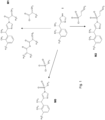
- Fig. 1 illustrates the reaction scheme for producing one of the present polymerizable monomers comprising medetomidine.
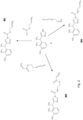
- Fig. 2 illustrates the reaction scheme for producing the present polymerizable monomer comprising medetomidine.
- Fig. 2 illustrates the reaction scheme for producing the present polymerizable monomer comprising medetomidine.
- Allyl medetomidine M4 was prepared from I and allyl isocyanate according to the reaction scheme illustrated in Fig. 2 .
- the crude was dissolved in ethyl acetate and subjected to flash column chromatography on silica gel using ethyl acetate/heptane (1:1) to ethyl acetate as eluent to afford pure (determined via LC-MS and TLC analysis) allyl medetomidine M4.
- the purified M4 was dissolved in acetonitrile/H 2 O (1:1) and lyophilized to yield 1.96 g (94%) of pure crystalline M4.
- Table 1 provides a summary of molar ratios and reaction times for the various syntheses.
- a 100 mL 3-necked round bottom flask was immersed in a temperature regulated oil bath. On its leftmost neck, nitrogen gas was flown in. In its middle neck, a glass stopper was placed where it could be removed and replaced in order to take samples of the reaction at different times. On its rightmost neck, a condenser with cold running water as coolant was placed to prevent runoff of the dichloromethane (DCM) solvent.
- DCM dichloromethane
- Medetomidine (M6R1: 5.0781 g; M6R2: 5.3057 g; M6R4: 5.03225 g) was first dissolved in 25 mL DCM. 6.03 mL pyridine, acting as catalyst, was then introduced into the medetomidine solution. 3.71 mL IEM was next added dropwise, with an exothermic reaction being noticeable from the increase in the thermocouple sensor going above the set temperature. The reaction was run for 4.5 h as the isocyanate peak has been found to be greatly reduced from a Fourier-transform infrared spectroscopy (FTIR) reading at 4 h.
- FTIR Fourier-transform infrared spectroscopy
- the medetomidine conjugated allyl isocyanate was purified by dissolving the crude mixture in toluene and co-evaporating the pyridine from the mixture in a rotary evaporator in room temperature. This procedure was followed for M6R1, M6R2, M6R4.
- the next step was to use a flash chromatography column to separate the unreacted medetomidine and isocyanate from the adduct.
- the original protocol used a gradient of ethyl acetate and heptane, first dissolving the product in a 50:50 blend.
- M6R1 immediately precipitated and formed a solid chunk where it was previously a sticky liquid mixture with some toluene.
- M6R2 and M6R4 were stored without flash chromatography purification.
- M6R2 and M6R4 were stored and used in chemical characterization and release studies without further purification to prevent unwanted precipitation/crosslinking of unreacted isocyatate chains.
- Medetomidine (5.03830 g) was added in 25 mL DCM for dissolution in a 100 mL 3-neck round bottom flask. Pyridine (2.01 mL) was added. The starting temperature in the oil bath was 31.7°C. IEM (3.71 mL) was added by 200 ⁇ L stages. The synthesis was run for 24 hours. The following day, the reaction mixture was used directly for CP6R1 polymerization.
- Medetomidine (M6R3: 1.0013 g; M6R6: 4.02450 g) was first dissolved in the DCM solvent (M6R3: 5 mL; M6R6: 20.53 mL) within the reaction flask. IEM was then added dropwise and the flask was sealed. Samples were taken at different time intervals to monitor the extent of reaction. The synthesis was run for much longer (see Table 6) in order to allow sufficient time for the addition reaction to take place.
- Medetomidine (5.03104 g) was added in 30 mL DCM for dissolution in a 100 mL 3-neck round bottom flask. The starting temperature in the oil bath was 31.7°C. lEA (3.36 mL) was added by 200 ⁇ L stages.
- M5R1 was precipitated in heptane. Previous observations of M6 showed that keeping the monomer in room temperature to thaw for use renders it insoluble to acetone and solvents, in which it was previously soluble. However this was not the case with M5R1.
- the monomer/heptane slurry was placed in a fume hood to evaporate out the remaining organic solvent for two days. Acetone was added to resolubilize and the M5R1 monomer was successfully re-dissolved.
- Fig. 1 illustrates the reaction scheme for producing this medetomidine containing sulfonamide compound M0.
- Vial 1 contained reference compound medetomidine dissolved in ethanol (1 ml).
- Substance M2 25 mg was added to vial 2 and 3.
- Substance M3 25 mg was added to vial 4 and 5.
- Substance M4 25 mg was added to vial 6 and 7 and substance M0 was added to vial 8 and 9.
- the solid material in vials 2 to 9 were dissolved in ethanol (1 ml) and PBS buffer pH 7.4 (1 ml) to mimic sea water containing different salts and having a pH slightly basic. Ethanol was chosen as solvent to increase the solubility of the substances.
- Sample M2 had a Rf value of ⁇ 0.6
- sample M3 had a Rf value of ⁇ 0.8
- sample M4 had a Rf value of 0.55-0.60
- sample M0 had a Rf value of 0.7
- Medetomidine had a Rf value of 0.1.
- decomposition of the derivatives was more visible, mainly in the vials stored at room temperature.
- sample M2 showed only medetomidine from the vial stored at room temperature, while the vial stored in the refrigerator showed a mixture of medetomidine and the starting material.
- Sample M3 showed only medetomidine from the vial stored in room temperature, while the other vial stored in the refrigerator showed a mixture of medetomidine and the starting material. Samples M2 and M3 seemed to be very similar in stability. Sample M4 was stable when stored in the refrigerator after two weeks, but the vial stored at room temperature showed decomposition to medetomidine as well as non-hydrolyzed M4. Sample M0 was stable in room temperature and in the refrigerator after two weeks. The results from the stability experiment indicated that the urea derivative was the most stable and the carbamate derivative was the least stable. The stability of the sulfonamide derivatives was very dependent on the size of the alkyl group.
- M1 and M4 were evaluated via quantification of the release of I into artificial seawater (3 % NaCl, pH 8.0).
- compound M1 (0.023 g) was suspended in 5 mL artificial seawater, while M4 (0.044 g) were suspended in 10 mL artificial seawater.
- the solutions were stirred (300 rpm) at ambient temperatures and samples were collected at 10, 15, 20 and 25 days. The samples were stored in freezer 2-2.5 months prior to LC-MS analysis.
- LC-MS LC-MS
- the LC-MS system was composed of an Acquity I-class UPLC with a Waters Xevo G2-S Qtof.
- the chromatographic separation was obtained on a C18 column with gradient elution (Eluent A, 0.1 % NH 4 in MQ-water and Eluent B, 100 % acetonitrile).
- the samples (from freezer) were extracted with hexane and the organic extracts were analyzed by LC-MS.
- Three external calibration curves for I, M1 and M4 were prepared the same way as the samples and used for quantification.
- Polymers from M1 and M4 were prepared using radical polymerization initiated by UV-irradiation according to Analytica Chimica Acta 2001, 435: 19-24 and the general method for polymerization is as follows.
- Homopolymers of M1 and M4 was further prepared to evaluate the reactivity of the individual monomers.
- M1 and M4 (0.26 g) were dissolved in CHCl 3 (2 mL) and azobis isobutyronitrile (AIBN) (0.026 g) was added.
- AIBN azobis isobutyronitrile
- the solution was purged with N 2 (g) for 5 min and placed in the UV-cabinet where it was cured for initial 24 h. Inspection after 24 h indicated a low degree of polymerization (clear, non-viscous solution) and polymerization was therefore continued for an additional 24 h.
- the experiment was terminated after 48 h and the resultant viscous solution was left to dry at ambient temperature to remove the solvent.
- Co-polymers of M1 and M4 were prepared with methyl methacrylate (MMA) and the crosslinker ethylene glycol dimethacrylate (EGDMA) employing AIBN as free radical polymerization initiator as illustrated in Fig. 4 .
- MMA methyl methacrylate
- EGDMA crosslinker ethylene glycol dimethacrylate
- the solid polymer monolith was washed with acetone (10 mL, discarded), crushed with a mortar and pestle (in an acetone slurry) and passed through a sieve (60 ⁇ m) to generate a homogenous polymer particle distribution for the release studies.
- the polymer particles were sedimented from acetone (discarded) and dried at room temperature prior to further studies.
- Polymers prepared with only MMA as co-polymers did not form solid polymers but instead transparent gels due to the lack of a crosslinking monomer. These polymers were also washed with acetone prior to analysis.
- Polymers incorporating ⁇ 0.3 % of the monomers M1 and M4 were also prepared according to the ratios summarized in Table 1.
- polymers incorporating 10 % of M4 were also prepared using the composition for the neat EGDMA polymers.
- the prepared polymers were characterized with FTIR in an attempt to quantify the covalent incorporation of M1 and M4 in the copolymers.
- the reference spectra of the monomers and I were compared to the IR-spectra of the ground and washed polymers.
- Polymers prepared with 10 % M4 were also analyzed using FTIR.
- Monomers M1 and M4 were incorporated at molar ratios ranging between 0.3-10 % in different copolymer systems together with EGDMA and MMA. Visually the polymerization reactions appeared successful as shown and the material was used for release studies. In parallel, the polymers were evaluated using FTIR. Both M1 and M4 also displayed strong carbonyl signals at ⁇ 1750 cm -1 , which unfortunately overlapped with the carbonyl signals of both EGDMA and MMA making the use of that signal ambiguous for assessment of monomer incorporation.
- CP6R1 was synthesized from M6R5 without any purification of the M6R5 monomer.
- Azobisisobutyronitrile (AIBN) (0.82118 g) dissolved in 5 mL dimethylformamide (DMF), methyl methacrylate (MMA) (26.6 mL), and an additional 35 mL DMF were added to the M6R5 reaction product. This mixture was purged with argon gas before being sealed. The reaction was run for 5 hours.
- AIBN Azobisisobutyronitrile
- MMA methyl methacrylate
- the crude mixture was precipitated in 400 mL Tris buffer solution, then washed with pure water, before being washed with acetonitrile. This acetonitrile/polymer slurry was left to dry and a hard white polymer was obtained as the final product.
- CP6R2 was synthesized from M6R6 without any purification of the M6R6 monomer.
- AIBN (1.65376 g) dissolved in 5 mL DMF, MMA (8.54 mL), and an additional 78 mL DMF were added to the M6R6 reaction product. This mixture was purged with argon gas before being sealed. The reaction was run for 4 hours.
- CP6R1 had an AIBN:MMA:M6 ratio of 0.5:10:1, whereas CP6R2 had an AIBN:MMA:M6 ratio of 1:8:2.
- the resulting co-polymer CP6R2 was soluble in acetone and could be precipitated in water.
- CP5R1 was synthesized from M5R1 following a purification of the M5R1 monomer.
- the sticky M5R1 (4.0090 g) was dissolved in 45 mL DMF.
- AIBN 0.6481 g
- MMA 5.010 mL
- Table 4 show all the synthesized polymers divided into groups (PoC, CP5, CP6 and MS) where the same method was used within each group. The only difference between syntheses within the group was the ratios used of the reagents and monomers. Therefore only one detailed example from each group is given below.
- the reaction temperature was 65°C for all polymers except PoC_R2 and PoC_R3, which had a reaction temperature of 70°C.
- the PoC-group contained M5 or M6, tri-isopropyl silyl acrylate (TIPSA), and MMA.
- the CP5- and CP6-groups have M5 or M6, TIPSA and MMA and may contain either 2-methoxyethyl acrylate (MEA) or butyl methacrylate (BMA) to give it increased hydrophilicity or hydrophobicity.
- MEA 2-methoxyethyl acrylate
- BMA butyl methacrylate
- the MS-group is the non-RAFT synthesis based on the corresponding polymers made with similar CP6 monomer ratios. The exception to this is MS_R13a, MS_R13b, and MS_R13c. MS-synthesis was made in smaller scale in scintillation vials.
- medetomidine I (1.07068 g) was dissolved in 10 ml DCM with a magnetic stirring, set in room temperature. IEM (750 ⁇ l) was added dropwise. After three hours, MMA (2.81 mL) and TIPSA (6.08 mL) were added. AIBN (0.14472 g) and butanone (40 mL) were added and the mixture was homogenized and sealed with rubber stoppers and parafilm under argon atmosphere. The reaction was left with stirring at 70°C for 5.5 h. The reaction was terminated by removing the flask from the oil bath and opening it and letting oxygen terminate the radicals.
- medetomidine I (0.6808 g) was dissolved with 10 ml DCM by stirring with a magnet. IEM (480 ⁇ l) was then added dropwise with the flask left unsealed to eventually let the DCM evaporate overnight.
- MMA (2.81 mL), TIPSA (6.11 mL), and MEA (0.68 mL).
- Xylene (20 mL) were added to the flask and mixed to homogenize.
- AIBN (0.15206 g) and DSDA (0.19585 g) were added to individual scintillation vials.
- butanone (1 ml) was added to dissolve the AIBN.
- xylene (9 ml) was added.
- This AIBN solution was then added to the reaction flask.
- xylene (10 mL) was added to dissolve it.
- This DSDA solution was then added to the reaction flask.
- the reaction flask was purged with argon and sealed with rubber stopper and parafilm. The reaction was started by lowering the reaction flask down into a 65°C oil bath. The reaction was left in the bath for 6.5 hours and was then terminated by taking it out of the bath, opening the flask and letting oxygen terminate the radicals.
- medetomidine I (0.31741 g) was dissolved with 4 ml DCM by stirring with a magnet. IEM (220 ⁇ L) was then added dropwise with the vial left unsealed to eventually evaporate the DCM overnight.
- AIBN (0.06865 g), MMA (1.96 mL), TIPSA (1.42 mL), and MEA (0.32 mL) were added to the vial.
- the vial was sealed with a rubber stopper and wrapped with parafilm. Using a glass syringe, 6 mL of butanone was introduced. The content of the vial was mixed at room temperature.
- the vial was purged with argon for 20 minutes and was then lowered into the oil bath to start the polymerization reaction and was left at 65°C for 5 hours. The reaction was terminated by bringing the vial out of the bath, opening the vessel and letting oxygen terminate the radicals.
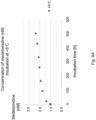
- the polymeric PSB displayed a time dependent low linear release of 1 as graphically illustrated in Fig. 5 .
- Medetomidine was also linked to isocyanate functionalized polystyrene beads (from Biotage) to function as a model polymer system (shown in Fig. 3 ) to study the release of medetomidine from a polymer.
- polystyrene immobilized medetomidine was generated by reacting I with polystyrene methylisocyanate employing the same coupling conditions used to produce M4, see Fig. 3 .
- PSB The synthesis of PSB was performed in syringes (20 mL) fitted with filters to retain the polystyrene beads.
- 1 g of polystyrene methylisocyanate beads (Biotage 800261 batch 04446, capacity 1.48 mmol/g) was added to the syringe followed by the addition of I (446 mg, 2.23 mmol, 1.5 equiv.) and pyridine (0.36 mL, 4.46 mmol, 3 equiv.) dissolved in anhydrous dichloromethane (10 mL). The syringe was agitated overnight at room temperature.
- the order of the injected samples in the final analytical sequence was as follows; Blank, Calibration samples S1 to S6, Blank, 1 h (+5°C, RT, +50°C), 4 h (+5°C, RT, +50°C), 24 h (+5°C, RT, +50°C), 96 h (+5°C, RT, +50°C 1:10), 168 h (+5°C, RT, +50°C 1:10), 264 h (+5°C, RT, +50°C 1:20), 336 h (+5°C, RT, +50°C 1:20), 432 h (+5°C, RT, +50°C 1:20), 504 h (+5°C, RT, +50°C 1:20), Blank, Calibration samples S1 to S6, Blank.
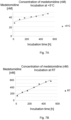
- the data indicates a faster release of medetomidine during the initial phase, up to approximately 24 hours, potentially corresponding to a wash-out phase of unbound medetomidine from the polymer.
- another release phase follows characterized by a slower constant rate during the last twenty days of the three weeks of incubation. This was experienced for all three evaluated temperatures (+5°C, RT and +50°C), see Figs. 6A to 6C .
- the rate of release of medetomidine was different between the three evaluated temperatures.
- the total amount of released medetomidine was calculated in picomol (pmol) and was plotted against time during the period of constant compound release (day 1 to day 21), see Figs.
- the rate of release was calculated as pmol/h/mg polymer. Assuming a linear relationship, the release rate of medetomidine at +5°C was about 0.007 pmol/h/mg polymer, at RT about 0.18 pmol/h/mg polymer and about 4.6 pmol/h/mg polymer for the incubation at +50°C.
- Table 6 summaries the results plotted in Figs. 6 and 7 .
- Table 6 - Measured concentrations of medetomidine (nM) and the calculated released amounts of medetomidine (pmol) over time Time (h) +5°C RT +50°C Concentration (nM) Released amount (pmol) Concentration (nM) Released amount (pmol) Concentration (nM) Released amount (pmol) 1 1.01 20.2 2.67 53.4 9.67 193 4 1.06 21.2 3.43 68.5 25.5 508 24 1.39 27.6 7.04 139 75.3 1487 96 1.76 35.0 12.2 242 183 3616 168 1.92 38.2 14.4 285 257 5067 264 2.03 40.3 19.4 382 396 7777 336 2.10 41.7 24.3 477 480 9407 432 2.23 44.2 27.8 545 566 11067 504 2.37 46.9 28.9 566 638 12450
- the crude polymer product from MS_R7 and MS_R13a were precipitated in methanol and the methanol/monomer/reaction residues mixture was decanted off.
- the "wet polymer” contained some butanone and methanol. The wet polymer was immediately re-dissolved back into butanone before it was used for the leach rate study.
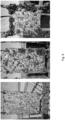
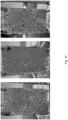
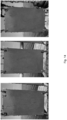
- Both the epoxy control and control formulation (formulation #1) showed high degree of fouling accumulation after 13 weeks of immersion ( Figs. 9 and 10 ).
- Fouling species on expoxy control included, for example, barnacles, mussel, bryozoa, tunicate, green algae, filamentous algae and tubeworm ( Fig. 9 ).
- the biofouling was mainly barnacles ( Fig. 10 ).
- a few tunicates were visible, but in principle the control formulation was selective for barnacle accumulation and, thus, relevant to use for studying the effect upon addition of medetomidine, both free or as polymer bound.
- formulations containing polymer bound medetomidine can perform comparable with formulations having medetomidine dispersed (free).
- Table 9 Area covered by various fouling organism on each test panel Formulation_ panel replicate no.
Landscapes
- Chemical & Material Sciences (AREA)
- Organic Chemistry (AREA)
- Health & Medical Sciences (AREA)
- Chemical Kinetics & Catalysis (AREA)
- Medicinal Chemistry (AREA)
- Polymers & Plastics (AREA)
- Materials Engineering (AREA)
- Engineering & Computer Science (AREA)
- Life Sciences & Earth Sciences (AREA)
- Wood Science & Technology (AREA)
- Plural Heterocyclic Compounds (AREA)
- Paints Or Removers (AREA)
- Agricultural Chemicals And Associated Chemicals (AREA)
- Addition Polymer Or Copolymer, Post-Treatments, Or Chemical Modifications (AREA)
- Organic Low-Molecular-Weight Compounds And Preparation Thereof (AREA)
- Compositions Of Macromolecular Compounds (AREA)
- Materials Applied To Surfaces To Minimize Adherence Of Mist Or Water (AREA)
Claims (15)
- Polymerisierbares Monomer, umfassend Medetomidin oder ein Enantiomer, eine Base oder ein Salz davon, das/die über eine hydrolysierbare Bindung kovalent an das polymerisierbare Monomer gebunden ist, wobei das polymerisierbare Monomer, umfassend Medetomidin oder das Enantiomer, die Base oder das Salz davon, ausgewählt ist aus der Gruppe bestehend aus einem Medetomidinmethacrylat, einem Allylsulfonylmedetomidin und einem Medetomidinacrylat.
- Monomer nach Anspruch 1, wobei Medetomidin oder das Enantiomer, die Base oder das Salz davon über die hydrolysierbare Bindung zwischen einem Stickstoffatom an dem Imidazol-Ring von Medetomidin oder des Enantiomers, der Base oder dem Salz davon und dem Monomer, vorzugsweise zwischen einem Stickstoffatom an Position 1 des Imidazol-Rings von Medetomidin oder des Enantiomers, der Base oder des Salzes davon und dem Monomer kovalent an das Monomer gebunden ist.
- Monomer nach Anspruch 2, wobei Medetomidin oder das Enantiomer, die Base oder das Salz davon über die hydrolysierbare Bindung zwischen einem Stickstoffatom an dem Imidazol-Ring von Medetomidin oder des Enantiomers, der Base oder des Salzes davon und einem Kohlenstoffatom oder einem Schwefelatom an dem Monomer kovalent an das Monomer gebunden ist, vorzugsweise wobei die hydrolysierbare Bindung ausgewählt ist aus der Gruppe bestehend aus einer N-C-Bindung und einer N-S-Bindung.
- Monomer nach einem der Ansprüche 1 bis 3, wobei das Monomer, umfassend Medetomidin oder das Enantiomer, die Base oder das Salz davon, eine allgemeine Formel II oder III aufweist:

 R1 ausgewählt ist aus der Gruppe bestehend aus Formel IV bis V:
 R2 ausgewählt ist aus der Gruppe bestehend aus Formel VII und VIII:
 N 0 oder 1 ist;R3 ausgewählt ist aus der Gruppe bestehend aus Formel IX bis XI:
 M 0, 1, 2 oder 3 ist;R unabhängig H oder Alkyl ist, wobei das Alkyl vorzugsweise ein C1- bis C6-Alkyl und mehr bevorzugt ein C1- bis C4-Alkyl ist, wie etwa Methyl oder Ethyl, vorzugsweise Methyl.
 - Monomer nach einem der Ansprüche 1 bis 4, wobei das Monomer, umfassend Medetomidin oder das Enantiomer, die Base oder das Salz davon, ausgewählt ist aus der Gruppe bestehend aus 1-{4-[1-(2,3-Dimethylphenyl)ethyl]-1H-imidazol-1-yl}-2-methylprop-2-en-1-on, 1-{5[1-(2,3-Dimethylphenyl)ethyl]-1H-imidazol-1-yl}-2-methylprop-2-en-1-on, 2-({4-[1-(2,3-Dimethylphenyl)ethyl]-1H-imidazol-1-carbonyl}amino)ethyl-2-methylprop-2-enoat, 2-({5-[1-(2,3-Dimethylphenyl)ethyl]-1H-imidazol-1-carbonyl}amino)ethyl-2-methylprop-2-enoat, 4-[1-(2,3-Dimethylphenyl)ethyl]-1-(prop-2-en-1-sulfonyl)-1H-imidazol, 5-[1-(2,3-Dimethylphenyl)ethyl]-1-(prop-2-en-1-sulfonyl)-1H-imidazol, Prop-2-en-1-yl-4-[1-(2,3-Dimethylphenyl)ethyl]-1H-imdidazol-1-carboxylat, Prop-2-en-1-yl-5-[1-(2,3-Dimethylphenyl)ethyl]-1H-imidazol-1-carboxamid, 5-[1-(2,3-Dimethylphenyl)ethyl]-N-(prop-2-en-1-yl)-1H-imidazol-1-carboxamid, 2-({4-[1-(2,3-Dimethylphenyl)ethyl]-1H-imdidazol-1-carbonyl}amino)ethyl-prop2-enoat und 2-({5-[1-(2,3-Dimethylphenyl)ethyl]-1H-imidazol-1-carbonyl}amino)ethyl-prop-2-enoat.
- Monomer nach einem der Ansprüche 1 bis 5, wobei das Monomer, umfassend Medetomidin oder das Enantiomer, die Base oder das Salz davon, ein Medetomidinmethacrylat ist.
- Monomer nach Anspruch 6, wobei das Medetomidinmethacrylat ausgewählt ist aus der Gruppe bestehend aus 1-{4-[2,3-Dimethylphenyl)ethyl]-1H-imidazol-1-yl}-2-methylprop-2-en-1-on, 1-{5-[1-(2,3-Dimethylphenyl)ethyl]-1H-imidazol-1-yl}-2-methylprop-2-en-1-on, 2-({4-[1-(2,3-Dimethylphenyl)ethyl]-1H-imidazol-1-carbonyl}amino)ethyl-2-methylprop-2-enoat und 2({5-[1-(2,3-Dimethylphenyl)ethyl]-1H-imidazol-1-carbonyl}amino)ethyl-2-methylprop-2-enoat, vorzugsweise 2-({4-[1-(2,3-Dimethylphenyl)ethyl]-1H-imidazol-1-carbonyl}amino)ethyl-2-methylprop-2-enoat.
- Monomer nach einem der Ansprüche 1 bis 5, wobei das Monomer, umfassend Medetomidin oder das Enantiomer, die Base oder das Salz davon, ein Medetomidinacrylat ist.
- Monomer nach Anspruch 8, wobei das Medetomidinacrylat ausgewählt ist aus der Gruppe bestehend aus 2-({4-[1-(2,3-Dimethylphenyl)ethyl]-1H-imidazol-1-carbonyl}amino)ethyl-prop-2-enoat und 2-({5[1-(2,3-Dimethylphenyl)ethyl]-1H-imidazol-1-carbonyl}amino)ethyl-prop-2-enoat, vorzugsweise 2-({4-[1-(2,3-Dimethylphenyl)ethyl]-1H-imidazol-1-carbonyl}amino)ethyl-prop-2-enoat.
- Monomer nach einem der Ansprüche 1 bis 5, wobei das Monomer, umfassend Medetomidin oder das Enantiomer, die Base oder das Salz davon, ein Allylmedetomidin ist.
- Monomer nach Anspruch 10, wobei das Allylmedetomidin ausgewählt ist aus der Gruppe bestehend aus Prop-2-en-1-yl-4-[1-(2,3-Dimethylphenyl)ethyl]-1H-imidazol-1-carboxylat, Prop-2-en-1-yl-5-[1-(2,3-Dimethylphenyl)ethyl]-1H-imidazol-1-carboxylat, 4-[1-(2,3-Dimethylphenyl)ethyl]-N-(prop-2-en-1-yl)-1H-imidazol-1-carboxamid und 5-[1-(2,3-Dimethylphenyl)ethyl]-N-(prop-2-en-1-yl)-1H-imidazol-1-carboxamid.
- Antifouling-Zusammensetzung, umfassend ein Monomer nach einem der Ansprüche 1 bis 11 und ein Lösungsmittel.
- Zusammensetzung nach Anspruch 12, ferner umfassend freies Medetomidin oder ein Enantiomer, eine Base oder ein Salz davon, das/die nicht kovalent an irgendeine sich wiederholende Einheit oder irgendein Monomer gebunden ist.
- Zusammensetzung nach Anspruch 13 oder 14, wobei das Lösungsmittel ausgewählt ist aus der Gruppe bestehend aus Xylol, Toluol, 1-Methoxy-2-propanol, 1-Methoxy-2-propanoylacetat, Methylisobutylketon, Lösungsmittelnaphtha und Mischungen davon.
- Artikel, umfassend eine Oberflächenbeschichtung, die ein Monomer nach einem der Ansprüche 1 bis 11 und/oder eine Antifouling-Zusammensetzung nach einem der Ansprüche 12 bis 14 auf mindestens einem Abschnitt einer Oberfläche des Artikels, der dazu ausgestaltet ist, in Wasser eingetaucht zu werden, umfasst, um maritimes Biofouling der Oberfläche zu verhindern.
Applications Claiming Priority (3)
| Application Number | Priority Date | Filing Date | Title |
|---|---|---|---|
| SE2051222 | 2020-10-21 | ||
| PCT/SE2021/051046 WO2022086416A1 (en) | 2020-10-21 | 2021-10-20 | Antifouling compounds |
| EP21798821.1A EP4038149B1 (de) | 2020-10-21 | 2021-10-20 | Antifouling-verbindungen |
Related Parent Applications (2)
| Application Number | Title | Priority Date | Filing Date |
|---|---|---|---|
| EP21798821.1A Division-Into EP4038149B1 (de) | 2020-10-21 | 2021-10-20 | Antifouling-verbindungen |
| EP21798821.1A Division EP4038149B1 (de) | 2020-10-21 | 2021-10-20 | Antifouling-verbindungen |
Publications (3)
| Publication Number | Publication Date |
|---|---|
| EP4177318A1 EP4177318A1 (de) | 2023-05-10 |
| EP4177318C0 EP4177318C0 (de) | 2024-08-14 |
| EP4177318B1 true EP4177318B1 (de) | 2024-08-14 |
Family
ID=78402204
Family Applications (2)
| Application Number | Title | Priority Date | Filing Date |
|---|---|---|---|
| EP22215139.1A Active EP4177318B1 (de) | 2020-10-21 | 2021-10-20 | Antifouling-verbindungen |
| EP21798821.1A Active EP4038149B1 (de) | 2020-10-21 | 2021-10-20 | Antifouling-verbindungen |
Family Applications After (1)
| Application Number | Title | Priority Date | Filing Date |
|---|---|---|---|
| EP21798821.1A Active EP4038149B1 (de) | 2020-10-21 | 2021-10-20 | Antifouling-verbindungen |
Country Status (10)
| Country | Link |
|---|---|
| US (1) | US20230383129A1 (de) |
| EP (2) | EP4177318B1 (de) |
| JP (2) | JP2026053357A (de) |
| KR (1) | KR102930616B1 (de) |
| CN (2) | CN116348557B (de) |
| DK (1) | DK4038149T3 (de) |
| ES (2) | ES2945827T3 (de) |
| MY (1) | MY207535A (de) |
| PT (1) | PT4038149T (de) |
| WO (1) | WO2022086416A1 (de) |
Families Citing this family (1)
| Publication number | Priority date | Publication date | Assignee | Title |
|---|---|---|---|---|
| CN115197149B (zh) * | 2021-04-02 | 2023-09-22 | 四川大学华西医院 | 一种5-苄基咪唑类化合物及其制备方法和用途 |
Family Cites Families (13)
| Publication number | Priority date | Publication date | Assignee | Title |
|---|---|---|---|---|
| US7311766B2 (en) | 2005-03-11 | 2007-12-25 | I-Tech Ab | Method and use of nanoparticles to bind biocides in paints |
| US7531581B2 (en) * | 2005-03-11 | 2009-05-12 | I-Tech Ab | Method and use of acidified modified polymers to bind biocides in paints |
| CN102753532B (zh) | 2009-12-09 | 2015-05-13 | I-技术有限公司 | 美托咪定的制备方法 |
| DK2551309T3 (en) * | 2010-03-23 | 2017-07-10 | Chugoku Marine Paints | ANTI-GRILL COATING COMPOSITION AND APPLICATION THEREOF |
| BR112013032393B1 (pt) | 2011-06-21 | 2021-01-26 | Basell Polyolefine Gmbh | processo para descarregar partículas de poliolefina a partir de reator de polimerização em fase gasosa e processo para polimerizar olefinas |
| IN2014DN00144A (de) | 2011-07-22 | 2015-05-22 | Cambrex Karlskoga Ab | |
| EP2671449A1 (de) | 2012-06-06 | 2013-12-11 | Construction Research & Technology GmbH | Verwendung von Vanadiumpentoxidpartikeln als Biozid |
| GB201501593D0 (en) | 2015-01-30 | 2015-03-18 | Cambrex Karlskoga Ab | New compounds and processes |
| WO2018003136A1 (ja) * | 2016-07-01 | 2018-01-04 | 中国塗料株式会社 | 防汚塗料組成物、防汚塗膜、防汚塗膜付き基材及びその製造方法、並びに防汚方法 |
| WO2018003135A1 (ja) * | 2016-07-01 | 2018-01-04 | 中国塗料株式会社 | 防汚塗料組成物、防汚塗膜、防汚塗膜付き基材及びその製造方法、並びに防汚方法 |
| CZ30799U1 (cs) | 2016-07-20 | 2017-07-03 | SYNPO, akciová společnost | Hydrofobní antimikrobiální polymerní systém |
| CN109906256B (zh) * | 2016-11-09 | 2022-02-08 | 中国涂料株式会社 | 防污涂料组合物、防污涂膜、带防污涂膜的基材及其制造方法、以及防污方法 |
| DK3339387T3 (da) | 2016-12-22 | 2020-09-21 | Evonik Operations Gmbh | Forbindelser på basis af addukter med isocyanater til belægningssammensætninger |
-
2021
- 2021-10-20 WO PCT/SE2021/051046 patent/WO2022086416A1/en not_active Ceased
- 2021-10-20 MY MYPI2023002404A patent/MY207535A/en unknown
- 2021-10-20 PT PT217988211T patent/PT4038149T/pt unknown
- 2021-10-20 CN CN202180071775.6A patent/CN116348557B/zh active Active
- 2021-10-20 EP EP22215139.1A patent/EP4177318B1/de active Active
- 2021-10-20 KR KR1020237017133A patent/KR102930616B1/ko active Active
- 2021-10-20 CN CN202410912201.2A patent/CN118772061A/zh active Pending
- 2021-10-20 ES ES21798821T patent/ES2945827T3/es active Active
- 2021-10-20 EP EP21798821.1A patent/EP4038149B1/de active Active
- 2021-10-20 ES ES22215139T patent/ES2991795T3/es active Active
- 2021-10-20 DK DK21798821.1T patent/DK4038149T3/da active
- 2021-10-20 US US18/249,589 patent/US20230383129A1/en active Pending
-
2025
- 2025-12-02 JP JP2025217851A patent/JP2026053357A/ja active Pending
- 2025-12-02 JP JP2025217852A patent/JP2026053358A/ja active Pending
Also Published As
| Publication number | Publication date |
|---|---|
| JP2026053358A (ja) | 2026-03-25 |
| CN118772061A (zh) | 2024-10-15 |
| WO2022086416A1 (en) | 2022-04-28 |
| EP4177318C0 (de) | 2024-08-14 |
| ES2991795T3 (es) | 2024-12-04 |
| CN116348557B (zh) | 2024-07-05 |
| EP4038149A1 (de) | 2022-08-10 |
| MY207535A (en) | 2025-03-03 |
| CN116348557A (zh) | 2023-06-27 |
| KR20230107821A (ko) | 2023-07-18 |
| EP4038149B1 (de) | 2023-01-25 |
| US20230383129A1 (en) | 2023-11-30 |
| KR102930616B1 (ko) | 2026-02-25 |
| ES2945827T3 (es) | 2023-07-07 |
| DK4038149T3 (da) | 2023-04-24 |
| PT4038149T (pt) | 2023-05-29 |
| JP2026053357A (ja) | 2026-03-25 |
| EP4177318A1 (de) | 2023-05-10 |
| JP2023551097A (ja) | 2023-12-07 |
Similar Documents
| Publication | Publication Date | Title |
|---|---|---|
| FI102290B (fi) | Kasvittumista estävä päällystekoostumus | |
| JP3474672B2 (ja) | 塗料組成物 | |
| JPH07102193A (ja) | 塗料組成物 | |
| FI108042B (fi) | Päällystyskoostumus | |
| JP3196361B2 (ja) | 塗料用樹脂組成物及び海中構造物用防汚塗料 | |
| AU2004202176A1 (en) | Triarylsilyl(meth)acryloyl-containing polymers for marine coating compositions | |
| CN109906254B (zh) | 防污涂料组合物、防污涂膜、带防污涂膜的基材及其制造方法、以及防污方法 | |
| JP2026053357A (ja) | 防汚化合物 | |
| KR100556016B1 (ko) | 오염방지 코팅 조성물 | |
| JP3474673B2 (ja) | 塗料組成物 | |
| EP3693421B1 (de) | Bewuchshemmende lackzusammensetzung und beschichteter artikel mit einer unter verwendung der besagten zusammensetzung gebildeten bewuchshemmenden beschichtung auf der oberfläche | |
| JP3451786B2 (ja) | 塗料組成物 | |
| US20060293408A1 (en) | Non-aqueous dispersion based antifouling paint composition | |
| EP3480268A1 (de) | Antifouling-beschichtungszusammentzung, antifouling-beschichtungsfilm, mit antifouling-beschichtungsfilm versehenes basismaterial, verfahren zur herstellung davon und antifouling-verfahren | |
| JP3396349B2 (ja) | 生物付着防止用塗料組成物 | |
| JP7860101B2 (ja) | 防汚化合物 | |
| JPH01146969A (ja) | 防汚塗料 | |
| HK40117724A (zh) | 防污化合物 | |
| HK40090467B (zh) | 防污化合物 | |
| HK40090467A (zh) | 防污化合物 | |
| JP3811749B2 (ja) | 非水分散型防汚塗料組成物 | |
| US20050255081A1 (en) | Stabilizers for hydrolyzable organic binders | |
| EP4303276A1 (de) | Antifouling-beschichtungsmaterialzusammensetzung | |
| JPH01146808A (ja) | 防汚コーティング材 | |
| JPH04264168A (ja) | 塗料組成物 |
Legal Events
| Date | Code | Title | Description |
|---|---|---|---|
| PUAI | Public reference made under article 153(3) epc to a published international application that has entered the european phase |
Free format text: ORIGINAL CODE: 0009012 |
|
| STAA | Information on the status of an ep patent application or granted ep patent |
Free format text: STATUS: THE APPLICATION HAS BEEN PUBLISHED |
|
| AC | Divisional application: reference to earlier application |
Ref document number: 4038149 Country of ref document: EP Kind code of ref document: P |
|
| AK | Designated contracting states |
Kind code of ref document: A1 Designated state(s): AL AT BE BG CH CY CZ DE DK EE ES FI FR GB GR HR HU IE IS IT LI LT LU LV MC MK MT NL NO PL PT RO RS SE SI SK SM TR |
|
| STAA | Information on the status of an ep patent application or granted ep patent |
Free format text: STATUS: REQUEST FOR EXAMINATION WAS MADE |
|
| STAA | Information on the status of an ep patent application or granted ep patent |
Free format text: STATUS: EXAMINATION IS IN PROGRESS |
|
| 17P | Request for examination filed |
Effective date: 20230926 |
|
| RBV | Designated contracting states (corrected) |
Designated state(s): AL AT BE BG CH CY CZ DE DK EE ES FI FR GB GR HR HU IE IS IT LI LT LU LV MC MK MT NL NO PL PT RO RS SE SI SK SM TR |
|
| 17Q | First examination report despatched |
Effective date: 20231017 |
|
| GRAP | Despatch of communication of intention to grant a patent |
Free format text: ORIGINAL CODE: EPIDOSNIGR1 |
|
| STAA | Information on the status of an ep patent application or granted ep patent |
Free format text: STATUS: GRANT OF PATENT IS INTENDED |
|
| INTG | Intention to grant announced |
Effective date: 20240524 |
|
| GRAS | Grant fee paid |
Free format text: ORIGINAL CODE: EPIDOSNIGR3 |
|
| GRAA | (expected) grant |
Free format text: ORIGINAL CODE: 0009210 |
|
| STAA | Information on the status of an ep patent application or granted ep patent |
Free format text: STATUS: THE PATENT HAS BEEN GRANTED |
|
| AC | Divisional application: reference to earlier application |
Ref document number: 4038149 Country of ref document: EP Kind code of ref document: P |
|
| AK | Designated contracting states |
Kind code of ref document: B1 Designated state(s): AL AT BE BG CH CY CZ DE DK EE ES FI FR GB GR HR HU IE IS IT LI LT LU LV MC MK MT NL NO PL PT RO RS SE SI SK SM TR |
|
| RAP3 | Party data changed (applicant data changed or rights of an application transferred) |
Owner name: I-TECH AB |
|
| REG | Reference to a national code |
Ref country code: GB Ref legal event code: FG4D |
|
| REG | Reference to a national code |
Ref country code: CH Ref legal event code: EP |
|
| REG | Reference to a national code |
Ref country code: DE Ref legal event code: R096 Ref document number: 602021017354 Country of ref document: DE |
|
| REG | Reference to a national code |
Ref country code: IE Ref legal event code: FG4D |
|
| U01 | Request for unitary effect filed |
Effective date: 20240911 |
|
| U07 | Unitary effect registered |
Designated state(s): AT BE BG DE DK EE FI FR IT LT LU LV MT NL PT RO SE SI Effective date: 20240926 |
|
| REG | Reference to a national code |
Ref country code: ES Ref legal event code: FG2A Ref document number: 2991795 Country of ref document: ES Kind code of ref document: T3 Effective date: 20241204 |
|
| PG25 | Lapsed in a contracting state [announced via postgrant information from national office to epo] |
Ref country code: GR Free format text: LAPSE BECAUSE OF FAILURE TO SUBMIT A TRANSLATION OF THE DESCRIPTION OR TO PAY THE FEE WITHIN THE PRESCRIBED TIME-LIMIT Effective date: 20241115 Ref country code: PL Free format text: LAPSE BECAUSE OF FAILURE TO SUBMIT A TRANSLATION OF THE DESCRIPTION OR TO PAY THE FEE WITHIN THE PRESCRIBED TIME-LIMIT Effective date: 20240814 |
|
| U20 | Renewal fee for the european patent with unitary effect paid |
Year of fee payment: 4 Effective date: 20241217 |
|
| PG25 | Lapsed in a contracting state [announced via postgrant information from national office to epo] |
Ref country code: IS Free format text: LAPSE BECAUSE OF FAILURE TO SUBMIT A TRANSLATION OF THE DESCRIPTION OR TO PAY THE FEE WITHIN THE PRESCRIBED TIME-LIMIT Effective date: 20241214 |
|
| PG25 | Lapsed in a contracting state [announced via postgrant information from national office to epo] |
Ref country code: HR Free format text: LAPSE BECAUSE OF FAILURE TO SUBMIT A TRANSLATION OF THE DESCRIPTION OR TO PAY THE FEE WITHIN THE PRESCRIBED TIME-LIMIT Effective date: 20240814 |
|
| PG25 | Lapsed in a contracting state [announced via postgrant information from national office to epo] |
Ref country code: RS Free format text: LAPSE BECAUSE OF FAILURE TO SUBMIT A TRANSLATION OF THE DESCRIPTION OR TO PAY THE FEE WITHIN THE PRESCRIBED TIME-LIMIT Effective date: 20241114 |
|
| PG25 | Lapsed in a contracting state [announced via postgrant information from national office to epo] |
Ref country code: RS Free format text: LAPSE BECAUSE OF FAILURE TO SUBMIT A TRANSLATION OF THE DESCRIPTION OR TO PAY THE FEE WITHIN THE PRESCRIBED TIME-LIMIT Effective date: 20241114 Ref country code: PL Free format text: LAPSE BECAUSE OF FAILURE TO SUBMIT A TRANSLATION OF THE DESCRIPTION OR TO PAY THE FEE WITHIN THE PRESCRIBED TIME-LIMIT Effective date: 20240814 Ref country code: IS Free format text: LAPSE BECAUSE OF FAILURE TO SUBMIT A TRANSLATION OF THE DESCRIPTION OR TO PAY THE FEE WITHIN THE PRESCRIBED TIME-LIMIT Effective date: 20241214 Ref country code: HR Free format text: LAPSE BECAUSE OF FAILURE TO SUBMIT A TRANSLATION OF THE DESCRIPTION OR TO PAY THE FEE WITHIN THE PRESCRIBED TIME-LIMIT Effective date: 20240814 Ref country code: GR Free format text: LAPSE BECAUSE OF FAILURE TO SUBMIT A TRANSLATION OF THE DESCRIPTION OR TO PAY THE FEE WITHIN THE PRESCRIBED TIME-LIMIT Effective date: 20241115 |
|
| PG25 | Lapsed in a contracting state [announced via postgrant information from national office to epo] |
Ref country code: SM Free format text: LAPSE BECAUSE OF FAILURE TO SUBMIT A TRANSLATION OF THE DESCRIPTION OR TO PAY THE FEE WITHIN THE PRESCRIBED TIME-LIMIT Effective date: 20240814 |
|
| PG25 | Lapsed in a contracting state [announced via postgrant information from national office to epo] |
Ref country code: CZ Free format text: LAPSE BECAUSE OF FAILURE TO SUBMIT A TRANSLATION OF THE DESCRIPTION OR TO PAY THE FEE WITHIN THE PRESCRIBED TIME-LIMIT Effective date: 20240814 |
|
| PG25 | Lapsed in a contracting state [announced via postgrant information from national office to epo] |
Ref country code: SK Free format text: LAPSE BECAUSE OF FAILURE TO SUBMIT A TRANSLATION OF THE DESCRIPTION OR TO PAY THE FEE WITHIN THE PRESCRIBED TIME-LIMIT Effective date: 20240814 |
|
| REG | Reference to a national code |
Ref country code: CH Ref legal event code: PL |
|
| PLBE | No opposition filed within time limit |
Free format text: ORIGINAL CODE: 0009261 |
|
| STAA | Information on the status of an ep patent application or granted ep patent |
Free format text: STATUS: NO OPPOSITION FILED WITHIN TIME LIMIT |
|
| PG25 | Lapsed in a contracting state [announced via postgrant information from national office to epo] |
Ref country code: MC Free format text: LAPSE BECAUSE OF FAILURE TO SUBMIT A TRANSLATION OF THE DESCRIPTION OR TO PAY THE FEE WITHIN THE PRESCRIBED TIME-LIMIT Effective date: 20240814 |
|
| 26N | No opposition filed |
Effective date: 20250515 |
|
| PG25 | Lapsed in a contracting state [announced via postgrant information from national office to epo] |
Ref country code: CH Free format text: LAPSE BECAUSE OF NON-PAYMENT OF DUE FEES Effective date: 20241031 |
|
| PG25 | Lapsed in a contracting state [announced via postgrant information from national office to epo] |
Ref country code: IE Free format text: LAPSE BECAUSE OF NON-PAYMENT OF DUE FEES Effective date: 20241020 |
|
| U20 | Renewal fee for the european patent with unitary effect paid |
Year of fee payment: 5 Effective date: 20251016 |
|
| PGFP | Annual fee paid to national office [announced via postgrant information from national office to epo] |
Ref country code: GB Payment date: 20251020 Year of fee payment: 5 |
|
| PGFP | Annual fee paid to national office [announced via postgrant information from national office to epo] |
Ref country code: NO Payment date: 20251023 Year of fee payment: 5 |
|
| PGFP | Annual fee paid to national office [announced via postgrant information from national office to epo] |
Ref country code: TR Payment date: 20251008 Year of fee payment: 5 |
|
| PG25 | Lapsed in a contracting state [announced via postgrant information from national office to epo] |
Ref country code: CY Free format text: LAPSE BECAUSE OF FAILURE TO SUBMIT A TRANSLATION OF THE DESCRIPTION OR TO PAY THE FEE WITHIN THE PRESCRIBED TIME-LIMIT; INVALID AB INITIO Effective date: 20211020 |
|
| PGFP | Annual fee paid to national office [announced via postgrant information from national office to epo] |
Ref country code: ES Payment date: 20251114 Year of fee payment: 5 |
|
| PG25 | Lapsed in a contracting state [announced via postgrant information from national office to epo] |
Ref country code: HU Free format text: LAPSE BECAUSE OF FAILURE TO SUBMIT A TRANSLATION OF THE DESCRIPTION OR TO PAY THE FEE WITHIN THE PRESCRIBED TIME-LIMIT; INVALID AB INITIO Effective date: 20211020 |