EP4155271A2 - Kathodenmaterial für eine lithium-ionen-batterie sowie herstellungsverfahren und anwendung davon - Google Patents
Kathodenmaterial für eine lithium-ionen-batterie sowie herstellungsverfahren und anwendung davon Download PDFInfo
- Publication number
- EP4155271A2 EP4155271A2 EP22206781.1A EP22206781A EP4155271A2 EP 4155271 A2 EP4155271 A2 EP 4155271A2 EP 22206781 A EP22206781 A EP 22206781A EP 4155271 A2 EP4155271 A2 EP 4155271A2
- Authority
- EP
- European Patent Office
- Prior art keywords
- lithium
- cathode material
- ion battery
- sintering
- preparation
- Prior art date
- Legal status (The legal status is an assumption and is not a legal conclusion. Google has not performed a legal analysis and makes no representation as to the accuracy of the status listed.)
- Pending
Links
Images

Classifications
-
- H—ELECTRICITY
- H01—ELECTRIC ELEMENTS
- H01M—PROCESSES OR MEANS, e.g. BATTERIES, FOR THE DIRECT CONVERSION OF CHEMICAL ENERGY INTO ELECTRICAL ENERGY
- H01M4/00—Electrodes
- H01M4/02—Electrodes composed of, or comprising, active material
- H01M4/36—Selection of substances as active materials, active masses, active liquids
- H01M4/48—Selection of substances as active materials, active masses, active liquids of inorganic oxides or hydroxides
- H01M4/50—Selection of substances as active materials, active masses, active liquids of inorganic oxides or hydroxides of manganese
- H01M4/505—Selection of substances as active materials, active masses, active liquids of inorganic oxides or hydroxides of manganese of mixed oxides or hydroxides containing manganese for inserting or intercalating light metals, e.g. LiMn2O4 or LiMn2OxFy
-
- C—CHEMISTRY; METALLURGY
- C01—INORGANIC CHEMISTRY
- C01G—COMPOUNDS CONTAINING METALS NOT COVERED BY SUBCLASSES C01D OR C01F
- C01G53/00—Compounds of nickel
- C01G53/40—Complex oxides containing nickel and at least one other metal element
- C01G53/42—Complex oxides containing nickel and at least one other metal element containing alkali metals, e.g. LiNiO2
-
- C—CHEMISTRY; METALLURGY
- C01—INORGANIC CHEMISTRY
- C01G—COMPOUNDS CONTAINING METALS NOT COVERED BY SUBCLASSES C01D OR C01F
- C01G53/00—Compounds of nickel
- C01G53/40—Complex oxides containing nickel and at least one other metal element
- C01G53/42—Complex oxides containing nickel and at least one other metal element containing alkali metals, e.g. LiNiO2
- C01G53/44—Complex oxides containing nickel and at least one other metal element containing alkali metals, e.g. LiNiO2 containing manganese
-
- C—CHEMISTRY; METALLURGY
- C01—INORGANIC CHEMISTRY
- C01G—COMPOUNDS CONTAINING METALS NOT COVERED BY SUBCLASSES C01D OR C01F
- C01G53/00—Compounds of nickel
- C01G53/40—Complex oxides containing nickel and at least one other metal element
- C01G53/42—Complex oxides containing nickel and at least one other metal element containing alkali metals, e.g. LiNiO2
- C01G53/44—Complex oxides containing nickel and at least one other metal element containing alkali metals, e.g. LiNiO2 containing manganese
- C01G53/50—Complex oxides containing nickel and at least one other metal element containing alkali metals, e.g. LiNiO2 containing manganese of the type (MnO2)n-, e.g. Li(NixMn1-x)O2 or Li(MyNixMn1-x-y)O2
-
- C—CHEMISTRY; METALLURGY
- C01—INORGANIC CHEMISTRY
- C01G—COMPOUNDS CONTAINING METALS NOT COVERED BY SUBCLASSES C01D OR C01F
- C01G53/00—Compounds of nickel
- C01G53/40—Complex oxides containing nickel and at least one other metal element
- C01G53/42—Complex oxides containing nickel and at least one other metal element containing alkali metals, e.g. LiNiO2
- C01G53/44—Complex oxides containing nickel and at least one other metal element containing alkali metals, e.g. LiNiO2 containing manganese
- C01G53/50—Complex oxides containing nickel and at least one other metal element containing alkali metals, e.g. LiNiO2 containing manganese of the type (MnO2)n-, e.g. Li(NixMn1-x)O2 or Li(MyNixMn1-x-y)O2
- C01G53/502—Complex oxides containing nickel and at least one other metal element containing alkali metals, e.g. LiNiO2 containing manganese of the type (MnO2)n-, e.g. Li(NixMn1-x)O2 or Li(MyNixMn1-x-y)O2 containing lithium and cobalt
- C01G53/504—Complex oxides containing nickel and at least one other metal element containing alkali metals, e.g. LiNiO2 containing manganese of the type (MnO2)n-, e.g. Li(NixMn1-x)O2 or Li(MyNixMn1-x-y)O2 containing lithium and cobalt with the molar ratio of nickel with respect to all the metals other than alkali metals higher than or equal to 0.5, e.g. Li(MzNixCoyMn1-x-y-z)O2 with x ≥ 0.5
-
- H—ELECTRICITY
- H01—ELECTRIC ELEMENTS
- H01M—PROCESSES OR MEANS, e.g. BATTERIES, FOR THE DIRECT CONVERSION OF CHEMICAL ENERGY INTO ELECTRICAL ENERGY
- H01M10/00—Secondary cells; Manufacture thereof
- H01M10/05—Accumulators with non-aqueous electrolyte
- H01M10/052—Li-accumulators
- H01M10/0525—Rocking-chair batteries, i.e. batteries with lithium insertion or intercalation in both electrodes; Lithium-ion batteries
-
- H—ELECTRICITY
- H01—ELECTRIC ELEMENTS
- H01M—PROCESSES OR MEANS, e.g. BATTERIES, FOR THE DIRECT CONVERSION OF CHEMICAL ENERGY INTO ELECTRICAL ENERGY
- H01M4/00—Electrodes
- H01M4/02—Electrodes composed of, or comprising, active material
- H01M4/13—Electrodes for accumulators with non-aqueous electrolyte, e.g. for lithium-accumulators; Processes of manufacture thereof
- H01M4/131—Electrodes based on mixed oxides or hydroxides, or on mixtures of oxides or hydroxides, e.g. LiCoOx
-
- H—ELECTRICITY
- H01—ELECTRIC ELEMENTS
- H01M—PROCESSES OR MEANS, e.g. BATTERIES, FOR THE DIRECT CONVERSION OF CHEMICAL ENERGY INTO ELECTRICAL ENERGY
- H01M4/00—Electrodes
- H01M4/02—Electrodes composed of, or comprising, active material
- H01M4/36—Selection of substances as active materials, active masses, active liquids
- H01M4/48—Selection of substances as active materials, active masses, active liquids of inorganic oxides or hydroxides
- H01M4/485—Selection of substances as active materials, active masses, active liquids of inorganic oxides or hydroxides of mixed oxides or hydroxides for inserting or intercalating light metals, e.g. LiTi2O4 or LiTi2OxFy
-
- H—ELECTRICITY
- H01—ELECTRIC ELEMENTS
- H01M—PROCESSES OR MEANS, e.g. BATTERIES, FOR THE DIRECT CONVERSION OF CHEMICAL ENERGY INTO ELECTRICAL ENERGY
- H01M4/00—Electrodes
- H01M4/02—Electrodes composed of, or comprising, active material
- H01M4/36—Selection of substances as active materials, active masses, active liquids
- H01M4/48—Selection of substances as active materials, active masses, active liquids of inorganic oxides or hydroxides
- H01M4/52—Selection of substances as active materials, active masses, active liquids of inorganic oxides or hydroxides of nickel, cobalt or iron
- H01M4/525—Selection of substances as active materials, active masses, active liquids of inorganic oxides or hydroxides of nickel, cobalt or iron of mixed oxides or hydroxides containing iron, cobalt or nickel for inserting or intercalating light metals, e.g. LiNiO2, LiCoO2 or LiCoOxFy
-
- C—CHEMISTRY; METALLURGY
- C01—INORGANIC CHEMISTRY
- C01P—INDEXING SCHEME RELATING TO STRUCTURAL AND PHYSICAL ASPECTS OF SOLID INORGANIC COMPOUNDS
- C01P2002/00—Crystal-structural characteristics
- C01P2002/50—Solid solutions
- C01P2002/52—Solid solutions containing elements as dopants
-
- C—CHEMISTRY; METALLURGY
- C01—INORGANIC CHEMISTRY
- C01P—INDEXING SCHEME RELATING TO STRUCTURAL AND PHYSICAL ASPECTS OF SOLID INORGANIC COMPOUNDS
- C01P2002/00—Crystal-structural characteristics
- C01P2002/50—Solid solutions
- C01P2002/52—Solid solutions containing elements as dopants
- C01P2002/54—Solid solutions containing elements as dopants one element only
-
- C—CHEMISTRY; METALLURGY
- C01—INORGANIC CHEMISTRY
- C01P—INDEXING SCHEME RELATING TO STRUCTURAL AND PHYSICAL ASPECTS OF SOLID INORGANIC COMPOUNDS
- C01P2004/00—Particle morphology
- C01P2004/60—Particles characterised by their size
- C01P2004/61—Micrometer sized, i.e. from 1-100 micrometer
-
- C—CHEMISTRY; METALLURGY
- C01—INORGANIC CHEMISTRY
- C01P—INDEXING SCHEME RELATING TO STRUCTURAL AND PHYSICAL ASPECTS OF SOLID INORGANIC COMPOUNDS
- C01P2004/00—Particle morphology
- C01P2004/60—Particles characterised by their size
- C01P2004/64—Nanometer sized, i.e. from 1-100 nanometer
-
- C—CHEMISTRY; METALLURGY
- C01—INORGANIC CHEMISTRY
- C01P—INDEXING SCHEME RELATING TO STRUCTURAL AND PHYSICAL ASPECTS OF SOLID INORGANIC COMPOUNDS
- C01P2006/00—Physical properties of inorganic compounds
- C01P2006/12—Surface area
-
- C—CHEMISTRY; METALLURGY
- C01—INORGANIC CHEMISTRY
- C01P—INDEXING SCHEME RELATING TO STRUCTURAL AND PHYSICAL ASPECTS OF SOLID INORGANIC COMPOUNDS
- C01P2006/00—Physical properties of inorganic compounds
- C01P2006/16—Pore diameter
-
- C—CHEMISTRY; METALLURGY
- C01—INORGANIC CHEMISTRY
- C01P—INDEXING SCHEME RELATING TO STRUCTURAL AND PHYSICAL ASPECTS OF SOLID INORGANIC COMPOUNDS
- C01P2006/00—Physical properties of inorganic compounds
- C01P2006/16—Pore diameter
- C01P2006/17—Pore diameter distribution
-
- C—CHEMISTRY; METALLURGY
- C01—INORGANIC CHEMISTRY
- C01P—INDEXING SCHEME RELATING TO STRUCTURAL AND PHYSICAL ASPECTS OF SOLID INORGANIC COMPOUNDS
- C01P2006/00—Physical properties of inorganic compounds
- C01P2006/40—Electric properties
-
- C—CHEMISTRY; METALLURGY
- C01—INORGANIC CHEMISTRY
- C01P—INDEXING SCHEME RELATING TO STRUCTURAL AND PHYSICAL ASPECTS OF SOLID INORGANIC COMPOUNDS
- C01P2006/00—Physical properties of inorganic compounds
- C01P2006/80—Compositional purity
-
- H—ELECTRICITY
- H01—ELECTRIC ELEMENTS
- H01M—PROCESSES OR MEANS, e.g. BATTERIES, FOR THE DIRECT CONVERSION OF CHEMICAL ENERGY INTO ELECTRICAL ENERGY
- H01M4/00—Electrodes
- H01M4/02—Electrodes composed of, or comprising, active material
- H01M2004/021—Physical characteristics, e.g. porosity, surface area
-
- H—ELECTRICITY
- H01—ELECTRIC ELEMENTS
- H01M—PROCESSES OR MEANS, e.g. BATTERIES, FOR THE DIRECT CONVERSION OF CHEMICAL ENERGY INTO ELECTRICAL ENERGY
- H01M4/00—Electrodes
- H01M4/02—Electrodes composed of, or comprising, active material
- H01M2004/026—Electrodes composed of, or comprising, active material characterised by the polarity
- H01M2004/028—Positive electrodes
-
- Y—GENERAL TAGGING OF NEW TECHNOLOGICAL DEVELOPMENTS; GENERAL TAGGING OF CROSS-SECTIONAL TECHNOLOGIES SPANNING OVER SEVERAL SECTIONS OF THE IPC; TECHNICAL SUBJECTS COVERED BY FORMER USPC CROSS-REFERENCE ART COLLECTIONS [XRACs] AND DIGESTS
- Y02—TECHNOLOGIES OR APPLICATIONS FOR MITIGATION OR ADAPTATION AGAINST CLIMATE CHANGE
- Y02E—REDUCTION OF GREENHOUSE GAS [GHG] EMISSIONS, RELATED TO ENERGY GENERATION, TRANSMISSION OR DISTRIBUTION
- Y02E60/00—Enabling technologies; Technologies with a potential or indirect contribution to GHG emissions mitigation
- Y02E60/10—Energy storage using batteries
Definitions
- the present invention relates to the technical field of lithium-ion batteries, and in particular to a lithium-ion battery cathode material, a preparation method and an application thereof.
- the positive active material of the rechargeable lithium battery is obtained by preparing a precursor by a coprecipitation method and then mixing and sintering with a lithium source.
- the material includes pores with an average diameter of about 10nm to about 60nm and a porosity of about 0.5% to about 20%.
- the material has good particle strength, thus preventing or reducing the occurrence of breakage after extrusion.
- the material tends not to react with the electrolyte and shows good thermal stability, thus providing a high-capacity rechargeable lithium battery.
- the chemical formula of the material is Li a Ni x Co y Mn z M k O 2 , where 0.45 ⁇ x ⁇ 0.65, 0.15 ⁇ y ⁇ 0.25, 0.15 ⁇ z ⁇ 0.35, the cobalt content of the material is high, the capacity is insufficient, and the cost performance cannot meet the requirements.
- the China patent CN108123119A discloses a nickel-based active material for lithium secondary batteries, a preparation method thereof and a lithium secondary battery including a positive electrode containing the nickel-based active material.
- the nickel-based active material disclosed by the present patent can be obtained by firstly processing a mixture of a lithium precursor and a metal hydroxide at a low temperature, and then performing heat treatment at a high temperature in an oxygen atmosphere.
- the material can include secondary particles.
- the secondary particle includes agglomerates of at least two plate-like primary particles.
- the China patent CN1856890 discloses lithium composite oxide particles for lithium secondary battery cathode materials, a lithium secondary battery positive electrode using the particles, and a lithium secondary battery.
- the lithium composite oxide particles for lithium secondary battery cathode materials disclosed by the present patent can enhance the low-temperature load characteristics of the battery and also enhance the coatability when manufacturing the cathode.
- the material shall meet the following condition (a) and at least one of the following conditions (b) and (c) when measured by a mercury intrusion method.
- the present patent mainly solves the low-temperature performance, but fails to give consideration to the high-temperature performance.
- the China patent CN104272520A discloses a non-aqueous electrolyte secondary battery and a manufacturing method thereof.
- the present patent discloses a cathode mixed material layer constituting a positive electrode of the non-aqueous electrolyte secondary battery.
- the pore size distribution curve measured by a mercury porosimeter there is a peak A with differential pore capacity and a peak B closer to a small pore diameter side than the peak A in the range of 0.05 ⁇ m to 2 ⁇ m; in the pore size distribution curve, there is a minimum point C where the differential pore volume becomes a minimum value; and the ratio (X C /X L ) of the differential pore capacity X L of the larger one of the differential pore capacity X A of the peak A and the differential pore capacity X B of the peak B, to the differential pore capacity X C of the minimum point C is 0.6 or more.
- the present patent mainly aims at reducing the gas production of batteries by adding overcharging additives in the process of manufacturing the batteries.
- the technical problem to be solved by the present invention is as follows: in the prior art, the pore diameter of cathode materials is too large, and most of them belong to macroporous materials; and because of the existence of these macropores, the migration path of lithium ions is too long, therefore, relatively high capacity cannot be provided for a lithium-ion battery, and particles of the cathode material will crack in the process of repeated charge and discharge of the lithium-ion battery, resulting in capacity attenuation, internal resistance increase, gas production and the like of the lithium-ion battery in the cycle process.
- the present invention provides a cathode material for the lithium-ion battery.
- the cathode material comprises mesopores with relatively small diameters, and these mesopores provide more shorter paths for lithium ion migration, so that the lithium-ion battery has relatively high capacity; meanwhile, the lithium-ion cathode material prepared by the method of the present invention basically does not crack in the charge and discharge process of the lithium-ion battery, and thus, the capacity attenuation and the like of the lithium-ion battery material in the cycle process is prevented.
- the present invention also provides a preparation method of the lithium-ion cathode material and a lithium-ion battery containing the lithium-ion cathode material.
- the present invention also provides an application of the lithium-ion cathode material or the lithium-ion battery in the fields of digital batteries, power batteries or energy storage batteries.
- a pore volume of pores with a pore size of 3-20 nm accounts for 60% or more of a total mesopore volume of the mesopores.
- a pore volume of pores with a pore size of 5-19 nm accounts for 40% or more of a total pore volume of the mesopores.
- the specific surface area of the cathode material is 0.25-1.5m 2 /g, preferably, the D V 50 particle size of the cathode material is 2.00-6.00 ⁇ m, and further preferably, the total free lithium content of the cathode material is less than 2000ppm.
- the cathode material contains lithium element, nickel element and manganese element, and the content of the nickel element in the cathode material is greater than that of manganese element.
- the cathode material contains elements as defined in a chemical formula 1;
- the present invention further provides a preparation method of the lithium-ion battery cathode material.
- the preparation method comprises steps of mixing raw materials, then sintering at least twice and crushing at least twice.
- the sintering temperature in step (2) is 300-780°C, and the sintering time is 3-14 hours; and further preferably, the sintering atmosphere is air, oxygen or mixed gas of air and oxygen.
- the Li source is lithium-containing oxide, lithium-containing fluoride or lithium-containing salt, and preferably, the Li source is selected from one or more than two of lithium hydroxide anhydrous, lithium hydroxide monohydrate, lithium carbonate, lithium nitrate, lithium acetate and lithium fluoride.
- the present invention also provides a lithium-ion battery cathode material prepared by the above-mentioned preparation method.
- the present invention further provides a lithium-ion battery positive electrode which comprises a current collector and a cathode material loaded on the current collector.
- the cathode material is the above-mentioned lithium-ion battery cathode material.
- the present invention further provides a lithium-ion battery, which is characterized by comprising a positive electrode, a negative electrode and a lithium salt-containing electrolyte.
- the positive electrode is the above-mentioned lithium-ion battery positive electrode.
- the present invention further provides an application of the above-mentioned lithium-ion battery cathode material, or the above-mentioned lithium-ion battery positive electrode, or the above-mentioned lithium-ion battery in the field of digital batteries, power batteries or energy storage batteries.
- the lithium-ion battery cathode material of the present invention mainly contains the mesopores; the pore size of the mesopores is mainly in the range of 2-20nm, the pore volume of mesopores with the pore size of 2-20nm accounts for more than 90% of the total pore volume, there are almost no macropores in particles, the particle structure is stable, and the particles will not crack during repeated charge and discharge, so the lithium-ion battery cathode material has a good cycle performance; the distribution of pores among the particles is relatively reasonable, which can provide a favorable channel for lithium ion transmission, therefore, relatively high capacity can be provided, and at the same time, the increase of impedance in the battery cycle process is relatively small; and if it exceeds the above range, the transmission distance of lithium ions will increase, the capacity will decrease, and the impedance will increase rapidly.
- the pore size distribution refers to the change of proportion of pore volume of different pore sizes in the total pore volume with the pore size.
- mesopores refer to pores with a pore size of 2-50nm, that is, pores with a pore size of 2nm or more to 50nm or less, micropores are pores with a pore size of less than 2nm, and macropores are pores with a pore size of more than 50nm.
- the present invention provides a lithium-ion battery cathode material which has a porous structure, wherein a pore volume of mesopores with a pore size of 2-20nm accounts for 90% of a pore volume of total pores.
- a pore volume of pores with a pore size of 3-20 nm accounts for 60% or more of a total mesopore volume of the mesopores.
- a pore volume of pores with a pore size of 5-19 nm accounts for 40% or more of a total pore volume of the mesopores.
- the specific surface area of the cathode material is 0.25-1.5m 2 /g, preferably, the D V 50 particle size of the cathode material is 2.00-6.00 ⁇ m, and further preferably, the total free lithium content of the cathode material is less than 2000ppm.
- the cathode material contains lithium, nickel and manganese, and the content of the nickel in the cathode material is greater than that of the manganese.
- the cathode material contains elements shown in a chemical formula 1;
- the present invention further provides a preparation method of the lithium-ion battery cathode material.
- the preparation method comprises steps of mixing raw materials, then sintering at least twice and crushing at least twice.
- the first sintering temperature is 750-980°C, and the sintering time is 8-40 hours; the second sintering temperature is 650-920°C, and the sintering time is 5-20 hours; and preferably, the sintering atmosphere is air, oxygen or mixed gas of air and oxygen.
- the preparation method of the above-mentioned lithium-ion battery cathode material further comprises the following steps:
- the sintering temperature in step (2) is 300-780°C, and the sintering time is 3-14 hours; and further preferably, the sintering atmosphere is air, oxygen or mixed gas of air and oxygen.
- the Li source is lithium-containing oxide, lithium-containing fluoride or lithium-containing salt, and preferably, the Li source is selected from one or more than two of lithium hydroxide anhydrous, lithium hydroxide monohydrate, lithium carbonate, lithium nitrate, lithium acetate and lithium fluoride.
- the present invention also provides a lithium-ion battery cathode material prepared by the above-mentioned preparation method.
- the lithium-ion battery cathode material of the present invention which is prepared by the preparation method comprising steps of mixing raw materials, then sintering at least twice and crushing at least twice.
- the first sintering temperature is 750-980°C, and the sintering time is 8-40 hours; the second sintering temperature is 650-920°C, and the sintering time is 5-20 hours.
- the sintering temperature in step (2) is 300-780°C, and the sintering time is 3-14 hours.
- the present invention further provides a lithium-ion battery positive electrode which comprises a current collector and a cathode material loaded on the current collector.
- the cathode material is the above-mentioned lithium-ion battery cathode material.
- the present invention further provides a lithium-ion battery, which is characterized by comprising a positive electrode, a negative electrode and a lithium salt-containing electrolyte.
- the positive electrode is the above-mentioned lithium-ion battery positive electrode.
- the lithium-ion battery of the present invention further comprises a diaphragm and an aluminum-plastic film.
- the electrode comprises a positive electrode and a negative electrode.
- the positive electrode is made of a positive electrode current collector, a positive active material coated on the positive electrode current collector, a binder, a conductive improver and the like; and the positive active material is the above-mentioned lithium-ion cathode material.
- the negative electrode is made of a current collector, a negative active material coated on the current collector, a binder, a conductive improver and the like.
- the diaphragm is a PP/PE film commonly used in this industry, and is used for separating the positive electrode from the negative electrode; and the aluminum-plastic film is a container of the positive electrode, the negative electrode, the diaphragm and the electrolyte.
- the binder includes polyvinyl alcohol, carboxymethyl cellulose, hydroxypropyl cellulose, polyvinyl chloride, carboxylated polyvinyl chloride, polyvinyl fluoride, ethylene oxide-containing polymers, polyvinylpyrrolidone, polyurethane, polytetrafluoroethylene, poly(1,1-difluoroethylene), polyethylene, polypropylene, styrene butadiene rubber, acrylated styrene butadiene rubber, epoxy resin, nylon, the like, and combinations thereof, and is used for improving the adhesion characteristics between positive active material particles and between the positive active material particles and the current collector.
- the conductive improver includes one or more than two of a carbon-based material, a metal-based material and a conductive polymer.
- the carbon-based material is one or more than two of natural graphite, artificial graphite, carbon black, acetylene black, Ketjenblack or carbon fibers
- the metal-based material is metal powder or metal fibers of copper, nickel, aluminum or silver
- the conductive polymer is a polyphenylene derivative.
- Table 1 Information of reagents used in Examples Name of reagents Grade Model Manufacturer nanometer zirconium oxide ceramic grade --- Xuancheng Jingrui New Materials (Anhui) Co., Ltd. nanometer titanium dioxide ceramic grade --- Xuancheng Jingrui New Materials (Anhui) Co., Ltd. tungsten oxide ceramic grade --- Xuancheng Jingrui New Materials (Anhui) Co., Ltd. nanometer magnesium oxide ceramic grade --- Xuancheng Jingrui New Materials (Anhui) Co., Ltd. nanometer aluminum oxide ceramic grade --- Xuancheng Jingrui New Materials (Anhui) Co., Ltd.
- Material mixing select a 200L plow mixer, start stirring, add 46.11 kg of lithium hydroxide monohydrate, 0.256 kg of nanometer titanium dioxide and 100.0 kg of nickel manganese hydroxide precursor Ni 0.68 Mn 0.32 (OH) 2 (battery grade, purchased from Guangdong Jiana Energy Technology Co., Ltd.), and stir for 2 hours for later use;
- Material mixing select a 200L plow mixer, start stirring, add 45.87 kg of lithium hydroxide monohydrate and 100 kg of nickel manganese cobalt hydroxide precursor Ni 0.65 Co 0.1 Mn 0.25 (OH) 2 (battery grade, purchased from Guizhou Zhongwei Zhengyuan New Material Co., Ltd.), and stir for 2 hours for later use;
- the chemical formula of the above cathode material obtained after digestion with dilute hydrochloric acid and ICP detection is LiNi 0.65 Co 0.1 Mn 0.25 Sr 0.03 O 2 .
- Material mixing select a 200L plow mixer, start stirring, add 51.97 kg of lithium hydroxide monohydrate, 0.244 kg of boric oxide and 100 kg of nickel manganese cobalt hydroxide precursor Ni 0.78 Co 0.07 Mn 0.15 (OH) 2 (battery grade, purchased from Jingmen Genlinmei New Material Co., Ltd.), and stir for 2 hours for later use;
- the chemical formula of the above cathode material obtained after digestion with dilute hydrochloric acid and ICP detection is Li 1.14 Ni 0.77 Co 0.07 Mn 0.15 B 0.01 O 2 .
- Material mixing select a 200L plow mixer, start stirring, add 48.46 kg of lithium hydroxide monohydrate and 100 kg of nickel manganese cobalt hydroxide precursor Ni 0.79 Co 0.02 Mn 0.19 (OH) 2 (battery grade, purchased from Guangdong Jiana Energy Technology Co., Ltd.), and stir for 2 hours for later use;
- the chemical formula of the above cathode material obtained after digestion with dilute hydrochloric acid and ICP detection is Li 1.06 Ni 0.79 Co 0.02 Mn 0.1 gAl 0.0013 P 0.0013 O 2 .
- first sintering adopt a 36m roller kiln, set the sintering temperature at 970°C, introduce air (the air flow rate is 15L/min), load mixed materials into the roller kiln for first sintering, keep the temperature constant for 8 hours, cool the materials to a room temperature, and pulverize the materials with an air pulverizer to obtain primary sintered semi-finished products
- secondary sintering adopt a 36m roller kiln, set the sintering temperature at 910°C, introduce air (the air flow rate is 15L/min), load the obtained primary sintered semi-finished products into the 36m roller kiln for secondary sintering
- the chemical formula of the above cathode material obtained after digestion with dilute hydrochloric acid and ICP detection is Li 1.08 Ni 0.62 Co 0.03 Mn 0.35 O 2 .
- Material mixing select a 200L plow mixer, start stirring, add 43.24 kg of lithium carbonate and 100 kg of nickel manganese cobalt hydroxide precursor Ni 0.62 Co 0.03 Mn 0.35 (OH) 2 (battery grade, purchased from Guangdong Jiana Energy Technology Co., Ltd.), and stir for 2 hours for later use; and first sintering: adopt a 36m roller kiln, set the sintering temperature at 970°C, introduce air (the air flow rate is 15L/min), load mixed materials into the roller kiln for first sintering, keep the temperature constant for 8 hours, cool the materials to a room temperature, and sieve to obtain the cathode material.
- first sintering adopt a 36m roller kiln, set the sintering temperature at 970°C, introduce air (the air flow rate is 15L/min), load mixed materials into the roller kiln for first sintering, keep the temperature constant for 8 hours, cool the materials to a room temperature, and sie
- the chemical formula of the above cathode material obtained after digestion with dilute hydrochloric acid and ICP detection is Li 1.08 Ni 0.62 Co0.03Mn0.3502.
- Material mixing select a 200L plow mixer, start stirring, add 46.96 kg of lithium hydroxide monohydrate, 0.256 kg of nanometer titanium dioxide and 100.0 kg of nickel manganese hydroxide precursor Ni 0.4 Mn 0.6 (OH) 2 (battery grade, purchased from Guangdong Jiana Energy Technology Co., Ltd.), and stir for 2 hours for later use;
- the chemical formula of the above cathode material obtained after digestion with dilute hydrochloric acid and ICP detection is LiNi 0.4 Mn 0.6 Ti 0.0063 O 2 .
- the pore size distribution curve, specific surface area, particle size and total free lithium content of Examples 1-8 are measured according to the following method.
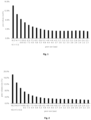
- a desorption side isotherm is measured by a Micromeritics automatic surface area and porosity analyzer (TriStarII3020), and then the pore size distribution curve with pore diameters as abscissas and pore volume percentages (percentage of the pore volume of mesopores with different pore sizes in the pore volume of total mesopores) as ordinates is obtained by using the desorption side isotherm and calculating with a BJH method. As shown in FIGs.
- the specific surface area of the present invention is determined by referring to a gravimetric method in GB/T 19587-2004 gas adsorption using the BET Method, and is determined by the Micromeritics automatic surface area and porosity analyzer (TriStarII3020). The test results are shown in Table 3.
- Total free lithium content-the unit is weight percentage (%)
- a 454261 soft package battery is prepared according to the following method.
- Preparation of the positive electrode add the cathode material of the present invention, the conductive carbon black (S.P), and the polyvinylidene fluoride (PVDF) serving as the binder into the N-methylpyrrolidone (NMP) (a weight ratio of the cathode material to the NMP is 2.1:1) according to a weight ratio of 94:3:3, fully mix, stir to form uniform slurry, coat on an aluminum foil current collector, dry and press into a pole piece.
- NMP N-methylpyrrolidone
- Preparation of a negative electrode add the negative electrode artificial graphite, the conductive carbon black (S.P), the carboxymethyl cellulose (CMC) and the binder (SBR) into enough pure water according to a weight ratio of 95:1:1:3, mix, stir to form uniform slurry, coat on the copper foil current collector, dry and press into a pole pieces.
- S.P conductive carbon black
- CMC carboxymethyl cellulose
- SBR binder
- the model of a battery cell is 454261.
- test temperature at 25°C, stand for 4 hours, charge at constant current and constant voltage for 4 hours (such as 1/3C, charge to 4.2V), pause, stand, discharge at a constant current (such as 1/3C, end at 3.0V), and pause; stand for 4 hours, charge at constant current and constant voltage for 4 hours (such as 1/3C, charge to 4.3V), pause, stand, discharge at a constant current (such as 1C, end at 3.0V), and pause; and repeat the previous steps to obtain capacity data under different voltage conditions.
- constant current and constant voltage such as 1/3C, charge to 4.2V
- pause, stand discharge at a constant current (such as 1/3C, end at 3.0V)
- pause stand for 4 hours, charge at constant current and constant voltage for 4 hours (such as 1/3C, charge to 4.3V), pause, stand, discharge at a constant current (such as 1C, end at 3.0V), and pause; and repeat the previous steps to obtain capacity data under different voltage conditions.
- step 2) of the cycle test add a step of constant-current discharge for 30 seconds before the constant-current discharge (the voltage difference within 30 seconds is recorded, and then the DCR is obtained by dividing the voltage by the current), and the rest is unchanged. Repeat the previous step of constant-current charge, and carry out the cycle test to obtain the growth rate of DCR in different cycles (divide a difference value between the DCR after the cycle and the DCR after the first cycle by the DCR after the first cycle).
- the lithium-ion battery cathode materials prepared in examples 1-6 mainly contain mesopores, the pore sizes of the mesopores are mainly in the range of 2-20nm, the pore volume of the mesopores in the range of 2-20nm accounts for more than 90% of the total pore volume, the pore volume of the pores in the range of 3-20nm accounts for more than 80% of the total pore volume of the mesopores, and the pore volume of the pores in the range of 5-19nm accounts for more than 57% of the total pore volume of the mesopores; the lithium-ion battery cathode materials prepared in Examples 1-6 have a relatively large specific surface area of 0.48-1.5m 2 /g and a relatively small particle size of 2.8-5.6 ⁇ m; the cathode materials prepared in Examples 7 and 8 mainly contain mesopores and macropores, the mesopores in the range of 2-20nm are
- the lithium-ion battery cathode material provided by the present invention has mesopores, the pore size of which is mainly in the range of 2-20nm and accounts for more than 90%, and these mesopores provide more shorter paths for lithium ion migration, so that the lithium-ion battery cathode material provided by the present invention has higher capacity; at the same time, during the charge and discharge process of the lithium-ion battery, the cathode material is not easy to crack, and thus, the capacity attenuation of the lithium-ion battery cathode material in the cycle process is prevented.
Landscapes
- Chemical & Material Sciences (AREA)
- Inorganic Chemistry (AREA)
- Chemical Kinetics & Catalysis (AREA)
- Electrochemistry (AREA)
- General Chemical & Material Sciences (AREA)
- Organic Chemistry (AREA)
- Engineering & Computer Science (AREA)
- Materials Engineering (AREA)
- Manufacturing & Machinery (AREA)
- Battery Electrode And Active Subsutance (AREA)
- Inorganic Compounds Of Heavy Metals (AREA)
Applications Claiming Priority (1)
| Application Number | Priority Date | Filing Date | Title |
|---|---|---|---|
| CN202111115015.9A CN115159589A (zh) | 2021-09-23 | 2021-09-23 | 一种锂离子电池正极材料及制法和应用 |
Publications (2)
| Publication Number | Publication Date |
|---|---|
| EP4155271A2 true EP4155271A2 (de) | 2023-03-29 |
| EP4155271A3 EP4155271A3 (de) | 2023-04-12 |
Family
ID=83475601
Family Applications (1)
| Application Number | Title | Priority Date | Filing Date |
|---|---|---|---|
| EP22206781.1A Pending EP4155271A3 (de) | 2021-09-23 | 2022-11-10 | Kathodenmaterial für eine lithium-ionen-batterie sowie herstellungsverfahren und anwendung davon |
Country Status (4)
| Country | Link |
|---|---|
| US (1) | US20230187626A1 (de) |
| EP (1) | EP4155271A3 (de) |
| JP (2) | JP7677934B2 (de) |
| CN (2) | CN120637475A (de) |
Cited By (1)
| Publication number | Priority date | Publication date | Assignee | Title |
|---|---|---|---|---|
| CN119284872A (zh) * | 2024-09-30 | 2025-01-10 | 四川紫宸科技有限公司 | 一种多孔碳、硅碳负极材料及其制备方法和应用 |
Families Citing this family (3)
| Publication number | Priority date | Publication date | Assignee | Title |
|---|---|---|---|---|
| KR102753437B1 (ko) * | 2023-06-07 | 2025-01-10 | 한국원자력연구원 | 양극활물질 및 이를 포함하는 리튬 이차전지 |
| KR102893681B1 (ko) * | 2025-03-21 | 2025-12-01 | 성균관대학교산학협력단 | 양극활물질, 이의 제조방법, 양극 및 전기화학소자 |
| CN119993750B (zh) * | 2025-04-15 | 2025-07-18 | 内蒙古工业大学 | 一种碳纳米纤维负载WSe2/Dy-WO3异质结电极材料的制备方法和应用 |
Citations (4)
| Publication number | Priority date | Publication date | Assignee | Title |
|---|---|---|---|---|
| CN1856890A (zh) | 2003-09-26 | 2006-11-01 | 三菱化学株式会社 | 用于锂二次电池正极材料的锂复合氧化物颗粒、锂二次电池正极以及使用该正极的锂二次电池 |
| CN102280636A (zh) | 2010-06-13 | 2011-12-14 | 三星Sdi株式会社 | 正极活性材料、其制备方法及包括其的可充电锂电池 |
| CN104272520A (zh) | 2012-04-27 | 2015-01-07 | 丰田自动车株式会社 | 非水电解质二次电池及其制造方法 |
| CN108123119A (zh) | 2016-11-30 | 2018-06-05 | 三星Sdi株式会社 | 用于锂二次电池的基于镍的活性材料、其制备方法和包括含其的正极的锂二次电池 |
Family Cites Families (12)
| Publication number | Priority date | Publication date | Assignee | Title |
|---|---|---|---|---|
| CN1233563C (zh) * | 2003-11-05 | 2005-12-28 | 湖南瑞翔新材料有限公司 | 钴酸锂三次烧结合成方法 |
| JP5218782B2 (ja) | 2009-11-27 | 2013-06-26 | 戸田工業株式会社 | 非水電解質二次電池用Li−Ni複合酸化物粒子粉末及びその製造方法、並びに非水電解質二次電池 |
| CN102723465B (zh) * | 2011-06-15 | 2015-02-18 | 中国科学院金属研究所 | 锂离子电池用多孔LiFePO4块体电极的制备方法 |
| CN108682844A (zh) * | 2018-05-04 | 2018-10-19 | 贵州大龙汇成新材料有限公司 | 一种锂离子电池锰酸锂正极材料的制备方法 |
| CN109713251B (zh) | 2018-11-30 | 2022-05-17 | 贵州高点科技有限公司 | 锂离子电池正极材料及其制备方法和应用 |
| CN110176583A (zh) * | 2019-05-10 | 2019-08-27 | 湖南金富力新能源股份有限公司 | 包覆有锆元素的锂离子电池正极材料及其制法和应用 |
| CN110589901A (zh) * | 2019-06-26 | 2019-12-20 | 浙江美都海创锂电科技有限公司 | 镍钴锰酸锂正极材料(Ni≥0.8)的制备方法 |
| KR102644802B1 (ko) | 2019-08-08 | 2024-03-08 | 주식회사 엘지에너지솔루션 | 이차전지용 양극 활물질의 제조방법 |
| CN113054186B (zh) * | 2019-12-26 | 2022-07-15 | 惠州比亚迪实业有限公司 | 一种三元材料及其制备方法和锂离子电池 |
| CN111435744B (zh) | 2020-01-17 | 2022-04-12 | 蜂巢能源科技有限公司 | 无钴层状正极材料及其制备方法、正极片和锂离子电池 |
| JP6705068B1 (ja) | 2020-01-17 | 2020-06-03 | 住友化学株式会社 | 全固体リチウムイオン電池用正極活物質、電極および全固体リチウムイオン電池 |
| KR102379561B1 (ko) * | 2020-03-05 | 2022-03-28 | 삼성에스디아이 주식회사 | 리튬이차전지용 복합양극활물질, 그 제조방법 및 이를 포함하는 양극을 함유한 리튬이차전지 |
-
2021
- 2021-09-23 CN CN202510554567.1A patent/CN120637475A/zh active Pending
- 2021-09-23 CN CN202111115015.9A patent/CN115159589A/zh active Pending
-
2022
- 2022-10-17 US US17/967,262 patent/US20230187626A1/en active Pending
- 2022-10-19 JP JP2022167421A patent/JP7677934B2/ja active Active
- 2022-11-10 EP EP22206781.1A patent/EP4155271A3/de active Pending
-
2025
- 2025-05-01 JP JP2025076425A patent/JP7814593B2/ja active Active
Patent Citations (4)
| Publication number | Priority date | Publication date | Assignee | Title |
|---|---|---|---|---|
| CN1856890A (zh) | 2003-09-26 | 2006-11-01 | 三菱化学株式会社 | 用于锂二次电池正极材料的锂复合氧化物颗粒、锂二次电池正极以及使用该正极的锂二次电池 |
| CN102280636A (zh) | 2010-06-13 | 2011-12-14 | 三星Sdi株式会社 | 正极活性材料、其制备方法及包括其的可充电锂电池 |
| CN104272520A (zh) | 2012-04-27 | 2015-01-07 | 丰田自动车株式会社 | 非水电解质二次电池及其制造方法 |
| CN108123119A (zh) | 2016-11-30 | 2018-06-05 | 三星Sdi株式会社 | 用于锂二次电池的基于镍的活性材料、其制备方法和包括含其的正极的锂二次电池 |
Cited By (1)
| Publication number | Priority date | Publication date | Assignee | Title |
|---|---|---|---|---|
| CN119284872A (zh) * | 2024-09-30 | 2025-01-10 | 四川紫宸科技有限公司 | 一种多孔碳、硅碳负极材料及其制备方法和应用 |
Also Published As
| Publication number | Publication date |
|---|---|
| JP2025105943A (ja) | 2025-07-10 |
| EP4155271A3 (de) | 2023-04-12 |
| CN120637475A (zh) | 2025-09-12 |
| JP2023046411A (ja) | 2023-04-04 |
| JP7677934B2 (ja) | 2025-05-15 |
| JP7814593B2 (ja) | 2026-02-16 |
| CN115159589A (zh) | 2022-10-11 |
| US20230187626A1 (en) | 2023-06-15 |
Similar Documents
| Publication | Publication Date | Title |
|---|---|---|
| US12406979B2 (en) | Carbon-coated lithium-rich oxide composite material and preparation method thereof | |
| EP4155271A2 (de) | Kathodenmaterial für eine lithium-ionen-batterie sowie herstellungsverfahren und anwendung davon | |
| CN111193019B (zh) | 一种补锂添加剂及其制备方法和锂离子电池 | |
| US10790509B2 (en) | Positive-electrode active material precursor for nonaqueous electrolyte secondary battery, positive-electrode active material for nonaqueous electrolyte secondary battery, method for manufacturing positive-electrode active material precursor for nonaqueous electrolyte secondary battery, and method for manufacturing positive-electrode active material for nonaqueous electrolyte secondary battery | |
| EP3731314A1 (de) | Aktivmaterial für positive elektrode und lithiumionenbatterie | |
| EP3467915A1 (de) | Hochratiges lithium-kobaltoxid-positivelektrodenmaterial und herstellungsverfahren dafür | |
| WO2018090956A1 (zh) | 高电压锂电池正极材料、电池及制法和应用 | |
| CN113363476B (zh) | 一种锂离子电池三元正极材料及其制备方法 | |
| KR20240158142A (ko) | 이중 코팅된 고니켈 리튬 이온 양극재, 이의 제조 방법 및 응용 | |
| KR20150073970A (ko) | Li-Ni 복합 산화물 입자 분말 및 비수전해질 이차 전지 | |
| CN109461893B (zh) | 一种新型锂离子电池正极材料及其制备方法 | |
| EP4216308A1 (de) | Kathodenmaterial mit hohem nickelgehalt für eine lithium-ionen-batterie sowie herstellungsverfahren und anwendung davon | |
| EP4645448A1 (de) | Lithium-supplementierendes material, positivelektrode, elektrochemische vorrichtung und elektrische vorrichtung | |
| KR101223482B1 (ko) | 표면 개질된 리튬 이차전지용 양극 활물질 및 그 제조방법 | |
| EP2477260A1 (de) | Siliciumoxid und anodenmaterial für lithiumionen-sekundärzellen | |
| CN114068918B (zh) | 磷酸铁锂正极活性材料及其制备方法及电池 | |
| CN118231601A (zh) | 双层包覆三元材料及其制备方法和正极极片和锂离子电池和用电设备 | |
| CN115304104B (zh) | 锰系补锂添加剂及其制备方法和应用 | |
| CN114573043B (zh) | 正极材料及其制备方法和应用 | |
| CN114937769A (zh) | 一种无水洗高倍率型中空高镍正极材料及其制备方法与应用 | |
| CN115020695A (zh) | 正极活性材料、电化学装置和电子设备 | |
| CN114094095A (zh) | 尖晶石型正极材料及其制备方法与锂离子电池正极片 | |
| CN116014103B (zh) | 一种高镍三元正极材料及其制备方法和应用 | |
| KR101589296B1 (ko) | 리튬 이차 전지용 양극 활물질, 이의 제조 방법, 및 이를 포함하는 리튬 이차 전지 | |
| CN116259747A (zh) | 一种正极材料、二次电池及用电装置 |
Legal Events
| Date | Code | Title | Description |
|---|---|---|---|
| PUAI | Public reference made under article 153(3) epc to a published international application that has entered the european phase |
Free format text: ORIGINAL CODE: 0009012 |
|
| STAA | Information on the status of an ep patent application or granted ep patent |
Free format text: STATUS: THE APPLICATION HAS BEEN PUBLISHED |
|
| PUAL | Search report despatched |
Free format text: ORIGINAL CODE: 0009013 |
|
| AK | Designated contracting states |
Kind code of ref document: A2 Designated state(s): AL AT BE BG CH CY CZ DE DK EE ES FI FR GB GR HR HU IE IS IT LI LT LU LV MC ME MK MT NL NO PL PT RO RS SE SI SK SM TR |
|
| AK | Designated contracting states |
Kind code of ref document: A3 Designated state(s): AL AT BE BG CH CY CZ DE DK EE ES FI FR GB GR HR HU IE IS IT LI LT LU LV MC ME MK MT NL NO PL PT RO RS SE SI SK SM TR |
|
| RIC1 | Information provided on ipc code assigned before grant |
Ipc: H01M 4/525 20100101ALI20230307BHEP Ipc: C01G 53/00 20060101AFI20230307BHEP |
|
| STAA | Information on the status of an ep patent application or granted ep patent |
Free format text: STATUS: REQUEST FOR EXAMINATION WAS MADE |
|
| 17P | Request for examination filed |
Effective date: 20230926 |
|
| RBV | Designated contracting states (corrected) |
Designated state(s): AL AT BE BG CH CY CZ DE DK EE ES FI FR GB GR HR HU IE IS IT LI LT LU LV MC ME MK MT NL NO PL PT RO RS SE SI SK SM TR |