EP4145475A1 - Neodym-eisen-bor-magnet und herstellungsverfahren dafür - Google Patents
Neodym-eisen-bor-magnet und herstellungsverfahren dafür Download PDFInfo
- Publication number
- EP4145475A1 EP4145475A1 EP21942136.9A EP21942136A EP4145475A1 EP 4145475 A1 EP4145475 A1 EP 4145475A1 EP 21942136 A EP21942136 A EP 21942136A EP 4145475 A1 EP4145475 A1 EP 4145475A1
- Authority
- EP
- European Patent Office
- Prior art keywords
- alloy
- treatment
- preparation
- balance
- ndfeb magnet
- Prior art date
- Legal status (The legal status is an assumption and is not a legal conclusion. Google has not performed a legal analysis and makes no representation as to the accuracy of the status listed.)
- Pending
Links
- 229910001172 neodymium magnet Inorganic materials 0.000 title claims abstract description 52
- 238000002360 preparation method Methods 0.000 title claims abstract description 32
- 229910045601 alloy Inorganic materials 0.000 claims abstract description 116
- 239000000956 alloy Substances 0.000 claims abstract description 116
- 238000005496 tempering Methods 0.000 claims abstract description 35
- 239000011812 mixed powder Substances 0.000 claims abstract description 30
- 239000002994 raw material Substances 0.000 claims abstract description 28
- 238000010298 pulverizing process Methods 0.000 claims abstract description 17
- 238000005245 sintering Methods 0.000 claims abstract description 17
- 238000002156 mixing Methods 0.000 claims abstract description 7
- 238000003825 pressing Methods 0.000 claims abstract description 7
- 229910052733 gallium Inorganic materials 0.000 claims description 37
- 229910052796 boron Inorganic materials 0.000 claims description 36
- 229910052802 copper Inorganic materials 0.000 claims description 36
- 229910052779 Neodymium Inorganic materials 0.000 claims description 34
- 229910052739 hydrogen Inorganic materials 0.000 claims description 33
- 239000001257 hydrogen Substances 0.000 claims description 33
- 229910052782 aluminium Inorganic materials 0.000 claims description 30
- 150000002431 hydrogen Chemical class 0.000 claims description 24
- 229910052758 niobium Inorganic materials 0.000 claims description 22
- 239000002245 particle Substances 0.000 claims description 22
- 229910052726 zirconium Inorganic materials 0.000 claims description 21
- 229910052777 Praseodymium Inorganic materials 0.000 claims description 15
- 238000000034 method Methods 0.000 claims description 12
- UFHFLCQGNIYNRP-UHFFFAOYSA-N Hydrogen Chemical compound [H][H] UFHFLCQGNIYNRP-UHFFFAOYSA-N 0.000 claims description 9
- QVGXLLKOCUKJST-UHFFFAOYSA-N atomic oxygen Chemical compound [O] QVGXLLKOCUKJST-UHFFFAOYSA-N 0.000 claims description 9
- 239000001301 oxygen Substances 0.000 claims description 9
- 229910052760 oxygen Inorganic materials 0.000 claims description 9
- 229910052702 rhenium Inorganic materials 0.000 claims description 9
- 229910052684 Cerium Inorganic materials 0.000 claims description 6
- 229910052742 iron Inorganic materials 0.000 claims description 6
- 229910052746 lanthanum Inorganic materials 0.000 claims description 6
- 229910052710 silicon Inorganic materials 0.000 claims description 3
- 238000004519 manufacturing process Methods 0.000 abstract description 10
- 229910052692 Dysprosium Inorganic materials 0.000 abstract description 9
- 230000009286 beneficial effect Effects 0.000 abstract description 9
- 229910052771 Terbium Inorganic materials 0.000 abstract description 7
- 238000009740 moulding (composite fabrication) Methods 0.000 abstract description 3
- XEEYBQQBJWHFJM-UHFFFAOYSA-N iron Substances [Fe] XEEYBQQBJWHFJM-UHFFFAOYSA-N 0.000 description 35
- 239000000843 powder Substances 0.000 description 25
- 238000012360 testing method Methods 0.000 description 19
- 238000009826 distribution Methods 0.000 description 13
- 238000003723 Smelting Methods 0.000 description 11
- 230000000052 comparative effect Effects 0.000 description 9
- 238000005266 casting Methods 0.000 description 8
- 238000006356 dehydrogenation reaction Methods 0.000 description 6
- 239000000463 material Substances 0.000 description 3
- 238000009659 non-destructive testing Methods 0.000 description 3
- 229910052761 rare earth metal Inorganic materials 0.000 description 3
- 150000002910 rare earth metals Chemical class 0.000 description 3
- 239000013078 crystal Substances 0.000 description 2
- 238000005324 grain boundary diffusion Methods 0.000 description 2
- 239000000696 magnetic material Substances 0.000 description 2
- 230000001737 promoting effect Effects 0.000 description 2
- QJVKUMXDEUEQLH-UHFFFAOYSA-N [B].[Fe].[Nd] Chemical compound [B].[Fe].[Nd] QJVKUMXDEUEQLH-UHFFFAOYSA-N 0.000 description 1
- 238000000137 annealing Methods 0.000 description 1
- 230000015572 biosynthetic process Effects 0.000 description 1
- 238000010586 diagram Methods 0.000 description 1
- 230000000694 effects Effects 0.000 description 1
- 238000005516 engineering process Methods 0.000 description 1
- 238000009776 industrial production Methods 0.000 description 1
- 230000005389 magnetism Effects 0.000 description 1
- 239000000203 mixture Substances 0.000 description 1
- 238000011056 performance test Methods 0.000 description 1
- 230000001105 regulatory effect Effects 0.000 description 1
- 238000011160 research Methods 0.000 description 1
- 239000011347 resin Substances 0.000 description 1
- 229920005989 resin Polymers 0.000 description 1
- 238000006467 substitution reaction Methods 0.000 description 1
- 238000001721 transfer moulding Methods 0.000 description 1
Images
Classifications
-
- H—ELECTRICITY
- H01—ELECTRIC ELEMENTS
- H01F—MAGNETS; INDUCTANCES; TRANSFORMERS; SELECTION OF MATERIALS FOR THEIR MAGNETIC PROPERTIES
- H01F41/00—Apparatus or processes specially adapted for manufacturing or assembling magnets, inductances or transformers; Apparatus or processes specially adapted for manufacturing materials characterised by their magnetic properties
- H01F41/02—Apparatus or processes specially adapted for manufacturing or assembling magnets, inductances or transformers; Apparatus or processes specially adapted for manufacturing materials characterised by their magnetic properties for manufacturing cores, coils, or magnets
- H01F41/0253—Apparatus or processes specially adapted for manufacturing or assembling magnets, inductances or transformers; Apparatus or processes specially adapted for manufacturing materials characterised by their magnetic properties for manufacturing cores, coils, or magnets for manufacturing permanent magnets
- H01F41/0266—Moulding; Pressing
-
- B—PERFORMING OPERATIONS; TRANSPORTING
- B22—CASTING; POWDER METALLURGY
- B22F—WORKING METALLIC POWDER; MANUFACTURE OF ARTICLES FROM METALLIC POWDER; MAKING METALLIC POWDER; APPARATUS OR DEVICES SPECIALLY ADAPTED FOR METALLIC POWDER
- B22F3/00—Manufacture of workpieces or articles from metallic powder characterised by the manner of compacting or sintering; Apparatus specially adapted therefor ; Presses and furnaces
- B22F3/12—Both compacting and sintering
- B22F3/16—Both compacting and sintering in successive or repeated steps
-
- B—PERFORMING OPERATIONS; TRANSPORTING
- B22—CASTING; POWDER METALLURGY
- B22F—WORKING METALLIC POWDER; MANUFACTURE OF ARTICLES FROM METALLIC POWDER; MAKING METALLIC POWDER; APPARATUS OR DEVICES SPECIALLY ADAPTED FOR METALLIC POWDER
- B22F3/00—Manufacture of workpieces or articles from metallic powder characterised by the manner of compacting or sintering; Apparatus specially adapted therefor ; Presses and furnaces
- B22F3/24—After-treatment of workpieces or articles
-
- B—PERFORMING OPERATIONS; TRANSPORTING
- B22—CASTING; POWDER METALLURGY
- B22F—WORKING METALLIC POWDER; MANUFACTURE OF ARTICLES FROM METALLIC POWDER; MAKING METALLIC POWDER; APPARATUS OR DEVICES SPECIALLY ADAPTED FOR METALLIC POWDER
- B22F9/00—Making metallic powder or suspensions thereof
- B22F9/02—Making metallic powder or suspensions thereof using physical processes
- B22F9/023—Hydrogen absorption
-
- B—PERFORMING OPERATIONS; TRANSPORTING
- B22—CASTING; POWDER METALLURGY
- B22F—WORKING METALLIC POWDER; MANUFACTURE OF ARTICLES FROM METALLIC POWDER; MAKING METALLIC POWDER; APPARATUS OR DEVICES SPECIALLY ADAPTED FOR METALLIC POWDER
- B22F9/00—Making metallic powder or suspensions thereof
- B22F9/02—Making metallic powder or suspensions thereof using physical processes
- B22F9/04—Making metallic powder or suspensions thereof using physical processes starting from solid material, e.g. by crushing, grinding or milling
-
- C—CHEMISTRY; METALLURGY
- C22—METALLURGY; FERROUS OR NON-FERROUS ALLOYS; TREATMENT OF ALLOYS OR NON-FERROUS METALS
- C22C—ALLOYS
- C22C38/00—Ferrous alloys, e.g. steel alloys
- C22C38/002—Ferrous alloys, e.g. steel alloys containing In, Mg, or other elements not provided for in one single group C22C38/001 - C22C38/60
-
- C—CHEMISTRY; METALLURGY
- C22—METALLURGY; FERROUS OR NON-FERROUS ALLOYS; TREATMENT OF ALLOYS OR NON-FERROUS METALS
- C22C—ALLOYS
- C22C38/00—Ferrous alloys, e.g. steel alloys
- C22C38/005—Ferrous alloys, e.g. steel alloys containing rare earths, i.e. Sc, Y, Lanthanides
-
- C—CHEMISTRY; METALLURGY
- C22—METALLURGY; FERROUS OR NON-FERROUS ALLOYS; TREATMENT OF ALLOYS OR NON-FERROUS METALS
- C22C—ALLOYS
- C22C38/00—Ferrous alloys, e.g. steel alloys
- C22C38/06—Ferrous alloys, e.g. steel alloys containing aluminium
-
- C—CHEMISTRY; METALLURGY
- C22—METALLURGY; FERROUS OR NON-FERROUS ALLOYS; TREATMENT OF ALLOYS OR NON-FERROUS METALS
- C22C—ALLOYS
- C22C38/00—Ferrous alloys, e.g. steel alloys
- C22C38/10—Ferrous alloys, e.g. steel alloys containing cobalt
-
- C—CHEMISTRY; METALLURGY
- C22—METALLURGY; FERROUS OR NON-FERROUS ALLOYS; TREATMENT OF ALLOYS OR NON-FERROUS METALS
- C22C—ALLOYS
- C22C38/00—Ferrous alloys, e.g. steel alloys
- C22C38/12—Ferrous alloys, e.g. steel alloys containing tungsten, tantalum, molybdenum, vanadium, or niobium
-
- C—CHEMISTRY; METALLURGY
- C22—METALLURGY; FERROUS OR NON-FERROUS ALLOYS; TREATMENT OF ALLOYS OR NON-FERROUS METALS
- C22C—ALLOYS
- C22C38/00—Ferrous alloys, e.g. steel alloys
- C22C38/14—Ferrous alloys, e.g. steel alloys containing titanium or zirconium
-
- C—CHEMISTRY; METALLURGY
- C22—METALLURGY; FERROUS OR NON-FERROUS ALLOYS; TREATMENT OF ALLOYS OR NON-FERROUS METALS
- C22C—ALLOYS
- C22C38/00—Ferrous alloys, e.g. steel alloys
- C22C38/16—Ferrous alloys, e.g. steel alloys containing copper
-
- H—ELECTRICITY
- H01—ELECTRIC ELEMENTS
- H01F—MAGNETS; INDUCTANCES; TRANSFORMERS; SELECTION OF MATERIALS FOR THEIR MAGNETIC PROPERTIES
- H01F1/00—Magnets or magnetic bodies characterised by the magnetic materials therefor; Selection of materials for their magnetic properties
- H01F1/01—Magnets or magnetic bodies characterised by the magnetic materials therefor; Selection of materials for their magnetic properties of inorganic materials
- H01F1/03—Magnets or magnetic bodies characterised by the magnetic materials therefor; Selection of materials for their magnetic properties of inorganic materials characterised by their coercivity
- H01F1/032—Magnets or magnetic bodies characterised by the magnetic materials therefor; Selection of materials for their magnetic properties of inorganic materials characterised by their coercivity of hard-magnetic materials
- H01F1/04—Magnets or magnetic bodies characterised by the magnetic materials therefor; Selection of materials for their magnetic properties of inorganic materials characterised by their coercivity of hard-magnetic materials metals or alloys
- H01F1/047—Alloys characterised by their composition
- H01F1/053—Alloys characterised by their composition containing rare earth metals
- H01F1/055—Alloys characterised by their composition containing rare earth metals and magnetic transition metals, e.g. SmCo5
- H01F1/057—Alloys characterised by their composition containing rare earth metals and magnetic transition metals, e.g. SmCo5 and IIIa elements, e.g. Nd2Fe14B
-
- H—ELECTRICITY
- H01—ELECTRIC ELEMENTS
- H01F—MAGNETS; INDUCTANCES; TRANSFORMERS; SELECTION OF MATERIALS FOR THEIR MAGNETIC PROPERTIES
- H01F1/00—Magnets or magnetic bodies characterised by the magnetic materials therefor; Selection of materials for their magnetic properties
- H01F1/01—Magnets or magnetic bodies characterised by the magnetic materials therefor; Selection of materials for their magnetic properties of inorganic materials
- H01F1/03—Magnets or magnetic bodies characterised by the magnetic materials therefor; Selection of materials for their magnetic properties of inorganic materials characterised by their coercivity
- H01F1/032—Magnets or magnetic bodies characterised by the magnetic materials therefor; Selection of materials for their magnetic properties of inorganic materials characterised by their coercivity of hard-magnetic materials
- H01F1/04—Magnets or magnetic bodies characterised by the magnetic materials therefor; Selection of materials for their magnetic properties of inorganic materials characterised by their coercivity of hard-magnetic materials metals or alloys
- H01F1/047—Alloys characterised by their composition
- H01F1/053—Alloys characterised by their composition containing rare earth metals
- H01F1/055—Alloys characterised by their composition containing rare earth metals and magnetic transition metals, e.g. SmCo5
- H01F1/057—Alloys characterised by their composition containing rare earth metals and magnetic transition metals, e.g. SmCo5 and IIIa elements, e.g. Nd2Fe14B
- H01F1/0571—Alloys characterised by their composition containing rare earth metals and magnetic transition metals, e.g. SmCo5 and IIIa elements, e.g. Nd2Fe14B in the form of particles, e.g. rapid quenched powders or ribbon flakes
- H01F1/0573—Alloys characterised by their composition containing rare earth metals and magnetic transition metals, e.g. SmCo5 and IIIa elements, e.g. Nd2Fe14B in the form of particles, e.g. rapid quenched powders or ribbon flakes obtained by reduction or by hydrogen decrepitation or embrittlement
-
- H—ELECTRICITY
- H01—ELECTRIC ELEMENTS
- H01F—MAGNETS; INDUCTANCES; TRANSFORMERS; SELECTION OF MATERIALS FOR THEIR MAGNETIC PROPERTIES
- H01F1/00—Magnets or magnetic bodies characterised by the magnetic materials therefor; Selection of materials for their magnetic properties
- H01F1/01—Magnets or magnetic bodies characterised by the magnetic materials therefor; Selection of materials for their magnetic properties of inorganic materials
- H01F1/03—Magnets or magnetic bodies characterised by the magnetic materials therefor; Selection of materials for their magnetic properties of inorganic materials characterised by their coercivity
- H01F1/032—Magnets or magnetic bodies characterised by the magnetic materials therefor; Selection of materials for their magnetic properties of inorganic materials characterised by their coercivity of hard-magnetic materials
- H01F1/04—Magnets or magnetic bodies characterised by the magnetic materials therefor; Selection of materials for their magnetic properties of inorganic materials characterised by their coercivity of hard-magnetic materials metals or alloys
- H01F1/047—Alloys characterised by their composition
- H01F1/053—Alloys characterised by their composition containing rare earth metals
- H01F1/055—Alloys characterised by their composition containing rare earth metals and magnetic transition metals, e.g. SmCo5
- H01F1/057—Alloys characterised by their composition containing rare earth metals and magnetic transition metals, e.g. SmCo5 and IIIa elements, e.g. Nd2Fe14B
- H01F1/0571—Alloys characterised by their composition containing rare earth metals and magnetic transition metals, e.g. SmCo5 and IIIa elements, e.g. Nd2Fe14B in the form of particles, e.g. rapid quenched powders or ribbon flakes
- H01F1/0575—Alloys characterised by their composition containing rare earth metals and magnetic transition metals, e.g. SmCo5 and IIIa elements, e.g. Nd2Fe14B in the form of particles, e.g. rapid quenched powders or ribbon flakes pressed, sintered or bonded together
- H01F1/0576—Alloys characterised by their composition containing rare earth metals and magnetic transition metals, e.g. SmCo5 and IIIa elements, e.g. Nd2Fe14B in the form of particles, e.g. rapid quenched powders or ribbon flakes pressed, sintered or bonded together pressed, e.g. hot working
-
- H—ELECTRICITY
- H01—ELECTRIC ELEMENTS
- H01F—MAGNETS; INDUCTANCES; TRANSFORMERS; SELECTION OF MATERIALS FOR THEIR MAGNETIC PROPERTIES
- H01F1/00—Magnets or magnetic bodies characterised by the magnetic materials therefor; Selection of materials for their magnetic properties
- H01F1/01—Magnets or magnetic bodies characterised by the magnetic materials therefor; Selection of materials for their magnetic properties of inorganic materials
- H01F1/03—Magnets or magnetic bodies characterised by the magnetic materials therefor; Selection of materials for their magnetic properties of inorganic materials characterised by their coercivity
- H01F1/032—Magnets or magnetic bodies characterised by the magnetic materials therefor; Selection of materials for their magnetic properties of inorganic materials characterised by their coercivity of hard-magnetic materials
- H01F1/04—Magnets or magnetic bodies characterised by the magnetic materials therefor; Selection of materials for their magnetic properties of inorganic materials characterised by their coercivity of hard-magnetic materials metals or alloys
- H01F1/047—Alloys characterised by their composition
- H01F1/053—Alloys characterised by their composition containing rare earth metals
- H01F1/055—Alloys characterised by their composition containing rare earth metals and magnetic transition metals, e.g. SmCo5
- H01F1/057—Alloys characterised by their composition containing rare earth metals and magnetic transition metals, e.g. SmCo5 and IIIa elements, e.g. Nd2Fe14B
- H01F1/0571—Alloys characterised by their composition containing rare earth metals and magnetic transition metals, e.g. SmCo5 and IIIa elements, e.g. Nd2Fe14B in the form of particles, e.g. rapid quenched powders or ribbon flakes
- H01F1/0575—Alloys characterised by their composition containing rare earth metals and magnetic transition metals, e.g. SmCo5 and IIIa elements, e.g. Nd2Fe14B in the form of particles, e.g. rapid quenched powders or ribbon flakes pressed, sintered or bonded together
- H01F1/0577—Alloys characterised by their composition containing rare earth metals and magnetic transition metals, e.g. SmCo5 and IIIa elements, e.g. Nd2Fe14B in the form of particles, e.g. rapid quenched powders or ribbon flakes pressed, sintered or bonded together sintered
-
- H—ELECTRICITY
- H01—ELECTRIC ELEMENTS
- H01F—MAGNETS; INDUCTANCES; TRANSFORMERS; SELECTION OF MATERIALS FOR THEIR MAGNETIC PROPERTIES
- H01F41/00—Apparatus or processes specially adapted for manufacturing or assembling magnets, inductances or transformers; Apparatus or processes specially adapted for manufacturing materials characterised by their magnetic properties
- H01F41/02—Apparatus or processes specially adapted for manufacturing or assembling magnets, inductances or transformers; Apparatus or processes specially adapted for manufacturing materials characterised by their magnetic properties for manufacturing cores, coils, or magnets
- H01F41/0253—Apparatus or processes specially adapted for manufacturing or assembling magnets, inductances or transformers; Apparatus or processes specially adapted for manufacturing materials characterised by their magnetic properties for manufacturing cores, coils, or magnets for manufacturing permanent magnets
-
- B—PERFORMING OPERATIONS; TRANSPORTING
- B22—CASTING; POWDER METALLURGY
- B22F—WORKING METALLIC POWDER; MANUFACTURE OF ARTICLES FROM METALLIC POWDER; MAKING METALLIC POWDER; APPARATUS OR DEVICES SPECIALLY ADAPTED FOR METALLIC POWDER
- B22F3/00—Manufacture of workpieces or articles from metallic powder characterised by the manner of compacting or sintering; Apparatus specially adapted therefor ; Presses and furnaces
- B22F3/24—After-treatment of workpieces or articles
- B22F2003/248—Thermal after-treatment
-
- B—PERFORMING OPERATIONS; TRANSPORTING
- B22—CASTING; POWDER METALLURGY
- B22F—WORKING METALLIC POWDER; MANUFACTURE OF ARTICLES FROM METALLIC POWDER; MAKING METALLIC POWDER; APPARATUS OR DEVICES SPECIALLY ADAPTED FOR METALLIC POWDER
- B22F2202/00—Treatment under specific physical conditions
- B22F2202/05—Use of magnetic field
-
- B—PERFORMING OPERATIONS; TRANSPORTING
- B22—CASTING; POWDER METALLURGY
- B22F—WORKING METALLIC POWDER; MANUFACTURE OF ARTICLES FROM METALLIC POWDER; MAKING METALLIC POWDER; APPARATUS OR DEVICES SPECIALLY ADAPTED FOR METALLIC POWDER
- B22F2301/00—Metallic composition of the powder or its coating
- B22F2301/35—Iron
- B22F2301/355—Rare Earth - Fe intermetallic alloys
-
- B—PERFORMING OPERATIONS; TRANSPORTING
- B22—CASTING; POWDER METALLURGY
- B22F—WORKING METALLIC POWDER; MANUFACTURE OF ARTICLES FROM METALLIC POWDER; MAKING METALLIC POWDER; APPARATUS OR DEVICES SPECIALLY ADAPTED FOR METALLIC POWDER
- B22F2304/00—Physical aspects of the powder
- B22F2304/10—Micron size particles, i.e. above 1 micrometer up to 500 micrometer
-
- B—PERFORMING OPERATIONS; TRANSPORTING
- B22—CASTING; POWDER METALLURGY
- B22F—WORKING METALLIC POWDER; MANUFACTURE OF ARTICLES FROM METALLIC POWDER; MAKING METALLIC POWDER; APPARATUS OR DEVICES SPECIALLY ADAPTED FOR METALLIC POWDER
- B22F2998/00—Supplementary information concerning processes or compositions relating to powder metallurgy
- B22F2998/10—Processes characterised by the sequence of their steps
-
- B—PERFORMING OPERATIONS; TRANSPORTING
- B22—CASTING; POWDER METALLURGY
- B22F—WORKING METALLIC POWDER; MANUFACTURE OF ARTICLES FROM METALLIC POWDER; MAKING METALLIC POWDER; APPARATUS OR DEVICES SPECIALLY ADAPTED FOR METALLIC POWDER
- B22F2999/00—Aspects linked to processes or compositions used in powder metallurgy
-
- C—CHEMISTRY; METALLURGY
- C22—METALLURGY; FERROUS OR NON-FERROUS ALLOYS; TREATMENT OF ALLOYS OR NON-FERROUS METALS
- C22C—ALLOYS
- C22C2202/00—Physical properties
- C22C2202/02—Magnetic
Definitions
- the present disclosure relates to the field of NdFeB, and in particular to an NdFeB magnet and a preparation method thereof.
- Magnetic energy product is the most important in the technical indexes of magnetic materials. Magnetic energy product denotes the magnitude of energy of external magnetic field generated by unit volume of a magnet. High magnetic energy product means that a motor may make use of a smaller magnet to output higher power.
- Sintered NdFeB magnet is the permanent magnet material with the strongest overall magnetic performance in the world. With its excellent properties and cost performance superior to the conventional permanent magnet materials, sintered NdFeB magnet is widely applied in the fields, such as, energy, traffic, machinery, medical treatment, computer, home appliances and thus, plays an important role in national economy.
- Neodymium iron boron (NdFeB) is an important rare earth permanent magnetic material and featured by high magnetic energy product, high coercive force, light weight and low cost. NdFeB is the magnet with the highest cost performance up to now, and has been awarded "the king of magnet”. The appearance of NdFeB enables the magnetic devices to develop towards a high efficient, miniaturized and light-weight trend.
- NdFeB magnet there are two major methods to improve the coercive force of NdFeB magnet in industrial production: one is to add heavy rare earth Dy/Tb and the like to a master alloy directly by smelting, and to prepare a magnet with a conventional process. But after Dy/Tb is directly added to substitute Nd in the principal phase Nd 2 Fe 14 B, the generated new (Nd,Dy) 2 Fe 14 B and (Nd,Dy) 2 Fe 14 B have an anisotropism greater than that of the principal phase, thereby obviously improving the coercive force of the sintered magnet.
- Two is a grain boundary diffusion process. The magnet sample prepared by the grain boundary diffusion process is limited by the thickness of a magnet.
- the content of Dy and Tb is the key to determine the cost of a high-performance sintered Ndfeb magnet material. But in recent years, the cost of heavy rare earth has increased, and how to improve the coercive force of an NdFeB magnet with a little addition or no addition of Dy and Tb has become a research priority. Effects of post-sinter annealing on the microstructure and magnetic properties of Nd-Fe-B sintered magnets with Nd-Ga intergranular addition [J], Chinese Physics B, 2021 .
- the academic paper has disclosured that the content (especially the content of Nd and Ga) of each component in alloy, and hydrogen decrepitation temperature are regulated and controlled, thus promoting the improvement of coercive force of the formed sintered magnet to some extent.
- the principal phase Re 2 T 14 B is mainly formed preferentially and Re 6 Fe 13 Ga phase is formed secondly in this literature; the formation of the Re 6 Fe 13 Ga phase requires strict conditions, which is not beneficial to volume production. Furthermore, the sintered magnet formed by the above method has slightly enhanced coercive force, and poor remanence and magnetic performance stability.
- NdFeB magnet which has a simpler preparation process, higher improvement of coercive force, and more stable remanence and magnetic performance, and is more beneficial to volume production.
- the main objective of the present disclosure is to provide an NdFeB magnet and a preparation method thereof, thus solving the problems in the prior art, namely, when the coercive force of an NdFeB magnet is improved with a little addition or no addition of Dy and Tb, it is not beneficial to volume production; the formed sintered magnet has slightly enhanced coercive force, and poor residual magnetism and poor magnetic performance stability.
- a preparation method of an NdFeB magnet includes the following steps: S1, mixing an alloy A and an alloy B for pulverizing treatment to obtain a mixed powder; S2, pressing and forming the mixed powder to obtain a pressed article; S3, successively performing sintering treatment and tempering treatment on the pressed article to obtain the NdFeB magnet; where, raw material components of the alloy A contain 28-35 wt% Re, 64-71.2 wt% T and 0.8-1.0 wt% B by weight percentage; where, Re is one or more of La, Ce, Pr or Nd; and T is one or more of Fe, Co, Al, Si, Cu, Nb, Zr and Ga; raw material components of the alloy B contain 40-60 wt% Re, 39.2-59.5 wt% T and 0.5-0.8 wt% B by weight percentage; where, Re is one or more of La, Ce, Pr or Nd, T contains Fe and Ga; and
- the alloy B has a use amount accounting for 1-10% of the weight of the alloy A.
- the raw material components of the alloy B contain 40-60 wt % Re, 0-2 wt% Co, 3-10 wt% Cu, 3-10 wt% Ga, 0-0.5 wt% Nb and/or Zr, 0.5-0.8 wt% B and a balance of Fe.
- the raw material components of the alloy A contain: 30-32 wt% Nd, 1.0-2.0 wt% Co, 0.05-0.1 wt% Cu, 0.3-0.8 wt% Al, 0.1-0.15 wt% Ga, 0.12-0.15 wt% Zr, 0.9-0.92 wt% B and the balance of Fe;
- the raw materials of the alloy B contain: 40-50 wt% Nd, 1.0-1.5 wt% Co, 5-8 wt% Cu, 0.1-0.4 wt% Al, 5-8 wt% Ga, 0.2-0.3 wt% Nb, 0.65-0.75 wt% B and the balance of Fe.
- the raw material components of the alloy A contain: 32 wt% Nd, 1.5 wt% Co, 0.1 wt% Cu, 0.8 wt% Al, 0.1 wt% Ga, 0.15 wt% Zr, 0.9 wt% B and the balance of Fe;
- the raw material components of the alloy B contain: 50 wt% Nd, 1.0 wt% Co, 6 wt% Cu, 0.4 wt% Al, 6 wt% Ga, 0.3 wt% Nb, 0.75 wt% B and the balance of Fe; or, the raw material components of the alloy A contain: 31.5 wt% Nd, 1.5 wt% Co, 0.1 wt% Cu, 0.6 wt% Al, 0.1 wt% Ga, 0.15 wt% Zr, 0.9 wt% B and the balance of Fe;
- the raw material components of the alloy B contain: 45 wt% Nd, 1.0 wt% Co, 5 wt% Cu, 0.1
- the mixed powder has a mean particle size of 2.8-3.0 ⁇ m.
- the sintering treatment has a treatment temperature of 1000-1100°C and a treatment time of 5-10 h.
- the tempering treatment includes a primary tempering treatment and a secondary tempering treatment performed in order; preferably, the primary tempering treatment has a treatment temperature of 880-920°C and a treatment time of 2-4 h; preferably, the secondary tempering treatment has a treatment temperature of 450-550°C and a treatment time of 4-6 h.
- the preparation method further contains a step of mixing the alloy A and the alloy B, and performing hydrogen decrepitation treatment and dehydrogenafion treatment successively; preferably, the dehydrogenafion treatment has a treatment temperature of 450-500°C and a treatment time of 5-10 h; preferably, the mixed powder has a hydrogen content of 600-1200 ppm and an oxygen content of 1000-1500 ppm.
- the mixed powder is pressed and formed in an oriented magnetic field, and the oriented magnetic field has a magnetic field intensity is not less than 1.4T.
- an NdFeB magnet is provided.
- the NdFeB magnet is prepared by the above preparation method.
- an alloy A and an alloy B based on a specific component content are used as raw materials, and subjected to multiple steps of pulverizing, forming, sintering and tempering treatment to prepare an NdFeB magnet.
- the Re 6 Fe 13 Ga phase in the magnet may be doped between the surfaces of crystal boundary of the principal phase Re 2 T 14 B more evenly and stably, thus forming an isolating layer.
- the NdFeB magnet of the present disclosure has a more enhanced coercive force and more stable remanence and magnetic performance without the addition of Dy and Tb. Meanwhile, the preparation method is simple to operate and thus, is more beneficial for volume production.
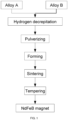
- FIG. 1 is a flow diagram showing a preparation method of an NdFeB magnet of the present disclosure.
- the present disclosure provides a preparation method of an NdFeB magnet, as shown in FIG.
- the preparation method includes the following steps: S1, mixing an alloy A and an alloy B for pulverizing treatment to obtain a mixed powder; S2, pressing and forming the mixed powder to obtain a pressed article; S3, successively performing sintering treatment and tempering treatment on the pressed article to obtain the NdFeB magnet; where, raw material components of the alloy A contain 28-35 wt% Re, 64-71.2 wt% T and 0.8-1.0 wt% B by weight percentage; where, Re is one or more of La, Ce, Pr or Nd; and T is one or more of Fe, Co, Al, Si, Cu, Nb, Zr and Ga; raw material components of the alloy B contain 40-60 wt% Re, 39.2-59.5 wt% T and 0.5-0.8 wt% B by weight percentage; where, Re is one or more of La, Ce, Pr or Nd, T contains Fe and Ga; and meanwhile, T further contains one or more of Co, Cu, Nb, and Zr.
- an alloy A and an alloy B based on the above specific component content are used as raw materials, and subjected to multiple steps of pulverizing, forming, sintering and tempering treatment to prepare an NdFeB magnet.
- the Re 6 Fe 13 Ga phase in the magnet may be doped between the surfaces of crystal boundary of the principal phase Re 2 T 14 B more evenly and stably, thus forming an isolating layer.
- the NdFeB magnet of the present disclosure has a more enhanced coercive force and more stable remanence and magnetic performance without the addition of Dy and Tb. Meanwhile, the preparation method is simple to operate and thus, is more beneficial for volume production.
- the above alloys A and B are prepared by conventionally smelting the raw materials; the specific smelting process is commonly known in the art, for example, a resin transfer molding technology (RTM), and a vacuum rapid hardening smelting process.
- RTM resin transfer molding technology
- the alloy B preferably has a use amount accounting for 1-10% of the weight of the alloy A.
- the NdFeB magnet has more enhanced coercive force and better magnetic performance stability within such a scope.
- the preparation method is simple to operate and thus, is more beneficial for volume production.
- the raw material components of the alloy B preferably contain 40-60 wt % Re, 0-2 wt% Co, 3-10 wt% Cu, 3-10 wt% Ga, 0-0.5 wt% Nb and/or Zr, 0.5-0.8 wt% B and a balance of Fe.
- each component content in the alloy A is as follows: 30-32 wt% Nd, 1.0-2.0 wt% Co, 0.05-0.1 wt% Cu, 0.3-0.8 wt% Al, 0.1-0.15 wt% Ga, 0.12-0.15 wt% Zr, 0.9-0.92 wt% B and the balance of Fe; each component content in the alloy B is as follows: 40-50 wt% Nd, 1.0-1.5 wt% Co, 5-8 wt% Cu, 0.1-0.4 wt% Al, 5-8 wt% Ga, 0.2-0.3 wt% Nb, 0.65-0.75 wt% B and the balance of Fe. Based on this, the magnet has more significantly enhanced coercive force, and has more stable remanence and magnetic performance.
- each component content in the alloy A is as follows: 32 wt% Nd, 1.5 wt% Co, 0.1 wt% Cu, 0.8 wt% Al, 0.1 wt% Ga, 0.15 wt% Zr, 0.9 wt% B and the balance of Fe; each component content in the alloy B is as follows: 50 wt% Nd, 1.0 wt% Co, 6 wt% Cu, 0.4 wt% Al, 6 wt% Ga, 0.3 wt% Nb, 0.75 wt% B and the balance of Fe; or, each component content in the alloy A is as follows: 31.5 wt% Nd, 1.5 wt% Co, 0.1 wt% Cu, 0.6 wt% Al, 0.1 wt% Ga, 0.15 wt% Zr, 0.9 wt% B and the balance of Fe; each component content in the alloy B is as follows: 32 wt% Nd, 1.5 wt% Co, 0.1 wt% Cu, 0.8
- the mixed powder has a mean particle size of 2.8-3.0 ⁇ m, and 50% powder has a particle size less than 3.5 ⁇ m in normal distribution.
- alloys A and B may be mixed more evenly, which may further improve the subsequent forming efficiency, thereby promoting the magnet to achieve more stable magnetic performance.
- the sintering treatment has a treatment temperature of 1000-1100°C and a treatment time of 5-10 h.
- the tempering treatment includes a primary tempering treatment and a secondary tempering treatment performed in order; preferably, the primary tempering treatment has a treatment temperature of 880-920°C and a treatment time of 2-4 h; preferably, the secondary tempering treatment has a treatment temperature of 450-550°C and a treatment time of 4-6 h.
- the preparation method further includes a step of mixing the alloy A and the alloy B, and performing hydrogen decrepitation treatment and dehydrogenafion treatment successively; preferably, the dehydrogenafion treatment has a treatment temperature of 450-500°C and a treatment time of 5-10 h; preferably, the mixture of alloys A and B may be pre-crushed first in the hydrogen decrepitation treatment of the mixed powder, thus further improving the subsequent pulverizing efficiency.
- the hydrogen content and the oxygen content in the mixed powder may be respectively controlled within 600-1200 ppm and 1000-1500 ppm better.
- the mixed powder is pressed and formed in an oriented magnetic field, and the oriented magnetic field has a magnetic field intensity is not less than 1.4T.
- the pressed article is more compact, and alloys A and B in the article are mixed more evenly, such that the magnet has more significantly enhanced intrinsic coercive force, more superior remanence and maximum magnetic energy product, and more stable magnetic performance after the subsequent sintering and tempering treatment.
- the present disclosure further provides an NdFeB magnet, and the NdFeB magnet is prepared by the above preparation method of the NdFeB magnet.
- the NdFeB magnet of the present disclosure has significantly enhanced coercive force, and has more stable remanence and magnetic performance without any addition of Dy/Tb, and is more beneficial to volume production.
- a casting alloy piece A was prepared according to a formula of 31.5 wt% (Nd, Pr), 1.5 wt% Co, 0.1 wt% Cu, 0.6 wt% Al, 0.1 wt% Ga, 0.15 wt% Zr, 0.90 wt% B and a balance of Fe by weight.
- a casting alloy piece B was prepared according to a formula of 45 wt% (Nd, Pr), 1.0 wt% Co, 5 wt% Cu, 0.1 wt% Al, 5 wt% Ga, 0.3 wt% Nb, 0.70 wt% B and a balance of Fe by weight via a vacuum rapid hardening smelting process.
- a weight ratio of Nd to Pr was 2:8.
- the alloy A and alloy B were mixed (the alloy B had a use amount accounting for 5% of the weight of the alloy A), and successively subjected to hydrogen decrepitation, dehydrogenafion and pulverizing treatment, thus obtaining a mixed powder.
- the hydrogen decrepitation and dehydrogenafion had a treatment temperature of 480°C and dehydrogenafion treatment time of 6 h; after dehydrogenation, the powder had a hydrogen content of 980 ppm and an oxygen content of 1100 ppm.
- the hydrogen decrepitated powder was pulverized via airflow, and the particle size of the mixed powder accorded with the normal distribution, and the mean particle size was 2.8 ⁇ m; 50% powder had a particle size less than 3.25 ⁇ m in normal distribution.
- the mixed powder was pressed and formed into a 60 ⁇ 35 ⁇ 40 (mm) block blank in an oriented magnetic field ( ⁇ 1.4T), and the blank was put to a high-vacuum sintering furnace and sintered for 7 h at 1070°C, and subjected to a primary tempering treatment for 3 h at 900°C and a secondary tempering treatment for 5 h at 510°C in order, and prepared into an NdFeB magnet.
- a ⁇ 10 ⁇ 10 (mm) standard sample was taken for test and the test results were shown in Table 1 below.
- Example 2 differed from Example 1 only in that the use amount of the alloy B was 12% of the weight of the alloy A.
- a ⁇ 10 ⁇ 10 (mm) standard sample was taken for test and the test results were shown in Table 2 below.
- Table 2 Source of magnet Remanence Br (kGs) Intrinsic coercive force Hcj (kOe) Maximum magnetic energy product (BH)max (MGOe)
- Example 2 12.65 18.9 37.23 Alloy A 13.5 17.2 43.56 Alloy B 10.2 11.2 29.15
- a casting alloy piece A was prepared according to a formula of 30 wt% (Nd, Pr), 1.0 wt% Co, 0.05 wt% Cu, 0.3 wt% Al, 0.1 wt% Ga, 0.12 wt% Zr, 0.92 wt% B and a balance of Fe by weight.
- a casting alloy piece B was prepared according to a formula of 40 wt% (Nd, Pr), 1.0 wt% Co, 8 wt% Cu, 0.1 wt% Al, 8 wt% Ga, 0.2 wt% Nb, 0.65 wt% B and a balance of Fe by weight via a vacuum rapid hardening smelting process.
- a weight ratio of Nd to Pr was 2:8.
- the alloy A and alloy B were mixed (the alloy B had a use amount accounting for 6% of the weight of the alloy A), and successively subjected to hydrogen decrepitation, dehydrogenafion and pulverizing treatment, thus obtaining a mixed powder.
- the hydrogen decrepitation and dehydrogenafion had a treatment temperature of 470°C and dehydrogenafion treatment time of 6 h; after dehydrogenation, the powder had a hydrogen content of 1020 ppm and an oxygen content of 1060 ppm.
- the hydrogen decrepitated powder was pulverized via airflow, and the particle size of the mixed powder accorded with the normal distribution, and the mean particle size was 2.95 ⁇ m; 50% powder had a particle size less than 3.42 ⁇ m in normal distribution.
- the mixed powder was pressed and formed into a 70 ⁇ 50 ⁇ 35 (mm) block blank in an oriented magnetic field ( ⁇ 1.4T), and the blank was put to a high-vacuum sintering furnace and sintered for 7 h at 1060°C, and subjected to a primary tempering treatment for 3 h at 900°C and a secondary tempering treatment for 5 h at 510°C, and prepared into an NdFeB magnet.
- a ⁇ 10 ⁇ 10 (mm) standard sample was taken for test and the test results were shown in Table 3 below.
- Example 4 differed from Example 3 only in that the use amount of the alloy A was 11% of the weight of the alloy B. A ⁇ 10 ⁇ 10 (mm) standard sample was taken for test and the test results were shown in Table 4 below. Table 4 Source of magnet Remanence Br (kGs) Intrinsic coercive force Hcj (kOe) Maximum magnetic energy product (BH)max (kOe) (MGOe) Example 4 13.58 16.52 46.65 Alloy A 14.2 13.5 51.27 Alloy B 10.85 12.5 30.24
- a casting alloy piece A was prepared according to a formula of 32 wt% (Nd, Pr), 1.5 wt% Co, 0.1 wt% Cu, 0.8 wt% Al, 0.1 wt% Ga, 0.15 wt% Zr, 0.90 wt% B and a balance of Fe by weight via vacuum rapid hardening smelting.
- a casting alloy piece B was prepared according to a formula of 50 wt% (Nd, Pr), 1.0 wt% Co, 6 wt% Cu, 0.4 wt% Al, 6 wt% Ga, 0.3 wt% Nb, 0.75 wt% B and a balance of Fe by weight via vacuum rapid hardening smelting. In the alloy A and alloy B, a weight ratio of Nd to Pr was 2:8.
- the alloy A and alloy B were mixed (the alloy B had a use amount accounting for 8% of the weight of the alloy A), and successively subjected to hydrogen decrepitation, dehydrogenafion and pulverizing treatment, thus obtaining a mixed powder.
- the hydrogen decrepitation and dehydrogenafion had a treatment temperature of 490°C and dehydrogenafion treatment time of 6 h; after dehydrogenation, the powder had a hydrogen content of 980 ppm and an oxygen content of 1050 ppm.
- the hydrogen decrepitated powder was pulverized via airflow, and the particle size of the mixed powder accorded with the normal distribution, and the mean particle size was 2.87 ⁇ m; 50% powder had a particle size less than 3.28 ⁇ m in normal distribution.
- the mixed powder was pressed and formed into a 70 ⁇ 50 ⁇ 35 (mm) block blank in an oriented magnetic field ( ⁇ 1.4T), and the blank was put to a high-vacuum sintering furnace and sintered for 7 h at 1080°C, and subjected to a primary tempering treatment for 3 h at 900°C and a secondary tempering treatment for 5 h at 510°C, and prepared into an NdFeB magnet.
- a ⁇ 10 ⁇ 10 (mm) standard sample was taken for test and the test results were shown in Table 5 below.
- Example 6 differed from Example 5 only in that the use amount of the alloy B was 13% of the weight of the alloy A.
- a ⁇ 10 ⁇ 10 (mm) standard sample was taken for test and the test results were shown in Table 6 below.
- Table 6 Source of magnet Remanence Br (kGs) Intrinsic coercive force Hcj (kOe) Maximum magnetic energy product (BH)max (kOe) (MGOe) Example 6 12.57 19.75 37.75 Alloy A 13.21 18.25 41.82 Alloy B 10.12 13.65 27.12
- Comparative Example 1 differed from Example 1 in that raw materials were together prepared into an alloy, and then an NdFeB magnet was manufactured. Specifically: an alloy C was prepared according to a formula of 32.14 wt% (Nd, Pr), 1.48 wt% Co, 0.33 wt% Cu, 0.58 wt% Al, 0.24 wt% Ga, 0.16 wt% Zr, 0.89 wt% B and a balance of Fe by weight via vacuum rapid hardening smelting, and then, the alloy C was subjected to hydrogen decrepitation, dehydrogenafion and pulverizing treatment to obtain a powder.
- the hydrogen decrepitation and dehydrogenafion had a treatment temperature of 480°C and dehydrogenafion treatment time of 6 h; after dehydrogenation, the powder had a hydrogen content of 980 ppm and an oxygen content of 1100 ppm.
- the hydrogen decrepitated powder was pulverized via airflow, and the particle size of the mixed powder accorded with the normal distribution, and the mean particle size was 2.8 ⁇ m; 50% powder had a particle size less than 3.25 ⁇ m in normal distribution.
- a weight ratio of Nd to Pr was 2:8.
- the powder was pressed and formed into a 60 ⁇ 35 ⁇ 40 (mm) block blank in an oriented magnetic field ( ⁇ 1.4T), and the blank was put to a high-vacuum sintering furnace and sintered for 7 h at 1070°C, and subjected to a primary tempering treatment for 3 h at 900°C and a secondary tempering treatment for 5 h at 510°C in order, and prepared into an NdFeB magnet.
- a ⁇ 10 ⁇ 10 (mm) standard sample was taken for test and the test results were shown in Table 7 below.
- Comparative Example 2 differed from Example 3 in that raw materials were together prepared into an alloy, and then an NdFeB magnet was manufactured. Specifically: a casting alloy piece D was prepared according to a formula of 30.57 wt% (Nd, Pr), 1.0 wt% Co, 0.5 wt% Cu, 0.29 wt% Al, 0.55 wt% Ga, 0.11 wt% Zr, 0.90 wt% B and a balance of Fe by weight via vacuum rapid hardening smelting, and then, the alloy D was subjected to hydrogen decrepitation for discharge, dehydrogenafion and pulverizing treatment to obtain a powder.
- the hydrogen decrepitation and dehydrogenafion had a treatment temperature of 470°C and dehydrogenafion treatment time of 6 h; after dehydrogenation, the powder had a hydrogen content of 1020 ppm and an oxygen content of 1060 ppm.
- the hydrogen decrepitated powder was pulverized via airflow, and the particle size of the mixed powder accorded with the normal distribution, and the mean particle size was 2.95 ⁇ m; 50% powder had a particle size less than 3.42 ⁇ m in normal distribution.
- a weight ratio of Nd to Pr was 2:8.
- the powder was pressed and formed into a 70 ⁇ 50 ⁇ 35 (mm) block blank in an oriented magnetic field ( ⁇ 1.4T), and the blank was put to a high-vacuum sintering furnace and sintered for 7 h at 1060°C, and subjected to a primary tempering treatment for 3 h at 900°C and a secondary tempering treatment for 5 h at 510°C in order, and prepared into an NdFeB magnet.
- a ⁇ 10 ⁇ 10 (mm) standard sample was taken for test and the test results were shown in Table 7 below.
- Comparative Example 3 differed from Example 5 in that raw materials were together prepared into an alloy, and then an NdFeB magnet was manufactured. Specifically: a casting alloy piece E was prepared according to a formula of 33.33 wt% (Nd, Pr), 1.46 wt% Co, 0.54 wt% Cu, 0.77 wt% Al, 0.54 wt% Ga, 0.14 wt% Zr, 0.02 wt% Nb, 0.89 wt% B and a balance of Fe by weight via vacuum rapid hardening smelting, and then, the alloy E was subjected to hydrogen decrepitation for discharge, dehydrogenafion and pulverizing treatment to obtain a powder.
- the hydrogen decrepitation and dehydrogenafion had a treatment temperature of 490°C and dehydrogenafion treatment time of 6 h; after dehydrogenation, the powder had a hydrogen content of 980 ppm and an oxygen content of 1050 ppm.
- the hydrogen decrepitated powder was pulverized via airflow, and the particle size of the mixed powder accorded with the normal distribution, and the mean particle size was 2.87 ⁇ m; 50% powder had a particle size less than 3.28 ⁇ m in normal distribution.
- a weight ratio of Nd to Pr was 2:8.
- the powder was pressed and formed into a 70 ⁇ 50 ⁇ 35 (mm) block blank in an oriented magnetic field ( ⁇ 1.4T), and the blank was put to a high-vacuum sintering furnace and sintered for 7 h at 1080°C, and subjected to a primary tempering treatment for 3 h at 900°C and a secondary tempering treatment for 5 h at 510°C in order, and prepared into an NdFeB magnet.
- a ⁇ 10 ⁇ 10 (mm) standard sample was taken for test and the test results were shown in Table 7 below.
Landscapes
- Engineering & Computer Science (AREA)
- Chemical & Material Sciences (AREA)
- Power Engineering (AREA)
- Mechanical Engineering (AREA)
- Materials Engineering (AREA)
- Metallurgy (AREA)
- Organic Chemistry (AREA)
- Inorganic Chemistry (AREA)
- Crystallography & Structural Chemistry (AREA)
- Manufacturing & Machinery (AREA)
- Hard Magnetic Materials (AREA)
- Powder Metallurgy (AREA)
- Manufacturing Cores, Coils, And Magnets (AREA)
Applications Claiming Priority (2)
| Application Number | Priority Date | Filing Date | Title |
|---|---|---|---|
| CN202110651274.7A CN115472408A (zh) | 2021-06-10 | 2021-06-10 | 钕铁硼磁体及其制备方法 |
| PCT/CN2021/116296 WO2022257285A1 (zh) | 2021-06-10 | 2021-09-02 | 钕铁硼磁体及其制备方法 |
Publications (2)
| Publication Number | Publication Date |
|---|---|
| EP4145475A1 true EP4145475A1 (de) | 2023-03-08 |
| EP4145475A4 EP4145475A4 (de) | 2024-06-05 |
Family
ID=84364754
Family Applications (1)
| Application Number | Title | Priority Date | Filing Date |
|---|---|---|---|
| EP21942136.9A Pending EP4145475A4 (de) | 2021-06-10 | 2021-09-02 | Neodym-eisen-bor-magnet und herstellungsverfahren dafür |
Country Status (5)
| Country | Link |
|---|---|
| US (1) | US20240222006A1 (de) |
| EP (1) | EP4145475A4 (de) |
| JP (1) | JP2024522323A (de) |
| CN (1) | CN115472408A (de) |
| WO (1) | WO2022257285A1 (de) |
Families Citing this family (1)
| Publication number | Priority date | Publication date | Assignee | Title |
|---|---|---|---|---|
| CN119920607A (zh) * | 2023-10-31 | 2025-05-02 | 浙江东阳东磁稀土有限公司 | 钕铁硼磁体及其制备方法 |
Family Cites Families (16)
| Publication number | Priority date | Publication date | Assignee | Title |
|---|---|---|---|---|
| JPH08273960A (ja) * | 1995-03-31 | 1996-10-18 | Seiko Epson Corp | 希土類永久磁石の製造方法 |
| JP5552868B2 (ja) * | 2010-03-30 | 2014-07-16 | Tdk株式会社 | 焼結磁石、モーター及び自動車 |
| CN102903471A (zh) * | 2011-07-28 | 2013-01-30 | 比亚迪股份有限公司 | 一种钕铁硼永磁材料及其制备方法 |
| CN103103442A (zh) * | 2013-02-28 | 2013-05-15 | 包头稀土研究院 | 主辅合金法制备钕铁硼的方法 |
| WO2015020181A1 (ja) * | 2013-08-09 | 2015-02-12 | Tdk株式会社 | R-t-b系焼結磁石、および、モータ |
| JP6205511B2 (ja) * | 2015-01-09 | 2017-09-27 | インターメタリックス株式会社 | RFeB系焼結磁石の製造方法 |
| JP6572550B2 (ja) * | 2015-02-04 | 2019-09-11 | Tdk株式会社 | R−t−b系焼結磁石 |
| JP6642838B2 (ja) * | 2015-02-17 | 2020-02-12 | 日立金属株式会社 | R−t−b系焼結磁石の製造方法 |
| CN105575577B (zh) * | 2016-03-04 | 2017-09-29 | 四川大学 | 烧结富铈稀土永磁材料及其制备方法 |
| CN105931784B (zh) * | 2016-06-30 | 2018-04-03 | 成都八九九科技有限公司 | 一种耐腐蚀含铈稀土永磁材料及其制备方法 |
| JP6860808B2 (ja) * | 2016-08-17 | 2021-04-21 | 日立金属株式会社 | R−t−b系焼結磁石の製造方法 |
| WO2018180891A1 (ja) * | 2017-03-29 | 2018-10-04 | 日立金属株式会社 | R-t-b系焼結磁石の製造方法 |
| CN110088853B (zh) * | 2018-12-29 | 2021-06-29 | 三环瓦克华(北京)磁性器件有限公司 | 稀土磁体及制备方法 |
| CN111009369B (zh) * | 2019-10-29 | 2021-08-27 | 厦门钨业股份有限公司 | 一种稀土永磁材料及其制备方法和应用 |
| CN112908664B (zh) * | 2019-12-03 | 2022-12-20 | 北京中科三环高技术股份有限公司 | 一种制备稀土烧结磁体的方法 |
| CN111378907A (zh) * | 2020-04-08 | 2020-07-07 | 甘肃稀土新材料股份有限公司 | 一种提高钕铁硼永磁材料矫顽力的辅助合金及应用方法 |
-
2021
- 2021-06-10 CN CN202110651274.7A patent/CN115472408A/zh active Pending
- 2021-09-02 WO PCT/CN2021/116296 patent/WO2022257285A1/zh not_active Ceased
- 2021-09-02 EP EP21942136.9A patent/EP4145475A4/de active Pending
- 2021-09-02 JP JP2022572632A patent/JP2024522323A/ja active Pending
- 2021-09-02 US US17/928,623 patent/US20240222006A1/en active Pending
Also Published As
| Publication number | Publication date |
|---|---|
| JP2024522323A (ja) | 2024-06-18 |
| WO2022257285A1 (zh) | 2022-12-15 |
| CN115472408A (zh) | 2022-12-13 |
| EP4145475A4 (de) | 2024-06-05 |
| US20240222006A1 (en) | 2024-07-04 |
Similar Documents
| Publication | Publication Date | Title |
|---|---|---|
| CN101364465B (zh) | 稀土永磁材料及其制备方法 | |
| CN106128673B (zh) | 一种烧结钕铁硼磁体及其制备方法 | |
| AU2021288185B2 (en) | Heavy rare earth alloy, neodymium-iron-boron permanent magnet material, raw material, and preparation method | |
| CN102956336B (zh) | 一种制备复合添加钆、钬和钇的烧结钕铁硼永磁材料的方法 | |
| CN110047636B (zh) | 一种高矫顽力富La/Ce烧结磁体的制备方法 | |
| CN103985533B (zh) | 共晶合金氢化物掺杂提高烧结钕铁硼磁体矫顽力的方法 | |
| US20230021711A1 (en) | Neodymium-iron-boron permanent magnet material, preparation method, and application | |
| JP7600416B2 (ja) | ネオジム鉄ホウ素磁石材料及びその製造方法並びに応用 | |
| CN109102976A (zh) | 一种提高稀土钕铁硼磁性能的方法 | |
| CN108281246B (zh) | 一种高性能烧结钕铁硼磁体及其制备方法 | |
| CN111378907A (zh) | 一种提高钕铁硼永磁材料矫顽力的辅助合金及应用方法 | |
| CN103137314A (zh) | 一种制备稀土-铁-硼永磁体的方法 | |
| CN112086255A (zh) | 一种高矫顽力、耐高温烧结钕铁硼磁体及其制备方法 | |
| CN113871121A (zh) | 耐高温磁体及其制造方法 | |
| CN102360909A (zh) | 一种钕铁硼磁体的制备方法 | |
| CN110060833B (zh) | 一种高剩磁、高矫顽力r-t-b永磁材料及其制备方法 | |
| WO2025086914A1 (zh) | 一种基于多步扩散方法的高矫顽力混合稀土永磁材料及其制备方法 | |
| CN111968818B (zh) | 一种钕铁硼永磁体及其制备方法和应用 | |
| EP4145475A1 (de) | Neodym-eisen-bor-magnet und herstellungsverfahren dafür | |
| CN109192424B (zh) | 一种超高矫顽力烧结钕铁硼磁体 | |
| TW202238633A (zh) | 一種r-t-b系永磁材料及其製備方法和應用 | |
| CN113205939A (zh) | 一种含锆烧结钕铁硼磁体及其制备方法 | |
| KR20220041189A (ko) | R-t-b계 영구자석 재료, 원료조성물, 제조방법, 응용 | |
| CN115798910A (zh) | 烧结钕铁硼永磁体及其制备方法 | |
| US12087481B2 (en) | Auxiliary alloy casting piece, high-remanence and high-coercive force NdFeB permanent magnet, and preparation methods thereof |
Legal Events
| Date | Code | Title | Description |
|---|---|---|---|
| STAA | Information on the status of an ep patent application or granted ep patent |
Free format text: STATUS: UNKNOWN |
|
| STAA | Information on the status of an ep patent application or granted ep patent |
Free format text: STATUS: THE INTERNATIONAL PUBLICATION HAS BEEN MADE |
|
| PUAI | Public reference made under article 153(3) epc to a published international application that has entered the european phase |
Free format text: ORIGINAL CODE: 0009012 |
|
| STAA | Information on the status of an ep patent application or granted ep patent |
Free format text: STATUS: REQUEST FOR EXAMINATION WAS MADE |
|
| 17P | Request for examination filed |
Effective date: 20221130 |
|
| AK | Designated contracting states |
Kind code of ref document: A1 Designated state(s): AL AT BE BG CH CY CZ DE DK EE ES FI FR GB GR HR HU IE IS IT LI LT LU LV MC MK MT NL NO PL PT RO RS SE SI SK SM TR |
|
| A4 | Supplementary search report drawn up and despatched |
Effective date: 20240503 |
|
| RIC1 | Information provided on ipc code assigned before grant |
Ipc: H01F 1/057 20060101ALI20240427BHEP Ipc: H01F 41/02 20060101AFI20240427BHEP |
|
| DAV | Request for validation of the european patent (deleted) | ||
| DAX | Request for extension of the european patent (deleted) |