EP4137637B1 - In wasser auflösbare folie und verfahren zur herstellung davon - Google Patents
In wasser auflösbare folie und verfahren zur herstellung davon Download PDFInfo
- Publication number
- EP4137637B1 EP4137637B1 EP21813142.3A EP21813142A EP4137637B1 EP 4137637 B1 EP4137637 B1 EP 4137637B1 EP 21813142 A EP21813142 A EP 21813142A EP 4137637 B1 EP4137637 B1 EP 4137637B1
- Authority
- EP
- European Patent Office
- Prior art keywords
- sheet
- base paper
- mass
- water
- water dispersible
- Prior art date
- Legal status (The legal status is an assumption and is not a legal conclusion. Google has not performed a legal analysis and makes no representation as to the accuracy of the status listed.)
- Active
Links
Images
Classifications
-
- D—TEXTILES; PAPER
- D21—PAPER-MAKING; PRODUCTION OF CELLULOSE
- D21H—PULP COMPOSITIONS; PREPARATION THEREOF NOT COVERED BY SUBCLASSES D21C OR D21D; IMPREGNATING OR COATING OF PAPER; TREATMENT OF FINISHED PAPER NOT COVERED BY CLASS B31 OR SUBCLASS D21G; PAPER NOT OTHERWISE PROVIDED FOR
- D21H27/00—Special paper not otherwise provided for, e.g. made by multi-step processes
- D21H27/002—Tissue paper; Absorbent paper
-
- A—HUMAN NECESSITIES
- A47—FURNITURE; DOMESTIC ARTICLES OR APPLIANCES; COFFEE MILLS; SPICE MILLS; SUCTION CLEANERS IN GENERAL
- A47K—SANITARY EQUIPMENT; ACCESSORIES THEREFOR, e.g. TOILET ACCESSORIES
- A47K11/00—Closets without flushing; Urinals without flushing; Chamber pots; Chairs with toilet conveniences or specially adapted for use with toilets
- A47K11/10—Hand tools for cleaning the toilet bowl, seat or cover, e.g. toilet brushes
- A47K11/105—Disposable covers to keep the bowl clean
-
- A—HUMAN NECESSITIES
- A47—FURNITURE; DOMESTIC ARTICLES OR APPLIANCES; COFFEE MILLS; SPICE MILLS; SUCTION CLEANERS IN GENERAL
- A47L—DOMESTIC WASHING OR CLEANING; SUCTION CLEANERS IN GENERAL
- A47L13/00—Implements for cleaning floors, carpets, furniture, walls, or wall coverings
- A47L13/10—Scrubbing; Scouring; Cleaning; Polishing
- A47L13/16—Cloths; Pads; Sponges
- A47L13/17—Cloths; Pads; Sponges containing cleaning agents
-
- D—TEXTILES; PAPER
- D21—PAPER-MAKING; PRODUCTION OF CELLULOSE
- D21H—PULP COMPOSITIONS; PREPARATION THEREOF NOT COVERED BY SUBCLASSES D21C OR D21D; IMPREGNATING OR COATING OF PAPER; TREATMENT OF FINISHED PAPER NOT COVERED BY CLASS B31 OR SUBCLASS D21G; PAPER NOT OTHERWISE PROVIDED FOR
- D21H17/00—Non-fibrous material added to the pulp, characterised by its constitution; Paper-impregnating material characterised by its constitution
- D21H17/03—Non-macromolecular organic compounds
- D21H17/05—Non-macromolecular organic compounds containing elements other than carbon and hydrogen only
- D21H17/06—Alcohols; Phenols; Ethers; Aldehydes; Ketones; Acetals; Ketals
-
- D—TEXTILES; PAPER
- D21—PAPER-MAKING; PRODUCTION OF CELLULOSE
- D21H—PULP COMPOSITIONS; PREPARATION THEREOF NOT COVERED BY SUBCLASSES D21C OR D21D; IMPREGNATING OR COATING OF PAPER; TREATMENT OF FINISHED PAPER NOT COVERED BY CLASS B31 OR SUBCLASS D21G; PAPER NOT OTHERWISE PROVIDED FOR
- D21H25/00—After-treatment of paper not provided for in groups D21H17/00 - D21H23/00
- D21H25/005—Mechanical treatment
-
- D—TEXTILES; PAPER
- D21—PAPER-MAKING; PRODUCTION OF CELLULOSE
- D21H—PULP COMPOSITIONS; PREPARATION THEREOF NOT COVERED BY SUBCLASSES D21C OR D21D; IMPREGNATING OR COATING OF PAPER; TREATMENT OF FINISHED PAPER NOT COVERED BY CLASS B31 OR SUBCLASS D21G; PAPER NOT OTHERWISE PROVIDED FOR
- D21H25/00—After-treatment of paper not provided for in groups D21H17/00 - D21H23/00
- D21H25/02—Chemical or biochemical treatment
-
- D—TEXTILES; PAPER
- D21—PAPER-MAKING; PRODUCTION OF CELLULOSE
- D21H—PULP COMPOSITIONS; PREPARATION THEREOF NOT COVERED BY SUBCLASSES D21C OR D21D; IMPREGNATING OR COATING OF PAPER; TREATMENT OF FINISHED PAPER NOT COVERED BY CLASS B31 OR SUBCLASS D21G; PAPER NOT OTHERWISE PROVIDED FOR
- D21H25/00—After-treatment of paper not provided for in groups D21H17/00 - D21H23/00
- D21H25/04—Physical treatment, e.g. heating, irradiating
-
- A—HUMAN NECESSITIES
- A47—FURNITURE; DOMESTIC ARTICLES OR APPLIANCES; COFFEE MILLS; SPICE MILLS; SUCTION CLEANERS IN GENERAL
- A47K—SANITARY EQUIPMENT; ACCESSORIES THEREFOR, e.g. TOILET ACCESSORIES
- A47K11/00—Closets without flushing; Urinals without flushing; Chamber pots; Chairs with toilet conveniences or specially adapted for use with toilets
- A47K11/10—Hand tools for cleaning the toilet bowl, seat or cover, e.g. toilet brushes
Definitions
- the present invention relates to a water dispersible sheet and a method to manufacture the water dispersible sheet.
- a toilet cleaning sheet which is a water dispersible sheet, has surface strength so as not to tear when a toilet bowl is scrubbed with it, and a water dispersing property so as to be discarded as it is in water collected in the toilet bowl and to be flushed after completion of cleaning (see, for example, Patent Document 1).
- Patent Document 2 discloses a wet wiper in which chemical liquid is impregnated to a fiber sheet, wherein the fiber sheet is formed by laminating two or three pieces of base paper subjected to two kinds of crepe process including dry crepe and wet crepe and includes polyvinyl alcohol as fibers, and the chemical liquid contains boric acid.
- Patent Document 3 discloses a method for manufacturing toilet paper, comprising: printing and applying aqueous lotion chemicals onto band-like continuous crepe paper by a printer, while a pattern with a non-chemicals-application portions and chemicals-application portions is formed; and bringing embossing convex portions into press-contact only to the non-chemicals-application portions of the continuous crepe paper.
- Patent Document 4 discloses a toilet cleaning sheet including a multi-ply base paper sheet which contains pulp and a water-soluble binder and is impregnated with an aqueous chemical agent.
- the present invention has been made in consideration of the above problems, and the purpose is to provide a water dispersible sheet with excellent balance in the strength between the longitudinal direction and the transverse direction, and a method to manufacture such water dispersible sheet.
- the toilet cleaning sheet as a water dispersible sheet which is an embodiment of the present invention, will be described in detail.
- the scope of the invention is not limited to the illustrated examples.
- a toilet cleaning sheet will be described as an example of the water dispersible sheet, but the water dispersible sheet also includes a wet tissue impregnated with a chemical solution for use in wiping.
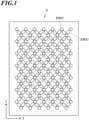
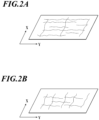
- X, Y, up and down, and left and right directions are defined as shown in FIG. 1 , FIG. 2A, and FIG. 2B .
- the toilet cleaning sheet S of the present invention is a sheet in which base paper sheets are subjected to ply processing (stacked) and is preferably a toilet cleaning sheet of a wet type that is impregnated with a predetermined chemical solution.
- the base paper sheet is preferably made by ply processing of two base paper sheets, because when it is made by ply processing of three or more base paper sheets, CMC described later is applied in a spotty manner.
- the base paper sheet may also be composed of a single base paper sheet, without ply processing.
- the surface of the toilet cleaning sheet S is embossed.
- embosses EM11 and EM12 are provided as shown in FIG. 1 .
- the basis weight of the base paper sheet per sheet is about 30 to 150 g/m 2 .
- the basis weight is based on JIS P 8124.
- the base paper sheet of the toilet cleaning sheet S is configured with a water dispersible fiber aggregate so as to be discarded in the water collected in the toilet bowl as it is after cleaning the toilet bowl and the like.
- the fiber aggregate is not particularly limited as long as it has a water dispersing property, but a single layer or multiple layers of paper or nonwoven fabric can be suitably used.
- the fiber raw material may be a natural fiber or a synthetic fiber, and they may be mixed. Suitable fiber raw materials include cellulosic fibers such as wood pulp, nonwood pulp, rayon, and cotton, biodegradable fibers made of polylactic acid, and the like.
- cellulosic fibers such as wood pulp, nonwood pulp, rayon, and cotton
- biodegradable fibers made of polylactic acid, and the like.
- polyethylene fibers, polypropylene fibers, polyvinyl alcohol fibers, polyester fibers, polyacrylonitrile fibers, synthetic pulp, glass wool, and the like may be used in combination.
- a fiber aggregate containing at least pulp is preferable, and suitable pulp to be used as a raw material is leaf bleached kraft pulp (LBKP) and needle bleached kraft pulp (NBKP) blended in an appropriate ratio.
- LKP leaf bleached kraft pulp
- NKP needle bleached kraft pulp
- the blended ratio of the needle bleached kraft pulp is preferably 50% by mass to 70% by mass, more preferably 65% by mass.
- the base paper sheet may be configured of a sheet made of crushed pulp or a sheet of crushed pulp covered or sandwiched with a water dispersible sheet(s).
- a water-soluble binder for enhancing paper strength is applied to the base paper sheet of the toilet cleaning sheet S.
- the water-soluble binder include a binder component such as carboxymethyl cellulose, polyvinyl alcohol, starch or a derivative thereof, hydroxypropyl cellulose, sodium alginate, trant gum, guar gum, xanthan gum, gum arabic, carrageenan, galactomannan, gelatin, casein, albumin, purplan, polyethylene oxide, viscose, polyvinyl ethyl ether, sodium polyacrylate, sodium polymethacrylate, polyacrylamide, hydroxylated derivatives of polyacrylic acid, polyvinyl pyrrolidone / vinyl pyrrolidone vinyl acetate copolymer, and the like.
- a water-soluble binder having a carboxyl group is preferably used.
- the water-soluble binder having a carboxyl group is an anionic water-soluble binder which readily generates carboxylate in water.
- examples thereof include polysaccharide derivatives, synthetic polymers, and natural products.
- polysaccharide derivative examples include a salt of carboxymethyl cellulose, carboxyethyl cellulose or a salt thereof, and carboxymethylated starch or a salt thereof, and an alkali metal salt of carboxymethyl cellulose (CMC) is particularly preferable.
- CMC carboxymethyl cellulose
- CMC has an etherification degree of 0.6 to 2.0, particularly 0.9 to 1.8, more preferably 1.0 to 1.5. This is because the water dispersing property and the development of wet paper strength become extremely good.
- water-swellable CMC This exerts a function of linking the fibers constituting the base paper sheet while remaining unswollen by forming cross-links with a specific metal ion as the cross-linking agent in the chemical solution, so that strength as a durable toilet wiping sheet in cleaning/wiping is exhibited.
- CMC is applied to the toilet cleaning sheet S as the water-soluble binder.
- the base paper sheet may be uniformly impregnated with CMC in the thickness direction, but is preferably impregnated with CMC such that the content of CMC in the base paper sheet gradually increases from the center in the thickness direction toward the front face and the back face.
- the added amount of the CMC which is the water-soluble binder is preferably 5% or less with relation to the weight of the base paper sheet. Consequently, both strength of the toilet cleaning sheet S in dealing with water stains and water dispersing properties of the toilet cleaning sheet S can be achieved.
- Examples of the synthetic polymers include a salt of a polymer or a copolymer of an unsaturated carboxylic acid, a salt of a copolymer of an unsaturated carboxylic acid and a monomer copolymerizable with the unsaturated carboxylic acid, and the like.
- Examples of the unsaturated carboxylic acid include acrylic acid, methacrylic acid, itaconic acid, crotonic acid, maleic anhydride, maleic acid, fumaric acid, and the like.
- Examples of the monomer copolymerizable with them include esters of these unsaturated carboxylic acids, vinyl acetate, ethylene, acrylamide, vinyl ether, and the like.
- a particularly preferred synthetic polymer is one using acrylic acid or methacrylic acid as the unsaturated carboxylic acid, and specifically include salts of polyacrylic acid, polymethacrylic acid, or acrylic acid methacrylic acid copolymer, and salts of a copolymer of acrylic acid or methacrylic acid, an alkyl acrylate or alkyl methacrylate.
- Examples of natural products include sodium alginate, xanthan gum, gellan gum, Tragacanth gum, pectin, and the like.
- CNF Cellulose nanofibers
- CNF can be added to the water-soluble binder (CMC in the present embodiment), and the specific surface area of the base paper sheet is larger than that with pulponly composition.
- CNF refers to fine cellulose fibers obtained by fibrillating pulp fibers.
- CNF refers to cellulose fibers containing cellulose fine fibers having a fiber width of nano-order size (1 nm or more and 1000 nm or less).
- An average fiber width is preferably 100 nm or less.
- Number average, median, mode diameter (mode) and the like from a certain number of fibers are used to calculate the average fiber width.
- the base paper sheet may be uniformly impregnated with CNF in the thickness direction, but is preferably impregnated with CNF such that the content of CNF in the base paper sheet gradually increases from the center in the thickness direction toward the front face and the back face.
- pulp fibers usable for the production of CNF include chemical pulp such as broad leaf tree pulp (LBKP) and needle leaf tree pulp (NBKP) ; mechanical pulp such as bleaching thermomechanical pulp (BTMP), stone ground pulp (SGP), pressurized stone ground pulp (PGW), refiner ground pulp (RGP), chemi-ground pulp (CGP), thermogrand pulp (TGP), grand pulp (GP), thermomechanical pulp (TMP), chemi-thermo mechanical pulp (CTMP), and refiner mechanical pulp (RMP); used paper pulp manufactured from Kraft waste paper, Kraft envelope waste paper, magazine waste paper, newspaper waste paper, leaflets waste paper, office waste paper, cardboard waste paper, high quality white waste paper, Kent waste paper, simili waste paper, cardboard waste paper, and woody waste paper; and deinked pulp (DIP) made by deinking used paper pulp. As long as the effects of the present invention are not impaired, these may be used alone or in combination of multiple types.
- BTMP bleaching thermomechanical pulp
- SGP stone ground pulp
- PGW pressurized stone ground
- Fibrillation methods used for producing CNF are not limited to, but include, for example, mechanical methods such as a high pressure homogenizer method, a microfluidizer method, a grinder grinding method, a bead mill freeze pulverization method, and an ultrasonic fibrillating method.
- CNF that has been only mechanically treated by the above fibrillation methods namely, CNF that has been subjected to no modification with functional groups
- CNF that has been subjected to no modification with functional groups has higher thermal stability and therefore can be used in a wider range of applications than CNF that has been subjected to modification with functional groups such as phosphate groups and carboxymethyl groups.
- CNF that has been subjected to modification with functional groups such as phosphate groups and carboxymethyl groups can also be used in the present invention.
- the pulp fiber may be mechanically treated by the fibrillation methods, and then chemically treated by carboxymethylation, or enzymatically treated.
- Chemically treated CNF include, for example, iCNF (individualized CNF) (single nanocellulose) having a diameter of 3 to 4 nm, such as TEMPO-oxidized CNF, phosphate esterified CNF, and phosphite esterified CNF.
- CNF treated only chemically or enzymatically, or CNF treated chemically or enzymatically and then treated mechanically by the fibrillation process may be used.
- the ratio of the tensile strength in the longitudinal and the transverse directions of the toilet cleaning sheet S (longitudinal/transverse) is 0.9 to 1.2 and preferably close to 1.0.
- the papermaking step which is a step for producing paper
- the ratio of the tensile strength in the longitudinal and the transverse directions can be obtained from the ratio of the wet strengths in the directions of MD (Machine Direction) and CD (Cross Direction).
- the longitudinal/transverse ratio of dry tensile strength of the base paper sheet defined in JIS P 8113 (2006) is 0.6 to 0.8.
- This longitudinal/transverse ratio can be adjusted by changing various paper making conditions such as a jet wire ratio in the wire part.
- the difference in the longitudinal direction/transverse ratio can be made small when embossing is provided.
- the toilet cleaning sheet S of the present embodiment is impregnated with a predetermined chemical solution containing the cross-linking agent that forms cross-links with the water-soluble binder (CMC in the case of the toilet cleaning sheet S of the present embodiment).
- the chemical solution contains an auxiliary agent such as glycol ethers, an aqueous detergent, an antiseptic, a disinfectant, an organic solvent, and the like.
- the base paper sheet After impregnated with the water-soluble binder and then dried, the base paper sheet is impregnated with the chemical solution.
- the toilet cleaning sheet S is impregnated with the chemical solution of 100 to 500 % by mass, preferably 150 to 300 % by mass, relative to the mass of the base paper sheet as the base material of the toilet cleaning sheet S.
- boric acid various metal ions and the like can be used, but when CMC is used as the water-soluble binder, a polyvalent metal ion is preferably used.
- polyvalent metal ions selected from a group consisting of alkaline earth metals, manganese, zinc, cobalt, and nickel, from the viewpoint of developing wet strength for durability in use by sufficiently bonding the fibers and from the viewpoint of improving the sufficient water dispersing property.
- these metal ions ions of calcium, strontium, barium, zinc, cobalt, or nickel are used particularly preferably.
- Glycol ethers have a structure in which a hydroxyl group at one or both ends of glycol, a divalent alcohol, is etherified, and are a compound including a hydrophobic alkyl group and a hydrophilic ether group and hydroxy group in the molecule.
- Glycol ethers have a lower molecular weight than surfactants and leads to a lower dynamic surface tension than conventional detergents containing only surfactants. Therefore, an interface between the chemical solution and stain can be formed more quickly.
- Glycol ethers also function as a coupling agent to compatibilize hydrophobic oil or stain with water, and can pull off stain and prevent it from reattaching. Therefore, the addition of glycol ethers to the chemical solution can improve the wiping performance of the toilet cleaning sheet S.
- the chemical solution of the present invention includes glycol ethers such as: propylene glycol monomethyl ether (PGME), diethylene glycol monobutyl ether (DGME), ethylene glycol monomethyl ether, diethylene glycol monomethyl ether, triethylene glycol monomethyl ether, polyethylene glycol monomethyl ether, ethylene glycol isopropyl ether, diethylene glycol monoisopropyl ether, triethylene glycol monomethyl ether, polyethylene glycol monomethyl ether, ethylene glycol isopropyl ether, diethylene glycol monoisopropyl ether, and ethylene glycol monobutyl ether.
- glycol ethers such as: propylene glycol monomethyl ether (PGME), diethylene glycol monobutyl ether (DGME), ethylene glycol monomethyl ether, diethylene glycol monomethyl ether, triethylene glycol monomethyl ether, polyethylene glycol monomethyl ether, ethylene glycol isopropyl ether, diethylene glycol monoisopropyl
- PGME which is usually added as a detergent ingredient and is known to improve detergency, exhibits an effect of directly improving the sheet strength, and has an effect of enhancing the sheet strength improving effect due to the CMC and the polyvalent metal ion.
- the amount of PGME to be added is preferably 20 to 60 g/m 2 , more preferably 26 to 40 g/m 2 .
- the amount is less than 20 g/m 2 , the deodorant effect is not sufficiently obtained. Even when the amount is more than 60 g/m 2 , the obtained deodorant effect is not more than that when the amount is 60 g/m 2 .
- DGME is an auxiliary agent similar to PGME in that it has an effect of improving sheet strength.
- the amount of DGME to be added is preferably 5 to 30 g/m 2 , more preferably 10 to 20 g/m 2 .
- glycol ethers such as PGME need to be formulated appropriately into the chemical solution in addition to DGME.
- aqueous detergent for example, lower or higher (aliphatic) alcohol can be used in addition to a surfactant.
- parabens such as methylparaben, ethylparaben, propylparaben, and the like can used.
- the disinfectant for example, benzalkonium chloride, chlorhexidine gluconate, povidone iodine, ethanol, benzalkonium cetyl phosphate, triclosan, chloroxylenol, isopropylmethylphenol, and the like can used.
- organic solvent polyhydric alcohols such as glycol (divalent), glycerin (trivalent), sorbitol (tetravalent), and the like can used.
- auxiliary agent of the above-mentioned components of the chemical solution can be selected appropriately, and a component which fulfills other functions may be contained in the chemical solution as necessary.
- PG propylene glycol
- Embossing is performed on the surface of the toilet cleaning sheet S.
- the toilet cleaning sheet S for example, as shown in FIG. 1 , two types of embosses EM11 and EM12 are embossed on it.
- the embosses EM11 are arranged so as to form a diamond lattice. As a result, uneven wiping can be reduced as compared with the case where the embosses EM11 are arranged to form a square lattice or a rectangular lattice.
- the embosses EM12 are arranged between the embosses EM11.
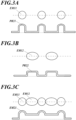
- the embosses EM11 each have, as shown in FIG. 3A , a protrusion PR21 having a curved shape.
- the embosses EM12 each have, as shown in FIG. 3B , a protrusion PR22 having a plane shape.
- the embosses EM12 are arranged between the embosses EM11, the protrusions PR21 of the embosses EM11 and the protrusions PR22 of the embosses EM12 are closely adhered to each other to form a continuous emboss EM21 as shown in FIG. 3C .
- the protrusions PR21 of the embosses EM11 and the protrusions PR22 of the embosses EM12 may be only close to each other and do not have to be continuous.
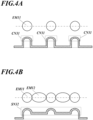
- the respective embosses are deformed and the contact areas increase for the first time when a force is applied to the toilet cleaning sheet S during the wiping operation. Therefore, as well as increasing the contact areas, flexibility is also improved due to deformation of the respective embosses.
- the contact areas CN31 after deformation of the embosses EM11 due to the force applied to the toilet cleaning sheet S during the wiping operation are generated discretely in the vicinity of the respective embosses EM11.
- the contact areas SN32 after deformation of the embosses EM11 and EM12 due to the force applied to the toilet cleaning sheet S during the wiping operation are increased as compared with the contact area CN31 of FIG. 4A .
- the two types of the embosses EM11 and EM12 also exhibit the effect of normal embosses, and it is possible to improve the texture, absorbency, bulkiness, etc. of the toilet cleaning sheet S.
- the continuous embosses EM21 also exhibit the effect of good appearance by embossing.
- the toilet cleaning sheet S is folded in two at the center portion in the Y direction by a fold process. Then, it is stored in a plastic case for storage or in a packaging film in a folded state, and unfolded as necessary at the time of use.
- the way of folding the toilet cleaning sheet S is not limited to folding in two, but may be folding in four or eight, for example.
- the CMC included in a binder solution of the example and the comparative examples described below are CMC 1330 (Daicel).
- the DGME in the chemical solution is a linear compound.
- Raw material for making paper blended in the ratio of 40% by mass of NBKP and 60% by mass of LBKP and raw material for making paper blended in the ratio of 65% by mass of NBKP and 35% by mass of LBKP are prepared.
- paper is made under the conditions described in example 1 and comparative examples 1-3 while adjusting a jet wire ratio. After making a base paper sheet that is targeted 86 g/m2, ply processing is performed to make two plies.
- Each base paper sheet is cut in a width of 25 mm to form a sheet for the tests.
- Each end of the test sheet is held with a chuck in a tensile testing machine (TENSIRON RTG1210 manufactured by A&D).
- a maximum load point when the plies of the base paper sheets are peeled at adhered locations is measured under the conditions of the distance between the chucks being 50 mm and the speed being 500 mm/min.
- Such test is performed 4 times for each test sheet in the MD direction and the CD direction. With this, an average value of the tensile strength and an average value of longitudinal/transverse strength ratio are calculated.
- the binder solution including 96 percent water and 4 percent CMC is applied by spraying 1.4% by mass at dry weight on an outer surface of each base paper sheet.
- the sheet is passed through a hot air dryer (temperature 180°) until the sheet is dried so that moisture contents is approximately 8 percent.
- the sheet is impregnated with the chemical solution blended at a ratio of 4.050% by mass of cross-linking agent, 0.200% by mass of aqueous detergent, 0.205% by mass of antiseptic, 0.200% by mass of disinfectant, 3.000% by mass of PG, 16.5% by mass of PGME, and 75.845% by mass of purified water in an amount of 200% by mass, and the test sheets for the example 1 and the comparative examples 1-3 are made.
- test the same as the test 1 is performed 4 times for each test sheet. With this, the average value of the tensile strength and the average value of the longitudinal/transverse strength ratio are calculated.
- test 2 the sheets are embossed as shown in FIG. 1 with embossing processing equipment after heat drying, and the sheet is impregnated with the chemical solution.
- test sheets for the example 1, and the comparative examples 1-3 are made.
- test the same as the test 1 is performed 4 times for each test sheet. With this, the average value of the tensile strength and the longitudinal/transverse strength ratio are calculated.
- the range is to be 0.6 to 0.8 as shown in example 1. Consequently, the longitudinal/transverse strength ratio of the toilet cleaning sheet S in which emboss processing is performed can be within the range of 0.9 to 1.2. As a result, it is possible to achieve the toilet cleaning sheet S with the longitudinal/transverse strength ratio that has excellent balance.
- the binder solution including 96 percent water and 4 percent CMC is applied by spraying 1.4% by mass at dry weight on an outer surface of base paper sheets for the example 1 and the comparative example 2.
- the sheet is passed through a hot air dryer (temperature 180°C) until the sheet is dried so that moisture contents is approximately 8 percent.
- embossing is performed as shown in FIG. 1 with emboss processing equipment, and embossed sheets for the example 1 and the comparative example 2 are made.
- the embossed sheets for the example 1 and the comparative example 2 are each impregnated with the chemical solution blended at a ratio of 4.050% by mass of cross-linking agent, 0.200% by mass of aqueous detergent, 0.205% by mass of antiseptic, 0.200% by mass of disinfectant, 3.000% by mass of PG, 16.5% by mass of PGME, and 75.845% by mass of purified water in an amount of 200% by mass, and the test sheets for the example 1 and the comparative example 2 are made.
- the embossed sheets for the example 1 and the comparative example 2 are each impregnated with a chemical solution blended at a ratio of 4.050% by mass of cross-linking agent, 0.200% by mass of aqueous detergent, 0.205% by mass of antiseptic, 0.200% by mass of disinfectant, 3.000% by mass of PG, 13.5% by mass of PGME, 3.000% by mass of DGME and 75.845% by mass of purified water in an amount of 200% by mass, and the test sheets for the example 2 and the comparative example 4 are made.
- abrasion resistance test is performed according to procedures (1) to (3) described below in accordance with the Martindale method defined in JIS L 1096 E method (2010).
- the present invention can be used to provide a water dispersible sheet with excellent balance in strength between a longitudinal direction and a transverse direction and a method to manufacture the water dispersible sheet.
Landscapes
- Biochemistry (AREA)
- Engineering & Computer Science (AREA)
- Mechanical Engineering (AREA)
- Life Sciences & Earth Sciences (AREA)
- Chemical & Material Sciences (AREA)
- Chemical Kinetics & Catalysis (AREA)
- General Chemical & Material Sciences (AREA)
- Public Health (AREA)
- Health & Medical Sciences (AREA)
- Cleaning Implements For Floors, Carpets, Furniture, Walls, And The Like (AREA)
- Paper (AREA)
- Sanitary Thin Papers (AREA)
- Non-Flushing Toilets (AREA)
Claims (4)
- Wasserdispergierbares Blatt, umfassend:ein Basispapierblatt, das ein wasserdispergierbares Faseraggregat beinhaltet, wobei das Basispapierblatt mit einer chemischen Lösung umfassend Diethylenglykolmonobutylether imprägniert ist,wobei das Faseraggregat 50 Massen-% bis 70 Massen-% NBKP beinhaltet,wobei das wasserdispergierbare Blatt ein Verhältnis von Längs- zu Querfestigkeit von 0,9 bis 1,2 beinhaltet, und wobei die Prägung auf dem wasserdispergierbaren Blatt gebildet ist, undwobei 5 g/m2 bis 30 g/m2 Diethylenglykolmonobutylether zu dem wasserdispergierbare Blatt hinzugefügt werden.
- Wasserdispergierbares Blatt nach Anspruch 1, wobei ein wasserlösliches Bindemittel, das nicht mehr als 5 % eines Gewichts des Basispapierblatts ausmacht, hinzugefügt wird.
- Wasserdispergierbares Blatt nach Anspruch 1 oder 2, wobei 20 g/m2 bis 60 g/m2 Propylenglykolmonomethylether zu dem wasserdispergierbaren Blatt hinzugefügt werden.
- Herstellungsverfahren zur Herstellung des wasserdispergierbaren Blatts nach einem der Ansprüche 1 bis 3, das Verfahren umfassend:Erzeugen eines Basispapierblattes mit einem Verhältnis von Längs- zu Querfestigkeit von 0,6 bis 0,8 aus einem Faseraggregat;Anwenden eines wasserlöslichen Bindemittels in dem Basispapierblatt;Wärmetrocknen des Basispapiers;Prägen des Basispapierblatts; undImprägnieren des Basispapierblatts mit einer chemischen Lösung, umfassend Diethylenglykolmonobutylether, sodass 5 g/m2 bis 30 g/m2 Diethylenglykolmonobutylether zu dem wasserdispergierbaren Blatt hinzugefügt werden,wobei das Verhältnis von Längs- zu Querfestigkeit des wasserdispergierbaren Blatts nach dem Prägen und Imprägnieren mit der chemischen Lösung 0,9 bis 1,2 ist.
Applications Claiming Priority (2)
| Application Number | Priority Date | Filing Date | Title |
|---|---|---|---|
| JP2020094077A JP7030895B2 (ja) | 2020-05-29 | 2020-05-29 | 水解性シートの製造方法 |
| PCT/JP2021/017882 WO2021241205A1 (ja) | 2020-05-29 | 2021-05-11 | 水解性シート及び水解性シートの製造方法 |
Publications (3)
| Publication Number | Publication Date |
|---|---|
| EP4137637A1 EP4137637A1 (de) | 2023-02-22 |
| EP4137637A4 EP4137637A4 (de) | 2023-10-11 |
| EP4137637B1 true EP4137637B1 (de) | 2024-12-25 |
Family
ID=78745290
Family Applications (1)
| Application Number | Title | Priority Date | Filing Date |
|---|---|---|---|
| EP21813142.3A Active EP4137637B1 (de) | 2020-05-29 | 2021-05-11 | In wasser auflösbare folie und verfahren zur herstellung davon |
Country Status (5)
| Country | Link |
|---|---|
| US (1) | US12366037B2 (de) |
| EP (1) | EP4137637B1 (de) |
| JP (1) | JP7030895B2 (de) |
| CN (1) | CN115427633A (de) |
| WO (1) | WO2021241205A1 (de) |
Families Citing this family (3)
| Publication number | Priority date | Publication date | Assignee | Title |
|---|---|---|---|---|
| JP6470236B2 (ja) * | 2016-08-26 | 2019-02-13 | 大王製紙株式会社 | 水解性シート及び当該水解性シートの製造方法 |
| JP7105750B2 (ja) * | 2019-09-30 | 2022-07-25 | 大王製紙株式会社 | 水解性シート |
| JP7030895B2 (ja) * | 2020-05-29 | 2022-03-07 | 大王製紙株式会社 | 水解性シートの製造方法 |
Family Cites Families (31)
| Publication number | Priority date | Publication date | Assignee | Title |
|---|---|---|---|---|
| ES2051344T3 (es) * | 1988-11-30 | 1994-06-16 | Kao Corp | Hoja de limpieza desintegrable en agua. |
| JP4446542B2 (ja) * | 2000-02-25 | 2010-04-07 | 花王株式会社 | 水解紙の製造方法 |
| US8673115B2 (en) * | 2002-10-07 | 2014-03-18 | Georgia-Pacific Consumer Products Lp | Method of making a fabric-creped absorbent cellulosic sheet |
| JP4540470B2 (ja) * | 2004-12-27 | 2010-09-08 | 花王株式会社 | 水解性清拭物品 |
| JP4619188B2 (ja) | 2005-04-28 | 2011-01-26 | 花王株式会社 | 水解紙の製造方法 |
| JP2008002017A (ja) * | 2006-06-22 | 2008-01-10 | Kao Corp | 水解性清掃物品及びその製造方法 |
| JP4787201B2 (ja) | 2006-07-21 | 2011-10-05 | 花王株式会社 | 硬表面用洗浄剤組成物 |
| JP4818063B2 (ja) | 2006-10-17 | 2011-11-16 | 花王株式会社 | 嵩高紙の製造方法 |
| JP5474655B2 (ja) * | 2010-05-12 | 2014-04-16 | 大福製紙株式会社 | 紙及び紙の製造方法 |
| US20110290437A1 (en) * | 2010-06-01 | 2011-12-01 | Nathan John Vogel | Dispersible Wet Wipes Made Using Short Cellulose Fibers for Enhanced Dispersibility |
| JP5395101B2 (ja) * | 2011-02-28 | 2014-01-22 | 大王製紙株式会社 | トイレットペーパーの製造方法 |
| US8834677B2 (en) * | 2013-01-31 | 2014-09-16 | Kimberly-Clark Worldwide, Inc. | Tissue having high improved cross-direction stretch |
| US10323354B2 (en) * | 2013-07-19 | 2019-06-18 | Asahi Kasei Fibers Corporation | Fine cellulose fiber sheet |
| JP6448307B2 (ja) | 2014-10-29 | 2019-01-09 | 愛媛県 | 水解性薬液含浸シートの製造方法 |
| WO2016159145A1 (ja) | 2015-03-31 | 2016-10-06 | 大王製紙株式会社 | 家庭用薄葉紙及び水解性シート |
| JP6423307B2 (ja) | 2015-03-31 | 2018-11-14 | 大王製紙株式会社 | 水解性シートの製造方法 |
| US10422084B2 (en) * | 2015-05-29 | 2019-09-24 | Daio Paper Corporation | Hydrolysable sheet |
| JP6230570B2 (ja) * | 2015-06-30 | 2017-11-15 | 大王製紙株式会社 | 水解性シートの製造方法 |
| JP6399998B2 (ja) * | 2015-12-28 | 2018-10-03 | ユニ・チャーム株式会社 | 水解性不織布及びその製造方法 |
| JP6470236B2 (ja) * | 2016-08-26 | 2019-02-13 | 大王製紙株式会社 | 水解性シート及び当該水解性シートの製造方法 |
| JP6211160B1 (ja) * | 2016-09-30 | 2017-10-11 | 大王製紙株式会社 | 水解性シート |
| JP6829088B2 (ja) | 2017-01-30 | 2021-02-10 | 大王製紙株式会社 | ウェットワイパー |
| JP6346969B1 (ja) * | 2017-01-31 | 2018-06-20 | 大王製紙株式会社 | 水解性シート及び当該水解性シートの製造方法 |
| JP6929073B2 (ja) * | 2017-01-31 | 2021-09-01 | 大王製紙株式会社 | 水解性シート及び当該水解性シートの製造方法 |
| US11420414B2 (en) * | 2017-03-02 | 2022-08-23 | Fitesa Germany Gmbh | Wipes having high sustainable content |
| JP6962701B2 (ja) * | 2017-03-31 | 2021-11-05 | 大王製紙株式会社 | 清掃用シート及び当該清掃用シートの製造方法 |
| US11364711B2 (en) * | 2018-12-21 | 2022-06-21 | The Clorox Company | Multi-layer substrates comprising sandwich layers and polyethylene |
| JP7199979B2 (ja) * | 2019-01-21 | 2023-01-06 | 大王製紙株式会社 | 清掃用シート及び清掃用シートの製造方法 |
| JP7105750B2 (ja) * | 2019-09-30 | 2022-07-25 | 大王製紙株式会社 | 水解性シート |
| JP7030895B2 (ja) * | 2020-05-29 | 2022-03-07 | 大王製紙株式会社 | 水解性シートの製造方法 |
| JP2024013396A (ja) * | 2022-07-20 | 2024-02-01 | 日本製紙株式会社 | ヒートシール紙、および包装体 |
-
2020
- 2020-05-29 JP JP2020094077A patent/JP7030895B2/ja active Active
-
2021
- 2021-05-11 WO PCT/JP2021/017882 patent/WO2021241205A1/ja not_active Ceased
- 2021-05-11 EP EP21813142.3A patent/EP4137637B1/de active Active
- 2021-05-11 CN CN202180030166.6A patent/CN115427633A/zh active Pending
- 2021-05-11 US US17/924,026 patent/US12366037B2/en active Active
Also Published As
| Publication number | Publication date |
|---|---|
| JP2021188170A (ja) | 2021-12-13 |
| EP4137637A1 (de) | 2023-02-22 |
| WO2021241205A1 (ja) | 2021-12-02 |
| JP7030895B2 (ja) | 2022-03-07 |
| US20230167608A1 (en) | 2023-06-01 |
| CN115427633A (zh) | 2022-12-02 |
| EP4137637A4 (de) | 2023-10-11 |
| US12366037B2 (en) | 2025-07-22 |
Similar Documents
| Publication | Publication Date | Title |
|---|---|---|
| EP3521511B1 (de) | Wasserlösliche folie und verfahren zur herstellung der wasserlöslichen folie | |
| EP3505038B1 (de) | Wasserlösliche folie und verfahren zur herstellung von wasserlöslicher folie | |
| EP4015706B1 (de) | Hydrolysierbare folie | |
| EP4137637B1 (de) | In wasser auflösbare folie und verfahren zur herstellung davon | |
| EP3915455A1 (de) | Reinigungsblatt und verfahren zur herstellung eines reinigungsblatts | |
| US11155966B2 (en) | Hydrolytic sheet and method for manufacturing hydrolytic sheet | |
| JP6962701B2 (ja) | 清掃用シート及び当該清掃用シートの製造方法 | |
| JP7551293B2 (ja) | 清掃シート及び当該清掃シートの製造方法 | |
| JP6775393B2 (ja) | 水解性シート及び当該水解性シートの製造方法 | |
| JP6792487B2 (ja) | 水解性シートの製造方法 | |
| TWI878471B (zh) | 清掃用濕巾及該清掃用濕巾的製造方法 | |
| JP6929073B2 (ja) | 水解性シート及び当該水解性シートの製造方法 | |
| JP7451194B2 (ja) | 清掃シート | |
| BR112022004402B1 (pt) | Folha dispersível em água | |
| EP4005459A1 (de) | Wischtuch und verfahren zur herstellung eines wischtuchs |
Legal Events
| Date | Code | Title | Description |
|---|---|---|---|
| STAA | Information on the status of an ep patent application or granted ep patent |
Free format text: STATUS: THE INTERNATIONAL PUBLICATION HAS BEEN MADE |
|
| PUAI | Public reference made under article 153(3) epc to a published international application that has entered the european phase |
Free format text: ORIGINAL CODE: 0009012 |
|
| STAA | Information on the status of an ep patent application or granted ep patent |
Free format text: STATUS: REQUEST FOR EXAMINATION WAS MADE |
|
| 17P | Request for examination filed |
Effective date: 20221114 |
|
| AK | Designated contracting states |
Kind code of ref document: A1 Designated state(s): AL AT BE BG CH CY CZ DE DK EE ES FI FR GB GR HR HU IE IS IT LI LT LU LV MC MK MT NL NO PL PT RO RS SE SI SK SM TR |
|
| DAV | Request for validation of the european patent (deleted) | ||
| DAX | Request for extension of the european patent (deleted) | ||
| A4 | Supplementary search report drawn up and despatched |
Effective date: 20230911 |
|
| RIC1 | Information provided on ipc code assigned before grant |
Ipc: D21H 27/30 20060101ALI20230905BHEP Ipc: A47L 13/17 20060101ALI20230905BHEP Ipc: A47K 10/16 20060101ALI20230905BHEP Ipc: D21H 27/00 20060101AFI20230905BHEP |
|
| STAA | Information on the status of an ep patent application or granted ep patent |
Free format text: STATUS: EXAMINATION IS IN PROGRESS |
|
| 17Q | First examination report despatched |
Effective date: 20240430 |
|
| GRAP | Despatch of communication of intention to grant a patent |
Free format text: ORIGINAL CODE: EPIDOSNIGR1 |
|
| STAA | Information on the status of an ep patent application or granted ep patent |
Free format text: STATUS: GRANT OF PATENT IS INTENDED |
|
| INTG | Intention to grant announced |
Effective date: 20240719 |
|
| GRAS | Grant fee paid |
Free format text: ORIGINAL CODE: EPIDOSNIGR3 |
|
| GRAA | (expected) grant |
Free format text: ORIGINAL CODE: 0009210 |
|
| STAA | Information on the status of an ep patent application or granted ep patent |
Free format text: STATUS: THE PATENT HAS BEEN GRANTED |
|
| AK | Designated contracting states |
Kind code of ref document: B1 Designated state(s): AL AT BE BG CH CY CZ DE DK EE ES FI FR GB GR HR HU IE IS IT LI LT LU LV MC MK MT NL NO PL PT RO RS SE SI SK SM TR |
|
| REG | Reference to a national code |
Ref country code: GB Ref legal event code: FG4D |
|
| REG | Reference to a national code |
Ref country code: CH Ref legal event code: EP |
|
| REG | Reference to a national code |
Ref country code: DE Ref legal event code: R096 Ref document number: 602021023990 Country of ref document: DE |
|
| REG | Reference to a national code |
Ref country code: IE Ref legal event code: FG4D |
|
| REG | Reference to a national code |
Ref country code: LT Ref legal event code: MG9D |
|
| PG25 | Lapsed in a contracting state [announced via postgrant information from national office to epo] |
Ref country code: HR Free format text: LAPSE BECAUSE OF FAILURE TO SUBMIT A TRANSLATION OF THE DESCRIPTION OR TO PAY THE FEE WITHIN THE PRESCRIBED TIME-LIMIT Effective date: 20241225 |
|
| PG25 | Lapsed in a contracting state [announced via postgrant information from national office to epo] |
Ref country code: FI Free format text: LAPSE BECAUSE OF FAILURE TO SUBMIT A TRANSLATION OF THE DESCRIPTION OR TO PAY THE FEE WITHIN THE PRESCRIBED TIME-LIMIT Effective date: 20241225 |
|
| PG25 | Lapsed in a contracting state [announced via postgrant information from national office to epo] |
Ref country code: BG Free format text: LAPSE BECAUSE OF FAILURE TO SUBMIT A TRANSLATION OF THE DESCRIPTION OR TO PAY THE FEE WITHIN THE PRESCRIBED TIME-LIMIT Effective date: 20241225 |
|
| PG25 | Lapsed in a contracting state [announced via postgrant information from national office to epo] |
Ref country code: NO Free format text: LAPSE BECAUSE OF FAILURE TO SUBMIT A TRANSLATION OF THE DESCRIPTION OR TO PAY THE FEE WITHIN THE PRESCRIBED TIME-LIMIT Effective date: 20250325 |
|
| PG25 | Lapsed in a contracting state [announced via postgrant information from national office to epo] |
Ref country code: GR Free format text: LAPSE BECAUSE OF FAILURE TO SUBMIT A TRANSLATION OF THE DESCRIPTION OR TO PAY THE FEE WITHIN THE PRESCRIBED TIME-LIMIT Effective date: 20250326 Ref country code: LV Free format text: LAPSE BECAUSE OF FAILURE TO SUBMIT A TRANSLATION OF THE DESCRIPTION OR TO PAY THE FEE WITHIN THE PRESCRIBED TIME-LIMIT Effective date: 20241225 |
|
| PG25 | Lapsed in a contracting state [announced via postgrant information from national office to epo] |
Ref country code: RS Free format text: LAPSE BECAUSE OF FAILURE TO SUBMIT A TRANSLATION OF THE DESCRIPTION OR TO PAY THE FEE WITHIN THE PRESCRIBED TIME-LIMIT Effective date: 20250325 |
|
| REG | Reference to a national code |
Ref country code: NL Ref legal event code: MP Effective date: 20241225 |
|
| PG25 | Lapsed in a contracting state [announced via postgrant information from national office to epo] |
Ref country code: NL Free format text: LAPSE BECAUSE OF FAILURE TO SUBMIT A TRANSLATION OF THE DESCRIPTION OR TO PAY THE FEE WITHIN THE PRESCRIBED TIME-LIMIT Effective date: 20241225 |
|
| REG | Reference to a national code |
Ref country code: AT Ref legal event code: MK05 Ref document number: 1754247 Country of ref document: AT Kind code of ref document: T Effective date: 20241225 |
|
| PG25 | Lapsed in a contracting state [announced via postgrant information from national office to epo] |
Ref country code: SM Free format text: LAPSE BECAUSE OF FAILURE TO SUBMIT A TRANSLATION OF THE DESCRIPTION OR TO PAY THE FEE WITHIN THE PRESCRIBED TIME-LIMIT Effective date: 20241225 |
|
| PG25 | Lapsed in a contracting state [announced via postgrant information from national office to epo] |
Ref country code: PL Free format text: LAPSE BECAUSE OF FAILURE TO SUBMIT A TRANSLATION OF THE DESCRIPTION OR TO PAY THE FEE WITHIN THE PRESCRIBED TIME-LIMIT Effective date: 20241225 |
|
| PGFP | Annual fee paid to national office [announced via postgrant information from national office to epo] |
Ref country code: DE Payment date: 20250521 Year of fee payment: 5 |
|
| PG25 | Lapsed in a contracting state [announced via postgrant information from national office to epo] |
Ref country code: ES Free format text: LAPSE BECAUSE OF FAILURE TO SUBMIT A TRANSLATION OF THE DESCRIPTION OR TO PAY THE FEE WITHIN THE PRESCRIBED TIME-LIMIT Effective date: 20241225 |
|
| PGFP | Annual fee paid to national office [announced via postgrant information from national office to epo] |
Ref country code: GB Payment date: 20250527 Year of fee payment: 5 |
|
| PG25 | Lapsed in a contracting state [announced via postgrant information from national office to epo] |
Ref country code: IS Free format text: LAPSE BECAUSE OF FAILURE TO SUBMIT A TRANSLATION OF THE DESCRIPTION OR TO PAY THE FEE WITHIN THE PRESCRIBED TIME-LIMIT Effective date: 20250425 |
|
| PG25 | Lapsed in a contracting state [announced via postgrant information from national office to epo] |
Ref country code: PT Free format text: LAPSE BECAUSE OF FAILURE TO SUBMIT A TRANSLATION OF THE DESCRIPTION OR TO PAY THE FEE WITHIN THE PRESCRIBED TIME-LIMIT Effective date: 20250428 |
|
| PG25 | Lapsed in a contracting state [announced via postgrant information from national office to epo] |
Ref country code: EE Free format text: LAPSE BECAUSE OF FAILURE TO SUBMIT A TRANSLATION OF THE DESCRIPTION OR TO PAY THE FEE WITHIN THE PRESCRIBED TIME-LIMIT Effective date: 20241225 |
|
| PGFP | Annual fee paid to national office [announced via postgrant information from national office to epo] |
Ref country code: FR Payment date: 20250528 Year of fee payment: 5 |
|
| PG25 | Lapsed in a contracting state [announced via postgrant information from national office to epo] |
Ref country code: AT Free format text: LAPSE BECAUSE OF FAILURE TO SUBMIT A TRANSLATION OF THE DESCRIPTION OR TO PAY THE FEE WITHIN THE PRESCRIBED TIME-LIMIT Effective date: 20241225 Ref country code: RO Free format text: LAPSE BECAUSE OF FAILURE TO SUBMIT A TRANSLATION OF THE DESCRIPTION OR TO PAY THE FEE WITHIN THE PRESCRIBED TIME-LIMIT Effective date: 20241225 |
|
| PG25 | Lapsed in a contracting state [announced via postgrant information from national office to epo] |
Ref country code: SK Free format text: LAPSE BECAUSE OF FAILURE TO SUBMIT A TRANSLATION OF THE DESCRIPTION OR TO PAY THE FEE WITHIN THE PRESCRIBED TIME-LIMIT Effective date: 20241225 |
|
| PGFP | Annual fee paid to national office [announced via postgrant information from national office to epo] |
Ref country code: TR Payment date: 20250505 Year of fee payment: 5 |
|
| PG25 | Lapsed in a contracting state [announced via postgrant information from national office to epo] |
Ref country code: CZ Free format text: LAPSE BECAUSE OF FAILURE TO SUBMIT A TRANSLATION OF THE DESCRIPTION OR TO PAY THE FEE WITHIN THE PRESCRIBED TIME-LIMIT Effective date: 20241225 |
|
| PG25 | Lapsed in a contracting state [announced via postgrant information from national office to epo] |
Ref country code: IT Free format text: LAPSE BECAUSE OF FAILURE TO SUBMIT A TRANSLATION OF THE DESCRIPTION OR TO PAY THE FEE WITHIN THE PRESCRIBED TIME-LIMIT Effective date: 20241225 |
|
| PG25 | Lapsed in a contracting state [announced via postgrant information from national office to epo] |
Ref country code: SE Free format text: LAPSE BECAUSE OF FAILURE TO SUBMIT A TRANSLATION OF THE DESCRIPTION OR TO PAY THE FEE WITHIN THE PRESCRIBED TIME-LIMIT Effective date: 20241225 |
|
| REG | Reference to a national code |
Ref country code: DE Ref legal event code: R097 Ref document number: 602021023990 Country of ref document: DE |
|
| PG25 | Lapsed in a contracting state [announced via postgrant information from national office to epo] |
Ref country code: DK Free format text: LAPSE BECAUSE OF FAILURE TO SUBMIT A TRANSLATION OF THE DESCRIPTION OR TO PAY THE FEE WITHIN THE PRESCRIBED TIME-LIMIT Effective date: 20241225 |
|
| PLBE | No opposition filed within time limit |
Free format text: ORIGINAL CODE: 0009261 |
|
| STAA | Information on the status of an ep patent application or granted ep patent |
Free format text: STATUS: NO OPPOSITION FILED WITHIN TIME LIMIT |
|
| REG | Reference to a national code |
Ref country code: CH Ref legal event code: L10 Free format text: ST27 STATUS EVENT CODE: U-0-0-L10-L00 (AS PROVIDED BY THE NATIONAL OFFICE) Effective date: 20251105 |
|
| 26N | No opposition filed |
Effective date: 20250926 |
|
| REG | Reference to a national code |
Ref country code: CH Ref legal event code: H13 Free format text: ST27 STATUS EVENT CODE: U-0-0-H10-H13 (AS PROVIDED BY THE NATIONAL OFFICE) Effective date: 20251223 |
|
| PG25 | Lapsed in a contracting state [announced via postgrant information from national office to epo] |
Ref country code: LU Free format text: LAPSE BECAUSE OF NON-PAYMENT OF DUE FEES Effective date: 20250511 |
|
| PG25 | Lapsed in a contracting state [announced via postgrant information from national office to epo] |
Ref country code: CH Free format text: LAPSE BECAUSE OF NON-PAYMENT OF DUE FEES Effective date: 20250531 |
|
| REG | Reference to a national code |
Ref country code: BE Ref legal event code: MM Effective date: 20250531 |
|
| PG25 | Lapsed in a contracting state [announced via postgrant information from national office to epo] |
Ref country code: MC Free format text: LAPSE BECAUSE OF FAILURE TO SUBMIT A TRANSLATION OF THE DESCRIPTION OR TO PAY THE FEE WITHIN THE PRESCRIBED TIME-LIMIT Effective date: 20241225 |