EP4124252B1 - Oberbekleidung mit einem einteiligen rückenteil - Google Patents
Oberbekleidung mit einem einteiligen rückenteil Download PDFInfo
- Publication number
- EP4124252B1 EP4124252B1 EP22186632.0A EP22186632A EP4124252B1 EP 4124252 B1 EP4124252 B1 EP 4124252B1 EP 22186632 A EP22186632 A EP 22186632A EP 4124252 B1 EP4124252 B1 EP 4124252B1
- Authority
- EP
- European Patent Office
- Prior art keywords
- arm
- sleeve
- section
- upper garment
- edge
- Prior art date
- Legal status (The legal status is an assumption and is not a legal conclusion. Google has not performed a legal analysis and makes no representation as to the accuracy of the status listed.)
- Active
Links
Images




Classifications
-
- A—HUMAN NECESSITIES
- A41—WEARING APPAREL
- A41D—OUTERWEAR; PROTECTIVE GARMENTS; ACCESSORIES
- A41D1/00—Garments
- A41D1/04—Vests, jerseys, sweaters or the like
-
- A—HUMAN NECESSITIES
- A41—WEARING APPAREL
- A41D—OUTERWEAR; PROTECTIVE GARMENTS; ACCESSORIES
- A41D13/00—Professional, industrial or sporting protective garments, e.g. surgeons' gowns or garments protecting against blows or punches
- A41D13/0015—Sports garments other than provided for in groups A41D13/0007 - A41D13/088
-
- A—HUMAN NECESSITIES
- A41—WEARING APPAREL
- A41D—OUTERWEAR; PROTECTIVE GARMENTS; ACCESSORIES
- A41D27/00—Details of garments or of their making
- A41D27/10—Sleeves; Armholes
-
- A—HUMAN NECESSITIES
- A41—WEARING APPAREL
- A41D—OUTERWEAR; PROTECTIVE GARMENTS; ACCESSORIES
- A41D31/00—Materials specially adapted for outerwear
- A41D31/04—Materials specially adapted for outerwear characterised by special function or use
- A41D31/18—Elastic
-
- A—HUMAN NECESSITIES
- A41—WEARING APPAREL
- A41D—OUTERWEAR; PROTECTIVE GARMENTS; ACCESSORIES
- A41D2600/00—Uses of garments specially adapted for specific purposes
- A41D2600/10—Uses of garments specially adapted for specific purposes for sport activities
-
- A—HUMAN NECESSITIES
- A41—WEARING APPAREL
- A41D—OUTERWEAR; PROTECTIVE GARMENTS; ACCESSORIES
- A41D2600/00—Uses of garments specially adapted for specific purposes
- A41D2600/10—Uses of garments specially adapted for specific purposes for sport activities
- A41D2600/108—Hunting
Definitions
- the invention relates to an outerwear according to the preamble of claim 1.
- Such an outerwear is known from US 6 353 943 B1 known.
- long-sleeved and short-sleeved polo shirts for golfers which have a front part, a left and a right side part, a left and a right upper arm part and a one-piece back part.
- the side parts form connecting pieces between the front part and the back part, ie they cover the upper body flanks of the wearer, and extend from a left or right armhole on the inside of a sleeve to a sleeve end.
- the back part of the US 6 353 934 B1 The outerwear shown has arm sections integrated into the back part, which extend laterally outwards from a central area of the back part and, similar to a raglan sleeve, form an upper arm shell that extends forwards (ventrally) around the upper arm and shoulder.
- This design is intended to achieve a high degree of freedom of movement, especially for movements typical of golf.
- the EP 3 439 496 B1 relates to an article of clothing having at least a front panel and a rear panel.
- the object of the invention is to provide outer clothing for sport shooting and hunting, which has as little impairment as possible for the shooter when handling a weapon.
- an article having the features according to claim 1, namely an outer garment with a front part, a left and a right preferably a strip-shaped side part, a left and a right upper arm part and a one-piece back part with a vertical central area covering the back and the rear shoulder area of a person, the back part having arm sections protruding laterally to the left and right, each of which has an upper side for connection to the left and right upper arm part and an underside for connection to the left and right side part.
- the left and right upper sides of the arm sections have a lateral inner starting point located at the central area of the back part and a lateral outer end point away from the central area.
- the left and right undersides of the arm sections also have a lateral inner starting point located at the central area of the back part and a lateral outer end point away from the central area.
- the outer clothing is characterized in that the lateral outer end points of the left and right upper sides coincide with the end points of the underside.
- the arm sections extend laterally at least far enough to cover 1/3 of the length of an upper arm of a person wearing the outer garment.
- the upper sides and the lower sides each meet at a common end point, so that the arm sections taper outwards.
- the freedom of articulation of a shoulder, upper and/or lower arm can be advantageously influenced.
- the tapered shape of the arm sections allows the back section to be decoupled from the rest of the outerwear, so that arm and/or shoulder movements introduce little or no tension into the back section. This can also prevent or at least reduce folds in the back section.
- the arm sections are designed in such a way that they extend laterally so far that they cover a significant rear part of the upper arms of a person wearing the outer clothing. When the person wearing the outer clothing is viewed from behind, the arm sections therefore extend significantly beyond the lateral border of the person's upper body or the lateral border of the back part, and thus have a significant lateral extension.
- Arm sections with coinciding end points of an upper and lower side of the arm section ending in an armhole or near the armhole are outside the Invention, since it does not achieve the inventive object of increasing the freedom of articulation in the upper arm.
- lateral extension means that the arm sections have a lateral extension that is at least 1/3 of the length of an upper arm of the person wearing the outerwear.
- the lateral extension can be 2/5, 1/2, 2/3 or 5/6 of the length of the upper arm.
- the arm sections therefore have a lateral extension of 10 cm or more, in particular 12 cm, 15 cm, 20 cm or 25 cm.
- the lateral extension is the greatest horizontal distance between the starting point and the end point of the underside of the arm section. If the underside of the arm section runs horizontally, the lateral extension corresponds to the length of the underside of the arm section, for example.
- the coinciding end points of the upper and lower sides of the arm sections preferably lie on a back side of the upper arm associated with the arm section, wherein the end points lie at a distal height/length of the upper arm which is between 1/3 and 5/6, preferably 2/5, 1/2 or 2/3, of the length of the upper arm.
- outerwear refers in particular to long- or short-sleeved items of clothing for covering a person's upper body. This can in particular be underwear, outerwear or weatherproof functional clothing.
- the outerwear can be made of textile or non-textile materials or a mixture of these.
- edges in the sense of this document are to be understood as synonymous and refer to the outer edges of a flat cut or a multi-layer cut composite (with pockets, zippers, inner lining, etc.) for the manufacture of outerwear.
- the description of the edges indicates the cutting path that is essential for the invention.
- Individual sides or edges of the outer garment parts are connected to each other in a suitable manner, preferably by sewing or gluing the sides or edges.
- the directions used in the text refer to the usual anatomical directions for a standing person with arms hanging loosely at the side, whereby these directions are to be transferred analogously to the outer clothing.
- the central section of the back part can have a lower region and an upper region connected to it, with the left and right arm sections being arranged laterally to the left and right of the upper region, respectively.
- the lower region is delimited laterally by a left and right, essentially vertical long side, and forms the region of the outer clothing that covers the wearer's lower back when worn. It can end with a waistband at the lower (caudal) end, for example.
- the upper region can be delimited at the upper end by a left and right shoulder line and a neck cutout, and extends laterally approximately as far as the lower region, so that the upper region covers a shoulder-neck section, i.e.
- the upper area then forms approximately a rectangle that extends vertically from the armpit holes to the shoulder line, i.e. the upper end of the back, and laterally from the left to the right armpit hole.
- the arm sections can extend over just one section or over the entire height (height in the caudal-cranial direction) of the upper region (so that in the latter case the lateral inner starting points of the upper and lower sides of the arm sections essentially coincide with the vertical beginning and end of the upper section of the central region of the back part).
- the arm sections therefore essentially do not extend further in the caudal direction than to the height of an armhole.
- the left or right starting point of the upper side of the arm section of the back part is essentially located at the left or right end points of a right and left shoulder line.
- the shoulder line is understood to be the contour of the back part that is visible in a frontal projection of the outer clothing when worn as the outer contour or apex line of the shoulders. The end points of the shoulder line therefore approximately coincide with the anatomical position of the shoulder joints.
- the shoulder line can simultaneously represent the upper end of the back part.
- the back part can be extended by collar parts and/or - as described below - shoulder straps.
- the back part can follow all movements of a shoulder, especially a shoulder blade, without tension.
- the lateral inner starting point of the lower sides is approximately at the same height as the lateral inner starting point of the upper side, seen in the lateral direction, so that the inner starting points of the upper and lower sides are each on a common vertical line.
- the left or right upper side of the arm sections can be suitably dorsal and/or curved.
- Dorsal means that the upper side of the arm sections does not change to the front (ventral) of the outer clothing.
- a curved line is a soft, kink-free line on the upper side without sharp changes in direction.
- the curved shape of the upper side also means that it can be stretched and lengthened with little effort, for example by gradually increasing the radius of curvature of the upper side (so that the curve becomes 'flatter').
- the left or right upper side of the left or right arm section has a convex shape, ie it slopes downwards (caudally) in a proximal-distal direction. This is particularly advantageous for the arm movements that are typical when holding a long weapon, ie movements in which the shoulder and upper arm are moved backwards and the forearm is bent forwards.
- the upper side can also be concave or ascending in the proximal-distal direction. This is advantageous, for example, for a lateral upward movement of an arm (upward movement of the arm in a frontal plane), especially for sports such as handball or volleyball, in which the arms are often moved upwards in a stretched position.
- the upper side or a seam formed with the upper side can be used as a force conductor, so that when an arm is moved or bent, forces acting on the outer clothing can be diverted via the arm sections along the upper sides of the arm sections, so that the central area of the back part and thus the entire back of the wearer experiences little or no tension.
- This can improve the comfort of wearing the outer clothing, e.g. when carrying a weapon for a long time.
- seams which always stiffen the clothing across the seam, can be advantageously moved to less disruptive places and the seam can be advantageously moved along the natural (anatomical) movement or bending lines of a shoulder or arm.
- the term armhole is the transition from the piece of outerwear covering the torso to the area of the upper extremities or arms - it is advantageous if the undersides of the left or right arm section essentially have a straight line and, particularly preferably, a horizontal line - in relation to the back part as an unsewn cut (the flat raw cut, e.g. made of a flat textile).
- horizontal line can also be understood to mean that the underside of the left or right arm section forms an angle of 90° ⁇ 10°, preferably 85° ⁇ 5°, with the left or right long side of the central section.
- the left or right underside of the arm sections does not extend distally-dorsally any further than the elbow area, i.e. approximately up to the proximal-distal 'height' of the anatomical position of an elbow or before, and preferably below the elbow (below in this context means below the humerus, i.e. medially).
- the elbow area free, tensile stresses can be prevented from occurring due to the bending of the forearm or up to into the back part. Minor stretching or tensile stresses can be transferred and diverted via the left or right upper arm part along the shoulder line to the wearer's shoulder.
- the left and right upper sides form seams that preform the elbow area (by sewing with parts that adjoin the upper and lower sides).
- the upper and lower sides can also have additional seams that preform the elbow area, for example in the form of seams that pull the material together at certain points. This allows a three-dimensional design to be created before processing into outerwear, or the arm section can be brought into a desired 3D shape.
- the back section can also be provided with a left or right shoulder strap to connect it to the front section.
- Each shoulder strap extends laterally over the length of the left or right shoulder line, i.e. between the end point of the shoulder line and a collar cutout, and extends ventrally forwards, for example up to the level of the anatomical position of a collar bone. This allows the weight of the outer clothing to be distributed over a large area across the wearer's shoulders. In addition, seams in the shoulder and neck area and thus potential pressure points can be avoided.
- parts of the outerwear can be cut pieces.
- part also includes any other pre-processed semi-finished product in which, for example, several textile or non-textile layers have been processed, pockets or zippers have been incorporated, or other modifications have been made to a cut piece.
- all other parts can be made in one piece or in multiple parts, especially composed of several sub-parts.
- the left and right upper arm parts each have a first outer edge, which is preferably connected to the upper side of the left and right arm section over the entire length of the upper arm part.
- the left and right upper arm parts each have a second outer edge, which is attached to a laterally inner, first end of the first outer edge and which is connected to an upper section of the outside of the front part.
- the left and right upper arm parts each have a third outer edge which is attached to the other end, the second end, of the second outer edge, wherein the third outer edge runs on the back side (ventral) and is connected to a ventral-proximal section of the ventral long side of the side part, so that the left and right upper arm parts respectively encompass an outer side of the left and right upper arm of the wearer.
- the corresponding outerwear forms a basic framework for outerwear with short or long sleeves with a high degree of freedom of articulation in the shoulder and arm area, whose sleeves can be completed in different ways:
- the outer garment is equipped with a left or right long sleeve, each long sleeve comprising a lateral inner (medial) inner sleeve and an outer (lateral) outer sleeve, and the left or right side part is so long in the longitudinal direction that the side part extends to a sleeve end and forms the entire inner sleeve.
- This allows a high degree of freedom of movement when raising the arm in a frontal plane (i.e. in a plane of a longitudinal section), since there are no transverse seams in the inner sleeve of the outer garment along the lifting movement that interrupt the flow of force.
- the outer sleeve is formed from the upper arm part, the arm section of the back part and a forearm part, wherein the forearm part has a first, a second, a third and a fourth edge, and the first edge of the forearm part forms a sleeve end which, together with the sleeve end of the side part, forms a sleeve cuff.
- the second edge of the forearm part is connected to a distal section of the ventral longitudinal side of the side part and the third edge of the forearm part is connected to a distal section of the third outer edge of the upper arm part.
- the fourth edge of the forearm part is connected to a distal end section of the dorsal longitudinal side of the side part.
- the upper arm part has a fourth outer edge which is connected to a section of the dorsal longitudinal side of the side part.
- the left or right upper arm part is designed in such a way that it extends from proximal to distal and at the same time curves from ventral to distal in such a way that the upper arm part covers the biceps, the elbow area and the outer forearm of the wearer.
- This allows the upper arm part to follow the natural bending line of an arm when bent or stretched, while the other parts of the sleeve, i.e. the forearm part, the arm section of the back part and the section of the side part forming the inner sleeve, remain essentially free of stress.
- the outer garment is a short-sleeved outer garment with a left or right short sleeve, each short sleeve comprising an inner, medial inner sleeve and an outer, lateral outer sleeve.
- the right or left inner sleeve is formed by the right or left side part, analogously to the long-sleeved version mentioned above.
- At least one of the parts is stretchable in at least one or two directions, i.e. made of a 2-way stretch material or a 4-way stretch material.
- a 2-way stretch material can, for example, be a woven fabric with weft and warp threads, where the weft threads are made of a material that is highly elastic compared to the warp threads of the fabric, so that the fabric can be stretched very strongly in the direction of the weft threads (main stretch direction), while the fabric across this, i.e. in the direction of the warp threads, has little or no elasticity.
- threads that are mechanically pre-tensioned by crimping or twisting can also be used to produce a 2-way stretch material.
- Such a 2-way stretch material is known as "mechanical stretch”.
- a mechanical stretch material is lighter in weight than a 2-way stretch material with, for example, elastane threads.
- the back part can be made of a 2-way stretch material, wherein the main stretching direction of the back part runs laterally, so that the back part and in particular the arm sections can follow a forward movement of a shoulder by stretching.
- the upper arm part can be made of a 2-way stretch material, whereby the 2-way stretch material is oriented so that the main stretch direction runs proximal-distal. This allows the upper arm part to adapt particularly well to the forearm by lengthening or shortening when it is bent or extended.
- the left or right side part is made of a 2-way stretch material, whereby the main stretching direction is oriented in the longitudinal direction of the side part, i.e. caudal-cranial or proximal-distal.
- essentially all parts of the outerwear are preferably made of one fabric.
- the parts can be cut, for example, across the weaving direction or diagonally at a 45° angle to the weaving direction (so-called bias cut).
- a bias cut can increase the stretchability of the processed fabric.
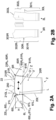
- Fig. 1A and 1B show an outer garment 1A according to the invention in a front and rear view.
- the outer garment is a weatherproof hunting jacket composed of several parts. It essentially consists of a one-piece back part 2, a two-piece front part 3 connected by a zipper with a left and a right half 3L and 3R, two side parts 4L and 4R, a left and a right upper arm part 5L and 5R and a left and right lower arm part 7L and 7R.
- the hunting jacket also has a collar 8 and a hood 9 attached to it.
- the outer contour of the essential parts of the hunting jacket, ie the cut of these parts, are in the Fig. 2A to 2C shown.
- all parts can be single-layer fabric cuts that are joined together at their outer edges, as explained in more detail below.
- the parts can also be complex half-pieces that are made up of multi-layer cuts and have details such as pockets, zippers, reinforcement patches, decorations or similar.
- the term "part” is therefore not necessarily to be understood as one-piece.
- the individual parts can, as in the case of the front part 3 with the left and right halves 3A and 3B respectively, it can also be composed of several sub-parts (partial surfaces), unless otherwise stated.
- the hunting jacket is designed as long-sleeved outerwear 1A, so that it essentially completely covers the torso and arms of a person or wearer and protects the person from the effects of the weather.
- the body of the hunting jacket is formed by the back part 2, the side parts 3 and the two-part front part 3L or 3R, which are connected by corresponding longitudinal seams at their respective outer edges.
- the back part 2 has a central section Z for covering the back - i.e. a lower back and a dorsal shoulder-neck area of a wearer - which can be divided into an upper and a lower section O or U.
- the upper section O corresponds approximately to the region of the outer clothing which covers a shoulder-neck area, i.e. approximately an area between two shoulder blades of the wearer.
- the lower section U covers approximately the remaining part of the wearer's back.
- the upper section and the lower section are made in one piece, i.e. seamless. This allows the number of parts required for the outer clothing to be reduced.
- the upper section O and the lower section U could also be made in two parts and connected to one another by a horizontal seam.
- the arm sections 6L, 6R are each limited at the top and bottom (cranial and caudal) by an upper side 60L, 60R and a lower side 61L, 61R.
- the start and end of the upper sides can be characterized by a laterally inner starting point 60L 1 or 60R 1 and a laterally outer end point 60L 2 or 60R 2.
- the start and end of the lower sides can also be defined by a laterally inner starting point 61L 1 or 61R 1 and a laterally outer end point 61L 2 or 61R 2 .
- the end points 60L 2 and 60R 2 of the top sides 60L, 60R and the end points 61L 2 and 61R 2 of the bottom sides 61L, 61R coincide on the left and right respectively.
- the top side 60L, 60R and the bottom side 61L, 61R are - in contrast to other cuts for outerwear - not parallel and connected to each other at the outer, lateral end by an additional end side, but have a converging line.
- the starting points 60L 1 , 60R 1 , 61L 1 , 61R 1 of the upper side 60L, 60R and the lower side 61L, 61R are each laterally at approximately the same height and approximately at the same vertical height as lateral and vertical boundary lines of the central section Z, referred to here as long sides 20L and 20R.
- the upper starting points 60L 1 and 60R 1 are approximately at the height of the anatomical position of the shoulder joints of the wearer or - equivalently - at a laterally outer end 22L E and 22R E of a left or right shoulder line 22L or 22R, as can be seen in particular from Fig.
- the arm sections 6L and 6R when viewed from the side, each start approximately at the height of an armhole, i.e. the transition from the section of the outer garment 1A covering the torso to the sleeves, and extend over an entire height H of the upper section O of the back part 2.
- the armholes or the edges of the parts forming the armhole are indicated in the figures by the dash-dot lines L.
- the line course of the left and right upper sides 60L, 60R is curved and slopes outwards and downwards, i.e. convex.
- the line course of the left and right lower sides 61L, 61R is approximately straight.
- the upper and lower sides 60L, 60R and 61L, 61R are each completely dorsally oriented.
- the left and right arm sections 6L and 6R are completely on the back of the outer clothing and do not extend ventrally.
- the back part 2 is connected to the dorsal long sides 41L, 41R of the side parts 4L, 4R or their corresponding sections 410L, 410R via the long sides 20L and 20R up to the height of the armhole (line L), as in Fig. 2C
- the side parts 4L, 4R are connected via ventral longitudinal sides 40L, 40R or corresponding sections 401L, 401R up to the level of the armhole (line L) of the left or right side part 4 with the left or right Halves 3A, 3B of the front part 3 are connected via lower sections 301L, 301R of the front part 3A, 3B.
- a left and right shoulder strap 21L, 21R is arranged on the back part 2 along the shoulder lines 22L, 22R to the left and right of the collar cutout 250, which extend over the shoulder lines 22L, 22R to the front of the outer garment 1A, here up to the level of the anatomical position of a collar bone of the wearer.
- the shoulder straps 21L, 21R are then connected to collar edges 303L, 303R of the front part 3 located at the upper end.
- the hunting jacket is essentially mirror-symmetrical with respect to a sagittal plane, the anatomical median plane, which is why, for reasons of clarity, the suffixes L and R for left and right sides are omitted in the following description of the sleeves and, for simplicity, only the singular is used, e.g. the sleeve or the upper arm part 5 (representing a left and a right sleeve or upper arm part 5L or 5R).
- the sleeve is formed from the arm section 6 of the back part 2, the upper arm part 5, the forearm part 7 and a distal area of the side part 4, the area above the arm line L of the side part 4, see area with sections 402 to 403 and 411 to 413 in Fig. 2C .
- the upper arm part 5 is four-sided with two arcuate and opposite outer edges, namely a first and a third outer edge 51 and 53, as well as two likewise opposite outer edges, the second and fourth outer edges 52 and 54.
- the upper arm part 5 is cut in such a way that it forms a front (ventral) outer sleeve of the sleeve in the outer clothing 1A, extends in a distal direction obliquely and downwards (caudally) sloping onto the back of the upper arm into an elbow area EB, ie it encompasses an elbow of the wearer, and thus forms a textile hinge along the natural bending line of an arm.
- the forearm part 7 is formed on four sides with edges 71 to 74.
- the edge 71 is arranged opposite the edge 73 and forms a part of a cuff of the sleeve of the outer garment 1A as a sleeve end.
- the third edge 73 is concavely shaped and is connected to the upper arm part 5 via a distal section 530 of the third outer edge 53.
- the edges 72 and 74 are approximately straight and run in a proximal-distal direction on a front and back of the sleeve in the area of a forearm.
- the area of the side part 4 located above the armhole line L essentially forms a medially inner part of the sleeve (inner sleeve).
- the strip-shaped side part 4 forms with a lower area a lateral flank of the outer clothing 1A, cf. the sections 401, 410 of the long sides 40, 41 up to the armhole line L in Fig. 2C . Since the side part 4 extends over the entire length of the outer garment 1A, transverse seams in the area of the armhole, which would hinder the freedom of movement of an extremity, can be avoided.
- the front and rear longitudinal sides 40, 41 of the side part 4 can be divided into several sections in the proximal-distal direction:
- the front (ventral) longitudinal side 40 has the sections 401, 402 and 403.
- the rear (ventral) longitudinal side 41 has the flank section 410, as well as first, second and third rear sections 411, 412 and 413.
- the side part 4 is connected in the proximal-distal direction from the armhole on the back (dorsal) via the first partial section 411 to the underside 61 of the arm section 6 of the back part 2, via the second partial section 412 to the fourth outer edge 54 of the upper arm part 5 and via the distal partial or end section 413 to the fourth edge 74 of the forearm part 7.
- the side part 4 On the front side (ventral), the side part 4 is connected in the proximal-distal direction starting from the armhole via the second partial section 402 to a partial section of the third outer edge 53 of the upper arm part 5, and via the third end section 403 to the second edge 72 of the lower arm part 7.
- the first outer edge 51 of the upper arm part 5 has a course adapted to the contour of the upper side 60 of the back part 6 and is connected to the upper side 60 over the entire length of the Top side 60.
- the second outer edge 52 is rounded and runs along the armhole line L of the outer garment 1B, the second outer edge 52 being connected at the front (with a ventral section of the outer edge 52) to an upper, end section of the front part 3, the upper edge 303, and via the remaining section of the outer edge 52 to the shoulder strap 21.
- the back part 2, the upper arm part 5 and the side part 4 are made of 2-way stretch material, each with a main stretch direction, as indicated in the figures by the double arrows indicating the main stretch direction.
- the main stretch direction of the back part 2 extends laterally.
- the main stretch direction of the side part 4 and the upper arm part 5 are each along a longitudinal extension in relation to the long sides 40 or 51 and 53, cf. Fig. 2C , oriented.
- connection points or seams are positioned outside the natural movement and bending lines of an arm or shoulder, so that the connection points or seams cause little or no stiffening along these movement and bending lines.
- vertical joints where the outer edges of one part run perpendicularly to the outer edge of another part, are also completely avoided, which means that force peaks in these joints or connection points are always divided into different force directions and the forces can be widely distributed, including large areas of the outerwear.
- the convex shape of the upper side 60 of the arm section 6 of the back part 2 also allows forces that arise when the sleeve is stretched, which are introduced into the upper arm part 5 via the elbow EB when a forearm is bent sharply, for example, to be distributed over a large area over the entire length of the upper side 60 of the arm section onto an upper arm. Pressure points with high loads on the wearer's arm can thus be avoided.
- Figures 3A and 3B show a second embodiment of an outerwear according to the invention in a front and rear view.
- Outerwear 1B is a short-sleeved polo shirt, ie outerwear.
- Outerwear 1B is, with the exception of the Sleeves are basically designed in a similar way to the first embodiment, so that reference can be made to the previous statements in this regard.
- Obvious differences such as the one-piece design of the front part 3 - without a zipper, but instead with a discontinuous button strip -, the lack of pockets or, for example, the use of a single-layer piqué fabric for the parts of the outer clothing 1B are conceivable as alternative designs.
- the side part 4 of the outer clothing 1B in contrast to the side part 4 of the outer clothing 1A, does not run in a straight vertical line dorsally, i.e. on the sections 410 of the longitudinal edges 41, but is composed of one partial line tapering outwards and one inwards.
- the front part 3 is also designed to be wider laterally than the front part 3 of the outer clothing 1A.
- the sleeves are essentially - because of the mirror-image design, the denotations L and R for the left and right sides are omitted in the description - formed from the arm sections 6 of the back part, the upper arm parts 5 and areas of the side parts 4 located above an arm line, i.e. designed in three parts. These areas of the side parts form the inner sleeves of the outer clothing 1B.
- the upper arm parts 5 are designed on four sides with four outer edges 51 to 54, with first outer edges 51 on the back side (dorsal) being connected to the upper sides 60 of the arm sections 6, second outer edges 52 being connected to a distal end section of dorsal long sides of the side parts 4 and third outer edges 53 on the front side (ventral) being connected to distal end sections of front (ventral) long sides of the side parts 4.
- the fourth outer edges 54 form a sleeve end or, in conjunction with sleeve ends 42 of the side parts 4, a sleeve cuff.
- This cut allows the sleeves of the outer garment 1B to follow the shoulder and arm movements of a wearer with only slight relative displacement of the individual parts with respect to the respective contact surfaces of the parts on the wearer's skin.
- the exemplary outer garments 1A and 1B can follow movements of upper extremities very well, allow a high degree of freedom of articulation, offer a high level of comfort, and can be manufactured in an advantageous and cost-effective manner due to a small number of parts.
Landscapes
- Engineering & Computer Science (AREA)
- Textile Engineering (AREA)
- Health & Medical Sciences (AREA)
- General Health & Medical Sciences (AREA)
- Physical Education & Sports Medicine (AREA)
- Professional, Industrial, Or Sporting Protective Garments (AREA)
Priority Applications (2)
| Application Number | Priority Date | Filing Date | Title |
|---|---|---|---|
| HRP20241495TT HRP20241495T1 (hr) | 2021-07-29 | 2022-07-25 | Vanjska odjeća s jednodijelnim stražnjim dijelom |
| RS20241227A RS66119B1 (sr) | 2021-07-29 | 2022-07-25 | Odeća sa jednodelnim zadnjim delom |
Applications Claiming Priority (1)
| Application Number | Priority Date | Filing Date | Title |
|---|---|---|---|
| DE102021119767.8A DE102021119767A1 (de) | 2021-07-29 | 2021-07-29 | Oberbekleidung mit einem einteiligen Rückenteil |
Publications (3)
| Publication Number | Publication Date |
|---|---|
| EP4124252A1 EP4124252A1 (de) | 2023-02-01 |
| EP4124252B1 true EP4124252B1 (de) | 2024-09-25 |
| EP4124252C0 EP4124252C0 (de) | 2024-09-25 |
Family
ID=82703054
Family Applications (1)
| Application Number | Title | Priority Date | Filing Date |
|---|---|---|---|
| EP22186632.0A Active EP4124252B1 (de) | 2021-07-29 | 2022-07-25 | Oberbekleidung mit einem einteiligen rückenteil |
Country Status (8)
| Country | Link |
|---|---|
| US (1) | US12220005B2 (pl) |
| EP (1) | EP4124252B1 (pl) |
| DE (1) | DE102021119767A1 (pl) |
| ES (1) | ES2994085T3 (pl) |
| HR (1) | HRP20241495T1 (pl) |
| HU (1) | HUE068800T2 (pl) |
| PL (1) | PL4124252T3 (pl) |
| RS (1) | RS66119B1 (pl) |
Family Cites Families (15)
| Publication number | Priority date | Publication date | Assignee | Title |
|---|---|---|---|---|
| US2035377A (en) * | 1934-01-27 | 1936-03-24 | Carter William Co | Shoulder-supported garment |
| US4473908A (en) | 1982-06-08 | 1984-10-02 | Gabriele Knecht | Garment |
| US4939844A (en) * | 1986-07-18 | 1990-07-10 | Shikibo Ltd. | Master pattern for upper garments |
| US6202216B1 (en) * | 1998-02-04 | 2001-03-20 | The Yokohama Rubber Co., Ltd. | Garment |
| JP3582580B2 (ja) | 1998-12-28 | 2004-10-27 | 住友ゴム工業株式会社 | 上衣 |
| KR100833521B1 (ko) | 2001-10-05 | 2008-05-29 | 가부시키가이샤 시마세이키 세이사쿠쇼 | 곁바대의 형성방법 및 곁바대가 형성되어 이루어지는니트웨어 |
| US8418262B2 (en) * | 2003-01-27 | 2013-04-16 | Ross M. Angus | Body armour protection system protective hockey undershirt |
| JP2007303024A (ja) * | 2006-05-11 | 2007-11-22 | Shimano Inc | 自転車搭乗用衣服 |
| WO2013015325A1 (ja) | 2011-07-25 | 2013-01-31 | 株式会社ゴールドウイン | スポーツ用上衣 |
| WO2013126549A1 (en) * | 2012-02-21 | 2013-08-29 | New Balance Athletic Shoe, Inc. | Asymmetric athletic apparel and methods of use therefor |
| JP5662964B2 (ja) * | 2012-05-17 | 2015-02-04 | 帝人フロンティア株式会社 | 衣服 |
| US9655384B2 (en) * | 2015-02-16 | 2017-05-23 | Nike, Inc. | Article of apparel with enhanced mobility portions |
| US10413005B2 (en) * | 2016-04-07 | 2019-09-17 | Nike, Inc. | Sleeve construction for an article of apparel |
| DE102018205136A1 (de) * | 2018-04-05 | 2019-10-10 | Adidas Ag | Bekleidungsartikel |
| GB2589533A (en) * | 2019-06-07 | 2021-06-09 | Piombini Edward | Enhanced cycling garments |
-
2021
- 2021-07-29 DE DE102021119767.8A patent/DE102021119767A1/de not_active Withdrawn
-
2022
- 2022-07-25 EP EP22186632.0A patent/EP4124252B1/de active Active
- 2022-07-25 HR HRP20241495TT patent/HRP20241495T1/hr unknown
- 2022-07-25 RS RS20241227A patent/RS66119B1/sr unknown
- 2022-07-25 ES ES22186632T patent/ES2994085T3/es active Active
- 2022-07-25 HU HUE22186632A patent/HUE068800T2/hu unknown
- 2022-07-25 PL PL22186632.0T patent/PL4124252T3/pl unknown
- 2022-07-28 US US17/875,705 patent/US12220005B2/en active Active
Also Published As
| Publication number | Publication date |
|---|---|
| RS66119B1 (sr) | 2024-11-29 |
| EP4124252A1 (de) | 2023-02-01 |
| EP4124252C0 (de) | 2024-09-25 |
| PL4124252T3 (pl) | 2024-12-16 |
| DE102021119767A1 (de) | 2023-02-02 |
| US12220005B2 (en) | 2025-02-11 |
| ES2994085T3 (en) | 2025-01-17 |
| US20230032200A1 (en) | 2023-02-02 |
| HRP20241495T1 (hr) | 2025-01-03 |
| HUE068800T2 (hu) | 2025-01-28 |
Similar Documents
| Publication | Publication Date | Title |
|---|---|---|
| DE4035966C2 (de) | Sportoberbekleidung | |
| DE102015206254B4 (de) | Tasche für Sportbekleidungsartikel | |
| EP3913316B1 (de) | Kopfbedeckung, schal, kopftuch, schlauchschal und sturmhaube mit einer ballistischen schutzausrüstung | |
| DE202008001340U1 (de) | Radsportoberbekleidung | |
| DE69836695T2 (de) | Wendbares Hemd mit Ausschnittfläche zu Kühlungszwecken | |
| DE102005031401B4 (de) | Fahrradbekleidung | |
| EP3416508B1 (de) | Stützende herrenhose | |
| DE60209766T2 (de) | Kleidungstück mit geschützten verformbaren einsatz | |
| EP4124252B1 (de) | Oberbekleidung mit einem einteiligen rückenteil | |
| EP3021701B1 (de) | Selbsttragendes bekleidungsstück | |
| DE202021104066U1 (de) | Oberbekleidung mit einem einteiligen Rückenteil | |
| EP1538247B1 (de) | Beinbekleidungsstück | |
| DE102012020306B4 (de) | Dirndlbluse und Dirndl | |
| EP4051039B1 (de) | Rückenfläche eines oberhemdes | |
| DE102016107164A1 (de) | Bekleidung für Sportler, insbesondere Ruderer | |
| EP3552506B1 (de) | Unterleibsbekleidung | |
| EP0893072A1 (de) | Oberkörperbekleidungsstück, insbesondere Hemd | |
| DE19619874C2 (de) | Büstenhalterteil und damit hergestelltes Damenbekleidungsstück | |
| DE212019000395U1 (de) | Kimono | |
| DE202020103209U1 (de) | Motorradbekleidung | |
| US20170273369A1 (en) | Trousers and method | |
| DE102005023340B4 (de) | Kleidungsstück | |
| DE102019002582B4 (de) | Hose | |
| DE102013018118B4 (de) | Sporthose | |
| EP1850686A2 (de) | Oberbekleidungsstück |
Legal Events
| Date | Code | Title | Description |
|---|---|---|---|
| REG | Reference to a national code |
Ref country code: HR Ref legal event code: TUEP Ref document number: P20241495T Country of ref document: HR |
|
| PUAI | Public reference made under article 153(3) epc to a published international application that has entered the european phase |
Free format text: ORIGINAL CODE: 0009012 |
|
| STAA | Information on the status of an ep patent application or granted ep patent |
Free format text: STATUS: THE APPLICATION HAS BEEN PUBLISHED |
|
| AK | Designated contracting states |
Kind code of ref document: A1 Designated state(s): AL AT BE BG CH CY CZ DE DK EE ES FI FR GB GR HR HU IE IS IT LI LT LU LV MC MK MT NL NO PL PT RO RS SE SI SK SM TR |
|
| STAA | Information on the status of an ep patent application or granted ep patent |
Free format text: STATUS: REQUEST FOR EXAMINATION WAS MADE |
|
| 17P | Request for examination filed |
Effective date: 20230801 |
|
| RBV | Designated contracting states (corrected) |
Designated state(s): AL AT BE BG CH CY CZ DE DK EE ES FI FR GB GR HR HU IE IS IT LI LT LU LV MC MK MT NL NO PL PT RO RS SE SI SK SM TR |
|
| GRAP | Despatch of communication of intention to grant a patent |
Free format text: ORIGINAL CODE: EPIDOSNIGR1 |
|
| STAA | Information on the status of an ep patent application or granted ep patent |
Free format text: STATUS: GRANT OF PATENT IS INTENDED |
|
| GRAS | Grant fee paid |
Free format text: ORIGINAL CODE: EPIDOSNIGR3 |
|
| INTG | Intention to grant announced |
Effective date: 20240724 |
|
| GRAA | (expected) grant |
Free format text: ORIGINAL CODE: 0009210 |
|
| STAA | Information on the status of an ep patent application or granted ep patent |
Free format text: STATUS: THE PATENT HAS BEEN GRANTED |
|
| AK | Designated contracting states |
Kind code of ref document: B1 Designated state(s): AL AT BE BG CH CY CZ DE DK EE ES FI FR GB GR HR HU IE IS IT LI LT LU LV MC MK MT NL NO PL PT RO RS SE SI SK SM TR |
|
| REG | Reference to a national code |
Ref country code: GB Ref legal event code: FG4D Free format text: NOT ENGLISH |
|
| REG | Reference to a national code |
Ref country code: CH Ref legal event code: EP |
|
| REG | Reference to a national code |
Ref country code: DE Ref legal event code: R096 Ref document number: 502022001747 Country of ref document: DE |
|
| REG | Reference to a national code |
Ref country code: IE Ref legal event code: FG4D Free format text: LANGUAGE OF EP DOCUMENT: GERMAN |
|
| U01 | Request for unitary effect filed |
Effective date: 20240925 |
|
| U07 | Unitary effect registered |
Designated state(s): AT BE BG DE DK EE FI FR IT LT LU LV MT NL PT RO SE SI Effective date: 20241018 |
|
| REG | Reference to a national code |
Ref country code: SK Ref legal event code: T3 Ref document number: E 45213 Country of ref document: SK |
|
| REG | Reference to a national code |
Ref country code: HR Ref legal event code: T1PR Ref document number: P20241495 Country of ref document: HR |
|
| PG25 | Lapsed in a contracting state [announced via postgrant information from national office to epo] |
Ref country code: GR Free format text: LAPSE BECAUSE OF FAILURE TO SUBMIT A TRANSLATION OF THE DESCRIPTION OR TO PAY THE FEE WITHIN THE PRESCRIBED TIME-LIMIT Effective date: 20241226 |
|
| REG | Reference to a national code |
Ref country code: ES Ref legal event code: FG2A Ref document number: 2994085 Country of ref document: ES Kind code of ref document: T3 Effective date: 20250117 |
|
| REG | Reference to a national code |
Ref country code: HU Ref legal event code: AG4A Ref document number: E068800 Country of ref document: HU |
|
| PG25 | Lapsed in a contracting state [announced via postgrant information from national office to epo] |
Ref country code: GR Free format text: LAPSE BECAUSE OF FAILURE TO SUBMIT A TRANSLATION OF THE DESCRIPTION OR TO PAY THE FEE WITHIN THE PRESCRIBED TIME-LIMIT Effective date: 20241226 |
|
| PG25 | Lapsed in a contracting state [announced via postgrant information from national office to epo] |
Ref country code: SM Free format text: LAPSE BECAUSE OF FAILURE TO SUBMIT A TRANSLATION OF THE DESCRIPTION OR TO PAY THE FEE WITHIN THE PRESCRIBED TIME-LIMIT Effective date: 20240925 |
|
| PGFP | Annual fee paid to national office [announced via postgrant information from national office to epo] |
Ref country code: SK Payment date: 20250624 Year of fee payment: 4 |
|
| PLBE | No opposition filed within time limit |
Free format text: ORIGINAL CODE: 0009261 |
|
| STAA | Information on the status of an ep patent application or granted ep patent |
Free format text: STATUS: NO OPPOSITION FILED WITHIN TIME LIMIT |
|
| PGFP | Annual fee paid to national office [announced via postgrant information from national office to epo] |
Ref country code: HU Payment date: 20250722 Year of fee payment: 4 |
|
| REG | Reference to a national code |
Ref country code: HR Ref legal event code: ODRP Ref document number: P20241495 Country of ref document: HR Payment date: 20250716 Year of fee payment: 4 |
|
| 26N | No opposition filed |
Effective date: 20250626 |
|
| U20 | Renewal fee for the european patent with unitary effect paid |
Year of fee payment: 4 Effective date: 20250731 |
|
| PGFP | Annual fee paid to national office [announced via postgrant information from national office to epo] |
Ref country code: ES Payment date: 20250819 Year of fee payment: 4 |
|
| PGFP | Annual fee paid to national office [announced via postgrant information from national office to epo] |
Ref country code: NO Payment date: 20250722 Year of fee payment: 4 |
|
| PGFP | Annual fee paid to national office [announced via postgrant information from national office to epo] |
Ref country code: PL Payment date: 20250709 Year of fee payment: 4 Ref country code: TR Payment date: 20250722 Year of fee payment: 4 |
|
| PGFP | Annual fee paid to national office [announced via postgrant information from national office to epo] |
Ref country code: HR Payment date: 20250716 Year of fee payment: 4 |
|
| PGFP | Annual fee paid to national office [announced via postgrant information from national office to epo] |
Ref country code: CH Payment date: 20250801 Year of fee payment: 4 |
|
| PGFP | Annual fee paid to national office [announced via postgrant information from national office to epo] |
Ref country code: IE Payment date: 20250724 Year of fee payment: 4 Ref country code: RS Payment date: 20250715 Year of fee payment: 4 Ref country code: CZ Payment date: 20250711 Year of fee payment: 4 |
|
| PGFP | Annual fee paid to national office [announced via postgrant information from national office to epo] |
Ref country code: IS Payment date: 20250718 Year of fee payment: 4 |